Molinist William Lane Craig:
Hos 1:9 Then God said: “Call his name Lo-Ammi, For you are not My people, And I will not be your God.
If you would like to guest post commentary on this verse, please send to christopher.c.fisher@gmail.com .
From Benjamin L. Corey of Formerly Fundie. Reason 1 fo 5 from 5 Reasons Why Calvinism Makes Me Want To Gouge My Eyes Out:
I couldn’t in good conscience worship the Calvinist’s god.
One of the key aspects of Calvinism is a concept called “predestination” which essentially means, God picked the people who are going to heaven. Where it gets sick is on the flip side of that same coin (a position held by Calvin), that God also picks the people who go to hell. There are no choices involved– before God even created us, he hand picked who would go to heaven and who he would burn in hell for all of eternity.
Now, we know from the teachings of Jesus that the group of people in history who embrace God is smaller than the group who do not (broad vs. narrow road). If both Calvinists and Jesus are equally correct, the result is purely evil. This would mean that God created a MAJORITY of humanity for the sole purpose of torturing them in hell for all of eternity, and that they never had a choice. God would have created them for the sole purpose of torturing them. I just don’t think I can worship a god who would do something like that.
Case in point: if I get to heaven and find out that my beautiful daughter Johanna is in hell and that she’s in hell because God chose her before the foundations of the world to burn for all eternity, I won’t be able to worship him in good conscience. Perhaps I would bow down out of total fear, but I would NOT worship him because he was holy, beautiful, and “all together wonderful” as Boyd often describes him. Instead, I would bow down because he would be a sick and twisted god who scared the crap out of me.
For full post, click here.
Isa 43:9 Let all the nations be gathered together, And let the people be assembled. Who among them can declare this, And show us former things? Let them bring out their witnesses, that they may be justified; Or let them hear and say, “It is truth.”
If you would like to guest post commentary on this verse, please send to christopher.c.fisher@gmail.com .
At one point, ETS was seeking to kick out any Open Theists. Oldly, Geisler was pressing to kick out Open Theists on the claim of rejecting “inerrancy”. He posted his resignation letter on his own webpage. Snippet:
4. ETS is Logically Inconsistent with Its Own Doctrinal Basis
The ETS statement affirms: “The Bible alone, and the Bible in its entirety, is the Word of God written and is therefore inerrant in the autographs” (emphasis added). The word “therefore” logically connects the word of “God” and “inerrant” to make it clear that neither God nor the Bible errs. This meaning of the word “therefore” is confirmed by the living framers of the statement. But Open Theists confessed both God and the Bible err in the sense understood by the framers of this doctrinal statement, namely, they believe that the Bible affirms some things that are not factually correct. John Sanders agrees that there are unconditional prophesies that go unfulfilled. And Pinnock confessed that Chronicles gives exaggerated numbers that do not correspond with the facts. But these count as errors according to the understanding of the ETS founding fathers. All the living founders expressed this in writing to ETS and those not living have expressed this same view in their writings.
For full letter, click here.
The Christian Classics Ethereal Library hosts many free books, among which is the works of Augustine’s mentor, Ambrose:
Heb 2:14 Inasmuch then as the children have partaken of flesh and blood, He Himself likewise shared in the same, that through death He might destroy him who had the power of death, that is, the devil,
Heb 2:15 and release those who through fear of death were all their lifetime subject to bondage.
If you would like to guest post commentary on this verse, please send to christopher.c.fisher@gmail.com .
From John Sander’s paper Be Wary of Ware:
I am not stating a position but asking how simple foreknowledge handles a set of biblical texts that we all must address. What do we do with those texts where God says (unconditionally) that something will happen and then it does not happen? For example, God made an unconditional announcement that Nineveh would be destroyed (Jonah), and God made an unconditional announcement to Hezekiah that he would shortly die (2 Kings 20), but neither of these came to pass. As an aside, it is interesting that what really offends Ware is that we actually believe what the Bible says in such passages! For Ware, anyone who believes these biblical texts mean what they say is a heretic and should be thrown out of the assembly.
From the TheologyOnline debate Does God Know Your Entire Future. Bob Enyart writes:
Settled Interpretation: By elevating the quantitative attributes of omniscience, control, omnipotence, and immutability, above God’s qualitative attributes of being relational, good, and loving, Calvinists believe that God is glorified more by Judas carrying out his treachery, than if he had repented and being broken, sought forgiveness.
Open Interpretation: Because the quantitative attributes should not take precedent over God’s being relational and loving, which are among His highest attributes, therefore no creaturely action can glorify God more than to obey the greatest command, which is to love Him. Thus if Judas had repented, Jesus would not be angered, but overjoyed, as the Shepherd who left the ninety-nine to recover the one lost sheep. God would care nothing of Judas failing to live up to the expected betrayal, as compared to the glory of reconciliation.
…
So let me restate your question into its historical narrative. Earlier, Judas had left the upper room after finding out that Jesus already knew about his betrayal. In the evening after dinner the Lord took the eleven for a walk over the Brook Kidron and up the side of the Mount of Olives to Gethsemane. And in that garden, the Lord spoke the most mournful prayers ever uttered, about the dear cost of our salvation. And now watch what Calvinists think is their greatest nightmare, and see what Openness possibilities would look like actually playing out in human history. As Jesus is praying, the traitor appears, but not with a cohort of temple guards. He comes alone. And he stumbles, and falls at the feet of his Lord. “Master…, I…, I…,” but he can’t stop crying. “Master…, Master…,” his words not able to break through his sobs. Peter stirs, and awoken by the wailing, comes to see what is happening. He has a weapon, but does not need to draw his sword. For no guards were there. And Malchus was still back at the high priest’s courtyard, warming himself at a fire of coals. Peter sees his fellow disciple, Judas, prostrate and consumed in tears. He was pleading with the Lord, for something Simon couldn’t understand. Judas was overcome with grief, and the sound of wailing brings James and John, who see Jesus put his arms around Judas’ head. And the Lord cleans his nose and eyes with the edge of His robe. Then the Lord asked him, “Who are you seeking?” And Judas couldn’t answer. And so He kissed him, and said, “I know, Judas, I know.”
“I forgive you.”
Sam. Consider the entirety of who Judas was and ever will be. What could he ever have done that could have glorified God more than to repent in Gethsemane? If Judas had repented, as did Nineveh after God promised destruction in forty days, God would not cease to be God. Rather, He and the angels in heaven would rejoice. The Evangelists would not feel defeated, but they would glory recording such an event in their Gospels, as does the Scripture when Nineveh repented and avoided God’s prophesied destruction forty days later. Jonah lamented that God’s mercy superseded His prophecy (though it did!). And Settled View proponents seem to suggest they would do likewise. Calvinists always bring up Judas, suggesting that God could not be God if Judas had repented, but He survived Nineveh. Actually, God wanted to be wrong about Nineveh, because love influences Him. And God could have survived Judas also. If Judas had repented, Christ might have given Matthias a different task, of engraving this story into the walls of the New Jerusalem [Rev. 21:14] just beneath the name of Judas Iscariot. Calvinists do not lament the fact that Nineveh repented (true?). And it would be EXACTLY the same situation if Judas had repented.
What A Friend We Have in Jesus by Joseph M. Scriven
Lyrics:
What a friend we have in Jesus,
All our sins and griefs to bear!
What a privilege to carry
Everything to God in prayer!
Oh, what peace we often forfeit,
Oh, what needless pain we bear,
All because we do not carry
Everything to God in prayer!
Have we trials and temptations?
Is there trouble anywhere?
We should never be discouraged—
Take it to the Lord in prayer.
Can we find a friend so faithful,
Who will all our sorrows share?
Jesus knows our every weakness;
Take it to the Lord in prayer.
Are we weak and heavy-laden,
Cumbered with a load of care?
Precious Savior, still our refuge—
Take it to the Lord in prayer.
Do thy friends despise, forsake thee?
Take it to the Lord in prayer!
In His arms He’ll take and shield thee,
Thou wilt find a solace there.
Blessed Savior, Thou hast promised
Thou wilt all our burdens bear;
May we ever, Lord, be bringing
All to Thee in earnest prayer.
Soon in glory bright, unclouded,
There will be no need for prayer—
Rapture, praise, and endless worship
Will be our sweet portion there.
Isa 45:20 “Assemble yourselves and come; Draw near together, You who have escaped from the nations. They have no knowledge, Who carry the wood of their carved image, And pray to a god that cannot save.
If you would like to guest post commentary on this verse, please send to christopher.c.fisher@gmail.com .
1Jn 4:2 By this you know the Spirit of God: Every spirit that confesses that Jesus Christ has come in the flesh is of God,
1Jn 4:3 and every spirit that does not confess that Jesus Christ has come in the flesh is not of God. And this is the spirit of the Antichrist, which you have heard was coming, and is now already in the world.
If you would like to guest post commentary on this verse, please send to christopher.c.fisher@gmail.com .
From John Sander’s paper Be Wary of Ware:
Ware castigates our view of petitionary prayer as “arrogant” and “presumptuous” to think we could advise God, helping God achieve a “better plan.” The view of petitionary prayer we have put forward is not unique to openness, since it is likely the dominant view of evangelicals. Hence, Ware’s vituperate attack is really denigrating the prayer life of mainstream evangelicalism! Unfortunately, Ware shows no understanding whatsoever of this deep-seated piety. In Ware’s view of prayer, we are saying to God what God has ordained we should say. Our prayers of petition are not genuine dialogue with God, but simply the means by which God brings about what he has ordained. How different this is from biblical characters such as Abraham, Moses, and Hezekiah who dialogued and even argued with God. God is the one who invites us to speak with him in this way—it is no presumption on our part. God is the one who invites us to collaborate with him. We clearly say in our writings that God does not need our advice, but God asks for our input anyway because of the genuine personal relationship he wants to develop. God is the one who has chosen to make prayer a dialogue instead of a monologue. Moreover, we have never said that, for instance, when Moses intercedes for the people (Exodus 32) and God accepts Moses’ input, this results in a “better” plan. What we have said is that God has sovereignly decided that part of the plan-making process will be to include what Moses desires. God has decided that his “best” plan will involve taking our concerns into account, not because God must, but because God lovingly wants this kind of relationship. This represents the overarching Arminian view of petitionary prayer.
Part 1
Part 2
Part 3
Part 4
Part 5
Part 6
Part 7
Part 8
Part 9
Part 10
Part 11
Heb 2:16 For indeed He does not give aid to angels, but He does give aid to the seed of Abraham.
Heb 2:17 Therefore, in all things He had to be made like His brethren, that He might be a merciful and faithful High Priest in things pertaining to God, to make propitiation for the sins of the people.
Heb 2:18 For in that He Himself has suffered, being tempted, He is able to aid those who are tempted.
If you would like to guest post commentary on this verse, please send to christopher.c.fisher@gmail.com .
From Tom Belt of An Open Orthodoxy:
As I speak, the promise of a major unified voice of renewal within the Church is today a fragmented roomful of siblings fighting over who inherits the family name. In one corner you have fundamentalist open theists (imagine that!) who will burn you at the stake for disagreeing with the Chicago Statement on Biblical Inerrancy, some who will anathematize you for being an Old Earther, and others who think Greg Boyd is the Devil. In the opposite corner you have open theists who deeply value diversity for whom “theism” in “open theism” is just a generic theism, like the “theism” in “monotheism” but qualified by “open.” For these, open theists are Christians, Muslims, Jews, and some Hindus who also happen to believe the future is open. In this corner open theism is just an interfaith dialogue about human freedom and indeterminacy. Still for others (like Dwayne and me) open theism was a movement within orthodox (small ‘o’) Christianity. The 1994 authors of The Openness of God were Christian trinitarians, and their trinitarianism wasn’t incidental to their open theism. For these original five (Pinnock and Co.) at least, ‘open theism’ was ‘open trinitariansm’.
For full post, click here.
From Divine Foreknowledge – Four Views. William Craig Lane questions Open Theism based on Jesus predicting Peter’s denials:
Boyd’s attempt to explain away Jesus’ predictions of Peter’s denials as an inference from his flawed character is fanciful. Granted that Jesus could infer that Peter would fail him, how could he infer that Peter’s failure would come in the form of denials, rather than, say, flight or silence, and how could he infer three denials before the cock crowed twice? In the absence of middle knowledge, Boyd’s claim that God “orchestrated” the circumstances implied that God took away the freedom of the servant girl and all the other in the courtyard of the high priest’s house, as well as those at the arrest of Jesus.
When Classical Theists imply that omniscience was necessary to know that Peter would deny Jesus three times before the cock crowed, it is useful to start with the well-established fact that Jesus did not know everything:
Mar 13:32 “But of that day and hour no one knows, not even the angels in heaven, nor the Son, but only the Father.
Jesus was not omniscient, yet he predicted Peter’s denials. Lane must then assume that Jesus gained his information from God or that Jesus (not omniscient) just knew Peter’s actions. The first case has little scriptural evidence. The second defeats Lane’s initial point.
This cannot be stressed enough. Jesus (who was not omniscient) predicted Peter’s denials. When your evidence defeats your position, your evidence may not be very good.
William Craig Lane offers alternative hypotheticals to Peter’s denial. Maybe when Peter is questioned, Peter chooses to flee. Maybe when Peter is questioned, Peter remains silent. Hypothetically, pretend the Bible recorded either. In both cases, an intellectually honest reader would clearly recognize that Lane, in an effort to salvage the “prophecy” would interpret three silences, or three fleeings, or any combination of the above as a “fulfillment” of prophecy. When the classical theists read the Bible, farfetched latitude is given for “prophecy fulfillment”. See the prophecy of Tyre. When the prophecy turns out very straightforward, zero latitude is given. To be intellectually honest, a classical theist would have to acknowledge there are countless ways in which the “prophecy” could have been fulfilled or explained away if it had failed.
Say it failed. Say Peter, instead, repented. Nineveh repented after Jonah proclaimed “forty days, and Nineveh shall be overthrown!”. The Classical Theists see that prophecy as a warning. There is no reason that if Peter repented that they would then not claim that Jesus’ prophecy was of the same category.
In other words, no matter what happened that night, the classical view would excuse the events. The only reason they hold it as “proof positive” of future events is that it was specific and it came true. Never mind that Jesus was not omniscient and that Jesus himself probably did not want his own prophecy to come true. Prophecy is often warning, and Jesus was making a point to Peter. Jesus was not attempting some magic forecasting trick.
Lane’s follow-up is that the people in the courtyard would have no free will. Lane assumes that some people would not freely inquire about the latest celebrity gossip unless they were forced. Again, the classical theist is enforcing a weird standard that is foreign to human experience. People are naturally gossip minded and love to ask questions about the latest exciting news. It does not take a particularly powerful or skillful person to influence three people to ask about the latest happenings. As Bob Enyart points out in a 2007 debate with Gene Cook:
Enyart: Whenever we debate… a settled viewer, they pretend that we’re saying that God is impotent that He can do nothing. But God is the creator God… so therefore He can do things. Like He can get people to name a baby Cyrus and He can get a rooster to crow. He can do some things…
Cook: [chuckles] That gives me great comfort, Bob, that: “God can do some things”.
Enyart: Well, that’s what we are up against. Doctor Lamerson denied that God could get a rooster to crow unless He foreknew that it would crow.
Isa 48:3 “I have declared the former things from the beginning; They went forth from My mouth, and I caused them to hear it. Suddenly I did them, and they came to pass.
Isa 48:4 Because I knew that you were obstinate, And your neck was an iron sinew, And your brow bronze,
Isa 48:5 Even from the beginning I have declared it to you; Before it came to pass I proclaimed it to you, Lest you should say, ‘My idol has done them, And my carved image and my molded image Have commanded them.’
If you would like to guest post commentary on this verse, please send to christopher.c.fisher@gmail.com .
Bryan Caplan talks about blame and determinism. Caplan shows that some individuals are not consistent in their beliefs:
…I’ll just point out that blaming Republicans is incompatible with any fundamental rejection of the notion of blame. Blaming Republicans is incompatible with the determinist rejection of blame: If Republicans, like all humans “just can’t help what they do,” how can you blame them for scoffing at the IPCC? Blaming Republicans is incompatible with the utilitarian rejection of blame: If we should always do whatever maximizes social utility, blaming Republicans is just an irrelevant excuse for public policies that fail to take Republicans’ feelings into account. Blaming Republicans is an existence theorem; if blaming Republicans is justified, blaming people is sometimes justified.
A theological parallel would be a determinist claiming that all names were or were not written in the book of life from before the world began, but then blaming individuals for not repenting.
From Volume 1 of Calvin’s Commentaries on Genesis:
12. Now I know that thou fearest God. The exposition of Augustine, ‘I have caused thee to know,’ is forced. But how can any thing become known to God, to whom all things have always been present? Truly, by condescending to the manner of men, God here says that what he has proved by experiment, is now made known to himself. And he speaks thus with us, not according to his own infinite wisdom, but according to our infirmity. Moses, however, simply means that Abraham, by this very act, testified how reverently he feared God. It is however asked, whether he had not already, on former occasions, given many proofs of his piety? I answer that when God had willed him to proceed thus far, he had, at length, completed his true trial; in other persons a much lighter trial might have been sufficient.449 And as Abraham showed that he feared God, by not sparing his own, and only begotten son; so a common testimony of the same fear is required from all the pious, in acts of self-denial. Now since God enjoins upon us a continual warfare, we must take care that none desires his release before the time.
Psa 78:41 Yes, again and again they tempted God, And limited the Holy One of Israel.
If you would like to guest post commentary on this verse, please send to christopher.c.fisher@gmail.com .
From The New Interpreter’s Bible: Genesis to Leviticus:
Brueggemann notes correctly that this test “is not a game with God; God genuinely does not know…. The flow of the narrative accomplishes something in the awareness of God. He did not know. Now he knows” (Brueggeman, Genesis, 187). The test is as real for God as it is for Abraham.
The test is not designed to teach Abraham something—that he is too attached to Isaac, or that Isaac is “pure gift,” or that he must learn to cling to God rather than to the content of the promise. Experience always teaches, of course, and Abraham certainly learns. But nowhere does the text say that he now trusts more in God or has learned a lesson of some sort. Rather, the test confirms a fact: Abraham trusts deeply that God has his best interests at heart so that he will follow where God’s command leads (a point repeated in vv. 12 and 16). The only one said to learn anything from the test is God: “Now I know” (v. 12). God does not teach; rather, God learns. For the sake of the future, God needs to know about Abraham’s trust.
While God knew what was likely to happen, God does not have absolute certainty as to how Abraham would respond. God has in view the larger divine purpose, not just divine curiosity or an internal divine need. The story addresses a future that encompasses all the families of the earth: Is Abraham the faithful one who can carry that purpose along? Or does God need to take some other course of action, perhaps even look for another?
Is the promise of God thereby made conditional? In some sense, yes (see. vv. 16-18). Fidelity was not optional. God could not have used a disloyal Abraham for the purposes God intends.
From the blog The Pangea:
Putting all of our Christian presuppositions aside, if we can be comfortable with a God who does not know every detail of our future decisions, would not such an interpretation actually make sense out of this whole incident of the near sacrifice of Isaac? God tested Abraham because so that God could learn something. It was a genuine discerning on God’s part to make sure that he had selected the right person for the job of creating a family that would eventually bless the world. If Abraham ended the test with a failing grade, a new plan would need to be initiated.[2] But in fact the test is passed with flying colors and so God reiterates the covenant to him in the verses that immediately follow (Genesis 22.15-20). Abraham, for a time, helped release God from the immediate bind at hand.
For full post, click here.
Isa 44:7 And who can proclaim as I do? Then let him declare it and set it in order for Me, Since I appointed the ancient people. And the things that are coming and shall come, Let them show these to them.
From the theologyonline debate, Does God Know Your Entire Future:
Therefore, Sam, if you show evidence that God told Moses that He would part the Red Sea, and He then did so, that would not qualify as a proof-text for exhaustive foreknowledge, but as a proof-text for God intervening in history. Theoretically your position can win with scriptural evidence that God knows everything that will ever happen, or that He knew us before we were conceived, or that He exists in the future, etc. But you cannot win the debate simply with evidence that God has plans, or that He intervenes, or that He knows the past or present, since we all agree that God does things, and knows things.
God decided in His time that He would pick a ruler, and name and empower him to do His bidding. The Open View doesn’t teach that God lacks competence and ability. He is not less competent and capable than FDR. We, after all, are the ones who teach that God can and does change what would otherwise occur in the future, including by influence, and by direct action. (But influence cannot violate anyone’s will, since that is impossible by definition, see BEA-SLQ3.) So as with the kinds of biblical examples offered by the Settled view, God prophesying something that He can do or bring about by influence cannot be proof of exhaustive foreknowledge, just as FDR’s committed effort toward the Allied victory does not prove him omniscient of the future. These Isaiah passages do not speak about omniscience, but about God’s ability to accomplish goals.
In this paper by Alan R. Rhoda, he lays out some principles of Open Theism. Here is the abstract:
ABSTRACT: The goal of this paper is to facilitate ongoing dialogue between open
and non-open theists. First, I try to make precise what open theism is by
distinguishing the core commitments of the position from other secondary and
optional commitments. The result is a characterization of ‘generic open theism’,
the minimal set of commitments that any open theist, qua open theist, must affirm.
Second, within the framework of generic open theism I distinguish three important
variants and discuss challenges distinctive to each. The significance of this
approach is that it helps avoid conflating arguments bearing on specific versions of
open theism with arguments pertaining to open theism simpliciter.
For full paper, click here.
Jer 24:7 Then I will give them a heart to know Me, that I am the LORD; and they shall be My people, and I will be their God, for they shall return to Me with their whole heart.
James White has a two hour talk on Open Theism. Hilariously, at about the 15 minute mark White claims that Open Theism is emotionally based and then White goes on to spend 45 more minutes (about an hour total) making emotional arguments! White also brings to the table some very strange misrepresentations of Open Theism. One example, at about the 42 minute mark he claims that Open Theism believes God can only control weather. White seems to be the reincarnation of AW Pink, a lot of rambling with little substance.
Edit: the audio download can be found here: link
Best selling author, Greg Perry of RightNerve talks about Repentance:
As I said above, “repent” – meaning to change one’s mind – is an extremely close approximation to the original Greek and Hebrew words. So, what does that mean for us?
It means that when we read the English word repent in Scripture, we should stick with its accurate meaning of changing one’s mind. Anything else we add does little but subtract from God’s Word. Until we’re smart enough to win Jeopardy against God, we should probably stick with just listening to Him and taking Him at His Word.
God’s Word helps us understand God’s Word. Often, the immediate context of a word in Scripture, the surrounding context, the book it’s in, the time period it’s written in, and its place in Biblical history will all help us understand a word better.
…God says He repents more than 25 times in Scripture. He says a fewer number of times that He doesn’t repent. Yes, we have to work out what’s going on here. God isn’t psychotic or bipolar; we must read His Words and figure out what He is teaching us when when He uses context to teach us. (Hint: It turns out that this seeming contradiction is one of the simplest things to understand in Scripture. God often was either going to bless or bring destruction onto a person or nation and then, due to man’s change in one direction or another, God rethinks and changes what He said would happen. Or, due to man’s stubbornness to not change direction, God didn’t rethink or change what He was going to do. Those times He refuses to repent.)
Still, if we only used the number of times God says something as having more weight, God certainly seems to repent of what He was about to do several times.
By sticking to what words actually mean, we can begin to attack errant beliefs. And by “errant” I truly mean errant from the literal Word of God, not just those who disagree with us.
For full post, click here.
Gen 17:1 When Abram was ninety-nine years old, the LORD appeared to Abram and said to him, “I am Almighty God; walk before Me and be blameless.
Gen 17:2 And I will make My covenant between Me and you, and will multiply you exceedingly.”
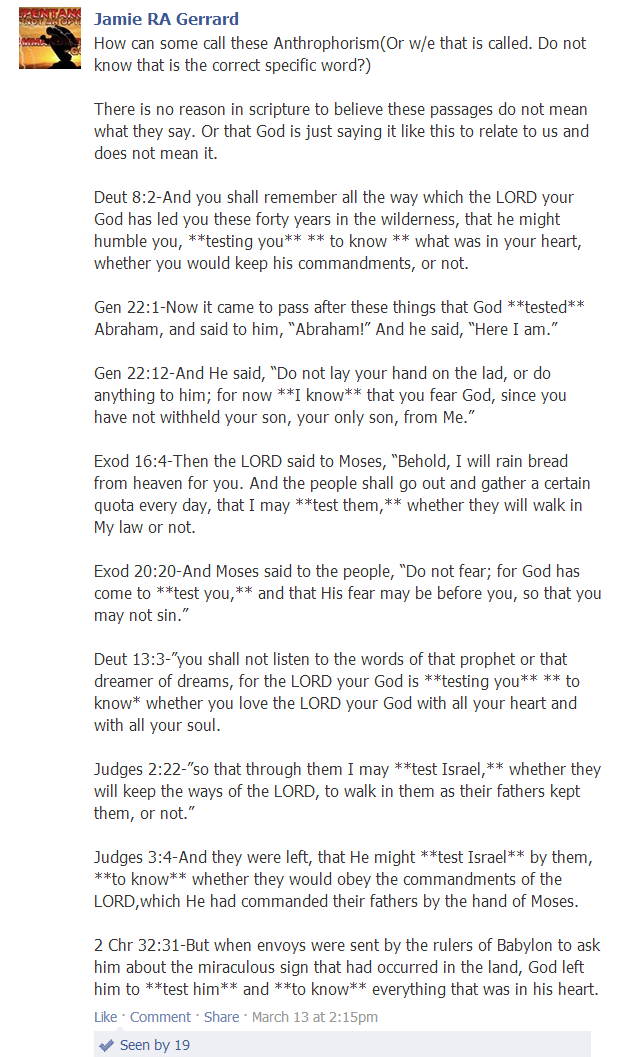
Jamie RA Gerrard of The Pilgrim’s Diary on the Facebook group What is Open Theism:
How can some call these Anthrophorism(Or w/e that is called. Do not know that is the correct specific word?)
There is no reason in scripture to believe these passages do not mean what they say. Or that God is just saying it like this to relate to us and does not mean it.
Deut 8:2-And you shall remember all the way which the LORD your God has led you these forty years in the wilderness, that he might humble you, **testing you** ** to know ** what was in your heart, whether you would keep his commandments, or not.
Gen 22:1-Now it came to pass after these things that God **tested** Abraham, and said to him, “Abraham!” And he said, “Here I am.”
Gen 22:12-And He said, “Do not lay your hand on the lad, or do anything to him; for now **I know** that you fear God, since you have not withheld your son, your only son, from Me.”
Exod 16:4-Then the LORD said to Moses, “Behold, I will rain bread from heaven for you. And the people shall go out and gather a certain quota every day, that I may **test them,** whether they will walk in My law or not.
Exod 20:20-And Moses said to the people, “Do not fear; for God has come to **test you,** and that His fear may be before you, so that you may not sin.”
Deut 13:3-”you shall not listen to the words of that prophet or that dreamer of dreams, for the LORD your God is **testing you** ** to know* whether you love the LORD your God with all your heart and with all your soul.
Judges 2:22-”so that through them I may **test Israel,** whether they will keep the ways of the LORD, to walk in them as their fathers kept them, or not.”
Judges 3:4-And they were left, that He might **test Israel** by them, **to know** whether they would obey the commandments of the LORD,which He had commanded their fathers by the hand of Moses.
2 Chr 32:31-But when envoys were sent by the rulers of Babylon to ask him about the miraculous sign that had occurred in the land, God left him to **test him** and **to know** everything that was in his heart.
From John Eldredge’s Wild At Heart:
As with every relationship, there’s a certain amount of unpredictability, and the ever-present likelihood that you’ll get hurt. The ultimate risk anyone ever takes is to love, for as C. S. Lewis says, “Love anything and your heart will be wrung and possibly broken. If you want to make sure of keeping it intact you must give it to no one, not even an animal.” But God does give it, again and again and again, until he is literally bleeding from it all. God’s willingness to risk is just astounding—far beyond what any of us would do were we in his position.
So far, so good. He later disclaims Open Theism:
Trying to reconcile God’s sovereignty and man’s free will has stumped the church for ages. We must humbly acknowledge that there’s a great deal of mystery involved, but for those aware of the discussion, I am not advocating open theism. Nevertheless, there is definitely something wild in the heart of God.
Mar 9:21 So He [Jesus] asked his father, “How long has this been happening to him?” And he said, “From childhood.
If you would like to guest post commentary on this verse, please send to christopher.c.fisher@gmail.com .
From Howard Elseth’s Did God Know:
The term sums up the common qualities of a certain class of actions. If we use the word goodness as a synonym for God, we must remember that God is good because He chooses to be good. If we say that God is simply a “blob” of good in the sky who can do nothing but good, because He is good, you then destroy the factor of choice. If you eliminate choice you eliminate virtue. This would make God no different than a machine operating out of necessity in proportion to the quality of its construction and the ability of its operator. Similarly in regard to evil. It is not a concrete thing, but an abstract term. It represents the common qualities of a certain class of actions. Evil exists because beings choose to sin. So the problem we must face is this: Is God responsible for the evil acts of these beings? If not, who is?
Arminian Kerrigan Skelly of PinPoint Evangelism speaks about Predestination:
Joh 17:5 And now, O Father, glorify Me together with Yourself, with the glory which I had with You before the world was.
From Gregory Boyd’s God of the Possible:
…it is better to allow Scripture to inform us regarding the nature of divine wisdom than to reinterpret an entire motif in order to square it with our preconceptions of divine wisdom. If God says he regretted a decision, and if Scripture elsewhere tells us that God is perfectly wise, then we should simply conclude that one can be perfectly wise and still regret a decision. Even if this is a mystery to us, it is better to allow the mystery to stand than to assume that we know what God’s wisdom is like and conclude on this basis that God can’t mean what he clearly says.
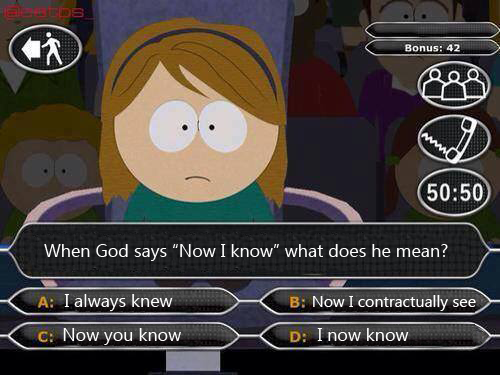
In Genesis 18, we find the story of when Abraham almost sacrificed his son by God’s command. God had commanded Abraham to kill his son. Abraham, although distraught, proved determined to obey God. God then stops the sacrifice at the last moment:
Gen 22:10 And Abraham stretched out his hand and took the knife to slay his son.
Gen 22:11 But the Angel of the LORD called to him from heaven and said, “Abraham, Abraham!” So he said, “Here I am.”
Gen 22:12 And He said, “Do not lay your hand on the lad, or do anything to him; for now I know that you fear God, since you have not withheld your son, your only son, from Me.”
This presents a problem to the Classical view of God. God is portrayed here as learning new information. God says “now I know” (as opposed to know before and not requiring the attempted sacrifice). Several attempts have been made for the Classical view to explain this. One such attempt is made by James Patrick Holding of Tekton. Holding claims that “now I know” is a figure of speech, binding a contract:
In the case of Genesis, we would again offer the conclusion that the “now I know” is a contractual seal saying what God has observed in response (in time) to a human act.
Holding quotes several verses in which he attempts to build the context that “now I know” is a “recognition” event. Several of the times this phrase appears in the Bible, the context is either ambiguous or detailing gaining information. Several of the instances are commands/imperatives and several are individuals speaking. Holding, himself, does not distinguish between the two.
Statements
Exo 18:10 And Jethro said, “Blessed be the LORD, who has delivered you out of the hand of the Egyptians and out of the hand of Pharaoh, and who has delivered the people from under the hand of the Egyptians.
Exo 18:11 Now I know that the LORD is greater than all the gods; for in the very thing in which they behaved proudly, He was above them.”Jdg 17:12 So Micah consecrated the Levite, and the young man became his priest, and lived in the house of Micah.
Jdg 17:13 Then Micah said, “Now I know that the LORD will be good to me, since I have a Levite as priest!”Psa 20:6 Now I know that the LORD saves His anointed; He will answer him from His holy heaven With the saving strength of His right hand. [This seems to be a Psalm written by David in response to some event in which God gave help]
Imperatives (“yada” is sometimes translated “consider”):
Jdg 18:14 Then the five men who had gone to spy out the country of Laish answered and said to their brethren, “Do you know that there are in these houses an ephod, household idols, a carved image, and a molded image? Now therefore, consider what you should do.”
1Sa 25:17 Now therefore, know and consider what you will do, for harm is determined against our master and against all his household. For he is such a scoundrel that one cannot speak to him.”
2Sa 24:13 So Gad came to David and told him; and he said to him, “Shall seven years of famine come to you in your land? Or shall you flee three months before your enemies, while they pursue you? Or shall there be three days’ plague in your land? Now consider and see what answer I should take back to Him who sent me.”
Jer 42:21 And I have this day declared it to you, but you have not obeyed the voice of the LORD your God, or anything which He has sent you by me.
Jer 42:22 Now therefore, know certainly [yada yada] that you shall die by the sword, by famine, and by pestilence in the place where you desire to go to dwell.”
In all cases, the individual in question is bringing something into their mind that may not have existed before. The imperatives are commands for people to think, always in response to provided information that could sway a decision. The one commanding is either unsure that the people were including this information in their decisions or bringing up new knowledge the individual did not have. People are responding to knowledge.
When the individual speaks about themselves, it never seems to be this “recognition” event. When the individual is speaking, they are learning new information. This makes sense; other people cannot be trusted to think for themselves so it must sometimes be pointed out to them to include information in their decisions. When people talk about themselves, it is a different dynamic. People know their own thoughts, and only say “Now I know” when they learn something new. They might have suspected in the past, but the new knowledge is confirming their thoughts.
The statement that “Now I Know” represents some sort of “contractual seal” is not a concept found in the Bible, although it is a better attempt to explain the text than calling it an anthropomorphism. In both the context of a self-referential statement and of an imperative statement it is a response to information. This is not what the Classical view wishes to portray God as doing. God is not being reminded of things He might not have known in order to think more clearly. And the Classical view does not want God learning new information. An “contractual agreement” idiom is just not supported by the context or other context of similar word use.
James Patrick Holding next includes texts which do not include the iconic phrase. Both Genesis 12:11 and 2 Kings 5:15 contain the English phrase “Now I know”, but the “now” is actually an interjection like “Hey”.
“Hey, I know you are beautiful.” Gen. 12:11
“Hey, I know there is no other God.” 2Ki 5:15
Holding mentions the Hebrew words are different, but fails to explain the meaning of the new word. In Genesis 12:13, two verse after the one used by Holding, the same word is translated “I pray thee” or “please”. This is not the same statement.
From H Roy Elseth’s Did God Know:
It is also quite common in Christian circles to hear the statements: “If we could prove God, He would not be God,” “If we could fully understand God, then we would be equal to Him,” or “If we could fully understand Him, He could not be God.” This is incredible subjective reasoning. It is just as logical as saying, if you could fully understand the workings of a television set or prove how it functions, then you would become a television set. Most of us would agree that God fully understands the principles of television. Does that mean then that we can absurdly reason that God is a television set?
Isa 41:13 For I, the LORD your God, will hold your right hand, Saying to you, ‘Fear not, I will help you.’
Enyart points out that most of the chosen went to hell:
Mar 7:15 There is nothing that enters a man from outside which can defile him; but the things which come out of him, those are the things that defile a man.
From H Roy Elseth’s Did God Know:
…that the absolute prevention of evil would have made our world not better than it is, but infinitely worse. There are three conceivable ways in which evil could have been prevented: 1) God might have refrained from creating beings capable of sinning; or 2), having created such beings, He might have kept them from temptation; or 3), allowing them to be tempted, He might have forcibly prevented them from yielding. First, suppose that He had created only beings incapable of sinning. That would have been to create nothing higher than a brute.
Isa 41:17 “The poor and needy seek water, but there is none, Their tongues fail for thirst. I, the LORD, will hear them; I, the God of Israel, will not forsake them.
From Dan Martin of Nailing it to the Door:
“Four Views” is a worthwhile study for what it really means for God to providentially rule creation, and the implications of that for the problem of evil and sin. It will come as no surprise to anyone who’s been reading this blog to know that I find the open view most compelling. But that’s not why I am recommending this book. The most important contents of this volume, to me, come in the introduction and conclusion by editor Dennis Jowers.
But the take-home message of the whole book, for me anyhow, comes in the concluding essay where Jowers summarizes areas of agreement and disagreement between the contributing authors. It is an essay that exudes respect for the positions, and the Christian commitment, of all four authors. While recognizing the significant areas of disagreement between them, Jowers observes “… the commitment to Scripture’s authority and inerrancy that this volume’s authors share is rare in the upper echelons of contemporary academic theology and, to this extent, worthy of notice and celebration.” The overall tenor of Jowers’ analysis of all four positions … pointing out strengths and weaknesses in each … demonstrates a generous attitude I don’t often encounter in theological debates. We could do with more like Dennis Jowers in the world.
For full post, click here.
The Library of Theology hosts an entire free chapter from the Classic Open Theism book, Did God Know by Howard Elseth.
For pdf, click here.
1Jn 5:4 For whatever is born of God overcomes the world. And this is the victory that has overcome the world—our faith.
From the Q&A with Gregory Boyd on Rachel Held Evens:
I find that people often assume that “sovereignty” means “control.” So if you deny that God controls everything, they assume you’re denying God is “sovereign.” My question is: why attribute this kind of “sovereignty” to God? While this is the kind of sovereignty power-hungry people have always grasped after, it’s not the kind of “sovereignty” we admire. In fact, most understand that leaders who lead by trying to control everyone instead of trusting their character and wisdom to win people over are leaders who lack character and wisdom – which is precisely why they try to control others. For my two cents, I think it is insulting to attribute this kind of “sovereignty” to God.
From Facebook group God is Open:
I’ve found that many Christians think that they are in a group of those that think exactly like they do. Yet there are so many doctrines, from minor to major, within Christendom that it’s a virtual guarantee that no two people have the exact understanding of God and Scripture as any other two. When you start to examine beliefs, it’s soon evident that people you thought held similar beliefs actually hold very different beliefs than you imagined.
This really struck me one time when I was having lunch with a church member and he revealed that he didn’t exactly believe that Jesus had always been God (at least I think that’s what it was…it’s been many years). He was way off from what the church believed, and I realized that what he had told me confidentially (many people seem to feel free to confide their secrets to me) would get him ostracized from the church. Perhaps for good reason too. I’m not arguing that. But I did have the opportunity to help him understand that issue better through careful questions pointing to God’s nature in Scripture.
But even within “orthodoxy” if there really is such a thing in the common sense, there are wide varieties of opinion. If we understand those differences and accept that we are all seeking the truth, rather than getting upset at others with slightly different doctrines, it may help us present the truth in a manner which draws us together than divides us.
The pastor who married my wife and I came from a Quaker background. He mentioned a method they used when they were corporately listening for the word of the Lord. They’d all gather in the meetinghouse and pray about whatever it was on their minds. Then they’d come together and honestly present what they believed God had said. If it wasn’t unanimous, they’d return to prayer, then come together again later to check again. They continued on until all were in agreement.
Now I’m not saying that works. It was rather the attitude displayed. They had a willingness to listen to the Lord with an open and humble attitude together, listening for what God had to say, without dividing over every point.
If believers would approach God’s word in a more peaceful, humble, and LOVING manner, with an open heart toward God, we’d learn so much more and come that much closer to God’s will for His people.

Best selling author, Greg Perry of RightNerve talks about Hermeneutics:
One hermeneutic is to take the Bible literally. This is Dr. Cone’s approach. This is also my desired approach. Certainly some things in Scripture are metaphors and analogies and parables that use one thing to illustrate something else. That “something else” is often a spiritual truth. In spite of metaphors and analogies and parables existing in the Bible, the literal hermeneutic says, “Let’s first and foremost just assume that the Bible means what it says. And if we read certain passages and find that God’s giving us an analogy of some kind, that will be fine. But we first assume it’s literal and it grammatically means what it grammatically says.”
…
For example, Dr. Cone has shown that Noah used a literal hermeneutic to understand God’s Word:
God told Noah: “Build a boat.”
So Noah built a boat.If Noah wanted to spiritualize God’s Word, he would start analyzing all the things God possibly could have meant when He told Noah to build a boat. If Noah had a time machine and looked forward to learn all about Greek philosophy, Noah could have guessed that the “boat” was actually an anthropomorphism for Noah swimming in the sea of sin all around him.
For full post, click here.
Amazing Grace by John Newton
Lyrics:
Amazing Grace, how sweet the sound,
That saved a wretch like me.
I once was lost but now am found,
Was blind, but now I see.
T’was Grace that taught my heart to fear.
And Grace, my fears relieved.
How precious did that Grace appear
The hour I first believed.
Through many dangers, toils and snares
I have already come;
‘Tis Grace that brought me safe thus far
and Grace will lead me home.
When we’ve been there ten thousand years
Bright shining as the sun.
We’ve no less days to sing God’s praise
Than when we’ve first begun.
Exo 33:17 So the LORD said to Moses, “I will also do this thing that you have spoken; for you have found grace in My sight, and I know you by name.”
Walter Brueggemann notes in his work on Genesis states on Genesis 22:12:
It is not a game with God. God genuinely does not know. And that is settled in verse 12, “Now I know.” There is real development in the plot. The flow of the narrative accomplishes something in the awareness of God. He did not know. Now he knows. The narrative will not be understood if it is taken as a flat event of “testing.” It can only be understood if it is seen to be a genuine movement in the history between Yahweh and Abraham.
Isa 57:15 For thus says the High and Lofty One Who inhabits eternity, whose name is Holy: “I dwell in the high and holy place, With him who has a contrite and humble spirit, To revive the spirit of the humble, And to revive the heart of the contrite ones.
From Dan Martin of Nailing it to the Door:
Open Theism starts–never forget this–not from logical assumptions, but from observing that the God represented in our scriptures is a dynamic, interactive God who changes his mind, his plans, and his behavior in interaction with his creatures. This is not wishful thinking and it’s not secular philosophy, it’s how the stories actually read. Open Theists simply insist that no rationalization or mental gymnastics need be applied to the Biblical accounts of God dealing with his own people.
For full post, click here.
Isa 6:3 And one cried unto another, and said, Holy, holy, holy, is the LORD of hosts: the whole earth is full of his glory.
From the ReKnew YouTube channel:
From the Cruciform View on Romans 9:13
First off, Paul is quoting Malachi 1:2-3 in verse 13. It was common practice in the ancient world to refer to a whole corporate, nation with the name of a patriarchal individual. Indeed, this where the name “Israel” comes from. The corporate nation of people was named after the individual patriarch Jacob, after his name was changed to Israel (Gen. 32:22-28). Likewise with the twelve corporate tribes of Israel, with each group being named after it’s individual patriarch (Judah, Benjamin, Napthali, etc.). Paul is not referring to individuals in this passage, but rather to the corporate nations that were their descendants. (I explained the idea of corporate election a little bit more in my treatment of Romans 8:28-30 in Part 4 of this blog series)
For full post, click here.
Imagine this conversation:
Wife: I was planning our son’s birthday party on Saturday. Is that a good day?
Husband: That works for me. I will be there.
Wife: You will be there? You are omniscient!
Husband: What are you talking about?
Wife: You said you would be there. That day is a week from now, and for you to know that you will be there means you must know all events: past, present and future.
Husband: No. I really don’t know all the future. But I am definitely going to be there.
Wife: How do you know you are going to be there if you are not omniscient?
Husband: Because I have a car, and I will just drive there. I have nothing else going on that day.
Wife: But what if you get hit by a bus? You cannot say you will be there.
Husband: Well, I guess I cannot say that I am “definitely” going to be there, in the sense that nothing ever can change the outcome. But those things are highly improbable, so yeah, I will “definitely” be there in the sense that barring any unlikely circumstance I will be there.
Wife: I do not believe you.
Husband: What are you talking about?
Wife: You don’t know the future, so how can I trust a word you say?
Husband: What are you talking about?
Wife: If you do not know the future that means anything can happen. When you say you will be there, you could just change your mind.
Husband: But haven’t I always done what I said I was going to do? You know me. I always go to our children’s birthday parties.
Wife: Well, if you do not know the future then you might go crazy and change. Because you do not know the future, because the future is not set, I cannot trust a word you say.
Husband: *confused look* … alrighty… I am going to go play with the kids now.
Most people would correctly identify the wife as being very low in stability. If her husband has proven to be reliable in the past concerning events, she is amiss not to trust his predictions of the future. After all, his character is known and he has the power to make his predictions a reality.
This scene, although a work of fiction, describes several debates between Open Theists and Calvinists. Calvinists instantly act like the wife in the above storyline. If “God does not know the future we cannot trust Him”. Here is Samuel Lamerson in a debate on theologyonline:
I am not sure that I would trust my money to an earthly gambler, and sure that I would not trust my salvation to a God who creates with no idea of what the agents of his creation will do.
This is echoed by Gene Cook in a 2007 debate:
[Paraphrasing Lamerson] “How can we trust Him if the future is open?” I agree: how can we trust him. And the response of Bob Enyart is, well, we can trust Him because God is loving, and God is good, and God is righteous. Bob, how do we know God is good, God is loving, and God is righteous? How do we know He is going to be good, righteous and loving tomorrow?… If you say that God is changing, how do we know He is not going to change his decision to accept me as one of His sons?
The Calvinist, to function in society, has a very low burden of trust for fellow human beings. What Calvinist will say they “do not trust” their wife because she has the ability to change?
But when God is brought into the equation, Calvinists discard all signs of rational thinking. This follows a long line of Calvinists trying to ignore how rational people converse, act, and think, opting instead for arbitrary and unreasonable standards. If God does not know something with 100% certainty, God is said not to know it. If God says He will accomplish something, it is assumed that God can only know it if God knew the future. If God is said to be sovereign that means God controls all things. If God is said not to know the future, we then cannot believe anything He says. This is unnatural to how people naturally function.
The really funny thing is that when God has to defend Himself against His critics, God gives reasons. Open Theists do not really have to work to defend these points against Calvinists. God defends Himself against those who think that God cannot know the future. In Isaiah 40-48, the message is echoed: “God knows the future because God is powerful and can bring about His purposes”:
Isa 48:3 “I have declared the former things from the beginning; They went forth from My mouth, and I caused them to hear it. Suddenly I did them, and they came to pass.
When God explains to people how He knows the future, it is not Calvinism. God explains that He knows things because He can do them. God does not rely on the irrational statement that people should trust God because God does not change. That statement is only found in Calvinist apologetics.
Lev 11:45 For I am the LORD who brings you up out of the land of Egypt, to be your God. You shall therefore be holy, for I am holy.
From Thomas J Oord’s new book The Nature of Love:
“We love because [God] first loved us,” says John (1 Jn. 4:19). God first loving us should not refer primarily to what God has done in the distant past. The idea God first loves should refer primarily to God acting first in any particular moment to make possible our love in response. This idea is what theologians often call “prevenient grace.” It says God’s loving action comes before and makes possible out free response. God is a personal and causal being to whose call loving creatures can respond appropriately. Creatures could not love if our relational God were not the Lover who initially empowers, inspires, and beckons them.
From the first chapter of Did God Know by Howard Elseth:
Wanting to give the girl something, Duncan remembered the package of gum he had. He called to her, but the shy little girl misunderstood and was frightened. She jumped away from her stone toys – and Duncan’s call to her became the call of death.
Nearby the water pond, unknown to the children, lived a viper. The snake hid himself during the day between rocks and fed on the small animals that frequently came to the water. Today, however, the heat had driven him to the shade of one of the many bushes near the pool. He had been silently sensing the presence of the children for a long time, but now the sudden movement of the little girl excited him.
He lunged out at her and dug his venemous fangs into her soft leg with incredible deftness. Terror overcame Duncan…
Duncan had not prayed in a long time. But he prayed now-out of desperation. He pleaded with God not to let the beautiful child die. It seemed to him that there was no reason or sense to what had happened. His prayers were to no avail, however. The innocent girl shivered in the afternoon heat. Numbness worked its way up her leg and poison quickly moved throughout the small body. Sweat came out of her unwrinkled skin as convulsions emptied the girl’s stomach of vomit. As the afternoon sun faded, the black-haired girl died.
Duncan’s thoughts drifted toward God. What had the girl done that God inflicted this upon her? Was her crime playing with stones in a quiet African town? Who is God that He would allow such a thing? If God knew beforehand that the viper would strike out at the child, why didn’t He prevent it? How could a God of love remain idle during such an event? Worse yet, did God plan or determine that this event would happen, as the theologian John Calvin suggests? How ludicrous it seemed to Duncan that a God so great that He created millions of planets in millions of light years of space would spend His time plotting and planning to kill one child in an obscure African village. How could this possibly be the “will of God”? It made no sense. A God of that kind could not conceivably be worthy of man’s love.
Psa 2:11 Serve the LORD with fear, And rejoice with trembling.
Mark Driscoll claims Open Theism makes God powerless, rather than the truth: Open Theism makes God more powerful than Classical theism.
From atheist Bertrand Russell in an essay entitled Has Religion Made
Useful Contributions to Civilization?:
The world, we are told, was created by a God who is both good and omnipotent. Before He created the world He foresaw all the pain and misery that it would contain; He is therefore responsible for all of it. It is useless to argue that the pain in the world is due to sin. In the first place, this is not true; it is not sin that causes rivers to overflow their banks or volcanoes to erupt. But even if it were true, it would make no difference. If I were going to beget a child knowing that the child was going to be a homicidal maniac, I should be responsible for his crimes. If God knew in advance the sins of which man would be guilty, He was clearly responsible for all the consequences of those sins when He decided to create man. The usual Christian argument is that the suffering in the world is a purification for sin and is therefore a good thing. This argument is, of course, only a rationalization of sadism; but in any case it is a very poor argument. I would invite any Christian to accompany me to the children’s ward of a hospital, to watch the suffering that is there being endured, and then to persist in the assertion that those children are so morally abandoned as to deserve what they are suffering. In order to bring himself to say this, a man must destroy in himself all feelings of mercy and compassion. He must, in short, make himself as cruel as the God in whom he believes. No man who believes that all is for the best in this suffering world can keep his ethical values unimpaired, since he is always having to find excuses for pain and misery.
Isa 46:5 “To whom will you liken Me, and make Me equal And compare Me, that we should be alike?
Isa 46:6 They lavish gold out of the bag, And weigh silver on the scales; They hire a goldsmith, and he makes it a god; They prostrate themselves, yes, they worship.
Isa 46:7 They bear it on the shoulder, they carry it And set it in its place, and it stands; From its place it shall not move. Though one cries out to it, yet it cannot answer Nor save him out of his trouble.
From Thomas J Oord’s new book The Nature of Love:
Even before Jesus Christ revealed God’s nature most clearly, biblical authors considered love a, if not the, primary attribute of God. The phrase “steadfast love” is the most common Old Testament description of God’s nature. Divine love is relentless. God’s love is everlastingly loyal. The psalmist speaks often of God’s steadfast love for creation, making statements such as “the earth is full of the steadfast love of the LORD” (Ps. 33:5). In Jeremiah 31:3, God declares, “I have loved you with an everlasting love.” Even King Huram of Tyre testifies that God loves the chosen people (2 Chr. 2:11). Deuteronomy affirms that God loves “the strangers” or alien peoples (Duet. 10:18). Old Testament writers witness powerfully to the love of God.
From an article entitled Total Control – God’s Sovereignty Misdefined:
What Calvinists Say
“…not only had God a perfect foreknowledge of the outcome of Adam’s trial, not only did His omniscient eye see Adam eating of the forbidden fruit, but He decreed beforehand that he should do so. This is evident not only from the general fact that nothing happens save that which the Creator and governor of the universe has eternally purposed, but also from the express declaration of Scripture that Christ as a Lamb ‘verily was foreordained before the foundation of the world’ (1 Pet 1:20).” (A.W. Pink The Sovereignty of God p.249.italics in original) (Reason 2 is used)
“To put it now in its strongest form, we insist that God does as He Pleases, only as He pleases, always as He pleases; that whatever takes place in time is but the outworking of that which He decreed in eternity.” (Pink The Sovereignty of God p.194).
“God is seen as the great and mighty King who has appointed the course of nature and who directs the course of history even down to its minutest details.” Boettner Ref. Doctrine of Predest. p.13.
All things whatever arise from and depend on, the divine appointment;” John Calvin Commentary on Romans
Abraham Kuyper, “The determination of the existence of all things to be created, … is the most tremendous predestination conceivable in heaven or on earth;… our entire existence, being entirely dependent on it.
B. B. Warfield wrote, “…nothing, however small, however strange, occurs without His ordering, or without its peculiar fitness for its place in the working out of His purposes…
“And since [God] knew perfectly every event of every kind which would be involved in this particular world-order, He very obviously predetermined every event which would happen when He chose this plan. His choice of the plan, or His making certain that the creation should be on this order, we call His foreordina-tion or His predestination. Even the sinful acts of men are included in this plan.
Curt Daniel writes “Thus, it is absolutely essential to see that God foreordained everything that will come to pass. He predestined everything that will ever happen, down to the smallest detail.” (Biblical Calvinism p.2)
“It would destroy the confidence of God’s people could they be persuaded that God does not foreordain whatever comes to pass. It is because the Lord reigns, and doeth His pleasure in heaven and on earth, that they repose in perfect security under His guidance and protection.” (Dr. Charles Hodge Systematic Theology I p.545). God did not directly decree Jer 19:5; 32:35; Lk 19:41-44; Mt 23:37-39, etc.
On Scribd, Machen’s NT Greek for Beginners is being hosted:
For link, click here.
Luk 13:2 And Jesus answered and said to them, “Do you suppose that these Galileans were worse sinners than all other Galileans, because they suffered such things?
Luk 13:3 I tell you, no; but unless you repent you will all likewise perish.
Luk 13:4 Or those eighteen on whom the tower in Siloam fell and killed them, do you think that they were worse sinners than all other men who dwelt in Jerusalem?
Luk 13:5 I tell you, no; but unless you repent you will all likewise perish.”
From H Roy Elseth’s Did God Know:
The beginning chapter of Genesis, the first book of the Bible, gives some startling insight into man’s creation. Genesis 1:27, 28 and 31 declare:
So God created man in his own image, in the image of God created he him; male and female created he them. And God blessed them, and God said unto them, Be fruitful, and multiply, and replenish the earth, and subdue it: and have dominion over the fish of the sea, and over the fowl of the air, and over every living thing that moveth upon the earth.
And God saw every thing that he had made, and behold, it was very good, And the evening and the morning were the sixth day.
Several ideas stand out here. First, we were originally created in the image of God. If we are creative and inventive personalities, it would follow then that God probably has those same characteristics. Secondly, God appears to want man to dominate the earth, not in a destructive way, but in a productive and protective way. He appears to leave the method how this task is to be carried out to man’s ingenuity. In other words, He seems to give man a certain freedom.
God makes a value judgment in the last verse of the chapter. He declares about His creation, “It was very good.” God does not just say it was fair creation, or a good creation, but the “good” is stressed. It was “very good.” Now it seems odd that God would make such an observation if He knew several years later that His production would become askew, a failure, and that man would become extremely evil. If God knew the corruption that would follow before He created man, then we can only believe that His conception of good is far less than ours.
“He Reigns” by the Newsboys
Lyrics:
It’s the song of the redeemed
Rising from the African plain
It’s the song of the forgiven
Drowning out the Amazon rain
The song of Asian believers
Filled with God’s holy fire
It’s every tribe, every tongue, every nation
A love song born of a grateful choir
It’s all God’s children singing
Glory, glory, hallelujah
He reigns, He reigns
It’s all God’s children singing
Glory, glory, hallelujah
He reigns, He reigns
Let it rise about the four winds
Caught up in the heavenly sound
Let praises echo from the towers of cathedrals
To the faithful gathered UNDER GROUND
Of all the songs sung from the dawn of creation
Some were meant to persist
Of all the bells rung from a thousand steeples
None rings truer than this
It’s all God’s children singing
Glory, glory, hallelujah
He reigns, He reigns
It’s all God’s children singing
Glory, glory, hallelujah
He reigns, He reigns
It’s all God’s children singing
Glory, glory, hallelujah
He reigns, He reigns
It’s all God’s children singing
Glory, glory, hallelujah
He reigns, He reigns
And all the powers of darkness
Tremble at what they’ve just heard
‘Cause all the powers of darkness
Can’t drown out a single word
When all God’s children sing out
Glory, glory, hallelujah
He reigns, He reigns
All God’s people singing
Glory, glory, hallelujah
He reigns, He reigns
Rev 15:4 Who shall not fear You, O Lord, and glorify Your name? For You alone are holy. For all nations shall come and worship before You, For Your judgments have been manifested.”
Pastor Anderson of Faithful Word Baptist Church addresses the five points of Calvinism:
Isa 43:25 “I, even I, am He who blots out your transgressions for My own sake; And I will not remember your sins.
From Facebook group Open Theism:
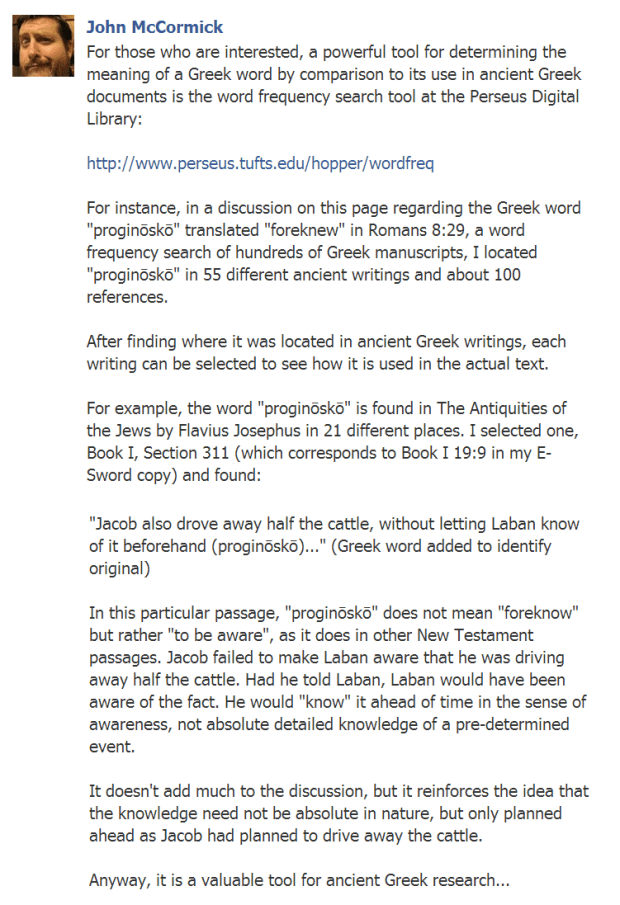
For those who are interested, a powerful tool for determining the meaning of a Greek word by comparison to its use in ancient Greek documents is the word frequency search tool at the Perseus Digital Library:
http://www.perseus.tufts.edu/hopper/wordfreq
For instance, in a discussion on this page regarding the Greek word “proginōskō” translated “foreknew” in Romans 8:29, a word frequency search of hundreds of Greek manuscripts, I located “proginōskō” in 55 different ancient writings and about 100 references.
After finding where it was located in ancient Greek writings, each writing can be selected to see how it is used in the actual text.
For example, the word “proginōskō” is found in The Antiquities of the Jews by Flavius Josephus in 21 different places. I selected one, Book I, Section 311 (which corresponds to Book I 19:9 in my E-Sword copy) and found:
“Jacob also drove away half the cattle, without letting Laban know of it beforehand (proginōskō)…” (Greek word added to identify original)
In this particular passage, “proginōskō” does not mean “foreknow” but rather “to be aware”, as it does in other New Testament passages. Jacob failed to make Laban aware that he was driving away half the cattle. Had he told Laban, Laban would have been aware of the fact. He would “know” it ahead of time in the sense of awareness, not absolute detailed knowledge of a pre-determined event.
It doesn’t add much to the discussion, but it reinforces the idea that the knowledge need not be absolute in nature, but only planned ahead as Jacob had planned to drive away the cattle.
Anyway, it is a valuable tool for ancient Greek research…
From Beau Ballentine on the official God is Open Facebook group:
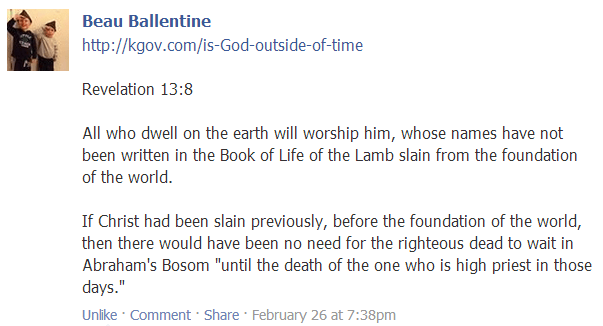
Revelation 13:8
All who dwell on the earth will worship him, whose names have not been written in the Book of Life of the Lamb slain from the foundation of the world.
If Christ had been slain previously, before the foundation of the world, then there would have been no need for the righteous dead to wait in Abraham’s Bosom “until the death of the one who is high priest in those days.”
Roger Olson, a classical Arminian, defends Open Theism from those who would call it Process Theology:
So what are the differences? All open theists affirm creatio ex nihilo while process theology denies it. All open theists affirm God’s omnipotence while process theology denies it. All open theists affirm the supernatural and miracles while most, if not all, process theologians deny them. Open theists all say that God limits himself; process theology represents God as essentially limited and finite. The only point on which they agree is about God’s knowledge of the future, but even there one finds profound differences. For example, according to open theists the openness of the future even for God is due to God’s self-limitation in creation. According to all open theists, God could know the future exhaustively and infallibly IF he chose to create a world with a closed future (as in divine determinism).
For full post, click here.
1Jn 1:5 This is the message which we have heard from Him and declare to you, that God is light and in Him is no darkness at all.
Roger Olson provides a definition of Process Theology:
In spite of recent misuses of the term (and concept), historically process theology has ALWAYS meant belief that God and the world are necessarily ontologically interdependent (panentheism) and that this interdependence is NOT due to any voluntary self-limitation on God’s part. God is essentially limited, not omnipotent and CANNOT act unilaterally coercively to cause events in a supernatural way. (I could add that most process theologians are not classical trinitarians and do not believe in the classical hypostatic union or many other elements of traditional Christian orthodoxy.)
…But [Open Theism] is not process theology… as I have argued over and over to anyone who will listen, they are not the same.
For full post, click here.
From Facebook group Open Theism. Adapted from a series of posts by John McCormick in response to the following Calvinist post:
I’m a determinist, I believe that libertarian free will is unBiblical.
I love God and love the Bible, I just want to be more Biblical in my life
and my theology.Here are a few verses supporting determinism: (there many more)
Psalm 33:10-11
The LORD fails the plans of the nations; he thwarts the purposes of the
peoples. But the plans of the LORD stand firm forever, the purposes of his heart through all generations. (immutability)Lamentations 3:37-38
“Who can speak and have it happen if the Lord has not decreed it?” (this verse is a tough one to make it say it’s opposite)Proverbs 19:21
“Many are the plans in a man’s heart, but it is the Lord’s purpose that prevails.”(God is in control not us)Deuteronomy 32:39
See now that I, I am He, and there is no god besides Me; it is I who puts to death and gives life. I have wounded, and it is I who heals; and there is no one who can deliver from My hand. (God claims credit for life,death, wounding)Daniel 4:35
He does as He pleases with the powers of heaven and the peoples of the earth. No one can hold back his hand or say to him: ‘What have you done? (Do we really think we can change God)1 Pe 4:19
Therefore let those who suffer according to God’s will entrust their souls to a faithful Creator while doing good (God makes people suffer, for his good purpose)Act 4:28
to do whatever your hand and your plan had predestined to take place. (Our ways and decisions are set according to His will)Eph 1:9
making known to us the mystery of his will, according to his purpose, which he set forth in Christ (According to his purpose or ours)Eph 2:8
For by grace you have been saved through faith. And this is not your own doing; it is the gift of (Not our doing but his, not our choice but his)Isa 14:27
For the Lord of hosts has purposed,
and who will annul it?
His hand is stretched out,
and who will turn it back
(How silly for us to think God changes depending on our decisions)Isa 46:10
declaring the end from the beginning
and from ancient times things not yet done,
saying, ‘My counsel shall stand,
and I will accomplish all my purpose,’
(The end from the beginning not the beginning from the end)John 15:5
I am the vine; you are the branches. Whoever abides in me and I in him, he it is that bears much fruit, for apart from me you can do nothing
(does nothing really mean nothing, yes. What about in Greek, yes)Pro 16:4
The Lord has made everything for its purpose,
even the wicked for the day of trouble(God makes the wicked for a purpose, sounds like God makes everything)Rom 9:11
though they were not yet born and had done nothing either good or bad—in order that God’s purpose of election might continue, not because of works but because of him who calls— (wow one kid didn’t even get a chance to change Gods mind with his works)Rom 9:18
So then he has mercy on whomever he wills, and he hardens whomever he wills(Yes God hardens hearts)Eph 1:11
In him we have obtained an inheritance, having been predestined according to the purpose of him who works all things according to the counsel of his will.
(According to his purpose, who will ALL things, not some things)(predestined, even in GreeK it means limiting beforehand)Determinism wins?
I’ll address each of the passages you posted regarding Open Theism versus determinism…
======================================
Psalm 33:10-11
The LORD fails the plans of the nations; he thwarts the purposes of the peoples. But the plans of the LORD stand firm forever, the purposes of his heart through all generations. (immutability)
======================================
ANSWER: Immutability does not imply determinism. Nor is this strong immutability. This is described as “weak immutability” or constancy of God’s character.
Nor does this show determinism. It simply shows that God makes plans and has the power to cause those plans to happen despite the purposes of humans, and that He stands firm on those plans and won’t change His mind.
His plans as recorded in Scripture, which He gave to His prophets, were couched in symbolic terminology. God could match many situations to those plans and there still be only a single possible fulfillment. Thus history only had to be manipulated in a simple manner to accomplish His grand design, while the minor details were not important.
I like to say that God controls the macro-events while we get to control micro-events.
======================================
Lamentations 3:37-38
“Who can speak and have it happen if the Lord has not decreed it?” (this verse is a tough one to make it say it’s opposite)
======================================
ANSWER: Contextually, the Lamentations is a poetic genre, and this passage is rhetorical in nature. It asks a question related to the rest of the passage.
Lamentations 3:34-37
(34) To bring down under his feet all the prisoners of the earth,
(35) to turn aside the judgment of a man before the face of the Most High,
(36) to condemn a man unjustly in his judgment which the Lord has not given commandment.
(37) Who has thus spoken, and it has come to pass? the Lord has not commanded it.
The context is that God has made a declaration of judgment, but someone is trying to countermand His judgment. The question asks how anyone can countermand what God has commanded.
What this passage does not say is that God decrees everything that someone speaks which happens.
If we take a verse out of its context, it can lead us far astray from what the passage was originally meant to say.
======================================
Proverbs 19:21
“Many are the plans in a man’s heart, but it is the Lord’s purpose that prevails.”(God is in control not us)
======================================
ANSWER: This doesn’t say that God is in control, not us. It says that when there is a difference of opinion, God has the power to cause His purpose to prevail. It doesn’t suggest that people cannot make plans happen at all. It just means they can’t do anything in opposition to God’s plan.
======================================
Deuteronomy 32:39
See now that I, I am He, and there is no god besides Me; it is I who puts to death and gives life. I have wounded, and it is I who heals; and there is no one who can deliver from My hand. (God claims credit for life,death, wounding)
======================================
ANSWER: All true, but this offers no argument in favor of determinism. It simply says that He has the ultimate power.
The translation you use has a bit of bias. Here’s a better translation, the Young’s Literal Translation, which often provides a more accurate translation of a passage:
Deuteronomy 32:39
(39) See ye, now, that I — I [am] He, And there is no god with Me: I put to death, and I keep alive; I have smitten, and I heal; And there is not from My hand a deliverer…
As can be seen from the literal translation, it doesn’t imply that every life and death are personally caused by God. What it plainly states is that He has the power to wound, kill, or make alive and nobody can prevent Him because nobody is as powerful as He.
======================================
Daniel 4:35
He does as He pleases with the powers of heaven and the peoples of the earth. No one can hold back his hand or say to him: ‘What have you done? (Do we really think we can change God)
======================================
ANSWER: Again, all this demonstrates is that nobody can resist His power. It doesn’t mean that God does not change in the simple sense that He hears what we say.
You should study immutability, particularly the logical flaws of the strong immutability theory. Here’s a great resource to do that:
http://www.iep.utm.edu/div-immu/#H3
When you read the passages put forth against Open Theism, consider whether they ABSOLUTELY refute the element they are said to refute, or if it has a wider possible interpretation. It’s also best to try to examine, if possible, every passage in regards to the original languages of Scripture within the context of those cultures.
For instance, the ancient Hebrew culture did not have the concept of eternity or infinity. Those “absolutes” were not known at that time, and the first evidence of that concept didn’t occur until around the time of Christ. It didn’t even originate with Greek philosophy, though the idea of eternity/infinity was further developed in that culture.
So when we look at “eternity” in the Old Testament, we need to understand that the ancient Hebrews didn’t know of the absolute form of eternity or infinity, so we can’t use that concept in passages which appear to speak of eternity. They only understood the future as the “vanishing point”, or further than they could see.
======================================
1 Pe 4:19
Therefore let those who suffer according to God’s will entrust their souls to a faithful Creator while doing good (God makes people suffer, for his good purpose)
======================================
ANSWER: Ditto earlier arguments. This indicates God’s will dominates over all others, but not that He necessarily makes everything happen.
Think of it this way. My children when young suffered according to my will, because I had more power (and knowledge). When they did not do good, I punished them and they had no power to resist. But my children could do things without my guidance. My power over them didn’t mean that they couldn’t function independently, but only that when our wills clashed, mine would prevail.
======================================
Act 4:28
to do whatever your hand and your plan had predestined to take place. (Our ways and decisions are set according to His will)
======================================
ANSWER: Again, context is important.
Acts 4:24-28
(24) and they having heard, with one accord did lift up the voice unto God, and said, `Lord, thou art God, who didst make the heaven, and the earth, and the sea, and all that are in them,
(25) who, through the mouth of David thy servant, did say, Why did nations rage, and peoples meditate vain things?
(26) the rulers of the land stood up, and the rulers were gathered together against the Lord and against His Christ;
(27) for gathered together of a truth against Thy holy child Jesus, whom Thou didst anoint, were both Herod and Pontius Pilate, with nations and peoples of Israel,
(28) to do whatever Thy hand and Thy counsel did determine before to come to pass.
This passage, taken alone, may seem to suggest that everything is predestined.
However, within context, it’s plain that this passage is restricted to the particular event where the people of Israel, their leaders, as well as Herod and Pontius Pilate, gathered together to put Jesus to death.
======================================
Eph 1:9
making known to us the mystery of his will, according to his purpose, which he set forth in Christ (According to his purpose or ours)
======================================
ANSWER: This indicates that God has a plan. It doesn’t mean that EVERYTHING that happens EVERYWHERE is part of that plan, in a deterministic sense.
God made a plan that entailed certain things: That He would demonstrate His love through the nation of Israel, which was the vessel through which He would walk among us, but that His own people would reject Him, to sacrifice Him on the Cross, that He would rise in victory and show God’s glory to all.
That’s a gross simplification of His plan, but even so, we can see that it doesn’t include infinite detail. It doesn’t specify who all the players would be nor exact dates or times. Around His plan many billions of personal choices were made by humans that had no direct bearing on or direct connection to His plan.
So demonstrating that God has a Plan or that God makes things occur according to His Plan, according to His purpose, is no argument for determinism.
======================================
Eph 2:8
For by grace you have been saved through faith. And this is not your own doing; it is the gift of (Not our doing but his, not our choice but his)
======================================
ANSWER: This passage doesn’t speak of choice at all.
God made salvation available freely. We can’t work for that gift, because it’s not available through works.
BUT, we do make the choice to accept that gift, which it plainly states in this passage: “you have been saved through faith”. It’s not God’s faith that receives that free gift, but our own. Gifts are free to reject. Nobody is forced to take a gift or it’s not a gift. If we don’t have the choice to refuse the gift or accept it as our will decides, then it’s no gift but a penalty.
Faith indicates a free-will choice to accept or refuse the free gift of salvation.
======================================
Isa 14:27
For the Lord of hosts has purposed, and who will annul it?
His hand is stretched out, and who will turn it back (How silly for us to think God changes depending on our decisions)
======================================
ANSWER: Your conclusion makes the unwarranted assumption that God has purposed EVERY single event.
But it doesn’t. It simply states as noted previously that WHEN God purposes a thing, nobody can change it. That’s an indication of the greatness of His power, not an indication of the scope of the use of that power.
After finishing my commentary on the passages you posted, I’ll post some passages which prove that Open Theism is correct.
======================================
Isa 46:10
declaring the end from the beginning and from ancient times things not yet done, saying, ‘My counsel shall stand,
and I will accomplish all my purpose,’ (The end from the beginning not the beginning from the end)
======================================
ANSWER: He DECLARES the end from the beginning. He states what is going to happen–not in EVERY DETAIL, because that is in no way implied–but only according to His plan.
======================================
John 15:5
I am the vine; you are the branches. Whoever abides in me and I in him, he it is that bears much fruit, for apart from me you can do nothing (does nothing really mean nothing, yes. What about in Greek, yes)
======================================
ANSWER: Again, “context is king”.
John 15:1-8
(1) `I am the true vine, and my Father is the husbandman;
(2) every branch in me not bearing fruit, He doth take it away, and every one bearing fruit, He doth cleanse by pruning it, that it may bear more fruit;
(3) already ye are clean, because of the word that I have spoken to you;
(4) remain in me, and I in you, as the branch is not able to bear fruit of itself, if it may not remain in the vine, so neither ye, if ye may not remain in me.
(5) `I am the vine, ye the branches; he who is remaining in me, and I in him, this one doth bear much fruit, because apart from me ye are not able to do anything;
(6) if any one may not remain in me, he was cast forth without as the branch, and was withered, and they gather them, and cast to fire, and they are burned;
(7) if ye may remain in me, and my sayings in you may remain, whatever ye may wish ye shall ask, and it shall be done to you.
(8) `In this was my Father glorified, that ye may bear much fruit, and ye shall become my disciples.
First, even if we were to accept that nothing in this context means that not one single thing they ever did happened apart from Jesus’ control, this passage doesn’t apply to all of mankind. This is part of a private speech between Jesus and His Twelve Disciples. So if a determinist argues that “nothing” applies in the extreme sense, they can hardly then argue logically against the extreme sense that it applied only to the Twelve Apostles.
But nothing in this context doesn’t really mean “nothing at all”. It’s “nothing” restricted to the context of the passage. The disciples could do nothing WHEN IT CAME TO THE MATTER OF BEARING SPIRITUAL FRUIT (vs. 4). Nothing in the context indicates that the “nothing” in verse 5 refers to all things whatsoever. That would go beyond the thesis of the passage.
======================================
Eph 1:11
In him we have obtained an inheritance, having been predestined according to the purpose of him who works all things according to the counsel of his will.
(According to his purpose, who will ALL things, not some things)(predestined, even in GreeK it means limiting beforehand)
======================================
ANSWER: Literally this is translated,
Ephesians 1:11
(11) in whom also we did obtain an inheritance, being foreordained according to the purpose of Him who the all things is working according to the counsel of His will,
It simply means that He manipulates all things which are necessary to obtain the ends He has chosen. It doesn’t mean that God specifically manipulates absolutely every single thing.
Predestined DOES mean “limited beforehand” or “to limit in advance”. In other words, God chose use His power to limit how salvation would work in the future.
The word “predestined” doesn’t mean that people are individually “limited in advance” to become believers. It means that He generally chose that there would be believers, thus any who fit in that category fit within the limit He has set. They fit into that category by making a free-will decision to serve God.
======================================
Pro 16:4
The Lord has made everything for its purpose, even the wicked for the day of trouble(God makes the wicked for a purpose, sounds like God makes everything)
======================================
ANSWER: Look at the passage carefully. God made everything for ITS PURPOSE. Not God’s purpose (at least in this passage).
In Hebrew it says that God made everything for “reply”, which is a way of saying that it answers to its purpose.
This is simply saying that the Universe and everything in it was designed by God–with which Open Theism does not disagree–and that wickedness has a purpose as well. (The term for “wicked” is generic, not specifically referring to people but just moral wickedness.)
This passage is as much in favor of Open Theism as it is for determinism.
======================================
Rom 9:11
though they were not yet born and had done nothing either good or bad—in order that God’s purpose of election might continue, not because of works but because of him who calls— (wow one kid didn’t even get a chance to change Gods mind with his works)
Rom 9:18
So then he has mercy on whomever he wills, and he hardens whomever he wills(Yes God hardens hearts)
======================================
ANSWER: This is a complex passage, but suffice to say that it has been misused in favor of determinism when it doesn’t really say what most people think.
When the entire passage is viewed in context, this has nothing to do with salvation or pre-destination, except in the weak sense that God had a basic plan that happened to be fulfilled in Esau and Jacob.
Here we have to look back to the analogy of parent/small child compared to God/humans.
At some point God chose to use Abraham, then Isaac rather than Ishmael, and then Jacob rather than Esau. But like a father direct his children, the children lived lives of many choices and decisions which weren’t directly related to God’s plan. Yes, God affected the path of their lives, as a parent directs a child into particular paths.
But God’s direction of major events according to His plan affected neither their basic free-will right to choose nor their free-will ability to choose salvation. He did not reject Ishmael or Esau’s salvation, only their pre-eminence within His plan. They still had the opportunity to live righteously or not, and to live eternally with Him.
At the time of their birth the only promise they had was that Esau would serve Jacob, which is not necessarily a bad thing. It’s not a condemnation of Esau in any way. It was simply that one would be pre-eminent between the two.
If you look in Scripture, God’s statement “Jacob have I loved, but Esau I have hated” (from Malachi 1:2-3) came long after the ends of their lives and referred not to Jacob and Esau as individual persons, but to Israel and Edom. Edom was the nation which descended from Esau. God “hated” that nation–or chose not to bless it as a corporate group–while still loving the individual Edomites. That “hatred” was simply a distinction of choice between nations, not “hatred” in the sense opposite to love.
Numerous theologians have pointed out that “hated” or “hatred” by God in passages like these don’t carry the absolute meaning of “hated”, but rather means the absence of an extra-special love or generally means “less love”. Evidence of this can be found in Genesis 29:30-33, Matthew 10:37, Luke 14:26, John 12:25, et al.
Verse 18 speaks of God choosing to harden hearts or have mercy as He wills. Yet we know from other passages that His mercy is universal in scope.
In the best example from Scripture, Pharoah wouldn’t let the Israelites go to worship in the wilderness. Throughout the entire account, God and Pharoah took turns hardening Pharoah’s heart…but Pharoah’s wickedness was a pre-existing condition. He was headed away from God by his own choice.
John 12:40 paraphrases Isaiah 6:10 to say that God hardened the hearts of the children of Israel, “…that they should not see with their eyes, nor understand with their heart, and be converted, and I should heal them.” Yet many of those whose hearts were hardened still turned to the Lord in the end, so this wasn’t a wholesale condemnation of these people to Hell by God without a just opportunity for them to choose Him. God manipulated their hearts so that His purpose would be achieved, because that nation had sinned against Him corporately. Thus He blinded them to the truth until it was time for the truth (i.e. Jesus the Messiah) to be revealed.
Yet we don’t know how the hardening of the hearts took place in any of these situations. A determinist might assume that God directly manipulated their hearts. An Open Theist would believe that God manipulated the situation to harden their hearts, without compromising their free-wills. The question is which does Scripture support.
Since we know that God is both loving and just, we know that He would not condemn a person to an eternal place in Hell without giving that person a real opportunity to choose Him. God is long-suffering as well, so we know there is abundant opportunity for every person to choose to serve God.
Scripture supports this idea by proclaiming God’s righteousness, love, and justice, then defining what those terms mean for human beings. If they are defined materially different for God, then there is cognitive dissonance, a condition in which Scripture becomes nonsense and is certainly not true.
Again, when we look at passages which support Open Theism we’ll see that there is abundant evidence that Scripture supports free-will and God’s love over determinism and an arbitrary capricious puppetmaster of a God.
Isa 42:9 Behold, the former things are come to pass, and new things do I declare: before they spring forth I tell you of them.
Michio Kaku says the universe is random:
Num 4:18 “Do not cut off the tribe of the families of the Kohathites from among the Levites;
Num 4:19 but do this in regard to them, that they may live and not die when they approach the most holy things: Aaron and his sons shall go in and appoint each of them to his service and his task.
From the blog Seekadoo, a Calvinist dictionary. Here are a few highlights:
Free Will: Something that can’t exist because it would make God helpless if true.
Reprobate: Those whom God justly damns to maximize His glory.
Sovereignty: meticulous micromanagement
Whosoever: The elect
World: The elect
For full post, click here.
Clement of Alexandria, Miscellanies 5:12, 208 AD
No one can rightly express him wholly. For on account of his greatness he is ranked as the All, and is the Father of the universe. Nor are any parts to be predicated of him. For the One is indivisible; wherefore also it is infinite, not considered with reference to inscrutability, but with reference to its being without dimensions, and not having a limit. And therefore it is without form.
Reposted comment from Roger Olson:
There is no “sovereignty” in human experience like the “sovereignty” Calvinists insist we must attribute to God in order “really” to believe in “God’s sovereignty.” In ordinary human language “sovereignty” NEVER means total control of every thought and every intention of every subject. And yet it has become a Calvinist mantra that non-Calvinists “do not believe in God’s sovereignty.” I have a tape of a talk where R. C. Sproul says that Arminians “say they believe in God’s sovereignty” but he goes on to say “there’s precious little sovereignty left” (after Arminians qualify it). And yet he doesn’t admit there (or anywhere I’m aware of) that his own view of God’s sovereignty (which I call divine determinism) is not at all like sovereignty as we ordinarily mean it. That’s like saying of an absolute monarch who doesn’t control every subject’s every thought and intention and every molecule in the universe that he doesn’t really exercise sovereignty. It’s an idiosyncratic notion of “sovereignty.”
For original quote, click here.
Exo 15:11 “Who is like You, O LORD, among the gods? Who is like You, glorious in holiness, Fearful in praises, doing wonders?
From Kurt Johnson‘s blog. Kurt gives his own definition of Open Theism:
Open Theists believe that God has made beings (humans, at least, & probably angels) with a free-will. They believe that God has created us with the ability to choose. They don’t think that we are always freely choosing, but when we are freely choosing, we could have done other than we did. (Read that last sentence one more time.) This is what Open Theists mean for us to have a free-will. It’s a will that is truly free to go one way or another. (This is a view of free-will that is shared by most Arminians and is called a libertarian view of free-will.)
For full post, click here.
TC Moore of Theological Graffiti addresses a “cookbook” of verses proffered by a Calvinist. From Facebook group Open Theism:
T. C. Moore Donavan , you’re certainly entitled to your view, and it’s good that you want your life to be biblical, but I’d suggest that the approach to theology you’re demonstrating here is very UNbiblical. It’s akin to treating the Bible like a cookbook, where every page is a recipe, and any page can be consulted equally as applicable. By stringing together a list of verses wrenched from their contexts and presuming that each one self-evidently supports a determinist position dishonors the Scriptures and is unhelpful theologically.
The Bible, canonically organized and superintended by the Holy Spirit as it has been, tells ONE story. The Hebrew Bible begins that story, sets the stage, builds tension, and foreshadows the rest of the story. In the New Testament, particularly in the Life of Jesus, the Story reaches its climax, bringing to fruition that which was foreshadowed.
To have “biblical” theology, we must not string together verses, wrenched from their contexts, and presume to systemize them with some arbitrary categories. Instead, we should look to the Telos of the Bible and to the Main Character: Jesus. In Jesus, the Bible finally and definitively reveals God’s character and nature. What we see in Jesus is that God is self-giving, never-ending, division-destroying love. And we see that God is not coercive. Instead, God triumphs over evil with a force more powerful than coercion. God triumphs through self-sacrificial love.
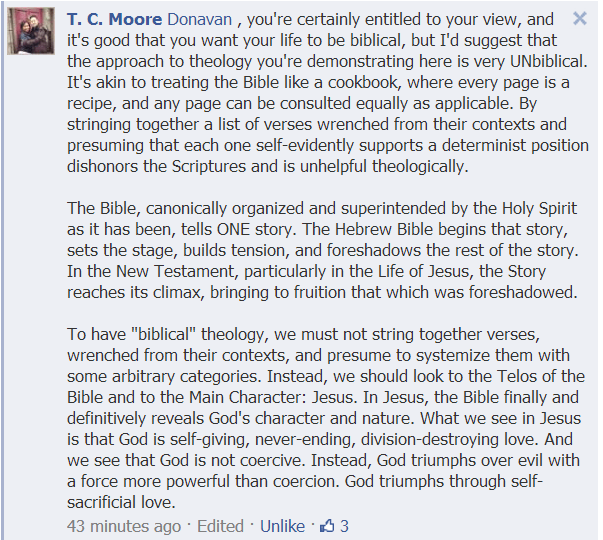
In an article entitled Why Does John Piper Misrepresent Evangelical Arminianism?, the author points out that Calvinists resort to rhetorical devices in order to boaster their claims:
The other interpretation both Calvinists and Arminians would disagree with and that is “man-centered” means that the entire plan of salvation was brought about by the will of man and that he does something significant in himself to make salvation happen. That kind of “man-centered” soteriology is clearly rejected by Arminians. So one is left wondering what point there is in claiming Arminianism is “man-centered” unless it’s only being used as a rhetorical device.
For full post, click here.
1Sa 2:2 “No one is holy like the LORD, For there is none besides You, Nor is there any rock like our God.
Archive.org is hosting three books about/by Charles Finney in mobi format:
The Life of Charles G. Finney by A. H. Mills
Charles G. Finney (Autobiography)
The Promises of God by Charles Finney
For download links, click here.
1Pe 1:1 Peter, an apostle of Jesus Christ, to the strangers scattered throughout Pontus, Galatia, Cappadocia, Asia, and Bithynia,
1Pe 1:2 Elect [eklektos] according to the foreknowledge of God the Father, through sanctification of the Spirit, unto obedience and sprinkling of the blood of Jesus Christ: Grace unto you, and peace, be multiplied.
In 1 Peter 2, Peter writes that people were “chosen” or “elect” according to the foreknowledge of God the Father. In the Augustinian mindset, this is some sort of predetermination of people, almost like a guest-list of people that will be saved. But this is not at all how Jesus uses the word “elect”.
Two times in Matthew, Jesus states “For many are called, but few are chosen.” Context is key to understanding this phrase. In both contexts, Jesus illustrates with a parable. In no context does the events indicate the Augustinian interpretation of election.
In Matthew 22 is found the parable of the wedding feast. It is a very odd story:
Mat 22:2 “The kingdom of heaven is like a certain king who arranged a marriage for his son,
Mat 22:3 and sent out his servants to call those who were invited to the wedding; and they were not willing to come.
Mat 22:4 Again, he sent out other servants, saying, ‘Tell those who are invited, “See, I have prepared my dinner; my oxen and fatted cattle are killed, and all things are ready. Come to the wedding.” ‘
Mat 22:5 But they made light of it and went their ways, one to his own farm, another to his business.
Mat 22:6 And the rest seized his servants, treated them spitefully, and killed them.
Mat 22:7 But when the king heard about it, he was furious. And he sent out his armies, destroyed those murderers, and burned up their city.
A rich man is hosting a wedding for his son and invites all the guests. The feast is prepared and waiting for the guests. All the guests had to do was show up. The invitation is made on several occasions. Eventually some individuals even kill the messengers; the king extracts swift vengeance on the murderers.
Mat 22:8 Then he said to his servants, ‘The wedding is ready, but those who were invited were not worthy.
Mat 22:9 Therefore go into the highways, and as many as you find, invite to the wedding.’
Mat 22:10 So those servants went out into the highways and gathered together all whom they found, both bad and good. And the wedding hall was filled with guests.
The banquet is prepared, but was been refused by the normal guests. The king has to change his plan and then outreach to the masses in order to fill his banquet table. He invites anyone and everyone. But some who came to the wedding, were not suitably dressed:
Mat 22:11 “But when the king came in to see the guests, he saw a man there who did not have on a wedding garment.
Mat 22:12 So he said to him, ‘Friend, how did you come in here without a wedding garment?’ And he was speechless.
Mat 22:13 Then the king said to the servants, ‘Bind him hand and foot, take him away, and cast him into outer darkness; there will be weeping and gnashing of teeth.’
The “rich” man, who could afford to dress nicely but declined, that is the one who was thrown out of the banquet. It is in this context that Jesus states:
Mat 22:14 “For many are called, but few are chosen.” [eklektos]
This is not at all what the Calvinists think of when they talk about election.
The parable mirrors Jesus’ gospel of the Kingdom. God reached out to convince mainstream Israel to be saved, but they declined. God reached out to them time and time again. But they responded with rejection and murder of God’s prophets. God then responds by broadening His invitations for salvation, reaching out to all classes of society (Jesus’ primary ministry was to the sinners). Some of these people respond, but not all of them in an acceptable fashion. God casts those individuals out. The remaining are “elect”. Election is not a guest-list filled with approved names. The idea is the exact opposite. Election is about individuals choosing God.
Everything Glorious by David Crowder Band
Lyrics:
The day is brighter here with You
The night is lighter than it’s hue
Would lead me to believe
Which leads me to believe
(chorus)
You make everything glorious
You make everything glorious
You make everything glorious
And I am Yours
What does that make me?
My eyes are small but they have seen
The beauty of enormous things
Which leads me to believe
There’s light enough to see that
(chorus)
You make everything glorious
You make everything glorious
You make everything glorious
And I am Yours
From glory to glory
You are glorious You are glorious
From glory to glory
You are glorious. You are glorious
Which leads me to believe
Why I can believe that
You make everything glorious
You make everything glorious
You make everything glorious
And I am Yours
You make everything glorious
You make everything glorious
You make everything glorious
And I am Yours
From glory to glory From glory to glory
You are glorious. You are glorious.
You are glorious. You are glorious.
You make everything glorious
You make everything glorious
You make everything glorious
And I am Yours
Jer 17:7 “Blessed is the man who trusts in the LORD, And whose hope is the LORD.
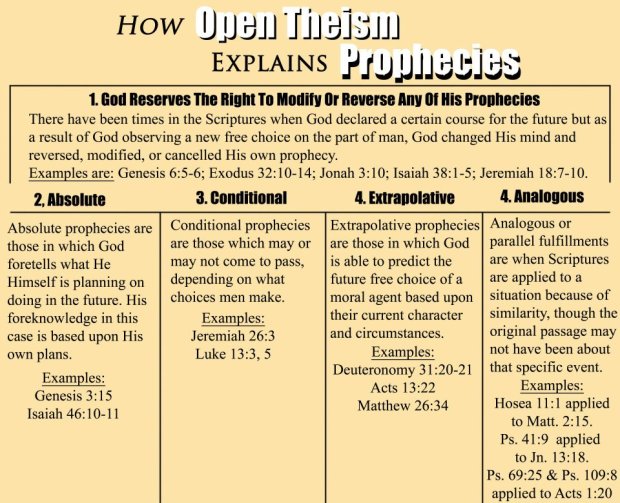
For original post, click here.
1Pe 1:24 because “ALL FLESH IS AS GRASS, AND ALL THE GLORY OF MAN AS THE FLOWER OF THE GRASS. THE GRASS WITHERS, AND ITS FLOWER FALLS AWAY,
If you would like to guest post commentary on this verse, please send to christopher.c.fisher@gmail.com .
Jamie RA Gerrard of Radical Reformation points out that the Bible tells us to seek God:
Reformed Christians aka Calvinists, Lutherans and others teach man has lost his free-will due to the fall and can no longer seek God. (Lets see what scripture says.)
“But if from thence thou shalt seek the LORD thy God, thou shalt find him, if thou seek him with all thy heart and with all thy soul.” Deuteronomy 4:29
“Seek the LORD, and his strength: seek his face evermore.” Psalm 105:4
“Seek ye the LORD while he may be found, call ye upon him while he is near:” Isaiah 55:6
“But seek ye first the kingdom of God, and his righteousness; and all these things shall be added unto you”. Matthew 6:33
”And I say unto you, Ask, and it shall be given you; seek, and ye shall find; knock, and it shall be opened unto you. 10 For every one that asketh receiveth; and he that seeketh findeth; and to him that knocketh it shall be opened.” Luke 11:9, 10
“God that made the world and all things therein,….hath determined… That they should seek the Lord, if haply they might feel after him, and find him, though he be not far from every one of us…” Acts 17:22-31
Oh wow! God has determined that we should seek him. I recommend reading the whole of Pauls sermon on Mars Hill as it destroys Calvinism.
For full post, click here.
From the Society of Evangelical Arminians, from a post about how Romans 11 has nothing to do with “double predestination”:
Truly, this passage should be an eye opener for those who have not taken God’s salvific, propitiatory agape love for the entire world (John 3:16; cf. 1 John 2:2) seriously enough. In short, if Rom 11:5-7 is not describing the reprobate of Calvinistic double predestination then it is safe to say that there are no such people. What Calvin meant by terms like “elect” and “chosen” and “hardened” has nothing to do with what Paul meant by these terms. The Calvinist system is foreign to Paul and twists Paul’s terms to mean things that they never meant.
For full post, click here.
Psa 5:5 The boastful shall not stand in Your sight; You hate all workers of iniquity.
From Christopher Fisher, a series of posts, images, and videos dealing with anthropomorphism:
Anthropomorphisms – How Calvinists define and use
Anthropomorphisms Depict Fiction – One reason they do not work as an idiom
Ikea Anthropomorphic Lamp Commercial – A video illustrating Anthropomorphism.
Memes:
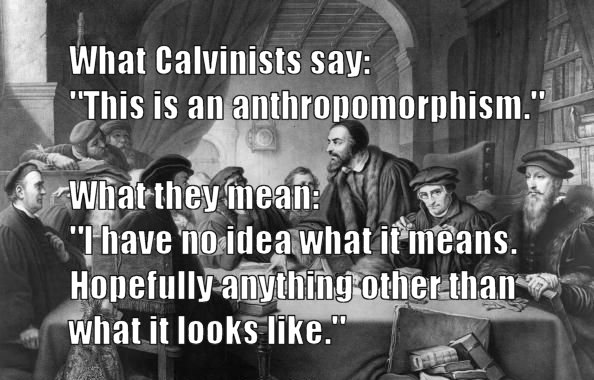
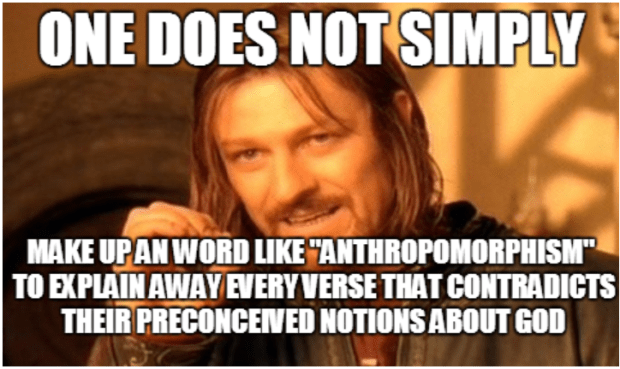
In Bruce Ware’s God’s Lesser Glory: The Diminished God of Open Theism, Ware is giving evidence that God knows the future when as a side note he writes:
Even more remarkable is the prediction of a future king to whom God gave the name Cyrus nearly 200 years before his parents gave him that exact name.
Ware, here, is perplexed that God could know a name of a baby 200 years in advance. In Ware’s mind, there is no other way to know the name of a future baby than to meticulously see the entire future.
In real life, there are plenty of ways to ensure a baby is named what you desire. You could pay the parents. You could threaten the parents. You could convince the parents. You could publish a popular nickname for someone, supplanting their given name. The possibilities are endless. God is powerful, ensuring a name of a future baby does not seem as impressive as Ware would have us believe. The text itself is found deep in a long series of chapters proclaiming God’s power (Isaiah 40-48). In the text, the author stresses the point God knows what will happen because God is powerful and He will bring it to past. The text is the exact opposite of Ware’s understanding: that God knows what will happen because He mystically sees the future. That the text stresses God’s power as the mechanism makes it antithetical to the knowledge mechanism. It is evidence against the Augustinian view of God!
But all this aside, Ware ignores very similar events in the Bible: the naming of both Jesus and John the Baptist.
Jesus’ naming was easy. God sends an angel to Mary and the angel tells Mary what to name Jesus:
Mat 1:21 And she will bring forth a Son, and you shall call His name JESUS, for He will save His people from their sins.”
Being told by an angel what to name her child is convincing enough for Mary. Mary promptly names her child “Jesus”. Could Cyrus’ parents have had an angelic visit? If God controlled all things, as some Calvinists claim, why would God have to convince Mary in the first place? Mary had a free choice as to naming Jesus and chose the name provided by God.
Another naming story occurs in the person of John the Baptist. In Luke 1, a priest named Zacharias encounters an angel. The angel prophecies that Zacharias would have a son and call his name John:
Luk 1:13 But the angel said to him, “Do not be afraid, Zacharias, for your prayer is heard; and your wife Elizabeth will bear you a son, and you shall call his name John.
Zacharias waxes skeptical. He does not believe he will have a son. Zacharias points out he is old. The angel responds by striking Zacharias mute until the things that are prophesied are completed:
Luk 1:18 And Zacharias said to the angel, “How shall I know this? For I am an old man, and my wife is well advanced in years.”
Luk 1:19 And the angel answered and said to him, “I am Gabriel, who stands in the presence of God, and was sent to speak to you and bring you these glad tidings.
Luk 1:20 But behold, you will be mute and not able to speak until the day these things take place, because you did not believe my words which will be fulfilled in their own time.”
Not only was Zacharias struck mute but he was also given an implicit threat. Zacharias would have the child, but would only be granted the ability to speak once the child was properly named. This is precisely what happens:
Luk 1:24 Now after those days his wife Elizabeth conceived…
…
Luk 1:57 Now Elizabeth’s full time came for her to be delivered, and she brought forth a son.
Luk 1:58 When her neighbors and relatives heard how the Lord had shown great mercy to her, they rejoiced with her.
Luk 1:59 So it was, on the eighth day, that they came to circumcise the child; and they would have called him by the name of his father, Zacharias.
Luk 1:60 His mother answered and said, “No; he shall be called John.”
Luk 1:61 But they said to her, “There is no one among your relatives who is called by this name.”
Luk 1:62 So they made signs to his father—what he would have him called.
Luk 1:63 And he asked for a writing tablet, and wrote, saying, “His name is John.” So they all marveled.
Luk 1:64 Immediately his mouth was opened and his tongue loosed, and he spoke, praising God.
Notice that it is exactly after the moment that Zacharias names John that he is allowed to speak again. Zacharias had already been proven wrong about his wife getting pregnant. For at least 9 months, Zacharias sat mute contemplating the angel’s words. When the angel stated “these things take place”, the angel was including the naming of John the Baptist. Implicit in Zacharias’ mind was that if he deviated from the angel’s instruction then he would not be granted voice. In other words, God coerced Zacharias into naming his son “John”.
God did not force Zacharias’ mouth to say “John”, and Zacharias could have still named John something else (presumably). But Zacharias weighed his options and preferred naming his son sensibly. God used power to fulfill His will.
This is how God can easily deal with an uncooperative agent. Because God is powerful, He can capture fleeing prophets in the mouths of fish and polymorph arrogant kings into wild beasts. What Calvinism does is downplay God’s power. God can only know things because He mystically sees the future, but that is not at all how the Bible depicts God. God knows things because He is powerful to achieve them. God can make these things happen in spite of human free will. When Ware assumes otherwise, he demeans God.
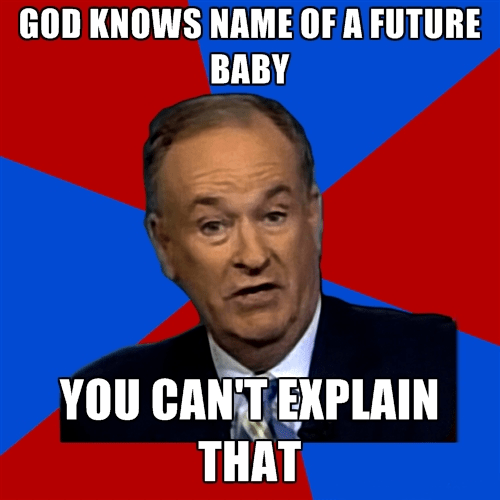
Isa 45:18 For thus says the LORD, Who created the heavens, Who is God, Who formed the earth and made it, Who has established it, Who did not create it in vain, Who formed it to be inhabited: “I am the LORD, and there is no other.
Act 13:48 Now when the Gentiles heard this, they were glad and glorified the word of the Lord. And as many as had been appointed to eternal life believed.
Speaking about Acts 13:48, Morrell points out the Greek word for appointed is in the “middle” voice. A literal translation would be “appointed themselves”. Morrell states:
3. Also notice the passive/middle ending “μένοι.” That means that ordained/disposed can be taken as something which was done to them (passive), in this case by the word, or something which they did to themselves (middle), in this case by allowing themselves to be properly influenced by the word. Given the context of this passage, especially in contrast with vs. 46 that uses the reflexive pronoun “ἑαυτοῦ” to say that they judged themselves unworthy of eternal life, this verb “τεταγμένοι” should be understood to be in the middle voice. Context is the only key in determining whether a verb is in the passive or in the middle, as the ending is identical.
For full post, click here.
From a post by Craig Fisher:
Despite the popular songs that reference Joel 3:10 “Let the Weak say I am Strong” (such as “What the Lord has done in me” by Hillsong), this is not a call for the Christian to be strong. On the contrary, this is a taunt for the enemies of God to be gathered together at the Valley of Jehoshaphat for slaughter.
For full post, click here.
Rev 1:8 “I am the Alpha and the Omega, the Beginning and the End,” says the Lord, “who is and who was and who is to come, the Almighty.”
Apparently John Calvin was a very sickly man.
HT: Contemporary Calvinist. Also see: John Calvin was a Monster
A Facebook post by Will Duffy, founder of the Collaborators Project on Facebook group God is Open:
In preparing for a Sunday School a few weeks back, I realized that the story of the Tower of Babel is evidence for Open Theism. The Bible states, “And the Lord said, ‘Indeed the people are one and they all have one language, and this is what they begin to do; now nothing that they propose to do will be withheld from them.'”
But wait, isn’t their every action already predetermined? What is there to worry about? If nothing they propose will be withheld from them, their future MUST be open. So what does God do? He makes a change. He actually changes His own design. His original design was one language and one speech on the entire earth. But now that has become problematic. So God changed His original plan and created multiple languages.
God was moved to change His own design due to man’s freedom. This story makes no sense if Calvinism is true..
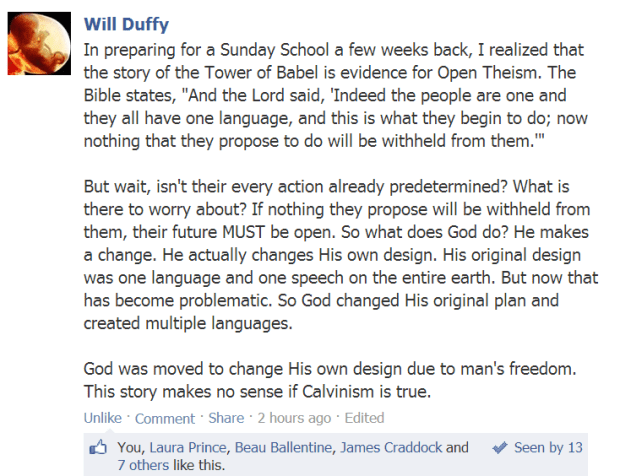
From Roger E Olson of Patheos:
So what is the “fundamentalism” in much contemporary American Calvinism that makes it so objectionable?… 1) a tendency to elevate most secondary doctrines, non-essential to being an orthodox Christian, to essential status, 2) a tendency to avoid Christian fellowship and cooperation with people who claim to be Christian but are not “like minded,” 3) a tendency to be highly suspicious of the spirituality of anyone who thinks differently about secondary and tertiary doctrines, however slight the disagreement may be, 4) a tendency to elevate to sacrosanct status a whole system of theology and consider any deviation from it as (at best) on a slippery slope toward apostasy, 5) a tendency to focus obsessively on one or more beliefs or practices that, in the larger scheme of orthodox Protestantism, is relatively minor (e.g., modern Bible translations that include inclusive language about human beings, pretribulation rapture, young earth creationism, etc.), 6) a tendency to be harshest (using the “rhetoric of exclusion”) toward those closest theologically but flawed doctrinally at one or a few points.
For full post, click here.
Pro 15:3 The eyes of the LORD are in every place, Keeping watch on the evil and the good.
From the Facebook group Arminians and Open Theists in Open Dialogue:
One of the heroic aspects of the character of James Arminius was his courage to follow his studies where they led. So filled with integrity was he that when asked to support Beza’s view of predestination and after researching it to prepare to defend it, he realized it was error. So he had to adopt the oppositional view. That cost him his reputation and standing. And cost others their lives and their homeland. Yet, Arminius was proven correct.
If an Arminian organization kicks out members for simply exploring OVT, how are they not spitting on the grave of the noble Arminius? How are they not adopting the same attitude as the kangaroo court of Dordt?
One of the egregious aspects of the Calvinist groups is how they use their Confessions as litmus tests for fellowship.
Another is how the idolize Calvin and TULIP.
I don’t idolize Arminius or any tradition. I value them, I benefit from them, but they are not God, and not scripture. And since they are human constructs they are subject to human revision.

From Kurt Johnson‘s blog. Kurt asks a reader to listen to one of John Piper’s videos and insert Calvinism wherever they hear “the Doctrines of Grace”. The point is to illustrate what happens when doctrine is elevated above the Bible:
Here is a selection of quotes from the video with “Calvinism” inserted for “The Doctrines of Grace”: (my emphasis added)
Calvinism is my life… the source of my life… the joy of my life… the sustaining foundation of my life… the hope, the end, the goal of my life.
If you love Calvinism, and you live it…
…and you want to commend Calvinism, remember that it is infinitely valuable…
…I pray that God will make Calvinism your life, the source of your life, the sustaining foundation of your life… the joy and the hope of your life.
For full post, click here.
Jas 1:13 Let no one say when he is tempted, “I am tempted by God”; for God cannot be tempted by evil, nor does He Himself tempt anyone.
Jas 1:14 But each one is tempted when he is drawn away by his own desires and enticed.
Jas 1:15 Then, when desire has conceived, it gives birth to sin; and sin, when it is full-grown, brings forth death.
While e-sword is the best free software for Windows, the best free software for Android is MySword (unrelated developers).
The best free software for tablet Bible study is MySword. It is easy to use, supports many free Bibles (such as the KJV, the Majority Greek, the Critical Greek, the Septuagint, etc), hosts a good variety of commentaries, and includes various dictionaries. One of the best downloads is the Greek New Testament Byzantine with conjugations and declensions listed of all words:
2 Ἦσαν G1510 G5707 V-IAI-3P ὁμοῦ G3674 ADV Σίμων G4613 N-NSM Πέτρος G4074 N-NSM, καὶ G2532 CONJ Θωμᾶς G2381 N-NSM ὁ G3588 T-NSM λεγόμενος G3004 G5746V-PPP-NSM Δίδυμος G1324 N-NSM, καὶ G2532 CONJ Ναθαναὴλ G3482 N-PRI ὁ G3588 T-NSM ἀπὸ G575 PREP Κανᾶ G2580 N-PRI τῆς G3588 T-GSF Γαλιλαίας G1056 N-GSF, καὶG2532 CONJ οἱ G3588 T-NPM τοῦ G3588 T-GSM Ζεβεδαίου G2199 N-GSM, καὶ G2532CONJ ἄλλοι G243 A-NPM ἐκ G1537 PREP τῶν G3588 T-GPM μαθητῶν G3101 N-GPM αὐτοῦG846 P-GSM δύο G1417 A-NUI.
In the modern world, people no longer have to be able to know Greek to read it!
Guest post by Craig Fisher
God’s Continuing Love for Israel:
Hos 11:1 “When Israel was a child, I loved him, And out of Egypt I called My son.
Hos 11:2 As they called them, So they went from them; They sacrificed to the Baals, And burned incense to carved images.
Here is a summary of God’s message of the Old Testament prophets: I loved Israel, I called them, but they rejected Me. In this passage, Hosea is using a metaphor of parent to son to illustrate this concept. The purpose of a metaphor is to bring together two ideas that have points in common with one another. The dominant idea should not have to explained since it is a common association that almost everyone understands. The dominant idea in this metaphor is the concept of parenthood. Although some people might have negative ideas of parenthood (such as victims of abuse) even these people will have an understanding characteristics of a good parent. The comparative idea (in this case God’s love for Israel) will have points in common with the dominant idea (a father’s love for his son). A reader must take care, however, not to strain to metaphor: there will points not in common with the dominant idea.
When reading passages such as Hosea, the reader must establish a real and essential analogy between God and parent. Not only is the relationship real and essential but the relationship must be readily apparent or the purpose of the metaphor is lost. God wants us to focus on the intensity of the relationship. Parents love their offspring. The children are an extension of the parents’ self concept: their love, their ambitions, their joys, and their despairs. Children act as an extension of a parent, an autonomous and loved extension.
In the text, the rejection of the parent is felt intensely. The rejection is sudden and undeserved. The parent feels betrayed by the child yet the parent cannot sever the relationship because of love. This produces a mixed reaction from God. God wants to show his love and receive love back. God wants to draw near to the child. The child’s reaction is to draw farther away. As a parent, God would be justified in moving away from the child, but God has a conflict between His mercy and His justice.
Hos 11:3 “I taught Ephraim to walk, Taking them by their arms; But they did not know that I healed them.
Hos 11:4 I drew them with gentle cords, With bands of love, And I was to them as those who take the yoke from their neck. I stooped and fed them.
How do parents teach children to walk? The mother holds the baby by the arms as the infant struggles to maintain balance. The father reaches out daring the child to cross the small path between father and mother. The baby holds out his hands smiles and bravely steps toward a smiling and encouraging father while the mother softly gives sounds of encouragement from the rear. Sometimes the baby makes it, sometimes the baby falls. The father probably at first holds out his hand to help the baby cross from mother to dad. The scene is repeated time and time again until the baby is strong enough to walk alone.
The ritual is as old as man. Sometimes grandparents can even relive their own moments with their grandchildren. God wants to capture these memories (so precious in the relationship between parents and children) to demonstrate his love for Israel. “Remember these moments in your life”, God is saying, “this is the kind of love I feel for you.” This is in accordance to the introduction and the theme of this chapter, God is saying “I loved him”.
The dominant idea of the love of parent for child, the tenderness of the training, and the sense of accomplishment, praise and bonding between the parents and child is the theme of this metaphor. The metaphor contains real information about God. The essential and memorable character of the metaphor is analogous to the message and not contrary to the message.
The second image, although not as tender, is about a master and his beast of burden. In Old Testament times this image would be a familiar everyday occurrence. Today the image is strange and remote. A horse or an ox is controlled by the bridle in the mouth. The owner moves the bridle to cause pain in the mouth which turns the whole animal one way or the other. Often a horse or ox would feed while the bridle was still in their mouths. A merciful master lifts the yokes of the oxen to push the bit back from the neck and closer to the cheeks of the oxen. This allows the oxen to eat their food in comfort without the painful reminder of correction from the yoke. At night the yoke or bridle would be removed altogether to allow the ox to eat in peace. The master stoops and feeds the beast becoming the slave of the beast in a reversal of the roles during the day.
Hos 11:5 “He shall not return to the land of Egypt; But the Assyrian shall be his king, Because they refused to repent.
Hos 11:6 And the sword shall slash in his cities, Devour his districts, And consume them, Because of their own counsels.
Hos 11:7 My people are bent on backsliding from Me. Though they call to the Most High, None at all exalt Him.
The opposite of love in not hate but indifference. Often the most intense love affairs are ended in the heat of anger and personal vengeance. To be in love is to be vulnerable, to let down you defenses and show the need in your life for the recipient of your affections. This surrender of your most intimate moments only magnifies the betrayal of your trust when the event happens. It is impossible to understand the personal hurt and suffering of this betrayal without first knowing the love shared at the beginning of the relationship.
Hos 11:8 “How can I give you up, Ephraim? How can I hand you over, Israel? How can I make you like Admah? How can I set you like Zeboiim? My heart churns within Me; My sympathy is stirred.
Hos 11:9 I will not execute the fierceness of My anger; I will not again destroy Ephraim. For I am God, and not man, The Holy One in your midst; And I will not come with terror.
God has pronounced judgment. Ephraim or Israel will be destroyed. The sword will slash his people, many will die and the rest will be uprooted from the land and sent into exile. Or will they? God proceeds to rethink His judgment and repents. The word translated “churns” means “to overthrow” or “turn around”. The word is in the passive and has a more reflexive meaning (“overthrows itself” or “turns itself around”). To turn your heart around is to change your mind or repent. The word Nacham translated “sympathy” here can either mean comfort or repentance. God could be saying my repentance is stirred (more literal “warmed”) within me. The context supports either translation.
God pronounces judgment then He says “how can I give you up”, “how can I hand you over”. This is a change in the heart of God. If not a change it is at least some indecision, some reassessment of a prior decision. Admah and Zeboiim were the two cities that shared the fate of Sodom and Gomorrah. Admah and Zeboiim were not the cities of the chosen people of God. Because of their wickedness they deserved their fate. This will be a harder decision for God, to destroy a people so totally, a people with whom he had shared a special love.
Can the word again be supported by the text or is it a historical addendum by the translators. II Kings 15:29 describe the first invasion of Assyria into Israel:
2Ki 15:29 In the days of Pekah (740-732) king of Israel, Tiglath-Pileser king of Assyria came and took Ijon, Abel Beth Maachah, Janoah, Kedesh, Hazor, Gilead, and Galilee, all the land of Naphtali; and he carried them captive to Assyria.
This first invasion of Israel carried away a significant portion of Israel. It is believed Hosea prophesied sometime after 732 and before the final and second invasion of Israel (722) by Assyria:
II Kings 17: 3-6 Shalmaneser king of Assyria came up against him…5 Now the king of Assyria went throughout all the land, and went up to Samaria and besieged it for three years. 6 In the ninth year of Hoshea, the king of Assyria took Samaria and carried Israel away to Assyria, and placed them in Halah and by the Habor, the River of Gozan, and in the cities of the Medes.
2Ki 17:3 Shalmaneser king of Assyria came up against him…
…
2Ki 17:5 Now the king of Assyria went throughout all the land, and went up to Samaria and besieged it for three years.
2Ki 17:6 In the ninth year of Hoshea, the king of Assyria took Samaria and carried Israel away to Assyria, and placed them in Halah and by the Habor, the River of Gozan, and in the cities of the Medes.
The translators believed God meant “I will not destroy Israel again like the invasion in 732”. It is not as significant as God’s two statements “9 I will not execute the fierceness of My anger; I will not destroy Ephraim.” Of course, as supported by secular and Biblical history, God did destroy Israel and Ephraim in 722.
What happened? God changed his mind. He was going to destroy Israel but stopped short of total destruction because his love overcame his desire for judgment. He allowed Israel to have another chance. Perhaps their immanent destruction would change their hearts and minds. What we do know is that God did bring the destruction of Israel into play. After describing how Israel fell to the King of Assyria (II Kings 17:7) the Scripture state the cause for the fall: the sins of Israel.
A man would have the tendency to destroy and bring wrath against his former lover. God is not a man, He changes his mind and wants to allow Israel to have another chance. A chance they did not deserve. A chance that would fail.
Augustine and John Calvin would disagree with this analysis. They believe God never changes his mind:
But when he says that his heart was changed, and that his repentings were brought back again, the same mode of speaking after the manner of men is adopted; for we know that these feelings belong not to God; he cannot be touched with repentance, and his heart cannot undergo changes. To imagine such a thing would be impiety.
(Calvin’s Commentaries, Vol. 26: Hosea, tr. by John King, [1847-50], at sacred-texts.com)
First Calvin admits the Scriptures do say God’s heart was changed and he repented. This is not in dispute. Calvin is practicing reductionism. Scripture says one thing but Calvin’s theology says another thing therefore the Word of God must mean something else. To quote from Terence E Fretheim, The Suffering of God, p 47:
One then buys an absolute form of omniscience at the price of placing the integrity and coherence of all God’s words in jeopardy: Does God really mean what he said or not?
According to Calvin God knows everything that will happen in the future (omniscience) because God determines everything that will happen (his secret will) despite and in contrast to the statements of what he wants to happen (his revealed will).
It is possible to believe that John Calvin (famed for knowledge of Latin, Greek and Hebrew) would defend his views of Hebrew 11 on some great exegesis of the text. But no, he resorts to defending his view with personal attacks based on a preconception of God.
Why is it impious to think that God repents? Because John Calvin has a preconception of God that does not fit what Scriptures say about God. He believes that when God says he changes his mind this is a type of metaphor called anthropomorphism which means God is pretending to be like a man in order to accommodate himself to mankind. At the same time this is not so veiled personal attack on all would disagree with him. If you believe God changes his mind you are impious. Pious is from the Latin meaning devout or good. You are not good if you believe what the Bible says.
As to this mode of speaking, it appears indeed at the first glance to be strange that God should make himself like mortals in changing his purposes and in exhibiting himself as wavering. God, we know, is subject to no passions; and we know that no change takes place in him. What then do these expressions mean, by which he appears to be changeable? Doubtless he accommodates himself to our ignorances whenever he puts on a character foreign to himself
(Calvin’s Commentaries, Vol. 26: Hosea, tr. by John King, [1847-50], at sacred-texts.com)
Is love not a passion? Does not God present himself as wavering? Would it be impious not to accept God as having passion (anger and love) or as wavering. Are we too dull to understand God if he says “I repent” or “I do not repent”? Does God put on a character foreign to himself? Is God an actor in some kind of play that is not real?
An intellectually honest reader is not able to change the meaning of the Scripture by labeling everything an “anthropomorphism”. An idiom cannot change the meaning of Scripture from “God repents” to “God does not repent”. Calvin’s answer is:
but yet he assumes the character of one deliberating, that none might think that he hastily fell into anger, or that, being soon excited by excessive fury, he devoted to ruin those who had lightly sinned, or were guilty of no great crimes. That no one then might assign to God an anger too fervid,
(Calvin’s Commentaries, Vol. 26: Hosea, tr. by John King, [1847-50], at sacred-texts.com)
God assumes the character (play acting) of one who deliberates or repents as a public relations stunt (“that no one might think God hastily fell into anger or that God may have too hot an anger”). In other words Calvin thinks God is pretending to love Israel and lying to protect his reputation.
Calvin’s explanation of Hosea 11 not only does not meet the readily intelligible and coherent standards of metaphor, this explanation seriously questions God’s integrity and honesty.
John Calvin never loved his father. He was taken from his father’s home after his mother’s death and lived apart from his father his whole life. In a letter to Nicholas Duchemin he is at his father’s death bed, he expresses no grief at the passing of his father, but considers this event as an inconvenience in his busy life. His relationship to his father; a distant, powerful, arbitrary and unloving authority figure, mirrors his conception of God; transcendent, omnipotent, and without passions. Calvin’s three children died almost immediately upon birth. He would not raise or love any children. Perhaps, Calvin was incapable of understanding the God of Hosea 11. Perhaps, instead of an exegesis of Hosea 11, Calvin’s explanation is a self projection of who Calvin is.
Hab 1:13 You are of purer eyes than to behold evil, And cannot look on wickedness. Why do You look on those who deal treacherously, And hold Your tongue when the wicked devours A person more righteous than he?
In Christ Alone by by Keith Getty and Stuart Townend
Lyrics:
In Christ Alone Lyrics
In Christ alone, my hope is found
He is my light, my strength, my song
This cornerstone, this solid ground
Firm through the fiercest drought and storm
What heights of love, what depths of peace
When fears are stilled, when strivings cease
My comforter, my all-in-all
Here in the love of Christ I stand
There in the ground His body lay
Light of the world by darkness slain
Then bursting forth in glorious day
Up from the grave He rose again
And as He stands in victory
Sin’s curse has lost its grip on me
For I am His and He is mine
Bought with the precious blood of Christ
No guilt in life, no fear in death
This is the power of Christ in me
From life’s first cry to final breath
Jesus commands my destiny
No power of hell, no scheme of man
Can ever pluck me from His hand
Till He returns or calls me home
Here in the power of Christ I’ll stand
Till He returns or calls me home
Here in the power of Christ I’ll stand
Here in the power of Christ I’ll stand
Jud 1:25 To God our Savior, Who alone is wise, Be glory and majesty, Dominion and power, Both now and forever. Amen.
I find, then, that man was by God constituted free, master of his own will and power; indicating as by this constitution of his nature… you will find that when He puts before man good and evil, life and death, that the entire course of discipline is arranged in precepts by God’s calling men from sin, and threatening and exhorting them; and this on no other ground than that man is free with a will either for obedience or disobedience or resistance.
For context, click here.
From Carson T. Clark of Musings of a Hardlining Moderate writes on prayer:
Don’t get me wrong. Obviously there should be a good deal of explicit communication with God, and it’s certainly healthy to do so on a daily basis. Not argument there. Yet maybe there’s also something to be said for the implicit communication my mentor alluded to. Perhaps it too is a form of prayer. If it is, I’ll tell you this much: Praying without ceasing just became a whole lot more plausible, not to mention psychologically healthy.
For full post, click here.
Isa 40:18 To whom then will you liken God? Or what likeness will you compare to Him?
Isa 40:19 The workman molds an image, The goldsmith overspreads it with gold, And the silversmith casts silver chains.
From Bob Hill’s discontinued site:
I want to belabor this point. Why was Calvin certain that God is immutable? Is this plainly asserted in Scripture? Was Calvin certain that God does not repent because the Scripture said so or because of his Platonic influence? Does Scripture show that God is immutable or that He repents? Where is this clear evidence? It is interesting that Calvin dismissed the evidence almost in a cavalier manner when he dealt with the Scripture that God changes.
For full paper, click here.
From Facebook group Calvinism, Arminianism, Pelagianism, Wesleyanism, Finneyism, Lutheranism:
It is impossible for an omniscient, omnipotent, omnipresent God to create beings with free will. Free will is incompatible with those attributes, the only way for it to be compatible is to dumb down God’s attributes, and I refuse to do that!
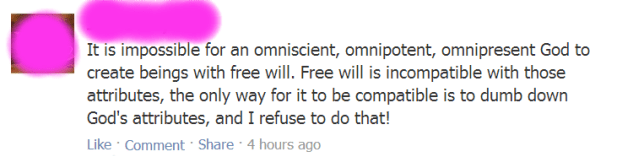
From Greg Boyd:
“I unequivocally affirm that God possesses every divine perfection, including the attributes of omnipotence and omniscience. I believe that God is the sovereign Creator and Lord, leading history toward his desired end, yet granting freedom to his creatures as he wills. He knows and can reveal all that he has determined about the future, thus declaring “the end from the beginning” (Isa. 46:10).”
For full post, click here.
John Piper, in Beyond the Bounds: Open Theism and the Undermining of Biblical Christianity, offers a challenge to God’s prophecy accuracy if Open Theism is correct in its understanding of an open future. He writes:
If Scripture contains predictions and prophecies about the future, which most evangelicals admit, then how is God able to guarantee that these predictions will come to pass as he has predicted?
Before answering Piper, an objective reader must first step back and make some predictions. An objective reader could build a hypothesis about how the Bible would treat prophecy in both closed and open hypothetical scenarios. The objective reader then could look how the Bible actually treats prophecy and see if the Bible better fits the closed or open model.
An Open Future:
1. Prophecies by God would be contingent on current knowledge, predictable events, or even God’s own power to make things happen.
2. When the Bible describes the methodology about how God knows the future, it would describe one of these three methodologies.
3. It would not describe God knowing the future in the ways predicted by the closed view of God.
4. Some prophecies would be subverted by the actions of human beings, new conditions changing prophecy.
5. Some prophecies would downright fail.
A Closed Future:
1. Prophecies by God would be contingent on God seeing the future (timelessness), God inherently having all knowledge, or God controlling all events (sovereignty).
2. When the Bible describes the methodology about how God knows the future, it would describe EXCLUSIVELY one of these three methodologies.
3. It would not describe God knowing the future in the ways predicted by the open view of God.
4. No prophecies would be subverted by the actions of human beings.
5. No prophecies would fail.
The problem for the closed view is that all the common sense predictions of their model are not found in the Bible. When the Bible talks about what God knows, it is not unknowable things. Where the closed view claims this, the text is ambiguous (e.g. the names in the Book of Life). When God describes how He knows things, it always gives a methodology denied by the closed view:
Isa 48:3 “I have declared the former things from the beginning; They went forth from My mouth, and I caused them to hear it. Suddenly I did them, and they came to pass.
Notice that God declares things and then God does them. The entire 9 chapters from Isaiah 40 through 48 speak explicitly about God’s power to bring about prophecy. God knows the future because God is powerful. Prophecy speaks to power, not knowledge. There is no hint of any assumption of a closed future. In fact, no scripture speaks towards God having inherent knowledge of the future, controlling all events, or seeing the future like a movie.
Many of the direct prophecies by God do not come true precisely because of human action: the prophecy of Nineveh being of primary exhibit. Sometimes prophecies (such as the prophecy of Tyre or the prophecy of expelling foreign nations from the Promised Land) fail for no apparent reason. Failed or subverted prophecy is not the norm, but it does occur throughout the Bible. The Bible offers no apologies; that task is left for the Calvinists.
So, in what way does Piper believe God “guarantees” prophecy? Is God guaranteeing in the sense that nothing could subvert the prophecy ever? That does not seem to be God’s standard. It seems again Piper is letting his philosophy interpret the Bible rather than the Bible his philosophy.
Isa 40:10 Behold, the Lord GOD shall come with a strong hand, And His arm shall rule for Him; Behold, His reward is with Him, And His work before Him.
Isa 40:11 He will feed His flock like a shepherd; He will gather the lambs with His arm, And carry them in His bosom, And gently lead those who are with young.
From Beau Ballentine on the official God is Open Facebook group:
Calvinism inherently rejects predestination. For predestination to be true, God must determine something beforehand. Before God determined, the future would have to be open. Predestination refutes an eternally settled future and Calvinism.
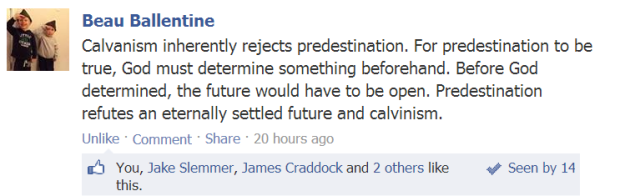
W Scott Taylor of IdeoAmnosTouTheou on Facebook group Open Theism, Moral Government Theology, Pentecostal:
~ “From the Foundation of the World” ~ Mistranslation.
Mistranslation should be understood as a “theologically biased” translation. Biblical students with more than a passing acquaintance with the Greek of the New Testament realize that case and syntax analysis plays an important part in rendering the intent of the original author to those unfamiliar with the language.
The purpose of this post is to, 1.) show the Greek phrase in each instance it occurred in the New Testament, and, 2.) identify why, based upon basic Greek grammar of case and syntax the phrase has a more probable translation.
1.) Every instance of the phrase translated “from the foundation of the world” are listed below:
Matt 13:35 ἀπὸ καταβολῆς [κόσμου].
Matt 25:34 ἀπὸ καταβολῆς κόσμου.
Luke 11:50 ἀπὸ καταβολῆς κόσμου
John 17:24 πρὸ καταβολῆς κόσμου
Ephesia 1:4 πρὸ καταβολῆς κόσμου
Hebrew 4:3 ἀπὸ καταβολῆς κόσμου
Hebre 9:26 ἀπὸ καταβολῆς κόσμου
1 Pet 1:20 πρὸ καταβολῆς κόσμου
Revel 13:8 ἀπὸ καταβολῆς κόσμου.
Revel 17:8 ἀπὸ καταβολῆς κόσμου
2.) Note that in each case the preposition ( ἀπὸ or πρὸ ) are genitive and that each phrase is also genitive. An entry from “A Greek-English Lexicon of the New Testament And other Early Christian literature” Arndt & Gingrich, is provided to show that the first use of the genitive for ἀπὸ is spatial in meaning rather than temporal.
An alternate translation that would be equally as admissible if not more so than the traditional rendering would be:
“In view of the fall, or moral descent of the inhabitants of the world or social order.” How that works out practically in each instance of the phrase’s occurrence can be pursued, discussed and explained in follow on threads in this op.
For bibliographic purposes one would do well to review:
“C. F. D. Moule “An Idiom Book Of New Testament Greek” Chapter V Prepositions.” pg 48-92. Also, Daniel B. Wallace “Greek Grammar Beyond The Basics” pg 9,32-35,37,72-136,138,177-78,727-29. Other considerations exist and have been researched in the course of this presentation. It is my contention that there are no reasons why the verses in question cannot be rendered alternately as shown.
Needless to say, the impact of this can be very far reaching. So far in fact that it will touch nearly 90% of your Christian Theology.
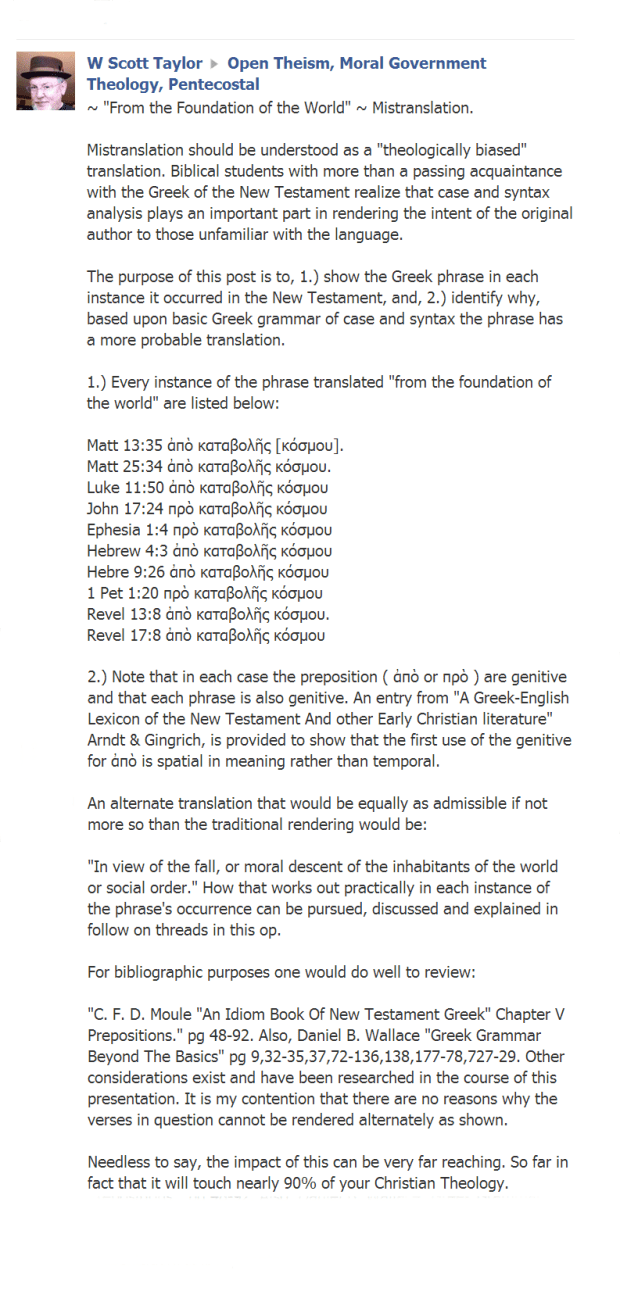
Jer 3:7 And I said, after she had done all these things, ‘Return to Me.’ But she did not return. And her treacherous sister Judah saw it.
If you would like to guest post commentary on this verse, please send to christopher.c.fisher@gmail.com .
From Jacob Hunt of Jacob’s Blog:
When characterizing the powerlessness of God in process and open theology, he is probably comparing them to the power of his God. And while it is certainly true that the God of process theism is not all powerful, you simply can’t say that about the open theist God. In open theism, God is all-powerful, he’s simply decided to use more restraint than the Calvinist God because he wants to share that power with His creatures. To illustrate, a bodybuilder who isn’t currently lifting weights could be much more powerful than one who is. Somebody not using their power doesn’t mean they don’t have power to use. Similarly, there’s no reason to think that an open theist God is less powerful than a Calvinist God.
For full post, click here.
Economics teaching platform, LearnLiberty has a great video on Free Will:
2Pe 3:9 The Lord is not slack concerning His promise, as some count slackness, but is longsuffering toward us, not willing that any should perish but that all should come to repentance.
From Rhoblogy:
Appealing to an eschaton that comes sooner rather than later does the Open Theist no good here, for it only pushes the problem back one step. Further, the god of Open Theism cannot guarantee that the eschaton will arrive when He is planning. Perhaps something will happen that takes the issue out of His hands. God can’t know whether He will lose His power. He can’t know that someone else won’t beat Him. He can’t know that He can keep His promises. He couldn’t know that He’d be able to pull off the resurrection of Jesus. He can’t know whether the laws of physics will be the same in 10 seconds from now. He can’t know whether He’ll indeed be able to preserve His people from falling away. Can’t know whether He will win in the end. Those prophecies in the Bible are just educated guesses.
From Bob Enyart Live, When God Kills Kids.
For entire audio, click here.
Luk 11:11 If a son asks for bread from any father among you, will he give him a stone? Or if he asks for a fish, will he give him a serpent instead of a fish?
For a limited time, The Nature of Love by Thomas Jay Oord, is being offered as a free ebook. Personal information required.
For details, click here.
Be Thou My Vision
Lyrics:
Be Thou my vision, O Lord of my heart
Naught be all else to me, save that Thou art
Thou my best thought by day or by night
Waking or sleeping Thy presence my light
Be thou my wisdom and Thou my true word
I ever with Thee and Thou with me, Lord
Thou my great Father, I, Thy true son
Thou in me dwelling and I with Thee one
Riches I heed not nor man’s empty praise
Thou mine inheritance now and always
Thou and thou only first in my heart
High King of heaven my treasure Thou are
High King of heaven my victory won
May I reach heaven’s joys, O bright heaven’s Sun
Heart of my own heart whatever befall
Still be my vision O Ruler of all
Psa 103:8 The LORD is merciful and gracious, Slow to anger, and abounding in mercy.
From the comments section of the Patheos: Why open theism doesn’t even matter (very much) blog post:
It troubles me that for all the lip service given to civility, fairness, and honesty among conservative evangelicals, we succeeded in silencing (in a way tantamount to intellectual bullying) an important and potentially enriching theological discussion on the nature of omniscience (even if we end up disagreeing with the Openness view). I followed much of the public debate and found it disheartening. In my opinion, this is a great loss to the church on a number of fronts: (1) we failed to demonstrate that even with deep theological differences, we can listen, understand, and assess and yes, profoundly disagree, in a Christian manner; (2) we have also, in effect, stifled any future discussion about this subject (or similar subjects) in conservative circles and created a social stigma around anyone who thinks the view has merit; (3) we managed to push Open Theists (unfairly, I think) to the periphery of “theological acceptability” so that others automatically dismiss their other contributions due to their stand on this one issue.
Some will no doubt see these developments as a great victory for Christian truth, but I see them as a great loss to what could have been a robust and beneficial contribution to our understanding of God. While I am not an Open Theist, I am sympathetic to the concerns that they raise and believe that, as Christians, they have the right to raise them and have their views treated fairly in public discussion. Are we so theologically insecure that we can no longer engage ideas that question our assumptions and challenge us to rethink our positions–especially, when there is at least a prima facie reason for it based on what Scripture itself says?
Heb 5:8 though He was a Son, yet He learned obedience by the things which He suffered.
From by Jared Moore in an article entitled Does God Change? Yes and No. A Response to Bruce Ware:
Furthermore, in order to possess genuine emotions, there must be a sense where God is with humanity within time and space. Thus, when God’s disposition towards His people changes from joy to anger, this change is due to a change in experiential knowledge. Otherwise, these emotions are nominal (in name only). If God is relationally mutable, there must be a sense where His experiential knowledge changes. This experiential knowledge does not change the Scriptural truth that God is all-knowing, it simply means that since God is with us in time, He knows in a way as He experiences time with us that He did not know before (Ware would argue). His joy, anger, etc. are real within time with us. I, however, cringe with the thought of saying, “God is not all-knowing in an experiential way.” I must concede, however, that God is really angry, joyful, etc. in Scripture. These are not mere anthropomorphisms; however, I cannot concede at this point that God’s emotions are contingent on His experiential knowledge at the moment of experience. I think there may be a better way to tie God’s real emotions to His ultimate knowledge without arguing that God must experience knowledge to possess real emotions. His emotions may be so “other” than us that the manifestation of His emotions is what we see in Scripture, instead of Him learning something in an experiential manner that He did not know in an experiential manner prior to experiencing this knowledge in time and space.
For full text, click here.
In a very interesting post, Roger E. Olson alludes to the fact that the entire anti Open Theism movement is built around censorship, not debate:
The tenor of the controversy is one thing; the truth status of open theism is another thing. I was writing then primarily about the controversy. I believe that, for the most part, it was left unfinished. The anti-open theists, mostly Calvinists, won the day insofar as they persuaded (often, I am convinced, through misrepresentation) evangelical leaders such as administrators of institutions of higher learning to shun open theists.
For full article, click here.

Mar 13:32 “But of that day and hour no one knows, not even the angels in heaven, nor the Son, but only the Father.
Jamie Schofield writes an mock diary of a child whose father is like the Calvinist God. Excerpt:
Dear Diary,
Pete became sick today after lunch. I don’t always like my brother, but I wish he felt better. He says his stomach hurts, and he wishes he could throw up, but he can’t. Dad came home from work and told us that he put something in Pete’s lunch to make him sick. Pete asked why? Was it something he did? Dad said no, it didn’t have anything to do with anything Pete did. He says he did it to show that he has control over everything, and he can give or he can take away, as he wills. He gives us all our food, and so if he wants to do something to the food, he can if he wants. Then he said he loves Pete and me, and we can trust him to always do the right thing for us. Is the right thing for Pete for him to be sick and hurting? Why, daddy? I asked Dad if he was going to hurt me like he hurt Pete. He said he wouldn’t tell me, but you never know.
The whole document is worth a read. For full document, click here.
In Their God is Too Small by Bruce Ware, Ware quotes John Sanders:
It is God’s desire that we enter into a give-and-take relationship of love, and this is not accomplished by God’s forcing his blueprint on us. Rather, God wants us to go through life together with him, making decisions together. Together we decide the actual course of my life. God’s will for my life does not reside in a list of specific activities but in a personal relationship. As lover and friend, God works with us wherever we go and whatever we do. To a large extent our future is open and we are to determine what it will be in dialogue with God.
Ware replies:
I mean no disrespect when I ask, Whom should I believe: Jesus, or John Sanders? The contrast is that glaring. For Jesus, prayer with the Father was never a matter of deciding the actual course of his life together in dialogue with the Father. As he instructed his disciples to pray, “your will be done,” so he lived his life. Recall that Jesus said, over and again, things like, “I do nothing on my own authority, but speak just as the Father taught me” (John 8:28), and, “I always do the things that are pleasing to him” (John 8:29). From beginning to end, Jesus sought to accomplish what his Father had sent him to do. Even in the garden, facing the biggest test of faith imaginable, Jesus prayed, “not my will, but yours, be done” (Luke 22:42).
In Ware’s rush to mock Sanders, he commits several logical errors. The primary error is that God’s will necessarily means some sort of minutely detailed overall plan. When Jesus prayed “not my will but yours be done” this is not “let your meticulous control over every facet of my life be done”. This is, in context, about one event: the crucifixion. Note that Jesus willed to not be crucified. Jesus literally asks to be let out of the task: “Father, if thou be willing, remove this cup from me”. Jesus is probing God for a way to fulfill God’s plan for redemption through another means than crucifixion. Jesus thought that he could influence God and that the future was not set in stone. Jesus then lets it be known that God should default to God’s original plan. This would be like me telling my children, “Please come watch a movie with me, but if you do not want to then you do not have to.” It is a relational statement (!), deferring preference to the other party. Jesus thought his petition could influence God. What does Ware think Jesus is communicating to God?
Likewise, when Jesus tells the disciples to pray that “God’s will be done on earth as it is in heaven,” this implies that God’s will is not being done on earth. People are rebellious. Jesus came to preach repentance. John the Baptist came to “prepare the way of the Lord”. God’s will is that people act righteously. Submitting to God’s will does not mean letting God control every flick of every eyelash. God is not interested in micromanaging. God gives overall direction. Ware commits the logical fallacy of Equivocation. Ware just assumes he knows what “God’s will” is and that God wills certain events in every person’s life.
In reality, Sanders is correct. God enters into a “give-and-take relationship of love”. God does not plan who we will marry or what house to buy. Those are things we can decide with God. There are limitless possibilities under God’s will. Submitting to God’ will in no sense is incompadible with a “give-and-take relationship.” God just wills that people act righteously, and there is countless ways in which to do that.
Here is Paul, telling us the will of God:
1Th 4:3 For this is the will of God, even your sanctification, that ye should abstain from fornication:
1Th 4:4 That every one of you should know how to possess his vessel in sanctification and honour;
1Th 4:5 Not in the lust of concupiscence, even as the Gentiles which know not God:
1Th 4:6 That no man go beyond and defraud his brother in any matter: because that the Lord is the avenger of all such, as we also have forewarned you and testified.
1Th 4:7 For God hath not called us unto uncleanness, but unto holiness.
 God is Open