Open Theism

McCormick on Variant Beliefs

From Facebook group God is Open:

I’ve found that many Christians think that they are in a group of those that think exactly like they do. Yet there are so many doctrines, from minor to major, within Christendom that it’s a virtual guarantee that no two people have the exact understanding of God and Scripture as any other two. When you start to examine beliefs, it’s soon evident that people you thought held similar beliefs actually hold very different beliefs than you imagined.

This really struck me one time when I was having lunch with a church member and he revealed that he didn’t exactly believe that Jesus had always been God (at least I think that’s what it was…it’s been many years). He was way off from what the church believed, and I realized that what he had told me confidentially (many people seem to feel free to confide their secrets to me) would get him ostracized from the church. Perhaps for good reason too. I’m not arguing that. But I did have the opportunity to help him understand that issue better through careful questions pointing to God’s nature in Scripture.

But even within “orthodoxy” if there really is such a thing in the common sense, there are wide varieties of opinion. If we understand those differences and accept that we are all seeking the truth, rather than getting upset at others with slightly different doctrines, it may help us present the truth in a manner which draws us together than divides us.

The pastor who married my wife and I came from a Quaker background. He mentioned a method they used when they were corporately listening for the word of the Lord. They’d all gather in the meetinghouse and pray about whatever it was on their minds. Then they’d come together and honestly present what they believed God had said. If it wasn’t unanimous, they’d return to prayer, then come together again later to check again. They continued on until all were in agreement.

Now I’m not saying that works. It was rather the attitude displayed. They had a willingness to listen to the Lord with an open and humble attitude together, listening for what God had to say, without dividing over every point.

If believers would approach God’s word in a more peaceful, humble, and LOVING manner, with an open heart toward God, we’d learn so much more and come that much closer to God’s will for His people.

open theism

Perry Talks Hermeneutics

Best selling author, Greg Perry of RightNerve talks about Hermeneutics:

One hermeneutic is to take the Bible literally. This is Dr. Cone’s approach. This is also my desired approach. Certainly some things in Scripture are metaphors and analogies and parables that use one thing to illustrate something else. That “something else” is often a spiritual truth. In spite of metaphors and analogies and parables existing in the Bible, the literal hermeneutic says, “Let’s first and foremost just assume that the Bible means what it says. And if we read certain passages and find that God’s giving us an analogy of some kind, that will be fine. But we first assume it’s literal and it grammatically means what it grammatically says.”

For example, Dr. Cone has shown that Noah used a literal hermeneutic to understand God’s Word:

God told Noah: “Build a boat.”
So Noah built a boat.

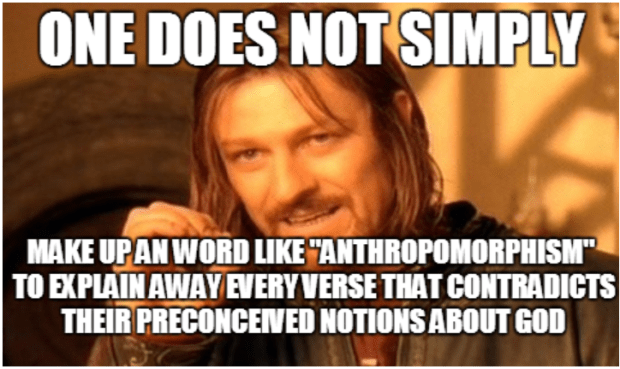
If Noah wanted to spiritualize God’s Word, he would start analyzing all the things God possibly could have meant when He told Noah to build a boat. If Noah had a time machine and looked forward to learn all about Greek philosophy, Noah could have guessed that the “boat” was actually an anthropomorphism for Noah swimming in the sea of sin all around him.

For full post, click here.

Worship Sunday – Amazing Grace

Amazing Grace by John Newton

Lyrics:

Amazing Grace, how sweet the sound,
That saved a wretch like me.
I once was lost but now am found,
Was blind, but now I see.

T’was Grace that taught my heart to fear.
And Grace, my fears relieved.
How precious did that Grace appear
The hour I first believed.

Through many dangers, toils and snares
I have already come;
‘Tis Grace that brought me safe thus far
and Grace will lead me home.

When we’ve been there ten thousand years
Bright shining as the sun.
We’ve no less days to sing God’s praise
Than when we’ve first begun.

Brueggemann on Now I Know

Walter Brueggemann notes in his work on Genesis states on Genesis 22:12:

It is not a game with God. God genuinely does not know. And that is settled in verse 12, “Now I know.” There is real development in the plot. The flow of the narrative accomplishes something in the awareness of God. He did not know. Now he knows. The narrative will not be understood if it is taken as a flat event of “testing.” It can only be understood if it is seen to be a genuine movement in the history between Yahweh and Abraham.

Martin Defines Open Theism

From Dan Martin of Nailing it to the Door:

Open Theism starts–never forget this–not from logical assumptions, but from observing that the God represented in our scriptures is a dynamic, interactive God who changes his mind, his plans, and his behavior in interaction with his creatures. This is not wishful thinking and it’s not secular philosophy, it’s how the stories actually read. Open Theists simply insist that no rationalization or mental gymnastics need be applied to the Biblical accounts of God dealing with his own people.

For full post, click here.

Romans 9 is about Nations

From the Cruciform View on Romans 9:13

First off, Paul is quoting Malachi 1:2-3 in verse 13. It was common practice in the ancient world to refer to a whole corporate, nation with the name of a patriarchal individual. Indeed, this where the name “Israel” comes from. The corporate nation of people was named after the individual patriarch Jacob, after his name was changed to Israel (Gen. 32:22-28). Likewise with the twelve corporate tribes of Israel, with each group being named after it’s individual patriarch (Judah, Benjamin, Napthali, etc.). Paul is not referring to individuals in this passage, but rather to the corporate nations that were their descendants. (I explained the idea of corporate election a little bit more in my treatment of Romans 8:28-30 in Part 4 of this blog series)

For full post, click here.

Apologetics Thursday – Calvinist Trust Issues

By Christopher Fisher:

Imagine this conversation:

Wife: I was planning our son’s birthday party on Saturday. Is that a good day?
Husband: That works for me. I will be there.
Wife: You will be there? You are omniscient!
Husband: What are you talking about?
Wife: You said you would be there. That day is a week from now, and for you to know that you will be there means you must know all events: past, present and future.
Husband: No. I really don’t know all the future. But I am definitely going to be there.
Wife: How do you know you are going to be there if you are not omniscient?
Husband: Because I have a car, and I will just drive there. I have nothing else going on that day.
Wife: But what if you get hit by a bus? You cannot say you will be there.
Husband: Well, I guess I cannot say that I am “definitely” going to be there, in the sense that nothing ever can change the outcome. But those things are highly improbable, so yeah, I will “definitely” be there in the sense that barring any unlikely circumstance I will be there.
Wife: I do not believe you.
Husband: What are you talking about?
Wife: You don’t know the future, so how can I trust a word you say?
Husband: What are you talking about?
Wife: If you do not know the future that means anything can happen. When you say you will be there, you could just change your mind.
Husband: But haven’t I always done what I said I was going to do? You know me. I always go to our children’s birthday parties.
Wife: Well, if you do not know the future then you might go crazy and change. Because you do not know the future, because the future is not set, I cannot trust a word you say.
Husband: *confused look* … alrighty… I am going to go play with the kids now.

Most people would correctly identify the wife as being very low in stability. If her husband has proven to be reliable in the past concerning events, she is amiss not to trust his predictions of the future. After all, his character is known and he has the power to make his predictions a reality.

This scene, although a work of fiction, describes several debates between Open Theists and Calvinists. Calvinists instantly act like the wife in the above storyline. If “God does not know the future we cannot trust Him”. Here is Samuel Lamerson in a debate on theologyonline:

I am not sure that I would trust my money to an earthly gambler, and sure that I would not trust my salvation to a God who creates with no idea of what the agents of his creation will do.

This is echoed by Gene Cook in a 2007 debate:

[Paraphrasing Lamerson] “How can we trust Him if the future is open?” I agree: how can we trust him. And the response of Bob Enyart is, well, we can trust Him because God is loving, and God is good, and God is righteous. Bob, how do we know God is good, God is loving, and God is righteous? How do we know He is going to be good, righteous and loving tomorrow?… If you say that God is changing, how do we know He is not going to change his decision to accept me as one of His sons?

The Calvinist, to function in society, has a very low burden of trust for fellow human beings. What Calvinist will say they “do not trust” their wife because she has the ability to change?

But when God is brought into the equation, Calvinists discard all signs of rational thinking. This follows a long line of Calvinists trying to ignore how rational people converse, act, and think, opting instead for arbitrary and unreasonable standards. If God does not know something with 100% certainty, God is said not to know it. If God says He will accomplish something, it is assumed that God can only know it if God knew the future. If God is said to be sovereign that means God controls all things. If God is said not to know the future, we then cannot believe anything He says. This is unnatural to how people naturally function.

The really funny thing is that when God has to defend Himself against His critics, God gives reasons. Open Theists do not really have to work to defend these points against Calvinists. God defends Himself against those who think that God cannot know the future. In Isaiah 40-48, the message is echoed: “God knows the future because God is powerful and can bring about His purposes”:

Isa 48:3 “I have declared the former things from the beginning; They went forth from My mouth, and I caused them to hear it. Suddenly I did them, and they came to pass.

When God explains to people how He knows the future, it is not Calvinism. God explains that He knows things because He can do them. God does not rely on the irrational statement that people should trust God because God does not change. That statement is only found in Calvinist apologetics.

Oord on Prevenient Grace

From Thomas J Oord’s new book The Nature of Love:

“We love because [God] first loved us,” says John (1 Jn. 4:19). God first loving us should not refer primarily to what God has done in the distant past. The idea God first loves should refer primarily to God acting first in any particular moment to make possible our love in response. This idea is what theologians often call “prevenient grace.” It says God’s loving action comes before and makes possible out free response. God is a personal and causal being to whose call loving creatures can respond appropriately. Creatures could not love if our relational God were not the Lover who initially empowers, inspires, and beckons them.

Elseth Ancedote on the Problem of Evil

From the first chapter of Did God Know by Howard Elseth:

Wanting to give the girl something, Duncan remembered the package of gum he had. He called to her, but the shy little girl misunderstood and was frightened. She jumped away from her stone toys – and Duncan’s call to her became the call of death.

Nearby the water pond, unknown to the children, lived a viper. The snake hid himself during the day between rocks and fed on the small animals that frequently came to the water. Today, however, the heat had driven him to the shade of one of the many bushes near the pool. He had been silently sensing the presence of the children for a long time, but now the sudden movement of the little girl excited him.

He lunged out at her and dug his venemous fangs into her soft leg with incredible deftness. Terror overcame Duncan…

Duncan had not prayed in a long time. But he prayed now-out of desperation. He pleaded with God not to let the beautiful child die. It seemed to him that there was no reason or sense to what had happened. His prayers were to no avail, however. The innocent girl shivered in the afternoon heat. Numbness worked its way up her leg and poison quickly moved throughout the small body. Sweat came out of her unwrinkled skin as convulsions emptied the girl’s stomach of vomit. As the afternoon sun faded, the black-haired girl died.

Duncan’s thoughts drifted toward God. What had the girl done that God inflicted this upon her? Was her crime playing with stones in a quiet African town? Who is God that He would allow such a thing? If God knew beforehand that the viper would strike out at the child, why didn’t He prevent it? How could a God of love remain idle during such an event? Worse yet, did God plan or determine that this event would happen, as the theologian John Calvin suggests? How ludicrous it seemed to Duncan that a God so great that He created millions of planets in millions of light years of space would spend His time plotting and planning to kill one child in an obscure African village. How could this possibly be the “will of God”? It made no sense. A God of that kind could not conceivably be worthy of man’s love.

Russell on the Problem of Evil

From atheist Bertrand Russell in an essay entitled Has Religion Made
Useful Contributions to Civilization?
:

The world, we are told, was created by a God who is both good and omnipotent. Before He created the world He foresaw all the pain and misery that it would contain; He is therefore responsible for all of it. It is useless to argue that the pain in the world is due to sin. In the first place, this is not true; it is not sin that causes rivers to overflow their banks or volcanoes to erupt. But even if it were true, it would make no difference. If I were going to beget a child knowing that the child was going to be a homicidal maniac, I should be responsible for his crimes. If God knew in advance the sins of which man would be guilty, He was clearly responsible for all the consequences of those sins when He decided to create man. The usual Christian argument is that the suffering in the world is a purification for sin and is therefore a good thing. This argument is, of course, only a rationalization of sadism; but in any case it is a very poor argument. I would invite any Christian to accompany me to the children’s ward of a hospital, to watch the suffering that is there being endured, and then to persist in the assertion that those children are so morally abandoned as to deserve what they are suffering. In order to bring himself to say this, a man must destroy in himself all feelings of mercy and compassion. He must, in short, make himself as cruel as the God in whom he believes. No man who believes that all is for the best in this suffering world can keep his ethical values unimpaired, since he is always having to find excuses for pain and misery.

VOTD Isaiah 46:5-7

Isa 46:5 “To whom will you liken Me, and make Me equal And compare Me, that we should be alike?
Isa 46:6 They lavish gold out of the bag, And weigh silver on the scales; They hire a goldsmith, and he makes it a god; They prostrate themselves, yes, they worship.
Isa 46:7 They bear it on the shoulder, they carry it And set it in its place, and it stands; From its place it shall not move. Though one cries out to it, yet it cannot answer Nor save him out of his trouble.

Oord on Love

From Thomas J Oord’s new book The Nature of Love:

Even before Jesus Christ revealed God’s nature most clearly, biblical authors considered love a, if not the, primary attribute of God. The phrase “steadfast love” is the most common Old Testament description of God’s nature. Divine love is relentless. God’s love is everlastingly loyal. The psalmist speaks often of God’s steadfast love for creation, making statements such as “the earth is full of the steadfast love of the LORD” (Ps. 33:5). In Jeremiah 31:3, God declares, “I have loved you with an everlasting love.” Even King Huram of Tyre testifies that God loves the chosen people (2 Chr. 2:11). Deuteronomy affirms that God loves “the strangers” or alien peoples (Duet. 10:18). Old Testament writers witness powerfully to the love of God.

Calvinists on Sovereignty

From an article entitled Total Control – God’s Sovereignty Misdefined:

What Calvinists Say

“…not only had God a perfect foreknowledge of the outcome of Adam’s trial, not only did His omniscient eye see Adam eating of the forbidden fruit, but He decreed beforehand that he should do so. This is evident not only from the general fact that nothing happens save that which the Creator and governor of the universe has eternally purposed, but also from the express declaration of Scripture that Christ as a Lamb ‘verily was foreordained before the foundation of the world’ (1 Pet 1:20).” (A.W. Pink The Sovereignty of God p.249.italics in original) (Reason 2 is used)

“To put it now in its strongest form, we insist that God does as He Pleases, only as He pleases, always as He pleases; that whatever takes place in time is but the outworking of that which He decreed in eternity.” (Pink The Sovereignty of God p.194).

“God is seen as the great and mighty King who has appointed the course of nature and who directs the course of history even down to its minutest details.” Boettner Ref. Doctrine of Predest. p.13.

All things whatever arise from and depend on, the divine appointment;” John Calvin Commentary on Romans

Abraham Kuyper, “The determination of the existence of all things to be created, … is the most tremendous predestination conceivable in heaven or on earth;… our entire existence, being entirely dependent on it.

B. B. Warfield wrote, “…nothing, however small, however strange, occurs without His ordering, or without its peculiar fitness for its place in the working out of His purposes…

“And since [God] knew perfectly every event of every kind which would be involved in this particular world-order, He very obviously predetermined every event which would happen when He chose this plan. His choice of the plan, or His making certain that the creation should be on this order, we call His foreordina-tion or His predestination. Even the sinful acts of men are included in this plan.

Curt Daniel writes “Thus, it is absolutely essential to see that God foreordained everything that will come to pass. He predestined everything that will ever happen, down to the smallest detail.” (Biblical Calvinism p.2)

“It would destroy the confidence of God’s people could they be persuaded that God does not foreordain whatever comes to pass. It is because the Lord reigns, and doeth His pleasure in heaven and on earth, that they repose in perfect security under His guidance and protection.” (Dr. Charles Hodge Systematic Theology I p.545). God did not directly decree Jer 19:5; 32:35; Lk 19:41-44; Mt 23:37-39, etc.

Free Monday – Greek for Beginners

On Scribd, Machen’s NT Greek for Beginners is being hosted:

For link, click here.

VOTD Luke 13:2-5

Luk 13:2 And Jesus answered and said to them, “Do you suppose that these Galileans were worse sinners than all other Galileans, because they suffered such things?
Luk 13:3 I tell you, no; but unless you repent you will all likewise perish.
Luk 13:4 Or those eighteen on whom the tower in Siloam fell and killed them, do you think that they were worse sinners than all other men who dwelt in Jerusalem?
Luk 13:5 I tell you, no; but unless you repent you will all likewise perish.”

Elseth on Genesis 1

From H Roy Elseth’s Did God Know:

The beginning chapter of Genesis, the first book of the Bible, gives some startling insight into man’s creation. Genesis 1:27, 28 and 31 declare:

So God created man in his own image, in the image of God created he him; male and female created he them. And God blessed them, and God said unto them, Be fruitful, and multiply, and replenish the earth, and subdue it: and have dominion over the fish of the sea, and over the fowl of the air, and over every living thing that moveth upon the earth.

And God saw every thing that he had made, and behold, it was very good, And the evening and the morning were the sixth day.

Several ideas stand out here. First, we were originally created in the image of God. If we are creative and inventive personalities, it would follow then that God probably has those same characteristics. Secondly, God appears to want man to dominate the earth, not in a destructive way, but in a productive and protective way. He appears to leave the method how this task is to be carried out to man’s ingenuity. In other words, He seems to give man a certain freedom.

God makes a value judgment in the last verse of the chapter. He declares about His creation, “It was very good.” God does not just say it was fair creation, or a good creation, but the “good” is stressed. It was “very good.” Now it seems odd that God would make such an observation if He knew several years later that His production would become askew, a failure, and that man would become extremely evil. If God knew the corruption that would follow before He created man, then we can only believe that His conception of good is far less than ours.

Worship Sunday – He Reigns

“He Reigns” by the Newsboys

Lyrics:

It’s the song of the redeemed
Rising from the African plain
It’s the song of the forgiven
Drowning out the Amazon rain
The song of Asian believers
Filled with God’s holy fire
It’s every tribe, every tongue, every nation
A love song born of a grateful choir

It’s all God’s children singing
Glory, glory, hallelujah
He reigns, He reigns
It’s all God’s children singing
Glory, glory, hallelujah
He reigns, He reigns

Let it rise about the four winds
Caught up in the heavenly sound
Let praises echo from the towers of cathedrals
To the faithful gathered UNDER GROUND
Of all the songs sung from the dawn of creation
Some were meant to persist
Of all the bells rung from a thousand steeples
None rings truer than this

It’s all God’s children singing
Glory, glory, hallelujah
He reigns, He reigns
It’s all God’s children singing
Glory, glory, hallelujah
He reigns, He reigns
It’s all God’s children singing
Glory, glory, hallelujah
He reigns, He reigns
It’s all God’s children singing
Glory, glory, hallelujah
He reigns, He reigns

And all the powers of darkness
Tremble at what they’ve just heard
‘Cause all the powers of darkness
Can’t drown out a single word

When all God’s children sing out
Glory, glory, hallelujah
He reigns, He reigns
All God’s people singing
Glory, glory, hallelujah
He reigns, He reigns

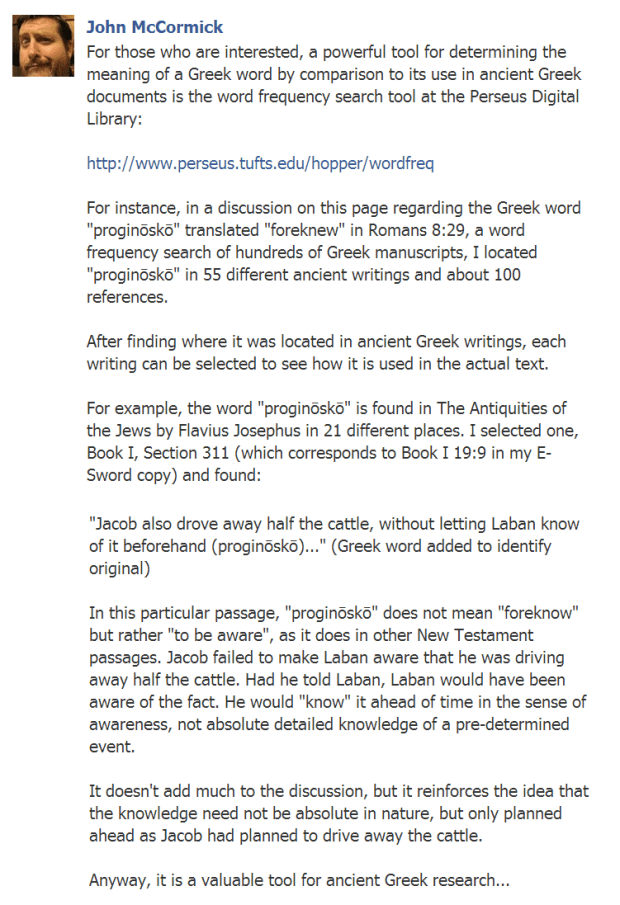
A Greek Resource

From Facebook group Open Theism:

For those who are interested, a powerful tool for determining the meaning of a Greek word by comparison to its use in ancient Greek documents is the word frequency search tool at the Perseus Digital Library:

http://www.perseus.tufts.edu/hopper/wordfreq

For instance, in a discussion on this page regarding the Greek word “proginōskō” translated “foreknew” in Romans 8:29, a word frequency search of hundreds of Greek manuscripts, I located “proginōskō” in 55 different ancient writings and about 100 references.

After finding where it was located in ancient Greek writings, each writing can be selected to see how it is used in the actual text.

For example, the word “proginōskō” is found in The Antiquities of the Jews by Flavius Josephus in 21 different places. I selected one, Book I, Section 311 (which corresponds to Book I 19:9 in my E-Sword copy) and found:

“Jacob also drove away half the cattle, without letting Laban know of it beforehand (proginōskō)…” (Greek word added to identify original)

In this particular passage, “proginōskō” does not mean “foreknow” but rather “to be aware”, as it does in other New Testament passages. Jacob failed to make Laban aware that he was driving away half the cattle. Had he told Laban, Laban would have been aware of the fact. He would “know” it ahead of time in the sense of awareness, not absolute detailed knowledge of a pre-determined event.

It doesn’t add much to the discussion, but it reinforces the idea that the knowledge need not be absolute in nature, but only planned ahead as Jacob had planned to drive away the cattle.

Anyway, it is a valuable tool for ancient Greek research…

open theism

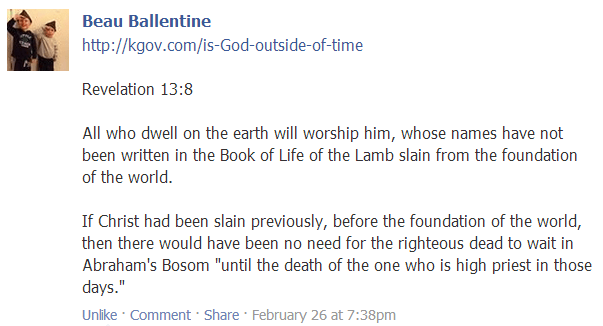
Book of Life Implications

From Beau Ballentine on the official God is Open Facebook group:

Revelation 13:8

All who dwell on the earth will worship him, whose names have not been written in the Book of Life of the Lamb slain from the foundation of the world.

If Christ had been slain previously, before the foundation of the world, then there would have been no need for the righteous dead to wait in Abraham’s Bosom “until the death of the one who is high priest in those days.”

god is open

Olson Explains Difference Between Open Theism and Process Theology

Roger Olson, a classical Arminian, defends Open Theism from those who would call it Process Theology:

So what are the differences? All open theists affirm creatio ex nihilo while process theology denies it. All open theists affirm God’s omnipotence while process theology denies it. All open theists affirm the supernatural and miracles while most, if not all, process theologians deny them. Open theists all say that God limits himself; process theology represents God as essentially limited and finite. The only point on which they agree is about God’s knowledge of the future, but even there one finds profound differences. For example, according to open theists the openness of the future even for God is due to God’s self-limitation in creation. According to all open theists, God could know the future exhaustively and infallibly IF he chose to create a world with a closed future (as in divine determinism).

For full post, click here.

Olson Defines Process Theology

Roger Olson provides a definition of Process Theology:

In spite of recent misuses of the term (and concept), historically process theology has ALWAYS meant belief that God and the world are necessarily ontologically interdependent (panentheism) and that this interdependence is NOT due to any voluntary self-limitation on God’s part. God is essentially limited, not omnipotent and CANNOT act unilaterally coercively to cause events in a supernatural way. (I could add that most process theologians are not classical trinitarians and do not believe in the classical hypostatic union or many other elements of traditional Christian orthodoxy.)

…But [Open Theism] is not process theology… as I have argued over and over to anyone who will listen, they are not the same.

For full post, click here.

Apologetics Thursday – Calvinist Prooftext Roundup

From Facebook group Open Theism. Adapted from a series of posts by John McCormick in response to the following Calvinist post:

I’m a determinist, I believe that libertarian free will is unBiblical.
I love God and love the Bible, I just want to be more Biblical in my life
and my theology.

Here are a few verses supporting determinism: (there many more)

Psalm 33:10-11
The LORD fails the plans of the nations; he thwarts the purposes of the
peoples. But the plans of the LORD stand firm forever, the purposes of his heart through all generations. (immutability)

Lamentations 3:37-38
“Who can speak and have it happen if the Lord has not decreed it?” (this verse is a tough one to make it say it’s opposite)

Proverbs 19:21
“Many are the plans in a man’s heart, but it is the Lord’s purpose that prevails.”(God is in control not us)

Deuteronomy 32:39
See now that I, I am He, and there is no god besides Me; it is I who puts to death and gives life. I have wounded, and it is I who heals; and there is no one who can deliver from My hand. (God claims credit for life,death, wounding)

Daniel 4:35
He does as He pleases with the powers of heaven and the peoples of the earth. No one can hold back his hand or say to him: ‘What have you done? (Do we really think we can change God)

1 Pe 4:19
Therefore let those who suffer according to God’s will entrust their souls to a faithful Creator while doing good (God makes people suffer, for his good purpose)

Act 4:28
to do whatever your hand and your plan had predestined to take place. (Our ways and decisions are set according to His will)

Eph 1:9
making known to us the mystery of his will, according to his purpose, which he set forth in Christ (According to his purpose or ours)

Eph 2:8
For by grace you have been saved through faith. And this is not your own doing; it is the gift of (Not our doing but his, not our choice but his)

Isa 14:27
For the Lord of hosts has purposed,
and who will annul it?
His hand is stretched out,
and who will turn it back
(How silly for us to think God changes depending on our decisions)

Isa 46:10
declaring the end from the beginning
and from ancient times things not yet done,
saying, ‘My counsel shall stand,
and I will accomplish all my purpose,’
(The end from the beginning not the beginning from the end)

John 15:5
I am the vine; you are the branches. Whoever abides in me and I in him, he it is that bears much fruit, for apart from me you can do nothing
(does nothing really mean nothing, yes. What about in Greek, yes)

Pro 16:4
The Lord has made everything for its purpose,
even the wicked for the day of trouble(God makes the wicked for a purpose, sounds like God makes everything)

Rom 9:11
though they were not yet born and had done nothing either good or bad—in order that God’s purpose of election might continue, not because of works but because of him who calls— (wow one kid didn’t even get a chance to change Gods mind with his works)

Rom 9:18
So then he has mercy on whomever he wills, and he hardens whomever he wills(Yes God hardens hearts)

Eph 1:11
In him we have obtained an inheritance, having been predestined according to the purpose of him who works all things according to the counsel of his will.
(According to his purpose, who will ALL things, not some things)(predestined, even in GreeK it means limiting beforehand)

Determinism wins?

I’ll address each of the passages you posted regarding Open Theism versus determinism…

======================================
Psalm 33:10-11
The LORD fails the plans of the nations; he thwarts the purposes of the peoples. But the plans of the LORD stand firm forever, the purposes of his heart through all generations. (immutability)
======================================
ANSWER: Immutability does not imply determinism. Nor is this strong immutability. This is described as “weak immutability” or constancy of God’s character.

Nor does this show determinism. It simply shows that God makes plans and has the power to cause those plans to happen despite the purposes of humans, and that He stands firm on those plans and won’t change His mind.

His plans as recorded in Scripture, which He gave to His prophets, were couched in symbolic terminology. God could match many situations to those plans and there still be only a single possible fulfillment. Thus history only had to be manipulated in a simple manner to accomplish His grand design, while the minor details were not important.

I like to say that God controls the macro-events while we get to control micro-events.

======================================
Lamentations 3:37-38
“Who can speak and have it happen if the Lord has not decreed it?” (this verse is a tough one to make it say it’s opposite)
======================================
ANSWER: Contextually, the Lamentations is a poetic genre, and this passage is rhetorical in nature. It asks a question related to the rest of the passage.

Lamentations 3:34-37
(34) To bring down under his feet all the prisoners of the earth,
(35) to turn aside the judgment of a man before the face of the Most High,
(36) to condemn a man unjustly in his judgment which the Lord has not given commandment.
(37) Who has thus spoken, and it has come to pass? the Lord has not commanded it.

The context is that God has made a declaration of judgment, but someone is trying to countermand His judgment. The question asks how anyone can countermand what God has commanded.

What this passage does not say is that God decrees everything that someone speaks which happens.

If we take a verse out of its context, it can lead us far astray from what the passage was originally meant to say.

======================================
Proverbs 19:21
“Many are the plans in a man’s heart, but it is the Lord’s purpose that prevails.”(God is in control not us)
======================================
ANSWER: This doesn’t say that God is in control, not us. It says that when there is a difference of opinion, God has the power to cause His purpose to prevail. It doesn’t suggest that people cannot make plans happen at all. It just means they can’t do anything in opposition to God’s plan.

======================================
Deuteronomy 32:39
See now that I, I am He, and there is no god besides Me; it is I who puts to death and gives life. I have wounded, and it is I who heals; and there is no one who can deliver from My hand. (God claims credit for life,death, wounding)
======================================
ANSWER: All true, but this offers no argument in favor of determinism. It simply says that He has the ultimate power.

The translation you use has a bit of bias. Here’s a better translation, the Young’s Literal Translation, which often provides a more accurate translation of a passage:

Deuteronomy 32:39
(39) See ye, now, that I — I [am] He, And there is no god with Me: I put to death, and I keep alive; I have smitten, and I heal; And there is not from My hand a deliverer…

As can be seen from the literal translation, it doesn’t imply that every life and death are personally caused by God. What it plainly states is that He has the power to wound, kill, or make alive and nobody can prevent Him because nobody is as powerful as He.

======================================
Daniel 4:35
He does as He pleases with the powers of heaven and the peoples of the earth. No one can hold back his hand or say to him: ‘What have you done? (Do we really think we can change God)
======================================
ANSWER: Again, all this demonstrates is that nobody can resist His power. It doesn’t mean that God does not change in the simple sense that He hears what we say.

You should study immutability, particularly the logical flaws of the strong immutability theory. Here’s a great resource to do that:

http://www.iep.utm.edu/div-immu/#H3

When you read the passages put forth against Open Theism, consider whether they ABSOLUTELY refute the element they are said to refute, or if it has a wider possible interpretation. It’s also best to try to examine, if possible, every passage in regards to the original languages of Scripture within the context of those cultures.

For instance, the ancient Hebrew culture did not have the concept of eternity or infinity. Those “absolutes” were not known at that time, and the first evidence of that concept didn’t occur until around the time of Christ. It didn’t even originate with Greek philosophy, though the idea of eternity/infinity was further developed in that culture.

So when we look at “eternity” in the Old Testament, we need to understand that the ancient Hebrews didn’t know of the absolute form of eternity or infinity, so we can’t use that concept in passages which appear to speak of eternity. They only understood the future as the “vanishing point”, or further than they could see.

======================================
1 Pe 4:19
Therefore let those who suffer according to God’s will entrust their souls to a faithful Creator while doing good (God makes people suffer, for his good purpose)
======================================
ANSWER: Ditto earlier arguments. This indicates God’s will dominates over all others, but not that He necessarily makes everything happen.

Think of it this way. My children when young suffered according to my will, because I had more power (and knowledge). When they did not do good, I punished them and they had no power to resist. But my children could do things without my guidance. My power over them didn’t mean that they couldn’t function independently, but only that when our wills clashed, mine would prevail.

======================================
Act 4:28
to do whatever your hand and your plan had predestined to take place. (Our ways and decisions are set according to His will)
======================================
ANSWER: Again, context is important.

Acts 4:24-28
(24) and they having heard, with one accord did lift up the voice unto God, and said, `Lord, thou art God, who didst make the heaven, and the earth, and the sea, and all that are in them,
(25) who, through the mouth of David thy servant, did say, Why did nations rage, and peoples meditate vain things?
(26) the rulers of the land stood up, and the rulers were gathered together against the Lord and against His Christ;
(27) for gathered together of a truth against Thy holy child Jesus, whom Thou didst anoint, were both Herod and Pontius Pilate, with nations and peoples of Israel,
(28) to do whatever Thy hand and Thy counsel did determine before to come to pass.

This passage, taken alone, may seem to suggest that everything is predestined.

However, within context, it’s plain that this passage is restricted to the particular event where the people of Israel, their leaders, as well as Herod and Pontius Pilate, gathered together to put Jesus to death.

======================================
Eph 1:9
making known to us the mystery of his will, according to his purpose, which he set forth in Christ (According to his purpose or ours)
======================================
ANSWER: This indicates that God has a plan. It doesn’t mean that EVERYTHING that happens EVERYWHERE is part of that plan, in a deterministic sense.

God made a plan that entailed certain things: That He would demonstrate His love through the nation of Israel, which was the vessel through which He would walk among us, but that His own people would reject Him, to sacrifice Him on the Cross, that He would rise in victory and show God’s glory to all.

That’s a gross simplification of His plan, but even so, we can see that it doesn’t include infinite detail. It doesn’t specify who all the players would be nor exact dates or times. Around His plan many billions of personal choices were made by humans that had no direct bearing on or direct connection to His plan.

So demonstrating that God has a Plan or that God makes things occur according to His Plan, according to His purpose, is no argument for determinism.

======================================
Eph 2:8
For by grace you have been saved through faith. And this is not your own doing; it is the gift of (Not our doing but his, not our choice but his)
======================================
ANSWER: This passage doesn’t speak of choice at all.

God made salvation available freely. We can’t work for that gift, because it’s not available through works.

BUT, we do make the choice to accept that gift, which it plainly states in this passage: “you have been saved through faith”. It’s not God’s faith that receives that free gift, but our own. Gifts are free to reject. Nobody is forced to take a gift or it’s not a gift. If we don’t have the choice to refuse the gift or accept it as our will decides, then it’s no gift but a penalty.

Faith indicates a free-will choice to accept or refuse the free gift of salvation.

======================================
Isa 14:27
For the Lord of hosts has purposed, and who will annul it?
His hand is stretched out, and who will turn it back (How silly for us to think God changes depending on our decisions)
======================================
ANSWER: Your conclusion makes the unwarranted assumption that God has purposed EVERY single event.

But it doesn’t. It simply states as noted previously that WHEN God purposes a thing, nobody can change it. That’s an indication of the greatness of His power, not an indication of the scope of the use of that power.

After finishing my commentary on the passages you posted, I’ll post some passages which prove that Open Theism is correct.

======================================
Isa 46:10
declaring the end from the beginning and from ancient times things not yet done, saying, ‘My counsel shall stand,
and I will accomplish all my purpose,’ (The end from the beginning not the beginning from the end)
======================================
ANSWER: He DECLARES the end from the beginning. He states what is going to happen–not in EVERY DETAIL, because that is in no way implied–but only according to His plan.

======================================
John 15:5
I am the vine; you are the branches. Whoever abides in me and I in him, he it is that bears much fruit, for apart from me you can do nothing (does nothing really mean nothing, yes. What about in Greek, yes)
======================================
ANSWER: Again, “context is king”.

John 15:1-8
(1) `I am the true vine, and my Father is the husbandman;
(2) every branch in me not bearing fruit, He doth take it away, and every one bearing fruit, He doth cleanse by pruning it, that it may bear more fruit;
(3) already ye are clean, because of the word that I have spoken to you;
(4) remain in me, and I in you, as the branch is not able to bear fruit of itself, if it may not remain in the vine, so neither ye, if ye may not remain in me.
(5) `I am the vine, ye the branches; he who is remaining in me, and I in him, this one doth bear much fruit, because apart from me ye are not able to do anything;
(6) if any one may not remain in me, he was cast forth without as the branch, and was withered, and they gather them, and cast to fire, and they are burned;
(7) if ye may remain in me, and my sayings in you may remain, whatever ye may wish ye shall ask, and it shall be done to you.
(8) `In this was my Father glorified, that ye may bear much fruit, and ye shall become my disciples.

First, even if we were to accept that nothing in this context means that not one single thing they ever did happened apart from Jesus’ control, this passage doesn’t apply to all of mankind. This is part of a private speech between Jesus and His Twelve Disciples. So if a determinist argues that “nothing” applies in the extreme sense, they can hardly then argue logically against the extreme sense that it applied only to the Twelve Apostles.

But nothing in this context doesn’t really mean “nothing at all”. It’s “nothing” restricted to the context of the passage. The disciples could do nothing WHEN IT CAME TO THE MATTER OF BEARING SPIRITUAL FRUIT (vs. 4). Nothing in the context indicates that the “nothing” in verse 5 refers to all things whatsoever. That would go beyond the thesis of the passage.

======================================
Eph 1:11
In him we have obtained an inheritance, having been predestined according to the purpose of him who works all things according to the counsel of his will.
(According to his purpose, who will ALL things, not some things)(predestined, even in GreeK it means limiting beforehand)
======================================
ANSWER: Literally this is translated,

Ephesians 1:11
(11) in whom also we did obtain an inheritance, being foreordained according to the purpose of Him who the all things is working according to the counsel of His will,

It simply means that He manipulates all things which are necessary to obtain the ends He has chosen. It doesn’t mean that God specifically manipulates absolutely every single thing.

Predestined DOES mean “limited beforehand” or “to limit in advance”. In other words, God chose use His power to limit how salvation would work in the future.

The word “predestined” doesn’t mean that people are individually “limited in advance” to become believers. It means that He generally chose that there would be believers, thus any who fit in that category fit within the limit He has set. They fit into that category by making a free-will decision to serve God.

======================================
Pro 16:4
The Lord has made everything for its purpose, even the wicked for the day of trouble(God makes the wicked for a purpose, sounds like God makes everything)
======================================
ANSWER: Look at the passage carefully. God made everything for ITS PURPOSE. Not God’s purpose (at least in this passage).

In Hebrew it says that God made everything for “reply”, which is a way of saying that it answers to its purpose.

This is simply saying that the Universe and everything in it was designed by God–with which Open Theism does not disagree–and that wickedness has a purpose as well. (The term for “wicked” is generic, not specifically referring to people but just moral wickedness.)

This passage is as much in favor of Open Theism as it is for determinism.

======================================
Rom 9:11
though they were not yet born and had done nothing either good or bad—in order that God’s purpose of election might continue, not because of works but because of him who calls— (wow one kid didn’t even get a chance to change Gods mind with his works)
Rom 9:18
So then he has mercy on whomever he wills, and he hardens whomever he wills(Yes God hardens hearts)
======================================
ANSWER: This is a complex passage, but suffice to say that it has been misused in favor of determinism when it doesn’t really say what most people think.

When the entire passage is viewed in context, this has nothing to do with salvation or pre-destination, except in the weak sense that God had a basic plan that happened to be fulfilled in Esau and Jacob.

Here we have to look back to the analogy of parent/small child compared to God/humans.

At some point God chose to use Abraham, then Isaac rather than Ishmael, and then Jacob rather than Esau. But like a father direct his children, the children lived lives of many choices and decisions which weren’t directly related to God’s plan. Yes, God affected the path of their lives, as a parent directs a child into particular paths.

But God’s direction of major events according to His plan affected neither their basic free-will right to choose nor their free-will ability to choose salvation. He did not reject Ishmael or Esau’s salvation, only their pre-eminence within His plan. They still had the opportunity to live righteously or not, and to live eternally with Him.

At the time of their birth the only promise they had was that Esau would serve Jacob, which is not necessarily a bad thing. It’s not a condemnation of Esau in any way. It was simply that one would be pre-eminent between the two.

If you look in Scripture, God’s statement “Jacob have I loved, but Esau I have hated” (from Malachi 1:2-3) came long after the ends of their lives and referred not to Jacob and Esau as individual persons, but to Israel and Edom. Edom was the nation which descended from Esau. God “hated” that nation–or chose not to bless it as a corporate group–while still loving the individual Edomites. That “hatred” was simply a distinction of choice between nations, not “hatred” in the sense opposite to love.

Numerous theologians have pointed out that “hated” or “hatred” by God in passages like these don’t carry the absolute meaning of “hated”, but rather means the absence of an extra-special love or generally means “less love”. Evidence of this can be found in Genesis 29:30-33, Matthew 10:37, Luke 14:26, John 12:25, et al.

Verse 18 speaks of God choosing to harden hearts or have mercy as He wills. Yet we know from other passages that His mercy is universal in scope.

In the best example from Scripture, Pharoah wouldn’t let the Israelites go to worship in the wilderness. Throughout the entire account, God and Pharoah took turns hardening Pharoah’s heart…but Pharoah’s wickedness was a pre-existing condition. He was headed away from God by his own choice.

John 12:40 paraphrases Isaiah 6:10 to say that God hardened the hearts of the children of Israel, “…that they should not see with their eyes, nor understand with their heart, and be converted, and I should heal them.” Yet many of those whose hearts were hardened still turned to the Lord in the end, so this wasn’t a wholesale condemnation of these people to Hell by God without a just opportunity for them to choose Him. God manipulated their hearts so that His purpose would be achieved, because that nation had sinned against Him corporately. Thus He blinded them to the truth until it was time for the truth (i.e. Jesus the Messiah) to be revealed.

Yet we don’t know how the hardening of the hearts took place in any of these situations. A determinist might assume that God directly manipulated their hearts. An Open Theist would believe that God manipulated the situation to harden their hearts, without compromising their free-wills. The question is which does Scripture support.

Since we know that God is both loving and just, we know that He would not condemn a person to an eternal place in Hell without giving that person a real opportunity to choose Him. God is long-suffering as well, so we know there is abundant opportunity for every person to choose to serve God.

Scripture supports this idea by proclaiming God’s righteousness, love, and justice, then defining what those terms mean for human beings. If they are defined materially different for God, then there is cognitive dissonance, a condition in which Scripture becomes nonsense and is certainly not true.

Again, when we look at passages which support Open Theism we’ll see that there is abundant evidence that Scripture supports free-will and God’s love over determinism and an arbitrary capricious puppetmaster of a God.

Clement on Simplicity

Clement of Alexandria, Miscellanies 5:12, 208 AD

No one can rightly express him wholly. For on account of his greatness he is ranked as the All, and is the Father of the universe. Nor are any parts to be predicated of him. For the One is indivisible; wherefore also it is infinite, not considered with reference to inscrutability, but with reference to its being without dimensions, and not having a limit. And therefore it is without form.

The Calvinist Definition of Sovereignty Is Idiosyncratic

Reposted comment from Roger Olson:

There is no “sovereignty” in human experience like the “sovereignty” Calvinists insist we must attribute to God in order “really” to believe in “God’s sovereignty.” In ordinary human language “sovereignty” NEVER means total control of every thought and every intention of every subject. And yet it has become a Calvinist mantra that non-Calvinists “do not believe in God’s sovereignty.” I have a tape of a talk where R. C. Sproul says that Arminians “say they believe in God’s sovereignty” but he goes on to say “there’s precious little sovereignty left” (after Arminians qualify it). And yet he doesn’t admit there (or anywhere I’m aware of) that his own view of God’s sovereignty (which I call divine determinism) is not at all like sovereignty as we ordinarily mean it. That’s like saying of an absolute monarch who doesn’t control every subject’s every thought and intention and every molecule in the universe that he doesn’t really exercise sovereignty. It’s an idiosyncratic notion of “sovereignty.”

For original quote, click here.

Johnson Explains Open Theism

From Kurt Johnson‘s blog. Kurt gives his own definition of Open Theism:

Open Theists believe that God has made beings (humans, at least, & probably angels) with a free-will. They believe that God has created us with the ability to choose. They don’t think that we are always freely choosing, but when we are freely choosing, we could have done other than we did. (Read that last sentence one more time.) This is what Open Theists mean for us to have a free-will. It’s a will that is truly free to go one way or another. (This is a view of free-will that is shared by most Arminians and is called a libertarian view of free-will.)

For full post, click here.

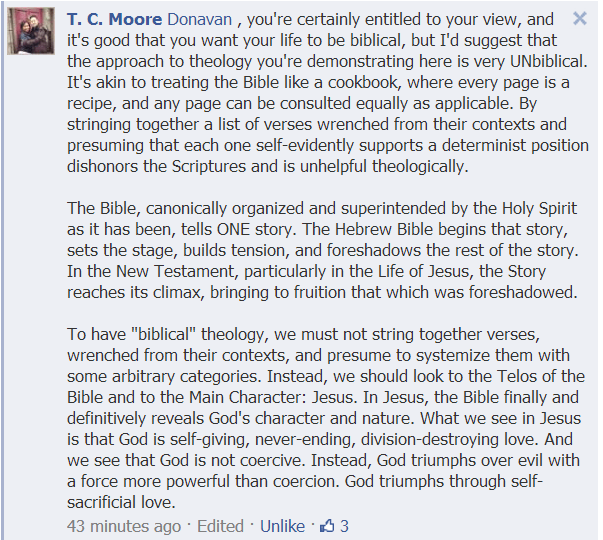
TC Moore on Context

TC Moore of Theological Graffiti addresses a “cookbook” of verses proffered by a Calvinist. From Facebook group Open Theism:

T. C. Moore Donavan , you’re certainly entitled to your view, and it’s good that you want your life to be biblical, but I’d suggest that the approach to theology you’re demonstrating here is very UNbiblical. It’s akin to treating the Bible like a cookbook, where every page is a recipe, and any page can be consulted equally as applicable. By stringing together a list of verses wrenched from their contexts and presuming that each one self-evidently supports a determinist position dishonors the Scriptures and is unhelpful theologically.

The Bible, canonically organized and superintended by the Holy Spirit as it has been, tells ONE story. The Hebrew Bible begins that story, sets the stage, builds tension, and foreshadows the rest of the story. In the New Testament, particularly in the Life of Jesus, the Story reaches its climax, bringing to fruition that which was foreshadowed.

To have “biblical” theology, we must not string together verses, wrenched from their contexts, and presume to systemize them with some arbitrary categories. Instead, we should look to the Telos of the Bible and to the Main Character: Jesus. In Jesus, the Bible finally and definitively reveals God’s character and nature. What we see in Jesus is that God is self-giving, never-ending, division-destroying love. And we see that God is not coercive. Instead, God triumphs over evil with a force more powerful than coercion. God triumphs through self-sacrificial love.

open theism

Man-Centered Rhetorical Device

In an article entitled Why Does John Piper Misrepresent Evangelical Arminianism?, the author points out that Calvinists resort to rhetorical devices in order to boaster their claims:

The other interpretation both Calvinists and Arminians would disagree with and that is “man-centered” means that the entire plan of salvation was brought about by the will of man and that he does something significant in himself to make salvation happen. That kind of “man-centered” soteriology is clearly rejected by Arminians. So one is left wondering what point there is in claiming Arminianism is “man-centered” unless it’s only being used as a rhetorical device.

For full post, click here.

Jesus and Election

By Christopher Fisher

1Pe 1:1 Peter, an apostle of Jesus Christ, to the strangers scattered throughout Pontus, Galatia, Cappadocia, Asia, and Bithynia,
1Pe 1:2 Elect [eklektos] according to the foreknowledge of God the Father, through sanctification of the Spirit, unto obedience and sprinkling of the blood of Jesus Christ: Grace unto you, and peace, be multiplied.

In 1 Peter 2, Peter writes that people were “chosen” or “elect” according to the foreknowledge of God the Father. In the Augustinian mindset, this is some sort of predetermination of people, almost like a guest-list of people that will be saved. But this is not at all how Jesus uses the word “elect”.

Two times in Matthew, Jesus states “For many are called, but few are chosen.” Context is key to understanding this phrase. In both contexts, Jesus illustrates with a parable. In no context does the events indicate the Augustinian interpretation of election.

In Matthew 22 is found the parable of the wedding feast. It is a very odd story:

Mat 22:2 “The kingdom of heaven is like a certain king who arranged a marriage for his son,
Mat 22:3 and sent out his servants to call those who were invited to the wedding; and they were not willing to come.
Mat 22:4 Again, he sent out other servants, saying, ‘Tell those who are invited, “See, I have prepared my dinner; my oxen and fatted cattle are killed, and all things are ready. Come to the wedding.” ‘
Mat 22:5 But they made light of it and went their ways, one to his own farm, another to his business.
Mat 22:6 And the rest seized his servants, treated them spitefully, and killed them.
Mat 22:7 But when the king heard about it, he was furious. And he sent out his armies, destroyed those murderers, and burned up their city.

A rich man is hosting a wedding for his son and invites all the guests. The feast is prepared and waiting for the guests. All the guests had to do was show up. The invitation is made on several occasions. Eventually some individuals even kill the messengers; the king extracts swift vengeance on the murderers.

Mat 22:8 Then he said to his servants, ‘The wedding is ready, but those who were invited were not worthy.
Mat 22:9 Therefore go into the highways, and as many as you find, invite to the wedding.’
Mat 22:10 So those servants went out into the highways and gathered together all whom they found, both bad and good. And the wedding hall was filled with guests.

The banquet is prepared, but was been refused by the normal guests. The king has to change his plan and then outreach to the masses in order to fill his banquet table. He invites anyone and everyone. But some who came to the wedding, were not suitably dressed:

Mat 22:11 “But when the king came in to see the guests, he saw a man there who did not have on a wedding garment.
Mat 22:12 So he said to him, ‘Friend, how did you come in here without a wedding garment?’ And he was speechless.
Mat 22:13 Then the king said to the servants, ‘Bind him hand and foot, take him away, and cast him into outer darkness; there will be weeping and gnashing of teeth.’

The “rich” man, who could afford to dress nicely but declined, that is the one who was thrown out of the banquet. It is in this context that Jesus states:

Mat 22:14 “For many are called, but few are chosen.” [eklektos]

This is not at all what the Calvinists think of when they talk about election.

The parable mirrors Jesus’ gospel of the Kingdom. God reached out to convince mainstream Israel to be saved, but they declined. God reached out to them time and time again. But they responded with rejection and murder of God’s prophets. God then responds by broadening His invitations for salvation, reaching out to all classes of society (Jesus’ primary ministry was to the sinners). Some of these people respond, but not all of them in an acceptable fashion. God casts those individuals out. The remaining are “elect”. Election is not a guest-list filled with approved names. The idea is the exact opposite. Election is about individuals choosing God.

Worship Sunday – Everything Glorious

Everything Glorious by David Crowder Band

Lyrics:

The day is brighter here with You
The night is lighter than it’s hue
Would lead me to believe
Which leads me to believe

(chorus)
You make everything glorious
And I am Yours
What does that make me?

My eyes are small but they have seen
The beauty of enormous things
Which leads me to believe
There’s light enough to see that

(chorus)
You make everything glorious
And I am Yours

From glory to glory
You are glorious You are glorious
From glory to glory
You are glorious. You are glorious
Which leads me to believe
Why I can believe that

You make everything glorious
And I am Yours
You make everything glorious
And I am Yours

From glory to glory From glory to glory
You are glorious. You are glorious.

You make everything glorious
And I am Yours

Gerrard Reminds Us to Seek God

Jamie RA Gerrard of Radical Reformation points out that the Bible tells us to seek God:

Reformed Christians aka Calvinists, Lutherans and others teach man has lost his free-will due to the fall and can no longer seek God. (Lets see what scripture says.)

“But if from thence thou shalt seek the LORD thy God, thou shalt find him, if thou seek him with all thy heart and with all thy soul.” Deuteronomy 4:29

“Seek the LORD, and his strength: seek his face evermore.” Psalm 105:4

“Seek ye the LORD while he may be found, call ye upon him while he is near:” Isaiah 55:6

“But seek ye first the kingdom of God, and his righteousness; and all these things shall be added unto you”. Matthew 6:33

”And I say unto you, Ask, and it shall be given you; seek, and ye shall find; knock, and it shall be opened unto you. 10 For every one that asketh receiveth; and he that seeketh findeth; and to him that knocketh it shall be opened.” Luke 11:9, 10

“God that made the world and all things therein,….hath determined… That they should seek the Lord, if haply they might feel after him, and find him, though he be not far from every one of us…” Acts 17:22-31

Oh wow! God has determined that we should seek him. I recommend reading the whole of Pauls sermon on Mars Hill as it destroys Calvinism.

For full post, click here.

Calvinists Redefine Words

From the Society of Evangelical Arminians, from a post about how Romans 11 has nothing to do with “double predestination”:

Truly, this passage should be an eye opener for those who have not taken God’s salvific, propitiatory agape love for the entire world (John 3:16; cf. 1 John 2:2) seriously enough. In short, if Rom 11:5-7 is not describing the reprobate of Calvinistic double predestination then it is safe to say that there are no such people. What Calvin meant by terms like “elect” and “chosen” and “hardened” has nothing to do with what Paul meant by these terms. The Calvinist system is foreign to Paul and twists Paul’s terms to mean things that they never meant.

For full post, click here.

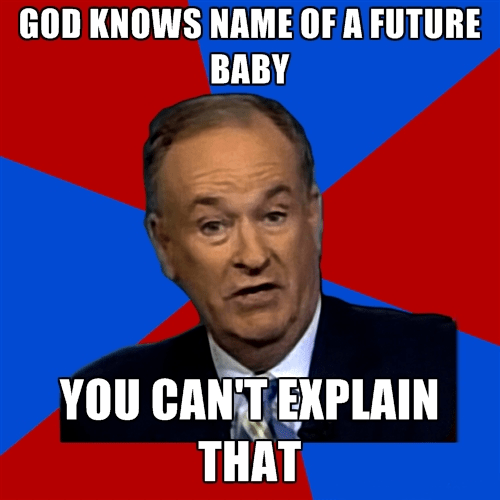
Apologetics Thursday – How God Names Babies

In Bruce Ware’s God’s Lesser Glory: The Diminished God of Open Theism, Ware is giving evidence that God knows the future when as a side note he writes:

Even more remarkable is the prediction of a future king to whom God gave the name Cyrus nearly 200 years before his parents gave him that exact name.

Ware, here, is perplexed that God could know a name of a baby 200 years in advance. In Ware’s mind, there is no other way to know the name of a future baby than to meticulously see the entire future.

In real life, there are plenty of ways to ensure a baby is named what you desire. You could pay the parents. You could threaten the parents. You could convince the parents. You could publish a popular nickname for someone, supplanting their given name. The possibilities are endless. God is powerful, ensuring a name of a future baby does not seem as impressive as Ware would have us believe. The text itself is found deep in a long series of chapters proclaiming God’s power (Isaiah 40-48). In the text, the author stresses the point God knows what will happen because God is powerful and He will bring it to past. The text is the exact opposite of Ware’s understanding: that God knows what will happen because He mystically sees the future. That the text stresses God’s power as the mechanism makes it antithetical to the knowledge mechanism. It is evidence against the Augustinian view of God!

But all this aside, Ware ignores very similar events in the Bible: the naming of both Jesus and John the Baptist.

Jesus’ naming was easy. God sends an angel to Mary and the angel tells Mary what to name Jesus:

Mat 1:21 And she will bring forth a Son, and you shall call His name JESUS, for He will save His people from their sins.”

Being told by an angel what to name her child is convincing enough for Mary. Mary promptly names her child “Jesus”. Could Cyrus’ parents have had an angelic visit? If God controlled all things, as some Calvinists claim, why would God have to convince Mary in the first place? Mary had a free choice as to naming Jesus and chose the name provided by God.

Another naming story occurs in the person of John the Baptist. In Luke 1, a priest named Zacharias encounters an angel. The angel prophecies that Zacharias would have a son and call his name John:

Luk 1:13 But the angel said to him, “Do not be afraid, Zacharias, for your prayer is heard; and your wife Elizabeth will bear you a son, and you shall call his name John.

Zacharias waxes skeptical. He does not believe he will have a son. Zacharias points out he is old. The angel responds by striking Zacharias mute until the things that are prophesied are completed:

Luk 1:18 And Zacharias said to the angel, “How shall I know this? For I am an old man, and my wife is well advanced in years.”
Luk 1:19 And the angel answered and said to him, “I am Gabriel, who stands in the presence of God, and was sent to speak to you and bring you these glad tidings.
Luk 1:20 But behold, you will be mute and not able to speak until the day these things take place, because you did not believe my words which will be fulfilled in their own time.”

Not only was Zacharias struck mute but he was also given an implicit threat. Zacharias would have the child, but would only be granted the ability to speak once the child was properly named. This is precisely what happens:

Luk 1:24 Now after those days his wife Elizabeth conceived…

Luk 1:57 Now Elizabeth’s full time came for her to be delivered, and she brought forth a son.
Luk 1:58 When her neighbors and relatives heard how the Lord had shown great mercy to her, they rejoiced with her.
Luk 1:59 So it was, on the eighth day, that they came to circumcise the child; and they would have called him by the name of his father, Zacharias.
Luk 1:60 His mother answered and said, “No; he shall be called John.”
Luk 1:61 But they said to her, “There is no one among your relatives who is called by this name.”
Luk 1:62 So they made signs to his father—what he would have him called.
Luk 1:63 And he asked for a writing tablet, and wrote, saying, “His name is John.” So they all marveled.
Luk 1:64 Immediately his mouth was opened and his tongue loosed, and he spoke, praising God.

Notice that it is exactly after the moment that Zacharias names John that he is allowed to speak again. Zacharias had already been proven wrong about his wife getting pregnant. For at least 9 months, Zacharias sat mute contemplating the angel’s words. When the angel stated “these things take place”, the angel was including the naming of John the Baptist. Implicit in Zacharias’ mind was that if he deviated from the angel’s instruction then he would not be granted voice. In other words, God coerced Zacharias into naming his son “John”.

God did not force Zacharias’ mouth to say “John”, and Zacharias could have still named John something else (presumably). But Zacharias weighed his options and preferred naming his son sensibly. God used power to fulfill His will.

This is how God can easily deal with an uncooperative agent. Because God is powerful, He can capture fleeing prophets in the mouths of fish and polymorph arrogant kings into wild beasts. What Calvinism does is downplay God’s power. God can only know things because He mystically sees the future, but that is not at all how the Bible depicts God. God knows things because He is powerful to achieve them. God can make these things happen in spite of human free will. When Ware assumes otherwise, he demeans God.

God-is-open

Morrell Points out Reflexive Verb

Act 13:48 Now when the Gentiles heard this, they were glad and glorified the word of the Lord. And as many as had been appointed to eternal life believed.

Speaking about Acts 13:48, Morrell points out the Greek word for appointed is in the “middle” voice. A literal translation would be “appointed themselves”. Morrell states:

3. Also notice the passive/middle ending “μένοι.” That means that ordained/disposed can be taken as something which was done to them (passive), in this case by the word, or something which they did to themselves (middle), in this case by allowing themselves to be properly influenced by the word. Given the context of this passage, especially in contrast with vs. 46 that uses the reflexive pronoun “ἑαυτοῦ” to say that they judged themselves unworthy of eternal life, this verb “τεταγμένοι” should be understood to be in the middle voice. Context is the only key in determining whether a verb is in the passive or in the middle, as the ending is identical.

For full post, click here.

Joel is Taken Out of Context

From a post by Craig Fisher:

Despite the popular songs that reference Joel 3:10 “Let the Weak say I am Strong” (such as “What the Lord has done in me” by Hillsong), this is not a call for the Christian to be strong. On the contrary, this is a taunt for the enemies of God to be gathered together at the Valley of Jehoshaphat for slaughter.

For full post, click here.

Will Duffy on the Tower of Babel

A Facebook post by Will Duffy, founder of the Collaborators Project on Facebook group God is Open:

In preparing for a Sunday School a few weeks back, I realized that the story of the Tower of Babel is evidence for Open Theism. The Bible states, “And the Lord said, ‘Indeed the people are one and they all have one language, and this is what they begin to do; now nothing that they propose to do will be withheld from them.'”

But wait, isn’t their every action already predetermined? What is there to worry about? If nothing they propose will be withheld from them, their future MUST be open. So what does God do? He makes a change. He actually changes His own design. His original design was one language and one speech on the entire earth. But now that has become problematic. So God changed His original plan and created multiple languages.

God was moved to change His own design due to man’s freedom. This story makes no sense if Calvinism is true..

god is open

Objections to New Calvinists

From Roger E Olson of Patheos:

So what is the “fundamentalism” in much contemporary American Calvinism that makes it so objectionable?… 1) a tendency to elevate most secondary doctrines, non-essential to being an orthodox Christian, to essential status, 2) a tendency to avoid Christian fellowship and cooperation with people who claim to be Christian but are not “like minded,” 3) a tendency to be highly suspicious of the spirituality of anyone who thinks differently about secondary and tertiary doctrines, however slight the disagreement may be, 4) a tendency to elevate to sacrosanct status a whole system of theology and consider any deviation from it as (at best) on a slippery slope toward apostasy, 5) a tendency to focus obsessively on one or more beliefs or practices that, in the larger scheme of orthodox Protestantism, is relatively minor (e.g., modern Bible translations that include inclusive language about human beings, pretribulation rapture, young earth creationism, etc.), 6) a tendency to be harshest (using the “rhetoric of exclusion”) toward those closest theologically but flawed doctrinally at one or a few points.

For full post, click here.

Arminius was Persecuted like Open Theists

From the Facebook group Arminians and Open Theists in Open Dialogue:

One of the heroic aspects of the character of James Arminius was his courage to follow his studies where they led. So filled with integrity was he that when asked to support Beza’s view of predestination and after researching it to prepare to defend it, he realized it was error. So he had to adopt the oppositional view. That cost him his reputation and standing. And cost others their lives and their homeland. Yet, Arminius was proven correct.

If an Arminian organization kicks out members for simply exploring OVT, how are they not spitting on the grave of the noble Arminius? How are they not adopting the same attitude as the kangaroo court of Dordt?

One of the egregious aspects of the Calvinist groups is how they use their Confessions as litmus tests for fellowship.
Another is how the idolize Calvin and TULIP.
I don’t idolize Arminius or any tradition. I value them, I benefit from them, but they are not God, and not scripture. And since they are human constructs they are subject to human revision.

god is open

A Piper Thought Experiment

From Kurt Johnson‘s blog. Kurt asks a reader to listen to one of John Piper’s videos and insert Calvinism wherever they hear “the Doctrines of Grace”. The point is to illustrate what happens when doctrine is elevated above the Bible:

Here is a selection of quotes from the video with “Calvinism” inserted for “The Doctrines of Grace”: (my emphasis added)

Calvinism is my life… the source of my life… the joy of my life… the sustaining foundation of my life… the hope, the end, the goal of my life.

If you love Calvinism, and you live it…

…and you want to commend Calvinism, remember that it is infinitely valuable…

…I pray that God will make Calvinism your life, the source of your life, the sustaining foundation of your life… the joy and the hope of your life.

For full post, click here.

Free Monday – Andriod Bible Software

While e-sword is the best free software for Windows, the best free software for Android is MySword (unrelated developers).

http://mysword.info/

The best free software for tablet Bible study is MySword. It is easy to use, supports many free Bibles (such as the KJV, the Majority Greek, the Critical Greek, the Septuagint, etc), hosts a good variety of commentaries, and includes various dictionaries. One of the best downloads is the Greek New Testament Byzantine with conjugations and declensions listed of all words:

2  Ἦσαν G1510 G5707 V-IAI-3P ὁμοῦ G3674 ADV Σίμων G4613 N-NSM Πέτρος G4074 N-NSM, καὶ G2532 CONJ Θωμᾶς G2381 N-NSM ὁ G3588 T-NSM λεγόμενος G3004 G5746V-PPP-NSM Δίδυμος G1324 N-NSM, καὶ G2532 CONJ Ναθαναὴλ G3482 N-PRI ὁ G3588 T-NSM ἀπὸ G575 PREP Κανᾶ G2580 N-PRI τῆς G3588 T-GSF Γαλιλαίας G1056 N-GSF, καὶG2532 CONJ οἱ G3588 T-NPM τοῦ G3588 T-GSM Ζεβεδαίου G2199 N-GSM, καὶ G2532CONJ ἄλλοι G243 A-NPM ἐκ G1537 PREP τῶν G3588 T-GPM μαθητῶν G3101 N-GPM αὐτοῦG846 P-GSM δύο G1417 A-NUI.

In the modern world, people no longer have to be able to know Greek to read it!

Calvin Never Loved His Father – Hosea 11

Guest post by Craig Fisher

God’s Continuing Love for Israel:

Hos 11:1 “When Israel was a child, I loved him, And out of Egypt I called My son.
Hos 11:2 As they called them, So they went from them; They sacrificed to the Baals, And burned incense to carved images.

Here is a summary of God’s message of the Old Testament prophets: I loved Israel, I called them, but they rejected Me. In this passage, Hosea is using a metaphor of parent to son to illustrate this concept. The purpose of a metaphor is to bring together two ideas that have points in common with one another. The dominant idea should not have to explained since it is a common association that almost everyone understands. The dominant idea in this metaphor is the concept of parenthood. Although some people might have negative ideas of parenthood (such as victims of abuse) even these people will have an understanding characteristics of a good parent. The comparative idea (in this case God’s love for Israel) will have points in common with the dominant idea (a father’s love for his son). A reader must take care, however, not to strain to metaphor: there will points not in common with the dominant idea.

When reading passages such as Hosea, the reader must establish a real and essential analogy between God and parent. Not only is the relationship real and essential but the relationship must be readily apparent or the purpose of the metaphor is lost. God wants us to focus on the intensity of the relationship. Parents love their offspring. The children are an extension of the parents’ self concept: their love, their ambitions, their joys, and their despairs. Children act as an extension of a parent, an autonomous and loved extension.

In the text, the rejection of the parent is felt intensely. The rejection is sudden and undeserved. The parent feels betrayed by the child yet the parent cannot sever the relationship because of love. This produces a mixed reaction from God. God wants to show his love and receive love back. God wants to draw near to the child. The child’s reaction is to draw farther away. As a parent, God would be justified in moving away from the child, but God has a conflict between His mercy and His justice.

Hos 11:3 “I taught Ephraim to walk, Taking them by their arms; But they did not know that I healed them.
Hos 11:4 I drew them with gentle cords, With bands of love, And I was to them as those who take the yoke from their neck. I stooped and fed them.

How do parents teach children to walk? The mother holds the baby by the arms as the infant struggles to maintain balance. The father reaches out daring the child to cross the small path between father and mother. The baby holds out his hands smiles and bravely steps toward a smiling and encouraging father while the mother softly gives sounds of encouragement from the rear. Sometimes the baby makes it, sometimes the baby falls. The father probably at first holds out his hand to help the baby cross from mother to dad. The scene is repeated time and time again until the baby is strong enough to walk alone.

The ritual is as old as man. Sometimes grandparents can even relive their own moments with their grandchildren. God wants to capture these memories (so precious in the relationship between parents and children) to demonstrate his love for Israel. “Remember these moments in your life”, God is saying, “this is the kind of love I feel for you.” This is in accordance to the introduction and the theme of this chapter, God is saying “I loved him”.

The dominant idea of the love of parent for child, the tenderness of the training, and the sense of accomplishment, praise and bonding between the parents and child is the theme of this metaphor. The metaphor contains real information about God. The essential and memorable character of the metaphor is analogous to the message and not contrary to the message.

The second image, although not as tender, is about a master and his beast of burden. In Old Testament times this image would be a familiar everyday occurrence. Today the image is strange and remote. A horse or an ox is controlled by the bridle in the mouth. The owner moves the bridle to cause pain in the mouth which turns the whole animal one way or the other. Often a horse or ox would feed while the bridle was still in their mouths. A merciful master lifts the yokes of the oxen to push the bit back from the neck and closer to the cheeks of the oxen. This allows the oxen to eat their food in comfort without the painful reminder of correction from the yoke. At night the yoke or bridle would be removed altogether to allow the ox to eat in peace. The master stoops and feeds the beast becoming the slave of the beast in a reversal of the roles during the day.

Hos 11:5 “He shall not return to the land of Egypt; But the Assyrian shall be his king, Because they refused to repent.
Hos 11:6 And the sword shall slash in his cities, Devour his districts, And consume them, Because of their own counsels.
Hos 11:7 My people are bent on backsliding from Me. Though they call to the Most High, None at all exalt Him.

The opposite of love in not hate but indifference. Often the most intense love affairs are ended in the heat of anger and personal vengeance. To be in love is to be vulnerable, to let down you defenses and show the need in your life for the recipient of your affections. This surrender of your most intimate moments only magnifies the betrayal of your trust when the event happens. It is impossible to understand the personal hurt and suffering of this betrayal without first knowing the love shared at the beginning of the relationship.

Hos 11:8 “How can I give you up, Ephraim? How can I hand you over, Israel? How can I make you like Admah? How can I set you like Zeboiim? My heart churns within Me; My sympathy is stirred.
Hos 11:9 I will not execute the fierceness of My anger; I will not again destroy Ephraim. For I am God, and not man, The Holy One in your midst; And I will not come with terror.

God has pronounced judgment. Ephraim or Israel will be destroyed. The sword will slash his people, many will die and the rest will be uprooted from the land and sent into exile. Or will they? God proceeds to rethink His judgment and repents. The word translated “churns” means “to overthrow” or “turn around”. The word is in the passive and has a more reflexive meaning (“overthrows itself” or “turns itself around”). To turn your heart around is to change your mind or repent. The word Nacham translated “sympathy” here can either mean comfort or repentance. God could be saying my repentance is stirred (more literal “warmed”) within me. The context supports either translation.

God pronounces judgment then He says “how can I give you up”, “how can I hand you over”. This is a change in the heart of God. If not a change it is at least some indecision, some reassessment of a prior decision. Admah and Zeboiim were the two cities that shared the fate of Sodom and Gomorrah. Admah and Zeboiim were not the cities of the chosen people of God. Because of their wickedness they deserved their fate. This will be a harder decision for God, to destroy a people so totally, a people with whom he had shared a special love.

Can the word again be supported by the text or is it a historical addendum by the translators. II Kings 15:29 describe the first invasion of Assyria into Israel:

2Ki 15:29 In the days of Pekah (740-732) king of Israel, Tiglath-Pileser king of Assyria came and took Ijon, Abel Beth Maachah, Janoah, Kedesh, Hazor, Gilead, and Galilee, all the land of Naphtali; and he carried them captive to Assyria.

This first invasion of Israel carried away a significant portion of Israel. It is believed Hosea prophesied sometime after 732 and before the final and second invasion of Israel (722) by Assyria:

II Kings 17: 3-6  Shalmaneser king of Assyria came up against him…5 Now the king of Assyria went throughout all the land, and went up to Samaria and besieged it for three years. 6 In the ninth year of Hoshea, the king of Assyria took Samaria and carried Israel away to Assyria, and placed them in Halah and by the Habor, the River of Gozan, and in the cities of the Medes.

2Ki 17:3 Shalmaneser king of Assyria came up against him…

2Ki 17:5 Now the king of Assyria went throughout all the land, and went up to Samaria and besieged it for three years.
2Ki 17:6 In the ninth year of Hoshea, the king of Assyria took Samaria and carried Israel away to Assyria, and placed them in Halah and by the Habor, the River of Gozan, and in the cities of the Medes.

The translators believed God meant “I will not destroy Israel again like the invasion in 732”. It is not as significant as God’s two statements “9 I will not execute the fierceness of My anger; I will not destroy Ephraim.” Of course, as supported by secular and Biblical history, God did destroy Israel and Ephraim in 722.

What happened? God changed his mind. He was going to destroy Israel but stopped short of total destruction because his love overcame his desire for judgment. He allowed Israel to have another chance. Perhaps their immanent destruction would change their hearts and minds. What we do know is that God did bring the destruction of Israel into play. After describing how Israel fell to the King of Assyria (II Kings 17:7) the Scripture state the cause for the fall: the sins of Israel.

A man would have the tendency to destroy and bring wrath against his former lover. God is not a man, He changes his mind and wants to allow Israel to have another chance. A chance they did not deserve. A chance that would fail.

Augustine and John Calvin would disagree with this analysis. They believe God never changes his mind:

But when he says that his heart was changed, and that his repentings were brought back again, the same mode of speaking after the manner of men is adopted; for we know that these feelings belong not to God; he cannot be touched with repentance, and his heart cannot undergo changes. To imagine such a thing would be impiety.

(Calvin’s Commentaries, Vol. 26: Hosea, tr. by John King, [1847-50], at sacred-texts.com)

First Calvin admits the Scriptures do say God’s heart was changed and he repented. This is not in dispute. Calvin is practicing reductionism. Scripture says one thing but Calvin’s theology says another thing therefore the Word of God must mean something else. To quote from Terence E Fretheim, The Suffering of God, p 47:

One then buys an absolute form of omniscience at the price of placing the integrity and coherence of all God’s words in jeopardy: Does God really mean what he said or not?

According to Calvin God knows everything that will happen in the future (omniscience) because God determines everything that will happen (his secret will) despite and in contrast to the statements of what he wants to happen (his revealed will).

It is possible to believe that John Calvin (famed for knowledge of Latin, Greek and Hebrew) would defend his views of Hebrew 11 on some great exegesis of the text. But no, he resorts to defending his view with personal attacks based on a preconception of God.

Why is it impious to think that God repents? Because John Calvin has a preconception of God that does not fit what Scriptures say about God. He believes that when God says he changes his mind this is a type of metaphor called anthropomorphism which means God is pretending to be like a man in order to accommodate himself to mankind. At the same time this is not so veiled personal attack on all would disagree with him. If you believe God changes his mind you are impious. Pious is from the Latin meaning devout or good. You are not good if you believe what the Bible says.

As to this mode of speaking, it appears indeed at the first glance to be strange that God should make himself like mortals in changing his purposes and in exhibiting himself as wavering. God, we know, is subject to no passions; and we know that no change takes place in him. What then do these expressions mean, by which he appears to be changeable? Doubtless he accommodates himself to our ignorances whenever he puts on a character foreign to himself
(Calvin’s Commentaries, Vol. 26: Hosea, tr. by John King, [1847-50], at sacred-texts.com)

Is love not a passion? Does not God present himself as wavering? Would it be impious not to accept God as having passion (anger and love) or as wavering. Are we too dull to understand God if he says “I repent” or “I do not repent”? Does God put on a character foreign to himself? Is God an actor in some kind of play that is not real?

An intellectually honest reader is not able to change the meaning of the Scripture by labeling everything an “anthropomorphism”. An idiom cannot change the meaning of Scripture from “God repents” to “God does not repent”. Calvin’s answer is:

but yet he assumes the character of one deliberating, that none might think that he hastily fell into anger, or that, being soon excited by excessive fury, he devoted to ruin those who had lightly sinned, or were guilty of no great crimes. That no one then might assign to God an anger too fervid,
(Calvin’s Commentaries, Vol. 26: Hosea, tr. by John King, [1847-50], at sacred-texts.com)

God assumes the character (play acting) of one who deliberates or repents as a public relations stunt (“that no one might think God hastily fell into anger or that God may have too hot an anger”). In other words Calvin thinks God is pretending to love Israel and lying to protect his reputation.

Calvin’s explanation of Hosea 11 not only does not meet the readily intelligible and coherent standards of metaphor, this explanation seriously questions God’s integrity and honesty.

John Calvin never loved his father. He was taken from his father’s home after his mother’s death and lived apart from his father his whole life. In a letter to Nicholas Duchemin he is at his father’s death bed, he expresses no grief at the passing of his father, but considers this event as an inconvenience in his busy life. His relationship to his father; a distant, powerful, arbitrary and unloving authority figure, mirrors his conception of God; transcendent, omnipotent, and without passions. Calvin’s three children died almost immediately upon birth. He would not raise or love any children. Perhaps, Calvin was incapable of understanding the God of Hosea 11. Perhaps, instead of an exegesis of Hosea 11, Calvin’s explanation is a self projection of who Calvin is.

Worship Sunday – In Christ Alone

In Christ Alone by by Keith Getty and Stuart Townend

Lyrics:

In Christ Alone Lyrics

In Christ alone, my hope is found

He is my light, my strength, my song

This cornerstone, this solid ground

Firm through the fiercest drought and storm

What heights of love, what depths of peace

When fears are stilled, when strivings cease

My comforter, my all-in-all

Here in the love of Christ I stand

There in the ground His body lay

Light of the world by darkness slain

Then bursting forth in glorious day

Up from the grave He rose again
And as He stands in victory

Sin’s curse has lost its grip on me
For I am His and He is mine

Bought with the precious blood of Christ

No guilt in life, no fear in death
This is the power of Christ in me

From life’s first cry to final breath

Jesus commands my destiny

No power of hell, no scheme of man

Can ever pluck me from His hand
Till He returns or calls me home

Here in the power of Christ I’ll stand
Till He returns or calls me home

Here in the power of Christ I’ll stand

Tertullian on Free Will

I find, then, that man was by God constituted free, master of his own will and power; indicating as by this constitution of his nature… you will find that when He puts before man good and evil, life and death, that the entire course of discipline is arranged in precepts by God’s calling men from sin, and threatening and exhorting them; and this on no other ground than that man is free with a will either for obedience or disobedience or resistance.

For context, click here.

Thoughts on Prayer

From Carson T. Clark of Musings of a Hardlining Moderate writes on prayer:

Don’t get me wrong. Obviously there should be a good deal of explicit communication with God, and it’s certainly healthy to do so on a daily basis. Not argument there. Yet maybe there’s also something to be said for the implicit communication my mentor alluded to. Perhaps it too is a form of prayer. If it is, I’ll tell you this much: Praying without ceasing just became a whole lot more plausible, not to mention psychologically healthy.

For full post, click here.

Hill Counters Immutability

From Bob Hill’s discontinued site:

I want to belabor this point. Why was Calvin certain that God is immutable? Is this plainly asserted in Scripture? Was Calvin certain that God does not repent because the Scripture said so or because of his Platonic influence? Does Scripture show that God is immutable or that He repents? Where is this clear evidence? It is interesting that Calvin dismissed the evidence almost in a cavalier manner when he dealt with the Scripture that God changes.

For full paper, click here.

Frank Admission by Calvinist

From Facebook group Calvinism, Arminianism, Pelagianism, Wesleyanism, Finneyism, Lutheranism:

It is impossible for an omniscient, omnipotent, omnipresent God to create beings with free will. Free will is incompatible with those attributes, the only way for it to be compatible is to dumb down God’s attributes, and I refuse to do that!

god is open

Boyd Attributes of God

From Greg Boyd:

“I unequivocally affirm that God possesses every divine perfection, including the attributes of omnipotence and omniscience. I believe that God is the sovereign Creator and Lord, leading history toward his desired end, yet granting freedom to his creatures as he wills. He knows and can reveal all that he has determined about the future, thus declaring “the end from the beginning” (Isa. 46:10).”

For full post, click here.

A Brief Outline and Defense of the Open View

Apologetics Thursday – Piper’s False Prophecy Assumptions

god is open
By Christopher Fisher

John Piper, in Beyond the Bounds: Open Theism and the Undermining of Biblical Christianity, offers a challenge to God’s prophecy accuracy if Open Theism is correct in its understanding of an open future. He writes:

If Scripture contains predictions and prophecies about the future, which most evangelicals admit, then how is God able to guarantee that these predictions will come to pass as he has predicted?

Before answering Piper, an objective reader must first step back and make some predictions. An objective reader could build a hypothesis about how the Bible would treat prophecy in both closed and open hypothetical scenarios. The objective reader then could look how the Bible actually treats prophecy and see if the Bible better fits the closed or open model.

An Open Future:
1. Prophecies by God would be contingent on current knowledge, predictable events, or even God’s own power to make things happen.
2. When the Bible describes the methodology about how God knows the future, it would describe one of these three methodologies.
3. It would not describe God knowing the future in the ways predicted by the closed view of God.
4. Some prophecies would be subverted by the actions of human beings, new conditions changing prophecy.
5. Some prophecies would downright fail.

A Closed Future:
1. Prophecies by God would be contingent on God seeing the future (timelessness), God inherently having all knowledge, or God controlling all events (sovereignty).
2. When the Bible describes the methodology about how God knows the future, it would describe EXCLUSIVELY one of these three methodologies.
3. It would not describe God knowing the future in the ways predicted by the open view of God.
4. No prophecies would be subverted by the actions of human beings.
5. No prophecies would fail.

The problem for the closed view is that all the common sense predictions of their model are not found in the Bible. When the Bible talks about what God knows, it is not unknowable things. Where the closed view claims this, the text is ambiguous (e.g. the names in the Book of Life). When God describes how He knows things, it always gives a methodology denied by the closed view:

Isa 48:3 “I have declared the former things from the beginning; They went forth from My mouth, and I caused them to hear it. Suddenly I did them, and they came to pass.

Notice that God declares things and then God does them. The entire 9 chapters from Isaiah 40 through 48 speak explicitly about God’s power to bring about prophecy. God knows the future because God is powerful. Prophecy speaks to power, not knowledge. There is no hint of any assumption of a closed future. In fact, no scripture speaks towards God having inherent knowledge of the future, controlling all events, or seeing the future like a movie.

Many of the direct prophecies by God do not come true precisely because of human action: the prophecy of Nineveh being of primary exhibit. Sometimes prophecies (such as the prophecy of Tyre or the prophecy of expelling foreign nations from the Promised Land) fail for no apparent reason. Failed or subverted prophecy is not the norm, but it does occur throughout the Bible. The Bible offers no apologies; that task is left for the Calvinists.

So, in what way does Piper believe God “guarantees” prophecy? Is God guaranteeing in the sense that nothing could subvert the prophecy ever? That does not seem to be God’s standard. It seems again Piper is letting his philosophy interpret the Bible rather than the Bible his philosophy.

VOTD Isaiah 40:10-11

Isa 40:10 Behold, the Lord GOD shall come with a strong hand, And His arm shall rule for Him; Behold, His reward is with Him, And His work before Him.
Isa 40:11 He will feed His flock like a shepherd; He will gather the lambs with His arm, And carry them in His bosom, And gently lead those who are with young.

Foundation of the World Mistranslation

W Scott Taylor of IdeoAmnosTouTheou on Facebook group Open Theism, Moral Government Theology, Pentecostal:

~ “From the Foundation of the World” ~ Mistranslation.

Mistranslation should be understood as a “theologically biased” translation. Biblical students with more than a passing acquaintance with the Greek of the New Testament realize that case and syntax analysis plays an important part in rendering the intent of the original author to those unfamiliar with the language.

The purpose of this post is to, 1.) show the Greek phrase in each instance it occurred in the New Testament, and, 2.) identify why, based upon basic Greek grammar of case and syntax the phrase has a more probable translation.

1.) Every instance of the phrase translated “from the foundation of the world” are listed below:

Matt 13:35 ἀπὸ καταβολῆς [κόσμου].
Matt 25:34 ἀπὸ καταβολῆς κόσμου.
Luke 11:50 ἀπὸ καταβολῆς κόσμου
John 17:24 πρὸ καταβολῆς κόσμου
Ephesia 1:4 πρὸ καταβολῆς κόσμου
Hebrew 4:3 ἀπὸ καταβολῆς κόσμου
Hebre 9:26 ἀπὸ καταβολῆς κόσμου
1 Pet 1:20 πρὸ καταβολῆς κόσμου
Revel 13:8 ἀπὸ καταβολῆς κόσμου.
Revel 17:8 ἀπὸ καταβολῆς κόσμου

2.) Note that in each case the preposition ( ἀπὸ or πρὸ ) are genitive and that each phrase is also genitive. An entry from “A Greek-English Lexicon of the New Testament And other Early Christian literature” Arndt & Gingrich, is provided to show that the first use of the genitive for ἀπὸ is spatial in meaning rather than temporal.

An alternate translation that would be equally as admissible if not more so than the traditional rendering would be:

“In view of the fall, or moral descent of the inhabitants of the world or social order.” How that works out practically in each instance of the phrase’s occurrence can be pursued, discussed and explained in follow on threads in this op.

For bibliographic purposes one would do well to review:

“C. F. D. Moule “An Idiom Book Of New Testament Greek” Chapter V Prepositions.” pg 48-92. Also, Daniel B. Wallace “Greek Grammar Beyond The Basics” pg 9,32-35,37,72-136,138,177-78,727-29. Other considerations exist and have been researched in the course of this presentation. It is my contention that there are no reasons why the verses in question cannot be rendered alternately as shown.

Needless to say, the impact of this can be very far reaching. So far in fact that it will touch nearly 90% of your Christian Theology.

god is open

God is Powerful

From Jacob Hunt of Jacob’s Blog:

When characterizing the powerlessness of God in process and open theology, he is probably comparing them to the power of his God. And while it is certainly true that the God of process theism is not all powerful, you simply can’t say that about the open theist God. In open theism, God is all-powerful, he’s simply decided to use more restraint than the Calvinist God because he wants to share that power with His creatures. To illustrate, a bodybuilder who isn’t currently lifting weights could be much more powerful than one who is. Somebody not using their power doesn’t mean they don’t have power to use. Similarly, there’s no reason to think that an open theist God is less powerful than a Calvinist God.

For full post, click here.

Critic Believes God Cannot Know Anything

From Rhoblogy:

Appealing to an eschaton that comes sooner rather than later does the Open Theist no good here, for it only pushes the problem back one step. Further, the god of Open Theism cannot guarantee that the eschaton will arrive when He is planning. Perhaps something will happen that takes the issue out of His hands. God can’t know whether He will lose His power. He can’t know that someone else won’t beat Him. He can’t know that He can keep His promises. He couldn’t know that He’d be able to pull off the resurrection of Jesus. He can’t know whether the laws of physics will be the same in 10 seconds from now. He can’t know whether He’ll indeed be able to preserve His people from falling away. Can’t know whether He will win in the end. Those prophecies in the Bible are just educated guesses.

Worship Sunday – Be Thou My Vision

Be Thou My Vision

Lyrics:

Be Thou my vision, O Lord of my heart
Naught be all else to me, save that Thou art
Thou my best thought by day or by night
Waking or sleeping Thy presence my light

Be thou my wisdom and Thou my true word
I ever with Thee and Thou with me, Lord
Thou my great Father, I, Thy true son
Thou in me dwelling and I with Thee one

Riches I heed not nor man’s empty praise
Thou mine inheritance now and always
Thou and thou only first in my heart
High King of heaven my treasure Thou are

High King of heaven my victory won
May I reach heaven’s joys, O bright heaven’s Sun
Heart of my own heart whatever befall
Still be my vision O Ruler of all

Critic Defends Open Discussion

From the comments section of the Patheos: Why open theism doesn’t even matter (very much) blog post:

It troubles me that for all the lip service given to civility, fairness, and honesty among conservative evangelicals, we succeeded in silencing (in a way tantamount to intellectual bullying) an important and potentially enriching theological discussion on the nature of omniscience (even if we end up disagreeing with the Openness view). I followed much of the public debate and found it disheartening. In my opinion, this is a great loss to the church on a number of fronts: (1) we failed to demonstrate that even with deep theological differences, we can listen, understand, and assess and yes, profoundly disagree, in a Christian manner; (2) we have also, in effect, stifled any future discussion about this subject (or similar subjects) in conservative circles and created a social stigma around anyone who thinks the view has merit; (3) we managed to push Open Theists (unfairly, I think) to the periphery of “theological acceptability” so that others automatically dismiss their other contributions due to their stand on this one issue.

Some will no doubt see these developments as a great victory for Christian truth, but I see them as a great loss to what could have been a robust and beneficial contribution to our understanding of God. While I am not an Open Theist, I am sympathetic to the concerns that they raise and believe that, as Christians, they have the right to raise them and have their views treated fairly in public discussion. Are we so theologically insecure that we can no longer engage ideas that question our assumptions and challenge us to rethink our positions–especially, when there is at least a prima facie reason for it based on what Scripture itself says?

Arminian on God’s Emotion

From by Jared Moore in an article entitled Does God Change? Yes and No. A Response to Bruce Ware:

Furthermore, in order to possess genuine emotions, there must be a sense where God is with humanity within time and space. Thus, when God’s disposition towards His people changes from joy to anger, this change is due to a change in experiential knowledge. Otherwise, these emotions are nominal (in name only). If God is relationally mutable, there must be a sense where His experiential knowledge changes. This experiential knowledge does not change the Scriptural truth that God is all-knowing, it simply means that since God is with us in time, He knows in a way as He experiences time with us that He did not know before (Ware would argue). His joy, anger, etc. are real within time with us. I, however, cringe with the thought of saying, “God is not all-knowing in an experiential way.” I must concede, however, that God is really angry, joyful, etc. in Scripture. These are not mere anthropomorphisms; however, I cannot concede at this point that God’s emotions are contingent on His experiential knowledge at the moment of experience. I think there may be a better way to tie God’s real emotions to His ultimate knowledge without arguing that God must experience knowledge to possess real emotions. His emotions may be so “other” than us that the manifestation of His emotions is what we see in Scripture, instead of Him learning something in an experiential manner that He did not know in an experiential manner prior to experiencing this knowledge in time and space.

For full text, click here.

Calvinist Censorship Strategy

In a very interesting post, Roger E. Olson alludes to the fact that the entire anti Open Theism movement is built around censorship, not debate:

The tenor of the controversy is one thing; the truth status of open theism is another thing. I was writing then primarily about the controversy. I believe that, for the most part, it was left unfinished. The anti-open theists, mostly Calvinists, won the day insofar as they persuaded (often, I am convinced, through misrepresentation) evangelical leaders such as administrators of institutions of higher learning to shun open theists.

For full article, click here.

Diary of A Calvinist Kid

Jamie Schofield writes an mock diary of a child whose father is like the Calvinist God. Excerpt:

Dear Diary,
Pete became sick today after lunch. I don’t always like my brother, but I wish he felt better. He says his stomach hurts, and he wishes he could throw up, but he can’t. Dad came home from work and told us that he put something in Pete’s lunch to make him sick. Pete asked why? Was it something he did? Dad said no, it didn’t have anything to do with anything Pete did. He says he did it to show that he has control over everything, and he can give or he can take away, as he wills. He gives us all our food, and so if he wants to do something to the food, he can if he wants. Then he said he loves Pete and me, and we can trust him to always do the right thing for us. Is the right thing for Pete for him to be sick and hurting? Why, daddy? I asked Dad if he was going to hurt me like he hurt Pete. He said he wouldn’t tell me, but you never know.

The whole document is worth a read. For full document, click here.

Apologetics Thursday – Ware Misses God’s Will

By Christopher Fisher

In Their God is Too Small by Bruce Ware, Ware quotes John Sanders:

It is God’s desire that we enter into a give-and-take relationship of love, and this is not accomplished by God’s forcing his blueprint on us. Rather, God wants us to go through life together with him, making decisions together. Together we decide the actual course of my life. God’s will for my life does not reside in a list of specific activities but in a personal relationship. As lover and friend, God works with us wherever we go and whatever we do. To a large extent our future is open and we are to determine what it will be in dialogue with God.

Ware replies:

REAL FATHERI mean no disrespect when I ask, Whom should I believe: Jesus, or John Sanders? The contrast is that glaring. For Jesus, prayer with the Father was never a matter of deciding the actual course of his life together in dialogue with the Father. As he instructed his disciples to pray, “your will be done,” so he lived his life. Recall that Jesus said, over and again, things like, “I do nothing on my own authority, but speak just as the Father taught me” (John 8:28), and, “I always do the things that are pleasing to him” (John 8:29). From beginning to end, Jesus sought to accomplish what his Father had sent him to do. Even in the garden, facing the biggest test of faith imaginable, Jesus prayed, “not my will, but yours, be done” (Luke 22:42).

In Ware’s rush to mock Sanders, he commits several logical errors. The primary error is that God’s will necessarily means some sort of minutely detailed overall plan. When Jesus prayed “not my will but yours be done” this is not “let your meticulous control over every facet of my life be done”. This is, in context, about one event: the crucifixion. Note that Jesus willed to not be crucified. Jesus literally asks to be let out of the task: “Father, if thou be willing, remove this cup from me”. Jesus is probing God for a way to fulfill God’s plan for redemption through another means than crucifixion. Jesus thought that he could influence God and that the future was not set in stone. Jesus then lets it be known that God should default to God’s original plan. This would be like me telling my children, “Please come watch a movie with me, but if you do not want to then you do not have to.” It is a relational statement (!), deferring preference to the other party. Jesus thought his petition could influence God. What does Ware think Jesus is communicating to God?

Likewise, when Jesus tells the disciples to pray that “God’s will be done on earth as it is in heaven,” this implies that God’s will is not being done on earth. People are rebellious. Jesus came to preach repentance. John the Baptist came to “prepare the way of the Lord”. God’s will is that people act righteously. Submitting to God’s will does not mean letting God control every flick of every eyelash. God is not interested in micromanaging. God gives overall direction. Ware commits the logical fallacy of Equivocation. Ware just assumes he knows what “God’s will” is and that God wills certain events in every person’s life.

In reality, Sanders is correct. God enters into a “give-and-take relationship of love”. God does not plan who we will marry or what house to buy. Those are things we can decide with God. There are limitless possibilities under God’s will. Submitting to God’ will in no sense is incompadible with a “give-and-take relationship.” God just wills that people act righteously, and there is countless ways in which to do that.

Here is Paul, telling us the will of God:

1Th 4:3 For this is the will of God, even your sanctification, that ye should abstain from fornication:
1Th 4:4 That every one of you should know how to possess his vessel in sanctification and honour;
1Th 4:5 Not in the lust of concupiscence, even as the Gentiles which know not God:
1Th 4:6 That no man go beyond and defraud his brother in any matter: because that the Lord is the avenger of all such, as we also have forewarned you and testified.
1Th 4:7 For God hath not called us unto uncleanness, but unto holiness.

God Cannot Decide New Things

A Facebook post by Will Duffy, founder of the Collaborators Project:

I have been pointing out to Calvinists for years that the God of Calvinism has never had the ability to make a decision. The answers I get are mind-blowing. Here’s the latest:

Will Duffy: “…but the God of Calvinism has never had the ability to make a decision.”

Rho Logy: “So what? At least He can know things.”

god is open

Hill on Augustine and Scripture

From Bob Hill of the now discontinued Biblical Answers:

Augustine also explained the reasoning which allowed him to be converted to the Catholic faith:

For first of all the things began to appear unto me as possible to be defended: and the Catholic faith, in defense of which I thought nothing could be answered to the Manichees’ arguments, I now concluded with myself, might well be maintained without absurdity: especially after I had heard one or two hard places of the Old Testament resolved now and then; which when I understood literally, I was slain. Many places therefore of those books having been spiritually expounded.

What could Augustine not accept literally? One of them was the mutability of God, that God would change his will or purpose from one time to the next in order to adjust to a changeable mankind. In Confessions, Augustine explains which literal interpretations were unacceptable. Here is one of his statements:

And because God commanded them one thing then, and these another thing now for certain temporal respects; and yet those of both ages were servants to the same righteousness, whereas they may observe in one man, and in one day, and in one house, different things to be fit for different members, and one thing to be lawful now, which in an hour hence is not so; and something to be permitted or commanded in one corner, which is forbidden or punished in another. Is Justice thereupon various or mutable.

The Manichaeans believed God could not be mutable and retain his perfection. Augustine accepted this philosophy as true and attempted to prove this doctrine with Scripture.

In another writing, On the Morals of the Catholic Church, Augustine explained the doctrines of the Old Testament that were so absurd. In explaining his dispute with the Manichaeans we observe his agreement with them against the literal interpretation of the Old Testament.

We do not worship a God who repents, or is envious, or needy, or cruel, or who takes pleasure in the blood men or beasts, or is pleased with guilt or crime, or whose possession of the earth is limited to a little corner of it. These and such like are the silly notions . . . the fancies of old women or of children . . . and in those by whom these passages are literally understood. . . . And should any one suppose that anything in God’s substance or nature can suffer change or conversion, he will be held guilty of wild profanity.

Augustine agreed with the Manichaeans that a mutable God was totally unacceptable. In this conflict between the Platonic doctrine of immutability and the literal interpretation of Scriptures what had to change? Augustine’s answer was that the literal interpretation of Scripture had to change. For Augustine the plain narratives of Scripture had to be reinterpreted by spiritual or allegorical methods. The Manichaeans believed the Old Testament revealed a God who was mutable or could repent. Since the Platonists believed that God was immutable this idea of God repenting was a source of ridicule for the Catholic Church. Augustine was so embarrassed by these arguments that he chose to reinterpret Scripture rather than refute the Platonic philosophy.

Sanders Asks How Calvin Knows What God is Like

John Sanders from The God Who Risks:

…the notion that God grieves has long troubled many scholars. Many held that it is not appropriate to attribute such changes to God. Instead, such language should be understood as divine “accommodation” to our level of understanding. That is, God is not actually like these biblical depictions. John Calvin, for instance, in reference to the biblical text about God experiencing changing emotions or changes of mind said that such texts do not inform us what God is really like. Rather, he claimed that in these texts God “lisps” to us as does a nursemaid to a young child. Though God may be lisping to us in the biblical depictions, the question is how we know this. After all, we know that the nursemaid is speaking “baby talk” because we know what “adult talk” is like. But if Scripture is “baby talk,” then from where do we get our “adult talk” about God? Do we obtain it from natural theology? If the Bible contains both baby talk and true talk about God then we need a criterion by which to distinguish between them. Unfortunately, Calvin does not disclose how he decides which biblical texts go into which category.

prophecy is about power

From Christopher Fisher:

Because prophecy is primarily about power, God does not mind when prophecy fails. God is not concerned about what people think of His “prediction” ability. Every time God speaks about true predictions, it is in this context. Every prophecy just assumes the future is not set, and God is actively working to bring about the prophecy. In this sense, each prophecy can be viewed as a blow against traditional omniscience. If God did know the future, His claim would take the form of “I know it will come to past because I see the future”, not “I know it will come to past because I will do it.” But the Bible is devoid of the former and filled with the latter.

For full post, click here.

Hill on Being Predestined to Adoption

From the discontinued Bob Hill site Biblical Answers:

Next, let’s look at the most important passage on adoption concerning the body of Christ, Eph 1:4-6. Just as He chose us in Him before the foundation of the world, that we should be holy and without blame before Him in love, 5 having predestined us to adoption as sons by Jesus Christ to Himself, according to the good pleasure of His will, 6 to the praise of the glory of His grace, by which He has made us accepted in the Beloved.

Corporate Israel was God’s son by adoption according to Romans 9:4. We also see that the nation will not be cast away. But the nation will be purged in the tribulation according to

Zec 13:8,9 And it shall come to pass in all the land, says the Lord, that two-thirds in it shall be cut off and die, but one- third shall be left in it: 9 I will bring the one-third through the fire, will refine them as silver is refined, and test them as gold is tested. They will call on My name, and I will answer them. I will say, “This is My people”; And each one will say, “The Lord is my God.”

This will be in fulfillment of Hos 1:6-11.

And she conceived again and bore a daughter. Then God said to him: Call her name Lo-Ruhamah, For I will no longer have mercy on the house of Israel, But I will utterly take them away. 7 Yet I will have mercy on the house of Judah, will save them by the Lord their God, and will not save them by bow, nor by sword or battle, by horses or horsemen. 8 Now when she had weaned Lo-Ruhamah, she conceived and bore a son. 9 Then God said: Call his name Lo-Ammi, for you are not My people, and I will not be your God. 10 Yet the number of the children of Israel Shall be as the sand of the sea, which cannot be measured or numbered. And it shall come to pass in the place where it was said to them, You are not My people, There it shall be said to them, You are sons of the living God. 11 Then the children of Judah and the children of Israel Shall be gathered together, and appoint for themselves one head; and they shall come up out of the land, for great will be the day of Jezreel!

But only believing Israel will be saved.

Rom 11:2,24,25 God has not cast away His people whom He foreknew. Or do you not know what the Scripture says of Elijah, how he pleads with God against Israel, saying, 25 For I do not desire, brethren, that you should be ignorant of this mystery, lest you should be wise in your own opinion, that blindness in part has happened to Israel until the fullness of the Gentiles has come in. 26 And so all Israel will be saved, as it is written: The Deliverer will come out of Zion, And He will turn away ungodliness from Jacob.

Every member of the body of Christ has the adoption based on God’s predestination, because we have all put our trust in Christ. We can’t lose our adoption. The body of Christ was predestinated to receive this adoption. We became members of this body and its blessings when we believed.

Closed View Tries to Explain God’s Repentance

From Another King James Believer:

The answer is given later in 1 Samuel 15. After God says in verse 11, “I repent that I have made Saul king,” Samuel says in verse 29, as if to clarify, “The Strength of Israel will not lie nor repent: for he is not a man, that he should repent” (KJV). The point of this verse seems to be that, even though there is a sense in which God does repent (verse 11), there is another sense in which he does not repent (verse 29). The difference would naturally be that God’s repentance happens in spite of perfect foreknowledge, while most human repentance happens because we lack foreknowledge. God’s way of “repenting” is unique to God: “God is not a man that he should repent” (the way a man repents in his ignorance of the future).

For context, click here.

Calvinist Contradictions

Although not an Open Theist, “Bill” lists 115 Calvinist Contradictions. From Save the Perishing blog:

Calvinist contradiction #15
Calvinist: “The bible says to rightly divide the word of truth so any contradictions should be studied until they are no longer contradictions.”
“What about the contradiction between God’s sovereignty and man’s responsibility?”
Calvinist: “Thats ok if we don’t understand that…thats a mystery.”
Why are contradictions in other ministries EXPOSED AS ERROR by Calvinists but not the ones in their own doctrine which are ACCEPTED as “mysteries?”

For full post, click here.

God is Almighty

From Christopher Fisher:

In contrast to “omnipotent”, God is called “Almighty” 57 times in the Bible. Often, it is a nominal adjective that is used in place of God’s own name. The Bible seriously identifies “Almighty” with God; this is what God wants to be called. God illustrates His Almighty-ness with examples of Him being Almighty.

Gen 15:7 Then He said to him, “I am the LORD, who brought you out of Ur of the Chaldeans, to give you this land to inherit it.”

Gen 26:24 And the LORD appeared to him the same night and said, “I am the God of your father Abraham; do not fear, for I am with you. I will bless you and multiply your descendants for My servant Abraham’s sake.”

Exo 6:7 I will take you as My people, and I will be your God. Then you shall know that I am the LORD your God who brings you out from under the burdens of the Egyptians.

God connects Himself with His creative action. God is Almighty because He does powerful things. God is the “living” God, often contrasted to stone idols that have no power. God is active and working in creation. This is the context of God calling Himself “Almighty”, not philosophical proofs invented by human beings. So I do not use the word “omnipotent”. In fact, I will mock those obsessed with the word when possible.

So while man might be omnipotent, God is Almighty.

For full post, click here.

Worship Sunday – Come Thou Fount

Come Thou Fount by Robert Robinson.

Lyrics:

Come thou fount of every blessing
Tune my heart to sing Thy grace
Streams of mercy never ceasing
Call for songs of loudest praise

Teach me some melodious sonnet
Sung by flaming tongues above
I’ll praise the Mount I’m fixed upon it
Mount of Thy redeeming love

Here I raise my Ebenezer
Hither by Thy help I come
Oh, and I hope by Thy good pleasure
Safely to arrive at home

Oh Jesus, sought me when a stranger
Wandering from the fold of God
He, to rescue me from danger
Interposed His precious blood

Ode to grace, how great a debtor
Daily I’m constrained to be
And let Thy goodness like a fetter
Bind my wandering heart to Thee

Prone to wander, Lord, I feel it
Prone to leave the God I love
Here’s my heart, Lord, take and seal it
Seal it for Thy courts above

Here’s my heart, Lord, take and seal it
Seal it for Thy courts above

Infinite is Imprecise

On Facebook group God is Open , Benjamin Joseph Stenson remarks on the strange adherence to the ill-defined attribute of “infinite”:

I have seen theologians call God “infinite” without qualification. Infinite it what ways? Every way? How many ways are there?

It might sound good, but I think we should save that which only sounds good for hyperbolic praises rather than theology. Infinity is not inherent glory. Sometimes an attribute is far more glorious being definite rather than infinite.

god is open

VOTD Exodus 34:6

Exo 34:6 And the LORD passed before him and proclaimed, “The LORD, the LORD God, merciful and gracious, longsuffering, and abounding in goodness and truth,
Exo 34:7 keeping mercy for thousands, forgiving iniquity and transgression and sin, by no means clearing the guilty, visiting the iniquity of the fathers upon the children and the children’s children to the third and the fourth generation.”

What About Revelation?

On Facebook group Arminians and Open Theists in Open Dialogue, Richard asks:

Revelation 20:7-9 states: “When the thousand years are completed, Satan will be released from his prison, and will come out to deceive the nations which are in the four corners of the earth, Gog and Magog, to gather them together for the war; the number of them is like the sand of the seashore. And they came up on the broad plain of the earth and surrounded the camp of the saints and the beloved city, and fire came down from heaven and devoured them.”

How do Open Theists explain a future action such as this? The text doesn’t say that God determines their actions. Rather, it shows that God knows will they will do, and in turn, what God will do in response. One thing that I don’t find persuasive is when someone says, “Well, if what you are saying is true, then the other side has already won.” Hopefully that won’t be the answer. I’m curious, and I mean no ill intent. I’ve just always wondered how OT’s explain things such as this. Thanks in advance.

William Lance Huget responds:

I think Revelation can still be taken with a normative literal approach while recognizing the apocalyptic genre, figurative language, symbols, etc. This tends to lead to a futurist view, pre-trib, pre-mill. 4 corners is not literal, but recognized language. We can take things at face value unless context does not warrant it. Much of Revelation is general with more than one exact way for things to come to pass. God will consummate His project and can orchestrate these predictable things based on 1000s of years of human/demonic history. Note that it does not name specific names, dates, details, If it did, then I would question Open Theism. Since it does not, I will assume God can influence issues, persist in His plan, predict much of the future, etc. Regardless of view of Rev. 20, I don’t see a strong objection to Open Theism here. Boyd and others have dealt with the generic predictive prophecy objection, so there is literature out there to handle it.

open theism godisopen

Calvinist True Believers

On Grit in the Oyster, the author talks about Calvinist intolerance for theology:

The second reason I don’t indentify as Reformed is because of the tradition’s resulting unwillingness to do theology. This unwillingness is deeply ingrained. And it is deadly. Since Reformation theology is equated with ‘the-gospel-faith-once-delivered’, it becomes the holy deposit to be cherished and guarded: NOT questioned or added to. In fact questioning the tradition is the very opposite of faithfulness: it smacks of unbelief. Since the doctrine is from God, our task is to maintain it, and make sure we don’t turn away from the truth.

Theology as a discipline, then, poses a threat. For orthodoxy has been established: any further theologising simply risks distorting and debasing it. The only theology tolerated is what we might call micro-theology: theology in the gaps where the movement has not yet turned its attention, further clarification of doctrines long-accepted, work on small details. And this sort of micro-theology has long been a specialty of the Reformed movement: arguments over small matters. Rival theories about the precise relationship between law and gospel, for example. We have long been champions at dividing over such minutiae. If the hair won’t split, we will happily split for it! But on all issues of any gospel-importance, the Church’s doctrine has been well-established for centuries: those discussions are closed and no further work is wanted. Any new suggestions or divergent formulations are a priori heterodox.

For context, click here.

God’s Will is Not Immutable

From Craig Fisher:

Heb 6:18 that by two immutable things, in which it is impossible for God to lie, we might have strong consolation, who have fled for refuge to lay hold of the hope set before us.

Of course, God is speaking about only two immutable things and God is not one of them. The first immutable thing is the promise which he willed the beloved of Hebrews 6 would inherit. The second immutable thing was his oath.

Heb 6:17 Thus God, determining to show more abundantly to the heirs of promise the immutability of His counsel, (το αμεταθετον της βουλης αυτου) confirmed it by an oath,

This is not talking about the essence or knowledge or attributes of God. God is saying he is not lying about his promise to the beloved. Some classical theologians would argue he is referring to all of God’s counsel as being immutable. Luke 7:30 says:

30 But the Pharisees and lawyers rejected the will of God for themselves, not having been baptized by him.

The will of God for the Pharisees and the lawyers included their baptism but they would not be baptized and rejected the will (βουλη) of God. If the Pharisees can reject the will of God then God’s counsel is not immutable. It is within the free will of man.

For full post, click here.

Apologetics Thursday – Geisler’s False Dichotomy on Repentance

By Christopher Fisher

Norman Geisler writes in his Creating God in the Image of Man:

And 1 Samuel 15:29 affirms emphatically, “He who is the Glory of Israel does not lie or change his mind: for he is not a man, that he should change his mind.” What is more, this is affirmed in the very context that states that God does change his mind, something that the author of 1 Samuel thought to be consistent (15:11). But this could only be the case if one of these two is taken literally and the other not. But which is which? Once again the answer comes only by seeing which is best explained in the light of the other.

Notice Geisler’s False Dichotomy: There are two verses that contradict each other; one must trump the other. Geisler is appealing to his reader not to see the common sense third answer: that both texts are literal and should be viewed in the way that the original author intended.

When 1 Samuel was being written, the author did not think that in verse 11 he would describe God repenting only to affirm 18 verses later that God is immutable. In fact, if the Samuel’s entire point is quoted, the point is that God had just taken Israel from Saul:

1Sa 15:28 And Samuel said unto him, The LORD hath rent the kingdom of Israel from thee this day, and hath given it to a neighbour of thine, that is better than thou.
1Sa 15:29 And also the Strength of Israel will not lie nor repent: for he is not a man, that he should repent.

To Geisler, this is how he views this conversation:

So Samuel said to him, “The LORD has taken your kingdom, and by the way, have I ever explained to you about God’s incommunicable attributes such as immutability and impeccability?”

Because Calvinism is dependent on “proof texts” ripped from context, they tend force odd readings onto texts. It would be unnatural for Samuel to add a random sentence into his conversation explaining immutability. What was his point? What was he trying to accomplish? What is Samuel communicating to Saul? Context is key for understanding what sentences mean.

Here is the context of the entire chapter:

King Saul has just violated God’s command not to take spoils of war:

1Sa 15:9 But Saul and the people spared Agag, and the best of the sheep, and of the oxen, and of the fatlings, and the lambs, and all that was good, and would not utterly destroy them: but every thing that was vile and refuse, that they destroyed utterly.
1Sa 15:10 Then came the word of the LORD unto Samuel, saying,
1Sa 15:11 It repenteth me that I have set up Saul to be king: for he is turned back from following me, and hath not performed my commandments. And it grieved Samuel; and he cried unto the LORD all night.

This leads God directly to “repenting” of having made Saul the king of Israel. Samuel hears God’s message, and the next morning confronts Saul on his spoils of war. Samuel explains to Saul that “Because thou hast rejected the word of the LORD, he hath also rejected thee from being king.” Saul immediately repents, and asks for mercy (for his kingdom to not be taken away):

1Sa 15:24 And Saul said unto Samuel, I have sinned: for I have transgressed the commandment of the LORD, and thy words: because I feared the people, and obeyed their voice.
1Sa 15:25 Now therefore, I pray thee, pardon my sin, and turn again with me, that I may worship the LORD.

Notice Saul’s deep repentance. Saul seeks pardon and wants to go worship God. But this is denied. Samuel says:

1Sa 15:28 And Samuel said unto him, The LORD hath rent the kingdom of Israel from thee this day, and hath given it to a neighbour of thine, that is better than thou.
1Sa 15:29 And also the Strength of Israel will not lie nor repent: for he is not a man, that he should repent.

The context of God not repenting is “repenting that He made Saul king.” When God says He will not repent, God is saying “I will not repent of repenting that I made Saul king (taking his kingdom away).” God is not making a general claim of immutability. God is making the claim that Saul cannot expect to convince God to give him back the kingdom. God has made up his mind.

To set up a parallel to really drive home the point: Pretend I allow my boys to play with GI Joes. Pretend I have given them instructions on how to play gently such that they do not destroy those action figures. If my boys then play with those GI Joes, destroy a couple, then I might then take away those toys. If my boys apologize and promise to be more careful in the future, I would be well within my rights to say: “I am taking the GI Joes. I will not change my mind. I am not your mom that I would change my mind.”

For someone to come along and claim that I am immutable would be a disservice to the context. My statement was limited to the events in question, and extrapolating and mystifying would be a gross injustice. My words, taken literally, are that my mind is made up on this one issue.

Interestingly enough, Geisler fails to mention the text then recounts God’s repentance again:

1Sa 15:35 And Samuel came no more to see Saul until the day of his death: nevertheless Samuel mourned for Saul: and the LORD repented that he had made Saul king over Israel.

When Geisler talks about having to interpret one verse in light of the other, this reveals his flawed method of interpretation. The best means of interpretation is to ascertain exactly what the author of any specific text was trying to communicate to his readers. Implications of verses should only be secondary. Geisler would rather read his theology into the text than gain his theology from the text. He tries to distract by assuming the way he sees a particular verse is a literal understanding, when it is the farthest thing from it.

Perry Points out that Forced Love is Not Love

Best selling author and RightNerve blogger Greg Perry tells us about love and free will:

Those who don’t want to be with God are never going to be forced to be with Him. Forced love is not love; it’s something else.

You see, if God forced put everybody who didn’t want to be with Him in Heaven, Heaven would then be like a prison with people hating where they were.

Consider the downside to free-will (I suggest there is no downside but stay with me here): If, in the 6,000 years of human history, if man’s free-will resulted in only one person choosing to love God and only that one person ended up in Heaven, the perfection of love freely given would be no less than if the majority chose to be with Him.

Love freely given is love. If a man forces his love onto a woman, we’d consider him sick. God isn’t sick.

For full post, click here.

Brueggemann on the Nature Reading of the Old Testament

From Walter Brueggemann’s Theology of the Old Testament:

…the characteristic claim of Israel’s testimony is that Yahweh is an active agent who is the subject of an active verb, and so the testimony is that Yahweh, the God of Israel, has acted in decisive and transformative ways… There is, to be sure, a large and vexed literature about “the acts of God,” literature that tends to proceed either by recognizing that such utterances make no sense historically., or by reifying the phrase into a philosophical concept…

Israel’s testimony, however, is not to be understood as a claim subject to historical explication or to philosophical understanding. It is rather an utterance that proposes that this particular past be construed according to this utterance. For our large purposes we should note, moreover, that such testimonial utterance in Israel is characteristically quite concrete, and only on the basis of many such concrete evidence does Israel dare to generalize.

Jason Staples Defends Divine Bear Maulings

Jason Staples comments on 2 Kings 2:23-24:

2 Kings 2:23–24 tells of the prophet Elisha calling a curse down upon a group of “children” (KJV), “youths” (NIV), “boys,” (NRSV/ESV), or “lads” (NASB), resulting in two bears (she-bears, if you must) mauling forty two of them…

Secondly, the emphasis in the passage isn’t Elisha’s baldness or that the juveniles bring it up—it’s that the youth of Bethel reject and scorn YHWH’s prophet (signaling a rejection of God himself). The problem is that, rather than receiving the prophet, they tell him to “go up”—the exact word (עלה) used to describe Elijah’s departure to heaven twelve verses earlier. That is, they tell him to stay away, that they wanted nothing to do with him or his God, that he should go join Elijah in heaven if he was really such a powerful prophet. That they call him “baldy,” though certainly disrespectful, was not the cause of the cursing.

For full post, click here.

God is Sovereignty Because His Action

On Grit in the Oyster, the author talks about God’s sovereignty:

The first mention of God’s sovereignty in Scripture is at the Exodus:

…your right hand, O LORD, shattered the enemy…
You brought your people in and planted them on the mountain of your own possession,
the place, O LORD, that you made your abode,
the sanctuary, O LORD, that your hands have established.
18 The LORD will rule as King forever and ever.” Exodus 15

What does God’s sovereignty mean here? It means he came down and smashed Pharaoh, and created a people and gave them a land where he would rule over them. It’s not abstract, it’s very concrete. It’s about God’s presence and visible action.

For context, click here.

Randy’s Testimony

From Randy Hardman of The Bara Initiative:

I guess I started down this trek years ago when confronted with the notion of impassibility. Wrestling with an exegesis report on Hosea 11, I struggled to understand how the doctrine of impassibility could be true. I had heard people make this claim most of my life: “God cannot change” since tied to “change” was emotion. God does not “feel” love, he does not “feel” regret, he does not “feel” pain. Encountering Hosea 11 and then reading out into other passages, I began to realize how at odds this position really was with Scripture. After God describes his relationship with Israel as a father teaching a child how to walk and then calling judgment upon them for their sin and rejection of God, we find God changing his mind. It’s here that we see the heart of God groaning and wrenching for His people:

“How can I give you up, Ephraim?
How can I hand you over, Israel?
How can I treat you like Admah?
How can I make you like Zeboyim?
My heart is changed within me;
all my compassion is aroused.
I will not carry out my fierce anger,
nor will I devastate Ephraim again.

For full post, click here.

Malachi 3 Makes No Sense to Calvinism

From Craig Fisher:

Mal 3:6 “For I am the LORD, I do not change; Therefore you are not consumed, O sons of Jacob.

God is making a point: “I do not change, therefore you are not consumed.” Suppose God is saying: “I do not gain any new knowledge, therefore you are not consumed.”  Does this even make sense? How about “My essence does not change, therefore you are not consumed”? Again, this is nonsensical. We would be better to look towards the context of the text to understand its meaning.

Mal 3:1 “Behold, I send My messenger, And he will prepare the way before Me. And the Lord, whom you seek, Will suddenly come to His temple, Even the Messenger of the covenant, In whom you delight. Behold, He is coming,” Says the LORD of hosts.
Mal 3:2 “But who can endure the day of His coming? And who can stand when He appears? For He is like a refiner’s fire And like launderers’ soap.
Mal 3:3 He will sit as a refiner and a purifier of silver; He will purify the sons of Levi, And purge them as gold and silver, That they may offer to the LORD An offering in righteousness.
Mal 3:4 “Then the offering of Judah and Jerusalem Will be pleasant to the LORD, As in the days of old, As in former years.
Mal 3:5 And I will come near you for judgment; I will be a swift witness Against sorcerers, Against adulterers, Against perjurers, Against those who exploit wage earners and widows and orphans, And against those who turn away an alien— Because they do not fear Me,” Says the LORD of hosts.
Mal 3:6 “For I am the LORD, I do not change; Therefore you are not consumed, O sons of Jacob.
Mal 3:7 Yet from the days of your fathers You have gone away from My ordinances And have not kept them. Return to Me, and I will return to you,” Says the LORD of hosts. “But you said, ‘In what way shall we return?’

Through the context, one sees that the messenger of the Lord is coming. His mission is to purify the priests, the sons of Levi, in order that the offerings made by Israel may be acceptable to the Lord.  Also, the Lord is calling for a return to righteousness. He will exclude sorcerers, adulterers, perjurers, greedy business owners, and uncharitable people.  He punctuates these sins by saying “I do not change” meaning God still considers sin to be sin. He encourages Israel to drop their sins and return on to the Lord.  Those people who believe they are the chosen ones of God but can continue in their sins are deluded. God still punishes sinners, he does not change.

God is not changing his morality. There is no reference to the nature of God or to his knowledge. The threat of being consumed, the result clause of the syllogism “I do not change, therefore you are not consumed” would make no sense if God was referring to his nature or his knowledge. In fact if God is referring to his knowledge, he knows all future events. What is the purpose of his warning? The future would be fixed and God would know if Israel sinned or not. He would not have to warn them and offer a reward if they obeyed. The contingency of the warning is claim that God will change his mind about destroying Israel if they change their ways.

For original post, click here.

Ware asks Is Open Theism Evangelical?

Critical of people who believe God is Open, Bruce Ware argues that Open Theism is not Evangelical:

My conclusion is this. The cost to doctrine and faith by open theism’s denial of exhaustive divine foreknowledge is too great to be accepted within evangelicalism. It would be easier to say, let the discussion continue (which it will regardless, to be sure) and allow difference of opinion here as we do in other matters. After all, drawing the lines will no doubt be perceived by some as narrow, perhaps “fundamentalistic,” and unloving, though these perceptions will be unfounded. Yet, to fail to challenge a proposal as massive in its harmful implications for theology and for the church as found in the openness proposal would be utterly irresponsible, and by its neglect, our failure would constitute complicity in the harmful effects these doctrinal innovations have for our evangelical theology and for the life of the church. So, with deep and abiding longings to honor God and his Word, to see the church strengthened, and to retain whatever integrity evangelicalism has through its core commitments, I would urge this conclusion: open theism, by its denial of exhaustive divine foreknowledge, has shown itself to be unacceptable as a viable, legitimate model within evangelicalism.

For full paper, click here.

Sanders On Talking Nonsense

From John Sander’s The God Who Risks:

To be consistent, the ideas within a model must “make sense,” since if they do not then they are literally “nonsense” and unintelligible. In order for a model to be intelligible, it must be logically consistent. Statements that are self-contradictory are meaningless. Symbolically, a contradiction is written A and not-A. That is, something that belongs in category A is also not in category not-A. If we say “my red car is not red” or “the apple on my desk is not an apple” we are not making meaningful utterances. Statements such as “God is the creator and is not the creator” and “God is timeless and also experiences time” are self-contradictory. They simply make no sense.

Not All Open Theists Embrace Omniscience

Nailing it to the Door has an excellent post explaining that not all Open Theists belive that God “knows all possible futures”. Dan Martin explains:

Belt and Boyd both use the analogy of the Infinitely Intelligent Chess Player to describe how an omniscient God must know not just a single, settled compendium of future events, but rather all the various possibility-trees that might branch from the infinite combinations of choices we might make. That’s what Ben was saying about his future lunch. Bratcher steps back and explains why this discussion came to be, and in the process I think he shines a light on the error in the argument:

The kinds of questions asked in the early church, especially following Augustine in the 4th and 5th centuries, were metaphysical ontological questions about ultimate reality. And those questions were rooted in the Platonic and Neoplatonic philosophies that saw God and human existence in absolute or idealistic terms. God was defined by asking logical questions, and reaching logical answers. Basically, a view of God was developed whereby God was defined in terms of what a god ought to be to be God. While the results may not be totally invalid, they are obviously limited, and a departure from Scripture and God’s own revelation about himself in human history.

This explanation by Bratcher is key. The very notion of God’s “having” to be omniscient is itself not a doctrine of the Bible, but rather part of Plato’s ideal of what a supreme God must be like–an ideal which Augustine adopted and “Christianized.” Bratcher goes on to state that all of our beloved “omni-” doctrines (omniscience, omnipresence, omnipotence, etc.) actually arise from the logical conceptions of what God “ought” to be. As he sums up his own point, I simply do not think these formulations are at all adequate, simply because they are our definition of what we want in a God or what a god by our definition should be, which does not necessarily define God very adequately. They are far too limiting, at the very point that they claim to be all encompassing! In other words, God does not have to be what we say he is, no matter how “big” or “omni-” we try to make what we say…

It is only once we conclude that our doctrine of omniscience requires God to know everything about the future, that the question of just what God foreknows becomes a “problem.” The Infinitely Intelligent Chess Player, it seems to me, is the Open Theists solution to the problem our own logic created…a problem they should have called out at the same time they called out deterministic doctrines of the future.

To read the full post, click here.

Free Bible Software

http://www.e-sword.net/

The best free software for Bible study is e-Sword. It is easy to use, supports many free Bibles (such as the KJV, the Majority Greek, the Critical Greek, the Septuagint, etc) and pay Bibles (such as the NKJV), hosts a good variety of commentaries, and includes various dictionaries. One of the best downloads is the Greek New Testament Textus Receptus with conjugations and declensions listed of all words:

Joh 21:2 ησανG1510 V-IAI-3P ομουG3674 ADV σιμωνG4613 N-NSM πετροςG4074 N-NSM καιG2532 CONJ θωμαςG2381 N-NSM οG3588 T-NSM λεγομενοςG3004 V-PPP-NSM διδυμοςG1324 N-NSM καιG2532 CONJ ναθαναηλG3482 N-PRI οG3588 T-NSM αποG575 PREP καναG2580 N-PRI τηςG3588 T-GSF γαλιλαιαςG1056 N-GSF καιG2532 CONJ οιG3588 T-NPM τουG3588 T-GSM ζεβεδαιουG2199 N-GSM καιG2532 CONJ αλλοιG243 A-NPM εκG1537 PREP τωνG3588 T-GPM μαθητωνG3101 N-GPM αυτουG846 P-GSM δυοG1417 A-NUI

In the modern world, people no longer have to be able to know Greek to read it!

Jim Shares His Testimony

On Facebook Group Open Theism, Moral Government Theology, Pentecostal, Jim gives us his testimony:

I pondered this debate for 15 years before I made up my mind, but I can tell you this, the day I decided my position, was the day I saw the negative affects that the Platonic and Hellenistic view of God had on theology.

Years ago, Harry Conn had been talking to some friends of mine and told them that the word grieved in Genesis 6 meant grief that was so strong that one could not catch there breath. I was so touched by this, I decided to go and study it. I went to a local Theological Seminary and began combing through the commentaries. After my 5th strait commentary that said this passage could not possibly mean what it say, because God does not have emotion, something clicked in my mind. These men were not studying scripture to allow it to shape there beliefs, they were approaching the scripture with their theological presuppositions and conforming it to what they “knew” to be true.

These men had a list of presuppositions that were so clearly fixed in their minds that blinded them to the true testimony of scripture, and these positions were all related. They were all philosophical in nature. They had a list of attributes that defined what must first be true about God for Him to be God, and they all emanated from a Platonic view of God.

It was at that point that I realized that I had a choice to make. I could continue to allow the majority of Christendom (the “orthodox”), shape what I believe, or I could prayerfully lay everything I believed at the feet of Jesus and begin studying God’s word again. This time, allowing His testimony of Himself to shape my belief. I do not claim to have everything right, but I know that when I face Him, I will do so having done my best to conform what I believe to His word, and not to have conformed His word to what I believe.

god is open open theism

Morrell Proves God is Open

Jesse Morrell gives a short scriptural defense of Open Theism followed by a well written defense. Here is the first part:

* God speaks of the future in terms of what may or may not be: Ex. 3:18, 4:9, 13:17; Eze.12:3; Jer. 36:3; 36:7

* God changes His plans in response to changing circumstances: Ex. 32:10-14, Jer. 18:1-10; Jonah 3:10

* God’s willingness to change His plans is considered one of His glorious attributes: Jonah 4:2; Joel 2:12-13

* God tests people to see what types of decisions they will make: Gen. 22:12; Ex. 16:4; Deut. 8:2, 13:1-3; 2 Chron. 32:31

* God has had disappointments and has regretted how things turned out: Gen. 6:5-6; 1 Sam. 15:10, 15:35

* God has expected things to happen that didn’t come to pass: Isa. 5:1-5; Jer. 3:6-7, 3:19-20

* God gets frustrated and grieved when he attempts to bring individuals into alignment with his will and they resist: Eze. 22:29-31; Isa. 63:10; Eph. 4:30; cf. Heb. 3:8, 3:15, 4:7; Acts 7:51

* The prayers of men have changed the plans of God (God changes the future: Ex. 32:10- 14; Num. 11:1-2, 14:12-20, 16:16:20-35; Deut. 9:13-14, 9:18-20, 9:25; 2 Sam. 24:17-25; 1 Kin. 21:27-29; 2 Kin. 20:6; 2 Chron. 12:5-8; Jer. 26:19; Isa. 38:5

* God is said to have repented (changed His mind) multiple times in the Bible: Gen. 6:6-7; Ex. 32:12-14; Num. 23:19; Deut. 32:36; Judges 2:18; 1 Sam. 15:11, 15:29, 15:35; 2Sam. 24:16; Ps. 90:13, 106:45, 110:4, 135:14; Jer. 4:28, 15:6, 18:8, 18:10, 20:16, 26:3, 26:13, 26:19, 42:10, Eze. 24:14, Hos. 11:8, 13:14; Joel 1:13-14; Amos 7:3, 7:6; Jonah 3:9-10, 4:2; Zach. 8:14

* Prophecies are often God foretelling what He Himself will later bring to pass. So they often have to do more with God’s omnipotence to bring about His plans then merely foreseeing the future: Gen. 3:15; 1 Kin. 8:15, 8:20, 8:24, 13:32 (with 2 Kin. 23:1-3, 15-18); 2 Kings 19:25; 2 Chron. 1:9 (1 Chron. 6:4; 10, 15); 2 Chron 36:21-22; Ezra 1:1; Isa. 5:19, 25:1-2, 37:26, 42:9 (with vs. 16); 46:10; Jer. 29:10, 32:24, 32:28, 33:14-15, Lam. 3:37; Eze. 12:25, 17:24, 33:29, 33:33; Dan. 4:33, 4:37; Acts 3:18, 27:32-35; Rev. 17:17. This type of prophecy includes the prophecies of the Messiah. So His birth, the location of His birth, the miracle of His birth, were not accidents or merely foreseen events, but were the deliberate plan of God (Gen. 3:15; Isa. 9:6; 53:6; Acts 2:23, 4:28)

* The future is partly open (undetermined, uncertain): Ex. 3:18, 4:9, 13:17; Eze. 12:3; Gen. 22:12; Ex. 16:4; Deut. 8:2, 13:1-3; Jdg. 2:20-22, Jdg. 3:4, Ex. 33:2, Ex. 34:24; 1 Sam. 2:30, 2 Chron. 12:6-7, 2 Chron. 16:9; 2 Chron. 32:31; Ps. 81:13-14; Isa. 5:1-5; Jer. 3:6-7, 3:19-20; Matt. 24:20; 26:53; Mk. 13:20.

* The future is partly settled (determined, certain): Gen. 3:15; 1 Kin. 8:15, 8:20, 8:24, 13:32 (with 2 Kin. 23:1-3, 15-18); 2 Kings 19:25; 2 Chron. 1:9 (1 Chron. 6:4; 10, 15); 2 Chron 36:21-22; Ezra 1:1; Isa. 5:19, 25:1-2, 37:26, 42:9 (with vs. 16); Jer. 29:10, 32:24, 32:28, 33:14-15, Lam. 3:37; Eze. 12:25, 17:24, 33:29, 33:33; Dan. 4:33, 4:37; Acts 3:18, 27:32-35; Rev. 17:17; Gen. 3:15; Isa. 9:6; 53:6; Acts 2:23, 4:28.

* The future can be changed: Gen. 19:17-22; Ex. 32:10-14, Jer. 18:1-10; Ex. 32:10-14; Num.11:1-2, 14:12-20, 16:20-35; Deut. 9:13-14, 9:18-20, 9:25; 2 Sam. 24:17-25; 1 Kin. 21:27-29; 2 Kin. 20:6; 2 Chron. 12:5-8; Jer. 26:19; Isa. 38:5; Matt. 24:20; Mk. 13:20;

* Scriptures that say God has a past, present, and a future: Jn. 1:14; Rev. 1:4, 1:8, 4:8; 5:12;

* Scriptures that say God’s eternity is endless time, that is, time without beginning or end: Isa. 9:6-7; Isa. 43:10; Isa. 57:15; Job 36:26; Dan. 4:34; Hab. 1:12 Ps. 23:2; Ps. 90:2; Ps. 102:24; Ps. 102:27; Lk. 1:33; Heb 1:12; Rev 1:4; Rev. 1:8; Rev. 4:8; Rev. 5:14;

* Scriptures that say man’s eternity is endless time: Isa. 45:17; Eph. 3:21; Rev. 14:11;

* Scriptures that say eternity is endless time for Heavenly creatures: Rev. 4:8

* Eternity is time without end (endless time instead of timelessness): Isa. 9:6-7; Isa. 43:10; Isa. 57:15; Job 36:26; Dan. 4:34; Hab. 1:12 Ps. 23:2; Ps. 90:2; Ps. 102:24; Ps. 102:27; Lk. 1:33; Heb 1:12; Rev 1:4; Rev. 1:8; Rev. 4:8; Rev. 5:14; Isa. 45:17; Eph. 3:21; Rev. 14:11

Read the entire post, click here.

Worship Sunday – Made to Love

Made to Love by TobyMac

Lyrics:

The dream is fading, now I’m staring at the door
I know its over cause my feet have hit the cold floor
Check my reflection, I ain’t feelin what I see
It’s no mystery
Whatever happened to a passion I could live for?
What became of the flame that made me feel more?
And when did i forget that…

I was made to love You
I was made to find You
I was made just for You
Made to adore You
I was made to love
And be loved by You
You were here before me
You were waiting on me
And you said you’d keep me
Never would you leave me
I was made to love
and be loved by You

The dream’s alive with my eyes opened wide
Back in the ring You’ve got me swinging for the grand prize
I feel the haters is spittin vapors on my dreams
But I still believe
I’m reachin out, reachin up, reachin over
I feel a breeze cover me called Jehovah
And Daddy I’m on my way
Cause I was made to love…

I was made to love You
I was made just for you Made to adore you
I was made to love and be loved by you

You were here before You were waiting on me
And you said you’d keep
Me never would you leave
I was made to love and be loved by you

Anything I would give up for You
Everything, I’d give it all away
(Repeat 3x)

I was made to love You, I was made to love You
I was made to love You, I was made to find you
I was made to love You, Made just for You
I was made to love You, I will love by you

Ouellette says Faith is not the Gift

From Derek Ouellette of Covenant of Love:

Ephesians 2:8-9 does not teach that saving faith is a gift from God. That is grammatically incorrect. The gift of God, according to Paul, is that God saves by grace everyone who has faith in Christ. And that is not a work. Faith is never taught by Paul to be a meritorious work toward salvation. That is a gross misunderstanding of Paul. The apostle always treats Faith and Works as oppose and against each other. Faith is not a work toward salvation but it is something we produce in response to Gods prevenient, or amazing, grace. The gift of God, to word it another way, is that he saves (by his grace) those who believe.

For full post, click here.

Smock Explains the Garden of Eden

On Facebook group Calvinism, Arminianism, Pelagianism, Wesleyanism, Finneyism, Lutheranism, a Calvinist asks a question in a mocking tone:

If God did not want Adam to fall why did He not make the forbidden fruit repulsive to the eye with a foul odor? Genesis 3:6: And when the woman saw that the tree was good for food, and that it was pleasant to the eyes, and a tree to be desired to make one wise…

Notable street preacher Jed Smock replies:

God made the fruit of the tree attractive for the same reason a teacher when he tests his students with a multiple choice exam makes three out of four possible answers at least somewhat plausible so that it is a genuine test. The professor is not trying to trick his students; he is challenging them to study and examining them for their own benefit and to determine whether or not they have learned their lessons. Adam failed his test. Jesus passed all of his tests. Will be pass our tests and endure to the end? God expected Job to pass his tests; Satan anticipated that he would fail. God turned out to be right. Satan certainly does not believe that God has exhaustive and absolute foreknowledge of our future moral choices or he would not even challenged God on his estimation of Job’s character. It would seem to me that Satan is in a position to know whether or not God has absolute knowledge of everything that is going to happen.

god is open - open theism

Oord on God’s Predictions

Posted by Thomas Jay Oord of For the Love of Wisdom on Facebook group Open Theism:

Matt- I think Open Theists should say that the free decision of any individual is incalculable, inscrutable, and cannot be known in advance with absolute certainty. But I do think the One who knows all previous moments and decisions can predict with uncanny accuracy, at least sometimes, what a person will freely choose. But predict is different than foreknow with certainty.

Thomas Jay Oord

God is Almighty

From Christopher Fisher:

In contrast to “omnipotent”, God is called “Almighty” 57 times in the Bible. Often, it is a nominal adjective that is used in place of God’s own name. The Bible seriously identifies “Almighty” with God; this is what God wants to be called. God illustrates His Almighty-ness with examples of Him being Almighty.

Gen 15:7 Then He said to him, “I am the LORD, who brought you out of Ur of the Chaldeans, to give you this land to inherit it.”

Gen 26:24 And the LORD appeared to him the same night and said, “I am the God of your father Abraham; do not fear, for I am with you. I will bless you and multiply your descendants for My servant Abraham’s sake.”

Exo 6:7 I will take you as My people, and I will be your God. Then you shall know that I am the LORD your God who brings you out from under the burdens of the Egyptians.

God connects Himself with His creative action. God is Almighty because He does powerful things. God is the “living” God, often contrasted to stone idols that have no power. God is active and working in creation. This is the context of God calling Himself “Almighty”, not philosophical proofs invented by human beings.

For context, click here.