Triablogue’s use of Annotated Prooftexts

Triablogue states that he has made a compilation of quotes about the Bible that “support or [are] consistent” with Reformed theology:

I’ll quote Calvinists, Arminians, an open theist, and some scholars I don’t know how to classify. All the quotes will support or be consistent with Reformed theology. You might wonder why a non-Calvinist scholar would offer an interpretation consist with, or supportive of, Calvinism. One reason is that some commentators compartmentalize exegetical and systematic theology. They think you should interpret each book on its own terms, without shoehorning passages into a harmonious system of doctrine. Likewise, some scholars think some verses are more Calvinistic while others are more Arminian. They don’t interpret one in relation to the other. In addition, some liberal scholars don’t think Scripture has a consistent theological message.

Triablogue does not offer commentary on how the quotes that he does use can be considered supportive or consistent with Reformed theology, so each verse quote is a lesson in guesswork into Triablogue’s thoughts. The qualification that the quote might be “consistent” with Reformed theology seems to allow a broad brush. After all, commenting on Luke 2:1 by saying Caesar did decree a census is absolutely “consistent” with Reformed theology, but to pretend the commentary has anything to do with Reformed theology is a mistake.

Triablogue also seems to gloss over the areas in which his prooftexts counter Calvinism, opting to focus on points that support his premise rather than those that destroy it.

Triablogue quotes “K. Mathews, Genesis 11:27–50:26 (B&H 2005), 2:813.” For his first prooftext:

Gen 45:5-8; 50:20

5 And now do not be distressed or angry with yourselves because you sold me here, for God sent me before you to preserve life. 6 For the famine has been in the land these two years, and there are yet five years in which there will be neither plowing nor harvest. 7 And God sent me before you to preserve for you a remnant on earth, and to keep alive for you many survivors. 8 So it was not you who sent me here, but God. He has made me a father to Pharaoh, and lord of all his house and ruler over all the land of Egypt.

20 As for you, you meant evil against me, but God meant it for good, to bring it about that many people[a] should be kept alive, as they are today.

God used their crime for his purposes, purposes they could not have anticipated. Here Joseph sounds forth the overarching theological conviction of the Joseph Novel: God’s purposes are not thwarted by human sin, but rather advanced by it through his good graces. The hand of God is seen, not only in clearly miraculous interventions and revelations, but also in the working out of divine purpose through human agency, frail and broken as it is. Joseph knows it to be true: “You sold me…” but “God sent me…”

Joseph does not deny their evil intent. But the word play, using the same verb with different idioms, highlights the way God has turned the evil intent of humans into an opportunity to accomplish his good purposes. They planned harm, but God reconfigured their evil and produced good from it…The brothers sold Joseph to Egypt with evil intent, but it was really God who brought him to Egypt in order to preserve life. B. Arnold, Genesis (Cambridge 2009), 361,388.
God’s providence has directed everything, even the misdeeds of the brothers. It underscores the true purpose of the entire account of Joseph: God is the subject of the story, and he is moving all things to the end and goal that he has decreed (cf. 50:20). That goal is the preservation of a “remnant,” or seed on the earth.

Joseph again highlights the fact of the sovereignty and providence of God. He states emphatically that the true source of his coming to Egypt is not the brothers’ evil activity…Rather, it was the will of God that brought about the present circumstances: this opening statement clearly proclaims the doctrine of providence. It was God who placed Joseph in these various official positions.

Joseph simply believes that God even uses the sinfulness of humans to bring about his good purposes for the world. This theological concept is no stranger to the rest of Scripture (see Prov 16:1; 20:24; Ps 37:23; Jer 10:23). As Proverbs 16:9 says, “The heart of man plans his way, but Yahweh directs his steps.” There is no stronger statement regarding the true meaning of the sovereignty of God in Scripture than what Joseph says here to his brothers. J. Currid, Genesis (EP 2003), 2:324-325; 397.

“But God sent me ahead of you” (v7a) reiterates Joseph’s interpretation of his travail in Egypt…Joseph viewed the families of Jacob as the surviving “remnant” of the world’s populations (cp. the Noah imagery, v5). If the Jacobites fail to survive, the whole of the human family will die without salvation hope. Joseph’s role as savior of the world from starvation typifies the salvation of the nations that the promises call for (e.g. 12:3).

A few things of note, just the text of Genesis 45:5-8; 50:20 negates Reformed theology on its own, much less the wording of the associated quote. The main issue is that Calvinists, Reformed, and often Arminians do not tend to talk about God as they actually believe God is. In Reformed theology, God is simple, outside of time, pure actuality. God cannot “do” things, but forever remains immutable. God cannot speak or interact with creation. God cannot be related to creation in any sense, for that would defy is transcendence and simplicity.

Does Genesis talk with this Reformed theology in mind, or does it talk like this Reformed theology is not even a consideration in the minds of the writers. Is God pure actuality or active and dynamic? Is God incomprehensibly transcendent, or does God interact with people? Let the verses speak for themselves.

The text of both Genesis and the quote depict God in a vastly different manner than Reformed theology. God “sends” (v 5). God takes precautions (v 7). God actively positions people into preferred places, as opposed to eternal decrees in which free actors are not a concern (v 8). God repurposes other people’s plans (v 20). None of these are actions of an immutable, simple, pure actuality God, not affected by creation and wholly transcendent.

The mere fact that the authors of Genesis have to point out this specific working of God suggests all listeners in the story do not automatically assume all things are the work of God. If they did, there would be no reason to attribute this specific action to God. Joseph and his audience are not Calvinists, but believe that God works within creation in specific instances to ensure success in His goals.

Likewise, the associated quote by Mathews is not a Calvinistic concept. God specifically acting in one instance to assure success is antithetical to Calvinism, which believes all things (no matter how minute) are the eternal decree of God.

Triablogue might not understand the logical fallacy of Composition, assuming something true of a part can be extrapolated to the whole. Yes, a car window is made out of glass, but this doesn’t suggest the entire car is made out of glass. Pointing out a car window is made of glass even suggests the entire car is NOT made out of glass or else it would be easier to just explain that the entire car is glass.

Yes, God might work a specific purpose in one instance, but that doesn’t mean God works every instance no matter how remote for some secretive purpose. God working to save Joseph from his brothers to make him powerful does not mean God gives children cancer for some sort of goal in mind. That is a terrible stretch of logic. The context does not even assume God controlled the intentions of Joseph’s brothers, much less most the actions in the story that worked counter to God’s plans. The point is that God overcame obsticles and used them to His advantage, and interesting action for a supposedly “immutable, impassible” God.

The Matthews quote affirms this; that God can use evil intentions for good results. If Triablogue wants to quote this as compatible with Reformed theology, he needs to ignore basically everything else being described in the text.

creatio ex creatione sempiternaliter en amore

Thomas J Oord proposes an alternative theory of creation:

My theory says God never creates out of absolute nothingness. Each moment of creation history begins with God creating something in relation to what God previously created. God always creates something new from something old and never ex nihilo.

This theory says God has always been creating. God’s work to create in relation to what God previously created has always been going on. To put it another way, God’s creating is everlasting. That’s why I call God the “ever Creator.” God’s creating activity had no absolute beginning and is new every moment of a history without beginning or end.

A Mormon Defends Open Theism

The entire article is good and worth a read. There seems to be issues with rendering some text (e.g. ‘ is rendered as â€), which need to be ignored, but the writing is solid. Some excerpts:

Framing the Debate

It is no secret that Open Theists read scriptures with different operative principles of interpretation than those who maintain classical theology. Open theists generally argue that scriptural passages demonstrate that God changes his mind, relents, repents or feels sorrow for things that have occurred. If they are correct, then at least to the extent such scripture is regarded as disclosing what is true of God, then God cannot be, as classical theists maintain: (1) immutable in the strong sense that none of God’s intrinsic properties is subject to change; (2) impassible in the sense that nothing outside of God influences him or otherwise has no feelings comparable to human feelings; (3) timeless in the sense that God is outside of any type of temporal succession; (4) prescient in the sense that God has infallible foreknowledge.

Those who oppose Open Theism argue that the “literal” readings of scripture by Open Theists ignore more general statements about God elsewhere in the Bible; fail to recognize that God adapts himself “anthropomorphically” to speak to mere mortals and that from the divine point of view things look very different than from this view adapted to human weaknesses. We question whether this type of critique of open theists can be coherently maintained. Indeed, it seems that those who critique open theists readings makes several hermeneutical assumptions that are not merely foreign to the text itself, but which assume a view of human knowledge that is both arrogant and impossible from the human stance.

Exegesis of Exodus 32

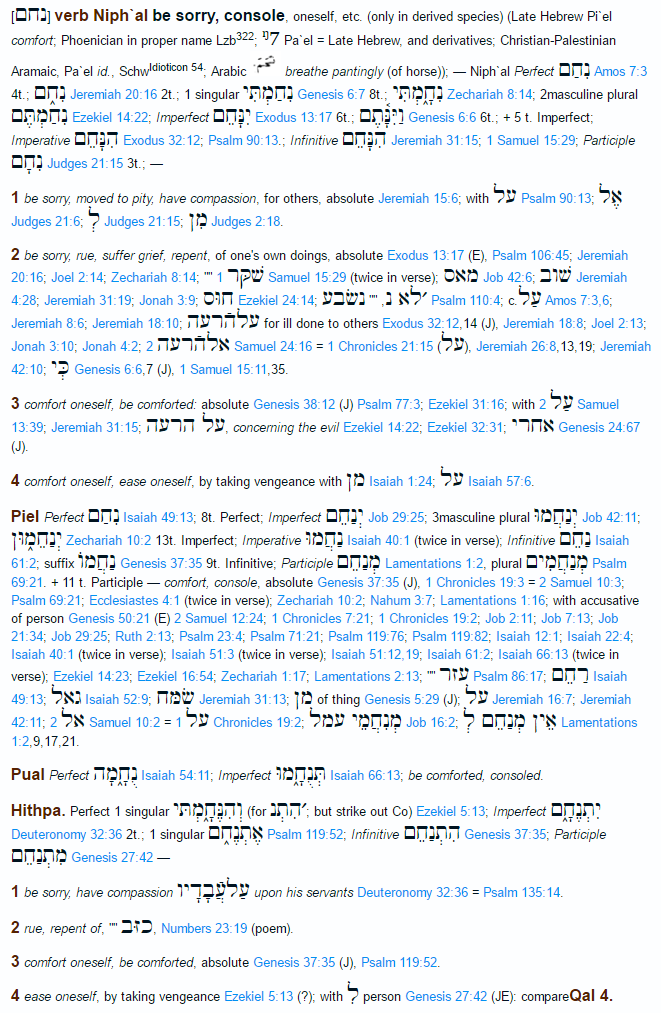
There are several key points to be made about this text. God clearly declares that he intends to destroy the Israelites who had made the golden calf and to fulfill his promises by raising up a holy people through the lineage of Moses’ descendants alone. Moses, however, contends with God. Moses “begged” God to both “turn” (bwX) his wrath and “repent” (mhn) of his purpose to destroy Israel. (v. 12) The verbs here show that Moses expected God to change what he had declared he would do. He expected God to change his mind. The Hebrew verb nacham means not merely to change, but its primary meaning is to feel sorrow or regret for what one does. Its primary meaning is emotive. It refers to the emotional tone of one’s feelings about one’s own actions. The Hebrew shuv means to turn around, to turn from, to change one’s course or direction. Moses then asks God to remember (rkz) the covenant he has made to raise seed from them as numerous as the stars. God then “repents” (KJV) or “relents” (NAB) or “changes his mind about the disaster he had planned to bring to his people.” (NRSV). While Moses believes that God’s intentions and declarations can be turned away and changed, he believes that there is something that must remain constant: God’s commitment to his covenant promises. Thus, Moses argues with God based upon the unchanging commitment to his covenant with Abraham to make of him a great nation. What is unchanging for Moses in this narrative is not God; but God’s purposes and promises.

On Reading the Bible

The most obvious problem with such a view is that there is no principled basis for distinguishing non-literal or metaphoric readings from those that should be taken as literal. All language is “anthropomorphic” in the sense that it is the tool we use to express, refer and communicate. So all and any language is to some extent “anthropomorphic” or irredeemably limited by our own epistemic horizons and linguistic usages and practices. We cannot escape our own skin. Yet limiting the scripture by denying any conclusion that could be drawn that is not expressed in the very quoting of scripture itself without any grasp of what is asserted makes reading scripture rather pointless. We can read the words, but not grasp or understand in any way what is being said by those words. Thus, all language is metaphoric since the sign is not what is pointed to by the sign or words used. To that extent, this objection is over-broad. Moreover, it would rule out the possibility not only of the deductive conclusions of open theists but also certainly the classical view which is, if anything, even more far removed from the scriptural language.

Moreover, there is no rule or set of criteria provided in the scripture itself to discern whether something should be taken literally or merely metaphorically. When the scripture straightforwardly asserts that Moses saw God and spoke with him face to face, or that God has the form of the appearance of a human as Ezekiel asserted, the traditional views have uniformly asserted that a prior commitment to God’s immaterial nature rules out taking such statements as descriptions of what God is really like. Mormons take these passages literally as statements revealing God’s likeness and image. When the scriptures rather straightforwardly state that God changed his mind, repented or relented, how do we decide that these are not actually statements describing what God actually did instead of some metaphor to human experience to allow us to grasp some bare notion of what God actually did? We suggest that arguments that such passages should be taken metaphorically and not as assertions stating what God actually did are driven by prior theological commitments and not the text. In fact, there is nothing in these texts suggesting merely a metaphorical reading. The explanation that the language is merely metaphorical is thus a conclusion not based on the text from outside the text based on prior commitments that conflict with the text. Yet how could our views of God ever be informed by the text if we read the text in this manner? Such a way of approaching the text is presumptuous because it assumes that we already know more than the text and can correct the text based upon extra-textual theological commitment or linguistic practices.

On Jonah and Exodus 32

Piper applies this reasoning to the text in Jonah and suggests that God’s unconditional declaration that Ninevah would be overthrown was in reality based on a condition of repentance “that if the Ninevites meet, they will be spared.” So Jonah 3:4 should be read with the implicit condition, which if made explicit would say: “Yet forty days and Ninevah will be overthrown unless you repent.” The people of Ninevah repented, so God was not mistaken and the prophecy by Jonah was accurate because, Piper claims, all such prophecies of threat of destruction must be understood to contain such a conditional clause as suggested by Jeremiah 18:7-10. Yet it seems fairly clear that there is in reality no change in God’s intentions as Piper claims. All along God knew that Ninevah would repent and all along he intended that Jonah’s prophecy would be the catalyst to bring about that repentance. God intended to relent when Ninevah repented all along. However, it also follows that what Jonah declared was neither true nor an accurate reflection of God’s intention. Ninevah was not overthrown in forty days, as Jonah declared it would be. Nor did God ever intend that it would be; rather, he intended and knew that Ninevah would repent and that Ninevah would not be destroyed.

Piper’s strategy doesn’t do justice to the text. There is no such conditional stated in the text of Jonah 3:4. What Jonah asserted did not come to pass. However, barring arguments of the uselessness of simple foreknowledge or the circularity arguments against middle knowledge, given the text alone as a guide it is at least possible that God intended the people to repent and knew that his threat through Jonah would bring it about. Perhaps the Israelites had such an implicit understanding as suggested by Jeremiah. The absolute prophecy of destruction of Ninevah may then be read as a conditional because all prophecies are conditional. Even if God knows the future, it may be the case that God knows of the repentance which his prophecy brings about.

However, this strategy fails miserably in the context of Exodus 32. If we alter Exodus 32:10 along the lines suggested by Piper, it reads as follows with implicit assertions made explicit: “Now therefore leave me alone, that my wrath may burn hot against them, and that I may consume them; and I will make of you a great nation unless they repent — and I know that they won’t repent.” There is a problem with Piper’s suggested strategy, however. The Israelites did not repent and if God knew the future, then God knew they wouldn’t repent. However, God changes his intentions anyway. So God’s change of intentions cannot be explained by Israel’s repentance. God’s change of intentions was not occasioned by the repentance of Israel, but by Moses’s steadfast stand for his people and willingness to ask God to relent what he had declared. So the actual change is not about repentance but about Moses’s argument. So Exodus 32:10 must be changed as follows: “Now therefore leave me alone [even though I know that you will not leave me alone but argue against what I am now suggesting], that my wrath may burn hot against them, and that I may consume them; and I will make of you a great nation unless you argue with me to not do so – as you are now doing and I know that I will not do what I am now saying I will.” The problem with amending Exodus 32 along the lines suggested by Piper is that it results in not merely non-sense, but in God flatly contradicting what he declares his intentions to be. It also results in the dialogue becoming disgenuine and contrived.

Worship Sunday – At The Cross

There’s a place where mercy reigns
And never dies
There’s a place where streams of grace
Flow deep and wide
Where all the love
I’ve ever found
Comes like a flood
Comes flowing down

At the cross, at the cross
I surrender my life
I’m in awe of You
I’m in awe of You
Where Your love ran red
And my sin washed white
I owe all to You
I owe all to You, Jesus

There’s a place where sin and shame
Are powerless
Where my heart has peace with God
And forgiveness
Where all the love
I’ve ever found
Comes like a flood
Comes flowing down

Here
My hope is found
Here
On Holy ground
Here I bow down
Here I bow down
Here
Arms open wide
Here
You saved my life
Here I bow down
Here I bow down

Proverbs 16:33 Commentary

Part of the ongoing Verse Quick Reference project.

Pro 16:33 The lot is cast into the lap, but its every decision is from the LORD.

Calvinist John Piper includes this text in a list of prooftexts on God doing everything that ever happens:

God “works all things according to the counsel of his will” (Eph. 1:11).

“All things” includes rolling dice (Prov. 16:33), falling sparrows (Matt. 10:29), failing sight (Ex. 4:11), financial loss (1 Sam. 2:7), the decisions of kings (Prov. 21:1), the sickness of children (2 Sam. 12:15), the suffering and slaughter of saints (1 Pet. 4:19; Ps. 44:11), the completion of travel (James 4:15), repentance (2 Tim. 2:25), faith (Phil. 1:29), holiness (Phil. 3:12-13), spiritual growth (Heb. 6:3), life and death (1 Sam. 2:6), and the crucifixion of Christ (Acts 4:27-28).

Piper, John; Taylor, Justin; Helseth, Paul Kjoss. Beyond the Bounds: Open Theism and the Undermining of Biblical Christianity (pp. 380-381). Crossway. Kindle Edition.

In this sense, Proverbs 16:33 is used to illustrate God’s meticulous control over all things. Granted, that is one such possible meaning of this verse, but it is not the only meaning. Language is not that static that a simple sentence without context must mean what Piper claims it to mean.

Adam Clarke takes the “lot” to be a serious inquiry to God, and not to be confused with playing with dice. Other possibilities include this proverb being a generality, or just illustrating a concept such as God is the one who guides people. The author is unlikely to be claiming that for a pair of 6-sided dice, God just prefers that they roll a 7 most often, and other numbers according their own random probability.

Proverbs lacks context to clarify the meaning of this passage. Just a few Proverbs later, the author talks about God testing hearts to know what people will do (Pro 17:3) and being angry at people that do wrong (Pro 17:15). The author might believe that God guides people’s paths, but in a responsive way in accordance to what God observes in human behavior.

Altrogge prooftexts Deuteronomy 7:6

From 5 Reasons I’m a Calvinist. The first reason is unconditional election. Stephen Altrogge writes:

I believe in the doctrines of grace because they run throughout the entire Bible, like a golden thread from Genesis to Revelation. In the Old Testament, we see that God unconditionally chose Israel to be his people.

Deuteronomy 7:6-7 says:

For you are a people holy to the Lord your God. The Lord your God has chosen you to be a people for his treasured possession, out of all the peoples who are on the face of the earth. It was not because you were more in number than any other people that the Lord set his love on you and chose you, for you were the fewest of all peoples…

This theme, of God choosing a people for himself, comes up again and again, both in the Old Testament and the New Testament. God clearly chose Israel to be his people, and that choice was not based on anything they had done. It was an unconditional choice.

Altrogge is prooftexting in an awful way. The face-value of the quote is not an “unconditional election”. It just states that God wasn’t picking a people based on strength. Just because God doesn’t pick on strength does not mean the choosing was not based on anything. Instead, the context explains that the picking was entirely conditional. The reason God picked Israel (the part of the passage that Altrogge conveniently forgets to quote) is that God had a longstanding promise to Abraham:

Deu 7:6 “For you are a people holy to the LORD your God. The LORD your God has chosen you to be a people for his treasured possession, out of all the peoples who are on the face of the earth.
Deu 7:7 It was not because you were more in number than any other people that the LORD set his love on you and chose you, for you were the fewest of all peoples,
Deu 7:8 but it is because the LORD loves you and is keeping the oath that he swore to your fathers, that the LORD has brought you out with a mighty hand and redeemed you from the house of slavery, from the hand of Pharaoh king of Egypt.

The picking in Altrogge’s prooftext is not referring to the Abrahamic covenant, but the liberation from Egypt. Moses claims that God is picking based on His previous promises to individuals.

Interestingly enough, God’s choice of Abraham/Israel was not unconditional. God relates how He knows Abraham is worthy of his calling and how He knows Israel will serve God:

Gen 18:17 And the LORD said, Shall I hide from Abraham that thing which I do;
Gen 18:18 Seeing that Abraham shall surely become a great and mighty nation, and all the nations of the earth shall be blessed in him?
Gen 18:19 For I know him, that he will command his children and his household after him, and they shall keep the way of the LORD, to do justice and judgment; that the LORD may bring upon Abraham that which he hath spoken of him. [KJV]

God did not choose Abraham for no reason, but because He saw in Abraham a kindred spirit. God even tests Abraham’s loyalty in Genesis 18, with Abraham passing the test. God’s expectations are that Abraham, a righteous man, will spawn a righteous nation. This expectation does not materialize within the Bible. God is thwarted. He time and time again wishes to kill all of Israel and restart due to failed expectations. Moses is confronted twice with this reality, in which God wants to destroy all of Israel but doesn’t because of Moses’ petition.

Altrogge’s prooftext about God’s unconditional election is in context of God choosing a people He regrets choosing and then attempts to kill. This is an odd concept for unconditional election. It sounds fairly conditional, conditional on Israel’s continued loyalty to God.

StriderMTB on 1 John 5:10-11

From A Theology in Tension:

1 John 5:10-11 states: “Whoever believes in the Son of God accepts this testimony. Whoever does not believe God has made him out to be a liar, because they have not believed the testimony God has given about his Son. And this is the testimony: God has given us eternal life, and this life is in his Son.” [NIV]

Because as mentioned in verse 10, the unbeliever is calling God a liar, in that he or she refuses to believe in God’s testimony, namely, that which “God has given about His Son” (vs.10). If this were not so, we are left with the absurd notion that John is condemning unbelievers for calling God a liar because they refuse to believe God gave His Son and the gift of eternal life to elect Christians only!

It is clear John is not condemning unbelievers for calling God a liar because they refuse to believe God has given His Son and the gift of eternal life to some select elect, but rather because they refuse to believe God gave His Son and the gift of eternal life to them.

A Thorough Compilation of Calvinist Quotes on God Causing Evil

StriderMTB of A Theology in Tension compiles a long list of Calvinist quotes about God determining evil. A Sample:

John Piper:

“So when I say that everything that exists — including evil — is ordained by an infinitely holy and all-wise God to make the glory of Christ shine more brightly, I mean that, one way or the other, God sees to it that all things serve to glorify his Son.”

A.W. Pink:

“Plainly it was God’s will that sin should enter this world, otherwise it would not have entered, for nothing happens except what God has eternally decreed. Moreover, there was more than a simple permission, for God only permits things that fulfill his purpose.”

R.C. Sproul Jr.

God wills all things that come to pass…God desired for man to fall into sin. I am not accusing God of sinning; I am suggesting that God created sin.”

Worship Sunday – Revelation Song

Worthy is the Lamb who was slain
Holy, holy is Thee
Sing a new song to Him who sits on
Heaven’s mercy seat

Worthy is the Lamb who was slain
Holy, holy is He
Sing a new song to Him who sits on
Heaven’s mercy seat

Holy, holy, holy is the Lord God Almighty
Who was and is and is to come
With all creation I sing praise to the King of kings
You are my everything and I will adore You

Clothed in rainbows of living color
Flashes of lighting rolls of thunder
Blessing and honor strength and glory and power be
To You the only one who’s King

Holy, holy, holy is the Lord God Almighty
Who was and is and is to come
With all creation I sing praise to the King of kings
You are my everything and I will adore You

Filled with wonder awestruck wonder
At the mention of Your name
Jesus Your name is power, breath and living water
Such a marvelous mystery

Oh, You’re worthy, mystery
You are worthy

Holy, holy, holy is the Lord God Almighty
Who was and is and is to come
With all creation I sing praise to the King of kings
You are my everything and I will adore You, I will adore You

Hebrews 1:11-12 Commentary

Part of the ongoing Verse Quick Reference project.

Heb 1:11 THEY WILL PERISH, BUT YOU REMAIN; AND THEY WILL ALL GROW OLD LIKE A GARMENT;
Heb 1:12 LIKE A CLOAK YOU WILL FOLD THEM UP, AND THEY WILL BE CHANGED. BUT YOU ARE THE SAME, AND YOUR YEARS WILL NOT FAIL.”

Hebrews 1:11-12 is a quote from Psalms 102:26:

Psa 102:24 “O my God,” I say, “take me not away in the midst of my days— you whose years endure throughout all generations!”
Psa 102:25 Of old you laid the foundation of the earth, and the heavens are the work of your hands.
Psa 102:26 They will perish, but you will remain; they will all wear out like a garment. You will change them like a robe, and they will pass away,
Psa 102:27 but you are the same, and your years have no end.

Louis Berkhof uses both these verses for a prooftext on immutability:

The Immutability of God is a necessary concomitant of His aseity. It is that perfection of God by which He is devoid of all change, not only in His Being, but also in His perfections, and in His purposes and promises. In virtue of this attribute He is exalted above all becoming, and is free from all accession or diminution and from all growth or decay in His Being or perfections. His knowledge and plans, His moral principles and volitions remain forever the same. Even reason teaches us that no change is possible in God, since a change is either for better or for worse. But in God, as the absolute Perfection, improvement and deterioration are both equally impossible. This immutability of God is clearly taught in such passages of Scripture as Ex. 3: 14; Ps. 102: 26-28; Isa. 41: 4; 48: 12; Mal. 3: 6; Rom. 1: 23; Heb. 1: 11,12; Jas. 1: 17.

Berkhof, Louis. Systematic Theology (Kindle Locations 1181-1184). . Kindle Edition.

Berkhof claims that these verses are speaking about God being unchanging in the sense that any change to God in any respect must be a change for the worse. He is reading Perfect Being immutability into these fairly straightforward texts about God never aging or growing weak.

In the context of Psalms 102:25-27, God is being praised for His everlastingness, contrasted to the short time that people live. The people will die but God will live forever. The narrator contrasts God with man. He points out God’s years are “through all generations”. Those who are changed, die with old age. God is not subject to this same aging.

The broader context is a cry for God to listen to the petitioner’s prayer. In verse 1, there is a call for God to “hear my prayer” and in verse two to “do not hide your face from me”. God is said to watch man from heaven (v19). The petitioner begs for God’s salvation. These are not actions of someone thinking in terms of perfect immutability, in which God does not listen or respond or experience duration. These are the prayers of an Open Theist begging God to listen and act.

The context of Hebrews 1:11-12 is the Messiah sitting next to Yahweh on His throne, in heaven and having a conversation. These facts are antithetical to the Perfect Being narrative, in which God is perfectly simple, timeless, immutability, and cannot be related to anything in any manner. By having relations with other things, this causes change. Furthermore, Hebrews 1:11-12 is applied to Jesus, who lived, died, and rose again. These are all changes, and not compatible with the immutability narrative.

The “You are the same, And Your years will have no end” in both Hebrews 1:11-12 is best seen as one in which God will never grow old and die. Instead, Yahweh (and Jesus) live forever without aging. This is not a prooftext for immutability, but a prooftext to God’s everlastingness and uninterrupted reign.

A Review of Mind, Brain, and Free Will

Peter Schaefer reviews Richard Swinburne’s Mind, Brain, and Free Will. The review is detailed and explains exactly the concepts found in the book. An excerpt:

Swinburne begins the book by discussing various ways of describing things that happen in he world. As elsewhere in his works he does this by carving the world up into substances,
properties, and events. Substances are individual things (trees, rocks, bodies, and—if they exist—souls). Properties are traits or characteristics of substances. Events involve temporal descriptions of substances and their properties. For example, an event might be ‘Peter’s eyes turned red from lack of sleep on 05/29/2014 at 7 p.m.’. This involves substances (Peter, eyes), properties coming into being (turning red) at a certain time (7 p.m.). Swinburne thinks that if all substances, properties, and events are included in a description of the world, then that description is total—nothing is left unaccounted for. Swinburne also spends some time exploring the idea of informative rigid designators. A rigid designator for a substance (or property or event) is one which ‘pursues’ that substance (or property or event) throughout change. Thus ‘Richard Swinburne’ describes a specific British philosopher of religion before, during, and after his tenure as Professor of Philosophy at Oxford University. When informative rigid designators are used, Swinburne claims, we know what it means for a substance (or property or event) to be a given substance. We can then evaluate claims of identity-say, when a physicalist claims that a mental event just is a physical event (or property or substance). When such designators are used, we can ‘unpack’ sentences and claims about identity and evaluate meaningfully what things are logically possible or impossible.

Brueggemann on Moses Subverting God’s Plan to Restart Israel

In Numbers 14, Yahweh is completely provoked by Israel, who endlessly complains about its treatment by Yahweh. Yahweh’s patience with Israel is exhausted. In weariness, Yahweh confides in Moses that Yahweh would like simply to destroy Israel and to start over with only Moses (v. 12). Moses seeks to talk Yahweh out of this declared destructive intention. Moses employs two strategies in seeking to persuade Yahweh not to act in rage. First, Moses appeals to Yahweh’s pride, shaming Yahweh in the eyes of the Egyptians and in the eyes of the inhabitants of the land (vv. 13– 16). Second, Moses makes an alternative suggestion to Yahweh, proposing that instead of destroying recalcitrant Israel, Yahweh forgive (vv. 17– 19). The basis of this daring appeal is a direct and complete quotation of Exod 34: 6– 7, which Moses now quotes as a prayer, concerning Yahweh’s self-commitment to Israel made at Sinai, which Yahweh proposes to disregard.

Brueggemann, Walter. Theology of the Old Testament: Testimony, Dispute, Advocacy (p. 219). Fortress Press. Kindle Edition.

Worship Sunday – I’ll Fly Away

Some bright morning when this life is over
I’ll fly away
To that home on Gods celestial shore
I’ll fly away

I’ll fly away, oh glory
I’ll fly away in the morning
When I die hallelujah by and by
I’ll fly away

When the shadows of this life have gone
I’ll fly away
Like a bird from these prison walls I’ll fly
I’ll fly away

I’ll fly away, oh glory
I’ll fly away in the morning
When I die hallelujah by and by
I’ll fly away

Oh how glad and happy when we meet
I’ll fly away
No more cold iron shackles on my feet
I’ll fly away

I’ll fly away oh glory
I’ll fly away in the morning
When I die hallelujah by and by
I’ll fly away

I’ll fly away oh glory
I’ll fly away in the morning
When I die hallelujah by and by
I’ll fly away

Just a few more weary days and then
I’ll fly away
To a land where joys will never end
I’ll fly away

I’ll fly away oh glory
I’ll fly away in the morning
When I die hallelujah by and by
I’ll fly away
I’ll fly away

Luke 1:3 Commentary

Part of the ongoing Verse Quick Reference project.

Luk 1:3 it seemed good to me also, having had perfect understanding of all things from the very first, to write to you an orderly account, most excellent Theophilus,

In the first chapter of Luke, Luke claims that he has had “perfect understanding of all things” and this is “from the very first”. Luke is not claiming to have omniscience of all things to have ever happened. Instead, the “perfect understanding” means an accurate memory, although imperfect. “From the very first” is limited by context to Jesus’ ministry.

This is a hyperbolic figure of speech.

Omniscience in the Wisdom of Jesus Son of Sirach

The book of Sirach was written somewhere in the second century BC. This book was written during the height of Hellenization of Israel. The author of the book Yeshua Ben Sira writes that he traveled from Israel to Egypt and translated the Hebrew original work into Greek, stating:

You are urged therefore to read with good will and attention, and to be indulgent in cases where, despite out diligent labor in translating, we may seem to have rendered some phrases imperfectly. For what was originally expressed in Hebrew does not have exactly the same sense when translated into another language. Not only this work, but even the law itself, the prophecies, and the rest of the books differ not a little as originally expressed.

He urges caution in reading his work. This work incorporates various sayings found in Israel. It makes at least two allusions to outside works, Aesop’s Fables (Sir 13:2–3) and The Egyptian Satire of the Trades (Sir 38:24-39:11). The work seems to show familiarity with outside literature.

Within Sirach, there are various omniscience claims about God.

Sir 15:18 For great is the wisdom of the Lord; he is mighty in power and sees everything;
Sir 15:19 his eyes are on those who fear him, and he knows every deed of man.…

In Sirach 15:18 God is said to see everything. The picture is a common one in Jewish writings in which God is watching everything as it occurs. God’s “eyes” are said to be on those who fear Him, signaling God’s protection of his own people. The statement appears to clarify that God knows all deeds of man, even though that man might not be God’s.

Sir 17:19 All their works are as the sun before him, and his eyes are continually upon their ways.
Sir 17:20 Their iniquities are not hidden from him, and all their sins are before the Lord.

Sir 17:23 Afterward he will arise and requite them, and he will bring their recompense on their heads.
Sir 17:24 Yet to those who repent he grants a return, and he encourages those whose endurance is failing.

In Sirach 17:19-20 God is said to see the works of man as the sun lights up the day. Whereas the Sun gives vision to people, God is able to see as if the Sun is always lighting everything. God records man’s sins. The context is God’s judgment. If man does not repent of his sins then God will punish them in measure.

Sir 23:18 A man who breaks his marriage vows says to himself, “Who sees me? Darkness surrounds me, and the walls hide me, and no one sees me. Why should I fear? The Most High will not take notice of my sins.”
Sir 23:19 His fear is confined to the eyes of men, and he does not realize that the eyes of the Lord are ten thousand times brighter than the sun; they look upon all the ways of men, and perceive even the hidden places.
Sir 23:20 Before the universe was created, it was known to him; so it was also after it was finished.

Sirach 23:18-20 concerns itself with the impious man. A common claim in Israel was that God does not see man’s sin. In verse 18, the reason the impious man believes God cannot see what he does is that he does it in the dark. God’s omniscience, to the impious, was thought to be a function of God’s visibility during the daylight. The author counters this by ascribing a light to God’s eyes.

In these verses, God’s eyes are said to burn 10,000 time brighter than the Sun. The Sun is not the source of God’s knowledge. God’s eyes generate their own light, which sees all things.

The number 10,000 is very interesting and has pagan counterparts. Pettazzoni writes:

The vain fancy of the impious man that he can escape the all-seeing vision of Deity is to be found also in the Avesta, with reference to Mithra, who is a sky- and sun god… Also the “ten thousand eyes” of the Iranian Mithra (Yasht x. 7, 24, 82, I4I) and the thousand eyes of Varuna (Atharva-Veda iv, I6, 4) recall the pronouncement of ben Sirach that “the eyes of the Lord are ten thousand times brighter than the sun”…

Zeus also is ascribed three times ten thousand spies on Earth who spy on his behalf. Of course, in Israel, Yahweh is not ascribed monstrous eyes. He is not given a multiplicity of eyes, and when the Bible does talk about his eyes (i.e. his seven eyes in Zec 4:10) it is more likely referring to angels of God who act as spies.

Instead of having ten thousand eyes, Yahweh’s eyes burn 10,000 times brighter than the Sun, suggesting a visual omniscience or a figurative claim that nothing in secret will be hidden from God.

Sir 34:16 The eyes of the Lord are upon those who love him, a mighty protection and strong support, a shelter from the hot wind and a shade from noonday sun, a guard against stumbling and a defense against falling.

Verse 34:16 describes the particular focus of God’s omniscience as being towards the fate of those who follow him. God watches His people and protects them and provides them comfort. This mirrors Sirach 15:19, in which God pays particular focus on those who fear Him.

Sir 39:19 The works of all flesh are before him, and nothing can be hid from his eyes.
Sir 39:20 From everlasting to everlasting he beholds them, and nothing is marvelous to him.
Sir 39:21 No one can say, “What is this?” “Why is that?” for everything has been created for its use.
Sir 39:22 His blessing covers the dry land like a river, and drenches it like a flood.
Sir 39:23 The nations will incur his wrath, just as he turns fresh water into salt.
Sir 39:24 To the holy his ways are straight, just as they are obstacles to the wicked.

Sirach 39 might contain a claim of exhaustive divine foreknowledge. God is said to see everything. He sees everything “from everlasting to everlasting”, which could be a claim that He sees the entire future or it is a claim that God watches everything always. God is said in Sirach 42:21 to be from “everlasting to everlasting”, a common claim in the Hebrew Bible. The phrase possibly could mean that while God is living everlasting to everlasting that He sees all.

There is also a hint that nothing takes God by surprise. Verse 20 says “nothing is marvelous to him”. This could be another indication that the author has exhaustive divine foreknowledge in mind. Alternatively, it could be due to mankind not being able to build novelty (as Ecclesiastes 1:9 claims, “Nothing is new under the Sun”).

This passage goes on to affirm some sort of divine determinism. God makes everything for a reason (could this be why God is not taken by surprise?). The same resources God uses for good for those who love him, God uses for evil for those who reject Him. Nothing happens outside God’s providence. This is not to be confused with individuals not having free will, as the idea seems to be that people can repent of their evil and be forgiven (Sir 17:24).

Sir 42:16 The sun looks down on everything with its light, and the work of the Lord is full of his glory.

In Sirach 42:16, omniscience is ascribed to the Sun in a figurative sense. The Sun illuminates all God’s great works. This phrase “looks down on everything” is a type of light-based omniscience that the impious would ascribe to God. Yes, God knows everything, but because He sees everything in the light. The phrase was limited to this understanding. The author of Sirach rejects this. The Sun might be omniscient in a sense, but God is much more so.

Sir 42:18 He searches out the abyss, and the hearts of men, and considers their crafty devices.
For the Most High knows all that may be known, and he looks into the signs of the age.
Sir 42:19 He declares what has been and what is to be, and he reveals the tracks of hidden things.
Sir 42:20 No thought escapes him, and not one word is hidden from him.
Sir 42:21 He has ordained the splendors of his wisdom, and he is from everlasting and to everlasting. Nothing can be added or taken away, and he needs no one to be his counselor.

In Sirach 42:18, God is said to “known all that may be known”. This seems to mirror a common Open Theist claim about God’s omniscience. God’s knowledge is limited to actual facts. God is said to search people and figure out the “signs of the age”. These statements do not appear to affirm exhaustive divine foreknowledge.

God is then said to declare “what has been and what is to be”, signifying, in context, God’s wisdom (verse 21). This also could be a function of divine determinism spoke about in Sirach 39:21. If this is a statement about exhaustive divine foreknowledge the surrounding phrases sound awkward. God “looks into signs” and “searches out the abyss and the hearts of man”. God is said to “consider their ways”. The concept of divine timelessness is definitely not in the mind of this author.

The last statement that God “nothing can be added or taken away” appears in context of “no one to be his counselor”. Is this a claim of Platonistic perfection? It likely is rather a claim of divine wisdom, claiming that God is the wisest of all creatures. God does not need counsel.

Sir 48:22 For Hezekiah did what was pleasing to the Lord, and he held strongly to the ways of David his father, which Isaiah the prophet commanded, who was great and faithful in his vision.
Sir 48:23 In his days the sun went backward, and he lengthened the life of the king.
Sir 48:24 By the spirit of might he saw the last things, and comforted those who mourned in Zion.
Sir 48:25 He revealed what was to occur to the end of time, and the hidden things before they came to pass.

In Sirach 48, Hezekiah is said to be a prophet of God. He is said to have revealed “what was to occur to the end of time.” Could this mean he revealed what was to occur “at” the end of time? This is more likely the case, as with the other prophets (specifically of the exilic timeframe). There is not word in this passage what type of knowledge Hezekiah is imparting. Is this foreseeing the future in a clairvoyant way? Are these loose prophecies which God has plans to fulfill although it is not a literal representation of the future? The context is not clear.

In all, Sirach shows some signs of Hellenization, as one might expect with a text translated to Greek in Egypt. Do Hebrew concepts of omniscience and everlastingness translate well to a Greek speaker? Is the author adopting Hellenistic terms to help give the text a wider audience? Is there leeway in the text to allow traditional Hebrew theology to retain acceptability? It is hard to know the answers.

The Sirach seems to affirm a visual omniscience of all things, in the context of God continued effort to watch the actions of man in order to dispense justice. God is given control over the happenings of the world, creating everything for a divine purpose, but giving individuals the opportunity to choose their own outcome in the divine play.

Goldingay on Quasi-predictions

From the Word Biblical Commentary on Daniel:

The quasi-predictions begin this process by interpreting recent history in the light of Scripture. They are not indulging in mere theological apologetic, but in a radical theological necessity (Fishbane, Interpretation, 510–11 [and see 509–22 generally], against Hartman, ―The Functions of Some So-called Apocalyptic Timetables NTS 22 [1976] 1–14). Nor is it the case that the mere—pretended!—ability to predict the future in 11:2–39 gives grounds for believing the actual prophecy in 11:40–12:3. It is rather the quasi-predictions’ ability to make sense of the past by relating it in the light of Scripture that implies grounds for trusting the actual prophecy’s portrait of what the future will bring, painted in the light of the same Scripture. When they speak about the past, they do so on the basis of having historical data, and scriptural text as a means of interpretation. When they speak about the future, they have only scriptural text, and are providing an imaginary scenario, a possible embodiment of that text, which is not to be pressed to provide (or be judged by) historical data. Its object is not to provide historical data but to provide scriptural interpretation of what the events to come will mean. The seer implicitly wishes to commend a certain form of behavior, namely, resistance to Seleucid/reformist pressures. His explicit focus, however, is a cognitive one. He aims to provide a way for conservative Jews to understand their present experience, looking at it in the light of various scriptural texts. The supernatural being provides this for the seer (10:1, 14); the ―discerning‖ provide it for the multitude (11:33).

Worship Sunday – Lord I Need You

Lord, I come, I confess
Bowing here I find my rest
Without You I fall apart
You’re the One that guides my heart

Lord, I need You, oh, I need You
Every hour I need You
My one defense, my righteousness
Oh God, how I need You

Where sin runs deep Your grace is more
Where grace is found is where You are
And where You are, Lord, I am free
Holiness is Christ in me

Lord, I need You, oh, I need You
Every hour I need You
My one defense, my righteousness
Oh God, how I need You

Teach my song to rise to You
When temptation comes my way
And when I cannot stand I’ll fall on You
Jesus, You’re my hope and stay

Lord, I need You, oh, I need You
Every hour I need You
My one defense, my righteousness
Oh God, how I need You

You’re my one defense, my righteousness
Oh God, how I need You
My one defense, my righteousness
Oh God, how I need You

2 Samuel 14:20 Commentary

Part of the ongoing Verse Quick Reference project.

2Sa 14:20 In order to change the course of things your servant Joab did this. But my lord has wisdom like the wisdom of the angel of God to know all things that are on the earth.”

An often ignored verse, 2 Samuel 14:20. In context, Joab wants to convince King David to forgive Absalom. He sends a woman to David in order to do the convincing. She begins her speech with flattery. King David, she says, knows “all things that are on earth”. Naturally, this should be taken in a hyperbolic sense.

But the phrase is interesting. Elsewhere, other kings are said to know everything. The idea likely being forwarded is that the king has wide-ranging power. Their access to information is above virtually anyone else.

The same phrase, if applied to God, would be taken as Platonic Omniscience by Negative Theologians. God knows all that can be known, instantly and inherently. But the phrase is instead applied to two creatures, David and the angel of God.

The angel of God could be Yahweh (there is precedence in the Bible for this), but this seems to be applied to creatures as well. King David, himself, is said to be an “angel of God” five chapters later:

2Sa 19:27 And he hath slandered thy servant unto my lord the king; but my lord the king is as an angel of God: do therefore what is good in thine eyes.

That this type of omniscience, a knowledge of all things on Earth, would be applied to angels and man, shows the extent of hyperbolic phrases of this type in the Bible. It also is a clear example of this type of speech not being meant in a Platonic sense.

Short on God’s Role in Joseph’s Life

Gen 50:20  As for you, you meant evil against me, but God meant it for good, to bring it about that many people should be kept alive, as they are today. 

This passage is used to claim God is responsible for all that happened to Joseph. Neil Short writes:

These passages seem to clearly teach that God orchestrated the sin of Joseph’s brothers in order to bring about a greater good. The plain sense of a passage is not always the correct sense. Consider evangelist Stephen’s explanation in his swan-song sermon in Acts.

Acts 7:9-10
9 “The patriarchs, jealous of Joseph, sold him into Egypt; but God was with him, 10 and rescued him from all his afflictions, and enabled him to win favor and to show wisdom when he stood before Pharaoh, king of Egypt, who appointed him ruler over Egypt and over all his household.
According to Stephen, God’s action began after the sin of Joseph’s brothers. God worked through various people to bring Joseph into a better situation in which the work of God would be evident. He granted that Joseph would have favor in the eyes of his master Potiphar (Genesis 39:4, which did not work out all that well), his jailer (Genesis 39:21) and Pharaoh (Genesis 41:44, Acts 7:10).

Thus, God did indeed mean it for good but only after the fact of the brothers’ sin. God did not need the sin of these brothers to accomplish his plan. God took a negative intention and worked out a positive result.

This interpretation was understood by Stephen in Acts.

Worship Sunday – Register

Find it funny when the punch-line was You. And You don’t like my punk boy attitude. You didn’t smile when I checked out that girl, or when my sin kept me in the world. And then I claim all I wanna do is praise Your name. I hate my sin, destroy it and mold in me from within. And then I claim all I wanna do is praise Your name. I hate my sin, destroy it and mold in me from within. And now I’m trying to keep the bad stuff away, but if I forget to keep Your word and pray. I love You Jesus, I need Your love in my life. I love You Jesus, I want to be like You Christ. And now I’m trying to keep the bad stuff away, but if I forget to keep Your word and pray. I love You Jesus, I need Your love in my life. I love You Jesus, I want to be like You Christ.

Ezekiel 33:8-9 Commentary

Part of the ongoing Verse Quick Reference project.

Eze 33:8 If I say to the wicked, O wicked one, you shall surely die, and you do not speak to warn the wicked to turn from his way, that wicked person shall die in his iniquity, but his blood I will require at your hand.
Eze 33:9 But if you warn the wicked to turn from his way, and he does not turn from his way, that person shall die in his iniquity, but you will have delivered your soul.

In Ezekiel 33, God explains to Ezekiel the concept of a watchman. The illustration is that of someone watching for approaching enemies. If this watchman notifies the people of approaching enemies, anyone who dies does so at their own fault. After all, they were warned. But if the watchman does not warn the people, then the people’s blood is on the hands of the watchman.

God then uses this principle to apply to Ezekiel. Ezekiel is appointed a watchman. He can no longer stay silent, because if he does then he will receive greater condemnation. Ezekiel’s special tasking, above and beyond the normal duties of individuals, is to proclaim God’s warnings to the people. If he does not then he will not “deliver his soul” (possibly spiritual or physical death).

God’s warnings also increase culpability of the people. If the people are warned and do not repent, their blood is on their own heads. This suggests both that Ezekiel’s message were conditional warnings and that the people had the ability to respond. The fact that the people do not respond increases their guilt.

Apologetics Thursday – Inwards and Outwards Callings

A Calvinists attempts to settle the “contradiction” between Matthew 22:14 and Romans 8:29-30:

That is a very good question. I would like to call your attention to a text in 1 Corinthians which, I think, clears up any misunderstandings of this issue.

“Jews demand signs and Greeks seek wisdom, but we preach Christ crucified, a stumbling block to Jews and folly to Gentiles, but to those who are called, both Jews and Greeks, Christ the power of God and the wisdom of God.” 1 Cor 1:22-24

As this passage demonstrates, there are two types of calls: 1) the OUTWARD call of the gospel and 2) in INWARD call of the Spirit. We preach the gospel indiscriminately to all persons but, if you notice the above verse, the outward call is UNIVERSALLY rejected by both Jews and Gentiles because it is a stumbling block or folly to them … But “to those who are called” (through the gospel) by God’s Spirit, “the power and wisdom of God” i.e. there is salvation. The gospel must not only come in word, but in Spirit (1 Thess 1:4, 5). We can call people to faith in Christ till we are blue in the face, as we should, but outward persuasion is not sufficient to change a heart of stone to a heart of flesh by itself. Only God can do that (Ezek 36:26, John 6:63, 65) and He has chosen to do so through the proclamation of the gospel by the church.

This type of theology distracts from the context of all three passages. The context of Matthew 22 is God explaining the mechanics of what makes someone chosen. God tries and fails to entice followers from one group, and has to turn to another. Within that new group, those who are unwilling to conform to God’s standards are cast out. People are elect by their response.

The context of Romans 8 is that Paul is proclaiming the ultimate victory is God’s and God’s faithful will be rewarded. He states that believers will be killed, but they have the ultimate victory. Paul is not referring to people being unable to reject God. Paul is not even talking about people who were once Christians who recant their beliefs. The idea is the opposite, Paul is encouraging Christians such that they do not recant the faith.

The third text, 1 Corinthians, in context is about the different cultural mindset of Paul’s audience. The Jews are looking for a Messiah to bring about the Day of the Lord. The Hebrew mindset is relational and focused on world shaping events. The Greeks want to talk about metaphysics. Jesus is a stumbling-block to the Jews because he does not fit the Messiah for which they seek. Jesus is folly to the Gentiles because he does not fit their philosophy (the Platonism espoused by this Calvinist author, who quotes Paul without a hint of irony). This verse in NO way proves what this Calvinist would have it mean: that there are two types of calls (Outwards and Inward). It is not about that and the author fails to show his work.

In short, none of these verses contradict when read in context. They are not even about the same subjects in order to contradict.

Kurtk Johnson Simplifies Open Theism

From Open Theism Simplified:

First off, as the name suggests, “Open Theism” is for “theists” …those who believe in a God. Secondly, “Open” describes possibilities. Put them together and you have possibilities (Open) and a God (Theism), therefore, “Open Theism.”

Ok, let’s go a little deeper into what is meant by “Open.” Possibilities are about what might and might not come to pass. If God is all-knowing, then it must also be the fact that God knows all of the future. Open Theists agree that God is all-knowing and that God knows all of the future, and like others, they think that some of that future is possibilities, but what sets Open Theism apart is the belief that God knows possibilities as possibilities. So, Open Theism then denies that God faces a future of only settled facts about what will or will not be, and insists that God knows the future as partly settled (or ‘closed’) and partly unsettled (or ‘open’). Only God knows all that is ‘closed’ or ‘open’ about the future.

Kaminsky on Personal Omniscience

Nor is the dynamic of divine interpersonal relations in the primeval history restricted to reward and punishment. Rather, we encounter here a number of intriguing and suggestive instances of rapport between the deity and humankind. Thus, in the garden, the interplay goes far beyond a simple case of human action and divine response. Consider the dramatically calculated questions posed to the man and woman: “Where are you?… Who told you that you were naked?” (Gen 3:9, 11). Of the same kind are YHWH’s leading questions to Cain: “Why are you so irritated and dejected?” and “Where is Abel, your brother?” (Gen 4:6, 9). These questions are intentionally designed to elicit a particular anticipated response, which in turn will be addressed by appropriate instruction or rebuke, as warranted. To me, at least, these stylized verbal interactions speak less of divine omniscience, as a theological tenet, than they do of parental or pedagogical ploys. That is, the questions reveal an intimate rapport with the subjects, and a finely tuned familiarity with their customary thought patterns, evasions, and defenses. Once again, the primeval history serves as prologue to subsequent narratives, especially in terms of similarly rhetorical questions posed, for example, to Elijah (“What prompts your coming here?” 1 Kgs 18:9, 13) and Jonah (“Are you really so very distraught?” 4:4, 9). There is a depth of divine concern in these pointed interrogations, as well as a personal stake and involvement on the part of the deity, that far transcends abstract philosophical categories such as “omniscience.”

Joel Kaminsky, Jews, Christians, and the Theology of the Hebrew Scriptures

Worship Sunday – Come Alive

Through the eyes of man it seems there’s so much we have lost
As we look down the road where all the prodigals have walked
And one by one the enemy has whispered lies and led them off as slaves

But I know that You are God, Yours is the victory
We know there is more to come that we may not yet see
So with the faith You’ve given us we step into the valley unafraid

We call out to dry bones, come alive, come alive
We call out to dead hearts, come alive, come alive
Up out of the ashes, let us see an army rise
We call out to dry bones come alive

God of endless mercy, God of unrelenting love
Rescue every daughter bring us back the wayward sons
And by Your spirit breathe upon them show the world that You alone can save
You alone can save

So breathe, oh breath of God
Now breathe, oh breath of God
Breathe, oh breath of God
Now breathe

Job 11:7 Commentary

Part of the ongoing Verse Quick Reference project.

Job 11:7 “Can you find out the deep things of God? Can you find out the limit of the Almighty?

Job 11:7 is sometimes used to prooftext ideas of God’s infinite nature. Louis Berkhof, in his Systematic Theology writes:

1. HIS ABSOLUTE PERFECTION. This is the infinity of the Divine Being considered in itself. It should not be understood in a quantitative, but in a qualitative sense; it qualifies all the communicable attributes of God… In this sense of the word the infinity of God is simply identical with the perfection of His Divine Being. Scripture proof for it is found in Job 11: 7-10; Ps. 145: 3; Matt. 5: 48.
Berkhof, Louis. Systematic Theology (Kindle Locations 1207-1214). . Kindle Edition.

When quoting Job, the context is of vital concern. The story of Job is one in which three (or four) friends of Job confront Job and tell him their individual misconceptions about how the world operates. At the end of the book of Job, God condemns these friends (three explicitly, and one, perhaps, by implication) and commends Job:

Job 42:7 After the LORD had spoken these words to Job, the LORD said to Eliphaz the Temanite: “My anger burns against you and against your two friends, for you have not spoken of me what is right, as my servant Job has.

If Job is being quoted, Job is likely (but not necessarily) correct. If any of Job’s friends are being quoted, those ideas need to be treated with skepticism. Surely, the quotes should not find their way into a Systematic Theology textbook as evidence for a particular theology. To find it as evidence of a theology is to find evidence that the author does not understand the context of his evidence. It is poor theology.

This particular comment is a comment by Zophar the Naamathite. This is someone God specifically condemns for wrong speech about Him. The prooftext is suspect, and is not to be used for theology (other than understanding what wrong theology might look like).

Complicating the issue, this verse is striking similar to other comments in the Bible by true believers of God. But it is doubtful that this verse is being used as defending concepts of Platonic infinite, boundless and incomprehensible perfection. Rather, these sorts of comments are usually contextual to the mindset of early peoples: that God is on another level than human beings. A high school soccer player might be said to not be able to even compete with a professional soccer player. The question is one of scope of power. One agent lacks the power and ability to compare to the other. This is evident by the immediate context which questions Job’s ability to understand the limits of the Earth, much less God. Job is a weak creature. God is too complex.

In any case, Zophar is not speaking about qualifying “all the communicable attributes of God”. This is a wild stretch. Using this fleeting phrase as a prooftext for concepts not defined until centuries later is not valid theology.

Gary Yamasaki on Reading Biblical Stories

From Insights from Filmmaking for Analyzing Biblical Narrative:

A more prominent issue in the scholarly debate on this verse relates to the words of the angel of the Lord, “now I know …. ” On this phraseology, john Walton summarizes the key issue in the debate when he writes, “interpreters … object that God, in his omniscience, must have known that Abraham would do what he did. God, by his nature and affirmed attributes, cannot add to his cognitive knowledge.” On this issue, Walton himself suggests, “We must differentiate between knowledge as cognition and knowledge as experience. We can agree that God knew ahead of time what Abraham was going to do. But there is ample evidence throughout Scripture that God desires us to act out our faith and worship regardless of the fact that he knows our hearts.”36 Gunkel, on the other hand, addresses the apparent challenge to God’s omniscience in this verse by explaining, “The use of this concept in reference to God implies an anthropomorphism because, strictly taken, it excludes omniscience,” suggesting that this attribution of a lack of omniscience to God was simply due to inadvertence on the part of the author ofE in his crafting37 of this account.

Note how both these authors work to explain how this text could possibly suggest that God is here coming to know something new, a dynamic not in keeping with the idea that God is omniscient. In other words, both authors take God’s omniscience as a given. In the world of systematic theology, this is certainly a trait that has been attributed to God. It must be noted, however, that this attribution has emerged out of theological study of the Bible as a whole, and not from this narrative itself. Once again, this is at odds with a cinematic-story paradigm in which any given text is part of a self-contained storyworld (seep. 40, above). Therefore, analysis of the omniscience of God in Gen 22:12 ought to consider evidence only from the story-world of the Pentateuch on this issue. Further, the sequentiality of all stories (seep. 53, above) means that only evidence found in the text preceding Gen 22:12 should be considered, as subsequent evidence is not yet within the purview of a reader coming upon this verse.

Ibn Ezra on Genesis 22:1

Ibn Ezra is often claimed as an example of an early Jewish Open Theist. John Sanders points to his commentary on Genesis 22:1 for evidence of this. Evidently, Sanders is referring to the following commentary:

Some say we need to read with different spelling: נשא instead of נסה ‘Uplifted’ instead of ‘Test’. And I say, the content of the Parashah (the story) proves that נסה is a ‘Test’. And experts explain that נסה (Test) means – to know what exists in the present. And the Gaon (a Babylonian Jewish leader) explained that the purpose of the test was to show His righteousness to the people. But the Gaon surely knew that when Avraham bound his son, no one else was there. And others say “go to the land of Moriah, and offer him there as a burnt offering on one of the heights” meant to be “make a sacrifice upon the mountain.” And not him for sacrifice. And Abraham did not know the secret of the prophecy, and he hurried to slaughter him, and God said to him, “I did not ask for this.” All these wise leaders needed their interpretations because they couldn’t believe that God would command a Mitzvah and then change it. But all those leaders did not notice that there is a precedent for a change like that. In the case of commanding a role for the first born male child (Bamidbar ג – Nombers 3) He replaces them with the Levites one year later. (And my understanding is) that the text of the Torah uses “נסה” Test, and that is why we don’t need to think that anything changed. God tested Avraham for the purpose of giving him a reward (and not for the purpose of commanding sacrifices or showing his righteousness).

Source

Worship Sunday – In Christ Alone

In Christ alone my hope is found;
He is my light, my strength, my song;
This cornerstone, this solid ground,
Firm through the fiercest drought and storm.
What heights of love, what depths of peace,
When fears are stilled, when strivings cease!
My comforter, my all in all—
Here in the love of Christ I stand.

In Christ alone, Who took on flesh,
Fullness of God in helpless babe!
This gift of love and righteousness,
Scorned by the ones He came to save.
Till on that cross as Jesus died,
The wrath of God was satisfied;
For ev’ry sin on Him was laid—
Here in the death of Christ I live.

There in the ground His body lay,
Light of the world by darkness slain;
Then bursting forth in glorious day,
Up from the grave He rose again!
And as He stands in victory,
Sin’s curse has lost its grip on me;
For I am His and He is mine—
Bought with the precious blood of Christ.

No guilt in life, no fear in death—
This is the pow’r of Christ in me;
From life’s first cry to final breath,
Jesus commands my destiny.
No pow’r of hell, no scheme of man,
Can ever pluck me from His hand;
Till He returns or calls me home—
Here in the pow’r of Christ I’ll stand.

Job 2:10 Commentary

Part of the ongoing Verse Quick Reference project.

Job 2:10 But he said to her, “You speak as one of the foolish women would speak. Shall we receive good from God, and shall we not receive evil?” In all this Job did not sin with his lips.

Job 2:10 is often used to claim that God controls all things. Calvinist John Piper writes:

From the smallest thing to the greatest, good and evil, happy and sad, pagan and Christian, pain and pleasure—God governs all for his wise, just, and good purposes… After losing his ten children, Job says, “The LORD gave, and the LORD has taken away; blessed be the name of the LORD” (Job 1:21). Covered with boils, he says, “Shall we receive good from God, and shall we not receive evil?” (Job 2:10).
Piper, John; Taylor, Justin; Helseth, Paul Kjoss. Beyond the Bounds: Open Theism and the Undermining of Biblical Christianity (p. 381). Crossway. Kindle Edition.

There are a few issues with this type of prooftexting. First, the Fallacy of Composition is at play. Piper is going from one statement about Job, the most righteous person on Earth whom God was showing special attention, and then exporting that statement to all things that ever happen. If I had a child, I might give him ice cream one day and revoke his video games the next. The child might rightly claim that “my father gives and my father takes away.” This is not meant to be exportable to all of humanity. A child who I do not show attention would be amiss to say the same thing.

Secondly, standalone phrases have various possible meanings. When modern insurance claims say that houses are destroyed due to “acts of God”, this is not a theological statement nor is anyone trying to attribute that event to God’s express will (although it could have meant that at some remote time in the past). The idiom could be one that because God is in charge of the universe and this event happened, then God is responsible by the nature of His position. It could also mean that God was being blamed for not intervening. There are many alternatives to making this text some sort of prooftext about God controlling all things, even within the life of Job. More context is needed to understand what this means.

The actual context is a gentleman’s wager between God and “the adversary” on if Job would follow God. God does not know if Job’s righteousness is due to his rewards or due to faith for its’ own sake. God sits on his throne and receives reports from angels. All this does not suggest the extreme control that a prooftext on micromanagement sovereignty would have us believe.

Berkhof Prooftexts Infinity

1. HIS ABSOLUTE PERFECTION. This is the infinity of the Divine Being considered in itself. It should not be understood in a quantitative, but in a qualitative sense; it qualifies all the communicable attributes of God. Infinite power is not an absolute quantum, but an exhaustless potency of power; and infinite holiness is not a boundless quantum of holiness, but a holiness which is, qualitatively free from all limitation or defect. The same may be said of infinite knowledge and wisdom, and of infinite love and righteousness. Says Dr. Orr: “Perhaps we can say that infinity in God is ultimately: (a) internally and qualitatively, absence of all limitation and defect; (b) boundless potentiality.”[Side-Lights on Christian Doctrine, p. 26.] In this sense of the word the infinity of God is simply identical with the perfection of His Divine Being. Scripture proof for it is found in Job 11: 7-10; Ps. 145: 3; Matt. 5: 48.
Berkhof, Louis. Systematic Theology (Kindle Locations 1207-1214). . Kindle Edition.

Systematic Theologian, Louis Berkhof describes God’s infinite nature as “free from all limitation” and he says this “qualifies all the communicable attributes of God”. This is an interesting claim, as “limitation” is usually used in a subjective manner. Some individuals say the inability to “choose to know” is a limitation. Some say that “not knowing something” is a limitation. Some say that exterminating the inhabitants of the Promise Land was righteous. Some say that exterminating the inhabitants of the Promise Land would have been unrighteous (and is wrongly ascribed to God). Berkhof’s unqualified unlimited attributes do not exist.

These facts make one wonder if his prooftexts actually show what he is trying to claim. Job 11:7-10 reads:

Job 11:7 “Can you search out the deep things of God? Can you find out the limits of the Almighty?
Job 11:8 They are higher than heaven— what can you do? Deeper than Sheol— what can you know?
Job 11:9 Their measure is longer than the earth And broader than the sea.
Job 11:10 “If He passes by, imprisons, and gathers to judgment, Then who can hinder Him?

This is a comment by Zophar the Naamathite, of whom God says “you have not spoken of Me what is right, as My servant Job has” (Job 42:7). It is interesting that a prooftext is being quoted by someone God specifically condemns for wrong speech about God.

But, true, this verse reference is striking similar to other comments. Is the idea that is being peddled one of boundless infinite of the Platonic fashion, or is it one of God’s incomparable status (God is on a higher level than us). Notice the comparison language: Job cannot comprehend the boundaries of heaven and earth and the sea, how much more can not Job comprehend God?
Futhermore, is this about the infinite nature of all God’s “communicable attributes”? Did Zophar even comprehend the categories of “communicable” and “incommunicable” attributes to reference passively? Does the Bible ever speak in such abstract categories or define these concepts? Or, more likely, is Berkhof abusing text in order to prooftext his theology?

Pettazzoni on Assumptions Imported on Omniscience

There is a divergence, a difference of less and more, between what is postulated and what the data furnish, and all the efforts of the anthropological arguments to explain this difference as the result of a secondary degeneration or obscuration of the ideal presuppose the existence from the beginning of what does not take shape till later times and under particular historical circumstances. The whole theory springs from a compromise between historical investigation and theology. (Pettazzoni, The All Knowing God, p. 3)

Bluemel on Omniscience

Craig Bluemel’s thoughts on God’s knowledge of the future:

Many Unanswered Questions In Light of Definite Facts

This short study cannot address all the scriptural apologetics and arguments regarding the topic of future knowledge. It is not my intention to do so. This treatise is for those who have ears to hear, and eyes to see. It is a revelation from God to those who are willing to break with tradition, and assume the awesome responsibility of saying, “Here am I Lord, send me.”

It is my hope that those who have suffered extreme hardship and personal loss will now view the Creator as both loving, and as a God who works within the parameters of what He does know, NOT what he doesn’t. When God opened my eyes to this truth, I began to take more responsibility for my own actions. I stopped blaming God for my suffering and pain.

By knowing that God cannot possibly know what we will do or say, we have demonstrated how compulsory it is for His people to work with His plan, as it unfolds. The following are facts that will help you interpret the hard-to-understand verses of scripture that may seem to contradict this understanding:

1. God does not know what our future choices will be, but he works to influence us in every way possible to be one with Him and His plan for our lives.

2. Prophecy of scripture regarding future events should be viewed as God’s PLAN; it is NOT His foreknowledge of future events as they unfold. It is His blueprint; similar to the plans an engineer would design for a building. In this divine scheme, God does not know all of the names and individual events and choices leading to the completion of His plan, but He is certain there will be men and women of faith that will cooperate with Him in it. His incomprehensible knowledge of the past historical record of those who walked in faith, from the beginning of His creation until now, provide an accurate mathematical probability there will be others in the future whom He can rely upon with certainty to say “Yes” to Him, and bring about a successful completion of His design (or prophecy). History and human behavior repeat themselves; God uses this knowledge to His advantage.

3. While God does not know future events (i.e. the specifics of each individual life before they happen), He works with what He has, and intervenes for our ultimate good. It is difficult to perceive this at times, especially when tragedy strikes and when we are subject to the extremes of human suffering. Knowing that He is working within the parameters of the ‘now’ as opposed to knowing the future, we are motivated to pray fervently, and seek Him for direction. He truly works all things together for good:

· Rom 8:26-28 In the same way, the Spirit helps us in our weakness. We do not know what we ought to pray for, but the Spirit himself intercedes for us with groans that words cannot express. And he who searches our hearts knows the mind of the Spirit, because the Spirit intercedes for the saints in accordance with God’s will. And we know that in all things God works for the good of those who love him, who have been called according to his purpose. (NIV)

4. Certain verses of scripture may, in isolation, appear to support the doctrine that God does indeed know the future before it happens. These particular verses are limited in number, and must be interpreted in their full context. That is, you must read the entire passage, including numerous verses that precede and follow each verse. If the context conflicts with our interpretation of one verse we think supports the idea of divine foreknowledge, we should then consult the original Hebrew and Greek languages in their entirety. Translators universally accepted the doctrine of divine foreknowledge, and were thus biased when translating. They translated many verse unintentionally to support their skewed view of God. Thus many Bible translations contain numerous verses and passages that lend themselves to this view.

5. God loves you, and He gave His only begotten son as a ransom for you. He never mentions the name of “Jesus” in the entire Old Testament, and this omission is indicative of the position taken by this author. God mentions Jesus’ birthplace, his various titles, and his role as Messiah, but most of the particulars are left to time and the willingness of those who will obey His voice. Neither Joseph or Mary, nor any of Jesus disciples who were to become apostles are mentioned by name. The apostle Paul, who scribed nearly ¾ of the New Testament, is not even alluded to in the Old Testament. Thus we conclude God has His future plans for man, and does not know the exact players and events. This prompts us to seek Him, and know the One that made us in His likeness and image. SELAH

Worship Sunday – How Great Thou Art

O Lord, my God, when I in awesome wonder
Consider all the worlds Thy Hands have made;
I see the stars, I hear the rolling thunder,
Thy power throughout the universe displayed

Then sings my soul, My Saviour God, to Thee,
How great Thou art, how great Thou art.
Then sings my soul, My Saviour God, to Thee,
How great Thou art, how great Thou art!

And when I think of God, His Son not sparing;
Sent Him to die, I scarce can take it in;
That on the Cross, my burden gladly bearing,
He bled and died to take away my sin.

Then sings my soul, My Saviour God, to Thee,
How great Thou art, how great Thou art.
Then sings my soul, My Saviour God, to Thee,
How great Thou art, how great Thou art!

When Christ shall come with shout of acclamation
And lead me home, what joy shall fill my heart!
Then I shall bow with humble adoration,
And then proclaim, “My God, how great Thou art!”

Then sings my soul, My Saviour God, to Thee,
How great Thou art, how great Thou art.
Then sings my soul, My Saviour God, to Thee,
How great Thou art, how great Thou art!

2 Timothy 1:9 Commentary

Part of the ongoing Verse Quick Reference project.

2Ti 1:9 who has saved us and called us with a holy calling, not according to our works, but according to His own purpose and grace which was given to us in Christ Jesus before time began,

The NKJ translation states that grace was given to us “before time began”. The KJV lists this phrase as “before the world began”. The ESV states “before the ages began”. The Greek phrase is “χρονων αιωνιων” (time eternal). The Word English Bible possibly has the best translation “before times eternal”. The word for “time” is used consistently in the Bible for a passing of time. The word for “eternal” is used consistently to denote a large amount of time, or an unceasing time.

Second Timothy 1:9 is used to claim that individuals were chosen before time began, before any fall of man. Jesus, it is said, was an eternal plan in the mind of God. John Piper writes:

In other words, God not only foreknew in eternity the sinful choice that Adam (and Lucifer before him) would make, but he also planned to give us grace through Jesus Christ in response to the misery and destruction and condemnation resulting from the fall that he foreknew.
Piper, John; Taylor, Justin; Helseth, Paul Kjoss. Beyond the Bounds: Open Theism and the Undermining of Biblical Christianity (p. 375). Crossway. Kindle Edition.

Piper makes a good point. And the verse could be read in that fashion. This is particularly true if the word for “eternal” is being used as Plato uses it in Timeaus:

… Accordingly, seeing that that Model is an eternal Living Creature, He set about making this Universe, so far as He could, of a like kind. But inasmuch as the nature of the Living Creature was eternal, this quality it was impossible to attach in its entirety to what is generated; wherefore He planned to make a movable image of Eternity, and, as He set in order the Heaven, of that Eternity which abides in unity He made an eternal image, moving according to number, even that which we have named Time…

But the verse does not have to be read in the fashion of eternity. Instead, it could be used in more of a hyperbolic sense. In Polybius’ Histories, he uses the word to mean “a very large number” of writings:

Nor is it necessary to mention any names: but after Alexander’s death, in their mutual rivalries for the possession of various parts of nearly all the world, they filled a very large number of histories with the record of their glorious deeds.

Strabo in Geography uses “eternal” for natural phenomenon of tides, a twice daily event:

For instance, one could not accept such a reason for their having become a wandering and piratical folk as this—that while they were dwelling on a Peninsula they were driven out of their habitations by a great flood-tide; for in fact they still hold the country which they held in earlier times; and they sent as a present to Augustus the most sacred kettle1 in their country, with a plea for his friendship and for an amnesty of their earlier offences, and when their petition was granted they set sail for home; and it is ridiculous to suppose that they departed from their homes because they were incensed on account of a phenomenon that is natural and eternal, occurring twice every day.

In these uses, “eternal” just means “happens all the time” or “a very large amount”. Paul, in this fashion, could be using “time eternal” to mean “since always”, an English expression meaning that something has been in place for a long time, but not necessarily eternal in essence.

The idea of a Messiah is definitely not “eternal” in the Bible. One does not see talk of this Messiah until after the Babylon and Assyrian exiles. This is after the line of David is cut off (David was a Messiah, an anointed). Paul could be referring to expectations that have been in existence since the exilic period.

Alternatively, he may be referencing God’s enduring plan to have a people with whom to commune, a plan first implemented in the creation of man, and then time and time subverted throughout the Bible. The Bible tells a story of God attempting to reconcile man to Himself.
While Piper’s reading is acceptable, there are alternatives which are also likely.

aionion-plato

aionion-hyperbole

Apologetics Thursday – Ware Arguing from Adverse Consequences

Consider also some implications of the open view of God for living the Christian life. While open theists claim that their view enhances the reality and genuineness of relationship with God, the truth is that the gains they propose are not real, while the losses incurred are tragically great. In a word, what is lost in open theism is the Christian’s confidence in God. Think about it. When we are told that God: can only guess what much of the future will bring; is relatively reliable only when predicting things close at hand; cannot be trusted to give accurate guidance on matters that are far into the future; constantly sees many of his beliefs about the future proved wrong by what in fact transpires; reevaluates the rightness or wrongness ness of his own past conduct based on what he learns moment by moment; even regrets at times that his own decisions or his counsel to those who have trusted him have actually resulted in harm instead of the good he intended-given this portrayal of God (and more- read on!), what happens to the believer’s sense of confidence before God? Can God be trusted to give accurate guidance or to lead us in a direction truly best in light of future developments? Can hope in God to fulfill his promises be founded without mental reservation or qualification? Can a believer know that God will triumph in the future just as he has promised he will? All this and more is greatly harmed and ultimately undermined by the open theism proposal.

Bruce A. Ware. God’s Lesser Glory: The Diminished God of Open Theism (Kindle Locations 143-150). Kindle Edition.

Notice the phrasing of this argument. Ware is concerned that belief in a God without omniscience of future events will give up emotional security to the believers. He sizes up positive and negative consequences of a belief, and then he makes some type of weighted evaluation of which is the nicer belief.

Nice beliefs do not create reality. It would be nice to pretend child bone cancer does not exist, but any such person who believed such nonsense would rightly be dismissed as Pollyannaish. They would be seen as out-of-touch with reality, allowing their feelings to override their objective evaluations of truth. Feelings do not trump facts.

Ware wants an emotional argument. He knows these types of arguments are fairly effective, especially to those prone to believe his position already. These people will tend to feel emboldened without realizing that the other side has equally legitimate and pressing emotional concerns. When arguments are based on feelings, there are plenty to go around.

Ware’s evaluation is noticeably one-sided as he does not address counter-arguments or phrasing that will point the reader to a more representative evaluation of those he criticizes. Emotional arguments tend to work in this fashion, trying to minimize the emotional phrasing of opponents, while maximizing the emotional phrasing of one’s own argument.

Bruce Ware gives an excellent case study of emotional appeals.

Critical scholar finds Open Theism in Genesis 22

From Jews, Christians, and the Theology of the Hebrew Scriptures by Joel S. Kaminsky:

So what might we learn about God from this story? I remember the moment when that dimension of the text opened up for me. My homiletics colleague, Richard Ward, and I were doing a teaching session together, and he recited Gen 22 from memory. In the freshness of that new medium, I heard a verse I had always passed over before, although I do not recall his giving it any special emphasis. Again, the angel of the LORD is speaking: “Do not stretch out your hand to the lad and do not do a single thing to him, for now I know that you are a God-fearer, and you did not withhold your son, your only one, from me” (v. 12). If we take those words seriously—and in this narrative not a word is wasted—then we have to believe that there is something God now knows for the first time. (For all its theocentricity, the book of Genesis gives little comfort to the doctrine of divine omniscience.) What God knows now is so crucial that this most terrible “test” (v. 1) was devised, in order to show whether in fact Abraham cares for God above everything and everyone else—even above Isaac, his son and his own slender hope for fulfillment of God’s promise.

I spoke earlier of cultivating generosity toward the text, if we are indeed to befriend it. Generosity toward the Old Testament must mean this at least: accepting the text on its own terms, literally, working seriously with the language it offers us. The advantage of this present reading is that it is directed by the words of the passage rather than by an extraneous idea—the immorality of child sacrifice, the omniscience of God—however valid that idea might be in another interpretive situation.

This reading also coheres with the larger narrative context, to which the very first words of the chapter point us: “After these things, God tested Abraham.” After what things? Where are we in the history of salvation? At this point, all God’s eggs are in Abraham’s basket, almost literally. Recall that after the tower of Babel, God gave up on working a blessing directly upon all humankind and adopted a new strategy: channeling the blessing through Abraham’s line (Gen 12:3). Our story takes account of that new divine strategy: “And all the nations of the earth will find blessing through your seed, because you heeded my voice” (22:18). God, having been badly and repeatedly burned by human sin throughout the first chapters of Genesis, yet still passionately desirous of working blessing in the world, now consents to become totally vulnerable on the point of this one man’s faithfulness. But the narrative has just cast a shadow of doubt over Abraham’s total faith in God. Remember those two episodes in which Abraham has Sarah pass herself off as his sister? In Egypt and again in Canaan he lets his beautiful wife go into a king’s harem, rather than trusting God to protect them on their sojourn (Gen 12:10-17 and 20:1-18). “After these things, God tested Abraham.” After all that, we can begin to understand why God must know for sure whether the single human thread upon which the blessing hangs will hold firm.

Worship Sunday – How Can It Be

I am guilty
Ashamed of what I’ve done, what I’ve become
These hands are dirty
I dare not lift them up to the Holy One

You plead my cause, you right my wrongs
You break my chains, you overcome
You gave your life, to give me mine
You say that I am free
How can it be? Yeah
How can it be? Yeah

I’ve been hiding
Afraid I’ve let you down
Inside I doubt, that you could love me
But in your eyes, there’s only grace now

You plead my cause, you right my wrongs
You break my chains, you overcome
You gave your life, to give me mine
You say that I am free
How can it be? Yeah
How can it be? Yeah

Though I fall, you can make me new
From this death, I will rise with you
Oh, the grace reaching out for me, yeah
How can it be, how can it be?

You plead my cause, you right my wrongs
You break my chains, you overcome
You gave your life, to give me mine
You say that I am free, yeah

You plead my cause, you right my wrongs
You break my chains, you overcome
You gave your life, to give me mine
You say that I am free
How can it be? Yeah
How can it be? Yeah

Isaiah 40:28 Commentary

Part of the ongoing Verse Quick Reference project.

Isa 40:28 Have you not known? Have you not heard? The LORD is the everlasting God, the Creator of the ends of the earth. He does not faint or grow weary; his understanding is unsearchable.

Isaiah 40:28 is used in several ways by proponents of Classical Theism. The phrase “[God’s] understanding is unsearchable” is often used as a prooftext for omniscience. The phrase “[God] does not faint or grow weary” is used to trump other verses which describe God’s mental exhaustion at dealing with unrepentant Israel (e.g. Jer 15:6). This is not a prooftext for either use.

The context of Isaiah 40:28 has God imparting His regenerating power to those who follow Him. Those who reject God grow weary. Those who accept God never grow weary.

Isa 40:29 He gives power to the faint, and to him who has no might he increases strength.
Isa 40:30 Even youths shall faint and be weary, and young men shall fall exhausted;
Isa 40:31 but they who wait for the LORD shall renew their strength; they shall mount up with wings like eagles; they shall run and not be weary; they shall walk and not faint.

The idea is about being tired from fatigue. This is about power and strength. This is not about mental stress due to trying interpersonal relationships with loved ones, as in Jeremiah 15:6. Isaiah 40:28 is a claim that no one person can overpower God. The verse it is used to counter is about God’s frustration with dealing with people. Both verses (Jer 15:6 and Isa 40:28) can be true in their contexts without one overriding another.

Likewise, “understanding is unsearchable” is not quite a prooftext for total omniscience of all future events. The words being used don’t even necessarily have anything to do with knowledge, but with ability. “Understanding” is contrasted to “knowledge” in various verses and tends to have more in common with “craftiness”, “cleverness”, and even “skillfulness”. Take Psalms 78:72, for example:

Psa 78:72 With upright heart he shepherded them and guided them with his skillful hand.

The same word is translated “skillful”. A translation dealing with “knowledge” might work in this verse, but might not communicate the full intent. In any case, one would be hard pressed to equate “unsearchable understanding” to with modern concepts of omniscience. Nothing in the context suggests that this is what the author intended. Absolutely nothing in the context suggest this needs to extended to complete omniscience of all future events.

Isaiah 40:29 Commentary

Part of the ongoing Verse Quick Reference project.

Isa 40:28 Have you not known? Have you not heard? The LORD is the everlasting God, the Creator of the ends of the earth. He does not faint or grow weary; his understanding is unsearchable.

Isaiah 40:28 is used in several ways by proponents of Classical Theism. The phrase “[God’s] understanding is unsearchable” is often used as a prooftext for omniscience. The phrase “[God] does not faint or grow weary” is used to trump other verses which describe God’s mental exhaustion at dealing with unrepentant Israel (e.g. Jer 15:6). This is not a prooftext for either use.

The context of Isaiah 40:28 has God imparting His regenerating power to those who follow Him. Those who reject God grow weary. Those who accept God never grow weary.

Isa 40:29 He gives power to the faint, and to him who has no might he increases strength.
Isa 40:30 Even youths shall faint and be weary, and young men shall fall exhausted;
Isa 40:31 but they who wait for the LORD shall renew their strength; they shall mount up with wings like eagles; they shall run and not be weary; they shall walk and not faint.

The idea is about being tired from fatigue. This is about power and strength. This is not about mental stress due to trying interpersonal relationships with loved ones, as in Jeremiah 15:6. Isaiah 40:28 is a claim that no one person can overpower God. The verse it is used to counter is about God’s frustration with dealing with people. Both verses (Jer 15:6 and Isa 40:28) can be true in their contexts without one overriding another.

Likewise, “understanding is unsearchable” is not quite a prooftext for total omniscience of all future events. The words being used don’t even necessarily have anything to do with knowledge, but with ability. “Understanding” is contrasted to “knowledge” in various verses and tends to have more in common with “craftiness”, “cleverness”, and even “skillfulness”. Take Psalms 78:72, for example:

Psa 78:72 With upright heart he shepherded them and guided them with his skillful hand.

The same word is translated “skillful”. A translation dealing with “knowledge” might work in this verse, but might not communicate the full intent. In any case, one would be hard pressed to equate “unsearchable understanding” to with modern concepts of omniscience. Nothing in the context suggests that this is what the author intended. Absolutely nothing in the context suggest this needs to extended to complete omniscience of all future events.

Worship Sunday – Trust In You

*disclaimer: this song has some exhaustive foreknowledge language in it (“There’s not a day ahead you have not seen”):

Letting go of every single dream
I lay each one down at your feet
Every moment of my wandering
Never changes what you see
I try to win this war
I confess, my hands are weary, I need your rest
Mighty warrior, king of the fight
No matter what I face you’re by my side

When you don’t move the mountains
I’m needing you to move
When you don’t part the waters
I wish I could walk through
When you don’t give the answers
As I cry out to you
I will trust, I will trust, I will trust in you

Truth is you know what tomorrow brings
There’s not a day ahead you have not seen
So let all things be my life and breath
I want what you want Lord and nothing less

When you don’t move the mountains
I’m needing you to move
When you don’t part the waters
I wish I could walk through
When you don’t give the answers
As I cry out to you
I will trust, I will trust, I will trust in you
I will trust in you

You are my strength and comfort
You are my steady hand
You are my firm foudation
The rock on which I stand
Your ways are always higher
You plans are always good
There’s not a place where I’ll go
You’ve not already stood

When you don’t move the mountains
I’m needing you to move
When you don’t part the waters
I wish I could walk through
When you don’t give the answers
As I cry out to you
I will trust, I will trust, I will trust in you
I will trust in you
I will trust in you
I will trust in you

Mark 13:32 Commentary

Part of the ongoing Verse Quick Reference project.

Mar 13:32 “But of that day and hour no one knows, not even the angels in heaven, nor the Son, but only the Father.

In Mark 13:32, there is an unequivocal statement by Jesus about lacking some information about the future. Jesus states the “Son” does not know the day and hour of the Day of the Lord. What this verse shows is that Jesus was not omniscient of future events.

What this primarily shows is that omniscience of future events is not a requirement for divinity. This is in opposition to many classical claims about the attribute of God.

What this also shows is how generalizations and contextual understandings work within the bounds of language. Jesus is said elsewhere to “know all things” (Joh 21:17) and be the same “yesterday, today, and forever” (Heb 13:8). The knowing all things is likely only a claim that Jesus has a lot of knowledge. The being the same “yesterday, today and forever” is likely about Jesus’ moral character, in context, Jesus’ steadfast presence.

Additionally, when people point to prophecies of Jesus which did come true, they then are saying a non-omniscient being can make correct predictions of future events. This undermines any case that one has to be omniscient to accurately predict the future. Of course, in these incidents, a critic can claim that Jesus gained his information from the father, but this is assumed onto the text.

Apologetics Thursday – Roy’s Prooftexts

Steven Roy wrote a book How Much Does God Foreknow. He provides an online list of verse references. He explains what this is and what it proves:

In a comprehensive survey, I have identified a total of 4,017 predictive prophecies in canonical Scripture. Of these, 2,323 are predictive prophecies concerning future free human decisions or events that involve in one way or another such free decisions. In what follows, I will list these 2,323 predictive prophecies by reference only. Following this list, I will quote 300 representative prophecies, 157 from the Old Testament and 143 from the New Testament, to illustrate the number and variety and precision of such biblical predictions. Taken together, they form a strong quantitative argument for God’s foreknowledge of free human decisions.

Here is the problem. Yes, Roy lists out predictive prophesies, but he skips a step of logic. He assumes that by just listing out prophecies, that this proves his case. No, that does nothing of the sort. With this sort of logic, Nostradamus’ hundreds(?) of predictions are evidence that Nostradamus.

Roy forgets many things in his analysis. He doesn’t account for the specificity of the prophesy, or the optionality. But the main step of logic that he misses is verifying that the prophecy actually came true.

His very first prooftext is this:

Three Hundred Representative Examples of Biblical Predictive Prophecies Relating to Human Free Actions

1. Gen 15:13-14—The LORD to Abram: “Know for certain that your descendants will be strangers in a country not their own, and they will be enslaved and mistreated four hundred years. But I will punish the nation they serve as slaves and afterward they will come out with great possessions.”

This decidedly never happened. Israel was never enslaved for 400 years. They were actually enslaved for more like 80 years, from the birth of Moses to their liberation. The text of Exodus is also very specific that the total time in Egypt was 430 years, not 400 years.

Exo 12:40 Now the sojourn of the children of Israel who lived in Egypt was four hundred and thirty years.

In Genesis 15 is a prophecy of the future, it is a failed prophecy. Roy has not used basic competency in evaluating his prooftexts, and his steps of logic.

Instead, Genesis 15 is estimation. Prophecy works by being flexible. Things happen and prophecy changes. The authors of the Bible do not have an intellectual meltdown, but record events accurately. To them, it does not matter if the details are off. The details were never important in the first place. Instead, what is at issue is the general idea of a prophecy.

If God had omniscience of the future, there should be no failed details. Timeframes should be exact. Prophecy should not be so vague as to be able to be fulfilled through multiple means. But even the prophet John declares that God’s promised to Israel can be fulfilled, even if all of Israel rejects God, because God can rise up new children of Israel from the rocks. This is how prophecy is fulfilled: innovation and power. Not crystal ball fortunetelling.

Without further work, in showing how all these “prophecies” came true as well as explaining why clear fortunetelling of the future do not come true, Roy’s list is just a fanciful conjecture.

Olson on Ephesians 1:3-14

From Revival Theology Resources:

The Father is to be blessed SECONDLY because “He did appoint us beforehand unto adoption as sons through Jesus Christ unto Himself, . . . which He did freely bestow on us in Him who had become beloved, in whom we are having the redemption through His blood, the forgiveness of trespasses, . . . to bring together again for Himself the whole in the Christ.” In this series of apparently related expressions, there appears 5 aorist tenses, as follows: “did appoint beforehand,” “did freely bestow,” “did make to abound,” “having made (or, did make) known,” and “did purpose.” A perfect tense is very suggestively applied to Christ and His work. An aorist infinitive, “to bring together again,” is used to describe the instantaneous future culmination of the saved (tense basically having no time element in an infinitive, but relating to kind of action). But in speaking of the application of the plan of salvation, the all important present tense, “we are having the redemption,” signifying present continuous action, is used. This redemption consists in “the forgiveness of trespasses,” which of course could only occur in time after they had been committed.

The 5 aorist tenses and particularly the expression, “He who did appoint us beforehand unto adoption as sons,” may in all fairness to the text be interpreted to relate to God’s general plan of redemption wherein He appointed beforehand to adopt sinners back into sonship by means of the sacrificial death of Christ. That the method of salvation is what is appointed, rather than individuals being appointed, is further supported by the statement, “we are having redemption,” which appears to be an inserted thought in the series of expressions on the plan and mercy of salvation.

Worship Sunday – Christ In Me

In this obsession with the things this world says make us happy
Can’t see the slaves we are in all the searching all the grasping
Like we deserve much more than all these blessing we’re holding
So now I’m running free into an ocean of mercy unending

So come and empty me
So that it’s you I breathe
I want my life to be
Only Christ in me
So I will fix my eyes
‘Cause you’re my source of life
I need the world to see
That it’s Christ in me

Done with what holds me down the things I once was chasing after
Throw off these heavy chains that I have let become my master
So now I’m running free into an ocean of mercy unending

So come and empty me
So that it’s you I breathe
I want my life to be
Only Christ in me
So I will fix my eyes
‘Cause you’re my source of life
I need the world to see
That it’s Christ in me

In this obsession with the things this world says make us happy
Can’t see the slaves we are in all the searching all the grasping

So come and empty me
So that it’s you I breathe
I want my life to be
Only Christ in me
So I will fix my eyes
‘Cause you’re my source of life
I need the world to see
Only Christ in me
Only Christ in me
Only Christ in me
Christ in me

Genisis 6:5-7 Commentary

Part of the ongoing Verse Quick Reference project.

Gen 6:5 The LORD saw that the wickedness of man was great in the earth, and that every intention of the thoughts of his heart was only evil continually.
Gen 6:6 And the LORD regretted that he had made man on the earth, and it grieved him to his heart.
Gen 6:7 So the LORD said, “I will blot out man whom I have created from the face of the land, man and animals and creeping things and birds of the heavens, for I am sorry that I have made them”.

Genesis 6 follows the pattern of repentance found elsewhere in the Bible. Something is done by God, there is a change in disposition by God, and then that original thing is undone by God. In Genesis 6, this is God’s own past acts (God is not so much undoing man’s wickedness as he is undoing his past creation). The text, on face value, has God repenting of His own actions. God’s creation has failed and God blames His own actions. The text reads as if God is taking responsibility for the actions of His creation. God is blaming Himself.

The chapter depicts God as seeing that mankind has become evil. New information is flowing to God which prompts God to regret (repent) in making man. This regret is reinforced though a reiteration and use of a synonym (“grieved him to his heart”). The focus of the text changes from the narrator to God’s own words about Himself. God repeats what the narrator has already said. God declares His own regret in making mankind.

God’s solution is to undo all of creation. Although the narrator declares God’s regret in making man, God resolves to destroy everything on Earth including animals and birds. God is utterly undoing all that He has created. This helps the reader understand that God’s regret is really about undoing creation. If this were just about the guilty, then the entire world would not need to be punished.

The situation is unequivocal. God’s learning about mankind drives the plot. God’s repentance adds motivation for the resulting actions. God’s actions are geared toward the object of His regret (His own past acts). Not only the narrator, but God describes the repentance. If there was ever a passage of the Bible describing God changing His mind, it is this passage.

Sanders Responds to Oord Again

From Sander’s second follow-up article to Oord (both who are Open Theists):

When most open theists speak of God acting “unilaterally” or “controlling” something do they believe they are affirming metaphysical coercion? Do they believe that God is “controlling entirely,” and that an entity has lost “all capacity for causation, self-organization, agency, or free will?” Oord says we do and we say we do not. We could refrain from using the words unilateral and control and say instead that God was the one responsible for the event but I don’t think this solves the problem. It seems to me that just as when we say “Greg unilaterally controlled the hammer” this does not imply that there was no self-organization for the hammer. Of course, the hammer exists and is necessary for the act of hammering. If God resurrects the dead body of Jesus there had to be a dead body. Oord says that a mother placing a toddler in a crib is a case of bodily impact, not metaphysical control, since the toddler retains its self-organization and agency. If an open theist says God miraculously brings it about that the toddler floats from the floor into the crib is this an act of metaphysical coercion? Oord says it is but why should we think that if God does this then the toddler has lost all self-organization and agency? (see my article p.180).

Rushdoony on Platonic Impassibility

Stoicism followed the neoplatonic depreciation of passion or feeling. Reason, the faculty of mind or spirit, had to be the mainspring of action and life; the act of virtue must come from the knowledge of reason; reason being naturally good, the more nearly a man became pure reason, the more he approximated ideal reason and good. The “summum bonum” or highest good of man is the regulation of passion and the total ordering of life by passionless reason. The law of nature is virtue, a rational or passionless good; “nature” definitely did not mean the material world but the world of Ideas or Forms. The irrational nature of man must be suppressed and subjugated by his rational and true nature. The world of reason or nature is a passionless, determined, impersonal world, and as a result Stoicism was fatalistic. The world of necessity is the world of reason, whereas the world of freedom is the anarchistic world of personality, feeling, and imperfection.

Rushdoony, R. J.. The Flight From Humanity: A Study of the Effect of Neoplatonism on Christianity (Kindle Locations 350-356). Chalcedon/Ross House Books. Kindle Edition.

Charles Fisher Covers Uses of the Word Proginosko

From Proginosko – A Word Study:

First off, in two of the five times that it is used, it is not used of God, but of men, and surely men do not have an omniscience that requires foreknowledge. In fact, in those two instances, the word _proginosko_ is used to say that men knew something before, in times past.

Instance #1

One occurrence of the word, when used in reference to men is:

Acts 26:5 They have known me for a long time (_proginosko_) and can testify, if they are willing, that according to the strictest sect of our religion, I lived as a Pharisee. (NIV) Acts 26:5 Which knew me from the beginning (_proginosko_), if they would testify, that after the most straitest sect of our religion I lived a Pharisee. (KJV)

Who had _proginosko, in Acts 26:5? Who had “foreknowledge?’ The answer is in v.4: Acts 26:4 The Jews all know the way I have lived ever since I was a child, from the beginning of my life in my own country, and also in Jerusalem.

Paul is presenting his defense to Agrippa, and says that the Jews KNEW HIM BEFORE (proginosko). The use of the word, _proginosko_, does not, in this instance, require, divine foreknowledge or omniscience. Paul is merely saying that his accusers KNEW BEFORE what his life had been like.

Instance #2

The second occurrence of the word _proginosko_, when used in reference to men occurs in:

2 Pet. 3:17 Therefore, dear friends, since you already know (_proginosko_) this, be on your guard so that you may not be carried away by the error of lawless men and fall from your secure position. (NIV) 2 Pet. 3:17 Ye therefore, beloved, seeing ye know these things before, (_proginosko_) beware lest ye also, being led away with the error of the wicked, fall from your own steadfastness. (KJV)

Who had _proginosko_, “foreknowledge,” in 2 Pet 3:17? The answer is found in the opening salutation of the book. Peter addresses his letter: 2 Pet. 1:1 Simon Peter, a servant and apostle of Jesus Christ, To those who through the righteousness of our God and Savior Jesus Christ have received a faith as precious as ours:

The Christians who received Peter’s letter are the one who KNEW these things BEFORE. Again, no divine foreknowledge of events beforehand is required. Men are not omniscient, so this usage of the word _proginosko_ cannot mean “foreknowledge” in the sense that most people mean when they use it. They just KNEW the things that Peter is writing about BEFORE, and he is just reminding them of these things.

No “foreknowledge” is required here.

Worship Sunday – As the Deer

As The Deer
As the deer panteth for the water,
So my soul longeth after Thee.
You alone are my heart’s desire,
And I long to worship Thee.

You alone are my strength,
My shield;
To You alone may my spirit yeild.
You alone are my heart’s desire,
And I long to worship Thee.

You’re my friend
And You are my brother
Even though You are a King.
I love You more than any other,
So much more than anything.

You alone are my strength,
My shield;
To You alone may my spirit yeild.
You alone are my heart’s desire,
And I long to worship Thee.

I want you more than
gold or silver,
Only You can satisfy.
You alone are the real joy-giver
And the apple of my eye.

You alone are my strength,
My shield;
To You alone may my spirit yeild.
You alone are my heart’s desire,
And I long to worship Thee.

Jewish Scholar calls out the Christian Use of Anthropomorphism

From Biblical Myth and Rabbinic Mythmaking by Michael Fishbane

Equally tendentious is the presumptive dismissal of certain apparently mythic features of biblical language (its unabashed and pervasive depictions of God in anthropomorphic and anthropopathic terms) that blatantly occur in the monotheistic canon of Scripture—as if these were merely due to ‘the inadequacy of human language’ and ‘limitation of human thought’, or to some sort of necessarily ‘indirect grasp’ of ‘spiritual concepts’ by ‘images … that emphasize the sensual’.25 But on what grounds are such assertions made? Surely there is nothing in Scripture itself that would point in this direction, or suggest that the representations of divine form and feeling in human terms are anything other than the preferred and characteristic mode of depiction.26 Moreover, on what basis should one assume that the plain sense of Scripture is some (quasi-allegorical) approximation of a more spiritual or purely metaphorical content? And what would that content be, we may well ask, and is it even possible to get past the thick immediacy of biblical language and its concrete and sensible accounts of God?27 One can only conclude that the evasions of the direct sense of Scripture that such attitudes represent are attempts to save Scripture from itself—for oneself, and must thus be considered a species of modern apologetics.

NT Wright on Paul’s use of “flesh”

NT Wright on Paul’s use of “flesh”:

But what do “fleshly”…mean? ….[“Flesh”] is so problematic that it would be nice (as I have tried to do with some other technical language) to avoid it altogether, but I have found that doing so produces even worse tangles. Better to learn, once and for all, that when Paul uses the word “flesh” and other similar words he does not intend us simply to think of the “physical” world, in our normal sense, as opposed to the “non-physical.” He has other language for that. The word we translate, here and elsewhere, as “flesh” refers to people or things who share the corruptibility and mortality of the world, and, often enough and certainly here, the rebellion of the world. “Flesh” is a negative term. For Paul as a Jew the created order, the physical world, was good in itself. Only its wrong use, and its corruption and defacing, are bad. “Flesh” highlights that wrong use, that corruption and decay.

Reposted from New Leaven. pp. 140-41, Romans 1-8, Paul for Everyone.

Origin of the Term Anthropomorphism

First known use (1728):

anthropomorphism

And the 1753 supplement to the same work:

anthropomorphism-1
anthropomorphism-2

From 1911 Encyclopædia Britannica/Anthropomorphism:

ANTHROPOMORPHISM (Gr. ἄνθρωπος, man, μορφή, form), the attribution (a) of a human body, or (b) of human qualities generally, to God or the gods. The word anthropomorphism is a modern coinage (possibly from 18th century French). The New English Dictionary is misled by the 1866 reprint of Paul Bayne on Ephesians when it quotes “anthropomorphist” as 17th century English. Seventeenth century editions print “anthropomorphits,” i.e. anthropomorphites, in sense (a). The older abstract term is “anthropopathy,” literally “attributing human feelings,” in sense (b).

From Encyclopædia Britannica, Ninth Edition/Anthropomorphism:

ANTHROPOMORPHISM is a term used in theological writings to denote the figure by which words expressing human organs and activities are applied to the divine Being ; in short, it is the conception and representation of God as possessed of corporeal and human properties. Originally and literally the word implied only the ascrib ing to God a physical form resembling the human body, and consequently included under it all forms of expression which attribute to Him the exercise of physical organs and senses. But its meaning was soon extended so as to comprehend all representations of God which require Him either to be in himself corporeally extended, or to possess a corporeal body as the necessary condition of His activity. In this wider sense all theories were designated anthro pomorphic, which identified God with light or the physical universe, or which placed alongside of Him a primeval, uncreated matter.

Primitive ideas of God are necessarily framed by man from the analogy of his own nature. He is, however, able to represent God to himself under the analogy of his mental or spiritual, as well as under that of his material nature. This more refined form was called anthropo- pathism, and is that mode of contemplating the divine attributes founded on the analogy of God to the human spirit All forms of expression which ascribe to God passions, intelligence, or volition, rest ultimately upon this supposed analogy. In modern theology and philosophy, it is this mode of thought that usually receives the name of anthropomorphism.

Amos 7:1-9 Commentary

Part of the ongoing Verse Quick Reference project.

Amo 7:1 This is what the Lord GOD showed me: behold, he was forming locusts when the latter growth was just beginning to sprout, and behold, it was the latter growth after the king’s mowings.
Amo 7:2 When they had finished eating the grass of the land, I said, “O Lord GOD, please forgive! How can Jacob stand? He is so small!”
Amo 7:3 The LORD relented concerning this: “It shall not be,” said the LORD.
Amo 7:4 This is what the Lord GOD showed me: behold, the Lord GOD was calling for a judgment by fire, and it devoured the great deep and was eating up the land.
Amo 7:5 Then I said, “O Lord GOD, please cease! How can Jacob stand? He is so small!”
Amo 7:6 The LORD relented concerning this: “This also shall not be,” said the Lord GOD.
Amo 7:7 This is what he showed me: behold, the Lord was standing beside a wall built with a plumb line, with a plumb line in his hand.
Amo 7:8 And the LORD said to me, “Amos, what do you see?” And I said, “A plumb line.” Then the Lord said, “Behold, I am setting a plumb line in the midst of my people Israel; I will never again pass by them;
Amo 7:9 the high places of Isaac shall be made desolate, and the sanctuaries of Israel shall be laid waste, and I will rise against the house of Jeroboam with the sword.”

In Amos 7:3, the context is that God wants to judge Israel for wickedness. God first begins forming locusts, but Amos intercedes (“please forgive!”), and God repents. Then God begins calling fire on Israel. Amos again intercedes (“please forgive!”), and God repents again. Then God shows Amos a plumb line (used for demolishing buildings), and declares against Israel. The first part might have a period of time implied between pronouncements. It seems to be implied that Amos is recounting a history of his intercessions for Israel.

God is described as having begun to build a judgment by locusts. This is an action that God never finishes. Amos intercedes and God repents. The same series of events occur again after God begins preparing fire as judgement of Israel. Again, God never finishes what He began. Again the prophet intercedes and God repents. This passage would be odd in light of total omniscience of future events. Why would God begin activities He knows He will never complete? Why even delay punishment knowing that He would eventually punish anyways. The delayed punishment seems not to have borne any fruit.

This series of events is reminiscent of the potter and the clay parable found in Jeremiah 18. God begins shaping a pot, the pot is marred, and God makes the vessel into another object. In the Jeremiah passage as well as the Amos passage, God is not completing His original intentions. In contrast, the Jeremiah repentance is in respond to repentance in the people (either repentance to or from evil). In Amos, the repentance is due to the intercession by a valued individual apart from any repentance of the people.

This passage is not about Negative Theology, but God’s long-suffering and people exhausting His patience. This passage is written to communicate God’s excessive steps to reach Israel, steps which bare no fruit.

Sander’s Bibliography on Open Theism

Sander gives a fairly complete bibliography on Open Theism. An excerpt:

Sanders, John.

“God, Evil, and Relational Risk” in Michael Peterson ed., The Problem of Evil: Selected Readings, second edition (University of Notre Dame Press, 2017). Pp. 327-343
“Why Oord’s Essential Kenosis Model Fails to Solve the Problem of Evil While Retaining Miracles.” Wesleyan Theological Journal 51 no. 2 (Fall, 2016): 174-187.
with J. Aaron Simmons. “A Goldilocks God: Open Theism as a Feuerbachian Alternative?” Element 6, no. 2 (fall 2015): 35-55.
“Open Theism.” Routledge Encyclopedia of Philosophy Online, 2013.
“Divine Reciprocity and Epistemic Openness in Clark Pinnock’s Theology,” The Other Journal: the Church and Postmodernity (January 2012).
“Open Theistic Perspectives—The Freedom of Creation” in Ernst Conradie ed., Creation and Salvation: Essays on Recent Theological Movements. LIT Verlag, Berlin, 2012.
“Open Creation and the Redemption of the Environment,” Wesleyan Theological Journal, Spring 2012.
“The Eternal Now and Theological Suicide: A Reply to Laurence Wood,” Wesleyan Theological Journal 2 (Fall, 2010): 67-81.
“Theological Muscle-Flexing: How Human Embodiment Shapes Discourse About God,” in Thomas Jay Oord ed., Creation Made Free: Open Theology Engaging Science (Pickwick Publications, 2009).
“Divine Providence and the Openness of God” in Bruce Ware ed., Perspectives on the Doctrine of God: 4 Views. Broadman & Holman. Nashville, 2008.
“Divine Suffering in Open Theism” in D. Steven Long ed., The Sovereignty of God Debate (Wipf and Stock Publishing, 2008).
The God Who Risks: A Theology of Providence. Revised edition, IVP, 2007.
“An Introduction to Open Theism,” Reformed Review, 60, no. 2 (Spring 2007). The issue includes three articles responding to my article. http://www.westernsem.edu/files/westernsem/john%20sanders%20article.pdf
“How Do We Decide What God is Like?” in And God saw that it was good: Essays on Creation and God in Honor of Terence E. Fretheim, ed. Fred Gaiser, (Word and World supplement, series 5, January 2006), 154-162.
“Response to the Stone Campbell Movement and Open Theism,” in Evangelicalism and the Stone-Campbell Movement, Vol. 2, ed. William Baker (Abilene Christian University Press, 2006).
With Chris Hall, Does God have a Future? A Debate on Divine Providence. Grand Rapids, MI: Baker Academic, 2003.
“On Heffalumps and Heresies: Responses to Accusations Against Open Theism” Journal of Biblical Studies 2, no. 1 (Spring 2002): 1-44.
“Historical Considerations” and “Introduction” in The Openness of God: A Biblical Challenge to the Traditional Understanding of God. IVP, 1994.
“On Reducing God to Human Proportions” in Semper Reformandum: Studies in Honour of Clark Pinnock, eds. Anthony Cross and Stanley Porter (Paternoster, U.K. and Eerdmans, U.S. 2003).
“Why Simple Foreknowledge Offers No More Providential Control than the Openness of God,” Faith and Philosophy 14, no. 1 (Jan. 1997): 26-40.
“Is Open Theism a Radical Revision or Miniscule Modification of Arminianism?” Wesleyan Theological Journal (Fall 2003).
“The Assurance of Things to Come” in Looking to the Future, ed. David Baker, Grand Rapids, MI: Baker Book House, 2001.
“Be Wary of Ware: A Reply to Bruce Ware” Journal of the Evangelical Theological Society (June 2002): 221-231.
“A Tale of Two Providences.” Ashland Theological Journal 33 (2001): 41-55.
With Chris Hall, “Does God know your Next Move?” Christianity Today, May 21, 2001, pp. 38-45 and June 7, 2001, pp. 50-56.
“Truth at Risk,” Christianity Today, April 23, 2001, p. 103.
“Theological Lawbreaker?” Books and Culture (January, 2000) pp.10-11. Reprinted in Daniel Judd, ed. Taking Sides: Clashing Views on Controversial Issues in Religion. McGraw-Hill, 2002.

Apologetics Thursday – Amos 3

Calvin writes on Amos 3:

Now as to the word repent, as applied to God, let us know, as it has been elsewhere stated, that God changes not his purpose so as to retract what he has once determined. He indeed knew what he would do before he showed the vision to his Prophet Amos: but he accommodates himself to the measure of men’s understanding, when he mentions such changes. It was then the eternal purpose of God, to threaten the people, to show tokens of his displeasure, and yet to suspend for a time his vengeance, that their perverseness might be the more inexcusable. But in the meantime, as this was without advantage, he sets forth another thing — that he was already armed to execute his vengeance. God then does not relate what he had decreed, but what the Israelites deserved, and what punishment or reward was due to them. When, therefore, God begins to inflict punishment on sinners, it is as though he intended to execute fully his vengeance; he however forms a purpose in himself, but that is hid from us. As soon then as he lifts up his finger, we ought to regard it as owing to his mercy, that we are not instantly reduced to nothing; when it so happens, it is as though he changed his purpose, or as though he withheld his hand. This then ought to be borne in mind, when the prophet says, that God created locusts to devour all the grass, but that he suppliantly entreated God to put an end to this calamity. He then adds, that it repented God, not that there was any change of mind in God, but because God suddenly and beyond hope suspended the vengeance which was near at hand. It shall not then be

In Amos 7:3, the context is that God wants to judge Israel for wickedness. God first begins forming locusts, but Amos intercedes (“please forgive!”), and God repents. Then God begins calling fire on Israel. Amos again intercedes (“please forgive!”), and God repents again. Then God shows Amos a plumb line (used for demolishing buildings), and declares against Israel. The chapter ends reading:

Amo 7:17 Therefore thus says the LORD: “‘Your wife shall be a prostitute in the city, and your sons and your daughters shall fall by the sword, and your land shall be divided up with a measuring line; you yourself shall die in an unclean land, and Israel shall surely go into exile away from its land.'”

The first part might have a period of time implied between pronouncements. It seems to be implied that Amos is recounting a history of his intercessions for Israel. God is described as having begun to build a judgment by locusts. God has started doing something, that according to Calvin, God knew would never happen. God then calls on fire, another judgment, according to Calvin, God knew would never happen. This is all to inspire repentance, again according to Calvin, that never occurs. God ends up judging Israel very harshly.

Calvin’s reading is a very confused reading of this text. God delays knowing full well the reasons for His delays will never be realized. The people are never assumed to have repented, and never do repent. God’s repentance is attributed to Amos’ intercessions, and never hinted to be due to Calvin’s secret reasonings. The text just is not written with John Calvin’s theology in mind.

Instead, the text is written showing God’s mercy due to intercessory prayer, and how futile God’s mercy had been in inspiring repentance. God’s subsequent wrath is more defensible, as God had given every chance of repentance. In this version of events, God is not beginning tasks He will never fulfill. God is not having Amos write in a misleading manner. God is not taking actions for reasons that He knows will never materialize.

Open Theist Critic Asks that We Reimagine Freedom

From James K.A. Smith:

A second key theme here is human freedom. Open theism is the logical consequence of an Arminian understanding of human nature, free will and the effects of sin. Indeed, open theism assumes human freedom and seeks to extend the implications of this to our understanding of God.

But what exactly does it mean to be free? Open theism, reflecting a contemporary consensus, assumes a libertarian notion of human freedom. This is what Isaiah Berlin famously described as a “negative” understanding of freedom: one is free insofar as one is free from external constraints. To be free is to be autonomous and self-determining, free to do otherwise. Freedom is freedom of choice. It is this understanding of freedom that is enshrined in liberal democracy. This construal of freedom is so deeply ingrained in our culture, and even in contemporary theology and Christian philosophy, that it’s almost impossible to think of freedom in any other way.

Open theism, assuming that humans are free in this way, constructs an account of God’s foreknowledge that attempts to reconcile claims about God’s omniscience with human freedom — the sense that human choice creates the future as it goes. In this sense, open theism sees God as “making room” for human choice by granting space for human autonomy, even if that means that God takes the risk that we will choose badly, as we so often do.

However, there is another trajectory of thinking about freedom in the Christian tradition. Augustine emphasized a “positive” understanding of freedom as empowerment: I am free insofar as I am able to achieve the good. On this score, freedom isn’t just the ability to choose, but the ability to choose well, to choose rightly. What is valued is not autonomy, but a sense of dependence upon God — even a participation in God as that which properly orients us to the telos that constitutes human flourishing. In this telling of the story, sin and evil result from the very desire to be autonomous, to secure one’s independence from God.

Given the complexities of this problem and the inadequacy of language, we ought to be humble about which approach we take. And we might do well to hold both models in some kind of dialectical tension.

1 Kings 22:52 Commentary

Part of the ongoing Verse Quick Reference project.

1Ki 22:52  He did what was evil in the sight of the LORD and walked in the way of his father and in the way of his mother and in the way of Jeroboam the son of Nebat, who made Israel to sin. 

In 1 Kings 22:52, Jeroboam is said to “make Israel sin”. If there was a passage similarly worded about God, it would be claimed that God controlled those actors in a supernatural sense to force their actions. A common example of this are the passages that describe God hardening Pharaoh’s heart. The Calvinist understanding is that God controls all things and forced Pharaoh’s heart to become hard.

But communication standards allow a better understanding. “Making” someone do something doesn’t necessarily mean coercive force. “Making” someone do something, as used in many passages describing Kings who made Israel sin, is rather about leadership and persuasion. The mechanism is that people freely choose to follow the direction of the king. The king does not even necessarily have to issue decrees or even command the people to do evil. The people might just choose to mimic what they see. The king’s behavior might just a re-enforcing bad inclinations of the people.

1 Kings 22:52 and similar verses teach the reader to exercise caution in the assumptions brought to texts in which God “makes” people do things.

Apologetics Thursday – Luther on Free Will

From the article Luther on Free Will:

Commenting on Pharaoh’s heart being hardened by God, Luther wrote: “His [Pharaoh’s] evil will would not have been moved or hardened of itself, but as the omnipotent Agent makes it act (as he does the rest of his creation) by means of his own inescapable movement” (207). God did not merely “permit” Pharaoh’s heart to be hardened of itself. God “makes it act by means of his own inescapable will.” Furthermore, God did not simply look into the future and see what Pharaoh would do. God is the one who actually caused the hardening of his heart. On God’s foreknowledge, Luther wrote: “Had there been in Pharaoh any power to turn, or freedom of will that might have gone either way, God could not with such certainty have foretold his hardening” (211).

There are plenty of passages in the Bible were people make other people do things. In the example cited, Pharaoh’s heart is actually hardened in several passages by various actors:

God
Exo 7:3 And I will harden Pharaoh’s heart, and multiply My signs and My wonders in the land of Egypt.

Autonomously
Exo 7:13 And Pharaoh’s heart grew hard, and he did not heed them, as the LORD had said.

Pharaoh
Exo 8:15 But when Pharaoh saw that there was relief, he hardened his heart and did not heed them, as the LORD had said.

The magicians
Exo 7:22 Then the magicians of Egypt did so with their enchantments; and Pharaoh’s heart grew hard, and he did not heed them, as the LORD had said.

The last passage is interesting. The wording suggests that God’s statement was predictive more than a statement that God was magically hardening Pharaoh’s heart. This understanding is well in line with normal modes of speech. Other people in the Bible are said to “make” third parties do things. For example, Jeroboam makes Israel sin:

1Ki 22:52  He did what was evil in the sight of the LORD and walked in the way of his father and in the way of his mother and in the way of Jeroboam the son of Nebat, who made Israel to sin. 

The idea is not that Jeroboam is magic. Instead the idea is that the people willingly followed Jeroboam’s leadership. This was not a violation of free will, as much as a willing following of a leader. Much in the same way, the Exodus account reads as if God is predicting rather than overriding Pharaoh’s will:

Exo 3:19  But I know that the king of Egypt will not let you go unless compelled by a mighty hand. 

The text shows God finding an opportunity to use Egypt as an object lesson. It is reading too far into the text to see this has God overriding someone’s free will. That is counter to specific wordings in the passage and discounts what we know about normal standards of communication.

Podcast Defending Immutability

From the reclaiming the mind podcast:

A rational person, from the comments:

I think the scriptures you quoted are saying that the very nature of God never changes, but there are instances in the Bible where God changes his mind, regrets or has a change of heart. Frequent scriptures seem to suggest that God alters his actions in response to man’s behavior.

http://www.reclaimingthemind.org/blog/2014/11/theology-unplugged-can-god-change/

Worship Sunday – Oh Come All Ye Faithful

O Come All Ye Faithful
Joyful and triumphant,
O come ye, O come ye to Bethlehem.
Come and behold Him,
Born the King of Angels;
O come, let us adore Him,
Christ the Lord.

O Sing, choirs of angels,
Sing in exultation,
Sing all that hear in heaven God’s holy word.
Give to our Father glory in the Highest;
O come, let us adore Him,
Christ the Lord.

All Hail! Lord, we greet Thee,
Born this happy morning,
O Jesus! for evermore be Thy name adored.
Word of the Father, now in flesh appearing;
O come, let us adore Him,
Christ the Lord.

Acts 26:19 Commentary

Part of the ongoing Verse Quick Reference project.

Act 26:19 “Therefore, O King Agrippa, I was not disobedient to the heavenly vision,
Act 26:20 but declared first to those in Damascus, then in Jerusalem and throughout all the region of Judea, and also to the Gentiles, that they should repent and turn to God, performing deeds in keeping with their repentance.

Paul is often used as an example of an individual, chosen by God, who had no choice in his ministry. Earlier in Acts, Jesus appears to Paul during his persecution of Christians. Paul is recruited by Jesus to become a full time minister for the message of Christ.

But Paul had the ability to reject God’s calling. Much like the prophet Jonah, Paul could have chosen to flee God’s calling. But instead, Paul declares that he was obedient and that he decided to act on his calling by traveling to the areas of the Gentiles, to preach God’s word. Paul understands that he had every choice to reject his calling.

The context of Acts 26 is Paul explaining his ministry to his captor, King Agrippa. He relates how he saw the vision of Jesus, and the steps he took in order to fulfill his tasking. Paul is not fatalistic in his understanding of the situation.

Apologetics Thursday – Paul’s Audience

James White writes/says of Romans 9:

So there is the context. Here is the cathedral of Christian revelation in Romans chapter 8 and as soon as he says this it becomes very, very clear that the apostle Paul knows that as soon as he makes these over arching statements of God’s victory in Christ and the elect in Christ and the perfection of the salvation that immediately on of the first objections that’s going to be raised is “But Paul, don’t you realize that if what you’re saying is true and we look around us and we see the vast majority of the Jewish people reject your message, they reject Jesus is the Messiah, does that not mean that God’s Word has failed?” And so in Romans chapter 9 we begin “I am telling the truth in Christ, I am not lying, my conscience testifies with. me in the Holy Spirit, that I have great sorrow and unceasing grief in my heart. For I could wish that I myself were accursed, {separated} from Christ for the sake of my brethren, my kinsmen according to the flesh, who are Israelites, to whom belongs the adoption as sons and the glory and the covenants and the giving of the Law and the {temple} service and the promises, whose are the fathers, and from whom is the Christ according to the flesh, who is over all, God blessed forever. Amen.” I prefer the NIV or New King James at that point. “Who is God over all blessed forever” I think it is in reference to the deity of Christ but we’re not going to spend our time on that.

Paul is writing to believers. Paul is not writing to atheists. In fact, Paul is writing to a hostile Christian audience. We see all sorts of accusations that Paul’s audience was making against him (e.g. Rom 3:8). White would have people believe that Paul’s audience’s primary question is about God’s word failing due to mass rejection by the Jews of Jesus. Paul was writing to Jews who accepted Jesus. Why on Earth would they think the promise had failed? Why would that be their starting assumption? They were living proof of God’s promise.

Instead, Paul has just detailed Gentile salvation! Paul’s Jewish audience would take that as rank heresy. Their primary thought at this point would be “Paul, you are saying that all God’s promises to Israel have failed. You are wrong.” Paul responds with Romans 9, describing why and how God can change His promises. Paul’s own conclusion of Romans 9 is a defense of his theme:

Rom 9:30 What shall we say then? That Gentiles, who did not pursue righteousness, have attained to righteousness, even the righteousness of faith;
Rom 9:31 but Israel, pursuing the law of righteousness, has not attained to the law of righteousness.
Rom 9:32 Why? Because they did not seek it by faith, but as it were, by the works of the law. For they stumbled at that stumbling stone.

Monroe Questions God’s Control of Her Life

From Oord’s collection of essays on the Uncontrolling Love of God. Angela Monroe writes:

Sometimes it doesn’t feel as if this is true. It feels like the opposite. Sometimes I ask God to take control of my life, but he doesn’t. He doesn’t answer me one way or the other. He is silent. Sometimes, bad things happen. When there is seemingly endless pain and suffering around me, how I am supposed to believe that God is in control? It’s not the easiest thing to do, and it certainly doesn’t bring me comfort when I think about the purposeless pain that, if God were really in control, he could have prevented.

Worship Sunday – The First Noel

The First Noel the angel did say
Was to certain poor shepherds
in fields as they lay;
In fields as they lay, keeping their sheep,
On a cold winter’s night that was so deep.

Noel, Noel, Noel, Noel,
Born is the King of Israel.

They looked up and saw a star
Shining in the east beyond them far,
And to the earth it gave great light,
And so it continued both day and night.

And by the light of that same star
Three wise men came from country far;
To seek for a king was their intent,
And to follow the star wherever it went.

This star drew nigh to the northwest,
O’er Bethlehem it took it rest,
And there it did both stop and stay
Right over the place where Jesus lay.

Then entered in those wise men three
Full reverently upon their knee,
and offered there in his presence
Their gold, and myrrh, and frankincense.

Then let us all with one accord
Sing praises to our heavenly Lord;
That hath made heaven and earth of naught,
And with his blood mankind hath bought

Exodus 3:18 Commentary

Part of the ongoing Verse Quick Reference project.

Exo 3:18 And they will listen to your voice, and you and the elders of Israel shall go to the king of Egypt and say to him, ‘The LORD, the God of the Hebrews, has met with us; and now, please let us go a three days’ journey into the wilderness, that we may sacrifice to the LORD our God.’

The context of Exodus 3:18 is Moses’ conversation with God. God tasks Moses with going to the King of Egypt and securing the freedom of Israel from him. God says that Moses should first go to the elders of Israel and those elders would support Moses’ mission. This never happens; the elders reject Moses. Neither do the elders go to pharaoh to ask for release.

Moses himself does not see this statement by God as a prediction of the future (or clairvoyance of future acts). Instead, Moses begins questioning God, skeptical that the elders will listen to him. God responds by giving Moses a series of miracles by which he can convince Israel. Ultimately, none of these work, and Moses receives only resistance from the elders of Israel while he tries to liberate Israel.

God is predicting actions, not foreseeing events. Those actions are free and do not turn out as predicted. Neither Moses nor God treat the future as set and foreknown. Instead, they see God’s predictions as not concrete and not necessarily accurate. God never responds to Moses’ skepticism with an account of divine foreknowledge. God responds with a cascading contingency plan in case the people are not convinced. God treats the future as no settled, and His own predictions as possible scenarios.

Oord Responds to Sanders

Open Theist Thomas Oord responds to Open Theist John Sander’s criticisms of his book “The Uncontrolling Love of God”. An excerpt:

In The Uncontrolling Love of God, I devote an entire chapter to John Sanders’s influential book, The God Who Risks. I mention many things on which we agree. But I criticize his view of a few key issues. I argue that Sanders does not regard love as the logically preeminent attribute of God’s nature. Instead, he believes divine power precedes divine love. His statements about God creating are especially illustrative of the priority in God of controlling power over persuasive love.

Placing sovereignty logically prior to love, as Sanders does, should prompt us to wonder why God doesn’t occasionally control creatures to prevent genuine evils. The God Sanders describes could control others or situations if this God wanted to do so. So we rightly wonder why the God capable of control does not, in the name of love, prevent genuine evil. Sanders admits his view cannot solve the problem of evil. He doesn’t address much the problem of randomness.

Sanders Critiques Oord’s Essential Kenosis

Open Theist John Sanders critiques Open Theist Thomas Oord. A statement from Sanders about a new article he has written:

I argue that Oord tries to have his cake and eat it too. First, he says that “love never controls” but then turns around and criticizes the openness model for God failing to control a situation. In fact, Oord does think that love should control sometimes so it is false to say love never controls. Second, the major contradiction in the book arises from the claims that God cannot prevent any instance of evil and yet God can raise Jesus from the dead. If God is responsible for such acts then questions arise about God not preventing evil.

A link to the draft of his article, which he asks not to quote or cite in anticipation of a final draft being released:

[link]

Worship Sunday – It Came Upon a Midnight Clear

It came upon the midnight clear,
That glorious song of old,
From angels bending near the earth,
To touch their harps of gold:
“Peace on the earth, goodwill to men
From heavens all gracious King!”
The world in solemn stillness lay
To hear the angels sing.

Still through the cloven skies they come,
With peaceful wings unfurled;
And still their heavenly music floats
O’er all the weary world:
Above its sad and lowly plains
They bend on hovering wing,
And ever o’er its Babel sounds
The blessed angels sing.

O ye beneath life’s crushing load,
Whose forms are bending low,
Who toil along the climbing way
With painful steps and slow;
Look now, for glad and golden hours
Come swiftly on the wing;
Oh rest beside the weary road
And hear the angels sing.

For lo! the days are hastening on,
By prophets seen of old,
When with the ever-circling years
Shall come the time foretold,
When the new heaven and earth shall own
The Prince of Peace, their King,
And the whole world send back the song
Which now the angels sing.

Ezekiel 26:3 Commentary

Part of the ongoing Verse Quick Reference project.

Eze 26:3 therefore thus says the Lord GOD: Behold, I am against you, O Tyre, and will bring up many nations against you, as the sea brings up its waves.

Ezekiel 26 records a prophecy against Tyre. This prophecy against Tyre fails later in Ezekiel (Eze 29:18). Nebuchadnezzar leads his men against Tyre, but Tyre is not destroyed. Tyre consisted, at that time, of a city split between an island and the adjacent shore. When attacked, Tyre retreated to their more defensible island, and Nebuchadnezzar never was able to breach their defenses.

Ezekiel 26:3 is used to try to salvage this prophecy. The key word that is cited is “nations”. The claim is that God’s prophecy was that multiple different kings would attack Tyre over hundreds of years. The claim then is that Alexander the Great fulfilled the prophecy in xyzBC. Nebuchadnezzar was the first “wave” and Alexander was the final “wave”.

But this claim is not the most likely reading of the text. King Nebuchadnezzar is elsewhere described as a King of nations (Jer 28:11, Dan 4:1). This is a common thought in the ancient world. Different peoples are different nations although they are under the same government. The Kings levy auxiliary troops from these different nations, in addition to using alliance troops in conjunction with foreign rulers (e.g. 2Ch 20:1). In this way, “nations” are to come against Tyre.

This is reinforced by the details of the prophecy along with contextual clues. Tyre is said to become “plunder for the nations”. Nebuchadnezzar did not plunder Tyre and Alexander destroyed Tyre. If “nations” in verse Ezekiel 26:3 is meant to be successive waves of armies over hundreds of years, only one nation actually ended up plundering Tyre. A better understanding is that “nations” refers to a coalition of troops during a single instance.

Within Ezekiel the method of fulfillment is given within the prophecy itself:

Eze 26:7 “For thus says the Lord GOD: Behold, I will bring against Tyre from the north Nebuchadnezzar king of Babylon, king of kings, with horses and chariots, and with horsemen and a host of many soldiers.

The text goes on to list a number of things Nebuchadnezzar would do which also never happened. Nebuchadnezzar did not make Tyre “a bare rock” and “never to be rebuilt”. The context of these statement are what Nebuchadnezzar would do, not some distant king hundreds of years into the future.

The entire prophecy is against the princes of Tyre. A fulfillment, hundreds of years later, does not even fit the intent of the prophecy: to punish current leaders. A punishment of people who have been dead for hundreds of years is not that good of a punishment.

Using Ezekiel 26:3 as a prooftext to claim the prophecy was fulfilled in the person of Alexander the Great is an embellishment of the prophecy. There is nothing in the text warranting this, and the prophecy is better read as meant to be fulfilled under Nebuchadnezzar.

Apologetics Thursday – Bizarre Calvinist Article

In a very bizarre article, Triablogue claims that Open Theism is a variant of Manichaeism:

All the various religions and philosophies past and present are variants on three basic worldviews: Calvinism, atheism, and Manichaeism.

For example, freewill theism in its various forms (e.g. Arminianism, open theism) is a variant on the Zoroastrian or Manichean outlook on life. Representatives of this viewpoint include Zoroaster, Mani, Arminius, Wesley, Roger Olsen, Clark Pinnock, and Gregory Boyd–to name a few.

The theology of the Arminian, Manichaean or Zoroastrian is essentially and radically dualistic. He may claim to be a monotheist, but he’s really a bitheist or ditheist. In his theology, “God” is a code word for the good God (Zurvan/Ahura Mazda) while “Satan” is a code word for the evil God (Ahriman/Angra Mainyu).

Triablogue’s reasoning seems to be that in Open Theism or Arminianism, Satan is an opposing force of evil against God’s good. In Manichaeanism, there are forces of good in conflict with more powerful forces of evil. If this is the only aspect one is looking at, much of Christianity seems like Manichaeanism. But how many Christians think that “evil” is an inherent part of the world, that is could not “not exist”? When this question is answered, a lot of perceived dualism fades into nothingness.

I wonder how this Triablogue’s bizarre views fit with the Arminian Michael Heiser (and like-minded Open Theists) who claims there is no Satan in the Old Testament. Rabbi Sacks, a Jew, would also counter this dualistic mentality. Good versus evil metaphysics is an invention of Christian theology. None of these people are atheists, Calvinists, or believe in dualism. Triablogue seems very uninformed both on what people believe (and the basics of Manichaeanism, for that matter).

Triablogue doesn’t show much intellectual integrity in his trinity of worldviews. Instead of Calvinism, he would do well to replace the word with Platonism, but this does not fit what he is trying to sell. He tries to sell with emotional appeals to security over the future, although in Calvinism God predestined unmitigated evil for His glory. How on Earth would this give someone security. Triablogue would also do well to do a preliminary reading of the Psalms. In the Psalms he will find all sorts of non-Calvinists with little future security. Apparently the Psalms were written by Manichaeans.

Shocking Beliefs of John Calvin – Double Predestination

From the article Shocking Beliefs of John Calvin:

7. Calvin believed that God did not create all humans on equal terms, but created some individuals for eternal damnation.

This idea is known as “double predestination.” According to this view, God predestines some to salvation and others to destruction. While this idea will not be shocking to some Christians, particularly Calvinists, the idea that God would knowing create some individuals so as to destroy them eternally in the end is shocking to many believers.

According to Calvin, “The predestination by which God adopts some to the hope of life, and adjudges others to eternal death, no man who would be thought pious ventures simply to deny . . . By predestination we mean the eternal decree of God, by which he determined with himself whatever he wished to happen with regard to every man. All are not created on equal terms, but some are preordained to eternal life, others to eternal damnation; and, accordingly, as each has been created for one or other of these ends, we say that he has been predestinated to life or to death.” [16]
Chapter 21 of Book III of John Calvin’s Institutes of the Christian Religion is called “Of the eternal election, by which God has predestinated some to salvation, and others to destruction.”

Worship Sunday – Little Drummer Boy

Come they told me, pa rum pum pum pum
A new born King to see, pa rum pum pum pum
Our finest gifts we bring, pa rum pum pum pum
To lay before the King, pa rum pum pum pum,
rum pum pum pum, rum pum pum pum,

So to honor Him, pa rum pum pum pum,
When we come.

Little Baby, pa rum pum pum pum
I am a poor boy too, pa rum pum pum pum
I have no gift to bring, pa rum pum pum pum
That’s fit to give the King, pa rum pum pum pum,
rum pum pum pum, rum pum pum pum,

Shall I play for you, pa rum pum pum pum,
On my drum?

Mary nodded, pa rum pum pum pum
The ox and lamb kept time, pa rum pum pum pum
I played my drum for Him, pa rum pum pum pum
I played my best for Him, pa rum pum pum pum,
rum pum pum pum, rum pum pum pum,

Then He smiled at me, pa rum pum pum pum
Me and my drum.

Isaiah 55:8 Commentary

Part of the ongoing Verse Quick Reference project.

Isa 55:8 “For My thoughts are not your thoughts, Nor are your ways My ways,” says the LORD.

Isaiah 55:8 is often used by those wishing to justify what they claim are God’s acts. Something tragic will happen. God will be said to have done this. And then if they are questioned about this, they will claim that “God’s ways are not our ways.” This is to say that God has some mysterious plan that He is working. But the context of Isaiah 55:8 point to an entirely different meanings:

Isa 55:7 let the wicked forsake his way, and the unrighteous man his thoughts; let him return to the LORD, that he may have compassion on him, and to our God, for he will abundantly pardon.
Isa 55:8 For my thoughts are not your thoughts, neither are your ways my ways, declares the LORD.

The context is about God’s repentance. If the wicked repent, God will pardon. In this way, God’s thoughts are not our thoughts and God’s ways are not our ways. While man might not pardon someone who has wronged them, God is open to forgiveness.

The point of Isaiah 55:8 is not that God has some secretive plan that no one can understand, but that God is less vindictive than man. The text is expressly about God telling us how He operates, so it is not some secret surprise. The text is one for clarity, not confusion.

Apologetics Thursday – A Re-Examination of Open Theism

fisher-v-cantelmoGregg Cantelmo is well convinced that Open Theism has serious issues. He writes:

While it is viewed that open theism is a debate about divine foreknowledge, it is evident that open theism is a grand reworking of historic and orthodox theology. Only a handful of God’s attributes have been addressed thus far, but an historical and theological investigation of open theism shows that it is clearly a comprehensive and aberrant paradigm of God.

This is from his article An Examination of Open Theism. This article serves as a lengthy compilation of common criticisms and a good snapshot of the mindset of those opposed to Open Theism. The bulk of his criticism deserves a longer look. Cantelmo’s real arguments start with hermeneutics:

The hermeneutics of the open theists bring to the Scriptures their presumptions of what Scripture ought to teach and then proceed to teach it. Therefore it is helpful to understand the methods employed by open theists in interpreting the Bible.

This is an interesting claim, as it can be demonstrated that this is projection. The Classical reading of the Bible is founded on the principle of bringing one’s own theology to the text. Imposition of theology is the only way Classical theology is compatible with the Bible. Later in his article, Cantelmo appeals to “Progressive Revelation” as code that the Old Testament should be superseded and ignored, that is, except for vague prooftexts that he pulls from context to support his own beliefs. Malachi 3 is one such example of this textually abusive mindset. Here is a prominent Rabbi, Rabbi Sacks, detailing the textual abuse of Malachi 3:

Far from being timeless and immutable, God in the Hebrew Bible is active, engaged, in constant dialogue with his people, calling, urging, warning, challenging and forgiving. When Malachi says in the name of God, ‘I the Lord do not change’ (Malachi 3: 6), he is not speaking about his essence as pure being, the unmoved mover, but about his moral commitments. God keeps his promises even when his children break theirs. What does not change about God are the covenants he makes with Noah, Abraham and the Israelites at Sinai.

The immediate context of Malachi 3 is about God changing in relation to mankind, yet a small phrase is taken out of context and given a metaphysical meaning. Nothing in the text warrants this, and if the text is taken in a metaphysical sense then this makes Malachi’s argument incoherent (“I the Lord do not change: thus you are not destroyed”). The Open Theist take on this text is in accordance with standard reading comprehension, whereas the Calvinist take is an imposition of theology. This is not an isolated example of this textual abuse, but will serve as just a prima facie case that Cantelmo engages in projection when claiming the Open Theists are the ones bringing their presuppositions to the text.

Cantelmo next surveys a few areas in which he believes that Open Theism is on faulty ground:

Narrative Priority. This means that those passages that describe what God does are given greater interpretative weight than those passages that describe what God is like. This means that those passages that describe what God does are given greater interpretative weight than those passages that describe what God is like. I agree with Erickson who says, “I would propose that the general rule to be followed is that the teachings about what God is like should be the explanation of what he appears to be doing in a given situation.

Cantelmo, and his sources, seem to invent two categories of texts to put in opposition of each other. Descriptions of God (“didactic” texts) are put in opposition to narratives about how God acts. These descriptions are given priority. But interesting enough, this is not how language works. General descriptions are usually broad, based on specifics, and have exceptions. If someone describes their co-worker Bob as “nice”, we are not to interpret every act of Bob through the lens of niceness. If we see Bob stealing candy from a child, we do not need to invent a story about Bob protecting that child from cavities. Instead, our minds instantly understand the statement in context. Perhaps the person describing Bob as “nice” has a different standard of niceness, or they were contextually referring to their own interactions with Bob, or they understand that sometimes Bob has lapses in his niceness but still can be labeled as nice, or they were misinformed. Inventing a niceness narrative to explain Bob’s actions is perhaps the last rational option available to a discerning observer, but in theology, it tends to be the first leap of logic (e.g. God’s continued repentance is reinterpreted in light of non-repentance).

Furthermore, because descriptions have some inherent subjectivity built into the descriptors, it would definitely be a mistake to impose our own standards of “niceness” on Bob. Perhaps someone believes in spanking children as discipline. Perhaps we do not. If someone says Bob is nice, it would be a huge mistake to automatically assume Bob does not spank his children. When we read about characters in stories, general descriptions only go so far. Specific examples of the character in action give a more accurate portrait of that character than general descriptors can ever accomplish. After all, no one approaches the same adjectives in the same way. Do we better know Bob if someone lists descriptors of Bob or tells us a story about Bob illustrating each descriptor?

Cantelmo, and those in his tradition, reverse everything we know about reading comprehension when approaching the Bible. Any description of God is taken in some sort of arbitrary, metaphysical way. The meanings are imposed onto the text. For example, with Malachi 3, God’s statement is not seen as limited to context or specifically about God’s promise to Israel. Instead, it is taken as a metaphysical absolute, encompassing everything in the being of God. This new reading contradicts the immediate context of the verse, which is about God’s repentance. The tension between the narrative and the descriptive texts is manufactured due to a fundamental mistreatment of the text.

Reading comprehension should be the standard; not some conflict between descriptive and narrative texts. When the Bible says “Nothing God proposes to do will now be impossible for Him” this is not about God’s sovereignty or power. When the Bible says “no secret is hidden from you” this is not about God’s omniscience. When the Bible says that God foreknew Paul from the beginning, this is not about eternal foreknowledge. When the Bible says God was and will be, this is not about being outside of time.

If this is denied by the reader, there is good evidence the reader is wrong. All these statements are in the Bible, but they are not about God (the subject was changed to illustrate the concept). All these statements are made about men or angels. Men can do anything they purpose. No secret is hidden from a king. The Jews foreknew Paul from the beginning. The beast was, is not, and will be. These are not didactic texts which teach us about the incommunicable nature of man or angels. To take them that way would be a sign of terrible reading comprehension.

Normal reading comprehension teaches us that hyperbole and generalizations are everywhere. Even in my last sentence, note that hyperbole is not literally “everywhere”, but no one misunderstands what I say because hyperbole is so common that it is virtually unnoticed. This common idiom or communication norm is rejected in texts about God by many Christians, even when there are clear counterexamples to general rules of thumb.

Normal readers, when approaching “didactic” texts, would not label them didactic and put them in opposition to other texts. In fact, normal readers see no contradiction. But when Calvinists and Arminians come to these “didactic” texts, it is often with forcibly imposed meanings. The texts, more often than not, have parallel texts about men which the same readers take as idioms without question. Even predestination texts have parallels in ancient writings that have nothing to do with Calvinist predestination. This just shows the disconnect between Classical reading of the Bible and the use of normal reading comprehension standards. Calvinism hijacks words, it hijacks concepts, it rejects common communication norms, and it imposes its own theology on the text without warrant. In a cruel twist of irony, it then accuses others of its own sins.

Cantelmo brings up 1 Samuel 15 to illustrate his point:

A common example of this poor hermeneutic is the open theist’s use of 1 Samuel 15. Open theists emphasize the narrative portions of this chapter involving God regretting that He has made Saul king (1 Sam. 15:11, 35) while marginalizing the didactic portion that clearly teaches that God is not like a man that he should change His mind (1 Sam. 15:29).

If I were tell my kids I was taking them to McDonalds, but then they started fighting, I might then change my mind. The kids might complain and beg me to take them once again. I might respond with “I am not your mom, that I will change my mind.” No reader with basic reading comprehension would think:

1. I am claiming to be immutable.
2. There is any contradiction with what I just did (in changing my mind) and declaring I will not change my mind.

Competent readers understand that context limits my pronouncement to me changing my mind about not bringing my children to McDonalds. The only way the statement becomes contradictory is if someone unwarrantedly assumes I am making some sort of claim about immutability (a far stretch). No one would think I am giving my children an impromptu lesson on metaphysics.

The Open Theist approach is not denying the didactic text, but understanding it in context. The funny thing is that often in the Bible God does make eternal declarations, but then God repents due to mercy or compassion or unforeseen rebellion. Sometimes God says He repents for His own sake. Repentance is such a strong character trait of God, it is included in actual didactic texts about how God operates (Eze 18, Jer 18).

When Calvinists quote people (who are not the narrator or God), and then reject God and the narrator who speak about God, this is not Biblical scholarship. Samuel is not giving Saul an ad hoc lesson in metaphysics. Do Calvinists really think that Samuel is pausing to teach Saul about metaphysics? How would the argument of “not changing” work if repenting of making Saul could be read in light of “not repenting”? How would Saul take any solid conclusions from Samuel’s pronouncements? How would a quick lesson on metaphysics help Saul? And does not Saul, God’s chosen, already not know about this very important concept of immutability?

If Samuel is teaching metaphysics, the metaphysics would override the point Samuel is trying to make (that God has decided to choose someone other than Saul). Reading comprehension demands that we understand that Samuel is giving a material point that enforces his overall argument. It is just downright atrocious how Calvinists treat 1 Samuel 15.

Note: Contrary to Cantelmo’s claims, Jonah and Amos teach didactically that repentance is an essential part of God’s nature. In Jeremiah 18, God teaches (through His own words) that He will not do what He thinks to do or said He was to do if the circumstances change. Why are these “didactic” texts ignored in favor of texts pulled out of context (e.g. 1 Sam. 15:29)?

Cantelmo next criticizes the Open Theistic Interpretive Center:

Interpretive Center. An interpretive center is the designating of one portion of Scripture as a basis for interpreting other sections of Scripture. A verse or concept is used as the lens through which all other passages are understood. The interpretive center used by open theists in defining their picture of God is 1 John 4:8 which says “God is love.”

No one could reasonably claim that the premier Old Testament scholar, who is an Open Theist, uses “love” has his interpretive center. Walter Brueggemann and other textually based Open Theists do not try to interpret everything in light of “love”. Cantelmo’s criticism is actually against a subset of Open Theists, and thus is not a good argument against Open Theism in general.

If one wants to treat every text with equal weight, we should take our cues from the Canonical Critics, secular scholars who try to understand Biblical theology in its final form. These scholars describe Israel’s theology in very Open Theistic terms. Secular biblical scholarship, who are not pushing metaphysical agendas, is on the side of Open Theism.

Cantelmo then references God’s questions about the future:

He also cites Numbers 14:11 and Hosea 8:5 where God asks questions about the future. Most commentators interpret these verses as rhetorical questions, but Boyd, after acknowledging rhetorical questions as a possibility, concludes that the questions God ask must reflect his lack of knowledge about the duration of Israel’s stubbornness.

What clues in the text lead one to believe these are rhetorical questions rather than real questions with added rhetorical effect? In Numbers 14:10, those faithful to God are threatened with death by those wanting to rebel. God becomes angry and states “How long will these people reject Me?” and threatens to kill all of Israel. God states that He will kill them all. God gives Moses His new plan: God will kill Israel and fulfill His promise through Moses’ lineage. Moses makes an impassioned appeal to God’s reputation among the pagans. God then repents of His plans and “pardon[s], according to [Moses’] word”. These events are is reminiscent of the events on Exodus 32.

What is more likely, that this question is only for rhetorical effect? Or that in context God is seeking to destroy Israel because He has been frustrated time and time again by Israel’s consistent rebellion. The text states that “all these men… have put Me to the test now these ten times”. God is legitimately wondering how many more times He has to endure Israel. Where are the indications that God knew the future? Where are the indications that this was planned? Where are the indications that God’s promise to destroy Israel was merely a ploy for rhetorical effect? Did God legitimately offer to destroy them all in favor of Moses’ lineage? The context does not lend itself in the least to ideas about omniscience or Calvinistic sovereignty (in which God controls all things).

But even if the question in Numbers 14:10 was rhetorical, rhetoric has a purpose too. Often these types of statements are used to vent frustration. In Calvinism, God cannot be frustrated. God is impassible and immutable. This is to be contrasted with the Bible, in which God makes emotional based decisions:

Eze 5:13 “Thus shall my anger spend itself, and I will vent my fury upon them and satisfy myself. And they shall know that I am the LORD—that I have spoken in my jealousy—when I spend my fury upon them.

Elsewhere, Jeremiah wishes that God check His emotions before punishing him, because Jeremiah is likely to be killed by God:

Jer 10:24 O LORD, correct me, but with justice; Not in Your anger, lest You bring me to nothing.

Extreme emotion is attributed to God, a God said to be impassible by Calvinists. This just illustrates another reoccurring problem with Calvinist doctrine: their answers to problems often cause a cascading ripple of problems for their doctrine. Thomas Sowell, when applying this superficial thinking to non-economists, calls this Stage One thinking: not being able to think past the immediate results of an economic action. In theology, we can apply this to people such as Cantelmo, whose answers are only concerned about deflecting immediate concerns with consideration of second effects.

Cantelmo then accuses Open Theists of being selective:

He then continues to string together such passages, picking only the instances that support his case. Sanders does the same thing, only in more detail, as he selectively goes through Genesis.58 In doing this they simultaneously ignore the verses from this same block of material that seemingly contradicts the openness position.

Examples would have been nice in this section. Without Cantelmo pinpointing an example of an omission, it is hard to respond to this claim. On the blog GodisOpen.com, Calvinist strong points are specifically addressed in detail and in context. This ranges from the hardening of Pharaoh’s heart, to Ezekiel 16, to Romans 9, to Deutero-Isaiah. I am unaware of any untouched Calvinist prooftext. If Calvinists have unaddressed prooftexts, they should be able to point to specific texts without vague and unspecific allusions to these “selectively” skipped texts.

Much more can be said in reference to the hermeneutics of open theism. There seems to be a lack of understanding the nature of progressive revelation in that they seem to attach greater weight to Old Testament passages then they do to New Testament passages. Obscure and infrequent passages are also given precedence over clear and recurring passages.

“Progressive Revelation” is code for rejecting Biblical Inerrancy. Ancient Israel is portrayed as simpletons, unable to grasp theology. And as such, is allowed, presumably, by God to persist in their wrong views about God without an attempt by God’s prophets to correct these views. This is incredibly dismissive of the Biblical text. This is not to mention the major assumptions Cantelmo imposes that the New Testament authors were in disagreement with the Old Testament authors. This is not the case.

Perhaps the New Testament occurs over a shorter length of time so records less of God’s own history and, as such, is referenced less by Open Theists. But even in the pages of the New Testament, God becomes flesh, John the Baptist explains how God can fulfill prophecy in spite of no cooperation of man, Jesus informs everyone the future can be changed, Jesus admits to not knowing everything, Paul describes the process by which information flows to God, Paul explains God’s contingency plan due to God’s failed plan to reach Israel, John describes the new Earth in which God dwells with man with Jesus by His side, etc, etc. There is nothing contrary to Old Testament theology, but Old Testament theology is reinforced and consistently used for allusions and the basis of New Testament theological arguments.

The admission of Cantelmo to believing in Progressive Revelation is an admission of blatant rejection of God described in the Old Testament. It is a telling statement that Cantelmo (and company) need to rely heavily on New Testament texts (taken out of context and used in opposition to the Old Testament). It is also an admission that he believes that God’s dealings with man for thousands of years withheld vital truths on which most Calvinists now claim salvation hinges. That is not a rational position.

Cantelmo then claims that Open Theists appeal to minor and obscure passages. The hypocracy is amazing, considering Calvinist prooftexts feature prominently in Malachi or are found within a quote from false prophets (Num 23). Open Theists appeal to major Biblical events including Creation, the Fall, the Flood, the destruction of Sodom, the Exodus, the summations of the time of the Judges, the life and times of Saul and David, Jonah, the exilic prophets’ major claims, the incarnation, and the restored Earth. This is a veritable survey of every major Biblical event. Can Cantelmo name a major Biblical event that is not evidence for Open Theism? But Cantelmo already has discounted the major events in the Bible, by rejecting narrative. Cantelmo self-admittedly rejects larger stories in favor of fleeting statements.

There are some clear and reoccurring passages that Cantelmo forgets about. Repentance of God is a strong theme throughout the Bible. Here are a sample of texts which use the word “repent” in reference to God repenting, the same word the Calvinists reject when they say God is not a man that He should “repent”:

Gen 6:6 And the LORD was sorry that He had made man on the earth, and He was grieved in His heart.
Gen 6:7 So the LORD said, “I will destroy man whom I have created from the face of the earth, both man and beast, creeping thing and birds of the air, for [repent] that I have made them.”

Exo 32:12 Why should the Egyptians say, ‘With evil intent did he bring them out, to kill them in the mountains and to consume them from the face of the earth’? Turn from your burning anger and [repent] from this disaster against your people.

Exo 32:14 So the LORD [repented] from the harm which He said He would do to His people.

[KJV] Deu 32:36 For the LORD shall judge his people, and repent himself for his servants, when he seeth that their power is gone, and there is none shut up, or left.

Jdg 2:18 Whenever the LORD raised up judges for them, the LORD was with the judge, and he saved them from the hand of their enemies all the days of the judge. For the LORD was [repented] by their groaning because of those who afflicted and oppressed them.

1Sa 15:11 “I regret that I have made Saul king, for he has turned back from following me and has not performed my commandments.” And Samuel was angry, and he cried to the LORD all night.

1Sa 15:35 And Samuel did not see Saul again until the day of his death, but Samuel grieved over Saul. And the LORD regretted that he had made Saul king over Israel.

2Sa 24:16 And when the angel stretched out his hand toward Jerusalem to destroy it, the LORD [repented] from the calamity and said to the angel who was working destruction among the people, “It is enough; now stay your hand.” And the angel of the LORD was by the threshing floor of Araunah the Jebusite.

1Ch 21:15 And God sent the angel to Jerusalem to destroy it, but as he was about to destroy it, the LORD saw, and he [repented] from the calamity. And he said to the angel who was working destruction, “It is enough; now stay your hand.” And the angel of the LORD was standing by the threshing floor of Ornan the Jebusite.

Psa 90:13 Return, O LORD! How long? [Repent concerning] your servants!

Psa 106:45 For their sake he remembered his covenant, and [repented] according to the abundance of his steadfast love.

Psa 135:14 For the LORD will vindicate his people and [repent concerning] his servants.

Jer 15:6 You have rejected me, declares the LORD; you keep going backward, so I have stretched out my hand against you and destroyed you— I am weary of [repenting].

Jer 18:7 If at any time I declare concerning a nation or a kingdom, that I will pluck up and break down and destroy it,
Jer 18:8 and if that nation, concerning which I have spoken, turns from its evil, I will [repent] of the disaster that I [thought] to do to it.

Jer 18:9 And if at any time I declare concerning a nation or a kingdom that I will build and plant it,
Jer 18:10 and if it does evil in my sight, not listening to my voice, then I will [repent] of the good that I had [said] to do to it.

Jer 26:13 Now therefore mend your ways and your deeds, and obey the voice of the LORD your God, and the LORD will [repent] of the disaster that he has pronounced against you.

Jer 26:19 Did Hezekiah king of Judah and all Judah put him to death? Did he not fear the LORD and entreat the favor of the LORD, and did not the LORD [repent] of the disaster that he had pronounced against them? But we are about to bring great disaster upon ourselves.”

Jer 42:10 If you will remain in this land, then I will build you up and not pull you down; I will plant you, and not pluck you up; for I [repent] of the disaster that I did to you.

Joe 2:13 and rend your hearts and not your garments.” Return to the LORD your God, for he is gracious and merciful, slow to anger, and abounding in steadfast love; and he [repents] over disaster.

Amo 7:3 The LORD [repented] concerning this: “It shall not be,” said the LORD.

Amo 7:6 The LORD [repented] concerning this: “This also shall not be,” said the Lord GOD.

Jon 3:10 When God saw what they did, how they turned from their evil way, God [repented] of the disaster that he had said he would do to them, and he did not do it.

Jon 4:2 And he prayed to the LORD and said, “O LORD, is not this what I said when I was yet in my country? That is why I made haste to flee to Tarshish; for I knew that you are a gracious God and merciful, slow to anger and abounding in steadfast love, and [repenting] from disaster.

These are not even every verse in which God repents, but only in which the text explicitly attributes the Hebrew word from repentance to God (the New Testament uses Greek). God elsewhere repents of giving Eli an eternal house. God repents of killing Hezekiah. God repents of deciding to not physically travel with Israel in the Exodus. God repents of mandating that Ezekiel eat food cooked over human excrement.

The astounding rejection of the Bible, both narrative detailing how and why and in what measure God repents and texts that describe God’s general character, is evidence how contrary to the text modern “progressive” interpretation has become. God’s words are rejected. The narrator is rejected. The narration (sequence of events) is rejected. And even God’s prophets are rejected. This is in favor of a few fleeting statements demonstrably taken out of context.

Cantelmo’s next section deals with what he sees as a shortcoming in how Open Theists handle texts of the Bible. He starts with repentance prooftexts:

Open theists contend that these passages teach God’s limited foreknowledge because how could God feel sorrow for something if He knew in advance what was going to happen? The truth is that these two points are not necessarily connected as it is possible to know something in advance and yet still feel remorse when that event transpires.

Cantelmo completely glosses over the primary meaning of “repent”. It is not a change in emotion, but a change of mind. Just a survey of the above texts makes this clear. God says He will do something. God “repents”. Then God does not do the thing that God said He would do. One of the key advantages of omniscience, so Christianity is told by preachers, is that God can foresee events the outcomes of all things. God does not need to repent in Cantelmo’s view. This emotional crutch is often used against Open Theists! But this means repentance is just God acting schizophrenically or engaging in serial lying. God regularly says that He will do things, knowing full well that He will not do those things and never had any genuine intention of doing those things.

God’s constant reversal of doing things He says He will do also undermines another key emotional crutch of Classical Theism: that we can trust everything God says. Cantelmo’s dismissive reading of God’s pronouncements tells his listener that God can blanketly make an infinite number of false claims, only to be salvaged through complex technicalities. Open Theism’s answer is that God is acting in a manner consistent with rational reactions to new information. Trust only can come through consistency. Consistency with God and trust in His proclamations is something only Open Theism provides.

Cantelmo’s key complaint with repentance texts is that the word can be used for emotional sorrow:

It has also been suggested that word “repent” or “regret” in the niphal stem can carry the semantic meaning of “to experience emotional pain.

Cantelmo, without giving specifics about how this definition is to be applied to specific texts, is attempting to cast doubt on the word “repent”. This is the normal word for repentance throughout the Bible, one attributed often to man. The operation of God’s specific repentance is detailed in many of the above repentance texts. In these texts, the nature of God’s repentance is described, and it is often explicit in reversing former decrees. But this not the only problem with Cantelmo’s point.

Rehashing a key point: Calvinists engage in Stage One thinking. What is the reason God “repents” in some of these texts?

Gen 6:6 And the LORD was sorry that He had made man on the earth, and He was grieved in His heart.
Gen 6:7 So the LORD said, “I will destroy man whom I have created from the face of the earth, both man and beast, creeping thing and birds of the air, for I am sorry that I have made them.”

Examine this text. Repent is used twice, one in a quote by God and once by the narrator. Both times God is repenting of His own actions. If repentance is anger/pain, then God’s own actions are making Him mad/sad. While man’s actions lead to God regretting His own decision, mankind’s evil is only secondary in the text. God is blaming Himself for what He sees. Likewise, 1 Sam 15 reads the same way. God is blaming Himself, not grieving over what He sees:

1Sa 15:11 “I regret that I have made Saul king, for he has turned back from following me and has not performed my commandments.” And Samuel was angry, and he cried to the LORD all night.

That is why context is important. God is said to repent of His own actions twice (two instances and four verses) in the Bible (Gen 6:6,7 and 1Sa 15:11,35). In both these instances, God has done something in the past that He is now undoing. The text describes God’s subsequent actions to undo the thing He repents of. What combination of words would a Calvinist accept in the Bible to believe God repents? If the word is emotional pain, this does not solve the problem. What specifically in the text does the text say pains God? It is not Saul or man’s wickedness; it is God’s own actions. This type of compounding problem is typical with Calvinist responses.

This is also furthermore problematic for the Calvinists because their main prooftexts against God’s repentance use the same word for repentance that they try imply means “emotional pain”. In Making God in the Image of Man, Norman Geisler makes the absurdly wrong claim that a different word is used for repentance in 1 Samuel 15 verse 25 than in verses11 and 39. This is a false claim as anyone with access to basic Greek Bible software can verify. In verses 11 and 39 God is said to repent. In verse 25, the “God is not a man that He should repent” line is found. Why would Geisler want his false claim to be true to such extent that he puts it in print? It is because he wants to have his cake and eat it too. He wants verse 25 to be about repentance, and verses 11 and 39 to be about something else entirely. But Calvinists cannot have their cake and eat it too. If they kill repentance they kill their prooftexts against repentance.

Cantelmo details a second group of prooftexts with which he finds issue:

The second group of passages involves God testing Israel (Deut. 8:2; 13:3; Judg. 3:4). Open theists contend that is was necessary for God to test the nation so that He could learn what they would do under certain circumstances. This is clearly bringing ones preunderstanding to the text. Keil and Delitizsch maintain that the test was actually for the purpose of Israel’s humbling rather than God’s learning. They contend that God was testing His people for the purpose of publicly revealing the genuine condition of their hearts.

Keil and Delitizsch seem to levy a huge imposition on the text. The Bible specifically tells us the purpose of the tests within the very verses which describe the tests:

Deu 8:2 And you shall remember that the LORD your God led you all the way these forty years in the wilderness, to humble you and test you, to know what was in your heart, whether you would keep His commandments or not.

2Ch 32:31 However, regarding the ambassadors of the princes of Babylon, whom they sent to him to inquire about the wonder that was done in the land, God withdrew from him, in order to test him, that He might know all that was in his heart.

Jer 17:10 I, the LORD, search the heart, I test the mind, Even to give every man according to his ways, According to the fruit of his doings.

Psa 139:23 Search me, O God, and know my heart; Try me, and know my anxieties;
Psa 139:24 And see if there is any wicked way in me, And lead me in the way everlasting.

The text is explicit about the purpose of the testing: to know. God tests to know (and to judge). When people override the text with their own purpose, this is not Biblical Scholarship. Often Biblical Commenters impose what they want a text to mean over what the text expressly states (ironically a claim Cantelmo makes against Open Theists).

Cantelmo’s third set of problem texts are those involving failed prophecy:

The third group of passages involves allegedly failed prophecies. Open theists argue that there are various predictions found throughout the Bible that were never fulfilled exactly as predicted… which calls into question the very nature of an inerrant Scripture.

If fulfilled prophecy of the future is often used as evidence of God’s absolute omniscience of the future, how is an unfulfilled prophecy not cancerous to any thought that God knows the future? God says something will happen, but then it does not happen, and if it does happen, then not in the way described. If this ever occurs, a rational person should instantly banish all thoughts that God knows the future in some sort of absolute sense. A fortune teller is no good if they only get broad details right, but miss all sorts of small details. Anyone can do that.

I might have personally made 100 correct prophecies about the future (who will win the presidential elections, what I will eat tomorrow, what days I will travel on vacation, if my job interview will go well, how someone will react to a specific joke, that Walmart will be open on a certain day, what exact time to the minute that I will post a certain blog post, etc). A million fulfilled prophecies about the future cannot stand for one failed prophecy. I might have been wrong about the gender of my latest baby. No one will claim I am omniscient because “I got a whole lot of things right, and just ignore my wrong prophecy about my baby”. If I am wrong once then no matter how many correct prophecies I proffer, no one will think this constitutes evidence of omniscience of the future.

God’s prophecy is often vague enough to allow multiple solutions, and even then is flexible enough such that the details do not have to be true. The reader should visualize what prophecy should look like if someone knows the future like a movie, and then visual what prophecy would look like if prophecy is just claims of what one will do in the future. These are not the same caliber of prophecy.

The type, quality, and specificity of a prophecy coupled with the type, quality, and specificity of fulfillment should inform the reader on God’s knowledge of the future, and how He knows it. If I say “someone on Earth will die tomorrow”, I am not some omniscient genius (instead I just have basic knowledge of the world). If I say “Peter will die tomorrow” and then I go kill him, I am not some expert soothsayer (I used my power to make my will a reality). If I say Mr Peter Hickelston, whom I do not know and will never have contact with, of 123, 3rd Avenue, New York, New York will choke to death at 8:47PM while eating chicken while his wife and family call 911 at 8:52, leading to an ultimately failed resuscitation. If this comes true, one might then believe I know a little something about the future, not omniscience, but something.

The vaguer the prophecy and the more ways in which it can be fulfilled the less it is evidence of the future being known. Conversely, the more specific and more detailed the prophecy, the more evidence that the individual had knowledge of the future. The less power the predictor has to force an event to come true, the more likely the prediction was based on knowledge of the future rather than just being a claim about what the person will do. Conversely, the more power an individual has to affect the outcome of the event, the more evidence that this prophecy is one of power, not knowledge.

If the prophecy fails, if details are given but not fulfilled, this suggests there never was any knowledge of the future in the first place. The alternative is that the prophecy was a bold lie. Sure, it might be a lie to inspire response. For example, I might lie to my children that the boogeyman will get them if they do not brush their teeth, but these types of lies cannot be considered admirable. Ends do not justify means, especially if an infinite number of means is available to me. If God knows the outcome of every event, might He not find a route that does not involve a bold lie on His part? If God lies to us in some ways, how do we distinguish lies from truth?

Cantelmo ties failed prophecy with “textual inerrancy”, which is a rich claim coming from someone who dismisses most of the Bible, including the major plot points. This is a willful misrepresentation of Open Theism, and the claim only stands if assuming major philosophical concepts on top of the Bible. Cantelmo is really claiming that the prophets and God are opponents of inerrancy, because they are the ones who unapologetically included these failed prophecies in the Bible. For example:

1Sa 2:30 Therefore the LORD, the God of Israel, declares: ‘I promised that your house and the house of your father should go in and out before me forever,’ but now the LORD declares: ‘Far be it from me, for those who honor me I will honor, and those who despise me shall be lightly esteemed.

Is God proclaiming the Bible is errant? Is the author of Samuel questioning Biblical Inerrancy? In 1 Samuel 2, God changes a unilateral promise to a conditional promised because Eli’s sons acted more wickedly than expected. If God is reacting to unexpected events, there is no “error”. The only way that the Bible is errant is if God foreknew that Eli’s sons would rebel. In this case, God’s unilateral promise was a lie. God would make a promise, unconditionally, knowing full well He would reverse it to make it conditional. This lie by God would be recorded as scripture, and thus scripture would be errant. Cantelmo’s view is the one that questions the integrity of scriptures.

Instead, when the prophecy of Tyre fails, God offers Nebuchadnezzar a consolation prize of Egypt. When Nebuchadnezzar decides to turn back for personal reasons, Ezekiel’s prophecy that Egypt would be uninhabited and untouched for 40 years fails. This is how prophecy, which is contingent on human action, functions. No apologies are made. One has to wait until modern Christian notions of prophecy in order to find complicated and intricate defenses of these failed prophecy.

It is interesting Cantelmo does not mention Tyre or Egypt. Cantelmo focuses on a few key failed prophecies: that Paul would be bound, that no stone would be left on another, and Joseph’s dream. Cantelmo writes:

For both Gen. 37:9-11 and Acts 21:11 the Bible never says that these prophesies [sic] were not fulfilled exactly as predicted. Erickson points out that Scripture remains silent regarding how and when an exact fulfillment took place.

Cantelmo appeals to ignorance. Apparently there can be no prophecy that can ever be false because they are fulfilled off screen. This, of course, does not account for time specific prophecies and prophecies that explicitly state that they do not come true. Both types are found in Jonah. Nineveh is prophesied to be overthrown in 40 days, and 40 days later this does not happen. The specific reason given is that God repents and does not do what “he had said he would do to them” (something Cantelmo rejects as a possibility). God repents because the people repent. This is a literally fulfillment of the descriptions of how God regularly acts as found in Jeremiah 18: God will repent of what He thought He would do. God will repent of what He said He would do. And this is based on the actions of people. Cantelmo and Co just rule out Jeremiah 18 ever being fulfilled. God knows eternally everything that He will and will not do. There is no place for not doing something God thought He would do.

Other time specific prophesies that fail are:
-Israel’s 400 years under bondage in Egypt (their actual time in Egypt was 430 years as reported in Exodus and their actual time in bondage was 80 years as reported in Exodus 3).
-Israel’s 70 years in exile in Babylon (the actual time was 61 years)
-Hezekiah was prophesied to die in peace, but he died in war.
-Jesus’ hearers were prophesied to see the Day of the Lord. This prophecy is consistent throughout the New Testament. In fact, Cantelmo points to the prophecy of no stone left on top of each other. This prophecy was in the context of the Day of the Lord. It was never meant to be about Roman destruction, but God’s punishment of Israel during a time in which the angels would round up the wicked and kill them. The stones being left on top of eachother is irrelevant to the overall intent of this failed prophecy.

Cantelmo never addresses the fact that details of various prophecies never do come true. He embraces hyperbole for the stones prophecy, which is rational take. But he also assumes the Jews bound Paul at some unrecorded point, as if the prophecy given to Paul was not about the event that occurs in the temple in which Paul converts from free to imprisoned. His insistence that the Joseph dream is fulfilled off screen is humorous in that Joseph’s dream is often given as evidence of God’s omniscience.

If using Calvinist leeway given to God in fulfilling prophecy, Nostradamus could be claimed to be an amazing prophet. Any prophecy has wide latitude doesn’t have to be fulfilled exactly, can fail for “reasons”, and must have some unrecorded fulfillment if none can be found in history. Any prophecy that looks like it came true, did so, and is proof of Nostradamus’ predictive ability. The Calvinist use of prophecy is a classic case of special pleading.

This view of prophecy makes prophecy meaningless, because prophecy no longer has purpose. Prophecy is meant to inform people what would happen before it happens such that they know who did it when it finally does happen. This is how God describes how He generally works:

Isa 48:5 I declared them to you from of old, before they came to pass I announced them to you, lest you should say, ‘My idol did them, my carved image and my metal image commanded them.’

Amo 3:6 Is a trumpet blown in a city, and the people are not afraid? Does disaster come to a city, unless the LORD has done it?
Amo 3:7 “For the Lord GOD does nothing without revealing his secret to his servants the prophets.

If prophecy can fail at any moment and brushed aside, if prophecy can be fulfilled with infinite leeway, then how does it teach anyone that the prophecy is God’s work rather than the idols?

Cantelmo then turns to questions throughout the Bible:

The fourth group of passages involves situations where God asks a question. For example in Numbers 14:11, He asks, “How long will this people spurn Me? And how long will they not believe in Me, despite all the signs which I have performed in their midst?” Boyd contends that God asked questions of this nature in order to express his uncertainty regarding the future. Again this seems to impose ones preunderstanding upon the text. It would be more consistent with the biblical narrative to interpret this passage in a similar way as when God asked Adam in the garden, “Where are you?” (Gen. 3:9). God was not playing hide-in-seek, but rather desiring Adam to acknowledge his sinful act and repent. In the same manner God asked the questions of Numbers 14:11 to elicit a response of repentance from the rebellious people of Israel.

Granted, questions do have a varied number of formats and uses. Context is key to determining the function of a question.

In Numbers 14:11, Israel has rejected God. God speaks this rhetorical question to Moses, who has no need of repentance. Moses then argues that by destroying Israel that God’s reputation will suffer. God then repents of destroying Israel. If this is some sort of rhetorical device to get people to repent then it is not well played. The statement is not directed to the right actors and the people never do repent.

The Garden of Eden incident is very interesting. God is walking in the garden. The text describes the coolness of the day, as if God is taking a leisurely stroll. God then calls out for Adam. There is nothing in the text demanding that God knows where Adam is or knows what Adam has done. If this figure is viewed as a manifestation of Jesus, then this would be similar to Jesus’ explicit lack on omniscience in the New Testament. Forcing omniscience into the text is unwarranted.

Granted, the question could be a known-answer question. The purpose of a known answer question is to figure out if the person will admit to what they have done. In other words, the purpose of a known-answer question is to gather knowledge one does not have. In Cantelmo’s mind, however, the known-answer question is transformed from an information gathering technique into a mock call for repentance. God is the parent that calls their child “ugly” to inspire self-sufficiency. What effect does the question have? Does it inspire repentance? Not according to the text. So in Cantelmo’s mind, not only is it passive aggressive manipulation but it is also failed passive aggressive manipulation. Is that what the author of Genesis is trying to describe?

An interesting facet of the Genesis text is that Adam answers in a straightforward manner. His answers are taken on face value and responded to on face value. God does not treat Adam’s answers as if the question is a rhetorical device. Adam blames Eve. Eve blames the serpent. God punishes the serpent. God punishes Eve for listening to the serpent. God then punishes Adam for listening to Eve. God treats each answer on face value. No hidden agendas are presented.

Cantelmo’s wordview describes God taking all sorts of actions that God knows will fail. God takes actions to passive aggressively nudge Adam to repent, but this fails. God takes actions to passive aggressively nudge Israel to repent, but this fails. Why is God doing things He knows will fail? This only makes sense in the context of a legitimate attempt (highlighting again that Calvinist answers multiple their problems). At several points in the Bible, God laments that His acts fail to produce any result:

Jer 2:30 In vain have I struck your children; they took no correction; your own sword devoured your prophets like a ravening lion.

Isa 5:4 What more was there to do for my vineyard, that I have not done in it? When I looked for it to yield grapes, why did it yield wild grapes?

Jeremiah 2:30 and Isaiah 5:4 are voices of frustration. God is purposely frustrating Himself and doing things that are bound not to work, that is, if He knows the future. Alternatively, the frustration vented in Jeremiah and Isaiah are legitimate. In Isaiah, God is genuinely expecting to see His work pay off but encounters frustration. In Jeremiah, God expected that His punishments would work, but they failed.

The fifth group of passages used by open theists involves God seeing Israel’s idolatry and noting that it never entered His mind that Israel would behave in this manner. For example, Jeremiah 7:31 says, “They have built the high places of Topheth, which is in the valley of the son of Hinnom, to burn their sons and their daughters in the fire, which I did not command, and it did not come into My mind.”

This is an odd grouping of verses. Cantelmo takes three or four verses and considers it their own category of failed expectations. He fails to include plenty of verses in which things never do enter God’s mind that would fit this category well:

Isa 5:4 What more was there to do for my vineyard, that I have not done in it? When I looked for it to yield grapes, why did it yield wild grapes?

Jer 3:7 And I thought, ‘After she has done all this she will return to me,’ but she did not return, and her treacherous sister Judah saw it.

Jer 18:7 If at any time I declare concerning a nation or a kingdom, that I will pluck up and break down and destroy it,
Jer 18:8 and if that nation, concerning which I have spoken, turns from its evil, I will relent of the disaster that I [thought] to do to it.

Interestingly enough, Cantelmo misses the real reason Jeremiah 7:31 (“Never entered my mind”) texts are not good evidence of God not knowing the future. These texts are better understood that Yahweh never thought to command child sacrifice to Yahweh. Apparently there was an Israelite Yahweh child sacrifice cult that started in Israel. God expresses shock and laments that this was never His intention.

Cantelmo takes these text much like Boyd:

Erickson states that God’s saying that their behavior did not come into His mind should be understood, not as a declarative sentence, but as an expression of rebuke. He says, “When one says, “I never thought you would do that!” it often is a means of indicating how “unthinkable” the action is.” The purpose of such language is to express outrage and scandal.

Cantelmo adds:

Another problem with Boyd’s interpretation of this passage is that hundreds of years earlier God has warned Israel against committing this specific evil act (Deut. 12:31). If open theists are correct in their reading of the Jeremiah passage, then not only is God limited in His foreknowledge and foresight, but He is also forgetful about what He has specifically forbidden in the past.

First of all, God can specifically forbid and action with the expectation that His forbiddance of the action will result in Israel never doing it. If I tell my child “never get into a running car without an adult present” then I might reasonably never expect my children to do such a thing. After all, I specifically told them not to and this corrects any action on their part through naivety. If they disobey me and go joyriding with a friend, I might accurate say “I never expected you do to this.” Boyd’s reading is not inconsistent with this type of senario. Granted, Boyd’s reading is not the best reading.

Second, Cantelmo’s solution does not work because it counters much of his other theology. God is making emotional exclamations. This is not conducive to immutability or impassibility. The context of Jeremiah 7:31, 19:5 and 32:35 is God’s extreme anger. In 32:35, God specifically references how the people provoke Him. The people are so wicked, they affect God’s emotional state:

Jer 32:32 because of all the evil of the children of Israel and the children of Judah that they did to provoke me to anger—their kings and their officials, their priests and their prophets, the men of Judah and the inhabitants of Jerusalem.
Jer 32:33 They have turned to me their back and not their face. And though I have taught them persistently, they have not listened to receive instruction.

In Jeremiah 32, God continually tries to correct, but His correcting is in vain. This is thematic in God’s history with Israel. God’s actions fail to produce the results He desires. When God sees His own people killing their own children, He lashes out in anger threatening to kill everyone. God is not timeless. God does not eternally endure this affront to His person. God is instead solving an immediate problem so that Israel provokes Him no more. None of this is conducive to Calvinism.

Cantelmo’s last section details with a positive case for omniscience:

Ehaustive Foreknowledge. The biblical passages that favor the classical theist position far outweigh those of the open theist. Of the 4,800 passages that bear upon divine omniscience and especially, divine foreknowledge, only 105, or 2.1875 percent, directly argue for the open theist position.

Cantelmo cites Millard Erikson, who cites Bruce Ware, who cites Steve Roy. What this indicates is that Cantelmo has not seen the source text and has zero familiarity with the basis of his claim. Excerpts from Steve Roy’s book What Does God Foreknow can be found on Google Books. The excerpts do not show a very fair and reading comprehension orientated survey of Biblical evidence. Here is Roy:

Christians have long affirmed the omniscience of God, the infinite perfection of His knowledge. This is an attempt to be faithful to the teaching of Scriptute which describes God as being, among other things:

Roy then lists some omniscience related prooftexts. But do they mean what he wants them to mean: that God has infinitely perfect knowledge such that God can never have a new thought and all the future is known to God. Recall that a pagan king was told that “no secret can be hidden” from that king. Is that evidence that the king is omniscient? A good reader will see how much theology Roy imposes on his prooftexts:

perfect (cf. job 37:16, where Elihu describes God as being “perfect in knowledge”)

It is probably a bad idea to quote one of Job’s friends, who gives terrible advice and is corrected by God on his generally inaccurate theology. Also, keep in mind normal modes of speaking. Other beings are said to be perfect. Jesus is said to know everything although elsewhere Jesus admits that he does not. Are the words being used as a generalization? Or is Elihu speaking pure metaphysics of the type embraced by Roy? How much theology should be taken out passing reference to God’s knowledge? And why is a quote by someone who is likely an enemy of God used as a prime prooftext of omniscience? This suggests the textual support is absent. Roy is building inverted pyramids on glancing phrases from unreliable witnesses. This is not good theology.

vast (cf. Ps 139:17-18, “How precious to me are your thoughts, O God! How vast is the sum of them! I Were I to count them, I they would outnumber the grains of sand”)

If King David believed in omniscience, including omniscience of the future, he might more accurate say that God has all knowledge and all thoughts about all things that would ever happen. This is a Psalm of praise, and it is interesting how tame the statement is compared to the Calvinist idea of knowledge. Later in the Psalm, David challenges God to test him to find out what is in his heart. King David was no believer in exhaustive divine foreknowledge. King David, earlier in the Psalm claims that God knows him because God is watching (not some inherent knowledge from time eternal). Roy’s prooftext, in context, refutes Roy’s claims. Roy proffers a bad reading of the text with imposed meaning.

limitless (cf. Ps 147:5, ‘•Great is the Lord and mighty in power; I his understanding has no limit”)

This is about God’s understanding. It is about how God processes information. This is not about omniscience of having all knowledge. The generality principle applies here as well. Without more specific context detailing the meaning, Roy’s view of this verse is just wild speculation.

all-encompassing (cf. Job 28:24, “[God] views the ends of the earth I and sees everything under the heavens”; 1 Jn 3:20, ‘•God is greater than our hearts, and he knows everything”; Heb 4:13, “Nothing in all creation is hidden from God’s sight. Everything is uncovered and laid bare before the eyes of him to whom we must give account”)

Again, generalities cannot be ruled out unless the context is specific. It is not. Theological claims based on fleeting statements are speculative. The same omniscience claims could be said about the Prince of Tyre.

These texts also do not mention “how” God knows what He knows. As detailed earlier, God tests to know. How does God know something? He tests to find out.

Open Theists see these verses as evidence of current omniscience. Nothing is said about omniscience of all future events. For Roy to write an entire book of foreknowledge, perhaps he could cite one verse that details God’s omniscience of all future events. That verse does not rank in his top omniscience prooftexts, because that verse does not exist.

Roy has an interesting book, but his lack of critical thinking jeopardizes his findings. If his best verses do not mean what he wants them to mean, then it is guaranteed that he is taking extreme liberties with countless other verses as well. Gordon Olsen has a similar study, listing countless verses for and against future exhaustive omniscience. This study has a lot less bias, as evident in his attempt to categorize counter-examples. https://godisopen.com/wp-content/uploads/2014/06/goresearch.pdf

For Cantelmo to citing this study means very little. Perhaps he, like Roy, could start with a single verse that proves future omniscience of all events. Cantelmo does proffer Psalms 139, which is funny because the context rules out Cantelmo’s interpretation yet again:

An especially difficult passage for the open theist is Psalm 139, which declares God’s exhaustive knowledge of the psalmist. Verse 4 declares that God knows his speech even before there is a word on his tongue. This means that God is aware of the human contingency of the spoken word even before the human decision to speak takes place. In verse 16 the psalmist declares that God was aware of all of his days before one of them came to be.

Verse 16 is not about God foreknowing days. Here is John Calvin on the issue:

Some read ימים, yamim, in the nominative case, when days were made; the sense being, according to them — All my bones were written in thy book, O God! from the beginning of the world, when days were first formed by thee, and when as yet none of them actually existed. The other is the more natural meaning, That the different parts of the human body are formed in a succession of time; for in the first germ there is no arrangement of parts, or proportion of members, but it is developed, and takes its peculiar form progressively.

Cantelmo does not know this fact. Cantelmo does not consider it. Cantelmo is just not familiar with the Hebrew behind Psalms 139. Verse 16 is about fetology, not about knowing David’s future life.

Verse 4 is about God knowing David’s speech before he speaks. We do not have to guess how God knows what David will say before he says it. David is explicit: God watches David from afar. David’s point is that God knows him so well that God knows how David thinks. This would not be unlike me saying that “my wife knows what I will say before I say it”. It would be a huge mental failure to think I am claiming my wife is omniscient of all future events. My statement is not even a claim of present omniscience.

Psalms 139 is a personal Psalm, so nothing being said is meant to be generally exportable to everyone that exists. Cantelmo’s reading undermines the personal bond David is illustrating by claiming the reason God knows what David will say in advance is due to some sort of inherent knowledge. No, the knowledge is due to a personal relationship. In fact, David challenges God to test him in order to know what is in his heart:

Psa 139:23 Search me, O God, and know my heart! Try me and know my thoughts!
Psa 139:24 And see if there be any grievous way in me, and lead me in the way everlasting!

King David was an Open Theist. Psalms 139 is an Open Theistic psalm, which is revealed by applying just a little critical thinking to what is being said. This is not evidence of omniscience of all future events, but evidence against such a strange position.

understanding psalms 139

Cantelmo also cites Isaiah 40-48. Cantelmo claims:

The text is repetitive in its message that the God of Israel is known as the true and living God in contrast to idols, and this is evident on the basis that the true God knows and declares the future before it occurs.

Cantelmo is wrong. The test is not one of knowledge, but of power. Isaiah is not about a trivia contest (“My God knows more than your god”). Isaiah is a power contest (“Let’s say what we are going to do before we do it to prove that we are powerful, and stop after-the-fact claims of power acts”). This is likewise poor evidence of future omniscience of all events. God knows what will happen because God makes it happen. This is not applicable to everything that happens, but just what God wants to do.

understanding isaiah 41

More can be said about Cantelmo’s prooftexts and further comments. But this will have to suffice for the time being. Cantelmo doesn’t treat Open Theism is a generous fashion. Cantelmo rejects reading comprehension standards when approaching the Bible. Cantelmo’s criticism are unfounded and do not stand up to scrutiny. Someone in good faith should see Cantelmo’s article for what it is: a standing testament to uncritical thinking.
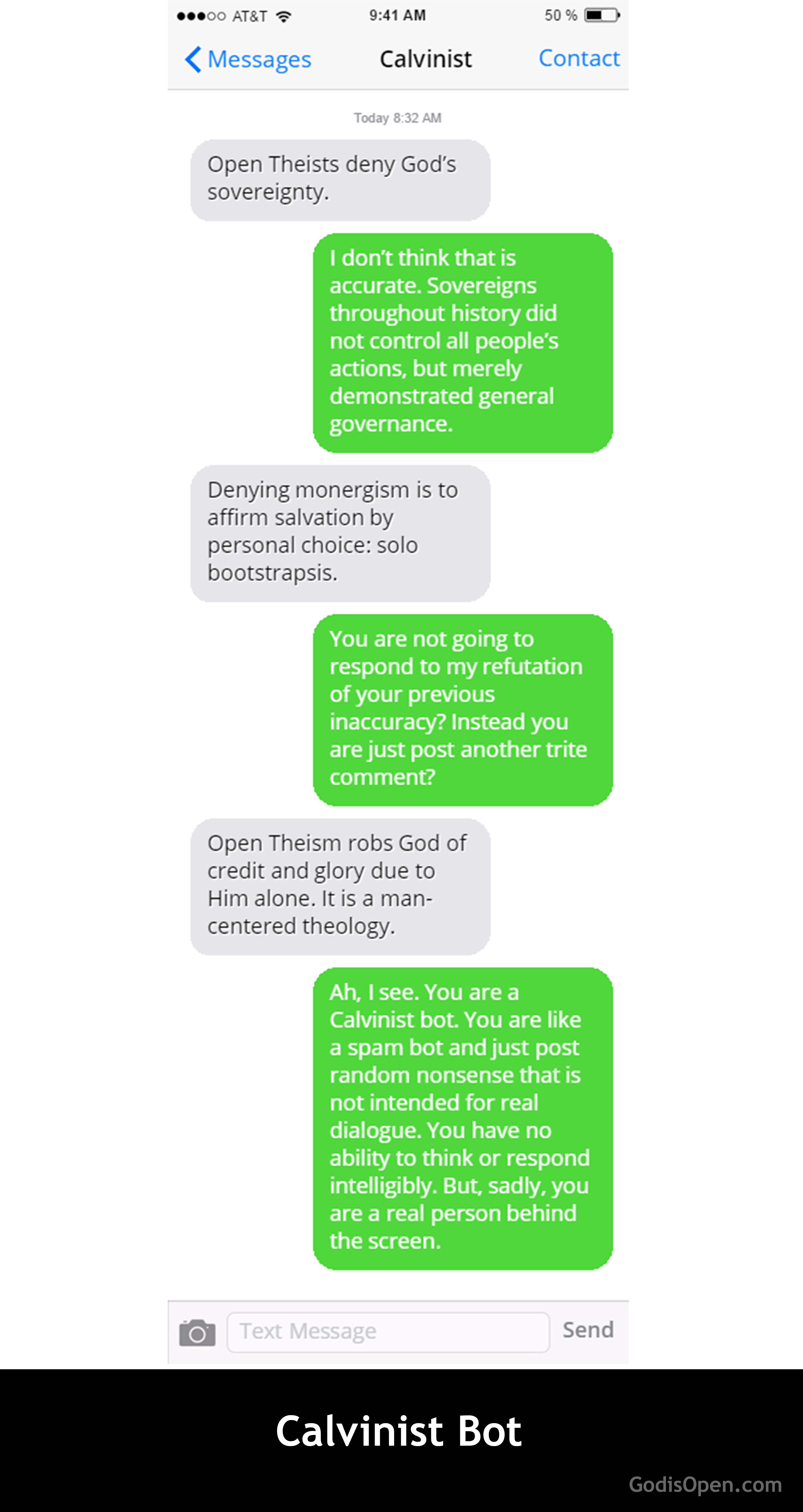
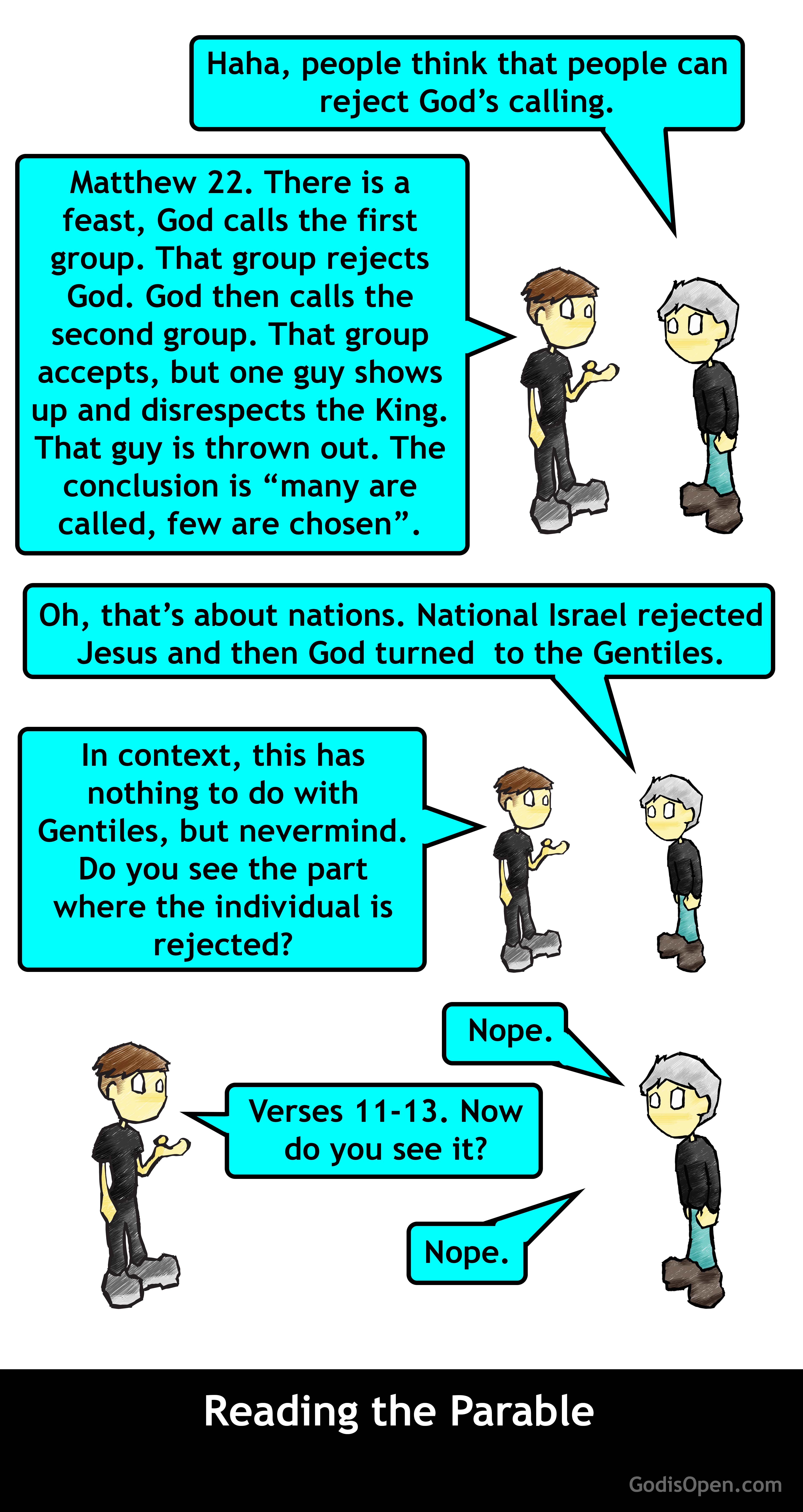
Practical Calvinism – Mother Blames God for Homicide of Children

From CNN:

Five children died and at least 12 were hospitalized after the bus plowed into a tree and flipped over in the Tennessee city.

Walker, 24, now faces five counts of vehicular homicide, reckless endangerment and reckless driving.

“Based on witness statements and physical evidence, the defendant was driving the school bus at a high rate of speed, well above the posted speed limit of 30 mph,” his arrest warrant affidavit says.

“Mr. Walker lost control of the bus and swerved off of the roadway to the right, striking an elevated driveway and mailbox, swerved to the left and began to overturn, striking a telephone pole and a tree.”

Cook said she’s grieving for the families of the children killed — but said her son is also suffering.

“My heart of love is going out for all that was in harm’s way of God’s will,” she said. “Sending out mine and our condolences to every family that God touched yesterday in this horrible accident. And I am asking for compassion also for my son.”

Worship Sunday – Cling

When the night is long
When I yearn for deep peace to come
I strain to hear Your song
But suddenly I know I’m not alone

For You settle over me
Dispelling all my fears
My Father, I know You are here

May Yours be the only smile I need to see
May You be the healing washing over me
With Your arms around me
Your peace surrounds me
And may it only be You
I cling to

I set out on this road
So many voices call to my soul
They try to fill my cup
But I have found, sweet Lord, that You’re my enough

So I’m staying close to You
You hold me to Your side
My Father, the joy of my life

Break any hold
This world has on me
I’m letting go
And I throw myself at Your feet
There’s just one thing
One single thing I need
To know the very One who formed me

Jeremiah 1:5 Commentary

Part of the ongoing Verse Quick Reference project.

Jer 1:5  “Before I formed you in the womb I knew you, and before you were born I consecrated you; I appointed you a prophet to the nations.” 

This text is used to promote future omniscience of all events. Each Christian is said to be known before they are born. Pro-life campaigns quote Jeremiah 1:5 as a blanket idea that God knows all babies before they are born. This might be stretching the text too far. Note that this knowledge is never said to be eternal knowledge. The idea that God knows all babies intimately from before the creation of the world is an unwarranted assumption. Likely the text is limited to Jeremiah’s conception, or God creating a specific baby for a specific purpose when a specific need arises.

This text is about Jeremiah. God, throughout the Bible, chooses people from birth to be advocates for him. King David was convinced about this. Isaiah was convinced of this (Isa 49:1). It is a fallacy is to take special people in the Bible and then export their experiences to all of humanity. Not everyone is King David or Jeremiah. This is the logical fallacy of composition.

But even God’s calling doesn’t always go as planned. In Numbers 18, God gives Aaron and his sons the priesthood. But in Leviticus 10:1, Aaron’s immediate sons quickly sin and God puts them to death. They have failed their calling and have failed God.

In 1 Samuel 22, the same thing happens. The sons of Eli sin. God kills them, revokes his promise to Aaron’s lineage, and then promises to raise up a faithful priest instead:

1Sa 2:30 Therefore the LORD God of Israel says: ‘I said indeed that your house and the house of your father would walk before Me forever.’ But now the LORD says: ‘Far be it from Me; for those who honor Me I will honor, and those who despise Me shall be lightly esteemed.

Notice the revocation of God’s promise. If God has foreseen the revoking of His promise, then His promise was a lie. The more natural reading is that although God raised up Aaron’s lineage to be a priest nation, they ignored God’s guidance, and God changed His mind based on their actions. God chooses to raise up a new priest:

1Sa 2:35 Then I will raise up for Myself a faithful priest who shall do according to what is in My heart and in My mind. I will build him a sure house, and he shall walk before My anointed forever.

The very next chapter starts with God calling to the boy, Samuel. Samuel was called as a boy, not from before birth, and only because of the failings of Eli’s sons. But Eli was called young, because God raises up people from birth. Sometimes they are a plan B, as with David who receives Saul’s kingdom after God wanted to give Saul an eternal kingdom but then Saul failed. Sometimes God’s chosen fail God.

Apologetics Thursday – William Lane Craig on Time

William Lain Craig believes that a Biblical theory of time lies not with the theologian, but with the philosopher:

When we speak of God as eternal, then, we may mean either ‘timeless’ or simply ‘everlasting’. The question is: which understanding of God’s relationship to time is to be preferred? Taking sharp issue with Cullmann’s study, James Barr has shown that the biblical data are not determinative. He argues that Cullmann’s study is based too heavily upon etymology and vocabulary studies, and these cannot be determinative in deciding the meaning of a term apart from use.4 Barr thinks that Genesis may very well teach that time was created along with the universe, and that God may be thought of as timeless.5 Barr’s basic contention is that, ‘A valid biblical theology can be built only upon the statements of the Bible, and not on the words of the Bible.’6 When this is done, the biblical data are inconclusive: ‘. ..if such a thing as a Christian doctrine of time has to be developed, the work of discussing it and developing it must belong not to biblical but to philosophical theology’.7

Therefore, the issue lies in the lap of the philosopher, not the theologian. Are there, then, good philosophical arguments for preferring one of these competing notions of God’s eternity to the other? I think that there are.

Barr’s study, which is cited, is about etymology (the study of how words are used). Granted, language is fluid and not as precise as many theologians would hope. But words have context. William Lane Craig, through Barr, claims that Genesis can be taken as God creating time, but parallel texts do not show this.

The chapter begins with a temporal clause often translated “In the beginning.” This translation implies that what follows is an account of the ultimate origins of the universe. The reader of such a translation expects to hear of the first act in time: “In the beginning, X happened as the first act in time.” Thus many English translations read: “In the beginning, Elohim created the heaven and earth.” This is, however, a poor translation of the Hebrew. The Hebrew phrase in question is similar to the opening phrase in other Near Eastern cosmologies and is best translated “when Elohim began creating the heavens and the earth,” just as Enuma Elish’s opening phrase is best translated as “when on high.” This more accurate translation suggests that the story is concerned not to depict the ultimate origin of everything, but rather to explain why and how the world is the way it is. The full translation of verses 1– 2 is: “When Elohim began to create heaven and earth (the earth being unformed and void and darkness on the face of the deep and the wind of Elohim hovering over the face of the water) Elohim said, “Let there be light” (Hayes’s translation).

Hayes, Christine. Introduction to the Bible (The Open Yale Courses Series) (Kindle Locations 753-758). Yale University Press. Kindle Edition.

Where are the claims that Enuma Elish depicts the creation of time? Where are the claims that Homer’ Iliad and Odyssey depict timeless gods? Where are the claims that the pagan gods depicted in the Bible are considered timeless by their adherents? So-called Biblical scholars intuitively know that the Baal worshipers were not worshiping a pure-simplicity, timeless, and immutable god. They bring a second, arbitrary, and unintuitive standard when approaching the God of the Bible. Instead, the narratives show God acting in time, creating, and experiencing. The Bible is filled with such stories in which God is treated like a genuine character in the events that happen. To pretend that God is not, and that a wholly new standard of reading the text applies exclusively to Him, and deny this standard to anything else we know, is not intellectually tenable.

Cullman’s Classic Work Christ and Time

Oscar Cullman:

Primitive Christianity knows nothing of a timeless God. The “eternal” God is he who was in the beginning, is now, and will be in all the future, “who is, who was, and who will be” (Rev. 1 :4) . Accordingly, his eternity can and must be expressed in this “naive” way, in terms of endless time.

https://www.scribd.com/doc/127918276/Cullmann-Christ-and-Time-the-Primitive-Christian-Conception-of-Time

Jeremiah 29:11 Commentary

Part of the ongoing Verse Quick Reference project.

Jer 29:11  For I know the plans I have for you, declares the LORD, plans for welfare and not for evil, to give you a future and a hope. 

Jeremiah 29:11 is often used for a prooftext to claim that God has plans for every person’s life, and often extended to mean that God then brings those plans about by micromanaging all coincidences one experiences. God, it is said, has intricate and detailed plans for everyone which He is constantly bringing to fruition. But Jeremiah 29:11 is just not about this. In context, Jeremiah is addressing Israel. This verse is about the Babylonian exile. Those being addressed are exilic Israel:

Jer 29:1  These are the words of the letter that Jeremiah the prophet sent from Jerusalem to the surviving elders of the exiles, and to the priests, the prophets, and all the people, whom Nebuchadnezzar had taken into exile from Jerusalem to Babylon. 

The benefit is specifically stated, and national in scope:

Jer 29:10  “For thus says the LORD: When seventy years are completed for Babylon, I will visit you, and I will fulfill to you my promise and bring you back to this place. 

This verse is about God’s plans for cooperate Israel. Any extension of the meaning to individuals in the modern world is out of the scope of what is intended. This verse is not about God having plans for individuals, nor micromanaging the lives of everyone on Earth.

Matthew 22:32 Commentary

Part of the ongoing Verse Quick Reference project.

Mat 22:32 ‘I AM THE GOD OF ABRAHAM, THE GOD OF ISAAC, AND THE GOD OF JACOB’ ? God is not the God of the dead, but of the living.”

In Matthew 22:32, Jesus is responding to the Sadducees. The Sadducees were of the opinion that there was no life after death. Death was the end. Jesus references an Old Testament quote by God. The quote is made in the present tense: ‘I AM THE GOD OF ABRAHAM, THE GOD OF ISAAC, AND THE GOD OF JACOB’ (a reference to Exodus 3:6). This statement is made by God to Moses, long after Abraham, Isaac, and Jacob had been dead. Jesus’ point is that if Abraham, Isaac, and Jacob no longer existed, then God would have said “I was the God of Abraham, Isaac, and Jacob.” Because it is in the present tense, God continues to be their God after they are dead. They still exist.

What this interaction shows is that neither Jesus, the Sadducees, or anyone else present at that time considered a possibility that God is timeless. If they believed God was timeless, Jesus’ argument would not work. The argument would be made that God is timeless, and thus can forever be currently the God of the dead because all events are happening to God in the same instant. Only without timelessness can arguments about God based on the tense of verbs be entertained. Jesus did not think God was timeless; he did not even consider the possibility. The Sadducees did not think God was timeless; they did not even consider the possibility. Anyone listening to Jesus did not think God was timeless; they did not even consider the possibility. Jewish thought in the time of Jesus did not entertain timelessness as a theological option. Their very arguments about God depend on God not being timeless.

Apologetics Thursday – Much Ado About Judaism

In the criticism of Open Theism, Beyond the Bounds, Russell Fuller writes:

“The idea of God in Judaism is developed from the Scriptures. The influence of contemporary philosophy which is seen in some Hellenistic Jewish writings—the Wisdom of Solomon, 4 Maccabees, and above all in Philo—is not recognizable in normative Judaism, nor is the influence of other religions. . . .”9 Similarly, Adin Steinsaltz declares: “Some of the mishnaic and talmudic sages were acquainted with Greek and classical literature, but this knowledge had almost no impact on their way of thinking where talmudic scholarship was concerned. In this they differed greatly from Egyptian Jewry which tried to combine Greek culture with Judaism.”10 Saul Lieberman, arguably the greatest Rabbinic authority of the last century and a leading expert on Hellenistic influence in Judaism, admits that some purely Greek ideas penetrated into Rabbinic circles, but these were limited to ethical principles and Greek legal thought.11

Piper, John; Taylor, Justin; Helseth, Paul Kjoss. Beyond the Bounds: Open Theism and the Undermining of Biblical Christianity (pp. 25-26). Crossway. Kindle Edition.

Fuller quotes plenty of Rabbis who discount the influence of Philo, but does not seem to have too much information quoted about the extent of Greek influence on Judaisms. Fuller’s thrust of his points about Judiasm is that Judiasm has not been corrupted by Greek thought, and that furthermore, Judiasm traditionally reflects Classical Theism’s views on God. This is not true, and even by the time the book of Jubilees was written perhaps 300 years before Jesus, the text of the Bible was being rewritten into more Hellenized ideas. Even the name of God shows some Hellenistic tampering.

Modern rabbis, contrary to what Fuller suggests (he does not show relevant quotes), do not agree that the current Christian idea of Yahweh is pure of Greek corruption. Perhaps the most influential Rabbi of our time, Rabbi Sacks, writes:

The fifth and most profound difference [between Christianity and Judaism] lies in the way the two traditions understood the key phrase in which God identifies himself to Moses at the burning bush. ‘Who are you?’ asks Moses. God replies, cryptically, Ehyeh asher ehyeh. This was translated into Greek as ego eimi ho on, and into Latin as ego sum qui sum, meaning ‘I am who I am’, or ‘I am he who is’. The early and medieval Christian theologians all understood the phrase to be speaking about ontology, the metaphysical nature of God’s existence. It meant that he was ‘Being-itself, timeless, immutable, incorporeal, understood as the subsisting act of all existing’. Augustine defines God as that which does not change and cannot change. Aquinas, continuing the same tradition, reads the Exodus formula as saying that God is ‘true being, that is being that is eternal, immutable, simple, self-sufficient, and the cause and principal of every creature’.

But this is the God of Aristotle and the philosophers, not the God of Abraham and the prophets. Ehyeh asher ehyeh means none of these things. It means ‘I will be what, where, or how I will be’. The essential element of the phrase is the dimension omitted by all the early Christian translations, namely the future tense. God is defining himself as the Lord of history who is about to intervene in an unprecedented way to liberate a group of slaves from the mightiest empire of the ancient world and lead them on a journey towards liberty…

Far from being timeless and immutable, God in the Hebrew Bible is active, engaged, in constant Far from being timeless and immutable, God in the Hebrew Bible is active, engaged, in constant dialogue with his people, calling, urging, warning, challenging and forgiving. When Malachi says in the name of God, ‘I the Lord do not change’ (Malachi 3: 6), he is not speaking about his essence as pure being, the unmoved mover, but about his moral commitments. God keeps his promises even when his children break theirs.

Sacks, Jonathan. The Great Partnership: Science, Religion, and the Search for Meaning (p. 65). Knopf Doubleday Publishing Group. Kindle Edition.

Rabbi Sacks understands that the picture of God drawn by the likes of Fuller is one of Greek origin. Negative attributes are known to be of Greek origin, and not part of early Jewish theology (Fuller even quotes a Rabbi to this effect, misunderstanding him). Fuller is incorrect to view Judiasm as untainted by Greek thought, and he is also incorrect to see Yahweh in modern Judaism as equivalent to his conception of God.