Open Theism

Answered Questions – Free Will and Foreknowledge

Jack asks:

Seriously though the problem I’m having is convincing a friend that the belief that God has exhaustive foreknowledge yet free will is still possible. I deal with Arminians not Calvinists.
So I’m looking for something that is a good argument against that. Is there a good blog or article I could refer an Arminian too? Something short enough that my friend might actually take the time to read it?

Several responses:

Will Duffy offers his debate on the subject: link

Christopher Fisher offers two quotes by atheists:

From Arguing Against Gods:

Another tricky issue is whether or not genuine omniscience is in any way compatible with free will – either ours or the alleged god’s. To start with our free will, it has been observed many times that if a god knows the future with infallible certainty, then what this god knows will necessarily happen – there is no possibility for anything else to occur. We are, then, incapable of altering the future. Although the concept of human “free will” is hotly contested, I’m not aware of any theory of free will which could be considered compatible with a being perfectly knowing the future. If a god knows who will win the next presidential election, then it isn’t possible for anyone else to win. That’s predestination – and some theologians have unflinchingly embraced it, for example John Calvin.

And

George H Smith from Atheism: the Case Against God:

The first problem with omniscience is that it cannot be reconciled with any theory of free will in man. If one believes in an omniscient being, one cannot consistently hold that man has volitional control over his actions. If God knows the future with infallible certainty, the future is predetermined, and man is impotent to change it.

Some theologians (such as Calvin) have enthusiastically embraced predestination, but most theologians, sensing the enormous problems entailed by this doctrine, have attempted to defend some theory of volition. Without volition, morality becomes meaningless: we cannot blame or praise a man for an action over which he has no control. Without volition, the Christian scheme of salvation is a farce; men are predestined for either heaven or hell, and they have no voice in the matter. Why does God create men only to save some arbitrarily, and damn others? Why does the Christian bother to proselytize, since men cannot help what they believe anyway? The problems that arise for theology if it affirms predestination are unsolvable, but they necessarily ensue when omniscience is attributed to God.

Apologetics Thursday – Answering Calvin’s Apologists

A Calvinist claims that John Calvin claimed to have opposed killing Servetus. He quotes a book:

Calvin responded to one of his accusers by saying “For what particular act of mine you accuse me of cruelty I am anxious to know. I myself know not that act, unless it be with reference to the death of your great master, Servetus. But that I myself earnestly entreated that he might not be put to death his judges themselves are witnesses, in the number of whom at that time two were his staunch favorites and defenders” (Calvin’s Calvinism Pg. 346)

But this seems to be a mistranslation. From A History of Protestantism:

To Calvin, above all men, we owe it that we are able to rise above the error that misled his age. And when we think, with profound regret, of this one stake planted by Protestant hands, surely we are bound to reflect, with a gratitude not less profound, on the thousands of stakes which the teaching of Calvin has prevented ever being set up. 23We are precluded from hearing Calvin in his own defense, because the death of Servetus was not brought as a charge against him during his lifetime. Still he refers twice to this affair in rebutting general accusations, and it is only fair to hear what he has to say. In his Declaration upon the Errors of Servetus, published a few months after his execution, Calvin says: “I made no entrearies that he might be punished with death, and to what I say, not only will all good people bear witness, but I defy even the wicked to say the contrary.” In 1558 he published his Defence of the Secret Providence of God. The book was translated into English by the Reverend Henry Cole, D.D., of Clare Hall, Cambridge. In that work, pp. 128, 129 (English translation), is the following passage, in which Calvin is appealing to his opponents: – “For what particular act of mine you accuse me of cruelty I am anxious to know. I myself know not, unless it be with reference to the death of your great master, Servetus. But that I myself ernestly entreated that he might not be put to death his judges themselves are witnesses, in the number of whom at that time two were his staunch favorers and defenders.” This would be decisive, did the original fully bear out the English rendering. Calvin’s words are- “Saevitiam meam in quo accuses, audire cupio: nisi forte in magistri tui Serveti morte, pro quo tamen me fuisse deprecatum testes sunt ipsi judices, ex quorum numero tunc duo erant strenui ejus patroni.” (Opp. Calvini, vol. 8, p. 646.) The construction of the words, we think, requires that the important clause should be read thus-I myself know not that act, unless it be with reference to your master, Servetus, for whom I myself earnestly interceded, as his judges themselves are witnesses, etc. If Calvin had said that he earnestly entreated that Servetus should not be put to death, we should have been compelled to believe he had changed his mind at the last moment. But we do not think his words imply this. As we read them they perfectly agree wit all the facts. Now that M. Rilliet de Candolle has published the whole process, the following propositions are undeniable:-1. That Calvin wished for a capital sentence: he had intimated this as early as 1546 in his letter to Farel. 2. That when the time came the Council of Geneva had taken both the ecclesiastical and civil power into their own hands. 3. That the part Calvin acted was simply his statutory duty. 4. Thathe had no power either to condemn or save Servetus. 5. That the only party in Christendom that wished an acquittal were the Libertines. 6. That their object was the overthrow of the Reformation in Geneva. 7. That the sentence of the Council was grounded mainly on the political and social consequences of Servetus’’ teaching. 8. That Calvin labored to substitute decapitation for burning.

Open Theist Comes to the Realization that God is Not to Blame

Jack writes on Facebook:

I too have broken much ground with people that are resistant to the Gospel over God’s character as presented from a closed thinking rational. People ask me why I’m so obsessed with Open Theism and that my friend is the answer. I came from a background that was not fun! Most of the people I interact with on a daily basis come from the same type of background. For people that have lived normal lives raised by typical and functional families the whole “God is in control” gospel is great. But for those of us that endured terrible childhoods and very hard adult lives as well, it’s not so great! In fact it sort of makes us really angry with Him.

Years ago I had an itinerant ministry called “Mad at the Devil Ministries.” LOL it was a crazy name but it was the best way to describe the message I preached. It was born of a resentment I had with God. One I developed due to very well meaning Christians who kept telling me that “God put you through all of that to help you minister to people who have been through the same.”

I believed them but it made me really mad. I would wonder to myself. If He put me through all that just so I can minister to other people who have been through hard times why is He putting them through all that? Wouldn’t it make much more sense not to put any of us through hard times so that it wouldn’t take someone like us to reach us???

Then overtime I realized that God didn’t put me through any of that. God wasn’t trying to give me a testimony the devil was trying to steal my testimony! Thus my ministry was born.

Fishbane on Mythmaking and the Bible

W Scott Taylor of ideoamnostoutheou posts a quote from Micheal Fishbane on the Facebook group The Open Theist Reformation: Biblical Open Theism:

Myth, Anthropomorphisms, Cosmic Plenum and Ancient Near Eastern ‘tendentious and presumptive dismissal of biblical language about God’. *
“A striking feature of contemporary attempts to differentiate ancient Israel from myth often depends upon definitions that first define myth in terms of polytheistic paganism, and thus juxtapose this definition to features of biblical monotheism—concluding thereby that ‘myth’ is absent from the latter. For example, on the argument that an essential variable of ancient Near Eastern paganism is the origin of the gods in a cosmic ‘plenum’, from which substance: they emerge as differentiated personalities, but upon whose elemental character they are necessarily and inherently dependent, the figure of a singular God with a transcendent will, who is (apparently) distinct from the natural world to which He gave created form, is of a fundamentally different sort. Hereby, myth is linked with the natural gods of polytheism and totally dissociated from supernatural monotheism. Accordingly, it is presumed that any hint of myth as recognizable from the ancient Near East (in terms of divine action, imagery, or personality) can only be harmless vestiges of a figurative (or metaphorical) sort and thus neither true nor living myth.

But this is a self-serving and fallacious line of argument. Whether or not these characterizations of polytheistic paganism or monotheism are in any way accurate, the exclusive identification of a literary phenomenon (myth) with a specific religious cultural form (natural polytheism) is both tendentious and tautological: the first, because the defintion is arbitrary and selective; and the second, because the identification is always self-confirming, and without any means of checking its circular or redundant character. Such argumentation is also based on certain essentialist views regarding polytheism and monotheism, though it generally avoids this stigma through the pretense of comparative historical study, and conceals an old cultural animus against brute ‘myth’ (the heir of Hellas) under the cover of an analytical phenomenology of religion. [22] Nevertheless, such intellectual practices reveal just how much the category of myth still serves as a container for all the cultural forms of ideologies that one has purportedly transcended (like irrationality, polytheism, and paganism) — for the sake of others assumed to be superior in kind (like reason, monotheism, or historical inquiry) and with which one identifies.[23] The result is a lamentable impoverishment of the notion and nature of myth, and its formulations within biblical monotheism; but it is also a schematization of monotheism that equally impoverishes its inherent and complex features. Indeed, the upshot of much recent writing is to claim differences between monotheism and polytheism that are arguably more polemical than propeadeutic, and that need to be thoroughly reconsidered.[24]

Equally tendentious is the presumptive dismissal of certain apparently mythic features of biblical language (its unabashed and pervasive deptions of God in anthropomorphic and anthropopathic terms) that blatantly occur in the monotheistic canon of Scripture—as if these were merely due to ‘the inadequacy of human language’ and ‘limitation of human thought’, or to some sort of necessarily ‘indirect grasp’ of ‘spiritual concepts’ by ‘images…that emphasize the sensual’.[25] But on what grounds are such assertions made? Surely there is nothing in Scripture itself that would point in this direction, or suggest that the representations of divine form and feeling in human terms are anything other than the preferred and characteristic mode of depiction. [26] Moreover, on what basis should one assume that the plain sense of Scripture is some (quasi-allegorical) approximation of a more spiritual or purely metaphorical content? And would would that content be, we may well ask, and is it even possible to get past the thick immediacy of biblical language and its concrete and sensible accounts of God? [27] One can only conclude that the evasion of the direct sense of Scripture that such attitudes represent are attempts to save Scripture from itself—for oneself, and must be considered a species of modern apologetics.[28]

[26.] Cf. the judicious concern of Jame Barr, ‘Theophany and Anthropomorphism in the Old Testament’, Congress Volume, Oxfort (SVT 7; Leiden: E. J. Brill, 1960), 33, who urges the interprete to shift from the question ‘Is God conceived of as essentially in human form”‘ to ‘When he does appear in a forma at all, is it thought that the human form isthe natural or characteristic one form him to assume?’ ”

* NOTE: the previous paragraphs (not the title) were taken from the Introduction :

“Biblical Myth and Rabbinic Mythmaking”, by Micheal Fishbane (see free preview via Google search on the title.

Worship Sunday – From the Inside Out

A thousand times I’ve failed
Still your mercy remains
Should I stumble again
Still I’m caught in your grace
Everlasting, your light will shine when all else fades
Never ending, your glory goes beyond all fame

Your will above all else
My purpose remains
The art of losing myself in bringing you praise
Everlasting, your light will shine when all else fades
Never ending, your glory goes beyond all fame

My heart and my soul
I give you control
Consume me from the inside out Lord
Let justice and praise
Become my embrace
To love you from the inside out

Everlasting, your light will shine when all else fades
Never ending, your glory goes beyond all fame
And the cry of my heart is to bring you praise
From the inside out
Lord my soul cries out

Calvin’s Full Quote of God’s Baby Talk

From Institutes of the Christian Religion (1.13.1):

1. The doctrine of Scripture concerning the immensity and the spirituality of the essence of God, should have the effect not only of dissipating the wild dreams of the vulgar, but also of refuting the subtleties of a profane philosophy. One of the ancients thought he spake shrewdly when he said that everything we see and everything we do not see is God (Senec. Praef. lib. 1 Quaest. Nat.) In this way he fancied that the Divinity was transfused into every separate portion of the world. But although God, in order to keep us within the bounds of soberness, treats sparingly of his essence, still, by the two attributes which I have mentioned, he at once suppresses all gross imaginations, and checks the audacity of the human mind. His immensity surely ought to deter us from measuring him by our sense, while his spiritual nature forbids us to indulge in carnal or earthly speculation concerning him. With the same view he frequently represents heaven as his dwelling-place. It is true, indeed, that as he is incomprehensible, he fills the earth also, but knowing that our minds are heavy and grovel on the earth, he raises us above the worlds that he may shake off our sluggishness and inactivity. And here we have a refutation of the error of the Manichees, who, by adopting two first principles, made the devil almost the equal of God. This, assuredly, was both to destroy his unity and restrict his immensity. Their attempt to pervert certain passages of Scripture proved their shameful ignorance, as the very nature of the error did their monstrous infatuation. The Anthropomorphites also, who dreamed of a corporeal God, because mouth, ears, eyes, hands, and feet, are often ascribed to him in Scripture, are easily refuted. For who is so devoid of intellect as not to understand that God, in so speaking, lisps with us as nurses are wont to do with little children? Such modes of expression, therefore, do not so much express what kind of a being God is, as accommodate the knowledge of him to our feebleness. In doing so, he must, of course, stoop far below his proper height.

Questions Answered – Do Calvinists Believe in Myths?

By Christopher Fisher
An Open Theist comments on a rough draft of my new book:

Though I think I understand your definition of “anthropomorphism” as fable or myth, I do not believe I have ever met a Calvinist who believed he was arguing that texts about God’s changing His mind (etc.) were fables about some non-existent, mythical, fictional character called “God.” They were always using the definition according to what I see the dictionary defintion to be, that of ascribing human characteristics to something (some real object or animal) that does not actually have those characteristics. When I say the “head” or “foot” of the bed, I do not believe, or even want to imply, that the bed does not exist. I am simply trying to communicate something about the bed that is easier to say than “the place where your head would be,” or “the place your foot would be if you were to lie down on the bed” (in the normal fashion, of course).

Now, maybe these Calvinists and I are using “metaphor,” or “personification,” and mistakenly calling it an anthropomorphism, but I never thought it would be appropriate to accuse them of saying God was a myth, or a fable. And, as far as I know, they were not trying to say that.

It seems to me that for way too long Arminians have been too generous with Calvinistic theology, theology which strips God of all emotion. These Calvinists blanketly qualify everything about God as anthropomorphism. But an anthropomorphism is a fictional framing device, not a metaphor or personification (in which one thing stands for another).

When Yahweh walks in the Garden of Eden, some Calvinists would claim this is an event that never happened. When God proclaims (to no one in particular that He regrets making man), when Abraham reasons with God, when Moses coerces God, when God repents to Samuel, when Jonah argues to God, when Ezekiel asks for one small change in God’s command (Eze 4)… they would frame these dialogues as never having happened. The dialogues only work under the assumption that the future is not set and that mankind can influence God. Did the individuals in the stories (who were talking to God) believe they could not change God’s mind? Did God actually engage in multiple two sided conversations under this impression? Because if the human side was genuine, then God’s side must be as well.

Taking this element (God’s mutability) from these stories robs the story of the core message and does not communicate anything. It literally turns God’s portion of these events into fable. From a narrative in which God sees that mankind has become wicked, then exclaims His regret in making man, then thhow the rabbit lost its taile narrator saying that He regrets making man, then God destroying the whole earth in an act commensurate with repentance… the audience is left with God not changing but destroying the Earth (no motivations, emotions, are left). How is this different from the flood myths around the world which explain why the flood happened? How is this materially different from the myth of Persephone in the Greek religion, a myth that explains why the seasons change? How is this different from the South American myth explaining how the rabbit lost its tail? In each of these myths, reality is explained with fictional stories. They are all myths. And when the Calvinist strips out God’s reasoning, dialogue, and actions, they are making stories about God into myth.

A detailed response to Closing the Door on Open Theism – Part 2

II. Open Theism’s Assault on God’s Attributes

In this section, McGeown starts speaking of omniscience. McGeown wants to focus on a word the Bible never uses and is usually defined by Greek philosophy (“omniscience”). In McGeown’s defense, many Open Theists use this word. But again, it is not Biblical argumentation in either case. And anyone concerned with Biblical theology should define attributes of God by standards found in the Bible. McGeown doesn’t seem to mind using extra-Biblical sources to define omniscience. He quotes Norman Geisler objecting that Open Theists define the word (again, a word that is not found in the Bible) to include all things knowable.

But, the Bible neither goes on a theological diatribe about God knowing every event that will ever occur or knowing all things knowable. Both statements are speculative. Instead, God is said to see all things in the context of knowing everyone’s hidden sins. When evil people throughout the Bible claim that God will not see their evil, God’s response is that He does see their evil and He will respond. God sees and searches to know (which, on its own, invalidates the traditional understanding of omniscience). There is no appeal to metaphysics. There is no appeal to God’s ‘omniscience’. The Bible is unconcerned with the extent of God’s knowledge over minutia.

After explaining that [most] Open Theists hold to a view of omniscience in which God knows all things knowable, McGeown objects to this understanding with a claim that if the future is Open then Satan might win:

The problem of this position, as John Frame rightly explains, is this: “If God has really left the future completely open, he has left open the possibility of Satan’s victory.”

This statement is riddled with fallacies. Number one is the moralitstic fallacy. What we would prefer to be real has zero effect on what is actually real. We can claim all we want that millions of people have not died in infancy. This might sound nice, but our nice thoughts have no effect on reality. Reality is not optional. It “could” be the case that Satan might ultimately win (why else would he rebel if he had no hope of some sort of victory). What if God just decides to withdraw and give Satan the victory? If God “cannot” do that, then Open Theists redefining omniscience is the least of McGeown’s problems. He would have just said that God is not omnipotent; God cannot do something man can easily do. Maybe McGeown would like to spend some time building the Biblical case that Satan will not and cannot win (two different things). McGeown has not shown that this is not a possibility but is relying on emotions to fuel his arguments (a second fallacy).

Fallacy number three is that McGeown and Piper cannot conceive of an open future in which Satan has no possibility of winning (this is a non-sequitur). I am free to jump at any height I wish. I might choose to jump 1 foot or 2 feet into the air. There are open possibilities. But the limitations of physics do not allow me to leap over buildings. I have near infinite possibilities for my jump, but they are still constrained by the limits of my strength and by gravity. Openness does not mean that reality is tossed to the wind. By McGeown’s logic, he might as well make the absurd claim that “If God has really left the future completely open, he has left open the possibility of my cat, Boots, becoming the supreme ruler of the universe.” The statement is a non-sequitur.

The fact that McGeown proffers this first argument is curious. Does he believe he is making a legitimate point? Did he not think through, not only the logic, but the common Open Theist responses to this sort of argument? This point is evidence that McGeown has not properly understood his opponents and has not thought through his own arguments.

McGeown then addresses the fact that Open Theists claim that God’s predictions sometime fail. He uses the case of King Saul as an example. McGeown then forgets to explain how that example is not a case of God’s failed predictions. McGeown just assumes the idea does not merit response. The first Biblical point in McGeown’s article is ignored by the author! Again, McGeown is presenting a thoroughly Platonistic argument and not a Biblical argument.

Predictably, McGeown then begins to defend omniscience with quotes. McGeown quotes, not the Bible, but a bunch of theologians. He quotes Bavinck, Dabney (using a moralistic fallacy), Reymond, Shedd, and Geisler. It is after this that McGeown first quotes a Bible verse. McGeown turns to Isaiah 41. The context and the meaning of those verses are obvious to those not involved in prooftexting; God can predict things because God is powerful and the idols are not. McGeown wishes to assume Yahweh is challenging the idols to a trivia game, as if God is trying to impress Israel with His knowledge. But it is competence, not knowledge, that is the source of Yahweh’s information. Yahweh is impressing Israel with His ability to bring His prophecy to pass.

McGeown waxes skeptical. He does not understand how if the future is free can God bring about things with certainty. Perhaps McGeown should take stock of his own life and how well he is at predicting the behavior and actions of others. Does McGeown ever assume that when he sets out to go to the store that the store owner will refuse to exchange his money for goods? I would wager that McGeown has never thought twice about his unspoken and accurate predictions of the actions of free people. McGeown would have the reader believe that God is less competent than every human alive, who makes countless accurate predictions on a daily basis.

McGeown would also like to think that counterexamples in the Bible do not abound. Twice, God is said to regret His own actions. Both times it is a quote from God, Himself. Quite a few examples can be given of God’s word not materializing, but in these cases McGeown would either like to claim God’s word was “conditional” (talk about having one’s cake and eating it too) or that in some weird and incomprehensible way the words came true. God tells Nineveh “40 days are you will be overthrown” and this time specific prophecy of Jonah did not come to pass. Jonah tells the reader exactly why: because one of God’s main attributes is repentance. God responses when conditions change. This is all in the context of a dialogue between Jonah and God, and in the larger context of a detailed story. To dismiss God’s thoughts, actions, and words is to dismiss the story as fable.

A Detailed Response to Closing the Door on Open Theism – Part 1 [link]
A Detailed Response to Closing the Door on Open Theism – Part 2 [link]
A Detailed Response to Closing the Door on Open Theism – Part 3 [link]
A Detailed Response to Closing the Door on Open Theism – Part 4 [link]
A Detailed Response to Closing the Door on Open Theism – Part 5 [link]

Adam Clarke on the Omniscience of God

Adam Clarke on the Omniscience of God:

Therefore it does not follow that, because God can do all things, therefore he must do all things. God is omniscient, and can know all things; but does it follow from this that he must know all things? Is he not as free in the volitions of his wisdom, as he is in the volitions of his power? The contingent as absolute, or the absolute as contingent? God has ordained some things as absolutely certain; these he knows as absolutely certain. He has ordained other things as contingent; these he knows as contingent. It would be absurd to say that he foreknows a thing as only contingent which he has made absolutely certain. And it would be as absurd to say that he foreknows a thing to be absolutely certain which in his own eternal counsel he has made contingent.

By absolutely certain, I mean a thing which must be, in that order, time, place, and form in which Divine wisdom has ordained it to be; and that it can be no otherwise than this infinite counsel has ordained. By contingent, I mean such things as the infinite wisdom of God has thought proper to poise on the possibility of being or not being, leaving it to the will of intelligent beings to turn the scale. Or, contingencies are such possibilities, amid the succession of events, as the infinite wisdom of God has left to the will of intelligent beings to determine whether any such event shall take place or not. To deny this would involve the most palpable contradictions, and the most monstrous absurdities.

If there be no such things as contingencies in the world, then every thing is fixed and determined by an unalterable decree and purpose of God; and not only all free agency is destroyed, but all agency of every kind, except that of the Creator himself; for on this ground God is the only operator, either in time or eternity: all created beings are only instruments, and do nothing but as impelled and acted upon by this almighty and sole Agent.
Consequently, every act is his own; for if he have purposed them all as absolutely certain, having nothing contingent in them, then he has ordained them to be so; and if no contingency, then no free agency, and God alone is the sole actor. Hence the blasphemous, though, from the premises, fair conclusion, that God is the author of all the evil and sin that are in the world; and hence follows that absurdity, that, as God can do nothing that is wrong, Whatever Is, is Right. Sin is no more sin; a vicious human action is no crime, if God have decreed it, and by his foreknowledge and will impelled the creature to act it. On this ground there can be no punishment for delinquencies; for if every thing be done as God has predetermined, and his determinations must necessarily be all right, then neither the instrument nor the agent has done wrong.

Thus all vice and virtue, praise and blame, merit and demerit, guilt and innocence, are at once confounded, and all distinctions of this kind confounded with them. Now, allowing the doctrine of the contingency of human actions, (and it must be allowed in order to shun the above absurdities and blasphemies), then we see every intelligent creature accountable for its own works, and for the use it makes of the power with which God has endued it; and, to grant all this consistently, we must also grant that God foresees nothing as absolutely and inevitably certain which he has made contingent; and, because he has designed it to be contingent, therefore he cannot know it as absolutely and inevitably certain.

I conclude that God, although omniscient, is not obliged, in consequence of this, to know all that he can know; no more than he is obliged, because he is omnipotent, to do all that he can do.”

Oord on the Paris Attacks

From Did God Allow the Paris Attacks:

The uncomfortable truth is that most theologians and Christians today and throughout history have said God permits genuine evil. God allows pointless suffering. And they appeal to mystery when asked questions like, “Did God allow the Paris attacks?” They say, “Don’t ask me, I’m not God!”

By contrast, I think theologians and Christians in general need to rethink God’s power. This means rethinking what it means to say God can control creatures and creation, whether these existing things have freedom or not.

In my new book, I’ve carefully laid out an argument that says God’s uncontrolling love prevents God from being able to stop genuine evil unilaterally. God is still almighty, I argue. God is omnipresent and loving too. God knows everything that can be known. But the uncontrolling God I describe should not be blamed for tragedies like those in Paris, because God cannot stop them acting alone.

Worship Sunday – Invitacion Fountain

All who are weak
All who are weary
Come to the Rock
Come to the Fountain
All who have sailed
On the rivers of heartache
Come to the sea
Come on be set free

If you lead me Lord I will follow
Where you lead me Lord I will go
Come and heal me Lord, I will follow
Where you lead me Lord I will go
I will go

All who are weak
All who are weary
Come to the Rock
Come to the Fountain
All who have climbed
On the mountains of heartache
Reach to the stars
Come on give your life

If you lead me Lord I will follow
Where you lead me Lord I will go
Come and heal me Lord, I will follow
Where you lead me Lord I will go

And If you lead me Lord I will follow
Where you lead me Lord I will go
Come and heal me Lord, I will follow
Where you lead me Lord I will go
Yes, I will go, yeah, I will go with You
Yes, I will go
Yes, I will go

Heal me
Heal me
Heal me
Heal me

And If you lead me Lord I will follow
Where you lead me Lord I will go
Come and heal me Lord, I will follow
Where you lead me Lord I will go
I will go

And if you lead me Lord I will follow
And where you lead me Lord I will go
So come and heal me Lord, I will follow
Where you lead me Lord I will go

If you lead me Lord I will follow
Where you lead me Lord I will go
Come and heal me Lord, I will follow
Where you lead me Lord I will go
I will go, I will go

If you lead me Lord I will follow
Where you lead me Lord I will go
Come and heal me Lord, I will follow
Where you lead me Lord I will go
I will go, I will go

Yes I will go
I will go
I will go
I will go

Jack Explains when to Accept Mystery and when to Question Mystery

From the GodisOpen Facebook page:

There are many things about God that are beyond our comprehension.

The fact that He is a triune God for one. I love how C. S. Lewis put it best. He said that trying to explain a trinity to us would be like going into a 2 dimensional world and trying to explain a 3 dimensional object. Like a cube, they cannot comprehend a cube but they can comprehend squares so we would try to explain how something can be six squares but only one cube.They would have some comprehension but could never fully grasp the meaning of a cube.

Or the fact that He has no beginning and no end. Everything that we have ever known has a beginning and can not last forever. So for us to even try to comprehend this idea of a being with no beginning and that will last forever is futile.

His love when you think about it is incomprehensible to some degree, that He would love a world so much that for the most part hates Him so.

I could go on and on describing things about God that are incomprehensible to us. But none of the things I described are completely irrational and absurd. They are all plausible, none of them prove themselves untrue within themselves.

God made us in His own image, and in His own likeness. In His image in that He created us in the form His Son would later take, in His likeness in that we were created as persons from a personal God. Some say that as mere humans we can never understand His personhood. That is not biblical because our personhood was created in that image. We CAN use ourselves as a reference when seeking to understand God. If we were created in His likeness IE we were created to be “like Him.” Then He is also very much like us! One thing can not be like another thing while at the same time that other thing is nothing like the one thing. That my friends is an absurdity!

When a theologian describes something that is incomprehensible to you ponder it. Seek out it’s meaning and search the scriptures to validate it’s truth. But when a theologian describes something about God that feels absolutely absurd to you question it! Object to it and demand explanations of absurd theories. It feels absurd to you for a reason. Reason is the reason LOL God created you to be reasonable because He is reasonable.

Many things about God are beyond all comprehension. Nothing about God is absurd.

Answered Questions – Verses Where God Does Not Know What Will Happen

Jack asks:

I’m in the middle of a discussion on one of my posts to my personal page about God’s exhaustive foreknowledge. I’m looking for more verses where God says that He did not know something was going to happen. I’ve already brought up Jeremiah 19:5 and I’m still waiting for my friends reply to that I also plan on bringing up Deuteronomy 8:2.
Does anyone have any suggestions of other verses?

The verse in reference:

Deu 8:2 And you shall remember that the LORD your God led you all the way these forty years in the wilderness, to humble you and test you, to know what was in your heart, whether you would keep His commandments or not.

Throughout the Bible, God tests to know:

Gen 22:1 Now it came to pass after these things that God tested Abraham…
Gen 22:12 And He said, “Do not lay your hand on the lad, or do anything to him; for now I know that you fear God, since you have not withheld your son, your only son, from Me.”

Exo 16:4 Then the LORD said to Moses, “Behold, I will rain bread from heaven for you. And the people shall go out and gather a certain quota every day, that I may test them, whether they will walk in My law or not.

Exo 33:5 For the LORD had said to Moses, “Say to the children of Israel, ‘You are a stiff-necked people. I could come up into your midst in one moment and consume you. Now therefore, take off your ornaments, that I may know what to do to you.’ ”

Deu 13:3 you shall not listen to the words of that prophet or that dreamer of dreams, for the LORD your God is testing you to know whether you love the LORD your God with all your heart and with all your soul.

Jdg 2:20 Then the anger of the LORD was hot against Israel; and He said, “Because this nation has transgressed My covenant which I commanded their fathers, and has not heeded My voice,
Jdg 2:21 I also will no longer drive out before them any of the nations which Joshua left when he died,
Jdg 2:22 so that through them I may test Israel, whether they will keep the ways of the LORD, to walk in them as their fathers kept them, or not.”

1Ch 28:9 “As for you, my son Solomon, know the God of your father, and serve Him with a loyal heart and with a willing mind; for the LORD searches all hearts and understands all the intent of the thoughts. If you seek Him, He will be found by you; but if you forsake Him, He will cast you off forever.

1Ch 29:17 I know also, my God, that You test the heart and have pleasure in uprightness. As for me, in the uprightness of my heart I have willingly offered all these things; and now with joy I have seen Your people, who are present here to offer willingly to You.

2Ch 32:31 However, regarding the ambassadors of the princes of Babylon, whom they sent to him to inquire about the wonder that was done in the land, God withdrew from him, in order to test him, that He might know all that was in his heart.

Psa 11:4 The LORD is in His holy temple, The LORD’s throne is in heaven; His eyes behold, His eyelids test the sons of men.

Psa 26:2 Examine me, O LORD, and prove me; Try my mind and my heart.

Psa 139:23 Search me, O God, and know my heart; Try me, and know my anxieties;
Psa 139:24 And see if there is any wicked way in me, And lead me in the way everlasting.

This concept is found throughout the Bible in varied wording. God tests to know.

As to Jack’s original question, the verses are too numerous to count. Every time God becomes furious at the actions of mankind, this reveals that the future is not set. Every time God urges people to choose Him, this reveals that the future is unknown. Every time God repents or changes His plans or revokes His promises, this reveals that the future in unknown. In contrast to the Classical Theists, who rely on a small handful of texts ripped out of context and given undue prominence (and meaning), Open Theists just have to point to the story of the Bible.

A detailed response to Closing the Door on Open Theism – Part 1

A response to Closing the Door on Open Theism

Martyn McGeown wrote a high profile article against Open Theism. The goal of this series is to examine his claims and give a response. McGeown breaks his article into five parts. He begins with an introduction:

I. Introduction

Christians have traditionally understood God in terms of three classic perfections, each with the prefix “omni” or “all”: omnipresent (everywhere present), omnipotent (all powerful) and omniscient (all knowing). These three attributes were until recently accepted by all orthodox theists. Today, theologians can take nothing for granted. God’s most fundamental perfections are under attack. One such assault on God’s perfections calls itself “open theism,” a movement within evangelicalism which denies that God knows the future choices of His creatures. God, according to open theism, has exhaustive knowledge of the past and of the present, but He does not know with certainty what will happen in the future. The future is “open” because history is not, as has traditionally been understood, the outworking in time of what God has decreed in eternity, but a historical “project” in which God and men decide together what the future will be. God has determined the general parameters of history, but He has left much of the future open to allow men to exercise their free will. Because men often choose in ways which disappoint, frustrate, sadden, thwart or even surprise God, He is forced to deviate from what He previously planned to do; but God is flexible and resourceful, and despite many setbacks, we are told, He will accomplish His final goal. Open theism is a radical denial of God’s sovereignty in favour of man’s so-called “libertarian free will.”

We shall see that open theism is a fundamental denial of the omniscience, the sovereignty and the immutability of God, and therefore a denial of the God of Scripture, and the worship of a strange god who has been created in man’s image. As such it must be condemned as idolatry.

Critical scholarship has long pointed out that this preoccupation with the omni’s (omniscience, omnipotence, omnipresence) and im’s (immutability, impassibility) is not a feature of early Jewish and Christian theology. Instead it is a reliance on 2nd and 3rd century Neo-Platonic thought. Augustine candidly admits that he believed the Bible was absurd until he read it in light of Platonism. Augustine had to be convinced to abandon the Bible in order to become a Christian. It is telling that much of McGeown’s thought processes owe allegiance to Augustine’s theology. But the Bible stands in stark contrast to these Greek categories.

Here are three scholars (an atheist, a Jew, and a Christian) saying as much:

Christine Hayes (Yale Professor):

Those who confuse the biblical character Yahweh with the “God” constructed by classical western theology may be troubled by the fact that Yahweh is presented in his interactions with humans in the Pentateuch as neither omniscient nor omnipotent. Unacquainted with the god constructed by western theology many centuries later, the biblical narrator( s) felt no such confusion, asserting the great power of Yahweh on the one hand and the absolute freedom of humankind on the other.

Rabbi Sacks (former Chief Rabbi of the United Hebrew Congregations of the Commonwealth):

The fifth and most profound difference lies in the way the two traditions understood the key phrase in which God identifies himself to Moses at the burning bush. ‘Who are you?’ asks Moses. God replies, cryptically, Ehyeh asher ehyeh. This was translated into Greek as ego eimi ho on, and into Latin as ego sum qui sum, meaning ‘I am who I am’, or ‘I am he who is’. The early and medieval Christian theologians all understood the phrase to be speaking about ontology, the metaphysical nature of God’s existence. It meant that he was ‘Being-itself, timeless, immutable, incorporeal, understood as the subsisting act of all existing’. Augustine defines God as that which does not change and cannot change. Aquinas, continuing the same tradition, reads the Exodus formula as saying that God is ‘true being, that is being that is

But this is the God of Aristotle and the philosophers, not the God of Abraham and the prophets. Ehyeh asher ehyeh means none of these things. It means ‘I will be what, where, or how I will be’. The essential element of the phrase is the dimension omitted by all the early Christian translations, namely the future tense. God is defining himself as the Lord of history who is about to intervene in an unprecedented way to liberate a group of slaves from the mightiest empire of the ancient world and lead them on a journey towards liberty.

Walter Brueggemann (premier Old Testament scholar):

What is most crucial about this relatedness is that Israel’s stock testimony is unconcerned to use a vocabulary that speaks about Yahweh’s own person per se. Israel has little vocabulary for that and little interest in exploring it. Such modest terminology as Israel has for Yahweh’s self might revolve around “Yahweh is holy,” but this sort of language is not normally used, and most often it occurs only in specialized priestly manuals. More important, Israel’s characteristic adjectival vocabulary about Yahweh is completely lacking in terms that have dominated classical theology, such as omnipotent, omniscient, omnipresent. This sharp contrast suggests that classical theology, insofar as it is dominated by such interpretive categories and such concerns, is engaged in issues that are not crucial for Israel’s testimony about Yahweh and are in fact quite remote from Israel’s primary utterance.

When Martyn McGeown starts his criticism, it is telling that he begins his criticism entrenched in Neo-Platonistic thoughts (notice his adherence to “perfections”, a highly Platonic concept). Where do the Bible authors make similar defenses of Yahweh? We have ample evidence throughout the Bible that plenty of individuals in Israel denied God’s omniscience (they denied God’s present knowledge of situations). Where do the prophets offer a metaphysical defense of God in which God knows all that will ever happen? Wouldn’t that be a primary counter-argument if this was the case? Instead the Bible records an impassioned plea from the authors to convince the people that their hidden sins are known to God. God sees, and thus God knows.

Furthermore, McGeown seems very interested in what Roger Olson points out is an idiosyncratic definition of sovereignty. McGeown has hijacked the word and twisted it beyond any normal use of the word:

There is no “sovereignty” in human experience like the “sovereignty” Calvinists insist we must attribute to God in order “really” to believe in “God’s sovereignty.” In ordinary human language “sovereignty” NEVER means total control of every thought and every intention of every subject. And yet it has become a Calvinist mantra that non-Calvinists “do not believe in God’s sovereignty.” I have a tape of a talk where R. C. Sproul says that Arminians “say they believe in God’s sovereignty” but he goes on to say “there’s precious little sovereignty left” (after Arminians qualify it). And yet he doesn’t admit there (or anywhere I’m aware of) that his own view of God’s sovereignty (which I call divine determinism) is not at all like sovereignty as we ordinarily mean it. That’s like saying of an absolute monarch who doesn’t control every subject’s every thought and intention and every molecule in the universe that he doesn’t really exercise sovereignty. It’s an idiosyncratic notion of “sovereignty.”

McGeown is showing his cards. He is not interested in using precise language to communicate intelligibly with others. Instead, he is interested in a strange theology which has to gain emotional appeal through appropriation of words that have a very opposite meaning. Perhaps the term “micro-management” would have been a better choice of words (or “fatalism”). But there is no appealing word to describe God exerting minute control of all things, because the idea is repulsive. On the same note, the idea is not found in the Bible.

Lastly, the idea that God is immutable is also not found in the Bible, not by any stretch of the imagination. Yahweh is constantly active and calling out for people to respond. Yahweh’s very sharp emotions are detailed in countless texts. God changes His mind, God tests people to see what they will do, God even revokes eternal promises due to unforeseen actions. God literally satisfies His wrath through righteous punishment. The Bible is filled, cover to cover, with God’s changes in emotions, processes, and plans. The claim that the God of the Bible is immutable is not a serious claim.

Rabbi Sacks puts it best:

Far from being timeless and immutable, God in the Hebrew Bible is active, engaged, in constant dialogue with his people, calling, urging, warning, challenging and forgiving. When Malachi says in the name of God, ‘I the Lord do not change’ (Malachi 3: 6), he is not speaking about his essence as pure being, the unmoved mover, but about his moral commitments.

A Detailed Response to Closing the Door on Open Theism – Part 1 [link]
A Detailed Response to Closing the Door on Open Theism – Part 2 [link]
A Detailed Response to Closing the Door on Open Theism – Part 3 [link]
A Detailed Response to Closing the Door on Open Theism – Part 4 [link]
A Detailed Response to Closing the Door on Open Theism – Part 5 [link]

Calvinist Defends Impassibility

From Mere Orthodoxy:

Not a Rock – Critics often contend that the doctrine of impassibility depicts God as an emotionless rock. But to teach that God is impassible is not to deny that God has an emotional life with cares, joys, loves, and so forth. Impassibility does not mean impassivity any more than immutability means immobility. Both are caricatures and misunderstandings of the classical doctrine. Just as the doctrine of God’s immutability or changelessness is not a teaching about a static, stone God, but a God so perfectly overflowing with life that any “change” could only tend towards a lesser state, so the doctrine of impassibility is statement about the perfection of God’s emotional life, his sovereignty over it, rather than its absence. In the early Fathers, to teach that God was impassible was to teach that God did not have “passions”, or unrestrained feelings ungoverned by reason or will that could simply sweep over him. A passion was thought of as a sort of violent, semi-physical force that could move a person without the consent of their reason or will. To deny that this can happen is to say that God’s emotional life is under his own control and will not erupt violently in irrational or sinful ways. In other words, God is not an emotional teenager.

Boyd Offers Scientific Support for Open Theism

From Reknew:

The second pointer arises from our common experience related to what we assume to be true in our daily life. The contemporary quantum physical paradigm of reality is reinforced by our common experience. Indeed, I would argue that the complementarity of determinacy and indeterminacy is a metaphysical principle, and thus is universally instantiated. Every event seems to exemplify it. From quantum particles to molecular structures and from the behavior of single-celled organisms to the spontaneous movements of insects, birds and mammals, including human beings, we find a dimension of individual indeterminacy within a broader parameter of determinacy. Sociology has taught us, for example, that group behavior is remarkably predictable, though the behavior of any individual within a group is not. So it is with most animal behavior.

Worship Sunday – I Love Your Presence

In the glory
Of your presence
I find rest
For my soul

In the depths
Of your love
I find peace
Makes me whole

I love I love I love your presence
I love I love I love you Jesus
I love I love I love your presence

If you want it come and get it
For cryin’ out loud
This love that he has given you
Was never in doubt
Let go of your heart let go of your head
And feel it now

Questions Answered – General Concerns about Open Theism

Jack writes:

A few people have expressed concerns to me about my recent theological paradigm shift to Open Theism. In fact one person told me I should never arrive at agreement with something so controversial without serious consideration and investigation.

There lies the misunderstanding. I did not arrive at this agreement without serious consideration nor did I arrive at this recently.

I have always been an Open Theist since the very first time I read the Bible from cover to cover. You see I was not a Christian nor had I even been convinced of even the existence of God when I first read His Word. Some of you know the story. I was in jail it was 1993 and I read the Bible everyday not with any quest for the truth or out of any curiosity whatsoever. I was reading it in front of the camera overlooking the cell pod in an effort to convince the guards I was changing. I wanted to make trustee, because in that small town the trustees were not in a cage. My goal was escape, which fortunately fell through because I never fooled anyone into making me a trustee.

The only problem is that I didn’t just pretend to read in order to pass the time I actually read. Having no previous theological training whatsoever I had never been taught what the Bible “actually teaches” about God. I just read it and accepted what I learned from it and it alone.

It was only after I became a Christian and started attending church and then later took several theological courses that I learned that God knows the future exhaustively, that He lives outside of time, that He can not change, and many many other things I had never conceived of by simply reading God’s Word without “proper guidance.”

Now I was a good Christian so I accepted these new “truths” about God and I heard out their reasonings from scripture to back up these teachings. That I was mistaking metaphors, anthropomorphisms, and allegories for literal truths. It did bother me that so much of the Bible could not be taken at face value but hey who was I to question my elders?
The problem is I kept reading and my previous beliefs I had arrived at from reading scripture alone kept pestering me to question my new beliefs arrived at from guidance.

I suspect if I were like most Christians who sit in Church for years before they ever follow through with a lifelong goal of actually reading the Bible for themselves I would have been better off. I would have known what the Bible “actually teaches” before I let it actually teach me anything that would confuse me. Unfortunately that was not the case.

Then one night while bored and browsing youtube I accidently stumbled onto a debate between an Open Theist (who just happened to be someone I already had been exposed to and loved but didn’t know his philosophical leanings) and a Calvinist. The Open theist was arguing the ideas I had as a young Christian before being taught differently and the Calvinist was actually more in agreement with the people that had taught me. Which was crazy because the people that had taught me were not Calvinist at all in fact they claimed to absolutely disagree with Calvinist. They were Arminian but none the less it appeared the Calvinist was debating their theology.

This is when I realized that what I thought the Bible taught in the first place might actually be plausible. When I learned I was not alone in my prior biblical conclusions.
Nevertheless I still did not completely agree with Open Theism at first it just interested me because it reminded me of a more “naive” time in my Christian life. A time when I believed most of the Bible was literal, not just to be literally interpreted but actually literal. So I did investigate and I did consider it thoroughly before accepting it’s teachings.
In short ( can I still say that at this point LOL) I have not departed from my theology, I have returned to it.

Apologetics Thursday – Knowledge of the Future

Will Birch gives a thoughtful critique of Open Theism:

The Psalmist continues: “Before a word is on my tongue you, LORD, know it completely.” (Ps. 139:4) My opinion is that this verse challenges the notion of Open Theism. For God cannot, in Open theory, but predict what I might say, given His knowledge of my character, and given His acquaintance with the varying situations I may encounter and how I may react. But here, the Psalmist indicates that God knows completely, yada’ta chullah, knows the whole of my speech. But notice, too, that God’s knowledge of my words is prior to the actual speaking of those words. Notice, as well, that His foreknowledge of my words is complete and exhaustive.

The passage being referenced in Psalms is not as cut and dry and Birch would like. Speech does not work mechanically where one can just view isolated sentences and determine absolute meaning. Even if King David says that God knows His thoughts “completely”, this falls within the bound of normal hyperbolic speech. And if King David’s point is that his relationship with God is unique, this actually works against what Birch is attempting to gain from this passage. Context is what will inform the reader on King David’s meaning.

Surveying the rest of the chapter shows that King David believes God knows him by searching him.

Psa 139:1 To the choirmaster. A Psalm of David. O LORD, you have searched me and known me!

King David ends this psalm with a challenge to God to search him to know his heart:

Psa 139:23 Search me, O God, and know my heart! Try me and know my thoughts!
Psa 139:24 And see if there be any grievous way in me, and lead me in the way everlasting!

King David believes that God learns about David through trials. For God to know if King David will remain true, God puts David into situations. This, in itself, undermines the point Birch makes.

Boyd on 5 Ways the Bible Supports Open Theism

From reknew.org:

1. The Lord frequently changes his mind in the light of changing circumstances, or as a result of prayer (Exod. 32:14; Num. 14:12–20; Deut. 9:13–14, 18–20, 25; 1 Sam. 2:27–36; 2 Kings 20:1–7; 1 Chron. 21:15; Jer. 26:19; Ezek. 20:5–22; Amos 7:1–6; Jonah 1:2; 3:2, 4–10). At other times he explicitly states that he will change his mind if circumstances change (Jer. 18:7–11; 26:2–3; Ezek. 33:13–15). This willingness to change is portrayed as one of God’s attributes of greatness (Joel 2:13–14; Jonah 4:2). If the future were exhaustively and eternally settled, as classical theism teaches, it would be impossible for God to genuinely change his mind about matters.

2. God sometimes expresses regret and disappointment over how things turned out—even occasionally over things that resulted from his own will. (Gen. 6:5–6; 1 Sam. 15:10, 35; Ezek. 22:29–31). If the future was exhaustively and eternally settled, it would be impossible for God to genuinely regret how some of his own decisions turned out.

3. At other times God tells us that he is surprised at how things turned out because he expected a different outcome (Isa. 5:3–7; Jer. 3:67; 19–20). If the future were eternally and exhaustively settled, everything would come to pass exactly as God eternally knew or determined it to be.

4. The Lord frequently tests his people to find out whether they’ll remain faithful to him (Gen. 22:12; Exod. 16:4; Deut. 8:2; 13:1–3; Judges 2:20–3:5; 2 Chron. 32:31). If the future were eternally and exhaustively settled, God could not genuinely say he tests people “to know” whether they’ll be faithful or not.

5. The Lord sometimes asks non-rhetorical questions about the future (Num. 14:11; Hos. 8:5) and speaks to people in terms of what may or may not happen (Exod. 3:18–4:9; 13:17; Jer. 38:17–18, 20–21, 23; Ezek. 12:1–3). If the future were exhaustively and eternally settled, God could never genuinely speak about the future in terms of what “may” or “may not” happen.

Unawered Questions – Anthropomorphisms in Exodus 32

To those who view God’s speech as anthropomorphic in Exodus 32.

When Moses is talking to God in Exodus 32, Calvinists claim that God’s speech is an anthropomorphism. Is Moses’ speech an anthropomorphism? How does Moses view God when He is speaking to God? And then who wrote Exodus? If it is Moses, why do we assume writer Moses had a different perspective of God than speaker Moses?

Apologetics Thursday – Piper on God Calling the Animals to Adam

John Piper writes Beyond the Bounds: Open Theism and the Undermining of Biblical Christianity:

Speech characterizes God and man, not animals. Adam recognizes this when on the sixth day he speaks names for the animals while learning God’s lesson that he stands far above the animals.

To John Piper, the reason that God calls the animals to Adam is to teach Adam a lesson. What is interesting is that the Bible gives an actual reason why God called the animals to Adam. This is to “see what Adam would call them”:

Gen 2:19 Now out of the ground the LORD God had formed every beast of the field and every bird of the heavens and brought them to the man to see what he would call them. And whatever the man called every living creature, that was its name.

Piper discounts the Biblical reason God called the animals to Adam and invents his own because the Biblical reason runs counter to his private theology. This point is literally found in a book subtitled: Open Theism and the Undermining of Biblical Christianity. Irony.

Worship Sunday – No Longer Strangers

Beautifully made
By nature I’ve fallen
By grace I’ve been raised
You’re calling me I’m coming home

We are no longer strangers to your arms
By your grace you have saved us
We’re no longer strangers
We’re no longer strangers to your arms

Once exiled by sin
Separated by my transgressions
Now welcomed in
You’re calling me I’m coming home

Father I’m coming home
Though I have wandered far
Your love is reaching out
I’m running to Your arms

I’m coming home

Schaefer reviews Swinburne

Peter Schaefer reviews Mind, Brain, and Free Will by Richard Swinburne. An excerpt:

Swinburne then turns (briefly) to matters of epistemology. How do we go about making judgments on various matters? As elsewhere, he defends some basic epistemic principles including the by-now-familiar principles of credulity (PC) iii and testimony (PT)iv. Any evidence that the way things seem or what people tell us not caused ultimately by the things apparently perceived or testified to provide a defeater for PC and PT. This last point can be unpacked more formally as the epistemic assumption (EA), which states that there are three components to justified belief in a theory. First, there must be a justified belief that the theory makes true predictions. Second, the only sources of evidence for that justified belief would be apparent experience, memory, and testimony that the theory predicts certain events and that those events occurred. Third and most importantly, such justification is undermined by any evidence that any apparent experience was not caused by an apparent experience of the event apparently remembered, or any apparent testimony was not caused by the testifier’s intention to report his or her apparent experience or memory. As will be seen shortly, this last part of the EA undergirds Swinburne’s case for free will in the face of recent neuroscientific findings.

Answered Questions – Why Were Adam and Eve Punished

An atheist asks:

3. Since Adam and Eve didn’t know right from wrong before eating from the tree of the knowledge of good and evil, why did God then punish them for something they didn’t understand they were doing?

The answer has more to do with what eating from the tree accomplished. Per Rabbi Sacks in The Great Partnership:

The biblical word da’at, ‘knowledge’, does not mean in Hebrew what it is normally taken to mean in the West, namely knowledge of facts, theories, systems and truths. It means interpersonal knowledge, intimacy, empathy. The ‘tree of knowledge’ is about this kind of knowledge. True knowledge that the other is not a mirror image of me, that he or she has wants and needs of her own that may clash with mine, is the source of all love and all pain. To know that I am known makes me want to hide: that is the couple’s first response after eating the fruit. The turning point comes when the man gives Eve a proper name. Love is born when we recognise the integrity of otherness. That is the meaning of love between people. It is the meaning of love between us and God. Only when we make space for the human other do we make space for the divine Other.

Adam and Eve learned about each-other through eating of the Tree of Knowledge. Before this time, they still knew it was wrong to disobey God (God told them the consequences outright), but they did not seem to have awareness of intimacy. Eating of the tree resulted in self-awareness, the death of naïvety.

Apologetics Thursday – Calvinist Fallacies

These following fallacies are common Calvinistic fallacies. This list is not meant to be taken that non-Calvinists do not often fall for these fallacies, but that these fallacies are ones often encountered in debates with Calvinists.

Moralistic fallacy

What it is:

The moralistic fallacy is the informal fallacy of assuming that whichever aspect of nature which has socially unpleasant consequences cannot exist. Its typical form is “if X were true, then it would happen that Z!”, where Z is a morally, socially or politically undesirable thing. What should be moral is assumed a priori to also be naturally occurring.

Where Calvinists use it:

Everywhere and always. Open Theism is wrong because it presents a new understanding of omniscience. Open Theism is wrong because God then would not be “sovereign”. Open Theism is wrong because if the future is open the Satan might win. Open Theism is wrong because then God would sometimes be “wrong”.

This article “refuting” Open Theism relies primarily on the Moralistic Fallacy: link

The Motte and Bailey Argument

What it is:

The writers of the paper compare this to a form of medieval castle, where there would be a field of desirable and economically productive land called a bailey, and a big ugly tower in the middle called the motte. If you were a medieval lord, you would do most of your economic activity in the bailey and get rich. If an enemy approached, you would retreat to the motte and rain down arrows on the enemy until they gave up and went away. Then you would go back to the bailey, which is the place you wanted to be all along.

Source

The idea is that an arguer makes an absurd claim that is not defensible. When pressed, they retreat to a more defensible position. If they win that, the again continue claiming the original absurd claim.

Where we see it:

Any time Calvinists claim that God controls everything or that God knows everything in the future. They may retreat to attempting to prove God controlled one thing or that God knew one thing in the future.

Here is one Calvinist claiming that the case of Joseph proves God’s control of all things:

https://www.youtube.com/watch?v=0eHjQHMWp1M

The Worst Argument in the World

What it is:

I declare the Worst Argument In The World to be this: “X is in a category whose archetypal member gives us a certain emotional reaction. Therefore, we should apply that emotional reaction to X, even though it is not a central category member.” Source

Where wematt-slick-worst-argument-in-the-world see it:

When Calvinists want to call the God of Open Theism “ignorant” or “makes mistakes”. The fallacy comes because usually people that “know quite a lot” or even know “everything everywhere” would not be conventionally called “ignorant” even if they might somehow technically fit the definition. Likewise, here is Matt Slick making the Worst Argument in the World when trying to get an Open Theist to say God makes mistakes: link

RC Sproul Recounts How He Became a Calvinist

RC Sproul attributes it to Romans 9:

The combination was too much for me. Gerstner, Edwards, the New Testament professor, and above all the Apostle Paul, were too formidable a team for me to withstand. The ninth chapter of Romans was the clincher. I simply could find no way to avoid the Apostle’s teaching in that chapter. Reluctantly, I sighed and surrendered, but with my head, not my heart. “OK, I believe this stuff, but I don’t have to like it!”

Worship Sunday – How Great Thou Art

O Lord, my God, when I in awesome wonder
Consider all the worlds Thy Hands have made;
I see the stars, I hear the rolling thunder,
Thy power throughout the universe displayed

Then sings my soul, My Saviour God, to Thee,
How great Thou art, how great Thou art.
Then sings my soul, My Saviour God, to Thee,
How great Thou art, how great Thou art!

And when I think of God, His Son not sparing;
Sent Him to die, I scarce can take it in;
That on the Cross, my burden gladly bearing,
He bled and died to take away my sin.

Then sings my soul, My Saviour God, to Thee,
How great Thou art, how great Thou art.
Then sings my soul, My Saviour God, to Thee,
How great Thou art, how great Thou art!

When Christ shall come with shout of acclamation
And lead me home, what joy shall fill my heart!
Then I shall bow with humble adoration,
And then proclaim, “My God, how great Thou art!”

Then sings my soul, My Saviour God, to Thee,
How great Thou art, how great Thou art.
Then sings my soul, My Saviour God, to Thee,
How great Thou art, how great Thou art!

Overbaugh Reviews The Uncontrolling Love of God by Thomas J Oord

By Bryan Overbaugh413AFRflbyL._SX331_BO1,204,203,200_

Thomas Jay Oord’s book The Uncontrolling Love of God: An Open and Relational Account of Providence is an excellent contribution to the contemporary conversation on this topic.  As displayed in the book’s title, Oord offers a view of providence that is uniquely situated amidst an ongoing open and relational conversation about the God/world relationship. The Uncontrolling Love of God is poised to offer new possibilities for not only those immersed in open and relational conversations but also those outside this particular theological movement. Those for whom the problem of evil has been a point of contention (theist and atheist alike) could also benefit from the insights offered in this book.

But lest you think that The Uncontrolling Love of God is merely a theological and philosophical treatment of the problem of evil, let me assure you it is not.  While Oord navigates the theological, philosophical and scientific disciplines with ease and precision, his book has an immensely practical aspect, as well.

Oord’s practicality is evident from the beginning of this book. From the very first page, he delves into the tragedy of the human experience, presenting real stories of people encountering unfathomable evil and suffering. For Oord, these stories serve as a catalyst for the theodicy question – if God is all-powerful and all-loving than why does evil, pain and suffering exist?

But while Oord is concerned with the practical, those who are seeking an academic conversation on the topic will not be disappointed. He explores the topics of providence and the problem of evil by taking seriously randomness, law-like regularities, free will, genuine evil and genuine moral goodness.  As Oord states, “My overarching aim for this book is to offer the best way to believe God acts providentially in a world of regularities, randomness, freedom and necessity, good and evil” (81).

Oord’s proposal avoids being determined by more popular theological answers. He spends a substantial portion of his book sketching out various models of providence. On one end of the spectrum there is the view that God is an omnicausal agent, determining all events according to the divine will. On the other end, there is the view that God is removed and uninvolved, whose ways are wholly other. Oord charitably presents all the models, offering a helpful critique of each while creating the space for his mediating position, essential kenosis.

Essential kenosis offers an alternative way of thinking about issues pertaining to the problem of evil and providence by coloring outside the theological lines [tweetable :) ].  In a conversation where God is believed to be either self-limited by God’s own choice or by some external force, Oord argues for involuntary divine self-limitation which comes not from some outside force but from the core of the divine nature, which is essentially and fundamentally love.

While Oord’s essential kenosis theology paints a picture of a God who is limited in agency due to the primacy of love, God is also intimately and persuasively active in the world, luring creation moment-by-moment. While this is not the first time Oord has written about essential kenosis, this is his most thorough presentation to date.  For those who are interested in reading his thoughts for the first time or are looking for deeper engagement with his theology, The Uncontrolling Love of God will undoubtedly be an important resource.

While one may argue that Oord’s proposal makes for a weak God that can achieve little if anything, he works hard to show that this is indeed not the case. In his chapter on providence and miracles, he spends considerable time showing that a non-coercive, non-interventionist God can still be an actor in the world. Miracles, divine agency that is surprising and unusual, special and good, do indeed happen. Oord goes a long way in showing that “[e]ssential kenosis explains how God can act miraculously without controlling others” (216).

Those who are searching for a satisfactory answer to the problem of evil may find The Uncontrolling Love of God a valuable resource.  I am confident that this book will generate fruitful conversation. I am hopeful that Oord’s proposal will provided practical and hopeful possibility for those who are making sense of either their own experience with evil, pain and suffering or the experience of an other.

Oord’s new book is a book of many possibilities – the possibility of answering the problem of evil and the possibility of offering a satisfying explanation for why one can still believe in God, divine agency, and miracles, all while taking seriously contemporary scientific knowledge.  And if one walks away unsatisfied, Oord’s proposal could at the very least provide opportunities to think more deeply about their own position and to ponder its potential.  As I see it, if people can read The Uncontrolling Love of God with an open mind and an open heart, all this can be a real possibility.
Book available December 2015.

Followup video by Oord:

Answered Questions – Boyd Explains Open Theists Belief God Has More Knowledge

From Ask an Open Theist (Greg Boyd)…Response:

From Sonja: So if I’m understanding open theism right, it sounds like it’s similar to–if not the same as–the idea that “omniscience” in God doesn’t mean “knows exactly what will happen” but instead means “knows every single permutation of what could happen.” Is that far off?

Greg. No, it’s not off at all! You’re actually stating a philosophical truth that I believe is extremely important. The next few paragraphs might be a little heavy for some readers because I have to use a little bit of philosophical jargon. But its Sonja’s fault because she asked such an important question! I encourage you to hang in there because I believe the point I’ll be making hits on one of the most fundamental mistakes made in the church tradition regarding the nature of omniscience and offers one of the strongest philosophical arguments for the open view:

Philosophers and theologians have often defined “divine omniscience” as “God’s knowledge of the truth value of all meaningful propositions.” I completely agree with this. Unfortunately, they typically assumed that propositions about what “will” and “will not” occur exhaust the field of meaningful propositions about the future. They thus concluded that God eternal knows all that will and will not take place and that there is nothing else for God to know.

This is a mistake, however, because propositions about what “might and might not” take place are also meaningful, and God must therefore know the truth value of these. Moreover, the opposite of “might” is “will not,” and the opposite of “might not” is “will.” So, if a “might and might not” proposition is true, then the corresponding propositions about what “will” and “will not” take place are both false.

For example, if its true that “Greg might and might not buy a blue Honda in 2016,” then its false that “Greg will (certainly) buy a blue Honda in 2016” and false that “Greg will (certainly) not buy a blue Honda in 2016.” So too, if it ever becomes true that “Greg will (certainly) buy a blue Honda in 2016” or true that “Greg will (certainly) not buy a blue Honda in 2016,” then it will be false that “Greg might and might not buy a blue Honda in 2016.” And since God knows the truth value of all propositions, God would know precisely when it is true that I “might and might not” buy this car and when it becomes true that I either “will” or “will not.” God thus faces a partly open future.

The irony is that, while open theists are constantly accused of limiting God’s knowledge, if my analysis is correct, it was the classical tradition that limited God’s knowledge! They overlooked an entire class of propositions the truth value of which an omniscient God must know. And it was right under their noses, for as I just demonstrated, the truth value of “might and might not” propositions is logically entailed by the true value of “will” and “will not” propositions. Hence, if God knows the truth value of “will” and “will not,” he must also know the truth value of “might and might not” propositions.

Apologetics Thursday – Psalm 110:4

In an article by John Piper, he cites Psalms 110:4 as a prooftext of God not being able to repent:

Psa 110:4 The LORD has sworn and will not change his mind, “You are a priest forever after the order of Melchizedek.”

This is one of the strangest prooftexts used by Calvinists to defend the idea that God cannot change. Within the very verse, unique conditions are described. God is saying He will not repent because He has sworn. God did not swear everything about everything, but only a specific promise (“an eternal priesthood”). Literally, Piper’s prooftext that God cannot change His mind is a text that describes one thing that God is committed to accomplishing. The natural suggestion is that God has latitude to repent on things about which He has not made such pressing promises. Piper’s prooftext cannot be generalized and is evidence against Piper’s own position.

Boyd on the Difference Between Past and Future

From The Future is Not Like the Past for God or Us:

If we possess authentic self-determining freedom, then our future must be fundamentally different from our past. The past is unalterable. There are no options for us, which is why we are not free in relation to it. There are not “ifs” or “maybes.” Everything about the past is definitely this way and definitely not any other way. If we are free, however, our future must be different from this. It must in part consist of realities that are possibly this way or possibly that way. Our future must be, at least in part, a realm of possibilities. And the God who knows all of reality just as it is and not otherwise must know it as such. He is not only the God of what will certainly be, he is also the God of possibility.

Belt on God being the Summum Bonum

Open Theist Tom Belt claims God is the Summum Bonum:

Just thinking out loud. Chime in if you want. God, all theists would agree, is the summum bonum—the greatest good, the highest value. I’m going to assume that here. What I’d like to suggest in addition to this (though it is nothing new) is that this highest value is God’s experience, more precisely his experience of “beatitude” or “unsurpassable aesthetic satisfaction” (to employ Greg’s expression from Trinity & Process). You might be thinking that I’ve said this all before and wonder what’s new here? Just this: God’s experience of his own beatitude is that about God which constitutes God as the summum bonum and that from which all created experiences derive their value.

Unanswered Questions – Did This Conversation Literally Happen

To those who believe God knows the future or is immutable, Exodus 32 describes a conversation between Moses and God. Did this conversation literally happen?

Exo 32:7 And the LORD said to Moses, “Go down, for your people, whom you brought up out of the land of Egypt, have corrupted themselves.
Exo 32:8 They have turned aside quickly out of the way that I commanded them. They have made for themselves a golden calf and have worshiped it and sacrificed to it and said, ‘These are your gods, O Israel, who brought you up out of the land of Egypt!'”
Exo 32:9 And the LORD said to Moses, “I have seen this people, and behold, it is a stiff-necked people.
Exo 32:10 Now therefore let me alone, that my wrath may burn hot against them and I may consume them, in order that I may make a great nation of you.”
Exo 32:11 But Moses implored the LORD his God and said, “O LORD, why does your wrath burn hot against your people, whom you have brought out of the land of Egypt with great power and with a mighty hand?
Exo 32:12 Why should the Egyptians say, ‘With evil intent did he bring them out, to kill them in the mountains and to consume them from the face of the earth’? Turn from your burning anger and relent from this disaster against your people.
Exo 32:13 Remember Abraham, Isaac, and Israel, your servants, to whom you swore by your own self, and said to them, ‘I will multiply your offspring as the stars of heaven, and all this land that I have promised I will give to your offspring, and they shall inherit it forever.'”
Exo 32:14 And the LORD relented from the disaster that he had spoken of bringing on his people.

Apologetics Thursday – McAfee on School Shootings

Camden McAfee (affiliated with John Piper) writes of the most recent school shooting tragedy:

Many of us know the power of Romans 8:28, but less of us are familiar with Genesis 50:20. In Romans, we read, that for those who love God, and are called according to his purposes, “all things work together for good.” But in Genesis, it gets even more pointed. “As for you, you meant evil against me, but God meant it for good, to bring it about that many people should be kept alive, as they are today” (Genesis 50:20).

It doesn’t say, “God used it for good.” It says, “God meant it for good.”

From the example of Genesis 50:20, McAfee draws the conclusion that every evil happens by God’s will and for God’s purposes. Generalizing based on one example is particularly poor thinking. This would be like using 1Sa 15:11 to claim that God always regrets all His actions:

1Sa 15:11 “I regret that I have made Saul king, for he has turned back from following me and has not performed my commandments.” And Samuel was angry, and he cried to the LORD all night.

Occasionally, God does regret His actions. We see this throughout the Bible, but this does not mean this this God’s normal state or that God regrets all His actions. Specific examples can only go so far.

In the case of Joseph, Joseph was a patriarch from a special people with God’s particular attention. It would be odd if God didn’t repurpose evil acts against him into providential good. Examples are much more suspect when the example is of an extraordinary figure. This would be like trying to generalize a day in the life of the president of America onto all people. The comparison just does not hold on its own.

Also note that God does not kill Joseph. In the school shootings, Christians were asked to self-identify as Christians and then executed. These Christians were not being preserved for some plan, as was Joseph who was saved for death. These Christians died. Where is the parallel?

McAfee’s last point that it says “God meant it for good” instead of “God used it for good” is a red herring. First, languages generally are fluid in the how words are used. There is no practical difference even in the English language between “meant” and “used”. In the Hebrew, the word being used is “weaved” or “plotted” or “contrived”. The Hebrew language is clearer than the English that God is repurposing the plans of evil men. There is every indication that God did this in real time, as the brothers of Joseph were fashioning their plan to harm Joseph, God was fashioning His plan of salvation.

Notice how the text reads:

Gen 50:20 As for you, you meant evil against me, but God meant it for good, to bring it about that many people should be kept alive, as they are today.

How is it in Calvinism, where God decrees all that is to happen, that God has to bring about events in order to bring about results? Cannot God just bring about those results without in intermediating event? Instead, this reads like God is being a tactician. God is maneuvering in order to bring about things that would not otherwise happen. God is using His resources to make sure the things that He wants actually happens.

As to McAfee’s overall point, there is no indication that God is using a school shooting to bring about some other plan. Much like the Tower of Siloam that Jesus references, this is a purposeless evil.

Book Review: The Uncontrolling Love of God by Thomas J Oord

By Christopher Fisher

413AFRflbyL._SX331_BO1,204,203,200_

For believers, making sense of [evil events] requires belief in God. But the answers that most give to the question of God’s relation to randomness and evil leave me unconvinced and discontented. They don’t make sense. Believers need better responses than the usual fare.
– Thomas Oord, The Uncontrolling Love of God

Thomas J Oord is understandably unimpressed with the standard answers to the problem of evil. Evil, it is said, is part of God’s plan. Evil is used by God to teach people. Evil is the result of sinful people and God does not interfere in order to preserve freedom. Christians give all sorts of complicated and incomplete answers to the answer of evil, but evil remains a powerful argument from those wishing to reject God. Former Calvinist Bart Ehrman, a popular scholar and critic of Christianity, cites evil as the main reason he left Christianity. If evil can convert hardcore Calvinists into atheism, then what chance do the rest of us have?

In his first chapter, Oord details three such true stories of heartbreak, suffering, and random happenstance. I will add to it my own:

A day after my 31st birthday, we received a call about my six year old son. We had been trying to diagnose a lump on his neck. The doctors were not certain what it was, but on this day they were informing us about the results of a biopsy. It was cancer: T-Cell leukemia. For the next 6 months we spent week after endless week in the hospital. This six year old was poked and prodded. He lost his hair. They installed a port on his chest and in his stomach. They pumped endless toxins into his spinal column. Although he finally was placed in the medium risk category and fell into remission, his newfound friends at the hospital were not as lucky.

One child, struggling to stay alive, is now given a 20% chance of survival. This strong kid fights day and night, braving horrendous radiation treatments. He desperately clings to life against the odds. Although his odds of survival are slipping, he presses to do anything to live. Often these children die in spite of their pleas for life.

I lay awake at night in the children’s ward listening to the cries from adjacent rooms. The sound is maddening. Children are suffering through no fault of their own, day and night. Some are too young to comprehend what is happening. And this is a first world country. In other places and in other times, there was not medicine to dull the pain. There was no surgery to fix a broken body. There was no hope. Child mortality, until the modern world, hovered at about 50%.

Evil is real and critics of Christianity cannot just be easily dismissed with platitudes on this front. Where was God in all of this? Was this some sort of plan by God to teach some lesson?

Oord responds:

Is the “lesson” they learned in death worth the evil they suffered? Can dead people mature?

Some evils are character destroying rather than character building. Many people have lives that are made far worse because of intense pain. They grow bitter, vengeful and tyrannical, making life hellish for others and themselves. The alleged divine strategy of improving personal character is often counterproductive.

Oord spends the first few chapters talking about randomness. He very well understands that events can be random but aggregates can be predictable. He also spends an appropriate amount of time dispelling the myth that any limitations on choice is a violation of free will. He states the most intuitive position on the matter: “The limited-but-genuine-freedom position says we freely choose among a limited number of options.”

This is what human beings experience. We cannot choose to jump to the moon, but most can choose to jump two feet into the air as opposed to one foot into the air. We choose what position to hold our arms during the jump or whether to allow physics to control their placement. Although our jump is limited by the extent of our strength, I would add that humans have available an infinite number of choices within set limitations. Even with limits, human beings have limitless options.

Oord starts with the common sense notion that whatever we experience should be our default understanding as to how the world works. If our daily experience is free choice (e.g. I choose between a Coke or some Lemonade to drink) then this should be our default metaphysical position. Fatalism should only be accepted if there is strong evidence to overcome our intuition (and claiming “intuition” is a result of fatalism is of no help to anyone). Oord acknowledges that the fatalists will always claim that there are underlying formulas influencing everything that happens (despite evidence of randomness on a subatomic level). If someone is devoted to fatalism, they can always claim that fatalism produces an appearance of randomness. How this is more rational than defaulting to randomness creating an appearance of randomness is anyone’s guess.

On top of this basis, Oord presents a model of providence in which God’s natural attributes inherently limit the extent of God’s abilities. This should be a very familiar concept to anyone familiar with the metaphysics proposed by most modern Christians. Proponents of “omniscience and omnipotence” claim that omnipotence does not include the ability for God to limit His knowledge (e.g. forget events or not see events happen). Proponents of “omnipresence and omnipotence” claim that omnipotence does not include the ability for God to limit His location. Proponents of “omnipotence and immutability” claim that omnipotence does not include the ability of God to change. Even schools of Open Theism limit omniscience to what can rationally be known. Because Negative Attributes are inherently contradictory, something has to give. To Oord, what gives is God’s ability to be coercive (God’s benevolence limits God’s omnipotence).

This proffered metaphysical model, admittedly, is of better fit than most current models although it shares with these other models the reimagining of ancient Jewish theology. In both Reformed metaphysics and in Oord’s metaphysics are God’s thoughts and actions stripped from the Biblical narrative (such as God’s destruction of the Earth to undo His regretted creation, or God’s laments that He has punished Israel continuously in vain). In this respect, Oord is similar to the Calvinist tradition. In other respects, Oord is superior to the Calvinist tradition (by not stripping God of His emotions, relational nature, and love). In both Oord’s metaphysics and Calvinism, God is powerless to stop evil (so there is not a power disparity). For this reason, I would classify Oord as more Theologically Biblical than even a Fundamentalist Calvinist. Both rework the Bible’s picture of God, Oord to a lesser extent.

Oord offers a metaphysics of “essential kenosis”. The idea is that God gives Himself into creation. Because the world is an extension of God’s love, God cannot unilaterally change creation. This would be God changing His own nature, which Oord says is impossible. Evil exists because God cannot stop it. But God can bilaterally change creation (differentiating Oord from Process Theology). This is Oord’s solution to a benevolent God coexisting with an evil world. Oord explains this more thoroughly than a review can do justice.

The book is engaging to read. There are insights on just about every front (from statistics to science to theology). The sources that are cited come from a wide variety of traditions. The flow of the text is, for the most part, smooth. The points are interwoven to make the most of their effect on the audience. Anyone interested in benevolence (or even Christological metaphysics) would do well to pick up this book.

If a reader is looking for a book on Biblical critical scholarship, this is probably not the book for them. If, instead, a reader is interested in a compelling and fair overview of a host of metaphysical models (proffering what it believes is the best metaphysical model which can be then applied to the Bible), this is a book they should not miss.

Book available December 2015.

Followup video by Oord:

Worship Sunday – Satisfy

https://www.youtube.com/watch?v=b0z1o55gGWU

Before the sun has touched the sky
Colors bursting from Your eyes
Before the flood of the morning light

Before the earth has felt Your heat
Before I stand up to my feet
Before I begin to feel this weak

Satisfy me, Lord, oh
I’m begging You, help me see
You’re all I want, You’re what I need
Oh satisfy me, Lord

And when the day is closing in like the stars in the night
I am falling into the pull of the earth and its affections

In me, O Lord, can You create a pure heart
Because I’m afraid that I just might run back
To the things I hate

Satisfy me, Lord, oh
Yeah I’m begging You, help me see
You’re all I want, You’re what I need
Oh satisfy me, Lord

You’re beautiful
You’re beautiful
You’re more than all this world can give
You’re beautiful
You’re beautiful
Your love is all I need to live

You’re beautiful
You’re beautiful
You’re more than all this world can give
You’re beautiful
More beautiful
Your love is all I need to live

Satisfy me, Lord, oh
Yeah I’m begging You to help me see
You’re all I want, You’re what I need
Oh satisfy me, Lord

Satisfy me, Lord, oh
Yeah I’m begging You, help me see
You’re all I want, You’re what I need
Oh satisfy me, Lord

Oh, oh, oh, oh, oh, oh, oh…

Berkhof on Incommunicable Attributes

Calvinist Louis Berkhof explains the difference between incommunicable and communicable attributes:

4. The most common distinction is that between incommunicable and communicable attributes. The former are those to which there is nothing analogous in the creature, as aseity, simplicity, immensity, etc.; the latter those to which the properties of the human spirit bear some analogy, as power, goodness, mercy, righteousness, etc. This distinction found no favor with the Lutherans, but has always been rather popular in Reformed circles, and is found in such representative works as those of the Leyden Professors,[ Synopsis Purioris Theologiae.] Mastricht and Turretin. It was felt from the very beginning, however, that the distinction was untenable without further qualification, since from one point of view every attribute may be called communicable. None of the divine perfections are communicable in the infinite perfection in which they exist in God, and at the same time there are faint traces in man even of the so-called incommunicable attributes of God. Among more recent Reformed theologians there is a tendency to discard this distinction in favor of some other divisions. Dick, Shedd, and Vos retain the old division. Kuyper expresses himself as dissatisfied with it, and yet reproduces it in his virtutes per antithesin and virtutes per synthesin; and Bavinck, after following another order in the first edition of his Dogmatics, returns to it in the second edition. Honig prefers to follow the division given by Bavinck in his first edition. And, finally, the Hodges, H. B. Smith, and Thornwell follow a division suggested by the Westminster Catechism. However, the classification of the attributes under two main heads, as found in the distinction under consideration, is really inherent in all the other divisions, so that they are all subject to the objection that they apparently divide the Being of God into two parts, that first God as He is in Himself, God as the absolute Being, is discussed, and then God as He is related to His creatures, God as a personal Being. It may be said that such a treatment does not result in a unitary and harmonious conception of the divine attributes. This difficulty may be obviated, however, by having it clearly understood that the two classes of attributes named are not strictly co-ordinate, but that the attributes belonging to the first class qualify all those belonging to the second class, so that it can be said that God is one, absolute, unchangeable and infinite in His knowledge and wisdom, His goodness and love, His grace and mercy, His righteousness and holiness. If we bear this in mind, and also remember that none of the attributes of God are incommunicable in the sense that there is no trace of them in man, and that none of them are communicable in the sense that they are found in man as they are found in God, we see no reason why we should depart from the old division which has become so familiar in Reformed theology. For practical reasons it seems more desirable to retain it.

Berkhof, Louis (2014-02-23). Systematic Theology (Kindle Locations 1102-1123). . Kindle Edition.

Apologetics Thursday – Sacks Sees Jesus as a Compromise

In The Great Partnership: Science, Religion, and the Search for Meaning, Rabbi Sacks speculates about the role of Jesus in Christianity:

So remote is the God of pure being – the legacy of Plato and Aristotle – that the distance is bridged in Christianity by a figure that has no counterpart in Judaism, the Son of God, a person who is both human and divine. In Judaism we are all both human and divine, dust of the Earth yet breathing God’s breath and bearing God’s image. These are profoundly different theologies.

While Sacks is correct to note that Jesus is used as a stop-gap by modern Christians between the “incommunicable” god of the Platonists and man, Sacks appears to assume this was the original state of Christianity. But Christianity was born in Judaism. All the early Christians were Jewish and were entrenched in solid Jewish theology and eschatology. It was not until the rise of Paul that the Gentiles were courted. The religion of Christianity never did invent Jesus as a bridge between an unknowable god and between man. Instead Jesus is depicted as a mediator, much like the Holy Spirit (they both advocate to God on our behalf (1Ti 2:5, Rom 8:26)). That Jesus and the Spirit advocate to the Father is directly counter to any Platonistic notion of god. Why would one try to sway an immutable and incomprehensible god?

The Bible depicts Jesus praying to God and asking God to change His mind (Mat 26:39). The picture is primarily relational, not metaphysical. When Jesus states “He who has seen Me has seen the Father” (Joh 14:9) this is not a bridge between the knowable and the unknowable. Instead, this is Jesus telling the disciples who they will meet when they finally meet God.

Morrell on Jesus the Open Theist

From Was Jesus an Open Theist:

1. Jesus rebuked his disciples for evidently not believing that the future was flexible and not fixed, or that it could be altered. “Thinkest thou that I cannot now pray to my Father, and he shall presently give me more than twelve legions of angels?” Matt. 26:53. Here we see Jesus teaching open theism and essentially rebuking his disciples for not believing in open theism. Jesus was saying that he had a free will choice between alternative possibilities.

2. “And pray ye that your flight be not in the winter.” Mark 13:18. Here Jesus taught the open theists view of prayer, that prayer can literally affect, determine, and change the future. If there were no alternative future possibilities that were as of yet undecided, prayer for the future would be useless and vain. If all future events were already an eternal fixity, praying for certain events in the future to happen or not happen or to happen a certain way would not matter one iota.

3. “And except those days should be shortened, there should no flesh be saved: but for the elect’s sake those days shall be shortened.” Matt. 24:22. Here Jesus taught not only that God has the sovereign ability to change the future (aka open theism) but that God has in fact, in this particular, changed the future. The Bible, in both Testaments, teaches God’s ability to lengthen or shorten a man’s days. Thus, the future is flexible and changeable, not eternally fixed and concrete.

Rabbi Sacks on the Platonistic Concept of God

From Faith Lectures – Creation: Where Did We Come From?

As long as we think of God in classic philosophical terms, that line makes no sense at all. If God is omniscient, omnipotent, platonic, Aristotelian-it is impossible to comprehend that God should lack anything. Indeed, as Maimonides says at the beginning of the Mishneh Torah, and as Aquinas and all the other theologians say, imagine the whole universe did not exist-God would not have been changed. No difference to Him. Take away the universe, you do not take anything away from God.

That is the classic Hellenistic conception of God as the total self-sufficient Being. But supposing we stop thinking in philosophical terms and start thinking in Jewish terms? And here I am referring you to Halevy’s classic distinction between the God of Aristotle and the God of Abraham-did I explain that before? You know that we have two names for God in Hebrew? The word elokim and the word yud, heh, vav, heh [Hashem]-the four-letter name of God. Yehuda Halevy says a brilliant thing about this? He says that the word el in Hebrew means ‘a force’. Elokim, therefore, means ‘the force of all forces’. Grammatically, syntactically, the word Elokim is a generic noun. It is an abstract concept: the force of all forces. Hashem is something different, grammatically different. It is a proper name. Hashem is a proper name: God’s first name is Hashem. Therefore, when we relate to Hashem as Elokim, we are relating to Him as a concept, as the first cause, the concept of God familiar to Plato, Aristotle: human, everyone else, but when we are referring to God as Hashem, we are referring to God as an individual, as a person, as a Thou. That is the difference, says Yehuda Halevy, between the God of Aristotle, which we share in the concept of Elokim, and the God of Abraham, which generates not science but prophecy and intimacy.

Worship Sunday – Holy Spirit

There’s nothing worth more
That will ever come close
Nothing can compare
You’re our Living Hope
Your Presence

I’ve tasted and seen
Of the sweetest of loves
Where my heart becomes free
And my shame is undone

Your presence Lord

Holy Spirit You are welcome here
Come flood this place and fill the atmosphere
Your glory God is what our hearts long for
To be overcome by Your presence Lord

Your presence Lord

There’s nothing worth more
That will ever come close
Nothing can compare
You’re our Living Hope

Your presence

I’ve tasted and seen
Of the sweetest of loves
Where my heart becomes free
And my shame is undone

Your presence Lord

Holy Spirit You are welcome here
Come flood this place and fill the atmosphere
Your glory God is what our hearts long for
To be overcome by Your presence Lord
(Repeat)

(end)
Let us become more aware of Your presence
Let us experience the glory of Your goodness
(Repeat)

Lord
Holy Spirit You are welcome here
Come flood this place and fill the atmosphere
Your glory God is what our hearts long for
To be overcome by Your presence Lord

Rabbi Sacks on I AM that I AM

The fifth and most profound difference lies in the way the two traditions understood the key phrase in which God identifies himself to Moses at the burning bush. ‘Who are you?’ asks Moses. God replies, cryptically, Ehyeh asher ehyeh. This was translated into Greek as ego eimi ho on, and into Latin as ego sum qui sum, meaning ‘I am who I am’, or ‘I am he who is’. The early and medieval Christian theologians all understood the phrase to be speaking about ontology, the metaphysical nature of God’s existence. It meant that he was ‘Being-itself, timeless, immutable, incorporeal, understood as the subsisting act of all existing’. Augustine defines God as that which does not change and cannot change. Aquinas, continuing the same tradition, reads the Exodus formula as saying that God is ‘true being, that is being that is eternal, immutable, simple, self-sufficient, and the cause and principal of every creature’.

Sacks, Jonathan (2012-09-11). The Great Partnership: Science, Religion, and the Search for Meaning (p. 64). Knopf Doubleday Publishing Group. Kindle Edition.

Answered Questions – How Can God Guarantee Eternal Salvation

From What is Open Theism:

How could God in any manner guarantee our eternal salvation if He does not know what the future holds?

This question might as well be worded: “How can God guarantee something He has unilateral control to decide?” What set of circumstances does the author believe would force God’s hand to revoke eternal salvation? If God has unilateral power to do something, why couldn’t He guarantee it?

Atheist Site Understands the Origin of Timelessness

From God is Eternal:

A more important basis for defining “eternal” as “timeless” is the ancient Greek idea that a perfect god must also be an immutable god. Perfection does not allow for change, but change is a necessary consequence of any person who experiences the changing circumstances of the historical process. According to Greek philosophy, especially that found in the Neoplatonism which would play an important role in the development of Christian theology, the “most real being” was that which existed perfectly and changelessly beyond the troubles and concerns of our world.

Worship Sunday – Holy Holy Holy Lord God Almighty

Holy, holy, holy! Lord God Almighty!
Early in the morning our song shall rise to Thee;
Holy, holy, holy, merciful and mighty!
God in three Persons, blessèd Trinity!

Holy, holy, holy! All the saints adore Thee,
Casting down their golden crowns around the glassy sea;
Cherubim and seraphim falling down before Thee,
Who was, and is, and evermore shall be.

Holy, holy, holy! though the darkness hide Thee,
Though the eye of sinful man Thy glory may not see;
Only Thou art holy; there is none beside Thee,
Perfect in power, in love, and purity.

Holy, holy, holy! Lord God Almighty!
All Thy works shall praise Thy Name, in earth, and sky, and sea;
Holy, holy, holy; merciful and mighty!
God in three Persons, blessèd Trinity!

Olsen on Contradictions in Immutability

From Roger Olsen’s Does God Change?:

What I “saw” early on in my theological training, however, was that those evangelical theologians who strongly touted God’s “immutability” were not very consistent about it. At least that’s what I thought I noticed in their writings. On the one hand, I was told, a good evangelical believes God is impervious to any change including having new experiences. On the other hand, I was told, it was the Son of God, the second person of the Trinity, equal with the Father and Holy Spirit, who experienced the incarnation including hunger, thirst, temptation, sorrow, pain and even death. The explanation? That he experienced these things only “through the human nature he took on” through Mary.

Apologetics Thursday – Ware on Deuteronomy 31:21

From Bruce A. Ware. God’s Lesser Glory: The Diminished God of Open Theism:

Consider especially the force of the concluding statement in verse 21. God says, “I know their intent which they are developing today, before I have brought them into the land which I swore.” God knows their future rebellion, for he specifically predicts it with certainty and in some detail before it occurs. Furthermore, this passage helpfully illustrates a point made earlier: that God can know something fully in advance and yet express the appropriate emotion and ethical response to that situation when it actually arises in its historical unfolding. Knowing something in advance does not preclude real relational interaction. action. God knows fully what Israel will do and he enters fully into intimate mate relationship with them, hot with emotion and deeply involved in response to the wickedness of their sin.

This is a quote in a book written against Open Theism, leading a reader to believe Ware would be using prooftexts meant to convince Open Theists of the errors of their ways. Deuteronomy 31:21 is a particularly bad verse to use as exhaustive knowledge of all future events. Pretend the phrase “I know their intent which they are developing today” was absent (notice also how Ware crops the word “for/because” from the start of the quote). Any Open Theist would predictably answer the charges that not only can God know the future because He knows people’s general tendencies, but God also has direct and current knowledge of Israel’s present state. The interesting thing is that this is exactly how this section is worded. God predicts a lot of things in the future and then claims He knows that future because of His present knowledge (“for I know their intent which they are developing today”). Ware’s prooftext is evidence of Open Theism.

Fisher on God being Personal

By Christopher Fisher:

personalGod’s first act towards human beings is to create man in His image. This is a very important concept in the Bible. Whereas the pagan gods have idols in their image, mankind is God’s image (the same Hebrew word is used to mean both “images” and “idols” throughout the Bible). Man bears the image of God and as such is imbued a certain level of closeness to God, a certain level of inherent value, a certain level of responsibility and power. Man is God’s crowning creation.

God’s first act towards man is calling the animals to man to see what man calls them. In the opening chapters of Genesis, God is curious about humanity and is eager to see what they do. Mankind quickly falls from grace. God expels man from the Garden, fearful that they will eat of the Tree of Life and live forever. God is responding and taking precautionary actions. Who knows what His new creation is capable of doing?

After mankind becomes more wicked than God had ever imagined, God floods the world in an effort to destroy everything (man, birds, animals, plant life). This is an ultimate act of desperation and disgust. God reverses His own glorious creation. His hopes are shattered by the very creature in His own image. But God shows mercy and, as a result, starts a new creation.

After the flood, God declares He will never again destroy the world because God has learned that mankind will always be evil from their youth. God has learned about His creation, lowering His expectations. God resolves to remain in contact with and to commune with His imperfect creation.

After failing to reach the whole of mankind, God singles out an individual through whom He can reach the world. God’s ultimate goal is humanity in relationship with Him. Abram (Abraham) is this man. God walks with Abraham and talks to Abraham. God tells Abraham about His plans, and Abraham advises God on God’s actions. God blesses Abraham materially and through rapid growth in descendants.

After Abraham’s death, God raises a fledging nation (Israel) under the protection of Egypt. When Egypt begins to oppress Israel, God again intervenes to save Israel in a visible and powerful way. All other nations from that point forward will have reason to fear the God of Israel. God shelters Israel as He leads them away from Egypt, leading through the sea and desert, feeding and guiding them.

God then forms and then presents an eternal covenant to Israel, detailing actions Israel must take and must not take to remain faithful to the covenant. Israel listens to the covenant and forms a pact with God to always be true to God. Moses acts as the mediator. God seals this pact with a personal luncheon with the elders of Israel.

But as soon as Moses is gone for a short time, Israel abandons God and the covenant they had just formed. God burns with wrath, and Moses must intervene to save Israel. God wishes to wipe Israel from the face of the Earth and raise a new nation through Moses. Moses objects that God’s purposes to impress and intimidate foreign nations will be thwarted. God agrees. Although enraged, God spares Israel. And this is not the only time this series of events occur.

Throughout Israel’s life, God’s relationship with them is tumultic. Even the name “Israel” means “struggles with God” (originally based off an event in which Jacob literally wrestles with God or an angel). But this name fits Israel for the duration of their existence. God engages in a series of blessings, curses, salvations, and appeasements. All of these fail in creating the righteous nation that God envisioned. Israel continuously violates their covenant relationship despite God’s best efforts. At one point, God laments “what more could I have done”. God has exhausted His toolbox of methods to reach Israel. They continually reject God, no matter what God does or tries.

Israel endures the Assyrian captivity and the Babylonian captivity. God uses Amos, Hosea, Micah, Isaiah, Nahum, Habakkuk, Jeremiah, Ezekiel, Haggai, Zechariah, Joel, and Malachi to spread His personalized messages to Israel about punishment, redemption, and a future hope. The message is tragic and compelling. Scattered through these writings, God impresses to Israel their status as a future priest nation. Through Israel, God would save the world.

As one last effort, God sends a Messiah (a Christ) to save Israel. Jesus preaches for 3 years and is, predictably, largely ignored. After Jesus dies and rises again, Israel still remains in rebellion against God. God turns to the Gentiles through an individual named Paul. Paul explains in the book of Romans that the Gentiles are now equal with the Jews. The Jewish rebellion has resulted in the advancement of the Gentiles. This is God’s last ditch effort to provoke the Jews to righteousness (in the words of Paul: through use of jealousy).

God’s grand plan to use Israel as a priest nation has failed. God has tried to build a people unto Himself, a nation of people with a special relation, a nation meant to be the light unto the world. This tragic turn of events may have delayed the end times, in which God plans to once again exalt the nation of Israel.

Ultimately, God plans to return to Earth and rule from Jerusalem. God plans a world in which the righteous live and the wicked are destroyed. God wishes to abolish pain and suffering and to live forever with a people of His own. All the nations of the world will come to God and worship in His holy city. In short, God’s relational nature is the story of the Bible. It is filled from end to end with God attempting to build a relationship with various people and nations. Often this ends in failure, but God presses through the failure with steadfast resolve.

The entire illustration of the Bible is one of utter commitment to a personal relationship to human beings. God attempts punishments and rewards. God attempts intimate appearances and utter abandonment. God attempts to reach the world through individuals, groups, and nations. God even sends His only son to reach the heart of mankind. Often this leads to heartbreak and disappointment in Yahweh, as He watches mankind repel Yahweh’s every advance.

A clear insight into God’s relational nature is through how God describes key individuals throughout the Bible. In Exodus 32 (see chapter 3), Moses stands in God’s way of destroying Israel. God changes His mind because of Moses’ intercession. Samuel intercedes for the people in 1 Samuel 12. Throughout the book of Samuel, the prophet Samuel has conversations with God. They exchange thoughts and feelings (see chapter 3). Both these men, Moses and Samuel, are given as prime examples of people who could sway God:

Jer 15:1 Then the LORD said to me, “Though Moses and Samuel stood before me, yet my heart would not turn toward this people. Send them out of my sight, and let them go!

Likewise, Abraham and David held personal relationships with God. Prophets, both small and great, converse with God and are blunt with God. In one such strange event (found in Ezekiel 4), God commands Ezekiel to use human waste to cook his food. Ezekiel objects. God instantly changes His requirements for Ezekiel and instead allows Ezekiel to use animal waste. God allows His commands to be modified, on the fly, by the desires of mankind.

Other times in the Bible, God has such high regard for individuals that he spares the lives of others as a result. In Ezekiel 14, we see the reverse. God is so incensed by Israel that no one except the righteous would be spared. This is a reversal of normal process:

Eze 14:14 even if these three men, Noah, Daniel, and Job, were in it, they would deliver but their own lives by their righteousness, declares the Lord GOD…
Eze 14:16 even if these three men were in it, as I live, declares the Lord GOD, they would deliver neither sons nor daughters. They alone would be delivered, but the land would be desolate.

Individuals can personally move God into actions that God would not have taken otherwise. The Bible highlights several exceptional people to whom God defers in the face of extreme passion. The message is that God values people. Certain individuals can move God based on whom they are and how they behave. God is not one to eschew advice. God is not one to believe that He only has the only right answers. God builds personal relationships.

God, by His very being, is relational to human beings. Human beings are God’s ultimate creation. It is with humans that God wants to talk, walk, and experience life. Man has the ultimate ability to affect God’s heart, more than trees, rocks, or any animal. When man rejects God, God responds. Sometimes God responds in sadness. Sometimes God responds in confusion. Sometimes God responds in forgiveness. Sometimes God responds in anger. God responds. This is the primary witness of the Bible.

Atheists Point Out Contradiction Between Omniscience and Free Will

From Arguing Against Gods:

Another tricky issue is whether or not genuine omniscience is in any way compatible with free will – either ours or the alleged god’s. To start with our free will, it has been observed many times that if a god knows the future with infallible certainty, then what this god knows will necessarily happen – there is no possibility for anything else to occur. We are, then, incapable of altering the future. Although the concept of human “free will” is hotly contested, I’m not aware of any theory of free will which could be considered compatible with a being perfectly knowing the future. If a god knows who will win the next presidential election, then it isn’t possible for anyone else to win. That’s predestination – and some theologians have unflinchingly embraced it, for example John Calvin.

Free Monday – Unpredictability and Indeterminism in Human Behavior

The full PDF can be found here. An extract:

This essay presents arguments for the view that complex human behavior of the type that interests educational researchers by its nature unpredictable if not indeterminate, a view that raises serious questions about the validity of a quantitative, experimental, positivist approach to educational research. The arguments are based on (a) individual differences, (b) chaos, (c) the evolutionary nature of learning and development, (d) the role of consciousness and free will in human behavior, and (e) the implications of quantum mechanics. Consequently it is argued that educational research that attempts to predict and control educational outcomes cannot be successful and that educational research should focus on providing descriptions and interpretations of educational phenomena to provide findings that can be used to improve our understanding of learning, development, and education and to facilitate their evolution.

Worship Sunday – Great Are You Lord

You give life, You are love
You bring light to the darkness
You give hope, You restore
Every heart that is broken

Great are You, Lord

It’s Your breath in our lungs
So we pour out our praise
We pour out our praise
It’s Your breath in our lungs
So we pour out our praise
To You only

You give life, You are love
You bring light to the darkness
You give hope, You restore
Every heart that is broken

Great are You, Lord

It’s Your breath in our lungs
So we pour out our praise
We pour out our praise
It’s Your breath in our lungs
So we pour out our praise
To You only
[x2]

All the earth will shout
Your praise
Our hearts will cry
These bones will sing
Great are You, Lord
[x3]

It’s Your breath in our lungs
So we pour out our praise
We pour out our praise
It’s Your breath in our lungs
So we pour out our praise
To You only
[x2]

Neyhart Explains Her Hermeneutic of Love

Open Theist Jennifer Neyhart presents her hermeneutic of love by which she reads the Bible:

Well, when Jesus was asked what was the greatest commandment, he responded by saying “Love the Lord your God with all your heart and with all your soul and with all your mind.’ This is the first and greatest commandment. And the second is like it: ‘Love your neighbor as yourself.’All the Law and the Prophets hang on these two commandments.” (Matthew 22:37-40)

In light of this passage, I would argue that the love of God and our love for God and people should be a lens for interpreting Scripture.

Unanswered Questions – Which Prophet is a Better Prooftext

For those who use Numbers 23:19 as a prooftext that God does not change:

Num 23:19 “God is not a man, that He should lie, Nor a son of man, that He should repent. Has He said, and will He not do? Or has He spoken, and will He not make it good?

Would we not do better to understand Balaam’s (a prophet despised in the Bible) description of God as limited to the context and Jonah’s description (that repentance is a core of God’s very nature) of God as absolute?

Jon 4:2 So he prayed to the LORD, and said, “Ah, LORD, was not this what I said when I was still in my country? Therefore I fled previously to Tarshish; for I know that You are a gracious and merciful God, slow to anger and abundant in lovingkindness, One who relents from doing harm.

Apologetics Thursday – Joseph Proving Too Much

Calvinists often make the case that Genesis 45 is a solid prooftext for God controlling all things (or engaging in compatibility actions with free will). Here is one such Calvinist which does that. Here is the Genesis text:

Gen 45:4 And Joseph said to his brothers, “Please come near to me.” So they came near. Then he said: “I am Joseph your brother, whom you sold into Egypt.
Gen 45:5 But now, do not therefore be grieved or angry with yourselves because you sold me here; for God sent me before you to preserve life.
Gen 45:6 For these two years the famine has been in the land, and there are still five years in which there will be neither plowing nor harvesting.
Gen 45:7 And God sent me before you to preserve a posterity for you in the earth, and to save your lives by a great deliverance.
Gen 45:8 So now it was not you who sent me here, but God; and He has made me a father to Pharaoh, and lord of all his house, and a ruler throughout all the land of Egypt.

Gen 50:20 But as for you, you meant evil against me; but God meant it for good, in order to bring it about as it is this day, to save many people alive.

So God takes credit for Joseph’s journey to Egypt and ascension to the throne although plenty of free will actions were involved in this plan. From this text Calvinists conclude that everything that happens then happens in some sort of compatibilistic sense. But this is not the case. Often God’s plans are thwarted by mankind. God appoints King Saul, but the regrets making Saul the King because Saul has failed Him. God appoints Eli’s sons to serve before Him forever, but God revokes that promise when Eli’s sons turn out wicked. God promises that Israel will conquer the Moabites but Israel retreats (2Ki 3:27).

In the Bible, God has plans and uses people’s actions to accomplish His plans, but this does not lead to any general sense of compatibilitic action. Calvinists cannot just point to one or two examples and then ignore the counterexamples. This is especially true when counterexamples abound everywhere in the Bible. God can use wicked people, but often wicked people thwart God.

Apologetics Thursday – A Short Exchange on John 3:16

From a Youtube video comments. Open Theist Christopher Fisher leads:

Mr Course,

Talking about John 3:16. The context is that Jesus is explaining to Nicodemus how to be saved. Jesus illustrates how to be saved with lifting up a serpent in the wilderness. John 3:16 is in parallel to this. Explain how saving only a few select individuals who are pre-chosen is consistent with Moses lifting up the serpent to save whoever chooses to look on the serpent.

Course, the Calvinist responds:

The conversation didn’t start at vs 16…. way earlier Jesus already said ” You must be born again”. And when asked how that happens Jesus says it’s like the wind…you cannot control it or predict it. That’s how the new birth is….. it’s not something you control.

//Jesus illustrates how to be saved with lifting up a serpent in the wilderness.//

No, he makes only 1 parallel… the serpent was lifted up ( for people in Israel) and He would be lifted up for people from all nations (the world).

Arminian responds:
+Mountain DG I don’t think Jesus’ point about the wind was “you cannot control it or predict it,” as if to tell Nicodemus he might get lucky and he might not get lucky to have the wind blow his way. The wind was there for Nicodemus, but Nicodemus wanted something the natural mind could understand—and that’s the real point of the wind illustration, that it was something he would have to accept not knowing how it works. It’s really reading a theology into the text to make the wind match determinism and Nicodemus simply unable to make any choice at all about what Christ was saying apart from Christ’s deterministic decree.

Christopher Fisher, Open Theist responds:

//No, he makes only 1 parallel… the serpent was lifted up ( for people in Israel) and He would be lifted up for people from all nations (the world).

That is not actually true:

Joh 3:14 And as Moses lifted up the serpent in the wilderness, so must the Son of Man be lifted up,
Joh 3:15 that whoever believes in him may have eternal life.

What does “that” mean? Doesnt it denote the purpose or the result? And then who does “whosoever” refer to? In the parallel, Moses lifts a serpent so that anyone in Israel who looks will be saved. In the same way, whosoever turns to Jesus will be saved. Right? You think Jesus is saying “only the elect” by whosoever? In contrast to the parallel in context?

The parallel is the saving action and that is the primary parallel. And what is Jesus communicating to Nicodemus? Is Nicodemus entertaining a rant about chosen elect being saved… and this in response to Nicodemus’ question on how to be saved? You actually believe this?

What would Jesus have to say to make you believe that he was referring to all mankind (or at least all Israel)?

Unanswered questions – Eli’s sons

On a Youtube video:

Your claim is that God chooses (and chooses arbitrarily). When God chose the house of Eli to be His priests forever, did He change His mind based on that actions of Eli’s sons? Can the chosen be rejected (un-chosen) based on their actions?

1Sa 2:30 Therefore the LORD, the God of Israel, declares: ‘I promised that your house and the house of your father should go in and out before me forever,’ but now the LORD declares: ‘Far be it from me, for those who honor me I will honor, and those who despise me shall be lightly esteemed.

The Calvinist’s non-response:

I never said He chooses arbitrarily. He has His reasons. He just doesn’t always tell us what they are.

Can the chosen be rejected (un-chosen) based on their actions?

It depends on what they were chosen for. Those chosen for salvation, no.

The reply:

In 1 Sam 2:30, God recalls that He has given an “eternal” promise. This eternal promise is revoked based on the actions of human beings. Instead, God replaces His eternal promise with a new system in which He will reward based on actions. So the question to you: can God’s eternal promises be revoked? If so, in what way were they eternal? Can the elect, chosen for an eternal promise, reject God?

1Sa 2:30 Therefore the LORD, the God of Israel, declares: ‘I promised that your house and the house of your father should go in and out before me forever,’ but now the LORD declares: ‘Far be it from me, for those who honor me I will honor, and those who despise me shall be lightly esteemed.

Apologetics Thursday – Ware’s Narrative of 1 Sam 15

From Bruce Ware’s Their God is Too Small: Open Theism and the Undermining of Confidence in God:

He is God, not man, and as God, he is above any “regret” in this strong sense (v. 29). But second, just because God does not ever question what is happening (since he knew it all previously), we should not conclude that he doesn’t care about the sin that unfolds. He does! He is deeply dismayed at what Saul does as he witnesses the unfolding of what he previously knew would occur. And as God observes Saul’s sin, he bemoans the disobedience and harm that Saul’s actions reflect. So, he “regrets” (in a weak sense) Saul’s king-ship, even though he knew and planned all along what is actually transpiring.

The first thing to notice about this quote is that Ware rewrites the narrative of 1 Samuel 15. Just by reading the story, a casual reader will not walk away with the understanding that Ware presents.

In the first few verses of 1 Samuel 15, God commands Saul to kill the Amalekites. Saul does so but spares the livestock and the king. God then says He regrets making Saul king. If the author had any notion that this rebellion was “foreknown” this would be the time to mention something, anything. But the author has God responding to events as they unfold. God regrets and regrets without apology or qualification.

Samuel then confronts Saul as says because Saul has rejected God that God rejects Saul. Samuel also says that day God has torn the kingdom from Saul. Saul reigns another 18 years after this, so it should be obvious that God decides to tear the kingdom from Saul once He sees Saul rebel in this chapter. Over this, Samuel says that God is not a man that He should repent. The narrative then says that God repents of making Saul king.

Ware plays coy when he does not address the very obvious fact that Samuel’s words are limited to the context of God giving Saul back the kingdom. Both God and the narrator are clear that God has repented, and God seeks out David as evidence of this repentance. The repentance is crucial to the narrative, whereas Ware’s understanding of immutability invalidates the narrative. Ware discounts both the narrator and God’s own words in favor of an idiosyncratic understanding of Samuel’s words.

Calvinist Advice to Absuive Marriages

John Piper responds to the question: What should a wife’s submission to her husband look like if he’s an abuser?

Part of that answer’s clearly going to depend on what kind of abuse we’re dealing with here . . . .

If this man, for example, is calling her to engage in abusive acts willingly – group sex, or something really weird, bizarre, harmful, that clearly would be sin. Then the way she submits – and I really think this is possible, it’s kind of paradoxical [sic]. She’s not going to go there. I’m saying no, she’s not going to do what Jesus would disapprove [sic], even though the husband is asking her to do it.

She’s going to say, however, something like, “Honey, I want so much to follow you as my leader. I think God calls me to do that, and I would love to do that. It would be sweet to me if I could enjoy your leadership.” And so – then she would say – “But if you would ask me to do this, require this of me, then I can’t – I can’t go there.”

Now that’s one kind of situation. Just a word on the other kind. If it’s not requiring her to sin, but simply hurting her, then I think she endures verbal abuse for a season, she endures perhaps being smacked one night, and then she seeks help from the church.

Text copied from this site. Video on this site.

Duffy on Freedom to Sin under Calvinism

Will Duffy, from a Facebook conversation:

When a Calvinist says that an unregenerate man is free to sin, he is lying to you. No Calvinist in the world believes that an unregenerate man is free to sin. An unregenerate man cannot sin unless God decreed for him to sin. An unregenerate man cannot freely choose what sin he wants to commit, he can only commit the sins God decreed for him to commit. According to Calvinist doctrine, God is the author of sin, not man. Man has no say in the matter.

Worship Sunday – Wonderful

Father You’re holy
Jesus You’re worthy
Spirit You’re lovely
God You’re wonderful

Father we need You
Jesus we love You
Spirit You’re welcome here
God You’re wonderful

Father You are heavenly
You are kindness and goodness without end
Jesus You are royalty
You are honored You’re worthy of all our days
Spirit You are a holy wind
Would You breathe and move and fall on us

Wonderful yes You are yes You are
You are great and wonderful
Yes You are yes You are

Father in heaven
Jesus among us
Spirit with us
God You’re wonderful

God You’re our Father
Jesus our brother
Spirit our helper
God You’re wonderful

Ware on Immutability

Calvinist Bruce Ware talks about immutability:

Through much of the history of the church, God has also been understood as absolutely immutable in every respect. After all, it was often reasoned , if God can change, then that changeability must indicate a change for the better or a change for the worse. But if for the better, then he was not God before; and if for the worse, then he no longer can rightly be conceived as God.

Ware, Bruce (2008-05-15). Perspectives on the Doctrine of God (p. 90). B&H Publishing. Kindle Edition.

Unanswered Questions – An Alternative Understanding of 1 Samuel 15

To the Calvinist who believes that 1 Sam 15 is a good prooftext for immutability:

1Sa 15:29 And also the Strength of Israel will not lie nor relent. For He is not a man, that He should relent.”

Is it possible that 1 Sam 15:29 is limited to the context (God is saying He will not repent of repenting of making Saul king) and that 1Sa 15:35 and 1Sa 15:11 better describe God’s thoughts and actions as described in the chapter?

Apologetics Thursday – Ware’s Selective Quoting

Calvinist Understanding of Isaiah 41From Bruce Ware’s Their God is Too Small: Open Theism and the Undermining of Confidence in God:

In Isaiah 41:21-29, God challenges the false gods, the idols of the nations surrounding Israel, to prove that they are gods. And what is the test he puts forth? God declares, “Let them bring them [these imposter gods], and tell us what is to happen. Tell us the former things, what they are, that we may consider their outcome; or declare to us the things to come. Tell us what is to come hereafter, that we may know that you are gods” (Isa. 41:22-23a, emphasis added).

The full passage is what follows:

Isa 41:22 “Let them bring forth and show us what will happen; Let them show the former things, what they were, That we may consider them, And know the latter end of them; Or declare to us things to come.
Isa 41:23 Show the things that are to come hereafter, That we may know that you are gods; Yes, do good or do evil, That we may be dismayed and see it together.
Isa 41:24 Indeed you are nothing, And your work is nothing; He who chooses you is an abomination.

Ware has neutered the purpose of Isaiah 41:22-23 by extracting the key components of the test. God is not challenging the false gods to a knowledge test, but to a power test. This test is under the same line as power tests throughout the Bible (see 1 Kings 18 for a prominent example). God is asking the false gods to give examples of previous power acts that they have completed to prove that “their work is something” to prove that “they can do good or evil” which can “dismay the observer”. Isaiah is not challenging the false gods to a trivia contest.

The judges are Israel who will evaluate if Yahweh is more powerful than the false gods. They are not evaluating if Yahweh just has more information that the false gods, but they are interested in seeing if Yahweh is powerful and can do the things that He says. The point of knowing the purpose of past acts is not just to have working knowledge, but being able to point to a purpose and a plan that is being worked out.

If the false gods cannot provide consistent and powerful acts that can be attributed to them, but Yahweh can, then Israel should take note and then decide to serve Yahweh. Notice the underlining assumption of free will in this passage.

This passage immediately moves into an example of God telling His purpose behind a power act He is working at that very moment:

Isa 41:25 “I have raised up one from the north, And he shall come; From the rising of the sun he shall call on My name; And he shall come against princes as though mortar, As the potter treads clay.
Isa 41:26 Who has declared from the beginning, that we may know? And former times, that we may say, ‘He is righteous’? Surely there is no one who shows, Surely there is no one who declares, Surely there is no one who hears your words.

What is God “declaring from the beginning”? It is that God is “raising up a savior” into order to save Israel. This is not game of trivia.

Boyd on the Conclusion of Romans 9

From reknew:

A fourth argument that demonstrates the error of the deterministic interpretation of Romans 9 concerns Paul’s summary at the end of this chapter. Whenever we are struggling to understand a complex line of reasoning such as we find in Romans 9, it is crucial to pay close attention to the author’s own summary of his argument, if and when he provides one. By all accounts, Romans 9 is a difficult, complex and highly disputed passage. Fortunately, Paul provides us with a very clear summary of his argument in this chapter (vss. 30-32). Unfortunately for the deterministic interpretation, it appeals to free will as the decisive factor in determining who “receives mercy” and who gets “hardened.”

Paul begins his summary by asking, “What then shall we say?” (vs. 30). If the deterministic interpretation was correct, we would expect Paul to answer by saying something like, “The sovereign God has determined who will be elect and who will not, and no one has the right to question him.” As a matter of fact, however, Paul doesn’t say anything like this. He rather summarizes his argument by saying:

Gentiles, who did not strive for righteousness, have attained it, that is, righteousness through faith; but Israel, who did strive for the righteousness that is based on the law, did not succeed in fulfilling that law. Why not? Because they did not strive for it on the basis of faith, but as if it were based on works” (vss. 30–32).

Enyart on What Cannot be a Figure of Speech

From Bob Enyart’s debate with Larry Bray:

2. STORY: God gave the Bible as a book of stories because unlike grammatical nuances the plot of a story survives translation into a thousand languages. So we interpret each verse to be consistent with the Bible’s overall plot. When God repeatedly repents and UNDOES things THAT HE DID, that cannot be a figure of speech because these are ACTIONS, which form parts of a story. A storyline can survive even poor grammar and translation (e.g., see a foreign language film with no subtitles). That’s why I wrote a book called The Plot [tiny.cc/lxwyp].

Worship Sunday – Hungry

Hungry, I come to you
For I know You satisfy
I am empty, but I know
Your love does not run dry

So I wait for you
So I wait for You
I’m falling on my knees
Offering all of me
Jesus, You’re all this heart is living for

Broken, I run to You
For Your arms are open wide
I am weary, but I know
Your touch restores my life

So I wait for you
So I wait for You
I’m falling on my knees
Offering all of me
Jesus, You’re all this heart is living for

Unanswered Questions – Fables in the Bible

Genesis 6 describes God looking down on Earth, seeing they have become evil, repenting of His own action of making mankind, and then becoming grieved. Calvinists claim that none of these things happened; that these are anthropomorphisms or baby talk by God to humans. How is claiming the events are an anthropomorphism materially different than calling it a fable?

Apologetics Thursday – Natural Reading

From Their God is Too Small: Open Theism and the Undermining of Confidence in God by Bruce Ware:

Two features of 1 Samuel 15:29 deserve brief mention. First, notice how the author links together the ideas of “will not lie” and “[will not] have regret.” Since it is true that God never lies (2 Tim. 2:13; Titus 1:2; Heb. 6:18), and since these ideas are connected in 1 Samuel 15:29, is not “God never lies and never regrets” the most natural way to understand this passage?

Bruce Ware claims the “natural way” to understand the text of Samuel is by importing questionable interpretations of texts written centuries after the passage being examined. It is important to notice this Calvinist mindset. Understanding passages in their textual context is not a primary importance. Forcing the text into some sort of broader systematic theology is the focus. This mindset is so ingrained that they believe it is the “natural way” to understand the text (nevermind that all of Israel did not have the overriding prooftexts for centuries). How did those Israelites read the text? What was their natural understanding. Possibly, like any reader of any text anywhere, they had to look towards the immediate context. That was their natural way to understand the text. And in context of God revoking His eternal plans, Calvinism was the least of their interpretation of the text.

McMahon on Psalms 139:16

THE KNOWLEDGE OF GOD IN PSALM 139:13-16

Timothy P. McMahon

David’s words in Psalm 139:16 are often cited to support the notion that God has predestined the lives and actions of human beings. The New King James Version’s rendering is typical:

And in Your book they were all written, the days fashioned for me, when as yet there were none of them.

From this translation one might reasonably understand that God, like the Fates of Greek mythology, has determined the individual’s lifespan and the course of events within it. Yet, interestingly enough, the old King James Version, whose translators’ predestinarian bent is evident throughout their work, viewed this text from a much less fatalistic perspective:

And in thy book all my members were written, which in continuance were fashioned, when as yet there was none of them.

In their view, apparently, God was able to foreknow, and perhaps to foreordain, David’s physical characteristics from his embryonic state. One might take this as an anachronistic (not only for the psalmist, but for the translators) description of genetics.

While the KJV translation here offers a reasonable concept, in order to understand the text more fully, we must examine the original Hebrew. One caveat at the outset: The text of Psalm 139:13-16 is extremely difficult. (Note that the two renderings above achieve quite disparate results, both containing several italicized words supplied by the translators in their attempt to make sense of the original.) We will attempt a fresh analysis of the text in order to propose a new interpretation of the passage.

Let us first view the passage under consideration within the context of Psalm 139 as a whole. Dahood (1969:3:284) points out that the psalm is a declaration of innocence on the part of the author. HaShem knows that he is pure, that he is not guilty of unfaithfulness or idolatry. His accusers (v.19) have nothing to stand on. God Himself can vouch for him. God knows everything about him, all his deepest secrets, even what he cannot know about himself[1].  Even if he wanted to escape the providence of HaShem, that would be impossible. Heaven is not high enough, the sea is not far enough, the winds are not remote enough, Sheol is not deep enough. The breadth and depth of God’s knowledge are “too wonderful for me, too high for me to attain” (v.6). He concludes the section leading up to our passage by exclaiming:

Even in the darkness He observes me[2]

and night is daylight all around me.

Even the darkness is not too dark for You

and at night it shines like daytime for You.

As darkness, so is light.

The imagery in v.12 of darkness, night and concealment remind David of that place which in Hebrew thought most typifies the unknown: Sheol, the realm of the dead[3]. The Old Testament offers only imprecise descriptions of the netherworld, where humans exist consciously in a shadowy state. In the Hebrew mind, the tentative, undefined existence in Sheol was comparable to another realm of human existence of which men had only the shadow of knowledge: the life of the fetus in his mother’s womb. The association between Sheol and the womb is intensified by the figure of the earth as mother[4]. Just as the fetus lives within his mother’s body, so Sheol is a chamber within the earth[5]. Job declares:

Naked I came from my mother’s womb, and naked I will return there[6].

Scripture elsewhere affirms God’s intimate knowledge of the netherworld (Job 26:6; Proverbs 15:11). Here, David declares that He possesses equally comprehensive knowledge of pre-natal life. As we approach vv.13-16, then, we must understand that the focus of David’s awestruck praise is not God’s ability to make things happen in the future, but His ability to examine the impenetrable, to see as well in darkness as in light, to know thoroughly and intimately those realms which to humans are mere shadows. Scripture often celebrates HaShem’s ability to bring about His will (e.g., Isaiah 49:10; Psalm 115:3), but here the subject is His wisdom, His understanding, His ability to perceive and know all things.

verse 13

ki atah qanita kilyotay // tesukkeni bebeten imi

for You possessed my kidneys // You covered me in my mother’s womb

While the syntax of this verse is refreshingly straightforward, there is room for discussion on the meanings of several key words.

(a) qnh. Generally in its 182 occurrences = “possess, acquire, purchase.’’ In Ugaritic it seems to mean “create, bring forth,’ which sense scholars have attempted to assign in Hebrew as well[7]. We see no compelling reason to accept this idea here, though.

(b) kilayot literally are the kidneys of a human or animal. The term is also used figuratively in a manner similar to the biblical use of ‘heart’ to signify a person’s innermost being or true self. This then might be a statement to the effect that God knew David intimately from his very beginning. Alternatively, TWOT suggests that kilayot is put here by synechdoche for the body as a whole, in which case it would be an indicator of HaShem’s protective care over the bearer of the messianic lineage.

(c) skk normally means ‘to cover,’ as in Exodus 33:32, “I will cover you with My hand,” indicating protection (Nahum 2:5), oversight (Exodus 25:20) or concealment (Lamentations 3:44)[8]. Dahood proposes translating the preposition b- ‘from,’, a usage common in Psalms[9]. This changes the focus to an affirmation of God’s protection throughout his life: “You have covered me from my mother’s womb.”

verse 14

odka ‘al ki nora atah nipla’ot

I will praise You, High One, for You are marvelously wonderful

nipla’im ma‘aseka // wenapsi yada‘ta me’od

marvels, Your acts // yes, You know my soul intimately.

The challenge of this verse is the inverse of the previous: Here, the vocabulary is relatively simple, but the syntax is difficult. Our translation above departs from the Massoretic Text in favor of the reading preserved in the Qumran manuscript 1QPsa as transcribed by Sanders (1967:72). In contrast, the best rendering we can come up with reading MT is as follows:

I will praise You because I am awesomely marvelous. Your acts are marvels, which my soul knows very well.

(a) This rendering divides the “marvels” between HaShem and David, his creation, rather than focusing on the Creator alone[10]. The final clause then addresses the psalmist’s knowledge rather than the knowledge of God, which we believe to be the overall theme of the composition.

(b) ‘al is normally a preposition, ‘on, upon,’ which here would be logical in sense, ‘because.’ Dahood (1969:3:293) sees here, as often in Psalms, a divine title, ‘el, similar to the universally recognized ‘elyon, ‘ Most High.’ The preposition ‘al here would be superfluous, as the following ki already means ‘because.’

(c) The MT form nora’ot is a feminine plural adjective, ‘awesome,’ with no apparent noun to modify. 1QPsa reads nwr’ ’th (which we have vocalized nora’ ’atah), the masculine singular form along with the 2ms pronoun. This yields an exclamation from David to HaShem, “You are awesome!” serving as an explanation for the preceding verb of praise[11].

(d) The form nipla’ot (from 1QPsa; MT reads niple’ti) is a nif‘al feminine plural participle from pl’, ‘to be marvelous.’ We have interpreted it as a substantive participle used adverbially: “You are marvelously awesome.”

(e) With Dahood we have repointed MT yoda‘at (fs qal participle) to yada‘ta (2 ms qal perfect), “You have known.” A more wooden rendering of the last word in the verse would yield, “You know my soul so well.” The important factor is to see it as a description of God’s knowledge rather than the psalmist’s.

David is simply in awe of the extent of HaShem’s knowledge both of the creation in general and of himself in particular. (This dual focus, along with the highly emotional state of the psalmist, explains the somewhat abrupt transitions in the syntax.) Even if the entire world is against him, HaShem knows his innocence; HaShem will vindicate him, for He has known him intimately since his very conception.

verse 15

lo’ nikhad ‘ozmi mimeka // aser ‘usseti baseter

my bones were not hidden from You // when I was made in the secret place

ruqqamti betahtiyot ’ares

[when] I was woven in the lowest parts of the earth

(a) The pointing of ‘ozmi ordinarily would indicate its derivation from ‘osem, ‘might,’ but, as this does not fit the sense, a derivation from ‘esem, ‘bone,’ is much more plausible and supported by the versions. While one would normally anticipate the plural ‘asamay, the singular is apparently used as a collective (cf. NKJV, ‘my frame’)[12].

(b) The verb form ‘usseti is understood as a form of ‘sh, ‘to make,’ although among over 2,000 occurrences, this is the only attestation of the pu‘al conjugation in Scripture. The sense fits well, and we have seen no convincing alternative proposal. Perhaps the pu‘al is used in an intensive sense to depict the duration of the process.

(c) We have rendered seter as ‘secret place’ because of its parallel to “the lower parts of the earth,” an unmistakable designation of Sheol.

(d) The verb rqm and its noun riqmah occur collectively twenty times in the OT, always with the meaning ‘embroider, weave.’ The verb implies great skill on the part of the weaver and usually a variegation of colors in the woven object. This unique usage seems to be an allusion to the marvelous intricacy of the human body, recognized even in pre-scientific times.

Verse 15 makes explicit the equation of the womb with Sheol. Since Sheol is “the secret place,” a miscarried fetus is “hidden” there (Job 3:16). Perhaps the view of Sheol as Abraham’s bosom (Luke 16) is prefigured in this usage, for “the secret place” is also used to designate the intimate dwelling of HaShem (Psalm 18:11; 32:7; 91:1).

While David employs passive forms here (“I was made… I was woven”), there can be no doubt that he views HaShem as the One who brought him forth: “Your hands have made me and stood me upright” (Psalm 119:73). The comparison of Sheol, which is in the earth, recalls God’s original formation of Adam “from the dust of the earth” (Genesis 2:7). That God brought David forth from the lower parts of the earth also foreshadows the redemption of Christ, who descended into “the lower parts of the earth” (Ephesians 4:11) to bring forth the souls of the righteous, such as David, to eternal life by His resurrection (cf. the application of Psalm 16 to Christ in Acts 2).

David’s poetic usage of the expression ‘embroidered’ or ‘variegated’ leads us to pause briefly to reflect upon the ancient biblical writers’ appreciation of the process of conception and fetal development. Qohelet (11:5) reminds us of the limitations of our knowledge:

Just as you do not know the way of the wind, or how the bones develop in the pregnant woman’s womb, so you do not know the action of God who does it all.

Again, God’s understanding of fetal development is an indication of the superiority of His knowledge. The most explicit biblical description of the process is found in Job 10:8-11, which we cite with minimal comment:

Your hands fashioned and made me altogether

— yet now You destroy me!

Remember that You made me out of clay

and to the dust You will return me[13].

Did You not pour me out like milk,

and curdle me like cheese?

You clothed me with skin and flesh

and knitted me with bones and muscles.

verse 16

golmi ra’u ‘eneka // we‘al sipreka kullam yikkatebu

Your eyes saw my fetus // and in Your book they all were written

yamim yussaru welo’ ehad bahem

they were formed [over a period of] days, and one of them is His

or, and not one is among them[14].

The difficult text of verse 16 has challenged interpreters throughout the centuries. The LXX renders almost word for word, yielding a translation not much better than the standard English versions:

akatergaston mou eidon oi ofqalmoi sou, kai epi tou bibliou sou panteı grafhsontai; hmeraı plasqhsontai kai ouqeiı en autoiı

Your eyes beheld my unformed [body] and in Your book all will be written; they will be formed [over a period of] days, and none [is] among them.

The main problem is determining the antecedent of the plural suffix of kullam, which in turn is the apparent subject of the verbs yikkatebu and yussaru. The only available candidate, golmi, ‘my fetus,’ is singular[15]. The usual approach is to find the requisite plural noun in yamim, ‘days.’ From this is derived the notion that the psalmist’s days are written in God’s book; that is to say, his life, or at least its duration, is predetermined. However, we see no solid basis for the idea that the plural suffix is “anticipatory” to a following noun here. Further, the verb ysr means ‘to form, shape,’ generally a physical object; rarely used figuratively in the sense of ‘formulate’ a plan of action. The concept of ‘forming days’ has no OT precedent. Finally, in this interpretation, the word ehad, ‘one,’ must refer to one of the days, which yields no perceptible sense from either textual variant of the final clause[16]. Modern interpreters generally resort to some sort of emendation (e.g., glmygmly, ‘my actions,’ with support from the Syriac) or reanalysis (Dahood reads gilay-m, ‘my life cycles’), but none of these attempts is to our satisfaction.

Unconvinced by ancient or modern interpretations, we here present our own proposal. We caution the reader that our solution is hypothetical, not resting on empirical evidence, yet we consider it eminently reasonable[17]. We propose that glmy be revocalized as golmay, a plural form representing the diversity of elements in the embryonic human body. The form is then understood in English as a sort of collective noun. We would then translate golmay as ‘my fetus,’ but the plural form would enable us to take this noun properly as the antecedent of the plural suffix -m, and so also as the subject of the two plural verbs, “were written” and “were formed.”

We cite by way of analogy the Hebrew noun panim, ‘face,’ which “always occurs in the plural, perhaps indicative of the fact that the face is a combination of features” (TWOT:727), and accordingly can take plural verbs (Isaiah 29:22) and adjectives (Proverbs 25:23), even when it refers to the face of only one person. In this light, we translate as follows:

Your eyes watched my fetus [in all its features]

(In Your book it was fully described in writing)

As it was being formed over a period of time.

And one of those [features] is His.

The second clause is understood as somewhat parenthetical; the third clause is subordinate to the first. The final clause is a bit abrupt, but such transitions (including the shift from second to third person) occur earlier in the composition and are well documented in Psalms generally.

David marvels at the depths of God’s knowledge and His providence. Throughout David’s gestation, HaShem watched the unfolding of the marvelous process He had set in motion when He created Adam and Eve with the power of procreation. Yet surely He was not merely observing, but carefully watching over David, forerunner of the promised Messiah.

What does it mean that David’s features were written in God’s book? This is usually taken as a reference to the book of life, which is then understood (in the light of Revelation 21:27) to mean that God determined David’s eternal destiny at the moment of his conception[18]. However, the book of life is not the only divine book mentioned in Scripture. Revelation 20:12 refers in the plural to “the books,” echoing Daniel 7:10. In addition to the book of life, God has other books in which He records people’s deeds and also the experiences of His people (Psalm 56:8). There is even a “book of HaShem” concerning the natural activities of the animals (Isaiah 34:16)[19]. We believe that David is referring to God’s careful record keeping concerning His beloved, even numbering the hairs on our heads. As cited above, Qohelet 11:5 infers that fetal development is in some sense “God’s action,” and our verse 16 stresses that it takes place over a period of time (taking yamim adverbially, as LXX and commonly in OT).

What then is the sense of the final clause? What “feature” of the fetus pertains especially to God? We believe this refers to the inner man, the soul or spirit. HaShem is “the God of the spirits of all flesh” (Numbers 16:22 & 27:16), not merely of the elect. (Certainly the spirit of every son of Israel would be His in a special way simply by virtue of the covenant.) Paul in Romans 5 establishes that by the justifying power of Christ all men are redeemed from the sin of Adam, and, in that sense, the spirit of the fetus would truly be His, at least until death ensues from the revival of sin (Romans 7:11)[20]. David himself trusted that his deceased child’s soul was in God’s loving hands (2 Samuel 12:23). “The spirit [nesamah] of man is HaShem’s lamp, searching the chambers of the belly” (Proverbs 20:27). Finally, it must be in the spirit that Christ illuminates every man who enters the world (John 1:8).

God, looking upon David as a mere shapeless mass, could view him as the person he would become. To HaShem, Creator of all, the individual’s genetic makeup is an open book. Certainly if we, mere human beings, can reasonably anticipate the results of our efforts, God, in His inestimable intelligence, can foresee David’s physical and mental characteristics and so deem him a suitable forerunner of the King. His ability in this regard is the same for every one of us as we are conceived in our mother’s womb. So we, too, can exclaim with the psalmist:

And for me, how precious are Your thoughts, O God,

How mighty their essence.


Bibliography

Bialik, Hayim N. and Yehoshua H. Ravnitsky, The Book of Legends (Sefer haAggadah), tr. William G. Braude. New York: Schocken, 1992 ed. (originally published in 1908-11).

Dahood, Mitchell J., Anchor Bible vol. 17A, Psalms 101-150. Garden City, NJ: Doubleday, 1970.

Klein, Ernest, A Comprehensive Etymological Dictionary of the Hebrew Language for Readers of English. New York: Macmillan, 1987.

Rosenberg, A.J., Psalms: A New English Translation, vol. 3. New York: Judaica Press, 1991.

Schwartz, Howard, Lilith’s Cave: Jewish Tales of the Supernatural, San Francisco: Harper & Row, 1988.

Weiser, Chaim M., Frumspeak: The First Dictionary of Yeshivish. Northvale, NJ: Jason Aronson, 1995.

[1] Here we might compare Paul in 1 Corinthians 4:1-5. An apt comparison may be made also to Christ, the One falsely accused throughout His life by the self-righteous of His day and finally condemned in the place of a criminal. In fact, a majority of this psalm may be read in a quite edifying manner as Messianic.

[2] Interpreting God as the subject of yesuppeni and taking swp here as equivalent to Arabic safa, ‘to watch, look.’ Cf. Job 9:17, “who observes me from the storm cloud.” See Dahood (1969:3:291).

[3] Darkness is associated with Sheol in Psalm 88:13; Job 15:22; 1 Samuel 2:9; Psalm 143:3.

[4] The image of Mother Earth does not appear as such in Scripture, probably to differentiate Israelite religion from the fertility cult so dominant in the beliefs of the surrounding peoples, and to emphasize that HaShem, who sometimes describes Himself with maternal imagery (Job 38:29; Isaiah 49:15-16), is the source of all creation, including the earth. It is implicit in the use of “mother” to designate the land of Israel (Hebrew eres means both ‘land’ and ‘earth’) in such texts as Isaiah 50:1; Ezekiel 19:2; Hosea 4:8, and also the land of Babylon in Jeremiah 50:12. It is also recognizable in such expressions as daughter (of) Zion, etc.

[5] Sheol is actually called a “womb” in Jonah 2:3, and the sea is said to have come forth from the womb in Job 38:8.

[6] Job’s statement is echoed almost verbatim in Qohelet 5:15, and, in less mythological terms, by Paul in 1 Timothy 6:7. Qohelet further equates the pre-natal and posthumous states in 6:4-5, indicating his belief in a conscious intermediate state, as opposed to the common but erroneous contrary interpretation of 9:5-10. The imagery of Job is brought out more fully in Ben Sira 40:1, “from the day they go forth from their mother’s womb, till the day they return to the mother of all living.”

[7] Primarily in Genesis 14:19-22, where HaShem is called qoneh samayim wa-eres, which might then be rendered ‘Creator of heaven and earth,’ although ‘Possessor’ is equally valid. Also see Deuteronomy 32:6, which may be translated to the effect that HaShem created Israel, but could also be understood as a declaration that He redeemed (‘purchased’) His people from Egypt.

[8] A homophone meaning ‘knit together’ has been proposed for this text and Job 10:11 (cited below).


[9] Supported by LXX ek gastroı and Syriac min karseh

[10] It also assumes that the verb niple’ti is derived from pl’, ‘marvel,’ rather than from plh, ‘separate,’ with which the form is more compatible.

[11] LXX oti foberoı qaumastwqhı, ‘for You are awesomely wonderful,’ is supportive here.

[12] LXX to ostoun mou is again sympathetic. 1QPsa reads ‘sby, ‘my pain(s),’ unless this represents a phonetic confusion of the labials b and m.

[13] Echoing the words of God to Adam in Genesis 3:19.

[14] Verse 16 exhibits a textual variant. The ketib, which is the text as written, reads l’, ‘not.’ The qere, the Massoretic marginal correction, reads lw, ‘to him.’ KJV and NKJV follow the ketib. We have chosen in our main exposition to follow the qere, but also offer an explanation following the ketib version.

The same variation between the negative and the possessive occurs in Isaiah 9:3 (v.2 in MT). KJV, following the ketib, renders “Thou hast multiplied the nation, and not increased the joy; they joy before thee…” The negation here is nonsensical. Reading the qere, we understand the verse: “You have multiplied the nation, You have increased their joy; they rejoice before You…”

[15] The word glmy is a hapax legomenon in the Bible. The only other occurrence of the root is the verbal form yglm in 2 Kings 2:8, where Elijah ‘rolled up’  (perhaps ‘wadded up’?) his garment. Klein (1987:101) defines golem as a “shapeless matter.” In medieval and modern Hebrew the verb develops such meanings as ‘personify’ and ‘embody.’ Rosenberg (1991:517-18) quotes Rashi and Redaq (David Qimhi) to the effect that glm refers to “the solidified drop of sperm, before the limbs and organs are formed in it. It is called golem just as wood is called golem before it is formed into a utensil.” Klein also compares Aramaic gulma, ‘shapeless mass.’ Finally, in Yeshivish, the slang of the rabbinical academies, goilem (note the Yiddish pronunciation) has come to mean ‘a hopelessly foolish or ineffectual person’ (Weiser 1995:31).

The rabbis of the midrash (Genesis Rabbah, cited in Bialik 1992:15) viewed this text from two angles. It was said in the name of R. Eleazar, “As the Lord was creating Adam, He had come to the stage when Adam had the form of a golem, an unarticulated lump, which lay prone from one end of the world to the other. With regard to this, Scripture says, ‘Thine eye did see my golem.’ In contrast, R. Judah bar Simon said that while Adam lay prone as a golem, ‘God caused to pass before him each generation with its sages, each generation with its scribes, each generation with its leaders, as it is said, ‘O [Adam], when thou wast a golem, thine eyes did see all [the worthies whose names were] inscribed in thy book’.” Medieval kabbalists developed a rather extensive legend concerning the golem. Such luminaries as the Maharal (R. Judah Loew of Prague) were said to have brought a clay figurine to life through magical invocation of the Tetragrammaton, and golem was used to describe this humanoid. See, among others, Schwartz (1988:243-5).

[16] The rabbis, following the qere reading lw, have traditionally understood this as a reference to the sabbath: At the original creation, God formed the seven days, and one of them was His. We find this interpretation lovely, but cannot imagine how it would be of any relevance in the context of Psalm 139.

[17] It is entirely possible that our proposal has been offered before, and we are simply unaware of its existence in the literature. If this is the case, we are not attempting to appropriate another’s scholarship. We can only vouch that we have not seen it elsewhere, and that it is, in this sense, the outcome of our own prayer and seeking of divine wisdom.

[18] We find it curious that those who oppose the open view of God would seek to buttress their argument by citing this text to support the notion that God made these determinations when David was in utero, as elsewhere it is held that all such determinations were made “before the foundation of the world.”

[19] Perhaps, in light of the command to “read,” this refers to the Torah, but we prefer to find in this text an allusion to the “laws of nature.” God’s involvement with the animal kingdom is portrayed in the whirlwind discourse in Job and in Psalm 104, esp. vv. 14, 21, 27-30.

[20] Taking the ketib reading l’, ‘not,’ we would render, “and not one of them [yet] existed [in its mature state].” In other words, God could perceive all of David’s features when they did not yet possess discrete forms.

Psalms 139:16 – Not a Calvinist Prooftext

Reprinted in full from Will the Real God Step Forward:

Psalm 139:16

New International Version (NIV)
16 Your eyes saw my unformed body;
all the days ordained for me were written in your book
before one of them came to be.

JPS Hebrew-English TANAKH
16:Your eyes saw my unformed limbs;
they were all recorded in your book;
in due time they were formed to the very last one of them.

This is the same verse as depicted in two very different translations. The NIV translates the verse as the “days” were formed and written before one of the “days” came to be. The JPS says the “unformed limbs” were formed and written before the “unformed limbs” became fully formed. The NIV uses the term “days” as the subject of the sentence clauses, the JPS uses the term “days” as an adverb; all these things happen in the days the limbs were being formed.

Although the Hebrew is not straightforward, the NIV leaves room for only one interpretation. In this version, the word “days” is the subject of all three clauses: the days “were ordained”, “were written” before “one them came to be”. As is often the case, this translation is used as a proof text for predestination and foreordination. It is claimed that God has predestined the days of every individual’s life. This has been the theme of too many Calvinist commentators who subordinate biblical exegesis to theology:

Foreordination in general cannot rest on foreknowledge; for only that which is certain can be foreknown…His foreknowledge of what is yet to be, whether it be in regard to the world as a whole or in regard to the, detailed life of every individual, rests upon His pre-arranged plan (Jeremiah 1:5; Psalm 139:14-16; Job 23:13, 14; 28:26, 27; Amos 3:7).

Boettner, Lorraine. The Reformed Doctrine of Predestination. Philadelphia: The Presbyterian and Reformed Publishing Company, 1966(p. 74)

The translation committee of the NIV was heavily weighted with Calvinist sympathizers. The lead translator was Edwin H. Palmer, who had died in 1980 served as executive secretary of CBT, as coordinator of all translation work on the NIV, and as the first general editor of The NIV Study Bible. Dr. Palmer was a pastor of Christian Reformed Churches and an Instructor in Systematic Theology at Westminster Theological Seminary (1960–1964). He wrote two books, one of which was The Five Points of Calvinism.

But as the JPS translations indicates, this is a poor prooftext for the Calvinist’s point. There is a better competing translation to the translation offered by the NIV. Although many if not most Calvinists accept Psalm 139:16 as a proof text for predestination, Calvin himself would agree with the JPS translation that the Hebrew uses “days” in an adverbial sense:

PSALM 139

16. …Interpreters are not agreed as to the second clause. Some read ימים, yamim, in the nominative case, when days were made; the sense being, according to them — All my bones were written in thy book, O God! from the beginning of the world, when days were first formed by thee, and when as yet none of them actually existed. The other is the more natural meaning, That the different parts of the human body are formed in a succession of time; for in the first germ there is no arrangement of parts, or proportion of members, but it is developed, and takes its peculiar form progressively.

Calvin’s Commentaries, Vol. 12: Psalms, Part V, tr. by John King, [1847-50], at sacred-texts.com Psalm 139

Calvin does not go into detail why he thinks “days” should be translated adverbial but I propose three reasons: the common adverbial use of the word “days” transliterated yā·mîm in the Old Testament, the context of Psalm 139, and the description of the use of yā·mîm as an adverb by a grammarian. It cannot be emphasized enough; this idea is supported by one very important grammarian: John Calvin.

The Hebrew word for days in Psalm 139:16 is transliterated yā·mîm (Hebrew יָמִ֑ים) is used 269 times in the Old Testament. It is used nominatively or accusatively, as the subject or the direct object of the verb, fewer than 45 times. (Amos 9:13 Behold the days are coming) Most of the other uses are adverbial uses of noun, what often is referred to as the genitive case.  (Genesis 8:12 So he waited yet another seven days and sent out the dove) It is admitted that “days” is a noun, the question is how is the word “days” used in the sentence; as the subject of the verb or the object of the verb or as an indicator of the duration of the action.

Most of the 269 times are adverbial uses of yā·mîm. In many cases as in Genesis 8:12 “seven days” just appears as a noun without a preposition or other indicator of adverbial use. In the English it is common to put a preposition before a noun to indicate the adverbial use of the noun. For example “we sleep at night.” The preposition “at” helps us to understand the noun “night” is being used adverbially in the sentence describing when we sleep.

In comparison to Psalm 139:16, in Genesis 24:55 there is a close equivalent use of yā·mîm. There is no preposition or adjective qualifying “days” the word just appears in the sentence. The reason the word few is in parenthesis is the translators have to supply an adjective to make the English understood. It is not common in English to use the accusative or nominative “days” alone in the sentence. But this is common in Hebrew.

Genesis 24:55 (NKJV) But her brother and her mother said, “Let the young woman stay with us a few days, at least ten; after that she may go.”

The word “days” is being used adverbially.  The subject of the sentence is not “days” but “the young woman.”  This common adverbial use of “days” is in Psalm 139:16.

Many translators have chosen to use the word “days” in Psalm 139:16 as the subject of the word form. (NKJ, NIV ESV, NASB, ASV, Douey-Rheims).  Other translators have used the word “days” as an adverb in the sentence.  (KJV, JPS, AKJV, ERV, Jubilee, Webster) Syntactical adverbial use of the word “days” describes the length of the activity of the main verb.   This form of the word “days” transliterated yā·mîm is used 269 in the Old Testament, and the overwhelming syntactical use is adverbial. (over 240 times)  In fact, placing yā·mîm at the end of the clause “all of them (unformed limbs) were being written,” and at the beginning of the clause “they (unformed limbs) were being formed” is a clever use of the adverb “in the days” complementing the imperfect forms “were being written” and “were being formed,” and at the same time providing a common link between the two clauses.  The formation of the unformed limbs was occurring in the same days God was seeing and writing down the event.

Another common indicator of meaning is context. There are three pronouns in Psalm 139:16. What are the antecedents of these pronouns?  The NIV translators thought the three pronouns should refer to “words.”
Psalm 139:16 NIV
Your eyes saw my unformed body;
 all the days (they) ordained for me (they)were written in your book
 before one of them (them) came to be.

The “JPS Hebrew-English TANAKH” translators thought the three pronouns should refer to “unformed limbs.”

Psalm 139:16 JPS
Your eyes saw my unformed limbs; they were all record in your book; in due time they were formed to the very last one of them.

In the Hebrew, the first clause is “(they)were written in your book.”  The word days comes after the first clause. The first use of the pronoun “they” is before the word “days” is even used. This would be very unusual because pronouns are used to avoid boring and redundant use of nouns. In order to be boring and redundant, these nouns would have to be used prior to the pronoun.

In fact the “unformed limbs” seems to the whole topic of the preceding three verses. These unformed limbs are mentioned as; my inward parts, me in my mother’s womb, my frame. The whole context is David as an unformed fetus before he was born. . Certainly context in verses 13-16 shows at least five references to the unformed limbs being formed.

Psalm 139:13-18 New King James Version (NKJV)
13 For You formed my inward parts;
You covered me in my mother’s womb.
14 I will praise You, for I am fearfully and wonderfully made;[a]
Marvelous are Your works,
And that my soul knows very well.
15 My frame was not hidden from You,
When I was made in secret,
And skillfully wrought in the lowest parts of the earth.

It is most likely the reference to “all of them” is David’s unformed limbs. This is supported by the King James version which says, and in thy book all my members were written. In fact the King James version used “days” adverbially and uses “unformed limbs” as the antecedent of the pronouns in the sentences.

Psalm 139:16 (KJV)
16 Thine eyes did see my substance, yet being unperfect; and in thy book all my members were written, which in continuance were fashioned, when as yet there was none of them.

The word for unformed substance is used as the subject and object of the prepositions. (“my members” were written, they were fashioned, and there were none of them.) The phrase (in continuance) is a translation of the Hebrew word “days.” This is an adverbial use of “days.”

The following is a lengthy quote from perhaps the most famous Hebrew grammarian. Gesenius affirms the use of nouns as adverbs in the sentence. There is not real distinction morphologically between nouns used in the accusative vs the nominative in the Hebrew. As a grammarian he would categorize this noun as an accusative noun, although he admits this is the adverbial syntactical use (genitive case) of Hebrew language. He actually uses a form of “day” in the Hebrew as an example of “day” used as an adverb.

 (b) Substantives in the accusative (the adverbial case of the Semites, § 118 m), cf. τὴν ἀρχήν, δωρεάν, e. g. מְאֹד (might) very, אֶ פֶ֫ס (cessation) no more, הַיּוֹם (the day) today (cf. § 126 b), 1מָחָר to-morrow, יַ חַ֫ד (union) together. Several of these continued to be used, though rarely, as substantives, e. g. סָבִיב , plur. סְבִיבִים and סְבִיבוֹת , circuit, as adverb circum, around; others have quite ceased to be so used, e. g. כְּבָר (length) long ago [Aram.: only in Ec.]; עוֹד (repetition, duration) again or further.

Gesenius, W., E.Kautzsch & A.E. Cowley (ed.), Gesenius’ Hebrew Grammar (Oxford: Clarendon Press, 1910), 270. (§ 100. Adverbs.2.(b))

The grammarians agree, it is possible to use the word “days” in the adverbial sense.  The overwhelming use of the word day (Hebrew yā·mîm) is in the adverbial sense.  Why does the NIV insist on using days as the subject and not as an adverb?

Are the commentators guided by exegesis or by theology? If the JPS translation is correct then this is not a proof text of the Calvinist eternal now. In the eternal now, God exists outside of time and sees every detail of the future outside of the limitation of time. The JPS translation leaves room for God seeing the development of the unformed fetus in real time as the event happens.

If one were to examine the literal Hebrew translation in the same word order, it would look like this:

The Westminster Leningrad Codex (WLC)

16 גָּלְמִ֤י׀ רָ֘א֤וּ עֵינֶ֗יךָ וְעַֽל־סִפְרְךָ֮ כֻּלָּ֪ם יִכָּ֫תֵ֥בוּ יָמִ֥ים יֻצָּ֑רוּ ׳וְלֹא׳ ״וְל֖וֹ״ אֶחָ֣ד בָּהֶֽם

My unformed substance, they saw, your eyes, and in your book, all of them, will be written, days, they shall be formed, and not, and him, one in them.

I would like to propose a different translation.

Your eyes saw my unformed substances and they were being recorded in your book, in the days the unformed substances were being formed, and as yet, not one of them was fully formed.

There is no controversy about the first clause (Your eyes saw my unformed substances). It is translated, “Your eyes saw my unformed substance.”

The second clause (and in the days) the word “days” is used adverbially. The pronouns used for the subject of the verbs formed and recorded is unformed substance and not days. The English word “words” (ימים, yamim) is being used syntactically as an adverb. It is referring to the timing of the verb ordain NIV or fashioned NKJV. God is observing the formation of the unformed embryo as it is being formed into a newborn baby.  In the words of John Calvin (the different parts of the human body are formed in a succession of time.) Calvin refers to this translation as the more natural meaning because of the context of Psalm 139.

Another problem of this verse is the tense forms of formed and written. (were being formed, they were being recorded in your book) The Hebrew has two tenses, the imperfect and the perfect. In English we call the imperfect the future and the perfect as the past for convenience. The Hebrew however stresses that the perfect is a completed action and the imperfect is an incompleted action. Every translation I could find translates the verbs in the past tense but the verbal form is imperfect not past.

The Psalmist is putting us into the perspective of God, in the past, when the events were not yet done. Keil and Delitzsch refers to this as the synchronous past.  As God’s eyes saw the embryo being formed into a human being he was recording the events as the embryo is being formed. Naturally to the Calvinist this would be against his theology. A Calvinist believes God decrees or writes in his book the formation of the embryo before the world began. These tense forms of “written” and “formed” should be respected.

There is some confusion about the translation of the last clause but it is probably an elliptical construction. An elliptical construction is the omission of one or more words in a sentence that are understood in the context. God was observing the process of the embryo being formed and as yet not one part was fully formed.

If the meaning were “the days were ordained,”  then God would be injecting some sort of timeless, philosophical, statement in the middle of a discourse about the formation of embryos. The word translated as “fashioned” is transliterated as yatsar, Hebrew יָצַר. It is used 63 times in the Old Testament. It is translated “ordained” by the New King James translators 0 times, King James version 0 times, and the NASB 1 time and the NIV 3 times. “Ordained” implies that God preplanned the event in ages past. The most natural meaning of the word yatsar is to fashion or form.

There is a real problem with the tense of the verbs. The verb for “saw” is in the past tense but the words fashion/ordain and “were written” are in the future tense. The tenses in Hebrew do not necessarily correspond to the English tenses. The past tense refers to completed action and the future tense refers to uncompleted action.  When God was looking at the unformed limbs he recorded them and fashioning them.

Your eyes saw my unformed limbs; they are being recorded in your book; in the days they were being formed to the very last one of them. Why do most translations used the past tense for the these verbs? (all the days ordained for me were written in your book) Keil and Delitzsch perhaps the most respected Hebrew commentary refers to the tenses as follows.

The signification of the future יכּתבוּ is regulated by ראוּ, and becomes, as relating to the synchronous past, scribebantur. The days יצּרוּ, which were already formed, are the subject. It is usually rendered: “the days which had first to be formed.” If יצּרוּ could be equivalent to ייצּרוּ, it would be to be preferred; but this rejection of the praeform. fut. is only allowed in the fut. Piel of the verbs Pe Jod, and that after a Waw convertens, e.g., ויּבּשׁ equals וייבּשׁ,

Keil and Delitzsch OT Commentary on Psalms 139:16

The synchronous past is referring to a point of view. The passage starts out with the past “Your eyes saw” and the words which follow are translated with a view as if one was speaking in this past time. Although the verb “is being written” is in the future/uncompleted tense it is referring to the past event “saw.” The timing of the event (is being written) is at the same time as the past tense “saw” making the action of the verb write being in the past. Therefore to match the past tense of “saw” the verb “write” is put into the past tense.

The verb “fashioned” is in the imperfect tense. How is one allowed to translate this verb into the past tense? Keil and Delitzch propose an error in the original manuscript or some alternative, corrupted form of the past tense. This corrupted form is somehow coincidentally the exact form of the future. The argument is unconvincing and too convenient for their goal of supporting their theology which makes their analysis suspect.

Even if one were to accept their methodology does it fit the translation? The action of writing and fashioning, even if they are in the past tense should be no more later that the action of the verb saw. The action of seeing is in the past when the embryo is still being formed. The Calvinist must believe the ordaining/fashioning and the writing are in the remote past at the beginning of time. This will not support the beginning of time contentions of the Calvinist.

Very rarely, do I agree with John Calvin but I have to admire him in this way.  He did not allow his theology to trump the translation of the verse.  In the Hebrew the most common way to indicate duration of time is with a simple noun uncluttered by propositions.
Exodus 20:11 Version (NKJV) For in six days the Lord made the heavens and the earth

The reason “in” is in italics is because the word “in” is not in the Hebrew.  It is implied by the context.  This is the same construction used in Psalm 139:16.  The noun “words” is not the subject of the sentence.  It is describing the duration of the events “saw” “were writing” and “were forming.”  The most natural meaning of the texts is “in days when.”  This translation allows for a more natural use of tenses of the verbs.  Excuses do not have to be made for translating the tenses away from their natural meaning.  The context is respected.  The context is about the unformed baby.  This is not some theological aberration about the “eternal now” of Plotinus.

What does Psalm 139:16 say?
Your eyes saw my unformed substances and they were being recorded in your book, in the days the unformed substances were being formed, and as yet, not one of them was fully formed.

Worship Sunday – What Joy is Found

What joy is found
In communion with You
In beholding Your beauty
In knowing Your truth
In living a life
That pleases Your heart
Responding with praises
To all that You are

Singing (And) oh how lovely
Is the King in all His glory
Is the Christ who is holy
Who was and is
And how amazing
Is His love so unfailing
Is His grace that draws us near

What joy is found
At the foot of Your throne
Bowing in reverence
Giving thanks to the One
Joining the angels
And the heavenly throng
Along with the saints
In unending song

Settecase Argues God is Everlasting

Joel Settecase argues that God is everlasting (as opposed to timeless-eternal). An abstract:

Philosophers have disagreed for centuries over God’s relationship to time. I will examine three different answers to this question. I will show that the best position is Everlastingism, viz., that God has always been temporal. This question is important for developing coherent theology,[1] and the matter of God’s relationship to time has entailments for his relationship to creation. As Alan Padgett has said, thoughtful believers should aim for “some kind of coherent understanding of even such remote issues…” as this one.[2] To establish that there is better evidence for Everlastingism than Eternalism, I will use philosophical theology as well as biblical theology.

My approach shall be to examine the evidence for and against Eternalism, an then the evidence for and against Everlastingism. Along the way, I will also discuss other views that intersect with these two.[3] I will show that the best and largest quantity of properly-interpreted evidence leads to the conclusion that God is temporally everlasting.

Unanswered Questions – Holding Christians to Higher Standard than the Bible

In response to a Calvinist rant:

Words that make a Reformed Christian cringe when some people start to talk about God..”Allow God to”….”Let God” …” God Needs” ….”Dont Get Outside God’s Will”…Or any reference to “Outside Will of God”…” “Sow a Seed Then refer to $$Money “…ughhh…Uhm yea, PLEASE stop…because God doesn’t NEED for nothing, He Commands and Calls…God Doesnt ask Permission for ANYTHING from NO one, so stop Saying ALLOW or LET. ..Our God is in heaven and he does whatever he pleases, according to HIS WILL which in return Benafits us even in his Wrath or Our Trials and Tribulations … God is Sovereign folks ALL the time not Sometimes Sovereign. …Stop putting man’s Standards and Limitations on God…

A question:

Here is what I do not understand. If the Bible regularly talks like this, how can Christians be condemned for speaking the same way?

Luk 13:34 “O Jerusalem, Jerusalem, the one who kills the prophets and stones those who are sent to her! How often I wanted to gather your children together, as a hen gathers her brood under her wings, but you were not willing!

Psa 78:41 Yes, again and again they tempted God, And limited the Holy One of Israel.

Jer 25:6 Do not go after other gods to serve and worship them, or provoke me to anger with the work of your hands. Then I will do you no harm.’

Apologetics Thrusday – Fisher v Ray debate

fisher v rayFrom a Calvinist Facebook page:

Christopher Fisher

Sovereignty (Calvinism equates “sovereignty” with “meticulous control” although this concept is foreign to any human culture):

  1. If God’s will is always already being done on earth as in heaven (as divine determinism implies) why did Jesus teach his disciples to pray, “Thy will be done on earth as it is in heaven?”

Verse: Luk 11:2 So He said to them, “When you pray, say: Our Father in heaven, Hallowed be Your name. Your kingdom come. Your will be done On earth as it is in heaven.

  1. People are tempted by evil. Does God cause this?

Verse: Jas 1:13 Let no one say when he is tempted, “I am tempted by God”; for God cannot be tempted by evil, nor does He Himself tempt anyone.

  1. Can God’s appointments be thwarted by man?

Verse: 1Ki 20:42 Then he said to him, “Thus says the LORD: ‘Because you have let slip out of your hand a man whom I appointed to utter destruction, therefore your life shall go for his life, and your people for his people.’ ”

  1. When God “struck” (aka “killed”) the children of Israel, did God’s intended purpose materialize?

Verse: Jer 2:30 In vain have I struck your children; they took no correction; your own sword devoured your prophets like a ravening lion.

  1. In the parable of the potter, does God finish what He started to do?

Verse: Jer 18:4 And the vessel that he made of clay was marred in the hand of the potter; so he made it again into another vessel, as it seemed good to the potter to make.

Omniscience (Calvinism believes God has complete knowledge of all future events):

  1. Does God test people to learn what they will do?

Verse: Deu 13:3 you shall not listen to the words of that prophet or that dreamer of dreams, for the LORD your God is testing you to know whether you love the LORD your God with all your heart and with all your soul.

Verse: 2Ch 32:31 However, regarding the ambassadors of the princes of Babylon, whom they sent to him to inquire about the wonder that was done in the land, God withdrew from him, in order to test him, that He might know all that was in his heart.

  1. Does God ever regret something He did?

Verse: Gen 6:6 And the LORD was sorry that He had made man on the earth, and He was grieved in His heart.

Verse: 1Sa 15:11 “I greatly regret that I have set up Saul as king, for he has turned back from following Me, and has not performed My commandments.” And it grieved Samuel, and he cried out to the LORD all night.

  1. Does God say He will do something although He knows that He will never do that thing?

Verse: 1Sa 2:30 Therefore the LORD God of Israel says: ‘I said indeed that your house and the house of your father would walk before Me forever.’ But now the LORD says: ‘Far be it from Me; for those who honor Me I will honor, and those who despise Me shall be lightly esteemed.

  1. When the Bible says God “thought to do” something that He does not do, what does “thought to do” mean?

Verse: Jer 18:7 The instant I speak concerning a nation and concerning a kingdom, to pluck up, to pull down, and to destroy it,

Jer 18:8 if that nation against whom I have spoken turns from its evil, I will relent of the disaster that I thought to bring upon it.

  1. Did God do what He said He would do in Jonah?

Verse: Jon 3:10 Then God saw their works, that they turned from their evil way; and God relented from the disaster that He had said He would bring upon them, and He did not do it.

Immutability (Calvinism believes God cannot change in any way):

  1. Could God have prevented the evil currently in this world? And if so, how can God be immutable? If no, how can God be omnipotent?

Verse: Jdg 2:20 Then the anger of the LORD was hot against Israel; and He said, “Because this nation has transgressed My covenant which I commanded their fathers, and has not heeded My voice,

Jdg 2:21 I also will no longer drive out before them any of the nations which Joshua left when he died,

Jdg 2:22 so that through them I may test Israel, whether they will keep the ways of the LORD, to walk in them as their fathers kept them, or not.”

  1. When God became flesh, was that a change?

Verse: Joh 1:1 In the beginning was the Word, and the Word was with God, and the Word was God.

Joh 1:14 And the Word became flesh and dwelt among us, and we beheld His glory, the glory as of the only begotten of the Father, full of grace and truth.

Timelessness (Calvinism believes God resides outside of “time”):

  1. Does God ever wait patiently and endure up to a breaking point?

Verse: Isa 42:14 “I have held My peace a long time, I have been still and restrained Myself. Now I will cry like a woman in labor, I will pant and gasp at once.

Goodness:

  1. How can a God who cannot lie make specific time-limit prophecies that do not come true when He said they would?

Verse: Jon 3:4 And Jonah began to enter the city on the first day’s walk. Then he cried out and said, “Yet forty days, and Nineveh shall be overthrown!”

Verse: 2Ki 20:5 “Return and tell Hezekiah the leader of My people, ‘Thus says the LORD, the God of David your father: “I have heard your prayer, I have seen your tears; surely I will heal you. On the third day you shall go up to the house of the LORD.

2Ki 20:6 And I will add to your days fifteen years. I will deliver you and this city from the hand of the king of Assyria; and I will defend this city for My own sake, and for the sake of My servant David.” ‘ ”

Jesus (Calvinism believes that Jesus is God except for the part of Jesus that was human):

  1. Was the part of Jesus that was “body” also “Godhead”?

Verse: Col 2:9 For in Him dwells all the fullness of the Godhead bodily;

  1. Did Jesus know everything?

Verse: Mar 13:32 “But of that day and hour no one knows, not even the angels in heaven, nor the Son, but only the Father.

  1. In what way does Jesus resemble an omnipotent, omnipresent, omniscient, immutable, timeless, and simple God?

Verse: Joh 14:9 Jesus said to him, “Have I been with you so long, and yet you have not known Me, Philip? He who has seen Me has seen the Father; so how can you say, ‘Show us the Father’?

  1. If Jesus’ will is the same as God’s will, then why would Jesus say that Jesus’ will would not be done if God’s will is done?

Verse: Luk 22:42 saying, “Father, if it is Your will, take this cup away from Me; nevertheless not My will, but Yours, be done.”

  1. Could Jesus have been saved from crucifixion by praying to God?

Verse: Mat 26:53 Or do you think that I cannot now pray to My Father, and He will provide Me with more than twelve legions of angels?

Miscellaneous:

  1. Why are the elect the enemy of the gospel?

Verse: Rom 11:28 Concerning the gospel they are enemies for your sake, but concerning the election they are beloved for the sake of the fathers.

C Ray  You must be addressing those semi-Arminian Calvinists who follow the theology of apparent contradictions and paradox? I can assure you that there are no contradictions in the Bible.

C Ray  It will take me some time to answer all the objections in the post. However, the first objection is so simple even a child can figure it out:

>>>1. If God’s will is always already being done on earth as in heaven (as divine determinism implies) why did Jesus teach his disciples to pray, “Thy will be done on earth as it is in heaven?”<<<

If we are praying for God’s will to be done, we are simply agreeing that God controls whatsoever comes to pass. That’s why Jesus taught us to pray according to God’s will. THY will be done. Jesus also prayed that if it were possible that the cup of His suffering would pass, but nevertheless not his human will be done but GOD’S will be done:

He went a little farther and fell on His face, and prayed, saying, “O My Father, if it is possible, let this cup pass from Me; nevertheless, not as I will, but as You will.” (Matthew 26:39 NKJ)

Again, a second time, He went away and prayed, saying, “O My Father, if this cup cannot pass away from Me unless I drink it, Your will be done.” (Matthew 26:42 NKJ)

God already knows the future because He has already determined it. It was NEVER God’s will that Jesus would NOT go to the cross. Jesus providentially in time said the prayer but God had already by the set foreknowledge of God determined that wicked men, including Judas, Pilate, and Herod, would have him betrayed, tried, convicted and crucified.

“Him, being delivered by the determined purpose and foreknowledge of God, you have taken by lawless hands, have crucified, and put to death; (Acts 2:23 NKJ)

“For truly against Your holy Servant Jesus, whom You anointed, both Herod and Pontius Pilate, with the Gentiles and the people of Israel, were gathered together 28 “to do whatever Your hand and Your purpose determined before to be done. (Acts 4:27-28 NKJ)

C Ray  Why pray if God is unable to determine the future? We don’t know what the future holds. God does because He controls it. Even the day and hour of your death is already determined by God. Hebrews 9:27. Psalm 139.

C Ray  More later:)

C Ray  It is irritating when Arminians flood with several questions instead of sticking to one proposition at a time. Prayer only makes sense if God is sovereign and can actually answer the prayer. God’s answer could be yes or no. But His will shall be done!

C Ray  The more Arminian they are the more they hate the doctrine of predestination.

C Ray  I should point out that the OP is from an Open Theism site. Open Theism is worse than Arminianism because it says that God is ignorant of the future:) Unfortunately, some Arminians, including Roger Olson, think that Open Theism is within the Arminian camp. Ironically, Olson contradicts himself when he also claims that Arminianism is “reformed” theology. If Arminians were more logical, they wouldn’t be Arminians.

C Ray  The same applies to Open Theism. If Open Theism advocates were more logical they wouldn’t believe Open Theism is true.

C Ray  My best shot? My best shot is not mine. It is the Bible:)

The LORD of hosts has sworn, saying, “Surely, as I have thought, so it shall come to pass, And as I have purposed, so it shall stand: (Isaiah 14:24 NKJ)

Christopher Fisher  1:

///If we are praying for God’s will to be done, we are simply agreeing that God controls whatsoever comes to pass.

That does not work. The text presents a contrast between Heaven and Earth. Why the contrast? In what way is Jesus asking that God’s will be done on Earth as it is in Heaven? If Jesus believed God’s will was being done on Earth, does this make sense? Wouldn’t it have been easier to just say “I agree with your will”. The sentence was not spoken by someone with a Calvinist mindset. That is why the question is so hard for Calvinists to answer. It is a request.

Christopher Fisher Ray 1: The LORD of hosts has sworn, saying, “Surely, as I have thought, so it shall come to pass, And as I have purposed, so it shall stand: (Isaiah 14:24 NKJ)

Isn’t this about God being capable of doing what He says, not about meticulous control of the future? And isn’t this Isaiah trying to convince Israel that God is powerful, which they do not believe? And if Isaiah were trying to convince the people that God controls everything (something they do no believe) wouldn’t he have worded it extremely different. Isaiah reads like an Open Theist trying to convince a Calvinist that God can actually do what He says.

Christopher Fisher Ray 2: Even the day and hour of your death is already determined by God. Hebrews 9:27. Psalm 139.

Hebrews 9:27, men are appointed to die once means that every person on Earth has a specific appointed day? You are bringing a lot of baggage into that verse. Plus you ignore Hezekiah and God’s judgment of angels in Psalms 82 in which He punishes them with eventual death.

On Psalms 139. Absolutely that is not what Psalms 139 says. “the days that were formed” is an adverbial phrase meaning that over the days that David’s body was forming, the body parts were being written into God’s book. Here is Calvin on the issue:

Some read ימים, yamim, in the nominative case, when days were made; the sense being, according to them — All my bones were written in thy book, O God! from the beginning of the world, when days were first formed by thee, and when as yet none of them actually existed. The other is the more natural meaning, That the different parts of the human body are formed in a succession of time; for in the first germ there is no arrangement of parts, or proportion of members, but it is developed, and takes its peculiar form progressively.

Christopher Fisher All the attached translations agree with John Calvin that Psalms 139 is not about God recording every day of your life but about a series of days in which your body forms in the womb, notice the adverbial phrase:

Geneva Bible: 16 Thine eyes did see me, when I was without forme: for in thy booke were all things written, which in continuance were facioned, when there was none of them before.

The attached picture is the Jewish translation of Psalms 139.

King James Bible

Thine eyes did see my substance, yet being unperfect; and in thy book all my members were written, which in continuance were fashioned, when as yet there was none of them.

Jubilee Bible 2000

Thine eyes did see my substance yet being imperfect; and in thy book all my members were written, which were then formed, without lacking one of them.

American King James Version

Your eyes did see my substance, yet being imperfect; and in your book all my members were written, which in continuance were fashioned, when as yet there was none of them.

English Revised Version

Thine eyes did see mine unperfect substance, and in thy book were all my members written, which day by day were fashioned, when as yet there was none of them.

C Ray  I showed you the prayer of Jesus in Gethsemane. I guess you don’t believe the Bible.

Christopher Fisher Ray, that is one of the questions. That proves that God’s will does not have to be done and it proves that Jesus and God do not have the same will.

C Ray  That isn’t what Psalm 139 says. It says God is absolutely omniscient, not ignorant. God is not a man;)

Christopher Fisher Ray 2: Ray, was John Calvin wrong when Calvin wrote:

Some read ימים, yamim, in the nominative case, when days were made; the sense being, according to them — All my bones were written in thy book, O God! from the beginning of the world, when days were first formed by thee, and when as yet none of them actually existed. The other is the more natural meaning, That the different parts of the human body are formed in a succession of time; for in the first germ there is no arrangement of parts, or proportion of members, but it is developed, and takes its peculiar form progressively.

C Ray  I am working today. I would ask you to stock to one or two propositions at a time. I will rebut your answers one at a time.

Christopher Fisher Alright, I will keep my responses numbered per your points and will keep my counter points numbered per the original question.

C Ray  Since we do not know the future being limited in knowledge, we do petition God. But why pray to an ignorant and helpless finite god who has no providential control over history, time, or evil?

Christopher Fisher Ray 3: He went a little farther and fell on His face, and prayed, saying, “O My Father, if it is possible, let this cup pass from Me; nevertheless, not as I will, but as You will.” (Matthew 26:39 NKJ)

Doesn’t this verse show us that God’s will does not have to be done (indicated by Jesus’ special asking that God not change His will on Jesus’ account)? Doesn’t this also show that Jesus did not know if it was a possibility, meaning even Jesus was not a Calvinist thinking in terms of immutable divine decrees?

Christopher Fisher Ray 4: But why pray to an ignorant and helpless finite god who has no providential control over history, time, or evil?

If prayer does not affect God. If the future was set and God time (and time again tells Israel that it is not… that He is waiting and pleading for them to change such that He does not have to punish them)… If God was immutable and cold like the stone idols that God despises… If God was timeless and unpersonal, as to make a mockery of the strong emotional highs and lows God ascribes to Himself throughout the Bible… then prayer would be pointless. We would be telling God what He already knows and has decreed. Instead, when God says something, people’s natural inclination is that they can convince God not to do it. Followup question: what was the reason that God decided not to destroy Israel on Mount Sinai?

C Ray  Out of context quotes only prove you are an irrationalist.

Christopher Fisher The Geneva Bible that I quoted to you… is that out of context as well? Seriously, you reject Calvin on this verse as well as good Hebrew scholarship. You are the one not acting rational.

Christopher Fisher Here is something you can do. Write the following: “Chris, I was wrong about Psalms 139:16 being a good prooftext for my view. Calvin himself did not take the verse the way I see it and this is reflected in the Geneva translation. I am too set in my ways to admit when I am clearly wrong and I will attempt to treat valid points with more respect in the future. I promise not to let my ego just lash out when I am thoroughly called out on irrational positions I hold.”

C Ray  Calvin was not infallible. Scripture speaks for itself.

C Ray  Some for afar off read beforehand, in which signification the Hebrew word is elsewhere taken, as if he had said—O Lord, every thought which I conceive in my heart is already known to thee beforehand. But I prefer the other meaning, That God is not confined to heaven, indulging in a state of repose, and indifferent to human concerns, according to the Epicurean idea, and that however far off we may be from him, he is never far off from us.

John Calvin. Psalm 139.

Christopher Fisher So, yes or no. Is Psalms 139:16 a good prooftext that God has planned our entire lives?

C Ray  The Bible clearly says God knows the future and has exhaustive omniscience.

Christopher Fisher Yes or no… was I quoting Calvin “out of context” like you claimed?

Christopher Fisher In the opening link, I mention that Calvinists have a very hard time with yes or no questions. I will try this again:

So, yes or no. Is Psalms 139:16 a good prooftext that God has planned our entire lives?

C Ray  Chris, no. Calvin said what you said he said. But as I said, Scripture is the final authority. Furthermore, I was on my phone earlier. How does it follow logically that Open Theism is true simply because Calvin’s focus was wrong in a few places in his commentaries? Just asking?

C Ray  Chris, let’s try a yes or no question for you. Is God absolutely omniscient? Yes or no?

C Ray  Isaiah 46:9-11 and many other places proves that God is absolutely sovereign and knows exhaustively everything that will happen. Ephesians 1:11 says God ordains all things that come to pass in time.

Christopher Fisher Did I claim Open Theism was true because Calvin interpreted a verse in a non-Calvinist way? No, my point is that your prooftexts, all your prooftexts, do not say what you want them to say. The fact that you admittedly oppose even John Calvin on some verses is very telling about your mindset towards the Bible. You are not interested in reading comprehension, and figuring out various and possibly understandings of texts, but you are looking for affirmation of your platonism. You disregard perfectly reasonable alternative understandings of the text.

Christopher Fisher Ray 5: Chris, let’s try a yes or no question for you. Is God absolutely omniscient? Yes or no?

No.The Bible never makes the claim and neither do I.

C Ray  Calvin also says in the same commentary on Psalm 139:16, “….. it was always one and the same in God’s book, who is not dependent upon time for the execution of his work.” Clearly Calvin’s view does not endorse that God is dependent on time or that God is ignorant of the future.

Christopher Fisher Ray 6: Isaiah 46:9-11 and many other places proves that God is absolutely sovereign

I feel like I am answering more of your questions than you are of mine. Refer back to my earlier question and answer that:

Ray 1: The LORD of hosts has sworn, saying, “Surely, as I have thought, so it shall come to pass, And as I have purposed, so it shall stand: (Isaiah 14:24 NKJ)

Isn’t this about God being capable of doing what He says, not about meticulous control of the future? And isn’t this Isaiah trying to convince Israel that God is powerful, which they do not believe? And if Isaiah were trying to convince the people that God controls everything (something they do no believe) wouldn’t he have worded it extremely different. Isaiah reads like an Open Theist trying to convince a Calvinist that God can actually do what He says.

C Ray  The Bible does make the claim. And that is because we logically deduce from the Scriptures by good and necessary consequence what the Bible says. There is a system of doctrinal and propositional truth in the Bible and the Scriptures cannot be broken into disparate parts that have no relationship to the other parts of the system of logical and propositional revelation in the Bible. John 10:35.

Christopher Fisher Ray 7: Ephesians 1:11 says God ordains all things that come to pass in time.

Eph 1:11 In him we have obtained an inheritance, having been predestined according to the purpose of him who works all things according to the counsel of his will,

Doesn’t perfectly normal reading comprehension allow this to say that God does everything that God does with careful thought. It would be like me saying “I eat everything according to my diet”. No, I do not eat “everything”, but “everything” I do eat is per my diet. And my statement is general, so even if there is slippage (I eat cake once), this does not invalidate my general statement.

C Ray  If God is able to control the future, then it implication is that God DOES control the future. If the universe can run by itself, then the implication by logical deduction and good and necessary consequence is that the universe is indendent of God and therefore there is something that is God’s equal. But that is Platonic dualism and even deism. God is in absolute control of all that happens, otherwise God is not God.

C Ray  If you reject God as defined by Scripture, then you are not a Christian.

Christopher Fisher No, I am going skating today. That is me controlling the future. Wow, I much be omniscient and omnipotent.

C Ray  The Westminster Confession of Faith summarizes the system of dogmatic theology in the Bible.

C Ray  If God foreknows you are going skating today, is it possible you won’t go skating today?

C Ray  Oh, wait. You think your god is ignorant.

C Ray  You have created a little god in your own finite and ignorant image.

C Ray  Vain thinking is vain.

Christopher Fisher So, back to my questions. I am not really interested in non-Biblical metaphysics. In my estimation, you have not answered a single OP question.

1:

///If we are praying for God’s will to be done, we are simply agreeing that God controls whatsoever comes to pass.

That does not work. The text presents a contrast between Heaven and Earth. Why the contrast? In what way is Jesus asking that God’s will be done on Earth as it is in Heaven? If Jesus believed God’s will was being done on Earth, does this make sense? Wouldn’t it have been easier to just say “I agree with your will”. The sentence was not spoken by someone with a Calvinist mindset. That is why the question is so hard for Calvinists to answer. It is a request.

C Ray  You are not interested in what the biblical text says either. And if you are not interested in metaphysics, why read the Bible? The Bible alone is the source of all knowledge, including metaphysics.

Christopher Fisher Ray, in my estimation, I am the only one addressing the text. You allude to Psalms and Hebrews and you do not even use normal reading comprehension to understand them. You assume the text supports you, and I showed that you were wrong. You have zero verses; which verse have you used in which I did not follow up that your understanding was idiosyncratic and unwarranted?

C Ray  Why is there a contrast between the Creator and His creation? Well, the answer to that question is obvious to any Calvinist. It’s because God is eternally a God who possesses aseity by nature and essence. There never was a time when God did not exist and God transcends time, history, and creation. That’s why in God’s omniscient mind there is no passing of time or any passing of one thought to another thought. God is omniscient and never learns anything new–including the future. God knows the future because it is ordained by God’s eternal decree. God never learns anything new by looking foreward to the future.

C Ray  Well, your estimation is wrong because you presuppose a finite god. I presuppose an omniscient God who is also omnipotent and omnipresent. That’s because the Bible also presupposes such a God. All Scripture is inspired by God. God controlled the wills of the men who wrote the Bible and every word they wrote is the very words of God.

C Ray  I am indeed a presuppositionalist. I presuppose there are no errors in the Bible. You presuppose a finite god who does not control the wills of the men who wrote the Bible.

Christopher Fisher That is not rational argument. I am wrong because I do not assume your theology? [ding ding ding] We have a winner of the bad rational thinking award.

C Ray  Chris, well, since you don’t believe God controls men’s wills, it follows that you cannot believe in the plenary verbal inspiration of Scripture or the infallibility and inerrancy of Scripture.

Christopher Fisher Mat 6:10 Your kingdom come, your will be done, on earth as it is in heaven.

Has God’s kingdom come? Is this a request by Jesus for God to bring His kingdom to Earth?

In the same way: “your will be done”. Is this a request by Jesus for God’s will to be done.

“On Earth as it is in Heaven”. Is God’s will currently being done on Earth in the same respect as it is in heaven.

My problem with Calvinism is that it takes clearly absurd readings of normal passages.

C Ray  Well, as I said, the logical implication is that you don’t believe the Bible since you cannot believe God inspired it.

Christopher Fisher Can God’s will be rejected?

Luk 7:30 but the Pharisees and the lawyers rejected the purpose of God for themselves, not having been baptized by him.)

C Ray  The Bible alone is God’s Word. 2 Timothy 3:16. You cannot affirm this verse because for you God is ignorant and finite. But if God is finite, maybe God is evil and cannot do anything about good?

C Ray  Of course the reprobate reject the Gospel:) But they were predestined to do so. That’s not ability. It’s inability.

8 and “A stone of stumbling And a rock of offense.” They stumble, being disobedient to the word, to which they also were appointed. (1Pe 2:8 NKJ)

Christopher Fisher You reject Jesus’s clear teachings. I am sure if we explored Exodus 32, you will reject a host of Biblical authors on the subject. You reject the Psalmist talking about fetology. Only one of us is rejecting the Bible, and that is you.

C Ray  38 that the word of Isaiah the prophet might be fulfilled, which he spoke: “Lord, who has believed our report? And to whom has the arm of the LORD been revealed?”

39 Therefore they could not believe, because Isaiah said again:

40 “He has blinded their eyes and hardened their hearts, Lest they should see with their eyes, Lest they should understand with their hearts and turn, So that I should heal them.” (Joh 12:38-40 NKJ)

C Ray  You do not believe because you are not of His sheep:

26 “But you do not believe, because you are not of My sheep, as I said to you. (Joh 10:26 NKJ)

Christopher Fisher This is a yes or no question. Let me remind you that my original claim is that Calvinists are terrible with yes or no questions:

Can God’s will be rejected?

Luk 7:30 but the Pharisees and the lawyers rejected the purpose of God for themselves, not having been baptized by him.)

C Ray  Oh, but I do believe the plain teaching of the whole bible in context. How do you think I decided to become a Calvinist? By reading heretical Open Theist scholars?

Christopher Fisher ^And this is boolay… God’s strong will.

boo-lay’

From G1014; volition, that is, (objectively) advice, or (by implication) purpose: – + advise, counsel, will.

Christopher Fisher Can God’s will be rejected?

Luk 7:30 but the Pharisees and the lawyers rejected the purpose of God for themselves, not having been baptized by him.)

Christopher Fisher Heb 6:17 uses the same word.

C Ray  I don’t answer yes or no questions. Here’s why? “Did you stop beating your wife?” Answer the question: YES or NO?

Christopher Fisher No, because I never started, therefor there is nothing to stop.

Christopher Fisher Easy… now answer my question.

C Ray  Logical fallacies are irrational and invalid. Asking irrational questions does not entail that the question was legimate.

Christopher Fisher I answered your “impossible question”… now answer mine. The only reason you dont want to answer is that it is clear you reject the Bible:

Can God’s will be rejected?

Luk 7:30 but the Pharisees and the lawyers rejected the purpose of God for themselves, not having been baptized by him.)

C Ray  But you didn’t answer with a yes or no. You answered with a qualification. So there’s the reason your debate questions are fallacious. Thanks for demonstrating the fallacy for me:)

Christopher Fisher Your intellectual dishonesty does not make my question a logical fallacy.

Christopher Fisher Then answer my question with a qualification… but say yes or no.

Christopher Fisher The qualification was to ensure you dont misunderstand the answer… it does not invalidate the answer.

C Ray  The reprobate resist God’s will. No Calvinist says otherwise. The reprobate have a will. But the question is whether the will is free or not. The answer is a resounding NO.

Christopher Fisher So… in your estimation… when the text says that the lawyers rejected God’s will, that the lawyers did not. You reject the Bible. Clearly.

C Ray  THE SOVEREIGNTY OF GOD.

Sect. 9.—THIS, therefore, is also essentially necessary and wholesome for Christians to know: That God foreknows nothing by contingency, but that He foresees, purposes, and does all things according to His immutable, eternal, and infallible will. By this thunderbolt, “Free-will” is thrown prostrate, and utterly dashed to pieces. Those, therefore, who would assert “Free-will,” must either deny this thunderbolt, or pretend not to see it, or push it from them. But, however, before I establish this point by any arguments of my own, and by the authority of Scripture, I will first set it forth in your words.

Martin Luther

http://www.truecovenanter.com/trueluth…/luther_bow.html&#8230;

TrueCovenanter.com: The Bondage of the Will

Sect. 9.—T, therefore, is also essentially necessary and wholesome for Christians to know: That God foreknows nothing by contingency, but that He foresees, purposes, and does all things according to His immutable, eternal, and infallible will. By this thunderbolt, “Free-will” is thrown prostrate, an…

TRUECOVENANTER.COM|BY MARTIN LUTHER

Christopher Fisher Your argument is literally the text does not mean what it says because you have overriding theology.

C Ray  >>>So… in your estimation… when the text says that the lawyers rejected God’s will, that the lawyers did not. You reject the Bible. Clearly.<<<<<

This is so obviously false that it does not need a rebuttal. Obviously if the will is not free, then if the lawyers rejected the commands of God to repent they did so willingly. Where does the Bible say that men do not have a volition? I have not seen such a verse.

C Ray  The reprobate willingly rebel and reject God’s commands.

Christopher Fisher They didnt reject their own will, they rejected God’s will.

Christopher Fisher This discussion is about reading comprehension.

C Ray  7 Because the carnal mind is enmity against God; for it is not subject to the law of God, nor indeed can be.

8 So then, those who are in the flesh cannot please God.

(Rom 8:7-8 NKJ)

Christopher Fisher Ok, can God’s will be rejected?

Christopher Fisher And did the lawyers reject God’s will?

Christopher Fisher Your argument is literally the text does not mean what it says because you have overriding theology.

C Ray  Define “will.” Do you mean God’s commands or do you mean God’s decrees?

C Ray  You are equivocating. The term “will” has to be defined. And you are obviously deliberately defining it otherwise from the Word of God:

29 “The secret things belong to the LORD our God, but those things which are revealed belong to us and to our children forever, that we may do all the words of this law. (Deu 29:29 NKJ)

Christopher Fisher ^ Feel free to define it however is the most favorable to your position. Make it work in both the context of Luk 7 and Heb 6.

Luk_7:30 ButG1161 theG3588 PhariseesG5330 andG2532 lawyersG3544 rejectedG114 theG3588 counselG1012 of GodG2316 againstG1519themselves,G1438 being notG3361 baptizedG907 ofG5259 him.G846

Heb_6:17 WhereinG1722 G3739 God,G2316 willingG1014 more abundantlyG4054 to shewG1925 unto theG3588 heirsG2818 of promiseG1860 theG3588 immutabilityG276 of hisG848 counsel,G1012 confirmedG3315 it by an oath:G3727

C Ray  Do you claim to know everything that God knows in every single detail? If so, then you are claiming to be omniscient. We can only know what God reveals in nature and in the Bible.

Christopher Fisher ^I told you I am not interested in metaphysics. Please ask questions about the Bible and what the Biblical authors believed.

C Ray  My position is God is omniscient. Your position is that your god is finite and ignorant. But can a god who is subject to creation and evil save you? I sincerely doubt it.

Christopher Fisher ^Platonism. Yum. I get my theology from the Bible. Can we discuss Exodus 32 now?

C Ray  You’re not interested in logic? So why are you here? God IS LOGIC. John 1:1. And logic was imparted to all men: John 1:9. Man IS the image of God. Genesis 1:27.

C Ray  If you are admitting that you are an irrationalist, then there is nothing more to discuss. That’s because without logic nothing makes any sense whatsoever.

Christopher Fisher Exo 32:14 And the LORD relented from the disaster that he had spoken of bringing on his people.

What is the reason that God did not destroy Israel, as Yahweh told Moses that He would?

C Ray  The Bible is not inherently contradictory because God has no contradictions in His mind and it is God who inspired the Bible.

Christopher Fisher Metaphysics is not “logic”. I would give you a rundown on logical propositions, but it will detract from the Bible. I can school you in another thread if you wish.

C Ray  So Exodus 32:14 says that God works providentially in time in ways that we as creatures can understand. So how does that prove your metaphysical assertion that your god is ignorant of the future? I thought you didn’t want to talk about metaphysics? Hello?

Christopher Fisher Exodus 32, what are Moses’ arguments as to why God should not destroy Israel.

C Ray  God already knew that He would relent and the reason is He had already ordained that the people of Israel would repent. Acts 11:18 implies it.

Christopher Fisher At this point, this should be friendly reading comprehension.

Christopher Fisher Here is the text to save you some time:

Exo 32:11 But Moses implored the LORD his God and said, “O LORD, why does your wrath burn hot against your people, whom you have brought out of the land of Egypt with great power and with a mighty hand?

Exo 32:12 Why should the Egyptians say, ‘With evil intent did he bring them out, to kill them in the mountains and to consume them from the face of the earth’? Turn from your burning anger and relent from this disaster against your people.

Exo 32:13 Remember Abraham, Isaac, and Israel, your servants, to whom you swore by your own self, and said to them, ‘I will multiply your offspring as the stars of heaven, and all this land that I have promised I will give to your offspring, and they shall inherit it forever.'”

Exo 32:14 And the LORD relented from the disaster that he had spoken of bringing on his people.

C Ray  18 When they heard these things they became silent; and they glorified God, saying, “Then God has also granted to the Gentiles repentance to life.” (Act 11:18 NKJ)

Repentance is a gift

Christopher Fisher Yes or no, did Moses argue that God would look bad to the neighboring people? Basically, God should refrain for His own sake and not due to the people’s sake. Did this argument work on convincing God?

C Ray  Chris, so when God speaks to creatures who are subject to time and discursive thinking, how else would God communicate to them in ways that they could understand? They are NOT omniscient. But your error is that you think because creatures need to be talked to on their level that the reverse is true of God and that God is therefore ignorant like men. False conclusion. God is not a man.

C Ray  9 “God is not a man, that He should lie, Nor a son of man, that He should repent. Has He said, and will He not do? Or has He spoken, and will He not make it good? (Num 23:19 NKJ)

Christopher Fisher Calvinists are terrible at yes or no questions. Let us try this again:

Yes or no, did Moses argue that God would look bad to the neighboring people? Basically, God should refrain for His own sake and not due to the people’s sake. Did this argument work on convincing God?

C Ray  Your stupidity is in confusing the creature with the Creator.

Christopher Fisher Yes or no, did Moses argue that God would look bad to the neighboring people? Basically, God should refrain for His own sake and not due to the people’s sake. Did this argument work on convincing God?

C Ray  So did you stop beating your mother? Yes or no?

Christopher Fisher No, because I never started therefor there is nothing to stop.

Christopher Fisher Stop being ridiculous.

Christopher Fisher Yes or no, did Moses argue that God would look bad to the neighboring people? Basically, God should refrain for His own sake and not due to the people’s sake. Did this argument work on convincing God?

C Ray  You will not persist in fallacious arguments here. If you insist on that method, you can go elsewhere. First warning.

C Ray  I am the head admin here. Behave yourself.

Christopher Fisher New question: does God himself claim that God changed His mind for His own sake in this narrative:

Eze 20:8 But they rebelled against Me and would not obey Me. They did not all cast away the abominations which were before their eyes, nor did they forsake the idols of Egypt. Then I said, ‘I will pour out My fury on them and fulfill My anger against them in the midst of the land of Egypt.’

Eze 20:9 But I acted for My name’s sake, that it should not be profaned before the Gentiles among whom they were, in whose sight I had made Myself known to them, to bring them out of the land of Egypt.

C Ray  If you cannot argue logically, you will be banned. Scriptural arguments and logic are required here.

Christopher Fisher This is God recounting the Exodus 32 event.

C Ray  Irrationalism and invalid arguments are not permitted. So if you keep attacking the man with abusive ad hominem, then it is a fallacious argument.

Christopher Fisher What does Yahweh say the reason is that He spared Israel?

C Ray  I do not say that God changes His mind because the Bible says that God is eternally immutable. Malachi 3:6 and James 1:17. Psalm 119:89. The anthropomophisms and anthropopathisms in Scripture do not entail that God is a creature or a man. God is defined by metaphysical propositions that are revealed in Scripture and by the logical deductions made from that system of propositional truth by good and necessary consequence. The word Trinity is not in Scripture. But the Bible teaches both the Trinity and the absolute sovereignty of God.

C Ray  Is God ignorant of what Israel would do?

C Ray  Yes or no?

Christopher Fisher What does God say in this text is the reason God did not destroy Israel:

Eze 20:8 But they rebelled against Me and would not obey Me. They did not all cast away the abominations which were before their eyes, nor did they forsake the idols of Egypt. Then I said, ‘I will pour out My fury on them and fulfill My anger against them in the midst of the land of Egypt.’

Eze 20:9 But I acted for My name’s sake, that it should not be profaned before the Gentiles among whom they were, in whose sight I had made Myself known to them, to bring them out of the land of Egypt.

C Ray  There are conditional commands in the Bible. If man disobeys, God lays out the consequences. If man obeys, then God rewards the obedience. But it does not follow that God does not ordain what man’s response will be.

C Ray  God could not be God if there is anything that happens apart from His sovereign permission. And if God willingly permits evil, then obviously God willed for the evil to occur since God could easily prevent it.

Christopher Fisher Right, we are not talking about “conditional actions”. It is clear from the text that the only actor is Moses. The people do not repent and God is not reacting to their repentance. God Himself states that He acted for His own sake. God’s change of mind was due, literally, to Moses’ argument that God would look bad if He killed Israel.

Christopher Fisher Here is Moses recounting the event:

Deu 9:13 “Furthermore the LORD spoke to me, saying, ‘I have seen this people, and indeed they are a stiff-necked people.

Deu 9:14 Let Me alone, that I may destroy them and blot out their name from under heaven; and I will make of you a nation mightier and greater than they.’

Deu 9:19 For I was afraid of the anger and hot displeasure with which the LORD was angry with you, to destroy you. But the LORD listened to me at that time also.

Deu 9:20 And the LORD was very angry with Aaron and would have destroyed him; so I prayed for Aaron also at the same time.

Christopher Fisher So, you discount God, you discount Ezekiel, you discount Moses…

Christopher Fisher When you are denying Yaweh’s speech about Himself, you should be afraid.

C Ray  Let me clue you in, Christopher Fisher. I am not just another ignorant plow boy:) I have two degrees in Arminian theology. I did my BA at an Assemblies of God college and my master of divinity at an Evangelical and Wesleyan seminary. I know your arguments better than you do. If you’re not going to answer my objections, you can go elsewhere to talk to thin air. Here you are required to answer my objections as I have answered all of yours thus far.

Christopher Fisher ^Better ask for your money back. What does God say in this text is the reason God did not destroy Israel:

Eze 20:8 But they rebelled against Me and would not obey Me. They did not all cast away the abominations which were before their eyes, nor did they forsake the idols of Egypt. Then I said, ‘I will pour out My fury on them and fulfill My anger against them in the midst of the land of Egypt.’

Eze 20:9 But I acted for My name’s sake, that it should not be profaned before the Gentiles among whom they were, in whose sight I had made Myself known to them, to bring them out of the land of Egypt.

C Ray  I do not deny that there are anthropopathisms in Scripture. Does God literally have emotions or body parts? No. And so when the text attributes human qualities to God such as “relenting” it does not literally mean that God repents or changes His mind as humans do.

C Ray  Next question?

C Ray  I will warn you again, Chris, you do not get to ignore me. If you want to preach, go elsewhere. This is a debate forum. I answered you objection several times and you keep repeating misrepresentations of the Calvinism position. Our position is laid out clearly in the Westminster Standards. So why do you keep creating straw man fallacies?

C Ray  The idea that men do not have a will is refuted several times over in the WCF.

Christopher Fisher Read the text, answer the question, then you can explain the question. I will provide you a copy paste version for your convenience:

“God says in the text that He did not destroy Israel and this was for His own sake lest His name is profaned among the Gentiles. I believe this is an anthropopathism. ”

What does God say in this text is the reason God did not destroy Israel:

Eze 20:8 But they rebelled against Me and would not obey Me. They did not all cast away the abominations which were before their eyes, nor did they forsake the idols of Egypt. Then I said, ‘I will pour out My fury on them and fulfill My anger against them in the midst of the land of Egypt.’

Eze 20:9 But I acted for My name’s sake, that it should not be profaned before the Gentiles among whom they were, in whose sight I had made Myself known to them, to bring them out of the land of Egypt.

C Ray  Chapter 3: Of God’s Eternal Decree

  1. God, from all eternity, did, by the most wise and holy counsel of His own will freely, and unchangeably ordain whatsoever comes to pass:1 yet so, as thereby neither is God the author of sin,2 nor is violence offered to the will of the creatures; nor is the liberty or contingency of second causes taken away, but rather established.3

See also: WLC 12 | WSC 7

——————————————————————————–

1 Eph. 1:11; Rom. 11:33; Heb. 6:17; Rom. 9:15,18.

2 James 1:13,17; 1 John 1:5.

3 Acts 2:23; Matt. 17:12; Acts 4:27,28; John 19:11; Prov. 16:33.

Christopher Fisher Ask your question, I will answer:

Christopher Fisher And, for the record, I have been answering almost all your objections. I even labelled them. You have not hardly answered any of my objections.

C Ray  The reason God did not destroy Israel is stated in the text. But simply quoting a text does not prove your deduction from the text is correct. That’s because plenty of other texts prove that God is not finite. Your error is in confusing God with the creature and ignoring what are clearly anthropomorphisms. We do not attribute human qualities to God just because God relates to humans in anthropomorphic or anthropopathic terms in Scripture. God does not literally have a nose or mouth or emotions. Nor does God literally repent or even relent. Those are clearly anthropopathic terms. God is totally distinct from creation and cannot literally repent because God is eternally unchanging. If God changes, then He is not God but something else.

C Ray  You have not answered my objection that your view confuses the Creator with anthropomorphisms and anthropopathisms in Scripture. Does God literally smell or taste?

C Ray  Does God literally “breathe”????

7 And the LORD God formed man of the dust of the ground, and breathed into his nostrils the breath of life; and man became a living being. (Gen 2:7 NKJ)

Christopher Fisher Anthropomorphisms, like your describe, are alien to normal reading comprehension. They are a mechanism invented such that Calvinists can deny the Bible. There is no hint in the narratives that the narratives are to be discounted, and the authors show zero familiarity with immutability, omniscience, etc.

C Ray  So you agree with the Mormons that God has a body? Oh, brother!

Christopher Fisher R8: Does God literally “breathe”????

Maybe. Jesus breathed. God can cause wind movement which is breathe. The Bible is not clear on God’s physical properties, so maybe is the best answer.

C Ray  Maybe you think God loses His temper, too?

Christopher Fisher Ray, do you understand the difference between metaphor and Anthropomorphism?

C Ray  God has no physical properties! God is a spirit:

“God is Spirit, and those who worship Him must worship in spirit and truth.” (John 4:24 NKJ)

C Ray  Act 17:24 “God, who made the world and everything in it, since He is Lord of heaven and earth, does not dwell in temples made with hands.

C Ray  18 Known unto God are all his works from the beginning of the world. (Act 15:18 KJV)

C Ray  Looks like God is not ignorant after all.

Christopher Fisher Metaphor is using two similar concepts, one to illustrate the other. A King might have a “hand of the King”. This is not literal, but symbollic (this doesnt mean he doesnt have a hand either). But symbols have meaning. Your Anthropomorphism does not have a meaning. What does it mean that God says that He repents for His own sake that the pagan nations will not think of Him poorly? You want to dismiss the text and have to resort to some any-text mechanism to do so.

And note: spirits have bodies:

1Co 15:42 So also is the resurrection of the dead. The body is sown in corruption, it is raised in incorruption.

1Co 15:43 It is sown in dishonor, it is raised in glory. It is sown in weakness, it is raised in power.

1Co 15:44 It is sown a natural body, it is raised a spiritual body. There is a natural body, and there is a spiritual body.

C Ray  Chris, I thought you said God literally relented? Now you’re saying it is a metaphor? Behind every metaphor in the Bible is a logical proposition.

Christopher Fisher No, nowhere do I say it is a metaphor.

Christopher Fisher Im explaining to you Language 101.. the difference between metaphor and anthropomorphism as you use it. Ezekiel and Exodus do not fit a metaphor.

C Ray  A metaphor can relate to anything symbolic. An anthropomorphism is attributing human characteristics to something that is not human. Dogs can be attributed with human characteristics such as thoughts and emotions. But are dogs humans? No. Dogs don’t think. In the same way we can attribute human characteristics to God so we can understand and relate to Him. But it does not follow that God is a man any more than it follows that a dog is a man. God is defined by the propositions and attributes given Him in the Scriptures.

C Ray  God is from everlasting to everlasting. He is not a man who is born and then dies.

Christopher Fisher There is nothing in the text and there is no figure of speech that explains away what is described. God saying that He repents for His own sake that the pagan nations will not think of Him poorly… this is not a concept to be pasted to a real concept in an informing way.

C Ray  2 Before the mountains were brought forth, Or ever You had formed the earth and the world, Even from everlasting to everlasting, You are God. (Psa 90:2 NKJ)

Christopher Fisher Anthropomorphism are fiction: The Brave Little Toaster. Disney Cars.

C Ray  Well, since you keep saying God is a man, you are therefore an heretic who does not believe the Bible. Anthropomorphisms do not make God a creature or a man. Sorry.

Christopher Fisher Metaphors and figures of speech need to be able to illustrate a real concept. God having wings and sheltering us gives us an image of God protecting us as a bird protects its young. The concepts are similar and related. What does “God saying that He repents for His own sake that the pagan nations will not think of Him poorly” mean?

C Ray  You have lost this little debate from the get go. You have denied that God is defined by Scripture as a whole. ALL Scripture is profitable for doctrine, not just a few verses taken out of context. There is a system of dogmatic truth in the Bible and the Westminster Standards are the best summary of that biblical system of truth.

C Ray  So if God does not have wings, does God repent? No.

C Ray  God does not think discursively. He is omniscient. He never learns anything new. Sorry.

Christopher Fisher Wings illustrate protection… The Genesis 6 narrative is a LONG NARRATIVE… it is not an idiom or figure of speech, but a story.

C Ray  18 To whom then will you liken God? Or what likeness will you compare to Him?

19 The workman molds an image, The goldsmith overspreads it with gold, And the silversmith casts silver chains.

20 Whoever is too impoverished for such a contribution Chooses a tree that will not rot; He seeks for himself a skillful workman To prepare a carved image that will not totter.

21 Have you not known? Have you not heard? Has it not been told you from the beginning? Have you not understood from the foundations of the earth?

22 It is He who sits above the circle of the earth, And its inhabitants are like grasshoppers, Who stretches out the heavens like a curtain, And spreads them out like a tent to dwell in.

23 He brings the princes to nothing; He makes the judges of the earth useless.

(Isa 40:18-23 NKJ)

C Ray  All Scripture is inspired…. That would include the verses that you disagree with. God is sovereign.

C Ray  35 All the inhabitants of the earth are reputed as nothing; He does according to His will in the army of heaven And among the inhabitants of the earth. No one can restrain His hand Or say to Him, “What have You done?” (Dan 4:35 NKJ)

C Ray  In fact, it is you who reads into the text. I interpret the Scriptures by other more plain Scriptures.

Christopher Fisher Do you want to deal with the text one by one like an adult, or do you want to spray and pray?

C Ray  God even ordains evil according to Isaiah 45:7….

I form the light, and create darkness: I make peace, and create evil: I the LORD do all these things. (Isaiah 45:7 KJV)

Shall a trumpet be blown in the city, and the people not be afraid? shall there be evil in a city, and the LORD hath not done it? (Amos 3:6 KJV)

Christopher Fisher Exo 32:7 And the LORD said to Moses, “Go, get down! For your people whom you brought out of the land of Egypt have corrupted themselves.

Exo 32:8 They have turned aside quickly out of the way which I commanded them. They have made themselves a molded calf, and worshiped it and sacrificed to it, and said, ‘This is your god, O Israel, that brought you out of the land of Egypt!’ ”

Christopher Fisher Eze 4:12 And you shall eat it as barley cakes; and bake it using fuel of human waste in their sight.”

Eze 4:13 Then the LORD said, “So shall the children of Israel eat their defiled bread among the Gentiles, where I will drive them.”

Eze 4:14 So I said, “Ah, Lord GOD! Indeed I have never defiled myself from my youth till now; I have never eaten what died of itself or was torn by beasts, nor has abominable flesh ever come into my mouth.”

Eze 4:15 Then He said to me, “See, I am giving you cow dung instead of human waste, and you shall prepare your bread over it.”

Christopher Fisher Eze 2:3 And He said to me: “Son of man, I am sending you to the children of Israel, to a rebellious nation that has rebelled against Me; they and their fathers have transgressed against Me to this very day.

C Ray  Chris, this is your second warning. I told you I decide what goes on here. If you don’t like the rules, go elsewhere.

Christopher Fisher Isa 5:4 What more could have been done to My vineyard That I have not done in it? Why then, when I expected it to bring forth good grapes, Did it bring forth wild grapes?

Christopher Fisher Jdg 2:20 Then the anger of the LORD was hot against Israel; and He said, “Because this nation has transgressed My covenant which I commanded their fathers, and has not heeded My voice,

Jdg 2:21 I also will no longer drive out before them any of the nations which Joshua left when he died,

Jdg 2:22 so that through them I may test Israel, whether they will keep the ways of the LORD, to walk in them as their fathers kept them, or not.”

Jdg 2:23 Therefore the LORD left those nations, without driving them out immediately; nor did He deliver them into the hand of Joshua.

C Ray  The rules are laid out in the group description. We adhere to confessional and biblical theology here. The Bible is the final authority and the Westminster Standard are the best summary of that system of dogmatic theology.

Christopher Fisher Yes, only one of us has been taking the Bible seriously. And this is evident in the Exodus 32 discussion.

C Ray  You will refrain from slanderous propaganda like this” “…like an adult….”

C Ray  If you cannot answer logically and biblically, go elsewhere. I’m sure others will tolerate your abusive ad hominem. Here it does not fly.

Christopher Fisher How is this an anthropomorphism? What does it mean?

Eze 20:8 But they rebelled against Me and would not obey Me. They did not all cast away the abominations which were before their eyes, nor did they forsake the idols of Egypt. Then I said, ‘I will pour out My fury on them and fulfill My anger against them in the midst of the land of Egypt.’

Eze 20:9 But I acted for My name’s sake, that it should not be profaned before the Gentiles among whom they were, in whose sight I had made Myself known to them, to bring them out of the land of Egypt.

Christopher Fisher Calling something an anthropomorphism does not give you license to ignore the text. What is being communicated?

C Ray  Conditional statements in Scripture do not entail that God literally changes His mind. God is eternally unchanging.

Christopher Fisher How is this an anthropomorphism? What does it mean? Calling something an anthropomorphism does not give you license to ignore the text. What is being communicated?

Eze 20:8 But they rebelled against Me and would not obey Me. They did not all cast away the abominations which were before their eyes, nor did they forsake the idols of Egypt. Then I said, ‘I will pour out My fury on them and fulfill My anger against them in the midst of the land of Egypt.’

Eze 20:9 But I acted for My name’s sake, that it should not be profaned before the Gentiles among whom they were, in whose sight I had made Myself known to them, to bring them out of the land of Egypt.

Christopher Fisher And why when we look at Biblical commentary from within the Bible does it always interpret like the face value of the original text. It is never discounted at metaphorical like Calvinists are prone to do. Could it be that Calvinists do not really care for what the Bible teaches?

C Ray  “It now follows, And I said I would pour forth, that is, I determined to pour forth. God here signifies that he was inflamed by anger, and unless they had respect to his name he would not withdraw his hand from the vengeance to which it was armed and prepared. We know that this does not properly belong to God, but this is, the language of accommodation, since first of all, God is not subject to vengeance, and, secondly, does not decree what he may afterwards retract. But since these things are not in character with God, simile and accommodation are used. As often as the Holy Spirit uses these forms of speech, let us learn that they refer rather to the matter in hand than to the character of God. God determined to pour forth his anger, that is, the Israelites had so deserved it through their crimes, that it was necessary to execute punishment upon them. The Prophet simply means that the people’s disposition was sinful, and hence God’s wrath would have been poured out, unless he had been held back from some other cause. I have already touched upon the obstacle, because he consulted his honor lest it should be profaned.”

John Calvin’s Commentary on Ezekiel 20:8…

Christopher Fisher Yeah, but what does it communicate the the audience?

Christopher Fisher God is literally recounting a past event, and not in terms conducive to Calvinism. Why would God “accommodate” with that event? What purpose does it serve and how is that more meaningful than God communicating what He actually means?

Christopher Fisher So, the first event describes God repenting due to Moses’ argument that God will look bad. Moses follows this up explaining that is what happened. God comments on this event saying the same thing. The Psalmist describes this event as Moses saving Israel from God.

Calvinists: Oh, that is just accommodation. Baby talk.

C Ray  You keep confusing God with the creature:)

C Ray  Yes, men are not omniscient:) Hello?

Christopher Fisher One of the OP questions is about Jesus. Seeing Jesus shows us God.

  1. In what way does Jesus resemble an omnipotent, omnipresent, omniscient, immutable, timeless, and simple God?

Verse: Joh 14:9 Jesus said to him, “Have I been with you so long, and yet you have not known Me, Philip? He who has seen Me has seen the Father; so how can you say, ‘Show us the Father’?

Christopher Fisher 16. Did Jesus know everything?

Verse: Mar 13:32 “But of that day and hour no one knows, not even the angels in heaven, nor the Son, but only the Father.

C Ray  bbl

C Ray  Jesus was a man. So no, Jesus didn’t know everything. Don’t confuse the Logos with the human person of Jesus. They are united but not mixed.

C Ray  Later

Christopher Fisher Great, Jesus did not know everything. That makes this question much harder for your belief:

  1. In what way does Jesus resemble an omnipotent, omnipresent, omniscient, immutable, timeless, and simple God?

Verse: Joh 14:9 Jesus said to him, “Have I been with you so long, and yet you have not known Me, Philip? He who has seen Me has seen the Father; so how can you say, ‘Show us the Father’?

C Ray  You are ignorant of the doctrine of the incarnation

Christopher Fisher So, let us sum up the conversation thus far. The Opening Post asserted that Calvinists were bad at answering questions, listing out 20 questions. You attempted to answer one question, which led to further complications of the text (which I pointed out and which you never answered). You attempted to use prooftexts to override the meaning of Jesus’ words. And every prooftext you used, I explained a common sense understanding that uses normal reading comprehension to show these verses do not necessarily support your theology (Psalms 139, Hebrews 3, Ephesians 1, Isaiah 14 and 46) and that allow Jesus’ words to be taken at face value. On a side note: This should call into question any prooftext you used that I did not address, as you regularly misquote the Bible unapologetically for your theology. Contrastingly, all the verses that I used, you attempted to just dismiss on the grounds that they do not fit your theology! You attempt to dismiss long narratives and grounded events that are commented on throughout the Bible in a manner never hinted at throughout the Bible with linguistical mechanisms that are alien to normal human speech. You even go so far as discounting the words of God, Himself. This, you believe, is rational thinking. Furthermore, you think people who take these events literally are irrational.

It is pretty clear to me that you have zero Biblical evidence for your beliefs. You are not interested in examining your prooftexts individually for context and meaning. Instead, you want to flood the conversation with prooftexts which you load with assumptions (assumptions unfounded when we turn to the texts in question). You have shown yourself hostile to answering very basic questions (proving the point of the OP) forcing me to ask repeatedly. You did not answer a ridiculous amount of questions throughout this conversation and wasted my time having to repeat several again and again. You also would not admit when you were clearly wrong when you claimed I misquoted Calvin. Your arrogance will not allow you to give any inch anywhere. You then use loaded language and insults to distract from the issues at hand. You are not a Biblical scholar and you use Platonism to override the Bible.


[To be continued…]

Edit: Full debate found here.
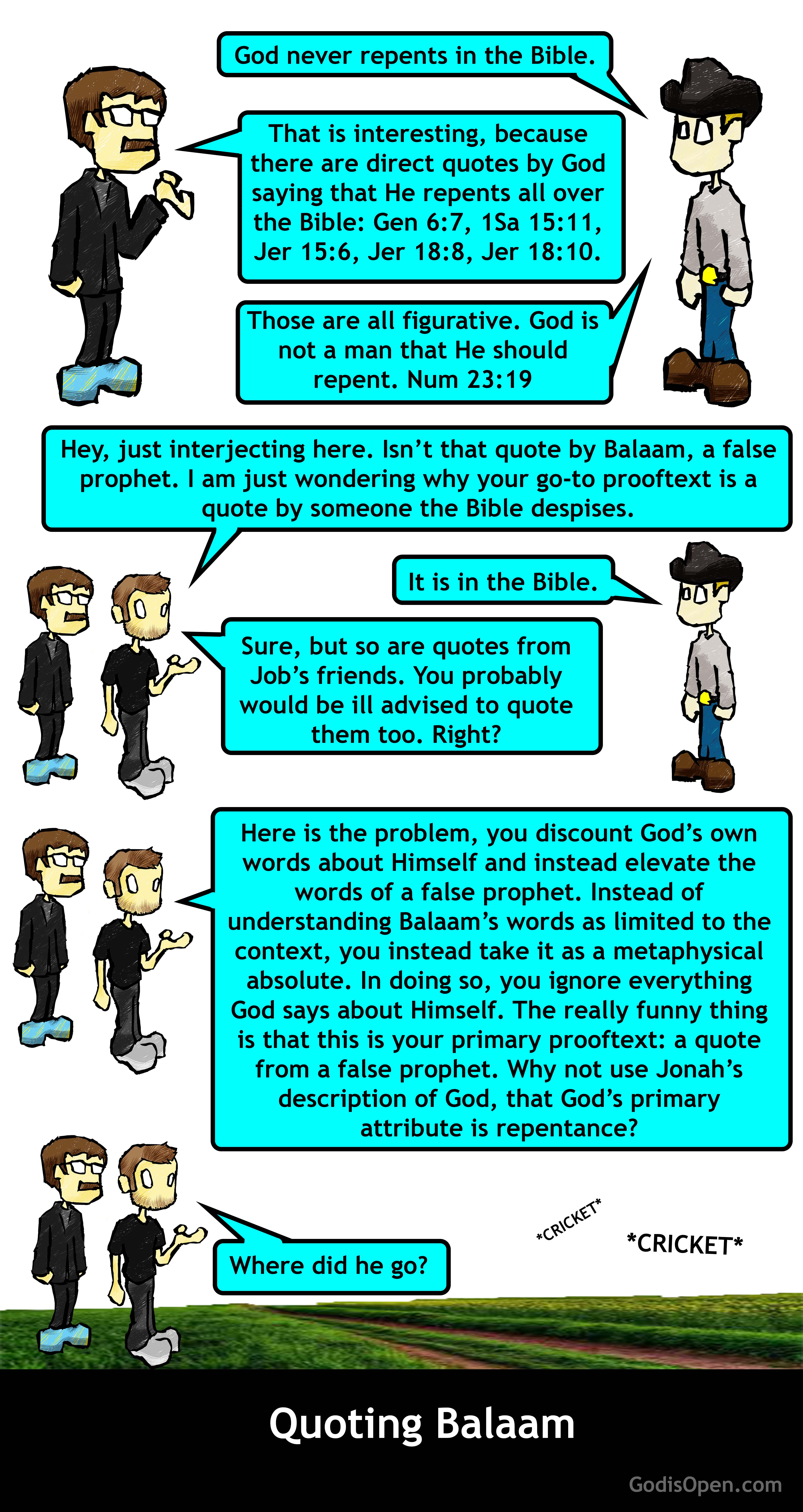
Calvin Admits to Killing Servetus

Calvin writes:

Servetus suffered the penalty due to his heresies, but was it by my will? Certainly his arrogance destroyed him not less than his impiety. And what crime was it of mine if our Council, at my exhortation, indeed, but in conformity with the opinion of several Churches, took vengeance on his execrable blasphemies? Let Baudouin abuse me as long as he will, provided that, by the judgment of Melanchthon, posterity owes me a debt of gratitude for having purged the Church of so pernicious a monster.

Calvin on Psalms 139:16

Whereas Calvinists usually quote Psalms 139:16 as evidence that God predestines people’s entire lives, Calvin understood it as a illustration of the development of a fetus in the womb:

Some read ימים, yamim, in the nominative case, when days were made; the sense being, according to them — All my bones were written in thy book, O God! from the beginning of the world, when days were first formed by thee, and when as yet none of them actually existed. The other is the more natural meaning, That the different parts of the human body are formed in a succession of time; for in the first germ there is no arrangement of parts, or proportion of members, but it is developed, and takes its peculiar form progressively.

Sproul on Repentance

Excerpted from Does God Change His Mind? Divine Repentance by Calvinist R.C. Sproul:

The biblical narratives in which God appears to repent, or change His mind, are almost always narratives that deal with His threats of judgment and punishment. These threats are then followed by the repentance of the people or by the intercessory petitions of their leaders. God is not talked into “changing His mind.” Out of His gracious heart He only does what He has promised to do all along – not punish sinners who repent and turn from their evil ways. He chooses not to do what He has every right to do.

The point of these narratives is to encourage us to pray. We are to make intercession. The promised threats of divine punishment are given with the condition attached that if we repent, we ~vi1l escape those punishments. Sometimes that condition is spelled out explicitly, while at other times it is merely implied. When we repent, then God removes the threat of punishment. The question is, Who is ultimately repenting here? God never repents in the sense that He turns away from sin or from error.

God is not a man. He does not ultimately or literally have arms or legs. He does not repent as men repent. He listens to our prayers but is never corrected by them. He changes not- neither in the perfection of His being nor in the perfection of His thoughts.

20 Questions for Calvinists

Calvin QuestionsCalvinists are notoriously bad at answering straightforward questions. They often avoid questions, especially “yes or no” questions about basic reading comprehension in the Bible. This is a list of questions that demonstrate this fact.

Sovereignty (Calvinism equates “sovereignty” with “meticulous control” although this concept is foreign to any human culture):

1. If God’s will is always already being done on earth as in heaven (as divine determinism implies) why did Jesus teach his disciples to pray, “Thy will be done on earth as it is in heaven?”

Verse: Luk 11:2 So He said to them, “When you pray, say: Our Father in heaven, Hallowed be Your name. Your kingdom come. Your will be done On earth as it is in heaven.

2. People are tempted by evil. Does God cause this?

Verse: Jas 1:13 Let no one say when he is tempted, “I am tempted by God”; for God cannot be tempted by evil, nor does He Himself tempt anyone.

3. Can God’s appointments be thwarted by man?

Verse: 1Ki 20:42 Then he said to him, “Thus says the LORD: ‘Because you have let slip out of your hand a man whom I appointed to utter destruction, therefore your life shall go for his life, and your people for his people.’ ”

4. When God “struck” (aka “killed”) the children of Israel, did God’s intended purpose materialize?

Verse: Jer 2:30 In vain have I struck your children; they took no correction; your own sword devoured your prophets like a ravening lion.

5. In the parable of the potter, does God finish what He started to do?

Verse: Jer 18:4 And the vessel that he made of clay was marred in the hand of the potter; so he made it again into another vessel, as it seemed good to the potter to make.

Omniscience (Calvinism believes God has complete knowledge of all future events):

6. Does God test people to learn what they will do?

Verse: Deu 13:3 you shall not listen to the words of that prophet or that dreamer of dreams, for the LORD your God is testing you to know whether you love the LORD your God with all your heart and with all your soul.

Verse: 2Ch 32:31 However, regarding the ambassadors of the princes of Babylon, whom they sent to him to inquire about the wonder that was done in the land, God withdrew from him, in order to test him, that He might know all that was in his heart.

7. Does God ever regret something He did?

Verse: Gen 6:6 And the LORD was sorry that He had made man on the earth, and He was grieved in His heart.

Verse: 1Sa 15:11 “I greatly regret that I have set up Saul as king, for he has turned back from following Me, and has not performed My commandments.” And it grieved Samuel, and he cried out to the LORD all night.

8. Does God say He will do something although He knows that He will never do that thing?

Verse: 1Sa 2:30 Therefore the LORD God of Israel says: ‘I said indeed that your house and the house of your father would walk before Me forever.’ But now the LORD says: ‘Far be it from Me; for those who honor Me I will honor, and those who despise Me shall be lightly esteemed.

9. When the Bible says God “thought to do” something that He does not do, what does “thought to do” mean?

Verse: Jer 18:7 The instant I speak concerning a nation and concerning a kingdom, to pluck up, to pull down, and to destroy it,
Jer 18:8 if that nation against whom I have spoken turns from its evil, I will relent of the disaster that I thought to bring upon it.

10. Did God do what He said He would do in Jonah?

Verse: Jon 3:10 Then God saw their works, that they turned from their evil way; and God relented from the disaster that He had said He would bring upon them, and He did not do it.

Immutability (Calvinism believes God cannot change in any way):

11. Could God have prevented the evil currently in this world? And if so, how can God be immutable? If no, how can God be omnipotent?

Verse: Jdg 2:20 Then the anger of the LORD was hot against Israel; and He said, “Because this nation has transgressed My covenant which I commanded their fathers, and has not heeded My voice,
Jdg 2:21 I also will no longer drive out before them any of the nations which Joshua left when he died,
Jdg 2:22 so that through them I may test Israel, whether they will keep the ways of the LORD, to walk in them as their fathers kept them, or not.”

12. When God became flesh, was that a change?

Verse: Joh 1:1 In the beginning was the Word, and the Word was with God, and the Word was God.

Joh 1:14 And the Word became flesh and dwelt among us, and we beheld His glory, the glory as of the only begotten of the Father, full of grace and truth.

Timelessness (Calvinism believes God resides outside of “time”):

13. Does God ever wait patiently and endure up to a breaking point?

Verse: Isa 42:14 “I have held My peace a long time, I have been still and restrained Myself. Now I will cry like a woman in labor, I will pant and gasp at once.

Goodness:

14. How can a God who cannot lie make specific time-limit prophecies that do not come true when He said they would?

Verse: Jon 3:4 And Jonah began to enter the city on the first day’s walk. Then he cried out and said, “Yet forty days, and Nineveh shall be overthrown!”

Verse: 2Ki 20:5 “Return and tell Hezekiah the leader of My people, ‘Thus says the LORD, the God of David your father: “I have heard your prayer, I have seen your tears; surely I will heal you. On the third day you shall go up to the house of the LORD.
2Ki 20:6 And I will add to your days fifteen years. I will deliver you and this city from the hand of the king of Assyria; and I will defend this city for My own sake, and for the sake of My servant David.” ‘ ”

Jesus (Calvinism believes that Jesus is God except for the part of Jesus that was human):

15. Was the part of Jesus that was “body” also “Godhead”?

Verse: Col 2:9 For in Him dwells all the fullness of the Godhead bodily;

16. Did Jesus know everything?

Verse: Mar 13:32 “But of that day and hour no one knows, not even the angels in heaven, nor the Son, but only the Father.

17. In what way does Jesus resemble an omnipotent, omnipresent, omniscient, immutable, timeless, and simple God?

Verse: Joh 14:9 Jesus said to him, “Have I been with you so long, and yet you have not known Me, Philip? He who has seen Me has seen the Father; so how can you say, ‘Show us the Father’?

18. If Jesus’ will is the same as God’s will, then why would Jesus say that Jesus’ will would not be done if God’s will is done?

Verse: Luk 22:42 saying, “Father, if it is Your will, take this cup away from Me; nevertheless not My will, but Yours, be done.”

19. Could Jesus have been saved from crucifixion by praying to God?

Verse: Mat 26:53 Or do you think that I cannot now pray to My Father, and He will provide Me with more than twelve legions of angels?

Miscellaneous:

20. Why are the elect the enemy of the gospel?

Verse: Rom 11:28 Concerning the gospel they are enemies for your sake, but concerning the election they are beloved for the sake of the fathers.

Hayes on Prophets and Prophecy

From Christine Hayes’Introduction to the Bible:

The Hebrew prophet should not be thought of primarily as a prognosticator predicting the future. Rather, the prophet addressed a specific and present historical situation in concrete terms. The prophet revealed Yahweh’s immediate intentions but only insofar as he sought to convey Yahweh’s response to present circumstances. The goal, however, was to inspire the people to faithful observance of the covenant in the present. Thus any “predictions” made by the classical prophets had reference to the immediate future as a response to the present situation. The prophet’s message was a message about the present, about what was wrong in the prophet’s day, and what must be done immediately in order to avert calamity.

More on God Learning Where the Temple Will Be Built

From Jacques More in an article entitled THE BIBLE TELLS US GOD LEARNS:

If I am about to go to the ice cream van, or the shop with ice cream, on a hot day and have yet to decide whether to have chocolate, vanilla, strawberry, or another, then I do not yet know what ice cream I will have. Once I’ve decided, then only do I know. I have learned what ice cream I am having. So, it would be true for me to say, when I left home that then I did not know what ice cream flavour I would have. I learnt of that decision AFTER I chose, when at the van or in the shop, but not when I left home.

This is exactly what God is telling us in regards to where the temple was to be built. He tells us that at the time of the exodus from Egypt He had not (yet) decided where this would be built.

Since the day that I brought My people out of the land of Egypt, I have chosen no city from any tribe of Israel in which to build a house, that My name might be there, nor did I choose any man to be a ruler over My people Israel.

2 Chronicles 6:5

God had not decided where to build the temple, “His house”, by the time the people of Israel were brought out of Egypt. God had chosen no city where to have it built. This is fully made plain by the persistent and repeated times God said that He would choose (at a later time) a place for a temple.

But you shall seek the place where the LORD your God chooses, out of all your tribes, to put His name for His dwelling place; and there you shall go. There you shall take your burnt offerings, your sacrifices, your tithes, the heave offerings of your hand, your vowed offerings, your freewill offerings, and the firstborn of your herds and flocks. And there you shall eat before the LORD your God, and you shall rejoice in all to which you have put your hand, you and your households, in which the LORD your God has blessed you.

Deuteronomy 12:5-7

”the place where the LORD your God chooses” in the NKJV is clear, but not as explicit to view as the older English rendition of the KJV “the place which the LORD your God shall choose”: “shall choose” is plainer in reading. God had yet to make that decision is clear: He shall make that decision, but it is not yet chosen. It is not yet decided. And this is repeated numerous other times:

. . . in the place which the LORD shall choose . . .

Deuteronomy 12:14 KJV

. . . in the place which he shall choose to place his name there . . .

Deuteronomy 14:23 KJV

. . . shalt go unto the place which the Lord thy God shall choose to place his name there . . .

Worship Sunday – Us for Them

When the lines are drawn
When you’re in or out
When it’s us or them
And we shame the doubt

It is all a lie
All we ever really need is love
There’s no need to shed more blood
Look upon the cross
Look upon the cross

See the face of Christ
See the mercy in His eyes
Every valley shall be lifted high
Now our enemies are blessed
The heavy laden rest
For His judgement is love
His judgement is love

There is no more guilt
There is no more shame
All our darkest sin
All our deepest pain

Blessed are the poor
All the lonely broken lost and torn
See a kingdom comes to us
A war that’s fought with love
Our only war is love

Prepare the way of the Lord
Wielding mercy like a sword
Every mountaintop will be made low
Know, He holds the earth like dust
And His judgement comes to us
And His judgement is love
His judgement is love

We will not fight their wars
We will not fall in line
Cause if it’s us or them
It’s us for them
It’s us for them

We reject the either or
They can’t define us anymore
Cause if it’s us or them
It’s us for them
It’s us for them

Cause if it’s us or them
It’s us for them
It’s us for them

Prepare the way of the Lord
Wielding mercy like a sword
Every mountaintop will be made low
Know, He holds the earth like dust
And His judgement comes to us
And His judgement is love
May our judgement be love

Blogger Analyzes the Prophecy of the Rooster Crowing

From Gospel Beyond Belief:

My proposal is that Jesus was only trying to teach Peter that his bravado was unwarranted and that Peter was not ready for the reality of the disappointment that the Kingdom of God was about suffering and not political onslaught. However, Jesus’ prediction was most likely not meant to be foretelling but was a strategic challenge to help Peter when the moment of the disappointment arrived. The importance of the prediction is not to show off Jesus’ predictive powers but for the nurturing of Peter. The open theist Greg Boyd has made the point that Jesus in the Gospel of John (chapter 21) alludes to Peter’s denials in order to teach him the real values of the Kingdom and that he predicted that Peter would follow him on the road of suffering and death. This episode helps tie together Jesus’ motive for saying what he did to Peter and what actually happened.

There is no reason why Jesus cannot use language in such a way as to challenge and there is no reason why Jesus cannot use language that is hyperbolic or figurative or whatever. It is my conjecture that Jesus’ prediction used an idiom and the purpose of the idiom was to communicate Jesus’ assurance that Peter would deny him. Jesus was only saying that he was sure Peter would deny him. Jesus was sure that Peter’s bravado was misplaced (because Peter believed in a political messiah?) and he was sure that there would be opportunity for Peter to deny him. At the same time, Jesus was sure Peter would try try to follow (albeit at a distance) because he knew Peter had deep feelings for Jesus. So, Jesus uttered his statement to Peter to warn him that his confidence was misplaced.

Answered Questions – Free will in heaven

From the Facebook group Open Theism:

Is there a consensus on the nature of “freewill” after a Christian is in heaven? Is there a guarantee that one will not choose to rebel against God in the afterlife?

Like much of Open Theist doctrines, there is no consensus. Open Theists can believe either. There is superficial reasons to believe people will always have free will. See Robots in Heaven.

Apologetics Thursday – Enyart debates Bray

An excerpt:

LB: That’s only if you refuse to allow for certain linguistic tools that God uses

What? Larry, an ACTION is not a linguistic tool. By definition actions CANNOT be figures of speech. Calvinists nullify hundreds of verses by saying that they are anthro this and anthro that, with trite and skin-deep pretense quoting verses about God’s arm (which anthropomorphism means that God can reach us) and God’s eyes (meaning He can see what is happening). But Calvinists are the world’s leading experts in what the Bible doesn’t mean. God says He repents and shows that He UNDID what He previously DID (e.g., removing Saul as King, 1 Sam. 10:24; 13:13; 15:23-27, 35; 16:1; 2 Sam. 7:8, 15). A verse is not a figure of speech just because it contradicts your doctrine. If God-repented-that-He-madeSaul-King were a figure of speech as Calvinists claim, then they should be able to tell us what it means. For that is the purpose of figures. But to prop up their philosophical OMNIs and IMs, they claim that God “grieving” does not mean that He grieves; and our sin being a “burden” on God doesn’t mean that; and God being “weary of repenting” does not mean that either.

Because Calvinists say that God being grieved by sin doesn’t really mean that, they feel free to claim the vulgar Calvinist doctrine that God Himself decreed every filthy deed in the rape of a child, as you wrote, “even of these kinds of terrible atrocities.” And this for His pleasure as Calvin claimed. So at the expense of one of God’s primary eternal attributes, His goodness, Calvinists prioritize a bunch of mathematical philosophical claims about HOW LITTLE change God can endure and HOW MUCH knowledge and power He has. But 30 times the Bible says that He is the “Living God.” Don’t reduce Him to such mathematical equations.

Moltmann on God’s Knowledge

As quoted on moltmanniac.com in an article God Doesn’t Will to Know Everything in Advance:

What can be said about the self-limitation of omnipotence in God’s love for those he has created can be said about the other metaphysical attributes of his divinity too: omnipresence, omniscience, invulnerability, and self-sufficiency. God doesn’t know everything in advance because he doesn’t will to know everything in advance. He waits for the response of those he has created, and lets their future come. God is not incapable of suffering; he opens himself in his Shekinah for the sufferings of his people, and in the incarnation of the Son for the sufferings of the love which desires to redeem the world. So in a certain way God becomes dependent on the response of his beloved creatures. In Christian theology one would not go so far as to declare God ‘in need of redemption’ together with his people Israel; but nevertheless, God has laid the sanctification of his Name and the doing of his will in the hands of human beings, and thus also, in its own way, the coming of his kingdom. It must be viewed as part of God’s self-humiliation that God does not desire to be without those he has created and loves, and therefore waits for them to repent and turn back, leaving them time, so that he may come to his kingdom together with them. Jürgen Moltmann, Science and Wisdom, p. 64

Torbeyns Reviews Does God Know the Future?

Tom Torbeyns of Crosstheology reviews the must-read Open Theist book Does God Know the Future?

Recommended!

A handbook on Open Theism for Open Theists and skeptics alike.

“Part I – Philosophical” is recommended to skeptical philosophers.

“Part II – Biblical” contains thorough information for the skeptical theologian.

The author of this book proves throroughly that, according to the Bible, God does not live in a timeless eternal-now state and that He does not know all of the future. As sacreligious as that might sound,after considering these many Bible passages, it gives more glory to the God of the Bible.

His interpretation might be a bit biased and sometimes he repeats himself.

But this book is recommended!

Worship Sunday – A Mighty Fortress is our God

A mighty fortress is our God,
a bulwark never failing;
our helper he amid the flood
of mortal ills prevailing.
For still our ancient foe
doth seek to work us woe;
his craft and power are great,
and armed with cruel hate,
on earth is not his equal.

Did we in our own strength confide,
our striving would be losing,
were not the right man on our side,
the man of God’s own choosing.
Dost ask who that may be?
Christ Jesus, it is he;
Lord Sabaoth, his name,
from age to age the same,
and he must win the battle.

And though this world, with devils filled,
should threaten to undo us,
we will not fear, for God hath willed
his truth to triumph through us.
The Prince of Darkness grim,
we tremble not for him;
his rage we can endure,
for lo, his doom is sure;
one little word shall fell him.

That word above all earthly powers,
no thanks to them, abideth;
the Spirit and the gifts are ours,
thru him who with us sideth.
Let goods and kindred go,
this mortal life also;
the body they may kill;
God’s truth abideth still;
his kingdom is forever.

Blogger Explains why Vague Prophecy Points to Open Theism

From Open Theism and Biblical Prophecy by Gospel Beyond Belief:

Premise 1

To understand premise 1, I want to explain what I mean by the strength of prophecy. I contend that the strength of Bible prophecy as a whole depends on the strength of individual prophecies and the quantity of such prophecies. Let us say for the sake of argument that Jesus was born in a manger on the evening of March 31, 4 B.C. in Bethlehem to parents of Davidic lineage. If this was so, then the following predictions, let’s say made in 500 B.C., would be on a scale of weaker strength prophecies to stronger strength prophecies:

A King will be born
A King will be born in Israel
A King will be born in Bethlehem
A King will be born in Bethlehem in 37-4 B.C.
A King will be born in Bethlehem in 4 B.C.
A King will be born in Bethlehem in 4 B.C. on March 31st
A King will be born in Bethlehem in 4 B.C. on the evening of March 31st
A King named Jesus will be born in Bethlehem in 4 B.C. on the evening of March 31st
A King named Jesus will be born in a manger in Bethlehem in 4 B.C. on the evening of March 31st
A King named Jesus will be born in a manger in Bethlehem in 4 B.C. on the evening of March 31st to parents named Joseph and Mary.
Prediction 10 is stronger than prediction 1 because you have to know much more about the future to be right about 10 than you do about 1. Specificity is not the only measure of the strength of prophecy, however. The amount of such prophecies also figures in the calculus. It could be the case that one prediction of value 4 is stronger that two predictions of value 3, but that would depend on the scale. But the obvious point remains that the more correct predictions the Bible makes the stronger Bible prophecy will be. But keep in mind that prophecies of low strength are still true.

I contend that the individual Old Testament prophecies concerning Jesus’ first advent fall in the 2-3 range in the (imperfect) scale of my example, but they do not reach to strength 4. This leads me to rate the overall strength of Bible prophecy, taking into account quantity as well as quality, in the 2-3 or 3-ish range. This is fairly low.

Premise 2

Open theism provides a better model for why Bible prophecy would have strength 2 or 3 and not 9 or 10. If the future is open then there is a lot of historical wiggle room that God gives freedom. Given this freedom, and given God’s unthwartable sovereign plans, then we wouldn’t expect Bible prophecy to be much higher than 2 or 3. Open theism is often compared to a chess game in which a grandmaster will always beat a novice even though the grandmaster does not know in advance what moves the novice will make. The grandmaster’s plan of victory is assured. God’s plans are assured even though the individual moves might not be known in advance. The grandmaster will win, even though we don’t know that it is by capturing the rook and forcing checkmate on move 14, say. In other words, the reason the strength of Bible prophecy is low is that Open theism is true.

Apologetics Thursday – Duffy v Capps Debate

Facebook is the hosting site of a debate between Will Duffy (an admin on this site) and Seth Capps (a Calvinist). Duffy’s first post:

Will Duffy‎

Debate: Is the Future Settled or Open?

I believe the future is open because God is free. If God is truly free, then the future must be open and cannot be settled, as Calvinists and Arminians claim that it is. In over 10 years of being an open theist, no one has ever been able to explain how God can remain free if the future is settled and predetermined and foreknown. Calvinists not only do not believe man has libertarian free will, they do not believe God has libertarian free will!

The Bible shows on every page that the future is open and that God is free. God is not bound by foreknowledge, nor is He bound by predestination or decrees. God is free. He has libertarian free will. Calvinists (and Arminians) must either reject their theology or reject God’s freedom. The two are not compatible.

My first biblical example that the future is open and that God is free comes from the arrest of Jesus Christ in Gethsemane. After Peter cuts off the ear of a servant of the high priest, Jesus replies that the future is not settled and that God has the ability to do something different than what actually happened.

Matthew 26:52-54
52 But Jesus said to him, “Put your sword in its place, for all who take the sword will perish by the sword. 53 Or do you think that I cannot now pray to My Father, and He will provide Me with more than twelve legions of angels? 54 How then could the Scriptures be fulfilled, that it must happen thus?”

Q1: Seth, do you believe God foreknew that He would send 12 legions of angels to prevent Jesus’ arrest?
Q2: Do you believe God decreed and predestined to send 12 legions of angels to prevent Jesus’ arrest?
Q3: If God did not foreknow or decree or predestine to send 12 legions of angels to prevent Jesus’ arrest, am I correct in asserting that if your theology is true, God did not have the freedom to do what Jesus said the Father had the freedom to do? In other words, am I correct in asserting that you do not believe God has the ability to do something different than what He foreknows/decrees/predestines?

TMS Hosts some Anti-Open Theism Resources

The Master’s Seminary hosts a few sermons against Open Theism:

Robert L. Thomas — Selected Scriptures
THE HERMENEUTICS OF OPEN THEISM

Trevor C. Craigen — Isaiah 40-48
A SERMONIC CHALLENGE TO OPEN THEISM

And a few articles against Open Theism:

It is Time to Change? Open Theism and the Divine Timelessness Debate MARSHALL WICKS AUGUST 25, 2009

The Openness of God: Does Prayer Change God? WILLIAM BARRICK MAY 18, 2010

Isaiah 40-48: A Sermonic Challenge to Open Theism TREVOR C. CRAIGEN MAY 18, 2010

The Hermeneutics of Open Theism ROBERT L. THOMAS AUGUST 25, 2009

And more…

Mohler Worried About Open Theism

From a 2004 article called The ‘Openness of God’ and the Future of Evangelical Theology:

Sadly, evangelicals are now debating the central doctrine of Christian theism. The question is whether evangelicals will affirm and worship the sovereign and purposeful God of the Bible, or shift their allegiance to the limited God of the modern mega-shift.

At stake is not only the future of the Evangelical Theological Society, but of evangelical theology itself. Regardless of how the votes go in Atlanta, this issue is likely to remain on the front burner of evangelical attention for years to come.

The debate over open theism is another reminder that theology is too important to be left to the theologians. Open theism must be a matter of concern for the whole church. This much is certain–God is not waiting to see how this vote turns out.

Worship Sunday – Speak oh Lord

Speak, O Lord, as we come to You
To receive the food of Your Holy Word.
Take Your truth, plant it deep in us;
Shape and fashion us in Your likeness,
That the light of Christ might be seen today
In our acts of love and our deeds of faith.
Speak, O Lord, and fulfill in us
All Your purposes for Your glory.

Teach us, Lord, full obedience,
Holy reverence, true humility;
Test our thoughts and our attitudes
In the radiance of Your purity.
Cause our faith to rise; cause our eyes to see
Your majestic love and authority.
Words of pow’r that can never fail-
Let their truth prevail over unbelief.

Speak, O Lord, and renew our minds;
Help us grasp the heights of Your plans for us-
Truths unchanged from the dawn of time
That will echo down through eternity.
And by grace we’ll stand on Your promises,
And by faith we’ll walk as You walk with us.
Speak, O Lord, till Your church is built
And the earth is filled with Your glory.

Chronology of Jules Lequyer and his Influence on Subsequent Philosophy

This time-line of Lequyer was written by Donald W. Viney, published in his translation of Lequyer’s “The Hornbeam Leaf” (Pittsburg, Kansas: Logos-Sophia Press, 2010):

This chronology builds on that of Jean Grenier, found in his version of Lequyer’s Œuvres complètes, p. xv.

1814: Birth of Joseph-Louis-Jules Lequyer on January 29th at Quintin (in Brittany). His father was Joseph-Jean-Noel Lequyer (1779-1837) and his mother was Céleste-Reine-Marie-Eusèbe Digaultray (1772-1844).

1834: Entrance to the École Polytechnique in Paris; Lequyer meets Charles Renouvier (1815-1903) at this school; Lequyer’s father officially fixes the spelling of the family name as “Lequyer.”

1837: Death of Lequyer’s father (1838 according to Séailles; Dugas says 1839).

1838: After failing the military exam to become a lieutenant and refusing a lesser military post, Lequyer resigns from the École Polytechnique.

1839: Settles at Plérin (Brittany), near St.-Brieuc.

1843: Settles in Paris and teaches French composition at the École Égyptienne; Lequyer translates into French the autobiography of Sir Humphrey Davy, but never publishes it.

1844: Death of Lequyer’s mother; she says to their devoted servant, Marianne Feuillet, “Oh, Marianne, pray, look out for my poor Jules. He has in his heart a passion which, I greatly fear, will be the death of him.”

1846: Mystical crisis; Lequyer wrote to Mgr. Épivent, “God spoke to me . . .”

1848: Return to Plérin and candidacy to the North Coast Assembly; he was not elected.

1850: Sells the family house at St.-Brieuc.

1851: February 28th, mental crisis where Lequyer tried to cut his arm off with a hatchet; confinement at Dinan; at Passy, April 11-19, under care of Dr. Esprit Blanche. After recovering, Lequyer proposes to Anne “Nanine” Deszille (1818-1909), a friend from childhood. She declines.

1853: Teaches mathematics at Besançon and at Lons-le-Saulnier.

1855: Return to Plérin, settles in the countryside in the family home, “Plermont” (Plérin + mont).

1860: Unsuccessful candidacy for the archivist’s position of the Côtes-du-Nord.

1861: Late December, Lequyer again proposes to Mlle. Deszille. She gives a definitive refusal.

1862: February 11th, death by drowning in the bay of St.-Brieuc. Louis Le Hesnan, the philosopher’s secretary who accompanied him reports that Lequyer’s last words were, “Adieu Nanine.” According to Louis Prat, one of his friends, Lequyer made a supreme wager in which he was asking God to save his genius.

1865: Renouvier underwrote 120 copies of a selection of Lequyer’s manuscripts under the title La Recherche d’une première vérité, fragments posthumes

1868: Renouvier and Agathe Lando erect a monument with a statue on top of it over Lequyer’s grave in Plérin. The inscription reads: This monument was raised to the memory of an unhappy friend and a man of great genius in 1868 by Renouvier. Jules Lequyer, born at Quintin in 1814. Deceased at Plérin in 1862. Pray for him. His works: “The Hornbeam Leaf,” Abel and Abel, The Search for a First Truth, The Dialogue of the Predestinate and the Reprobate.
1872 William James writes to Renouvier to request a copy of Renouvier’s edition of Lequyer’s works; Renouvier obliges and, after reading the book, James donates the copy to the Harvard library. James never mentions Lequyer by name in his published work, although he quotes him and alludes to him as “a French philosopher of genius” in The Principles of Psychology (1890).

1880s In the mid-1880s, the historian Proper Hémon happens upon Lequyer’s grave in Plérin and begins writing the philosopher’s biography. This is not published until 1991.

1898 George Séailles publishes “Une Philosophe Inconnu, Jules Lequier” [An unknown philosopher, Jules Lequier], in Revue Philosophique de la France et de L’Étranger. Tome XLV (1898), pp. 120-150. The article was summarized the same year by someone with the initials “E.A.” in The Philosophical Review vol. 7, n. 5 (1898), pp. 537-538.

1924 Publication of Ludovic Dugas’s edition of Renouvier’s collection of Lequyer’s writings, La Recherche d’une première vérité (Paris: Librairie Armand Colin, 1924). Dugas used Hémon’s research in his introduction to the work, “La Vie, L’Œuvre et le Génie de Lequier” [The life, work, and genius of Lequier], pp. 3-52. L. J. Russell reviewed the book for Mind, vol. 36, n. 144 (1927), pp. 512-514.

1936 Jean Grenier publishes his thesis, La Philosophie de Jules Lequier (Paris: Société d’éditions “Les Belles Lettres,” publications de la Faculté des Lettres d’Alger, IIIème Série, Tome X, 1936). In the same year Grenier published excerpts of Lequyer’s writing not included in the editions of Renouvier and Dugas, La Liberté [Freedom] (Paris: Librairie Philosophique J. Vrin, 1936). Harold A. Larrabee reviewed the two books for The Journal of Philosophy, vol. 34, n. 10 (May 13, 1937), pp. 269-270.

1944 Jean-Paul Sartre uses Lequyer’s phrase, “to make, and in making, to make oneself” as a summary of his existentialism but, like James, does not mention Lequyer by name. See Les écrits de Sartre, établie par Michel Contat et Michel Rybalka (Paris: Gaillimard, 1970), p. 655.

1948 Jean Wahl publishes a selection of Lequyer’s writing, Jules Lequier 1814-1862 (Genève et Paris: Édition des Trois Collines, 1948) which includes a lengthy introduction, pp. 9-117. In the same year, Charles Hartshorne lectures in Paris and Wahl introduces him to Lequyer’s work.

1952 Jules Lequier, Œuvres complètes [Complete Works], edited by Jean Grenier (Neuchâtel, Suisse: Éditions de la Baconnière, 1953).

1953 Charles Hartshorne and William L. Reese include an excerpt of Lequyer’s writing in their anthology, Philosophers Speak of God (Chicago University Press, 1953), pp. 227-230.

1974 Hartshorne’s student at Emory University, Harvey Brimmer, publishes a translation and brief commentary on Lequyer’s “The Hornbeam Leaf,” Philosophy in Context, vol. 3 (1974), pp. 94-100.

1975 Brimmer finishes his dissertation, Jules Lequier and Process Philosophy at Emory which includes appendices with translations of Lequyer’s The Problem of Knowledge and Probus or the Principle of Knowledge, which are the first two parts of Renouvier’s edition. Neither the dissertation nor the translations (with the exception of “The Hornbeam Leaf”) were published.

1991 Jules Lequier, Abel et Abel suivi d’une Notice Biographique de Jules Lequier. Texte établie et présenté par Gérard Pyguillem (Combas: Éditions de l’Éclat, 1991). This is the first time Prosper Hémon’s “Notice Biographique de Jules Lequyer” was published, pp. 109-235.

1993 Publication of André Clair’s edition of Renouvier’s collection of Lequyer’s writings, La Recherche d’une première vérité et autres textes (Paris: Presses Universitaires de France, 1993).

1998 Translation of Works of Jules Lequyer: The Hornbeam Leaf, The Dialogue of the Predestinate and the Reprobate, Eugene and Theophilus. Translated by Donald W. Viney. Foreword by Robert Kane. Lewiston (New York: The Edwin Mellen Press, 1998).

1999 Jules Lequyer’s Abel and Abel followed by Incidents in the Life and Death of Jules Lequyer. Foreword by William L. Reese. Translation by Mark West; biography by Donald W. Viney. (Lewiston, New York: The Edwin Mellen Press, 1999). This book is modeled on that the edition of Pyguillem in 1991.

2010 Publication of the first number of the Cahiers Jules Lequier [Jules Lequier Notebooks] with Goulven Le Brech as editor-in-chief. The Cahiers, published annually by Les amis de Jules Lequier [Friends of Jules Lequier], includes articles on Lequyer and difficult to obtain material from archives, as well as book reviews and a review of the literature concerning Lequyer.

2014 International Colloquium on Jules Lequier, celebrating the bicentennial of the philosopher’s birth, held at the École Normale Supérieure in Paris, September 30, 2014.

Answered Questions – Every Knee

From a Reddit Question and Answer with Greg Boyd:

How can the Open Theist God promise every knee will bow, and every tongue shall confess Jesus is Lord, without compromising anyone’s free will?

Greg responds:

How can a Calvinist affirm this without being a universalist? Look, this is an equally challenging passage for everyone who isn’t a universalist. For my two cents, I’m inclined to see this passage as expressing God’s loving bear hug around all humanity with the hope that all will come in. Yet, because love must be chosen, people always have the freedom to say NO THANKS.

Apologetics Thursday – Prayer Doesn’t Change God

By Christopher Fisher

In this video, Tom Wagner claims that “prayer changes us, not God.” This is echoed by a host of Christian pastors and teachings, even by the likes of CS Lewis:

I pray because I can’t help myself. I pray because I’m helpless. I pray because the need flows out of me all the time- waking and sleeping. It doesn’t change God- it changes me.

But this sentiment is foreign to the Bible. It has no bases in Biblical theology. Contrasted to this, the entire Bible is filled with God genuinely responding to prayer and often times doing otherwise than He would have done. Exodus 32 is a prime example.

Exo 32:9 And the LORD said unto Moses, I have seen this people, and, behold, it is a stiffnecked people:
Exo 32:10 Now therefore let me alone, that my wrath may wax hot against them, and that I may consume them: and I will make of thee a great nation.
Exo 32:11 And Moses besought the LORD his God, and said, LORD, why doth thy wrath wax hot against thy people, which thou hast brought forth out of the land of Egypt with great power, and with a mighty hand?
Exo 32:12 Wherefore should the Egyptians speak, and say, For mischief did he bring them out, to slay them in the mountains, and to consume them from the face of the earth? Turn from thy fierce wrath, and repent of this evil against thy people.
Exo 32:13 Remember Abraham, Isaac, and Israel, thy servants, to whom thou swarest by thine own self, and saidst unto them, I will multiply your seed as the stars of heaven, and all this land that I have spoken of will I give unto your seed, and they shall inherit it for ever.
Exo 32:14 And the LORD repented of the evil which he thought to do unto his people.

The Bible is filled with countless accounts of prayer working. The general idea of prayer is that it is a way to reach God and compel His action:

Psa 34:6 This poor man cried, and the LORD heard him and saved him out of all his troubles.
Psa 18:6 In my distress I called upon the LORD; to my God I cried for help. From his temple he heard my voice, and my cry to him reached his ears.
Psa 28:6 Blessed be the LORD! For he has heard the voice of my pleas for mercy.

Luk 11:11 What father among you, if his son asks for a fish, will instead of a fish give him a serpent;

1Jn 5:14 And this is the confidence that we have toward him, that if we ask anything according to his will he hears us.
1Jn 5:15 And if we know that he hears us in whatever we ask, we know that we have the requests that we have asked of him.

Joh 14:14 If you ask me anything in my name, I will do it.

Joh 15:7 If you abide in me, and my words abide in you, ask whatever you wish, and it will be done for you.

The idea that “prayer is for us” is not found in the Bible, but in extrapolations based on Platonic theology.

Clines on the Purpose of Job’s Test

From David Clines’ Job 1-20:

If now we move beyond the story-line and essay a probe into the theological resonances of this element of the story along the lines sketched in the Comment on v 6, the uncertainty in the divine world presses for a resolution. Is the problem one of heaven’s making or of earth’s? Suppose that an immutable law of retribution were heaven’s design; the question would always wait to be posed whether the retribution was no simple single process of cause and effect, but an endlessly revolving circle, with no possibility of discerning what was cause and what effect. That is, if the godly were always rewarded with earthly blessings which in turn promoted greater godliness, heaven would be confronted with the perennial chicken-and-egg conundrum, and heaven itself would not know what was really happening on earth. But suppose the immutable law of retribution were only a human inference on the part of the “wise” (or the naive) about the manner of heaven’s working, would not those shy of immutability in the deity crave some heaven-inspired drama to cripple the dogma and open up space in heaven and on earth for personal freedom? In either case the trial of Job is as necessary for loosing the causal nexus between piety and prosperity as it is for establishing the independence of suffering and guilt.

Yahweh delivers into the Satan’s “hand” all that Job possesses (but not the man himself). It is understood that Yahweh has agreed to “stretch forth [his] hand” and “smite” what is Job’s, and the delegation of the actual task to the Satan is entirely what we should expect given the scene of a monarch and his courtiers. Nothing is to be made of the fact that “Yahweh himself will not smite. He permits the Satan to do it” (Peake). This for three reasons: first, delegated permission is delegated authority and the ultimate delegator has the ultimate responsibility; second, the story does not distinguish between command and permission; third, if there is any significant difference between God’s part and the Satan’s part in the affliction of Job, Job’s complaints against God in the speeches (always against God and never against the Satan) would be to that extent wide of the mark, a conclusion the book as a whole does not allow us to entertain.

Clines on Job

From David Clines’ Job 1-20:

12 So naturally does Yahweh’s agreement to the proposal follow that we are compelled to pause in order to ponder its implications. Are we to condemn the figure of Yahweh here for his alacrity and cold-bloodedness (Duhm) in assenting to such a scheme? And do we find in the prohibition of harm to Job’s person the one lingering sign of Yahweh’s affection for his servant? Or is it that God himself does not need to be convinced of Job’s disinterested piety, but is prepared to allow the Satan to satisfy himself of its reality (Rowley), or, to put it more positively, accepts the challenge in order to vindicate his servant against the insinuations of the Satan (Peake)? Or are we to say, most improbably of all, that God assents to the trial of Job’s piety in order to refine or deepen Job’s faith?

All these suggestions attribute to the narrative a subtlety it does not bear, at least in its essential story-line. God can agree to the proposal to “smite” all that is Job’s only because he too, like everyone else, does not know what the outcome will be. The Yahweh of this tale is not the absolutely omniscient God of later systematic or speculative theology. He is wise beyond human comprehension, for his “eyes” and “ears,” like the spies of the Persian kings, are everywhere abroad, and report to him on days of assembly (cf. v 6). But not even Yahweh knows what has not yet happened; his knowledge does not encompass all possible hypothetical situations. He has confidence in Job, but not a confidence that would enable him to use Job as an object lesson to refute the Satan’s aspersions. He too has taken it for granted that he will bless the pious man; but that benign reciprocity has obscured the true relation of piety and prosperity. The Satan has the right to ask the question, and Yahweh is in the right in having the problem probed.

The alternative to such a reading of the story is worse. Affirm that Yahweh is infinitely omniscient, and you assert that Job’s suffering serves only to prove God right in the eyes of one of his subordinates. Affirm that Yahweh knows that Job will not waver, and you cannot explain why Yahweh takes the slightest notice of the Satan’s questions or why he does not dismiss them out of hand from superior knowledge.

Worship Sunday – How Deep the Father’s Love

How deep the Father’s love for us,
How vast beyond all measure
That He should give His only Son
To make a wretch His treasure

How great the pain of searing loss,
The Father turns His face away
As wounds which mar the chosen One,
Bring many sons to glory

Behold the Man upon a cross,
My sin upon His shoulders
Ashamed I hear my mocking voice,
Call out among the scoffers

It was my sin that held Him there
Until it was accomplished
His dying breath has brought me life
I know that it is finished

I will not boast in anything
No gifts, no power, no wisdom
But I will boast in Jesus Christ
His death and resurrection

Why should I gain from His reward?
I cannot give an answer
But this I know with all my heart
His wounds have paid my ransom

Boyd on Platonistic Omniscience

From How People Misunderstand Open Theism:

First, Plato argued that we see not by light entering our eyes (as we now know is the case) but by light proceeding out of our eyes (Timaeus 45b). For Plato, seeing is an active, not a passive, process. Since knowledge was considered to be a kind of seeing, Plato also construed knowing as acting on something rather than being acted upon (Sophist 248-49). I’ve discovered that this mistaken view of seeing and knowing is picked up and defended by a host of Hellenistic philosophers.

Second, several Neoplatonistic philosophers (Iamblichus, Proclus and Ammonius) used this theory of eyesight and knowing to explain how the gods can foreknow future free actions. They argued that the nature of divine knowledge is determined not by what is known but by the nature of the knower. Since they assumed the gods were absolutely unchanging, they concluded that the gods knew things in an absolutely unchanging manner, despite the fact that the reality the gods know is in fact perpetually changing. This allowed them to affirm that the future partly consisted of indefinite (aoristos) truths (viz. open possibilities) while nevertheless insisting that the gods knew the future in an exhaustively definite, unchanging way.

The view is, I’m convinced, completely incoherent. But one can understand how these philosophers arrived at it in light of their mistaken assumptions about seeing and knowing as wholly active processes. What the gods see when they look at the future conforms to the unchanging nature of the gods rather than the changing nature of the future they see. Through the influence of Augustine and especially Boethius (who explicitly espoused the ancient view of seeing and knowing and repeated some of the Neoplatonic arguments), this way of “reconciling” foreknowledge and free will quickly established itself as the dominant view in the Christian tradition.

Biederwolf on the Absurdity of Prayer for Our Sake

From How Can God Answer Prayer?: Being an Exhaustive Treatise of the Nature:

” The true value of prayer is that it stops people from wanting what they can’t get,” Dr. Patton goes on to apply this theory to some of the Master’s teaching about prayer. We are told to ask, to seek, and to knock.

“Imagine,” he says, “a child asking for some favor, or for the relief of some want, and standing hour after hour, repeating his requests, and being told by the father: ‘Go on asking, my child; it does you much good to ask. The longer you ask the more good it will do you. Do not expect to receive anything, however, as the principal benefit of asking is that, by and by, you will not want anything, and will cease to make any request.’ Imagine a mother seeking a lost child. She looks through the house and along the streets, then searches the fields and woods and examines the river banks. A wise neigh bor meets her and says: ‘seek on; look everywhere; search every accessible place. You will not find, indeed, but then seeking is a good thing. It puts the mind on the stretch; it fixes the attention; it aids observation; it makes the idea of the child very real. And then, after a while, you will cease to want your child.’

Calvin on God Predestining Sin

From Institutes of the Christian Religion:

6. Impiety starts another objection, which, however, seeks not so much to criminate God as to excuse the sinner; though he who is condemned by God as a sinner cannot ultimately be acquitted without impugning the judge. This, then is the scoffing language which profane tongues employ. Why should God blame men for things the necessity of which he has imposed by his own predestination? What could they do? Could they struggle with his decrees? It were in vain for them to do it, since they could not possibly succeed. It is not just, therefore, to punish them for things the principal cause of which is in the predestination of God. Here I will abstain from a defense to which ecclesiastical writers usually recur, that there is nothing in the prescience of God to prevent him from regarding; man as a sinner, since the evils which he foresees are man’s, not his. This would not stop the caviler, who would still insist that God might, if he had pleased, have prevented the evils which he foresaw, and not having done so, must with determinate counsel have created man for the very purpose of so acting on the earth. But if by the providence of God man was created on the condition of afterwards doing whatever he does, then that which he cannot escape, and which he is constrained by the will of God to do, cannot be charged upon him as a crime. Let us, therefore, see what is the proper method of solving the difficulty. First, all must admit what Solomon says, “The Lord has made all things for himself; yea, even the wicked for the day of evil,” (Prov. 16: 4.) Now, since the arrangement of all things is in the hand of God, since to him belongs the disposal of life and death, he arranges all things by his sovereign counsel, in such a way that individuals are born, who are doomed from the womb to certain death, and are to glorify him by their destruction. If any one alleges that no necessity is laid upon them by the providence of God, but rather that they are created by him in that condition, because he foresaw their future depravity, he says something, but does not say enough. Ancient writers, indeed, occasionally employ this solution, though with some degree of hesitation. The Schoolmen, again, rest in it as if it could not be gainsaid. I, for my part, am willing to admit, that mere prescience lays no necessity on the creatures; though some do not assent to this, but hold that it is itself the cause of things. But Valla, though otherwise not greatly skilled in sacred matters, seems to me to have taken a shrewder and more acute view, when he shows that the dispute is superfluous since life and death are acts of the divine will rather than of prescience. If God merely foresaw human events, and did not also arrange and dispose of them at his pleasure, there might be room for agitating the question, how far his foreknowledge amounts to necessity; but since he foresees the things which are to happen, simply because he has decreed that they are so to happen, it is vain to debate about prescience, while it is clear that all events take place by his sovereign appointment.

Worship Sunday – Amazing Love

I’m forgiven, because You were forsaken
I’m accepted, You were condemned
I’m alive and well, Your Spirit is within me
Because You died and rose again

I’m forgiven, because You were forsaken
I’m accepted, You were condemned
I’m alive and well, Your Spirit is within me
Because You died and rose again

Amazing love, how can it be
That You my King would die for me
Amazing love, I know it’s true
It’s my joy to honor You
Amazing love, how can it be
That You my King would die for me
Amazing love, I know it’s true
It’s my joy to honor You
In all I do I honor You

I’m forgiven, because You were forsaken
I’m accepted, You were condemned
I’m alive and well, Your Spirit is within me
Because You died and rose again

Physicist Rejects that Time is an Illusion

From Is the Future Already Written?:

Ellis’ calculations show that the evolving block universe does not contradict relativity’s prediction that two people can disagree on the order of two events. In both Einstein’s and Ellis’ pictures, the time at which each person perceives both events to have occurred is based on the discrepancies between how long it takes light from each event to reach them. In Einstein’s view, these events — and all future events — coexist. But in Ellis’ picture, both events must lie in the portion of the evolving block that houses the past; they are fixed into reality before information about them reaches anyone. Similarly, in Ellis’ view, two observers can disagree on the duration of an event, but only if that event has already crystallized into the past. Thus, Ellis’ model of time retains enough of the block universe to match with relativity’s predictions, but without needing to take Einstein’s drastic last step of assuming that the fourth dimension is solidified into the infinite future.