Worship Sunday – Soul on Fire
God, I’m running for Your heart
I’m running for Your heart
Till I am a soul on fire
Lord, I’m longing for Your ways
I’m waiting for the day
When I am a soul on fire
Till I am a soul on fire
Lord, restore the joy I had
And I have wandered bring me back
In this darkness, lead me through
Until all I see is You
Lord, let me burn for You again
Let me return to You again
And Lord, let me burn for You again
Let me return to You again
God, I’m running for Your heart
I’m running for Your heart
Till I am a soul on fire
I want to be
Till I am a soul on fire
Till I am a soul on fire
Podcast EP102 and EP103 – The Spectrum Of Open Theism
Questions Answered – Is God ever Surprised?
Scot McKnight answers a reader question:
Where are you on this one? Do you think God knows what you will wear tomorrow? Which way you will turn at the corner when you go for a leisure drive? What you will order when you go to Chipotle?
McKnight references John Goldingay, in his book, “Key Questions about Christian Faith: Old Testament Answers”. McKnight writes:
Sometimes God does not know how things will turn out.
I’m aware some of us are bothered by this statement, but I’m summarizing Goldingay and he’s reading the Bible and some passages in the Bible can be read just that way. So where?
Here’s one. Exodus 33:5: For the LORD had said to Moses, “Tell the Israelites, ‘You are a stiff-necked people. If I were to go with you even for a moment, I might destroy you. Now take off your ornaments and I will decide what to do with you.’” Or this one from Jeremiah 26:3: “Perhaps they will listen and each will turn from their evil ways. Then I will relent and not inflict on them the disaster I was planning because of the evil they have done.” It is the word “Perhaps” that reveals that either God is deceiving or God doesn’t know (or maybe others have other explanations). But a “plain reading” knows that “perhaps” implies contingency. And a final one from Exodus 4:8 Then the LORD said, “If they do not believe you or pay attention to the first sign, they may believe the second. 9 But if they do not believe these two signs or listen to you, take some water from the Nile and pour it on the dry ground. The water you take from the river will become blood on the ground.”
Sometimes things turn out differently from God’s expectations.
“God experiences disappointment” (29). In Isaiah 5 we find a song about a vinedresser and a vineyard, and it tells us that God expected/hoped for justice and righteousness but that’s not what happened. God was surprised. Read Jeremiah 3:6-7, 19-20; Isaiah 63:8-10.
Sometimes things turn out differently than God’s announcements.
Micah predicts through God that Jerusalem would be destroyed but it wasn’t (Mic 3:12); the king submitted himself to God (Jer 26:17-19). And Jonah predicted through God that Nineveh would be destroyed in 40 days and it wasn’t (Jonah 3:4, 10). The word here is “unless.” If things change, God’s announcements won’t turn out.
God and Nebuchadnezzar in Ezek 26:1-21; 29:17-20. God “sought to kill Moses” but his wife, Zipporah, stepped in and God backed off (Exod 4:24-26). Goldingay says Adam would die if he ate the fruit but he didn’t die — and that is another instance of this. He sees the predictions of Jesus — Matt 10:23; Mark 9:1; Mark 13 — as the same sort of thing.
Goldingay sees this as God’s intent and announcement but that they will happen if God doesn’t change his mind or things don’t shift. God remains consistent with the goals God has in mind.
Goldingay thinks open theism’s explanations don’t always apply. Sometimes God can know the future. Before it happens. But classical theists can’t explain that sometimes God doesn’t know and that sometimes God’s announcements don’t always occur as announced.
McKinght concludes:
Goldingay thinks open theism’s explanations don’t always apply. Sometimes God can know the future. Before it happens. But classical theists can’t explain that sometimes God doesn’t know and that sometimes God’s announcements don’t always occur as announced.
Scripture isn’t bothered by these problems, so Goldingay observes.
Enyart Recaps James White’s Denial of the Incarnation
Flowers Responds to White
Hayes on the Garden of Eden
From secular Yale professor Christine Hayes’ Introduction to the Bible:
The Garden of Eden story contains a narrative feature that will recur in the Pentateuch: Yahweh’s recalibrations in the light of human activity. Following the creation, Yahweh has to punt a bit. He modifies his plans for the first couple— barring access to the tree of life in response to their unforeseen disobedience. Despite their new mortality, humans are nevertheless a force to be reckoned with— unpredictable to the very god who created them.
Hayes, Christine (2012-10-30). Introduction to the Bible (The Open Yale Courses Series) (Kindle Locations 958-961). Yale University Press. Kindle Edition.
Meme Monday – Molinism
Worship Sunday – First
Before I bring my need
I will bring my heart
Before I lift my cares
I will lift my arms
I wanna know You
I wanna find You
In every season
In every moment
Before I bring my need
I will bring my heart
And seek You
First
I want to seek You
I want to seek You
First
I want to keep You
I want to keep You
First
More than anything I want, I want You
First
Before I speak a word
Let me hear Your voice
And in the midst of pain
Let me feel Your joy
I wanna know You
I wanna find You
In every season
In every moment
Before I speak a word
I will bring my heart
And seek You
First
I want to seek You
I want to seek You
First
I want to keep You
I want to keep You
First
More than anything I want, I want You
First
You are my treasure and my reward
Let nothing ever come before
You are my treasure and my reward
Let nothing ever come before
I seek You
First
First
I want to seek You
I want to seek You
First
I want to keep You
I want to keep You
First
More than anything I want, I want You
First
First
Podcast EP101 – An Overview Of 1st Century Religion
Questions Answered – What about the views of the Reformation
From James Jones’ defense of his 1828 book “An Inquiry Into the Popular Notion of an Unoriginated, Infinite and Eternal Prescience: With a Preface Containing a Dialogue Between the Author and One of His Readers”:
R. But, Sir, let me ask you, Did not Luther and Melancthon, and all the Reformers, believe in this very doctrine of eternal prescience?
A. It is possible they might: but even in that case, it will only follow, that although they exposed and reformed many errors of the church of Rome, they did not reform all its erroneous doctrines. The very principle upon which the agents of the Reformation founded their innovations on the church of Rime, is that on which I am now proceeding; the right and competency of private judgment in the interpretation of the word of God. And as to unsettling people’s minds, there is no possibility of reclaiming people from error except by unsettling their opinions. But if, but unsettling of people’s opinions, we can only lead them to the knowledge of truth, and to the enjoyment of personal salvation, then the acquisition of personal piety, and correct views of religious truth, must certainly be regarded as an ample recompense for all the trouble occasioned to the thereby.
A Detailed Response to Closing the Door on Open Theism – Part 6
Martyn McGeown writes:
Scripture knows nothing of a god who is infinitely resourceful because the unanticipated free choices of his creatures cause him to seek alternative routes to accomplish his ever changing purposes.
This is an interesting claim. The entire Bible is repeat with averted plans of God and even God explicitly saying He will change what He thinks and plans to do in response to man.
The central promise of the Old Testament even stands in stark contrast to McGeown’s claim. In Genesis 26, God gives Abraham an unconditional promise:
Gen 26:4 I will multiply your offspring as the stars of heaven and will give to your offspring all these lands. And in your offspring all the nations of the earth shall be blessed,
Throughout the Bible, this promise is treated as unconditional to the extent that in Malachi 3:6 God states that without the promise He would have killed all of Israel by that time. God’s contingency actions to fulfill this promise appear throughout the Bible and are even sometimes averted through human intervention. In Exodus 32 is one such instance.
In Exodus 32, God wants to kill all of Israel. But this would destroy His promise to Abraham (cutting off all of Abraham’s seed). But God has a solution: He will kill everyone except Moses. Moses could restart the promise of Abraham:
Exo 32:10 Now therefore let me alone, that my wrath may burn hot against them and I may consume them, in order that I may make a great nation of you.”
God never is left alone. God never is left to burn in His wrath. God never consumes Israel. Luckily for Israel’s sake, God’s plan to kill all of Israel except for Moses is averted. Moses convinces God not to destroy Israel. Moses threatens suicide (death). Moses gives a list of reasons. Moses appeals to God’s promise and to God’s public relations image. God repents and Israel is spared.
Throughout the Bible, there is often talk about a “remnant” coupled with talk of divine punishment. When Israel is to be punished, always a select few are to be saved in order to continue on the promise. In the New Testament, Paul takes this talk of a remnant, and claims that the Gentiles are being grafted into the remnant to fulfill the promise:
Rom 11:2 God has not rejected his people whom he foreknew. Do you not know what the Scripture says of Elijah, how he appeals to God against Israel?
Rom 11:3 “Lord, they have killed your prophets, they have demolished your altars, and I alone am left, and they seek my life.”
Rom 11:4 But what is God’s reply to him? “I have kept for myself seven thousand men who have not bowed the knee to Baal.”
Rom 11:5 So too at the present time there is a remnant, chosen by grace.
…
Rom 11:11 So I ask, did they stumble in order that they might fall? By no means! Rather through their trespass salvation has come to the Gentiles, so as to make Israel jealous.
Rom 11:12 Now if their trespass means riches for the world, and if their failure means riches for the Gentiles, how much more will their full inclusion mean!
This is heavy news for the Jews. To Paul, the promise of Abraham’s heirs is being fulfilled by Gentiles because of the unbelief of the Jews. This is God exercising a contingency plan. Also, interestingly enough, the purpose is to “provoke the Jews to jealousy”.
John the Baptist also explains how God could fulfill His unilateral promise to Abraham. Even if God killed every Jew alive, God could spring up new sons of Abraham from the rocks:
Mat 3:8 Therefore bear fruits worthy of repentance,
Mat 3:9 and do not think to say to yourselves, ‘We have Abraham as our father.’ For I say to you that God is able to raise up children to Abraham from these stones.
In other words, the Jews should not be confident that God’s promise will save them for the sake of the promise. God is resourceful and will find a way to fulfill the promise even if rejected by every Jew ever. To John, God will create new Jews. To Paul, God will graft in the Gentiles.
There are plenty more references to God navigating this promise in light of Israel’s actions, but this should suffice. Other examples of God’s resourcefulness in response to human behavior is finding a new king when God regrets choosing Saul, God building a cascading contingency plan to convince Israel of His power in Exodus 4 (even this contingency plan fails and God is forced to work unilaterally without the support of Israel), God forcing Nebuchadnezzar into a frenzy in order to subjugate him, God corralling a fleeing prophet in Jonah, God revoking His promise to destroy Nineveh once the people repent, God changing His promise of a priesthood once He encounters evil priests, and so on. The story of the Bible is a story of God acting, and acting in response to human acts, always changing and always modifying His plans.
As Biblical scholar, Christine Hayes states: “The character Yahweh in the Bible changes his mind; it’s just a fact of the text.”
For McGeown to claim otherwise is perplexing.
A Detailed Response to Closing the Door on Open Theism – Part 1 [link]
A Detailed Response to Closing the Door on Open Theism – Part 2 [link]
A Detailed Response to Closing the Door on Open Theism – Part 3 [link]
A Detailed Response to Closing the Door on Open Theism – Part 4 [link]
A Detailed Response to Closing the Door on Open Theism – Part 5 [link]
T. C. Moore Publishes an Extensive Review of the Uncontrolling Love of God
TC Moore publishes on acedemia.edu an extensive review of Oord’s The Uncontrolling Love of God. It begins:
In 15 years of full-time Christian ministry, I had not presided over a funeral service until yesterday. The funeral was for a 24 year old man who was brutally stabbed to death a few days before Christmas by a complete stranger.
He died mere hours before he was due to enter an expensive in-patient rehab program, to which he’d miraculously gained admission, after years of battling alcoholism. And from what I can gather from the police report given to the family, the young man’s murderer was an L.A. school teacher. The sheer absurdity and brutality of his murder continues to deeply sadden and confound me. How could something like this have even happened? The day before the funeral, I met with and listened to the victim’s mother as she told me just how completely devastating his death has been for her. She is a single mother of three and he was her oldest son. While I was listening and praying with her, she asked me a critical question that should give any sincere minister pause. She asked, “Do you think he was destined to die this way or do you think it was just bad luck?”
How would you have answered her?
As I imagine how pastors and ministers all over the United States would engage with that question, I’m deeply concerned that many are shamefully ill-equipped. They’ve been sold a model of divine providence that is not only biblical unfounded but also ethically bankrupt. Far too many well-meaning Christian ministers in the United States today would actually tell this grieving mother it was God’s will that her son die the way he did. Others, aware of how cruel such a statement would be, would attempt to find some creative way to avoid answering her directly, while secretly believing her son was predestined to be murdered.
Fisher Explains the Moralistic Fallacy to Agnostic
Fisher:
Mr Hendricks,
Thank you for agreeing to speak with me. You recently posted on an Open Theist Facebook group challenging Open Theism. I was very interested to speak with you about your views, so suggested this conversation which can then be posted to GodisOpen.com . You where amicable to such an arrangement, so I appreciate your willingness for dialogue.
I guess a good place to start is you. Can you tell us your background and your theological convictions? I am particularly interested in your views about the Bible and the authority of the Bible in your theology.
I await your reply.
Hendricks:
I was raised in the Nazarene church and started doubting their version of creation in my early teens. I have been agnostic since college and did not see much value in devotion to a nonhuman entity
So, from what I gather, you are not necessarily a Christian. That is a useful starting point.
Fisher:
About myself: I agree with much of what Yale Professor Christine Hayes says, and she too (like you) is not a Christian. Her scholarship extends to Old Testament theology. Her concerns, much like my own, is not whether the text is true or false, but an accurate reconstruction of Jewish ideas.
I believe that only after we examine the Bible can we then determine the truth of the Bible. I would assume you believe the same. Right?
Hendricks:
Examination is the first step to truth
Fisher:
Absolutely. You post on the Open Theism page suggested that mere revulsion had some sway on the truth of a mater. I would like to suggest that it does not. So if God is in your words “open-minded, fallible, somewhat mortal one” this would not be enough to determine the truth of who God is not.
This fallacy is formally known as the Moralistic fallacy. The moralistic fallacy is the informal fallacy of assuming that whichever aspect of nature which has socially unpleasant consequences cannot exist. Its typical form is “if X were true, then it would happen that Z!”, where Z is a morally, socially or politically undesirable thing. What should be moral is assumed a priori to also be naturally occurring.
So, I assume you would agree that “who the God of the Bible is” has no bearing on if He does or does not exist.
Hendricks:
I love this view of Biblical truth …
Fisher:
Again, that is the moralistic fallacy, rephrased. You are assuming that revulsion is a guide to truth. Whereas, in reality, our preference for a thing has zero bearing on the truth of that thing. Right?
Hendricks:
I have a bigger issue than this … I don’t believe in creation.
I find the concept of a human centered universe with a single non-human divine creator to be very egoistic arrogant. To assume our species deserves the singular focus of a being that creates all is ridiculous.
Fisher:
Creation is a bigger issue. But I am wondering if you understand the moralistic fallacy. This is important because it really is at the heart of so much false theology and false religion.
Your second point is again a moralistic fallacy. We cannot “will” reality into being.
Hendricks:
Talk about truth … this guy gets to the point of religion in general.
Fisher:
Not all Open Theists believe in hell. Some are annihilationists, some believe hell is just a place away from God. But this, to me, does not seem like a legitimate argument concerning the God of the Bible.
Secular Old Testament scholar, Christine Hayes talks about hell and explains how it is really not a facet of Old Testament religion. So acceptance of rejection of hell has little to do with acceptance or rejection of the God of the Old Testament.
After this, Hendricks does not respond.
Post discussion notes: it seems Hendricks did not have material objections to either Christianity or God in general. He did not seem to acknowledge the moralistic fallacy or recognize its use. Use of that basic fallacy shut down his most pressing arguments.
Olson Recounts His History with Boyd
From Roger Olsen’s Walter Wink and Greg Boyd on the Problem of Evil:
Recently I’ve been re-reading my former colleague and friend Greg Boyd’s book Satan and the Problem of Evil. (It’s also a very big book! Why can’t people keep their books briefer? :) I was privileged to work alongside Greg for several years and I remember our many talks about the subjects he deals with in that book. (In fact, I take some credit for helping launch Greg’s career as a theologian; it was I who choose his application out of a stack of applications for an open position in theology and insisted that we interview him. I remember how he absolutely hit the ball out of the ballpark in his interviews. Needless to say, he was hired and became one of the college’s most popular teachers and an influential evangelical scholar.)
Meme Monday – The Lord’s Prayer
Worship Sunday – Receive Our Song
Let our songs of praise be always on our lips
Let our songs of praise be always on our lips
Let our songs of praise be always on our lips
Let our songs of praise be always on our lips
I thank You when the sun comes up
I seek You when the sun goes down
I praise You in the dusk
Exalt You in the dark
Let Your will be done
You’re the beginning and the end
Sovereign over life and death
We praise You as our King
To You our God we sing
Let Your kingdom come
Lord receive our songs
Your children singing praises to You
Lord receive our songs
Let Your kingdom come
Let it come
You have called us out of the darkness into the light
To You the night is bright as day
Podcast EP100 – GodisOpen
Questions Answered – Is Open Theism Heretical
From James Jones’ defense of his 1828 book “An Inquiry Into the Popular Notion of an Unoriginated, Infinite and Eternal Prescience: With a Preface Containing a Dialogue Between the Author and One of His Readers”:
Reader: Why, Sir, your book would overturn all law and gospel at once. It is absolutely not fit to be read by any Christian people.
Answer: Perhaps, my dear Sir, you have mistaken the design of my arguments. The object of my book is to disprove the doctrine of an unoriginated, infinite, and eternal prescience ; and I am sure that I could never discover that doctrine in any part of either the law or the gospel. It is, I think, pretty certain that not any one
of the ten commandments, contains the doctrine of eternal prescience; and I think it is. equally certain that it is not contained in any of the laws of Moses. The design of the gospel, as you are well aware, is that of dispensing the blessings of mercy and salvation, by faith in Jesus Christ, and under the wise and righteous
dictates of the law of obedience to God. Pray Sir, on what principles will you identify the doctrine of eternal prescience, with either the law or the gospel?
A Detailed Response to Closing the Door on Open Theism – Part 5
Martyn McGeown then makes a bad point and a good point:
In addition, a god who cannot predict the future cannot give us an infallible Bible, especially one replete with prophecies of future events. Stephen Wellum writes, “If God is ignorant of vast stretches of forthcoming history, then how can any of the predictive prophecies in Scripture be anything more than mere probabilities?”
What does “infallible” mean to McGeown? The Bible has plenty of time specific prophecies. Several do not come to past (like the prophecy against Nineveh) and some are inaccurate (like the time prophesied for Egyptian slavery or the time prophesied for Babylonian captivity). Timeframes often work like rough estimates in prophesy. This would be expected from the Open Theist perspective, and would render the Bible false in the Calvinist perspective. Prophecy is flexible. God even says that it can be adverted. God can say something or think something, and that something can change.
In this sense, it is true that all prophecy work with probabilities. As discussed earlier, even the crucifixion was not a fixed event, not from the Biblical perspective. In order to claim prophecy is fixed, extra-Biblical standards must be imposed on the text. And those standards are generated by the completely unsubstantiated claims that the future is exhaustively known.
McGeown then turns to omnipotence (another word not used in the Bible except for a vague reference in the book of Revelation):
Open theism rejects God’s omnipotence and replaces it with something called “omnicompetence.”
…
However much Boyd wants to spin it, the fact is that his god does not “perfectly anticipate” the moves of his creatures. Sometimes, as we have seen with Saul and others, he fails to anticipate what his creatures will do.
The omnicompetent god of open theism has the added attribute of resourcefulness. “Sometimes the desires of God are stymied,” writes Sanders, “but God is resourceful and faithfully works to bring good even out of evil situations.”
McGeown seems to take it as a granted that diminishing what McGeown personally values in sovereignty is some sort of affront to God. He does not refute any arguments, but seems to believe they are self-refuting. In lack of any real arguments against the Open Theistic concept of God’s power and ability, a quote by Roger Olsen will have to suffice to counter McGeown:
There is no “sovereignty” in human experience like the “sovereignty” Calvinists insist we must attribute to God in order “really” to believe in “God’s sovereignty.” In ordinary human language “sovereignty” NEVER means total control of every thought and every intention of every subject. And yet it has become a Calvinist mantra that non-Calvinists “do not believe in God’s sovereignty.” I have a tape of a talk where R. C. Sproul says that Arminians “say they believe in God’s sovereignty” but he goes on to say “there’s precious little sovereignty left” (after Arminians qualify it). And yet he doesn’t admit there (or anywhere I’m aware of) that his own view of God’s sovereignty (which I call divine determinism) is not at all like sovereignty as we ordinarily mean it. That’s like saying of an absolute monarch who doesn’t control every subject’s every thought and intention and every molecule in the universe that he doesn’t really exercise sovereignty. It’s an idiosyncratic notion of “sovereignty.”
A Detailed Response to Closing the Door on Open Theism – Part 1 [link]
A Detailed Response to Closing the Door on Open Theism – Part 2 [link]
A Detailed Response to Closing the Door on Open Theism – Part 3 [link]
A Detailed Response to Closing the Door on Open Theism – Part 4 [link]
A Detailed Response to Closing the Door on Open Theism – Part 5 [link]
Jones on Contradictory Beliefs
From his defense of his 1828 book “An Inquiry Into the Popular Notion of an Unoriginated, Infinite and Eternal Prescience: With a Preface Containing a Dialogue Between the Author and One of His Readers”:
My good Sir, say rather they are Christian contradictions; and as Christian contradictions they must be believed and received. I am well aware that the philosophy of religious truth may indeed be incomprehensible ; but the possibility of every Christian doctrine must be intuitively evident : or otherwise the fact can never be a subject of rational conviction. If the mystery, or rather the absurdity, of a doctrine may be argued as a valid objection to the cordial belief of it, then I am quite sure that no person can have any rational conviction of the doctrine of eternal prescience. Your argument, my good Sir, is solely and obviously against yourself. If we are not to have any thing to do with mysteries, or rather with contradictory things, then I am very sure we have no business with the doctrine of an eternal prescience.
Adam Clarke on Necessary Knowledge
From his commentary on Acts 2:47:
Therefore it does not follow that, because God can do all things, therefore he must do all things. God is omniscient, and can know all things; but does it follow from this that he must know all things? Is he not as free in the volitions of his wisdom, as he is in the volitions of his power? The contingent as absolute, or the absolute as contingent? God has ordained some things as absolutely certain; these he knows as absolutely certain. He has ordained other things as contingent; these he knows as contingent. It would be absurd to say that he foreknows a thing as only contingent which he has made absolutely certain. And it would be as absurd to say that he foreknows a thing to be absolutely certain which in his own eternal counsel he has made contingent.
By absolutely certain, I mean a thing which must be, in that order, time, place, and form in which Divine wisdom has ordained it to be; and that it can be no otherwise than this infinite counsel has ordained. By contingent, I mean such things as the infinite wisdom of God has thought proper to poise on the possibility of being or not being, leaving it to the will of intelligent beings to turn the scale. Or, contingencies are such possibilities, amid the succession of events, as the infinite wisdom of God has left to the will of intelligent beings to determine whether any such event shall take place or not. To deny this would involve the most palpable contradictions, and the most monstrous absurdities.
If there be no such things as contingencies in the world, then every thing is fixed and determined by an unalterable decree and purpose of God; and not only all free agency is destroyed, but all agency of every kind, except that of the Creator himself; for on this ground God is the only operator, either in time or eternity: all created beings are only instruments, and do nothing but as impelled and acted upon by this almighty and sole Agent.
Consequently, every act is his own; for if he have purposed them all as absolutely certain, having nothing contingent in them, then he has ordained them to be so; and if no contingency, then no free agency, and God alone is the sole actor. Hence the blasphemous, though, from the premises, fair conclusion, that God is the author of all the evil and sin that are in the world; and hence follows that absurdity, that, as God can do nothing that is wrong, Whatever Is, is Right. Sin is no more sin; a vicious human action is no crime, if God have decreed it, and by his foreknowledge and will impelled the creature to act it. On this ground there can be no punishment for delinquencies; for if every thing be done as God has predetermined, and his determinations must necessarily be all right, then neither the instrument nor the agent has done wrong.
Thus all vice and virtue, praise and blame, merit and demerit, guilt and innocence, are at once confounded, and all distinctions of this kind confounded with them. Now, allowing the doctrine of the contingency of human actions, (and it must be allowed in order to shun the above absurdities and blasphemies), then we see every intelligent creature accountable for its own works, and for the use it makes of the power with which God has endued it; and, to grant all this consistently, we must also grant that God foresees nothing as absolutely and inevitably certain which he has made contingent; and, because he has designed it to be contingent, therefore he cannot know it as absolutely and inevitably certain.
I conclude that God, although omniscient, is not obliged, in consequence of this, to know all that he can know; no more than he is obliged, because he is omnipotent, to do all that he can do.
Meme Monday – Loaded Language
Worship Sunday – Oh Little Town Of Bethlehem
O little town of Bethlehem
How still we see thee lie
Above thy deep and dreamless sleep
The silent stars go by
Yet in thy dark streets shineth
The everlasting Light
The hopes and fears of all the years
Are met in thee tonight
For Christ is born of Mary
And gathered all above
While mortals sleep, the angels keep
Their watch of wondering love
O morning stars together
Proclaim the holy birth
And praises sing to God the King
And Peace to men on earth
How silently, how silently
The wondrous gift is given!
So God imparts to human hearts
The blessings of His heaven.
No ear may hear His coming,
But in this world of sin,
Where meek souls will receive him still,
The dear Christ enters in.
O holy Child of Bethlehem
Descend to us, we pray
Cast out our sin and enter in
Be born to us today
We hear the Christmas angels
The great glad tidings tell
O come to us, abide with us
Our Lord Emmanuel
Hayes on God Changing His Mind
From atheist Christine Hayes’ Yale lectures:
Secondly, remember that the Bible isn’t a manual of religion. It’s not a book of systematic theology. It doesn’t set out certain dogmas about God, and you need to be careful not to impose upon the Bible, theological ideas and beliefs that arose centuries after the bulk of the Bible was written — for example, a belief in a heaven and a hell as a system of reward or punishment, or the belief in a God that doesn’t change his mind. The character Yahweh in the Bible changes his mind; it’s just a fact of the text.
Staples Gives the Real Christmas Story
From Jason Staples:
In the first (recently published in NTS), he shows (in spite of the constant threat of the Spanish Inquisition) that Luke 2:7 in fact involves no “inn” (the word traditionally translated “inn” actually suggests an extra room or “place to stay”), nor does Luke suggest that Jesus was born in a stable, barn, cave, or anything of the sort. It’s an excellent article, and though it might take the fun out of nativity scenes for some folks, it is well worth the read for those interested in the biblical accounts of Jesus’ birth.
The end result is that in Luke’s account, Mary seems to have given birth in Joseph’s family’s house in Bethlehem, being forced to put Jesus in a manger, which would have been in the main room of the house, since they didn’t tend to have barns or stables for their animals like in the modern world, instead bringing the animals inside. Luke 2:7 is probably best translated something like this:
And she bore a son, her firstborn child, and they wrapped him in baby cloths and laid him in a manger, because they had no space in their accommodations [for him].
Yup, that’s right. No stable, no inn, no innkeeper. But on the plus side, it’s better exegesis of what Luke actually says. So it has that going for it. Which is nice.
A Detailed Response to Closing the Door on Open Theism – Part 4
Martyn McGeown proceeds to offer two more points against Open Theism: Open Theism wrongly suggests the crucifixion did not have to happen and Open Theism is incompatible with “true substitutionary atonement.” McGeown writes:
This is astounding. Christ’s incarnation was determined but not the cross?…
Sanders misses the point that the only reason why the Son became incarnate was to save the church. If there had been no fall, there would have been no need for the incarnation. And if the cross was not settled until Gethsemane why did Jesus repeatedly prophesy His death and even the means whereby He would die (Matt. 16:21; 20:18-19; John 3:14; 6:51; 10:11; 12:32-33; etc.) and what are we to make of passages such as Isaiah 53 which the New Testament insist were fulfilled at Calvary? God knew exactly, because He had planned exactly, how His Son would lay down His life for His elect (Acts 2:23; 4:27-28).
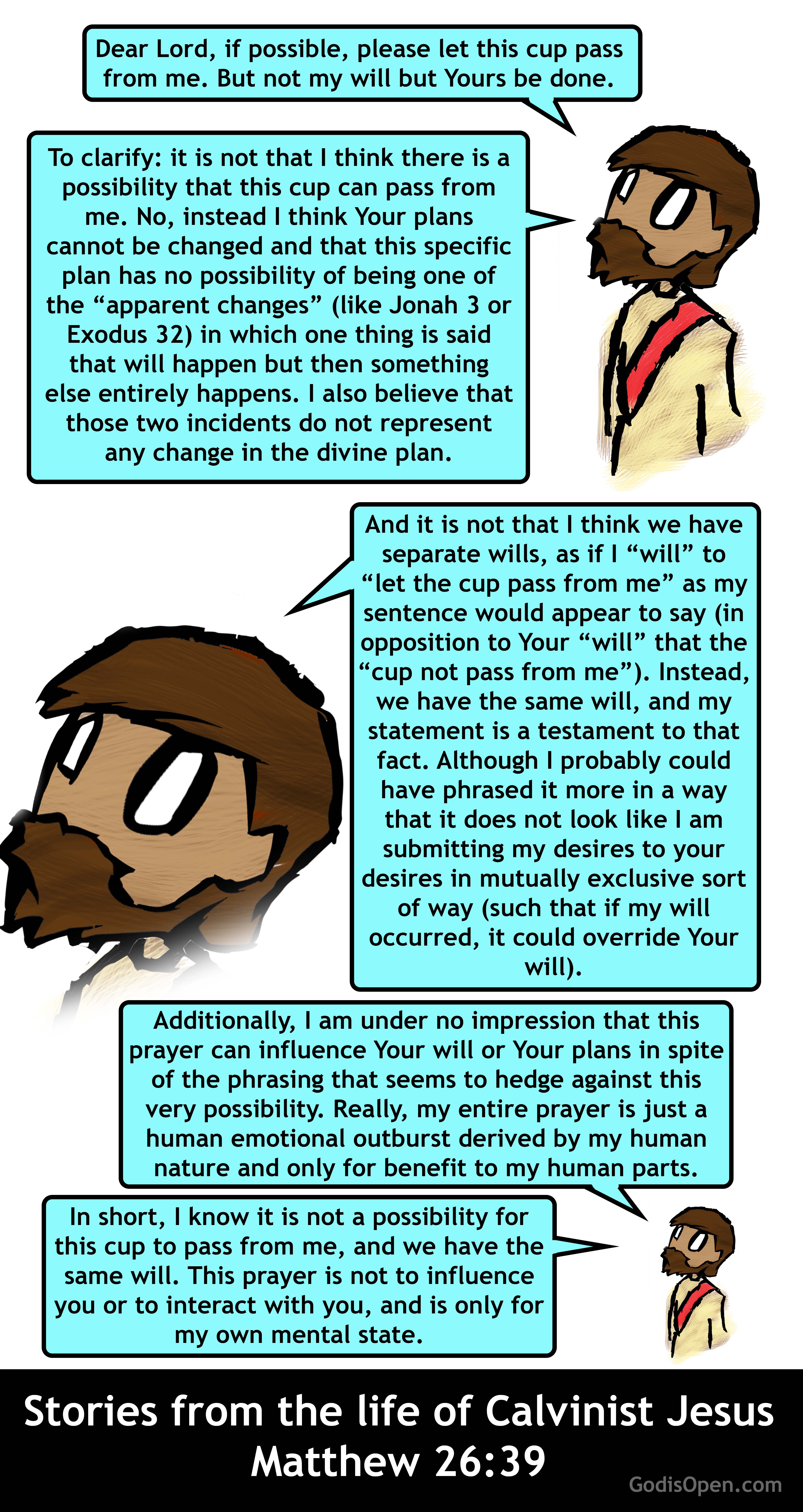
Any claim that the crucifixion could or could not have been avoided should be made on the basis of what the text of the Bible claims. Jesus spends ample time discussing if the crucifixion will happen. We see both statements that the crucifixion is predicted and that it can be avoided. Among Jesus’ statements is Jesus wondering if he should pray to forgo the crucifixion (Joh 12:27), Jesus praying to forgo the crucifixion (Mat 26:39, Mar 14:36, Luk 22:32), and Jesus explaining that God would honor His request to forgo the crucifixion at any time (Mat 26:53). These texts should very much inform the discussion on Jesus’ thoughts on the matter.
This is all in addition to God’s normal operating procedures (where God often changes His mind or even defers to mankind on how to do things). In Ezekiel 4, God commands that Ezekiel bake his food with human dung, Ezekiel objects, and God instantly allows Ezekiel to use cow dung. It does not bother God to change His plans in response to prayer.
McGeown gives a list of passage references that predict that Jesus would die and rise. Something has to be done with the apparent contradiction between McGeown’s texts and the texts in which Jesus shows the crucifixion can be avoided. To McGeown, his passages are taken as absolute; overriding any text that would suggest the crucifixion is not fixed. To the Open Theists, they take the more natural way of solving these discrepancies. Even very strong statements about future events are optional and can be reversed. If I say to my children that there is “no way” that I will give them ice cream because they have been naughty, they still might redeem themselves in some way. I might not think twice about then giving them ice cream after all. My strong statement about the future, as strong as it may be, is still flexible. This is normal in everyday conversation, and the Bible is no different.
In Jeremiah 18, God talks about several reversals that He entertains. He uses strong language about the future in each case. God might “think” He will do something, God might “say” that He will do something, but everything is not fixed in stone (despite what God previously promised):
Jer 18:8 if that nation against whom I have spoken turns from its evil, I will relent of the disaster that I thought to bring upon it.
Jer 18:10 if it does evil in My sight so that it does not obey My voice, then I will relent concerning the good with which I said I would benefit it.
We see this in action as God revokes “eternal” promises:
1Sa 2:30 Therefore the LORD God of Israel says: ‘I said indeed that your house and the house of your father would walk before Me forever.’ But now the LORD says: ‘Far be it from Me; for those who honor Me I will honor, and those who despise Me shall be lightly esteemed.
These examples are given, not to verse trump, but to show how language functions at a basic level. Any secular example would be just as valid. To understand the conflicting verses about the future, using normal speaking conventions (which are used throughout the Bible for the exact same purpose) seems more rational than inventing a strange adherence the absoluteness of future statements. The future is just not absolute and it is not treated as absolute by the Bible. Strong statements often do not materialize for various reasons.
McGeown also believes Open Theism affects views on the atonement:
In addition, open theism makes nonsense of the atonement. A universal atonement which does not save everyone is not a true substitutionary atonement. That is the blasphemy of Arminianism…
This is strange, indeed. McGeown presupposes some obscure, technical, and completely extra-Biblical definition of “atonement”. There are several competing views of the atonement. The atonement debate is held between opponents offering ambiguous verses that well post-date Jesus’ earthly ministry. To be adamant about one particular theory on atonement is strange. To call everyone else “blasphemers” is even stranger. Where is the Biblical precedence for particular views of the atonement to be the indicator between false and true Christians? Or is this just another Greek invention where philosophy trumps the concerns of those who wrote the Bible?
McGeown quotes Ware:
Therefore there could be no actual imputation of our sin to Christ … In fact, Christ would have had reason to wonder, as he hung on that cross, whether for any, or for how many, and for what sins, he was now giving his life. The sin paid for could only be sin in principle, and not sin by imputation, and the people died for was a blurry, impersonal, faceless, nameless, and numberless potential grouping.
These quotes from McGeown and Ware show in what warped mindset they operate. In what way are McGeown and Ware making coherent arguments? If I have a software that I give out for free, who cares if I know how many people will accept that free software. If Bill Gates funds a free ice cream cone for everyone in America, who cares if he knows how many people will eat that ice cream. But McGeown and Ware have a strange fascination with Jesus having to know (by name, date, and type) all sins that will ever occur? Where is the Bible concerned with such things? How does this even work with the fact that Jesus is depicted as learning throughout the gospels and as admitting to not knowing the end times? No doubt, Ware and McGeown would proffer some strange dualism where Jesus divests omniscience yet gets to selectively use it in the gospels when it fits Calvinist theology (apparently Jesus got a burst of omniscience on the cross). In order to save absurdities, more absurdities are invented.
A Detailed Response to Closing the Door on Open Theism – Part 1 [link]
A Detailed Response to Closing the Door on Open Theism – Part 2 [link]
A Detailed Response to Closing the Door on Open Theism – Part 3 [link]
A Detailed Response to Closing the Door on Open Theism – Part 4 [link]
A Detailed Response to Closing the Door on Open Theism – Part 5 [link]
An Open Letter to William Lane Craig
Tim Stratton writes to WLC on the nature of time. An excerpt:
My disagreement with you is regarding the claim that if the B-theory of time is true, then causal determinism is NOT false. That is to say, if the B-theory is reality, then causal determinism is true. In fact, just as the shape and structure of a slide at the water park determines the movement of the person traveling down the slide, the shape and structure of the 4-D block of spacetime causally determines the beliefs and behaviors of the “illusion of self-consciousness” traveling down the frozen “worm” in the static block. My argument is that these “choices” are purely illusory on a naturalistic B-theory model.
Dr. Craig, you rightly bring up the issue of divine foreknowledge and future free choices; however, I think this analogy is dissimilar. As you have taught me, knowledge (possessed by God or not) does not stand in causal relation with anything. For example, an infallible weather barometer that knew with 100 percent certainty that it will rain in Spain tomorrow does not cause the rain in Spain tomorrow.
However, on the B-theory model, the shape and structure of the eternal and static block does causally determine the beliefs and behaviors of the “person” who is nothing more than a slice of a frozen worm in the static block. Consider my water park analogy again: if the shape of the slide veers to the left, you could not go to the right even if you wanted to. Similarly, if the frozen worm in the static block veers to the left, the illusion of self-consciousness goes to the left no matter what. Therefore, this “choice” is nothing but an illusion if the B-theory of time is true (this would include the so-called “choice” to believe the B-theory is true).
Rogers Explains Jacob and Esau
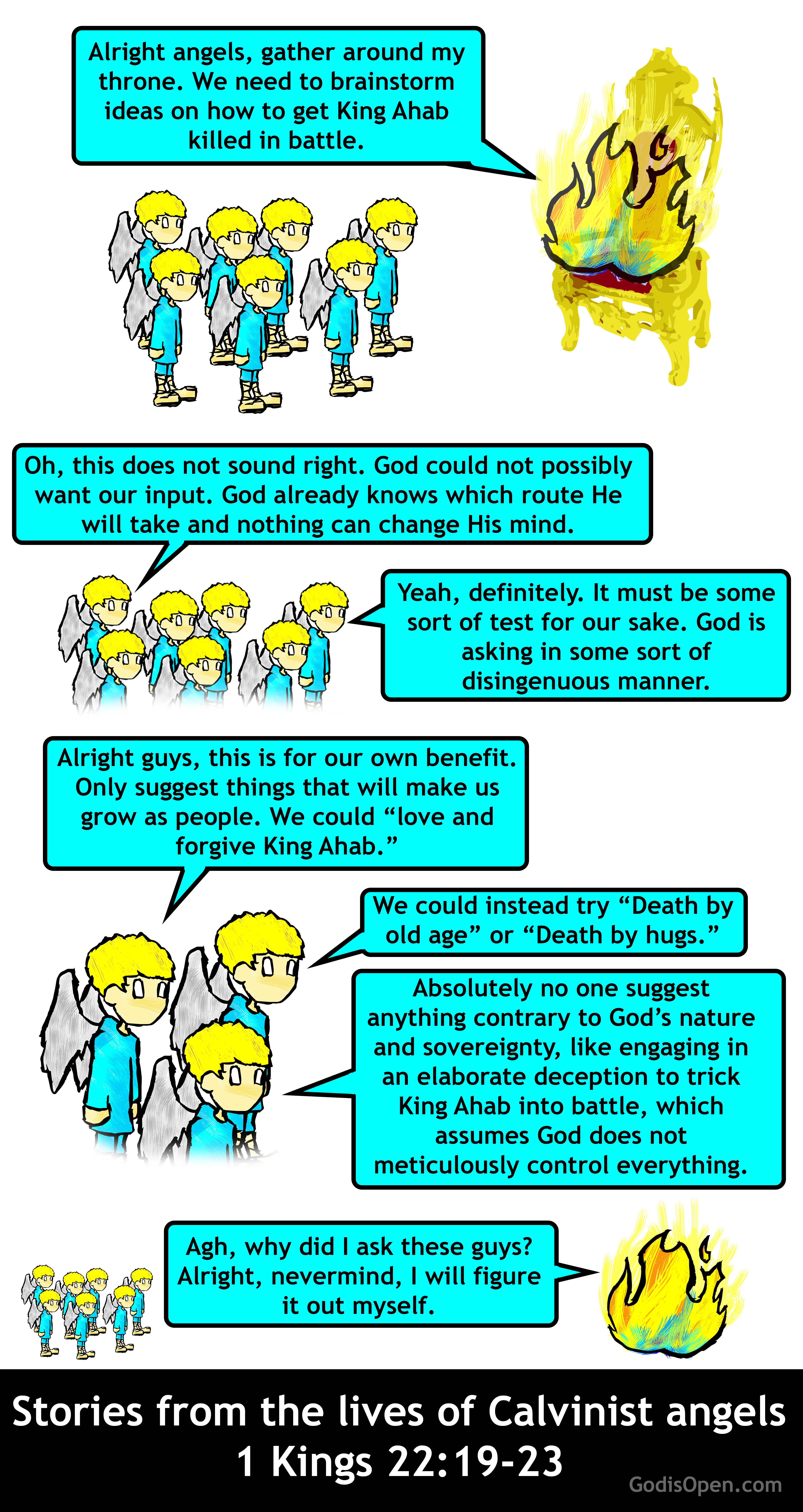
Meme Monday – Kings 22
Worship Sunday – O Come, O Come, Emmanuel
O come, O come, Emmanuel
And ransom captive Israel
That mourns in lonely exile here
Until the Son of God appear
Rejoice! Rejoice! Emmanuel
Shall come to thee, O Israel.
O come, Thou Rod of Jesse, free
Thine own from Satan’s tyranny
From depths of Hell Thy people save
And give them victory o’er the grave
Rejoice! Rejoice! Emmanuel
Shall come to thee, O Israel.
O come, Thou Day-Spring, come and cheer
Our spirits by Thine advent here
Disperse the gloomy clouds of night
And death’s dark shadows put to flight.
Rejoice! Rejoice! Emmanuel
Shall come to thee, O Israel.
O come, Thou Key of David, come,
And open wide our heavenly home;
Make safe the way that leads on high,
And close the path to misery.
Rejoice! Rejoice! Emmanuel
Shall come to thee, O Israel.
O come, O come, Thou Lord of might,
Who to Thy tribes, on Sinai’s height,
In ancient times did’st give the Law,
In cloud, and majesty and awe.
Rejoice! Rejoice! Emmanuel
Shall come to thee, O Israel.
Boyd on the Relational Aspect of Prayer
One of the key differences between “magic” and biblical faith is that magic is about engaging in behaviors that ultimately benefit the practitioner, while biblical faith is about cultivating a covenantal relationship with God that is built on mutual trust. And while the God-human relationship, like all trusting human-to-human relationships, benefits both God and the person of faith, it is not entered into as a means to some other end. We might say that magical faith is utilitarian while biblical faith is simply faithful.
With all sincerity, people often try to believe the right things to pray the right way. They try to attain a sufficient level of certainty about particular doctrines so that they can be sure that they are saved. Or they work to avoid the “deal-breaker” sins in order to get God to “save” them. But how is this significantly different from those who engage in magic by performing certain behaviors to get the spiritual realm to benefit them?
Answered Questions – Do I Believe God Does Not Know the Future
Asked on Facebook:
Do you believe God doesn’t know what’s going to happen?
I know what is going to happen. Tomorrow I will wake up at about 630, be to work by 7. I will call an event vendor. I will talk to my coworker about my day off.
So if I know the future, why would I think God does not know the future?
The future is not hard to know. But, you are probably talking about some sort of special knowledge that is not related to anything we are familiar with. No, I don’t have that knowledge and neither does God. God regrets His own action of making man (Gen 6:6). God regrets His own action of appointing Saul king (1Sa 15:35). God has the angels brainstorm ways to kill King Ahab (1Ki 22). Moses convinces God not to destroy Israel through reasoned arguments (Exo 32).
No, I am not a platonist who ascribes to God a knowledge of the future invented in the pages of Plotinus. I am a Biblicalist, who thinks that the Bible accurately describes God.
Jesus’ Knowledge in the Gospel of John – part 2
Part I can be found here: [link]
Jesus on Lazarus
The Lazarus incident has several very interesting features. The first is that Jesus seems to instantly know the condition of Lazarus when he is told that Lazarus is sick:
Joh 11:4 But when Jesus heard it he said, “This illness does not lead to death. It is for the glory of God, so that the Son of God may be glorified through it.”
Jesus says it is not an illness that leads to death. But Lazarus dies. Is it the case that Jesus was incorrect but was ultimately made correct through God’s intervention? Is it the case that Jesus knew the entire episode would play out with Lazarus dying and coming back to life? Was Jesus just confident that if Lazarus died, that God would resurrect Lazarus (as evident in Jesus’ claim that Lazarus’ condition would be used for God’s glory)? Was Jesus just under the impression that Lazarus would be healed by God? It is hard to say.
The scene seems to flash forward a couple days until Lazarus dies. Jesus seems to know this, and says:
Joh 11:14 Then Jesus told them plainly, “Lazarus has died,
Joh 11:15 and for your sake I am glad that I was not there, so that you may believe. But let us go to him.”
Was Jesus waiting for Lazarus to die? Possibly. Did Jesus know that Lazarus would die? Possibly. Did learning of Lazarus’ death prompt Jesus to set out for Judea? Possibly. It is not clear how Jesus has and is using his knowledge here.
Jesus sets out for Judea. In Judea, Jesus meets Martha. Jesus tells her that Lazarus would rise again. The grave is opened and Jesus thanks God for hearing him:
Joh 11:41 So they took away the stone. And Jesus lifted up his eyes and said, “Father, I thank you that you have heard me.
Joh 11:42 I knew that you always hear me, but I said this on account of the people standing around, that they may believe that you sent me.”
Jesus is confident that God answers all his prayers. This suggests that Lazarus was healed by Jesus’ prayers to God and that God’s power was at work. Does this reflect back to Jesus’ assurances that Lazarus would be healed? Is Jesus just confident that God is powerful and answers prayer, or is this passage about foreknowledge? It seems to be a passage about Jesus’ relationship with God, not about knowledge.
Jesus knows what God will do because Jesus wishes God to do those things. The causality flows from Jesus to God. One would assume the knowledge accompanies this trust. If this is the case, the story of Lazarus might be of one in which Jesus sets up a situation to prove that he has God’s favor. Jesus hears Lazarus is sick, waits for things to turn south, and then arrives to make things right. Again, this text is probably not about knowledge but relationship.
Jesus Has Come for the Hour
In John 12, Jesus is said to have not been weary of the final hour:
Joh 12:27 “Now is my soul troubled. And what shall I say? ‘Father, save me from this hour’? But for this purpose I have come to this hour.
The most straightforward reading is perhaps a rejection of what is written in the other gospels, where Jesus prays to be saved from the crucifixion. If Jesus is saying this in emotionless confidence, then it would be in contrast to his behavior elsewhere. But Albert Barnes attempts to rectify John with the other gospels:
Father, save me – This ought undoubtedly to have been read as a question – “Shall I say, Father, save me?” Shall I apply to God to rescue me? or shall I go forward to bear these trials? As it is in our translation, it represents him as actually offering the prayer, and then checking himself. The Greek will bear either interpretation.
To Albert Barnes, the solution is that Jesus said these words in perplexity. Jesus was wondering if he should pray to be released from the crucifixion or go through with the crucifixion. If this is the correct reading, it fits that Jesus was “troubled” (per the text), that Jesus believed the future was open (per other texts in John), and Jesus could persuade God to forgo the crucifixion (per the other gospels).
Jesus Figures out the Hour has Come
In John 13, the text talks about Jesus coming to the realization that his hour has come. This text is ambiguous. Did Jesus always know the exact hour? Or did something indicate to Jesus that his time had come? The use of “hour” here seems to be a more specific timeframe than other uses of “hour” in John, as consistent with normal figurative speech:
Joh 13:1 Now before the Feast of the Passover, when Jesus knew that his hour had come to depart out of this world to the Father, having loved his own who were in the world, he loved them to the end.
This text does not indicate heavily about the extent and use of Jesus’ knowledge.
Jesus Knows Judas will Betray Him
Jesus then proceeds to host the last supper. In this supper, Jesus’ betrayal comes up in conversation. Jesus makes a convert comment towards Judas and the narrator follows with:
Joh 13:11 For he knew who was to betray him; that was why he said, “Not all of you are clean.”
Jesus then follows this by claiming that Judas’ betrayal is predicted by scripture:
Joh 13:18 I am not speaking of all of you; I know whom I have chosen. But the Scripture will be fulfilled, ‘He who ate my bread has lifted his heel against me.’
Joh 13:19 I am telling you this now, before it takes place, that when it does take place you may believe that I am he.
Calvinist James White claims verse 19 is an allusion to Isaiah 43:10 and a deity claim. Isaiah 43 reads:
Isa 43:9 All the nations gather together, and the peoples assemble. Who among them can declare this, and show us the former things? Let them bring their witnesses to prove them right, and let them hear and say, It is true.
Isa 43:10 “You are my witnesses,” declares the LORD, “and my servant whom I have chosen, that you may know and believe me and understand that I am he. Before me no god was formed, nor shall there be any after me.
John 13:19 and Isaiah 43:10 seem to only share parallel concepts. The words, themselves, seem to have different phrasing. Isaiah has “witness”, “know and believe”, and lacks the “before and after” terminology. It might be a jump in logic to style John as a deity claim based on Isaiah 43 rather than a Messiah claim based on the immediate context. As seen from the woman at the well, knowledge of things gave prophet status, not necessarily deity status.
The previous verse, verse 18, is an allusion to Psalms 41:9. The phrases are directly parallel. Compare:
Joh 13:18 I am not speaking of all of you; I know whom I have chosen. But the Scripture will be fulfilled, ‘He who ate my bread has lifted his heel against me.’
Psa 41:9 Even my close friend in whom I trusted, who ate my bread, has lifted his heel against me.
It would be strange that Jesus alludes to two separate Bible verses in two very different manners just one verse apart. It is more reasonable to think that Jesus is making a combined claim, one that God will raise him up and overcome his enemies (the context of Psalms 41) and that this will prove he is Israel’s Messiah.
In any case, the disciples do not understand anything Jesus is saying (which would make a knowledge based deity claim even stranger). Jesus, later, becomes troubled and point blank says he will be betrayed:
Joh 13:21 After saying these things, Jesus was troubled in his spirit, and testified, “Truly, truly, I say to you, one of you will betray me.”
Joh 13:22 The disciples looked at one another, uncertain of whom he spoke.
The disciples continue to be confused and do not understand even after Jesus indicates Judas will betray him. Satan then enters Judas:
Joh 13:27 Then after he had taken the morsel, Satan entered into him. Jesus said to him, “What you are going to do, do quickly.”
In verse 2, the Devil is said to put it into Judas’ heart to betray Jesus. Is “Satan entering Judas” a figure of speech, meaning Judas acted on the thoughts the devil planted in verse 2? Or was Judas possessed? Why does John 13 introduce the Devil and Satan in relation to Judas? The Devil is mentioned only 3 times in John, and Satan only once. Perhaps, Satan is being used in a sense of personification. Judas became adversarial after Jesus indicated Judas would betray him. Jesus then tells Judas to go, and Judas proceeds to leave.
Jesus links Judas’ betrayal to God being glorified. This links back to John 12:27 where Jesus questions whether to forgo the crucifixion. In John 12, Jesus links his hour coming to God being glorified. In John 12:28, God speaks back to Jesus claiming to be glorified again. Could John 12 have been the defining moment when Jesus resolved on this outcome, cementing the events?
How did Jesus know that Judas was to betray him? Was it based on character (Judas is described by John as robbing the donations (Joh 12:6) and was picked for his bad character (Joh 6:70))? Was Jesus’ knowledge based on fatalism? If so, how does that fix the crucifixion not being a fixed event in John 12. Was Jesus’ knowledge based on the works of the Devil (who entices Judas in verse 2 and is equated with Judas in 6:70)?
The mechanism for this knowledge is probably not fatalism or future exhaustive knowledge. The text goes out of its way to involve the Devil, literally or figuratively. This serves as motivation for Judas.
Part 2 conclusion
Jesus is styled as knowing much about Lazarus, possibly even setting up the scenario. Jesus possibly states that the crucifixion can be avoided if he so wished. Jesus then knows that Judas is in the process of betraying him (predicted in earlier texts).
Biederwolf on the Practicality of Prayer That Does Not Affect God
From How Can God Answer Prayer?
…but that if a man had any sort of assurance that such approach of the soul to God as communion involves was being made to a Supreme Being whose ear was deaf and whose heart indifferent to our cries of distress and our petitions for help or hearing could not help us because of the inevitable course of things over which He has no control, the probability is that that man would soon begin to incline toward a state of dumb resignation to the inevitable, which in turn would rapidly tend toward the neglect of prayer altogether. We pray too little as it is. If with Frederick W. Robertson we see in prayer only such contemplation of the character of God as ends with the resignation of ourselves to His will, most men, we fear, would not put themselves even to such effort to obtain it. They would be more likely to accept the inevitable and devote the time otherwise required for such contemplation to making the best out of a condition of affairs for which there is no help, at least from above.
Biederwolf, William Edward (2013-07-22). How Can God Answer Prayer? Being an exhaustive treatise on the Nature, Conditions, and Difficulties of Prayer (Kindle Locations 298-305). . Kindle Edition.
Boyd Inteprets All God’s Attributes Though Love
The same thing must be said of all the other attributes of God. All of them are ultimately expressions of God’s servant love. Here are a few examples of what we’re talking about.
Scripture teaches that God is everywhere (he is “omnipresent”). Since God’s very essence is love, the primary meaning of this teaching is that it’s impossible to hide from God’s love. Even if we make our bed in hell, Scripture teaches, we’re surrounded by God’s triune love (Ps. 139:7-10).
Scripture teaches that God never changes (he is “immutable,” see Ps 102:25-27). Since God’s very essence is love, the primary meaning of this teaching is that it’s impossible for God’s love to ever waver. His love is perfect and unwavering and it endures forever (Ps 36). The immutability of God’s loving character is marvelously expressed in Scripture’s repeated emphasis on God’s faithfulness and trustworthiness.
Scripture also teaches that God knows everything (he is “omniscient”). Since God’s very essence is love, the primary meaning of this teaching is not merely that God knows all the facts that exist, but that God is intimately aware of every facet of our being. As David says, God searches our heart and knows our innermost thoughts and feelings, even before we do (Ps. 139:1-2).
Finally, Scripture teaches that God is “holy.” While this attribute is frequently associated with God’s strict rules and burning wrath against sin, the biblical word for “holy” (Heb 12:16) denotes something set apart, utterly unique and other-worldly. Since God’s very essence is love, the primary meaning of God’s holiness is that God’s perfect love is different from the kind of fickle and shallow love we usually experience in our world.
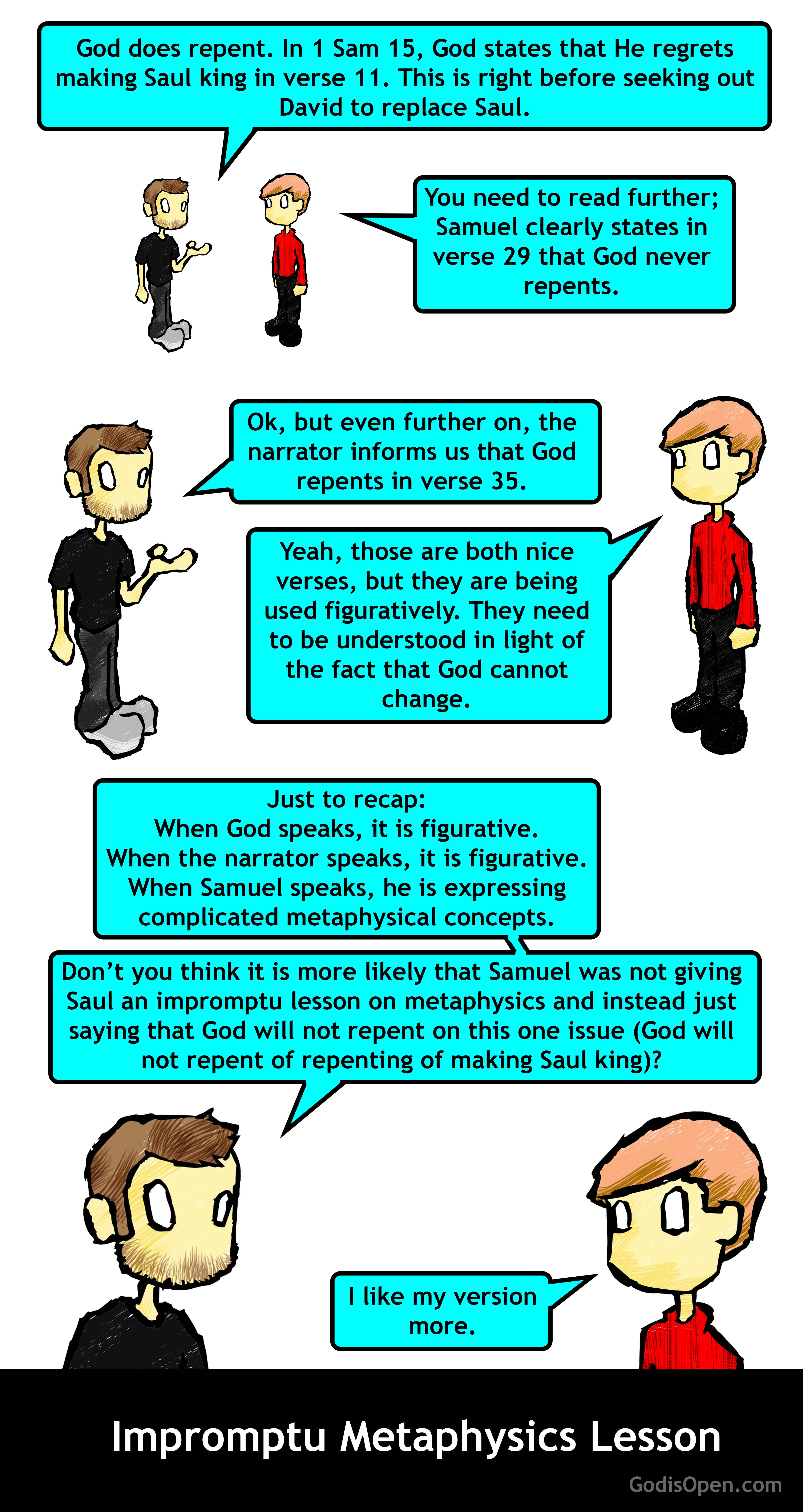
Meme Monday – Impromptu Metaphysics Lesson
Worship Sunday – Little Drummer Boy
Come they told me, pa rum pum pum pum
A new born King to see, pa rum pum pum pum
Our finest gifts we bring, pa rum pum pum pum
To lay before the King, pa rum pum pum pum,
rum pum pum pum, rum pum pum pum,
So to honor Him, pa rum pum pum pum,
When we come.
Little Baby, pa rum pum pum pum
I am a poor boy too, pa rum pum pum pum
I have no gift to bring, pa rum pum pum pum
That’s fit to give the King, pa rum pum pum pum,
rum pum pum pum, rum pum pum pum,
Shall I play for you, pa rum pum pum pum,
On my drum?
Mary nodded, pa rum pum pum pum
The ox and lamb kept time, pa rum pum pum pum
I played my drum for Him, pa rum pum pum pum
I played my best for Him, pa rum pum pum pum,
rum pum pum pum, rum pum pum pum,
Then He smiled at me, pa rum pum pum pum
Me and my drum.
Jesus’ Knowledge in the Gospel of John – part 1
Reblogged from Realityisnotoptional.com:
I was recently challenged on the concept of Jesus in the gospel of John. The challenger stated that Jesus is depicted as omniscient or semi-omniscient. Jesus, throughout the gospel of John, seems to have access to God’s knowledge (and power) and utilized it on a regular basis.
The first thing to note about the writing style of John is that it is more ethereal and cryptic than the other gospels. John introduces about 90% new material, and uses that material in such a way that it presents Jesus as more divine than the other gospels. Much more of Jesus’ statements are contextless and not very concrete. There is a lot of confusion for the listeners and the readers. The text sometimes, but not always, follows up with clarifications.
The book also tends to divorce Jesus from his Jewish apocalyptic primary message depicted in the other gospels. This suggests a late date of writing, when the followers of Christianity began to expect the imminent end was not so imminent and the Gentile mission was larger. The book seems to be written to later Greek converts (having to define terms such as “Rabbi” and “Messiah”). The cryptic nature probably appealed more to the Greek sense of mystery than the Jewish sense of apocalypticism.
Jesus shows clairvoyance
Jesus is depicted as having access to much of God’s knowledge. There is a very early scene in which Jesus recalls having seen someone in a place where Jesus was not present:
Joh 1:47 Jesus saw Nathanael coming toward him and said of him, “Behold, an Israelite indeed, in whom there is no deceit!”
Joh 1:48 Nathanael said to him, “How do you know me?” Jesus answered him, “Before Philip called you, when you were under the fig tree, I saw you.”
Joh 1:49 Nathanael answered him, “Rabbi, you are the Son of God! You are the King of Israel!”
Jesus’ knowledge of the character of Nathanael is based on seeing Nathanael earlier. Something about this scene gave Jesus the indication that Nathanael was doing something under the fig tree that spoke to his character. Perhaps Nathanael was in prayer. Jesus’ claim would be that God showed him Nathanael’s prayer.
Jesus knows the character of man
In the second chapter, Jesus is said to know the character of his new converts. He knows not to trust them, because he understands “man”:
Joh 2:23 Now when he was in Jerusalem at the Passover Feast, many believed in his name when they saw the signs that he was doing.
Joh 2:24 But Jesus on his part did not entrust himself to them, because he knew all people
Joh 2:25 and needed no one to bear witness about man, for he himself knew what was in man.
How this is worded seems to say that Jesus knew the general character of man, especially the people who are claiming to be his disciples. This instance seems to be referenced in a much later context:
Joh 6:60 When many of his disciples heard it, they said, “This is a hard saying; who can listen to it?”
Joh 6:61 But Jesus, knowing in himself that his disciples were grumbling about this, said to them, “Do you take offense at this?
…
Joh 6:64 But there are some of you who do not believe.” (For Jesus knew from the beginning who those were who did not believe, and who it was who would betray him.)
If John 6:64 is a reference to John 2:25, it would appear that Jesus knew who would betray him because he knew the character of the people with which he was dealing. Unlike the John 1:48 instance, Jesus is not tapping into divine knowledge for this event.
Jesus acquires new information
John 4 begins with Jesus learning about the actions of the Pharisees. In this case, Jesus did not have foreknowledge or clairvoyance (assumedly) about something that happens.
Joh 4:1 Now when Jesus learned that the Pharisees had heard that Jesus was making and baptizing more disciples than John
Joh 4:2 (although Jesus himself did not baptize, but only his disciples),
Joh 4:3 he left Judea and departed again for Galilee.
Jesus is operating in a manner in which he learns something, after it happens, and then Jesus responds accordingly.
Jesus knows a woman’s past
John 4 cuts to Jesus interacting with a woman at a well. In this interaction, Jesus is able to recall events from this woman’s life with accuracy:
Joh 4:17 The woman answered him, “I have no husband.” Jesus said to her, “You are right in saying, ‘I have no husband’;
Joh 4:18 for you have had five husbands, and the one you now have is not your husband. What you have said is true.”
Joh 4:19 The woman said to him, “Sir, I perceive that you are a prophet.
To this woman, that Jesus could recount her past put Jesus in the role of a prophet, someone who communicates with and for God. The woman’s normal interpretation of these events is not to bestow omniscience on Jesus, but to understand Jesus as operating through the power of God.
This passage reveals several idiomatic expressions, hyperboles. The woman says that Jesus “told me all that I ever did” and she says that Christ would “tell us all things.” These normal idiomatic expressions are very important, because within John, the disciples tell Jesus that Jesus knows “all things”:
Joh 16:30 Now we know that you know all things and do not need anyone to question you; this is why we believe that you came from God.”
The phrase “all things” most naturally is limited to a hyperbolic expression that needs to be taken in context. It would be a mistake to assume some sort of literal and metaphysical sense to these words unless the context is explicit.
Jesus changes the future
Jesus’ ministry is entirely in the context of saving people from things that can happen. One does not see in Jesus a sense of fatalism. Jesus warns people that their actions will be responsible for future contingencies. Jesus attempts to avert the worst with warnings.
In John 5, Jesus warns someone he has just healed that he needs to refrain from sinning to avert judgment:
Joh 5:14 Afterward Jesus found him in the temple and said to him, “See, you are well! Sin no more, that nothing worse may happen to you.”
Jesus attempts to save people:
Joh 5:34 Not that the testimony that I receive is from man, but I say these things so that you may be saved.
Jesus uses the power of God
Consistent with the events of Nathanael and the woman at the well, Jesus makes the claim that his power is through God.
Joh 5:19 So Jesus said to them, “Truly, truly, I say to you, the Son can do nothing of his own accord, but only what he sees the Father doing. For whatever the Father does, that the Son does likewise.
And:
Joh 5:30 “I can do nothing on my own. As I hear, I judge, and my judgment is just, because I seek not my own will but the will of him who sent me.
Jesus tests the disciples
Although Jesus generally knows people’s hearts, sometimes Jesus tests them in specific ways to learn what they will do:
Joh 6:5 Lifting up his eyes, then, and seeing that a large crowd was coming toward him, Jesus said to Philip, “Where are we to buy bread, so that these people may eat?”
Joh 6:6 He said this to test him, for he himself knew what he would do.
Jesus planned on performing a miracle, but wanted to see if the disciples would put their faith in Jesus’ power. The disciples are thinking of the non-miraculous, and seem to fail the test.
Jesus knows that Judas will betray him
Later in John 6, Jesus has a falling out with many of his disciples. These are probably many of the same disciples that Jesus did not trust in John 2:25. Jesus calls them out and then a bunch leave. The text then states that Jesus knew they were not true converts, adding in that Jesus knows who would betray him:
Joh 6:64 But there are some of you who do not believe.” (For Jesus knew from the beginning who those were who did not believe, and who it was who would betray him.)
The text then identifies that individual, by name:
Joh 6:68 Simon Peter answered him, “Lord, to whom shall we go? You have the words of eternal life,
Joh 6:69 and we have believed, and have come to know, that you are the Holy One of God.”
Joh 6:70 Jesus answered them, “Did I not choose you, the Twelve? And yet one of you is a devil.”
Joh 6:71 He spoke of Judas the son of Simon Iscariot, for he, one of the Twelve, was going to betray him.
How does Jesus know Judas would betray him? The knowledge about the other disciples was per their character. Would it not be safe to assume Jesus knew the character of Judas? There are no hints of divine information sharing in this text.
Jesus avoids dangerous situations
After this, Jesus decides to avoid Judea because there would be a chance he would die:
Joh 7:1 After this Jesus went about in Galilee. He would not go about in Judea, because the Jews were seeking to kill him.
Jesus, here, is not operating with exhaustive future omniscience, but is minimizing risks of future occurrences by avoiding dangerous situations. Someone with exhaustive future omniscience could easily inject themselves into dangerous situations and overcome. Someone operating within the bounds of human activity, with some divine help, needs to take precautions.
Jesus eventually does go to Judea, but is careful not to let that information out:
Joh 7:10 But after his brothers had gone up to the feast, then he also went up, not publicly but in private.
Jesus’ divine protection
In John 7, Jesus gives a speech that incites the authorities. They attempt to arrest him, but Jesus escapes. The stated reason is that “his hour has not come”:
Joh 7:30 So they were seeking to arrest him, but no one laid a hand on him, because his hour had not yet come.
Perhaps this is because Jesus was given divine protection. If this is the case, divine protection thwarts what would have been. The future is being changed through divine action. The Jews are thwarted at the end of chapter 8 where they attempt to stone Jesus:
Joh 8:59 So they picked up stones to throw at him, but Jesus hid himself and went out of the temple.
Jesus runs away. This is reoccurring:
Joh 10:39 Again they sought to arrest him, but he escaped from their hands.
Jesus learns about a man
In chapter 9, Jesus heals a blind man. The Jewish authorities expel the man from the synagogue for declaring Jesus as the Messiah. Jesus learns about this and then seeks out the man:
Joh 9:35 Jesus heard that they had cast him out, and having found him he said, “Do you believe in the Son of Man?”
Part 1 conclusion:
The text presents Jesus as knowledgeable, with the ability to tap into God’s power. Jesus is not depicted as omniscient. And the future is portrayed as flexible and indefinite.
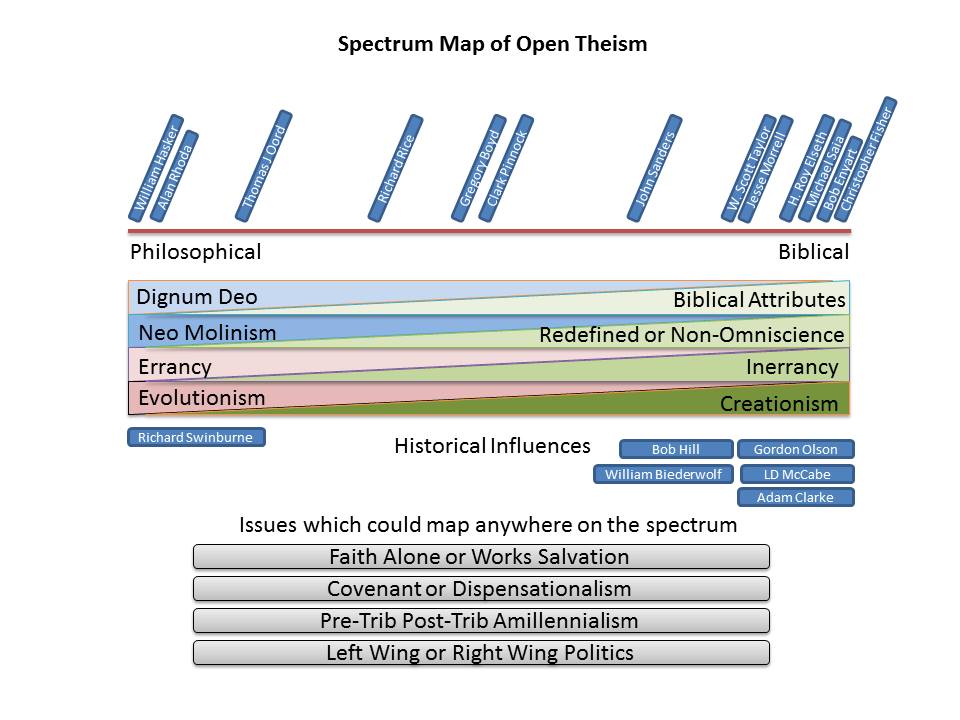
Unanswered Questions – Who are the leaders in the Biblical wing of Open Theism
On the GodisOpen facebook page, a conversation is occurring over the resent history of the Open Theism movement. Some are concerned about the prominence of the philosophical wing of Open Theism, wondering who the Biblical Open Theist leaders are.
This chart may provide an answer (to the extent the chart is correct). Morrell, Enyart and Saia seem to be main the contenders, although not as prominent as the Philosophical Open Theists (Hasker, Boyd, Rice, Swinburne, and Oord).
Apologetics Thursday – Hunt’s Sloppy Logic
David Hunt posits that Open Theists fall afoul of the law of Excluded Middle:
This reason for embracing Openism flies in the face of both logic and common usage. Let’s begin with logic. Either I will call my mother tomorrow, or I won’t call my mother tomorrow. One or the other of these statements about the future must be true. The principle that either a given statement or its denial is true is called the “Law of Excluded Middle.” But this first brief on behalf of Openism requires that this law be abrogated. That’s a heavy cost, and the vast majority of logicians would decline to pay it.
Craig, William Lane; Copan, Paul (2009-08-01). Contending with Christianity’s Critics: Anwering New Atheists and Other Objectors (Kindle Locations 5283-5287). B&H Publishing. Kindle Edition.
Where David Hunt errors is that he does not understand the law of Excluded Middle. The law of Excluded Middle only applies to statements that describe reality. For example, is the following statement true or false: “This statement is false”. If this statements was false, that would mean it is true. If this statement was true, that would mean it is false. If Hunt would apply his “logic” to this statement, then it is obvious that his law of Excluded Middle runs afoul of the law of Non-Contradiction.
Instead, when statements are abstract, and not based in “what is”, then the law of Excluded Middle does not apply. Does Santa have a beard? Well, “Santa” is an abstract concept. There is no real answer, not unless it is tied to reality in some sense: “Did Saint Nicolas at any time ever have a beard?” or “Does Santa, as imagined by the Coke commercials, have a beard?” These answers can be true or false because they are asking about an aspect of reality. Not unless a statement can be tied to reality does the law of Excluded Middle apply.
For Hunt to say that the law of Excluded Middle proves that the future can have true or false statement, he must first assume that the future can have true or false statements. He is falling prey to the Fallacy of Begging the Question (assuming what he is trying to prove), this is in addition to the fallacy of False Dilemma.
Hunt continues:
Ordinary usage and common sense also reject [Open Theism]. We make claims about the contingent future all the time, and we assume that such claims are sometimes true. Consider the following:
1. This coin will land heads on the next toss.
2. My wife will vote for candidate X in tomorrow’s election.
3. The U.S. will elect its first female president in 2016.The openist may object to taking such claims at face value on the grounds that the future is not yet real and that claims about it are therefore not yet true. But this objection would be received with bemusement by anyone engaged in the actual practice of making claims about the future.
Craig, William Lane; Copan, Paul (2009-08-01). Contending with Christianity’s Critics: Anwering New Atheists and Other Objectors (Kindle Locations 5287-5293). B&H Publishing. Kindle Edition.
Hunt moves from claiming that Open Theism flies in the face of “common usage” to claiming “ordinary usage… reject[s]” Open Theism. Hunt’s first statement might be correct; language is a good tool for showing how common people might intuitively understand a concept. But Hunt’s second statement is irrational. Language is filled with metaphors, hyperbole, figures of speech, and other linguistically shortcuts. “Language” does not “reject” anything. This is easily illustrated.
People talk about the “Sun rising”. This is even though, when questioned, basically everyone would admit that their concept of the “Sun rising” is that of the Earth revolving and spinning around a stationary Sun. The Sun rise imagery is a linguistical shortcut for all these people. When pressed, they will claim that the Sun really does not “rise”. The “Sun rising” is linguistical shortcut, and although it is a linguistical shortcut, it happens to a shortcut to a false concept.
Basically every astrophysicists knows that movement in space is relative. Phil Plait, the leading astrophysicist, has a good article on this. Movement is relative in space, and one can no more say that the Sun revolves around the Earth than the Earth revolves around the Sun. A reference point has to be arbitrarily picked. There are no “right” or “wrong” reference points.
Pretend Phil Plait adopted the reasoning of Hunt to make his case. Pretend he made the case that “ordinary usage” of language “rejects” the idea that the Earth revolves around the Sun. This would be an absurd claim. Linguistical features could tell us what ordinary people might find reasonable, but they in no way inform what accurately reflects reality.
That being said, “I was right” could easily be a linguistical shortcut to mean “what I predicted then happened to materialize”. In the same sense, one could easily claim “Santa has a beard” but actually mean “the commonly accepted image of Santa includes a beard.” Linguistical shortcuts are ubiquitous in human communication. Discounting them to try to score cheap theological points is not a good idea.
One could easily point out how the Biblical language “rejects” Calvinism in the use of language where people “choose” and God is consistently thwarted by those choices. And statements about time are always about past, present, and future, “rejecting” any timelessness. Hunt needs to rely on flexible language to maintain his Calvinism. Hunt’s arguments thwart his own beliefs.
Olson Teaches on Omniscience and Omnipresence
A classic lecture from Gordon Olson:
Oord Responds to Olson’s Response to Oord
Thomas J Oord responds to Roger Olson’s review of his book:
Closely related to the last point is the issue of God’s will vs. permission. If you (Roger) and others would say God’s will is always constrained by God’s love and that God’s love is always uncontrolling, we’d be in agreement. At least the first part of that previous sentence (“God’s will is always constrained by God’s love”) is solidly Arminian, as you know. In this, I’m retrieving an Arminian heritage I don’t find retrieved among many of my fellow open theists.
The second part of that sentence above seems necessary to overcome questions about God failing to prevent evil that God could prevent through control. That is, many say God could control free creatures, non-free creatures, less complex entities, or interrupt the law-like regularities of existence. Consequently, they cannot offer a solution to the problem of evil. If you would agree that God’s will is always constrained by God’s love and divine love is always uncontrolling, you would no longer need to say God “allows” evil. We’d be on the same page.
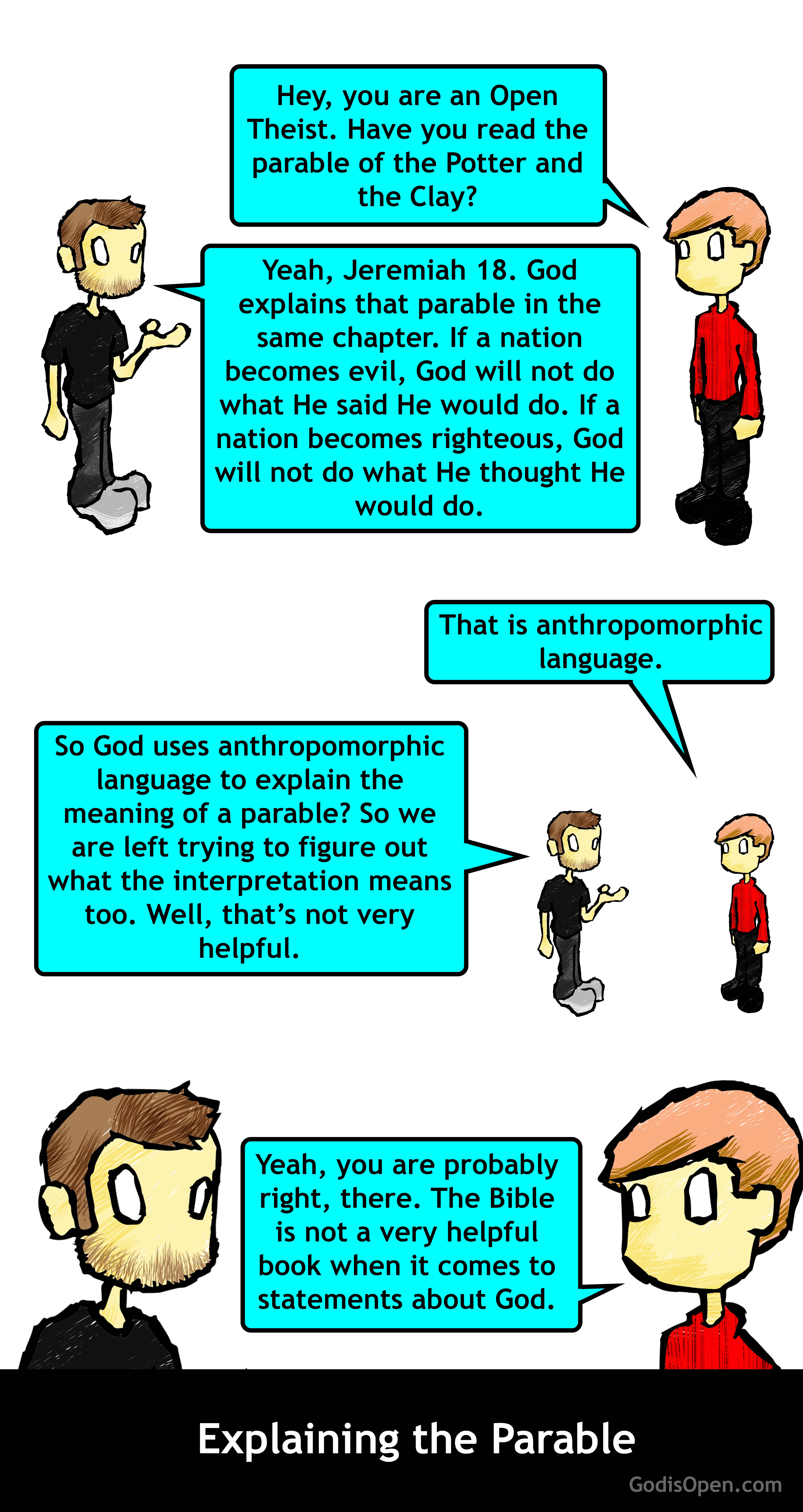
Meme Monday – Explaining the Parable
Worship Sunday – Break Free
I´m surrounded by Your presence
and my heart is filled with joy
a new passion deep within me
is awakening my soul
Just like David danced before You
full of strength and full of might
I will lay down everything that holds me back from You
I will break free, to live a life that honors You
I am dancing, by your spirit I am filled
I will break free to celebrate and worship you a-lone
I will choose to live after your heart and dance like David danced
I will choose to live after your heart and dance like David danced
Leighton Flowers Details Systematic Intellectual Dishonesty in James White
Unanswered Questions – Philosophical Objections to the Open View
On the GodisOpen Facebook page, one commenter asks:
I need some solid philosophical objections to the open view please.
Calvinists and Arminians, please help.
A detailed response to Closing the Door on Open Theism – Part 3
Martyn McGeown offers, perhaps, the best evidence for God knowing the future exhaustively. If God can predict, accurately, future events that involve too many random variables for even a present knowledge to accomidate, then this is evidence for divine foreknowledge. McGeown quotes Bruce Ware to this effect:
Consider the vast array of attending circumstances God must know about in advance for this prediction to be given. At the time Isaiah prophesies this, God must already know about the fall of Assyria, the rise and fall of Babylon, the rise of Medo-Persia, the fall of Israel, the fall of Judah, the birth and naming of Cyrus, the life and growth of this particular king, his ongoing life into adulthood, his selection as king, his willingness to consider helping the Israelites, his decision to assist in rebuilding Jerusalem, and on and on. This list hits a very few of the most significant items. Within each of these items is hidden a multitude of free will choices that would affect everything about the outcome for that particular piece of human history. It simply is incredible that God can say through Isaiah such a long time prior to Cyrus’s reign, “It is I who says of Cyrus, He is my shepherd! And he will perform all my desire.”
McGeown adds:
It simply will not do for the open theists to claim that God “tweaks” man’s free will occasionally to accomplish specific purposes. The example of Cyrus (Isa. 44:28) alone shows that open theism’s entire thesis collapses like a house of cards.
McGeown believes this is the best example in the Bible of God predicting something so minutely that it suggests future foreknowledge. This is an event in which Isaiah predicts the name (and character) of a king (possibly 140 years in advance). While McGeown is finally offering rational arguments, his evidence is fairly shoddy.
Assuming the prophecy of Isaiah is not Deutero-Isaiac (a critical assumption that must be held to make this point), then one would still have to figure out how likely it is to accurately predict names (and characters). It cannot be ruled out that God was involved with the naming (and breading), as power acts are traditionally how God predicts future events (as evident in Isaiah 40-48).
Two examples of people being named are found in the New Testament: Jesus and John the Baptist. In the case of Jesus, God asks Mary (Jesus’ mother) to name her baby and she does. In the case of John, God makes Zacharias (John’s father) mute until he names the baby what God wishes. Presumably, God would have killed Zacharias if he named his son anything except John. One naming was a request and one was coerced. Both of these examples suggest the naming is not fated, but must be brought about by free agents.
Another point should be added: it is a stretch to jump from “God knows the name and character of a baby, 140 years in advanced” to “God knows all events, no matter how small, infinitely into the future”. That is not a rational conclusion. If I was able to predict a name and character of a baby 140 years into the future (like a modern day Nostradamus) no one would jump to the conclusion I know the future in its entirety.
If a baby is the key evidence of future exhaustive foreknowledge, Open Theists should be assured that there is not any strong evidence against Open Theism in the Bible.
A Detailed Response to Closing the Door on Open Theism – Part 1 [link]
A Detailed Response to Closing the Door on Open Theism – Part 2 [link]
A Detailed Response to Closing the Door on Open Theism – Part 3 [link]
A Detailed Response to Closing the Door on Open Theism – Part 4 [link]
A Detailed Response to Closing the Door on Open Theism – Part 5 [link]
Olson Reviews Oord’s Book
From Arminian Roger Olson:
My second question is whether the God of the Bible in whom Oord believes (both God and the Bible as his inspired Word) ever intervened, interfered, powerfully and unilaterally, without the creatures’ consent, to control a creature—to make something happen to him or her that would not otherwise have happened? Oord does not think so. His final chapter (8) is “Miracles and God’s Providence.” Let it be noted that Oord affirms miracles. What he denies is that any miracle of God was or ever is unilateral, controlling and coercive. Let’s go right to two main miracles in the biblical narrative—both which Oord believes happened: the exodus and the resurrection of Jesus. Oord believes, and attempts to explain, that both involved creatures’ consent and participation. In neither case, Oord claims, did God act to control, without some level of cooperation from the things, persons being affected.
This is where I find Oord’s explanations frankly tortuous (not “torturous”). In fact, they become so fanciful and obscure that I cannot even imagine them as true. For example, in the exodus of Israel from Egypt, Oord suggests, God foreknew the wind that would separate the waters of the Red Sea and directed Moses to lead the Hebrew people to that spot at just the right time to walk across the Sea on dry land. One wonders how often that phenomenon happened! For example, in the case of Jesus’s bodily resurrection, God raised him back to live, to new life, immortal life, with Jesus’s own consent. True enough, I suppose one could argue and believe, but one still has to wonder about all the other circumstances surrounding and included in the resurrection event. But let’s turn to another “resurrection”—the resuscitation of Lazarus. Did Jesus gain Lazarus’s consent before raising him back to life? At one point Oord mentions that someone else’s consent can occasionally stand in for the consent of the person directly being affected by the divine act (when their consent is impossible). This would apparently be a necessary case of that. But is that really consistent with Oord’s overall thesis? What if Lazarus didn’t want to be resuscitated?
Whose consent did Jesus get to turn water into wine?
Then there are all the biblical events in which God apparently acted (or will act as prophecied) with the result of great harm to creatures: the flood of Noah’s day, the striking dead of Ananias and Sapphira (Acts 5), the judgment and punishment of rebellious angels and human sinners in the eschaton.
Torbeyns Reviews God’s Foreknowledge and Man’s Free Will
A Review of God’s Foreknowledge and Man’s Free Will by Richard Rice
Tom Torbeyns’s review Nov 28, 15
3 of 5 stars
Read from November 27 to 28, 2015, read count: 1‘“Come now, and let us reason together,” Says the Lord’
– Isaiah 1:18a (NKJV)POSITIVE ELEMENTS:
* This good piece of reasoning justifies God’s goodness.
* The chapter against Evil (chapter 4) is, in my opinion, the best part of the whole book.
It shows how the closed view of the future contains some serious problems concerning the subject of evil and the goodness of God.* In chapter 6, Providence and the Openness of God, the author of this book gives us a moving and most biblical way of how God can reform evil, which is intrinsically evil, to bring good out of it, even in our individual lives. It contains just a few examples of the beauty of an open future.
NEGATIVE ELEMENTS:
* While this book, in its defence of the possibility of an open future, is, in my opinion, irrefutable, more Bible verses in the first chapters would have surely made this a better book.
* I also expected more of chapter 7, which talks about the connection between prophecy and the open future.
Meme Monday – Eli’s Sons
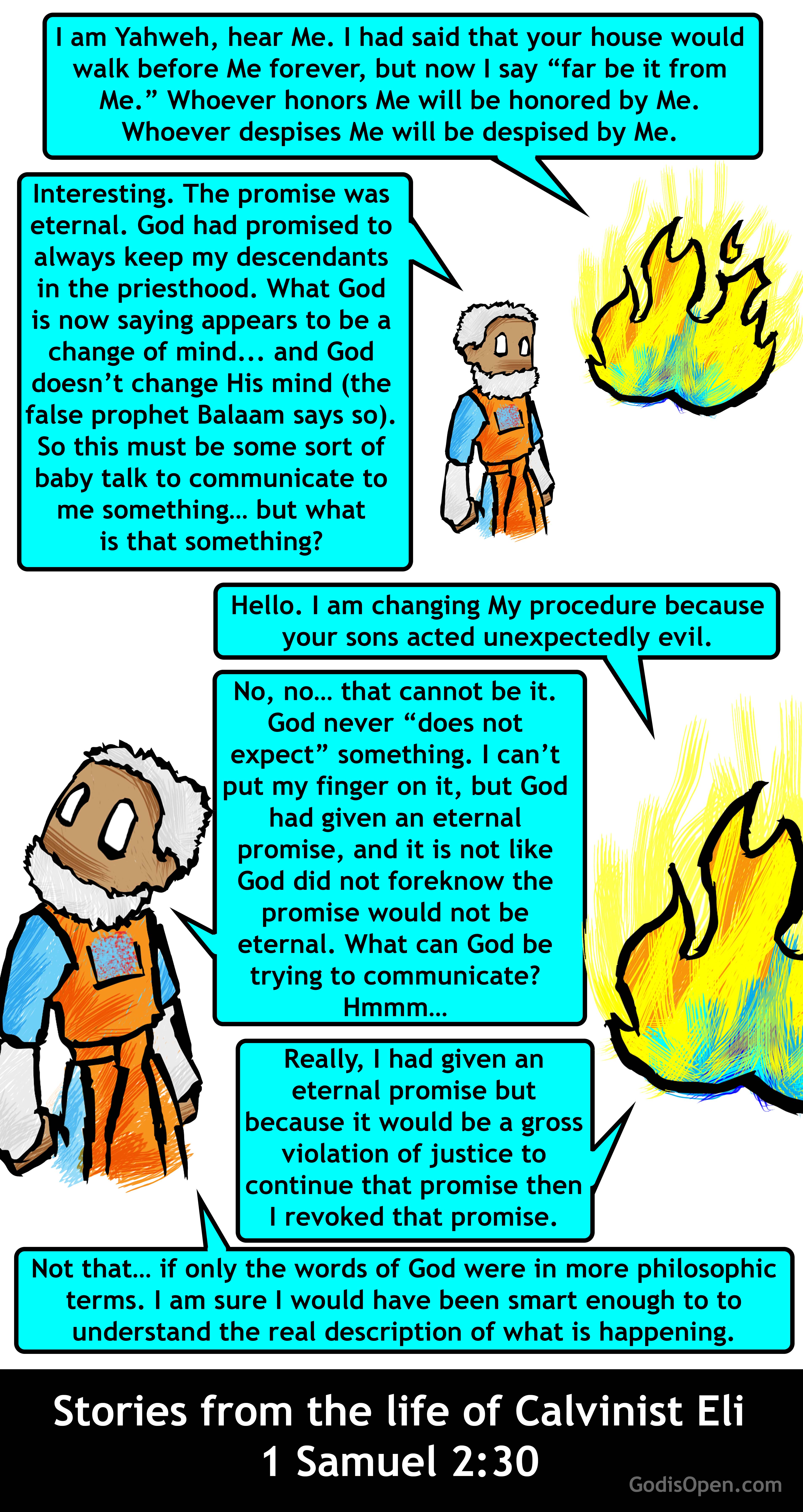
Worship Sunday – Turn Your Eyes Upon Jesus
Turn your eyes upon Jesus
look full in His wonderful face
and the things of earth will grow strangely dim
in the light of His glory and grace
Turn your eyes upon Jesus
look full in His wonderful face
and the things of earth will grow strangely dim
in the light of His glory and grace
Hasker on Philosophy
Answered Questions – Free Will and Foreknowledge
Jack asks:
Seriously though the problem I’m having is convincing a friend that the belief that God has exhaustive foreknowledge yet free will is still possible. I deal with Arminians not Calvinists.
So I’m looking for something that is a good argument against that. Is there a good blog or article I could refer an Arminian too? Something short enough that my friend might actually take the time to read it?
Several responses:
Will Duffy offers his debate on the subject: link
Christopher Fisher offers two quotes by atheists:
From Arguing Against Gods:
Another tricky issue is whether or not genuine omniscience is in any way compatible with free will – either ours or the alleged god’s. To start with our free will, it has been observed many times that if a god knows the future with infallible certainty, then what this god knows will necessarily happen – there is no possibility for anything else to occur. We are, then, incapable of altering the future. Although the concept of human “free will” is hotly contested, I’m not aware of any theory of free will which could be considered compatible with a being perfectly knowing the future. If a god knows who will win the next presidential election, then it isn’t possible for anyone else to win. That’s predestination – and some theologians have unflinchingly embraced it, for example John Calvin.
And
George H Smith from Atheism: the Case Against God:
The first problem with omniscience is that it cannot be reconciled with any theory of free will in man. If one believes in an omniscient being, one cannot consistently hold that man has volitional control over his actions. If God knows the future with infallible certainty, the future is predetermined, and man is impotent to change it.
Some theologians (such as Calvin) have enthusiastically embraced predestination, but most theologians, sensing the enormous problems entailed by this doctrine, have attempted to defend some theory of volition. Without volition, morality becomes meaningless: we cannot blame or praise a man for an action over which he has no control. Without volition, the Christian scheme of salvation is a farce; men are predestined for either heaven or hell, and they have no voice in the matter. Why does God create men only to save some arbitrarily, and damn others? Why does the Christian bother to proselytize, since men cannot help what they believe anyway? The problems that arise for theology if it affirms predestination are unsolvable, but they necessarily ensue when omniscience is attributed to God.
Apologetics Thursday – Answering Calvin’s Apologists
A Calvinist claims that John Calvin claimed to have opposed killing Servetus. He quotes a book:
Calvin responded to one of his accusers by saying “For what particular act of mine you accuse me of cruelty I am anxious to know. I myself know not that act, unless it be with reference to the death of your great master, Servetus. But that I myself earnestly entreated that he might not be put to death his judges themselves are witnesses, in the number of whom at that time two were his staunch favorites and defenders” (Calvin’s Calvinism Pg. 346)
But this seems to be a mistranslation. From A History of Protestantism:
To Calvin, above all men, we owe it that we are able to rise above the error that misled his age. And when we think, with profound regret, of this one stake planted by Protestant hands, surely we are bound to reflect, with a gratitude not less profound, on the thousands of stakes which the teaching of Calvin has prevented ever being set up. 23We are precluded from hearing Calvin in his own defense, because the death of Servetus was not brought as a charge against him during his lifetime. Still he refers twice to this affair in rebutting general accusations, and it is only fair to hear what he has to say. In his Declaration upon the Errors of Servetus, published a few months after his execution, Calvin says: “I made no entrearies that he might be punished with death, and to what I say, not only will all good people bear witness, but I defy even the wicked to say the contrary.” In 1558 he published his Defence of the Secret Providence of God. The book was translated into English by the Reverend Henry Cole, D.D., of Clare Hall, Cambridge. In that work, pp. 128, 129 (English translation), is the following passage, in which Calvin is appealing to his opponents: – “For what particular act of mine you accuse me of cruelty I am anxious to know. I myself know not, unless it be with reference to the death of your great master, Servetus. But that I myself ernestly entreated that he might not be put to death his judges themselves are witnesses, in the number of whom at that time two were his staunch favorers and defenders.” This would be decisive, did the original fully bear out the English rendering. Calvin’s words are- “Saevitiam meam in quo accuses, audire cupio: nisi forte in magistri tui Serveti morte, pro quo tamen me fuisse deprecatum testes sunt ipsi judices, ex quorum numero tunc duo erant strenui ejus patroni.” (Opp. Calvini, vol. 8, p. 646.) The construction of the words, we think, requires that the important clause should be read thus-I myself know not that act, unless it be with reference to your master, Servetus, for whom I myself earnestly interceded, as his judges themselves are witnesses, etc. If Calvin had said that he earnestly entreated that Servetus should not be put to death, we should have been compelled to believe he had changed his mind at the last moment. But we do not think his words imply this. As we read them they perfectly agree wit all the facts. Now that M. Rilliet de Candolle has published the whole process, the following propositions are undeniable:-1. That Calvin wished for a capital sentence: he had intimated this as early as 1546 in his letter to Farel. 2. That when the time came the Council of Geneva had taken both the ecclesiastical and civil power into their own hands. 3. That the part Calvin acted was simply his statutory duty. 4. Thathe had no power either to condemn or save Servetus. 5. That the only party in Christendom that wished an acquittal were the Libertines. 6. That their object was the overthrow of the Reformation in Geneva. 7. That the sentence of the Council was grounded mainly on the political and social consequences of Servetus’’ teaching. 8. That Calvin labored to substitute decapitation for burning.
Open Theist Comes to the Realization that God is Not to Blame
Jack writes on Facebook:
I too have broken much ground with people that are resistant to the Gospel over God’s character as presented from a closed thinking rational. People ask me why I’m so obsessed with Open Theism and that my friend is the answer. I came from a background that was not fun! Most of the people I interact with on a daily basis come from the same type of background. For people that have lived normal lives raised by typical and functional families the whole “God is in control” gospel is great. But for those of us that endured terrible childhoods and very hard adult lives as well, it’s not so great! In fact it sort of makes us really angry with Him.
Years ago I had an itinerant ministry called “Mad at the Devil Ministries.” LOL it was a crazy name but it was the best way to describe the message I preached. It was born of a resentment I had with God. One I developed due to very well meaning Christians who kept telling me that “God put you through all of that to help you minister to people who have been through the same.”
I believed them but it made me really mad. I would wonder to myself. If He put me through all that just so I can minister to other people who have been through hard times why is He putting them through all that? Wouldn’t it make much more sense not to put any of us through hard times so that it wouldn’t take someone like us to reach us???
Then overtime I realized that God didn’t put me through any of that. God wasn’t trying to give me a testimony the devil was trying to steal my testimony! Thus my ministry was born.
Fishbane on Mythmaking and the Bible
W Scott Taylor of ideoamnostoutheou posts a quote from Micheal Fishbane on the Facebook group The Open Theist Reformation: Biblical Open Theism:
Myth, Anthropomorphisms, Cosmic Plenum and Ancient Near Eastern ‘tendentious and presumptive dismissal of biblical language about God’. *
“A striking feature of contemporary attempts to differentiate ancient Israel from myth often depends upon definitions that first define myth in terms of polytheistic paganism, and thus juxtapose this definition to features of biblical monotheism—concluding thereby that ‘myth’ is absent from the latter. For example, on the argument that an essential variable of ancient Near Eastern paganism is the origin of the gods in a cosmic ‘plenum’, from which substance: they emerge as differentiated personalities, but upon whose elemental character they are necessarily and inherently dependent, the figure of a singular God with a transcendent will, who is (apparently) distinct from the natural world to which He gave created form, is of a fundamentally different sort. Hereby, myth is linked with the natural gods of polytheism and totally dissociated from supernatural monotheism. Accordingly, it is presumed that any hint of myth as recognizable from the ancient Near East (in terms of divine action, imagery, or personality) can only be harmless vestiges of a figurative (or metaphorical) sort and thus neither true nor living myth.But this is a self-serving and fallacious line of argument. Whether or not these characterizations of polytheistic paganism or monotheism are in any way accurate, the exclusive identification of a literary phenomenon (myth) with a specific religious cultural form (natural polytheism) is both tendentious and tautological: the first, because the defintion is arbitrary and selective; and the second, because the identification is always self-confirming, and without any means of checking its circular or redundant character. Such argumentation is also based on certain essentialist views regarding polytheism and monotheism, though it generally avoids this stigma through the pretense of comparative historical study, and conceals an old cultural animus against brute ‘myth’ (the heir of Hellas) under the cover of an analytical phenomenology of religion. [22] Nevertheless, such intellectual practices reveal just how much the category of myth still serves as a container for all the cultural forms of ideologies that one has purportedly transcended (like irrationality, polytheism, and paganism) — for the sake of others assumed to be superior in kind (like reason, monotheism, or historical inquiry) and with which one identifies.[23] The result is a lamentable impoverishment of the notion and nature of myth, and its formulations within biblical monotheism; but it is also a schematization of monotheism that equally impoverishes its inherent and complex features. Indeed, the upshot of much recent writing is to claim differences between monotheism and polytheism that are arguably more polemical than propeadeutic, and that need to be thoroughly reconsidered.[24]
Equally tendentious is the presumptive dismissal of certain apparently mythic features of biblical language (its unabashed and pervasive deptions of God in anthropomorphic and anthropopathic terms) that blatantly occur in the monotheistic canon of Scripture—as if these were merely due to ‘the inadequacy of human language’ and ‘limitation of human thought’, or to some sort of necessarily ‘indirect grasp’ of ‘spiritual concepts’ by ‘images…that emphasize the sensual’.[25] But on what grounds are such assertions made? Surely there is nothing in Scripture itself that would point in this direction, or suggest that the representations of divine form and feeling in human terms are anything other than the preferred and characteristic mode of depiction. [26] Moreover, on what basis should one assume that the plain sense of Scripture is some (quasi-allegorical) approximation of a more spiritual or purely metaphorical content? And would would that content be, we may well ask, and is it even possible to get past the thick immediacy of biblical language and its concrete and sensible accounts of God? [27] One can only conclude that the evasion of the direct sense of Scripture that such attitudes represent are attempts to save Scripture from itself—for oneself, and must be considered a species of modern apologetics.[28]
[26.] Cf. the judicious concern of Jame Barr, ‘Theophany and Anthropomorphism in the Old Testament’, Congress Volume, Oxfort (SVT 7; Leiden: E. J. Brill, 1960), 33, who urges the interprete to shift from the question ‘Is God conceived of as essentially in human form”‘ to ‘When he does appear in a forma at all, is it thought that the human form isthe natural or characteristic one form him to assume?’ ”
* NOTE: the previous paragraphs (not the title) were taken from the Introduction :
“Biblical Myth and Rabbinic Mythmaking”, by Micheal Fishbane (see free preview via Google search on the title.
Meme Monday – Balaam
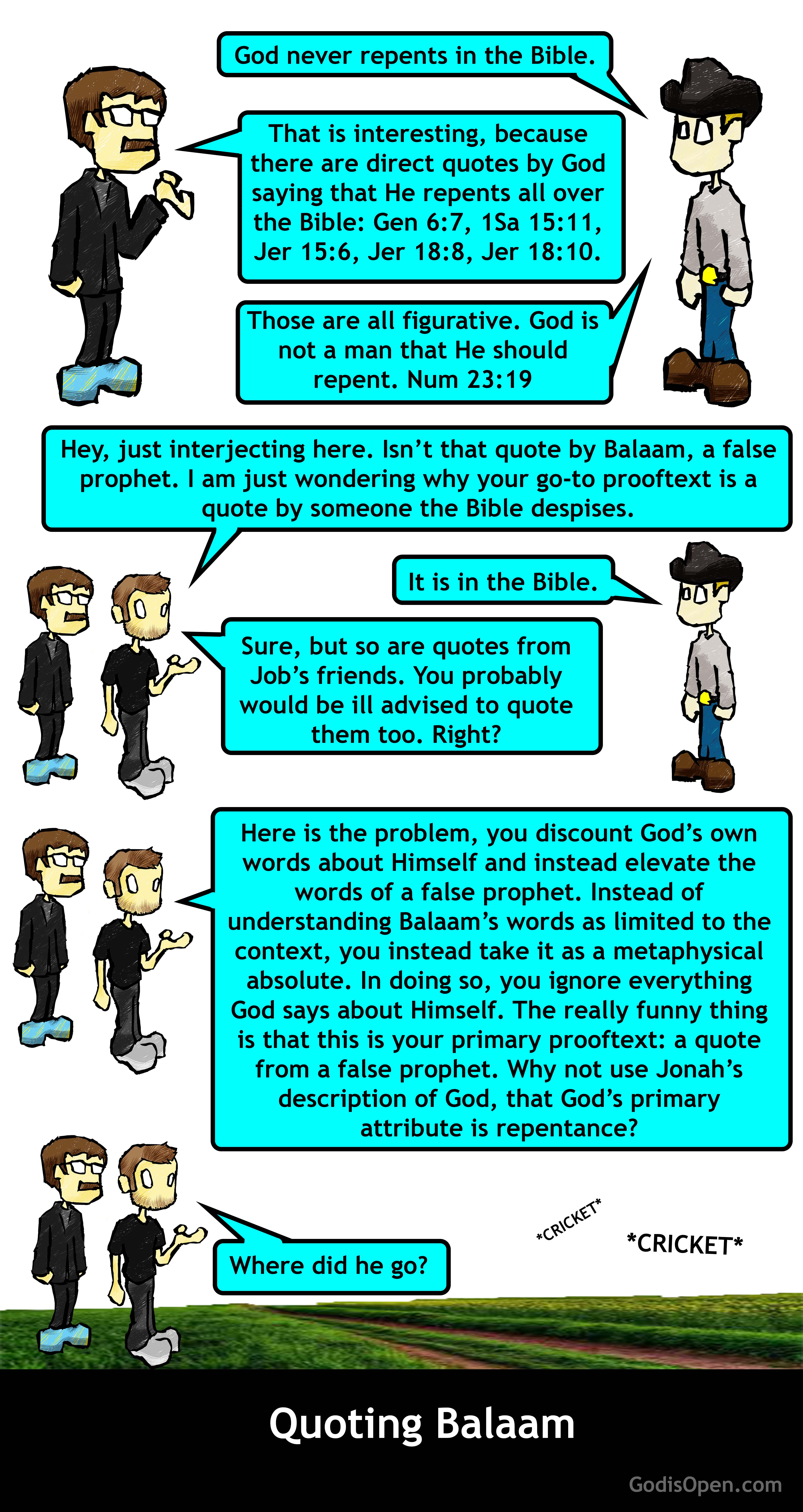
Worship Sunday – From the Inside Out
A thousand times I’ve failed
Still your mercy remains
Should I stumble again
Still I’m caught in your grace
Everlasting, your light will shine when all else fades
Never ending, your glory goes beyond all fame
Your will above all else
My purpose remains
The art of losing myself in bringing you praise
Everlasting, your light will shine when all else fades
Never ending, your glory goes beyond all fame
My heart and my soul
I give you control
Consume me from the inside out Lord
Let justice and praise
Become my embrace
To love you from the inside out
Everlasting, your light will shine when all else fades
Never ending, your glory goes beyond all fame
And the cry of my heart is to bring you praise
From the inside out
Lord my soul cries out
Calvin’s Full Quote of God’s Baby Talk
From Institutes of the Christian Religion (1.13.1):
1. The doctrine of Scripture concerning the immensity and the spirituality of the essence of God, should have the effect not only of dissipating the wild dreams of the vulgar, but also of refuting the subtleties of a profane philosophy. One of the ancients thought he spake shrewdly when he said that everything we see and everything we do not see is God (Senec. Praef. lib. 1 Quaest. Nat.) In this way he fancied that the Divinity was transfused into every separate portion of the world. But although God, in order to keep us within the bounds of soberness, treats sparingly of his essence, still, by the two attributes which I have mentioned, he at once suppresses all gross imaginations, and checks the audacity of the human mind. His immensity surely ought to deter us from measuring him by our sense, while his spiritual nature forbids us to indulge in carnal or earthly speculation concerning him. With the same view he frequently represents heaven as his dwelling-place. It is true, indeed, that as he is incomprehensible, he fills the earth also, but knowing that our minds are heavy and grovel on the earth, he raises us above the worlds that he may shake off our sluggishness and inactivity. And here we have a refutation of the error of the Manichees, who, by adopting two first principles, made the devil almost the equal of God. This, assuredly, was both to destroy his unity and restrict his immensity. Their attempt to pervert certain passages of Scripture proved their shameful ignorance, as the very nature of the error did their monstrous infatuation. The Anthropomorphites also, who dreamed of a corporeal God, because mouth, ears, eyes, hands, and feet, are often ascribed to him in Scripture, are easily refuted. For who is so devoid of intellect as not to understand that God, in so speaking, lisps with us as nurses are wont to do with little children? Such modes of expression, therefore, do not so much express what kind of a being God is, as accommodate the knowledge of him to our feebleness. In doing so, he must, of course, stoop far below his proper height.
Questions Answered – Do Calvinists Believe in Myths?
By Christopher Fisher
An Open Theist comments on a rough draft of my new book:
Though I think I understand your definition of “anthropomorphism” as fable or myth, I do not believe I have ever met a Calvinist who believed he was arguing that texts about God’s changing His mind (etc.) were fables about some non-existent, mythical, fictional character called “God.” They were always using the definition according to what I see the dictionary defintion to be, that of ascribing human characteristics to something (some real object or animal) that does not actually have those characteristics. When I say the “head” or “foot” of the bed, I do not believe, or even want to imply, that the bed does not exist. I am simply trying to communicate something about the bed that is easier to say than “the place where your head would be,” or “the place your foot would be if you were to lie down on the bed” (in the normal fashion, of course).
Now, maybe these Calvinists and I are using “metaphor,” or “personification,” and mistakenly calling it an anthropomorphism, but I never thought it would be appropriate to accuse them of saying God was a myth, or a fable. And, as far as I know, they were not trying to say that.
It seems to me that for way too long Arminians have been too generous with Calvinistic theology, theology which strips God of all emotion. These Calvinists blanketly qualify everything about God as anthropomorphism. But an anthropomorphism is a fictional framing device, not a metaphor or personification (in which one thing stands for another).
When Yahweh walks in the Garden of Eden, some Calvinists would claim this is an event that never happened. When God proclaims (to no one in particular that He regrets making man), when Abraham reasons with God, when Moses coerces God, when God repents to Samuel, when Jonah argues to God, when Ezekiel asks for one small change in God’s command (Eze 4)… they would frame these dialogues as never having happened. The dialogues only work under the assumption that the future is not set and that mankind can influence God. Did the individuals in the stories (who were talking to God) believe they could not change God’s mind? Did God actually engage in multiple two sided conversations under this impression? Because if the human side was genuine, then God’s side must be as well.
Taking this element (God’s mutability) from these stories robs the story of the core message and does not communicate anything. It literally turns God’s portion of these events into fable. From a narrative in which God sees that mankind has become wicked, then exclaims His regret in making man, then th e narrator saying that He regrets making man, then God destroying the whole earth in an act commensurate with repentance… the audience is left with God not changing but destroying the Earth (no motivations, emotions, are left). How is this different from the flood myths around the world which explain why the flood happened? How is this materially different from the myth of Persephone in the Greek religion, a myth that explains why the seasons change? How is this different from the South American myth explaining how the rabbit lost its tail? In each of these myths, reality is explained with fictional stories. They are all myths. And when the Calvinist strips out God’s reasoning, dialogue, and actions, they are making stories about God into myth.
A detailed response to Closing the Door on Open Theism – Part 2
II. Open Theism’s Assault on God’s Attributes
In this section, McGeown starts speaking of omniscience. McGeown wants to focus on a word the Bible never uses and is usually defined by Greek philosophy (“omniscience”). In McGeown’s defense, many Open Theists use this word. But again, it is not Biblical argumentation in either case. And anyone concerned with Biblical theology should define attributes of God by standards found in the Bible. McGeown doesn’t seem to mind using extra-Biblical sources to define omniscience. He quotes Norman Geisler objecting that Open Theists define the word (again, a word that is not found in the Bible) to include all things knowable.
But, the Bible neither goes on a theological diatribe about God knowing every event that will ever occur or knowing all things knowable. Both statements are speculative. Instead, God is said to see all things in the context of knowing everyone’s hidden sins. When evil people throughout the Bible claim that God will not see their evil, God’s response is that He does see their evil and He will respond. God sees and searches to know (which, on its own, invalidates the traditional understanding of omniscience). There is no appeal to metaphysics. There is no appeal to God’s ‘omniscience’. The Bible is unconcerned with the extent of God’s knowledge over minutia.
After explaining that [most] Open Theists hold to a view of omniscience in which God knows all things knowable, McGeown objects to this understanding with a claim that if the future is Open then Satan might win:
The problem of this position, as John Frame rightly explains, is this: “If God has really left the future completely open, he has left open the possibility of Satan’s victory.”
This statement is riddled with fallacies. Number one is the moralitstic fallacy. What we would prefer to be real has zero effect on what is actually real. We can claim all we want that millions of people have not died in infancy. This might sound nice, but our nice thoughts have no effect on reality. Reality is not optional. It “could” be the case that Satan might ultimately win (why else would he rebel if he had no hope of some sort of victory). What if God just decides to withdraw and give Satan the victory? If God “cannot” do that, then Open Theists redefining omniscience is the least of McGeown’s problems. He would have just said that God is not omnipotent; God cannot do something man can easily do. Maybe McGeown would like to spend some time building the Biblical case that Satan will not and cannot win (two different things). McGeown has not shown that this is not a possibility but is relying on emotions to fuel his arguments (a second fallacy).
Fallacy number three is that McGeown and Piper cannot conceive of an open future in which Satan has no possibility of winning (this is a non-sequitur). I am free to jump at any height I wish. I might choose to jump 1 foot or 2 feet into the air. There are open possibilities. But the limitations of physics do not allow me to leap over buildings. I have near infinite possibilities for my jump, but they are still constrained by the limits of my strength and by gravity. Openness does not mean that reality is tossed to the wind. By McGeown’s logic, he might as well make the absurd claim that “If God has really left the future completely open, he has left open the possibility of my cat, Boots, becoming the supreme ruler of the universe.” The statement is a non-sequitur.
The fact that McGeown proffers this first argument is curious. Does he believe he is making a legitimate point? Did he not think through, not only the logic, but the common Open Theist responses to this sort of argument? This point is evidence that McGeown has not properly understood his opponents and has not thought through his own arguments.
McGeown then addresses the fact that Open Theists claim that God’s predictions sometime fail. He uses the case of King Saul as an example. McGeown then forgets to explain how that example is not a case of God’s failed predictions. McGeown just assumes the idea does not merit response. The first Biblical point in McGeown’s article is ignored by the author! Again, McGeown is presenting a thoroughly Platonistic argument and not a Biblical argument.
Predictably, McGeown then begins to defend omniscience with quotes. McGeown quotes, not the Bible, but a bunch of theologians. He quotes Bavinck, Dabney (using a moralistic fallacy), Reymond, Shedd, and Geisler. It is after this that McGeown first quotes a Bible verse. McGeown turns to Isaiah 41. The context and the meaning of those verses are obvious to those not involved in prooftexting; God can predict things because God is powerful and the idols are not. McGeown wishes to assume Yahweh is challenging the idols to a trivia game, as if God is trying to impress Israel with His knowledge. But it is competence, not knowledge, that is the source of Yahweh’s information. Yahweh is impressing Israel with His ability to bring His prophecy to pass.
McGeown waxes skeptical. He does not understand how if the future is free can God bring about things with certainty. Perhaps McGeown should take stock of his own life and how well he is at predicting the behavior and actions of others. Does McGeown ever assume that when he sets out to go to the store that the store owner will refuse to exchange his money for goods? I would wager that McGeown has never thought twice about his unspoken and accurate predictions of the actions of free people. McGeown would have the reader believe that God is less competent than every human alive, who makes countless accurate predictions on a daily basis.
McGeown would also like to think that counterexamples in the Bible do not abound. Twice, God is said to regret His own actions. Both times it is a quote from God, Himself. Quite a few examples can be given of God’s word not materializing, but in these cases McGeown would either like to claim God’s word was “conditional” (talk about having one’s cake and eating it too) or that in some weird and incomprehensible way the words came true. God tells Nineveh “40 days are you will be overthrown” and this time specific prophecy of Jonah did not come to pass. Jonah tells the reader exactly why: because one of God’s main attributes is repentance. God responses when conditions change. This is all in the context of a dialogue between Jonah and God, and in the larger context of a detailed story. To dismiss God’s thoughts, actions, and words is to dismiss the story as fable.
A Detailed Response to Closing the Door on Open Theism – Part 1 [link]
A Detailed Response to Closing the Door on Open Theism – Part 2 [link]
A Detailed Response to Closing the Door on Open Theism – Part 3 [link]
A Detailed Response to Closing the Door on Open Theism – Part 4 [link]
A Detailed Response to Closing the Door on Open Theism – Part 5 [link]
Adam Clarke on the Omniscience of God
Adam Clarke on the Omniscience of God:
Therefore it does not follow that, because God can do all things, therefore he must do all things. God is omniscient, and can know all things; but does it follow from this that he must know all things? Is he not as free in the volitions of his wisdom, as he is in the volitions of his power? The contingent as absolute, or the absolute as contingent? God has ordained some things as absolutely certain; these he knows as absolutely certain. He has ordained other things as contingent; these he knows as contingent. It would be absurd to say that he foreknows a thing as only contingent which he has made absolutely certain. And it would be as absurd to say that he foreknows a thing to be absolutely certain which in his own eternal counsel he has made contingent.
By absolutely certain, I mean a thing which must be, in that order, time, place, and form in which Divine wisdom has ordained it to be; and that it can be no otherwise than this infinite counsel has ordained. By contingent, I mean such things as the infinite wisdom of God has thought proper to poise on the possibility of being or not being, leaving it to the will of intelligent beings to turn the scale. Or, contingencies are such possibilities, amid the succession of events, as the infinite wisdom of God has left to the will of intelligent beings to determine whether any such event shall take place or not. To deny this would involve the most palpable contradictions, and the most monstrous absurdities.
If there be no such things as contingencies in the world, then every thing is fixed and determined by an unalterable decree and purpose of God; and not only all free agency is destroyed, but all agency of every kind, except that of the Creator himself; for on this ground God is the only operator, either in time or eternity: all created beings are only instruments, and do nothing but as impelled and acted upon by this almighty and sole Agent.
Consequently, every act is his own; for if he have purposed them all as absolutely certain, having nothing contingent in them, then he has ordained them to be so; and if no contingency, then no free agency, and God alone is the sole actor. Hence the blasphemous, though, from the premises, fair conclusion, that God is the author of all the evil and sin that are in the world; and hence follows that absurdity, that, as God can do nothing that is wrong, Whatever Is, is Right. Sin is no more sin; a vicious human action is no crime, if God have decreed it, and by his foreknowledge and will impelled the creature to act it. On this ground there can be no punishment for delinquencies; for if every thing be done as God has predetermined, and his determinations must necessarily be all right, then neither the instrument nor the agent has done wrong.Thus all vice and virtue, praise and blame, merit and demerit, guilt and innocence, are at once confounded, and all distinctions of this kind confounded with them. Now, allowing the doctrine of the contingency of human actions, (and it must be allowed in order to shun the above absurdities and blasphemies), then we see every intelligent creature accountable for its own works, and for the use it makes of the power with which God has endued it; and, to grant all this consistently, we must also grant that God foresees nothing as absolutely and inevitably certain which he has made contingent; and, because he has designed it to be contingent, therefore he cannot know it as absolutely and inevitably certain.
I conclude that God, although omniscient, is not obliged, in consequence of this, to know all that he can know; no more than he is obliged, because he is omnipotent, to do all that he can do.”
Oord on the Paris Attacks
From Did God Allow the Paris Attacks:
The uncomfortable truth is that most theologians and Christians today and throughout history have said God permits genuine evil. God allows pointless suffering. And they appeal to mystery when asked questions like, “Did God allow the Paris attacks?” They say, “Don’t ask me, I’m not God!”
By contrast, I think theologians and Christians in general need to rethink God’s power. This means rethinking what it means to say God can control creatures and creation, whether these existing things have freedom or not.
In my new book, I’ve carefully laid out an argument that says God’s uncontrolling love prevents God from being able to stop genuine evil unilaterally. God is still almighty, I argue. God is omnipresent and loving too. God knows everything that can be known. But the uncontrolling God I describe should not be blamed for tragedies like those in Paris, because God cannot stop them acting alone.
Meme Monday – James
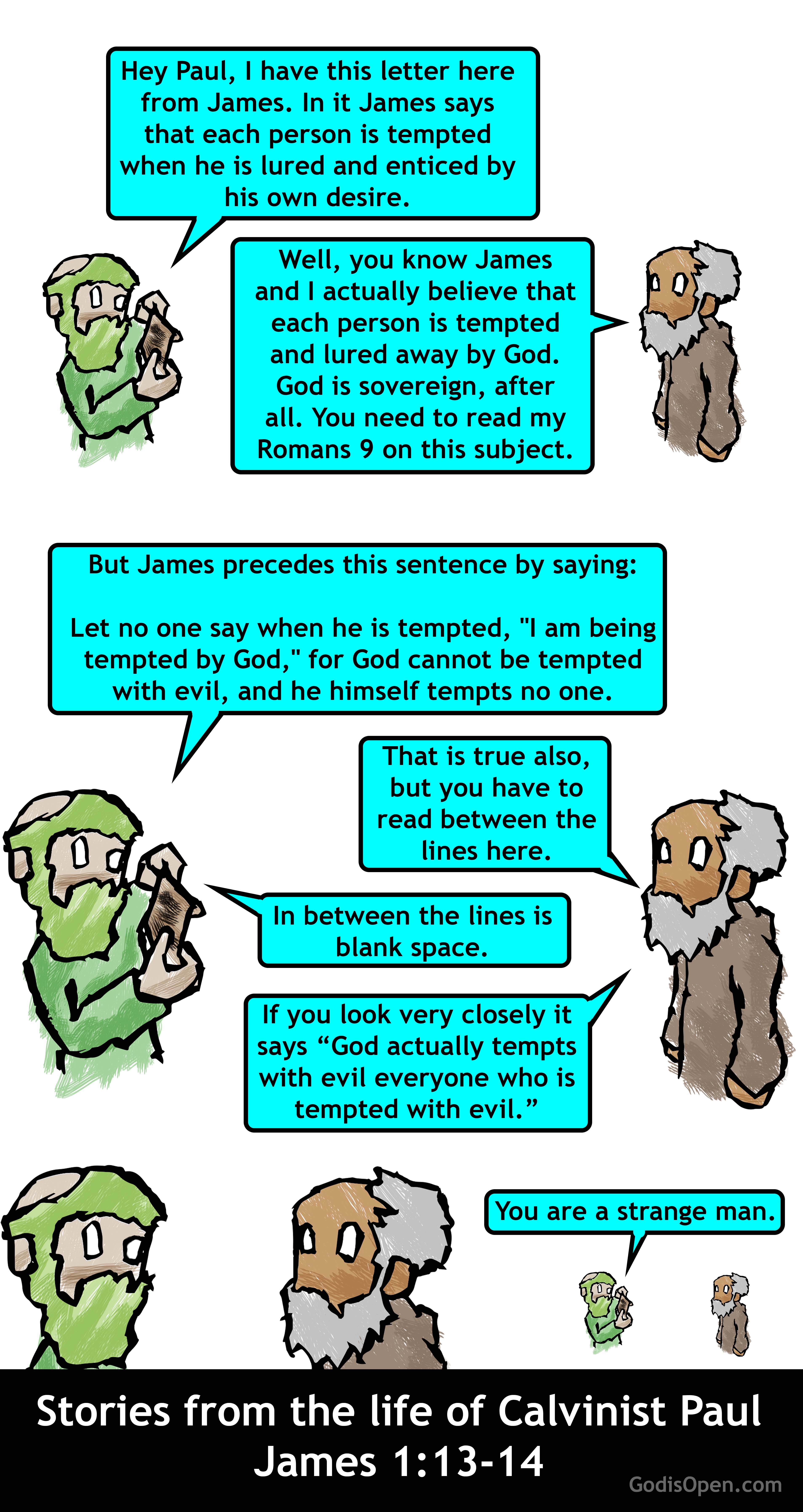
Worship Sunday – Invitacion Fountain
All who are weak
All who are weary
Come to the Rock
Come to the Fountain
All who have sailed
On the rivers of heartache
Come to the sea
Come on be set free
If you lead me Lord I will follow
Where you lead me Lord I will go
Come and heal me Lord, I will follow
Where you lead me Lord I will go
I will go
All who are weak
All who are weary
Come to the Rock
Come to the Fountain
All who have climbed
On the mountains of heartache
Reach to the stars
Come on give your life
If you lead me Lord I will follow
Where you lead me Lord I will go
Come and heal me Lord, I will follow
Where you lead me Lord I will go
And If you lead me Lord I will follow
Where you lead me Lord I will go
Come and heal me Lord, I will follow
Where you lead me Lord I will go
Yes, I will go, yeah, I will go with You
Yes, I will go
Yes, I will go
Heal me
Heal me
Heal me
Heal me
And If you lead me Lord I will follow
Where you lead me Lord I will go
Come and heal me Lord, I will follow
Where you lead me Lord I will go
I will go
And if you lead me Lord I will follow
And where you lead me Lord I will go
So come and heal me Lord, I will follow
Where you lead me Lord I will go
If you lead me Lord I will follow
Where you lead me Lord I will go
Come and heal me Lord, I will follow
Where you lead me Lord I will go
I will go, I will go
If you lead me Lord I will follow
Where you lead me Lord I will go
Come and heal me Lord, I will follow
Where you lead me Lord I will go
I will go, I will go
Yes I will go
I will go
I will go
I will go
Jack Explains when to Accept Mystery and when to Question Mystery
From the GodisOpen Facebook page:
There are many things about God that are beyond our comprehension.
The fact that He is a triune God for one. I love how C. S. Lewis put it best. He said that trying to explain a trinity to us would be like going into a 2 dimensional world and trying to explain a 3 dimensional object. Like a cube, they cannot comprehend a cube but they can comprehend squares so we would try to explain how something can be six squares but only one cube.They would have some comprehension but could never fully grasp the meaning of a cube.
Or the fact that He has no beginning and no end. Everything that we have ever known has a beginning and can not last forever. So for us to even try to comprehend this idea of a being with no beginning and that will last forever is futile.
His love when you think about it is incomprehensible to some degree, that He would love a world so much that for the most part hates Him so.
I could go on and on describing things about God that are incomprehensible to us. But none of the things I described are completely irrational and absurd. They are all plausible, none of them prove themselves untrue within themselves.
God made us in His own image, and in His own likeness. In His image in that He created us in the form His Son would later take, in His likeness in that we were created as persons from a personal God. Some say that as mere humans we can never understand His personhood. That is not biblical because our personhood was created in that image. We CAN use ourselves as a reference when seeking to understand God. If we were created in His likeness IE we were created to be “like Him.” Then He is also very much like us! One thing can not be like another thing while at the same time that other thing is nothing like the one thing. That my friends is an absurdity!
When a theologian describes something that is incomprehensible to you ponder it. Seek out it’s meaning and search the scriptures to validate it’s truth. But when a theologian describes something about God that feels absolutely absurd to you question it! Object to it and demand explanations of absurd theories. It feels absurd to you for a reason. Reason is the reason LOL God created you to be reasonable because He is reasonable.
Many things about God are beyond all comprehension. Nothing about God is absurd.
Answered Questions – Verses Where God Does Not Know What Will Happen
Jack asks:
I’m in the middle of a discussion on one of my posts to my personal page about God’s exhaustive foreknowledge. I’m looking for more verses where God says that He did not know something was going to happen. I’ve already brought up Jeremiah 19:5 and I’m still waiting for my friends reply to that I also plan on bringing up Deuteronomy 8:2.
Does anyone have any suggestions of other verses?
The verse in reference:
Deu 8:2 And you shall remember that the LORD your God led you all the way these forty years in the wilderness, to humble you and test you, to know what was in your heart, whether you would keep His commandments or not.
Throughout the Bible, God tests to know:
Gen 22:1 Now it came to pass after these things that God tested Abraham…
Gen 22:12 And He said, “Do not lay your hand on the lad, or do anything to him; for now I know that you fear God, since you have not withheld your son, your only son, from Me.”Exo 16:4 Then the LORD said to Moses, “Behold, I will rain bread from heaven for you. And the people shall go out and gather a certain quota every day, that I may test them, whether they will walk in My law or not.
Exo 33:5 For the LORD had said to Moses, “Say to the children of Israel, ‘You are a stiff-necked people. I could come up into your midst in one moment and consume you. Now therefore, take off your ornaments, that I may know what to do to you.’ ”
Deu 13:3 you shall not listen to the words of that prophet or that dreamer of dreams, for the LORD your God is testing you to know whether you love the LORD your God with all your heart and with all your soul.
Jdg 2:20 Then the anger of the LORD was hot against Israel; and He said, “Because this nation has transgressed My covenant which I commanded their fathers, and has not heeded My voice,
Jdg 2:21 I also will no longer drive out before them any of the nations which Joshua left when he died,
Jdg 2:22 so that through them I may test Israel, whether they will keep the ways of the LORD, to walk in them as their fathers kept them, or not.”1Ch 28:9 “As for you, my son Solomon, know the God of your father, and serve Him with a loyal heart and with a willing mind; for the LORD searches all hearts and understands all the intent of the thoughts. If you seek Him, He will be found by you; but if you forsake Him, He will cast you off forever.
1Ch 29:17 I know also, my God, that You test the heart and have pleasure in uprightness. As for me, in the uprightness of my heart I have willingly offered all these things; and now with joy I have seen Your people, who are present here to offer willingly to You.
2Ch 32:31 However, regarding the ambassadors of the princes of Babylon, whom they sent to him to inquire about the wonder that was done in the land, God withdrew from him, in order to test him, that He might know all that was in his heart.
Psa 11:4 The LORD is in His holy temple, The LORD’s throne is in heaven; His eyes behold, His eyelids test the sons of men.
Psa 26:2 Examine me, O LORD, and prove me; Try my mind and my heart.
Psa 139:23 Search me, O God, and know my heart; Try me, and know my anxieties;
Psa 139:24 And see if there is any wicked way in me, And lead me in the way everlasting.
This concept is found throughout the Bible in varied wording. God tests to know.
As to Jack’s original question, the verses are too numerous to count. Every time God becomes furious at the actions of mankind, this reveals that the future is not set. Every time God urges people to choose Him, this reveals that the future is unknown. Every time God repents or changes His plans or revokes His promises, this reveals that the future in unknown. In contrast to the Classical Theists, who rely on a small handful of texts ripped out of context and given undue prominence (and meaning), Open Theists just have to point to the story of the Bible.
A detailed response to Closing the Door on Open Theism – Part 1
A response to Closing the Door on Open Theism
Martyn McGeown wrote a high profile article against Open Theism. The goal of this series is to examine his claims and give a response. McGeown breaks his article into five parts. He begins with an introduction:
I. Introduction
Christians have traditionally understood God in terms of three classic perfections, each with the prefix “omni” or “all”: omnipresent (everywhere present), omnipotent (all powerful) and omniscient (all knowing). These three attributes were until recently accepted by all orthodox theists. Today, theologians can take nothing for granted. God’s most fundamental perfections are under attack. One such assault on God’s perfections calls itself “open theism,” a movement within evangelicalism which denies that God knows the future choices of His creatures. God, according to open theism, has exhaustive knowledge of the past and of the present, but He does not know with certainty what will happen in the future. The future is “open” because history is not, as has traditionally been understood, the outworking in time of what God has decreed in eternity, but a historical “project” in which God and men decide together what the future will be. God has determined the general parameters of history, but He has left much of the future open to allow men to exercise their free will. Because men often choose in ways which disappoint, frustrate, sadden, thwart or even surprise God, He is forced to deviate from what He previously planned to do; but God is flexible and resourceful, and despite many setbacks, we are told, He will accomplish His final goal. Open theism is a radical denial of God’s sovereignty in favour of man’s so-called “libertarian free will.”
…
We shall see that open theism is a fundamental denial of the omniscience, the sovereignty and the immutability of God, and therefore a denial of the God of Scripture, and the worship of a strange god who has been created in man’s image. As such it must be condemned as idolatry.
Critical scholarship has long pointed out that this preoccupation with the omni’s (omniscience, omnipotence, omnipresence) and im’s (immutability, impassibility) is not a feature of early Jewish and Christian theology. Instead it is a reliance on 2nd and 3rd century Neo-Platonic thought. Augustine candidly admits that he believed the Bible was absurd until he read it in light of Platonism. Augustine had to be convinced to abandon the Bible in order to become a Christian. It is telling that much of McGeown’s thought processes owe allegiance to Augustine’s theology. But the Bible stands in stark contrast to these Greek categories.
Here are three scholars (an atheist, a Jew, and a Christian) saying as much:
Christine Hayes (Yale Professor):
Those who confuse the biblical character Yahweh with the “God” constructed by classical western theology may be troubled by the fact that Yahweh is presented in his interactions with humans in the Pentateuch as neither omniscient nor omnipotent. Unacquainted with the god constructed by western theology many centuries later, the biblical narrator( s) felt no such confusion, asserting the great power of Yahweh on the one hand and the absolute freedom of humankind on the other.
Rabbi Sacks (former Chief Rabbi of the United Hebrew Congregations of the Commonwealth):
The fifth and most profound difference lies in the way the two traditions understood the key phrase in which God identifies himself to Moses at the burning bush. ‘Who are you?’ asks Moses. God replies, cryptically, Ehyeh asher ehyeh. This was translated into Greek as ego eimi ho on, and into Latin as ego sum qui sum, meaning ‘I am who I am’, or ‘I am he who is’. The early and medieval Christian theologians all understood the phrase to be speaking about ontology, the metaphysical nature of God’s existence. It meant that he was ‘Being-itself, timeless, immutable, incorporeal, understood as the subsisting act of all existing’. Augustine defines God as that which does not change and cannot change. Aquinas, continuing the same tradition, reads the Exodus formula as saying that God is ‘true being, that is being that is
But this is the God of Aristotle and the philosophers, not the God of Abraham and the prophets. Ehyeh asher ehyeh means none of these things. It means ‘I will be what, where, or how I will be’. The essential element of the phrase is the dimension omitted by all the early Christian translations, namely the future tense. God is defining himself as the Lord of history who is about to intervene in an unprecedented way to liberate a group of slaves from the mightiest empire of the ancient world and lead them on a journey towards liberty.
Walter Brueggemann (premier Old Testament scholar):
What is most crucial about this relatedness is that Israel’s stock testimony is unconcerned to use a vocabulary that speaks about Yahweh’s own person per se. Israel has little vocabulary for that and little interest in exploring it. Such modest terminology as Israel has for Yahweh’s self might revolve around “Yahweh is holy,” but this sort of language is not normally used, and most often it occurs only in specialized priestly manuals. More important, Israel’s characteristic adjectival vocabulary about Yahweh is completely lacking in terms that have dominated classical theology, such as omnipotent, omniscient, omnipresent. This sharp contrast suggests that classical theology, insofar as it is dominated by such interpretive categories and such concerns, is engaged in issues that are not crucial for Israel’s testimony about Yahweh and are in fact quite remote from Israel’s primary utterance.
When Martyn McGeown starts his criticism, it is telling that he begins his criticism entrenched in Neo-Platonistic thoughts (notice his adherence to “perfections”, a highly Platonic concept). Where do the Bible authors make similar defenses of Yahweh? We have ample evidence throughout the Bible that plenty of individuals in Israel denied God’s omniscience (they denied God’s present knowledge of situations). Where do the prophets offer a metaphysical defense of God in which God knows all that will ever happen? Wouldn’t that be a primary counter-argument if this was the case? Instead the Bible records an impassioned plea from the authors to convince the people that their hidden sins are known to God. God sees, and thus God knows.
Furthermore, McGeown seems very interested in what Roger Olson points out is an idiosyncratic definition of sovereignty. McGeown has hijacked the word and twisted it beyond any normal use of the word:
There is no “sovereignty” in human experience like the “sovereignty” Calvinists insist we must attribute to God in order “really” to believe in “God’s sovereignty.” In ordinary human language “sovereignty” NEVER means total control of every thought and every intention of every subject. And yet it has become a Calvinist mantra that non-Calvinists “do not believe in God’s sovereignty.” I have a tape of a talk where R. C. Sproul says that Arminians “say they believe in God’s sovereignty” but he goes on to say “there’s precious little sovereignty left” (after Arminians qualify it). And yet he doesn’t admit there (or anywhere I’m aware of) that his own view of God’s sovereignty (which I call divine determinism) is not at all like sovereignty as we ordinarily mean it. That’s like saying of an absolute monarch who doesn’t control every subject’s every thought and intention and every molecule in the universe that he doesn’t really exercise sovereignty. It’s an idiosyncratic notion of “sovereignty.”
McGeown is showing his cards. He is not interested in using precise language to communicate intelligibly with others. Instead, he is interested in a strange theology which has to gain emotional appeal through appropriation of words that have a very opposite meaning. Perhaps the term “micro-management” would have been a better choice of words (or “fatalism”). But there is no appealing word to describe God exerting minute control of all things, because the idea is repulsive. On the same note, the idea is not found in the Bible.
Lastly, the idea that God is immutable is also not found in the Bible, not by any stretch of the imagination. Yahweh is constantly active and calling out for people to respond. Yahweh’s very sharp emotions are detailed in countless texts. God changes His mind, God tests people to see what they will do, God even revokes eternal promises due to unforeseen actions. God literally satisfies His wrath through righteous punishment. The Bible is filled, cover to cover, with God’s changes in emotions, processes, and plans. The claim that the God of the Bible is immutable is not a serious claim.
Rabbi Sacks puts it best:
Far from being timeless and immutable, God in the Hebrew Bible is active, engaged, in constant dialogue with his people, calling, urging, warning, challenging and forgiving. When Malachi says in the name of God, ‘I the Lord do not change’ (Malachi 3: 6), he is not speaking about his essence as pure being, the unmoved mover, but about his moral commitments.
A Detailed Response to Closing the Door on Open Theism – Part 1 [link]
A Detailed Response to Closing the Door on Open Theism – Part 2 [link]
A Detailed Response to Closing the Door on Open Theism – Part 3 [link]
A Detailed Response to Closing the Door on Open Theism – Part 4 [link]
A Detailed Response to Closing the Door on Open Theism – Part 5 [link]
Calvinist Defends Impassibility
Not a Rock – Critics often contend that the doctrine of impassibility depicts God as an emotionless rock. But to teach that God is impassible is not to deny that God has an emotional life with cares, joys, loves, and so forth. Impassibility does not mean impassivity any more than immutability means immobility. Both are caricatures and misunderstandings of the classical doctrine. Just as the doctrine of God’s immutability or changelessness is not a teaching about a static, stone God, but a God so perfectly overflowing with life that any “change” could only tend towards a lesser state, so the doctrine of impassibility is statement about the perfection of God’s emotional life, his sovereignty over it, rather than its absence. In the early Fathers, to teach that God was impassible was to teach that God did not have “passions”, or unrestrained feelings ungoverned by reason or will that could simply sweep over him. A passion was thought of as a sort of violent, semi-physical force that could move a person without the consent of their reason or will. To deny that this can happen is to say that God’s emotional life is under his own control and will not erupt violently in irrational or sinful ways. In other words, God is not an emotional teenager.
Boyd Offers Scientific Support for Open Theism
The second pointer arises from our common experience related to what we assume to be true in our daily life. The contemporary quantum physical paradigm of reality is reinforced by our common experience. Indeed, I would argue that the complementarity of determinacy and indeterminacy is a metaphysical principle, and thus is universally instantiated. Every event seems to exemplify it. From quantum particles to molecular structures and from the behavior of single-celled organisms to the spontaneous movements of insects, birds and mammals, including human beings, we find a dimension of individual indeterminacy within a broader parameter of determinacy. Sociology has taught us, for example, that group behavior is remarkably predictable, though the behavior of any individual within a group is not. So it is with most animal behavior.
Meme Monday – Heretic
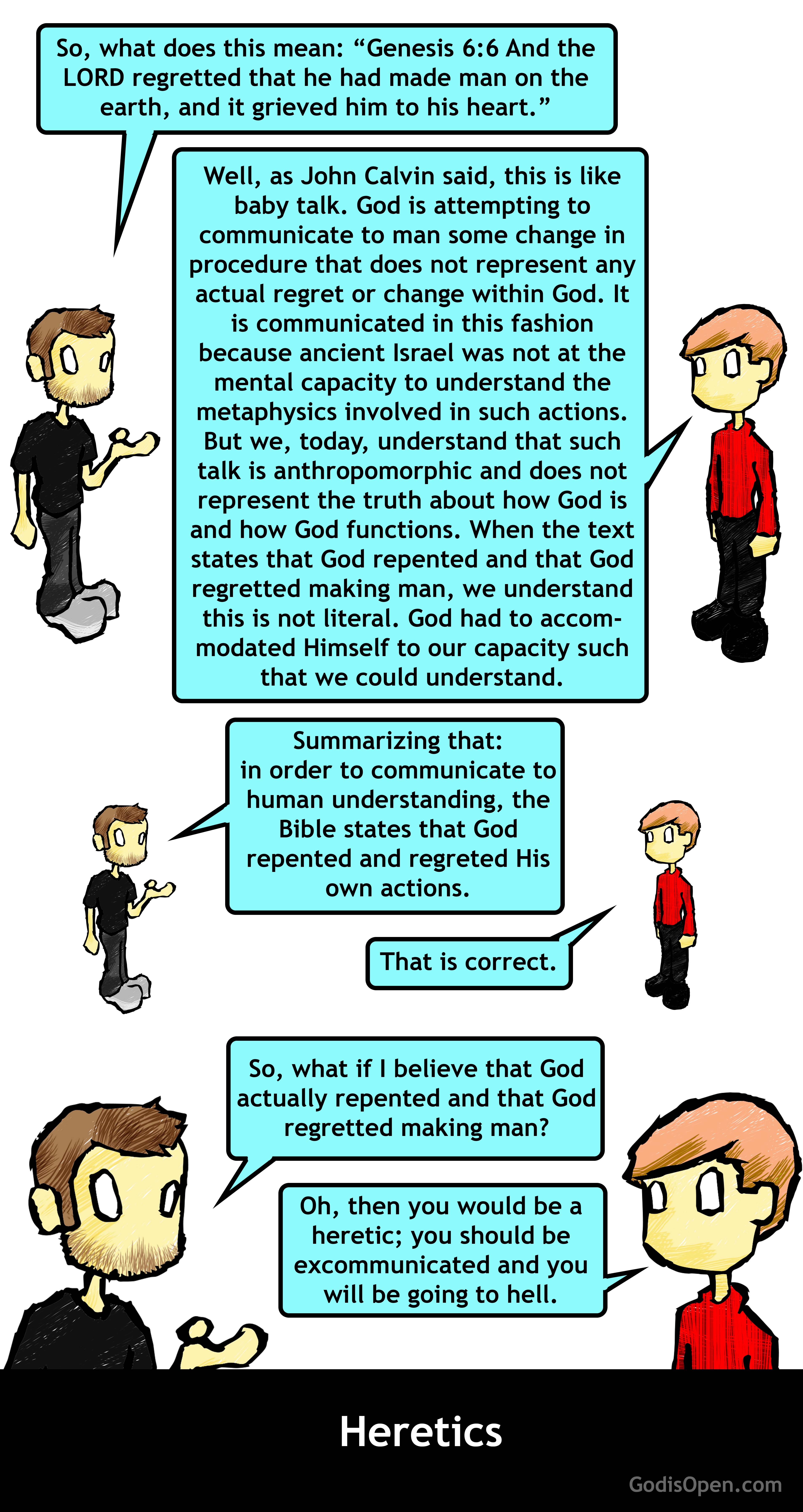
Worship Sunday – I Love Your Presence
In the glory
Of your presence
I find rest
For my soul
In the depths
Of your love
I find peace
Makes me whole
I love I love I love your presence
I love I love I love your presence
I love I love I love you Jesus
I love I love I love your presence
If you want it come and get it
For cryin’ out loud
This love that he has given you
Was never in doubt
Let go of your heart let go of your head
And feel it now
Piper Talks About Calvinism
Calvinist John Piper preaches on Calvinism:
Questions Answered – General Concerns about Open Theism
Jack writes:
A few people have expressed concerns to me about my recent theological paradigm shift to Open Theism. In fact one person told me I should never arrive at agreement with something so controversial without serious consideration and investigation.
There lies the misunderstanding. I did not arrive at this agreement without serious consideration nor did I arrive at this recently.
I have always been an Open Theist since the very first time I read the Bible from cover to cover. You see I was not a Christian nor had I even been convinced of even the existence of God when I first read His Word. Some of you know the story. I was in jail it was 1993 and I read the Bible everyday not with any quest for the truth or out of any curiosity whatsoever. I was reading it in front of the camera overlooking the cell pod in an effort to convince the guards I was changing. I wanted to make trustee, because in that small town the trustees were not in a cage. My goal was escape, which fortunately fell through because I never fooled anyone into making me a trustee.
The only problem is that I didn’t just pretend to read in order to pass the time I actually read. Having no previous theological training whatsoever I had never been taught what the Bible “actually teaches” about God. I just read it and accepted what I learned from it and it alone.
It was only after I became a Christian and started attending church and then later took several theological courses that I learned that God knows the future exhaustively, that He lives outside of time, that He can not change, and many many other things I had never conceived of by simply reading God’s Word without “proper guidance.”
Now I was a good Christian so I accepted these new “truths” about God and I heard out their reasonings from scripture to back up these teachings. That I was mistaking metaphors, anthropomorphisms, and allegories for literal truths. It did bother me that so much of the Bible could not be taken at face value but hey who was I to question my elders?
The problem is I kept reading and my previous beliefs I had arrived at from reading scripture alone kept pestering me to question my new beliefs arrived at from guidance.I suspect if I were like most Christians who sit in Church for years before they ever follow through with a lifelong goal of actually reading the Bible for themselves I would have been better off. I would have known what the Bible “actually teaches” before I let it actually teach me anything that would confuse me. Unfortunately that was not the case.
Then one night while bored and browsing youtube I accidently stumbled onto a debate between an Open Theist (who just happened to be someone I already had been exposed to and loved but didn’t know his philosophical leanings) and a Calvinist. The Open theist was arguing the ideas I had as a young Christian before being taught differently and the Calvinist was actually more in agreement with the people that had taught me. Which was crazy because the people that had taught me were not Calvinist at all in fact they claimed to absolutely disagree with Calvinist. They were Arminian but none the less it appeared the Calvinist was debating their theology.
This is when I realized that what I thought the Bible taught in the first place might actually be plausible. When I learned I was not alone in my prior biblical conclusions.
Nevertheless I still did not completely agree with Open Theism at first it just interested me because it reminded me of a more “naive” time in my Christian life. A time when I believed most of the Bible was literal, not just to be literally interpreted but actually literal. So I did investigate and I did consider it thoroughly before accepting it’s teachings.
In short ( can I still say that at this point LOL) I have not departed from my theology, I have returned to it.
Apologetics Thursday – Knowledge of the Future
Will Birch gives a thoughtful critique of Open Theism:
The Psalmist continues: “Before a word is on my tongue you, LORD, know it completely.” (Ps. 139:4) My opinion is that this verse challenges the notion of Open Theism. For God cannot, in Open theory, but predict what I might say, given His knowledge of my character, and given His acquaintance with the varying situations I may encounter and how I may react. But here, the Psalmist indicates that God knows completely, yada’ta chullah, knows the whole of my speech. But notice, too, that God’s knowledge of my words is prior to the actual speaking of those words. Notice, as well, that His foreknowledge of my words is complete and exhaustive.
The passage being referenced in Psalms is not as cut and dry and Birch would like. Speech does not work mechanically where one can just view isolated sentences and determine absolute meaning. Even if King David says that God knows His thoughts “completely”, this falls within the bound of normal hyperbolic speech. And if King David’s point is that his relationship with God is unique, this actually works against what Birch is attempting to gain from this passage. Context is what will inform the reader on King David’s meaning.
Surveying the rest of the chapter shows that King David believes God knows him by searching him.
Psa 139:1 To the choirmaster. A Psalm of David. O LORD, you have searched me and known me!
King David ends this psalm with a challenge to God to search him to know his heart:
Psa 139:23 Search me, O God, and know my heart! Try me and know my thoughts!
Psa 139:24 And see if there be any grievous way in me, and lead me in the way everlasting!
King David believes that God learns about David through trials. For God to know if King David will remain true, God puts David into situations. This, in itself, undermines the point Birch makes.
The Uncontrolling Love of God: An Open and Relational Account of Providence
Open Theist Prooftext Video
Meme Monday – Fuzzy Thoughts
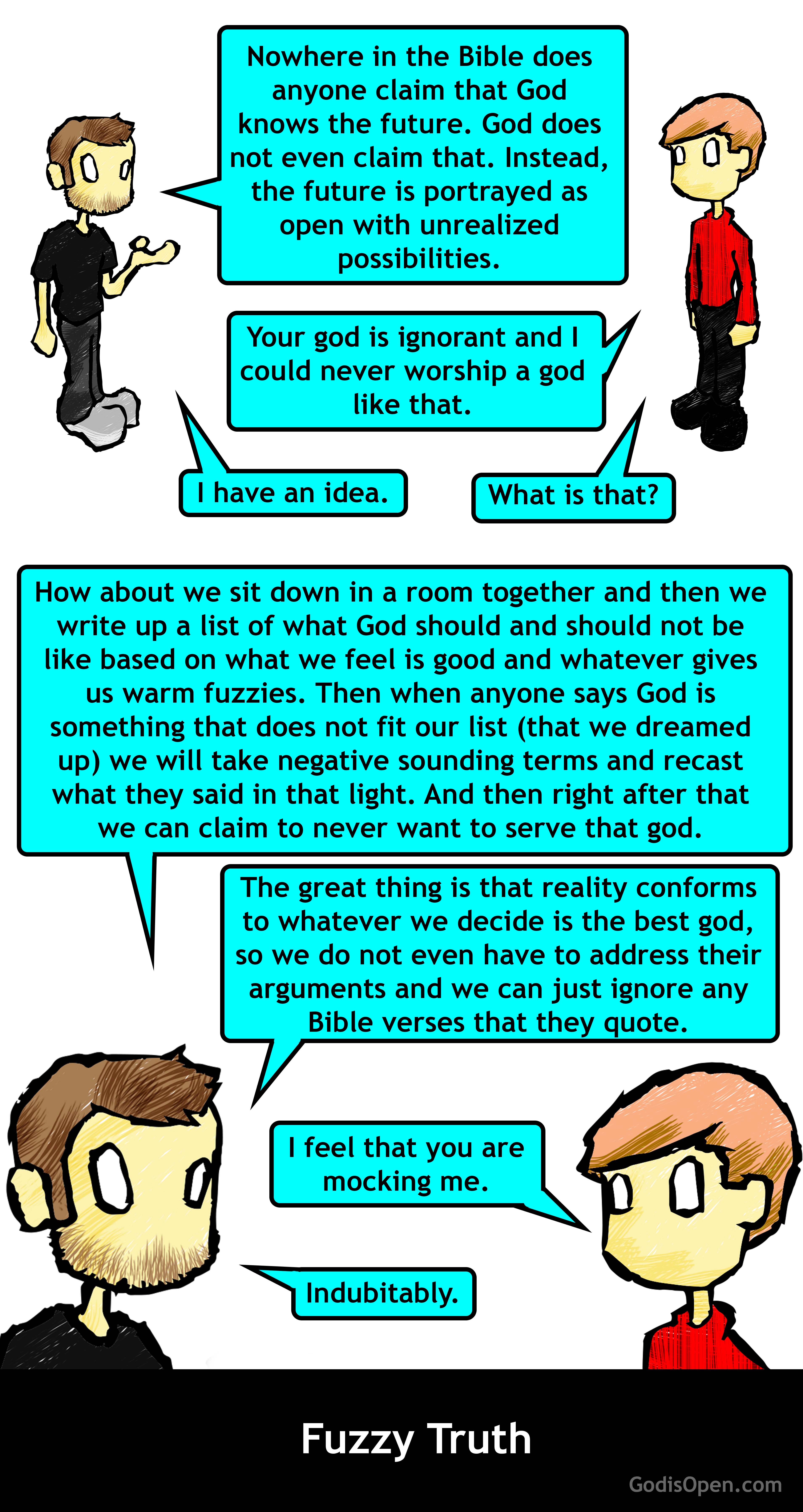
Worship Sunday – All Hail Jesus
You made the moon that moves the waves
The burning sun to light the day
Yours is the name above all names
You formed the Earth
Both height and depth
The universe and endless space
Yours is the name above all names
All hail Jesus
The King above all Kings
Enthroned in majesty
You reign eternally
Boyd on 5 Ways the Bible Supports Open Theism
1. The Lord frequently changes his mind in the light of changing circumstances, or as a result of prayer (Exod. 32:14; Num. 14:12–20; Deut. 9:13–14, 18–20, 25; 1 Sam. 2:27–36; 2 Kings 20:1–7; 1 Chron. 21:15; Jer. 26:19; Ezek. 20:5–22; Amos 7:1–6; Jonah 1:2; 3:2, 4–10). At other times he explicitly states that he will change his mind if circumstances change (Jer. 18:7–11; 26:2–3; Ezek. 33:13–15). This willingness to change is portrayed as one of God’s attributes of greatness (Joel 2:13–14; Jonah 4:2). If the future were exhaustively and eternally settled, as classical theism teaches, it would be impossible for God to genuinely change his mind about matters.
2. God sometimes expresses regret and disappointment over how things turned out—even occasionally over things that resulted from his own will. (Gen. 6:5–6; 1 Sam. 15:10, 35; Ezek. 22:29–31). If the future was exhaustively and eternally settled, it would be impossible for God to genuinely regret how some of his own decisions turned out.
3. At other times God tells us that he is surprised at how things turned out because he expected a different outcome (Isa. 5:3–7; Jer. 3:67; 19–20). If the future were eternally and exhaustively settled, everything would come to pass exactly as God eternally knew or determined it to be.
4. The Lord frequently tests his people to find out whether they’ll remain faithful to him (Gen. 22:12; Exod. 16:4; Deut. 8:2; 13:1–3; Judges 2:20–3:5; 2 Chron. 32:31). If the future were eternally and exhaustively settled, God could not genuinely say he tests people “to know” whether they’ll be faithful or not.
5. The Lord sometimes asks non-rhetorical questions about the future (Num. 14:11; Hos. 8:5) and speaks to people in terms of what may or may not happen (Exod. 3:18–4:9; 13:17; Jer. 38:17–18, 20–21, 23; Ezek. 12:1–3). If the future were exhaustively and eternally settled, God could never genuinely speak about the future in terms of what “may” or “may not” happen.
Unawered Questions – Anthropomorphisms in Exodus 32
To those who view God’s speech as anthropomorphic in Exodus 32.
When Moses is talking to God in Exodus 32, Calvinists claim that God’s speech is an anthropomorphism. Is Moses’ speech an anthropomorphism? How does Moses view God when He is speaking to God? And then who wrote Exodus? If it is Moses, why do we assume writer Moses had a different perspective of God than speaker Moses?
Apologetics Thursday – Piper on God Calling the Animals to Adam
John Piper writes Beyond the Bounds: Open Theism and the Undermining of Biblical Christianity:
Speech characterizes God and man, not animals. Adam recognizes this when on the sixth day he speaks names for the animals while learning God’s lesson that he stands far above the animals.
To John Piper, the reason that God calls the animals to Adam is to teach Adam a lesson. What is interesting is that the Bible gives an actual reason why God called the animals to Adam. This is to “see what Adam would call them”:
Gen 2:19 Now out of the ground the LORD God had formed every beast of the field and every bird of the heavens and brought them to the man to see what he would call them. And whatever the man called every living creature, that was its name.
Piper discounts the Biblical reason God called the animals to Adam and invents his own because the Biblical reason runs counter to his private theology. This point is literally found in a book subtitled: Open Theism and the Undermining of Biblical Christianity. Irony.
Calvinists and Atheists Debate God’s Attributes
A very interesting debate in which atheists point out issues with Classical Attributes such as Exhaustive Foreknowledge of the Future.
The Existence and Attributes of God Debate (AUDIO)
On debate participant is our old friend, Sye the Calvinist Guy.
White Gives Exegesis of Romans 9
Audio found in link. Calvinist James White speaks on Romans 9.
Meme Monday – Exodus 32
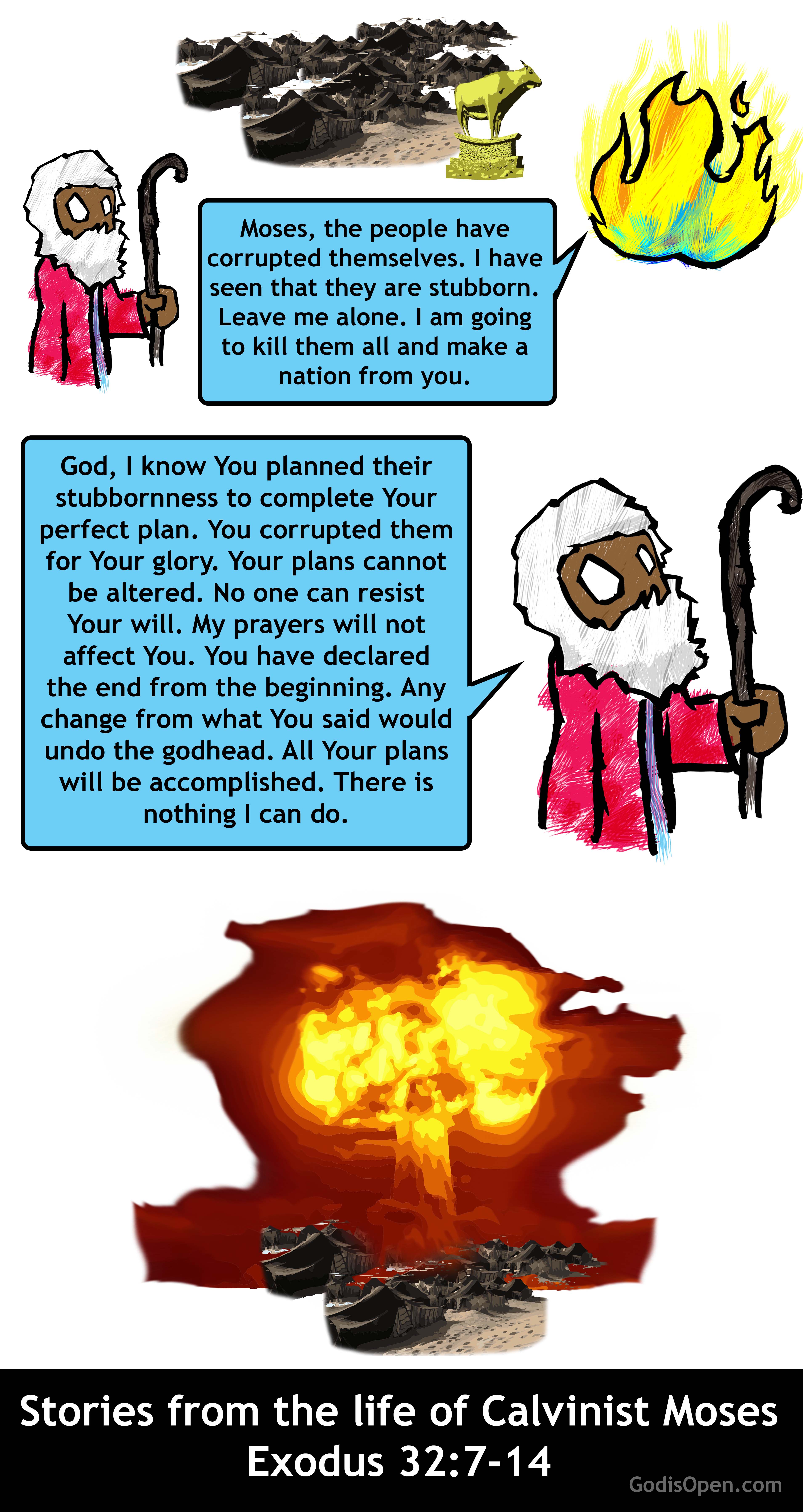
Worship Sunday – No Longer Strangers
Beautifully made
By nature I’ve fallen
By grace I’ve been raised
You’re calling me I’m coming home
You’re calling me I’m coming home
We are no longer strangers to your arms
We are no longer strangers to your arms
By your grace you have saved us
We’re no longer strangers
We’re no longer strangers to your arms
Once exiled by sin
Separated by my transgressions
Now welcomed in
You’re calling me I’m coming home
You’re calling me I’m coming home
Father I’m coming home
Though I have wandered far
Your love is reaching out
I’m running to Your arms
I’m running to Your arms
I’m coming home
Schaefer reviews Swinburne
Peter Schaefer reviews Mind, Brain, and Free Will by Richard Swinburne. An excerpt:
Swinburne then turns (briefly) to matters of epistemology. How do we go about making judgments on various matters? As elsewhere, he defends some basic epistemic principles including the by-now-familiar principles of credulity (PC) iii and testimony (PT)iv. Any evidence that the way things seem or what people tell us not caused ultimately by the things apparently perceived or testified to provide a defeater for PC and PT. This last point can be unpacked more formally as the epistemic assumption (EA), which states that there are three components to justified belief in a theory. First, there must be a justified belief that the theory makes true predictions. Second, the only sources of evidence for that justified belief would be apparent experience, memory, and testimony that the theory predicts certain events and that those events occurred. Third and most importantly, such justification is undermined by any evidence that any apparent experience was not caused by an apparent experience of the event apparently remembered, or any apparent testimony was not caused by the testifier’s intention to report his or her apparent experience or memory. As will be seen shortly, this last part of the EA undergirds Swinburne’s case for free will in the face of recent neuroscientific findings.
Answered Questions – Why Were Adam and Eve Punished
3. Since Adam and Eve didn’t know right from wrong before eating from the tree of the knowledge of good and evil, why did God then punish them for something they didn’t understand they were doing?
The answer has more to do with what eating from the tree accomplished. Per Rabbi Sacks in The Great Partnership:
The biblical word da’at, ‘knowledge’, does not mean in Hebrew what it is normally taken to mean in the West, namely knowledge of facts, theories, systems and truths. It means interpersonal knowledge, intimacy, empathy. The ‘tree of knowledge’ is about this kind of knowledge. True knowledge that the other is not a mirror image of me, that he or she has wants and needs of her own that may clash with mine, is the source of all love and all pain. To know that I am known makes me want to hide: that is the couple’s first response after eating the fruit. The turning point comes when the man gives Eve a proper name. Love is born when we recognise the integrity of otherness. That is the meaning of love between people. It is the meaning of love between us and God. Only when we make space for the human other do we make space for the divine Other.
Adam and Eve learned about each-other through eating of the Tree of Knowledge. Before this time, they still knew it was wrong to disobey God (God told them the consequences outright), but they did not seem to have awareness of intimacy. Eating of the tree resulted in self-awareness, the death of naïvety.
Apologetics Thursday – Calvinist Fallacies
These following fallacies are common Calvinistic fallacies. This list is not meant to be taken that non-Calvinists do not often fall for these fallacies, but that these fallacies are ones often encountered in debates with Calvinists.
Moralistic fallacy
What it is:
The moralistic fallacy is the informal fallacy of assuming that whichever aspect of nature which has socially unpleasant consequences cannot exist. Its typical form is “if X were true, then it would happen that Z!”, where Z is a morally, socially or politically undesirable thing. What should be moral is assumed a priori to also be naturally occurring.
Where Calvinists use it:
Everywhere and always. Open Theism is wrong because it presents a new understanding of omniscience. Open Theism is wrong because God then would not be “sovereign”. Open Theism is wrong because if the future is open the Satan might win. Open Theism is wrong because then God would sometimes be “wrong”.
This article “refuting” Open Theism relies primarily on the Moralistic Fallacy: link
The Motte and Bailey Argument
What it is:
The writers of the paper compare this to a form of medieval castle, where there would be a field of desirable and economically productive land called a bailey, and a big ugly tower in the middle called the motte. If you were a medieval lord, you would do most of your economic activity in the bailey and get rich. If an enemy approached, you would retreat to the motte and rain down arrows on the enemy until they gave up and went away. Then you would go back to the bailey, which is the place you wanted to be all along.
The idea is that an arguer makes an absurd claim that is not defensible. When pressed, they retreat to a more defensible position. If they win that, the again continue claiming the original absurd claim.
Where we see it:
Any time Calvinists claim that God controls everything or that God knows everything in the future. They may retreat to attempting to prove God controlled one thing or that God knew one thing in the future.
Here is one Calvinist claiming that the case of Joseph proves God’s control of all things:
The Worst Argument in the World
What it is:
I declare the Worst Argument In The World to be this: “X is in a category whose archetypal member gives us a certain emotional reaction. Therefore, we should apply that emotional reaction to X, even though it is not a central category member.” Source
Where we see it:
When Calvinists want to call the God of Open Theism “ignorant” or “makes mistakes”. The fallacy comes because usually people that “know quite a lot” or even know “everything everywhere” would not be conventionally called “ignorant” even if they might somehow technically fit the definition. Likewise, here is Matt Slick making the Worst Argument in the World when trying to get an Open Theist to say God makes mistakes: link
RC Sproul Recounts How He Became a Calvinist
RC Sproul attributes it to Romans 9:
The combination was too much for me. Gerstner, Edwards, the New Testament professor, and above all the Apostle Paul, were too formidable a team for me to withstand. The ninth chapter of Romans was the clincher. I simply could find no way to avoid the Apostle’s teaching in that chapter. Reluctantly, I sighed and surrendered, but with my head, not my heart. “OK, I believe this stuff, but I don’t have to like it!”
The Naked Archaeologist – Who Wrote the Bible?
Meme Monday – Ephesians 2:8
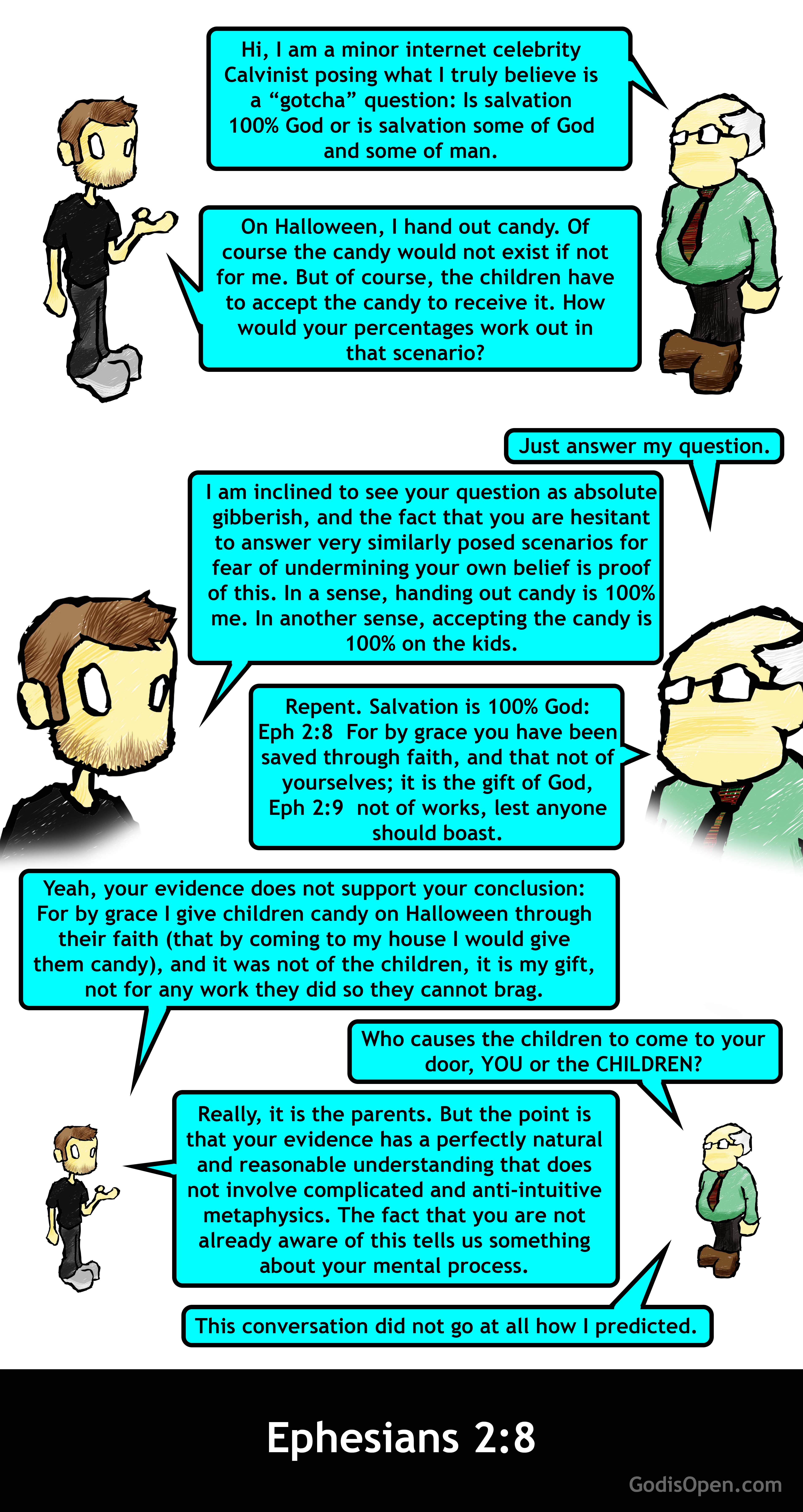
Worship Sunday – How Great Thou Art
O Lord, my God, when I in awesome wonder
Consider all the worlds Thy Hands have made;
I see the stars, I hear the rolling thunder,
Thy power throughout the universe displayed
Then sings my soul, My Saviour God, to Thee,
How great Thou art, how great Thou art.
Then sings my soul, My Saviour God, to Thee,
How great Thou art, how great Thou art!
And when I think of God, His Son not sparing;
Sent Him to die, I scarce can take it in;
That on the Cross, my burden gladly bearing,
He bled and died to take away my sin.
Then sings my soul, My Saviour God, to Thee,
How great Thou art, how great Thou art.
Then sings my soul, My Saviour God, to Thee,
How great Thou art, how great Thou art!
When Christ shall come with shout of acclamation
And lead me home, what joy shall fill my heart!
Then I shall bow with humble adoration,
And then proclaim, “My God, how great Thou art!”
Then sings my soul, My Saviour God, to Thee,
How great Thou art, how great Thou art.
Then sings my soul, My Saviour God, to Thee,
How great Thou art, how great Thou art!
Overbaugh Reviews The Uncontrolling Love of God by Thomas J Oord
By Bryan Overbaugh
Thomas Jay Oord’s book The Uncontrolling Love of God: An Open and Relational Account of Providence is an excellent contribution to the contemporary conversation on this topic. As displayed in the book’s title, Oord offers a view of providence that is uniquely situated amidst an ongoing open and relational conversation about the God/world relationship. The Uncontrolling Love of God is poised to offer new possibilities for not only those immersed in open and relational conversations but also those outside this particular theological movement. Those for whom the problem of evil has been a point of contention (theist and atheist alike) could also benefit from the insights offered in this book.
But lest you think that The Uncontrolling Love of God is merely a theological and philosophical treatment of the problem of evil, let me assure you it is not. While Oord navigates the theological, philosophical and scientific disciplines with ease and precision, his book has an immensely practical aspect, as well.
Oord’s practicality is evident from the beginning of this book. From the very first page, he delves into the tragedy of the human experience, presenting real stories of people encountering unfathomable evil and suffering. For Oord, these stories serve as a catalyst for the theodicy question – if God is all-powerful and all-loving than why does evil, pain and suffering exist?
But while Oord is concerned with the practical, those who are seeking an academic conversation on the topic will not be disappointed. He explores the topics of providence and the problem of evil by taking seriously randomness, law-like regularities, free will, genuine evil and genuine moral goodness. As Oord states, “My overarching aim for this book is to offer the best way to believe God acts providentially in a world of regularities, randomness, freedom and necessity, good and evil” (81).
Oord’s proposal avoids being determined by more popular theological answers. He spends a substantial portion of his book sketching out various models of providence. On one end of the spectrum there is the view that God is an omnicausal agent, determining all events according to the divine will. On the other end, there is the view that God is removed and uninvolved, whose ways are wholly other. Oord charitably presents all the models, offering a helpful critique of each while creating the space for his mediating position, essential kenosis.
Essential kenosis offers an alternative way of thinking about issues pertaining to the problem of evil and providence by coloring outside the theological lines [tweetable :) ]. In a conversation where God is believed to be either self-limited by God’s own choice or by some external force, Oord argues for involuntary divine self-limitation which comes not from some outside force but from the core of the divine nature, which is essentially and fundamentally love.
While Oord’s essential kenosis theology paints a picture of a God who is limited in agency due to the primacy of love, God is also intimately and persuasively active in the world, luring creation moment-by-moment. While this is not the first time Oord has written about essential kenosis, this is his most thorough presentation to date. For those who are interested in reading his thoughts for the first time or are looking for deeper engagement with his theology, The Uncontrolling Love of God will undoubtedly be an important resource.
While one may argue that Oord’s proposal makes for a weak God that can achieve little if anything, he works hard to show that this is indeed not the case. In his chapter on providence and miracles, he spends considerable time showing that a non-coercive, non-interventionist God can still be an actor in the world. Miracles, divine agency that is surprising and unusual, special and good, do indeed happen. Oord goes a long way in showing that “[e]ssential kenosis explains how God can act miraculously without controlling others” (216).
Those who are searching for a satisfactory answer to the problem of evil may find The Uncontrolling Love of God a valuable resource. I am confident that this book will generate fruitful conversation. I am hopeful that Oord’s proposal will provided practical and hopeful possibility for those who are making sense of either their own experience with evil, pain and suffering or the experience of an other.
Oord’s new book is a book of many possibilities – the possibility of answering the problem of evil and the possibility of offering a satisfying explanation for why one can still believe in God, divine agency, and miracles, all while taking seriously contemporary scientific knowledge. And if one walks away unsatisfied, Oord’s proposal could at the very least provide opportunities to think more deeply about their own position and to ponder its potential. As I see it, if people can read The Uncontrolling Love of God with an open mind and an open heart, all this can be a real possibility.
Book available December 2015.
Followup video by Oord:
Answered Questions – Boyd Explains Open Theists Belief God Has More Knowledge
From Ask an Open Theist (Greg Boyd)…Response:
From Sonja: So if I’m understanding open theism right, it sounds like it’s similar to–if not the same as–the idea that “omniscience” in God doesn’t mean “knows exactly what will happen” but instead means “knows every single permutation of what could happen.” Is that far off?
Greg. No, it’s not off at all! You’re actually stating a philosophical truth that I believe is extremely important. The next few paragraphs might be a little heavy for some readers because I have to use a little bit of philosophical jargon. But its Sonja’s fault because she asked such an important question! I encourage you to hang in there because I believe the point I’ll be making hits on one of the most fundamental mistakes made in the church tradition regarding the nature of omniscience and offers one of the strongest philosophical arguments for the open view:
Philosophers and theologians have often defined “divine omniscience” as “God’s knowledge of the truth value of all meaningful propositions.” I completely agree with this. Unfortunately, they typically assumed that propositions about what “will” and “will not” occur exhaust the field of meaningful propositions about the future. They thus concluded that God eternal knows all that will and will not take place and that there is nothing else for God to know.
This is a mistake, however, because propositions about what “might and might not” take place are also meaningful, and God must therefore know the truth value of these. Moreover, the opposite of “might” is “will not,” and the opposite of “might not” is “will.” So, if a “might and might not” proposition is true, then the corresponding propositions about what “will” and “will not” take place are both false.
For example, if its true that “Greg might and might not buy a blue Honda in 2016,” then its false that “Greg will (certainly) buy a blue Honda in 2016” and false that “Greg will (certainly) not buy a blue Honda in 2016.” So too, if it ever becomes true that “Greg will (certainly) buy a blue Honda in 2016” or true that “Greg will (certainly) not buy a blue Honda in 2016,” then it will be false that “Greg might and might not buy a blue Honda in 2016.” And since God knows the truth value of all propositions, God would know precisely when it is true that I “might and might not” buy this car and when it becomes true that I either “will” or “will not.” God thus faces a partly open future.
The irony is that, while open theists are constantly accused of limiting God’s knowledge, if my analysis is correct, it was the classical tradition that limited God’s knowledge! They overlooked an entire class of propositions the truth value of which an omniscient God must know. And it was right under their noses, for as I just demonstrated, the truth value of “might and might not” propositions is logically entailed by the true value of “will” and “will not” propositions. Hence, if God knows the truth value of “will” and “will not,” he must also know the truth value of “might and might not” propositions.
Apologetics Thursday – Psalm 110:4
In an article by John Piper, he cites Psalms 110:4 as a prooftext of God not being able to repent:
Psa 110:4 The LORD has sworn and will not change his mind, “You are a priest forever after the order of Melchizedek.”
This is one of the strangest prooftexts used by Calvinists to defend the idea that God cannot change. Within the very verse, unique conditions are described. God is saying He will not repent because He has sworn. God did not swear everything about everything, but only a specific promise (“an eternal priesthood”). Literally, Piper’s prooftext that God cannot change His mind is a text that describes one thing that God is committed to accomplishing. The natural suggestion is that God has latitude to repent on things about which He has not made such pressing promises. Piper’s prooftext cannot be generalized and is evidence against Piper’s own position.
Boyd on the Difference Between Past and Future
From The Future is Not Like the Past for God or Us:
If we possess authentic self-determining freedom, then our future must be fundamentally different from our past. The past is unalterable. There are no options for us, which is why we are not free in relation to it. There are not “ifs” or “maybes.” Everything about the past is definitely this way and definitely not any other way. If we are free, however, our future must be different from this. It must in part consist of realities that are possibly this way or possibly that way. Our future must be, at least in part, a realm of possibilities. And the God who knows all of reality just as it is and not otherwise must know it as such. He is not only the God of what will certainly be, he is also the God of possibility.
Belt on God being the Summum Bonum
Open Theist Tom Belt claims God is the Summum Bonum:
Just thinking out loud. Chime in if you want. God, all theists would agree, is the summum bonum—the greatest good, the highest value. I’m going to assume that here. What I’d like to suggest in addition to this (though it is nothing new) is that this highest value is God’s experience, more precisely his experience of “beatitude” or “unsurpassable aesthetic satisfaction” (to employ Greg’s expression from Trinity & Process). You might be thinking that I’ve said this all before and wonder what’s new here? Just this: God’s experience of his own beatitude is that about God which constitutes God as the summum bonum and that from which all created experiences derive their value.
Meme Monday – Dead
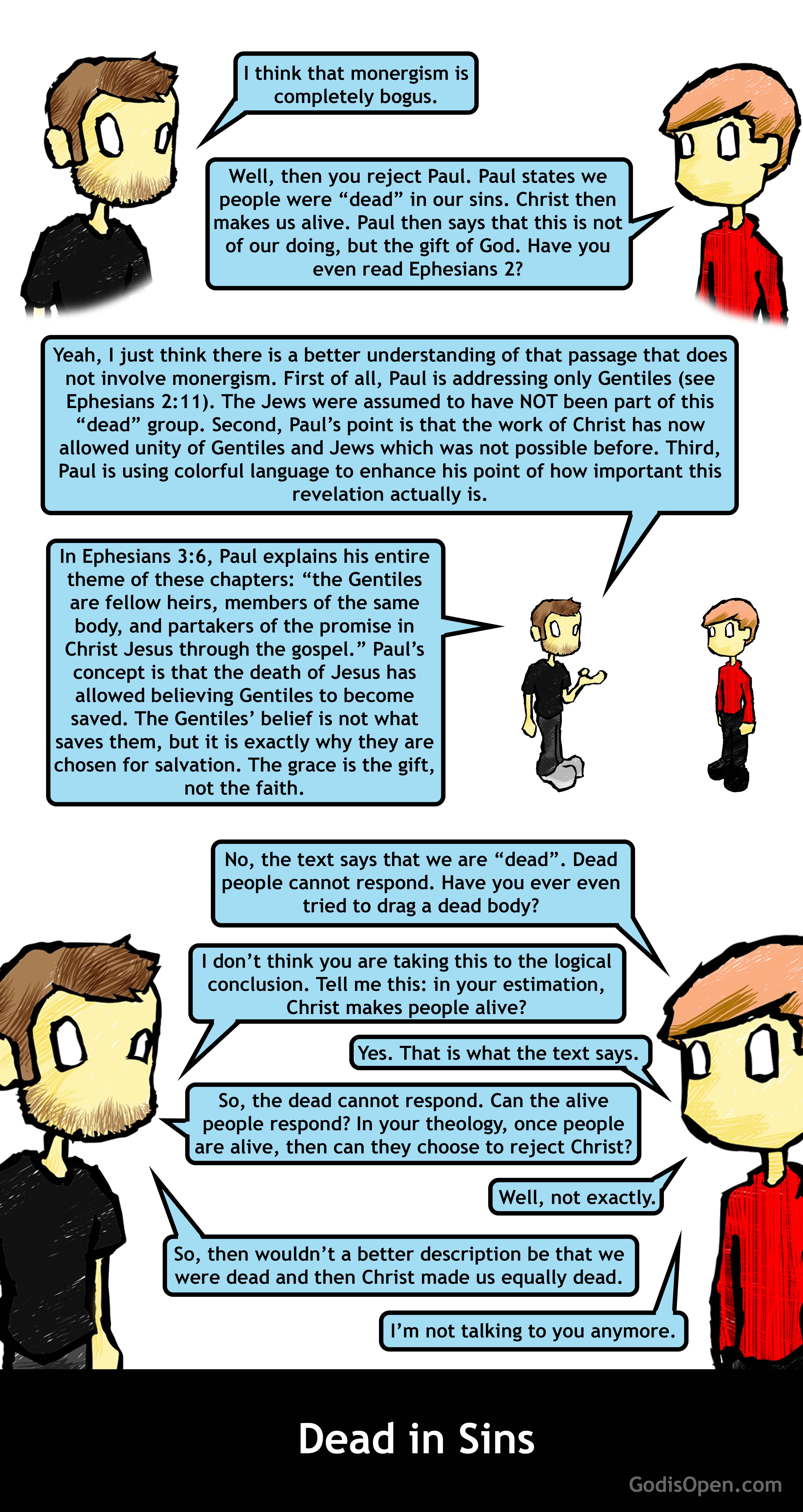
Worship Sunday – Dwell
Dwell in the midst of us
Come and dwell in this place
Dwell in the midst of us
Come and have Your way
Dwell in the midst of us
Wipe all the tears from our faces
Dwell in the midst of us
You can have Your way
Not our will, but Yours be done
Come and change us
Not our will, but Yours be done
Come sustain us
Attributes of God Wallpaper

Unanswered Questions – Did This Conversation Literally Happen
To those who believe God knows the future or is immutable, Exodus 32 describes a conversation between Moses and God. Did this conversation literally happen?
Exo 32:7 And the LORD said to Moses, “Go down, for your people, whom you brought up out of the land of Egypt, have corrupted themselves.
Exo 32:8 They have turned aside quickly out of the way that I commanded them. They have made for themselves a golden calf and have worshiped it and sacrificed to it and said, ‘These are your gods, O Israel, who brought you up out of the land of Egypt!'”
Exo 32:9 And the LORD said to Moses, “I have seen this people, and behold, it is a stiff-necked people.
Exo 32:10 Now therefore let me alone, that my wrath may burn hot against them and I may consume them, in order that I may make a great nation of you.”
Exo 32:11 But Moses implored the LORD his God and said, “O LORD, why does your wrath burn hot against your people, whom you have brought out of the land of Egypt with great power and with a mighty hand?
Exo 32:12 Why should the Egyptians say, ‘With evil intent did he bring them out, to kill them in the mountains and to consume them from the face of the earth’? Turn from your burning anger and relent from this disaster against your people.
Exo 32:13 Remember Abraham, Isaac, and Israel, your servants, to whom you swore by your own self, and said to them, ‘I will multiply your offspring as the stars of heaven, and all this land that I have promised I will give to your offspring, and they shall inherit it forever.'”
Exo 32:14 And the LORD relented from the disaster that he had spoken of bringing on his people.
Apologetics Thursday – McAfee on School Shootings
Camden McAfee (affiliated with John Piper) writes of the most recent school shooting tragedy:
Many of us know the power of Romans 8:28, but less of us are familiar with Genesis 50:20. In Romans, we read, that for those who love God, and are called according to his purposes, “all things work together for good.” But in Genesis, it gets even more pointed. “As for you, you meant evil against me, but God meant it for good, to bring it about that many people should be kept alive, as they are today” (Genesis 50:20).
It doesn’t say, “God used it for good.” It says, “God meant it for good.”
From the example of Genesis 50:20, McAfee draws the conclusion that every evil happens by God’s will and for God’s purposes. Generalizing based on one example is particularly poor thinking. This would be like using 1Sa 15:11 to claim that God always regrets all His actions:
1Sa 15:11 “I regret that I have made Saul king, for he has turned back from following me and has not performed my commandments.” And Samuel was angry, and he cried to the LORD all night.
Occasionally, God does regret His actions. We see this throughout the Bible, but this does not mean this this God’s normal state or that God regrets all His actions. Specific examples can only go so far.
In the case of Joseph, Joseph was a patriarch from a special people with God’s particular attention. It would be odd if God didn’t repurpose evil acts against him into providential good. Examples are much more suspect when the example is of an extraordinary figure. This would be like trying to generalize a day in the life of the president of America onto all people. The comparison just does not hold on its own.
Also note that God does not kill Joseph. In the school shootings, Christians were asked to self-identify as Christians and then executed. These Christians were not being preserved for some plan, as was Joseph who was saved for death. These Christians died. Where is the parallel?
McAfee’s last point that it says “God meant it for good” instead of “God used it for good” is a red herring. First, languages generally are fluid in the how words are used. There is no practical difference even in the English language between “meant” and “used”. In the Hebrew, the word being used is “weaved” or “plotted” or “contrived”. The Hebrew language is clearer than the English that God is repurposing the plans of evil men. There is every indication that God did this in real time, as the brothers of Joseph were fashioning their plan to harm Joseph, God was fashioning His plan of salvation.
Notice how the text reads:
Gen 50:20 As for you, you meant evil against me, but God meant it for good, to bring it about that many people should be kept alive, as they are today.
How is it in Calvinism, where God decrees all that is to happen, that God has to bring about events in order to bring about results? Cannot God just bring about those results without in intermediating event? Instead, this reads like God is being a tactician. God is maneuvering in order to bring about things that would not otherwise happen. God is using His resources to make sure the things that He wants actually happens.
As to McAfee’s overall point, there is no indication that God is using a school shooting to bring about some other plan. Much like the Tower of Siloam that Jesus references, this is a purposeless evil.
Holt on Hopelessness in Calvinism
From the GodisOpen Facebook page:
Piper: “A sovereign God is the only God that gives us unshakable hope.”
What an amazingly flawed statement. “Hope”…? How is there any hope when “God” may decide to cause such evil at any time.
Piper: “There’s a purposefulness behind everything that happens because it happens by God’s hand.”
Book Review: The Uncontrolling Love of God by Thomas J Oord
For believers, making sense of [evil events] requires belief in God. But the answers that most give to the question of God’s relation to randomness and evil leave me unconvinced and discontented. They don’t make sense. Believers need better responses than the usual fare.
– Thomas Oord, The Uncontrolling Love of God
Thomas J Oord is understandably unimpressed with the standard answers to the problem of evil. Evil, it is said, is part of God’s plan. Evil is used by God to teach people. Evil is the result of sinful people and God does not interfere in order to preserve freedom. Christians give all sorts of complicated and incomplete answers to the answer of evil, but evil remains a powerful argument from those wishing to reject God. Former Calvinist Bart Ehrman, a popular scholar and critic of Christianity, cites evil as the main reason he left Christianity. If evil can convert hardcore Calvinists into atheism, then what chance do the rest of us have?
In his first chapter, Oord details three such true stories of heartbreak, suffering, and random happenstance. I will add to it my own:
A day after my 31st birthday, we received a call about my six year old son. We had been trying to diagnose a lump on his neck. The doctors were not certain what it was, but on this day they were informing us about the results of a biopsy. It was cancer: T-Cell leukemia. For the next 6 months we spent week after endless week in the hospital. This six year old was poked and prodded. He lost his hair. They installed a port on his chest and in his stomach. They pumped endless toxins into his spinal column. Although he finally was placed in the medium risk category and fell into remission, his newfound friends at the hospital were not as lucky.
One child, struggling to stay alive, is now given a 20% chance of survival. This strong kid fights day and night, braving horrendous radiation treatments. He desperately clings to life against the odds. Although his odds of survival are slipping, he presses to do anything to live. Often these children die in spite of their pleas for life.
I lay awake at night in the children’s ward listening to the cries from adjacent rooms. The sound is maddening. Children are suffering through no fault of their own, day and night. Some are too young to comprehend what is happening. And this is a first world country. In other places and in other times, there was not medicine to dull the pain. There was no surgery to fix a broken body. There was no hope. Child mortality, until the modern world, hovered at about 50%.
Evil is real and critics of Christianity cannot just be easily dismissed with platitudes on this front. Where was God in all of this? Was this some sort of plan by God to teach some lesson?
Oord responds:
Is the “lesson” they learned in death worth the evil they suffered? Can dead people mature?
Some evils are character destroying rather than character building. Many people have lives that are made far worse because of intense pain. They grow bitter, vengeful and tyrannical, making life hellish for others and themselves. The alleged divine strategy of improving personal character is often counterproductive.
Oord spends the first few chapters talking about randomness. He very well understands that events can be random but aggregates can be predictable. He also spends an appropriate amount of time dispelling the myth that any limitations on choice is a violation of free will. He states the most intuitive position on the matter: “The limited-but-genuine-freedom position says we freely choose among a limited number of options.”
This is what human beings experience. We cannot choose to jump to the moon, but most can choose to jump two feet into the air as opposed to one foot into the air. We choose what position to hold our arms during the jump or whether to allow physics to control their placement. Although our jump is limited by the extent of our strength, I would add that humans have available an infinite number of choices within set limitations. Even with limits, human beings have limitless options.
Oord starts with the common sense notion that whatever we experience should be our default understanding as to how the world works. If our daily experience is free choice (e.g. I choose between a Coke or some Lemonade to drink) then this should be our default metaphysical position. Fatalism should only be accepted if there is strong evidence to overcome our intuition (and claiming “intuition” is a result of fatalism is of no help to anyone). Oord acknowledges that the fatalists will always claim that there are underlying formulas influencing everything that happens (despite evidence of randomness on a subatomic level). If someone is devoted to fatalism, they can always claim that fatalism produces an appearance of randomness. How this is more rational than defaulting to randomness creating an appearance of randomness is anyone’s guess.
On top of this basis, Oord presents a model of providence in which God’s natural attributes inherently limit the extent of God’s abilities. This should be a very familiar concept to anyone familiar with the metaphysics proposed by most modern Christians. Proponents of “omniscience and omnipotence” claim that omnipotence does not include the ability for God to limit His knowledge (e.g. forget events or not see events happen). Proponents of “omnipresence and omnipotence” claim that omnipotence does not include the ability for God to limit His location. Proponents of “omnipotence and immutability” claim that omnipotence does not include the ability of God to change. Even schools of Open Theism limit omniscience to what can rationally be known. Because Negative Attributes are inherently contradictory, something has to give. To Oord, what gives is God’s ability to be coercive (God’s benevolence limits God’s omnipotence).
This proffered metaphysical model, admittedly, is of better fit than most current models although it shares with these other models the reimagining of ancient Jewish theology. In both Reformed metaphysics and in Oord’s metaphysics are God’s thoughts and actions stripped from the Biblical narrative (such as God’s destruction of the Earth to undo His regretted creation, or God’s laments that He has punished Israel continuously in vain). In this respect, Oord is similar to the Calvinist tradition. In other respects, Oord is superior to the Calvinist tradition (by not stripping God of His emotions, relational nature, and love). In both Oord’s metaphysics and Calvinism, God is powerless to stop evil (so there is not a power disparity). For this reason, I would classify Oord as more Theologically Biblical than even a Fundamentalist Calvinist. Both rework the Bible’s picture of God, Oord to a lesser extent.
Oord offers a metaphysics of “essential kenosis”. The idea is that God gives Himself into creation. Because the world is an extension of God’s love, God cannot unilaterally change creation. This would be God changing His own nature, which Oord says is impossible. Evil exists because God cannot stop it. But God can bilaterally change creation (differentiating Oord from Process Theology). This is Oord’s solution to a benevolent God coexisting with an evil world. Oord explains this more thoroughly than a review can do justice.
The book is engaging to read. There are insights on just about every front (from statistics to science to theology). The sources that are cited come from a wide variety of traditions. The flow of the text is, for the most part, smooth. The points are interwoven to make the most of their effect on the audience. Anyone interested in benevolence (or even Christological metaphysics) would do well to pick up this book.
If a reader is looking for a book on Biblical critical scholarship, this is probably not the book for them. If, instead, a reader is interested in a compelling and fair overview of a host of metaphysical models (proffering what it believes is the best metaphysical model which can be then applied to the Bible), this is a book they should not miss.
Followup video by Oord:
Meme Monday – Corporate Election
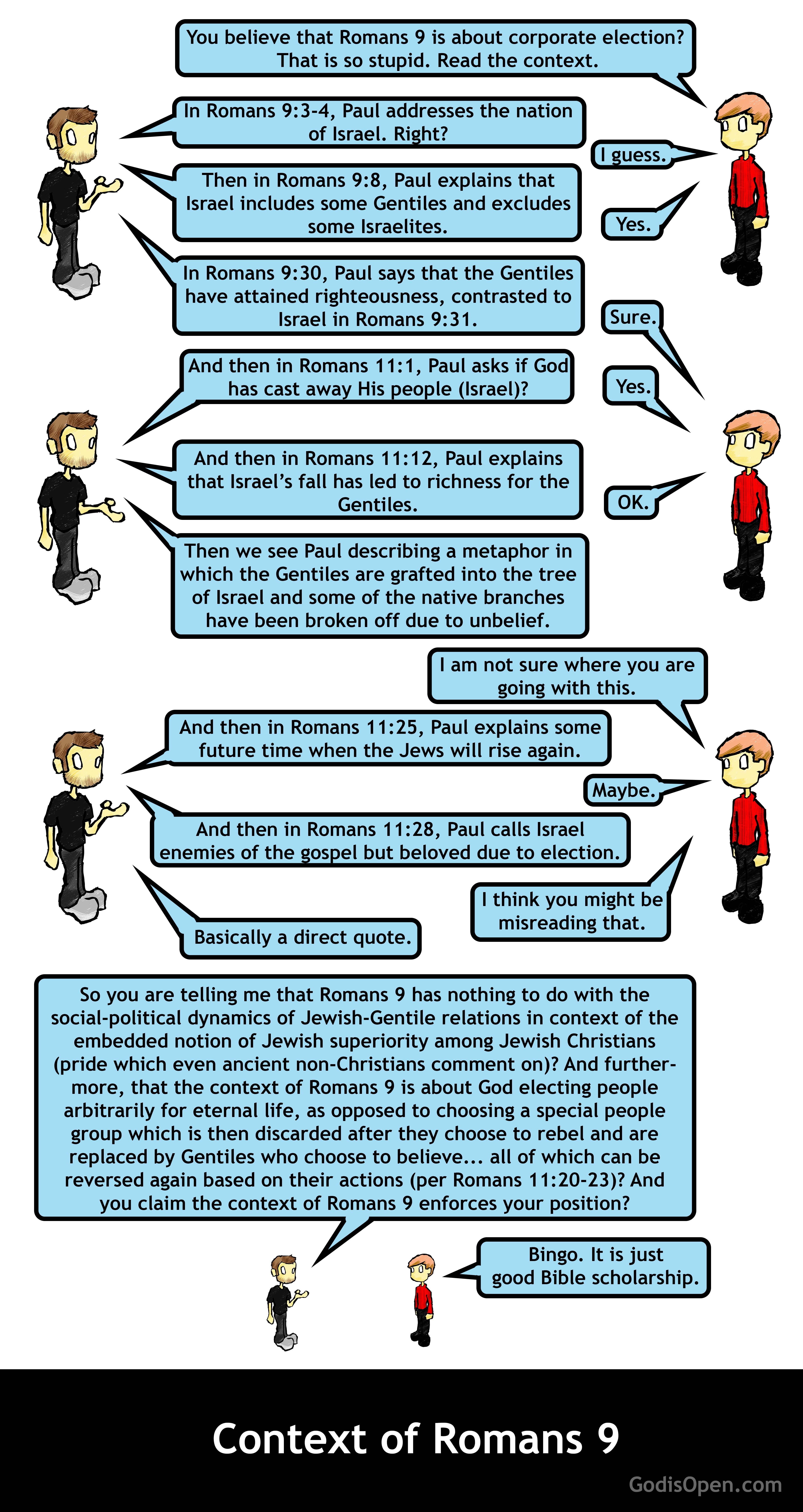
Worship Sunday – Satisfy
Before the sun has touched the sky
Colors bursting from Your eyes
Before the flood of the morning light
Before the earth has felt Your heat
Before I stand up to my feet
Before I begin to feel this weak
Satisfy me, Lord, oh
Satisfy me, Lord, oh
I’m begging You, help me see
You’re all I want, You’re what I need
Oh satisfy me, Lord
And when the day is closing in like the stars in the night
I am falling into the pull of the earth and its affections
In me, O Lord, can You create a pure heart
Because I’m afraid that I just might run back
To the things I hate
Satisfy me, Lord, oh
Satisfy me, Lord, oh
Yeah I’m begging You, help me see
You’re all I want, You’re what I need
Oh satisfy me, Lord
You’re beautiful
You’re beautiful
You’re more than all this world can give
You’re beautiful
You’re beautiful
Your love is all I need to live
You’re beautiful
You’re beautiful
You’re more than all this world can give
You’re beautiful
More beautiful
Your love is all I need to live
Satisfy me, Lord, oh
Satisfy me, Lord, oh
Yeah I’m begging You to help me see
You’re all I want, You’re what I need
Oh satisfy me, Lord
Satisfy me, Lord, oh
Satisfy me, Lord, oh
Yeah I’m begging You, help me see
You’re all I want, You’re what I need
Oh satisfy me, Lord
Oh, oh, oh, oh, oh, oh, oh…
Berkhof on Incommunicable Attributes
Calvinist Louis Berkhof explains the difference between incommunicable and communicable attributes:
4. The most common distinction is that between incommunicable and communicable attributes. The former are those to which there is nothing analogous in the creature, as aseity, simplicity, immensity, etc.; the latter those to which the properties of the human spirit bear some analogy, as power, goodness, mercy, righteousness, etc. This distinction found no favor with the Lutherans, but has always been rather popular in Reformed circles, and is found in such representative works as those of the Leyden Professors,[ Synopsis Purioris Theologiae.] Mastricht and Turretin. It was felt from the very beginning, however, that the distinction was untenable without further qualification, since from one point of view every attribute may be called communicable. None of the divine perfections are communicable in the infinite perfection in which they exist in God, and at the same time there are faint traces in man even of the so-called incommunicable attributes of God. Among more recent Reformed theologians there is a tendency to discard this distinction in favor of some other divisions. Dick, Shedd, and Vos retain the old division. Kuyper expresses himself as dissatisfied with it, and yet reproduces it in his virtutes per antithesin and virtutes per synthesin; and Bavinck, after following another order in the first edition of his Dogmatics, returns to it in the second edition. Honig prefers to follow the division given by Bavinck in his first edition. And, finally, the Hodges, H. B. Smith, and Thornwell follow a division suggested by the Westminster Catechism. However, the classification of the attributes under two main heads, as found in the distinction under consideration, is really inherent in all the other divisions, so that they are all subject to the objection that they apparently divide the Being of God into two parts, that first God as He is in Himself, God as the absolute Being, is discussed, and then God as He is related to His creatures, God as a personal Being. It may be said that such a treatment does not result in a unitary and harmonious conception of the divine attributes. This difficulty may be obviated, however, by having it clearly understood that the two classes of attributes named are not strictly co-ordinate, but that the attributes belonging to the first class qualify all those belonging to the second class, so that it can be said that God is one, absolute, unchangeable and infinite in His knowledge and wisdom, His goodness and love, His grace and mercy, His righteousness and holiness. If we bear this in mind, and also remember that none of the attributes of God are incommunicable in the sense that there is no trace of them in man, and that none of them are communicable in the sense that they are found in man as they are found in God, we see no reason why we should depart from the old division which has become so familiar in Reformed theology. For practical reasons it seems more desirable to retain it.
Berkhof, Louis (2014-02-23). Systematic Theology (Kindle Locations 1102-1123). . Kindle Edition.
Unanswered Questions – One Verse that Proves Exhaustive Foreknowledge
The Bible is a big book. At some counts, it has 31,102 verses. For those who believe in exhaustive future foreknowledge, please quote one verse that claims that God knows everything that will happen in the future.
Apologetics Thursday – Sacks Sees Jesus as a Compromise
In The Great Partnership: Science, Religion, and the Search for Meaning, Rabbi Sacks speculates about the role of Jesus in Christianity:
So remote is the God of pure being – the legacy of Plato and Aristotle – that the distance is bridged in Christianity by a figure that has no counterpart in Judaism, the Son of God, a person who is both human and divine. In Judaism we are all both human and divine, dust of the Earth yet breathing God’s breath and bearing God’s image. These are profoundly different theologies.
While Sacks is correct to note that Jesus is used as a stop-gap by modern Christians between the “incommunicable” god of the Platonists and man, Sacks appears to assume this was the original state of Christianity. But Christianity was born in Judaism. All the early Christians were Jewish and were entrenched in solid Jewish theology and eschatology. It was not until the rise of Paul that the Gentiles were courted. The religion of Christianity never did invent Jesus as a bridge between an unknowable god and between man. Instead Jesus is depicted as a mediator, much like the Holy Spirit (they both advocate to God on our behalf (1Ti 2:5, Rom 8:26)). That Jesus and the Spirit advocate to the Father is directly counter to any Platonistic notion of god. Why would one try to sway an immutable and incomprehensible god?
The Bible depicts Jesus praying to God and asking God to change His mind (Mat 26:39). The picture is primarily relational, not metaphysical. When Jesus states “He who has seen Me has seen the Father” (Joh 14:9) this is not a bridge between the knowable and the unknowable. Instead, this is Jesus telling the disciples who they will meet when they finally meet God.
Morrell on Jesus the Open Theist
From Was Jesus an Open Theist:
1. Jesus rebuked his disciples for evidently not believing that the future was flexible and not fixed, or that it could be altered. “Thinkest thou that I cannot now pray to my Father, and he shall presently give me more than twelve legions of angels?” Matt. 26:53. Here we see Jesus teaching open theism and essentially rebuking his disciples for not believing in open theism. Jesus was saying that he had a free will choice between alternative possibilities.
2. “And pray ye that your flight be not in the winter.” Mark 13:18. Here Jesus taught the open theists view of prayer, that prayer can literally affect, determine, and change the future. If there were no alternative future possibilities that were as of yet undecided, prayer for the future would be useless and vain. If all future events were already an eternal fixity, praying for certain events in the future to happen or not happen or to happen a certain way would not matter one iota.
3. “And except those days should be shortened, there should no flesh be saved: but for the elect’s sake those days shall be shortened.” Matt. 24:22. Here Jesus taught not only that God has the sovereign ability to change the future (aka open theism) but that God has in fact, in this particular, changed the future. The Bible, in both Testaments, teaches God’s ability to lengthen or shorten a man’s days. Thus, the future is flexible and changeable, not eternally fixed and concrete.
Rabbi Sacks on the Platonistic Concept of God
From Faith Lectures – Creation: Where Did We Come From?
As long as we think of God in classic philosophical terms, that line makes no sense at all. If God is omniscient, omnipotent, platonic, Aristotelian-it is impossible to comprehend that God should lack anything. Indeed, as Maimonides says at the beginning of the Mishneh Torah, and as Aquinas and all the other theologians say, imagine the whole universe did not exist-God would not have been changed. No difference to Him. Take away the universe, you do not take anything away from God.
That is the classic Hellenistic conception of God as the total self-sufficient Being. But supposing we stop thinking in philosophical terms and start thinking in Jewish terms? And here I am referring you to Halevy’s classic distinction between the God of Aristotle and the God of Abraham-did I explain that before? You know that we have two names for God in Hebrew? The word elokim and the word yud, heh, vav, heh [Hashem]-the four-letter name of God. Yehuda Halevy says a brilliant thing about this? He says that the word el in Hebrew means ‘a force’. Elokim, therefore, means ‘the force of all forces’. Grammatically, syntactically, the word Elokim is a generic noun. It is an abstract concept: the force of all forces. Hashem is something different, grammatically different. It is a proper name. Hashem is a proper name: God’s first name is Hashem. Therefore, when we relate to Hashem as Elokim, we are relating to Him as a concept, as the first cause, the concept of God familiar to Plato, Aristotle: human, everyone else, but when we are referring to God as Hashem, we are referring to God as an individual, as a person, as a Thou. That is the difference, says Yehuda Halevy, between the God of Aristotle, which we share in the concept of Elokim, and the God of Abraham, which generates not science but prophecy and intimacy.
Meme Monday – Arrogant
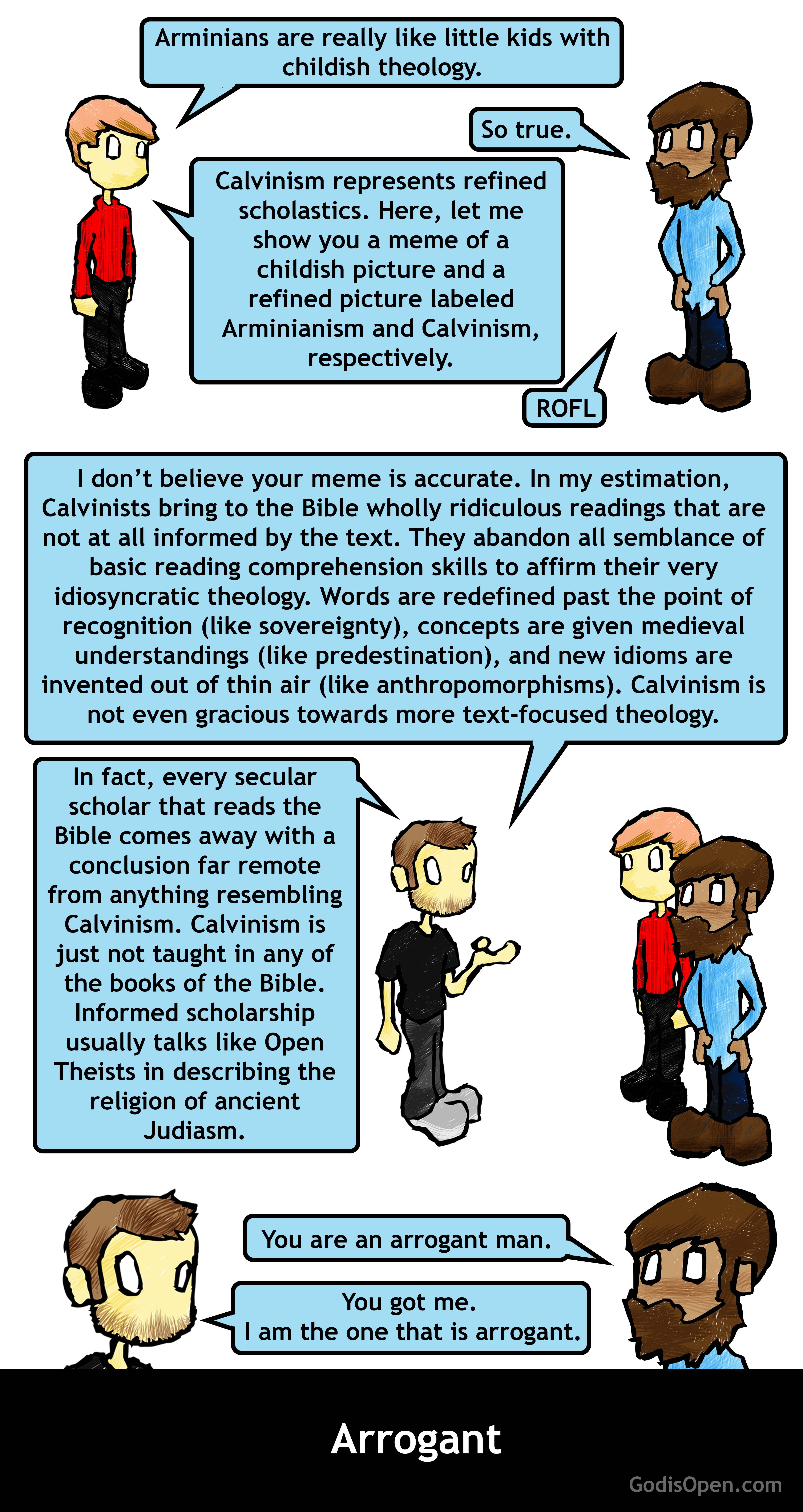
Worship Sunday – Holy Spirit
There’s nothing worth more
That will ever come close
Nothing can compare
You’re our Living Hope
Your Presence
I’ve tasted and seen
Of the sweetest of loves
Where my heart becomes free
And my shame is undone
Your presence Lord
Holy Spirit You are welcome here
Come flood this place and fill the atmosphere
Your glory God is what our hearts long for
To be overcome by Your presence Lord
Your presence Lord
There’s nothing worth more
That will ever come close
Nothing can compare
You’re our Living Hope
Your presence
I’ve tasted and seen
Of the sweetest of loves
Where my heart becomes free
And my shame is undone
Your presence Lord
Holy Spirit You are welcome here
Come flood this place and fill the atmosphere
Your glory God is what our hearts long for
To be overcome by Your presence Lord
(Repeat)
(end)
Let us become more aware of Your presence
Let us experience the glory of Your goodness
(Repeat)
Lord
Holy Spirit You are welcome here
Come flood this place and fill the atmosphere
Your glory God is what our hearts long for
To be overcome by Your presence Lord
Rabbi Sacks on I AM that I AM
The fifth and most profound difference lies in the way the two traditions understood the key phrase in which God identifies himself to Moses at the burning bush. ‘Who are you?’ asks Moses. God replies, cryptically, Ehyeh asher ehyeh. This was translated into Greek as ego eimi ho on, and into Latin as ego sum qui sum, meaning ‘I am who I am’, or ‘I am he who is’. The early and medieval Christian theologians all understood the phrase to be speaking about ontology, the metaphysical nature of God’s existence. It meant that he was ‘Being-itself, timeless, immutable, incorporeal, understood as the subsisting act of all existing’. Augustine defines God as that which does not change and cannot change. Aquinas, continuing the same tradition, reads the Exodus formula as saying that God is ‘true being, that is being that is eternal, immutable, simple, self-sufficient, and the cause and principal of every creature’.
Sacks, Jonathan (2012-09-11). The Great Partnership: Science, Religion, and the Search for Meaning (p. 64). Knopf Doubleday Publishing Group. Kindle Edition.
Answered Questions – How Can God Guarantee Eternal Salvation
From What is Open Theism:
How could God in any manner guarantee our eternal salvation if He does not know what the future holds?
This question might as well be worded: “How can God guarantee something He has unilateral control to decide?” What set of circumstances does the author believe would force God’s hand to revoke eternal salvation? If God has unilateral power to do something, why couldn’t He guarantee it?
Apologetics Thursday – Proving Chris Fisher is Omniscient
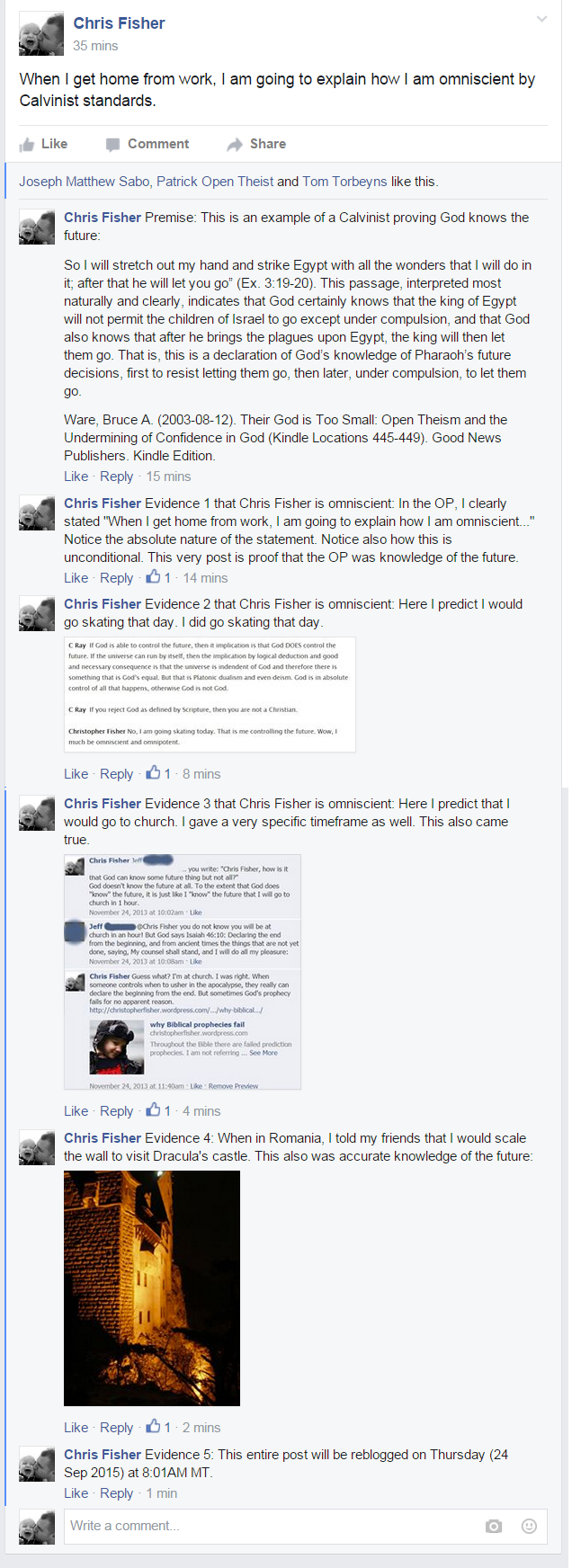
Rabbi Sacks on God’s Covenants
Atheist Site Understands the Origin of Timelessness
From God is Eternal:
A more important basis for defining eternal as timeless is the ancient Greek idea that a perfect god must also be an immutable god. Perfection does not allow for change, but change is a necessary consequence of any person who experiences the changing circumstances of the historical process. According to Greek philosophy, especially that found in the Neoplatonism which would play an important role in the development of Christian theology, the most real being was that which existed perfectly and changelessly beyond the troubles and concerns of our world.
Meme Monday – Calvinist Flowchart
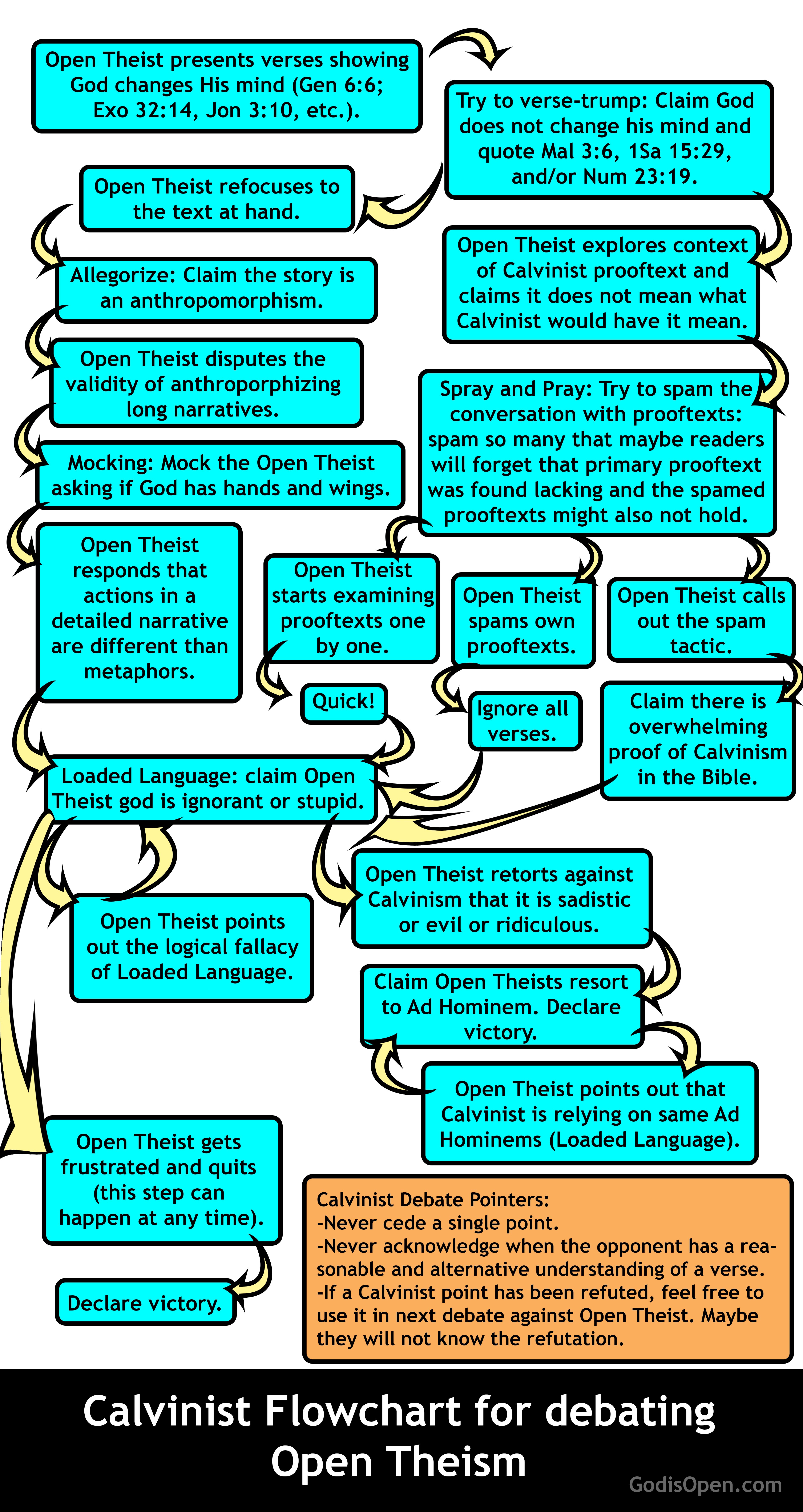
Worship Sunday – Holy Holy Holy Lord God Almighty
Holy, holy, holy! Lord God Almighty!
Early in the morning our song shall rise to Thee;
Holy, holy, holy, merciful and mighty!
God in three Persons, blessèd Trinity!
Holy, holy, holy! All the saints adore Thee,
Casting down their golden crowns around the glassy sea;
Cherubim and seraphim falling down before Thee,
Who was, and is, and evermore shall be.
Holy, holy, holy! though the darkness hide Thee,
Though the eye of sinful man Thy glory may not see;
Only Thou art holy; there is none beside Thee,
Perfect in power, in love, and purity.
Holy, holy, holy! Lord God Almighty!
All Thy works shall praise Thy Name, in earth, and sky, and sea;
Holy, holy, holy; merciful and mighty!
God in three Persons, blessèd Trinity!
Olsen on Contradictions in Immutability
From Roger Olsen’s Does God Change?:
What I “saw” early on in my theological training, however, was that those evangelical theologians who strongly touted God’s “immutability” were not very consistent about it. At least that’s what I thought I noticed in their writings. On the one hand, I was told, a good evangelical believes God is impervious to any change including having new experiences. On the other hand, I was told, it was the Son of God, the second person of the Trinity, equal with the Father and Holy Spirit, who experienced the incarnation including hunger, thirst, temptation, sorrow, pain and even death. The explanation? That he experienced these things only “through the human nature he took on” through Mary.
Questions Answered – What is greater, love or knowledge?
What is Greater?: Bob explains that the God of the Bible is living and is willing and able to respond to the actions of men.
Apologetics Thursday – Ware on Deuteronomy 31:21
From Bruce A. Ware. God’s Lesser Glory: The Diminished God of Open Theism:
Consider especially the force of the concluding statement in verse 21. God says, “I know their intent which they are developing today, before I have brought them into the land which I swore.” God knows their future rebellion, for he specifically predicts it with certainty and in some detail before it occurs. Furthermore, this passage helpfully illustrates a point made earlier: that God can know something fully in advance and yet express the appropriate emotion and ethical response to that situation when it actually arises in its historical unfolding. Knowing something in advance does not preclude real relational interaction. action. God knows fully what Israel will do and he enters fully into intimate mate relationship with them, hot with emotion and deeply involved in response to the wickedness of their sin.
This is a quote in a book written against Open Theism, leading a reader to believe Ware would be using prooftexts meant to convince Open Theists of the errors of their ways. Deuteronomy 31:21 is a particularly bad verse to use as exhaustive knowledge of all future events. Pretend the phrase “I know their intent which they are developing today” was absent (notice also how Ware crops the word “for/because” from the start of the quote). Any Open Theist would predictably answer the charges that not only can God know the future because He knows people’s general tendencies, but God also has direct and current knowledge of Israel’s present state. The interesting thing is that this is exactly how this section is worded. God predicts a lot of things in the future and then claims He knows that future because of His present knowledge (“for I know their intent which they are developing today”). Ware’s prooftext is evidence of Open Theism.
Fisher on God being Personal
 God’s first act towards human beings is to create man in His image. This is a very important concept in the Bible. Whereas the pagan gods have idols in their image, mankind is God’s image (the same Hebrew word is used to mean both “images” and “idols” throughout the Bible). Man bears the image of God and as such is imbued a certain level of closeness to God, a certain level of inherent value, a certain level of responsibility and power. Man is God’s crowning creation.
God’s first act towards man is calling the animals to man to see what man calls them. In the opening chapters of Genesis, God is curious about humanity and is eager to see what they do. Mankind quickly falls from grace. God expels man from the Garden, fearful that they will eat of the Tree of Life and live forever. God is responding and taking precautionary actions. Who knows what His new creation is capable of doing?
After mankind becomes more wicked than God had ever imagined, God floods the world in an effort to destroy everything (man, birds, animals, plant life). This is an ultimate act of desperation and disgust. God reverses His own glorious creation. His hopes are shattered by the very creature in His own image. But God shows mercy and, as a result, starts a new creation.
After the flood, God declares He will never again destroy the world because God has learned that mankind will always be evil from their youth. God has learned about His creation, lowering His expectations. God resolves to remain in contact with and to commune with His imperfect creation.
After failing to reach the whole of mankind, God singles out an individual through whom He can reach the world. God’s ultimate goal is humanity in relationship with Him. Abram (Abraham) is this man. God walks with Abraham and talks to Abraham. God tells Abraham about His plans, and Abraham advises God on God’s actions. God blesses Abraham materially and through rapid growth in descendants.
After Abraham’s death, God raises a fledging nation (Israel) under the protection of Egypt. When Egypt begins to oppress Israel, God again intervenes to save Israel in a visible and powerful way. All other nations from that point forward will have reason to fear the God of Israel. God shelters Israel as He leads them away from Egypt, leading through the sea and desert, feeding and guiding them.
God then forms and then presents an eternal covenant to Israel, detailing actions Israel must take and must not take to remain faithful to the covenant. Israel listens to the covenant and forms a pact with God to always be true to God. Moses acts as the mediator. God seals this pact with a personal luncheon with the elders of Israel.
But as soon as Moses is gone for a short time, Israel abandons God and the covenant they had just formed. God burns with wrath, and Moses must intervene to save Israel. God wishes to wipe Israel from the face of the Earth and raise a new nation through Moses. Moses objects that God’s purposes to impress and intimidate foreign nations will be thwarted. God agrees. Although enraged, God spares Israel. And this is not the only time this series of events occur.
Throughout Israel’s life, God’s relationship with them is tumultic. Even the name “Israel” means “struggles with God” (originally based off an event in which Jacob literally wrestles with God or an angel). But this name fits Israel for the duration of their existence. God engages in a series of blessings, curses, salvations, and appeasements. All of these fail in creating the righteous nation that God envisioned. Israel continuously violates their covenant relationship despite God’s best efforts. At one point, God laments “what more could I have done”. God has exhausted His toolbox of methods to reach Israel. They continually reject God, no matter what God does or tries.
Israel endures the Assyrian captivity and the Babylonian captivity. God uses Amos, Hosea, Micah, Isaiah, Nahum, Habakkuk, Jeremiah, Ezekiel, Haggai, Zechariah, Joel, and Malachi to spread His personalized messages to Israel about punishment, redemption, and a future hope. The message is tragic and compelling. Scattered through these writings, God impresses to Israel their status as a future priest nation. Through Israel, God would save the world.
As one last effort, God sends a Messiah (a Christ) to save Israel. Jesus preaches for 3 years and is, predictably, largely ignored. After Jesus dies and rises again, Israel still remains in rebellion against God. God turns to the Gentiles through an individual named Paul. Paul explains in the book of Romans that the Gentiles are now equal with the Jews. The Jewish rebellion has resulted in the advancement of the Gentiles. This is God’s last ditch effort to provoke the Jews to righteousness (in the words of Paul: through use of jealousy).
God’s grand plan to use Israel as a priest nation has failed. God has tried to build a people unto Himself, a nation of people with a special relation, a nation meant to be the light unto the world. This tragic turn of events may have delayed the end times, in which God plans to once again exalt the nation of Israel.
Ultimately, God plans to return to Earth and rule from Jerusalem. God plans a world in which the righteous live and the wicked are destroyed. God wishes to abolish pain and suffering and to live forever with a people of His own. All the nations of the world will come to God and worship in His holy city. In short, God’s relational nature is the story of the Bible. It is filled from end to end with God attempting to build a relationship with various people and nations. Often this ends in failure, but God presses through the failure with steadfast resolve.
The entire illustration of the Bible is one of utter commitment to a personal relationship to human beings. God attempts punishments and rewards. God attempts intimate appearances and utter abandonment. God attempts to reach the world through individuals, groups, and nations. God even sends His only son to reach the heart of mankind. Often this leads to heartbreak and disappointment in Yahweh, as He watches mankind repel Yahweh’s every advance.
A clear insight into God’s relational nature is through how God describes key individuals throughout the Bible. In Exodus 32 (see chapter 3), Moses stands in God’s way of destroying Israel. God changes His mind because of Moses’ intercession. Samuel intercedes for the people in 1 Samuel 12. Throughout the book of Samuel, the prophet Samuel has conversations with God. They exchange thoughts and feelings (see chapter 3). Both these men, Moses and Samuel, are given as prime examples of people who could sway God:
Jer 15:1 Then the LORD said to me, “Though Moses and Samuel stood before me, yet my heart would not turn toward this people. Send them out of my sight, and let them go!
Likewise, Abraham and David held personal relationships with God. Prophets, both small and great, converse with God and are blunt with God. In one such strange event (found in Ezekiel 4), God commands Ezekiel to use human waste to cook his food. Ezekiel objects. God instantly changes His requirements for Ezekiel and instead allows Ezekiel to use animal waste. God allows His commands to be modified, on the fly, by the desires of mankind.
Other times in the Bible, God has such high regard for individuals that he spares the lives of others as a result. In Ezekiel 14, we see the reverse. God is so incensed by Israel that no one except the righteous would be spared. This is a reversal of normal process:
Eze 14:14 even if these three men, Noah, Daniel, and Job, were in it, they would deliver but their own lives by their righteousness, declares the Lord GOD…
Eze 14:16 even if these three men were in it, as I live, declares the Lord GOD, they would deliver neither sons nor daughters. They alone would be delivered, but the land would be desolate.
Individuals can personally move God into actions that God would not have taken otherwise. The Bible highlights several exceptional people to whom God defers in the face of extreme passion. The message is that God values people. Certain individuals can move God based on whom they are and how they behave. God is not one to eschew advice. God is not one to believe that He only has the only right answers. God builds personal relationships.
God, by His very being, is relational to human beings. Human beings are God’s ultimate creation. It is with humans that God wants to talk, walk, and experience life. Man has the ultimate ability to affect God’s heart, more than trees, rocks, or any animal. When man rejects God, God responds. Sometimes God responds in sadness. Sometimes God responds in confusion. Sometimes God responds in forgiveness. Sometimes God responds in anger. God responds. This is the primary witness of the Bible.
Atheists Point Out Contradiction Between Omniscience and Free Will
From Arguing Against Gods:
Another tricky issue is whether or not genuine omniscience is in any way compatible with free will – either ours or the alleged god’s. To start with our free will, it has been observed many times that if a god knows the future with infallible certainty, then what this god knows will necessarily happen – there is no possibility for anything else to occur. We are, then, incapable of altering the future. Although the concept of human “free will” is hotly contested, I’m not aware of any theory of free will which could be considered compatible with a being perfectly knowing the future. If a god knows who will win the next presidential election, then it isn’t possible for anyone else to win. That’s predestination – and some theologians have unflinchingly embraced it, for example John Calvin.
Free Monday – Unpredictability and Indeterminism in Human Behavior
The full PDF can be found here. An extract:
This essay presents arguments for the view that complex human behavior of the type that interests educational researchers by its nature unpredictable if not indeterminate, a view that raises serious questions about the validity of a quantitative, experimental, positivist approach to educational research. The arguments are based on (a) individual differences, (b) chaos, (c) the evolutionary nature of learning and development, (d) the role of consciousness and free will in human behavior, and (e) the implications of quantum mechanics. Consequently it is argued that educational research that attempts to predict and control educational outcomes cannot be successful and that educational research should focus on providing descriptions and interpretations of educational phenomena to provide findings that can be used to improve our understanding of learning, development, and education and to facilitate their evolution.
Worship Sunday – Great Are You Lord
You give life, You are love
You bring light to the darkness
You give hope, You restore
Every heart that is broken
Great are You, Lord
It’s Your breath in our lungs
So we pour out our praise
We pour out our praise
It’s Your breath in our lungs
So we pour out our praise
To You only
You give life, You are love
You bring light to the darkness
You give hope, You restore
Every heart that is broken
Great are You, Lord
It’s Your breath in our lungs
So we pour out our praise
We pour out our praise
It’s Your breath in our lungs
So we pour out our praise
To You only
[x2]
All the earth will shout
Your praise
Our hearts will cry
These bones will sing
Great are You, Lord
[x3]
It’s Your breath in our lungs
So we pour out our praise
We pour out our praise
It’s Your breath in our lungs
So we pour out our praise
To You only
[x2]
Neyhart Explains Her Hermeneutic of Love
Open Theist Jennifer Neyhart presents her hermeneutic of love by which she reads the Bible:
Well, when Jesus was asked what was the greatest commandment, he responded by saying “Love the Lord your God with all your heart and with all your soul and with all your mind.’ This is the first and greatest commandment. And the second is like it: ‘Love your neighbor as yourself.’All the Law and the Prophets hang on these two commandments.” (Matthew 22:37-40)
In light of this passage, I would argue that the love of God and our love for God and people should be a lens for interpreting Scripture.
Unanswered Questions – Which Prophet is a Better Prooftext
For those who use Numbers 23:19 as a prooftext that God does not change:
Num 23:19 “God is not a man, that He should lie, Nor a son of man, that He should repent. Has He said, and will He not do? Or has He spoken, and will He not make it good?
Would we not do better to understand Balaam’s (a prophet despised in the Bible) description of God as limited to the context and Jonah’s description (that repentance is a core of God’s very nature) of God as absolute?
Jon 4:2 So he prayed to the LORD, and said, “Ah, LORD, was not this what I said when I was still in my country? Therefore I fled previously to Tarshish; for I know that You are a gracious and merciful God, slow to anger and abundant in lovingkindness, One who relents from doing harm.
Apologetics Thursday – Joseph Proving Too Much
Calvinists often make the case that Genesis 45 is a solid prooftext for God controlling all things (or engaging in compatibility actions with free will). Here is one such Calvinist which does that. Here is the Genesis text:
Gen 45:4 And Joseph said to his brothers, “Please come near to me.” So they came near. Then he said: “I am Joseph your brother, whom you sold into Egypt.
Gen 45:5 But now, do not therefore be grieved or angry with yourselves because you sold me here; for God sent me before you to preserve life.
Gen 45:6 For these two years the famine has been in the land, and there are still five years in which there will be neither plowing nor harvesting.
Gen 45:7 And God sent me before you to preserve a posterity for you in the earth, and to save your lives by a great deliverance.
Gen 45:8 So now it was not you who sent me here, but God; and He has made me a father to Pharaoh, and lord of all his house, and a ruler throughout all the land of Egypt.
…
Gen 50:20 But as for you, you meant evil against me; but God meant it for good, in order to bring it about as it is this day, to save many people alive.
So God takes credit for Joseph’s journey to Egypt and ascension to the throne although plenty of free will actions were involved in this plan. From this text Calvinists conclude that everything that happens then happens in some sort of compatibilistic sense. But this is not the case. Often God’s plans are thwarted by mankind. God appoints King Saul, but the regrets making Saul the King because Saul has failed Him. God appoints Eli’s sons to serve before Him forever, but God revokes that promise when Eli’s sons turn out wicked. God promises that Israel will conquer the Moabites but Israel retreats (2Ki 3:27).
In the Bible, God has plans and uses people’s actions to accomplish His plans, but this does not lead to any general sense of compatibilitic action. Calvinists cannot just point to one or two examples and then ignore the counterexamples. This is especially true when counterexamples abound everywhere in the Bible. God can use wicked people, but often wicked people thwart God.
Apologetics Thursday – A Short Exchange on John 3:16
From a Youtube video comments. Open Theist Christopher Fisher leads:
Mr Course,
Talking about John 3:16. The context is that Jesus is explaining to Nicodemus how to be saved. Jesus illustrates how to be saved with lifting up a serpent in the wilderness. John 3:16 is in parallel to this. Explain how saving only a few select individuals who are pre-chosen is consistent with Moses lifting up the serpent to save whoever chooses to look on the serpent.
Course, the Calvinist responds:
The conversation didn’t start at vs 16…. way earlier Jesus already said ” You must be born again”. And when asked how that happens Jesus says it’s like the wind…you cannot control it or predict it. That’s how the new birth is….. it’s not something you control.
//Jesus illustrates how to be saved with lifting up a serpent in the wilderness.//
No, he makes only 1 parallel… the serpent was lifted up ( for people in Israel) and He would be lifted up for people from all nations (the world).
Arminian responds:
+Mountain DG I don’t think Jesus’ point about the wind was “you cannot control it or predict it,” as if to tell Nicodemus he might get lucky and he might not get lucky to have the wind blow his way. The wind was there for Nicodemus, but Nicodemus wanted something the natural mind could understand—and that’s the real point of the wind illustration, that it was something he would have to accept not knowing how it works. It’s really reading a theology into the text to make the wind match determinism and Nicodemus simply unable to make any choice at all about what Christ was saying apart from Christ’s deterministic decree.
Christopher Fisher, Open Theist responds:
//No, he makes only 1 parallel… the serpent was lifted up ( for people in Israel) and He would be lifted up for people from all nations (the world).
That is not actually true:
Joh 3:14 And as Moses lifted up the serpent in the wilderness, so must the Son of Man be lifted up,
Joh 3:15 that whoever believes in him may have eternal life.What does “that” mean? Doesnt it denote the purpose or the result? And then who does “whosoever” refer to? In the parallel, Moses lifts a serpent so that anyone in Israel who looks will be saved. In the same way, whosoever turns to Jesus will be saved. Right? You think Jesus is saying “only the elect” by whosoever? In contrast to the parallel in context?
The parallel is the saving action and that is the primary parallel. And what is Jesus communicating to Nicodemus? Is Nicodemus entertaining a rant about chosen elect being saved… and this in response to Nicodemus’ question on how to be saved? You actually believe this?
What would Jesus have to say to make you believe that he was referring to all mankind (or at least all Israel)?
Calvinist Attempt to Critique Libertarian Freedom
Arminian v Calvinism Debate – Brown v White
Meme Monday – Arrest
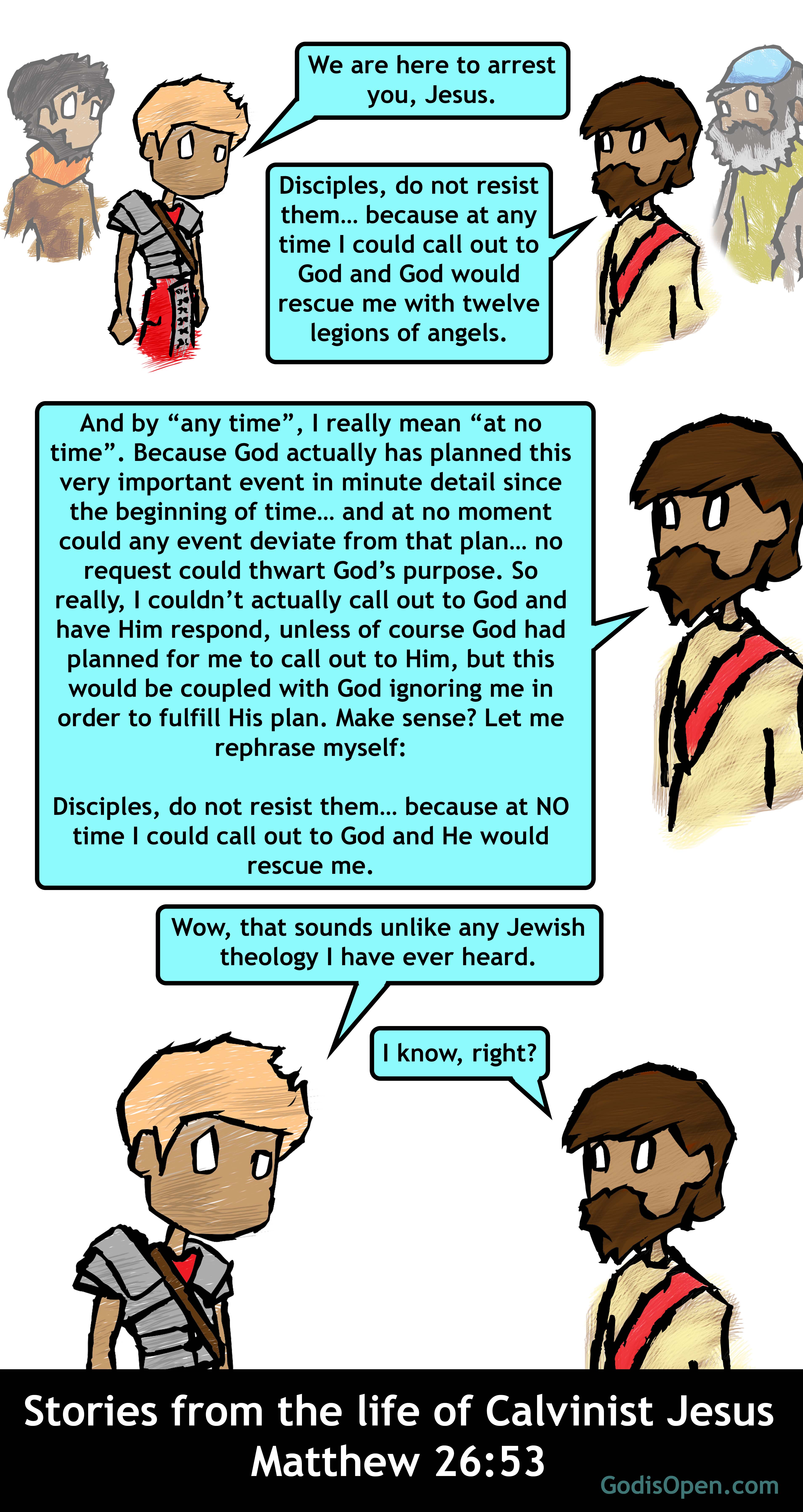
Worship Sunday – I Will Trust You
And I’ll wait and be still
And I’ll know You are God
You are God
I will love You and adore You
I will trust You God
And I will sing in times of trouble
(And) I will trust You God
In my weakness would You come
Help me stand up help me run
To the shadow of Your wings
And the comfort that it brings
Who Sinned That This Man was Born Blind
Unanswered questions – Eli’s sons
On a Youtube video:
Your claim is that God chooses (and chooses arbitrarily). When God chose the house of Eli to be His priests forever, did He change His mind based on that actions of Eli’s sons? Can the chosen be rejected (un-chosen) based on their actions?
1Sa 2:30 Therefore the LORD, the God of Israel, declares: ‘I promised that your house and the house of your father should go in and out before me forever,’ but now the LORD declares: ‘Far be it from me, for those who honor me I will honor, and those who despise me shall be lightly esteemed.
The Calvinist’s non-response:
I never said He chooses arbitrarily. He has His reasons. He just doesn’t always tell us what they are.
Can the chosen be rejected (un-chosen) based on their actions?
It depends on what they were chosen for. Those chosen for salvation, no.
The reply:
In 1 Sam 2:30, God recalls that He has given an “eternal” promise. This eternal promise is revoked based on the actions of human beings. Instead, God replaces His eternal promise with a new system in which He will reward based on actions. So the question to you: can God’s eternal promises be revoked? If so, in what way were they eternal? Can the elect, chosen for an eternal promise, reject God?
1Sa 2:30 Therefore the LORD, the God of Israel, declares: ‘I promised that your house and the house of your father should go in and out before me forever,’ but now the LORD declares: ‘Far be it from me, for those who honor me I will honor, and those who despise me shall be lightly esteemed.
Apologetics Thursday – Ware’s Narrative of 1 Sam 15
From Bruce Ware’s Their God is Too Small: Open Theism and the Undermining of Confidence in God:
He is God, not man, and as God, he is above any “regret” in this strong sense (v. 29). But second, just because God does not ever question what is happening (since he knew it all previously), we should not conclude that he doesn’t care about the sin that unfolds. He does! He is deeply dismayed at what Saul does as he witnesses the unfolding of what he previously knew would occur. And as God observes Saul’s sin, he bemoans the disobedience and harm that Saul’s actions reflect. So, he “regrets” (in a weak sense) Saul’s king-ship, even though he knew and planned all along what is actually transpiring.
The first thing to notice about this quote is that Ware rewrites the narrative of 1 Samuel 15. Just by reading the story, a casual reader will not walk away with the understanding that Ware presents.
In the first few verses of 1 Samuel 15, God commands Saul to kill the Amalekites. Saul does so but spares the livestock and the king. God then says He regrets making Saul king. If the author had any notion that this rebellion was “foreknown” this would be the time to mention something, anything. But the author has God responding to events as they unfold. God regrets and regrets without apology or qualification.
Samuel then confronts Saul as says because Saul has rejected God that God rejects Saul. Samuel also says that day God has torn the kingdom from Saul. Saul reigns another 18 years after this, so it should be obvious that God decides to tear the kingdom from Saul once He sees Saul rebel in this chapter. Over this, Samuel says that God is not a man that He should repent. The narrative then says that God repents of making Saul king.
Ware plays coy when he does not address the very obvious fact that Samuel’s words are limited to the context of God giving Saul back the kingdom. Both God and the narrator are clear that God has repented, and God seeks out David as evidence of this repentance. The repentance is crucial to the narrative, whereas Ware’s understanding of immutability invalidates the narrative. Ware discounts both the narrator and God’s own words in favor of an idiosyncratic understanding of Samuel’s words.
Calvinist Advice to Absuive Marriages
John Piper responds to the question: What should a wife’s submission to her husband look like if he’s an abuser?
Part of that answer’s clearly going to depend on what kind of abuse we’re dealing with here . . . .
If this man, for example, is calling her to engage in abusive acts willingly – group sex, or something really weird, bizarre, harmful, that clearly would be sin. Then the way she submits – and I really think this is possible, it’s kind of paradoxical [sic]. She’s not going to go there. I’m saying no, she’s not going to do what Jesus would disapprove [sic], even though the husband is asking her to do it.
She’s going to say, however, something like, “Honey, I want so much to follow you as my leader. I think God calls me to do that, and I would love to do that. It would be sweet to me if I could enjoy your leadership.” And so – then she would say – “But if you would ask me to do this, require this of me, then I can’t – I can’t go there.”
Now that’s one kind of situation. Just a word on the other kind. If it’s not requiring her to sin, but simply hurting her, then I think she endures verbal abuse for a season, she endures perhaps being smacked one night, and then she seeks help from the church.
Duffy on Freedom to Sin under Calvinism
Will Duffy, from a Facebook conversation:
When a Calvinist says that an unregenerate man is free to sin, he is lying to you. No Calvinist in the world believes that an unregenerate man is free to sin. An unregenerate man cannot sin unless God decreed for him to sin. An unregenerate man cannot freely choose what sin he wants to commit, he can only commit the sins God decreed for him to commit. According to Calvinist doctrine, God is the author of sin, not man. Man has no say in the matter.
Free Monday – Straight and Crooked Thinking
A free book about logical and rational thinking:
Worship Sunday – Wonderful
Father You’re holy
Jesus You’re worthy
Spirit You’re lovely
God You’re wonderful
Father we need You
Jesus we love You
Spirit You’re welcome here
God You’re wonderful
Father You are heavenly
You are kindness and goodness without end
Jesus You are royalty
You are honored You’re worthy of all our days
Spirit You are a holy wind
Would You breathe and move and fall on us
Wonderful yes You are yes You are
You are great and wonderful
Yes You are yes You are
Father in heaven
Jesus among us
Spirit with us
God You’re wonderful
God You’re our Father
Jesus our brother
Spirit our helper
God You’re wonderful
Ware on Immutability
Calvinist Bruce Ware talks about immutability:
Through much of the history of the church, God has also been understood as absolutely immutable in every respect. After all, it was often reasoned , if God can change, then that changeability must indicate a change for the better or a change for the worse. But if for the better, then he was not God before; and if for the worse, then he no longer can rightly be conceived as God.
Ware, Bruce (2008-05-15). Perspectives on the Doctrine of God (p. 90). B&H Publishing. Kindle Edition.
Unanswered Questions – An Alternative Understanding of 1 Samuel 15
To the Calvinist who believes that 1 Sam 15 is a good prooftext for immutability:
1Sa 15:29 And also the Strength of Israel will not lie nor relent. For He is not a man, that He should relent.”
Is it possible that 1 Sam 15:29 is limited to the context (God is saying He will not repent of repenting of making Saul king) and that 1Sa 15:35 and 1Sa 15:11 better describe God’s thoughts and actions as described in the chapter?
Apologetics Thursday – Ware’s Selective Quoting
 From Bruce Ware’s Their God is Too Small: Open Theism and the Undermining of Confidence in God:
In Isaiah 41:21-29, God challenges the false gods, the idols of the nations surrounding Israel, to prove that they are gods. And what is the test he puts forth? God declares, “Let them bring them [these imposter gods], and tell us what is to happen. Tell us the former things, what they are, that we may consider their outcome; or declare to us the things to come. Tell us what is to come hereafter, that we may know that you are gods” (Isa. 41:22-23a, emphasis added).
The full passage is what follows:
Isa 41:22 “Let them bring forth and show us what will happen; Let them show the former things, what they were, That we may consider them, And know the latter end of them; Or declare to us things to come.
Isa 41:23 Show the things that are to come hereafter, That we may know that you are gods; Yes, do good or do evil, That we may be dismayed and see it together.
Isa 41:24 Indeed you are nothing, And your work is nothing; He who chooses you is an abomination.
Ware has neutered the purpose of Isaiah 41:22-23 by extracting the key components of the test. God is not challenging the false gods to a knowledge test, but to a power test. This test is under the same line as power tests throughout the Bible (see 1 Kings 18 for a prominent example). God is asking the false gods to give examples of previous power acts that they have completed to prove that “their work is something” to prove that “they can do good or evil” which can “dismay the observer”. Isaiah is not challenging the false gods to a trivia contest.
The judges are Israel who will evaluate if Yahweh is more powerful than the false gods. They are not evaluating if Yahweh just has more information that the false gods, but they are interested in seeing if Yahweh is powerful and can do the things that He says. The point of knowing the purpose of past acts is not just to have working knowledge, but being able to point to a purpose and a plan that is being worked out.
If the false gods cannot provide consistent and powerful acts that can be attributed to them, but Yahweh can, then Israel should take note and then decide to serve Yahweh. Notice the underlining assumption of free will in this passage.
This passage immediately moves into an example of God telling His purpose behind a power act He is working at that very moment:
Isa 41:25 “I have raised up one from the north, And he shall come; From the rising of the sun he shall call on My name; And he shall come against princes as though mortar, As the potter treads clay.
Isa 41:26 Who has declared from the beginning, that we may know? And former times, that we may say, ‘He is righteous’? Surely there is no one who shows, Surely there is no one who declares, Surely there is no one who hears your words.
What is God “declaring from the beginning”? It is that God is “raising up a savior” into order to save Israel. This is not game of trivia.
Boyd on the Conclusion of Romans 9
From reknew:
A fourth argument that demonstrates the error of the deterministic interpretation of Romans 9 concerns Paul’s summary at the end of this chapter. Whenever we are struggling to understand a complex line of reasoning such as we find in Romans 9, it is crucial to pay close attention to the author’s own summary of his argument, if and when he provides one. By all accounts, Romans 9 is a difficult, complex and highly disputed passage. Fortunately, Paul provides us with a very clear summary of his argument in this chapter (vss. 30-32). Unfortunately for the deterministic interpretation, it appeals to free will as the decisive factor in determining who “receives mercy” and who gets “hardened.”
Paul begins his summary by asking, “What then shall we say?” (vs. 30). If the deterministic interpretation was correct, we would expect Paul to answer by saying something like, “The sovereign God has determined who will be elect and who will not, and no one has the right to question him.” As a matter of fact, however, Paul doesn’t say anything like this. He rather summarizes his argument by saying:
Gentiles, who did not strive for righteousness, have attained it, that is, righteousness through faith; but Israel, who did strive for the righteousness that is based on the law, did not succeed in fulfilling that law. Why not? Because they did not strive for it on the basis of faith, but as if it were based on works” (vss. 30–32).
Enyart on What Cannot be a Figure of Speech
From Bob Enyart’s debate with Larry Bray:
2. STORY: God gave the Bible as a book of stories because unlike grammatical nuances the plot of a story survives translation into a thousand languages. So we interpret each verse to be consistent with the Bible’s overall plot. When God repeatedly repents and UNDOES things THAT HE DID, that cannot be a figure of speech because these are ACTIONS, which form parts of a story. A storyline can survive even poor grammar and translation (e.g., see a foreign language film with no subtitles). That’s why I wrote a book called The Plot [tiny.cc/lxwyp].
Meme Monday – Best Prooftext
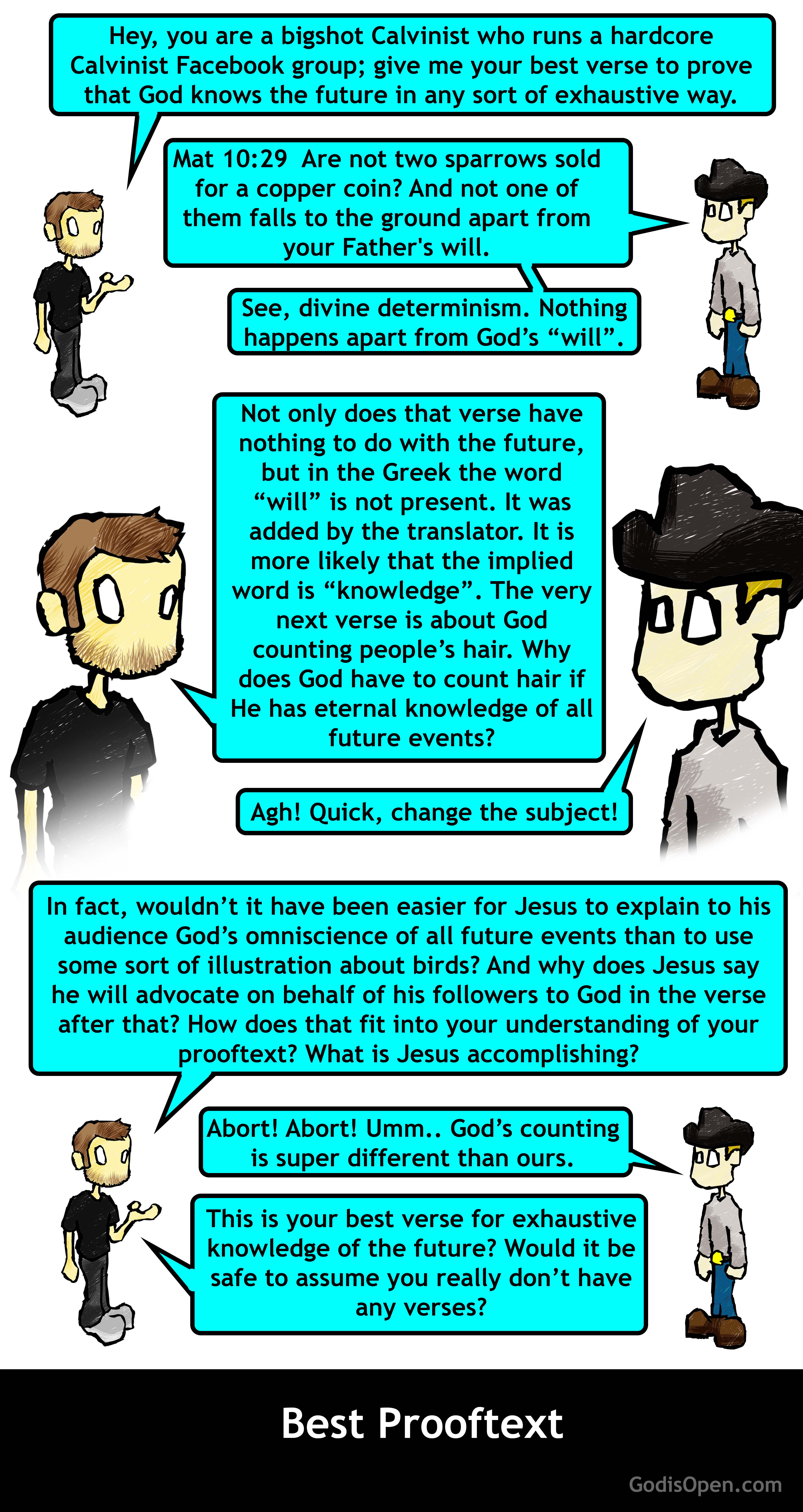
 God is Open