Worship Sunday – Hungry

Hungry, I come to you
For I know You satisfy
I am empty, but I know
Your love does not run dry

So I wait for you
So I wait for You
I’m falling on my knees
Offering all of me
Jesus, You’re all this heart is living for

Broken, I run to You
For Your arms are open wide
I am weary, but I know
Your touch restores my life

So I wait for you
So I wait for You
I’m falling on my knees
Offering all of me
Jesus, You’re all this heart is living for

Unanswered Questions – Fables in the Bible

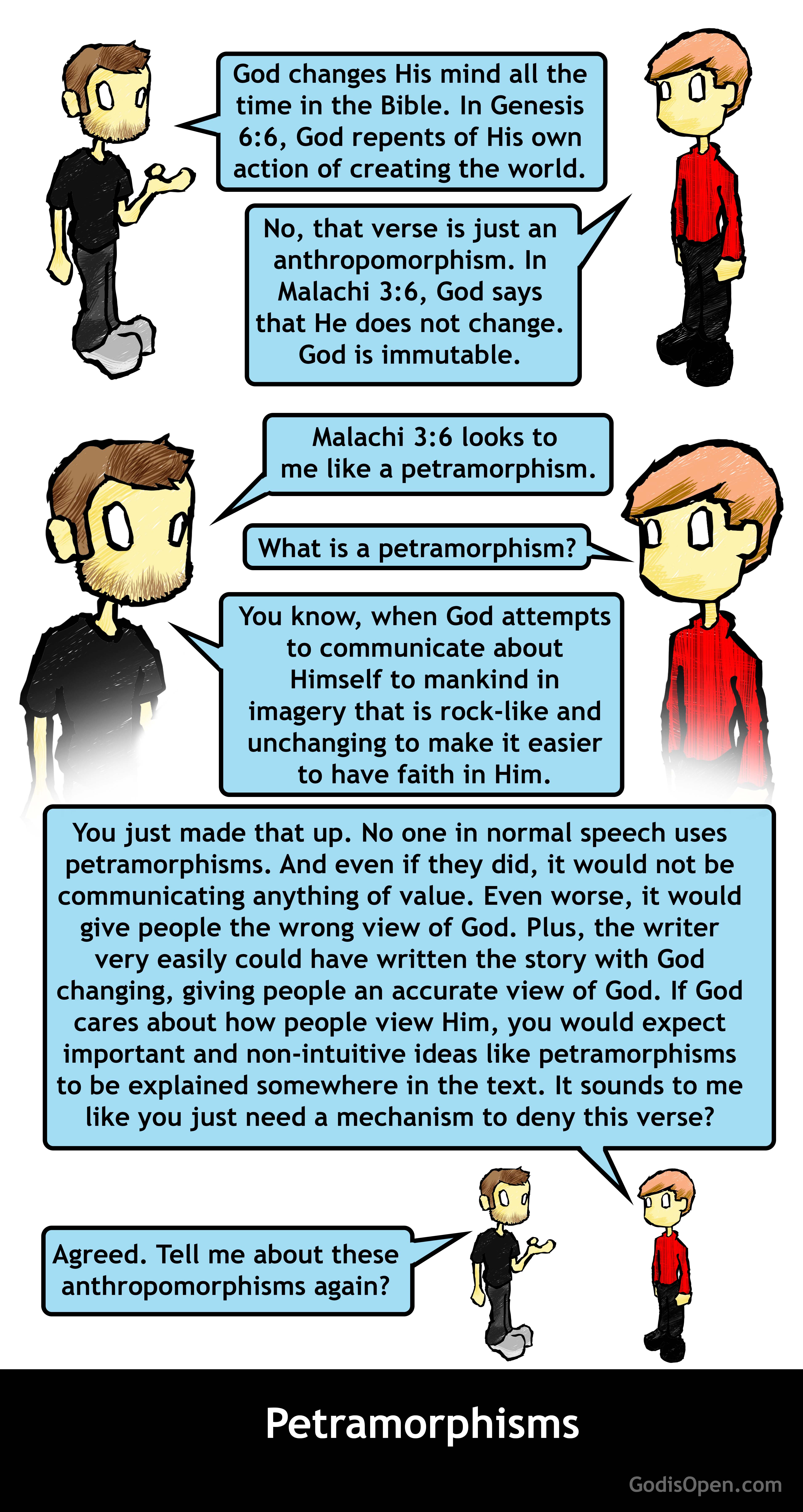
Genesis 6 describes God looking down on Earth, seeing they have become evil, repenting of His own action of making mankind, and then becoming grieved. Calvinists claim that none of these things happened; that these are anthropomorphisms or baby talk by God to humans. How is claiming the events are an anthropomorphism materially different than calling it a fable?

Apologetics Thursday – Natural Reading

From Their God is Too Small: Open Theism and the Undermining of Confidence in God by Bruce Ware:

Two features of 1 Samuel 15:29 deserve brief mention. First, notice how the author links together the ideas of “will not lie” and “[will not] have regret.” Since it is true that God never lies (2 Tim. 2:13; Titus 1:2; Heb. 6:18), and since these ideas are connected in 1 Samuel 15:29, is not “God never lies and never regrets” the most natural way to understand this passage?

Bruce Ware claims the “natural way” to understand the text of Samuel is by importing questionable interpretations of texts written centuries after the passage being examined. It is important to notice this Calvinist mindset. Understanding passages in their textual context is not a primary importance. Forcing the text into some sort of broader systematic theology is the focus. This mindset is so ingrained that they believe it is the “natural way” to understand the text (nevermind that all of Israel did not have the overriding prooftexts for centuries). How did those Israelites read the text? What was their natural understanding. Possibly, like any reader of any text anywhere, they had to look towards the immediate context. That was their natural way to understand the text. And in context of God revoking His eternal plans, Calvinism was the least of their interpretation of the text.

McMahon on Psalms 139:16

THE KNOWLEDGE OF GOD IN PSALM 139:13-16

Timothy P. McMahon

David’s words in Psalm 139:16 are often cited to support the notion that God has predestined the lives and actions of human beings. The New King James Version’s rendering is typical:

And in Your book they were all written, the days fashioned for me, when as yet there were none of them.

From this translation one might reasonably understand that God, like the Fates of Greek mythology, has determined the individual’s lifespan and the course of events within it. Yet, interestingly enough, the old King James Version, whose translators’ predestinarian bent is evident throughout their work, viewed this text from a much less fatalistic perspective:

And in thy book all my members were written, which in continuance were fashioned, when as yet there was none of them.

In their view, apparently, God was able to foreknow, and perhaps to foreordain, David’s physical characteristics from his embryonic state. One might take this as an anachronistic (not only for the psalmist, but for the translators) description of genetics.

While the KJV translation here offers a reasonable concept, in order to understand the text more fully, we must examine the original Hebrew. One caveat at the outset: The text of Psalm 139:13-16 is extremely difficult. (Note that the two renderings above achieve quite disparate results, both containing several italicized words supplied by the translators in their attempt to make sense of the original.) We will attempt a fresh analysis of the text in order to propose a new interpretation of the passage.

Let us first view the passage under consideration within the context of Psalm 139 as a whole. Dahood (1969:3:284) points out that the psalm is a declaration of innocence on the part of the author. HaShem knows that he is pure, that he is not guilty of unfaithfulness or idolatry. His accusers (v.19) have nothing to stand on. God Himself can vouch for him. God knows everything about him, all his deepest secrets, even what he cannot know about himself[1].  Even if he wanted to escape the providence of HaShem, that would be impossible. Heaven is not high enough, the sea is not far enough, the winds are not remote enough, Sheol is not deep enough. The breadth and depth of God’s knowledge are “too wonderful for me, too high for me to attain” (v.6). He concludes the section leading up to our passage by exclaiming:

Even in the darkness He observes me[2]

and night is daylight all around me.

Even the darkness is not too dark for You

and at night it shines like daytime for You.

As darkness, so is light.

The imagery in v.12 of darkness, night and concealment remind David of that place which in Hebrew thought most typifies the unknown: Sheol, the realm of the dead[3]. The Old Testament offers only imprecise descriptions of the netherworld, where humans exist consciously in a shadowy state. In the Hebrew mind, the tentative, undefined existence in Sheol was comparable to another realm of human existence of which men had only the shadow of knowledge: the life of the fetus in his mother’s womb. The association between Sheol and the womb is intensified by the figure of the earth as mother[4]. Just as the fetus lives within his mother’s body, so Sheol is a chamber within the earth[5]. Job declares:

Naked I came from my mother’s womb, and naked I will return there[6].

Scripture elsewhere affirms God’s intimate knowledge of the netherworld (Job 26:6; Proverbs 15:11). Here, David declares that He possesses equally comprehensive knowledge of pre-natal life. As we approach vv.13-16, then, we must understand that the focus of David’s awestruck praise is not God’s ability to make things happen in the future, but His ability to examine the impenetrable, to see as well in darkness as in light, to know thoroughly and intimately those realms which to humans are mere shadows. Scripture often celebrates HaShem’s ability to bring about His will (e.g., Isaiah 49:10; Psalm 115:3), but here the subject is His wisdom, His understanding, His ability to perceive and know all things.

verse 13

ki atah qanita kilyotay // tesukkeni bebeten imi

for You possessed my kidneys // You covered me in my mother’s womb

While the syntax of this verse is refreshingly straightforward, there is room for discussion on the meanings of several key words.

(a) qnh. Generally in its 182 occurrences = “possess, acquire, purchase.’’ In Ugaritic it seems to mean “create, bring forth,’ which sense scholars have attempted to assign in Hebrew as well[7]. We see no compelling reason to accept this idea here, though.

(b) kilayot literally are the kidneys of a human or animal. The term is also used figuratively in a manner similar to the biblical use of ‘heart’ to signify a person’s innermost being or true self. This then might be a statement to the effect that God knew David intimately from his very beginning. Alternatively, TWOT suggests that kilayot is put here by synechdoche for the body as a whole, in which case it would be an indicator of HaShem’s protective care over the bearer of the messianic lineage.

(c) skk normally means ‘to cover,’ as in Exodus 33:32, “I will cover you with My hand,” indicating protection (Nahum 2:5), oversight (Exodus 25:20) or concealment (Lamentations 3:44)[8]. Dahood proposes translating the preposition b- ‘from,’, a usage common in Psalms[9]. This changes the focus to an affirmation of God’s protection throughout his life: “You have covered me from my mother’s womb.”

verse 14

odka ‘al ki nora atah nipla’ot

I will praise You, High One, for You are marvelously wonderful

nipla’im ma‘aseka // wenapsi yada‘ta me’od

marvels, Your acts // yes, You know my soul intimately.

The challenge of this verse is the inverse of the previous: Here, the vocabulary is relatively simple, but the syntax is difficult. Our translation above departs from the Massoretic Text in favor of the reading preserved in the Qumran manuscript 1QPsa as transcribed by Sanders (1967:72). In contrast, the best rendering we can come up with reading MT is as follows:

I will praise You because I am awesomely marvelous. Your acts are marvels, which my soul knows very well.

(a) This rendering divides the “marvels” between HaShem and David, his creation, rather than focusing on the Creator alone[10]. The final clause then addresses the psalmist’s knowledge rather than the knowledge of God, which we believe to be the overall theme of the composition.

(b) ‘al is normally a preposition, ‘on, upon,’ which here would be logical in sense, ‘because.’ Dahood (1969:3:293) sees here, as often in Psalms, a divine title, ‘el, similar to the universally recognized ‘elyon, ‘ Most High.’ The preposition ‘al here would be superfluous, as the following ki already means ‘because.’

(c) The MT form nora’ot is a feminine plural adjective, ‘awesome,’ with no apparent noun to modify. 1QPsa reads nwr’ ’th (which we have vocalized nora’ ’atah), the masculine singular form along with the 2ms pronoun. This yields an exclamation from David to HaShem, “You are awesome!” serving as an explanation for the preceding verb of praise[11].

(d) The form nipla’ot (from 1QPsa; MT reads niple’ti) is a nif‘al feminine plural participle from pl’, ‘to be marvelous.’ We have interpreted it as a substantive participle used adverbially: “You are marvelously awesome.”

(e) With Dahood we have repointed MT yoda‘at (fs qal participle) to yada‘ta (2 ms qal perfect), “You have known.” A more wooden rendering of the last word in the verse would yield, “You know my soul so well.” The important factor is to see it as a description of God’s knowledge rather than the psalmist’s.

David is simply in awe of the extent of HaShem’s knowledge both of the creation in general and of himself in particular. (This dual focus, along with the highly emotional state of the psalmist, explains the somewhat abrupt transitions in the syntax.) Even if the entire world is against him, HaShem knows his innocence; HaShem will vindicate him, for He has known him intimately since his very conception.

verse 15

lo’ nikhad ‘ozmi mimeka // aser ‘usseti baseter

my bones were not hidden from You // when I was made in the secret place

ruqqamti betahtiyot ’ares

[when] I was woven in the lowest parts of the earth

(a) The pointing of ‘ozmi ordinarily would indicate its derivation from ‘osem, ‘might,’ but, as this does not fit the sense, a derivation from ‘esem, ‘bone,’ is much more plausible and supported by the versions. While one would normally anticipate the plural ‘asamay, the singular is apparently used as a collective (cf. NKJV, ‘my frame’)[12].

(b) The verb form ‘usseti is understood as a form of ‘sh, ‘to make,’ although among over 2,000 occurrences, this is the only attestation of the pu‘al conjugation in Scripture. The sense fits well, and we have seen no convincing alternative proposal. Perhaps the pu‘al is used in an intensive sense to depict the duration of the process.

(c) We have rendered seter as ‘secret place’ because of its parallel to “the lower parts of the earth,” an unmistakable designation of Sheol.

(d) The verb rqm and its noun riqmah occur collectively twenty times in the OT, always with the meaning ‘embroider, weave.’ The verb implies great skill on the part of the weaver and usually a variegation of colors in the woven object. This unique usage seems to be an allusion to the marvelous intricacy of the human body, recognized even in pre-scientific times.

Verse 15 makes explicit the equation of the womb with Sheol. Since Sheol is “the secret place,” a miscarried fetus is “hidden” there (Job 3:16). Perhaps the view of Sheol as Abraham’s bosom (Luke 16) is prefigured in this usage, for “the secret place” is also used to designate the intimate dwelling of HaShem (Psalm 18:11; 32:7; 91:1).

While David employs passive forms here (“I was made… I was woven”), there can be no doubt that he views HaShem as the One who brought him forth: “Your hands have made me and stood me upright” (Psalm 119:73). The comparison of Sheol, which is in the earth, recalls God’s original formation of Adam “from the dust of the earth” (Genesis 2:7). That God brought David forth from the lower parts of the earth also foreshadows the redemption of Christ, who descended into “the lower parts of the earth” (Ephesians 4:11) to bring forth the souls of the righteous, such as David, to eternal life by His resurrection (cf. the application of Psalm 16 to Christ in Acts 2).

David’s poetic usage of the expression ‘embroidered’ or ‘variegated’ leads us to pause briefly to reflect upon the ancient biblical writers’ appreciation of the process of conception and fetal development. Qohelet (11:5) reminds us of the limitations of our knowledge:

Just as you do not know the way of the wind, or how the bones develop in the pregnant woman’s womb, so you do not know the action of God who does it all.

Again, God’s understanding of fetal development is an indication of the superiority of His knowledge. The most explicit biblical description of the process is found in Job 10:8-11, which we cite with minimal comment:

Your hands fashioned and made me altogether

— yet now You destroy me!

Remember that You made me out of clay

and to the dust You will return me[13].

Did You not pour me out like milk,

and curdle me like cheese?

You clothed me with skin and flesh

and knitted me with bones and muscles.

verse 16

golmi ra’u ‘eneka // we‘al sipreka kullam yikkatebu

Your eyes saw my fetus // and in Your book they all were written

yamim yussaru welo’ ehad bahem

they were formed [over a period of] days, and one of them is His

or, and not one is among them[14].

The difficult text of verse 16 has challenged interpreters throughout the centuries. The LXX renders almost word for word, yielding a translation not much better than the standard English versions:

akatergaston mou eidon oi ofqalmoi sou, kai epi tou bibliou sou panteı grafhsontai; hmeraı plasqhsontai kai ouqeiı en autoiı

Your eyes beheld my unformed [body] and in Your book all will be written; they will be formed [over a period of] days, and none [is] among them.

The main problem is determining the antecedent of the plural suffix of kullam, which in turn is the apparent subject of the verbs yikkatebu and yussaru. The only available candidate, golmi, ‘my fetus,’ is singular[15]. The usual approach is to find the requisite plural noun in yamim, ‘days.’ From this is derived the notion that the psalmist’s days are written in God’s book; that is to say, his life, or at least its duration, is predetermined. However, we see no solid basis for the idea that the plural suffix is “anticipatory” to a following noun here. Further, the verb ysr means ‘to form, shape,’ generally a physical object; rarely used figuratively in the sense of ‘formulate’ a plan of action. The concept of ‘forming days’ has no OT precedent. Finally, in this interpretation, the word ehad, ‘one,’ must refer to one of the days, which yields no perceptible sense from either textual variant of the final clause[16]. Modern interpreters generally resort to some sort of emendation (e.g., glmygmly, ‘my actions,’ with support from the Syriac) or reanalysis (Dahood reads gilay-m, ‘my life cycles’), but none of these attempts is to our satisfaction.

Unconvinced by ancient or modern interpretations, we here present our own proposal. We caution the reader that our solution is hypothetical, not resting on empirical evidence, yet we consider it eminently reasonable[17]. We propose that glmy be revocalized as golmay, a plural form representing the diversity of elements in the embryonic human body. The form is then understood in English as a sort of collective noun. We would then translate golmay as ‘my fetus,’ but the plural form would enable us to take this noun properly as the antecedent of the plural suffix -m, and so also as the subject of the two plural verbs, “were written” and “were formed.”

We cite by way of analogy the Hebrew noun panim, ‘face,’ which “always occurs in the plural, perhaps indicative of the fact that the face is a combination of features” (TWOT:727), and accordingly can take plural verbs (Isaiah 29:22) and adjectives (Proverbs 25:23), even when it refers to the face of only one person. In this light, we translate as follows:

Your eyes watched my fetus [in all its features]

(In Your book it was fully described in writing)

As it was being formed over a period of time.

And one of those [features] is His.

The second clause is understood as somewhat parenthetical; the third clause is subordinate to the first. The final clause is a bit abrupt, but such transitions (including the shift from second to third person) occur earlier in the composition and are well documented in Psalms generally.

David marvels at the depths of God’s knowledge and His providence. Throughout David’s gestation, HaShem watched the unfolding of the marvelous process He had set in motion when He created Adam and Eve with the power of procreation. Yet surely He was not merely observing, but carefully watching over David, forerunner of the promised Messiah.

What does it mean that David’s features were written in God’s book? This is usually taken as a reference to the book of life, which is then understood (in the light of Revelation 21:27) to mean that God determined David’s eternal destiny at the moment of his conception[18]. However, the book of life is not the only divine book mentioned in Scripture. Revelation 20:12 refers in the plural to “the books,” echoing Daniel 7:10. In addition to the book of life, God has other books in which He records people’s deeds and also the experiences of His people (Psalm 56:8). There is even a “book of HaShem” concerning the natural activities of the animals (Isaiah 34:16)[19]. We believe that David is referring to God’s careful record keeping concerning His beloved, even numbering the hairs on our heads. As cited above, Qohelet 11:5 infers that fetal development is in some sense “God’s action,” and our verse 16 stresses that it takes place over a period of time (taking yamim adverbially, as LXX and commonly in OT).

What then is the sense of the final clause? What “feature” of the fetus pertains especially to God? We believe this refers to the inner man, the soul or spirit. HaShem is “the God of the spirits of all flesh” (Numbers 16:22 & 27:16), not merely of the elect. (Certainly the spirit of every son of Israel would be His in a special way simply by virtue of the covenant.) Paul in Romans 5 establishes that by the justifying power of Christ all men are redeemed from the sin of Adam, and, in that sense, the spirit of the fetus would truly be His, at least until death ensues from the revival of sin (Romans 7:11)[20]. David himself trusted that his deceased child’s soul was in God’s loving hands (2 Samuel 12:23). “The spirit [nesamah] of man is HaShem’s lamp, searching the chambers of the belly” (Proverbs 20:27). Finally, it must be in the spirit that Christ illuminates every man who enters the world (John 1:8).

God, looking upon David as a mere shapeless mass, could view him as the person he would become. To HaShem, Creator of all, the individual’s genetic makeup is an open book. Certainly if we, mere human beings, can reasonably anticipate the results of our efforts, God, in His inestimable intelligence, can foresee David’s physical and mental characteristics and so deem him a suitable forerunner of the King. His ability in this regard is the same for every one of us as we are conceived in our mother’s womb. So we, too, can exclaim with the psalmist:

And for me, how precious are Your thoughts, O God,

How mighty their essence.


Bibliography

Bialik, Hayim N. and Yehoshua H. Ravnitsky, The Book of Legends (Sefer haAggadah), tr. William G. Braude. New York: Schocken, 1992 ed. (originally published in 1908-11).

Dahood, Mitchell J., Anchor Bible vol. 17A, Psalms 101-150. Garden City, NJ: Doubleday, 1970.

Klein, Ernest, A Comprehensive Etymological Dictionary of the Hebrew Language for Readers of English. New York: Macmillan, 1987.

Rosenberg, A.J., Psalms: A New English Translation, vol. 3. New York: Judaica Press, 1991.

Schwartz, Howard, Lilith’s Cave: Jewish Tales of the Supernatural, San Francisco: Harper & Row, 1988.

Weiser, Chaim M., Frumspeak: The First Dictionary of Yeshivish. Northvale, NJ: Jason Aronson, 1995.

[1] Here we might compare Paul in 1 Corinthians 4:1-5. An apt comparison may be made also to Christ, the One falsely accused throughout His life by the self-righteous of His day and finally condemned in the place of a criminal. In fact, a majority of this psalm may be read in a quite edifying manner as Messianic.

[2] Interpreting God as the subject of yesuppeni and taking swp here as equivalent to Arabic safa, ‘to watch, look.’ Cf. Job 9:17, “who observes me from the storm cloud.” See Dahood (1969:3:291).

[3] Darkness is associated with Sheol in Psalm 88:13; Job 15:22; 1 Samuel 2:9; Psalm 143:3.

[4] The image of Mother Earth does not appear as such in Scripture, probably to differentiate Israelite religion from the fertility cult so dominant in the beliefs of the surrounding peoples, and to emphasize that HaShem, who sometimes describes Himself with maternal imagery (Job 38:29; Isaiah 49:15-16), is the source of all creation, including the earth. It is implicit in the use of “mother” to designate the land of Israel (Hebrew eres means both ‘land’ and ‘earth’) in such texts as Isaiah 50:1; Ezekiel 19:2; Hosea 4:8, and also the land of Babylon in Jeremiah 50:12. It is also recognizable in such expressions as daughter (of) Zion, etc.

[5] Sheol is actually called a “womb” in Jonah 2:3, and the sea is said to have come forth from the womb in Job 38:8.

[6] Job’s statement is echoed almost verbatim in Qohelet 5:15, and, in less mythological terms, by Paul in 1 Timothy 6:7. Qohelet further equates the pre-natal and posthumous states in 6:4-5, indicating his belief in a conscious intermediate state, as opposed to the common but erroneous contrary interpretation of 9:5-10. The imagery of Job is brought out more fully in Ben Sira 40:1, “from the day they go forth from their mother’s womb, till the day they return to the mother of all living.”

[7] Primarily in Genesis 14:19-22, where HaShem is called qoneh samayim wa-eres, which might then be rendered ‘Creator of heaven and earth,’ although ‘Possessor’ is equally valid. Also see Deuteronomy 32:6, which may be translated to the effect that HaShem created Israel, but could also be understood as a declaration that He redeemed (‘purchased’) His people from Egypt.

[8] A homophone meaning ‘knit together’ has been proposed for this text and Job 10:11 (cited below).


[9] Supported by LXX ek gastroı and Syriac min karseh

[10] It also assumes that the verb niple’ti is derived from pl’, ‘marvel,’ rather than from plh, ‘separate,’ with which the form is more compatible.

[11] LXX oti foberoı qaumastwqhı, ‘for You are awesomely wonderful,’ is supportive here.

[12] LXX to ostoun mou is again sympathetic. 1QPsa reads ‘sby, ‘my pain(s),’ unless this represents a phonetic confusion of the labials b and m.

[13] Echoing the words of God to Adam in Genesis 3:19.

[14] Verse 16 exhibits a textual variant. The ketib, which is the text as written, reads l’, ‘not.’ The qere, the Massoretic marginal correction, reads lw, ‘to him.’ KJV and NKJV follow the ketib. We have chosen in our main exposition to follow the qere, but also offer an explanation following the ketib version.

The same variation between the negative and the possessive occurs in Isaiah 9:3 (v.2 in MT). KJV, following the ketib, renders “Thou hast multiplied the nation, and not increased the joy; they joy before thee…” The negation here is nonsensical. Reading the qere, we understand the verse: “You have multiplied the nation, You have increased their joy; they rejoice before You…”

[15] The word glmy is a hapax legomenon in the Bible. The only other occurrence of the root is the verbal form yglm in 2 Kings 2:8, where Elijah ‘rolled up’  (perhaps ‘wadded up’?) his garment. Klein (1987:101) defines golem as a “shapeless matter.” In medieval and modern Hebrew the verb develops such meanings as ‘personify’ and ‘embody.’ Rosenberg (1991:517-18) quotes Rashi and Redaq (David Qimhi) to the effect that glm refers to “the solidified drop of sperm, before the limbs and organs are formed in it. It is called golem just as wood is called golem before it is formed into a utensil.” Klein also compares Aramaic gulma, ‘shapeless mass.’ Finally, in Yeshivish, the slang of the rabbinical academies, goilem (note the Yiddish pronunciation) has come to mean ‘a hopelessly foolish or ineffectual person’ (Weiser 1995:31).

The rabbis of the midrash (Genesis Rabbah, cited in Bialik 1992:15) viewed this text from two angles. It was said in the name of R. Eleazar, “As the Lord was creating Adam, He had come to the stage when Adam had the form of a golem, an unarticulated lump, which lay prone from one end of the world to the other. With regard to this, Scripture says, ‘Thine eye did see my golem.’ In contrast, R. Judah bar Simon said that while Adam lay prone as a golem, ‘God caused to pass before him each generation with its sages, each generation with its scribes, each generation with its leaders, as it is said, ‘O [Adam], when thou wast a golem, thine eyes did see all [the worthies whose names were] inscribed in thy book’.” Medieval kabbalists developed a rather extensive legend concerning the golem. Such luminaries as the Maharal (R. Judah Loew of Prague) were said to have brought a clay figurine to life through magical invocation of the Tetragrammaton, and golem was used to describe this humanoid. See, among others, Schwartz (1988:243-5).

[16] The rabbis, following the qere reading lw, have traditionally understood this as a reference to the sabbath: At the original creation, God formed the seven days, and one of them was His. We find this interpretation lovely, but cannot imagine how it would be of any relevance in the context of Psalm 139.

[17] It is entirely possible that our proposal has been offered before, and we are simply unaware of its existence in the literature. If this is the case, we are not attempting to appropriate another’s scholarship. We can only vouch that we have not seen it elsewhere, and that it is, in this sense, the outcome of our own prayer and seeking of divine wisdom.

[18] We find it curious that those who oppose the open view of God would seek to buttress their argument by citing this text to support the notion that God made these determinations when David was in utero, as elsewhere it is held that all such determinations were made “before the foundation of the world.”

[19] Perhaps, in light of the command to “read,” this refers to the Torah, but we prefer to find in this text an allusion to the “laws of nature.” God’s involvement with the animal kingdom is portrayed in the whirlwind discourse in Job and in Psalm 104, esp. vv. 14, 21, 27-30.

[20] Taking the ketib reading l’, ‘not,’ we would render, “and not one of them [yet] existed [in its mature state].” In other words, God could perceive all of David’s features when they did not yet possess discrete forms.

Psalms 139:16 – Not a Calvinist Prooftext

Reprinted in full from Will the Real God Step Forward:

Psalm 139:16

New International Version (NIV)
16 Your eyes saw my unformed body;
all the days ordained for me were written in your book
before one of them came to be.

JPS Hebrew-English TANAKH
16:Your eyes saw my unformed limbs;
they were all recorded in your book;
in due time they were formed to the very last one of them.

This is the same verse as depicted in two very different translations. The NIV translates the verse as the “days” were formed and written before one of the “days” came to be. The JPS says the “unformed limbs” were formed and written before the “unformed limbs” became fully formed. The NIV uses the term “days” as the subject of the sentence clauses, the JPS uses the term “days” as an adverb; all these things happen in the days the limbs were being formed.

Although the Hebrew is not straightforward, the NIV leaves room for only one interpretation. In this version, the word “days” is the subject of all three clauses: the days “were ordained”, “were written” before “one them came to be”. As is often the case, this translation is used as a proof text for predestination and foreordination. It is claimed that God has predestined the days of every individual’s life. This has been the theme of too many Calvinist commentators who subordinate biblical exegesis to theology:

Foreordination in general cannot rest on foreknowledge; for only that which is certain can be foreknown…His foreknowledge of what is yet to be, whether it be in regard to the world as a whole or in regard to the, detailed life of every individual, rests upon His pre-arranged plan (Jeremiah 1:5; Psalm 139:14-16; Job 23:13, 14; 28:26, 27; Amos 3:7).

Boettner, Lorraine. The Reformed Doctrine of Predestination. Philadelphia: The Presbyterian and Reformed Publishing Company, 1966(p. 74)

The translation committee of the NIV was heavily weighted with Calvinist sympathizers. The lead translator was Edwin H. Palmer, who had died in 1980 served as executive secretary of CBT, as coordinator of all translation work on the NIV, and as the first general editor of The NIV Study Bible. Dr. Palmer was a pastor of Christian Reformed Churches and an Instructor in Systematic Theology at Westminster Theological Seminary (1960–1964). He wrote two books, one of which was The Five Points of Calvinism.

But as the JPS translations indicates, this is a poor prooftext for the Calvinist’s point. There is a better competing translation to the translation offered by the NIV. Although many if not most Calvinists accept Psalm 139:16 as a proof text for predestination, Calvin himself would agree with the JPS translation that the Hebrew uses “days” in an adverbial sense:

PSALM 139

16. …Interpreters are not agreed as to the second clause. Some read ימים, yamim, in the nominative case, when days were made; the sense being, according to them — All my bones were written in thy book, O God! from the beginning of the world, when days were first formed by thee, and when as yet none of them actually existed. The other is the more natural meaning, That the different parts of the human body are formed in a succession of time; for in the first germ there is no arrangement of parts, or proportion of members, but it is developed, and takes its peculiar form progressively.

Calvin’s Commentaries, Vol. 12: Psalms, Part V, tr. by John King, [1847-50], at sacred-texts.com Psalm 139

Calvin does not go into detail why he thinks “days” should be translated adverbial but I propose three reasons: the common adverbial use of the word “days” transliterated yā·mîm in the Old Testament, the context of Psalm 139, and the description of the use of yā·mîm as an adverb by a grammarian. It cannot be emphasized enough; this idea is supported by one very important grammarian: John Calvin.

The Hebrew word for days in Psalm 139:16 is transliterated yā·mîm (Hebrew יָמִ֑ים) is used 269 times in the Old Testament. It is used nominatively or accusatively, as the subject or the direct object of the verb, fewer than 45 times. (Amos 9:13 Behold the days are coming) Most of the other uses are adverbial uses of noun, what often is referred to as the genitive case.  (Genesis 8:12 So he waited yet another seven days and sent out the dove) It is admitted that “days” is a noun, the question is how is the word “days” used in the sentence; as the subject of the verb or the object of the verb or as an indicator of the duration of the action.

Most of the 269 times are adverbial uses of yā·mîm. In many cases as in Genesis 8:12 “seven days” just appears as a noun without a preposition or other indicator of adverbial use. In the English it is common to put a preposition before a noun to indicate the adverbial use of the noun. For example “we sleep at night.” The preposition “at” helps us to understand the noun “night” is being used adverbially in the sentence describing when we sleep.

In comparison to Psalm 139:16, in Genesis 24:55 there is a close equivalent use of yā·mîm. There is no preposition or adjective qualifying “days” the word just appears in the sentence. The reason the word few is in parenthesis is the translators have to supply an adjective to make the English understood. It is not common in English to use the accusative or nominative “days” alone in the sentence. But this is common in Hebrew.

Genesis 24:55 (NKJV) But her brother and her mother said, “Let the young woman stay with us a few days, at least ten; after that she may go.”

The word “days” is being used adverbially.  The subject of the sentence is not “days” but “the young woman.”  This common adverbial use of “days” is in Psalm 139:16.

Many translators have chosen to use the word “days” in Psalm 139:16 as the subject of the word form. (NKJ, NIV ESV, NASB, ASV, Douey-Rheims).  Other translators have used the word “days” as an adverb in the sentence.  (KJV, JPS, AKJV, ERV, Jubilee, Webster) Syntactical adverbial use of the word “days” describes the length of the activity of the main verb.   This form of the word “days” transliterated yā·mîm is used 269 in the Old Testament, and the overwhelming syntactical use is adverbial. (over 240 times)  In fact, placing yā·mîm at the end of the clause “all of them (unformed limbs) were being written,” and at the beginning of the clause “they (unformed limbs) were being formed” is a clever use of the adverb “in the days” complementing the imperfect forms “were being written” and “were being formed,” and at the same time providing a common link between the two clauses.  The formation of the unformed limbs was occurring in the same days God was seeing and writing down the event.

Another common indicator of meaning is context. There are three pronouns in Psalm 139:16. What are the antecedents of these pronouns?  The NIV translators thought the three pronouns should refer to “words.”
Psalm 139:16 NIV
Your eyes saw my unformed body;
 all the days (they) ordained for me (they)were written in your book
 before one of them (them) came to be.

The “JPS Hebrew-English TANAKH” translators thought the three pronouns should refer to “unformed limbs.”

Psalm 139:16 JPS
Your eyes saw my unformed limbs; they were all record in your book; in due time they were formed to the very last one of them.

In the Hebrew, the first clause is “(they)were written in your book.”  The word days comes after the first clause. The first use of the pronoun “they” is before the word “days” is even used. This would be very unusual because pronouns are used to avoid boring and redundant use of nouns. In order to be boring and redundant, these nouns would have to be used prior to the pronoun.

In fact the “unformed limbs” seems to the whole topic of the preceding three verses. These unformed limbs are mentioned as; my inward parts, me in my mother’s womb, my frame. The whole context is David as an unformed fetus before he was born. . Certainly context in verses 13-16 shows at least five references to the unformed limbs being formed.

Psalm 139:13-18 New King James Version (NKJV)
13 For You formed my inward parts;
You covered me in my mother’s womb.
14 I will praise You, for I am fearfully and wonderfully made;[a]
Marvelous are Your works,
And that my soul knows very well.
15 My frame was not hidden from You,
When I was made in secret,
And skillfully wrought in the lowest parts of the earth.

It is most likely the reference to “all of them” is David’s unformed limbs. This is supported by the King James version which says, and in thy book all my members were written. In fact the King James version used “days” adverbially and uses “unformed limbs” as the antecedent of the pronouns in the sentences.

Psalm 139:16 (KJV)
16 Thine eyes did see my substance, yet being unperfect; and in thy book all my members were written, which in continuance were fashioned, when as yet there was none of them.

The word for unformed substance is used as the subject and object of the prepositions. (“my members” were written, they were fashioned, and there were none of them.) The phrase (in continuance) is a translation of the Hebrew word “days.” This is an adverbial use of “days.”

The following is a lengthy quote from perhaps the most famous Hebrew grammarian. Gesenius affirms the use of nouns as adverbs in the sentence. There is not real distinction morphologically between nouns used in the accusative vs the nominative in the Hebrew. As a grammarian he would categorize this noun as an accusative noun, although he admits this is the adverbial syntactical use (genitive case) of Hebrew language. He actually uses a form of “day” in the Hebrew as an example of “day” used as an adverb.

 (b) Substantives in the accusative (the adverbial case of the Semites, § 118 m), cf. τὴν ἀρχήν, δωρεάν, e. g. מְאֹד (might) very, אֶ פֶ֫ס (cessation) no more, הַיּוֹם (the day) today (cf. § 126 b), 1מָחָר to-morrow, יַ חַ֫ד (union) together. Several of these continued to be used, though rarely, as substantives, e. g. סָבִיב , plur. סְבִיבִים and סְבִיבוֹת , circuit, as adverb circum, around; others have quite ceased to be so used, e. g. כְּבָר (length) long ago [Aram.: only in Ec.]; עוֹד (repetition, duration) again or further.

Gesenius, W., E.Kautzsch & A.E. Cowley (ed.), Gesenius’ Hebrew Grammar (Oxford: Clarendon Press, 1910), 270. (§ 100. Adverbs.2.(b))

The grammarians agree, it is possible to use the word “days” in the adverbial sense.  The overwhelming use of the word day (Hebrew yā·mîm) is in the adverbial sense.  Why does the NIV insist on using days as the subject and not as an adverb?

Are the commentators guided by exegesis or by theology? If the JPS translation is correct then this is not a proof text of the Calvinist eternal now. In the eternal now, God exists outside of time and sees every detail of the future outside of the limitation of time. The JPS translation leaves room for God seeing the development of the unformed fetus in real time as the event happens.

If one were to examine the literal Hebrew translation in the same word order, it would look like this:

The Westminster Leningrad Codex (WLC)

16 גָּלְמִ֤י׀ רָ֘א֤וּ עֵינֶ֗יךָ וְעַֽל־סִפְרְךָ֮ כֻּלָּ֪ם יִכָּ֫תֵ֥בוּ יָמִ֥ים יֻצָּ֑רוּ ׳וְלֹא׳ ״וְל֖וֹ״ אֶחָ֣ד בָּהֶֽם

My unformed substance, they saw, your eyes, and in your book, all of them, will be written, days, they shall be formed, and not, and him, one in them.

I would like to propose a different translation.

Your eyes saw my unformed substances and they were being recorded in your book, in the days the unformed substances were being formed, and as yet, not one of them was fully formed.

There is no controversy about the first clause (Your eyes saw my unformed substances). It is translated, “Your eyes saw my unformed substance.”

The second clause (and in the days) the word “days” is used adverbially. The pronouns used for the subject of the verbs formed and recorded is unformed substance and not days. The English word “words” (ימים, yamim) is being used syntactically as an adverb. It is referring to the timing of the verb ordain NIV or fashioned NKJV. God is observing the formation of the unformed embryo as it is being formed into a newborn baby.  In the words of John Calvin (the different parts of the human body are formed in a succession of time.) Calvin refers to this translation as the more natural meaning because of the context of Psalm 139.

Another problem of this verse is the tense forms of formed and written. (were being formed, they were being recorded in your book) The Hebrew has two tenses, the imperfect and the perfect. In English we call the imperfect the future and the perfect as the past for convenience. The Hebrew however stresses that the perfect is a completed action and the imperfect is an incompleted action. Every translation I could find translates the verbs in the past tense but the verbal form is imperfect not past.

The Psalmist is putting us into the perspective of God, in the past, when the events were not yet done. Keil and Delitzsch refers to this as the synchronous past.  As God’s eyes saw the embryo being formed into a human being he was recording the events as the embryo is being formed. Naturally to the Calvinist this would be against his theology. A Calvinist believes God decrees or writes in his book the formation of the embryo before the world began. These tense forms of “written” and “formed” should be respected.

There is some confusion about the translation of the last clause but it is probably an elliptical construction. An elliptical construction is the omission of one or more words in a sentence that are understood in the context. God was observing the process of the embryo being formed and as yet not one part was fully formed.

If the meaning were “the days were ordained,”  then God would be injecting some sort of timeless, philosophical, statement in the middle of a discourse about the formation of embryos. The word translated as “fashioned” is transliterated as yatsar, Hebrew יָצַר. It is used 63 times in the Old Testament. It is translated “ordained” by the New King James translators 0 times, King James version 0 times, and the NASB 1 time and the NIV 3 times. “Ordained” implies that God preplanned the event in ages past. The most natural meaning of the word yatsar is to fashion or form.

There is a real problem with the tense of the verbs. The verb for “saw” is in the past tense but the words fashion/ordain and “were written” are in the future tense. The tenses in Hebrew do not necessarily correspond to the English tenses. The past tense refers to completed action and the future tense refers to uncompleted action.  When God was looking at the unformed limbs he recorded them and fashioning them.

Your eyes saw my unformed limbs; they are being recorded in your book; in the days they were being formed to the very last one of them. Why do most translations used the past tense for the these verbs? (all the days ordained for me were written in your book) Keil and Delitzsch perhaps the most respected Hebrew commentary refers to the tenses as follows.

The signification of the future יכּתבוּ is regulated by ראוּ, and becomes, as relating to the synchronous past, scribebantur. The days יצּרוּ, which were already formed, are the subject. It is usually rendered: “the days which had first to be formed.” If יצּרוּ could be equivalent to ייצּרוּ, it would be to be preferred; but this rejection of the praeform. fut. is only allowed in the fut. Piel of the verbs Pe Jod, and that after a Waw convertens, e.g., ויּבּשׁ equals וייבּשׁ,

Keil and Delitzsch OT Commentary on Psalms 139:16

The synchronous past is referring to a point of view. The passage starts out with the past “Your eyes saw” and the words which follow are translated with a view as if one was speaking in this past time. Although the verb “is being written” is in the future/uncompleted tense it is referring to the past event “saw.” The timing of the event (is being written) is at the same time as the past tense “saw” making the action of the verb write being in the past. Therefore to match the past tense of “saw” the verb “write” is put into the past tense.

The verb “fashioned” is in the imperfect tense. How is one allowed to translate this verb into the past tense? Keil and Delitzch propose an error in the original manuscript or some alternative, corrupted form of the past tense. This corrupted form is somehow coincidentally the exact form of the future. The argument is unconvincing and too convenient for their goal of supporting their theology which makes their analysis suspect.

Even if one were to accept their methodology does it fit the translation? The action of writing and fashioning, even if they are in the past tense should be no more later that the action of the verb saw. The action of seeing is in the past when the embryo is still being formed. The Calvinist must believe the ordaining/fashioning and the writing are in the remote past at the beginning of time. This will not support the beginning of time contentions of the Calvinist.

Very rarely, do I agree with John Calvin but I have to admire him in this way.  He did not allow his theology to trump the translation of the verse.  In the Hebrew the most common way to indicate duration of time is with a simple noun uncluttered by propositions.
Exodus 20:11 Version (NKJV) For in six days the Lord made the heavens and the earth

The reason “in” is in italics is because the word “in” is not in the Hebrew.  It is implied by the context.  This is the same construction used in Psalm 139:16.  The noun “words” is not the subject of the sentence.  It is describing the duration of the events “saw” “were writing” and “were forming.”  The most natural meaning of the texts is “in days when.”  This translation allows for a more natural use of tenses of the verbs.  Excuses do not have to be made for translating the tenses away from their natural meaning.  The context is respected.  The context is about the unformed baby.  This is not some theological aberration about the “eternal now” of Plotinus.

What does Psalm 139:16 say?
Your eyes saw my unformed substances and they were being recorded in your book, in the days the unformed substances were being formed, and as yet, not one of them was fully formed.

Worship Sunday – What Joy is Found

What joy is found
In communion with You
In beholding Your beauty
In knowing Your truth
In living a life
That pleases Your heart
Responding with praises
To all that You are

Singing (And) oh how lovely
Is the King in all His glory
Is the Christ who is holy
Who was and is
And how amazing
Is His love so unfailing
Is His grace that draws us near

What joy is found
At the foot of Your throne
Bowing in reverence
Giving thanks to the One
Joining the angels
And the heavenly throng
Along with the saints
In unending song

Settecase Argues God is Everlasting

Joel Settecase argues that God is everlasting (as opposed to timeless-eternal). An abstract:

Philosophers have disagreed for centuries over God’s relationship to time. I will examine three different answers to this question. I will show that the best position is Everlastingism, viz., that God has always been temporal. This question is important for developing coherent theology,[1] and the matter of God’s relationship to time has entailments for his relationship to creation. As Alan Padgett has said, thoughtful believers should aim for “some kind of coherent understanding of even such remote issues…” as this one.[2] To establish that there is better evidence for Everlastingism than Eternalism, I will use philosophical theology as well as biblical theology.

My approach shall be to examine the evidence for and against Eternalism, an then the evidence for and against Everlastingism. Along the way, I will also discuss other views that intersect with these two.[3] I will show that the best and largest quantity of properly-interpreted evidence leads to the conclusion that God is temporally everlasting.

Unanswered Questions – Holding Christians to Higher Standard than the Bible

In response to a Calvinist rant:

Words that make a Reformed Christian cringe when some people start to talk about God..”Allow God to”….”Let God” …” God Needs” ….”Dont Get Outside God’s Will”…Or any reference to “Outside Will of God”…” “Sow a Seed Then refer to $$Money “…ughhh…Uhm yea, PLEASE stop…because God doesn’t NEED for nothing, He Commands and Calls…God Doesnt ask Permission for ANYTHING from NO one, so stop Saying ALLOW or LET. ..Our God is in heaven and he does whatever he pleases, according to HIS WILL which in return Benafits us even in his Wrath or Our Trials and Tribulations … God is Sovereign folks ALL the time not Sometimes Sovereign. …Stop putting man’s Standards and Limitations on God…

A question:

Here is what I do not understand. If the Bible regularly talks like this, how can Christians be condemned for speaking the same way?

Luk 13:34 “O Jerusalem, Jerusalem, the one who kills the prophets and stones those who are sent to her! How often I wanted to gather your children together, as a hen gathers her brood under her wings, but you were not willing!

Psa 78:41 Yes, again and again they tempted God, And limited the Holy One of Israel.

Jer 25:6 Do not go after other gods to serve and worship them, or provoke me to anger with the work of your hands. Then I will do you no harm.’

Apologetics Thrusday – Fisher v Ray debate

fisher v rayFrom a Calvinist Facebook page:

Christopher Fisher

Sovereignty (Calvinism equates “sovereignty” with “meticulous control” although this concept is foreign to any human culture):

  1. If God’s will is always already being done on earth as in heaven (as divine determinism implies) why did Jesus teach his disciples to pray, “Thy will be done on earth as it is in heaven?”

Verse: Luk 11:2 So He said to them, “When you pray, say: Our Father in heaven, Hallowed be Your name. Your kingdom come. Your will be done On earth as it is in heaven.

  1. People are tempted by evil. Does God cause this?

Verse: Jas 1:13 Let no one say when he is tempted, “I am tempted by God”; for God cannot be tempted by evil, nor does He Himself tempt anyone.

  1. Can God’s appointments be thwarted by man?

Verse: 1Ki 20:42 Then he said to him, “Thus says the LORD: ‘Because you have let slip out of your hand a man whom I appointed to utter destruction, therefore your life shall go for his life, and your people for his people.’ ”

  1. When God “struck” (aka “killed”) the children of Israel, did God’s intended purpose materialize?

Verse: Jer 2:30 In vain have I struck your children; they took no correction; your own sword devoured your prophets like a ravening lion.

  1. In the parable of the potter, does God finish what He started to do?

Verse: Jer 18:4 And the vessel that he made of clay was marred in the hand of the potter; so he made it again into another vessel, as it seemed good to the potter to make.

Omniscience (Calvinism believes God has complete knowledge of all future events):

  1. Does God test people to learn what they will do?

Verse: Deu 13:3 you shall not listen to the words of that prophet or that dreamer of dreams, for the LORD your God is testing you to know whether you love the LORD your God with all your heart and with all your soul.

Verse: 2Ch 32:31 However, regarding the ambassadors of the princes of Babylon, whom they sent to him to inquire about the wonder that was done in the land, God withdrew from him, in order to test him, that He might know all that was in his heart.

  1. Does God ever regret something He did?

Verse: Gen 6:6 And the LORD was sorry that He had made man on the earth, and He was grieved in His heart.

Verse: 1Sa 15:11 “I greatly regret that I have set up Saul as king, for he has turned back from following Me, and has not performed My commandments.” And it grieved Samuel, and he cried out to the LORD all night.

  1. Does God say He will do something although He knows that He will never do that thing?

Verse: 1Sa 2:30 Therefore the LORD God of Israel says: ‘I said indeed that your house and the house of your father would walk before Me forever.’ But now the LORD says: ‘Far be it from Me; for those who honor Me I will honor, and those who despise Me shall be lightly esteemed.

  1. When the Bible says God “thought to do” something that He does not do, what does “thought to do” mean?

Verse: Jer 18:7 The instant I speak concerning a nation and concerning a kingdom, to pluck up, to pull down, and to destroy it,

Jer 18:8 if that nation against whom I have spoken turns from its evil, I will relent of the disaster that I thought to bring upon it.

  1. Did God do what He said He would do in Jonah?

Verse: Jon 3:10 Then God saw their works, that they turned from their evil way; and God relented from the disaster that He had said He would bring upon them, and He did not do it.

Immutability (Calvinism believes God cannot change in any way):

  1. Could God have prevented the evil currently in this world? And if so, how can God be immutable? If no, how can God be omnipotent?

Verse: Jdg 2:20 Then the anger of the LORD was hot against Israel; and He said, “Because this nation has transgressed My covenant which I commanded their fathers, and has not heeded My voice,

Jdg 2:21 I also will no longer drive out before them any of the nations which Joshua left when he died,

Jdg 2:22 so that through them I may test Israel, whether they will keep the ways of the LORD, to walk in them as their fathers kept them, or not.”

  1. When God became flesh, was that a change?

Verse: Joh 1:1 In the beginning was the Word, and the Word was with God, and the Word was God.

Joh 1:14 And the Word became flesh and dwelt among us, and we beheld His glory, the glory as of the only begotten of the Father, full of grace and truth.

Timelessness (Calvinism believes God resides outside of “time”):

  1. Does God ever wait patiently and endure up to a breaking point?

Verse: Isa 42:14 “I have held My peace a long time, I have been still and restrained Myself. Now I will cry like a woman in labor, I will pant and gasp at once.

Goodness:

  1. How can a God who cannot lie make specific time-limit prophecies that do not come true when He said they would?

Verse: Jon 3:4 And Jonah began to enter the city on the first day’s walk. Then he cried out and said, “Yet forty days, and Nineveh shall be overthrown!”

Verse: 2Ki 20:5 “Return and tell Hezekiah the leader of My people, ‘Thus says the LORD, the God of David your father: “I have heard your prayer, I have seen your tears; surely I will heal you. On the third day you shall go up to the house of the LORD.

2Ki 20:6 And I will add to your days fifteen years. I will deliver you and this city from the hand of the king of Assyria; and I will defend this city for My own sake, and for the sake of My servant David.” ‘ ”

Jesus (Calvinism believes that Jesus is God except for the part of Jesus that was human):

  1. Was the part of Jesus that was “body” also “Godhead”?

Verse: Col 2:9 For in Him dwells all the fullness of the Godhead bodily;

  1. Did Jesus know everything?

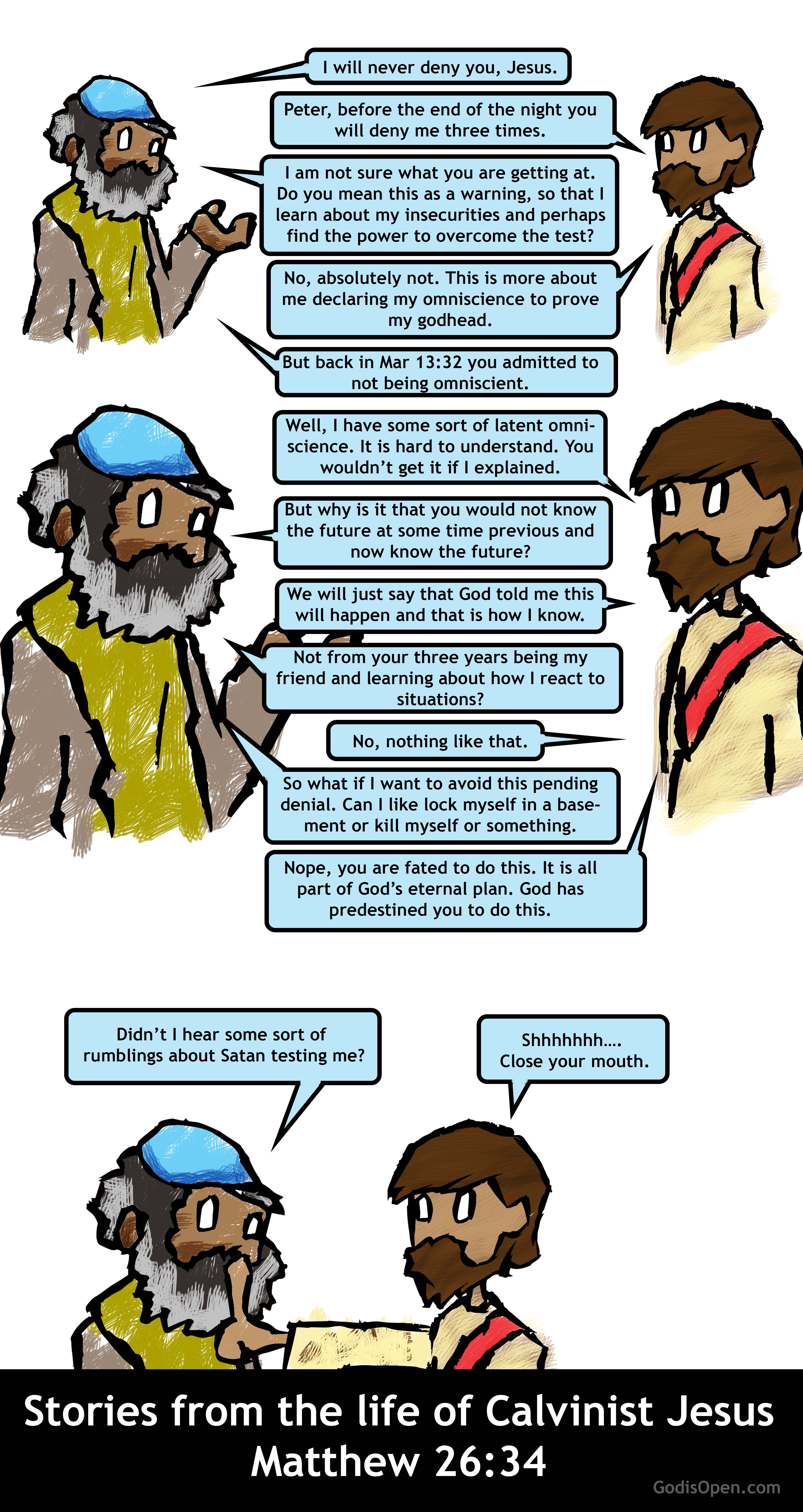
Verse: Mar 13:32 “But of that day and hour no one knows, not even the angels in heaven, nor the Son, but only the Father.

  1. In what way does Jesus resemble an omnipotent, omnipresent, omniscient, immutable, timeless, and simple God?

Verse: Joh 14:9 Jesus said to him, “Have I been with you so long, and yet you have not known Me, Philip? He who has seen Me has seen the Father; so how can you say, ‘Show us the Father’?

  1. If Jesus’ will is the same as God’s will, then why would Jesus say that Jesus’ will would not be done if God’s will is done?

Verse: Luk 22:42 saying, “Father, if it is Your will, take this cup away from Me; nevertheless not My will, but Yours, be done.”

  1. Could Jesus have been saved from crucifixion by praying to God?

Verse: Mat 26:53 Or do you think that I cannot now pray to My Father, and He will provide Me with more than twelve legions of angels?

Miscellaneous:

  1. Why are the elect the enemy of the gospel?

Verse: Rom 11:28 Concerning the gospel they are enemies for your sake, but concerning the election they are beloved for the sake of the fathers.

C Ray  You must be addressing those semi-Arminian Calvinists who follow the theology of apparent contradictions and paradox? I can assure you that there are no contradictions in the Bible.

C Ray  It will take me some time to answer all the objections in the post. However, the first objection is so simple even a child can figure it out:

>>>1. If God’s will is always already being done on earth as in heaven (as divine determinism implies) why did Jesus teach his disciples to pray, “Thy will be done on earth as it is in heaven?”<<<

If we are praying for God’s will to be done, we are simply agreeing that God controls whatsoever comes to pass. That’s why Jesus taught us to pray according to God’s will. THY will be done. Jesus also prayed that if it were possible that the cup of His suffering would pass, but nevertheless not his human will be done but GOD’S will be done:

He went a little farther and fell on His face, and prayed, saying, “O My Father, if it is possible, let this cup pass from Me; nevertheless, not as I will, but as You will.” (Matthew 26:39 NKJ)

Again, a second time, He went away and prayed, saying, “O My Father, if this cup cannot pass away from Me unless I drink it, Your will be done.” (Matthew 26:42 NKJ)

God already knows the future because He has already determined it. It was NEVER God’s will that Jesus would NOT go to the cross. Jesus providentially in time said the prayer but God had already by the set foreknowledge of God determined that wicked men, including Judas, Pilate, and Herod, would have him betrayed, tried, convicted and crucified.

“Him, being delivered by the determined purpose and foreknowledge of God, you have taken by lawless hands, have crucified, and put to death; (Acts 2:23 NKJ)

“For truly against Your holy Servant Jesus, whom You anointed, both Herod and Pontius Pilate, with the Gentiles and the people of Israel, were gathered together 28 “to do whatever Your hand and Your purpose determined before to be done. (Acts 4:27-28 NKJ)

C Ray  Why pray if God is unable to determine the future? We don’t know what the future holds. God does because He controls it. Even the day and hour of your death is already determined by God. Hebrews 9:27. Psalm 139.

C Ray  More later:)

C Ray  It is irritating when Arminians flood with several questions instead of sticking to one proposition at a time. Prayer only makes sense if God is sovereign and can actually answer the prayer. God’s answer could be yes or no. But His will shall be done!

C Ray  The more Arminian they are the more they hate the doctrine of predestination.

C Ray  I should point out that the OP is from an Open Theism site. Open Theism is worse than Arminianism because it says that God is ignorant of the future:) Unfortunately, some Arminians, including Roger Olson, think that Open Theism is within the Arminian camp. Ironically, Olson contradicts himself when he also claims that Arminianism is “reformed” theology. If Arminians were more logical, they wouldn’t be Arminians.

C Ray  The same applies to Open Theism. If Open Theism advocates were more logical they wouldn’t believe Open Theism is true.

C Ray  My best shot? My best shot is not mine. It is the Bible:)

The LORD of hosts has sworn, saying, “Surely, as I have thought, so it shall come to pass, And as I have purposed, so it shall stand: (Isaiah 14:24 NKJ)

Christopher Fisher  1:

///If we are praying for God’s will to be done, we are simply agreeing that God controls whatsoever comes to pass.

That does not work. The text presents a contrast between Heaven and Earth. Why the contrast? In what way is Jesus asking that God’s will be done on Earth as it is in Heaven? If Jesus believed God’s will was being done on Earth, does this make sense? Wouldn’t it have been easier to just say “I agree with your will”. The sentence was not spoken by someone with a Calvinist mindset. That is why the question is so hard for Calvinists to answer. It is a request.

Christopher Fisher Ray 1: The LORD of hosts has sworn, saying, “Surely, as I have thought, so it shall come to pass, And as I have purposed, so it shall stand: (Isaiah 14:24 NKJ)

Isn’t this about God being capable of doing what He says, not about meticulous control of the future? And isn’t this Isaiah trying to convince Israel that God is powerful, which they do not believe? And if Isaiah were trying to convince the people that God controls everything (something they do no believe) wouldn’t he have worded it extremely different. Isaiah reads like an Open Theist trying to convince a Calvinist that God can actually do what He says.

Christopher Fisher Ray 2: Even the day and hour of your death is already determined by God. Hebrews 9:27. Psalm 139.

Hebrews 9:27, men are appointed to die once means that every person on Earth has a specific appointed day? You are bringing a lot of baggage into that verse. Plus you ignore Hezekiah and God’s judgment of angels in Psalms 82 in which He punishes them with eventual death.

On Psalms 139. Absolutely that is not what Psalms 139 says. “the days that were formed” is an adverbial phrase meaning that over the days that David’s body was forming, the body parts were being written into God’s book. Here is Calvin on the issue:

Some read ימים, yamim, in the nominative case, when days were made; the sense being, according to them — All my bones were written in thy book, O God! from the beginning of the world, when days were first formed by thee, and when as yet none of them actually existed. The other is the more natural meaning, That the different parts of the human body are formed in a succession of time; for in the first germ there is no arrangement of parts, or proportion of members, but it is developed, and takes its peculiar form progressively.

Christopher Fisher All the attached translations agree with John Calvin that Psalms 139 is not about God recording every day of your life but about a series of days in which your body forms in the womb, notice the adverbial phrase:

Geneva Bible: 16 Thine eyes did see me, when I was without forme: for in thy booke were all things written, which in continuance were facioned, when there was none of them before.

The attached picture is the Jewish translation of Psalms 139.

King James Bible

Thine eyes did see my substance, yet being unperfect; and in thy book all my members were written, which in continuance were fashioned, when as yet there was none of them.

Jubilee Bible 2000

Thine eyes did see my substance yet being imperfect; and in thy book all my members were written, which were then formed, without lacking one of them.

American King James Version

Your eyes did see my substance, yet being imperfect; and in your book all my members were written, which in continuance were fashioned, when as yet there was none of them.

English Revised Version

Thine eyes did see mine unperfect substance, and in thy book were all my members written, which day by day were fashioned, when as yet there was none of them.

C Ray  I showed you the prayer of Jesus in Gethsemane. I guess you don’t believe the Bible.

Christopher Fisher Ray, that is one of the questions. That proves that God’s will does not have to be done and it proves that Jesus and God do not have the same will.

C Ray  That isn’t what Psalm 139 says. It says God is absolutely omniscient, not ignorant. God is not a man;)

Christopher Fisher Ray 2: Ray, was John Calvin wrong when Calvin wrote:

Some read ימים, yamim, in the nominative case, when days were made; the sense being, according to them — All my bones were written in thy book, O God! from the beginning of the world, when days were first formed by thee, and when as yet none of them actually existed. The other is the more natural meaning, That the different parts of the human body are formed in a succession of time; for in the first germ there is no arrangement of parts, or proportion of members, but it is developed, and takes its peculiar form progressively.

C Ray  I am working today. I would ask you to stock to one or two propositions at a time. I will rebut your answers one at a time.

Christopher Fisher Alright, I will keep my responses numbered per your points and will keep my counter points numbered per the original question.

C Ray  Since we do not know the future being limited in knowledge, we do petition God. But why pray to an ignorant and helpless finite god who has no providential control over history, time, or evil?

Christopher Fisher Ray 3: He went a little farther and fell on His face, and prayed, saying, “O My Father, if it is possible, let this cup pass from Me; nevertheless, not as I will, but as You will.” (Matthew 26:39 NKJ)

Doesn’t this verse show us that God’s will does not have to be done (indicated by Jesus’ special asking that God not change His will on Jesus’ account)? Doesn’t this also show that Jesus did not know if it was a possibility, meaning even Jesus was not a Calvinist thinking in terms of immutable divine decrees?

Christopher Fisher Ray 4: But why pray to an ignorant and helpless finite god who has no providential control over history, time, or evil?

If prayer does not affect God. If the future was set and God time (and time again tells Israel that it is not… that He is waiting and pleading for them to change such that He does not have to punish them)… If God was immutable and cold like the stone idols that God despises… If God was timeless and unpersonal, as to make a mockery of the strong emotional highs and lows God ascribes to Himself throughout the Bible… then prayer would be pointless. We would be telling God what He already knows and has decreed. Instead, when God says something, people’s natural inclination is that they can convince God not to do it. Followup question: what was the reason that God decided not to destroy Israel on Mount Sinai?

C Ray  Out of context quotes only prove you are an irrationalist.

Christopher Fisher The Geneva Bible that I quoted to you… is that out of context as well? Seriously, you reject Calvin on this verse as well as good Hebrew scholarship. You are the one not acting rational.

Christopher Fisher Here is something you can do. Write the following: “Chris, I was wrong about Psalms 139:16 being a good prooftext for my view. Calvin himself did not take the verse the way I see it and this is reflected in the Geneva translation. I am too set in my ways to admit when I am clearly wrong and I will attempt to treat valid points with more respect in the future. I promise not to let my ego just lash out when I am thoroughly called out on irrational positions I hold.”

C Ray  Calvin was not infallible. Scripture speaks for itself.

C Ray  Some for afar off read beforehand, in which signification the Hebrew word is elsewhere taken, as if he had said—O Lord, every thought which I conceive in my heart is already known to thee beforehand. But I prefer the other meaning, That God is not confined to heaven, indulging in a state of repose, and indifferent to human concerns, according to the Epicurean idea, and that however far off we may be from him, he is never far off from us.

John Calvin. Psalm 139.

Christopher Fisher So, yes or no. Is Psalms 139:16 a good prooftext that God has planned our entire lives?

C Ray  The Bible clearly says God knows the future and has exhaustive omniscience.

Christopher Fisher Yes or no… was I quoting Calvin “out of context” like you claimed?

Christopher Fisher In the opening link, I mention that Calvinists have a very hard time with yes or no questions. I will try this again:

So, yes or no. Is Psalms 139:16 a good prooftext that God has planned our entire lives?

C Ray  Chris, no. Calvin said what you said he said. But as I said, Scripture is the final authority. Furthermore, I was on my phone earlier. How does it follow logically that Open Theism is true simply because Calvin’s focus was wrong in a few places in his commentaries? Just asking?

C Ray  Chris, let’s try a yes or no question for you. Is God absolutely omniscient? Yes or no?

C Ray  Isaiah 46:9-11 and many other places proves that God is absolutely sovereign and knows exhaustively everything that will happen. Ephesians 1:11 says God ordains all things that come to pass in time.

Christopher Fisher Did I claim Open Theism was true because Calvin interpreted a verse in a non-Calvinist way? No, my point is that your prooftexts, all your prooftexts, do not say what you want them to say. The fact that you admittedly oppose even John Calvin on some verses is very telling about your mindset towards the Bible. You are not interested in reading comprehension, and figuring out various and possibly understandings of texts, but you are looking for affirmation of your platonism. You disregard perfectly reasonable alternative understandings of the text.

Christopher Fisher Ray 5: Chris, let’s try a yes or no question for you. Is God absolutely omniscient? Yes or no?

No.The Bible never makes the claim and neither do I.

C Ray  Calvin also says in the same commentary on Psalm 139:16, “….. it was always one and the same in God’s book, who is not dependent upon time for the execution of his work.” Clearly Calvin’s view does not endorse that God is dependent on time or that God is ignorant of the future.

Christopher Fisher Ray 6: Isaiah 46:9-11 and many other places proves that God is absolutely sovereign

I feel like I am answering more of your questions than you are of mine. Refer back to my earlier question and answer that:

Ray 1: The LORD of hosts has sworn, saying, “Surely, as I have thought, so it shall come to pass, And as I have purposed, so it shall stand: (Isaiah 14:24 NKJ)

Isn’t this about God being capable of doing what He says, not about meticulous control of the future? And isn’t this Isaiah trying to convince Israel that God is powerful, which they do not believe? And if Isaiah were trying to convince the people that God controls everything (something they do no believe) wouldn’t he have worded it extremely different. Isaiah reads like an Open Theist trying to convince a Calvinist that God can actually do what He says.

C Ray  The Bible does make the claim. And that is because we logically deduce from the Scriptures by good and necessary consequence what the Bible says. There is a system of doctrinal and propositional truth in the Bible and the Scriptures cannot be broken into disparate parts that have no relationship to the other parts of the system of logical and propositional revelation in the Bible. John 10:35.

Christopher Fisher Ray 7: Ephesians 1:11 says God ordains all things that come to pass in time.

Eph 1:11 In him we have obtained an inheritance, having been predestined according to the purpose of him who works all things according to the counsel of his will,

Doesn’t perfectly normal reading comprehension allow this to say that God does everything that God does with careful thought. It would be like me saying “I eat everything according to my diet”. No, I do not eat “everything”, but “everything” I do eat is per my diet. And my statement is general, so even if there is slippage (I eat cake once), this does not invalidate my general statement.

C Ray  If God is able to control the future, then it implication is that God DOES control the future. If the universe can run by itself, then the implication by logical deduction and good and necessary consequence is that the universe is indendent of God and therefore there is something that is God’s equal. But that is Platonic dualism and even deism. God is in absolute control of all that happens, otherwise God is not God.

C Ray  If you reject God as defined by Scripture, then you are not a Christian.

Christopher Fisher No, I am going skating today. That is me controlling the future. Wow, I much be omniscient and omnipotent.

C Ray  The Westminster Confession of Faith summarizes the system of dogmatic theology in the Bible.

C Ray  If God foreknows you are going skating today, is it possible you won’t go skating today?

C Ray  Oh, wait. You think your god is ignorant.

C Ray  You have created a little god in your own finite and ignorant image.

C Ray  Vain thinking is vain.

Christopher Fisher So, back to my questions. I am not really interested in non-Biblical metaphysics. In my estimation, you have not answered a single OP question.

1:

///If we are praying for God’s will to be done, we are simply agreeing that God controls whatsoever comes to pass.

That does not work. The text presents a contrast between Heaven and Earth. Why the contrast? In what way is Jesus asking that God’s will be done on Earth as it is in Heaven? If Jesus believed God’s will was being done on Earth, does this make sense? Wouldn’t it have been easier to just say “I agree with your will”. The sentence was not spoken by someone with a Calvinist mindset. That is why the question is so hard for Calvinists to answer. It is a request.

C Ray  You are not interested in what the biblical text says either. And if you are not interested in metaphysics, why read the Bible? The Bible alone is the source of all knowledge, including metaphysics.

Christopher Fisher Ray, in my estimation, I am the only one addressing the text. You allude to Psalms and Hebrews and you do not even use normal reading comprehension to understand them. You assume the text supports you, and I showed that you were wrong. You have zero verses; which verse have you used in which I did not follow up that your understanding was idiosyncratic and unwarranted?

C Ray  Why is there a contrast between the Creator and His creation? Well, the answer to that question is obvious to any Calvinist. It’s because God is eternally a God who possesses aseity by nature and essence. There never was a time when God did not exist and God transcends time, history, and creation. That’s why in God’s omniscient mind there is no passing of time or any passing of one thought to another thought. God is omniscient and never learns anything new–including the future. God knows the future because it is ordained by God’s eternal decree. God never learns anything new by looking foreward to the future.

C Ray  Well, your estimation is wrong because you presuppose a finite god. I presuppose an omniscient God who is also omnipotent and omnipresent. That’s because the Bible also presupposes such a God. All Scripture is inspired by God. God controlled the wills of the men who wrote the Bible and every word they wrote is the very words of God.

C Ray  I am indeed a presuppositionalist. I presuppose there are no errors in the Bible. You presuppose a finite god who does not control the wills of the men who wrote the Bible.

Christopher Fisher That is not rational argument. I am wrong because I do not assume your theology? [ding ding ding] We have a winner of the bad rational thinking award.

C Ray  Chris, well, since you don’t believe God controls men’s wills, it follows that you cannot believe in the plenary verbal inspiration of Scripture or the infallibility and inerrancy of Scripture.

Christopher Fisher Mat 6:10 Your kingdom come, your will be done, on earth as it is in heaven.

Has God’s kingdom come? Is this a request by Jesus for God to bring His kingdom to Earth?

In the same way: “your will be done”. Is this a request by Jesus for God’s will to be done.

“On Earth as it is in Heaven”. Is God’s will currently being done on Earth in the same respect as it is in heaven.

My problem with Calvinism is that it takes clearly absurd readings of normal passages.

C Ray  Well, as I said, the logical implication is that you don’t believe the Bible since you cannot believe God inspired it.

Christopher Fisher Can God’s will be rejected?

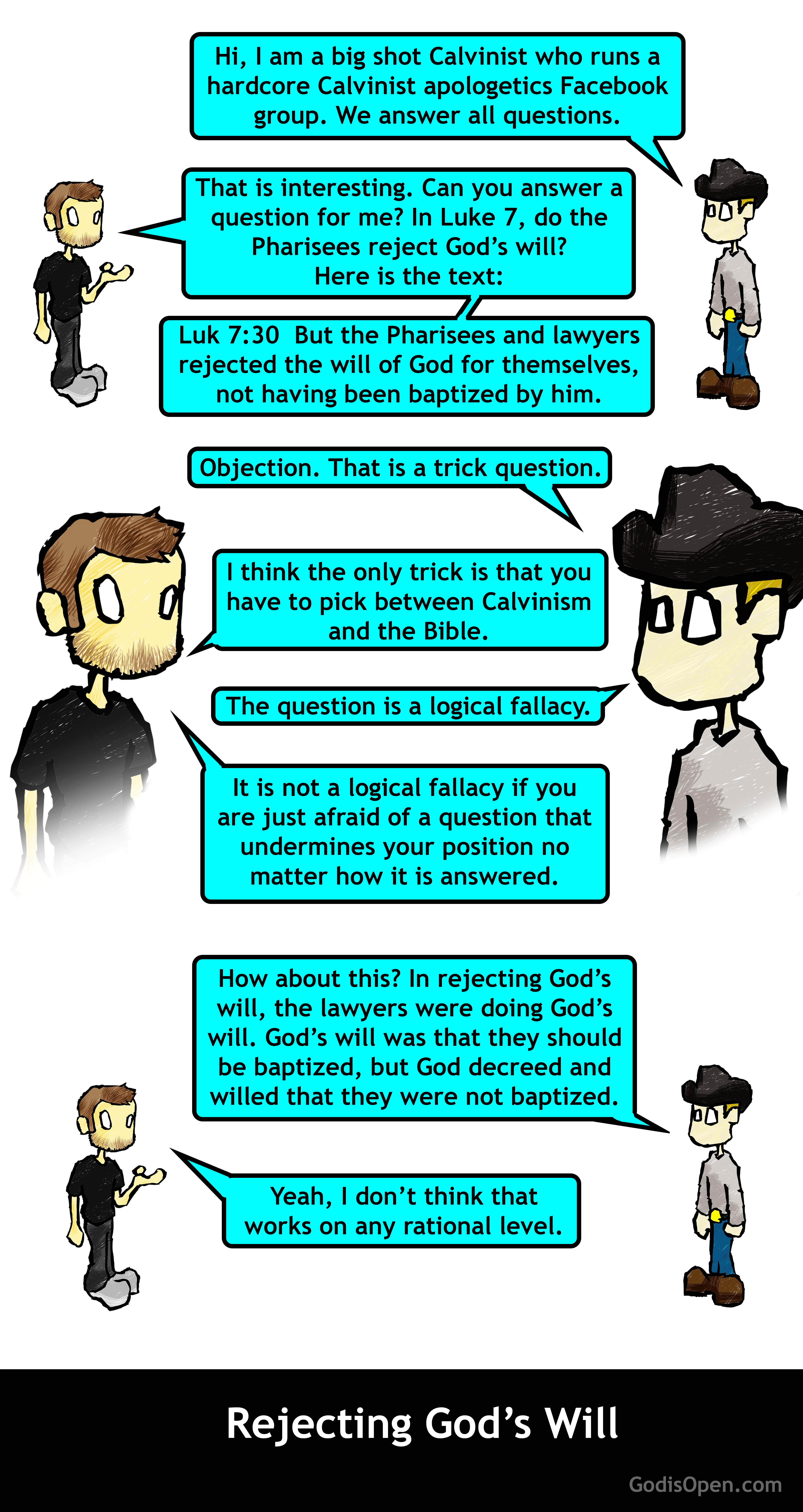
Luk 7:30 but the Pharisees and the lawyers rejected the purpose of God for themselves, not having been baptized by him.)

C Ray  The Bible alone is God’s Word. 2 Timothy 3:16. You cannot affirm this verse because for you God is ignorant and finite. But if God is finite, maybe God is evil and cannot do anything about good?

C Ray  Of course the reprobate reject the Gospel:) But they were predestined to do so. That’s not ability. It’s inability.

8 and “A stone of stumbling And a rock of offense.” They stumble, being disobedient to the word, to which they also were appointed. (1Pe 2:8 NKJ)

Christopher Fisher You reject Jesus’s clear teachings. I am sure if we explored Exodus 32, you will reject a host of Biblical authors on the subject. You reject the Psalmist talking about fetology. Only one of us is rejecting the Bible, and that is you.

C Ray  38 that the word of Isaiah the prophet might be fulfilled, which he spoke: “Lord, who has believed our report? And to whom has the arm of the LORD been revealed?”

39 Therefore they could not believe, because Isaiah said again:

40 “He has blinded their eyes and hardened their hearts, Lest they should see with their eyes, Lest they should understand with their hearts and turn, So that I should heal them.” (Joh 12:38-40 NKJ)

C Ray  You do not believe because you are not of His sheep:

26 “But you do not believe, because you are not of My sheep, as I said to you. (Joh 10:26 NKJ)

Christopher Fisher This is a yes or no question. Let me remind you that my original claim is that Calvinists are terrible with yes or no questions:

Can God’s will be rejected?

Luk 7:30 but the Pharisees and the lawyers rejected the purpose of God for themselves, not having been baptized by him.)

C Ray  Oh, but I do believe the plain teaching of the whole bible in context. How do you think I decided to become a Calvinist? By reading heretical Open Theist scholars?

Christopher Fisher ^And this is boolay… God’s strong will.

boo-lay’

From G1014; volition, that is, (objectively) advice, or (by implication) purpose: – + advise, counsel, will.

Christopher Fisher Can God’s will be rejected?

Luk 7:30 but the Pharisees and the lawyers rejected the purpose of God for themselves, not having been baptized by him.)

Christopher Fisher Heb 6:17 uses the same word.

C Ray  I don’t answer yes or no questions. Here’s why? “Did you stop beating your wife?” Answer the question: YES or NO?

Christopher Fisher No, because I never started, therefor there is nothing to stop.

Christopher Fisher Easy… now answer my question.

C Ray  Logical fallacies are irrational and invalid. Asking irrational questions does not entail that the question was legimate.

Christopher Fisher I answered your “impossible question”… now answer mine. The only reason you dont want to answer is that it is clear you reject the Bible:

Can God’s will be rejected?

Luk 7:30 but the Pharisees and the lawyers rejected the purpose of God for themselves, not having been baptized by him.)

C Ray  But you didn’t answer with a yes or no. You answered with a qualification. So there’s the reason your debate questions are fallacious. Thanks for demonstrating the fallacy for me:)

Christopher Fisher Your intellectual dishonesty does not make my question a logical fallacy.

Christopher Fisher Then answer my question with a qualification… but say yes or no.

Christopher Fisher The qualification was to ensure you dont misunderstand the answer… it does not invalidate the answer.

C Ray  The reprobate resist God’s will. No Calvinist says otherwise. The reprobate have a will. But the question is whether the will is free or not. The answer is a resounding NO.

Christopher Fisher So… in your estimation… when the text says that the lawyers rejected God’s will, that the lawyers did not. You reject the Bible. Clearly.

C Ray  THE SOVEREIGNTY OF GOD.

Sect. 9.—THIS, therefore, is also essentially necessary and wholesome for Christians to know: That God foreknows nothing by contingency, but that He foresees, purposes, and does all things according to His immutable, eternal, and infallible will. By this thunderbolt, “Free-will” is thrown prostrate, and utterly dashed to pieces. Those, therefore, who would assert “Free-will,” must either deny this thunderbolt, or pretend not to see it, or push it from them. But, however, before I establish this point by any arguments of my own, and by the authority of Scripture, I will first set it forth in your words.

Martin Luther

http://www.truecovenanter.com/trueluth…/luther_bow.html&#8230;

TrueCovenanter.com: The Bondage of the Will

Sect. 9.—T, therefore, is also essentially necessary and wholesome for Christians to know: That God foreknows nothing by contingency, but that He foresees, purposes, and does all things according to His immutable, eternal, and infallible will. By this thunderbolt, “Free-will” is thrown prostrate, an…

TRUECOVENANTER.COM|BY MARTIN LUTHER

Christopher Fisher Your argument is literally the text does not mean what it says because you have overriding theology.

C Ray  >>>So… in your estimation… when the text says that the lawyers rejected God’s will, that the lawyers did not. You reject the Bible. Clearly.<<<<<

This is so obviously false that it does not need a rebuttal. Obviously if the will is not free, then if the lawyers rejected the commands of God to repent they did so willingly. Where does the Bible say that men do not have a volition? I have not seen such a verse.

C Ray  The reprobate willingly rebel and reject God’s commands.

Christopher Fisher They didnt reject their own will, they rejected God’s will.

Christopher Fisher This discussion is about reading comprehension.

C Ray  7 Because the carnal mind is enmity against God; for it is not subject to the law of God, nor indeed can be.

8 So then, those who are in the flesh cannot please God.

(Rom 8:7-8 NKJ)

Christopher Fisher Ok, can God’s will be rejected?

Christopher Fisher And did the lawyers reject God’s will?

Christopher Fisher Your argument is literally the text does not mean what it says because you have overriding theology.

C Ray  Define “will.” Do you mean God’s commands or do you mean God’s decrees?

C Ray  You are equivocating. The term “will” has to be defined. And you are obviously deliberately defining it otherwise from the Word of God:

29 “The secret things belong to the LORD our God, but those things which are revealed belong to us and to our children forever, that we may do all the words of this law. (Deu 29:29 NKJ)

Christopher Fisher ^ Feel free to define it however is the most favorable to your position. Make it work in both the context of Luk 7 and Heb 6.

Luk_7:30 ButG1161 theG3588 PhariseesG5330 andG2532 lawyersG3544 rejectedG114 theG3588 counselG1012 of GodG2316 againstG1519themselves,G1438 being notG3361 baptizedG907 ofG5259 him.G846

Heb_6:17 WhereinG1722 G3739 God,G2316 willingG1014 more abundantlyG4054 to shewG1925 unto theG3588 heirsG2818 of promiseG1860 theG3588 immutabilityG276 of hisG848 counsel,G1012 confirmedG3315 it by an oath:G3727

C Ray  Do you claim to know everything that God knows in every single detail? If so, then you are claiming to be omniscient. We can only know what God reveals in nature and in the Bible.

Christopher Fisher ^I told you I am not interested in metaphysics. Please ask questions about the Bible and what the Biblical authors believed.

C Ray  My position is God is omniscient. Your position is that your god is finite and ignorant. But can a god who is subject to creation and evil save you? I sincerely doubt it.

Christopher Fisher ^Platonism. Yum. I get my theology from the Bible. Can we discuss Exodus 32 now?

C Ray  You’re not interested in logic? So why are you here? God IS LOGIC. John 1:1. And logic was imparted to all men: John 1:9. Man IS the image of God. Genesis 1:27.

C Ray  If you are admitting that you are an irrationalist, then there is nothing more to discuss. That’s because without logic nothing makes any sense whatsoever.

Christopher Fisher Exo 32:14 And the LORD relented from the disaster that he had spoken of bringing on his people.

What is the reason that God did not destroy Israel, as Yahweh told Moses that He would?

C Ray  The Bible is not inherently contradictory because God has no contradictions in His mind and it is God who inspired the Bible.

Christopher Fisher Metaphysics is not “logic”. I would give you a rundown on logical propositions, but it will detract from the Bible. I can school you in another thread if you wish.

C Ray  So Exodus 32:14 says that God works providentially in time in ways that we as creatures can understand. So how does that prove your metaphysical assertion that your god is ignorant of the future? I thought you didn’t want to talk about metaphysics? Hello?

Christopher Fisher Exodus 32, what are Moses’ arguments as to why God should not destroy Israel.

C Ray  God already knew that He would relent and the reason is He had already ordained that the people of Israel would repent. Acts 11:18 implies it.

Christopher Fisher At this point, this should be friendly reading comprehension.

Christopher Fisher Here is the text to save you some time:

Exo 32:11 But Moses implored the LORD his God and said, “O LORD, why does your wrath burn hot against your people, whom you have brought out of the land of Egypt with great power and with a mighty hand?

Exo 32:12 Why should the Egyptians say, ‘With evil intent did he bring them out, to kill them in the mountains and to consume them from the face of the earth’? Turn from your burning anger and relent from this disaster against your people.

Exo 32:13 Remember Abraham, Isaac, and Israel, your servants, to whom you swore by your own self, and said to them, ‘I will multiply your offspring as the stars of heaven, and all this land that I have promised I will give to your offspring, and they shall inherit it forever.'”

Exo 32:14 And the LORD relented from the disaster that he had spoken of bringing on his people.

C Ray  18 When they heard these things they became silent; and they glorified God, saying, “Then God has also granted to the Gentiles repentance to life.” (Act 11:18 NKJ)

Repentance is a gift

Christopher Fisher Yes or no, did Moses argue that God would look bad to the neighboring people? Basically, God should refrain for His own sake and not due to the people’s sake. Did this argument work on convincing God?

C Ray  Chris, so when God speaks to creatures who are subject to time and discursive thinking, how else would God communicate to them in ways that they could understand? They are NOT omniscient. But your error is that you think because creatures need to be talked to on their level that the reverse is true of God and that God is therefore ignorant like men. False conclusion. God is not a man.

C Ray  9 “God is not a man, that He should lie, Nor a son of man, that He should repent. Has He said, and will He not do? Or has He spoken, and will He not make it good? (Num 23:19 NKJ)

Christopher Fisher Calvinists are terrible at yes or no questions. Let us try this again:

Yes or no, did Moses argue that God would look bad to the neighboring people? Basically, God should refrain for His own sake and not due to the people’s sake. Did this argument work on convincing God?

C Ray  Your stupidity is in confusing the creature with the Creator.

Christopher Fisher Yes or no, did Moses argue that God would look bad to the neighboring people? Basically, God should refrain for His own sake and not due to the people’s sake. Did this argument work on convincing God?

C Ray  So did you stop beating your mother? Yes or no?

Christopher Fisher No, because I never started therefor there is nothing to stop.

Christopher Fisher Stop being ridiculous.

Christopher Fisher Yes or no, did Moses argue that God would look bad to the neighboring people? Basically, God should refrain for His own sake and not due to the people’s sake. Did this argument work on convincing God?

C Ray  You will not persist in fallacious arguments here. If you insist on that method, you can go elsewhere. First warning.

C Ray  I am the head admin here. Behave yourself.

Christopher Fisher New question: does God himself claim that God changed His mind for His own sake in this narrative:

Eze 20:8 But they rebelled against Me and would not obey Me. They did not all cast away the abominations which were before their eyes, nor did they forsake the idols of Egypt. Then I said, ‘I will pour out My fury on them and fulfill My anger against them in the midst of the land of Egypt.’

Eze 20:9 But I acted for My name’s sake, that it should not be profaned before the Gentiles among whom they were, in whose sight I had made Myself known to them, to bring them out of the land of Egypt.

C Ray  If you cannot argue logically, you will be banned. Scriptural arguments and logic are required here.

Christopher Fisher This is God recounting the Exodus 32 event.

C Ray  Irrationalism and invalid arguments are not permitted. So if you keep attacking the man with abusive ad hominem, then it is a fallacious argument.

Christopher Fisher What does Yahweh say the reason is that He spared Israel?

C Ray  I do not say that God changes His mind because the Bible says that God is eternally immutable. Malachi 3:6 and James 1:17. Psalm 119:89. The anthropomophisms and anthropopathisms in Scripture do not entail that God is a creature or a man. God is defined by metaphysical propositions that are revealed in Scripture and by the logical deductions made from that system of propositional truth by good and necessary consequence. The word Trinity is not in Scripture. But the Bible teaches both the Trinity and the absolute sovereignty of God.

C Ray  Is God ignorant of what Israel would do?

C Ray  Yes or no?

Christopher Fisher What does God say in this text is the reason God did not destroy Israel:

Eze 20:8 But they rebelled against Me and would not obey Me. They did not all cast away the abominations which were before their eyes, nor did they forsake the idols of Egypt. Then I said, ‘I will pour out My fury on them and fulfill My anger against them in the midst of the land of Egypt.’

Eze 20:9 But I acted for My name’s sake, that it should not be profaned before the Gentiles among whom they were, in whose sight I had made Myself known to them, to bring them out of the land of Egypt.

C Ray  There are conditional commands in the Bible. If man disobeys, God lays out the consequences. If man obeys, then God rewards the obedience. But it does not follow that God does not ordain what man’s response will be.

C Ray  God could not be God if there is anything that happens apart from His sovereign permission. And if God willingly permits evil, then obviously God willed for the evil to occur since God could easily prevent it.

Christopher Fisher Right, we are not talking about “conditional actions”. It is clear from the text that the only actor is Moses. The people do not repent and God is not reacting to their repentance. God Himself states that He acted for His own sake. God’s change of mind was due, literally, to Moses’ argument that God would look bad if He killed Israel.

Christopher Fisher Here is Moses recounting the event:

Deu 9:13 “Furthermore the LORD spoke to me, saying, ‘I have seen this people, and indeed they are a stiff-necked people.

Deu 9:14 Let Me alone, that I may destroy them and blot out their name from under heaven; and I will make of you a nation mightier and greater than they.’

Deu 9:19 For I was afraid of the anger and hot displeasure with which the LORD was angry with you, to destroy you. But the LORD listened to me at that time also.

Deu 9:20 And the LORD was very angry with Aaron and would have destroyed him; so I prayed for Aaron also at the same time.

Christopher Fisher So, you discount God, you discount Ezekiel, you discount Moses…

Christopher Fisher When you are denying Yaweh’s speech about Himself, you should be afraid.

C Ray  Let me clue you in, Christopher Fisher. I am not just another ignorant plow boy:) I have two degrees in Arminian theology. I did my BA at an Assemblies of God college and my master of divinity at an Evangelical and Wesleyan seminary. I know your arguments better than you do. If you’re not going to answer my objections, you can go elsewhere to talk to thin air. Here you are required to answer my objections as I have answered all of yours thus far.

Christopher Fisher ^Better ask for your money back. What does God say in this text is the reason God did not destroy Israel:

Eze 20:8 But they rebelled against Me and would not obey Me. They did not all cast away the abominations which were before their eyes, nor did they forsake the idols of Egypt. Then I said, ‘I will pour out My fury on them and fulfill My anger against them in the midst of the land of Egypt.’

Eze 20:9 But I acted for My name’s sake, that it should not be profaned before the Gentiles among whom they were, in whose sight I had made Myself known to them, to bring them out of the land of Egypt.

C Ray  I do not deny that there are anthropopathisms in Scripture. Does God literally have emotions or body parts? No. And so when the text attributes human qualities to God such as “relenting” it does not literally mean that God repents or changes His mind as humans do.

C Ray  Next question?

C Ray  I will warn you again, Chris, you do not get to ignore me. If you want to preach, go elsewhere. This is a debate forum. I answered you objection several times and you keep repeating misrepresentations of the Calvinism position. Our position is laid out clearly in the Westminster Standards. So why do you keep creating straw man fallacies?

C Ray  The idea that men do not have a will is refuted several times over in the WCF.

Christopher Fisher Read the text, answer the question, then you can explain the question. I will provide you a copy paste version for your convenience:

“God says in the text that He did not destroy Israel and this was for His own sake lest His name is profaned among the Gentiles. I believe this is an anthropopathism. ”

What does God say in this text is the reason God did not destroy Israel:

Eze 20:8 But they rebelled against Me and would not obey Me. They did not all cast away the abominations which were before their eyes, nor did they forsake the idols of Egypt. Then I said, ‘I will pour out My fury on them and fulfill My anger against them in the midst of the land of Egypt.’

Eze 20:9 But I acted for My name’s sake, that it should not be profaned before the Gentiles among whom they were, in whose sight I had made Myself known to them, to bring them out of the land of Egypt.

C Ray  Chapter 3: Of God’s Eternal Decree

  1. God, from all eternity, did, by the most wise and holy counsel of His own will freely, and unchangeably ordain whatsoever comes to pass:1 yet so, as thereby neither is God the author of sin,2 nor is violence offered to the will of the creatures; nor is the liberty or contingency of second causes taken away, but rather established.3

See also: WLC 12 | WSC 7

——————————————————————————–

1 Eph. 1:11; Rom. 11:33; Heb. 6:17; Rom. 9:15,18.

2 James 1:13,17; 1 John 1:5.

3 Acts 2:23; Matt. 17:12; Acts 4:27,28; John 19:11; Prov. 16:33.

Christopher Fisher Ask your question, I will answer:

Christopher Fisher And, for the record, I have been answering almost all your objections. I even labelled them. You have not hardly answered any of my objections.

C Ray  The reason God did not destroy Israel is stated in the text. But simply quoting a text does not prove your deduction from the text is correct. That’s because plenty of other texts prove that God is not finite. Your error is in confusing God with the creature and ignoring what are clearly anthropomorphisms. We do not attribute human qualities to God just because God relates to humans in anthropomorphic or anthropopathic terms in Scripture. God does not literally have a nose or mouth or emotions. Nor does God literally repent or even relent. Those are clearly anthropopathic terms. God is totally distinct from creation and cannot literally repent because God is eternally unchanging. If God changes, then He is not God but something else.

C Ray  You have not answered my objection that your view confuses the Creator with anthropomorphisms and anthropopathisms in Scripture. Does God literally smell or taste?

C Ray  Does God literally “breathe”????

7 And the LORD God formed man of the dust of the ground, and breathed into his nostrils the breath of life; and man became a living being. (Gen 2:7 NKJ)

Christopher Fisher Anthropomorphisms, like your describe, are alien to normal reading comprehension. They are a mechanism invented such that Calvinists can deny the Bible. There is no hint in the narratives that the narratives are to be discounted, and the authors show zero familiarity with immutability, omniscience, etc.

C Ray  So you agree with the Mormons that God has a body? Oh, brother!

Christopher Fisher R8: Does God literally “breathe”????

Maybe. Jesus breathed. God can cause wind movement which is breathe. The Bible is not clear on God’s physical properties, so maybe is the best answer.

C Ray  Maybe you think God loses His temper, too?

Christopher Fisher Ray, do you understand the difference between metaphor and Anthropomorphism?

C Ray  God has no physical properties! God is a spirit:

“God is Spirit, and those who worship Him must worship in spirit and truth.” (John 4:24 NKJ)

C Ray  Act 17:24 “God, who made the world and everything in it, since He is Lord of heaven and earth, does not dwell in temples made with hands.

C Ray  18 Known unto God are all his works from the beginning of the world. (Act 15:18 KJV)

C Ray  Looks like God is not ignorant after all.

Christopher Fisher Metaphor is using two similar concepts, one to illustrate the other. A King might have a “hand of the King”. This is not literal, but symbollic (this doesnt mean he doesnt have a hand either). But symbols have meaning. Your Anthropomorphism does not have a meaning. What does it mean that God says that He repents for His own sake that the pagan nations will not think of Him poorly? You want to dismiss the text and have to resort to some any-text mechanism to do so.

And note: spirits have bodies:

1Co 15:42 So also is the resurrection of the dead. The body is sown in corruption, it is raised in incorruption.

1Co 15:43 It is sown in dishonor, it is raised in glory. It is sown in weakness, it is raised in power.

1Co 15:44 It is sown a natural body, it is raised a spiritual body. There is a natural body, and there is a spiritual body.

C Ray  Chris, I thought you said God literally relented? Now you’re saying it is a metaphor? Behind every metaphor in the Bible is a logical proposition.

Christopher Fisher No, nowhere do I say it is a metaphor.

Christopher Fisher Im explaining to you Language 101.. the difference between metaphor and anthropomorphism as you use it. Ezekiel and Exodus do not fit a metaphor.

C Ray  A metaphor can relate to anything symbolic. An anthropomorphism is attributing human characteristics to something that is not human. Dogs can be attributed with human characteristics such as thoughts and emotions. But are dogs humans? No. Dogs don’t think. In the same way we can attribute human characteristics to God so we can understand and relate to Him. But it does not follow that God is a man any more than it follows that a dog is a man. God is defined by the propositions and attributes given Him in the Scriptures.

C Ray  God is from everlasting to everlasting. He is not a man who is born and then dies.

Christopher Fisher There is nothing in the text and there is no figure of speech that explains away what is described. God saying that He repents for His own sake that the pagan nations will not think of Him poorly… this is not a concept to be pasted to a real concept in an informing way.

C Ray  2 Before the mountains were brought forth, Or ever You had formed the earth and the world, Even from everlasting to everlasting, You are God. (Psa 90:2 NKJ)

Christopher Fisher Anthropomorphism are fiction: The Brave Little Toaster. Disney Cars.

C Ray  Well, since you keep saying God is a man, you are therefore an heretic who does not believe the Bible. Anthropomorphisms do not make God a creature or a man. Sorry.

Christopher Fisher Metaphors and figures of speech need to be able to illustrate a real concept. God having wings and sheltering us gives us an image of God protecting us as a bird protects its young. The concepts are similar and related. What does “God saying that He repents for His own sake that the pagan nations will not think of Him poorly” mean?

C Ray  You have lost this little debate from the get go. You have denied that God is defined by Scripture as a whole. ALL Scripture is profitable for doctrine, not just a few verses taken out of context. There is a system of dogmatic truth in the Bible and the Westminster Standards are the best summary of that biblical system of truth.

C Ray  So if God does not have wings, does God repent? No.

C Ray  God does not think discursively. He is omniscient. He never learns anything new. Sorry.

Christopher Fisher Wings illustrate protection… The Genesis 6 narrative is a LONG NARRATIVE… it is not an idiom or figure of speech, but a story.

C Ray  18 To whom then will you liken God? Or what likeness will you compare to Him?

19 The workman molds an image, The goldsmith overspreads it with gold, And the silversmith casts silver chains.

20 Whoever is too impoverished for such a contribution Chooses a tree that will not rot; He seeks for himself a skillful workman To prepare a carved image that will not totter.

21 Have you not known? Have you not heard? Has it not been told you from the beginning? Have you not understood from the foundations of the earth?

22 It is He who sits above the circle of the earth, And its inhabitants are like grasshoppers, Who stretches out the heavens like a curtain, And spreads them out like a tent to dwell in.

23 He brings the princes to nothing; He makes the judges of the earth useless.

(Isa 40:18-23 NKJ)

C Ray  All Scripture is inspired…. That would include the verses that you disagree with. God is sovereign.

C Ray  35 All the inhabitants of the earth are reputed as nothing; He does according to His will in the army of heaven And among the inhabitants of the earth. No one can restrain His hand Or say to Him, “What have You done?” (Dan 4:35 NKJ)

C Ray  In fact, it is you who reads into the text. I interpret the Scriptures by other more plain Scriptures.

Christopher Fisher Do you want to deal with the text one by one like an adult, or do you want to spray and pray?

C Ray  God even ordains evil according to Isaiah 45:7….

I form the light, and create darkness: I make peace, and create evil: I the LORD do all these things. (Isaiah 45:7 KJV)

Shall a trumpet be blown in the city, and the people not be afraid? shall there be evil in a city, and the LORD hath not done it? (Amos 3:6 KJV)

Christopher Fisher Exo 32:7 And the LORD said to Moses, “Go, get down! For your people whom you brought out of the land of Egypt have corrupted themselves.

Exo 32:8 They have turned aside quickly out of the way which I commanded them. They have made themselves a molded calf, and worshiped it and sacrificed to it, and said, ‘This is your god, O Israel, that brought you out of the land of Egypt!’ ”

Christopher Fisher Eze 4:12 And you shall eat it as barley cakes; and bake it using fuel of human waste in their sight.”

Eze 4:13 Then the LORD said, “So shall the children of Israel eat their defiled bread among the Gentiles, where I will drive them.”

Eze 4:14 So I said, “Ah, Lord GOD! Indeed I have never defiled myself from my youth till now; I have never eaten what died of itself or was torn by beasts, nor has abominable flesh ever come into my mouth.”

Eze 4:15 Then He said to me, “See, I am giving you cow dung instead of human waste, and you shall prepare your bread over it.”

Christopher Fisher Eze 2:3 And He said to me: “Son of man, I am sending you to the children of Israel, to a rebellious nation that has rebelled against Me; they and their fathers have transgressed against Me to this very day.

C Ray  Chris, this is your second warning. I told you I decide what goes on here. If you don’t like the rules, go elsewhere.

Christopher Fisher Isa 5:4 What more could have been done to My vineyard That I have not done in it? Why then, when I expected it to bring forth good grapes, Did it bring forth wild grapes?

Christopher Fisher Jdg 2:20 Then the anger of the LORD was hot against Israel; and He said, “Because this nation has transgressed My covenant which I commanded their fathers, and has not heeded My voice,

Jdg 2:21 I also will no longer drive out before them any of the nations which Joshua left when he died,

Jdg 2:22 so that through them I may test Israel, whether they will keep the ways of the LORD, to walk in them as their fathers kept them, or not.”

Jdg 2:23 Therefore the LORD left those nations, without driving them out immediately; nor did He deliver them into the hand of Joshua.

C Ray  The rules are laid out in the group description. We adhere to confessional and biblical theology here. The Bible is the final authority and the Westminster Standard are the best summary of that system of dogmatic theology.

Christopher Fisher Yes, only one of us has been taking the Bible seriously. And this is evident in the Exodus 32 discussion.

C Ray  You will refrain from slanderous propaganda like this” “…like an adult….”

C Ray  If you cannot answer logically and biblically, go elsewhere. I’m sure others will tolerate your abusive ad hominem. Here it does not fly.

Christopher Fisher How is this an anthropomorphism? What does it mean?

Eze 20:8 But they rebelled against Me and would not obey Me. They did not all cast away the abominations which were before their eyes, nor did they forsake the idols of Egypt. Then I said, ‘I will pour out My fury on them and fulfill My anger against them in the midst of the land of Egypt.’

Eze 20:9 But I acted for My name’s sake, that it should not be profaned before the Gentiles among whom they were, in whose sight I had made Myself known to them, to bring them out of the land of Egypt.

Christopher Fisher Calling something an anthropomorphism does not give you license to ignore the text. What is being communicated?

C Ray  Conditional statements in Scripture do not entail that God literally changes His mind. God is eternally unchanging.

Christopher Fisher How is this an anthropomorphism? What does it mean? Calling something an anthropomorphism does not give you license to ignore the text. What is being communicated?

Eze 20:8 But they rebelled against Me and would not obey Me. They did not all cast away the abominations which were before their eyes, nor did they forsake the idols of Egypt. Then I said, ‘I will pour out My fury on them and fulfill My anger against them in the midst of the land of Egypt.’

Eze 20:9 But I acted for My name’s sake, that it should not be profaned before the Gentiles among whom they were, in whose sight I had made Myself known to them, to bring them out of the land of Egypt.

Christopher Fisher And why when we look at Biblical commentary from within the Bible does it always interpret like the face value of the original text. It is never discounted at metaphorical like Calvinists are prone to do. Could it be that Calvinists do not really care for what the Bible teaches?

C Ray  “It now follows, And I said I would pour forth, that is, I determined to pour forth. God here signifies that he was inflamed by anger, and unless they had respect to his name he would not withdraw his hand from the vengeance to which it was armed and prepared. We know that this does not properly belong to God, but this is, the language of accommodation, since first of all, God is not subject to vengeance, and, secondly, does not decree what he may afterwards retract. But since these things are not in character with God, simile and accommodation are used. As often as the Holy Spirit uses these forms of speech, let us learn that they refer rather to the matter in hand than to the character of God. God determined to pour forth his anger, that is, the Israelites had so deserved it through their crimes, that it was necessary to execute punishment upon them. The Prophet simply means that the people’s disposition was sinful, and hence God’s wrath would have been poured out, unless he had been held back from some other cause. I have already touched upon the obstacle, because he consulted his honor lest it should be profaned.”

John Calvin’s Commentary on Ezekiel 20:8…

Christopher Fisher Yeah, but what does it communicate the the audience?

Christopher Fisher God is literally recounting a past event, and not in terms conducive to Calvinism. Why would God “accommodate” with that event? What purpose does it serve and how is that more meaningful than God communicating what He actually means?

Christopher Fisher So, the first event describes God repenting due to Moses’ argument that God will look bad. Moses follows this up explaining that is what happened. God comments on this event saying the same thing. The Psalmist describes this event as Moses saving Israel from God.

Calvinists: Oh, that is just accommodation. Baby talk.

C Ray  You keep confusing God with the creature:)

C Ray  Yes, men are not omniscient:) Hello?

Christopher Fisher One of the OP questions is about Jesus. Seeing Jesus shows us God.

  1. In what way does Jesus resemble an omnipotent, omnipresent, omniscient, immutable, timeless, and simple God?

Verse: Joh 14:9 Jesus said to him, “Have I been with you so long, and yet you have not known Me, Philip? He who has seen Me has seen the Father; so how can you say, ‘Show us the Father’?

Christopher Fisher 16. Did Jesus know everything?

Verse: Mar 13:32 “But of that day and hour no one knows, not even the angels in heaven, nor the Son, but only the Father.

C Ray  bbl

C Ray  Jesus was a man. So no, Jesus didn’t know everything. Don’t confuse the Logos with the human person of Jesus. They are united but not mixed.

C Ray  Later

Christopher Fisher Great, Jesus did not know everything. That makes this question much harder for your belief:

  1. In what way does Jesus resemble an omnipotent, omnipresent, omniscient, immutable, timeless, and simple God?

Verse: Joh 14:9 Jesus said to him, “Have I been with you so long, and yet you have not known Me, Philip? He who has seen Me has seen the Father; so how can you say, ‘Show us the Father’?

C Ray  You are ignorant of the doctrine of the incarnation

Christopher Fisher So, let us sum up the conversation thus far. The Opening Post asserted that Calvinists were bad at answering questions, listing out 20 questions. You attempted to answer one question, which led to further complications of the text (which I pointed out and which you never answered). You attempted to use prooftexts to override the meaning of Jesus’ words. And every prooftext you used, I explained a common sense understanding that uses normal reading comprehension to show these verses do not necessarily support your theology (Psalms 139, Hebrews 3, Ephesians 1, Isaiah 14 and 46) and that allow Jesus’ words to be taken at face value. On a side note: This should call into question any prooftext you used that I did not address, as you regularly misquote the Bible unapologetically for your theology. Contrastingly, all the verses that I used, you attempted to just dismiss on the grounds that they do not fit your theology! You attempt to dismiss long narratives and grounded events that are commented on throughout the Bible in a manner never hinted at throughout the Bible with linguistical mechanisms that are alien to normal human speech. You even go so far as discounting the words of God, Himself. This, you believe, is rational thinking. Furthermore, you think people who take these events literally are irrational.

It is pretty clear to me that you have zero Biblical evidence for your beliefs. You are not interested in examining your prooftexts individually for context and meaning. Instead, you want to flood the conversation with prooftexts which you load with assumptions (assumptions unfounded when we turn to the texts in question). You have shown yourself hostile to answering very basic questions (proving the point of the OP) forcing me to ask repeatedly. You did not answer a ridiculous amount of questions throughout this conversation and wasted my time having to repeat several again and again. You also would not admit when you were clearly wrong when you claimed I misquoted Calvin. Your arrogance will not allow you to give any inch anywhere. You then use loaded language and insults to distract from the issues at hand. You are not a Biblical scholar and you use Platonism to override the Bible.


[To be continued…]

Edit: Full debate found here.
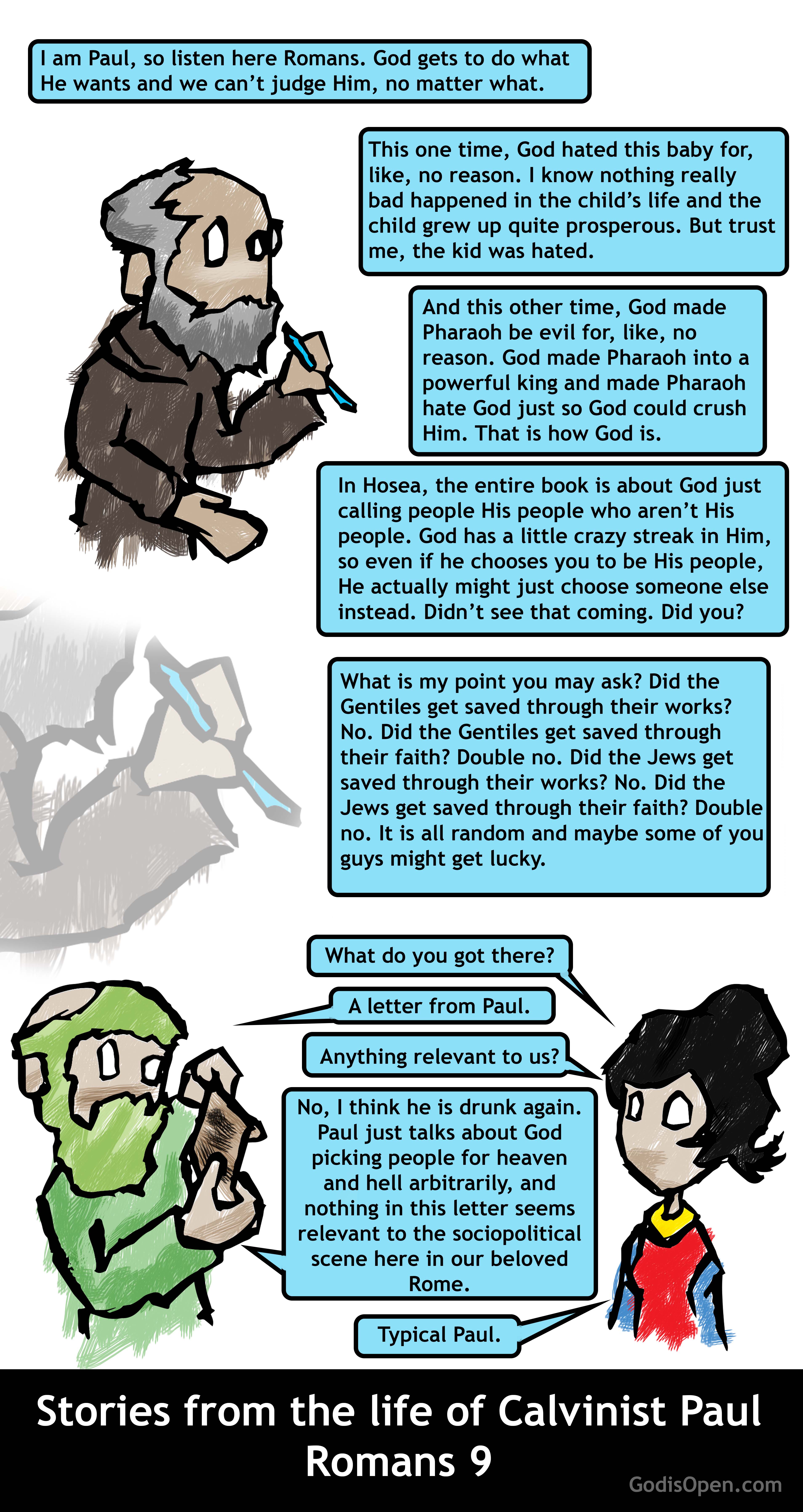
Calvin Admits to Killing Servetus

Calvin writes:

Servetus suffered the penalty due to his heresies, but was it by my will? Certainly his arrogance destroyed him not less than his impiety. And what crime was it of mine if our Council, at my exhortation, indeed, but in conformity with the opinion of several Churches, took vengeance on his execrable blasphemies? Let Baudouin abuse me as long as he will, provided that, by the judgment of Melanchthon, posterity owes me a debt of gratitude for having purged the Church of so pernicious a monster.

Calvin on Psalms 139:16

Whereas Calvinists usually quote Psalms 139:16 as evidence that God predestines people’s entire lives, Calvin understood it as a illustration of the development of a fetus in the womb:

Some read ימים, yamim, in the nominative case, when days were made; the sense being, according to them — All my bones were written in thy book, O God! from the beginning of the world, when days were first formed by thee, and when as yet none of them actually existed. The other is the more natural meaning, That the different parts of the human body are formed in a succession of time; for in the first germ there is no arrangement of parts, or proportion of members, but it is developed, and takes its peculiar form progressively.

Sproul on Repentance

Excerpted from Does God Change His Mind? Divine Repentance by Calvinist R.C. Sproul:

The biblical narratives in which God appears to repent, or change His mind, are almost always narratives that deal with His threats of judgment and punishment. These threats are then followed by the repentance of the people or by the intercessory petitions of their leaders. God is not talked into “changing His mind.” Out of His gracious heart He only does what He has promised to do all along – not punish sinners who repent and turn from their evil ways. He chooses not to do what He has every right to do.

The point of these narratives is to encourage us to pray. We are to make intercession. The promised threats of divine punishment are given with the condition attached that if we repent, we ~vi1l escape those punishments. Sometimes that condition is spelled out explicitly, while at other times it is merely implied. When we repent, then God removes the threat of punishment. The question is, Who is ultimately repenting here? God never repents in the sense that He turns away from sin or from error.

God is not a man. He does not ultimately or literally have arms or legs. He does not repent as men repent. He listens to our prayers but is never corrected by them. He changes not- neither in the perfection of His being nor in the perfection of His thoughts.

20 Questions for Calvinists

Calvin QuestionsCalvinists are notoriously bad at answering straightforward questions. They often avoid questions, especially “yes or no” questions about basic reading comprehension in the Bible. This is a list of questions that demonstrate this fact.

Sovereignty (Calvinism equates “sovereignty” with “meticulous control” although this concept is foreign to any human culture):

1. If God’s will is always already being done on earth as in heaven (as divine determinism implies) why did Jesus teach his disciples to pray, “Thy will be done on earth as it is in heaven?”

Verse: Luk 11:2 So He said to them, “When you pray, say: Our Father in heaven, Hallowed be Your name. Your kingdom come. Your will be done On earth as it is in heaven.

2. People are tempted by evil. Does God cause this?

Verse: Jas 1:13 Let no one say when he is tempted, “I am tempted by God”; for God cannot be tempted by evil, nor does He Himself tempt anyone.

3. Can God’s appointments be thwarted by man?

Verse: 1Ki 20:42 Then he said to him, “Thus says the LORD: ‘Because you have let slip out of your hand a man whom I appointed to utter destruction, therefore your life shall go for his life, and your people for his people.’ ”

4. When God “struck” (aka “killed”) the children of Israel, did God’s intended purpose materialize?

Verse: Jer 2:30 In vain have I struck your children; they took no correction; your own sword devoured your prophets like a ravening lion.

5. In the parable of the potter, does God finish what He started to do?

Verse: Jer 18:4 And the vessel that he made of clay was marred in the hand of the potter; so he made it again into another vessel, as it seemed good to the potter to make.

Omniscience (Calvinism believes God has complete knowledge of all future events):

6. Does God test people to learn what they will do?

Verse: Deu 13:3 you shall not listen to the words of that prophet or that dreamer of dreams, for the LORD your God is testing you to know whether you love the LORD your God with all your heart and with all your soul.

Verse: 2Ch 32:31 However, regarding the ambassadors of the princes of Babylon, whom they sent to him to inquire about the wonder that was done in the land, God withdrew from him, in order to test him, that He might know all that was in his heart.

7. Does God ever regret something He did?

Verse: Gen 6:6 And the LORD was sorry that He had made man on the earth, and He was grieved in His heart.

Verse: 1Sa 15:11 “I greatly regret that I have set up Saul as king, for he has turned back from following Me, and has not performed My commandments.” And it grieved Samuel, and he cried out to the LORD all night.

8. Does God say He will do something although He knows that He will never do that thing?

Verse: 1Sa 2:30 Therefore the LORD God of Israel says: ‘I said indeed that your house and the house of your father would walk before Me forever.’ But now the LORD says: ‘Far be it from Me; for those who honor Me I will honor, and those who despise Me shall be lightly esteemed.

9. When the Bible says God “thought to do” something that He does not do, what does “thought to do” mean?

Verse: Jer 18:7 The instant I speak concerning a nation and concerning a kingdom, to pluck up, to pull down, and to destroy it,
Jer 18:8 if that nation against whom I have spoken turns from its evil, I will relent of the disaster that I thought to bring upon it.

10. Did God do what He said He would do in Jonah?

Verse: Jon 3:10 Then God saw their works, that they turned from their evil way; and God relented from the disaster that He had said He would bring upon them, and He did not do it.

Immutability (Calvinism believes God cannot change in any way):

11. Could God have prevented the evil currently in this world? And if so, how can God be immutable? If no, how can God be omnipotent?

Verse: Jdg 2:20 Then the anger of the LORD was hot against Israel; and He said, “Because this nation has transgressed My covenant which I commanded their fathers, and has not heeded My voice,
Jdg 2:21 I also will no longer drive out before them any of the nations which Joshua left when he died,
Jdg 2:22 so that through them I may test Israel, whether they will keep the ways of the LORD, to walk in them as their fathers kept them, or not.”

12. When God became flesh, was that a change?

Verse: Joh 1:1 In the beginning was the Word, and the Word was with God, and the Word was God.

Joh 1:14 And the Word became flesh and dwelt among us, and we beheld His glory, the glory as of the only begotten of the Father, full of grace and truth.

Timelessness (Calvinism believes God resides outside of “time”):

13. Does God ever wait patiently and endure up to a breaking point?

Verse: Isa 42:14 “I have held My peace a long time, I have been still and restrained Myself. Now I will cry like a woman in labor, I will pant and gasp at once.

Goodness:

14. How can a God who cannot lie make specific time-limit prophecies that do not come true when He said they would?

Verse: Jon 3:4 And Jonah began to enter the city on the first day’s walk. Then he cried out and said, “Yet forty days, and Nineveh shall be overthrown!”

Verse: 2Ki 20:5 “Return and tell Hezekiah the leader of My people, ‘Thus says the LORD, the God of David your father: “I have heard your prayer, I have seen your tears; surely I will heal you. On the third day you shall go up to the house of the LORD.
2Ki 20:6 And I will add to your days fifteen years. I will deliver you and this city from the hand of the king of Assyria; and I will defend this city for My own sake, and for the sake of My servant David.” ‘ ”

Jesus (Calvinism believes that Jesus is God except for the part of Jesus that was human):

15. Was the part of Jesus that was “body” also “Godhead”?

Verse: Col 2:9 For in Him dwells all the fullness of the Godhead bodily;

16. Did Jesus know everything?

Verse: Mar 13:32 “But of that day and hour no one knows, not even the angels in heaven, nor the Son, but only the Father.

17. In what way does Jesus resemble an omnipotent, omnipresent, omniscient, immutable, timeless, and simple God?

Verse: Joh 14:9 Jesus said to him, “Have I been with you so long, and yet you have not known Me, Philip? He who has seen Me has seen the Father; so how can you say, ‘Show us the Father’?

18. If Jesus’ will is the same as God’s will, then why would Jesus say that Jesus’ will would not be done if God’s will is done?

Verse: Luk 22:42 saying, “Father, if it is Your will, take this cup away from Me; nevertheless not My will, but Yours, be done.”

19. Could Jesus have been saved from crucifixion by praying to God?

Verse: Mat 26:53 Or do you think that I cannot now pray to My Father, and He will provide Me with more than twelve legions of angels?

Miscellaneous:

20. Why are the elect the enemy of the gospel?

Verse: Rom 11:28 Concerning the gospel they are enemies for your sake, but concerning the election they are beloved for the sake of the fathers.

Hayes on Prophets and Prophecy

From Christine Hayes’Introduction to the Bible:

The Hebrew prophet should not be thought of primarily as a prognosticator predicting the future. Rather, the prophet addressed a specific and present historical situation in concrete terms. The prophet revealed Yahweh’s immediate intentions but only insofar as he sought to convey Yahweh’s response to present circumstances. The goal, however, was to inspire the people to faithful observance of the covenant in the present. Thus any “predictions” made by the classical prophets had reference to the immediate future as a response to the present situation. The prophet’s message was a message about the present, about what was wrong in the prophet’s day, and what must be done immediately in order to avert calamity.

More on God Learning Where the Temple Will Be Built

From Jacques More in an article entitled THE BIBLE TELLS US GOD LEARNS:

If I am about to go to the ice cream van, or the shop with ice cream, on a hot day and have yet to decide whether to have chocolate, vanilla, strawberry, or another, then I do not yet know what ice cream I will have. Once I’ve decided, then only do I know. I have learned what ice cream I am having. So, it would be true for me to say, when I left home that then I did not know what ice cream flavour I would have. I learnt of that decision AFTER I chose, when at the van or in the shop, but not when I left home.

This is exactly what God is telling us in regards to where the temple was to be built. He tells us that at the time of the exodus from Egypt He had not (yet) decided where this would be built.

Since the day that I brought My people out of the land of Egypt, I have chosen no city from any tribe of Israel in which to build a house, that My name might be there, nor did I choose any man to be a ruler over My people Israel.

2 Chronicles 6:5

God had not decided where to build the temple, “His house”, by the time the people of Israel were brought out of Egypt. God had chosen no city where to have it built. This is fully made plain by the persistent and repeated times God said that He would choose (at a later time) a place for a temple.

But you shall seek the place where the LORD your God chooses, out of all your tribes, to put His name for His dwelling place; and there you shall go. There you shall take your burnt offerings, your sacrifices, your tithes, the heave offerings of your hand, your vowed offerings, your freewill offerings, and the firstborn of your herds and flocks. And there you shall eat before the LORD your God, and you shall rejoice in all to which you have put your hand, you and your households, in which the LORD your God has blessed you.

Deuteronomy 12:5-7

”the place where the LORD your God chooses” in the NKJV is clear, but not as explicit to view as the older English rendition of the KJV “the place which the LORD your God shall choose”: “shall choose” is plainer in reading. God had yet to make that decision is clear: He shall make that decision, but it is not yet chosen. It is not yet decided. And this is repeated numerous other times:

. . . in the place which the LORD shall choose . . .

Deuteronomy 12:14 KJV

. . . in the place which he shall choose to place his name there . . .

Deuteronomy 14:23 KJV

. . . shalt go unto the place which the Lord thy God shall choose to place his name there . . .

Worship Sunday – Us for Them

When the lines are drawn
When you’re in or out
When it’s us or them
And we shame the doubt

It is all a lie
All we ever really need is love
There’s no need to shed more blood
Look upon the cross
Look upon the cross

See the face of Christ
See the mercy in His eyes
Every valley shall be lifted high
Now our enemies are blessed
The heavy laden rest
For His judgement is love
His judgement is love

There is no more guilt
There is no more shame
All our darkest sin
All our deepest pain

Blessed are the poor
All the lonely broken lost and torn
See a kingdom comes to us
A war that’s fought with love
Our only war is love

Prepare the way of the Lord
Wielding mercy like a sword
Every mountaintop will be made low
Know, He holds the earth like dust
And His judgement comes to us
And His judgement is love
His judgement is love

We will not fight their wars
We will not fall in line
Cause if it’s us or them
It’s us for them
It’s us for them

We reject the either or
They can’t define us anymore
Cause if it’s us or them
It’s us for them
It’s us for them

Cause if it’s us or them
It’s us for them
It’s us for them

Prepare the way of the Lord
Wielding mercy like a sword
Every mountaintop will be made low
Know, He holds the earth like dust
And His judgement comes to us
And His judgement is love
May our judgement be love

Blogger Analyzes the Prophecy of the Rooster Crowing

From Gospel Beyond Belief:

My proposal is that Jesus was only trying to teach Peter that his bravado was unwarranted and that Peter was not ready for the reality of the disappointment that the Kingdom of God was about suffering and not political onslaught. However, Jesus’ prediction was most likely not meant to be foretelling but was a strategic challenge to help Peter when the moment of the disappointment arrived. The importance of the prediction is not to show off Jesus’ predictive powers but for the nurturing of Peter. The open theist Greg Boyd has made the point that Jesus in the Gospel of John (chapter 21) alludes to Peter’s denials in order to teach him the real values of the Kingdom and that he predicted that Peter would follow him on the road of suffering and death. This episode helps tie together Jesus’ motive for saying what he did to Peter and what actually happened.

There is no reason why Jesus cannot use language in such a way as to challenge and there is no reason why Jesus cannot use language that is hyperbolic or figurative or whatever. It is my conjecture that Jesus’ prediction used an idiom and the purpose of the idiom was to communicate Jesus’ assurance that Peter would deny him. Jesus was only saying that he was sure Peter would deny him. Jesus was sure that Peter’s bravado was misplaced (because Peter believed in a political messiah?) and he was sure that there would be opportunity for Peter to deny him. At the same time, Jesus was sure Peter would try try to follow (albeit at a distance) because he knew Peter had deep feelings for Jesus. So, Jesus uttered his statement to Peter to warn him that his confidence was misplaced.

Answered Questions – Free will in heaven

From the Facebook group Open Theism:

Is there a consensus on the nature of “freewill” after a Christian is in heaven? Is there a guarantee that one will not choose to rebel against God in the afterlife?

Like much of Open Theist doctrines, there is no consensus. Open Theists can believe either. There is superficial reasons to believe people will always have free will. See Robots in Heaven.

Apologetics Thursday – Enyart debates Bray

An excerpt:

LB: That’s only if you refuse to allow for certain linguistic tools that God uses

What? Larry, an ACTION is not a linguistic tool. By definition actions CANNOT be figures of speech. Calvinists nullify hundreds of verses by saying that they are anthro this and anthro that, with trite and skin-deep pretense quoting verses about God’s arm (which anthropomorphism means that God can reach us) and God’s eyes (meaning He can see what is happening). But Calvinists are the world’s leading experts in what the Bible doesn’t mean. God says He repents and shows that He UNDID what He previously DID (e.g., removing Saul as King, 1 Sam. 10:24; 13:13; 15:23-27, 35; 16:1; 2 Sam. 7:8, 15). A verse is not a figure of speech just because it contradicts your doctrine. If God-repented-that-He-madeSaul-King were a figure of speech as Calvinists claim, then they should be able to tell us what it means. For that is the purpose of figures. But to prop up their philosophical OMNIs and IMs, they claim that God “grieving” does not mean that He grieves; and our sin being a “burden” on God doesn’t mean that; and God being “weary of repenting” does not mean that either.

Because Calvinists say that God being grieved by sin doesn’t really mean that, they feel free to claim the vulgar Calvinist doctrine that God Himself decreed every filthy deed in the rape of a child, as you wrote, “even of these kinds of terrible atrocities.” And this for His pleasure as Calvin claimed. So at the expense of one of God’s primary eternal attributes, His goodness, Calvinists prioritize a bunch of mathematical philosophical claims about HOW LITTLE change God can endure and HOW MUCH knowledge and power He has. But 30 times the Bible says that He is the “Living God.” Don’t reduce Him to such mathematical equations.

Moltmann on God’s Knowledge

As quoted on moltmanniac.com in an article God Doesn’t Will to Know Everything in Advance:

What can be said about the self-limitation of omnipotence in God’s love for those he has created can be said about the other metaphysical attributes of his divinity too: omnipresence, omniscience, invulnerability, and self-sufficiency. God doesn’t know everything in advance because he doesn’t will to know everything in advance. He waits for the response of those he has created, and lets their future come. God is not incapable of suffering; he opens himself in his Shekinah for the sufferings of his people, and in the incarnation of the Son for the sufferings of the love which desires to redeem the world. So in a certain way God becomes dependent on the response of his beloved creatures. In Christian theology one would not go so far as to declare God ‘in need of redemption’ together with his people Israel; but nevertheless, God has laid the sanctification of his Name and the doing of his will in the hands of human beings, and thus also, in its own way, the coming of his kingdom. It must be viewed as part of God’s self-humiliation that God does not desire to be without those he has created and loves, and therefore waits for them to repent and turn back, leaving them time, so that he may come to his kingdom together with them. Jürgen Moltmann, Science and Wisdom, p. 64

Torbeyns Reviews Does God Know the Future?

Tom Torbeyns of Crosstheology reviews the must-read Open Theist book Does God Know the Future?

Recommended!

A handbook on Open Theism for Open Theists and skeptics alike.

“Part I – Philosophical” is recommended to skeptical philosophers.

“Part II – Biblical” contains thorough information for the skeptical theologian.

The author of this book proves throroughly that, according to the Bible, God does not live in a timeless eternal-now state and that He does not know all of the future. As sacreligious as that might sound,after considering these many Bible passages, it gives more glory to the God of the Bible.

His interpretation might be a bit biased and sometimes he repeats himself.

But this book is recommended!

Worship Sunday – A Mighty Fortress is our God

A mighty fortress is our God,
a bulwark never failing;
our helper he amid the flood
of mortal ills prevailing.
For still our ancient foe
doth seek to work us woe;
his craft and power are great,
and armed with cruel hate,
on earth is not his equal.

Did we in our own strength confide,
our striving would be losing,
were not the right man on our side,
the man of God’s own choosing.
Dost ask who that may be?
Christ Jesus, it is he;
Lord Sabaoth, his name,
from age to age the same,
and he must win the battle.

And though this world, with devils filled,
should threaten to undo us,
we will not fear, for God hath willed
his truth to triumph through us.
The Prince of Darkness grim,
we tremble not for him;
his rage we can endure,
for lo, his doom is sure;
one little word shall fell him.

That word above all earthly powers,
no thanks to them, abideth;
the Spirit and the gifts are ours,
thru him who with us sideth.
Let goods and kindred go,
this mortal life also;
the body they may kill;
God’s truth abideth still;
his kingdom is forever.

Blogger Explains why Vague Prophecy Points to Open Theism

From Open Theism and Biblical Prophecy by Gospel Beyond Belief:

Premise 1

To understand premise 1, I want to explain what I mean by the strength of prophecy. I contend that the strength of Bible prophecy as a whole depends on the strength of individual prophecies and the quantity of such prophecies. Let us say for the sake of argument that Jesus was born in a manger on the evening of March 31, 4 B.C. in Bethlehem to parents of Davidic lineage. If this was so, then the following predictions, let’s say made in 500 B.C., would be on a scale of weaker strength prophecies to stronger strength prophecies:

A King will be born
A King will be born in Israel
A King will be born in Bethlehem
A King will be born in Bethlehem in 37-4 B.C.
A King will be born in Bethlehem in 4 B.C.
A King will be born in Bethlehem in 4 B.C. on March 31st
A King will be born in Bethlehem in 4 B.C. on the evening of March 31st
A King named Jesus will be born in Bethlehem in 4 B.C. on the evening of March 31st
A King named Jesus will be born in a manger in Bethlehem in 4 B.C. on the evening of March 31st
A King named Jesus will be born in a manger in Bethlehem in 4 B.C. on the evening of March 31st to parents named Joseph and Mary.
Prediction 10 is stronger than prediction 1 because you have to know much more about the future to be right about 10 than you do about 1. Specificity is not the only measure of the strength of prophecy, however. The amount of such prophecies also figures in the calculus. It could be the case that one prediction of value 4 is stronger that two predictions of value 3, but that would depend on the scale. But the obvious point remains that the more correct predictions the Bible makes the stronger Bible prophecy will be. But keep in mind that prophecies of low strength are still true.

I contend that the individual Old Testament prophecies concerning Jesus’ first advent fall in the 2-3 range in the (imperfect) scale of my example, but they do not reach to strength 4. This leads me to rate the overall strength of Bible prophecy, taking into account quantity as well as quality, in the 2-3 or 3-ish range. This is fairly low.

Premise 2

Open theism provides a better model for why Bible prophecy would have strength 2 or 3 and not 9 or 10. If the future is open then there is a lot of historical wiggle room that God gives freedom. Given this freedom, and given God’s unthwartable sovereign plans, then we wouldn’t expect Bible prophecy to be much higher than 2 or 3. Open theism is often compared to a chess game in which a grandmaster will always beat a novice even though the grandmaster does not know in advance what moves the novice will make. The grandmaster’s plan of victory is assured. God’s plans are assured even though the individual moves might not be known in advance. The grandmaster will win, even though we don’t know that it is by capturing the rook and forcing checkmate on move 14, say. In other words, the reason the strength of Bible prophecy is low is that Open theism is true.

Apologetics Thursday – Duffy v Capps Debate

Facebook is the hosting site of a debate between Will Duffy (an admin on this site) and Seth Capps (a Calvinist). Duffy’s first post:

Will Duffy‎

Debate: Is the Future Settled or Open?

I believe the future is open because God is free. If God is truly free, then the future must be open and cannot be settled, as Calvinists and Arminians claim that it is. In over 10 years of being an open theist, no one has ever been able to explain how God can remain free if the future is settled and predetermined and foreknown. Calvinists not only do not believe man has libertarian free will, they do not believe God has libertarian free will!

The Bible shows on every page that the future is open and that God is free. God is not bound by foreknowledge, nor is He bound by predestination or decrees. God is free. He has libertarian free will. Calvinists (and Arminians) must either reject their theology or reject God’s freedom. The two are not compatible.

My first biblical example that the future is open and that God is free comes from the arrest of Jesus Christ in Gethsemane. After Peter cuts off the ear of a servant of the high priest, Jesus replies that the future is not settled and that God has the ability to do something different than what actually happened.

Matthew 26:52-54
52 But Jesus said to him, “Put your sword in its place, for all who take the sword will perish by the sword. 53 Or do you think that I cannot now pray to My Father, and He will provide Me with more than twelve legions of angels? 54 How then could the Scriptures be fulfilled, that it must happen thus?”

Q1: Seth, do you believe God foreknew that He would send 12 legions of angels to prevent Jesus’ arrest?
Q2: Do you believe God decreed and predestined to send 12 legions of angels to prevent Jesus’ arrest?
Q3: If God did not foreknow or decree or predestine to send 12 legions of angels to prevent Jesus’ arrest, am I correct in asserting that if your theology is true, God did not have the freedom to do what Jesus said the Father had the freedom to do? In other words, am I correct in asserting that you do not believe God has the ability to do something different than what He foreknows/decrees/predestines?

TMS Hosts some Anti-Open Theism Resources

The Master’s Seminary hosts a few sermons against Open Theism:

Robert L. Thomas — Selected Scriptures
THE HERMENEUTICS OF OPEN THEISM

Trevor C. Craigen — Isaiah 40-48
A SERMONIC CHALLENGE TO OPEN THEISM

And a few articles against Open Theism:

It is Time to Change? Open Theism and the Divine Timelessness Debate MARSHALL WICKS AUGUST 25, 2009

The Openness of God: Does Prayer Change God? WILLIAM BARRICK MAY 18, 2010

Isaiah 40-48: A Sermonic Challenge to Open Theism TREVOR C. CRAIGEN MAY 18, 2010

The Hermeneutics of Open Theism ROBERT L. THOMAS AUGUST 25, 2009

And more…

Mohler Worried About Open Theism

From a 2004 article called The ‘Openness of God’ and the Future of Evangelical Theology:

Sadly, evangelicals are now debating the central doctrine of Christian theism. The question is whether evangelicals will affirm and worship the sovereign and purposeful God of the Bible, or shift their allegiance to the limited God of the modern mega-shift.

At stake is not only the future of the Evangelical Theological Society, but of evangelical theology itself. Regardless of how the votes go in Atlanta, this issue is likely to remain on the front burner of evangelical attention for years to come.

The debate over open theism is another reminder that theology is too important to be left to the theologians. Open theism must be a matter of concern for the whole church. This much is certain–God is not waiting to see how this vote turns out.

Worship Sunday – Speak oh Lord

Speak, O Lord, as we come to You
To receive the food of Your Holy Word.
Take Your truth, plant it deep in us;
Shape and fashion us in Your likeness,
That the light of Christ might be seen today
In our acts of love and our deeds of faith.
Speak, O Lord, and fulfill in us
All Your purposes for Your glory.

Teach us, Lord, full obedience,
Holy reverence, true humility;
Test our thoughts and our attitudes
In the radiance of Your purity.
Cause our faith to rise; cause our eyes to see
Your majestic love and authority.
Words of pow’r that can never fail-
Let their truth prevail over unbelief.

Speak, O Lord, and renew our minds;
Help us grasp the heights of Your plans for us-
Truths unchanged from the dawn of time
That will echo down through eternity.
And by grace we’ll stand on Your promises,
And by faith we’ll walk as You walk with us.
Speak, O Lord, till Your church is built
And the earth is filled with Your glory.

Chronology of Jules Lequyer and his Influence on Subsequent Philosophy

This time-line of Lequyer was written by Donald W. Viney, published in his translation of Lequyer’s “The Hornbeam Leaf” (Pittsburg, Kansas: Logos-Sophia Press, 2010):

This chronology builds on that of Jean Grenier, found in his version of Lequyer’s Œuvres complètes, p. xv.

1814: Birth of Joseph-Louis-Jules Lequyer on January 29th at Quintin (in Brittany). His father was Joseph-Jean-Noel Lequyer (1779-1837) and his mother was Céleste-Reine-Marie-Eusèbe Digaultray (1772-1844).

1834: Entrance to the École Polytechnique in Paris; Lequyer meets Charles Renouvier (1815-1903) at this school; Lequyer’s father officially fixes the spelling of the family name as “Lequyer.”

1837: Death of Lequyer’s father (1838 according to Séailles; Dugas says 1839).

1838: After failing the military exam to become a lieutenant and refusing a lesser military post, Lequyer resigns from the École Polytechnique.

1839: Settles at Plérin (Brittany), near St.-Brieuc.

1843: Settles in Paris and teaches French composition at the École Égyptienne; Lequyer translates into French the autobiography of Sir Humphrey Davy, but never publishes it.

1844: Death of Lequyer’s mother; she says to their devoted servant, Marianne Feuillet, “Oh, Marianne, pray, look out for my poor Jules. He has in his heart a passion which, I greatly fear, will be the death of him.”

1846: Mystical crisis; Lequyer wrote to Mgr. Épivent, “God spoke to me . . .”

1848: Return to Plérin and candidacy to the North Coast Assembly; he was not elected.

1850: Sells the family house at St.-Brieuc.

1851: February 28th, mental crisis where Lequyer tried to cut his arm off with a hatchet; confinement at Dinan; at Passy, April 11-19, under care of Dr. Esprit Blanche. After recovering, Lequyer proposes to Anne “Nanine” Deszille (1818-1909), a friend from childhood. She declines.

1853: Teaches mathematics at Besançon and at Lons-le-Saulnier.

1855: Return to Plérin, settles in the countryside in the family home, “Plermont” (Plérin + mont).

1860: Unsuccessful candidacy for the archivist’s position of the Côtes-du-Nord.

1861: Late December, Lequyer again proposes to Mlle. Deszille. She gives a definitive refusal.

1862: February 11th, death by drowning in the bay of St.-Brieuc. Louis Le Hesnan, the philosopher’s secretary who accompanied him reports that Lequyer’s last words were, “Adieu Nanine.” According to Louis Prat, one of his friends, Lequyer made a supreme wager in which he was asking God to save his genius.

1865: Renouvier underwrote 120 copies of a selection of Lequyer’s manuscripts under the title La Recherche d’une première vérité, fragments posthumes

1868: Renouvier and Agathe Lando erect a monument with a statue on top of it over Lequyer’s grave in Plérin. The inscription reads: This monument was raised to the memory of an unhappy friend and a man of great genius in 1868 by Renouvier. Jules Lequyer, born at Quintin in 1814. Deceased at Plérin in 1862. Pray for him. His works: “The Hornbeam Leaf,” Abel and Abel, The Search for a First Truth, The Dialogue of the Predestinate and the Reprobate.
1872 William James writes to Renouvier to request a copy of Renouvier’s edition of Lequyer’s works; Renouvier obliges and, after reading the book, James donates the copy to the Harvard library. James never mentions Lequyer by name in his published work, although he quotes him and alludes to him as “a French philosopher of genius” in The Principles of Psychology (1890).

1880s In the mid-1880s, the historian Proper Hémon happens upon Lequyer’s grave in Plérin and begins writing the philosopher’s biography. This is not published until 1991.

1898 George Séailles publishes “Une Philosophe Inconnu, Jules Lequier” [An unknown philosopher, Jules Lequier], in Revue Philosophique de la France et de L’Étranger. Tome XLV (1898), pp. 120-150. The article was summarized the same year by someone with the initials “E.A.” in The Philosophical Review vol. 7, n. 5 (1898), pp. 537-538.

1924 Publication of Ludovic Dugas’s edition of Renouvier’s collection of Lequyer’s writings, La Recherche d’une première vérité (Paris: Librairie Armand Colin, 1924). Dugas used Hémon’s research in his introduction to the work, “La Vie, L’Œuvre et le Génie de Lequier” [The life, work, and genius of Lequier], pp. 3-52. L. J. Russell reviewed the book for Mind, vol. 36, n. 144 (1927), pp. 512-514.

1936 Jean Grenier publishes his thesis, La Philosophie de Jules Lequier (Paris: Société d’éditions “Les Belles Lettres,” publications de la Faculté des Lettres d’Alger, IIIème Série, Tome X, 1936). In the same year Grenier published excerpts of Lequyer’s writing not included in the editions of Renouvier and Dugas, La Liberté [Freedom] (Paris: Librairie Philosophique J. Vrin, 1936). Harold A. Larrabee reviewed the two books for The Journal of Philosophy, vol. 34, n. 10 (May 13, 1937), pp. 269-270.

1944 Jean-Paul Sartre uses Lequyer’s phrase, “to make, and in making, to make oneself” as a summary of his existentialism but, like James, does not mention Lequyer by name. See Les écrits de Sartre, établie par Michel Contat et Michel Rybalka (Paris: Gaillimard, 1970), p. 655.

1948 Jean Wahl publishes a selection of Lequyer’s writing, Jules Lequier 1814-1862 (Genève et Paris: Édition des Trois Collines, 1948) which includes a lengthy introduction, pp. 9-117. In the same year, Charles Hartshorne lectures in Paris and Wahl introduces him to Lequyer’s work.

1952 Jules Lequier, Œuvres complètes [Complete Works], edited by Jean Grenier (Neuchâtel, Suisse: Éditions de la Baconnière, 1953).

1953 Charles Hartshorne and William L. Reese include an excerpt of Lequyer’s writing in their anthology, Philosophers Speak of God (Chicago University Press, 1953), pp. 227-230.

1974 Hartshorne’s student at Emory University, Harvey Brimmer, publishes a translation and brief commentary on Lequyer’s “The Hornbeam Leaf,” Philosophy in Context, vol. 3 (1974), pp. 94-100.

1975 Brimmer finishes his dissertation, Jules Lequier and Process Philosophy at Emory which includes appendices with translations of Lequyer’s The Problem of Knowledge and Probus or the Principle of Knowledge, which are the first two parts of Renouvier’s edition. Neither the dissertation nor the translations (with the exception of “The Hornbeam Leaf”) were published.

1991 Jules Lequier, Abel et Abel suivi d’une Notice Biographique de Jules Lequier. Texte établie et présenté par Gérard Pyguillem (Combas: Éditions de l’Éclat, 1991). This is the first time Prosper Hémon’s “Notice Biographique de Jules Lequyer” was published, pp. 109-235.

1993 Publication of André Clair’s edition of Renouvier’s collection of Lequyer’s writings, La Recherche d’une première vérité et autres textes (Paris: Presses Universitaires de France, 1993).

1998 Translation of Works of Jules Lequyer: The Hornbeam Leaf, The Dialogue of the Predestinate and the Reprobate, Eugene and Theophilus. Translated by Donald W. Viney. Foreword by Robert Kane. Lewiston (New York: The Edwin Mellen Press, 1998).

1999 Jules Lequyer’s Abel and Abel followed by Incidents in the Life and Death of Jules Lequyer. Foreword by William L. Reese. Translation by Mark West; biography by Donald W. Viney. (Lewiston, New York: The Edwin Mellen Press, 1999). This book is modeled on that the edition of Pyguillem in 1991.

2010 Publication of the first number of the Cahiers Jules Lequier [Jules Lequier Notebooks] with Goulven Le Brech as editor-in-chief. The Cahiers, published annually by Les amis de Jules Lequier [Friends of Jules Lequier], includes articles on Lequyer and difficult to obtain material from archives, as well as book reviews and a review of the literature concerning Lequyer.

2014 International Colloquium on Jules Lequier, celebrating the bicentennial of the philosopher’s birth, held at the École Normale Supérieure in Paris, September 30, 2014.

Answered Questions – Every Knee

From a Reddit Question and Answer with Greg Boyd:

How can the Open Theist God promise every knee will bow, and every tongue shall confess Jesus is Lord, without compromising anyone’s free will?

Greg responds:

How can a Calvinist affirm this without being a universalist? Look, this is an equally challenging passage for everyone who isn’t a universalist. For my two cents, I’m inclined to see this passage as expressing God’s loving bear hug around all humanity with the hope that all will come in. Yet, because love must be chosen, people always have the freedom to say NO THANKS.

Apologetics Thursday – Prayer Doesn’t Change God

By Christopher Fisher

In this video, Tom Wagner claims that “prayer changes us, not God.” This is echoed by a host of Christian pastors and teachings, even by the likes of CS Lewis:

I pray because I can’t help myself. I pray because I’m helpless. I pray because the need flows out of me all the time- waking and sleeping. It doesn’t change God- it changes me.

But this sentiment is foreign to the Bible. It has no bases in Biblical theology. Contrasted to this, the entire Bible is filled with God genuinely responding to prayer and often times doing otherwise than He would have done. Exodus 32 is a prime example.

Exo 32:9 And the LORD said unto Moses, I have seen this people, and, behold, it is a stiffnecked people:
Exo 32:10 Now therefore let me alone, that my wrath may wax hot against them, and that I may consume them: and I will make of thee a great nation.
Exo 32:11 And Moses besought the LORD his God, and said, LORD, why doth thy wrath wax hot against thy people, which thou hast brought forth out of the land of Egypt with great power, and with a mighty hand?
Exo 32:12 Wherefore should the Egyptians speak, and say, For mischief did he bring them out, to slay them in the mountains, and to consume them from the face of the earth? Turn from thy fierce wrath, and repent of this evil against thy people.
Exo 32:13 Remember Abraham, Isaac, and Israel, thy servants, to whom thou swarest by thine own self, and saidst unto them, I will multiply your seed as the stars of heaven, and all this land that I have spoken of will I give unto your seed, and they shall inherit it for ever.
Exo 32:14 And the LORD repented of the evil which he thought to do unto his people.

The Bible is filled with countless accounts of prayer working. The general idea of prayer is that it is a way to reach God and compel His action:

Psa 34:6 This poor man cried, and the LORD heard him and saved him out of all his troubles.
Psa 18:6 In my distress I called upon the LORD; to my God I cried for help. From his temple he heard my voice, and my cry to him reached his ears.
Psa 28:6 Blessed be the LORD! For he has heard the voice of my pleas for mercy.

Luk 11:11 What father among you, if his son asks for a fish, will instead of a fish give him a serpent;

1Jn 5:14 And this is the confidence that we have toward him, that if we ask anything according to his will he hears us.
1Jn 5:15 And if we know that he hears us in whatever we ask, we know that we have the requests that we have asked of him.

Joh 14:14 If you ask me anything in my name, I will do it.

Joh 15:7 If you abide in me, and my words abide in you, ask whatever you wish, and it will be done for you.

The idea that “prayer is for us” is not found in the Bible, but in extrapolations based on Platonic theology.

Clines on the Purpose of Job’s Test

From David Clines’ Job 1-20:

If now we move beyond the story-line and essay a probe into the theological resonances of this element of the story along the lines sketched in the Comment on v 6, the uncertainty in the divine world presses for a resolution. Is the problem one of heaven’s making or of earth’s? Suppose that an immutable law of retribution were heaven’s design; the question would always wait to be posed whether the retribution was no simple single process of cause and effect, but an endlessly revolving circle, with no possibility of discerning what was cause and what effect. That is, if the godly were always rewarded with earthly blessings which in turn promoted greater godliness, heaven would be confronted with the perennial chicken-and-egg conundrum, and heaven itself would not know what was really happening on earth. But suppose the immutable law of retribution were only a human inference on the part of the “wise” (or the naive) about the manner of heaven’s working, would not those shy of immutability in the deity crave some heaven-inspired drama to cripple the dogma and open up space in heaven and on earth for personal freedom? In either case the trial of Job is as necessary for loosing the causal nexus between piety and prosperity as it is for establishing the independence of suffering and guilt.

Yahweh delivers into the Satan’s “hand” all that Job possesses (but not the man himself). It is understood that Yahweh has agreed to “stretch forth [his] hand” and “smite” what is Job’s, and the delegation of the actual task to the Satan is entirely what we should expect given the scene of a monarch and his courtiers. Nothing is to be made of the fact that “Yahweh himself will not smite. He permits the Satan to do it” (Peake). This for three reasons: first, delegated permission is delegated authority and the ultimate delegator has the ultimate responsibility; second, the story does not distinguish between command and permission; third, if there is any significant difference between God’s part and the Satan’s part in the affliction of Job, Job’s complaints against God in the speeches (always against God and never against the Satan) would be to that extent wide of the mark, a conclusion the book as a whole does not allow us to entertain.

Clines on Job

From David Clines’ Job 1-20:

12 So naturally does Yahweh’s agreement to the proposal follow that we are compelled to pause in order to ponder its implications. Are we to condemn the figure of Yahweh here for his alacrity and cold-bloodedness (Duhm) in assenting to such a scheme? And do we find in the prohibition of harm to Job’s person the one lingering sign of Yahweh’s affection for his servant? Or is it that God himself does not need to be convinced of Job’s disinterested piety, but is prepared to allow the Satan to satisfy himself of its reality (Rowley), or, to put it more positively, accepts the challenge in order to vindicate his servant against the insinuations of the Satan (Peake)? Or are we to say, most improbably of all, that God assents to the trial of Job’s piety in order to refine or deepen Job’s faith?

All these suggestions attribute to the narrative a subtlety it does not bear, at least in its essential story-line. God can agree to the proposal to “smite” all that is Job’s only because he too, like everyone else, does not know what the outcome will be. The Yahweh of this tale is not the absolutely omniscient God of later systematic or speculative theology. He is wise beyond human comprehension, for his “eyes” and “ears,” like the spies of the Persian kings, are everywhere abroad, and report to him on days of assembly (cf. v 6). But not even Yahweh knows what has not yet happened; his knowledge does not encompass all possible hypothetical situations. He has confidence in Job, but not a confidence that would enable him to use Job as an object lesson to refute the Satan’s aspersions. He too has taken it for granted that he will bless the pious man; but that benign reciprocity has obscured the true relation of piety and prosperity. The Satan has the right to ask the question, and Yahweh is in the right in having the problem probed.

The alternative to such a reading of the story is worse. Affirm that Yahweh is infinitely omniscient, and you assert that Job’s suffering serves only to prove God right in the eyes of one of his subordinates. Affirm that Yahweh knows that Job will not waver, and you cannot explain why Yahweh takes the slightest notice of the Satan’s questions or why he does not dismiss them out of hand from superior knowledge.

Worship Sunday – How Deep the Father’s Love

How deep the Father’s love for us,
How vast beyond all measure
That He should give His only Son
To make a wretch His treasure

How great the pain of searing loss,
The Father turns His face away
As wounds which mar the chosen One,
Bring many sons to glory

Behold the Man upon a cross,
My sin upon His shoulders
Ashamed I hear my mocking voice,
Call out among the scoffers

It was my sin that held Him there
Until it was accomplished
His dying breath has brought me life
I know that it is finished

I will not boast in anything
No gifts, no power, no wisdom
But I will boast in Jesus Christ
His death and resurrection

Why should I gain from His reward?
I cannot give an answer
But this I know with all my heart
His wounds have paid my ransom

Boyd on Platonistic Omniscience

From How People Misunderstand Open Theism:

First, Plato argued that we see not by light entering our eyes (as we now know is the case) but by light proceeding out of our eyes (Timaeus 45b). For Plato, seeing is an active, not a passive, process. Since knowledge was considered to be a kind of seeing, Plato also construed knowing as acting on something rather than being acted upon (Sophist 248-49). I’ve discovered that this mistaken view of seeing and knowing is picked up and defended by a host of Hellenistic philosophers.

Second, several Neoplatonistic philosophers (Iamblichus, Proclus and Ammonius) used this theory of eyesight and knowing to explain how the gods can foreknow future free actions. They argued that the nature of divine knowledge is determined not by what is known but by the nature of the knower. Since they assumed the gods were absolutely unchanging, they concluded that the gods knew things in an absolutely unchanging manner, despite the fact that the reality the gods know is in fact perpetually changing. This allowed them to affirm that the future partly consisted of indefinite (aoristos) truths (viz. open possibilities) while nevertheless insisting that the gods knew the future in an exhaustively definite, unchanging way.

The view is, I’m convinced, completely incoherent. But one can understand how these philosophers arrived at it in light of their mistaken assumptions about seeing and knowing as wholly active processes. What the gods see when they look at the future conforms to the unchanging nature of the gods rather than the changing nature of the future they see. Through the influence of Augustine and especially Boethius (who explicitly espoused the ancient view of seeing and knowing and repeated some of the Neoplatonic arguments), this way of “reconciling” foreknowledge and free will quickly established itself as the dominant view in the Christian tradition.

Biederwolf on the Absurdity of Prayer for Our Sake

From How Can God Answer Prayer?: Being an Exhaustive Treatise of the Nature:

” The true value of prayer is that it stops people from wanting what they can’t get,” Dr. Patton goes on to apply this theory to some of the Master’s teaching about prayer. We are told to ask, to seek, and to knock.

“Imagine,” he says, “a child asking for some favor, or for the relief of some want, and standing hour after hour, repeating his requests, and being told by the father: ‘Go on asking, my child; it does you much good to ask. The longer you ask the more good it will do you. Do not expect to receive anything, however, as the principal benefit of asking is that, by and by, you will not want anything, and will cease to make any request.’ Imagine a mother seeking a lost child. She looks through the house and along the streets, then searches the fields and woods and examines the river banks. A wise neigh bor meets her and says: ‘seek on; look everywhere; search every accessible place. You will not find, indeed, but then seeking is a good thing. It puts the mind on the stretch; it fixes the attention; it aids observation; it makes the idea of the child very real. And then, after a while, you will cease to want your child.’

Calvin on God Predestining Sin

From Institutes of the Christian Religion:

6. Impiety starts another objection, which, however, seeks not so much to criminate God as to excuse the sinner; though he who is condemned by God as a sinner cannot ultimately be acquitted without impugning the judge. This, then is the scoffing language which profane tongues employ. Why should God blame men for things the necessity of which he has imposed by his own predestination? What could they do? Could they struggle with his decrees? It were in vain for them to do it, since they could not possibly succeed. It is not just, therefore, to punish them for things the principal cause of which is in the predestination of God. Here I will abstain from a defense to which ecclesiastical writers usually recur, that there is nothing in the prescience of God to prevent him from regarding; man as a sinner, since the evils which he foresees are man’s, not his. This would not stop the caviler, who would still insist that God might, if he had pleased, have prevented the evils which he foresaw, and not having done so, must with determinate counsel have created man for the very purpose of so acting on the earth. But if by the providence of God man was created on the condition of afterwards doing whatever he does, then that which he cannot escape, and which he is constrained by the will of God to do, cannot be charged upon him as a crime. Let us, therefore, see what is the proper method of solving the difficulty. First, all must admit what Solomon says, “The Lord has made all things for himself; yea, even the wicked for the day of evil,” (Prov. 16: 4.) Now, since the arrangement of all things is in the hand of God, since to him belongs the disposal of life and death, he arranges all things by his sovereign counsel, in such a way that individuals are born, who are doomed from the womb to certain death, and are to glorify him by their destruction. If any one alleges that no necessity is laid upon them by the providence of God, but rather that they are created by him in that condition, because he foresaw their future depravity, he says something, but does not say enough. Ancient writers, indeed, occasionally employ this solution, though with some degree of hesitation. The Schoolmen, again, rest in it as if it could not be gainsaid. I, for my part, am willing to admit, that mere prescience lays no necessity on the creatures; though some do not assent to this, but hold that it is itself the cause of things. But Valla, though otherwise not greatly skilled in sacred matters, seems to me to have taken a shrewder and more acute view, when he shows that the dispute is superfluous since life and death are acts of the divine will rather than of prescience. If God merely foresaw human events, and did not also arrange and dispose of them at his pleasure, there might be room for agitating the question, how far his foreknowledge amounts to necessity; but since he foresees the things which are to happen, simply because he has decreed that they are so to happen, it is vain to debate about prescience, while it is clear that all events take place by his sovereign appointment.

Worship Sunday – Amazing Love

I’m forgiven, because You were forsaken
I’m accepted, You were condemned
I’m alive and well, Your Spirit is within me
Because You died and rose again

I’m forgiven, because You were forsaken
I’m accepted, You were condemned
I’m alive and well, Your Spirit is within me
Because You died and rose again

Amazing love, how can it be
That You my King would die for me
Amazing love, I know it’s true
It’s my joy to honor You
Amazing love, how can it be
That You my King would die for me
Amazing love, I know it’s true
It’s my joy to honor You
In all I do I honor You

I’m forgiven, because You were forsaken
I’m accepted, You were condemned
I’m alive and well, Your Spirit is within me
Because You died and rose again

Physicist Rejects that Time is an Illusion

From Is the Future Already Written?:

Ellis’ calculations show that the evolving block universe does not contradict relativity’s prediction that two people can disagree on the order of two events. In both Einstein’s and Ellis’ pictures, the time at which each person perceives both events to have occurred is based on the discrepancies between how long it takes light from each event to reach them. In Einstein’s view, these events — and all future events — coexist. But in Ellis’ picture, both events must lie in the portion of the evolving block that houses the past; they are fixed into reality before information about them reaches anyone. Similarly, in Ellis’ view, two observers can disagree on the duration of an event, but only if that event has already crystallized into the past. Thus, Ellis’ model of time retains enough of the block universe to match with relativity’s predictions, but without needing to take Einstein’s drastic last step of assuming that the fourth dimension is solidified into the infinite future.

Answered Questions – Who Can Resist His Will

Calvinists often quote Romans 9 in an effort to claim that God’s will always and forever is happening:

Rom 9:18 Therefore He has mercy on whom He wills, and whom He wills He hardens.
Rom 9:19 You will say to me then, “Why does He still find fault? For who has resisted His will?”

They believe that God’s will is never thwarted. This is despite the fact that a major theme in the Bible is Israel’s continued thwarting of God’s will. But a very contrite answer is “lawyers”. Lawyers can resist God’s will:

Luk 7:30 But the Pharisees and lawyers rejected the will of God for themselves, not having been baptized by him.

The Calvinist takes Romans 9 out of context. Paul is not asking “who can resist God’s will on any matter ever?” Paul is saying “Because God’s calling of a chosen people was not based on merit, God is revoking this status, and who can oppose Him?” In fact, the beginning verses of Romans 9 details Israel’s rebellion in spite of divine advantages. And then in Romans 10, Paul warns the Gentiles that God will cut them off if they too rebel. And then in Romans 11, Paul makes it clear that the elect Israel are enemies of the gospel:

Rom 11:28 Concerning the gospel they are enemies for your sake, but concerning the election they are beloved for the sake of the fathers.

All these fact do not lend itself to an interpretation that “For who has resisted His will?” is a rhetorical question meant to be broadly applied. It only applies to the context of Paul’s point. Paul believes plenty of people resist God’s will.

Apologetics Thursday – Ezekiel 16

Triablogue writes:

iv) Perhaps I’m insufficiently well-read in current open theism literature, but to my knowledge, when open theists lay out their exegetical case for their position, there’s a conspicuous omission of passages like Ezk 16. Yet that seems to be custom-made for open theism, in terms of how open theism typically interprets and infers God’s nature (i.e. emotion, passibility, mutability) from the OT. It presents a limiting-case for open theist prooftexting.

He adds:

vi) Given open theist hermeneutics, the God who emerges from Ezk 16 is a terrifying God. And terrifying in a particular respect: he lacks emotional self-control. He loses his cool, lashing out in fury. A God with a short fuse.

It’s like a Mafia Don who adopts the daughter of his late brother. He raises her with great affection and kindness. But if his ward betrays his love, his love turns to hate. He becomes vindictive. He’s wonderful to you as long as you don’t cross him. But if you get on his wrong side, if he feels betrayed, then you will find yourself on the receiving end of omnipotent revenge.

It is clear from Triablogue that he believes Ezekiel 16 is some sort of allegory (that’s the word he uses). What he seems to mean by this is that the story is meant to engage the audience’s passions and has little semblance to God’s actions with Israel. But the problem with this is that the story explains what it means as it is told. The metaphor is interwoven with real events. Instead of suitors, the Egyptians, Assyrians, Chaldeans are named. The acts ascribed to Israel are idol worship and child sacrifice.

Israel is said to be the woman and God is said to be God. There is no hint that God is representing Himself with a puppet character that in no way resembles Himself. Instead, God uses the first person to tell this tale. The actions are directly attributed God and the woman’s actions are directly attributed to Israel throughout the story. If this is an “allegory”, it is a not a very well written one. Instead of an allegory, this serves more like an extended metaphor interwoven with real history. This is not a cute tale of morality, but an illustration of God’s extremely emotional relationship with Israel. That Triablogue attempts to divorce the text from God’s anger, jealousy, wrath, and vindictiveness is to reverse the intent of the story.

So, what is so disturbing about the story?

Ezekiel 16 tells a story. In the story, Israel is a girl abandoned by the world. God adopts and raises this girl:

Eze 16:6 “And when I passed by you and saw you struggling in your own blood, I said to you in your blood, ‘Live!’ Yes, I said to you in your blood, ‘Live!’

The man raises the girl and eventually falls in love with the girl. He marries the woman (so far, sounds like the plot of Jane Eyre):

Eze 16:8 “When I passed by you again and looked upon you, indeed your time was the time of love; so I spread My wing over you and covered your nakedness. Yes, I swore an oath to you and entered into a covenant with you, and you became Mine,” says the Lord GOD.

The man lavishes the woman with gifts of the finest sort. She becomes very popular as a result. This attracts other men and she becomes involved in numerous affairs:

Eze 16:15 “But you trusted in your own beauty, played the harlot because of your fame, and poured out your harlotry on everyone passing by who would have it.

God then rejects His whoring wife (and the whoring is described in great detail). He abandons her:

Eze 16:27 “Behold, therefore, I stretched out My hand against you, diminished your allotment, and gave you up to the will of those who hate you, the daughters of the Philistines, who were ashamed of your lewd behavior.

So God abandons His cheating wife. Men move in to fill the power void. God then rounds up Israel and condemns her to death (the Biblical penalty for adultery):

Eze 16:38 And I will judge you as women who break wedlock or shed blood are judged; I will bring blood upon you in fury and jealousy.

After Israel is judged (after all, Israel is not one person to be killed and to live no more), God’s jealousy will subside:

Eze 16:42 So I will lay to rest My fury toward you, and My jealousy shall depart from you. I will be quiet, and be angry no more.

God then returns to Israel and re-establishes His covenant:

Eze 16:60 “Nevertheless I will remember My covenant with you in the days of your youth, and I will establish an everlasting covenant with you.
Eze 16:61 Then you will remember your ways and be ashamed, when you receive your older and your younger sisters; for I will give them to you for daughters, but not because of My covenant with you.
Eze 16:62 And I will establish My covenant with you. Then you shall know that I am the LORD,

Why is this story shocking to Triablogue and to feminists? God was abused by His wife and as a result withdraws His gifts and protection. What? God is to embrace His cheating wife and celebrate her infidelity? God should celebrate adultery? What? God is obligated to protect His cheating wife from the rapists (such activity that she has actively paid to receive)? They kill her and God should have saved his adulterous wife? Why is it that nothing in this story would make God evil unless it is being read by a modern moral relativist?

Triablogue does not believe God can act and relate in ways the story depicts, so he must reject the text. In fact, Triablogue is disturbed by the actions that are depicted, actions that are ascribed to God! Humorously, Triablogue offers his own analogy (what is wrong with the metaphor the Bible uses?), but Triablogue fails to capture the story. This is not some petty slight, but a major action of wanton adultery with countless lovers within the context of marriage. Really, the entire point of this story is that God has been hurt emotionally by Israel to an incurable extent. This is not a story which is remotely compatible with immutability or omniscience of all future events. This is not a nice object lesson to Israel, misrepresenting everything God says and does. This is God pouring out His heart to Israel. God is emotionally devastated. Christians would do well not to make light of this fact.

Fiorenza on Augustine’s Platonistic Hermeneutic

From Systematic Theology: Task and Methods

In On Christian Doctrine, Augustine developed principles and rules for the interpretation of the Scriptures. In so doing, Augustine provided important and influential contributions to rhetoric, education, theology, and hermeneutics. Augustine’s hermeneutical theory should be understood in relation to his Neo-Platonic background and his attempt to come to grips with the incarnation of the divine wisdom. The Platonic chorismos schema—namely, the distinction between the changeable and unchangeable, the temporal and eternal—provides the background theory to his rules of interpretation. The changeable should be interpreted in relation to the unchangeable, the temporal to the eternal, the world to the transcendent, historical events to the divine plan of salvation, and the human Christ to the divine Word. Augustine’s hermeneutical theory bases signification on the ontological priority of the unchangeable eternal to the changeable and material.

This conviction (concerning the ontological priority of the transcendental reality over the material sign) leads Augustine to his basic principle of hermeneutics: what is of primary importance is not so much our knowledge of the material sign that enables us to interpret the eternal reality, but rather it is our knowledge of the eternal reality that enables us to interpret the material sign. This hermeneutical principle applies not only to allegorical and typological but also to literal interpretation. To understand the words of the Bible properly as signs of eternal reality, one must acknowledge that reality.

Olson on Judas being Chosen

From Biblical Truth Resources:

Judas was chosen to be one of the twelve apostles to serve God and be a witness to the Gospel and revealed truth. He obviously was partaking of this truth, but rebelled and became an apostate—thus frustrating the loving plans of his Master: Acts 1:25; Mt. 10:2-4; Lk. 6:12-13; Mk. 3:14-15. The reasons why the Twelve were chosen are given below. If the Lord Jesus chose to bestow extended labor of preparation upon one whom He certainly foresaw would fall of the intended mission, it would appear that an unwise and inconsistent choice was made. Judas had no authority, he merely “became a guide to those who arrested Jesus” (Acts 1:16).

Worship Sunday – Power of the Cross

Oh, to see the dawn of the darkest day
Christ on the road to Calvary
Tried by sinful men, torn and beaten then
Nailed to a cross of wood

This the power of the cross
Christ became sin for us
He took the blame, bore the wrath
We stand forgiven at the cross

Oh, to see the pain written on Your face
Bearing the awesome weight of all my sin
Every bitter thought, every evil deed
Crowning Your bloodstained brow

This the power of the cross
Christ became sin for us
He took the blame and bore the wrath
We stand forgiven at the cross

Now the daylight flees, now the ground beneath
Quakes as it’s Maker bows His head
Curtain torn in two, dead are raised to life
Finished the victory cry

This the power of the cross
And Christ became sin for us
He took the blame and bore the wrath
We stand forgiven at the cross

Oh, to see my name written in the wounds
For through Your suffering I am free
Death is crushed to death and life is mine to live
Won through Your selfless love

And this the power of the cross
Son of God, slain for us
What a love, what a cost
We stand forgiven at, we stand forgiven at
We stand forgiven at the cross

Christ the Center Panel on Impassibility

An interesting panel on impassibility by Calvinists:

The audio can be found here.

From the webpage:

The Christ the Center panel meets with Rev. Dr. James Dolezal to discuss the much maligned doctrine of divine impassibility. Beginning with a look at Westminster Confession of Faith 2.1, that “There is but one only, living, and true God, who is infinite in being and perfection, a most pure spirit, invisible, without body, parts, or passions…” the panel looks at the biblical basis and importance of understanding, affirming, and developing a proper use of this doctrine that God does not have passions. Often taken to be a denial of, for instance, God’s love, it is shown that the truth is to the contrary. As simple and as pure act, God is love in the fullest sense without fluctuation or change which is the human lot. This discussion offers much food for thought.

Unanswered Questions – Critical Biblical Scholarship

If Calvinism or Negative Theology is true, why is the thrust of Critical Biblical scholarship under the understanding that the Old Testament, in particular, holds no concept of Negative Theology (omnipresense, omnipotence, omniscience, timelessness, immutability, etc)? Do not critics usually focus on their most solid evidence?

Those who confuse the biblical character Yahweh with the “God” constructed by classical western theology may be troubled by the fact that Yahweh is presented in his interactions with humans in the Pentateuch as neither omniscient nor omnipotent. Unacquainted with the god constructed by western theology many centuries later, the biblical narrator( s) felt no such confusion, asserting the great power of Yahweh on the one hand and the absolute freedom of humankind on the other.

Hayes, Christine (2012-10-30). Introduction to the Bible (The Open Yale Courses Series) (Kindle Locations 964-967). Yale University Press. Kindle Edition.

What is most crucial about this relatedness is that Israel’s stock testimony is unconcerned to use a vocabulary that speaks about Yahweh’s own person per se. Israel has little vocabulary for that and little interest in exploring it. Such modest terminology as Israel has for Yahweh’s self might revolve around “Yahweh is holy,” but this sort of language is not normally used, and most often it occurs only in specialized priestly manuals. More important, Israel’s characteristic adjectival vocabulary about Yahweh is completely lacking in terms that have dominated classical theology, such as omnipotent, omniscient, omnipresent. This sharp contrast suggests that classical theology, insofar as it is dominated by such interpretive categories and such concerns, is engaged in issues that are not crucial for Israel’s testimony about Yahweh and are in fact quite remote from Israel’s primary utterance.

Brueggemann, Walter (2005-07-19). Theology of the Old Testament: Testimony, Dispute, Advocacy (p. 225). Fortress Press. Kindle Edition.

Apologetics Thursday – The Conflicting Biblical Views of the Monarchy

Christine Hayes, hostile to an inspired view of scriptures, writes:

More important, however, is the existence of sources that hold opposing views of the institution of kingship. Some passages are clearly antimonarchic; others are promonarchic (or at least report neutrally on the selection and installation of Saul as king).

Some have argued that while the editors who compiled the text preserved the promonarchic perspective of their sources, they chose to frame the promonarchic passages with their own antimonarchic passages, with the result that the antimonarchic passages provide an interpretive framework and are dominant. The implication is that despite positive contemporary evaluations of Israel’s kings, from the perspective of a later period, the institution of king-ship was considered a disaster for Israel, and that negative assessment is introduced by the Deuteronomistic redactor into the account of the origin of the institution. Others feel that the promonarchic and antimonarchic views were contemporaneous and equally ancient perspectives. Whether one view is older and one later, whether both are ancient or both late— the end result is a complex narrative that includes various views of monarchy in ancient Israel, views that defy easy categorization and that lend the book an air of complexity and sophistication.

A third perspective, one of an inspired scripture and one that only works in the context of Open Theism, is that the conflicting promonarchic passages and antimonarchic passages represents God’s struggles with Israel rejecting God’s Kingship over Israel. Israel has failed God throughout the book of Judges. Every man is doing what is right in their own eyes rather than submitting themselves to God. In God’s preferred system, there is no king except God, but this system has failed due to the people’s rejection of God. This failure is heightened by God’s cycle of blessings and punishments meant to correct Israel and to guide Israel. Israel has rejected all attempts by God to reform them.

The change to a human king represents God’s acceptance of a new strategy, a strategy which is adopted begrudgingly and which has several hiccups throughout the lifespan of this strategy. The entire process shows God’s frustrations in dealing with Israel. God enters the monarchy jaded. This, very well, can explain the conflicting promonarchic and antimonarchic passages within the Bible without need to resort to dual authorship.

Hayes on Reading the Bible

From a Huffington Post article, 5 Common Misconceptions About the Bible:

Correction #5

The character “Yahweh” in the Hebrew Bible should not be confused with the god of western theological speculation (generally referred to as “God”). The attributes assigned to “God” by post-biblical theologians — such as omniscience and immutability — are simply not attributes possessed by the character Yahweh as drawn in biblical narratives. Indeed, on several occasions Yahweh is explicitly described as changing his mind, because when it comes to human beings his learning curve is steep. Humans have free will; they act in ways that surprise him and he must change tack and respond. One of the greatest challenges for modern readers of the Hebrew Bible is to allow the text to mean what it says, when what is says flies in the face of doctrines that emerged centuries later from philosophical debates about the abstract category “God.”

Hayes on God Learning about Man

From Yale University Professor Christine Hayes:

Second of all in this story we see something that we’ll see repeatedly in the Pentateuch, and that is that God has to punt a bit. He has to modify his plans for the first couple, by barring access to the tree of life. That was not something presumably he planned to do. This is in response to, perhaps, their unforeseen disobedience: certainly the way the story unfolds that’s how it seems to us. So despite their newfound mortality, humans are going to be a force to be reckoned with. They’re unpredictable to the very god who created them.

Free Monday – Does God Control Everything

Calvinist RC Sproul is offering a free kindle pamphlet Does God Control Everything. A sample:

Providence is not the same thing as God’s foreknowledge or prescience. Foreknowledge is His ability to look down the corridors of time and know the outcome of an activity before it even begins. Nevertheless, it is appropriate to use the word providence with reference to God’s active governance of the universe, because He is indeed a God who sees. He sees everything that takes place in the universe. It is in full view of His eyes.

This can be one of the most terrifying thoughts a human being can have—that there is someone who is, as Jean-Paul Sartre lamented, an ultimate cosmic voyeur who looks through the celestial keyhole and observes every action of every human being. If there is anything about the character of God that repels people from Him more than His holiness, it is His omniscience. Every one of us has a keen desire.

Worship Sunday – Lord, I Need You

Lord, I come, I confess
Bowing here I find my rest
Without You I fall apart
You’re the One that guides my heart

Lord, I need You, oh, I need You
Every hour I need You
My one defense, my righteousness
Oh God, how I need You

Where sin runs deep Your grace is more
Where grace is found is where You are
And where You are, Lord, I am free
Holiness is Christ in me

Lord, I need You, oh, I need You
Every hour I need You
My one defense, my righteousness
Oh God, how I need You

Teach my song to rise to You
When temptation comes my way
And when I cannot stand I’ll fall on You
Jesus, You’re my hope and stay

Lord, I need You, oh, I need You
Every hour I need You
My one defense, my righteousness
Oh God, how I need You

You’re my one defense, my righteousness
Oh God, how I need You
My one defense, my righteousness
Oh God, how I need You

Slick Attempts to Get an Open Theist to Admit to To Semantics

https://carm.org/open-theist-whether-or-not-god-can-make-mistake

Matt Slick is concerned with philosophy/semantics, anything except the Bible (as shown before). In one conversation, Slick wanted to make mistake mean something other than what his opponent would have it mean. Slick just interested in semantics. Here is the dialogue, interestingly quoted with pride by Slick on his own website. It is apparent that Slick just doesn’t understand what he is talking about:

Matt: You said above it would be a mistake, right?
Stan: You said it.
Matt: I thought you did, my mistake. Okay, now if God expects something to happen and it doesn’t, did God make a mistake in his judgment? …in his expectation?
Stan: No. He expected it. It didn’t happen. The question should then be why? Why didn’t it happen?
Matt: So if I expect one thing to happen and I am wrong about it, then I didn’t make a mistake in my expectations?????
Stan: If I were an omnipotent God and expected something to happen, but it didn’t, if I refrained using my power to make it happen, it would have been a mistake to expect something to happen. Do you agree?
Matt: That isn’t the issue.
Stan: But that is the issue
Matt: I said, if God expects something to happen and it doesn’t, did God make a mistake in his judgment?
Stan: Its about God’s power and ability to make the future happen in accordance with his will.
Matt: Let’s ask it again: If God expects something to happen and it doesn’t, did God make a mistake in his judgment?
Stan: No Matt, he did not make a mistake. If you expect something to happen, but it doesn’t, there could lots of reasons from point a to b as to why it didn’t. After all, you never expected to become a Christian. Yet you did.
Matt: So, when you expect one thing to happen and when you are wrong about that, that is NOT a mistake??? correct?
Stan: It wasn’t a mistake at the time.

Also see Slick Mocks God.

Apologetics Thursday – Psalms 33:11

A Youtube video attempts to prooftext God’s immutability:

It cites:

Psa 33:11 The counsel of the LORD stands forever, the plans of his heart to all generations.

Does this mean God is immutable? How does someone read this and then come to the conclusion: “this means that God can not change in any respect, ever.”

1. It is about God’s counsel (God’s plans). In the previous verse the text contrasts God’s counsel with the counsel of nations. God is said to overthrow the nation’s counsel. That, in itself, is a change.

2. The contrast is about plans that can be thwarted and plans that cannot be thwarted. How does this imply immutability?

3. Does the text imply that man’s changeablness is what undid their plans? That seems like an absurd reading.

Psalms 33:11 cannot be reasonably claimed as a prooftext for immutability. For people to use it as a prooftext shows that the evidence for immutability is slim.

Arminian Welcomes Open Theists as Brothers

From Hope’s Reason:

I would not consider myself to be an open theist. But the question is: Is open theism a heresy? As I said, I know Clark Pinnock and I deeply respect him, not just intellectually but as a Christian. He has a passionate love for Christ and I believe that he is serving the Lord with all his strength. I can disagree with Clark on certain issues but I can not deny his love for Christ. To me, heresies are most often defined by an inadequate Christology, such as the Jehovah’s Witnesses’ belief of Jesus as the archangel Michael. I have seen no evidence of any heretical tendencies in their Christology. I continue to be skeptical about open theism, but I am not able label them as a heretical movement. They are Christian brothers and sisters that I have some disagreement with in theology.

Holt on All Knowledge Being a Contradictory Phrase

From the Facebook group GodisOpen:

Rohan Holt I’ve heard that a Hindu view of a God can be that God both exists and does not exist, at the same time. If God is everything (as Hinduism maintains), God can have completely incompatible attributes; even incompatible with reality. Calvinism starts to appear like Hinduism at some points, e.g. how it can define the “omni” attributes of God. “All knowledge” cannot possibly include the knowledge of what it feels like to be totally ignorant.

Free Monday – How the Salvation of Cornelius Refutes Calvinism

Will Duffy writes an article: How the Salvation of Cornelius Refutes Calvinism.

An excerpt:

Monergism would necessitate that Cornelius has already been regenerated at this point. For Calvinism would not describe an unsaved man the way Luke describes Cornelius here. Yet prior to his conversion, Cornelius was a devout man, and feared God. He also gave alms and prayed to God always. Though contradicted by numerous biblical examples, according to Calvinism, unregenerate men cannot do good in the sight of God. And in contrast to Ezekiel’s warning to the man whose “righteousness which he has done shall not be remembered”, regarding Cornelius, the Apostle Peter says, “Cornelius, your prayer has been heard, and your alms are remembered in the sight of God” (Acts 10:31). Yet the book of Acts shows clearly that Cornelius had yet to experience salvation.

Worship Sunday – Be Thou My Vision

Be Thou My Vision

Lyrics:

Be Thou my vision, O Lord of my heart
Naught be all else to me, save that Thou art
Thou my best thought by day or by night
Waking or sleeping Thy presence my light

Be thou my wisdom and Thou my true word
I ever with Thee and Thou with me, Lord
Thou my great Father, I, Thy true son
Thou in me dwelling and I with Thee one

Riches I heed not nor man’s empty praise
Thou mine inheritance now and always
Thou and thou only first in my heart
High King of heaven my treasure Thou are

High King of heaven my victory won
May I reach heaven’s joys, O bright heaven’s Sun
Heart of my own heart whatever befall
Still be my vision O Ruler of all

Hayes on the History of Genesis

From Introduction to the Old Testament by Yale Professor Christine Hayes:

With Jacob, who is now Israel, God seems perhaps to finally have found the working relationship with humans that he has been seeking since their creation. God learned immediately after creating this unique being, that he will exercise his free will against God. God saw that he had to limit the life span of humans, or risk creating an enemy that was nearly equal to him. So he casts the humans out of the Garden, blocks access to the tree of life. But humans continue their violent and evil ways, and in desperation, God wipes them out, and starts again. This second creation proves to be not much better. They forget God, they turn to idolatry. God has promised at this point, however, not to destroy all humankind again, so he experiments with a single individual of faith. Abraham’s faith withstands many a trial. He is obedient to God in a way that no one has been up to this point in the narrative, but perhaps ultimately the model of blind obedience is rejected, too. When Abraham prepares to slaughter his own son, perhaps God sees that blind faith can be as destructive and evil as disobedience, so God relinquishes his demand for blind obedience: he stops Abraham himself.

Questions Answered – Where does God Change His Mind in the Bible

By Christopher Fisher

From a commenter:

Where did God actually “change” his mind?

There is a very helpful category on this page to answer your question:

Verses on God’s repentance

God repents (changes His mind) throughout the Bible. So often does God do this that God laments:

Jer 15:6 You have forsaken Me,” says the LORD, “You have gone backward. Therefore I will stretch out My hand against you and destroy you; I am weary of relenting [repenting]!

God even declares that it is one of His general principles that He will change His mind based on circumstances:

Jer 18:7 The instant I speak concerning a nation and concerning a kingdom, to pluck up, to pull down, and to destroy it,
Jer 18:8 if that nation against whom I have spoken turns from its evil, I will relent of the disaster that I thought to bring upon it.
Jer 18:9 And the instant I speak concerning a nation and concerning a kingdom, to build and to plant it,
Jer 18:10 if it does evil in My sight so that it does not obey My voice, then I will relent concerning the good with which I said I would benefit it.

In this scenario, God both does not do what He thought He was going to do and does not do what He said He was going to do. We see this realized throughout the Bible:

1Sa 2:30 Therefore the LORD God of Israel says: ‘I said indeed that your house and the house of your father would walk before Me forever.’ But now the LORD says: ‘Far be it from Me; for those who honor Me I will honor, and those who despise Me shall be lightly esteemed.

Jon 3:10 Then God saw their works, that they turned from their evil way; and God relented from the disaster that He had said He would bring upon them, and He did not do it.

Jer 26:3 Perhaps everyone will listen and turn from his evil way, that I may relent concerning the calamity which I purpose to bring on them because of the evil of their doings.’

Exo 33:14 And he said, “My presence will go with you, and I will give you rest.”
Exo 33:15 And he said to him, “If your presence will not go with me, do not bring us up from here.
Exo 33:16 For how shall it be known that I have found favor in your sight, I and your people? Is it not in your going with us, so that we are distinct, I and your people, from every other people on the face of the earth?”
Exo 33:17 And the LORD said to Moses, “This very thing that you have spoken I will do, for you have found favor in my sight, and I know you by name.”

Eze 4:12 And you shall eat it as barley cakes; and bake it using fuel of human waste in their sight.”
Eze 4:13 Then the LORD said, “So shall the children of Israel eat their defiled bread among the Gentiles, where I will drive them.”
Eze 4:14 So I said, “Ah, Lord GOD! Indeed I have never defiled myself from my youth till now; I have never eaten what died of itself or was torn by beasts, nor has abominable flesh ever come into my mouth.”
Eze 4:15 Then He said to me, “See, I am giving you cow dung instead of human waste, and you shall prepare your bread over it.”

This is a huge theme in the Bible. I 1 Samuel, God changes His mind about Eli’s family priesthood after seeing the actions of Eli’s sons. In Jonah, God changes His mind about destroying Nineveh after seeing the people repent. In Jeremiah, God offers to change His mind about destroying Israel if the people repent. In Exodus, God changes His mind about accompanying Israel after Moses insists. In Ezekiel, God changes His mind about his prophet eating food cooked with human poop after the prophet objects.

Nowhere is there a concept of exhaustive definite foreknowledge (EDF). Instead, God reacts and changes His mind on a host of various issues at different scales. The largest scale repentance is God regretting that He made man:

Gen 6:5 And GOD saw that the wickedness of man was great in the earth, and that every imagination of the thoughts of his heart was only evil continually.
Gen 6:6 And it repented the LORD that he had made man on the earth, and it grieved him at his heart.
Gen 6:7 And the LORD said, I will destroy man whom I have created from the face of the earth; both man, and beast, and the creeping thing, and the fowls of the air; for it repenteth me that I have made them.

See also: God responds to rejection

Apologetics Thursday – Dealing with Counterfactuals

By Christopher Fisher

It is often claimed that knowledge of counterfactuals proves that God knows all possible futures. God knowing all possible futures is a strong belief held in many Open Theist circles, so it is not necessarily an argument against Open Theism. But if false, it definitely counters most Arminian and Calvinist interpretations of God.

Interestingly enough this claim surfaced recently on a thread on the GodisOpen Facebook page in which a Classical Arminian guest alluded to Paul to make this point:

1Co 2:8 None of the rulers of this age understood this, for if they had, they would not have crucified the Lord of glory.

The claim is that not only does God know the future, but that God knows all possible futures that could exist as well. The commenter believed that God must have communicated secretly to Paul that the rulers of his age would not have killed Jesus if they knew God’s plan.

It is not clear Paul’s meaning: would the rulers have tried to thwart God’s plan if they had known, or would they have become Christians had they have known? Probably Paul is thinking that the rulers would have done everything in their power to retain power and attempted to thwart God’s plan. But, wouldn’t that be common knowledge? Would that require special revelation to Paul to accomplish? Paul is most likely using counterfactuals in the same manner and with the same rhetorical sense that normal people communicate.

Elsewhere Jesus engages in counterfactuals:

Mat 11:23 And you, Capernaum, will you be exalted to heaven? You will be brought down to Hades. For if the mighty works done in you had been done in Sodom, it would have remained until this day.

Jesus is engaging in a deliberate insult toward Capernaum. He is calling Capernaum less savable than Sodom! This is right after Jesus attempts to convert them and fails:

Mat 11:20 Then he began to denounce the cities where most of his mighty works had been done, because they did not repent.

So is this a case of Jesus knowing all possible futures? It does not seem that way. Jesus did not see the future, assumedly, where he attempts to convert Capernaum and fails. If Jesus knew the exact moment one city would repent, why did he fail to convert Capernaum? Why is the entire Bible filled with stories of God’s failed attempts to convert Israel to Him? The more reasonable answer is that Jesus is being deliberately insulting, pointing out that Capernaum is worse than Sodom. Jesus is most likely using counterfactuals in the same manner and with the same rhetorical sense that normal people communicate.

So why should we reject God knowing every possible future?

1. It is a mechanism that is not derived from the Bible and invented in order to salvage some philosophical notion of omniscience. Throughout the Bible, God is very unconcerned about His knowledge as a defining characteristic. When contrasting Himself to the pagan idols, the ability to smell comes up more than having knowledge of things. God prides His ability to act more than His knowledge of things. In fact, praises of God’s knowledge throughout the Bible (the rare times they occur) often are centered on the here and now, have nothing to do with counterfactuals, and are intimately related to the speaker (see Psalms 139).

2. God often claims not to know certain things or expect certain things.

Gen 22:12 He said, “Do not lay your hand on the boy or do anything to him, for now I know that you fear God, seeing you have not withheld your son, your only son, from me.”

Jer 3:7 And I thought, ‘After she has done all this she will return to me,’ but she did not return, and her treacherous sister Judah saw it.

Deu 8:2 And you shall remember the whole way that the LORD your God has led you these forty years in the wilderness, that he might humble you, testing you to know what was in your heart, whether you would keep his commandments or not.

Isa 5:4 What more could have been done to My vineyard That I have not done in it? Why then, when I expected it to bring forth good grapes, Did it bring forth wild grapes?

While it is understood that the claim that God knows all possibilities does not negate God being surprised at what possibilities are chosen (the claim is almost falsifiable), the Bible just does not read as if this is the theology of the writers. Instead, this is imported onto the text without hint in the text of such theological understandings.

Fry Accuses God of Evil

In response to “when you die, you’ll walk up to the pearly gates and you’re confronted by God, what will you say to him?”

Fry responds:

“I’d say, bone cancer in children? What’s that about? How dare you? How dare you create a world in which there is such misery that is not our fault? It’s not right, it’s utterly, utterly evil. Why should I respect a capricious, mean-minded, stupid God that creates a world that is so full of injustice and pain?”

Interviewer: “And you think you’re going to get in?…”

Fry: “But I wouldn’t want to. I wouldn’t want to get in on his terms.”

http://worldofwonder.net/omg-wont-believe-atheist-stephen-frys-answer-say-god/

Free Monday – Objections to Calvinism

Library of theology is hosting a free PDF of Randolph S. Foster’s Objections to Calvinism:

An excerpt:

This book is the creature of circumstance. It had never existed, but for reasons over
which the author himself had no control. He wrote because it seemed necessary to write–
not because he had any ambition for authorship. He made a book, not with “intention of
forethought,” but almost before he was aware of it and without any pretense whatever.
The church of which he is a humble and obscure minister had been long and grievously
assailed by one of the principal organs of a sister denomination, her doctrines and usages
held up to public odium as perverted by the pen of misrepresentation, her influence for
piety questioned, and whatever was peculiar to her organization ridiculed and
calumniated. And this ungenerous course was commenced and pursued by an accredited
champion at a time when peace and Christian union had long existed, against
remonstrances on our part, and published deprecations of the consequences which were
certain to ensue.

We endured for a time. But this only seemed to whet the envenomed appetite of an
adversary who seemed intent to devour us. The greater our reluctance, the greater his
ferocity. It now seemed that to remain longer silent would not only be a reproach to
ourselves–a matter which, alone considered, gave us little concern–but must also weaken
the force, if not peril the interests, of truth itself. It was under such circumstances that the
substance of what is contained in this volume was given to the public through one of the
journals of our church in a series of letters addressed to the reverend gentleman who
seemed so anxious to discuss our respective differences. This is our apology, if any is
necessary, for sending to the public a volume which, it may be, some unacquainted with
the facts might conclude was uncalled for. Truth and religion required it. The time had
come when the real issues needed to be stated, and truth vindicated.

Boyd Gives Philosophical Arguments for Open Theism

Boyd explains why foreknowledge actualizes an event. From Reknew:

EDF [exhaustive definite foreknowledge] and Actual Occurrences

P1) If God possesses EDF, the definiteness of all events eternally precedes their actual occurrence.
P2) Actuality is distinct from possibility in that actuality is characterized by definiteness, while possibility is characterized by indefiniteness.
P3) Thus, all events are actual before they are actual.

Conclusion: It is absurd to say that an event is actual before it is actual, thus (reductio ad absurdem) God does not possess EDF.

Comment: This argument raises the question, What does the actual occurrence of x add to God’s foreknowledge of x so as to distinguish the actual occurrence of x from the mere foreknowledge of x? If God’s experience of the actual occurrence adds anything to God’s foreknowledge, then God’s foreknowledge cannot be exhaustively definite. God learned what it was to experience x even if we concede that prior to this God had perfect propositional knowledge about x. If God’s experience of the actual occurrence of x adds nothing to God’s knowledge, however, then it becomes utterly impossible to render intelligible the distinction between a thing’s actual “occurrence” and its being “merely” foreknown.

In other words, if experience is the highest form of knowledge (and it most certainly is), then an exhaustively definite knowledge of x entails an unsurpassably perfect experience of x. Hence too, an exhaustively definite foreknowledge of x must entail an unsurpassably definite experience of x an eternity before x occurs.

To salvage EDF, then, we must either grant retroactive causation or grant divine timelessness. Whether these concepts are either philosophically or biblically defensible is questionable.

Apologetics Thursday – Responding to Eight Criticisms

By Christopher Fisher

Quoted from The Dangers of Open Theism:

Richard L. Mayhue wrote an excellent critique of Greg Boyd’s God of the Possible. Since Boyd is at the forefront of open theism, Mayhue’s essay summarizes the theological errors of the entire movement. In “The Impossibility of God of the Possible” Mayhue lists eight reasons why Boyd and open theism fails:

1) The history of orthodox Christian doctrine declares against, not for, Boyd’s position.

2) God of the Possible depends upon philosophy, not theology, to prove its point.

3) This volume deifies man and humanizes God.

4) Boyd discards the unknown, mysterious dimensions of God in his discussions.

5) The book is built with an aberrant methodology.

6) God of the Possible dismisses the literary device of anthropopathism (ascribing human emotions and feelings to God).

7) Boyd’s position diminishes the Almighty’s deity.

8) The author downplays determinative biblical texts.

1) The history of orthodox Christian doctrine declares against, not for, Boyd’s position.

The protestant reformation overturned the entire history of orthodox thought. Calvin and Augustine overturned the history of thought of Free Will. The modern church is nowhere near as apocalyptic as the very early church. Any modern Christian revolts against historical orthodoxy on some level.

The use of the Church Fathers is to help understand what early Christians understood as Christian doctrine. But these views need to be taken with a grain of salt. Most of these writings originated in Greek converts coming from Platonistic backgrounds, some of whom, like Augustine, denied the Bible in order to accept it. Is Mayhue willing to call the Bible absurd unless viewed through Platonism, like Augustine did?

2) God of the Possible depends upon philosophy, not theology, to prove its point.

There are plenty of good works that are Biblically based. Walter Brueggemann’s Theology of the Old Testament is a prime example of textual, and not philosophically based, Open Theistic views.

3) This volume deifies man and humanizes God.

Man was made in the image of God. On some level, man resembled God. Mayhue wishes to sever this important link which is thematic in the Bible.

4) Boyd discards the unknown, mysterious dimensions of God in his discussions.

Unknown and mysterious should not be confused with self-contradictory. Appealing to mystery when faced with contradictions is a logical fallacy, and should not be entertained by rational people.

5) The book is built with an aberrant methodology.

This is a subjective claim. One can equally claim that making up a concept like anthropomorphism/ anthropopathism (which is alien to normal human communications) and using it to discard any problem texts is an “aberrant methodology”.

6) God of the Possible dismisses the literary device of anthropopathism (ascribing human emotions and feelings to God).

When figures of speech are used, they have meaning. When someone is called the “hand of the King”, that means they have power and support of the King. What does God repented mean? What does God became angry mean? The Bible is replete with these descriptions of God. Mayhue would have them have no meaning, the opposite meaning of what concept they depict. This is a claim that the Bible is filled with speech alien to human conversation and filled with lies. So, yes, anthropopathism is as bogus as Open Theists making up a word petamorphism to explain away any problem texts.

7) Boyd’s position diminishes the Almighty’s deity.

Mayhue engages in Dignum Deo theology, which is fallacious thinking. One cannot just make up attributes they think God should have and then expect reality to conform to that image.

8) The author downplays determinative biblical texts.

Unlike anthropopathisms, hyperboles and generalizations are used all the time in human language. Even in the last sentence “all the time” is a hyperbole (or generalization). They are used so frequently that readers do not even catch each figure of speech. The Old Testament concept of God is one in which an array of specific acts by God are examined and then are generalized into attributes.

From Walter Brueggemann’s Theology of the Old Testament:

Israel’s testimony, however, is not to be understood as a claim subject to historical explication or to philosophical understanding. It is rather an utterance that proposes that this particular past be construed according to this utterance. For our large purposes we should note, moreover, that such testimonial utterance in Israel is characteristically quite concrete, and only on the basis of many such concrete evidence does Israel dare to generalize.

Declaring that certain general texts are “determinative” is bad theology. The determinative texts are the longer narratives about God’s thoughts and actions.

Hayes on God’s Struggle with Man

From Yale University Professor Christine Hayes:

So God’s focus has shifted dramatically, the text’s focus has shifted dramatically. Why? When you get to the end of Genesis 11 you feel that God has been rather shut out. Things aren’t going well. Although God created the earth as an intrinsically good paradise, he created humans in his image, he provided for them, humans to this point have put their moral freedom pretty much to poor use.

Many scholars, Kaufman, Sarna and others, say that one of the differences then between these myths of Israel and the mythologies of their neighbors is that in Ancient Near Eastern mythologies you have the struggle of good and evil cosmic powers. In the myths of the Bible this is replaced by a struggle between the will of God and rebellious humans. So these myths are telling also of a struggle, but it’s on a different plane. Adam and Eve, Cain, the generation of the flood, the builders of the tower of Babel — God has been continually spurned or thwarted by these characters. So he’s withdrawing his focus, and is going to choose to reveal himself to one small group, as if to say, “Okay, I can’t reach everybody, let me see if I can just find one person, one party, and start from there and build out.”

Hayes on God Learning from the Flood

From Yale University Professor Christine Hayes:

The Noah story, the flood story, ends with the ushering in of a new era, and it is in many ways a second creation that mirrors the first creation in some important ways. But this time God realizes — and again this is where God’s got to punt all the time. This is what I love about the first part of Genesis — God is trying to figure out what he has made and what he has done, and he’s got to shift modes all the time — and God realizes that he’s going to have to make a concession. He’s going to have to make a concession to human weakness and the human desire to kill. And he’s going to have to rectify the circumstances that made his destruction of the earth necessary in the first place.

So he establishes a covenant with Noah: covenant. And humankind receives its first set of explicit laws, no more implicit, “Murder is bad.” “Oh I wish I had known!” Now we’re getting our first explicit set of laws and they’re universal in scope on the biblical writer’s view. They apply to all humanity not just Israel. So these are often referred to as the terms of the Noahide covenant. They apply to all humanity.

This covenant explicitly prohibits murder in Genesis 9, that is, the spilling of human blood. Blood is the symbol of life: that’s a connection that’s made elsewhere in the Bible. Leviticus 17[:11], “The life… is in the blood.” So blood is the biblical symbol for life, but God is going to make a concession to the human appetite for power and violence. Previously humans were to be vegetarian: Genesis 1, the portrait was one in which humans and animals did not compete for food, or consume one another. Humans were vegetarian. Now God is saying humans may kill animals to eat them. But even so, he says, the animal’s life is to be treated with reverence, and the blood which is the life essence must be poured out on the ground, returned to God, not consumed. So the animal may be eaten to satisfy the human hunger for flesh, but the life essence itself belongs to God. It must not be taken even if it’s for the purposes of nourishment. Genesis 9:4-6, you shall not eat flesh with its life, that is, its blood. For your lifeblood I will surely require a reckoning; of every beast I will require it and of humans… So if you are killed by a beast or a human, there will have to be a reckoning, an accounting. “…of every person’s brother I will require the life of the person. Whoever sheds the blood of a person, in exchange for that person shall his blood be shed, for God made humans in his image [Hayes translation]. All life, human and animal, is sacred to God. The covenant also entails God’s promise to restore the rhythm of life and nature and never again to destroy the earth. The rainbow is set up as a symbol of the eternal covenant, a token of the eternal reconciliation between the divine and human realms.

We should note that this notion, or this idea of a god who can even make and keep an eternal covenant is only possible on the view that God’s word and will are absolute, insusceptible to nullification by some superior power or some divine antagonist.

Free Monday – Deconstructing the Book of Job

From author David Clines, Deconstructing the Book of Job

An excerpt:

According to the Satan, God must be thinking that Job does fear him gratuitously, that the piety of Job therefore is unmotivated and is the origin of his prosperity. The Satan’s own suspicion is that it is the other way around, and that it is Job’s prosperity that is the origin of his piety, that it is only in order to become prosperous or remain prosperous that Job is so exceptionally pious. When the point is put to him, God has to admit that he does not know the difference; he had been assuming all along, as do most humans, that the principle of retribution runs from the deed to the result, and not from the result to the motivation. God therefore has to allow an experiment to be carried out on Job to discover whether the dogma of retribution, to which he has been giving his assent, is true.

Worship Sunday – With You

WITH YOU

So pure, so right this love I feel inside
So good just to be with you
No shame to hide you put my fears to flight
I know that I am safe when I ‘m with you

This is who I ‘m meant to be
I know you have chosen me
I can never turn away from this truth
Let the storms rage on outside
Let the day fade into night
There is nothing else that I would rather do
Jesus, I was born to spend this life with You
(last time repeat:)
Jesus, I was born to spend this life with You

So warm inside, you open up so wide
You let me walk right in to you
No dark, just light your love so undisguised
I know where I belong when I ‘m with you

Answered Questions – Explaining Known Answer Questions to Slick

By Christopher Fisher

Matt Slick writes:

If, as the Open Theist wants to assert that God does not know all future events because He says, for example, to Abraham, “Do not stretch out your hand against the lad, and do nothing to him; for now I know that you fear God, since you have not withheld your son, your only son, from Me,” (Gen. 22:12), then can we also not assert that since God asks, “Adam, where are you?”, that God is not in all places since if God was in all places, He would know exactly where Adam was? Or if God rests, that does it mean that God is not all powerful? Of course not.

Matt Slick uses a rhetorical question to try to explain how a Known Answer Question question is related to a not-question statement. Slick even answers his own rhetorical question (and answers incorrectly!). Does Slick understand how rhetorical questions work?

A rhetorical question is designed to help the audience think about an issue and lead them into a correct answer. Like a rhetorical question, a Known Answer Question is a question designed to probe if the audience will give the correct response. They are both devices for audience interaction. In the case of Genesis 22:12, God could have been asking a Known Answer Question by saying “Adam, where are you?”. God could have been trying to get Adam to self-identify to God and to show some repentance. Notice that this all assumes the future is not set. God wants Adam to respond correctly and is attempting to guide him to a conclusion. The “parallel” incident in Exodus is not a Known Answer Question question, much less a question. For Slick to compare one to the other is incomprehensible because why would anyone assume a declarative statement would operate like a known answer question? Is this desperation on the part of Slick to explain away the clear text of Exodus?

Secondly, although the question in Genesis could be a Known Answer Question, that is a conclusion brought into the story only by presupposing omniscience and omnipresence, which are not elements in the story (or previous and later stories in Genesis). The author or authors of Genesis have long been thought by critical scholarship to have no concept of these Negative Attributes. This is just another assumption Slick imports onto the text without textual basis.

Slick’s second rhetorical question also is easily answered without resorting to what Slick assumes is the only response:

Or if God rests, that does it mean that God is not all powerful?

I rest all the time even though I have plenty of energy. Resting is an action that anyone can do at any time. What reason does Slick have to think God didn’t rest?

Apologetics Thursday – Hebrews 11:19

Grace Fellowship church writes about the fallacies of Open Theism:

Appeal to Selective Evidence. Carson writes: “As a general rule, the more complex and/or emotional the issue, the greater the tendency to select only part of the evidence, prematurely construct a grid, and so filter the rest of the evidence through the grid that it is robbed of any substance.”[73] The examples of this offense in OT are numerous but I shall give one glaring illustration. Consider the OT hypothesis that God did not know how Abraham would respond to the command to kill Isaac. Boyd makes much out of this apparent lack of knowledge and even says it teaches that “it was because Abraham did what he did that the Lord now knew he was a faithful covenant partner” (Gen 22:12).[74] Bruce Ware, interacting with Boyd on this issue points out how Boyd has not considered the related texts to this passage, especially Hebrews 11:19, which says, “He (Abraham) considered that God is able to raise men (Isaac) even from the dead; from which he also received him back as a type.” Expositing this verse, Ware concludes, “it demonstrates without any doubt that Abraham had a God-fearing heart leading up to his sacrifice of Isaac. Since God knows this (all Open Theists acknowledge He has perfect knowledge of the past and present), it is absolutely wrong to interpret Gen 22:12 as saying that only when Abraham lifted the knife did God ‘learn’ that Abraham feared God.”[75] It is easy to make the Bible say what we want it to say when we only appeal to certain texts and certain parts of certain texts.[76]

So Ware believes that Hebrews 11:19 invalidates God needing to test Abraham to know what was in his heart.

Heb 11:17 By faith Abraham, when he was tested, offered up Isaac, and he who had received the promises offered up his only begotten son,
Heb 11:18 of whom it was said, “IN ISAAC YOUR SEED SHALL BE CALLED,”
Heb 11:19 concluding that God was able to raise him up, even from the dead, from which he also received him in a figurative sense.

Is this the text that Ware would have his readers believe? Is it reasonable to believe that both Abraham could have believed that God would raise his son and God still needed to press Abraham until the last second to really know if that was true?

The fact is that human beings say a lot of things. They believe a lot of things. But when they are tested, there is a distance between how they thought they would act and what they actually do. The mere fact that God extends this test until the last second implies that this was a real test. God was checking Abraham on Abraham’s sincerity of his trust in God. If God knew the future, then why undergo the test? Why extend the test until the last second? Who is gaining what? Why do people, throughout the Bible, challenge God to test them in order to know them?

Despite Ware’s claims, this is not the counter-evidence that he would like to present it as. In order to be counter-evidence, he must first have to assume his starting case. The default understanding of Hebrews as it relates to Genesis is the Open Theist view; the one most common to normal human thought and action.

On the Sickness of Inability to Choose

On Facebook group GodisOpen, Nathan responds to Grudem’s stance that if God had freedom then God could become evil:

I remember when I first read this in Grudem’s Systematic Theology. It made me feel ill.

What he is saying is that God can’t be trusted with freedom. We take comfort, not in God’s proven character, but in his inability to choose evil.

Imagine a man becomes paralyzed from the neck down, and his wife says to him how trustworthy he is. She brags of her confidence that he will never strike or abuse her because he is utterly unable to.

How will this make the husband feel? Appreciated? No. He would feel the same way God does when we believe He is good to us only because He has no other choice…

Grieved in His heart

On Biblical Translator Mentality

Quoted by Brian Abasciano. Originally from Douglas Stuart Old Testament Exegesis: A Primer for Students and Pastors (Louisville: Westminster John Knox, 4th ed., 2009)

All the modern translations (and all the ancient ones for that matter) have been produced either by committees working against time deadlines or by individuals who cannot possibly know the whole Bible so well in the original that they produce flawless renderings at every point. Moreover, in the modern business of Bible publishing, the more “different” a translation is, the more risk there is that it will not sell. Thus there is a pressure on translators, committees, publisher’s, and others responsible to keep renderings conservative in meaning, even though, happily, usually up-to-date in idiomatic language. Finally, most people hate to go out on a limb with a translation in print. Many translation problems are matters of ambiguity: there is more than one way to construe the original. But space limitations do not permit translators to offer an explanation every time they might wish to render something from the original in a truly new way. So they almost always err on the side of caution. As a result, all modern translations tend, albeit with perfectly good intentions, to be overly “safe” and traditional. In the working of a translation committee, the lone genius is usually outvoted by the cautious majority.

Therefore, every so often you might actually produce a better translation than others have done, because you can invest much more time exegeting your passage than the individuals or committees were able to afford because of the speed at which they were required to work.

Free Monday – Yale Lecture Courses Introduction to the Old Testament

Yale University is hosting a free course: Introduction to the Old Testament. An excerpt from a lecture 3:

So, one of the things I’ve tried to claim in describing Genesis 1 is that in this story evil is represented not as a physical reality. It’s not built into the structure of the world. When God rests he’s looking at the whole thing, [and] it’s very good, it’s set up very well. And yet we know that evil is a condition of human existence. It’s a reality of life, so how do we account for it? And the Garden of Eden story, I think, seeks to answer that question. It actually does a whole bunch of things, but one thing it does, I think, is try to answer that question, and to assert that evil stems from human behavior. God created a good world, but humans in the exercise of their moral autonomy, they have the power to corrupt the good. So, the Garden of Eden story communicates what Kaufman would identify as a basic idea of the monotheistic worldview: that evil isn’t a metaphysical reality, it’s a moral reality. What that means ultimately is that evil lacks inevitability, depending on your theory of human nature, I suppose, and it also means that evil lies within the realm of human responsibility and control.

It is true — and maybe this will go a little bit of the distance towards answering it — it’s by eating of the fruit in defiance of God, human beings learn that they were able to do that, that they are free moral agents. They find that out. They’re able to choose their actions in conformity with God’s will or in defiance of God’s will. So paradoxically, they learn that they have moral autonomy. Remember, they were made in the image of God and they learn that they have moral autonomy by making the defiant choice, the choice for disobedience. The argument could be made that until they once disobeyed, how would they ever know that? And then you might raise all sorts of questions about, well, was this part of God’s plan that they ought to know this and should know this, so that their choice for good actually becomes meaningful. Is it meaningful to choose to do the good when you have no choice to do otherwise or aren’t aware that you have a choice to do otherwise? So, there’s a wonderful thirteenth-century commentator that says that God needed creatures who could choose to obey him, and therefore it was important for Adam and Eve to do what they did and to learn that they had the choice not to obey God so that their choice for God would become endowed with meaning. That’s one line of interpretation that’s gone through many theological systems for hundreds of years.

So the very action that brought them a godlike awareness of their moral autonomy was an action that was taken in opposition to God. So we see then that having knowledge of good and evil is no guarantee that one will choose or incline towards the good. That’s what the serpent omitted in his speech. He said if you eat of that fruit, of the tree of the knowledge of good and evil, you’ll become like God. It’s true in one sense but it’s false in another. He sort of omitted to point out… he implies that it’s the power of moral choice alone that is godlike. But the biblical writer will claim in many places that true godliness isn’t simply power, the power to do what one wishes. True godliness means imitation of God, the exercise of one’s power in a manner that is godlike, good, life-affirming and so on. So, it’s the biblical writer’s contention that the god of Israel is not only all-powerful but is essentially and necessarily good. Those two elements cannot become disjoined, they must always be conjoined in the biblical writer’s view. And finally, humans will learn that the concomitant of their freedom is responsibility. Their first act of defiance is punished harshly. So they learn in this story that the moral choices and actions of humans have consequences that have to be borne by the perpetrator.

Worship Sunday – Sinking Deep

VERSE
Standing here in Your presence
In a grace so relentless
I am won
By perfect love

Wrapped within the arms of heaven
In a peace that lasts forever
Sinking deep
In mercy’s sea

CHORUS
I’m wide awake
Drawing close
Stirred by grace
All my heart is Yours
All fear removed
I breathe You in
I lean into Your love
Your love

VERSE
When I’m lost You pursue me
Lift my head to see Your glory
Lord of all
So beautiful

Here in You I find shelter
Captivated by the splendor
Of Your face
My secret place

BRIDGE
Your love so deep
Is washing over me
Your face is all I seek
You are my everything

Jesus Christ
You are my one desire
Lord hear my only cry
To know You all my life

Abasciano Points Out White’s Ad Hominems

From Brian Abasciano: “A Reply to James White Concerning His Faulty Treatment of the Greek and Context of Acts 13:48

One of White’s main tactics was to pepper his comments with ridicule and expressions of shocked incredulity. Moreover, he called my motives into question, accusing me of both abusing scholarly information to hide not having a positive case and political salesmanship. And he charged me with exhibiting the heresy of Pelagianism. White’s response was simply not respectful or charitable dialogue as befitting scholarly discussion or exchange with a brother in Christ (and I regard White as brother in Christ). My plan here is to largely leave aside the ridicule and accusations in his response and to respond to anything he did say that had some substance to it. But I would urge anyone who watches his response to be alert to how often he makes disparaging comments in place of substantive arguments.

Remember White’s previous treatment of Bob Enyart and Christopher Fisher.

Answered Questions – Have You Convinced Anyone?

From an Open Theist Facebook group:

Question: Has anybody been able to study with someone who believes in comprehensive divine foreknowledge and successfully persuaded that person of the folly of the view? or, have you ever been able to study with someone and that person, while not being convinced, at least accepts your view as valid without characterizing it as somehow “limiting God?”

Alan Rhoda responds:

Alan Rhoda When we were dating I managed to persuade my initially skeptical wife of open theism. Her family’s another matter, though. They avoid talking about the issue with me.

Perhaps what would be useful is an intellegencesquared debate.

Apologetics Thursday – Acts 13:48

By Christopher Fisher

Act 13:48 Now when the Gentiles heard this, they were glad and glorified the word of the Lord. And as many as had been appointed to eternal life believed.

A Calvinist reports that Acts 13:48 is the Bible verse that made him a Calvinist. He writes:

I think the thing that was so compelling to me in this verse is that it wasn’t a broad doctrinal statement on God choosing a people for him self or even a parable. Don’t misunderstand me – I love those. But in that moment it occurred to me that this was a very historical and contextual expression of predestination in the bible. There are very specific people that this happens in the stream of the narrative. It was never meant to be a theological argument that’s build up over chapters. It’s a succinct statement from Luke about what happened to these gentiles who heard Paul’s sermon. More than that, it says it so plainly put and straight-forward.

But, here is the interesting thing, the Bible verse actually has a very probable translation that destroys Calvinism. Due to the single fact that most translators are Calvinists, this young man adopted their readings and also became a Calvinist. One has to wonder how much more damage the Calvinist stranglehold on translations has done. The verse very easily could have been rendered:

Act 13:48 Now when the Gentiles heard this, they were glad and glorified the word of the Lord. And as many as appointed themselves to eternal life believed.

In the Greek language, the Middle and Passive take the same verb form. So unless the context is clear, there is uncertainty in if others are acting upon someone or if those people are acting upon themselves. This Greek Grammar website explains:

Middle and Passive Transitive Verbs Transitive verbs can be either middle or passive, and only the context can help you decide which meaning is intended. (Transitive) Middle Voice Usage For transitive verbs, the implication of the of the middle voice is that the action expressed by the verb directly affects the subject. The verbs in the following sentences are all transitive, and they all have a middle/passive form in Greek. οὐκ οἴδατε τί αἰτεῖσθε You do not know what you are requesting (Matthew 20:22) ὁ Ἰησοῦς εἶπεν· πάτερ, εἰς χεῖράς σου παρατίθεμαι τὸ πνεῦμά μου. Jesus said: Father, into your hands I commit my spirit (Luke 23:46) τί διαλογίζεσθε ἐν ἑαυτοῖς …ὅτι ἄρτους οὐκ ἔχετε; Why are you discussing among yourselves …that you have no bread? In each of these examples, the subject is presented as acting for its own benefit. Compare the following example. The verb used there (δέχομαι) is a lexical middle. ἐμὲ δέχεται [He/she] receives me (Matthew 10:40) The form of this verb that appears in the lexicon (δέχομαι) is middle voice. Since the verb always has a middle voice implication—the action it expresses (receiving) directly impacts its subject—it never appears with active voice forms. Its meaning is best expressed in the middle voice. Passive Voice Usage (always transitive) Observe the following sentences in which the subject is acted upon by someone not explicitly named. οὐχὶ δύο στρουθία ἀσσαρίου πωλεῖται Aren’t two sparrows sold for a penny? (Matthew 10:19) ἀφίενταί σου αἱ ἁμαρτίαι Your sins are forgiven (Mark 2:5) ἕκαστον γὰρ δένδρον ἐκ τοῦ καρποῦ γινώσκεται For every tree is known by its fruit (Luke 6:44) Notice that the subject of these verbs would be the object if the verb were active voice. This is the basic meaning of the passive voice. When translating Greek middle/passive forms of transitive verbs you may need to try both middle and passive translations to see which makes best sense in the context.

This cannot be stated enough: When translating Greek middle/passive forms of transitive verbs you may need to try both middle and passive translations to see which makes best sense in the context. Jesse Morrel makes an excellent case as to why this passage would be better rendered as middle.

Hodge on Negative Theology

From Charles Hodge’s Systematic Theology:

This principle of classification is perhaps the one most generally adopted. It gives rise, however, really but to two classes, namely, the positive and negative, i.e., those in which something is affirmed, and those in which something is denied concerning God. To the negative class are commonly referred simplicity, infinity, eternity, immutability; to the positive class, power, knowledge, holiness, justice, goodness, and truth. Instead of calling the one class negative and the other positive, they are often distinguished as absolute and relative. By an absolute attribute is meant one which belongs to God, considered in Himself, and which implies no relation to other beings; by a relative attribute is meant one which implies relation to an object. They are also distinguished as immanent and transient, as communicable and incommunicable. These terms are used interchangeably. They do not express different modes of classification, but are different modes of designating the same classification. Negative, absolute, immanent, and incommunicable, are designations of one class; and positive, relative, transitive, and communicable, are designations of the other class.

VOTD – Deuteronomy 12:31

Deu 12:29 “When the LORD your God cuts off from before you the nations which you go to dispossess, and you displace them and dwell in their land,
Deu 12:30 take heed to yourself that you are not ensnared to follow them, after they are destroyed from before you, and that you do not inquire after their gods, saying, ‘How did these nations serve their gods? I also will do likewise.’
Deu 12:31 You shall not worship the LORD your God in that way; for every abomination to the LORD which He hates they have done to their gods; for they burn even their sons and daughters in the fire to their gods.

Polkinghorne on a Personal God

From Quantum Physics and Theology by Sir Rev. Dr. John Polkinghorne:

The Christian God is not simply a compassionate spectator of the travail of creation, looking down from the invulnerability of a celestial realm onto the sufferings of Earth. Christians believe that in Christ, and particularly in his cross, we see God sharing human life and its bitterness, even to the point of shameful and painful death, experienced in darkness and rejection. The Christian God is the crucified God, truly a fellow sufferer who understands. This insight touches the problem of suffering at the deepest level at which it can be met.

VOTD – Leviticus 20:4

Lev 20:4 And if the people of the land should in any way hide their eyes from the man, when he gives some of his descendants to Molech, and they do not kill him,
Lev 20:5 then I will set My face against that man and against his family; and I will cut him off from his people, and all who prostitute themselves with him to commit harlotry with Molech.

Free Monday – Universalism for Open Theists

From Gordon Knight’s Academia Account, Universalism for Open Theists.

The abstract:

Abstract: In this paper I argue that the denial of middle knowledge and emphasis on human freedom characteristic of open theism makes the traditional concept of hell even more morally problematic than it would otherwise be. But these same features of open theism present serious difficulties for the view that all will necessarily be saved. I conclude by arguing that the most promising approach for open theists is to adopt a version of contingent, as opposed to necessary, universalism.

More papers are linked on Knight’s profile.

Worship Sunday – Spirit Burn

Bless Your church with tongues of fire
Holy Spirit move
Leave no trace of man’s desire
Spirit burn right through
Spirit burn, Spirit burn, Spirit burn, Spirit burn
Glorify Your name
Let Your kingdom rule over our hearts
Father show Your face
Let the light of heaven shine from us
Rushing wind blow through this place
Pierce this worldly vale
Fill our streets with Your sweet salvation
Love that never fails
Spirit burn, Spirit burn, Spirit burn, Spirit burn
Holy fire, fall like rain
Mark Your church to bear Your name
Come in power, come and reign
Sanctify and stir Your saints

Apologetics Thursday – Psalms 33

By Christopher Fisher

A Calvinist website attempts to list out proof of Calvinism from texts other than Romans 9. From Triablogue:

Ps 33:10-11,15

10 The Lord brings the counsel of the nations to nothing;
he frustrates the plans of the peoples.
11 The counsel of the Lord stands forever,
the plans of his heart to all generations.
15 he who fashions the hearts of them all
and observes all their deeds.

On the other hand, the counsel and the purposes of the Lord endure forever. Here we find the verb “stand firm, endure” repeated. As the Lord’s creation stood firm at his decree (v9), so his counsel stands firm forever (v11). It cannot be shaken or interrupted by the antagonistic plans of the world. As the sage says, “There is no counsel, no wisdom, no plan against the counsel of the Lord” (Prov 21:30).. And to make his plan stand, as the psalmist says, “He brings to nothing the plans of the nations.” The certainty of the plan of the Lord is not temporary–it is eternal. This is stressed by “forever, to the farthest time,” and reiterated in the parallel colon that affirms that the purposes of God’s heart are “until endless generations.” The plan of the Lord can be trusted completely because it is carried out in faithfulness.

The first thing of note is that three verses are skipped in the middle of the quoted text. Interestingly enough, two of these verses are wholesale rejected by Calvinists:

Psa 33:12 Blessed is the nation whose God is the LORD, The people He has chosen as His own inheritance.
Psa 33:13 The LORD looks from heaven; He sees all the sons of men.
Psa 33:14 From the place of His dwelling He looks On all the inhabitants of the earth;

In Psalms 33, the psalmist presents God as dwelling in the heavens, watching men, looking down on men to see what they are doing. The idea being presented is that God actively watches mankind. In this regards, God sees what men are planning and God thwarts them (v10). The idea that God is actively monitoring and responding in real time to ensure His work is not destroyed is not a Calvinist theme.

Later, the text explicitly states that God gives special protection to those who worship God. God is said to save them from death and keep them alive in trying times:

Psa 33:18 Behold, the eye of the LORD is on those who fear Him, On those who hope in His mercy,
Psa 33:19 To deliver their soul from death, And to keep them alive in famine.

This is also not a Calvinist theme. If God had planned out eternity from before time began, from what death are people being saved? No, the concept is that when God sees His children in trouble, God intervenes and saves them. The entire section of Psalms 33 is about God’s dynamic relationship to mankind. God has plans and purposes. God will fulfill those plans. Thus God monitors human beings such that they do not thwart those plans.

This is a very Open Theistic text.

Frethiem on God’s Violence

From Terence Frethiem’s God and Violence in the Old Testament:

Remarkable correspondences exist between God’s actions and those of Nebuchadnezzar. God will not “pity, spare, or have compassion” (Jer 13:14), because that is what the Babylonians, the instruments of divine judgment, will not do (Jer 21:7; see 27:8). The violent words/deeds appear to be used for God because they are used for the actions of those in and through whom God mediates judgment; the latter will certainly act as kings and armies in that world are known to act. The portrayals of God’s wrath and violent action are conformed to the means that God uses. God thereby accepts any fallout that may accrue to the divine reputation.

Surgeon on the Incarnation

Quoted by Confessing Baptist:

But God is perpetually the same. He is not composed of any substance or material, but is spirit—pure, essential, and ethereal spirit—and therefore he is immutable. He remains everlastingly the same. There are no furrows on his eternal brow. No age hath palsied him; no years have marked him with the mementoes of their flight; he sees ages pass, but with him it is ever now. He is the great I AM—the Great Unchangeable.

Mark you, his essence did not undergo a change when it became united with the manhood. When Christ in past years did gird himself with mortal clay, the essence of his divinity was not changed; flesh did not become God, nor did God become flesh by a real actual change of nature; the two were united in hypostatical union, but the Godhead was still the same. It was the same when he was a babe in the manger, as it was when he stretched the curtains of heaven; it was the same God that hung upon the cross, and whose blood flowed down in a purple river, the self-same God that holds the world upon his everlasting shoulders, and bears in his hands the keys of death and hell.

He never has been changed in his essence, not even by his incarnation; he remains everlastingly, eternally, the one unchanging God, the Father of lights, with whom there is no variableness, neither the shadow of a change.

Free Monday – Beyond the Bounds

John Piper is hosting a free book against Open Theism: Beyond the Bounds.

Click here for link.

An excerpt:

Open theism has become front-page news in evangelical theological circles.
Professors cannot teach any subject in the intellectual theological disciplines these days without paying some attention to what open theists are saying. And the discussion does not go very far before someone starts wondering where all of this came from. Did Clark Pinnock, Gregory Boyd, John Sanders, and others get their ideas from the Bible? Or were they driven to their model by some set of philosophical presuppositions? Casual observers have noted similarities between open theism and process theology. Is this new view simply process thought dressed up in a more evangelical garb? And while we are at it, we might also field questions from those on the other side of the fence who wonder whether and to what degree traditionalism has been influenced by philosophical concerns. Were the Nicene Fathers simply recapitulating Platonism? Are their contemporary children propagating biblical theology or Hellenistic philosophy?

Worship Sunday – Refiner’s Fire

Purify my heart
Let me be as gold and precious silver
Purify my heart
Let me be as gold, pure gold

Refiner’s fire
My heart’s one desire
Is to be holy
Set apart for You, Lord
I choose to be holy
Set apart for You, my Master
Ready to do Your will

Purify my heart
Cleanse me from within
And make me holy
Purify my heart
Cleanse me from my sin
Deep within

Refiner’s fire
My heart’s one desire
Is to be holy
Set apart for You, Lord
I choose to be holy
Set apart for You, my Master
Ready to do Your will

Refiner’s fire
My heart’s one desire
Is to be holy
Set apart for You, Lord
I choose to be holy
Set apart for You, my Master
Ready to do Your will

Calvin on God’s Repentance

From Institutes of the Christian Religion:

If no man knowingly or willingly reduces himself to the necessity of repentance, we cannot attribute repentance to God without saying either that he knows not what is to happen, or that he cannot evade it, or that he rushes precipitately and inconsiderately into a resolution, and then forthwith regrets it. But so far is this from the meaning of the Holy Spirit, that in the very mention of repentance he declares that God is not influenced by any feeling of regret, that he is not a man that he should repent. And it is to be observed, that, in the same chapter, both things are so conjoined, that a comparison of the passages admirably removes the appearance of contradiction. When it is said that God repented of having made Saul king, the term change is used figuratively. Shortly after, it is added, “The Strength of Israel will not lie nor repent; for he is not a man, that he should repent,” (1 Sam. 15:29). In these words, his immutability is plainly asserted without figure. Wherefore it is certain that, in administering human affairs, the ordination of God is perpetual and superior to every thing like repentance. That there might be no doubt of his constancy, even his enemies are forced to bear testimony to it.

Apologetics Thursday – Answering A Slick Calvinist

By Christopher Fisher

Matt Slick asks some slick questions. This article will provide alternative answers then the ones he posts.

1. Do you believe that God learns?

Yes. God says that He does:

Gen 22:12 And He said, “Do not lay your hand on the lad, or do anything to him; for now I know that you fear God, since you have not withheld your son, your only son, from Me.”

1a. If God is learning, then isn’t He growing in understanding and gaining in knowledge?

Absolutely, just as Jesus did:

Luk 2:52 And Jesus increased in wisdom and stature, and in favor with God and men.

The idea that God cannot grow in knowledge or currently has “all knowledge” is a pagan idea. Does God know what it is like to be powerless without hope of redemption? Knowledge is not contextless. And because God is in another context then other beings, one cannot reasonable claim God has “all knowledge”. “All knowledge” is a non-concept. Plus, because the context of knowledge always changes, God’s knowledge always changes (even God’s current knowledge).

1b. Do you believe that God can make mistakes? For example, can God believe one thing will happen and it does not?

These are actually two separate questions. Matt Slick is falling prey to the fallacy of equivocation. He wants to be able to unilaterally define words. Believing one thing will happen and then that thing does not happen is absolutely not the definition of mistake. If I think that I am going to bring the children to Dairy Queen, then my children misbehave and I do not take them to Dairy Queen, no one would call this a “mistake”. Slick is just being dishonest in his questioning.

Does God make mistakes is a stand-alone question from whether or not God thinking one thing and another thing happens. If Slick wants to define making a mistake as doing something that after-the-fact the individual regrets doing, then, ever here, there is a strong history of this in the Bible:

Gen 6:6 And the LORD was sorry that He had made man on the earth, and He was grieved in His heart.
Gen 6:7 So the LORD said, “I will destroy man whom I have created from the face of the earth, both man and beast, creeping thing and birds of the air, for I am sorry that I have made them.”

Jon 3:10 Then God saw their works, that they turned from their evil way; and God relented from the disaster that He had said He would bring upon them, and He did not do it.

1Sa 2:30 Therefore the LORD God of Israel says: ‘I said indeed that your house and the house of your father would walk before Me forever.’ But now the LORD says: ‘Far be it from Me; for those who honor Me I will honor, and those who despise Me shall be lightly esteemed.

The entire history of the Bible is people thwarting God’s plans and God’s expectations. At one point God says that He has grown weary of repenting:

Jer 15:6 You have forsaken Me,” says the LORD, “You have gone backward. Therefore I will stretch out My hand against you and destroy you; I am weary of relenting!

Some Open Theists would not call these “mistakes”, but some would. The more interesting point is that Slick believes that this “mistake making” concept is more important than the Biblical narrative about God. Slick is involved in Dignum Deo theology, not Biblical theology.

2. If God learns what people will do only after they have done it, then is it possible for God to expect someone to do one thing and yet he doesn’t do it? Is it possible?

Yes, it happens all the time in the Bible.

2a. If yes, then you propose a god who makes mistakes and learns from his mistakes. Can such a god be trusted?

Do you trust your wife? Can she make mistakes? It is obvious you have some sort of antisocial and insane requirement for trust.

See Calvinist Trust Issues.

2a1. Is such a god biblical?

The entire Biblical story is of people overturning God’s expectations. God, Himself, laments this in His parable of the Vineyard. Notice, God’s expectations are explicitly said to have not materialized:

Isa 5:1 Now let me sing to my Well-beloved A song of my Beloved regarding His vineyard: My Well-beloved has a vineyard On a very fruitful hill.
Isa 5:2 He dug it up and cleared out its stones, And planted it with the choicest vine. He built a tower in its midst, And also made a winepress in it; So He expected it to bring forth good grapes, But it brought forth wild grapes.
Isa 5:3 “And now, O inhabitants of Jerusalem and men of Judah, Judge, please, between Me and My vineyard.
Isa 5:4 What more could have been done to My vineyard That I have not done in it? Why then, when I expected it to bring forth good grapes, Did it bring forth wild grapes?
Isa 5:5 And now, please let Me tell you what I will do to My vineyard: I will take away its hedge, and it shall be burned; And break down its wall, and it shall be trampled down.
Isa 5:6 I will lay it waste; It shall not be pruned or dug, But there shall come up briers and thorns. I will also command the clouds That they rain no rain on it.”

This is not some isolated incident. This is God relaying the history of Israel. From Ezekiel and Jeremiah, it is clear that this sort of scenario occurred long after Isaiah’s time.

2b. If God can make mistakes, then how do you know that the atonement isn’t a mistake? How do you know that His making you isn’t a mistake?

Again, notice that Slick is not worried about what is real. Slick wants to imagine a world in his head that is nice and comforting. This is not Biblical theology or rational theology. The truth is sometimes harsh. Not all children live in a world where they live to adulthood. Slick might respond: “that is horrible and we should reject it.” But reality is not based on nice thoughts and good intentions.

Slick does not think it would be very nice to live in a world with any shadow of doubt about “atonement”, no matter how improbable or miniscule. But because every single person operates using human minds (and human minds are subject to hallucinations or distorted perceptions), everything we know is subject to some level of doubt. A very famous TED talk questions if we can even know the true color of an object. http://www.ted.com/talks/beau_lotto_optical_illusions_show_how_we_see?language=en

Slick uses the word “knowledge” or “knowing” but seems not to understand its meaning. Does Slick know that he is a man? Absolutely without possibility of being mistaken or under delusion? Certainly he does not. Miniscule level of the probability of being wrong does not make something not “knowledge”.

Usuing the normally used definition of “knowing”, we can know that the atonement is not a mistake because God has been shown reliable in the past. The really funny thing is that in the Bible this is the case that God makes. God tells people to trust Him about the future because of His reliability in the past:

Isa 41:2 “Who raised up one from the east? Who in righteousness called him to His feet? Who gave the nations before him, And made him rule over kings? Who gave them as the dust to his sword, As driven stubble to his bow?
Isa 41:3 Who pursued them, and passed safely By the way that he had not gone with his feet?
Isa 41:4 Who has performed and done it, Calling the generations from the beginning? ‘I, the LORD, am the first; And with the last I am He.’ ”

Isa 41:9 You whom I have taken from the ends of the earth, And called from its farthest regions, And said to you, ‘You are My servant, I have chosen you and have not cast you away:
Isa 41:10 Fear not, for I am with you; Be not dismayed, for I am your God. I will strengthen you, Yes, I will help you, I will uphold you with My righteous right hand.’

3. The Bible says that Jesus bore our sins in His body on the cross (1 Pet. 2:24). If this is so, then how did God know which sins to place on Christ since we hadn’t committed them yet when Jesus was crucified?

Is this a serious question? Can a significantly rich person unilaterally tell me that all my debts are forgiven, even future debts? When someone has the power to take current action to overcome future scenarios, then it is really easy to do just that. Where does Slick get the assumption my sins are named and labeled? Sometimes in the Bible God forgets sin for His own sake:

Isa 43:25 “I, even I, am He who blots out your transgressions for My own sake; And I will not remember your sins.

So a reply question to Slick, did Jesus die for the sins that God promised to blot out and not remember? If yes, in what way is it accurate that God blotted out those sins and not remembered them if they still require atonement?

For dessert, look at this quip by Slick:

If you say that God does not need to know every sin we will commit, on what basis do you say he does not have to know? Just saying He doesn’t proves nothing. If you answer that it is because the future is unknowable, then you beg the question; that is, you assume the thing to be true which you are trying to prove, and that is not proof.

Translation: “I refuse to admit the possibility that bearing sins does not require future foreknowledge even if it is a logical possibility. Instead, if you claim that the text does not have to require future foreknowledge (while admitting that it does not preclude future foreknowledge either), I will act like a child and not return any graciousness to the opposing side. I will arbitrarily reject that as a possibility due to my own theological systems.”

This quip shows that Slick is not interested in rational discussion. Instead, he wishes to engage in a monologue on Dignum Deo theology.

Berkhof on I AM

From Louis Berkhof’s Systematic Theology:

The Pentateuch connects the name with the Hebrew verb hayah, to be, Ex. 3:13,14. On the strength of that passage we may assume that the name is in all probability derived from an archaic form of that verb, namely, hawah. As far as the form is concerned, it may be regarded as a third person imperfect qal or hiphil. Most likely, however, it is the former. The meaning is explained in Ex. 3:14, which is rendered “I am that I am,” or “I shall be what I shall be.” Thus interpreted, the name points to the unchangeableness of God. Yet it is not so much the unchangeableness of His essential Being that is in view, as the unchangeableness of His relation to His people. The name contains the assurance that God will be for the people of Moses’ day what He was for their fathers, Abraham, Isaac, and Jacob. It stresses the covenant faithfulness of God, is His proper name par excellence, Ex. 15:3; Ps. 83:19; Hos. 12:6; Isa. 42:8, and is therefore used of no one but Israel’s God. The exclusive character of the name appears from the fact that it never occurs in the plural or with a suffix. Abbreviated forms of it, found especially in composite names, are Yah and Yahu.

Economist Robert Murphy Makes the Case for Omniscience

Throwback to 2013, Economist Robert Murphy responds to Open Theist remarks by writing a blog post on omniscience:

==> First of all there are the prophecies, such as God’s promises to Abraham in Genesis and of course the entire Book of Revelation describing the end times. Thus from start to finish, the Bible shows that God has knowledge of exquisite details of the far-distant future. These aren’t generic statements like, “Energy will be conserved in the year 2834.” No, He is giving very specific descriptions of events. How can He do this if He’s not omniscient? It’s as if He’s the Alpha and Omega; oh yes, that’s exactly how He Himself describes it.
==> Job 42:2: “I know that thou canst do every thing, and that no thought can be withholden from thee.”
==> Psalm 44:21: “Shall not God search this out? for he knoweth the secrets of the heart.”
==> Proverbs 15:3: “The eyes of the Lord are in every place, beholding the evil and the good.”
==> Jeremiah 1:5: “Before I formed thee in the belly I knew thee; and before thou camest forth out of the womb I sanctified thee, and I ordained thee a prophet unto the nations.”
==> Luke 12:6-7: “Are not five sparrows sold for two farthings, and not one of them is forgotten before God? But even the very hairs of your head are all numbered. Fear not therefore: ye are of more value than many sparrows.”
==> John 21:17: “He saith unto him the third time, Simon, son of Jonas, lovest thou me? Peter was grieved because he said unto him the third time, Lovest thou me? And he said unto him, Lord, thou knowest all things; thou knowest that I love thee.”
==> Ephesians 1:4-5: “According as he hath chosen us in him before the foundation of the world, that we should be holy and without blame before him in love: Having predestinated us unto the adoption of children by Jesus Christ to himself, according to the good pleasure of his will…”
==> Let me admit that there are certain passages in the Bible where–if you didn’t have the above to go on–you might think that God is fallible. But many of them are of the form of God asking questions. Yet clearly there are cases where He obviously knows the answer. For example, when God asks Cain where Abel is (whom he has murdered) and Cain infamously retorts, “Am I my brother’s keeper?” does anybody really think that in this story, God didn’t know the answer before He asked?

Mr Grey responds:

Second, your argument from Biblical claims also seems a bit shallow, in that every verse cited is a third party making claims about God’s intelligence. God himself does not claim omniscience (though in Is. 55:9 he claims that his thoughts are superior to Man’s), only those writing on his behalf do.
Moreover, these claims are made in foreign languages used over two millenia ago, which may mean that our understanding of what, exactly, is meant by these claims is hampered by translation difficulties. E.g. is the sentiment of “The eyes of the Lord are in every place…” that God is closely monitoring even the deepest reaches of other galaxies for human sin, or that he simply has a pretty good grasp on what people are actually doing on a day-to-day basis? Granted, there really isn’t a practical distinction to be made between either state, but the broader point–God knows if you’re good or evil–is really what we should focus on, not whether this implies God is omniscient. Whether he is or he isn’t, it is sure that he does know whether we obey him or not.
Perhaps it might simply be the case that those who claim God knows everything are akin to the little children who go around bragging that their daddies can do anything. In the case of the latter, it isn’t really true that a human dad is so awesome that he can do literally everything in the universe, but four-year-olds are generally sincere in that particular belief. Likewise, it may simply be the case that God’s spokesmen are so in awe of God’s superiority that they might be exaggerating a little bit.

Olson on Irrational Response to Open Theism

From the comments section of a recent blog post:

I can’t help but mention, as an example of what you describe, the furor over “open theism” among conservative evangelicals especially in the 1990s on the heels of the publication of The Openness of God book. Many of the reactions I heard and read clearly revealed lack of knowledge of open theism. Many “scholars” reacted to it without first actually reading any open theist writings. The same popped up in the furor leading up to the publication of Rob Bell’s “Love Wins.” I blogged about that here. People who consider themselves scholars and who would like others to consider them scholars reacted to the book before it was even published. The problem is that within conservative evangelical circles people get credit for exposing a “heresy” even if they totally misrepresent it and cut it down as straw person (I’m using inclusive language there).

Apologetics Thursday – Robots in Heaven

By Christopher Fisher

robots in heaven

In this Calvinist meme, the idea that is being presented is that if God strips people of liberty in heaven then there is no reason to think God has not striped mankind of liberty on Earth. The humorous point is that Christians generally believe that in heaven there is no free will, so are endorsing some sort of double standard. Ignoring the moral implications (in heaven it is often thought that there is no sin while on Earth there is sin, making God not cuplible for sin in heaven but cuplible on Earth) of this meme, there is no reason to think that there is no free will in heaven. The closest the Bible comes to this concept is the description of the new earth in Revelation:

Rev 21:3 And I heard a loud voice from heaven saying, “Behold, the tabernacle of God is with men, and He will dwell with them, and they shall be His people. God Himself will be with them and be their God.
Rev 21:4 And God will wipe away every tear from their eyes; there shall be no more death, nor sorrow, nor crying. There shall be no more pain, for the former things have passed away.”

God is wiping away tears. No one is dying. No one is crying. Does this mean that there is no free will? Is this a hyperbole meant to illustrate the greatness of the Kingdom? Or is this a testament to God’s kingship and judgment? Is there any reason to default to a loss of free will?

Revelation also contains an idea of evil people still alive and functioning in the new Earth:

Rev 21:24 And the nations of those who are saved shall walk in its light, and the kings of the earth bring their glory and honor into it.
Rev 21:25 Its gates shall not be shut at all by day (there shall be no night there).
Rev 21:26 And they shall bring the glory and the honor of the nations into it.
Rev 21:27 But there shall by no means enter it anything that defiles, or causes an abomination or a lie, but only those who are written in the Lamb’s Book of Life.

The nations that are saved enter the city, except for those who are unclean. Why are these passages worded as such if there can no longer be sin? Would this suggest that the natural understanding of “no more tears” in the same chapter is due to the wicked not being allowed entrance?

We have every reason to believe in heaven, rebellion is possible. Also from the book of Revelation:

Rev 12:4 His tail drew a third of the stars of heaven and threw them to the earth. And the dragon stood before the woman who was ready to give birth, to devour her Child as soon as it was born.

Rev 12:7 And war broke out in heaven: Michael and his angels fought with the dragon; and the dragon and his angels fought,
Rev 12:8 but they did not prevail, nor was a place found for them in heaven any longer.
Rev 12:9 So the great dragon was cast out, that serpent of old, called the Devil and Satan, who deceives the whole world; he was cast to the earth, and his angels were cast out with him.

In this passage, there appears some sort of heavenly war. Inhabitants of heaven are disenfranchised and cast to Earth. This suggests that these actors all had the ability to rebel.

Why does this meme assume there is no free will in heaven? There is ample evidence even within the author of Revelation that mankind will always have free will to reject God. There seems to be no assumption otherwise.

Anonymous Calvinist Defends Impassibility

The author argues that impassibility is misunderstood:

The Bible? – What about those passages in the Bible that talk about God’s very strong feelings about things? What do they point to if God is not a passionate God? Are they “merely” anthropomorphisms that don’t “really” mean what they say? The Fathers and the medieval tradition made a distinction between ‘passions’ and ‘affections.’ An affection is a sort of controlled emotion that is subject to the will and mind of the one having it. It is a rational emotion that does not overcome the person, but is in line with the will. God has affections such as kindness, anger, etc. which he can display. The passages in the Bible talking about God’s anger, kindness, grief, and so forth are pointing to something real in God—his affections, the emotional life of the God of Israel. They are not “mere” anthropomorphisms, even though they are anthropomorphic. They are real descriptions, though not to be taken in a literalistic fashion, of God’s emotional life.

My Daughter Knows Words Before They Are Spoken

From a comment by Gene on a thread concerning Psalms 139 on the Facebook group God is Open:

Psa 139:4 For there is not a word on my tongue, But behold, O LORD, You know it altogether.

Even before there is a word on my tongue, Behold, my daughter knows it all. Its uncanny. Almost like we have lived together so long she really knows me, who I am , and how I think. She will even say sometimes, ” I know what you are thinking.” And she is right.

VOTD Ezekiel 22:14-16

Eze 22:14 Can your heart endure, or can your hands remain strong, in the days when I shall deal with you? I, the LORD, have spoken, and will do it.
Eze 22:15 I will scatter you among the nations, disperse you throughout the countries, and remove your filthiness completely from you.
Eze 22:16 You shall defile yourself in the sight of the nations; then you shall know that I am the LORD.” ‘ ”

Worship Sunday – Psalm 130 (De profundis)

130 De profundis

OUT of the deep have I called unto thee, O Lord : Lord, hear my voice.
2. O let thine ears consider well : the voice of my complaint.
3. If thou, Lord, wilt be extreme to mark what is done amiss : O Lord, who may abide it?
4. For there is mercy with thee : therefore shalt thou be feared.
5. I look for the Lord; my soul doth wait for him : in his word is my trust.
6. My soul fleeth unto the Lord : before the morning watch, I say, before the morning watch.
7. O Israel, trust in the Lord, for with the Lord there is mercy : and with him is plenteous redemption.
8. And he shall redeem Israel : from all his sins.

VOTD Ezekiel 22:3-4

Eze 22:3 Then say, ‘Thus says the Lord GOD: “The city sheds blood in her own midst, that her time may come; and she makes idols within herself to defile herself.
Eze 22:4 You have become guilty by the blood which you have shed, and have defiled yourself with the idols which you have made. You have caused your days to draw near, and have come to the end of your years; therefore I have made you a reproach to the nations, and a mockery to all countries.