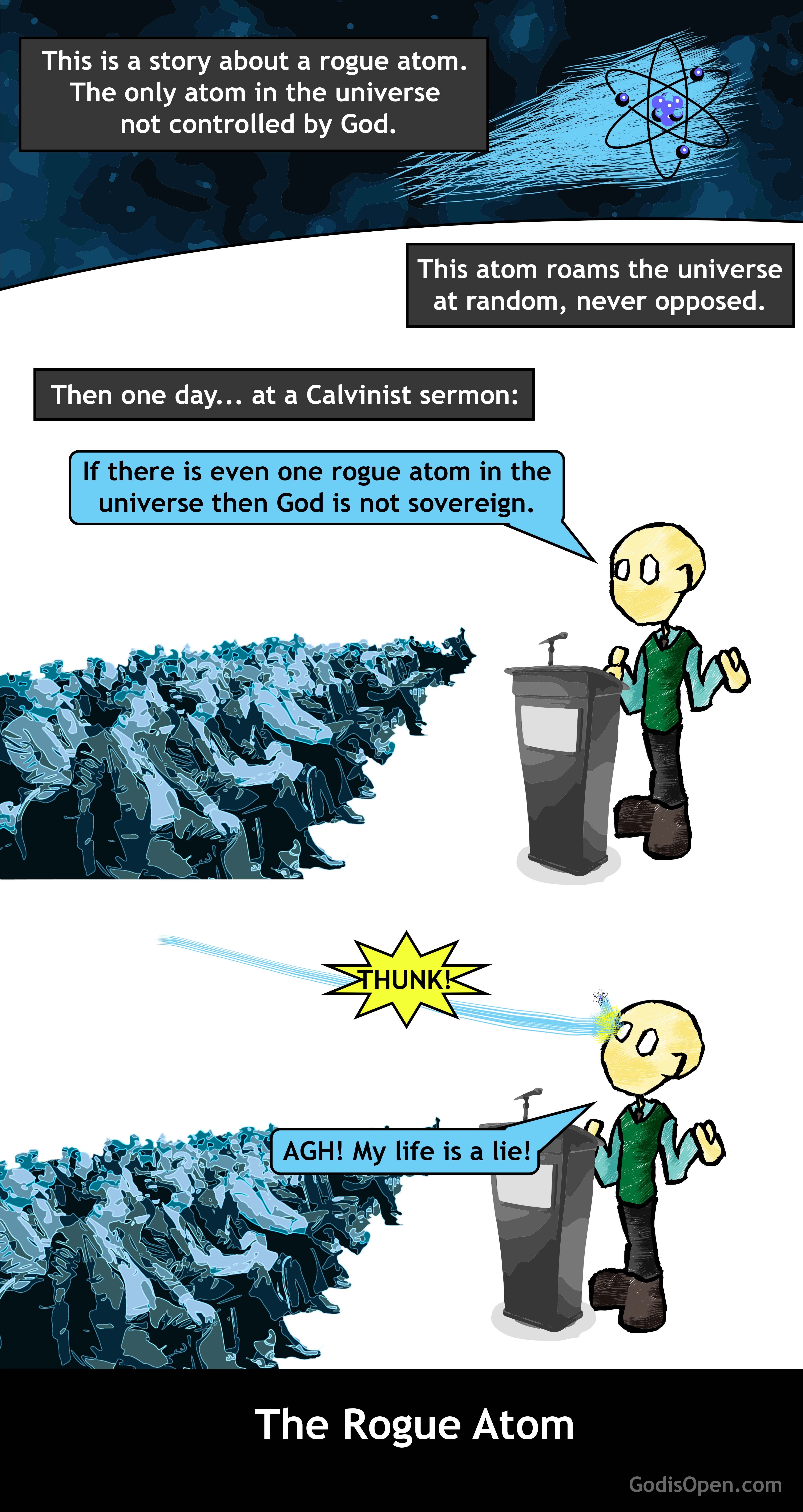
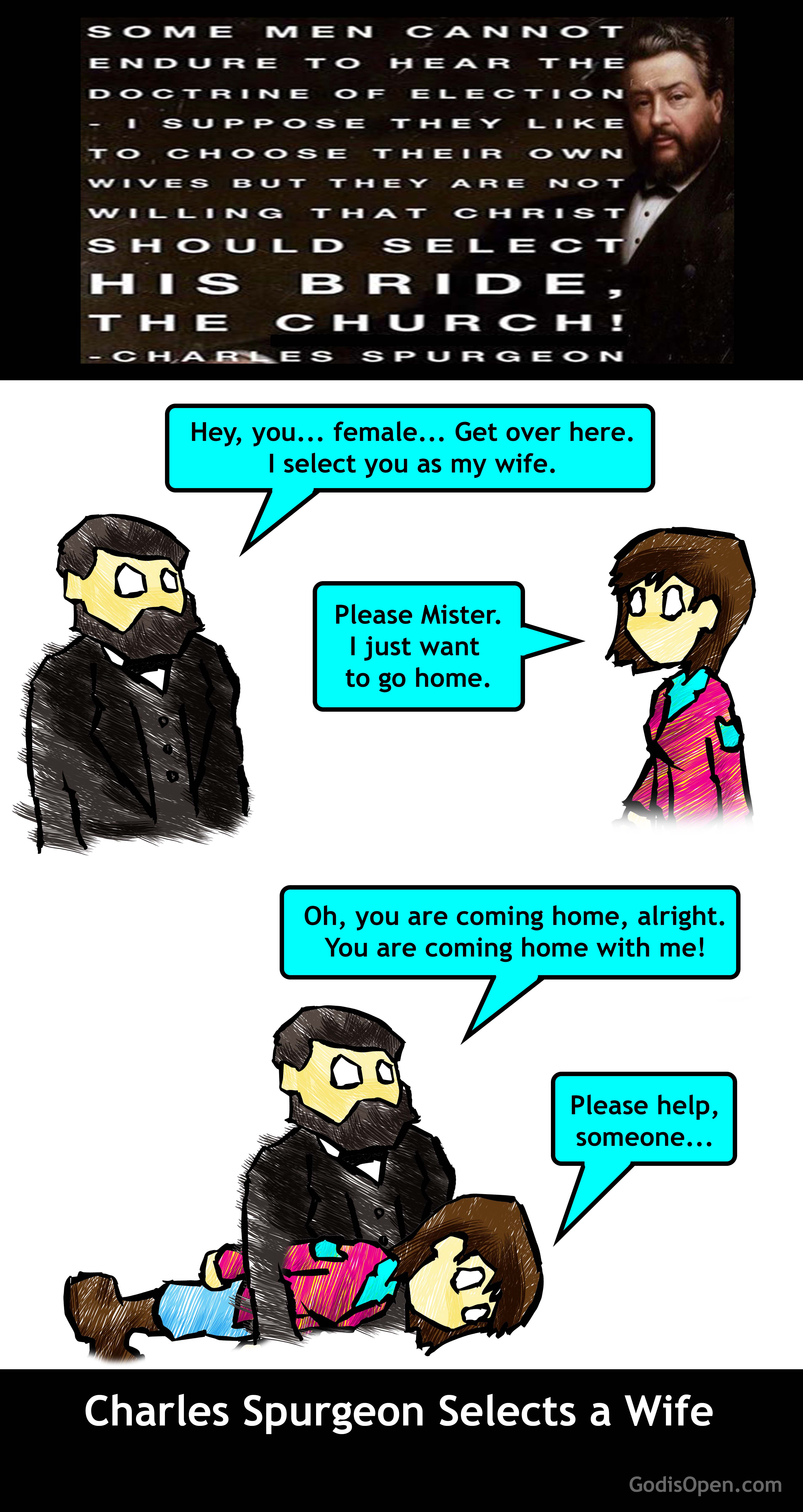
Pastor Woods Explains Sovereignty to Calvinists

From God’s Sovereignty Doesn’t Mean He Controls Everything, And Here’s Why:

A column I wrote for Christian Today last week with the title Yes, God Is Sovereign. That Doesn’t Mean He Chooses Who Runs America generated an extraordinary quantity of Twitter abuse. Some might have taken exception to a slight hint of anti-Trump bias (a “serial sex pest, braggart, narcissist, bully and all-round loose cannon who has been described as the most unqualified person ever to seek high office”) but in general the critiques had two main thrusts. One was that the Bible teaches God is in control of everything. The other was that if you didn’t believe that you didn’t believe in his sovereignty.

Both are wrong.

Take the biblical texts. Here are a selection of the many suggested, and why I don’t think they can be used to argue God chose Trump as President:

“I form the light and create darkness, I bring prosperity and create disaster. I, the Lord, do all these things” (Isaiah 45:7). This doesn’t say that every time there’s prosperity or disaster God does it; it just says he does it. And it has nothing to do with Trump’s election.

“The lot is cast into the lap, but its every decision is from the Lord” (Proverbs 16:33). An election is not the same as a roll of the dice.

“We know that in all things God works for the good of those who love him, who have been called according to his purpose” (Romans 8:28). Amen and amen. God will bring good out of evil; it’s what he does.

“He changes times and season; he sets up kings and deposes them” (Daniel 2:21). The clear biblical witness is that God is active in biblical history; no argument there. But whether his involvement extends to dictating the result of a US presidential election is a different matter entirely.

So, you see where I’m going here. A text without a context is a pretext.

Worship Sunday – Rock of Ages

Rock Of ages cleft for me
Let me hide myself in thee
Rock of Ages, cleft for me
Let me hide myself in thee
Let the water and the blood
From thy riven side which flowed
Be of sin the double cure
Cleanse me from it’s guilt and power
Nothing in my hand I bring
Simply to thy cross I cling
Nothing In my hand I bring
Simply to thy cross I cling
Naked, ccome to thee for dress
Helpless, look to thee for grace
Vile, I to the fountain fly
Wash me Savior, or I die
Rock of ages cleft for me
Let me hide myself in thee
Rock of Ages, cleft for me
Let me hide myself in thee

Numbers 23:19 Commentary

Part of the ongoing Verse Quick Reference project.

Num 23:19 God is not man, that he should lie, or a son of man, that he should change his mind. Has he said, and will he not do it? Or has he spoken, and will he not fulfill it?

Numbers 23:19 is often quoted as a prooftext for immutability. This quote is said to show that God cannot change in any way, shape, or form. But, contextually, there is likely a better understanding of this verse.

In context, God has intercepted a false prophet, Balaam, from declaring that Yahweh was against Israel. God threatens Balaam into proclaiming blessing, not curses for Israel. Balaam complies, and informs the enemies of Israel that “God is not a man that He should lie or a son of man that He should change His mind.” Contextually, the point is that God has declared blessings for Israel and will not just change His mind. God has spoken, and God will fulfill.

The context is God’s promises towards Israel. God is not fickle in His promises. The context says nothing about God’s essence, being eternally immutable in every respect, or even being impassible. Contextually, at best, this is a prooftext for God never changing His mind. More likely, however, this is a generality (as is common in human communication) and means simply that God is not arbitrary. God does change His blessings into curses throughout the Bible, but it is for reasons such as Israel rebelling against God. No such third party factors are at play in the Numbers verse.

A false prophet is speaking these words, granted under duress from God. Even if the speaker was arguing for pure immutability, the words need to be taken with a grain of salt. Surely, the reoccurring words from God about Himself describing God’s own change of mind have more weight than a false prophet. This text is a poor prooftext for immutability.

Apologetics Thursday – Perseverance of the Saints

Sherlock Helms, a budding YouTube Calvinist, produces this video on the Perseverance of the Saints:

In the video, Helms claims John 6:37-39 describes this “Perseverance of the Saints” in which people are magically stopped from turning away from God:

Joh 6:37 All that the Father gives Me will come to Me, and the one who comes to Me I will by no means cast out.
Joh 6:38 For I have come down from heaven, not to do My own will, but the will of Him who sent Me.
Joh 6:39 This is the will of the Father who sent Me, that of all He has given Me I should lose nothing, but should raise it up at the last day.

But Jesus, in spite of John 6:39, Jesus did lose one. This is explicit in John 17:12:

Joh 17:12 While I was with them in the world, I kept them in Your name. Those whom You gave Me I have kept; and none of them is lost except the son of perdition, that the Scripture might be fulfilled.

Did Jesus lose none that the father sent him, as per John 17:12? The answer is no. Judas was lost. The text explains why this one was lost, but it is still a loss. People “being kept” is not some sort of spiritual enabling that overcomes their human nature. Instead, it is something that can be undone.

So, what then does it mean “none of them is lost”? Contextually, it looks like none of Jesus’ followers were killed during his ministry. Contextually, this is a task for Jesus (“I kept them in your name”). This is not about keeping them spiritually for salvation. This is also not about some spiritual property that stops people from rebelling against God. Instead, this is an activity that Jesus did for his followers while he was on Earth.

In any case, John 17:12 is a fulfillment of John 6:37. There is no need to assume this is applicable to today, and no need to assume onto it any Calvinist notion of perseverance of the saints.

Stop Saying Everything Happens for A Reason

From faithit:

Sometimes bad things happen for no reason other than we are human beings having a human experience. Pain, heartache, grief, loss, disease and death are inevitable parts of the human experience.

We hear people say “Life dealt me a crappy hand” as if pain and hardships are not the norm. We assume that life is supposed to be easy and when things don’t go our way, we feel like we have been wronged. Human beings seem to have an innate sense of entitlement. We think that we are owed a pain-free existence.

But the truth is that human beings are not exempt from the human experience. And struggle is an innate part of the human experience. None of us are exceptions to this rule. We all struggle. We all suffer. We all experience pain, heartache and loss. And sometimes, there’s just no reason other than we are human and pain is a part of the process.

I recently had a conversation with a friend who was struggling to find peace with “God’s plan” for her life including the recent death of a loved one.

“How could this possibly be God’s will?” she asked.

Here’s what I’ve come to know about God’s will:

God’s will is not the path we walk, but rather how we walk the path.

God’s plan is never for someone to have cancer. God’s will is not for an innocent child to be brutally murdered. God’s will is not for a teenage girl to be raped. God’s will is not chronic pain, illness, disability or death.

God’s will is not an event that happens to us, it’s how we respond to what happens.

Read the rest…

The Use of the Word for Predestination in the Ancient World

prohorizo

Clement, προωρίσατο:
XXVIII. The second in order, and not any less than this, He says, is, “Thou shalt love thy neighbour as thyself,” consequently God above thyself. And on His interlocutor inquiring, “Who is my neighbour?” He did not, in the same way with the Jews, specify the blood-relation, or the fellow-citizen, or the proselyte, or him that had been similarly circumcised, or the man who uses one and the same law.

Eusebius, προωρισμένον :
2. Thereupon, as by Divine direction, he journeyed from the land of Cappadocia, where he first held the episcopate, to Jerusalem, in consequence of a vow and for the sake of information in regard to its places. They received him there with great cordiality, and would not permit him to return, because of another revelation seen by them at night, which uttered the clearest message to the most zealous among them. For it made known that if they would go outside the gates, they would receive the bishop foreordained for them by God. And having done this, with the unanimous consent of the bishops of the neighboring churches, they constrained him to remain.

Eusebius, προορισθέντα:
10. When therefore they were ordered to choose whether they would be released from molestation by touching the polluted sacrifice, and would receive from them the accursed freedom, or refusing to sacrifice, should be condemned to death, they did not hesitate, but went to death cheerfully. For they knew what had been declared before by the Sacred Scriptures. For it is said, ‘He that sacrifices to other gods shall be utterly destroyed,’ Exodus 22:20 and, ‘You shall have no other gods before me.’ Exodus 20:3

Plutarch, προωρίσθω :
§ xxx. Let so much suffice for general occasions of freedom of speech. There are also particular occasions, which our friends themselves furnish, that one who really cares for his friends will not neglect, but make use of.

Paul
προωρισεν
Act 4:28 to do whatever Your hand and Your purpose determined before to be done.

προωρισεν
Rom 8:29 For whom He foreknew, He also predestined to be conformed to the image of His Son, that He might be the firstborn among many brethren.
Rom 8:30 Moreover whom He predestined, these He also called; whom He called, these He also justified; and whom He justified, these He also glorified.

προωρισεν
1Co 2:7 But we speak the wisdom of God in a mystery, the hidden wisdom which God ordained before the ages for our glory,

προορισας
Eph 1:5 having predestined us to adoption as sons by Jesus Christ to Himself, according to the good pleasure of His will,

προορισθεντες
Eph 1:11 In Him also we have obtained an inheritance, being predestined according to the purpose of Him who works all things according to the counsel of His will,

Worship Sunday – What a Friend We Have in Jesus

What a friend we have in Jesus
All our sins and griefs to bear
And what a privilege to carry
Everything to God in prayer

Oh, what peace we often forfeit
Oh, what needless pain we bear
All because we do not carry
Everything to God in prayer

Have we trials and temptations?
Is there trouble anywhere?
We should never be discouraged
Take it to the Lord in prayer

Can we find a friend so faithful
Who will all our sorrows share?
Jesus knows our every weakness
Take it to the Lord in prayer

1 Samuel 15:29 Commentary

Part of the ongoing Verse Quick Reference project.

1Sa 15:29 And also the Strength of Israel will not lie nor relent. For He is not a man, that He should relent.”

1 Samuel 15:29 is often used to advocate the idea that God is immutable, not only immutable in His word but also in His very essence. Here is the context of the entire chapter:

King Saul has just violated God’s command not to take spoils of war.

1Sa 15:9 But Saul and the people spared Agag, and the best of the sheep, and of the oxen, and of the fatlings, and the lambs, and all that was good, and would not utterly destroy them: but every thing that was vile and refuse, that they destroyed utterly.
1Sa 15:10 Then came the word of the LORD unto Samuel, saying,
1Sa 15:11 It repenteth me that I have set up Saul to be king: for he is turned back from following me, and hath not performed my commandments. And it grieved Samuel; and he cried unto the LORD all night.

This leads God directly to “repenting” of having made Saul the king of Israel. Samuel hears God’s message and the next morning confronts Saul on his spoils of war. Samuel explains to Saul that “Because thou hast rejected the word of the LORD, he hath also rejected thee from being king.” Saul immediately repents, and asks for mercy (for his kingdom to not be taken away):

1Sa 15:24 And Saul said unto Samuel, I have sinned: for I have transgressed the commandment of the LORD, and thy words: because I feared the people, and obeyed their voice.
1Sa 15:25 Now therefore, I pray thee, pardon my sin, and turn again with me, that I may worship the LORD.
Notice Saul’s deep repentance. Saul seeks pardon and wants to go worship God. But this is denied. Samuel says:
1Sa 15:28 And Samuel said unto him, The LORD hath rent the kingdom of Israel from thee this day, and hath given it to a neighbour of thine, that is better than thou.
1Sa 15:29 And also the Strength of Israel will not lie nor repent: for he is not a man, that he should repent.

The context of God not repenting is “repenting that He made Saul king.” When God says He will not repent, God is saying “I will not repent of repenting that I made Saul king (taking his kingdom away).” God is not making a general claim of immutability. God is making the claim that Saul cannot expect to convince God to give him back the kingdom. God has made up his mind.

The statement needs to be understood in context, and not carte blanche applied to everything. In the direct context, not God says says that He repents, but also the narrator. It is the same word used in verse 29. The text is not contradicting itself, and it is not suggesting to elevate the words of Samuel over the words of God and the narrator. Samuel is definitely not launching into a off the cuff sermon on advanced metaphysics to Saul. Reading comprehension does not support 1 Samuel 15:29 as a prooftext for immutability.

Apologetics Thursday – Spurgeon v Samuel

C. H. Spurgeon:

4. Yet again, God is unchanging in his promises. Ah! we love to speak about the sweet promises of God; but if we could ever suppose that one of them could be changed, we would not talk anything more about them.

1 Samuel:

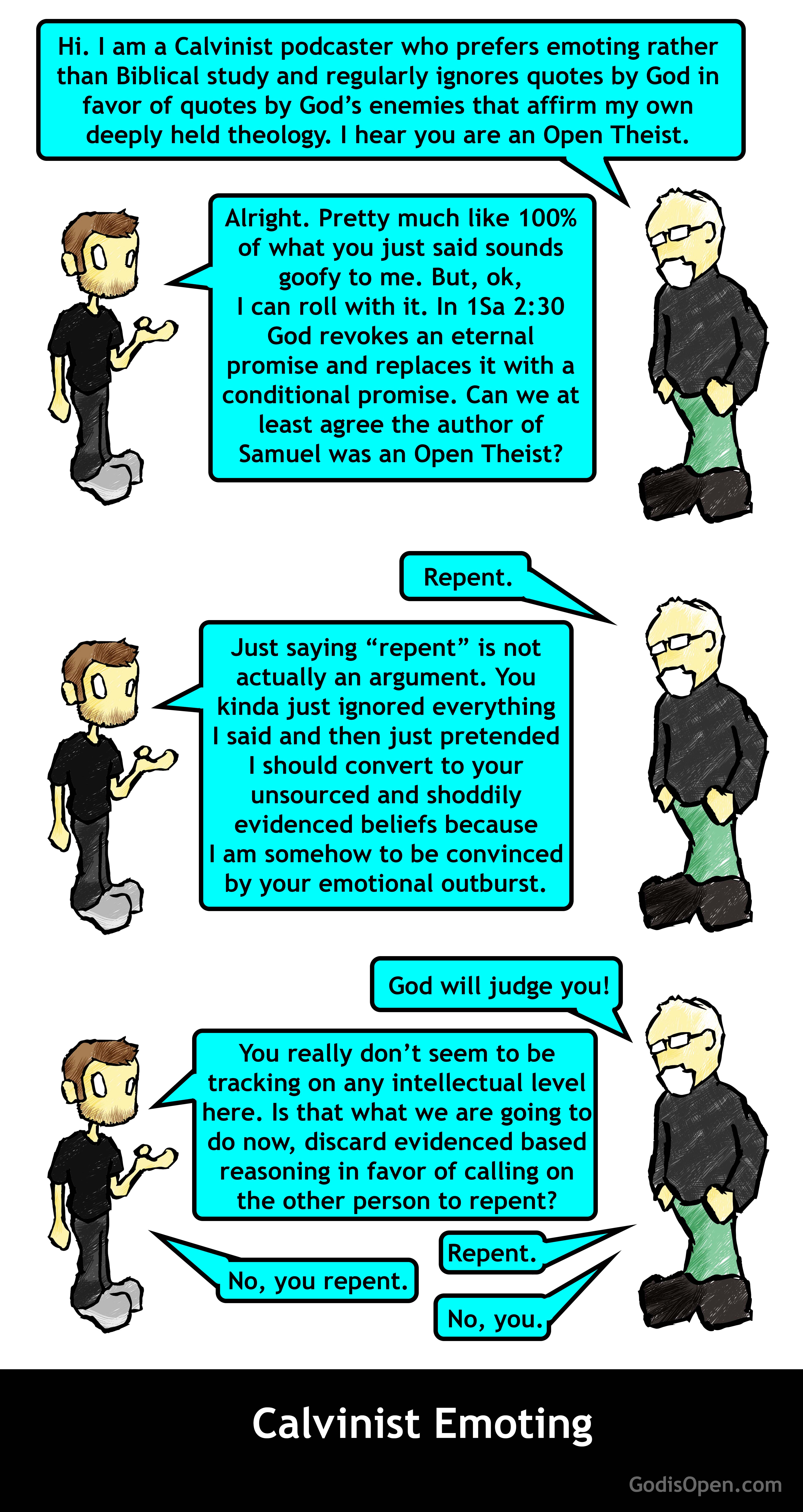
1Sa 2:30 Therefore the LORD, the God of Israel, declares: ‘I promised that your house and the house of your father should go in and out before me forever,’ but now the LORD declares: ‘Far be it from me, for those who honor me I will honor, and those who despise me shall be lightly esteemed.

Worship Sunday – Touch the Sky

What fortunes lies beyond the stars
Those dazzling heights too vast to climb
I got so high to fall so far
But I found heaven as love swept low
My heart beating, my soul breathing
I found my life when I laid it down
Upward falling, spirit soaring
I touch the sky when my knees hit the ground
What treasure waits within Your scars
This gift of freedom gold can’t buy
I bought the world and sold my heart
You traded heaven to have me again
My heart beating, my soul breathing
I found my life when I laid it down
Upward falling, spirit soaring
I touch the sky when my knees hit the ground
Find me here at Your feet again
Everything I am, reaching out, I surrender
Come sweep me up in Your love again
And my soul will dance
On the wings of forever
My heart beating, my soul breathing
I found my life when I laid it down
Upward falling, spirit soaring
I touch the sky when my knees hit the ground
Find me here at Your feet again
Everything I am, reaching out I surrender
Come sweep me up in Your love again
And my soul will dance
On the wings of forever
Upward falling, spirit soaring
I touch the sky
When my knees hit the ground

Ezekiel 4:12-15 Commentary

Part of the ongoing Verse Quick Reference project.

Eze 4:12 And you shall eat it as a barley cake, baking it in their sight on human dung.”
Eze 4:13 And the LORD said, “Thus shall the people of Israel eat their bread unclean, among the nations where I will drive them.”
Eze 4:14 Then I said, “Ah, Lord GOD! Behold, I have never defiled myself. From my youth up till now I have never eaten what died of itself or was torn by beasts, nor has tainted meat come into my mouth.”
Eze 4:15 Then he said to me, “See, I assign to you cow’s dung instead of human dung, on which you may prepare your bread.”

In Ezekiel 4, God is commanding Ezekiel to perform a series of symbolic acts to prophesy to the people of what is to come. Some of these tasks are quite hard, such as sleeping on his side for over a year. One such command is for Ezekiel to cook his food with human poop/dung. Ezekiel was to use the poop as fuel for his cooking fire. The symbolic purpose was to teach Israel that they too would eat unclean food, as the human excrement would defile the food.

But this is too much for the committed Ezekiel. If he were to eat this food, he would be undoing his life’s work in remaining pure in food. God instantly changes His mind and allows Ezekiel to use cow dung instead of human dung. This is an instant change of plan based on a real time petition. God’s original plan is modified to allow for the concerns of his prophet.

This entire incident counters all sorts of classical theology. God’s plans can change based on the desires of people. God’s plans are flexible and can change in an instant. What God declares does not necessarily come to past. God does not mind changing His plans to accommodate people. God sometimes compromises.

Yahweh, as shown in this story, is not outside of time. Yahweh is not immutable, and is definitely not impassible. Instead He cares about people and they can change Him. Yahweh does not know the future, but experiences it in the present. If He were to have an eternal picture of the future, His command to use human dung would be disingenuous. Instead he might have begun with the cow dung, explaining it is a stand-in for human dung, and both represent the uncleanness in the food Israel will soon eat. Instead, what happens is a clear change in God’s plans. This is describing a dynamic God, one who considers humanity when modifying His decrees.

Apologetics Thursday – Spurgeon v Jeremiah

C. H. Spurgeon:

3. Then again, God changes not in his plans. That man began to build, but was not able to finish, and therefore he changed his plan, as every wise man would do in such a case; he built upon a smaller foundation and commenced again. But has it ever been said that God began to build but was not able to finish? Nay.

Jeremiah:

Jer 18:1 The word that came to Jeremiah from the LORD:
Jer 18:2 “Arise, and go down to the potter’s house, and there I will let you hear my words.”
Jer 18:3 So I went down to the potter’s house, and there he was working at his wheel.
Jer 18:4 And the vessel he was making of clay was spoiled in the potter’s hand, and he reworked it into another vessel, as it seemed good to the potter to do.
Jer 18:5 Then the word of the LORD came to me:
Jer 18:6 “O house of Israel, can I not do with you as this potter has done? declares the LORD. Behold, like the clay in the potter’s hand, so are you in my hand, O house of Israel.
Jer 18:7 If at any time I declare concerning a nation or a kingdom, that I will pluck up and break down and destroy it,
Jer 18:8 and if that nation, concerning which I have spoken, turns from its evil, I will relent of the disaster that I intended to do to it.
Jer 18:9 And if at any time I declare concerning a nation or a kingdom that I will build and plant it,
Jer 18:10 and if it does evil in my sight, not listening to my voice, then I will relent of the good that I had intended to do to it.
Jer 18:11 Now, therefore, say to the men of Judah and the inhabitants of Jerusalem: ‘Thus says the LORD, Behold, I am shaping disaster against you and devising a plan against you. Return, every one from his evil way, and amend your ways and your deeds.’

Bob Utley Prooftexts Immutability

From Bible.org:

This Arabic root means “to breathe heavy” (BDB 636, KB 688, Niphal PERFECT). This is an anthropomorphic metaphor. The root of this word expresses deep feelings (see Robert B. Girdlestone, Synonyms of the Old Testament, pp. 87-88). The prophet Nahum carries this term in his name. God is often spoken of in the Bible as changing His mind or relenting (cf. v. 6; Gen. 18:22-32; Num. 14:11-20; Josh. 7:6-13; II Kgs. 22:19-20; Ps. 106:45; Jer. 18:1-16; 26:3,13,19; Jonah 3:10). God is affected by (1) our prayers and (2) His character of compassion and love (cf. Exod. 3:7; Jdgs. 2:18; Hosea 11:8-9; Joel 2:13-14; Amos 5:15). However, this should not be understood in the sense that God’s nature or purpose vacillates. It does not change (cf. Num. 23:19; 1 Sam. 15:29; Mal. 3:6; Heb. 13:8; James 1:17).

Num. 23:19; 1 Sam. 15:29; Mal. 3:6; Heb. 13:8; James 1:17 are all used to override God changing His mind.

Worship Sunday – Mighty Jesus

Communion with the living God
Is what I’m longing for
His presence is more priceless than all things
And at my broken heart He stands
Knocking at the door
I’ll let Him in and see

Mighty Jesus, Rock of Salvation
When all else is shifting sand
It’s on you alone I stand

Oh Lord
My hope relies in nothing else
Than what is from above
Oh earthly treasures they have let me down
So I’ll forsake all else for you
And cling to this great love
Rejoicing in a song that will resound

Mighty Jesus, Rock of Salvation
When all else is shifting sand
It’s you alone I stand
It’s on you alone I stand
Oh precious Jesus, You are my treasure
And in no one else I find my home
It’s in you and you alone

Upon the solid rock
I will stand, I will stand
On you and you alone
I will stand, I will stand
When everything around falls apart, falls apart
I will stand, yes I will stand
Upon the solid rock
I will stand, I will stand, yes
On you and you alone
I will stand, I will stand
Oh, When everything around falls apart, falls apart
I will stand, yes I will stand

Mighty Jesus, Rock of Salvation
When all else is shifting sand
It’s on you alone I stand
Oh precious Jesus, you are my treasure
And in no one else I find my home
It’s in you and you alone
And in no one else I find my home
It’s in you and you alone

Daniel 2:21 Commentary

Part of the ongoing Verse Quick Reference project.

Dan 2:21 And He changes the times and the seasons; He removes kings and raises up kings; He gives wisdom to the wise And knowledge to those who have understanding.

Daniel 2:21 is sometimes claimed as evidence that God is responsible for the rise and fall of all kings to ever exist. By extension, God controls all governments and perhaps all things in life. But even the first step of logic is unwarranted, and the following steps of logic are definitely too much.

Often when powerful people talk about what they do and how they act, they use similar statements. In Isaiah 14, God speaks to the king of Babylon and uses similar phrases:

Isa 14:5 The LORD has broken the staff of the wicked, the scepter of rulers,
Isa 14:6 that struck the peoples in wrath with unceasing blows, that ruled the nations in anger with unrelenting persecution.

Isa 14:12 “How you are fallen from heaven, O Day Star, son of Dawn! How you are cut down to the ground, you who laid the nations low!

The king of Babylon “ruled the nations” and “laid nations low”. Naturally no one would assume the text is about the king of Babylon ruling all nations on earth or destroying all nations to ever be destroyed. Instead, the claims are about characteristic actions of Babylon. When writing about characteristic actions, often this general phrasing is used. It does not matter if it is about people, nations, or even God. This is just a normal way of writing.

To claim Daniel 2:21 is about God controlling all nations everywhere is to import theology onto the text. The more natural reading is much like Isaiah 14 that God is powerful and has characteristically controlled nations (but not necessarily all nations). The statement is a general power claim, not a claim to control everything ever to happen. If the author’s purpose was to proclaim God’s power, and the author believed God controlled all things to ever happen, he probably would have written quite a different point. Saying God controls all things is a much more forceful claim than controlling governments. Not surprisingly, the author never makes the claim that God controls all things.

Apologetics Thursday – God makes Kings

god-makes-kings

Certain Calvinists attempt to use Daniel 2:21 as a prooftext in favor of the idea that God controls the rise and fall of all government. Daniel 2:21 reads:

Dan 2:21 And He changes the times and the seasons; He removes kings and raises up kings; He gives wisdom to the wise And knowledge to those who have understanding.

Just reading this verse does not suggest that God controls “all” governmental politics. Normal language would suggest that these are just things that God does sometimes. They are power acts that show the might of God’s decrees.

We can see similar language constructs in other kingly statements. The hedonist king Sardanapalus writes:

I was the king, and while I lived on earth,
And saw the bright rays of the genial sun,
I ate and drank and loved; and knew full well
The time that men do live on earth was brief.
And liable to many sudden changes,
Reverses, and calamities. Now others
Will have th’ enjoyment of my luxuries,
Which I do leave behind me. For these reasons
I never ceased one single day from pleasure.

We can notice the generalities and hyperboles just inherent in how language works. When the king “ate, drank, and loved” he did not eat everything ever, or drink everything ever, or love everything ever. Definitely Sardanapalus did cease from pleasure at least one day of his life. The statement is hyperbolic. These are just a characteristic acts of Sardanapalus. The intent is to show Sardanapalus’ hedonistic lifestyle.

In a similar way, when Daniel writes about God “raising Kings”, “changing seasons”, and “giving wisdom to the wise”, this is more a statement of God’s power. God regularly does these things that show how powerful God is. These are not universal and all-encompassing claims. The assumption needs to be against this sort of interpretation because that is not the natural assumption provided anyone was the subject other than God.

Worship Sunday – Every Giant Will Fall

I can see the Promised Land
Though there’s pain within the plan
There is victory in the end
Your love is my battle cry

When my fear’s like Jericho
Build their walls around my soul
When my heart is overthrown
Your love is my battle cry
The anthem for all my life

Every giant will fall, the mountains will move
Every chain of the past, You’ve broken in two
Over fear, over lies, we’re singing the truth
That nothing is impossible with You (woah)
With You (woah)

There is hope within the fight
In the wars that rage inside
Though the shadows steal the light
Your love is my battle cry
The anthem for all my life

Every giant will fall, the mountains will move
Every chain of the past, You’ve broken in two
Over fear, over lies, we’re singing the truth
That nothing is impossible
Every giant will fall, the mountains will move
Every chain of the past, You’ve broken in two
Over fear, over lies, we’re singing the truth
That nothing is impossible with You (woah)
With You (woah)

No greater name, no higher name
No stronger name than Jesus
You overcame, broke every chain
Forever reign, King Jesus

No greater name, no higher name
No stronger name than Jesus
You overcame, broke every chain
Forever reign, King Jesus

Every giant will fall, the mountains will move
Every chain of the past, You’ve broken in two
Over fear, over lies, we’re singing the truth
That nothing is impossible
Every giant will fall, the mountains will move
Every chain of the past, You’ve broken in two
Over fear, over lies, we’re singing the truth
That nothing is impossible with You (woah)
With You (woah)

Oh nothing is impossible

Judges10:13-16 Commentary

Part of the ongoing Verse Quick Reference project.

Jdg 10:13 Yet you have forsaken me and served other gods; therefore I will save you no more.
Jdg 10:14 Go and cry out to the gods whom you have chosen; let them save you in the time of your distress.”
Jdg 10:15 And the people of Israel said to the LORD, “We have sinned; do to us whatever seems good to you. Only please deliver us this day.”
Jdg 10:16 So they put away the foreign gods from among them and served the LORD, and he became impatient over the misery of Israel.

Judges 10:16 is possibly better translated by the NJKV:

Jdg 10:16 So they put away the foreign gods from among them and served the LORD. And His soul could no longer endure the misery of Israel.

In Judges 10, God becomes so frustrated with Israel that He proclaims that He “will save you no more”. But the people repent in verse 15. They show humility and accept punishment, only asking that God once again save them. In verse 16, the people forsake false gods, and then the text reads that God’s “soul could no longer endure the misery of Israel.” God changes His mind. Although He had proclaimed against Israel to no longer save them, God reverses that position when He witnesses their repentance.

It is important to note that Israel has before been given leniency due to their suffering. In verse 14, God is repenting of continually showing leniency due to suffering. But God reverses His declaration after direct observation of their suffering, yet again. The idea being communicated is both God’s overwhelming frustration with Israel’s cycle of sin, their short-lived repentance, and God’s wasted efforts in salvation. This is coupled with God’s emotional attachment to His people, while seeing them suffer. This passage is about God’s conflicting internal emotions, and God’s commitment to Israel instead of His own declarations.

None of this would make sense in a world where God is impassible, or outside of time, or has a single “perfect” will. This is just one of many examples in which God revokes His declared intentions. In this instance, the text represents God as knowing the people would beg to be saved and would repent. God’s own repentance is not based on intellectual knowledge, but new emotional experiences that sway God against His prior judgement. God’s change is not based on calculated logic, but on passions that the people evoke within God.

Apologetics Thrusday – R.C. Sproul Admits to Eisegesis

R.C. Sproul admits that when he approaches his conception of God, it is through his own presuppositions (Eisegesis rather than Exegesis).

One might think that someone committed to the Bible would finish his concluding statement differently:

“In reformed theology we constantly test our doctrine by going back to”
A. Our fundamental understanding of the character of God
B. The Bible

R.C. Sproul chooses “A”.

Flowers on the Could Should Calvinist Fallacy

Leighton Flowers sums up the Calvinist argument:

1. God tells man they SHOULD keep all the commandments.
2. Man CANNOT keep all the commandments.
3. God also tells man they SHOULD believe and repent for breaking commandments.
4. Therefore man also CANNOT believe and repent for breaking commandments.

He then draws a parallel:

1. Dad tells his kids they SHOULD get to the top of stairs.
2. Kids CANNOT complete this task as requested.
3. Dad also tells the kids they SHOULD ask for help.
4. Therefore the kids CANNOT ask for help.

He then explains the fallacy:

Do you see the problem now? The whole purpose of presenting my kids with that dilemma was to help them to discover their need for help. To suggest that they cannot realize their need and ask for help on the basis that they cannot get to the top of stairs completely undermines the very purpose of the giving them that dilemma.

The purpose of the father in both instances is to get others to trust Him. The law was not sent for the purpose of getting mankind to heaven. Just as the purpose of the activity was not to get the kids to the top of the staircase. The purpose was to help them to see that they have a need and that they cannot do it on their own.

Calvinists have wrongly concluded that because mankind is unable to attain righteousness by works through the law, they must also be equally unable to attain righteousness by grace through faith. In other words, they have concluded that because mankind is incapable of “making it to the top of the stairs,” then they are equally incapable of “recognizing their inability and asking for help.” IT DOES NOT FOLLOW AND IT IS NOT BIBLICAL.

Worship Sunday – He Is Yahweh

Who is moving on the waters
Who is holding up the moon
Who is peeling back the darkness
With the burning light of noon
Who is standing on the mountains
Who is on the earth below
Who is bigger than the heavens and the lover of my soul

(Chorus) Creator God, He is Yahweh
The Great I am, He is Yahweh
The Lord of All, He is Yahweh
Rose of Sharon, He is Yahweh
The Righteous Son, He is Yahweh
The Three-in-one, He is Yahweh

Who is He that makes me happy
Who is He that gives me peace
Who is He that brings me comfort
And turns the bitter into sweet
Who is stirring up my passion
Who is rising up in me
Who is filling up my hunger, with everything I need.

You are holy and eternal
And forever You will reign
Every knee will bow before You
Every tongue will confess Your name
All the angels give You glory
As they stand before Your throne
And here on Earth we gather
To declare Your name alone.

Amos 3:6-7 Commentary

Part of the ongoing Verse Quick Reference project.

Amo 3:6 Is a trumpet blown in a city, and the people are not afraid? Does disaster come to a city, unless the LORD has done it?
Amo 3:7 “For the Lord GOD does nothing without revealing his secret to his servants the prophets.

Amos 3:6-7 is much like the theme of Isaiah 42-48. God is said to declare all His works to His prophets before God acts. The concept is that people can then differentiate between God’s acts and happenstance. It is not very convincing to attribute acts to God “after the fact”. Any false religion can do that. The test of a true God is revealing power acts before those acts are accomplished.

Notice how this passage is antithetical to concepts such as God controlling all things. If God does everything, and everything God does is told to his prophets, then God would have to be communicating all sorts of endless, infinite, trivial things to people that have neither the time nor the brainpower to process. The assumption in Amos is that God does not do everything, and that when God does act in a way to show His power He then makes it public such that He can gain credit.

Apologetics Thursday – The Beginning of Time

Tim Chaffey writes against Open Theism:

To the open theist, God is limited by time. The Bible teaches that God created time: “In the beginning God created the heavens and the earth” (Genesis 1: 1). It could only have been “the beginning” if time started at that point. Einstein’s theory of relativity also posits that time is a physical property of our universe. If there were no matter, there would be no time. Since there is matter then there is time.

This author seems to be unaware of basic Biblical scholarship on Genesis 1. The JPS translations states:

1 When God began to create heaven and earth—2 the earth being unformed and void, with darkness over the surface of the deep and a wind from God sweeping over the water—3 God said, ‘Let there be light.’”

This translation mirrors the Hebrew punctuation in the Masoretic text.

The first verse is not a “first act by God” but rather a title or summary about what is to happen, or even listing pre-existing conditions. We find a parallel text in the second chapter during the second creation narrative:

Gen 2:4 These are the generations of the heavens and the earth when they were created, in the day that the LORD God made the earth and the heavens.

Both Genesis 1:1 and 2:4 serve parallel purposes. They set up what is to come. They are introductions to the stories. They are absolutely not about metaphysics and the nature of time. Even a generous reading of Genesis 1:1 has nothing to do with “time being created.” At most, the beginning could be limited to the beginning of the Earth. The angels are assumed to pre-exist these events. For Chaffey to presume his metaphysics onto the Bible (metaphysics nowhere described in the Bible) is a disservice to Biblical interpretation.

Boyd Give Five Basic Points on Open Theism

Boyd gives 5 basic points on Open Theism (mirrored by Kurt Williams):

1. The Lord frequently changes his mind in the light of changing circumstances, or as a result of prayer (Exod. 32:14; Num. 14:12–20; Deut. 9:13–14, 18–20, 25; 1 Sam. 2:27–36; 2 Kings 20:1–7; 1 Chron. 21:15; Jer. 26:19; Ezek. 20:5–22; Amos 7:1–6; Jonah 1:2; 3:2, 4–10). At other times he explicitly states that he will change his mind if circumstances change (Jer. 18:7–11; 26:2–3; Ezek. 33:13–15). This willingness to change is portrayed as one of God’s attributes of greatness (Joel 2:13–14; Jonah 4:2). If the future were exhaustively and eternally settled, as classical theism teaches, it would be impossible for God to genuinely change his mind about matters.

2. God sometimes expresses regret and disappointment over how things turned out—even occasionally over things that resulted from his own will. (Gen. 6:5–6; 1 Sam. 15:10, 35; Ezek. 22:29–31). If the future was exhaustively and eternally settled, it would be impossible for God to genuinely regret how some of his own decisions turned out.

3. At other times God tells us that he is surprised at how things turned out because he expected a different outcome (Isa. 5:3–7; Jer. 3:67; 19–20). If the future were eternally and exhaustively settled, everything would come to pass exactly as God eternally knew or determined it to be.

4. The Lord frequently tests his people to find out whether they’ll remain faithful to him (Gen. 22:12; Exod. 16:4; Deut. 8:2; 13:1–3; Judges 2:20–3:5; 2 Chron. 32:31). If the future were eternally and exhaustively settled, God could not genuinely say he tests people “to know” whether they’ll be faithful or not.

5. The Lord sometimes asks non-rhetorical questions about the future (Num. 14:11; Hos. 8:5) and speaks to people in terms of what may or may not happen (Exod. 3:18–4:9; 13:17; Jer. 38:17–18, 20–21, 23; Ezek. 12:1–3). If the future were exhaustively and eternally settled, God could never genuinely speak about the future in terms of what “may” or “may not” happen.

Worship Sunday – King of the World

Happiness is temporary
It’s here and gone in a flash of light
Troubles come without a warning
To turn the day into the night

Ohhh, when everything is changing
Ohhh, the truth is still the same
Ohhh, and I know that no one can
Ever steal it away

I’m gonna dance to the beat of amazing grace
Gonna hold to the promise that You made
And I know whatever’s gonna come my way
You’re here with me and it’s going to be a good day
it’s going to be a good day, a good day

Fear can be so, so convincing
But I will keep my eyes on You
In every moment help me remember
That You always will bring me through
Ohhh, ‘cause You’re forever faithful
Ohhh, the Truth is still the same
Ohhh, and I know that no one can
Ever steal it away

I’m gonna dance to the beat of amazing grace
Gonna hold to the promise that You made
And I know whatever’s gonna come my way
You’re here with me and it’s going to be a good day
it’s going to be a good day, a good day
Come my way
You’re here with me and it’s going to be a good day

And You carry me, carry me

Because You’re for me
You’ll be with me till the end
Because You’re for me
You’ll be with me till the end
Because You’re for me
You’ll be with me till the end
Because You’re for me
You’ll be with me till the end

I’m gonna dance to the beat of amazing grace
Gonna hold to the promise that You made
And I know whatever’s gonna come my way
You’re here with me and it’s going to be a good day
it’s going to be a good day, a good day
Come my way
You’re here with me and it’s going to be a good day

Genesis 1:1 Commentary

Part of the ongoing Verse Quick Reference project.

Gen 1:1 In the beginning, God created the heavens and the earth.

Genesis 1:1 is often used to support the claim that God created time, and thus God is outside of time and sees all the future in one instant. Genesis 1:1 is said to be God creating all that exists. It is claimed that time is something that exists, thus time is created in Genesis 1:1.

The striking problems with this position should be obvious.

First, this verse says nothing about “time” being created. That has to be assumed onto the verse. The assumption is counter to normal Jewish thought throughout the Bible that does not see “time” as a thing to be manipulated. There is no slowing of time, reversing time, time travel, or any similar concepts in the Bible. Time is not a “thing” in normal Jewish thought.

Second, the verse just talks about the “heavens and the earth”. Perfectly rational people would be able to claim that this verse is just about creating the physical world. This does not event have to be about creating a spiritual “heaven”, as birds fly in the “heaven” in verse 20. The assumption that “time” is created is unwarranted.

Third, Biblical scholarship such (as Dr. Michael Heiser (known as “liberal”), Dr. James Allman (known as “conservative”), and Dr. Joel M. Hoffman (a secular scholar)) seems to be fairly united that Genesis 1:1 is not an “initial event”. Instead this is a summary of what is happening in the chapter, or, in conjunction with the following verses, is setting up the preconditions before God starts creating. This is most evident in the JPS:

When God began to create the heaven and the earth – the earth being unformed and void, with darkness over the surface of the deep and a wind from God sweeping over the water – God said, “Let there be light”; and there was light.

One can still see this in modern translations:

Gen 1:1 In the beginning, God created the heavens and the earth.
Gen 1:2 The earth was without form and void, and darkness was over the face of the deep. And the Spirit of God was hovering over the face of the waters.
Gen 1:3 And God said, “Let there be light,” and there was light.

Compare to Genesis 2:4:

Gen 2:4 These are the generations of the heavens and the earth when they were created, in the day that the LORD God made the earth and the heavens.
Gen 2:5 When no bush of the field was yet in the land and no small plant of the field had yet sprung up—for the LORD God had not caused it to rain on the land, and there was no man to work the ground,
Gen 2:6 and a mist was going up from the land and was watering the whole face of the ground—
Gen 2:7 then the LORD God formed the man of dust from the ground and breathed into his nostrils the breath of life, and the man became a living creature.

Notice the starting sentence is prepping the story. It informs the reader about what the story is depicting and then gives starting conditions. In Genesis 1:1, water and a formless earth exist. In Genesis 2:4, no plants exist and God uses rain to create vegetation. This is before creating man.

In short, Genesis 1:1 has nothing to do with metaphysics. God is not creating “time”. That assumption is a fairly presumptuous one, at best.

Apologetics Thursday – Timelessness as Non-concept

if I had anyTim Chaffey writes against Open Theism:

Open theists often construct a straw man to knock down at this point. They claim that God cannot look down the passages of time to see what an individual will freely choose to do. This straw man betrays their misunderstanding of God’s nature. God is not “in time” as we are. He transcends time. He is not part of His creation like the pantheist declares. He is outside of it (transcendent) but can intervene when and where He chooses. Since God is not physically bound to the universe, He is not affected by time. As such, God does not need to “look down the passages of time” to see the future. He sees the entire timeline at the same moment.

This paragraph is entirely philosophical. The irony is that not a dozen sentences before, Chaffey criticizes Open Theism as being “philosophically based”. Where in the Bible describes God as outside of time? We have plenty of passages about God experiencing things in time and even learning new things. What we do not have is Platonic timelessness as described in Plato’s Timaeus.

Being “outside of time”, in addition to not being Biblical by any stretch of the imagination, is a non-concept. How does a being exist apart of sequential events? How does a being exist in timeless immutability? And furthermore, how does that being interact with time? It is not conceptual.

If a being was “outside of time”, this would be no different than non-existence (which is fitting because Platonism tries to describe the ultimate being in purely negative ways). There would be no room for action, interaction, creation, change any time in any fashion. God would not exist. Timelessness was designed by the Platonists to be a non-concept, and that is exactly what it is.

Perhaps Chaffey can take his own advice, and discard philosophy when forming his opinions about God.

Worship Sunday – Be with us now

It’s hard to understand this life we’re living
More down than up, more lost than found these days
But everybody’s searching for the reasons
But the pain, the shame, that just won’t go away

If there’s a miracle in Your plan
It’s that we know we are in Your hands
Even when we don’t understand

Be with us now
Be with us now
If You’re strong enough to make us whole
Surely You could let us know
That You’re with us now
Be with us now
If love can conquer every fear
Please wash away these tears
Be with us now

To help us to be faithful while we are waiting
When time goes by and nothing seems to change
‘Cause Lord, we need Your hope, we need your healing
When we’re falling apart with a broken hearts
We need You to show us the way

Be with us now
Be with us now
If You’re strong enough to make us whole
Surely You could let us know
That You’re with us now
Be with us now
If love can conquer every fear
Please wash away these tears

Emmanuel, God with us
Be with us now
Emmanuel, God with us
Be with us now

Be with me now, be with me now
If You’re strong enough to make me whole
Surely You could let me know

Be with us now
Be with us now
If You’re strong enough to make us whole
Surely You could let us know
That You’re with us now
Be with us now
If love can conquer every fear
Please wash away these tears
Be with us now
Emmanuel
Be with us now

Psa 51.5 Commentary

Part of the ongoing Verse Quick Reference project.

Psa 51:5 Behold, I was brought forth in iniquity, and in sin did my mother conceive me.

Psalms 51:1 is often used to defend doctrines such as Total Depravity or Original Sin. The claim is that King David’s statement is concerning the ontological nature of human beings; that all human beings are sinful from birth. But this is more likely not what King David is speaking about. Walter Brueggemann writes:

c) The statement of verse 5 can be readily misunderstood. It does not mean that sex is sinful, nor that this speaker has a perverted beginning, or that the mother is morally implicated. Rather the speaker asserts that he is utterly guilty, in principle, from the beginning. There never was a time when this speaker was not so burdened. I take this to be not a clinical statement, but an expression of theological candor as the speaker exposes himself to God’s righteousness. One may say that it is a piece of liturgical hyperbole, as is much of the Psalms. We do not need to take the statement ontologically as a ” doctrine of man . ” What is important is that in this moment of drastic confrontation, the speaker has no claim. There is indeed “no health in him.”

Brueggemann points out that the statement need not be more than hyperbole. This would be much like Job who says:

Job 31:18 …from my mother’s womb I guided the widow),

The speech is hyperbolic, meant to say that Job’s entire life is one characterized by helping the poor (Job is protesting his innocence). This is not about Job being sinless by nature. Likewise, King David’s statement is not about man’s utterly fallen nature. Psalm 51 is not even about anyone except King David himself. Instead, this is a submission to God’s judgment in the context of a Psalm exclusively about King David’s own sin and guilt.

Alternatively, it has been claimed by various Open Theists that King David is referencing the conditions of his conception in which his mother sinned to conceive him. But this is speculative in nature.

Apologetics Thursday – Calvinist Noah Meme

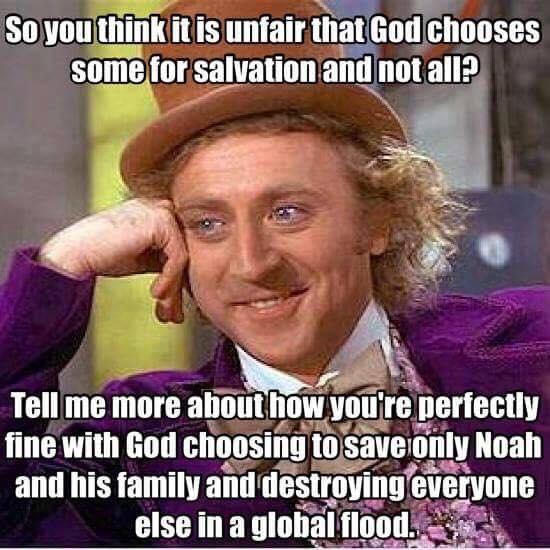
god-choosing-some

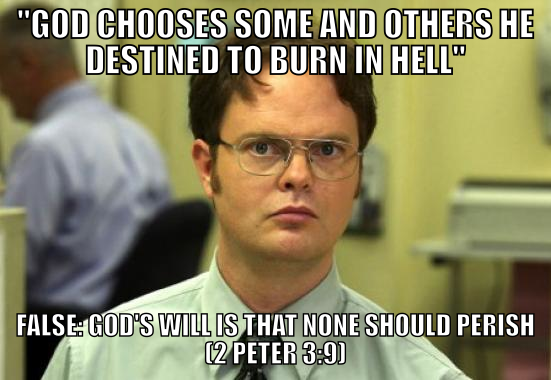
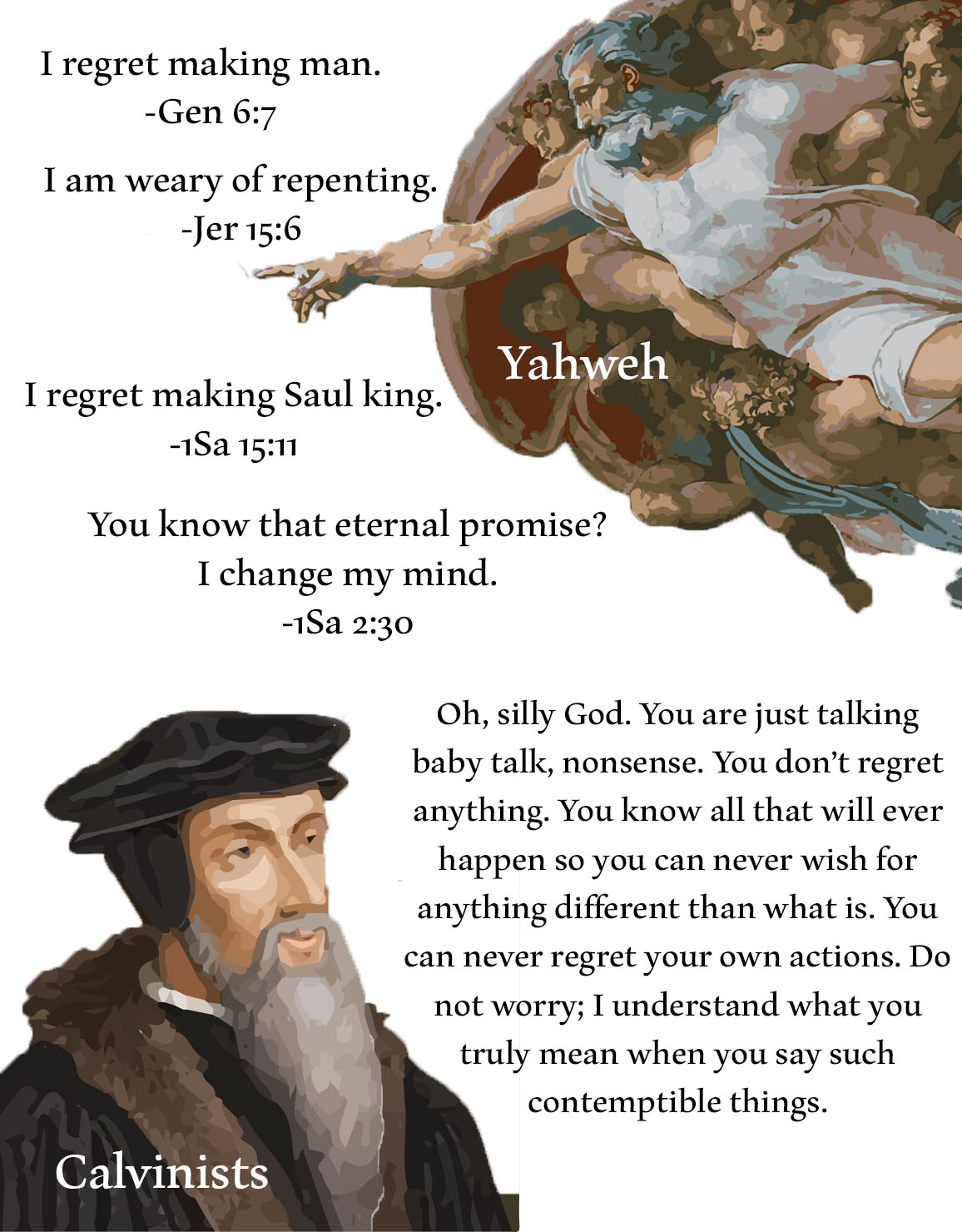
This meme seems to surface from time to time on Calvinist social media sites and on theological debate sites. It is often used by Calvinists to attempt to reinforce the Calvinist doctrine of election: that from time-eternal God chose some for salvation and not others based on God’s arbitrary grace. God spiritually regenerates some, but not others. Only the regenerates can be saved.

On face value the meme is absurd, which is quickly pointed out by non-Calvinists. The meme is in reference to Genesis 6:

Gen 6:7 So the LORD said, “I will blot out man whom I have created from the face of the land, man and animals and creeping things and birds of the heavens, for I am sorry that I have made them.”
Gen 6:8 But Noah found favor in the eyes of the LORD.
Gen 6:9 These are the generations of Noah. Noah was a righteous man, blameless in his generation. Noah walked with God.

There are a few things to note about this text which counter Calvinist theology:

1. Noah is chosen to be saved, not arbitrarily, but because he is righteous and blameless. No one claims that Noah was chosen unfairly, because it is definitely fair to choose to save righteous people rather than wicked for salvation. This is, in fact, a major claim of Christian Non-Calvinist theology, in contrast to the arbitrary nature of Calvinist election. This is literally a story against Calvinism, so it is very odd that the Calvinists would make a meme about it.

2. In the text, there is not even the concept that Noah has ever sinned (this is assumed on the text). As such, there is no concept of regeneration.

3. Noah seems to be saved as an afterthought. God resolves to destroy the world, and then only afterwards decides to save Noah. David Clines writes:

No, God cannot have decided at one and the same time to destroy all that lived and to spare Noah and his family and the animals and so ensure that humans and animals alike would not be wiped out. That would have been a logical impossibility; there must have been two decisions, the second effectively cancelling out the first.

This suggests no eternal knowledge of the future, and illustrates God changing His mind (both about creating man and then about uncreating man). The text is very contrary to Calvinist ideas of immutability of omniscience of future events.

4. Noah’s family is saved due to Noah’s righteousness and not their own, suggesting that God’s regard for Noah was so great that God saved unrighteous people for Noah’s sake. There is no indication in the text of Noah’s family being righteous. A future commentary even suggests that Noah’s family was not righteous:

Eze 14:13 “Son of man, when a land sins against me by acting faithlessly, and I stretch out my hand against it and break its supply of bread and send famine upon it, and cut off from it man and beast,
Eze 14:14 even if these three men, Noah, Daniel, and Job, were in it, they would deliver but their own lives by their righteousness, declares the Lord GOD.

In this text, God declares that he will only save those who are righteous, and not their families. Noah is used as an example of one who would be saved but not his family.

This fact shows that God sometimes saves the unrighteous “unregenerate”, due to His concern for the righteous. This counters the entire idea of a saved elect (because the non-elect are being saved too).

5. The flood narrative is ultimately a story of failure. God wipes out man because they are evil. Then after the flood, God resolves to never again do the same thing although man will continue to be evil. In essence, God’s judgment changed nothing and God decides to forgo any future similar judgments. Clines writes:

It is indeed sometimes argued that 8.21 does not mean that Yhwh will not again curse the ground (with a Flood) because humans are sinful from their youth, but although humans are sinful from their youth…
Whether the sinfulness of humanity is the reason why another Flood will not occur, or whether another Flood will not occur despite the sinfulness of humanity, in both cases it is being affirmed that humanity is permanently sinful, both before and after the Flood.

This is a powerful theological statement. It reinforces the extravagant assessment of humanity in 6.5, but it also lets slip the fact that, according to the Flood narrative itself, the Flood changed nothing. The Flood was therefore pointless. It is not just that it achieved nothing, and that the world was no better off after it than before it. It is not a question of efficiency or effectiveness. More important is the moral issue at stake. It was bad enough to destroy humanity on account of its sins, but it was worse to do so when thereafter it is acknowledged that perennial and unrelieved sinfulness will never again be a reason for wiping out humanity. The failure of the Flood is fundamentally the deity’s failure.

The flood narrative is ultimately a major polemic against Calvinism. There is nothing Calvinistic about the text, and the actual story is quite shocking to Calvinist systematic theology.

Calvinist explains the Rhetorical Flourish of Calvinism

From C Michael Patton’s Why Arminianism Won’t Preach (And Calvinism Won’t Sell):

Think about the major conferences out there that are theological in nature: Desiring God, Together for the Gospel, The Gospel Coalition, and Ligonier Ministries. All of them fill churches and arenas with thousands of people. Passion fills the air as speakers talk about theological issues in the church. John Piper, Don Carson, R.C. Sproul, John MacArthur, Albert Mohler, Tim Keller, and the like are invited to speak. Diversity runs deep in these theology conferences. Dispensationalist and Covenant Theologians, paedobaptists and credo baptists, charismatics and non-charismatics, and premillenialists and amillenialists are all represented. However, it is hard to find an Arminian invited to (much less putting together) such engagements. Why? I don’t know, but I suspect that it is because Arminianism, as a theological distinctive, just does not preach. Don’t get me wrong. I did not say that Arminians can’tpreach. They most certainly can. And I did not say that Arminianism is not true (this is not the question on the table). It is simply that the distinctives of Arminianism do not ignite passions in such settings. Evangelicals love to hear about the sovereignty of God, the glory of God in suffering, the security of God’s grace, the providence of God over missions, and yes, even the utter depravity of man. This stuff preaches. This stuff sells tickets.

For the Arminian to put together a distinctive conference, things would be a bit less provocative. Things like “The Responsibility of Man in Suffering,” “Man’s Role in Salvation,” or “The Insecurity of Salvation” won’t preach too well. Think about how hard it is for a Calvinist to try to plug in a token Arminian at a general theology conference. On what subject do you let them speak? “Roger Olson, I would like you to come to our conference and speak on . . . (papers ruffling) . . . ummm . . . (papers ruffling more) . . . Do you do anything in apologetics (except suffering)?”

Brueggemann on being Concieved in Sin

Psa 51:5 Behold, I was brought forth in iniquity, and in sin did my mother conceive me.

Walter Brueggemann writes:

c) The statement of verse 5 can be readily misunderstood . It does not mean that sex is sinful, nor that this speaker has a perverted beginning, or that the mother is morally implicated . Rather the speaker asserts that he is utterly guilty, in principle, from the beginning. There never was a time when this speaker was not so burdened . I take this to be not a clinical statement, but an expression of theological candor as the speaker exposes himself to God’s righteousness. One may say that it is a piece of liturgical hyperbole, as is much of the Psalms. We do not need to take the statement ontologically as a ” doctrine of man . ” What is important is that in this moment of drastic confrontation, the speaker has no claim . There is indeed ” no health in him . “

Worship Sunday – Stars

You spoke a word and life began
Told oceans where to start and where to end
You set in motion time and space
But still you come and you call to me by name
Still you come and you call to me by name

If you can hold the stars in place
You can hold my heart the same
Whenever I fall away
Whenever I start to break
So here I am, lifting up my heart
To the one who holds the stars

The deepest depths, the darkest nights
Can’t separate, can’t keep me from your sight
I get so lost, forget my way
But still you love and you don’t forget my name

If you can hold the stars in place
You can hold my heart the same
Whenever I fall away
Whenever I start to break
So here I am, lifting up my heart
If you can calm the raging sea
You can calm the storm in me
You’re never too far away
You never show up too late
So here I am, lifting up my heart
To the one who holds the stars

Your love has called my name
What do I have to fear?
Your love has called my name
What do I have to fear?

If you can hold the stars in place
You can hold my heart the same
Whenever I fall away
Whenever I start to break
So here I am, lifting up my heart
(Lifting up my heart)
If you can calm the raging sea
You can calm the storm in me
You’re never too far away
You never show up too late
So here I am, lifting up my heart
To the one who holds the stars

You’re the one who holds the stars

Genesis 15:13 Commentary

Part of the ongoing Verse Quick Reference project.

Gen 15:13 Then the LORD said to Abram, “Know for certain that your offspring will be sojourners in a land that is not theirs and will be servants there, and they will be afflicted for four hundred years.

Gen 15:13 Then the LORD said to Abram, “Know for certain that your offspring will be sojourners in a land that is not theirs and will be servants there, and they will be afflicted for four hundred years.

Genesis 15:13 reads as if God is foretelling the future. God tells Abraham both that his offspring will be oppressed and adds a timeframe. If this is just a general foretelling of the future, it serves as evidence that God has omniscience of future events (especially if firm time frames are used).

In Genesis 15:13, God explains to Abram (Abraham) that his decedents will be “afflicted” for 400 years. The context of this is Abraham wondering how God will prove to him that he will have decedents as numerous as the stars. In the text, God has Abraham gather animals for sacrifice, and then Abraham passes out and goes into this vision.

This vision is possibly meant to calm Abraham’s fears that his lineage would be cut off. God’s assures that both Abraham’s decedents will be alive for 400 years and under foreign rule for this same timeframe. These facts seem to be presented to alleviate Abraham’s fears.

God could be offering Egypt (or another foreign nation) as protection of Abraham’s family, as Abraham’s decedents multiply. That might be the purpose of this prophecy. This is in fact what happens, as Israel multiplies at so fast a rate that a future Pharaoh attempts to cull their newborns.

If this is the case, then the foretelling of the future is actually a prophecy that God fulfills in order to bread Israel into a mighty nation. God would be able to do this through His own power. If true, Genesis 15:13 is God promising protection rather than just telling visions of future events.

A few items of note. First, Israel is never “afflicted” for 400 years. The oppression described in Exodus 1 only starts within the generation in which Moses is born. Israel, then, only suffers about 80 years of slavery and oppression. Second, Exodus puts the timeframe in Egypt at 430 years (Exo 12:40). Each of these facts mean that the “prophecy” in Genesis 15:13 only came true in a loose sense. It is not as much a vision of the future, as a general prediction of the future. This prophecy is “fulfilled” in the sense that it generally was accurate, but a vision of the future would be expected to better predict the details.

This being the case, Genesis 15:13 is not good evidence that God has omniscience of future events.

Apologetics Thursday – My Conversation with Ron Nash

By Christopher Fisher

ronnashLast week, on Apologetics Thursday, there was an article concerning Ron Nash’s case against Open Theism. I had the opportunity to meet Ron Nash when I attended Summit Ministries in August of 2000. I was 17 at the time and spent one lunch talking with Ron Nash.

I asked him about Open Theism. I referenced the events in Genesis 22 (he might have brought up Genesis 22; it was a long time ago), where God tests Abraham and then declares “Now I know” when Abraham chooses to sacrifice his son for God. Ron Nash did not directly address the Genesis 22 text. Instead he directed my attention to Genesis 3.

He talked about how in the garden God asks Adam “Where are you?” Did God know where Abraham was when God said this? “Well yes,” was the implied response. Nash then proceeded to claim that Genesis 22 is much like Genesis 3 in regards to an apparent lack of knowledge. He also claimed that Open Theists say God did not know where Adam was in Genesis 3 (a statement which I instantly saw as a straw man, as I did not know any Open Theists who made that claim). He said the problem with this is that this position denies “present” knowledge.

I did not have the time to address the counter-arguments to this. After all, Genesis 3, if God did know where Abraham was, could easily be a “known answer question”. The purpose of these questions is to test to see if someone will tell the truth or instead tell a lie. In other words, even in the event of a “known answer question”, God is attempting to learn about how people will act. The assumption is that God does not already know.

Another thing to note is that it is not at all clear that Yahweh in the text does know where Adam is. Yahweh is described as walking through the garden in “the cool of the day”. The scene is almost like a leisurely stroll and suggests this is a common occurrence. Often events like these are called theophanies and the claim is that this individual is Jesus. Why force omniscience on the text if this is the case? Theologians who know Jesus’ claims of non-knowledge of certain events would not claim Jesus in the New Testament “knows everything”. Why impose omniscience on the Old?

Regardless, the Genesis 3 event has little in common with the Genesis 22 event. Genesis 22 does not pose a question with anticipated response. Instead it is a statement. The statement fits the events of the narrative, and cannot easily be dismissed as a “known answer question” or other such metaphor. Metaphors mean something. They are intended to communicate parallels. What Ron Nash is Genesis 22 “Now I know” meant to communicate to the readers?

I didn’t get the chance to follow up with Mr Nash. He died 6 years later in 2006.

New Podcast on Paul

Open Theist Kurt Williams has started a podcast on the apostle Paul. See the webpage at Paulcast . From the website:

In The Paulcast, Kurt Willems looks at issues pertaining to relevant scholarship, (radical) new perspectives on Paul, Jewish and Roman contexts for understanding his letters, important Pauline scholars and books, and Paul’s ongoing relevance for regular folks today. In addition, Kurt will occasionally interview important voices from a variety of perspectives who will help us wrestle with the major questions that come out of the study of the historical Paul.

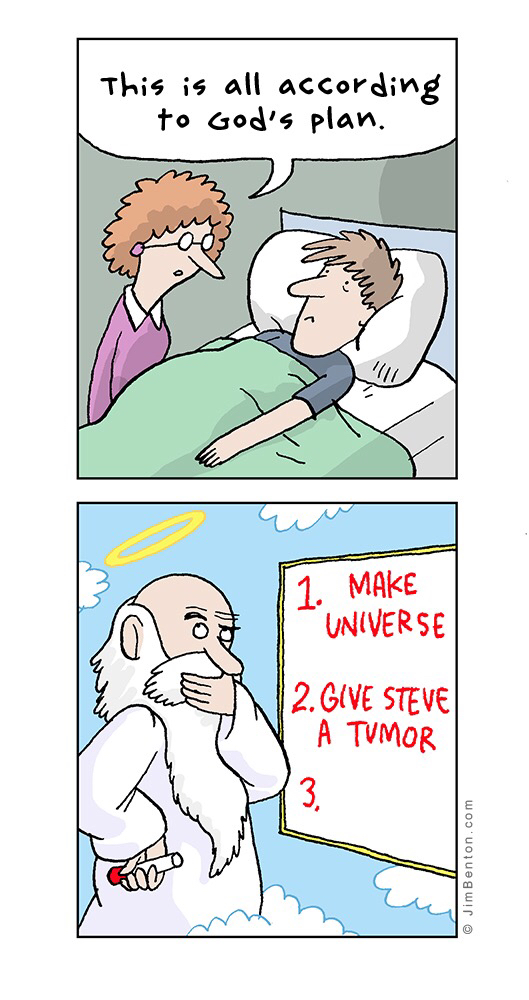
Christianity Today Writes that God Does Not have Plans for the Lives of Individuals

From Christianity Today:

God has a wonderful plan for your life.

It’s evangelical orthodoxy, on a par with belief in substitutionary atonement and the sanctity of Spurgeon. It’s part of the salvation package, along with forgiveness of sins and life everlasting. Christianity isn’t just true, it offers the sure and certain knowledge that whatever happens to you is God’s will. If you don’t like it, it’s because you haven’t understood it.

I don’t believe a word of it.

And:

Where does the idea that God has our lives mapped out for us come from? Biblically, it’s often related to Jeremiah 29: 11, “‘For I know the plans I have for you,’ declares the Lord, ‘plans to prosper you and not to harm you, plans to give you hope and a future.'” There are other verses that speak of him working behind the scenes to bring about a particular result.

The trouble is that in too much evangelical rhetoric, these verses have had a weight put on them that they can’t possibly bear. So we’re forced into all sorts of mental gymnastics to try to justify the idea that God has a plan for each individual, even when this idea so clearly fails the test of experience. I’m sorry, but I don’t believe God’s plans for anyone include bereavement, divorce, redundancy or large-scale tragedy.

Worship Sunday – God Is

When all you see, Is here and now
When everything is crumbling, falling to the ground
This is just a moment, This is not forever
I know it seems impossible and all your hope is gone.

But God is… God is…
Greater than the fear you’re facing, greater than the storm that’s raging
God is… God is…
with you when you cry, so cry out his name
Cause God is greater than the pain.

He knows the trials, His children face
He knows the tears that fall that we all have to taste
But don’t you dare let go now, don’t let the candle blow out
His love is strong, so just hold on cause he is with you through it all

He is mighty, More than able,
to rescue and restore the ones he loves
He is a refuge and a savior
A savior

God is greater than the pain

Act 13.48 Commentary

Part of the ongoing Verse Quick Reference project.

Act 13:48 Now when the Gentiles heard this, they were glad and glorified the word of the Lord. And as many as had been appointed to eternal life believed.

This verse is often used to defend the idea that God has elected people eternally for salvation. One Calvinist reports that Acts 13:48 is the Bible verse that made him a Calvinist.

But this Bible verse seems to be mistranslated. There exists a better and more natural translation that better fits the context. The verse very easily could have been rendered:

Act 13:48 Now when the Gentiles heard this, they were glad and glorified the word of the Lord. And as many as appointed themselves to eternal life believed.

In the Greek language, the Middle and Passive take the same verb form. So unless the context is clear, there is uncertainty in if others are acting upon someone or if those people are acting upon themselves. A Greek Grammar website explains:

Middle and Passive Transitive Verbs Transitive verbs can be either middle or passive, and only the context can help you decide which meaning is intended. (Transitive) Middle Voice Usage For transitive verbs, the implication of the of the middle voice is that the action expressed by the verb directly affects the subject. The verbs in the following sentences are all transitive, and they all have a middle/passive form in Greek. οὐκ οἴδατε τί αἰτεῖσθε You do not know what you are requesting (Matthew 20:22) ὁ Ἰησοῦς εἶπεν• πάτερ, εἰς χεῖράς σου παρατίθεμαι τὸ πνεῦμά μου. Jesus said: Father, into your hands I commit my spirit (Luke 23:46) τί διαλογίζεσθε ἐν ἑαυτοῖς …ὅτι ἄρτους οὐκ ἔχετε; Why are you discussing among yourselves …that you have no bread? In each of these examples, the subject is presented as acting for its own benefit. Compare the following example. The verb used there (δέχομαι) is a lexical middle. ἐμὲ δέχεται [He/she] receives me (Matthew 10:40) The form of this verb that appears in the lexicon (δέχομαι) is middle voice. Since the verb always has a middle voice implication—the action it expresses (receiving) directly impacts its subject—it never appears with active voice forms. Its meaning is best expressed in the middle voice. Passive Voice Usage (always transitive) Observe the following sentences in which the subject is acted upon by someone not explicitly named. οὐχὶ δύο στρουθία ἀσσαρίου πωλεῖται Aren’t two sparrows sold for a penny? (Matthew 10:19) ἀφίενταί σου αἱ ἁμαρτίαι Your sins are forgiven (Mark 2:5) ἕκαστον γὰρ δένδρον ἐκ τοῦ καρποῦ γινώσκεται For every tree is known by its fruit (Luke 6:44) Notice that the subject of these verbs would be the object if the verb were active voice. This is the basic meaning of the passive voice. When translating Greek middle/passive forms of transitive verbs you may need to try both middle and passive translations to see which makes best sense in the context.

This cannot be stated enough: When translating Greek middle/passive forms of transitive verbs you may need to try both middle and passive translations to see which makes best sense in the context. Jesse Morrel makes an excellent case as to why this passage would be better rendered as middle:

3. Also notice the passive/middle ending “μένοι.” That means that ordained/disposed can be taken as something which was done to them (passive), in this case by the word, or something which they did to themselves (middle), in this case by allowing themselves to be properly influenced by the word. Given the context of this passage, especially in contrast with vs. 46 that uses the reflexive pronoun “ἑαυτοῦ” to say that they judged themselves unworthy of eternal life, this verb “τεταγμένοι” should be understood to be in the middle voice. Context is the only key in determining whether a verb is in the passive or in the middle, as the ending is identical.

Apologetics Thursday – Fortuneteller God

In an article on the The Case Against Open Theism, Ron Nash writes:

The theory in question [that statements about the future are neither true nor false] seriously limits the knowledge of God and conflicts with the Bible’s account of God’s ability to predict the future. If propositions about the future are neither true nor false, it is logically impossible for God to predict the future. The belief that God does predict the future presumes that God knows what he is talking about.

Reading this passage, one might see the author’s view of God as of one of a fortuneteller. God is a mystic and peers into the future to “predict” events that will happen. Where does God do this in the Bible? Usually, God’s statements about the future throughout the Bible are linked to God’s power. God will punish. God will judge. And sometimes these events that God “predicts” fail to happen, as is the case when God “predicted” that Nineveh would be destroyed in 40 days and that event never happened. Sure, there were “reasons” it did not happen, but the author of the article would treat God’s prediction as a false statement, if future events must have a truth value. If it is true that Ninevah would not be overthrown in 40 days, God’s prediction that it would be overthrown in 40 days (a prediction believed by all actors involved) was just a lie.

In the Bible, God is not a fortuneteller, predicting in a crystal ball what people’s future’s hold. Instead, we see God’s knowledge of the future woven with God’s power to act. God’s predictions are not so much “in 20 years you will find true love” but “in 20 years I will punish you for your wickedness.” Where we do see God’s predictions, often God wants His predictions to fail (Israel’s continued disobedience) and sometimes God admits His predictions of Israel’s actions do fail:

Jer 3:7 And I thought, ‘After she has done all this she will return to me,’ but she did not return, and her treacherous sister Judah saw it.

Goetz on Semiclassical Theism and the Passage of Planck Times

A philosophically based paper on Open Theism, a paper which attempts to advocate . An abstract:

This paper models God and time in the framework of modern physics. God bridges and simultaneously exists in (1) a universe with infinite tenseless time and (2) a created parallel universe with tensed time and a point origin. The primary attributes of God are inexhaustible love, inexhaustible perception, and inexhaustible force. The model also incorporates modern physics theories that include relativity, the conservation of energy, quantum mechanics, and multiverse geometry. For example, creation out of nothing and divine intervention are subject to physical processes and likewise nomological possibility. I will call this model semiclassical theism.

From the paper:

This paper is a model of God bridging and simultaneously existing in (1) a universe with infinite tenseless time and (2) a created parallel universe with tensed time and a point origin. The model is framed by modern physics theories that include relativity, the conservation of energy, quantum mechanics, and multiverse geometry. The model also states that the primary attributes of God are (1) inexhaustible love, (2) inexhaustible perception, and (3) inexhaustible force. I will call this semiclassical theism. Furthermore, in the case of Trinitarian doctrine, I will call this semiclassical Christianity.

Worship Sunday – Redeemed

Seems like all I could see was the struggle
Haunted by ghosts that lived in my past
Bound up in shackles of all my failures
Wondering how long is this gonna last
Then You look at this prisoner and say to me “son
Stop fighting a fight it’s already been won”

I am redeemed, You set me free
So I’ll shake off these heavy chains
Wipe away every stain, now I’m not who I used to be
I am redeemed, I’m redeemed

All my life I have been called unworthy
Named by the voice of my shame and regret
But when I hear You whisper, “Child lift up your head”
I remember, oh God, You’re not done with me yet

I am redeemed, You set me free
So I’ll shake off these heavy chains
Wipe away every stain, now I’m not who I used to be

Because I don’t have to be the old man inside of me
‘Cause his day is long dead and gone
Because I’ve got a new name, a new life, I’m not the same
And a hope that will carry me home

I am redeemed, You set me free
So I’ll shake off these heavy chains
Wipe away every stain, ’cause I’m not who I used to be

I am redeemed, You set me free
So I’ll shake off these heavy chains
Wipe away every stain, yeah, I’m not who I used to be
Oh, God, I’m not who I used to be
Jesus, I’m not who I used to be
‘Cause I am redeemed
Thank God, redeemed

Gen 50.20 Commentary

Part of the ongoing Verse Quick Reference project.

Gen 50:20 As for you, you meant evil against me, but God meant it for good, to bring it about that many people should be kept alive, as they are today.

This verse is often used by those who want to claim that God makes all evil happen in order to fit into His perfect plans. Evil, it is said, is caused by God for a greater purpose, and exists concurrently with man’s will (a belief called compatibilism).

Here is Calvinist James White:

Joseph’s brothers meant their actions for evil. But in direct parallel, God meant the same action for good. Due to the intention of the hearts of Joseph’s brothers, the action in the human realm was evil. The very same action as part of God’s eternal decree was meant for good, for by it God brought about His purpose and plan. One action, two intentions, compatible in all things. Joseph’s brothers were accountable for their intentions; God is to be glorified for His.

This verse just does not read that way despite those who want to make the concepts mechanical. The verse has nothing to do with eternal decrees, or even God causing Joseph to be sold into slavery. It easily can be ready that Joseph’s brothers purposed to do evil, but God purposed to do good. There is nothing in the reading that suggests God is not repurposing Joseph’s brother’s evil acts. In fact, a future Biblical commenter reads the same passage as God rescuing Joseph from his brothers:

Acts 7:9 And the patriarchs, jealous of Joseph, sold him into Egypt; but God was with him
Acts 7:10 and rescued him out of all his afflictions and gave him favor and wisdom before Pharaoh, king of Egypt, who made him ruler over Egypt and over all his household.

This is a perfectly acceptable reading of Genesis 50:20, that stands in opposition to God decreeing the evil to happen.

In any case, it is a wild leap of logic to point to one instance of an evil event being used for good, then to posit that all evil events are used for good, God has decreed them all since time eternal, and that God endorses the evil events.

Understanding the Hypostatic Union

From the book Neoplatonism:

Plotinus’s model includes three “hypostases,” or fundamental levels of reality. The first and highest is the unknowable “One,” which emanates the next level, called Nous, translated as Divine Mind or Intelligence. This second level contains the Platonic Forms or Ideas, which we can know intellectually, and so this level is also called the Intelligible World. Nous then emanates the next lower level, Psychē or Soul, which animates the physical world and serves as an intermediary between the Intelligible World and the material world we know with our physical senses.

In Neoplatonism, the universe was divided fundamentally between the highest good (the One), the unchangeable realm known as the “Intellect”, and finally the material world or “Soul”. The highest level of existence was considered pure actuality, or pure act, or pure aseity. This realm could in no fashion be related to other forms of being, but was timeless, immutable, impassible, and ineffable. The second level was the Intellect, with which all good philosophers strove to re-achieve union. The material world was the world of the soul, in which philosophers had to escape through ascension. The early Church fathers became infatuated with this strain of Neoplatonism, in which the material world was separate and unrelated to the highest Good, which they equated with God.

Augustine, particularly, was a strong adherent to Neoplatonism (in this tradition). His conversion to Christianity recognized what he saw as a distinction between Neoplatonism and what he considered Christianity. He saw Jesus as the enabling spark which connects the various realms and helps guide the Soul back to merge with the Intellect, without which the bridge could not be made. Jesus was the key to ascension to the changeless realm.

Jesus, in this view, has an element of the One in himself (often described by modern adherents as a mystery one just has to accept). Recall, the One cannot be in relation to anything else. The One is beyond description or intelligibility; no positive attributes can be said of the One. This, in modern circles is called the Hypostatic union.

Adherents to the idea of the Hypostatic Union will talk about two natures of Christ (the natural and divine), and differentiate Jesus from Christ (as White does in the Enyart debate). They will also be hesitant to call “divine” the human nature of Jesus. Divinity in Neoplatonism, can have nothing to do with the changing material world. In this way, the concept of the Hypostatic Union is a Neoplatonistic mechanism for bridging the hypostases, while trying to maintain them as distinct.

Mcmahon on Job 42.11

Job 42:11 Then came to him all his brothers and sisters and all who had known him before, and ate bread with him in his house. And they showed him sympathy and comforted him for all the evil that the LORD had brought upon him. And each of them gave him a piece of money and a ring of gold.

Timothy Mcmahon Comments on Job 42:11 on the Facebook page God is Open:

…if I were translating the text I’d go with “that HaShem brought on him” and then deal with it exegetically. The OT authors, at least in an earlier phase, simply didn’t wrestle with the issue of whether God allows or initiates. Throughout the book of Job, everyone agrees that God has brought Job’s calamity on him; they disagree on the reason for it. It’s only later, when the prose sections are appended to the poem, that we learn of the Satan’s intermediary role. You see the same development between 2 Samuel 24 and 1 Chronicles 21.

Praying to an Uncontrolling God

From the Uncontrolling Love of God project. Prayer to the Uncontrolling God:

The idea that we are collaborative partners with God has a significant impact on our prayer lives. In essence, we go to God not only trying to discern his will, but also suggesting solutions ourselves. We are wise, of course, to leave the ultimate decision up to the Almighty. Where, after all, were we when he laid the foundations of the world? Still we are free to argue, debate, and recommend. By joining in this kind of interaction we are better able to understand God’s reasoning and participate more fully and intentionally in God’s vision.

Worship Sunday – Happy Day

The greatest day in history
Death is beaten, You have rescued me
Sing it out, Jesus is alive

The empty cross, the empty grave
Life eternal, You have won the day
Shout it out, Jesus is alive
He’s alive

Oh, happy day, happy day
You washed my sin away
Oh, happy day, happy day
I’ll never be the same
Forever I am changed

When I stand in that place
Free at last, meeting face to face
I am yours, Jesus, You are mine

Endless joy, perfect peace
Earthly pain finally will cease
Celebrate, Jesus is alive
He’s alive

And oh, happy day, happy day
You washed my sin away
Oh, happy day, happy day
I’ll never be the same
Oh no, forever I am changed

Oh, what a glorious day
What a glorious way
That You have saved me
And oh, what a glorious day
What a glorious name

Hey, and oh, happy day, happy day
You washed my sin away
Oh, happy day, happy day
I’ll never be the same
Oh no, forever I am changed
What a glorious, glorious day
I’ll never be the same

Act 15:18 Commentary

Act 15:18 “Known to God from eternity are all His works.

Adam Clarke comments on this verse:

“The whole of this verse is very dubious: the principal part of it is omitted by the most ancient MSS… Supposing the whole to be genuine, critics have labored to find out the sense… They therefore would translate the passage thus: All the works of God are ever dear unto him. And, if so, consequently we might naturally expect him to be merciful to the Gentiles, as well as to the Jews; and the evidence now afforded of the conversion of the Gentiles is an additional proof that all God’s works are equally dear to him.”

The ESV translates the same verse:

Acts 15:17 …says the Lord, who makes these things
Act 15:18 known from of old.’

The ESV is perhaps the more natural contextual meaning. In the context, James is explaining to a hostile audience why Gentiles do not have to circumcise. This passage is about affirming Paul’s message to the Gentiles. Amos is quoted as precedence (v16-17) for this contentious development. James’ argument is that God has been planning this development for some time, as evidenced in Amos. The text can only dubiously be extended to this as affirmation that even God’s minor actions as been planned from long ago, and even more dubiously extended to mean that God has absolute omniscience over the future. The verse, after all, is about God’s own plans for His own actions.

Morrell Gives 12 Points on Man’s Free Will

From Jesse Morrell’s “12 Minute Best Scriptural Arguments” for Free Will in the debate against Calvinist Matt Slick

Number 5:

5. The Bible Teaches Man Still Had A Free Will After Adam’s Sin

That man’s free will to choose between good and evil, between obedience and disobedience, continued after the fall of Adam and Even can be seen in a plethora of verses.

i. Genesis 4:6-7: God spoke to Cain immediately after the fall of Adam and Eve as someone who had no reason to be upset because he could simply do well and it would be accepted of him.

ii. Deut. 11:26-27: God told Israel that He was setting before them blessings or curses, blessings if they obey and curses if they disobey, thus declaring that they had the power of contrary choice between obedience and disobedience.

iii. Deut. 30:19: God told Israel that He set before them the way of life and the way of death, choose life.

iv. Deut. 8:2: God tested men to see if they would obey Him or disobey Him. Why would He test them to see which one they would do if their ability to do anything except disobey had been lost?

v. Joshua 24:25: Joshua told Israel to choose this day whom they would serve, whether they would serve God or other gods. Evidently men have a free will choose whether they will serve God or not.

vi. Jer. 21:8: God said to Israel that He set before them the way of life or the way of death. God is declaring that He has given them the “power of contrary choice.”

vii. Jer. 11:7-8: God said that He “earnestly protested” with the fathers of Israel to obey His voice. Why would He “earnestly protest” for them to obey Him if they cannot?

viii. Jer. 38:20: Jeremiah told the king, “Obey I beseech you the voice of the Lord” as if this was a choice the sinful king could and should make.

ix. Ps. 53:2: God looked down from heaven to see if there were any that did understand and seek Him and found none. Why would God look down to see if this was happening if He took away any possibility of it when Adam sinned? The fact that God looked down to see presupposes that it was a possibility.

x. Genesis 6:5-6 & Ezekiel 6:9: God expresses great brokenness of heart over the abundance of man’s sin, as if things could have been differently.

xi. Jer. 19:5, 32:35: God said when Israel sacrificed their children to false gods that they were doing what He commanded not “neither came it into my mind” He said that they would do such a thing. In other words, God knew that they were capable of doing otherwise and expected them to.

xii. Isa. 5:4: God said He did all that He could for His vineyard to bring forth grapes but it brought forth wild grapes instead. Evidently Israel had a free choice to bring forth either kind and God did not withhold from them the ability to bring forth that grapes that He wanted.

xiii. Ps. 81:13 & Isa. 48:18: God bemoans the disobedience of Israel, saying O that they had obeyed my commandments, as if they could have! He is speaking as if the past could have been different than it was.

Free DTS Course on Genesis

[Link]

From the website:

Genesis is taught by Dr. James Allman, DTS professor of Old Testament Studies. We believe that the whole Bible, as Paul says in Timothy, is “useful for teaching, rebuking, correcting, and training in righteousness”. That’s why we’ve made this course, Genesis, free for the first time.

This course is designed for those who want to:

learn more about the first book of the Bible
grow in understanding of who God is and why He created you
deepen their walk with the Lord by applying the text to their life

Worship Sunday – You Are My Hope

Times are hard
Times have changed
Don’t you say
But I keep holding on to you
It’s hard to keep the faith alive day to day
Leaning on the strength I’ve found in you
You’re the hope of all the Earth

You are my hope
You are my strength
You’re everything
Everything I need
You are my hope
You are my life
You are my hope
You are my hope

Far beyond what I can see or comprehend
Etching your eternity in me
Nations stream and angels sing, “Jesus reigns”
And every knee bows down
You’re the hope of all the Earth

You are my hope
You are my strength
You’re everything
Everything I need
You are my hope
You are my life
You are my hope
You are my hope

Carry on and I sing of how
You love and I love you now
All the times that I start to sink
You come and you rescue me
You are my hope
You are my hope

New Subsite Launched

The plan for GodisOpen has always been to collect a running list of common prooftexts and create an easily navigable reference site. That project will be collected in the new subsite Quick Verse Reference. This site will compile a quick reference list for common verses used by Open Theists and verses used against Open Theists. This site can be accessed via the Resources tab.

The plan is to gradually expand this list each week, ultimately becoming the best tool for new Open Theists to understand various verses throughout the Bible.

Apologetics Thursday – God Does Not Need Anything

Act 17:24 The God who made the world and everything in it, being Lord of heaven and earth, does not live in temples made by man,
Act 17:25 nor is he served by human hands, as though he needed anything, since he himself gives to all mankind life and breath and everything.

The two most popular systematic theologies on Amazon.com comment on Acts 17:24-25:

Wayne Grudem:

Scripture in several places teaches that God does not need any part of creation in order to exist or for any other reason. God is absolutely independent and selfsufficient. Paul proclaims to the men of Athens, “The God who made the world and everything in it, being Lord of heaven and earth, does not live in shrines made by man, nor is he served by human hands, as though he needed anything since he himself gives to all men life and breath and everything” (Acts 17:24–25). The implication is that God does not need anything from mankind.

Louis Berkhof:

The universe is not the existence-form of God nor the phenomenal appearance of the Absolute; and God is not simply the life, or soul, or inner law of the world, but enjoys His own eternally complete life above the world, in absolute independence of it. He is the transcendent God, glorious in holiness, fearful in praises, doing wonders. This doctrine is supported by passages of Scripture which (1) testify to the distinct existence of the world, Isa. 42:5; Acts 17:24;

Acts 17:24-25 is used as a prooftext to prove that God has no needs and is independent of the world. God is said not to gain anything from the world because then this would mean God would be dependent on the world, in some sense. If God can gain something He did not have through His relationship with the world, God is not self-sufficient. If God can gain, then God would not be perfect. The idea is related to impassibility, but touted as “self-sufficiency”. The Negative Theology connotations are different than what normal people would consider “self-sufficiency”.

If a man were to survive by himself in the woods, he would be called self-sufficient. But this does not mean he does not rely on other things, or derive pleasure from talking to other people, or cannot gain from having a wife. But this is not the Negative Theological idea of Self-Sufficiency, ultimately rooted in Perfect Being theology.

But this is not at all how Paul is using this statement. The statement is being made in the context of idols. The pagans would build temples to idols, house those idols, feed those idols. This is what Paul is discounting. God doesn’t have to rely on man’s service. Paul is not saying that God cannot benefit in a relational way by communion with man. Paul is not saying that God does not desire and crave worship. Paul is just saying we don’t build houses for God.

Contrasted to Negative Theology, God is often described as jealous and desirous of worship and loyalty. Within the Psalms, often people bargain with God. If God lets them die, then God will be forgoing praise. If God spares them, then they will praise Him and proselytize.

Morrell on the Nature and Character of God

From an unpublished work:

A God who grieves and suffers is the God of the Bible. But He is also a God of jubilation and joy. Man can bless God or hurt His feelings. He is susceptible to grief, anger, abhorrence, jealousy, rage, wrath, hate, love, happiness, pleasure, joy, compassion, pity, and sympathy. These make up the emotional attributes of God and we should love Him all the more because of them.

Oord Summarizes His Experience Being Ousted From Teaching Role

From Northwest Nazarene professor shares views on God, loses academic freedom:

10. Pain for all involved

Oord and his wife still feel the pain of the ordeal. He and others say he’s unlikely to ever be hired again by a Nazarene college, because any president who took him on could also face Oord’s critics.

“I have been ousted here for all intents and purposes,” says Oord, who may try to get on at a Methodist school.

The pain also extends to the campus and Idaho Nazarenes, says Borger.

“I feel badly that it happened as it happened and the way it was portrayed,” said Borger, the former Nazarene district superintendent. “I feel badly for Tom and his family. I feel badly for NNU. I feel badly for the Church of the Nazarene.”

Worship Sunday – Indestructable

Fear nobody but His Majesty
My spirit, you retrieved
For you I wait silently
It seems that you believe in me

Fear nobody but His Majesty
My spirit, you retrieved
For you I wait silently
It seems that you believe in me

Indestructible digging through the rubble
Bubblin’ we don’t need no more trouble
That bahella-scope vision, hot-hot fiction
Like I’m running a muck upon a rhythm

Stay on the plan so you don’t lose the vision
Stay sizzling Peter pan I’m from a land hip like this
From the city feeling it
Ya breathing in, ya put on your glasses and ya see through it

Fear nobody but His Majesty (fear no one)
My spirit, you retrieved
For you I wait silently (his majesty)
It seems that you believe in me

Fear nobody but His Majesty (fear no one)
My spirit, you retrieved
For you I wait silently (his majesty)
It seems that you believe in me

Some of them run-run-running like rats on a wheel
‘Trife will find her new deal
Who is their ticket for a meal?
This world is real on the heels of a final generation

I remember that day in November
Standing on the roof and I’m feeling so tender
All shook up like I’ve been in the blender
Fend off the demons in the park after dark

Lend me your hand I want to be a member
Spent too much and now I’m rendered
Dead mend these wounds we got to find a common thread
Want to fly in the sky but you’re heavy like lead

Fear nobody but His Majesty (fear no one)
My spirit, you retrieved
For you I wait silently (his majesty)
It seems that you believe in me

Fear nobody but His Majesty (fear no one)
My spirit, you retrieved
For you I wait silently (his majesty)
It seems that you believe in me

Just a tool in the hands of the builder
Fill them with the strength to go further
Diggin’ deep for eternal treasure
Stay away from quicksand and false pleasure

Dare not speak with arrogance
Appearance like a lion lurkin’ in the mist
They surround and they gaze their fix
Grab the rope of God’s heritage

Fear nobody but His Majesty (fear no one)
My spirit, you retrieved
For you I wait silently (his majesty)
It seems that you believe in me

Fear nobody but His Majesty (fear no one)
My spirit, you retrieved
For you I wait silently (his majesty)
It seems that you believe in me

Release me from their schemes
My distress you will relieve
Shield me on the path that’s dark and slippery
They seek deception and futility

I stand with integrity
Sneak to the roof of that building
Don’t want nobody here to see me
To say that I’m living in a fantasy
But I believe in find and keep

And I plead in sincerity
Won’t you utterly remove the cloud hangin’ over me
Won’t cha wave that decree in the shade of your wings
Shelter me from the wicked who have plundered me
From my mortal enemies won’t ‘cha shield me?

Sanders on Weak and Strong Immutability

This quote comes from John Sanders (in Facebook group a while ago):

Let me attempt to clarify some points. First, words such as predestination, election, and salvation have more than one meaning. So when students ask me if I affirm predestination and I reply “yes” they are typically shocked. I then inform them I reject what they likely mean by the term—theological determinism. However, there are different understandings of the term though I may not want to use it due to how it is typically understood. In the OOG we distinguished between strong and weak understandings of immutability and claimed that the divine nature does not change but that God does have changing mental states (e.g strategies and emotions). At that time I don’t recall anyone distinguishing between different forms of impassibility. We took the term to have only one meaning, what has come to be known as strong impassibility—God is never affected by creatures in any respect. As the dialogue ensued we were asked whether God is ever overwhelmed by emotions as humans are apt to be such that God becomes incapacitated to act. We denied that this was the case. The distinction between strong and weak versions of impassibility arose in the literature and in discussions with Hasker, Rice, and Pinnock I decided to use both strong and weak immutability and strong and weak impassibility in the revised edition of GWR to distinguish between Classical Theism and Traditional Freewill Thesim (I placed Open Theism as a version of Freewill Theism). Our position had not changed from what we wrote in OOG. We simply became more precise about what we affirmed and rejected. We rejected strong impassibility and still do. This move was similar to the discussion about the “openness” of the future. People asked if we were saying that every aspect of the future was open and so we said no, some of the future may be closed. Getting more precise on these matters was acting responsibly. One is welcome to disagree with us about the meaning of the terms or the distinctions and suggest a more helpful way of understanding the issue. What I reject is the claim that “After much brow-beating, Sanders is now conceding qualified impassibility” My use of weak impassibility was in conference papers around 2002 and in GWR by 2006 so it had nothing to do with Tom Belt’s reasoning. I’m not in agreement with Belt on this issue by the way. But the point is that my motivation for making this distinction long preceded any conversations on Facebook. If weak impassibility as I defined it in GWR is inconsistent with open theism then I suppose that would mean I was an open theist until 2002 (as were Pinnock, Hasker and Rice). However, since my view has not changed, only become more clearly defined, I feel confident in asserting that I affirm open theism.

Facebook Sanders Immutability

Apologetics Thursday – Why Did You Believe and Your Friend Not

Leighton Flowers answers the oft asked Calvinist Question:

“WHY DID YOU BELIEVE THE GOSPEL, BUT YOUR FRIEND DID NOT? ARE YOU WISER OR SMARTER OR MORE SPIRITUAL OR BETTER TRAINED OR MORE HUMBLE?”

1) QUESTION BEGGING FALLACY:

… this is a game of question begging because it presumes a deterministic answer is required. It is tantamount to asking, “What determined the response of you and your friend?” As if something or someone other than the responsible agents themselves made the determination. The question presumes determinism is true and that libertarian free will (self-determination) is not possible. [2]

I believe that the cause of a choice is the chooser (or the cause of a determination is the determiner)…

Piper Prays for Family of Five Killed in Car Accident

Audio availible. From the link:

Jamison and Kathryne Pals and their small children were driving from Minneapolis to Colorado for final preparations as missionaries to Japan. They planned to leave in October. But in an interstate construction zone in western Nebraska, a semi truck rear-ended the family’s vehicle.

Tragically, the entire family died at the scene, including Jamison and Kathryne, both 29, and their three young children, 3-year-old Ezra, 23-month-old Violet, and 2-month-old Calvin.

The 53-year-old trucker was arrested and charged with five counts of felony motor vehicle homicide.

And random Calvinists on the internet respond:

Calvinists Respond to Death

Worship Sunday – All Around Me

My hands are searching for you
My arms are outstretched towards you
I feel you on my fingertips
My tongue dances behind my lips for you

This fire rising through my being
Burning, I’m not used to seeing you

I’m I’m alive, I’m I’m alive

I can feel you all around me
Thickening the air I’m breathing
Holding on to what I’m feeling
Savoring this heart that’s healing

My hands float up above me
And you whisper you love me
And I begin to fade
Into our secret place

The music makes me sway
The angels singing say we are alone with you
I am alone, and they are too with you

I’m alive, I’m alive

I can feel you all around me
Thickening the air I’m breathing
Holding on to what I’m feeling
Savoring this heart that’s healing

And so I cry (holy)
The light is white (holy)
And I see you

I’m alive, I’m alive, I’m alive

I can feel you all around me
Thickening the air I’m breathing
Holding on to what I’m feeling
Savoring this heart that’s healing

Take my hand
I give it to you
Now you owe me
All I am
You said you would never leave me
I believe you
I believe

I can feel you all around me
Thickening the air I’m breathing
Holding on to what I’m feeling
Savoring this heart that’s healed

Shownotes – Arthur Haglund on Matt Slick

From the shownotes from podcast Ep134 – Arthur Haglund on John 6 and Matt Slick. A list of tool moves done by Matt Slick against Haglund:

1. He escalates a fight when you ask him to what verse he is turning.
2. He embeds his presuppositions in his questions and phrases them that if you reject Matt Slick you reject Jesus: “Do you agree with Jesus that Calvinism is true?” type questions. He gets mad when you don’t answer “yes” or “no”.
3. He asks questions that assume you gave entirely different answers to the very previous question than you actually did.
4. He refuses to understand your beliefs and his questions show that he is not even tracking with your answers.
5. He is condescending and tries to portray himself with the moral high ground.
6. He has double standards for how questions can be answered or how points can be made.
7. He tries to stop you from making a parallel to show how reasonable people can understand the same verse in a valid way.

Apologetics Thursday – CARM Refuted on Free Will

GodsoLoved offers up a refutation of CARM on Free Will:

William Hasker (an open theist) defines libertarianism as the following: “An agent is free with respect to a given action at a given time if at that time it is within the agent’s power to perform the action and also within the agent’s power to refrain from the action.” (Opennes of God, p.136-137)

In contrast, CARM says of libertarian free will: “This is the position that a person is equally able to make choices between options independent of pressures or constraints from external or internal causes. In other words, the person is able to equally choose between any set of options.”

As opposed to the first definition I quoted from CARM on libertarianism, this definition is utterly unacceptable. All libertarians believe that all actions were caused, by either an event-cause or an agent-cause. It either shows a lack of research done by CARM or a deliberate intention to mislead readers on libertarianism and set up a straw man.

Atheist Describes the Difference Between Eternal and Everlasting

From about.atheism :

A more important basis for defining “eternal” as “timeless” is the ancient Greek idea that a perfect god must also be an immutable god. Perfection does not allow for change, but change is a necessary consequence of any person who experiences the changing circumstances of the historical process. According to Greek philosophy, especially that found in the Neoplatonism which would play an important role in the development of Christian theology, the “most real being” was that which existed perfectly and changelessly beyond the troubles and concerns of our world.

Eternal in the sense of everlasting, on the other hand, presumes a God who is part of and acts within history. Such a god exists through the course of time like other persons and things; however, unlike other persons and things, such a god has no beginning and no end. Arguably, an everlasting god cannot know the details of our future actions and choices without impinging upon our free will. Despite that difficulty, however, the concept of “everlasting” has tended to be more popular among average believers and even many philosophers because it is easier to comprehend and because it more compatible with the religious experiences and traditions of most people.

Hicks on Arminius and Open Theism

John Mark Hicks, “Was Arminius an Open Theist? Meticulous Providence in the Theology of Jacob Arminius,” quoted via William Birch:

I suggest that we no longer use the language of “meticulous providence” as an equivalent for “theological determinism” (what open theists think is the Reformed understanding of sovereignty). Originally the phrase “meticulous providence” identified a view of providence that denies pointless or gratuitous evils. This does not entail determinism or any understanding of eternal decrees, as in Reformed scholasticism. …

Arminius affirmed with Reformed theology a “meticulous providence” where God has sovereignty over evil such that no evil act is autonomous and uncircumscribed by God’s intent for good. God is sovereign in such a way that God concurs with the act itself and its effect has specific meaning and significance. This is a critical difference between classic Arminianism and open theism. Whereas Arminius asserted an understanding of concurrence that entails meticulous providence, open theism does not.

This difference is no minor one since it reaches to the very core of why open theism, at least pastorally, arose as an alternative to Reformed theology and more traditional Arminianism. When classic Arminianism affirms “meticulous providence” (in the sense defined herein), this constitutes a radical disagreement with open theism. In terms of “meticulous providence,” Reformed theology and classic Arminianism stand together. …

Worship Sunday – King Without a Crown

You’re all that I have,
And you’re all that I need.
Each and every day I pray to get to know you please.
Want to be close to you,
Yes I’m so hungry.
You’re like water for my soul,
When it gets thirsty.
Without you, there’s no me,
You’re the air that I breath.
Sometimes the world is dark,
And I just can’t see.
With these demons surround all around,
To bring me down to negativity.
But I believe yes I believe,
I’ll say that I believe.
I’ll stand on my own two feet,
Won’t be brought down on one knee.
I’ll fight with all of my might,
To get these demons to flee.
Hashem’s rays, fire blaze,
Burn bright and I believe.
Hashem’s rays, fire blaze,
Burn bright and I believe.
Out of darkness comes light,
Twilight unto the heights.
Crown Heights burning up,
All through the twilight.
Say thank you to my god,
Now I finally got it right.
And I’ll fight with all of my heart,
And all of my soul,
And all of my might.

What’s this feeling,
My love will rip a hole in the ceiling.
I give myself to you,now,
From the essence of my being.
And I sing to my god,
Songs of love and healing.
I want Moshiach now,
So it’s time we start revealing.

What’s this feeling,
My love will rip a hole in the ceiling.
I give myself to you,
From the essence of my being.
And I sing to my god,
Songs of love and healing.
I want Moshiach now.

Strip away the layers,
And reveal your soul.
You got to give yourself up,
And then you become whole.
You’re a slave to yourself,
And you don’t even know.
You wanted to live the fast life,
But your brain moves slow.
You’re trying to stay high,
Bound to stay low.
You want god,
But you can’t deflate your ego.
You’re already there,
Then there’s nowhere to go.
Your cup’s already full,
Then it’s bound to overflow.
If you’re drowning in the water,
And you can’t stay afloat.
Ask Hashem for mercy,
He’ll throw you a rope.
You’re looking for help from god,
Say he couldn’t be found.
Searching up to the sky,
Looking beneath the ground.
Like a king without his crown,
You keep falling down.
You really want to live,
But couldn’t get rid of your frown.
You tried to reach unto the heights,
And wound down bound on the ground.
Giving up your fright,
Then you heard a sound.
Out of Light comes day,
Out of day comes light.
Nullify to the one,
Like sunlight in a ray.
Making room for his love,
Then a fire gone blaze.
Make room for his love,
And a fire gone blaze.

What’s this feeling,
My love will rip a hole in the ceiling.
I give myself to you,
From the essence of my being.
And I sing to my god,
Songs of love and healing.
I want Moshiach now,
Time it starts revealing.

What’s this feeling,
My love will rip a skylight in the ceiling.
I give myself to you,
From the essence of my being.
And I sing to my god,
Songs of love and healing.
I want Moshiach now.

So lift up mine eyes,
Where my help come from.
And I seen it circling around,
From the mountain.
Thunder, you feel it in your chest,
You keep my mind at ease,
And my soul at rest,
You’re not vexed.

Look to the sky,
Where my help come from.
Seen it circling around,
From the mountain.
Thunder, you feel it in your chest,
You keep my mind at ease,
And my soul at rest,
You’re not vexed.

Uncontrolling Love mini-blogs

The uncontrollinglove.com is running a series of articles by individuals in dialogue with Thomas J Oord’s latest book, The Uncontrolling Love of God.

The first essay speaks about God’s interaction with modern medicine:

The author is clear and affirms the importance of faith in the healing process. However, he very firmly states that human emotions, state of mind and expectations all play a role in the healing process (203). It is therefore reasonable to conclude that while, in some instances, two individuals may have equally strong faith in God, that cancerous cells, genetic malfunctions or ingrained unhealthy habits may prevent bodily healing, even when many prayers are offered for the saints of God so afflicted. Yes, God does initiate the healing process, but healing rarely occurs in the absence of “creaturely cooperation” (214).

If the body is already too diseased prayers of faith may be uttered, but the mortal body will continue to degenerate until death occurs. Oord points out that sometimes the body’s organs are simply too diseased to cooperate with “God’s healing gifts” (214) and the individual dies.

Apologetics Thursday – Debating an Internet Calvinist on Malachi 3

The individual will be known as MRG.

Chris Fisher
MRG said to Gene “for you every verse that refutes open theism is a bad verse to use in the Bible… Which happens to be much of the Bible… “I am God… I do not change”
Let’s talk about this verse. I would love to take MRG‘s verses one by one. But let’s talk about the context of the verse. MRG, would you care to just give a brief overview of the situation in Mal 3, in which we find this verse?

Posit a guess why Rabbi Sacks thinks this is a verse that has been ripped out of context by Christians to justify a more Platonic view of God. I will post his quote later. I just want you to review the material on your own first.

MRG

Well why don’t you make an assertion that God changed and assert hoe God changes as well as how God potentially changes. Many open theists teach God could very well sin in the future. Just make a position statement. “God is not immutable. He is just like us and constantly changes and this is how God constantly changes…”

Chris Fisher
MRG, here is the thing. I don’t think you have ever given any real thought to Malachi. I don’t think you understand the context of the verse. Context defines meaning. You can’t just rip small phrases out of context and build a theology. I posit that you never have even tried to understand how this verse fits into the overall context of Malachi.

Mal 3:6 “For I the LORD do not change; therefore you, O children of Jacob, are not consumed.

I the Lord do not change, therefore… Israel is not destroyed. How does one lead to the other? How does that fit the context? I don’t think you even know anything about the verses you quote. You do not even want to consider, on your own, how a renowned Rabbi can see your position on this verse as an abhorrent interpretation.

Furthermore, I posit that all your prooftexts are just as horrendously ripped out of context to mean things usually opposite of what the context states. It is a sad indictment against you.

Chris Fisher
Here is Rabbi Sacks:

Far from being timeless and immutable, God in the Hebrew Bible is active, engaged, in constant dialogue with his people, calling, urging, warning, challenging and forgiving. When Malachi says in the name of God, ‘I the Lord do not change’ (Malachi 3: 6), he is not speaking about his essence as pure being, the unmoved mover, but about his moral commitments. God keeps his promises even when his children break theirs. What does not change about God are the covenants he makes with Noah, Abraham and the Israelites at Sinai.

Sacks, Jonathan. The Great Partnership: Science, Religion, and the Search for Meaning (p. 65). Knopf Doubleday Publishing Group. Kindle Edition.

MRG

Actually I was thinking of a different verse in scripture. Stop adding more verses that oppose your view. This verse rejects many open theists view that God could sin tomorrow. God sinning any time in the future is completely possible to many open theists. God could potentially become as evil as Hitler.

Chris Fisher
MRG, Nonsense… Where else does God say He does not change? In a quote from God? Nonsense. You don’t know the Bible.

In Malachi, the issue is that Israel is evil. God wants to utterly destroy them. But God refrains. Why? Because of His unilateral promise to Abraham (the promise which most statements throughout the Bible in reference to God not changing are actually about). He follows this up with this:

Mal 3:7 From the days of your fathers you have turned aside from my statutes and have not kept them. Return to me, and I will return to you, says the LORD of hosts.

So God follows this up saying God will change in relation to man. Don’t read the end of the chapter, because meshing what happens there with immutability is absurd.

MRG

You see how open theism bleeds into many areas of theology and creates bad thinking everywhere?

Chris Fisher
Seriously though, what verse were you thinking about in which God says: “I am God… I do not change” Where?

Chris Fisher
Again, you don’t know the Bible. You blatantly prooftext out of context. And the context more often than not counters how you want to take verses.

MRG

Chris I don’t know where you get your arguments from Greg Boyd? Bob Enyart?

Chris so when we are doing exegesis of scripture there are oh I’m guessing around 60 semantic functions that help us rightly interpret scripture and not butcher it…

You missed the word “therefore”

Now can you tell me why this is important to the text and our conversation ?

Chris Fisher
Alright. Things are not going well for you. Let’s run a tally.
1. You thought you were quoting a different verse than Mal 3:6 in which God says He doesnt change. Doesn’t exist.
2. You refused to read the context of the verse, and try to figure out why a prominent Rabbi would see this as a verse ripped out of context to support a Platonic notion of God. Alright, just discount Rabbi Sacks.
3. You appeal to an ad hominem, pretending that the validity of my beliefs has anything to do with “who I got them from”. If you just read our conversation, you can see quote from Rabbi Sacks. Will it ever dawn on you that your preferred reading of the text is not kosher or warranted by the text. It is not just me saying it.
4. Where do I miss the word “therefore”? When I literally quote you, and you claimed you were quoting the Bible? Is that your argument, that you instead of quoting an actual verse of the Bible you were making up stuff?
5. Then you ignore my questions about context, and ask “why is this important to the text of our conversation”… back up and answer my contextual questions. Here they are:

a. would you care to just give a brief overview of the situation in Mal 3, in which we find this verse?

“I the Lord do not change, therefore… Israel is not destroyed.”
b. How does one lead to the other?
c. How does that fit the context?

Flowers on Theistic Fatalism of Calvinism

Arminian Leighton Flowers writes:

It’s interesting to me that when a Calvinist seeks to defend against the charge of being a “Theistic Fatalist” he often argues “God not only ordains the end; but also the means” as if that is a point the Theistic Fatalist would in anyway deny.

That argument does not avoid the charge of Theistic Fatalism, but in fact affirms it. For what is Theistic Fatalism if not God’s determination of not only the ends but every single desire, thought and action (i.e. “means”) that bring about those ends?

What do the Calvinists think this qualification is accomplishing in their effort to distinguish themselves from the Theistic Fatalist? The belief that God unchangeably causes every meticulous detail of both the ends and their given means is at the very heart of Theistic Fatalism.

Are there Theistic Fatalists out there arguing, “God doesn’t determine the means,” while the Calvinists are going around correcting them saying, “No, no, no God does control the means too?” Of course not. Both systems of thought clearly affirm God’s cause of all things, including the ends and their respective means.

So, what is the Calvinist seeking to accomplish by pointing out a common belief that Calvinists share with Theistic Fatalists?

It appears to me the only real difference between a Theistic Fatalist and a Compatibilistic Calvinist is that the latter refuses to accept the practical implications of their own claims in order to remain consistent with the clear teaching of the Bible.

Short on Evil Being a Part of God’s Plan

From It’s All Part of God’s Plan:

Have you ever heard someone tell another who is going through a nasty life circumstance that “It’s all a part of God’s grand plan?” If that theory were even true, I don’t see how it would be comforting. I don’t see how the theory would make God out to be more trustworthy than if nasty circumstances were not in God’s plan!

[Quote of Exodus 5:1-6:1]

The above (rather lengthy) reading reinforces in the Book of Exodus the great need the Israelites had for deliverance. The people’s suffering, as emphasized by the additional suffering imposed in this chapter, was never God’s will. God did not want this situation at all (cf. Exodus 3:7; Isaiah 30:1; Hosea 8:4)! God, beginning here, worked through Moses and Aaron to turn the difficult situation into a powerful deliverance.

Worship Sunday – Everlasting God

Strength will rise as we wait upon the Lord
Wait upon the Lord, we will wait upon the Lord
Strength will rise as we wait upon the Lord
Wait upon the Lord, we will wait upon the Lord

Our God, You reign forever
Our hope, our strong deliverer

You are the everlasting God
The everlasting God
You do not faint
You won’t grow weary

You’re the defender of the weak
You comfort those in need
You lift us up on wings like eagles

Strength will rise as we wait upon the Lord
Wait upon the Lord, we will wait upon the Lord
Strength will rise as we wait upon the Lord
Wait upon the Lord, we will wait upon the Lord

Our God, You reign forever
Our hope, our strong deliverer

You are the everlasting God
The everlasting God
You do not faint
You won’t grow weary

You’re the defender of the weak
You comfort those in need
You lift us up on wings like eagles

You are the everlasting God
The everlasting God
The everlasting God
The everlasting

Strength will rise as we wait upon the Lord
(You are the everlasting God)
Wait upon the Lord, we will wait upon the Lord
(The everlasting God)
Strength will rise as we wait upon the Lord
(The everlasting God)
Wait upon the Lord, we will wait upon the Lord
(The everlasting)

Everlasting God
(The everlasting God)
I will wait upon the Lord
(The everlasting God)
Rise up on wings like eagles
(The everlasting)

The Lord is the everlasting God
The Creator of all the Earth
He never grows weak or weary
No one can measure the depths of His understanding

He gives power to the weak and strength to the powerless
Even youths will become weak and tired
And young men will fall in exhaustion
But those who trust in the Lord will find new strength

They will soar high on wings like eagles
They will run and not grow weary
They will walk and not faint

The Doctrine of God

By Guest Blogger Blair Reynolds

(article original published 2006)

Classical theism, the reigning doctrine of God in Christendom, affirms that God is void of body, parts, passions, even compassion, wholly simple, wholly immutable, independent, immaterial, the supreme cause and never the effect. What creatures have, God does not. I challenge this doctrine, on five grounds.

First, I find it unbiblical. Now, in so saying, I realize the Bible is not a book on metaphysics. God’s salvific revelation occurs in history, not nature. Nevertheless, I feel Scripture implies a metaphysic wholly other than that found in classical theism. Granted, many biblical passages speak of God as immutable.

But wait a second; many others do in fact speak of God as changing (e.g., Hosea 11:8, Amos 7:3, Jeremiah 18:8, Exodus 32:14). Indeed, the prophets function so as to alter the operations of YHWH’s will. Malachi 3:5-7 is often taken to be an affirmation of a wholly immutable God (“I, the Lord, change not”).

But this is followed up by saying, “Return to me, that I might return to you.” Taken together, these passages mean, at least to me, that God enjoys a fixity of purpose, and in that fixity, does not vary.

But rather than denying change, such fixity insists upon it. Hence, if we change in such-and-such a way, then God, too, will change in an appropriate manner. And the biblical metaphors for God are all anthropomorphic in nature.

God shares the creaturely characteristics of will, memory, emotion, anger, disappointment, etc. Quarrel all you want with these metaphors, as but a mere concession to our feeble intellects. Still, the fact remains they mean God undergoes changing affective states analogous to pleasure and displeasure in ourselves.

If these metaphors do not fit the reality of God, then they are useless and should be dropped. The Incarnation, if it is at all revelatory of God, reveals his general modus operandi with creation.

God is incarnate throughout the entire universe, which functions as his body. And the biblical predication of God is generally relative predication. It’s hard to be a creator, without a creation; a king, without subjects; a father, without children; a lover, without someone to love.

Second, there is the matter of epistemology. Knowledge, I think, demands two things. No. 1, we must generalize from the familiar to the unfamiliar. No. 2, to have knowledge, real knowledge, we must have empathy, a knowing from “within.” Now, if there is one “within” I am most familiar with, it is human experience.

So, I think that unless there is a genuine analogy, a true likeness, between ourselves and all the rest of reality, from the atom up to God, then we haven’t got an inkling as to what is going on. Now, one major characteristic of human existence is that we are continually changing, evolving.

The traditional notion of the “self” as something permanent is a myth. Rather, the “self” is best thought of as a name for a society of perishing occasions. Moment to moment, we are different persons.

No thinker thinks twice. God, then, I see as the most changeable that there is, the supreme effect as well as cause. And in so saying, I am not overlooking the fact that there is consistency in God. There is an absolute or abstract dimension to God.

It is what God always does. God always seeks to maximize beauty, is always omniscient, empathic, loving. But there is also the matter of the relative nature of God, God in the concrete, God as continually changing.

We must, however, be careful not to focus just on the common thread running through various occasions, overlooking their key differences. Well may God always seek to maximize beauty; but what is beautiful in one context or era may not be in another. Well may God always be omniscient; but as new things happen, God’s knowledge is increased, if for no other reason than that he has moved from knowing X as merely potential to knowing X as a definite, decided matter of fact. Another major characteristic of human existence is that we are social, relational beings who arise out of our relationships.

Reality is like a spider’s web; you tweak it here and it giggles there. God, then, is indeed the supreme effect as well as cause. As much as God creates the universe, the universe creates God.

Third, there is the matter of meaning, value, significance. If God is wholly immutable, as classical theism argues, then, saint or sinner, it’s all the same to him, he remains blissfully indifferent. If nothing can make any real difference in God, then his love and wisdom can make no difference in his decision-making process.

But who can put any real faith in such a cold, dehumanizing God? And if God could be just as happy, whole, and complete, without a universe as with one, then why did he bother to create it in the first place? How would we be anything other than meaningless and insignificant to him? And how could we think of God as loving?

Love means, at a minimum, to derive part of the content of your being from the loved object. And how could God deliver us from the evil of evils, that the past fades? We acquire satisfactions, only to lose them. So, why bother to do anything, when it’s all going to go up in smoke soon enough?

If God is wholly immutable, he is, then, helpless to deliver us from this evil. On the other hand, if God is supreme effect, if we can pass our experiences over into God, then everything is of significance, because everything is preserved and enjoyed in God’s memory forever.

Fourth, there is the matter of divine transcendence. Classical theism sought to affirm transcendence, but at the price of immanence. God, in Thomism, exists wholly outside of creation, wholly unrelated to anything going on.

Hence, we are left with the tragic situation of a world that never really gets into the life of God, because he is not about to react to it, and a God who never really gets into the world, because he would then be affected, conditioned, by it.

The universe, then, has meaning only in the negative sense of a kind of holding tank to be escaped from if we are to attain to what is of ultimate value. Thus Christianity becomes a static, world-negating religion. And then, is God truly transcendent? The classical model of God pictures him and the world as two wholly separate circles that do not intersect.

The world of time, change, materiality, contrasted over and against the divine world of immaterial, changeless simplicity. Well then, what do we call the whole of reality, the whole shooting match? Meta-God?

Because by that it would seem that God is but one limited aspect of some larger, more inclusive whole or reality that includes him and then some. Put another way, classical theism argued that no reality can stand over and against God, on an equal footing, so as to exclude him.

But, ironically, that is exactly what classical theism ended up doing: The whole world of materiality and change is, at best, an anti-God principle, the complete and total antithesis of God’s own nature.

I think a better solution is to say that God is the chief exemplification of all metaphysical principles. Loosely put, what holds for creatures also holds for God, but to the nth degree. And this huge quantitative difference makes for a qualitative one as well.

Everything in the universe is a part of everything else, is incarnate throughout; but only to a very limited degree. We, for example, directly interact with little more than our own brain cells.

In sharp contrast, God’s body, the universe, is wholly internal to him. Hence, God enjoys an unsurpassably direct and immediate empathic response to any and all creaturely feeling. We are total strangers to sensitivity on such a grand scale.

Fifth, and finally, there is the matter of what is sometimes called the “monopolar prejudice” of classical theism. Now, it sure seems to me that the church fathers, and many Christians today, set up checklists of seemingly contradictory divine attributes, such as being-becoming, and cause-effect.

Then they go down the list, ascribing only one side to God, the side that squares best with certain Hellenic notions that the “really real” is wholly simple, immaterial, and passionless.

To me, this is lopsided. Nothing real can be described by reference to only one side or pole, and each pole represents a virtue. If it is good to be independent and not deterred by others, it is also good to be deeply moved and affected by the feelings of others.

I think that creation is God’s own eternal evolution from unconsciousness into self-consciousness and self-actualization. We should rejoice in the fact that we have a genuine significance in the life of God.

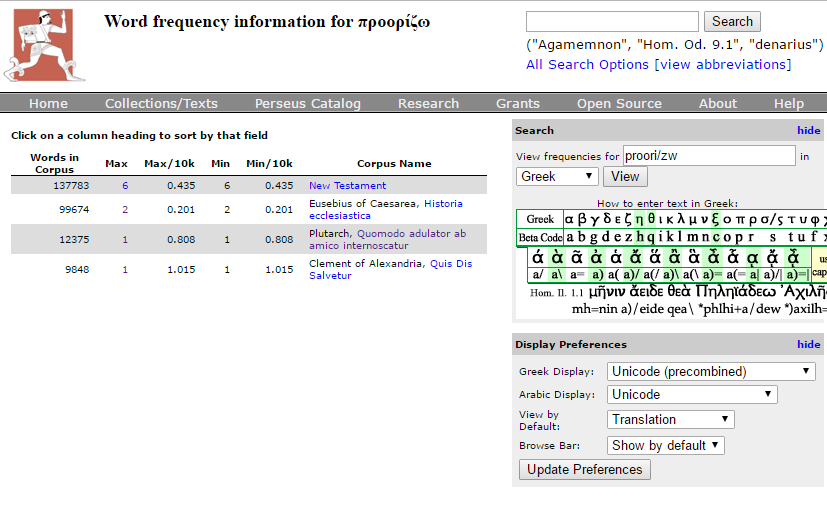
Worship Sunday – Mighty to Save

Everyone needs compassion
A love that’s never failing
Let mercy fall on me

Everyone needs forgiveness
The kindness of a Savior
The hope of every nations

Savior, He can move the mountains
My God is mighty to save
He is mighty to save

Forever author of salvation
He rose and conquered the grave
Jesus conquered the grave

So take me as You find me
With all my fears and failures
Fill my life again

I give my life to follow
Everything I believe in
And now I surrender

Savior, He can move the mountains
My God, my God is mighty to save
He is mighty to save

Forever author of salvation
He rose, He conquered the grave
Jesus conquered the grave

Shine your light and let the whole world see
We’re singing for the glory of the risen King, Jesus
Shine your light and let the whole world see
We’re singing for the glory of the risen King

Savior, He can move the mountains
My God is mighty to save
He is mighty to save

Forever author of salvation
He rose and conquered the grave
Jesus conquered the grave

Savior, He can move the mountains
My God is mighty to save
He is mighty to save

Forever author of salvation
He rose and conquered the grave
Jesus conquered the grave

Savior, He can move the mountains
My God is mighty to save
He is mighty to save

Forever author of salvation
He rose and conquered the grave
Jesus conquered the grave

Savior, He can move the mountains
My God is mighty to save
He is mighty to save

Forever author of salvation
He rose and conquered the grave
Jesus conquered the grave

Fisher on How Matthew Uses Prophecy

From failed prophecies in matthew:

Where Christians and Atheists disconnect is that the culture of ancient Judaism was not like modern American culture. In order to show events were true or from God, they were compared with parallel concepts. The concepts did not have to be exact or a prophecy (as Americans think of prophecy: foretelling future events). The point was more to show precedence: to show that God was doing something in the New Testament, the Old Testament was shown to have a similar concept. The apostle Paul is known to do this (see Romans 9:25 v Hosea 1:10 and 2:23). Matthew does this to no end, infuriating critics of Christianity.

Short on How the New Testament Uses Fulfillment

From How is scripture fulfilled?:

James quoted Genesis 15:6. It is not a prophecy and it is not something that needed to be “fulfilled.” James is not implying that Abraham fulfilled a prophecy when he believed God. What he is doing in this case is quoting the passage in order to conclude his argument and also to give it more weight.

“Fulfill” does not mean that the current point is a prophecy that is now coming true. The usual meaning is that the current point can be rephrased in classical Old Testament language. It is quoted for its rhetorical impact.

Today, instead of saying “fulfilled” we would probably say “We might verbalize the current point in classical Old Testament verbiage” or, “I am reminded of the text” or “This idea gives new meaning to the Old Testament saying.”

We often say contemporary things in phrases that have become classic. When I make an elaborate plan and it fails, I often say, “Oh, the best laid plans of mice and men.” I don’t mean the original poet had my situation in mind. I am recycling his excellent verbiage and applying it to my situation.

So, what was the writer of Matthew doing by applying Hosea 11:1 to Joseph, Mary and Jesus’ trip to Egypt? In simple terms, the Egypt trip reminds the writer of the words he read in Hosea. On a slightly more sophisticated level, he may be thinking of the Egypt trip as a kind of reenactment by Jesus of the Exodus.

Worship Sunday – Strong Tower

When I wander through the desert
And I’m longing for my home
All my dreams have gone astray
When I’m stranded in the valley
And I’m tired and all alone
It seems like I’ve lost my way

I go running to your mountain
Where you mercy sets me free

You are my strong tower
Shelter over me
Beautiful and mighty
Everlasting King
You are my strong tower
Fortress when I’m weak
Your name is true and holy
And Your face is all I see

In the middle of my darkness
In the midst of all my fear
You’re refuge and my hope
When the storm of life is raging
And the thunders all I hear
You speak softly to my soul

Now I’m running to your mountain
Where you mercy sets me free

You are my strong tower
Shelter over me
Beautiful and mighty
Everlasting King
You are my strong tower
Fortress when I’m weak
Your name is true and holy
And Your face is all I see
(And Your face is all I see)
Yeah… Your face is all I see

I go running to your mountain
Where you mercy sets me free

You are my strong tower
Shelter over me
Beautiful and mighty
Everlasting king
You are my strong tower
Fortress when I’m weak
Your name is true and holy
(Your name is true and holy)
You are my strong tower
Shelter over me
Beautiful and mighty
Everlasting king
You are my strong tower
Fortress when I’m weak
Your name is true and holy
And your face is all I see

Morrell on Telic and Ecbatic Prophecy

From BiblicalTruthResources:

First of all, it needs to be understood that there is a difference between the telic and the ecbatic when it comes to scriptures being fulfilled. When it says “that it might be fulfilled” that does not mean that this specific event was prophesied of by Isaiah, but only that such a scripture is fulfilled by this specific event through applicability or similarity. When a scripture is in the telic sense it refers to a specific prophecy, but when it is used in the ecbatic sense it refers to events that fulfill passages through parallelism.

Albert Barnes said, “Might be fulfilled – That the same effect should occur which occurred in the time of Isaiah. This does not mean that the Pharisees rejected Christ in order that the prophecy of Isaiah should be fulfilled, but that by their rejection of him the same thing had occurred which took place in the time of Isaiah.”

Apologetics Thursday – How the New Testament Uses Prophecy

In a discussion in how we need to use context to define short passages, a critic writes:

Did Christ and the writers of scripture violate your reading comprehension rules when they quoted scripture?

I respond (edited):

The writers of the New Testament engaged in a lot of near quoting of the Old Testament. This is not exact quoting but using parallel concepts. Basically every single Matthew prophecy is this. Paul quotes Hosea as applying to Gentiles when in context it applies to Jews.

Let’s examine this passage:

Rom 9:25 As He says also in Hosea: “I WILL CALL THEM MY PEOPLE, WHO WERE NOT MY PEOPLE, AND HER BELOVED, WHO WAS NOT BELOVED.”

How is this used in Romans?
How is this used in Hosea?
Who do they refer to in each passage?

Heiser on Prophecy in Matthew

From The Naked Bible:

He was instantly reminded of verses like Hosea 11:1 and the way that the messiah and the nation were identified with each other in his Bible elsewhere (the OT). Seeing the points of analogy, was led by the Spirit to note the connection in his gospel. There’s no need to view Hosea 11:1 as a prophecy that pointed to Jesus. Rather, a gospel writer saw an analogy and interpreted that analogy as something God intended to be made clear once messiah had come. We could consider it typology or a simple analogy. Either way, it made sense to Matthew and, I think, it isn’t hard for us now to see the sense of it. It’s not magic

Hoffman on Prophecy in Matthew

From God Didn’t Say That:

A proof text is a text that is used to demonstrate a point. This isn’t “proof” in the modern, scientific sense, though. The proof text doesn’t have to prove anything. And the proof text doesn’t even have to mean the same thing as what it’s demonstrating. The point of using a proof text was that it was considered better to use words of Scripture than to invent new ones — even if the words of Scripture were taken out of context.

The whole notion of text matching and of a proof text is generally foreign to our modern way of thinking. But it was central to how texts were understood 2,000 years ago.

Worship Sunday – Beautiful One

Wonderful, so wonderful
Is your unfailing love
Your cross has spoken mercy over me
No eye has seen no ear has heard
No heart could fully know
How glorious, how beautiful you are.

Beautiful one I love you
Beautiful one I adore
Beautiful one my soul must sing.

Powerful so powerful
Your glory fills the skies
Your mighty works displayed for all to see
The beauty of your majesty
Awakes my heart to see
How marvelous how wonderful you are.

Beautiful one I love you
Beautiful one I adore
Beautiful one my soul must sing.
Beautiful one I love you
Beautiful one I adore
Beautiful one my soul must sing.

You opened my eyes to your wonders anew
You captured my heart with this love
Because nothing on Earth is as beautiful as you
You opened my eyes to your wonders anew
You captured my heart with this love
Because nothing on Earth is as beautiful as you are.

Beautiful one I love you
Beautiful one I adore
Beautiful one my soul must sing.
Beautiful one I love you
Beautiful one I adore
Beautiful one my soul must sing.

And you opened my eyes to your wonders anew
You captured my heart with this love
Because nothing on earth is as beautiful as you are.

Answered Questions – How is Calvinism Gnostic

One a Facebook page, a Calvinist wonders how Calvinism is gnosticism.

calvinism like gnosticism

Main features of Gnosticism:
-A special elect with secret knowledge.
-An eternal hope in an ascension to a spiritual realm.
-God as Perfect Being theology… immutable and timeless.
-The material world is corruption and cannot be divine (see Calvinist conceptions of the Hypostatic Union).

Rhoda on Open Theist Perfect Being Theology

“Open Theism and Other Models of Divine Providence”:

As a group, open theists are committed to a robust perfect being theology according to which God is conceived of as a metaphysically necessary being who essentially exemplifies a maximally excellent set of compossible great-making properties, including maximal power, knowledge, and goodness. The differences between open and non-open theists (both classical and process) have to do with what that maximal property set consists in, not with whether God exemplifies such a set.

Worship Sunday – The Happy Song

Well I could sing unending songs
Of how you saved my soul
& I could dance a thousand miles
Because of your great love

c’mon everybody dance
Everybody dance

My heart is bursting Lord to
To tell of all you’ve done
Of how’ve you changed my life
And wiped away the past

Well, I want to shout it out
From every roof top sing
For now I know
That God is for me, not against me

I could sing unending songs
Of how you saved my soul
& I could dance a thousand miles
Because of your great love

My heart is bursting Lord to
To tell of all you’ve done
Of how’ve you changed my life
And wiped away the past

Well I want to shout it out
From every roof top sing
For now I know
That God is for me, not against me

Everybody’s singin’ now
Cuz we’re so happy
Yeah,
Everybody’s dancin’ now
Cuz we’re so happy

If only I could see your face,
See you smiling over us
And unseen angels celebrate
Hey! The joy is in this place
Yeah,
The joy is in this place

I could sing unending songs
Of how you’ve saved my soul
& I could dance a thousand miles
Because of your great love
& I could sing unending songs
Of how you’ve saved my soul
& I could dance a thousand miles
Because of your great love

Answered Questions – What about John 6:65

A private question:

Have you blogged on John 6:65?

John 6:65:

Joh 6:65 And He said, “Therefore I have said to you that no one can come to Me unless it has been granted to him by My Father.”

No. I have not blogged about this. Here is what appears to be happening in the text:

Jesus offends his disciples by talking about cannibalism (v53-56). A bunch of disciples leave. Then Jesus doubles down and makes a reference to himself ascending to heaven (v62). This offends more of them. Jesus then tells them his words are life, and there are disciples that do not believe it (referencing those who left). He flushes them out by saying no one can come to/with him unless they accept that Jesus’ words are from God. the next verse says a bunch of disciples leave (v66). Then the 12 disciples start talking about eternal life. It seems “that no man can come unto me, except it were given unto him of my Father” the “it” is Jesus’ words, the life giving words
and false disciples were following Jesus but not believing his words were from God. Jesus’ point is twofold, that those who are rejecting him are rejecting God, and that they just don’t understand Jesus’ teaching (which they would understand if they were more spiritually inclined).

Birch on Humanizing Others

Arminian William Birch advocates humanizing those with whom we might morally disagree:

My amateur opinion is that people like Omar [the Muslim mass shooter of a homosexual nightclub] maintain the cognitive distortion of objectifying people. He viewed LGBTQ people as mere objects of his disgust and hatred. They are not, in his mind, people of inestimable value and dignity as image-bearers of God. They are “things” of a vile nature that deserve to be eradicated, much like some loathed insect, or disease. This is the same sort of objectification maintained by the Nazis against the Jewish people. This is the same sort of demeaning and devaluing of the human nature of Armenians by the Ottomans in the early twentieth century. Indeed, we even see traces of this horrible state of mind when men objectify women, and women objectify men for sensual and sexual pleasure. We need a mass ontological-perceptual reformation — viewing human beings as does God, as image-bearers of the Divine.

Worship Sunday – In Christ Alone

By Christina Grimmie, who was recently murdered.

In Christ alone my hope is found;
He is my light, my strength, my song;
This cornerstone, this solid ground,
Firm through the fiercest drought and storm.
What heights of love, what depths of peace,
When fears are stilled, when strivings cease!
My comforter, my all in all—
Here in the love of Christ I stand.

In Christ alone, Who took on flesh,
Fullness of God in helpless babe!
This gift of love and righteousness,
Scorned by the ones He came to save.
Till on that cross as Jesus died,
The wrath of God was satisfied;
For ev’ry sin on Him was laid—
Here in the death of Christ I live.

There in the ground His body lay,
Light of the world by darkness slain;
Then bursting forth in glorious day,
Up from the grave He rose again!
And as He stands in victory,
Sin’s curse has lost its grip on me;
For I am His and He is mine—
Bought with the precious blood of Christ.

No guilt in life, no fear in death—
This is the pow’r of Christ in me;
From life’s first cry to final breath,
Jesus commands my destiny.
No pow’r of hell, no scheme of man,
Can ever pluck me from His hand;
Till He returns or calls me home—
Here in the pow’r of Christ I’ll stand.

Birch Explores God’s Frustration when People Reject Him

From James White, Twitter, and God Decreeing Evil:

In Isaiah, for example, God complains that He has reared children but they have disobeyed Him. (Isa. 1:2 NRSV; cf. Isa. 30:1, 2, 3, 9, 12, 13) God then reasons with them: “Wash yourselves; make yourselves clean; remove the evil of your doings from before my eyes; cease to do evil, learn to do good; seek justice, rescue the oppressed, defend the orphan, plead for the widow.” (Isa. 1:16, 17) Does God not have a purpose? Yes, God has a purpose, and God has a decree for the ages. But God also declares: “The look on their faces bears witness against them; they proclaim their sin like Sodom, they do not hide it. Woe to them! For they have brought evil on themselves.” (Isa. 3:9 NRSV, emphasis added) God pronounces blessings to the innocent (Isa. 3:10) and justice to the guilty (Isa. 3:11) — “for what their hands have done shall be done to them.” God even grieves over the willing rebelliousness of His people: “What more was there to do for my vineyard that I have not done in it? When I expected it to yield grapes, why did it yield wild grapes?” (Isa. 5:4; cf. Isa. 9:13, 14, 15, 16, 17) Isaiah betrays the Calvinist.

In Jeremiah, God is, again, angry with His rebellious people, leading us to ask: If He decreed, rendered certain and necessary, and brought about their rebellion, then why would God be angry? God is not schizophrenic: He does not commit mind-control, bringing about one’s rebellious heart, only to then judge the individual for doing what He decreed for them to do. (Jer. 2:13, 14, 15, 16, 17) We find God Himself admitting that human beings have the ability to reject His authority. The LORD said, “Indeed, long ago you threw off my authority and refused to be subject to me. You said, ‘I will not serve you.’ Instead, you gave yourself to other gods on every high hill and under every green tree.” (Jer. 2:20 NET, emphases added; cf. Jer. 2:29) But how can the Israelites reject God’s sovereign authority? How can they refuse to be subject to Him, since He has strictly foreordained all that comes to pass? God, allegedly, foreordained their rebellion, which they, allegedly, “freely” committed, and then God punished them for it. Jeremiah betrays the Calvinist.

In Ezekiel, we note the sovereignty of God, rightly defined, and the free will and responsibility of human beings created in His image (Ezek. 3:6, 7, 18, 19, 20, 21, 27; 5:6, 7, 8, 9; 6:9; 9:9, 10). As a matter of fact, the prophet informs us of God’s relationship to the thoughts of people: “Mortal, prophesy against the prophets of Israel who are prophesying; say to those who prophesy out of their own imagination; ‘Hear the word of the LORD!’ Thus says the Lord GOD, Alas for the senseless prophets who follow their own spirit, and have seen nothing!” (Ezek. 13:2-3, emphases added; cf. Ezek. 13:8, 9, 10, 17; 20:32) God does not wish for their adversity and treachery: “You have discouraged the righteous with your lies, but I didn’t want them to be sad. And you have encouraged the wicked by promising them life, even though they continue in their sins. Because of all this, you will no longer talk of seeing visions that you never saw, nor will you make predictions. For I will rescue my people from your grasp. Then you will know that I am the LORD.” (Ezek. 13:22-23 NLT, emphasis added) Ezekiel betrays the Calvinist.