Heb 4:15 For we do not have a High Priest who cannot sympathize with our weaknesses, but was in all points tempted as we are, yet without sin.
Author: christopher fisher
Calvin on True Scotsmen
John Calvin claims that those who fall away were never saved in the first place”
Those who fall away have never been thoroughly imbued with the knowledge of Christ but only had a slight and passing taste of it. – See more at: http://johncalvinquotes.com/those-who-fall-away-from-the-faith/#sthash.wSe5MU1v.dpuf
God Cannot Decide New Things
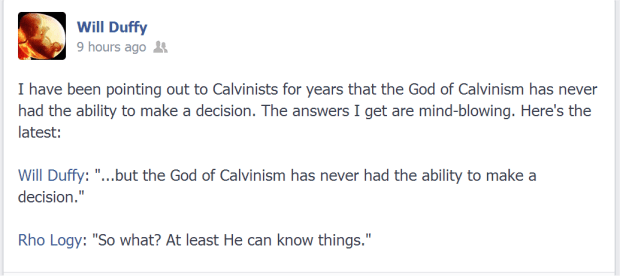
A Facebook post by Will Duffy, founder of the Collaborators Project:
I have been pointing out to Calvinists for years that the God of Calvinism has never had the ability to make a decision. The answers I get are mind-blowing. Here’s the latest:
Will Duffy: “…but the God of Calvinism has never had the ability to make a decision.”
Rho Logy: “So what? At least He can know things.”
VOTD Colossians 2:8
Col 2:8 Beware lest anyone cheat you through philosophy and empty deceit, according to the tradition of men, according to the basic principles of the world, and not according to Christ.
Hill on Augustine and Scripture
From Bob Hill of the now discontinued Biblical Answers:
Augustine also explained the reasoning which allowed him to be converted to the Catholic faith:
For first of all the things began to appear unto me as possible to be defended: and the Catholic faith, in defense of which I thought nothing could be answered to the Manichees’ arguments, I now concluded with myself, might well be maintained without absurdity: especially after I had heard one or two hard places of the Old Testament resolved now and then; which when I understood literally, I was slain. Many places therefore of those books having been spiritually expounded.
What could Augustine not accept literally? One of them was the mutability of God, that God would change his will or purpose from one time to the next in order to adjust to a changeable mankind. In Confessions, Augustine explains which literal interpretations were unacceptable. Here is one of his statements:
And because God commanded them one thing then, and these another thing now for certain temporal respects; and yet those of both ages were servants to the same righteousness, whereas they may observe in one man, and in one day, and in one house, different things to be fit for different members, and one thing to be lawful now, which in an hour hence is not so; and something to be permitted or commanded in one corner, which is forbidden or punished in another. Is Justice thereupon various or mutable.
The Manichaeans believed God could not be mutable and retain his perfection. Augustine accepted this philosophy as true and attempted to prove this doctrine with Scripture.
In another writing, On the Morals of the Catholic Church, Augustine explained the doctrines of the Old Testament that were so absurd. In explaining his dispute with the Manichaeans we observe his agreement with them against the literal interpretation of the Old Testament.
We do not worship a God who repents, or is envious, or needy, or cruel, or who takes pleasure in the blood men or beasts, or is pleased with guilt or crime, or whose possession of the earth is limited to a little corner of it. These and such like are the silly notions . . . the fancies of old women or of children . . . and in those by whom these passages are literally understood. . . . And should any one suppose that anything in God’s substance or nature can suffer change or conversion, he will be held guilty of wild profanity.
Augustine agreed with the Manichaeans that a mutable God was totally unacceptable. In this conflict between the Platonic doctrine of immutability and the literal interpretation of Scriptures what had to change? Augustine’s answer was that the literal interpretation of Scripture had to change. For Augustine the plain narratives of Scripture had to be reinterpreted by spiritual or allegorical methods. The Manichaeans believed the Old Testament revealed a God who was mutable or could repent. Since the Platonists believed that God was immutable this idea of God repenting was a source of ridicule for the Catholic Church. Augustine was so embarrassed by these arguments that he chose to reinterpret Scripture rather than refute the Platonic philosophy.
Sanders Asks How Calvin Knows What God is Like
John Sanders from The God Who Risks:
…the notion that God grieves has long troubled many scholars. Many held that it is not appropriate to attribute such changes to God. Instead, such language should be understood as divine “accommodation” to our level of understanding. That is, God is not actually like these biblical depictions. John Calvin, for instance, in reference to the biblical text about God experiencing changing emotions or changes of mind said that such texts do not inform us what God is really like. Rather, he claimed that in these texts God “lisps” to us as does a nursemaid to a young child. Though God may be lisping to us in the biblical depictions, the question is how we know this. After all, we know that the nursemaid is speaking “baby talk” because we know what “adult talk” is like. But if Scripture is “baby talk,” then from where do we get our “adult talk” about God? Do we obtain it from natural theology? If the Bible contains both baby talk and true talk about God then we need a criterion by which to distinguish between them. Unfortunately, Calvin does not disclose how he decides which biblical texts go into which category.
prophecy is about power
From Christopher Fisher:
Because prophecy is primarily about power, God does not mind when prophecy fails. God is not concerned about what people think of His “prediction” ability. Every time God speaks about true predictions, it is in this context. Every prophecy just assumes the future is not set, and God is actively working to bring about the prophecy. In this sense, each prophecy can be viewed as a blow against traditional omniscience. If God did know the future, His claim would take the form of “I know it will come to past because I see the future”, not “I know it will come to past because I will do it.” But the Bible is devoid of the former and filled with the latter.
For full post, click here.
VOTD Romans 8:32
Rom 8:32 He who did not spare His own Son, but delivered Him up for us all, how shall He not with Him also freely give us all things?
Hill on Being Predestined to Adoption
From the discontinued Bob Hill site Biblical Answers:
Next, let’s look at the most important passage on adoption concerning the body of Christ, Eph 1:4-6. Just as He chose us in Him before the foundation of the world, that we should be holy and without blame before Him in love, 5 having predestined us to adoption as sons by Jesus Christ to Himself, according to the good pleasure of His will, 6 to the praise of the glory of His grace, by which He has made us accepted in the Beloved.
Corporate Israel was God’s son by adoption according to Romans 9:4. We also see that the nation will not be cast away. But the nation will be purged in the tribulation according to
Zec 13:8,9 And it shall come to pass in all the land, says the Lord, that two-thirds in it shall be cut off and die, but one- third shall be left in it: 9 I will bring the one-third through the fire, will refine them as silver is refined, and test them as gold is tested. They will call on My name, and I will answer them. I will say, “This is My people”; And each one will say, “The Lord is my God.”
This will be in fulfillment of Hos 1:6-11.
And she conceived again and bore a daughter. Then God said to him: Call her name Lo-Ruhamah, For I will no longer have mercy on the house of Israel, But I will utterly take them away. 7 Yet I will have mercy on the house of Judah, will save them by the Lord their God, and will not save them by bow, nor by sword or battle, by horses or horsemen. 8 Now when she had weaned Lo-Ruhamah, she conceived and bore a son. 9 Then God said: Call his name Lo-Ammi, for you are not My people, and I will not be your God. 10 Yet the number of the children of Israel Shall be as the sand of the sea, which cannot be measured or numbered. And it shall come to pass in the place where it was said to them, You are not My people, There it shall be said to them, You are sons of the living God. 11 Then the children of Judah and the children of Israel Shall be gathered together, and appoint for themselves one head; and they shall come up out of the land, for great will be the day of Jezreel!
But only believing Israel will be saved.
Rom 11:2,24,25 God has not cast away His people whom He foreknew. Or do you not know what the Scripture says of Elijah, how he pleads with God against Israel, saying, 25 For I do not desire, brethren, that you should be ignorant of this mystery, lest you should be wise in your own opinion, that blindness in part has happened to Israel until the fullness of the Gentiles has come in. 26 And so all Israel will be saved, as it is written: The Deliverer will come out of Zion, And He will turn away ungodliness from Jacob.
Every member of the body of Christ has the adoption based on God’s predestination, because we have all put our trust in Christ. We can’t lose our adoption. The body of Christ was predestinated to receive this adoption. We became members of this body and its blessings when we believed.
VOTD Philippians 2:7
Php 2:7 but made Himself of no reputation, taking the form of a bondservant, and coming in the likeness of men.
Free Monday – What is Reformed Theology
It appears that Ligonier Ministries is sending out free books on Reformed Theology. This is a physical book and they do require some personal information.
Filling out a form will prompt them to send: “What is Reformed Theology?” by Dr. R.C. Sproul
For the website, click here.
Closed View Tries to Explain God’s Repentance
From Another King James Believer:
The answer is given later in 1 Samuel 15. After God says in verse 11, “I repent that I have made Saul king,” Samuel says in verse 29, as if to clarify, “The Strength of Israel will not lie nor repent: for he is not a man, that he should repent” (KJV). The point of this verse seems to be that, even though there is a sense in which God does repent (verse 11), there is another sense in which he does not repent (verse 29). The difference would naturally be that God’s repentance happens in spite of perfect foreknowledge, while most human repentance happens because we lack foreknowledge. God’s way of “repenting” is unique to God: “God is not a man that he should repent” (the way a man repents in his ignorance of the future).
For context, click here.
Calvinist Contradictions
Although not an Open Theist, “Bill” lists 115 Calvinist Contradictions. From Save the Perishing blog:
Calvinist contradiction #15
Calvinist: “The bible says to rightly divide the word of truth so any contradictions should be studied until they are no longer contradictions.”
“What about the contradiction between God’s sovereignty and man’s responsibility?”
Calvinist: “Thats ok if we don’t understand that…thats a mystery.”
Why are contradictions in other ministries EXPOSED AS ERROR by Calvinists but not the ones in their own doctrine which are ACCEPTED as “mysteries?”
For full post, click here.
God is Almighty
From Christopher Fisher:
In contrast to “omnipotent”, God is called “Almighty” 57 times in the Bible. Often, it is a nominal adjective that is used in place of God’s own name. The Bible seriously identifies “Almighty” with God; this is what God wants to be called. God illustrates His Almighty-ness with examples of Him being Almighty.
Gen 15:7 Then He said to him, “I am the LORD, who brought you out of Ur of the Chaldeans, to give you this land to inherit it.”
Gen 26:24 And the LORD appeared to him the same night and said, “I am the God of your father Abraham; do not fear, for I am with you. I will bless you and multiply your descendants for My servant Abraham’s sake.”
Exo 6:7 I will take you as My people, and I will be your God. Then you shall know that I am the LORD your God who brings you out from under the burdens of the Egyptians.
God connects Himself with His creative action. God is Almighty because He does powerful things. God is the “living” God, often contrasted to stone idols that have no power. God is active and working in creation. This is the context of God calling Himself “Almighty”, not philosophical proofs invented by human beings. So I do not use the word “omnipotent”. In fact, I will mock those obsessed with the word when possible.
So while man might be omnipotent, God is Almighty.
For full post, click here.
VOTD John 14:9
Joh 14:9 Jesus said to him, “Have I been with you so long, and yet you have not known Me, Philip? He who has seen Me has seen the Father; so how can you say, ‘Show us the Father’?
Worship Sunday – Come Thou Fount
Come Thou Fount by Robert Robinson.
Lyrics:
Come thou fount of every blessing
Tune my heart to sing Thy grace
Streams of mercy never ceasing
Call for songs of loudest praise
Teach me some melodious sonnet
Sung by flaming tongues above
I’ll praise the Mount I’m fixed upon it
Mount of Thy redeeming love
Here I raise my Ebenezer
Hither by Thy help I come
Oh, and I hope by Thy good pleasure
Safely to arrive at home
Oh Jesus, sought me when a stranger
Wandering from the fold of God
He, to rescue me from danger
Interposed His precious blood
Ode to grace, how great a debtor
Daily I’m constrained to be
And let Thy goodness like a fetter
Bind my wandering heart to Thee
Prone to wander, Lord, I feel it
Prone to leave the God I love
Here’s my heart, Lord, take and seal it
Seal it for Thy courts above
Here’s my heart, Lord, take and seal it
Seal it for Thy courts above
Infinite is Imprecise
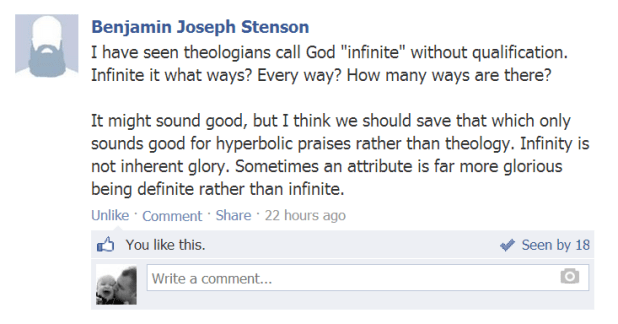
On Facebook group God is Open , Benjamin Joseph Stenson remarks on the strange adherence to the ill-defined attribute of “infinite”:
I have seen theologians call God “infinite” without qualification. Infinite it what ways? Every way? How many ways are there?
It might sound good, but I think we should save that which only sounds good for hyperbolic praises rather than theology. Infinity is not inherent glory. Sometimes an attribute is far more glorious being definite rather than infinite.
VOTD Exodus 34:6
Exo 34:6 And the LORD passed before him and proclaimed, “The LORD, the LORD God, merciful and gracious, longsuffering, and abounding in goodness and truth,
Exo 34:7 keeping mercy for thousands, forgiving iniquity and transgression and sin, by no means clearing the guilty, visiting the iniquity of the fathers upon the children and the children’s children to the third and the fourth generation.”
What About Revelation?
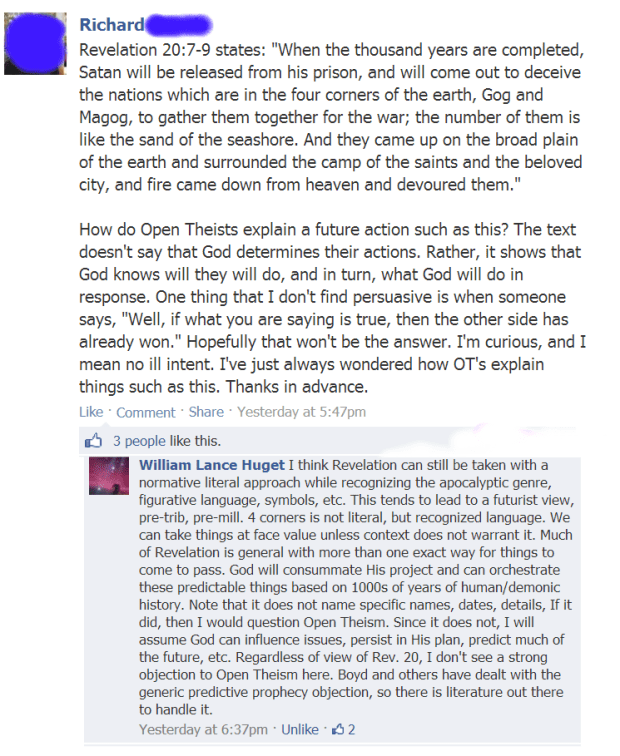
On Facebook group Arminians and Open Theists in Open Dialogue, Richard asks:
Revelation 20:7-9 states: “When the thousand years are completed, Satan will be released from his prison, and will come out to deceive the nations which are in the four corners of the earth, Gog and Magog, to gather them together for the war; the number of them is like the sand of the seashore. And they came up on the broad plain of the earth and surrounded the camp of the saints and the beloved city, and fire came down from heaven and devoured them.”
How do Open Theists explain a future action such as this? The text doesn’t say that God determines their actions. Rather, it shows that God knows will they will do, and in turn, what God will do in response. One thing that I don’t find persuasive is when someone says, “Well, if what you are saying is true, then the other side has already won.” Hopefully that won’t be the answer. I’m curious, and I mean no ill intent. I’ve just always wondered how OT’s explain things such as this. Thanks in advance.
William Lance Huget responds:
I think Revelation can still be taken with a normative literal approach while recognizing the apocalyptic genre, figurative language, symbols, etc. This tends to lead to a futurist view, pre-trib, pre-mill. 4 corners is not literal, but recognized language. We can take things at face value unless context does not warrant it. Much of Revelation is general with more than one exact way for things to come to pass. God will consummate His project and can orchestrate these predictable things based on 1000s of years of human/demonic history. Note that it does not name specific names, dates, details, If it did, then I would question Open Theism. Since it does not, I will assume God can influence issues, persist in His plan, predict much of the future, etc. Regardless of view of Rev. 20, I don’t see a strong objection to Open Theism here. Boyd and others have dealt with the generic predictive prophecy objection, so there is literature out there to handle it.
Sanders on Divine Nature
John Sanders from The God Who Risks:
If the incarnation is true and the divine Son experienced full human life, then God is not particularly concerned about having human characteristics attributed to him. The divine self-disclosure in Jesus puts an end to the claim that being in the form of a human is contrary to the divine nature.
Free eBook – Calvinism And Evangelical Arminianism
Free eBook at Monergism.com. Calvinism And Evangelical Arminianism: Compared As To Election, Rebrobation, Justification And Related Doctrines By John L. Girardeau
For download page, click here.
VOTD Exodus 4:14
Exo 4:14 So the anger of the LORD was kindled against Moses, and He said: “Is not Aaron the Levite your brother? I know that he can speak well. And look, he is also coming out to meet you. When he sees you, he will be glad in his heart.
Calvinist True Believers
On Grit in the Oyster, the author talks about Calvinist intolerance for theology:
The second reason I don’t indentify as Reformed is because of the tradition’s resulting unwillingness to do theology. This unwillingness is deeply ingrained. And it is deadly. Since Reformation theology is equated with ‘the-gospel-faith-once-delivered’, it becomes the holy deposit to be cherished and guarded: NOT questioned or added to. In fact questioning the tradition is the very opposite of faithfulness: it smacks of unbelief. Since the doctrine is from God, our task is to maintain it, and make sure we don’t turn away from the truth.
Theology as a discipline, then, poses a threat. For orthodoxy has been established: any further theologising simply risks distorting and debasing it. The only theology tolerated is what we might call micro-theology: theology in the gaps where the movement has not yet turned its attention, further clarification of doctrines long-accepted, work on small details. And this sort of micro-theology has long been a specialty of the Reformed movement: arguments over small matters. Rival theories about the precise relationship between law and gospel, for example. We have long been champions at dividing over such minutiae. If the hair won’t split, we will happily split for it! But on all issues of any gospel-importance, the Church’s doctrine has been well-established for centuries: those discussions are closed and no further work is wanted. Any new suggestions or divergent formulations are a priori heterodox.
For context, click here.
God’s Will is Not Immutable
From Craig Fisher:
Heb 6:18 that by two immutable things, in which it is impossible for God to lie, we might have strong consolation, who have fled for refuge to lay hold of the hope set before us.
Of course, God is speaking about only two immutable things and God is not one of them. The first immutable thing is the promise which he willed the beloved of Hebrews 6 would inherit. The second immutable thing was his oath.
Heb 6:17 Thus God, determining to show more abundantly to the heirs of promise the immutability of His counsel, (το αμεταθετον της βουλης αυτου) confirmed it by an oath,
This is not talking about the essence or knowledge or attributes of God. God is saying he is not lying about his promise to the beloved. Some classical theologians would argue he is referring to all of God’s counsel as being immutable. Luke 7:30 says:
30 But the Pharisees and lawyers rejected the will of God for themselves, not having been baptized by him.
The will of God for the Pharisees and the lawyers included their baptism but they would not be baptized and rejected the will (βουλη) of God. If the Pharisees can reject the will of God then God’s counsel is not immutable. It is within the free will of man.
For full post, click here.
Apologetics Thursday – Geisler’s False Dichotomy on Repentance
Norman Geisler writes in his Creating God in the Image of Man:
And 1 Samuel 15:29 affirms emphatically, “He who is the Glory of Israel does not lie or change his mind: for he is not a man, that he should change his mind.” What is more, this is affirmed in the very context that states that God does change his mind, something that the author of 1 Samuel thought to be consistent (15:11). But this could only be the case if one of these two is taken literally and the other not. But which is which? Once again the answer comes only by seeing which is best explained in the light of the other.
Notice Geisler’s False Dichotomy: There are two verses that contradict each other; one must trump the other. Geisler is appealing to his reader not to see the common sense third answer: that both texts are literal and should be viewed in the way that the original author intended.
When 1 Samuel was being written, the author did not think that in verse 11 he would describe God repenting only to affirm 18 verses later that God is immutable. In fact, if the Samuel’s entire point is quoted, the point is that God had just taken Israel from Saul:
1Sa 15:28 And Samuel said unto him, The LORD hath rent the kingdom of Israel from thee this day, and hath given it to a neighbour of thine, that is better than thou.
1Sa 15:29 And also the Strength of Israel will not lie nor repent: for he is not a man, that he should repent.
To Geisler, this is how he views this conversation:
So Samuel said to him, “The LORD has taken your kingdom, and by the way, have I ever explained to you about God’s incommunicable attributes such as immutability and impeccability?”
Because Calvinism is dependent on “proof texts” ripped from context, they tend force odd readings onto texts. It would be unnatural for Samuel to add a random sentence into his conversation explaining immutability. What was his point? What was he trying to accomplish? What is Samuel communicating to Saul? Context is key for understanding what sentences mean.
Here is the context of the entire chapter:
King Saul has just violated God’s command not to take spoils of war:
1Sa 15:9 But Saul and the people spared Agag, and the best of the sheep, and of the oxen, and of the fatlings, and the lambs, and all that was good, and would not utterly destroy them: but every thing that was vile and refuse, that they destroyed utterly.
1Sa 15:10 Then came the word of the LORD unto Samuel, saying,
1Sa 15:11 It repenteth me that I have set up Saul to be king: for he is turned back from following me, and hath not performed my commandments. And it grieved Samuel; and he cried unto the LORD all night.
This leads God directly to “repenting” of having made Saul the king of Israel. Samuel hears God’s message, and the next morning confronts Saul on his spoils of war. Samuel explains to Saul that “Because thou hast rejected the word of the LORD, he hath also rejected thee from being king.” Saul immediately repents, and asks for mercy (for his kingdom to not be taken away):
1Sa 15:24 And Saul said unto Samuel, I have sinned: for I have transgressed the commandment of the LORD, and thy words: because I feared the people, and obeyed their voice.
1Sa 15:25 Now therefore, I pray thee, pardon my sin, and turn again with me, that I may worship the LORD.
Notice Saul’s deep repentance. Saul seeks pardon and wants to go worship God. But this is denied. Samuel says:
1Sa 15:28 And Samuel said unto him, The LORD hath rent the kingdom of Israel from thee this day, and hath given it to a neighbour of thine, that is better than thou.
1Sa 15:29 And also the Strength of Israel will not lie nor repent: for he is not a man, that he should repent.
The context of God not repenting is “repenting that He made Saul king.” When God says He will not repent, God is saying “I will not repent of repenting that I made Saul king (taking his kingdom away).” God is not making a general claim of immutability. God is making the claim that Saul cannot expect to convince God to give him back the kingdom. God has made up his mind.
To set up a parallel to really drive home the point: Pretend I allow my boys to play with GI Joes. Pretend I have given them instructions on how to play gently such that they do not destroy those action figures. If my boys then play with those GI Joes, destroy a couple, then I might then take away those toys. If my boys apologize and promise to be more careful in the future, I would be well within my rights to say: “I am taking the GI Joes. I will not change my mind. I am not your mom that I would change my mind.”
For someone to come along and claim that I am immutable would be a disservice to the context. My statement was limited to the events in question, and extrapolating and mystifying would be a gross injustice. My words, taken literally, are that my mind is made up on this one issue.
Interestingly enough, Geisler fails to mention the text then recounts God’s repentance again:
1Sa 15:35 And Samuel came no more to see Saul until the day of his death: nevertheless Samuel mourned for Saul: and the LORD repented that he had made Saul king over Israel.
When Geisler talks about having to interpret one verse in light of the other, this reveals his flawed method of interpretation. The best means of interpretation is to ascertain exactly what the author of any specific text was trying to communicate to his readers. Implications of verses should only be secondary. Geisler would rather read his theology into the text than gain his theology from the text. He tries to distract by assuming the way he sees a particular verse is a literal understanding, when it is the farthest thing from it.
Perry Points out that Forced Love is Not Love
Best selling author and RightNerve blogger Greg Perry tells us about love and free will:
Those who don’t want to be with God are never going to be forced to be with Him. Forced love is not love; it’s something else.
You see, if God forced put everybody who didn’t want to be with Him in Heaven, Heaven would then be like a prison with people hating where they were.
Consider the downside to free-will (I suggest there is no downside but stay with me here): If, in the 6,000 years of human history, if man’s free-will resulted in only one person choosing to love God and only that one person ended up in Heaven, the perfection of love freely given would be no less than if the majority chose to be with Him.
Love freely given is love. If a man forces his love onto a woman, we’d consider him sick. God isn’t sick.
For full post, click here.
VOTD Revelation 22:19
Rev 22:19 and if anyone takes away from the words of the book of this prophecy, God shall take away his part from the Book of Life, from the holy city, and from the things which are written in this book.
Incarnation Shows God is Open
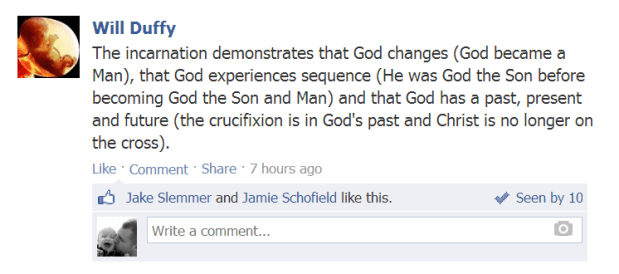
A Facebook post by Will Duffy, founder of the Collaborators Project:
The incarnation demonstrates that God changes (God became a Man), that God experiences sequence (He was God the Son before becoming God the Son and Man) and that God has a past, present and future (the crucifixion is in God’s past and Christ is no longer on the cross).
Brueggemann on the Nature Reading of the Old Testament
From Walter Brueggemann’s Theology of the Old Testament:
…the characteristic claim of Israel’s testimony is that Yahweh is an active agent who is the subject of an active verb, and so the testimony is that Yahweh, the God of Israel, has acted in decisive and transformative ways… There is, to be sure, a large and vexed literature about “the acts of God,” literature that tends to proceed either by recognizing that such utterances make no sense historically., or by reifying the phrase into a philosophical concept…
Israel’s testimony, however, is not to be understood as a claim subject to historical explication or to philosophical understanding. It is rather an utterance that proposes that this particular past be construed according to this utterance. For our large purposes we should note, moreover, that such testimonial utterance in Israel is characteristically quite concrete, and only on the basis of many such concrete evidence does Israel dare to generalize.
VOTD Genesis 1:1
Gen 1:1 In the beginning God created the heavens and the earth.
Jason Staples Defends Divine Bear Maulings
Jason Staples comments on 2 Kings 2:23-24:
2 Kings 2:23–24 tells of the prophet Elisha calling a curse down upon a group of “children” (KJV), “youths” (NIV), “boys,” (NRSV/ESV), or “lads” (NASB), resulting in two bears (she-bears, if you must) mauling forty two of them…
Secondly, the emphasis in the passage isn’t Elisha’s baldness or that the juveniles bring it up—it’s that the youth of Bethel reject and scorn YHWH’s prophet (signaling a rejection of God himself). The problem is that, rather than receiving the prophet, they tell him to “go up”—the exact word (עלה) used to describe Elijah’s departure to heaven twelve verses earlier. That is, they tell him to stay away, that they wanted nothing to do with him or his God, that he should go join Elijah in heaven if he was really such a powerful prophet. That they call him “baldy,” though certainly disrespectful, was not the cause of the cursing.
For full post, click here.
God is Sovereignty Because His Action
On Grit in the Oyster, the author talks about God’s sovereignty:
The first mention of God’s sovereignty in Scripture is at the Exodus:
…your right hand, O LORD, shattered the enemy…
You brought your people in and planted them on the mountain of your own possession,
the place, O LORD, that you made your abode,
the sanctuary, O LORD, that your hands have established.
18 The LORD will rule as King forever and ever.” Exodus 15What does God’s sovereignty mean here? It means he came down and smashed Pharaoh, and created a people and gave them a land where he would rule over them. It’s not abstract, it’s very concrete. It’s about God’s presence and visible action.
For context, click here.
Randy’s Testimony
From Randy Hardman of The Bara Initiative:
I guess I started down this trek years ago when confronted with the notion of impassibility. Wrestling with an exegesis report on Hosea 11, I struggled to understand how the doctrine of impassibility could be true. I had heard people make this claim most of my life: “God cannot change” since tied to “change” was emotion. God does not “feel” love, he does not “feel” regret, he does not “feel” pain. Encountering Hosea 11 and then reading out into other passages, I began to realize how at odds this position really was with Scripture. After God describes his relationship with Israel as a father teaching a child how to walk and then calling judgment upon them for their sin and rejection of God, we find God changing his mind. It’s here that we see the heart of God groaning and wrenching for His people:
“How can I give you up, Ephraim?
How can I hand you over, Israel?
How can I treat you like Admah?
How can I make you like Zeboyim?
My heart is changed within me;
all my compassion is aroused.
I will not carry out my fierce anger,
nor will I devastate Ephraim again.
For full post, click here.
Malachi 3 Makes No Sense to Calvinism
From Craig Fisher:
Mal 3:6 “For I am the LORD, I do not change; Therefore you are not consumed, O sons of Jacob.
God is making a point: “I do not change, therefore you are not consumed.” Suppose God is saying: “I do not gain any new knowledge, therefore you are not consumed.” Does this even make sense? How about “My essence does not change, therefore you are not consumed”? Again, this is nonsensical. We would be better to look towards the context of the text to understand its meaning.
Mal 3:1 “Behold, I send My messenger, And he will prepare the way before Me. And the Lord, whom you seek, Will suddenly come to His temple, Even the Messenger of the covenant, In whom you delight. Behold, He is coming,” Says the LORD of hosts.
Mal 3:2 “But who can endure the day of His coming? And who can stand when He appears? For He is like a refiner’s fire And like launderers’ soap.
Mal 3:3 He will sit as a refiner and a purifier of silver; He will purify the sons of Levi, And purge them as gold and silver, That they may offer to the LORD An offering in righteousness.
Mal 3:4 “Then the offering of Judah and Jerusalem Will be pleasant to the LORD, As in the days of old, As in former years.
Mal 3:5 And I will come near you for judgment; I will be a swift witness Against sorcerers, Against adulterers, Against perjurers, Against those who exploit wage earners and widows and orphans, And against those who turn away an alien— Because they do not fear Me,” Says the LORD of hosts.
Mal 3:6 “For I am the LORD, I do not change; Therefore you are not consumed, O sons of Jacob.
Mal 3:7 Yet from the days of your fathers You have gone away from My ordinances And have not kept them. Return to Me, and I will return to you,” Says the LORD of hosts. “But you said, ‘In what way shall we return?’
Through the context, one sees that the messenger of the Lord is coming. His mission is to purify the priests, the sons of Levi, in order that the offerings made by Israel may be acceptable to the Lord. Also, the Lord is calling for a return to righteousness. He will exclude sorcerers, adulterers, perjurers, greedy business owners, and uncharitable people. He punctuates these sins by saying “I do not change” meaning God still considers sin to be sin. He encourages Israel to drop their sins and return on to the Lord. Those people who believe they are the chosen ones of God but can continue in their sins are deluded. God still punishes sinners, he does not change.
God is not changing his morality. There is no reference to the nature of God or to his knowledge. The threat of being consumed, the result clause of the syllogism “I do not change, therefore you are not consumed” would make no sense if God was referring to his nature or his knowledge. In fact if God is referring to his knowledge, he knows all future events. What is the purpose of his warning? The future would be fixed and God would know if Israel sinned or not. He would not have to warn them and offer a reward if they obeyed. The contingency of the warning is claim that God will change his mind about destroying Israel if they change their ways.
For original post, click here.
VOTD Deuteronomy 32:36
Deu 32:36 “For the LORD will judge His people And have compassion on His servants, When He sees that their power is gone, And there is no one remaining, bond or free.
Ware asks Is Open Theism Evangelical?
Critical of people who believe God is Open, Bruce Ware argues that Open Theism is not Evangelical:
My conclusion is this. The cost to doctrine and faith by open theism’s denial of exhaustive divine foreknowledge is too great to be accepted within evangelicalism. It would be easier to say, let the discussion continue (which it will regardless, to be sure) and allow difference of opinion here as we do in other matters. After all, drawing the lines will no doubt be perceived by some as narrow, perhaps “fundamentalistic,” and unloving, though these perceptions will be unfounded. Yet, to fail to challenge a proposal as massive in its harmful implications for theology and for the church as found in the openness proposal would be utterly irresponsible, and by its neglect, our failure would constitute complicity in the harmful effects these doctrinal innovations have for our evangelical theology and for the life of the church. So, with deep and abiding longings to honor God and his Word, to see the church strengthened, and to retain whatever integrity evangelicalism has through its core commitments, I would urge this conclusion: open theism, by its denial of exhaustive divine foreknowledge, has shown itself to be unacceptable as a viable, legitimate model within evangelicalism.
For full paper, click here.
Sanders On Talking Nonsense
From John Sander’s The God Who Risks:
To be consistent, the ideas within a model must “make sense,” since if they do not then they are literally “nonsense” and unintelligible. In order for a model to be intelligible, it must be logically consistent. Statements that are self-contradictory are meaningless. Symbolically, a contradiction is written A and not-A. That is, something that belongs in category A is also not in category not-A. If we say “my red car is not red” or “the apple on my desk is not an apple” we are not making meaningful utterances. Statements such as “God is the creator and is not the creator” and “God is timeless and also experiences time” are self-contradictory. They simply make no sense.
VOTD Exodus 13:17
Exo 13:17 Then it came to pass, when Pharaoh had let the people go, that God did not lead them by way of the land of the Philistines, although that was near; for God said, “Lest perhaps the people change their minds when they see war, and return to Egypt.”
Not All Open Theists Embrace Omniscience
Nailing it to the Door has an excellent post explaining that not all Open Theists belive that God “knows all possible futures”. Dan Martin explains:
Belt and Boyd both use the analogy of the Infinitely Intelligent Chess Player to describe how an omniscient God must know not just a single, settled compendium of future events, but rather all the various possibility-trees that might branch from the infinite combinations of choices we might make. That’s what Ben was saying about his future lunch. Bratcher steps back and explains why this discussion came to be, and in the process I think he shines a light on the error in the argument:
The kinds of questions asked in the early church, especially following Augustine in the 4th and 5th centuries, were metaphysical ontological questions about ultimate reality. And those questions were rooted in the Platonic and Neoplatonic philosophies that saw God and human existence in absolute or idealistic terms. God was defined by asking logical questions, and reaching logical answers. Basically, a view of God was developed whereby God was defined in terms of what a god ought to be to be God. While the results may not be totally invalid, they are obviously limited, and a departure from Scripture and God’s own revelation about himself in human history.
This explanation by Bratcher is key. The very notion of God’s “having” to be omniscient is itself not a doctrine of the Bible, but rather part of Plato’s ideal of what a supreme God must be like–an ideal which Augustine adopted and “Christianized.” Bratcher goes on to state that all of our beloved “omni-” doctrines (omniscience, omnipresence, omnipotence, etc.) actually arise from the logical conceptions of what God “ought” to be. As he sums up his own point, I simply do not think these formulations are at all adequate, simply because they are our definition of what we want in a God or what a god by our definition should be, which does not necessarily define God very adequately. They are far too limiting, at the very point that they claim to be all encompassing! In other words, God does not have to be what we say he is, no matter how “big” or “omni-” we try to make what we say…
It is only once we conclude that our doctrine of omniscience requires God to know everything about the future, that the question of just what God foreknows becomes a “problem.” The Infinitely Intelligent Chess Player, it seems to me, is the Open Theists solution to the problem our own logic created…a problem they should have called out at the same time they called out deterministic doctrines of the future.
To read the full post, click here.
Free Book – An All-Consuming Passion for Jesus
John Pipper, notable Calvinist pastor, has a free ebook available. It is not really concerning God’s nature, but it is free: Click here.
Free Bible Software
The best free software for Bible study is e-Sword. It is easy to use, supports many free Bibles (such as the KJV, the Majority Greek, the Critical Greek, the Septuagint, etc) and pay Bibles (such as the NKJV), hosts a good variety of commentaries, and includes various dictionaries. One of the best downloads is the Greek New Testament Textus Receptus with conjugations and declensions listed of all words:
Joh 21:2 ησανG1510 V-IAI-3P ομουG3674 ADV σιμωνG4613 N-NSM πετροςG4074 N-NSM καιG2532 CONJ θωμαςG2381 N-NSM οG3588 T-NSM λεγομενοςG3004 V-PPP-NSM διδυμοςG1324 N-NSM καιG2532 CONJ ναθαναηλG3482 N-PRI οG3588 T-NSM αποG575 PREP καναG2580 N-PRI τηςG3588 T-GSF γαλιλαιαςG1056 N-GSF καιG2532 CONJ οιG3588 T-NPM τουG3588 T-GSM ζεβεδαιουG2199 N-GSM καιG2532 CONJ αλλοιG243 A-NPM εκG1537 PREP τωνG3588 T-GPM μαθητωνG3101 N-GPM αυτουG846 P-GSM δυοG1417 A-NUI
In the modern world, people no longer have to be able to know Greek to read it!
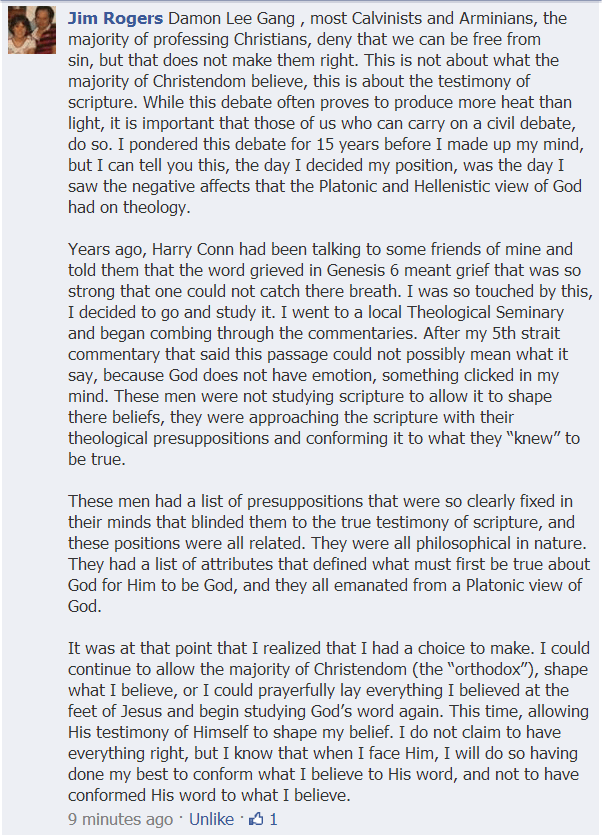
Jim Shares His Testimony
On Facebook Group Open Theism, Moral Government Theology, Pentecostal, Jim gives us his testimony:
I pondered this debate for 15 years before I made up my mind, but I can tell you this, the day I decided my position, was the day I saw the negative affects that the Platonic and Hellenistic view of God had on theology.
Years ago, Harry Conn had been talking to some friends of mine and told them that the word grieved in Genesis 6 meant grief that was so strong that one could not catch there breath. I was so touched by this, I decided to go and study it. I went to a local Theological Seminary and began combing through the commentaries. After my 5th strait commentary that said this passage could not possibly mean what it say, because God does not have emotion, something clicked in my mind. These men were not studying scripture to allow it to shape there beliefs, they were approaching the scripture with their theological presuppositions and conforming it to what they “knew” to be true.
These men had a list of presuppositions that were so clearly fixed in their minds that blinded them to the true testimony of scripture, and these positions were all related. They were all philosophical in nature. They had a list of attributes that defined what must first be true about God for Him to be God, and they all emanated from a Platonic view of God.
It was at that point that I realized that I had a choice to make. I could continue to allow the majority of Christendom (the “orthodox”), shape what I believe, or I could prayerfully lay everything I believed at the feet of Jesus and begin studying God’s word again. This time, allowing His testimony of Himself to shape my belief. I do not claim to have everything right, but I know that when I face Him, I will do so having done my best to conform what I believe to His word, and not to have conformed His word to what I believe.
Morrell Proves God is Open
Jesse Morrell gives a short scriptural defense of Open Theism followed by a well written defense. Here is the first part:
* God speaks of the future in terms of what may or may not be: Ex. 3:18, 4:9, 13:17; Eze.12:3; Jer. 36:3; 36:7
* God changes His plans in response to changing circumstances: Ex. 32:10-14, Jer. 18:1-10; Jonah 3:10
* God’s willingness to change His plans is considered one of His glorious attributes: Jonah 4:2; Joel 2:12-13
* God tests people to see what types of decisions they will make: Gen. 22:12; Ex. 16:4; Deut. 8:2, 13:1-3; 2 Chron. 32:31
* God has had disappointments and has regretted how things turned out: Gen. 6:5-6; 1 Sam. 15:10, 15:35
* God has expected things to happen that didn’t come to pass: Isa. 5:1-5; Jer. 3:6-7, 3:19-20
* God gets frustrated and grieved when he attempts to bring individuals into alignment with his will and they resist: Eze. 22:29-31; Isa. 63:10; Eph. 4:30; cf. Heb. 3:8, 3:15, 4:7; Acts 7:51
* The prayers of men have changed the plans of God (God changes the future: Ex. 32:10- 14; Num. 11:1-2, 14:12-20, 16:16:20-35; Deut. 9:13-14, 9:18-20, 9:25; 2 Sam. 24:17-25; 1 Kin. 21:27-29; 2 Kin. 20:6; 2 Chron. 12:5-8; Jer. 26:19; Isa. 38:5
* God is said to have repented (changed His mind) multiple times in the Bible: Gen. 6:6-7; Ex. 32:12-14; Num. 23:19; Deut. 32:36; Judges 2:18; 1 Sam. 15:11, 15:29, 15:35; 2Sam. 24:16; Ps. 90:13, 106:45, 110:4, 135:14; Jer. 4:28, 15:6, 18:8, 18:10, 20:16, 26:3, 26:13, 26:19, 42:10, Eze. 24:14, Hos. 11:8, 13:14; Joel 1:13-14; Amos 7:3, 7:6; Jonah 3:9-10, 4:2; Zach. 8:14
* Prophecies are often God foretelling what He Himself will later bring to pass. So they often have to do more with God’s omnipotence to bring about His plans then merely foreseeing the future: Gen. 3:15; 1 Kin. 8:15, 8:20, 8:24, 13:32 (with 2 Kin. 23:1-3, 15-18); 2 Kings 19:25; 2 Chron. 1:9 (1 Chron. 6:4; 10, 15); 2 Chron 36:21-22; Ezra 1:1; Isa. 5:19, 25:1-2, 37:26, 42:9 (with vs. 16); 46:10; Jer. 29:10, 32:24, 32:28, 33:14-15, Lam. 3:37; Eze. 12:25, 17:24, 33:29, 33:33; Dan. 4:33, 4:37; Acts 3:18, 27:32-35; Rev. 17:17. This type of prophecy includes the prophecies of the Messiah. So His birth, the location of His birth, the miracle of His birth, were not accidents or merely foreseen events, but were the deliberate plan of God (Gen. 3:15; Isa. 9:6; 53:6; Acts 2:23, 4:28)
* The future is partly open (undetermined, uncertain): Ex. 3:18, 4:9, 13:17; Eze. 12:3; Gen. 22:12; Ex. 16:4; Deut. 8:2, 13:1-3; Jdg. 2:20-22, Jdg. 3:4, Ex. 33:2, Ex. 34:24; 1 Sam. 2:30, 2 Chron. 12:6-7, 2 Chron. 16:9; 2 Chron. 32:31; Ps. 81:13-14; Isa. 5:1-5; Jer. 3:6-7, 3:19-20; Matt. 24:20; 26:53; Mk. 13:20.
* The future is partly settled (determined, certain): Gen. 3:15; 1 Kin. 8:15, 8:20, 8:24, 13:32 (with 2 Kin. 23:1-3, 15-18); 2 Kings 19:25; 2 Chron. 1:9 (1 Chron. 6:4; 10, 15); 2 Chron 36:21-22; Ezra 1:1; Isa. 5:19, 25:1-2, 37:26, 42:9 (with vs. 16); Jer. 29:10, 32:24, 32:28, 33:14-15, Lam. 3:37; Eze. 12:25, 17:24, 33:29, 33:33; Dan. 4:33, 4:37; Acts 3:18, 27:32-35; Rev. 17:17; Gen. 3:15; Isa. 9:6; 53:6; Acts 2:23, 4:28.
* The future can be changed: Gen. 19:17-22; Ex. 32:10-14, Jer. 18:1-10; Ex. 32:10-14; Num.11:1-2, 14:12-20, 16:20-35; Deut. 9:13-14, 9:18-20, 9:25; 2 Sam. 24:17-25; 1 Kin. 21:27-29; 2 Kin. 20:6; 2 Chron. 12:5-8; Jer. 26:19; Isa. 38:5; Matt. 24:20; Mk. 13:20;
* Scriptures that say God has a past, present, and a future: Jn. 1:14; Rev. 1:4, 1:8, 4:8; 5:12;
* Scriptures that say God’s eternity is endless time, that is, time without beginning or end: Isa. 9:6-7; Isa. 43:10; Isa. 57:15; Job 36:26; Dan. 4:34; Hab. 1:12 Ps. 23:2; Ps. 90:2; Ps. 102:24; Ps. 102:27; Lk. 1:33; Heb 1:12; Rev 1:4; Rev. 1:8; Rev. 4:8; Rev. 5:14;
* Scriptures that say man’s eternity is endless time: Isa. 45:17; Eph. 3:21; Rev. 14:11;
* Scriptures that say eternity is endless time for Heavenly creatures: Rev. 4:8
* Eternity is time without end (endless time instead of timelessness): Isa. 9:6-7; Isa. 43:10; Isa. 57:15; Job 36:26; Dan. 4:34; Hab. 1:12 Ps. 23:2; Ps. 90:2; Ps. 102:24; Ps. 102:27; Lk. 1:33; Heb 1:12; Rev 1:4; Rev. 1:8; Rev. 4:8; Rev. 5:14; Isa. 45:17; Eph. 3:21; Rev. 14:11
Read the entire post, click here.
VOTD Exodus 33:11
Exo 33:11 And the LORD spake unto Moses face to face, as a man speaketh unto his friend. And he turned again into the camp: but his servant Joshua, the son of Nun, a young man, departed not out of the tabernacle.
Worship Sunday – Made to Love
Made to Love by TobyMac
Lyrics:
The dream is fading, now I’m staring at the door
I know its over cause my feet have hit the cold floor
Check my reflection, I ain’t feelin what I see
It’s no mystery
Whatever happened to a passion I could live for?
What became of the flame that made me feel more?
And when did i forget that…
I was made to love You
I was made to find You
I was made just for You
Made to adore You
I was made to love
And be loved by You
You were here before me
You were waiting on me
And you said you’d keep me
Never would you leave me
I was made to love
and be loved by You
The dream’s alive with my eyes opened wide
Back in the ring You’ve got me swinging for the grand prize
I feel the haters is spittin vapors on my dreams
But I still believe
I’m reachin out, reachin up, reachin over
I feel a breeze cover me called Jehovah
And Daddy I’m on my way
Cause I was made to love…
I was made to love You
I was made just for you Made to adore you
I was made to love and be loved by you
You were here before You were waiting on me
And you said you’d keep
Me never would you leave
I was made to love and be loved by you
Anything I would give up for You
Everything, I’d give it all away
(Repeat 3x)
I was made to love You, I was made to love You
I was made to love You, I was made to find you
I was made to love You, Made just for You
I was made to love You, Made just for You
I was made to love You, Made just for You
I was made to love You, I will love by you
Ouellette says Faith is not the Gift
From Derek Ouellette of Covenant of Love:
Ephesians 2:8-9 does not teach that saving faith is a gift from God. That is grammatically incorrect. The gift of God, according to Paul, is that God saves by grace everyone who has faith in Christ. And that is not a work. Faith is never taught by Paul to be a meritorious work toward salvation. That is a gross misunderstanding of Paul. The apostle always treats Faith and Works as oppose and against each other. Faith is not a work toward salvation but it is something we produce in response to Gods prevenient, or amazing, grace. The gift of God, to word it another way, is that he saves (by his grace) those who believe.
For full post, click here.
Smock Explains the Garden of Eden
On Facebook group Calvinism, Arminianism, Pelagianism, Wesleyanism, Finneyism, Lutheranism, a Calvinist asks a question in a mocking tone:
If God did not want Adam to fall why did He not make the forbidden fruit repulsive to the eye with a foul odor? Genesis 3:6: And when the woman saw that the tree was good for food, and that it was pleasant to the eyes, and a tree to be desired to make one wise…
Notable street preacher Jed Smock replies:
God made the fruit of the tree attractive for the same reason a teacher when he tests his students with a multiple choice exam makes three out of four possible answers at least somewhat plausible so that it is a genuine test. The professor is not trying to trick his students; he is challenging them to study and examining them for their own benefit and to determine whether or not they have learned their lessons. Adam failed his test. Jesus passed all of his tests. Will be pass our tests and endure to the end? God expected Job to pass his tests; Satan anticipated that he would fail. God turned out to be right. Satan certainly does not believe that God has exhaustive and absolute foreknowledge of our future moral choices or he would not even challenged God on his estimation of Job’s character. It would seem to me that Satan is in a position to know whether or not God has absolute knowledge of everything that is going to happen.

VOTD Ecclesiastes 7:17
Ecc 7:17 Do not be overly wicked, Nor be foolish: Why should you die before your time?
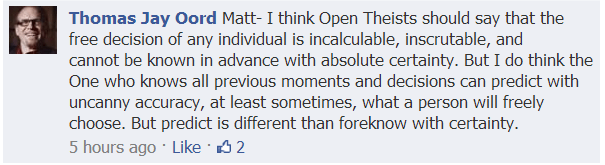
Oord on God’s Predictions
Posted by Thomas Jay Oord of For the Love of Wisdom on Facebook group Open Theism:
Matt- I think Open Theists should say that the free decision of any individual is incalculable, inscrutable, and cannot be known in advance with absolute certainty. But I do think the One who knows all previous moments and decisions can predict with uncanny accuracy, at least sometimes, what a person will freely choose. But predict is different than foreknow with certainty.
God is Almighty
From Christopher Fisher:
In contrast to “omnipotent”, God is called “Almighty” 57 times in the Bible. Often, it is a nominal adjective that is used in place of God’s own name. The Bible seriously identifies “Almighty” with God; this is what God wants to be called. God illustrates His Almighty-ness with examples of Him being Almighty.
Gen 15:7 Then He said to him, “I am the LORD, who brought you out of Ur of the Chaldeans, to give you this land to inherit it.”
Gen 26:24 And the LORD appeared to him the same night and said, “I am the God of your father Abraham; do not fear, for I am with you. I will bless you and multiply your descendants for My servant Abraham’s sake.”
Exo 6:7 I will take you as My people, and I will be your God. Then you shall know that I am the LORD your God who brings you out from under the burdens of the Egyptians.
God connects Himself with His creative action. God is Almighty because He does powerful things. God is the “living” God, often contrasted to stone idols that have no power. God is active and working in creation. This is the context of God calling Himself “Almighty”, not philosophical proofs invented by human beings.
For context, click here.
VOTD Isaiah 5:7
Isa 5:7 For the vineyard of the LORD of hosts is the house of Israel, And the men of Judah are His pleasant plant. He looked for justice, but behold, oppression; For righteousness, but behold, a cry for help.
All Our Days Were Not Written
From Christopher Fisher’s Misquoted Verses series:
Psa 139:16 Your eyes saw my substance, being yet unformed. And in Your book they all were written, The days fashioned for me, When as yet there were none of them.
Calvinists take this verse to mean that everyone’s entire life was predestined before they were born. This verse is their “proof” that God knows every event in someone’s future (from birth to death). But does it mean that? Could it mean anything else? Is that the natural understanding of the text?
…
In verse 13, David starts talking about how his parts were “formed”. In verse 14, David says he was “made”. In verse 15, David was “made” and “wrought”. Then in verse 16, the NKJ uses the word “fashioned” in reference to days. Something is rotten in the state of Denmark. Here is the KVJ translation:
Psa 139:16 Thine eyes did see my substance, yet being unperfect; and in thy book all my members were written, which in continuance were fashioned, when as yet there was none of them.
The KJV translators correctly saw that King David’s subject did not stray. King David was still talking about fetology in verse 16. David is talking about being formed in the womb. God saw David developing in the womb, had a blueprint (book), and David’s fetal development followed that path. David’s point is not “fatalism”, but that “fetal development is not Ad Hoc”. Before David developed as a baby, that path had been designed by God.
For full post, click here.
Atheist Recognizes A Closed Future Negates Free Will
George H Smith from Atheism: the Case Against God:
The first problem with omniscience is that it cannot be reconciled with any theory of free will in man. If one believes in an omniscient being, one cannot consistently hold that man has volitional control over his actions. If God knows the future with infallible certainty, the future is predetermined, and man is impotent to change it.
Some theologians (such as Calvin) have enthusiastically embraced predestination, but most theologians, sensing the enormous problems entailed by this doctrine, have attempted to defend some theory of volition. Without volition, morality becomes meaningless: we cannot blame or praise a man for an action over which he has no control. Without volition, the Christian scheme of salvation is a farce; men are predestined for either heaven or hell, and they have no voice in the matter. Why does God create men only to save some arbitrarily, and damn others? Why does the Christian bother to proselytize, since men cannot help what they believe anyway? The problems that arise for theology if it affirms predestination are unsolvable, but they necessarily ensue when omniscience is attributed to God.
No Laughing at Calvinists
The full post from Peter Lumpkins of SBC Tomorrow:
More Inspiration from John Calvin on this our Lord’s Day
During John Calvin’s reign in Geneva, reportedly it was considered a no-no to laugh during Calvin’s preaching, and to do so was met with stiff consequences:
“To laugh during a sermon was a matter which drew after it three days’ imprisonment, and the necessity of publicly asking pardon.”
–“Lives of Calvin” The London Quarterly Review, American Edition, Volume XXXV No.1, p. 286
Apologetics Thursday – “Now I Know” -God
Gen 22:12 And He said, “Do not lay your hand on the lad, or do anything to him; for now I know that you fear God, since you have not withheld your son, your only son, from Me.”
In Genesis 22, God tells Abraham to sacrifice his son, Isaac. Abraham had been counting on his son to continue Abraham’s lineage and fulfill God’s promise that Abraham’s decedents would be as numerous as the stars. Abraham takes Isaac to the mountains, binds him on an altar, and raises the knife to kill Isaac. But God intervenes. At this point God utters those famous words “Now I know”. God says that Abraham does not have to sacrifice Isaac because now God knows that Abraham fears (obeys) God.
The straightforward reading is that God just tested someone and learned their heart. But the closed view of God does not allow for God to learn new things. When those who see God as Open mention this text, the Close View gives a typical response. From John M Frame’s No Other God: A Response to Open Theism:
Ware points out that so-called straightforward interpretation of Genesis 22:12 cannot be maintained, even in the system of open theism. He makes three points. First, if God literally needed to test Abraham to find out what was in Abraham’s heart, then His ignorance was not of the future, but of the present. But open theists often claim that God knows the present exhaustively. Second, this interpretation denies what open theists elsewhere affirm, that God knows the inner motivations of the human heart. Third, if God is trying to find out whether Abraham will be faithful in the future, he is trying to know Abraham’s libertarian free choices in advance, which, on the openness view, not even God can know.
One thing that Openness proponents should point out is that of the three reasons given, none of them had to do with the text in question. All three points were of the argument: “The text cannot mean what it says because of the implications.” Notice also that implicitly the Closed View understands the face value meaning of the text. Every time the Calvinist claims something is an anthropomorphism they are admitting that fact.
But Frame and Ware list three points:
1. If God literally needed to test Abraham to find out what was in Abraham’s heart, then His ignorance was not of the future, but of the present.
Setting aside the fact that some Open Theists maintain that God can choose what He wants to know, even in the present, this argument still does not hold.
God was testing to see what a free will agent would do under extreme testing. Most humans, when asked a hard moral question will reply “I don’t know. I would have to experience the situation.” Others might claim to have one response but, in reality, might do another. I am reminded of the questions asked to abortion supporters in Ray Comforts’ 180 Movie.
No, the knowledge God was trying to test was not “present knowledge”. Abraham’s heart was not a computer program that God could look into to see the free will results based on hypothetical criteria. The only way to know what someone would really do is to test them. God was seeing how Abraham would handle a loyalty test. God stops Abraham at the last possible moment (when the knife is raised) because at any second Abraham could have chose to disobey.
2. This interpretation denies what open theists elsewhere affirm, that God knows the inner motivations of the human heart.
See the answer to point 1. Not even humans know how they will respond to situations before they occur. For parents, imagine if God asked you to sacrifice your children. How far would you go? What kind of inner struggles would occur? Would you do it?
The underlying Calvinist assumption about point 2 is that humans do not have free will. This is false.
3. Third, if God is trying to find out whether Abraham will be faithful in the future, he is trying to know Abraham’s libertarian free choices in advance, which, on the openness view, not even God can know.
This last point could only come from the mind of a Calvinist. When students are tested in school, what this is measuring is how likely they will perform on similar material in the future. The long term trends produce reliability (not perfect certainty) of the results. Employers do not “know” the future free actions of these students, but use grades to predict how skilled of a worker those students will be. God does the same.
In the Calvinist mindset, those who advocate Free Will would think God is just as likely to pick a meth head as a clean cut Baptist preacher to lead a revival, because God “doesn’t know the future free actions of man.” This is nonsense. Even though human beings have free will, their actions are predictable. I can right now predict that every time the Bible shows God learning something new that the Calvinist will claim it is an anthropomorphism and hold in contempt those who take the face value meaning as true. This is not a hard prediction to make. Yes, sometimes a Calvinist will choose to do something else, but those instances are shocking.
When God tests people, God is not going for “knowing something with 100% certainty”. God is establishing patterns of reliability.
The really interesting thing is that Genesis describes God making these predictions:
Gen 18:17 And the LORD said, “Shall I hide from Abraham what I am doing,
Gen 18:18 since Abraham shall surely become a great and mighty nation, and all the nations of the earth shall be blessed in him?
Gen 18:19 For I have known him, in order that he may command his children and his household after him, that they keep the way of the LORD, to do righteousness and justice, that the LORD may bring to Abraham what He has spoken to him.”
God predicted that Abraham would produce a righteous nation. This prediction ultimately failed. The Jews rejected God and rejected their Messiah. The entire Bible gives testament to this.
VOTD Deuteronomy 7:9
Deu 7:9 “Therefore know that the LORD your God, He is God, the faithful God who keeps covenant and mercy for a thousand generations with those who love Him and keep His commandments;
I Am Who I Am – Paul
Craig Fisher recounts the time Paul uttered the words that Jesus was nearly stoned for saying:
God, perhaps himself irritated at Moses’ desire for a more useful name, says “I AM WHO I AM.” (אֶֽהְיֶ֖ה אֲשֶׁ֣ר אֶֽהְיֶ֑ה) To understand this statement, it helps to understand how others have used it in scripture. Paul, after explaining his own unworthiness, uses the same words in Greek to explain to the Corinthians his apostleship:
1Co 15:10 But by the grace of God I am what I am
Paul is saying he knows that he is not worthy of this apostleship. In his checkered past, he has persecuted Christians, but God transformed him into an apostle, preaching the good news to all who would receive him. When Paul says “I am who I am”, he means “what you see is what you get”, nothing more or less. Paul is not claiming to be an immutable, simple and incorruptible god, a claim made by leading Calvinists.
For context, click here.
The Neo-Calvinist Personality
Excerpt from Dr. Paul Owen’s paper What Is Wrong With the Young, Restless and Reformed Movement?:
The TULIP Personality
Calvinism today seems to appeal mostly to a certain sort of personality, and that personality is not always healthy. I have discovered that the person who really spends a lot of time talking about the “doctrines of grace,” tends to fit a typical profile. They tend to be male (rarely do you find women sitting around arguing about the details of TULIP), intellectually arrogant, argumentative, insecure (and therefore intolerant), and prone to constructing straw-man arguments. In order for the typical Calvinist’s faith to remain secure, he seems to feel the need to imagine all others outside his theological box as evil, uninformed, or just plain stupid. I have seen this in men of all ages, some Baptist, some Presbyterian, some laymen, some ordained ministers.
I don’t think there is any necessary connection between Calvinism and such traits, so why does it seem to be so prevalent today? Part of the reason, which I do not have time or space to develop here, is that the evangelical church has no robust ecclesiology, and thus no structured spirituality to put into practice as the body of Christ. And given the absence of a structured spiritual life, Reformed Christianity tends to be reduced to a set of doctrines to contemplate, which attracts mainly certain kinds of people, and encourages certain kinds of attitudes among believers. Thus, when you remove Reformed theology from its proper historical place in the structured life of Reformed religion and ecclesiology, and plant it in the foreign soil of modern evangelical gnostic spirituality, it takes a grotesque shape that is contrary to its origins.
One thing I have noticed is that such features tend to display themselves most dramatically in those who experience Calvinism as a “second blessing.” They grow up either in a non-Christian home, or a Christian environment that did not talk about issues related to Calvinism. When they first encounter the “doctrines of grace,” they are suddenly captured by the intellectual beauty of a logical system that “makes sense” to them. When listening to Calvinist newbies over the years, as they describe their first exposure to Reformed theology, there is an evident “conversion narrative.” New TULIP converts speak in hushed tones about when they first “came to accept” the doctrines of grace. You get the sense that they entered a deeper state of Christian spirituality and walk with Christ by discovering that God arbitrarily saves and arbitrarily destroys whomsoever He chooses. I think that there is a certain obnoxious personality that likes to feel superior to others, and unfortunately, the “doctrines of grace” seem to do this for them.
This should be a reminder to all who view God as Open, we should minimize any arrogance, haughtiness, or feelings of intellectual superiority.
For context, click here.
John Calvin was a Monster
Peter Lumpkins sets straight James White on Calvin’s execution of Servetus:
It’s a joke to suggest Servetus broke no laws in Geneva. Servetus was guilty of heresy which was against the law (4:28).
Not so fast. At the time of Servetus’ arrest, no laws in Geneva had been broken. We apparently have few, if any, records of Servetus’ doing anything but renting a hotel room and attending church the next day. He’d broken no laws in Geneva. Was it a crime to have been convicted of heresy by Rome? If so, John Calvin and every Geneva pastor should also have been arrested as well. Thus at the time the authorities came and pulled Servetus from Calvin’s church, Barker was correct; Servetus had broken no laws of Geneva. From all indication, Servetus was only passing through and already had a boat ticket to Naples (see below). Even so, at the time no law apparently existed in Geneva which called for Servetus’ death even if he was a known heretic. According to the Encyclopedia Britannica, “No law, current in Geneva, has ever been adduced as enacting the capital sentence…but in 1535 all the old laws on the subject of religion had been set aside at Geneva; the only civil penalty for religion, retained by the edicts of 1543, was banishment” (Encyclopedia Britannica, Volume 21, 1892, p.685, emphasis added). Hence the author concludes, “The extinct law seems to have been arbitrarily revived” for the specific purpose of putting Servetus to death. According to famed Reformation historian, William Naphy, Servetus “would probably become the first person to be executed for heresy in Geneva…”(William G. Naphy, Calvin and the Consolidation of the Genevan Reformation p.183).
It is recommended to read the entire post. Click here.
For Part 1, click here.
VOTD Psalms 78:58
Psa 78:58 For they provoked Him to anger with their high places, And moved Him to jealousy with their carved images.
Psa 78:59 When God heard this, He was furious, And greatly abhorred Israel,
When God Asked the Angels for Ideas
Christopher Fisher talks about 1 Kings 22 and lists some key things the text teaches us about God:
God hated king Ahab and sought to kill him. God wanted Ahab to die in Ramoth Gilead. But God was not controlling Ahab. God does not use human beings as puppets. Instead God needs to convince Ahab to actually go to Ramoth Gilead to die. He crowdsources the angels to figure out how to do this. The text reads that various angels proffer ideas. We can imagine what they say: “We can get his wife to nudge him”, “We can make him angry at his enemy”, “We can get a neighboring King to pledge support in the battle”, “We can appeal to his pride”. But God finally listens to one angel that outright says to use lies to promote the idea that Ahab is going to win in battle. God likes this plan and endorses it.
Sure enough, King Ahab takes the advice of his prophets and ignores God’s prophet who clues Ahab in on the plot against him. King Ahab then dies at Ramoth Gilead.
Some take-aways from the text.
1. God does have plans, and those plans can be achieved through a multitude of routes.
2. God does not predecide all avenues and sometimes consults others for ideas.
3. God is not opposed to deception to further specific goals. This does not mean deception is always used by God, but in some cases He believes it is acceptable.
4. God’s prophets are allowed their own judgment in how to communicate God’s plans. Micaiah was allowed to even reveal God’s deception before the event took place.
5. Although God could have struck Ahab dead (we learn from other parts of the Bible), God preferred a more natural cause of death and sought to create circumstances to affect it. God does not always prefer the most direct and miraculous route.
6. Human beings are not directly controlled by God. In order to motivate human beings to act, God uses persuasion and events.
7. Angels are in heaven, advising God and helping God affect God’s plans.
For full text, click here.
Is God The Author of Sin?
From Jesse Morrell’s series Is God The Author of Sin?:
VOTD Ezekiel 18:32
Eze 18:32 For I have no pleasure in the death of one who dies,” says the Lord GOD. “Therefore turn and live!”
Bible Readers Should Be Detectives
From W Scott Taylor of IdeoAmnosTouTheou on Facebook Group Open Theism, Moral Government Theology, Pentecostal:
“The Openness of God” at one time could to be taken as a “Biblical” challenge to traditional understanding of God, but we have since learned that word “Biblical” was more elastic to some of the authors than many who read it. If one reads it with that understanding there is great value in it. A new kind of caveat emptor need accompany some works.
Really, one could read the Bible itself and take seriously the revelation “and God changed His mind” and allow oneself to be drawn into the Bible itself as it’s own coherent interpreter.
And the the reference to the Lord’s paradigm for us for prayer was not quite in context.
“After this manner therefore pray ye: Our Father which art in heaven, Hallowed be thy name. Thy kingdom come. Thy will be done in earth, as it is in heaven.”
The obvious seems to be generally missed in our Lord’s direction, and that is, “God’s will is not being done on Earth as it is in heaven!”
One does not pray that the Sun will come up in the morning or that the law of “cause and effect” will continue for another day.
One pray’s for that to be changed which is out of conformity to the revealed will of God.”
Sometimes I wonder if people would be more benefited by reading a few episodes of the famous “Sherlock Holmes” and apply his method to the interpretation of Scripture *first* than other works that bring one to the precipice of confrontation with even greater dizzying mental constructs.

Foreknowledge is Mistranslated
From H Roy Elseth’s Did God Know?:
The English word “foreknowledge” generally means knowledge of something before it happens, exists, or comes into being. It usually connotates certain knowledge – i.e. the event must happen or occur otherwise the person did not have “foreknowledge.” The Greek word found in the forms “proginosko, prognosis, and proginosken” is decidedly different. It means to predict what will happen, exist or come into being.
Proginosko carries with it the idea of past knowledge, to know beforehand, or even foresight, whether human or divine. It is rooted in a medical term originating in the time of Hippocrates and means almost exactly what our English counterpart word, prognosis, means. In medicine, it is the prediction of the probable course of the disease and of the chances of recovery based on present knowledge. In other words, it is a prognosis based on diagnosis…
However, when interpreting them in context of Scripture a strong theological twist was added. It seemed as if the scholars were trying to force a meaning upon proginosko [foreknowledge] which it really doesn’t have. They get in real trouble when they find that both Luke and Peter apply this same word “proginosko” [foreknowledge] not only to God, but also to man.
Calvinist Anthropomorphism Meme

At Facebook Group: realityisnotoptional
VOTD Jeremiah 15:1
Jer 15:1 Then the LORD said to me, “Even if Moses and Samuel stood before Me, My mind would not be favorable toward this people. Cast them out of My sight, and let them go forth.
We Work All Things Together With God
Rom 8:28 And we know that all things work together for good to those who love God, to those who are the called according to His purpose.
Tim Geddert explains that Romans 8:28 is about man working with God:
Now to the second time I changed my understanding of this verse! Even the translation that is given in the NIV needs to be reconsidered. The biggest problem with the NIV version is that it still misunderstands what the verb “sunergei” (“work together”) really means. Even if “God” is the subject, the NIV translation treats “sunergei” as though it means God is “working things together” i.e. “forming a pattern” or “mixing ingredients together” so that something new emerges. “Sunergei” in Greek is not about one party working various ingredients together; it is more than one party working on a common project. It means quite literally “work together.” If Romans 8:28 says that God “works together . . .” then the obvious question to be asked is “with whom?” If we read the text differently, the answer is clearly supplied in Romans 8:28.
…
Unless “sunergei” is being used here in a way completely unprecedented in the NT, Romans 8:28 is not about God fitting all things together into a pattern for our benefit. It is rather about God and those who love God working as partners, “working together” to bring about good in all situations. While we (i.e. those who love God and are called according to God’s purposes) may at times also be the beneficiaries of “God and others” working together, this verse is probably not primarily about the benefits we receive from God’s action on our behalf. It is rather a clear indication that those who are “foreknown, predestined, called, justified and glorified” (see the context of Romans 8:28!) are being transformed, not only in order to receive God’s grace, but also in order to become channels of God’s grace to others. We were called by God; we love God; and thus we join God’s work in the world. God is working to bring about good, and we are God’s fellow-workers. God’s good purposes will often come about in terrible situations, not because someone “sat back and trusted God’s promise” but because someone “joined God’s work in the world; became God’s hands and feet; became a tangible expression of God’s love and God’s caring.”
HT: Jess in Process
Calvinism Destroys God’s Justice
From Robin Phillips’ Why I Stopped Being a Calvinist series:
Imagine a potter who labors continually until he has created a number of excellently wrought vessels of great beauty. But he is not satisfied with that—he must also construct a second class of vessels in order to smash them into a hundred bits. This proves to everyone that he has strength. The God of Calvinism is like this potter; he must have two classes of people: One group with which to demonstrate His love and mercy, and another group with which to demonstrate His wrath and hatred of sin.
In the end, this amounts to saying that God hates sin so much that He wanted it to enter His creation eternally so that He could always be punishing it. But consider carefully what this actually means. Because His hatred of sin is so great, He must create it and it must go on existing eternally in those subjects He is forever punishing.
For full post, click here.
Forcing Attributes on God
From Dan Martin of Nailing it to the Door:
There’s a second application of the “omnis” that I think may be even more dangerous.
; When theologians make an assertion about God — for example God’s omniscience — and then start analyzing that assertion in philosophical terms, I find that the assertion tends to take on a life of its own. Riffing on the theme that “God knows everything,” theologians and philosophers seem to get wrapped up in the “everything” that God must know, and soon they’re making silly pronouncements of the sort that William Lane Craig made in Four Views on Divine Providence, when he stated “…the open theologian’s God turns out not to be omniscient… Thus, the open theologian must deny divine omniscience and therefore reject God’s perfection–a serious theological consequence indeed.” (location 1857 in the Kindle version). Put more simply, if God doesn’t know what we think he ought to know if he’s omniscient, then he mustn’t be God, or mustn’t be perfect, or mustn’t be something else a perfect God “ought” to be.My problem with this line of reasoning, of course, is that it seems to me that we wind up in the hubristic place of defining God through our theology, instead of forming our theology around God’s self-revelation.
For full post, click here.
Worship Sunday – Agnus Dei
Agnus Dei – Michael W Smith
Lyrics:
Alleluia
Alleluia
For the Lord God Almighty reigns
Alleluia
Alleluia
For the Lord God Almighty reigns
Alleluia
Holy
Holy are You Lord God Almighty
Worthy is the Lamb
Worthy is the Lamb
You are holy
Holy are you Lord God Almighty
Worthy is the Lamb
Worthy is the Lamb
Amen
VOTD Psalms 139:23
Psa 139:23 Search me, O God, and know my heart: try me, and know my thoughts:
Boyd on God Sharing Our Pain
From Gregory Boyd’s book Letters from a Skeptic:
Thinking of the grandeur of the stars we had just been looking at, I was saying to myself “there must be a God.” But thinking of the nightmarish suffering of Auschwitz, I was saying to myself “there can’t be a God.” The two thoughts were battling with each other at hyperspeed. I was tormented.
Finally, just as I approached my car, I looked up to the sky and cried out with a loud, angry voice—“the only God I can believe in is one who knows firsthand what it’s like to be a Jewish child buried alive, and knows what it’s like to be a Jewish mother watching her child be buried!” And just then it occurred to me (or was it revealed?): that is EXACTLY the kind of God Christianity proclaims. There is no other belief which does this. Only the Gospel dares to proclaim that God enters smack-dab into the middle of the hell we create. Only the Gospel dare to proclaim that God was born a baby in a bloody, crap-filled stable, that He lived a life befriending the prostitutes and lepers no one else would befriend, and that He suffered, firsthand, the hellish depth of all that is nightmarish in human existence. Only the Gospel portrait of God makes sense of the contradictory fact that the world is at once so beautiful and so ugly.
God is Vindictive
From W Scott Taylor of IdeoAmnosTouTheou asks on the Facebook group Open Theism, Moral Government Theology, Pentecostal:
Question:
God experiences vindictive reactions all the time, yet He is holy.
If you have an over “spiritualized” definition of the word vindictive or you don’t understand ultimate intention as God’s measure of righteousness you won’t be able to show why the first sentence can be so in five lines or less. Any takers?
Answer:
Morally sentient beings involuntarily experience indignation at unjust treatment. Benevolence sets aside injury to serve universal good. As an ultimate intention that constitutes holiness.

God Tests the Hearts of His People
Jamie Gerrard of The Pilgrim lists various verses about God testing to see what is in the hearts of people. A couple key verses:
Gen 22:12-And He said, “Do not lay your hand on the lad, or do anything to him; for now **I know** that you fear God, since you have not withheld your son, your only son, from Me.”
Exod 16:4-Then the LORD said to Moses, “Behold, I will rain bread from heaven for you. And the people shall go out and gather a certain quota every day, that I may **test them,** whether they will walk in My law or not.
Deut 13:3-”you shall not listen to the words of that prophet or that dreamer of dreams, for the LORD your God is **testing you** ** to know* whether you love the LORD your God with all your heart and with all your soul.
Addition: Psa 139:23 Search me, O God, and know my heart: try me, and know my thoughts:
For full post, click here.
Calvinist Claims God Causes Evil
Here is a Calvinist, tragically blaming God for sin:
After the initial shock and horror subsides, after the news crews go home, we’re always left with the same question: Where was God?
…But, of course, the Bible says more than that God could have prevented it; it says that it occurs “according to the counsel of his will” (Eph 1:11). Indeed, he works all things according to the counsel of his will. And when the Bible says ‘all things,’ it means all things:
This ‘all things’ includes the fall of sparrows (Matt 10:29), the rolling of dice (Prov 16:33), the slaughter of his people (Ps 44:11), the decisions of kings (Prov 21:1), the failing of sight (Exod 4:11), the sickness of children (2 Sam 12:15), the loss and gain of money (1 Sam 2:7), the suffering of saints (1 Pet 4:19), the completion of travel plans (Jas 4:15), the persecution of Christians (Heb 12:4–7), the repentance of souls (2 Tim 2:25), the gift of faith (Phil 1:29), the pursuit of holiness (Phil 3:12–13), the growth of believers (Heb 6:3), the giving of life and the taking in death (1 Sam 2:6), and the crucifixion of his Son (Acts 4:27–28). (John Piper, “Why I Do Not Say ‘God Did Not Cause This Calamity, But He Can Use It For Good’”)
All things — good, bad, ugly, and horrific — are ordained, guided, and governed by the Creator and Sustainer of the universe.
For full context, click here.
Hunt on Determinism and Responsibility
Jacob Hunt explains why Determinism and Responsibility are mutually exclusive in a recent post. Here is his overview of the subject:
The nature of the debate between compatablism and incompatablism centers around the fact that (1) determinism and human freedom seem to contradict each other (2) some sort of human freedom seems necessary for moral responsibility, and (3) most everybody, including most determinists, want to retain their belief in moral responsibility. Such determinists have therefore advocated for a modified kind of freedom which they see as compatible with determinism, in an attempt to save their belief in morality. This special kind of freedom is often called “compatablistic freedom” or “soft determinism.” The idea here is that someone is free if and when they can act as they desire, rather than against their will. Now, clearly this concept of freedom is compatible with determinism, for external causes (i.e. God, ones’s neurons, one’s environment, etc.) could easily determine somebody to desire something and achieve the goal of that desire. Nobody really disputes that. But the compatablist wants something more than just any kind of freedom: she wants a freedom that allows for moral responsibility. And lots of people think you can’t get moral responsibility unless determinism is false. I am one of those people.
For full post, click here.
VOTD Genesis 6:6
Gen 6:6 And the LORD was sorry that He had made man on the earth, and He was grieved in His heart.
Highlighted Blog – Jess in Process

Jess in Process is a blog by mother Jessica Kelly. Here is how she describes herself.
I’m an aspiring author, trained counselor, wife, and mother. I’m also a… well… widow doesn’t fit, my spouse is healthy. Orphan doesn’t describe me, I have several parents. There’s just no title for a mom who loses a child… that’s the one I’m looking for.
In 2012, Jess tragically lost her 4 year old son, Henry, to brain cancer. In her blog, she describes dealing with this suffering with God’s help. Raw emotion coupled with sound theology reverberate throughout her posts. Do not expect to read this with dry eyes. This blog in an excellent resources for Christians trying to understand how God can be good while evil exists in our fallen world.
Notable posts:
Pain and Purpose contains a good overview of Romans 8:28.
Did God Author This contains a brief explanation of the real meaning of various Calvinist proof texts
Henry, age 4.

Book Recommendation: Theology of the Old Testament
From Walter Brueggemann’s Theology of the Old Testament:
Israel’s characteristic adjectival vocabulary about Yahweh is completely lacking in terms that have dominated classical theology, such as omnipotent, omniscient, omnipresent. This sharp contrast suggested that classical theology, insofar as it is dominated by such interpretive categories and such concerns, is engaged in issues that are not crucial for Israel’s testimony about Yahweh and are in fact quite remote from Israel’s primary utterance…
The Old Testament, in its discernment of Yahweh, is relentlessly committed to the recognition that all of reality, including the reality of Yahweh, is relational, relative to the life and destiny of Israel. And the God of Israel has no propensity to be otherwise than related to Israel.
Brueggemann composes a fair and honest reading of the Old Testament, complete with an analysis of how the text is written and what it communicates. Although Brueggemann does not claim to be an Open Theist, he proposes that the natural understanding of the Old Testament is one of God being free, relational, and free from Classical constraints.
Defining Open Theism – Two Views
Openness as Future Contingencies. From Tom Belt:
Open Theism’s defining claim: divine epistemic openness regarding future contingents.
The defining claim of open theism is pretty simple: divine epistemic openness regarding future contingents. Now, that’s a mouthful, so let us break it down. Some aspects of the future are presently ‘settled’; that is, given everything at present which has anything to do with influencing or bringing about the future, some things about the future are determined to be. The causes and influences (divine and created) that presently exist limit the future to a single possibility with respect to some particular event or state of affairs.
For full post, click here.
Openness as God being free. From Bob Enyart:
Openness is based on God as the Living God. The five most fundamental attributes of God are that He is Living, Personal, Relational, Good, and Loving. These faithfully represent God the way that Scripture presents Him, and starkly contrast with the Greek and Roman philosophical construction of God. The Openness attributes are heavy on scriptural influence, and light on man’s philosophy. Children can understand the most important aspects of God. For “out of the mouth of babes… You have perfected praise” (Mat. 21:16) for “of such is the kingdom of heaven” (Mat. 19:14). Whereas adults wrestling with the metaphysical conjectures of intellectuals must first learn even how to pronounce omniscience, omnipresence, omnipotence, immutability, and impassibility. Thus Scripture warns us against human philosophy over substance (Col. 2:8), and who can deny the Calvinist emphasis on the writings and traditions of men.
For full post, click here. Also see: Enyart on God being Open.
VOTD Hebrews 10:31
Heb 10:31 It is a fearful thing to fall into the hands of the living God.
Boyd on the Calvinist Persecution of the Open View
Gregory Boyd, from the answers session of Ask an Open Theist:
My first encounter with the “backlash” you mentioned took place in the mid-90’s when John Piper launched a public crusade to get me fired from Bethel University and to have my church kicked out of the Baptist General Conference on the grounds that I was a “heretic.” There were also attempts by some to force publishers to stop publishing my books and for Christians to boycott bookstores that sold them. Hundreds of pastors signed a petition to get me fired, with only one of them taking the time to ask me what I actually believed and why I believed it.
And his personal response:
Being the sinner that I am, my initial response was anger mixed with a little fear. But it wasn’t too long before the Lord got my attention and helped me realize that this response was neither Christ-like nor healthy for me. I strongly sensed that the Lord gave me an assignment I was to carry out for a year to help me through this period: Every single day, I was to pray for the well-being of those who were leading this crusade! Initially, this was really hard, but I soon found that this exercise freed me from the cancer of bitterness and even empowered me to genuinely love my “enemy.” This deepened my conviction about the importance of obeying Jesus’ command to love, serve and pray for those who persecute us (Mt 5:44-45; Lk 6:27-35). I encourage anyone who is harboring anger toward someone to engage in this daily exercise.
For full post, click here.
Brown’s Overview of Romans 9
Except from Taylor Brown on his series “Why I Am a Free-Will Theist”:
1. Romans 9 is About the Corporate Nation of Israel, NOT the Salvation or Damnation of Individuals
The background context of Romans is that a rift occurred between the Jewish and Gentile Christians in the Roman church. The Gentiles were claiming that God had abandoned the Jews since so few of them had come to believe in Jesus as Messiah. This understandably made the Jewish Christians a little angry. As a result, Paul took it upon himself to write a letter to the church in Rome to help settle the dispute. The section of his letter we now know as Romans 9 was meant specifically to address the claim that God had abandoned Israel in favor of the Gentiles. The whole section of Romans 9-11 is Paul’s emphatic argument against such a notion.
For full post, click here.
VOTD 1 Thessalonians 1:9
1Th 1:9 For they themselves declare concerning us what manner of entry we had to you, and how you turned to God from idols to serve the living and true God,
Augustine and His Platonism
Excerpted from Christopher Fisher:
Simplicianus and Ambrose convinced Augustine that the Bible was to be taken figuratively. Notice how Augustine read the Bible on face value. Augustine called it “absurd”, he said “the letter kills”, he called it “perverse doctrines”, and he called it “offensive”. It was only through Simplicanus and Amborse spiritualizing the text in a Platonic sense that Augustine finally accepted the Bible. In short, Augustine was able to see the natural reading of the Bible, and Augustine rejected it because it was antithetical to Plantonism (that “god” cannot change)…
Augustine’s characteristics for the books of the Platonists are “pride” and “knowledge”. Augustine, even after becoming a Christian, held Platonism in high regard. This is in contrast to his disdain for the natural meaning of the Bible text, which he calls “absurd”, “killing”, “perverse”, and “offensive”. Biblical theology was to be rejected all except one point. The Platonists gave Augustine all Augustine’s theology except “charity”. In fact Augustine writes: “I might have thought that it could have been attained by the study of [Platonist] books alone.”
For full post, click here.
95 Open Theism Verses
Long excerpt from ApologeticJedi’s website:
1. God worked in six day-divided time spans, but rested on the seventh day. (Gen 2:1-2)
2. God brought the animals before Adam to see what he would call them. (Gen 2:19)
3. God is uncertain whether they will eat of the Tree of Life after the fall. (Gen 3:22)
4. God repents that he made man. (Gen 6:6)
5. God must patiently wait while the ark is being built. (1 Pet 3:20)
6. Satan is willing to wager with God over how the future will turn out. (Job 1:11-12)
7. Abraham challenges God over his promise, and lives! (Gen 15:2-3, 6)
8. God is prevailed upon by Abraham over whether to spare Sodom. (Gen 18:22-33)
9. The angels of God argue with Lot about sleeping in the square. (Gen 19:2-4)
10. God learns that Abraham would not even withhold even his own son. (Gen 22:12)
11. God is moved by the cries of injustice. (Ex. 2:23-25)
12. God agrees with Moses that a backup plan should be prepared. (Ex. 4:1-9)
13. God promised those in the Exodus would reach the promise land, but they don’t. (Deut. 1:8; 1:34)
14. God is uncertain how Israel will react when they see war. (Ex 13:17)
15. God tells Moses He will destroy Israel, but does not. (Ex 32:7-10; Deut 10:10)
16. God tells Moses He will not lead them, but He does. (Ex. 33:3-19)
17. God wants to destroy Israel again, but is talked out of it. (Num 14:11-12)
18. God sets both a curse and a blessing for Israel to choose. (Deut. 11:26-28)
19. God has faith in the people, that they can do it. (Deut 30:11)
20. God gives the choice of life and death. (Deut. 30:19)
21. God repents when his sets up people that lead others astray. (Deut. 32:36)
22. God promises to drive out the Canaanites, but doesn’t. (Josh 3:10; Judg 2:1-3; 3:1-7)
23. Joshua charges that we can choose between good and evil. (Joshua 24:15)
24. God changes His mind about establishing Eli and his sons forever. (1 Sam 2:30)
25. God gives Israel a king before He had planned to. (1 Sam 7:7-8)
26. God had planned to establish Saul forever, but will not. (1 Sam 13:13-14)
27. God repents over making Saul king. (1 Sam 15:10)
28. David believes God can change His mind. (2 Sam 12:21-23)
29. God’s mercy stopped the punishment from completing what He said. (2 Sam 24:16; 2 Chr 21:15)
30. Elijah claims they had two options to choose from. (1 Kings 18:21)
31. God is not always in the wind, fire, and earthquakes. (1 Kings 19:12)
32. God is full of compassion. (Ps 78:38-40)
33. God is limited by man’s decisions. (Ps 78:41)
34. God desires new songs. (Ps 33:3; 96:1; 98:1; 144:9; 149:1)
35. Heed my rebuke demands God, or else! (Prov 1:22-27)
36. The span of your life is alterable (Prov 9:11)
37. Solomon lists chance as a factor in life. (Eccl 9:11)
38. God tells Hezekiah that he will die, then adds years to his life. (2 Kings 20:1-6)
39. God expected His work towards Israel would not be in vain, but it is. (Isa 5:1-5)
40. God’s desire is to be allowed to forget our sins. (Isa 43:25)
41. God declares the future, rather than knowing it. (Isa 46:9-11)
42. It is not God that keeps men from being saved. (Isa 59:1)
43. The people were able to grieve the Holy Spirit. (Isa. 63:10)
44. God predicted Israel would repent, but admits He was wrong. (Jer 3:7-10)
45. Ordaining the sacrificing of children never entered God’s mind (Jer 7:31; 19:5; 32:35)
46. God gets tired of repenting. (Jer 15:6)
47. God promises to repent of what He thought to destroy a repenting people. (Jer 18:7-8)
48. God promises to repent of what He says to promote a backslidden people. (Jer 18:9-10)
49. God is uncertain if the people will repent if they hear his message. (Jer 26:2-3)
50. God is uncertain if the people will repent from a written message. (Jer 36:2-3)
51. God does not willingly bring grief on men. (Lam 3:33)
52. God despises the fatalistic viewpoint. (Eze 18:2)
53. God predicts Babylon will take Tyre, but they do not. (Eze 26:7; 29:18)
54. God predicts Babylon will destroy Egypt, but they do not. (Eze 30:10)
55. What God wants, is for the wicked to turn from their ways. (Eze 33:11)
56. God becomes heartbroken. (Hosea 11:8-9)
57. God sends a drought to influence his people without success. (Amos 4:6-11)
58. Nineveh repents and God refuses to fulfill His prophecy. (Jonah 3:10)
59. Jesus became flesh, who had never been so previously. (John 1:14)
60. The will of men and the will of God need to coincide. (John 7:17)
61. Some people are just born blind. (John 9:1-4)
62. Man has a choice, and God wants him to choose to abide in Him. (John 15:6-7)
63. Jesus is amazed at the unbelief of Israel. (Mark 6:6)
64. Jesus is marveled at the belief of Gentiles. (Luke 7:9)
65. The Pharisees and lawyers rejected the will of God. (Luke 7:30)
66. They could have believed if Satan hadn’t interfered. (Luke 8:12)
67. Jesus teaches about chance meetings. (Luke 10:31)
68. Bad things happen without a reason. (Luke 13:2-5)
69. God wants to destroy Israel, but Jesus convinces God to wait-and-see. (Luke 13:6-9)
70. Woe! Men are responsible for their own actions. (Luke 17:1)
71. Perhaps they will respect the master’s son, says the master. (Luke 20:13)
72. Jesus asks people to come to him. (Matt 11:28)
73. Jesus predicts the last days will not last as long as prophesied. (Matt 24:22)
74. Jesus predicts he will return in His follower’s lifetime. (Mat 24:33-34; 16:28; 10:23; 23:31-36)
75. Jesus says he wanted Israel to rally to him, but they weren’t willing. (Mat 23:37)
76. Jesus left Godliness to become sin and to experience death, for us. (Phil 2:8; Heb 12:12-20)
77. The Father, for the first time, forsakes the Son. (Mat 27:46)
78. The Holy Spirit announces the start of the Last Days that never come. (Acts 2:14-20)
79. People can resist the Holy Spirit in their lives. (Acts 7:51)
80. Paul advises to prevent prophecy from happening. (Acts 13:40-41; Hab 1:5)
81. Faith comes from things that men do – namely hearing and reading. (Rom 10:17)
82. God may return to Israel if the Gentiles abuse their position. (Rom 11:20-24)
83. Your prize is not decreed, but is based on how you run. (1 Cor 9:24)
84. To God, Love is more important than a prophecy. (1 Cor 13:1-13)
85. God changes His mind about keeping the Sabbaths. (Col 2:16)
86. God wants all to be saved. (1 Tim. 2:3)
87. God’s will is that men abstain from sexual immorality. (1 Thess 4:3)
88. Jesus must wait for his enemies to become His footstool. (Heb 10:12-13)
89. God does not pick one person over another. (Gal 2:6)
90. If you do these things, your election will be made sure. (2 Peter 1:10)
91. The Holy Spirit counsels everyone to decide to come to Christ. (2 Peter 3:9)
92. Temptation originates apart from God’s decree but from our own will. (James 1:13-15)
93. God very strongly desires that we follow Him and not the world. (James4:5)
94. There is time in heaven. (Rev. 8:1; 6:10; 22:2)
95. The water of life is offered to whoever wills. (Rev 22:17)
For full post, click here.
Free Kindle Book
HT: Jordan Bradford
Act fast. The Amazon Kindle version of Greg Boyd’s Letters from a Skeptic is free right now. Even if you do not have a kindle or a kindle app, you can still get it. And I suggest you do.
Amazon, click here.
VOTD Psalms 115:3-8
Psa 115:3 But our God is in heaven; He does whatever He pleases.
Psa 115:4 Their idols are silver and gold, The work of men’s hands.
Psa 115:5 They have mouths, but they do not speak; Eyes they have, but they do not see;
Psa 115:6 They have ears, but they do not hear; Noses they have, but they do not smell;
Psa 115:7 They have hands, but they do not handle; Feet they have, but they do not walk; Nor do they mutter through their throat.
Psa 115:8 Those who make them are like them; So is everyone who trusts in them.
Brown on Genesis 1:26
An excerpt from Taylor Brown’s new post:
Genesis 1:26
What better place to start then at the beginning (literally)? Here is the passage:
“Then God said, ‘Let us make humankind in our image, according to our likeness; and let them have dominion over the fish of the sea, and over the birds of the air, and over the cattle, and over all the wild animals of the earth, and over every creeping thing that creeps upon the earth.’”
A few things to note here. First off the very act of creating beings other than Himself signifies that God freely and willingly gives up some of His say-so in matters. Contrary to what many Calvinist theologians might say, God freely giving up some of His power and say-so is not by any means weak. Indeed, since God is fully revealed in Jesus on the cross, we see that since God is love (1 Jn. 4:8) He freely exercises His power from below, rather than from above. That is to say, God seeks to manifest His power by serving, giving, and loving, not by hoarding power and unilaterally determining every single little thing. (cf. Mk. 10:45; Matt. 20:28).
Secondly, we see in this passage that God chose to make humans in His image and likeness, and gave them authority to govern the Earth as His stewards. As God is genuinely free and self-determining, so He has graciously and lovingly endowed us with a measure of free-will and self-determination. Indeed, rather than choosing to unilaterally govern everything in creation, God lovingly gave humans authority to govern the Earth. These are not the actions of a God who values His total dread sovereignty above all else, but rather are the gracious actions of a Triune God who values genuine loving relationship above all else!
For context, click here.
Oord on God Permitting Evil
Excerpt from Oord, reviewing the book Jacob Arminius: Theologian of Grace:
Unfortunately, however, Arminius does not work out the implications of divine limitation in a way that allows him to solve the problem of evil. To absolve God, he tries to distinguish between God willing evil to occur and God merely permitting it. Arminius says he understands God’s providence as both willing and performing good acts, but God “freely permits actions that are evil.”
On this point, I’m with John Calvin who criticizes this so-called distinction between an omnipotent God permitting evil rather than willing it: “There can be no distinction between God’s will and God’s permission,” says Calvin “Why say ‘permission’ unless it is because God so wills?”
Distinguishing between God willing evil and God permitting it offers little consolation to victims of evil. When victims realize that God, as understood by Arminius, could have prevented their pain and suffering but voluntarily permitted it, they will likely find it difficult to retain trust in God’s love. After all, an omnipotent God who wills evil is only slightly more morally reprehensible than an omnipotent God who could unilaterally prevent evil but permits it nonetheless.
Arminius employs what I find to be an unsatisfactory greater goods theodicy, when he says, “God would never permit evil if he could not by his omnipotence produce good out of evil” (100). The implication here, of course, is that every rape, genocide, murder, etc. must have been permitted for some greater good. I find it difficult, if not impossible, to believe this is true for every instance of evil.
For full text, click here.
Will Duffy on Evil
A Facebook post by Will Duffy, founder of the Collaborators Project:
Answers to the problem of evil:
Calvinist: “God ordained the evil for His pleasure and glory.”
Arminian: “God did not ordain the evil, but is powerless to stop it.”
Truth: “Evil exists because God wants love and love must be freely given. You cannot have true love without the ability to hate.”
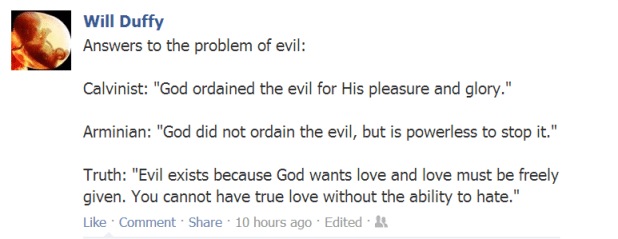
New Detractors Resource
Due to the need to understand and test opposing POVs, we have now added a “Detractors” page. This page will host views critical of the view that God is Open. Please send resources that you believe should be linked such that this site can be comprehensive.
To see full page, click here.
VOTD Deuteronomy 30:19
Deu 30:19 I call heaven and earth as witnesses today against you, that I have set before you life and death, blessing and cursing; therefore choose life, that both you and your descendants may live;
Bob Hill on Faith being a Gift of God
From Bob Hill’s discontinued website:
Question: Ephesians 2:8, is faith a gift of God?
i. Dear Ryan,
ii. I’m happy that our site helped you.
iii. In Ephesian 2:8,9, it’s not faith that is a gift from God, it is salvation. There is no place in the New Testament that says faith is a gift of God. There is a passage that some think says that faith is a gift. It is the verse you mentioned, Eph 2:8,9 For by grace you have been saved through faith, and that not of yourselves; it is the gift of God, 9 not of works, lest anyone should boast. However, the Greek for that verse does not say faith is the gift of God. When we look at the underlying Greek, we see that “grace” (xariti) is feminine and faith (pistews) is feminine, but the demonstrative adjective, “that” (touto) is neuter, likely the neuter complement of an abstract subject, salvation. If the “that” was referring to the feminine word “faith” (pistews), it would have been in the feminine case. So, instead, it is referring to the concept of salvation in the periphrastic participle, “have been saved”.
iv. When referring to concepts where the noun is not in the context, the word is usually in the neuter. Therefore, the gift that is being referred to by “that” (touto) is salvation. Salvation certainly is God’s gift to everyone who believes. Acts 13:39 and by Him everyone who believes is justified from all things from which you could not be justified by the law of Moses. Romans 1:16 For I am not ashamed of the gospel of Christ, for it is the power of God to salvation for everyone who believes, for the Jew first and also for the Greek. Romans 10:4 For Christ is the end of the law for righteousness to everyone who believes.
v. This faith is our faith. Notice the following passages. Matthew 15:28 28 Then Jesus answered and said to her, “O woman, great is your faith! Let it be to you as you desire.” And her daughter was healed from that very hour. Matthew 17:20 20 So Jesus said to them, “Because of your unbelief; for assuredly, I say to you, if you have faith as a mustard seed, you will say to this mountain, ‘Move from here to there,’ and it will move; and nothing will be impossible for you. Mark 2:5 5 When Jesus saw their faith, He said to the paralytic, “Son, your sins are forgiven you.” Luke 7:9 9 When Jesus heard these things, He marveled at him, and turned around and said to the crowd that followed Him, “I say to you, I have not found such great faith, not even in Israel!” Luke 7:50 50 Then He said to the woman, “Your faith has saved you. Go in peace.” Acts 14:9 9 This man heard Paul speaking. Paul, observing him intently and seeing that he had faith to be healed, Romans 1:17 17 For in it the righteousness of God is revealed from faith to faith; as it is written, “The just shall live by faith.” Romans 3:25 25 whom God set forth as a propitiation by His blood, through faith, to demonstrate His righteousness, because in His forbearance God had passed over the sins that were previously committed, Romans 3:26 26 to demonstrate at the present time His righteousness, that He might be just and the justifier of the one who has faith in Jesus. Romans 3:27 27 Where is boasting then? It is excluded. By what law? Of works? No, but by the law of faith. Romans 4:5 5 But to him who does not work but believes on Him who justifies the ungodly, his faith is accounted for righteousness, 1 Corinthians 15:14 14 And if Christ is not risen, then our preaching is empty and your faith is also empty. 1 Corinthians 15:17 17 And if Christ is not risen, your faith is futile; you are still in your sins! Ephesians 1:15 15 Therefore I also, after I heard of your faith in the Lord Jesus and your love for all the saints, Colossians 1:4 4 since we heard of your faith in Christ Jesus and of your love for all the saints; 1 Thessalonians 1:8 8 For from you the word of the Lord has sounded forth, not only in Macedonia and Achaia, but also in every place. Your faith toward God has gone out, so that we do not need to say anything. 1 Timothy 1:5 5 Now the purpose of the commandment is love from a pure heart, from a good conscience, and from sincere faith.
vi. Let me know if this does not answer your question.
vii. In Christ,
viii. Bob Hill
Yahweh Influences False Prophecy
Guest post by Neil Short of neshort.org:
In 1 Kings 22 a prophet Micaiah is consulted regarding the plans of Kings Ahab and Jehoshaphat to engage Aram in battle. In the prophecy, Micaiah first predicts success in the battle and then he predicts that King Ahab will be the primary casualty. He then elaborates with a vision of Yahweh authorizing a spirit to give lying oracles to Ahab’s prophets.
“and the LORD said, ‘Who will entice Ahab, that he may go up and fall at Ramoth-gilead?’ And one said one thing, and another said another. Then a spirit came forward and stood before the LORD, saying, ‘I will entice him.’ And the LORD said to him, ‘By what means?’ And he said, ‘I will go forth, and will be a lying spirit in the mouth of all his prophets.’ And he said, ‘You are to entice him, and you shall succeed; go forth and do so.’ Now therefore behold, the LORD has put a lying spirit in the mouth of all these your prophets; the LORD has spoken evil concerning you.” (1 Kings 22:20-23, RSV)
Terence Fretheim comments:
The variety of ways in which interpreters have sought to understand the lying spirit in this chapter is strange. Even notions of causality wherein God is said to cause everything that happens have intruded upon this conversation. But of course, if that were the case there would be nothing remarkable about this text! And despite some claims, such a notion of divine monism cannot be certainly found in any Old Testament text. (A full treatment cannot be provided here; for the finest guide available through these kinds of texts, see F. Lindström, God and the Origin of Evil.)
God can indeed use deception for God’s own purposes. We have seen in 1 Kings 13 that God makes use of a prophet who speaks both deceitful and truthful words to accomplish an objective, though God is not said to inspire the deceit there. Various texts make clear that false prophets who are explicitly said not to have been sent by God speak out over the course of Israel’s history (for example, Jer. 23:21; Deut. 18:22); at the same time, God can integrate such prophetic words into God’s larger purposes for Israel and the world. Texts like this, where God inspires the deceit (for example, Jer. 20:7; Ezek. 14:9), must be examined in their own contexts.
Several details should be lifted up for attention in trying to sort out this reference. The prophets of Ahab are specifically identified by God and Micaiah as “his prophets” and “all these your prophets” (vv. 22-23); they are contrasted with the “prophet of the Lord” by Jehoshaphat in verse 7. These are hired prophets (see Micah 3:5,11; the links to Micah are strong; v. 28b opens the book of Micah); they opportunistically speak assuring words to the king in order to assure themselves a living. There is no reason to think that these prophets are any different from the earlier 450 plus 400 prophets who ate “at Jezebel’s table” (18:19; only the 450 are slaughtered, 18:40). These are to be identified as false prophets, though their self-understanding might have been that they were true, as was the case with Hananiah (see v. 24; Jer. 28:2).
When the 400 prophets speak what they do, namely, that Ahab and the company will defeat the Aramaeans, they are speaking as such opportunists commonly do (e.g., Jer. 8:11; 23:17; Amos 5:18-20; Micah 3). So God does not use them against their natural proclivities or inclinations; the divine action is to encourage or inspire them in the direction they are already apt to go. It would not be unlike God’s intensification of already existing human obduracy (e.g., both God and pharaoh are the subject of hardening verbs in Exodus) or God’s giving the people up to their own stubbornness (Ps. 81:12). God is not in “total control of events” here; rather, the divine influence has been successful in inspiring them to stay on their opportunistic course.
Terence E. Fretheim, First and Second Kings (Louisville, KY: Westminster John Knox, 1999) 126-127.
VOTD Psalms 17:3
Psa 17:3 You have tested my heart; You have visited me in the night; You have tried me and have found nothing; I have purposed that my mouth shall not transgress.
Jephthah’s Daughter Was Not Sacrificed to God
A Facebook post by Nathaniel Runels on group Calvinism, Arminianism, Pelagianism, Wesleyanism, Finneyism, Lutheranism… . For context, Jephthah promised God that if God helped him then he would offer to God (as a burnt offering) the first thing he saw open returning home:
Jdg 11:30 And Jephthah vowed a vow unto the LORD, and said, If thou shalt without fail deliver the children of Ammon into mine hands,
Jdg 11:31 Then it shall be, that whatsoever cometh forth of the doors of my house to meet me, when I return in peace from the children of Ammon, shall surely be the LORD’S, and I will offer it up for a burnt offering.
Jephthah sees his daughter and fulfills his vow. Mr Runels writes:
Jephthah’s daughter was not a human sacrifice. She actually went out to mourn her virginity(38) the verse you left out. “And he said, Go. And he sent her away for two months: and she went with her companions, and BEWAILED HER VIRGINITY upon the mountains.. Most likely she was set a side as a virgin, not to be married, but in total service to the Lord. (Jdg 11:39-40.)”And it came to pass at the end of two months, that she returned unto her father, who did with her according to his vow which he had vowed: and she knew no man. And it was a custom in Israel, That the daughters of Israel went yearly to lament the daughter of Jephthah the Gileadite four days in a year.” Jeff Swayzee I am not here to argue either side, but I believe that you may have mis-read this passage. She was only said to have mourned her virginity, and she knew no man. Never said anything about death. And God’s character would not permit Him to receive such a sacrifice.
God does not demand human sacrifice.

Calvinist Dogma Trumps the Bible
From the Geneva Institute for Reformed Studies in an article entitled “Does God Repent of Things He Has Done?”:
Genesis 6:6-7 is a prime example, “And the LORD was sorry that He had made man on the earth, and He was grieved in His heart. So the LORD said, ‘I will destroy man whom I have created from the face of the earth, both man and beast, creeping thing and birds of the air, for I am sorry that I have made them.’ But Noah found grace in the eyes of the LORD.” (NKJV)
The old King James Version translates verse 7, “And the LORD said, ‘I will destroy man whom I have created from the face of the earth; both man, and beast, and the creeping thing, and the fowls of the air; for it repenteth me that I have made them.’ ”
Did God regret something he had done? Did he really repent as if he had made a mistake? Did God have to change his plan from what he had formerly wanted it to be? If so, then he is not the God we read about in the rest of the Bible. A careful study of these passages removes the apparent conflict.
First we need to take a look at the larger context. What do clear Bible passages teach about God’s nature?
God’s nature is “immutable” (he does not change).
The answer to Westminster Shorter Catechism question 4 is, “God is a Spirit, infinite, eternal, and unchangeable, in his being, wisdom, power, holiness, justice, goodness, and truth.”
If this is true, God can never regret, make errors, or change his plans. He answers to nothing greater than himself, therefore he is perfect and needs no improvement. God’s knowledge is perfect. It includes all things that ever will happen, there can be no reason to ever change or modify his plans.
Notice the appeal to a catechism. The remainder of the article lists various Bible verses that “contradict” God’s repentance, then offers an alternative meaning for “repent”. For context, click here.
See also, Calvinist Lies by Christopher Fisher which talks about the Hebrew use of the word repentance.
Knowing God through Jesus
An excerpt from Christopher Fisher on learning about God through Jesus:
Joh 14:9 Jesus said to him, “Have I been with you so long, and yet you have not known Me, Philip? He who has seen Me has seen the Father; so how can you say, ‘Show us the Father’?
Jesus is a picture to Christians of whom God is. What did Jesus show the disciples? Was it the traditional Latin attributes of God (omniscience, omnipresence, omnipotence, timelessness, and immutability)? The answer is clearly no.
Jesus admits to not being omniscient (Mar 13:32).
…
So in what sense did Jesus show his disciples “the Father”? It was in his actions, his relationship, his teachings, and his emotions. If Calvinists are to claim Jesus is God, they are at a loss to explain how not a single one of their championed attributes are shown through Jesus.
When a Calvinist plasters attributes of God onto a PowerPoint in church, think about which ones are shown in Jesus. This is a good test to see the differential in how Jesus portrays God and how Christians portray God. How do Christians measure up? Do they focus on the attributes that Jesus cares about? Or do they have their own private value system?
For full post, click here.
A Calvinists Explains TULIP
TULIP is an acronym used for five key tenants of Calvinism. For the Open Theist, it is important to understand the position of our detractors. The Contemporary Calvinist explains each point:
Total Depravity
Unconditional Election
Limited Atonement
Irresistable Grace
Perseverance of the Saints
On Christians Interpreting Divine Actions
From Colin E. Gunton’s Act and Being:
Greeks appear to stress a theology of divine being, Hebrews of divine action… there is a tendency to identify the divine attributes by a list of ‘omni’s’ and negatives – omnipotent, omniscience, omnipresent, infinite, eternal, and the rest – and then paste on to them conceptions of divine actions
Of course, Christians should take care when assuming outside factors onto a particular story.
Augustinian Christians Are Platonists
“Augustinian” is synonymous with “Reformed”, “Calvinist”, and “Classical Theists”. They are closely related to the philosophy of Plato. From Augustine:
If, then, Plato defined the wise man as one who imitates, knows, loves this God, and who is rendered blessed through fellowship with Him in His own blessedness, why discuss with the other philosophers? It is evident that none come nearer to us than the Platonists. -City of God, 8.5
For context, click here.
VOTD Jeremiah 18:7-8
Jer 18:7 At what instant I shall speak concerning a nation, and concerning a kingdom, to pluck up, and to pull down, and to destroy it;
Jer 18:8 If that nation, against whom I have pronounced, turn from their evil, I will repent of the evil that I thought to do unto them.
Proverbs are Proverbs
Submitted by Neil Short of neshort.org:
Proverbs 16:4 reads:
The LORD has made everything for its purpose, even the wicked for the day of trouble (RSV, NRSV, ESV, almost NASB).
This verse seems to teach the Calvinist doctrine that God created some people with the purpose of sending them to Hell (a logical corollary to Calvinism’s Irresistible Grace and Unconditional Election). This interpretation contradicts several straightforward Biblical passages saying that God does not want anybody to be damned and he is grieved when somebody chooses that life destiny (1 Timothy 2:4; 2 Peter 3:9; Ezekiel 18:30-32; 33:11; Lamentations 3:33). That’s why we check for an alternative interpretation for Proverbs 16:4! or we need to accept the Calvinist explanation and wrestle mightily with the other passages (as Calvinists do with 2 Peter 3:9).
My instant reaction to the “destined for Hell” view is a question. Why would you grab a verse out of the Wisdom literature of the Bible and apply it mathematically – like an axiom or theorem? Think of any proverb from Proverbs. Is it a rule that is true in every circumstance? The proverbs are true in a general sense; but there are [almost] always exceptions. Once we understand exactly what Proverbs 16:4 actually says, we’ll see that the usual method of applying proverbs applies here too. In fact, reading this verse in the Calvinist way is reading it in some way other than as a proverb. What life-lesson is being taught by stating that some people are created by God for Hell? None at all. It is thus seen as a statement of universal fact amidst a vast ocean of wisdom proverbs. Point: When you apply a Bible reading, be sure to acknowledgement the kind of literature the reading is.
For the full post, click here.
God comforts Job
W Scott Taylor hosts this commentary on Job (written by T. C. Ham):
The character of God in the book of Job appears to defy coherent portrayal. Seemingly capricious, God puts Job through inconceivable pain and loss over a cosmic wager against the adversary. Remaining reticent throughout most of the book as Job and his friends carry on endlessly, God allows Job to suffer in the dark. When Job asks for an answer, he receives what appears to be an angry rebuke. The God of Job 38 seems boastful, callous, and sardonic.
Perhaps there is another way to understand the Yhwh speech functioning within the world of the book—a way that mitigates the intensity of God’s anger, correlates the humbling of Job (in the poetic sections) to God’s pride in the servant (in the prose framework), and allows not only for a pedagogical opportunity but for a moment of consolation. In the following analysis of the beginning words of Yhwh in Job 38, I propose that the tone of the Yhwh speeches is closer to one of genuine compassion and comfort, suggesting that there may be a coherent character portrayal of God in the book of Job after all. In speaking gently, God addresses Job’s condition of suffering, without satisfactorily dealing with his concern over his innocence.
For full pdf, click here.
Enyart on God being Open
In this Bob Enyart Live episode, Pastor Enyart calls a Calvinist pastor and questions that individual on if God is Open. From the show description:
* Pastor Taylor Discusses: Open Theism with Bob Enyart. After giving a woman caller the strongest possible warning against Pastor Enyart’s teachings, Pastor Taylor’s audience gets to hear for themselves the biblical evidence that God is free, and able, to change the future, and thus, the future is not settled, but open!
For the full show, click here.
I AM is the Relational Name of God
From Craig Fisher:
Remember, God has already identified himself by connecting himself with the patriarchs Abraham, Isaac and Jacob. When God replies to Moses, “I will be who I will be,” he is referring to that relationship. This is the same usage as Paul’s statement, “I am who I am”, referring to Paul’s history. This statement is a historical identification. It emphasizes that this is a fixed and permanent history, and this emphasis is carried on in the following verses.
God takes on the name, “I AM” to tell the nation of Isreal: ‘I AM has sent me to you.’” (Exodus 3:14) What does this “I AM” mean? God reiterates:
Exo 3:15 Moreover God said to Moses, “Thus you shall say to the children of Israel: ‘The LORD God of your fathers, the God of Abraham, the God of Isaac, and the God of Jacob, has sent me to you. This is My name forever, and this is My memorial to all generations.’
It is clear from the context that “I AM” is the short form for this longer identity. He says “I AM” the God of your fathers. “I AM” is explicitly a historical identity of a personal relationship with his creation.
For full blog post, click here.
Jacques More on Saul
From Jacques More’ site, from an article on if God knows all future events:
King Saul
If you have read the previous chapter this is not totally new. This is an expansion and further explanation.
In Israel there was no king until God spoke to Samuel his prophet and directed him to pick out Saul a Benjamite to be their first king. Saul was chosen by God for this role, this post, as king (1 Samuel 10:24, 2 Samuel 21:6):. . . Do you see him whom the LORD has chosen . . .
1 Samuel 10:24
. . . Saul, whom the LORD chose . . .
2 Samuel 21:6
After ruling for a while, Saul deliberately rebelled against God and on one such public occasion, Samuel came along and said these words to Saul:
You have done foolishly. You have not kept the commandment of the LORD your God, which He commanded you. For now the LORD would have established your kingdom over Israel forever. But now your kingdom shall not continue.
The LORD has sought for Himself a man after His own heart, and the LORD has commanded him to be commander over His people, because you have not kept what the LORD commanded you.1 Samuel 13:13-14
I would like to look at ‘the LORD would have established your kingdom over Israel forever. But now your kingdom shall not continue’.
If the Bible is inspired and profitable for doctrine (2 Timothy 3:16) and God does not lie (Numbers 23:19, Titus 1:2), then I am bound to believe that God would indeed have established Saul’s kingdom over Israel for ever.
Now if God knew beforehand that Saul (the king He chose) was going to be a rebel like he became, then it is impossible for Him to have established his kingdom over Israel for ever.
So, either He would have established Saul’s kingdom, or, He would not. Since God does not lie, and I believe the above passage is scripture and therefore inspired by God, I can only conclude that God did not really know beforehand how Saul was going to end up.
For this passage to make full sense, the choice is simple, either God did not fully know beforehand and is telling the truth about the fact that He ‘would have established your [Saul’s] kingdom over Israel for ever’, or, God is not telling the truth: He in fact would not have established Saul’s kingdom, in the full advance knowledge that he was going to be rejected.
To my mind it is very plain: I believe God is telling the truth, the scripture is inspired and it makes full sense of God not to know fully the free choices of 1man
For full article, click here.
Library of Theology Resources
On Kerrigan Skelly’s website he hosts plenty of literature on Open Theism. Although Skelly is not an Open Theist, Jesse Morrell helped him collect these resources.
On his website he hosts resources such as The Open View of God by Gregory Boyd.
And the essay by Elseth on Katabole, a chapter out of his classic Open book Did God Know? (out of print).
For the link, click here.
VOTD Psalms 42:2
Psa 42:2 My soul thirsts for God, for the living God. When shall I come and appear before God?
Free Intro to Predestination and Free Will

Bob Enyart is hosting the introduction to his “Predestination and Free Will” seminary. Download now at kgov.com.
From the site:
…the question of whether or not God has planned out each person’s life affects us. Does God have a plan for your life? Does a blueprint exist for your future? Did God predetermine whether or not you would get married, and to whom? Did God plan whether you would be wealthy or poor, happy or sad? If God does plan your life, does He do so in minute detail or in general themes? If God has a plan for your life, are you able to alter that plan? This topic directly influences people concerning how they live their lives. As Christians, we must seek God to accurately portray the LORD to others. For any misrepresentation of God will dishonor Him and perhaps bring harm to those misled.
Oord Recommends a Few Books
Oord lists his latest reading picks. From the list:
Morality, Autonomy, and God, by Keith Ward. This philosophy of ethics book takes on major voices in philosophical ethics and science. Ward weaves together a view of ethics that embraces values, ideas, and God. Those who may only know Ward’s books aimed at a popular audience will find he is quite capable of writing for the academy in convincing ways. Ward’s arguments trump atheistic and naturalistic attempts to explain or explain away goodness.
Calvin vs. Wesley: Bringing Belief in Line with Practice, by Don Thorsen. The author is an expert on Wesley and theologian at Azusa Pacific University. I really like the accessible way the book is written. And given that I agree with the author’s view that Wesleyan theology is preferable to Calvinist theology, I enjoyed reading this book. I’ll be recommending it to students and laity.
God, Chance, and Purpose: Can God have it Both Ways? By David J. Bartholomew. I’ve been reading this book in hopes of gleaning insights for a book I’m writing on chance and purpose. Bartholomew writes as one who knows statistics and probabilities, and he uses various examples and theories to argue that chance is integral to God’s creating. He’s also not very fond of intelligent design!
To see full list, click here.
Restraint of Free Will
An excerpt from Christopher Fisher. Responding to a post by the Contemporary Calvinist:
God cannot just override Nebuchadnezzar’s will. It would be infinitely easier for God to just “enforce” His will by overriding human will. God need not “flood the Egyptians” (Exo 14), “make Zacharias mute” (Luk 1), or “send lying spirits to convince false prophets” (1Ki 22). If God overrode wills, God could just “make the Egyptians decide to turn around”, “make Zacharias name his son John”, and “make Ahab decide to go to battle”. But the Bible does not describe this. God instead uses his resources to physically and mentally stop and manipulate people. God plagues Nebuchadnezzar both physically and mentally, turns him into a psychotic beast, in order to make him humble. This works, and Nebuchadnezzar is much more humble than before the humiliation…
Free will is not constrained by physical and mental impediments. Free will is our internal decisions, apart from physical and mental capabilities or limitations. When Calvinists see God killing someone as “limiting that person’s will” we should correct them. God impedes individuals, but nowhere in the Bible “limits their will”.
For the full post, click here.
God Can Force An Outcome
From user Desert Reign on Theology Online:
In the Bible Paul says that God’s plan of salvation was not dependent on anything any man did. Paul gives different examples of this, one of which is the choice of Jacob over Esau to be the father of the chosen nation. Paul explains that this choice was not based on anything good or bad the twins did since the choice was made while they were still in the womb. This gives a flavour of what it means when we say that God’s plan didn’t depend on anything anyone did. Many people assume that the subsequent history was also predestined but it was not. It turned out that Jacob loved God eventually. But Paul’s point is that it need not have turned out that way. Jacob could have remained the villain that he started out as and it would not have affected God’s plan. Jacob would still have been the father of the chosen nation.
So in general I can make a principle, that God interacts with the world according to his faithful character but that if he wishes to force an outcome, then he may, regardless of any event or anyone’s decision.
For full thread, click here.
VOTD Genesis 2:19
Gen 2:19 Out of the ground the LORD God formed every beast of the field and every bird of the air, and brought them to Adam to see what he would call them. And whatever Adam called each living creature, that was its name.
Books Against Open Theism
A round-up of popular literature against the God being open:
Creating God in the Image of Man? by Norman L. Geisler [All Open Theists should read this book to understand how Calvinist theologians think]
God’s Lesser Glory: The Diminished God of Open Theism by Bruce A. Ware
No Other God: A Response to Open Theism by John M. Frame
Their God Is Too Small: Open Theism and the Undermining of Confidence in God by Bruce A. Ware
Beyond the Bounds: Open Theism and the Undermining of Biblical Christianity by John Piper
The Battle for God: Responding to the Challenge of Neotheism by H. Wayne House [Neotheism is a term coined with intent to try to hijack the term “Open Theism”. Calvinists do not like arguing against “Open” Theism.]
God is Open
Guest post by Christopher Fisher
From a blog post by TC Moore:
Open Theism has a serious PR problem. In fact, it has several. For starters, the name is terrible. It simply doesn’t clearly communicate the view’s central tenet: the partially indeterminate nature of the future. Which is understandable, since the central tenet is obscure and unsexy.
TC Moore is correct: Open Theism has a branding problem, but not for the reason he thinks.
Open is a great label. The current computer trends are Open Source, Open Worlds, and Open Standards. Open means free. Open doors lead to freedom. Open living rooms and open kitchens populate the United States.
Open should be capitalized as a brand. If the brand is failing, it is not due to the “Open” term. It is due to the PR campaign. The focus of most Open Theists is our own freedom. What our focus should be is God’s freedom.
God is open. God is free. God is powerful. God is love. God can do what He wishes. No one can change the image of God into the closed idols that He despises. God describes himself as living and dynamic. God is the God of relationships and defines Himself by them (“the God of Abraham, Isaac, and Jacob”).
Open Theism should focus on God. God is not chained. God is not closed. God is not confined. God is not static. God is not an idol.
That should be the debate. That should be the branding. God is open and free.
Oord on God’s Culpability for Evil
From Thomas J Oord
Distinguishing between God willing evil and God permitting it offers little consolation to victims of evil. When victims realize that God, as understood by Arminius, could have prevented their pain and suffering but voluntarily permitted it, they will likely find it difficult to retain trust in God’s love. After all, an omnipotent God who wills evil is only slightly more morally reprehensible than an omnipotent God who could unilaterally prevent evil but permits it nonetheless.
Arminius employs what I find to be an unsatisfactory greater goods theodicy, when he says, “God would never permit evil if he could not by his omnipotence produce good out of evil” (100). The implication here, of course, is that every rape, genocide, murder, etc. must have been permitted for some greater good. I find it difficult, if not impossible, to believe this is true for every instance of evil.
To read the full post, click here.
Enyart on Omniscience
From the classic Bob Enyart vs Samuel Lamerson written debate:
Omniscience
Omniscience means that God knows everything, exhaustively, and without exception. Does Scripture really teach this, or is this another philosophical invention? Memories of perversion burden God, and nothing requires Him to retain pristine recollections of every filthy deed. “You have burdened Me with your sins, you have wearied Me with your iniquities” (Isa. 43:24). God wants to put these wicked things out of His mind because it is ugly to remember them. “I, even I, am He who blots out your transgressions for My own sake; and I will not remember your sins” (Isa. 43:25; etc.).
When God says to the wicked, “I, even I, will utterly forget you” (Jer. 23:39), we rightly constrain this as a figure of speech, not meaning that God will no longer even recall men like Esau or Judas, but that His mercy toward the wicked will not endure forever. So, when God says that memory of filth is a burden that He wants to blot out of His mind, we weigh that against our philosophical doctrine of omniscience. Settled View proponents prioritize the quantitative aspect of vast knowledge above the qualitative attributes of God as good and personal. The Settled View denies out-of-hand the possibility that God’s loathing of sin might bring Him to limit His recollection of lewd acts. A pornography video does not have to play eternally in God’s mind.
Passages of God’s desire to forget sin are far more literal and “exhaustive” than any strained “proof-texts” for omniscience. We know that because these passages flow from the goodness and righteousness of God, whereas the omniscience “proof-texts” deal with quantity rather than quality. Thus they exaggerate the superficial at the expense of the substantive. No one can impose vulgar duty on God. Such basic biblical teaching shows that the non-biblical term “omniscience” overstates the truth. What is the true doctrine of God’s knowledge? God knows everything knowable that He wants to know. God does not want to know everything! And yes, He knows how many hairs are on your head, but He doesn’t know how many hairs are on the boogeyman’s head, because there is no boogeyman. God can do that which is doable, and He can know that which is knowable. So He knows, or at least He can determine instantly if He wants to know, how many hairs are on your head. And if He wants to lengthen the life of sparrows, God can instantly locate and strengthen them all. There are beings who keep track of endless reams of meaningless data, but God is not a bureaucrat. Does God keep track of every molecule in every roll of toilet paper, to trace its path from tree to the mill, to the store, to your sewer pipe, and back again? Does this interest God? The LORD has a purpose for His knowledge. God created man in His likeness, able to intuitively dismiss infinite piles of data as unimportant and endless possibilities as meaningless. God’s ways are higher than our ways (Isa. 55:9), but they are not lower. He reveals that He has no desire to retain Memorex memories of endless sadism, sodomy, and rape, and He need not keep infinite charts analyzing the base bodily functions of all animals. So while the unbiblical concept of omniscience demeans God, the true doctrine of His knowledge exalts Him in wisdom. God knows everything knowable that He wants to know.
For full debate, click here.
Greg Boyd answers questions
Pastor Gregory Boyd is Rachel Held Evans’ guest today, answering questions on Open Theism.
Excerpt questions:
Stephanie • 9 hours ago −
How old is this view? Is it relatively new, or have Christians been believing this for some time?Erin • 9 hours ago −
Could you explain, in your perspective, how God ‘knows’ — knows time, knows human intention, knows… everything? Does God know all possible outcomes or does Open Theism see it more that God is moving at the pace of humanity, & perhaps doesn’t know?Matt • 9 hours ago −
This is an interesting concept that I have often pondered. What would you say are some of the common “gotcha” verses people use to contradict this “open view of the future,” and what is your take on those verses?Trevor Wilson • 7 hours ago −
Anyone is free to answer this because I’m sure it’s different for everyone but:Why does our perception of the future matter? How does this affect how we treat our neighbors?
I think I’d be more interested in this discussion if I knew the answer to this.
Affiliates, feel free to answer (these or others) and then submit as guest posts.
All Days Were Written Before There Were Any
Christopher Fisher explains why Psalms 139:16 does not mean what the Calvinists would claim. An excerpt:
The KJV translators correctly saw that King David’s subject did not stray. King David was still talking about fetology in verse 16. David is talking about being formed in the womb. God saw David developing in the womb, had a blueprint (book), and David’s fetal development followed that path. David’s point is not “fatalism”, but that “fetal development is not Ad Hoc”. Before David developed as a baby, that path had been designed by God.
To put this in perspective, in the preceding 3 verses David is clearly talking about how his body is designed during pregnancy. In the last verse, Calvinists believe David switches topics to talk about fatalism. This is a mistranslation. The entire passage is about fetal development.
For full post, click the link.
Judas Was Not Predestined or Foreknown to Betray Christ
Excerpt from W Scott Taylor:
The important nuances of Greek syntax is evidenced here and seriously undermines the traditional view of Judas’ being either foreordained or foreknown to betray Jesus…
“And one of you is a devil.” Jesus does not say that Judas was a devil when he chose him, but that he is one now. In 13:2 and 27 John speaks of the devil entering Judas. How soon the plan to betray Jesus first entered the heart of Judas we do not know (12:4). One wonders if the words of Jesus did not cut Judas to the quick.”
…
This should be a relief to those who have wondered how in the world Jesus’ betrayal could have anything to do with God’s plan of Salvation.
To read more, click the link.
Did Augustine Corrupt the Church with Gnostic Doctine
From Jesse Morrell:
A Calvinist Reads Pride and Prejudice
From Christopher Fisher:
TULIP Meme

Calvin on Free Will
Re-posted from Gregory Boyd:

The Mechanics of Prophecy
Jacques More writes about prophecy as it relates to Open Theism:
in… an open theist view, how can prophecy exist about certain events yet to happen?
…
The answer is simple, instead of things intended to happen coming about due to direct control of everything, they come about out of indirect control as well as direct input and influence. There is the difference.
In direct control of a string puppet there is no movement observed that has not been controlled by the puppet handler. All the movements are directly related to the movements of the puppet handler, no matter how long the strings are.
With the indirect control of a small flock of sheep to put in a sheep pen, by using a faithful dog, a shepherd gives commands and input to the dog whilst having provided and prepared the pen in the first place. The sheep have no alternative in their make up, but to do the shepherd’s bidding via the dog and the layout of their environment: e.g. the gate is open, the pen is accessible and the walls making up the pen are secure and complete, plus they have a healthy fear of the dog.
There is a better way to shepherd for those with time and willingness to relate with the sheep. The shepherd in spending time and talking and whistling is thereby known by his sheep. So that in leading them without a dog and doing so by whistling and giving commands can be followed by the sheep to where he wants to take them. No dog is necessary.
Prophecy in open theism involves God knowing all the circumstances leading up to an event necessary to bring that event about. God then ensures these circumstances are present in time for that event. This is in conjunction with leading, inspiring and instructing those whom God has relationship with to play their parts. All others are directed using the dog and circumstance method.
To see full article, click here.
 God is Open