Open Theism
Worship Sunday – This is My Desire
This is my desire to honor you
Lord, with all my heart I worship you
All I have within me I give You praise
All that I adore is in you
Lord I give you my heart
I give you my soul
I live for you alone
Every breath that I take
Every moment I’m awake
Lord have Your way in me
Lord I give you my heart
I give you my soul
I live for you alone
Every breath that I take
Every moment I’m awake
Read more: Hillsong United – This Is My Desire Lyrics | MetroLyrics
Podcast EP121 – Tale of Two Cities – Sodom and Nineveh
Answered Questions – Free Will and Sovereignty
 Grace Family Fellowship asks:
OT argues that absolute sovereignty destroys real relationship since real relationship is predicated on free will. If I am not free to take on the relationship or to reject it then I can have no relationship. The question is, how can a sovereign God really relate to me as a person, if my personhood, by definition, requires absolute freedom. How do human responsibility and divine sovereignty co-exist? This is not a new question and has been answered effectively elsewhere.
Perhaps Arminians and Calvinists and other shades of Classical Theists need to find a new word. Sovereignty just does not have the meaning that makes in incompatible with free will, as evident by the more common use of that word in relation to human monarchs. Roger Olsen writes:
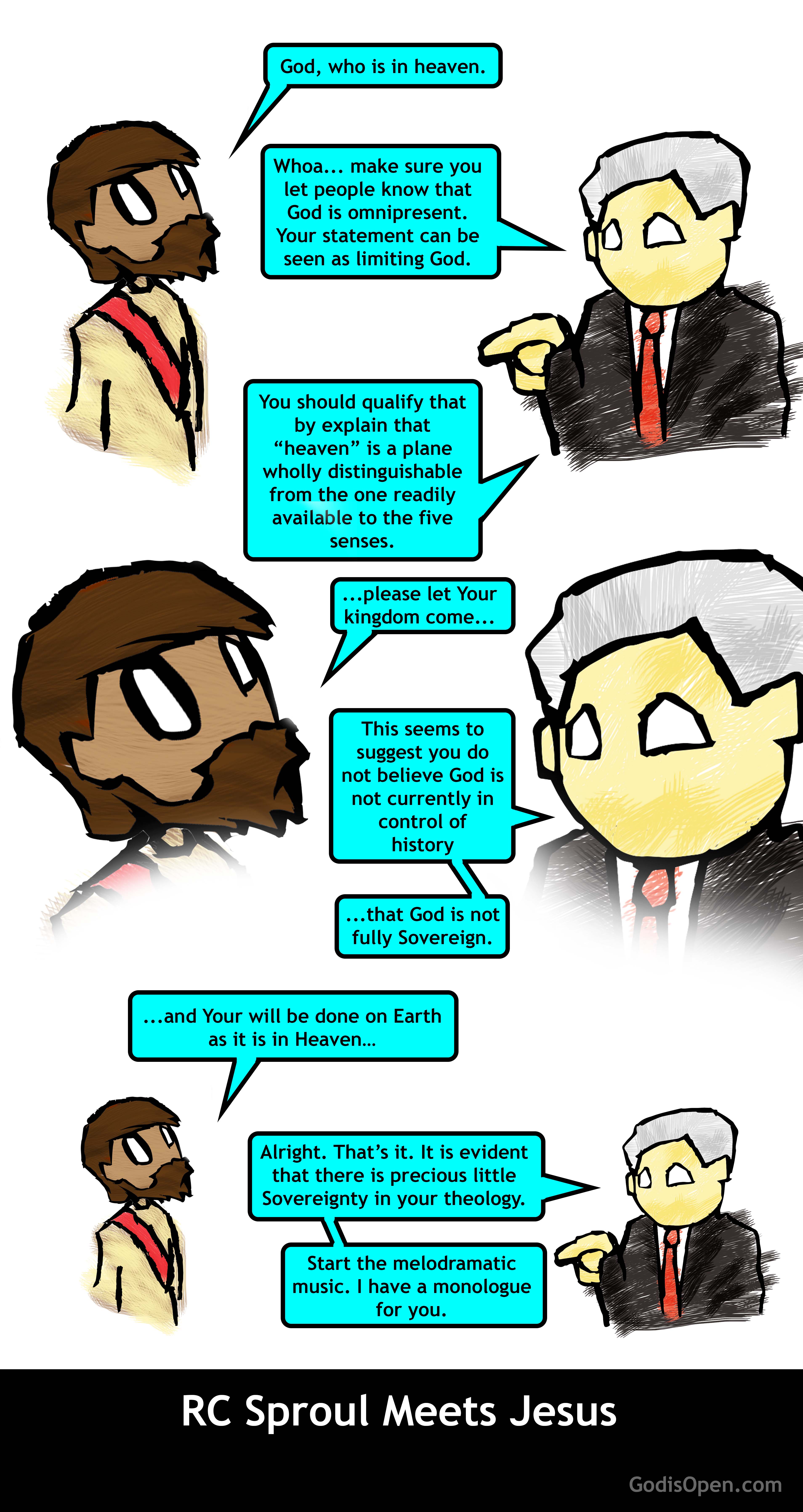
There is no “sovereignty” in human experience like the “sovereignty” Calvinists insist we must attribute to God in order “really” to believe in “God’s sovereignty.” In ordinary human language “sovereignty” NEVER means total control of every thought and every intention of every subject. And yet it has become a Calvinist mantra that non-Calvinists “do not believe in God’s sovereignty.” I have a tape of a talk where R. C. Sproul says that Arminians “say they believe in God’s sovereignty” but he goes on to say “there’s precious little sovereignty left” (after Arminians qualify it). And yet he doesn’t admit there (or anywhere I’m aware of) that his own view of God’s sovereignty (which I call divine determinism) is not at all like sovereignty as we ordinarily mean it. That’s like saying of an absolute monarch who doesn’t control every subject’s every thought and intention and every molecule in the universe that he doesn’t really exercise sovereignty. It’s an idiosyncratic notion of “sovereignty.”
The Classical Theist seems to be coopting a word with positive connotations to illustrate a concept for which there are better words. Micromanager, Control Freak, or Petty Tyrant come to mind. But these words do not inspire positive imagery. These concepts are explicitly rejected as attributes of God by Open Theists, eliminating all conflict between these concepts and Free Will.
Apologetics Thursday – Loose Prophecy Dates
Millard Erickson channels his inner Bruce Ware to argue that if God gives timeframes about the future, then the future does not have freewill choices:
Here again, however, a feature of the narrative presents a problem for the open theist position. Bruce Ware in particular points out that Jehovah does not just tell Hezekiah that he will extend his life. He is much more specific: his life will be extended by fifteen years. Ware says:
Does it not seem a bit odd that this favorite text of open theists, which purportedly demonstrates that God does not know the future and so changes his mind when Hezekiah prays, also shows that God knows precisely and exactly how much longer Hezekiah will live? On openness grounds, how could God know this? Over a fifteen-year time span, the contingencies are staggering! The number of future freewill choices, made by Hezekiah and by innumerable others, that relate to Hezekiah’s life and well-being, none of which God knows (in the openness view), is enormous. 19
Erickson, Millard J.; Erickson, Millard J. (2009-08-30). What Does God Know and When Does He Know It?: The Current Controversy over Divine Foreknowledge (p. 24). Zondervan. Kindle Edition.
Erickson does not discuss any Open Theist counters to his point, but many can be easily imagined. Both “God’s protection” and “predictable probabilities” are two possible answers. A third that will be developed in this response is that often in the Bible a timeframe is given and that timeframe is only a loose estimate, sometimes off by decades. The pliability of predicted timeframes is both good evidence that the future is not known and good evidence that in the case of Hezekiah, that the timeframe did not have to be exact to still be fulfilled.
Two loose predictions that will be discussed are the Babylonian exile and the captivity in Egypt. In Genesis 15, God promises Abraham that Israel will be oppressed in Egypt for 400 years:
Gen 15:13 Then the LORD said to Abram, “Know for certain that your offspring will be sojourners in a land that is not theirs and will be servants there, and they will be afflicted for four hundred years.
There is a specific and divergent number given in an Exodus text:
Exo 12:40 The time that the people of Israel lived in Egypt was 430 years.
Exo 12:41 At the end of 430 years, on that very day, all the hosts of the LORD went out from the land of Egypt.
Here is Answers in Genesis trying to answer the problematic numbers (they attempt to start the 400 years of persecution with Ismael mocking Isaac!). Not very persuasive. It is more likely the numbers are ballparks and not absolute.
https://answersingenesis.org/bible-questions/how-long-were-the-israelites-in-egypt/
The next event at which we will look is the Babylonian captivity. Christine Hayes writes:
Notice that the decree at the very beginning in Chronicles — in the 2 Chronicles version — the decree is said to fulfill the word of the prophet Jeremiah. Now, you remember that Jeremiah prophesied that the Babylonian exile would last 70 years; he wrote a letter, he said settle down, this is going to last a while, plant plants and build homes. So he had prophesied 70 years for an exile. Well, from the time of the first departure of exiles in 597, maybe to the return in 538, 61 years — it’s close. If you look from the destruction of the first temple perhaps in 586 to the completion of the second somewhere between 520, 515, we’re not really sure, that’s about 70 years. Either way, it seems that in the eyes of the Chronicler it was close enough. This seems to have been a fulfillment of Jeremiah’s prediction. That it would be about 70 years before they would return.
One site attempts to claim that the 70 years applies not to the judgment Israel but to a judgment against Assyrian. But to the author of Daniel, 70 years of desolation was applied to Israel:
Dan 9:1 In the first year of Darius the son of Ahasuerus, of the lineage of the Medes, who was made king over the realm of the Chaldeans—
Dan 9:2 in the first year of his reign I, Daniel, understood by the books the number of the years specified by the word of the LORD through Jeremiah the prophet, that He would accomplish seventy years in the desolations of Jerusalem.
Either way, the Babylonian exile and the Egyptian captivity present major problems and inspire from apologists all sorts of clever ways to avoid the problems. Surely, if Hezekiah ended up dying in only 5 years, all sorts of similar apologetics would spring up (“Maybe the 14 years is counting from a time Hezekiah would have died if not for the foreknown repentance”). These explanations, much like the attempted explanations of the Babylonian and Egyptian captivities, stretch credulity.
In the Bible, prophecy is often not exact even when using precise numbers. This is because the future is not known, and leeway is allowed. These loose timeframes, contrary to being evidence against Open Theism, is evidence for Open Theism.
Grace Family Fellowship Accuses Open Theism of being as Philosophical as Classical Theism
From Grace Family Fellowship:
When God’s love is cast in stone as His premier attribute, then all other attributes and all the decisions that God makes must flow out of love. Perhaps this is why there has been little or no discussion of God’s punishment and wrath by Open Theists, other than to say that they cannot conceive of a God who would punish for eternity.[45] Yet, the orthodox tradition has been to examine God’s attributes individually as a means of gaining a crisper definition to then inject into the overall picture of God. Open Theists suggest that CT has been overrun by neo-platonic thought, but isn’t one of the deplorable hangovers of Plato the creation of false dichotomies? OT has partitioned love from the rest of God where there is no textual warrant and has fallen into the trap they accuse others of squirming in.
Grace Fellowship Church Accurately Understands Open Theism
From Grace Fellowship Church:
As will be seen, OT is primarily a way of understanding God. It is an outright rejection of Classical Theism (CT throughout the rest of this paper) and claims to be a more accurate interpretation of what the Bible has to say regarding the nature of the Trinity and how the Trinity engages creation. It is not so much a redefinition of particular theological compartments[6] as it is a complete remodeling of theology proper. As may be expected, however, a reconstruction of God has incredible corollary effects on these particular sub-doctrines.
Meme Monday – Fable
Worship Sunday – I’m Trading My Sorrows
I’m trading my sorrows
I’m trading my shame
I’m laying them down for the joy of the Lord
I’m trading my sickness
I’m trading my pain
I’m laying it down for the joy of the Lord
We say yes Lord yes Lord yes yes Lord
Yes Lord yes Lord yes yes Lord
Yes Lord yes Lord yes yes Lord Amen
I’m pressed but not crushed persecuted but not abandoned
Struck down but not destroyed
I am blessed beyond the curse for his promise will endure
That his joy’s gonna be my strength
Though the sorrow may last for the night
His joy comes with the morning
Podcast EP120 – Canonical Criticism and Christine Hayes
Answered Questions – Fallacies in Arguments
A critic of Open Theism writes:
How could anyone trust a god who makes mistakes, who learns, who can’t control the hearts of His people, who must wait to see what happens? Is this the stuff of confidence? Why would you even pray to a God like that?
Open Theists claims are completely self-refuting. First of all you would need more knowledge then God to make these kind of assertions in the first place.
Besides how do they explain the thousands prophesies fulfilled to the very dot and letter if God wasn’t all knowing to predict them first? The real God is present everywhere, infinite, eternal, unchangeable, eternal, wisdom, all powerful, holiness, justice, goodness, truth, outside of time, self existed. He is not like his small minded creation, lol!
I respond:
First,do you understand what the moralistic fallacy is? I can easily say “who can trust a God that controls everything and sends people to hell through no fault of their own”. The problem comes because our preference do not affect reality. Do you understand this?
Second point, it is the fallacy of hasty generalization to claim just because some prophecies do come true, then God must know the future. The relevant data are the failed prophecies. If there is just one failed prophecy, then this shows that your contention is false. The prophecy of Nineveh is one such prophecy. I contend, if you try to explain away why this prophecy is not a failed prophecy, there is no such failed prophecy in which you could not use similar logic, thus making your original claim unfalsifiable.
Apologetics Thursday – Ware on Genesis 22
Bruce Ware objects that God’s test of Abraham just could not have taught God what Open Theism claims that it has taught God. Ware’s third reason for this:
Third, given the openness commitment to the nature of libertarian freedom, God’s test of Abraham simply cannot have accomplished what open theists claim it has.
…
According to these openness advocates, Abraham’s testing proved to God now that Abraham was a faithful covenant partner who, therefore, fore, could be trusted to be faithful in working with God in the fulfillment of God’s covenant purposes. But since Abraham possesses libertarian freedom, and since even God can be taken aback by improbable able and implausible human actions, what assurances could God have that Abraham would remain faithful in the future? One realizes how transient the “now I know” is for God. As soon as the test is over, another test would seemingly be required.
And notice, too, an interesting dilemma faced in the openness understanding of Abraham’s testing. At best, what God could come to know, on openness grounds, is whether or not Abraham’s passing the test demonstrated the continuation of a pattern of behavior that would render Abraham’s future faithfulness more probable. But of course, on the one hand, if Abraham’s passing of this test confirms further a pattern tern of faithfulness Abraham had already demonstrated in his life of trust and obedience, then it could not be literally true that in this test (i.e., the test of the sacrifice of Isaac) God learned now that Abraham feared him. On the other hand, if Abraham passed this test in striking contrast to a pattern of his previous unfaithfulness, why would God then conclude that Abraham would remain faithful in the future, even when he had passed this test, given his previous pattern of disobedience? Either way, whether Abraham had previously demonstrated a pattern of faithfulness fulness or not, the singular and transcient nature of this specific test demonstrates that what openness proponents claim God learned simply could not have been gained.
Bruce A. Ware. God’s Lesser Glory: The Diminished God of Open Theism (Kindle Locations 587-600). Kindle Edition.
Ware offers a double edged third critique:
1. God cannot have gained any certainty from the test.
2. God should have already seen the pattern.
Let the reader imagine a perhaps analogous scenario. A wife wants to know if her husband is faithful. She knows that he has been faithful in the past, but really wants to see if he holds true when presented with the opportunity. This will impart new knowledge: a new situation in which his faithfulness has never yet been tested.
She enlists a friend of hers to approach him. Her friend is attractive and seductive. She arranges for her friend to proposition her husband. After an attempted proposition, the husband declines. The wife then calls her husband, exclaiming “Now I know that you are faithful to me.”
Are Ware’s objections valid? Does the husband’s past faithfulness make this new data point obsolete? Or, is this a useful and necessary data point in understanding who her husband truly is?
Can one now object to the wife’s statement that “now she knows that he will be faithful” because he still has the free will to become (at some point of time) unfaithful. Or maybe she should not be able to make that claim because she just didn’t hit the right variables (maybe her husband prefers blondes over brunettes and the wife has to exhaust infinite numbers of test to truly know anything).
Ware’s objections seem unreasonable. Even with a history of data points, a new data point might yet be informative, especially when it is designed to cover a point that no previous data point has covered. Additionally, a specific test can act as both a proxy for other similar tests and as a proxy for true knowledge. That truth can be proclaimed as such.
See also:
Bruce Ware Makes a Candid Admission
Without any question, the most straightforward ward and literal meaning of these words is just as openness advocates say it is. God now learned what previously he had not known. When Abraham actually raised the knife, then and only then was God able to say, “now I know” that you fear me. God learned something he had not known before, and this demonstrates that he does not have exhaustive knowledge of the future-so argues the open theist.
Bruce A. Ware. God’s Lesser Glory: The Diminished God of Open Theism (Kindle Locations 584-587). Kindle Edition.
Jon’s Open Theist Testamony
From a 2010 post on a now defunct blog:
Not until a tragic accident that involved the passing of a dear youth member and friend that, the Classic theistic view somewhat crumbled. Some people were telling or at least implying that God is the author of life and if that is true, my friend’s death was somewhat authored by God. As I thought about it, far be it that I accepted that frame work for God. If I believed in a God who cared why then would he author a tragic story for my friend like one a novelist would do to his characters.
Enter Open Theism. This is a view which responds to Classic Theism. This view believes that God does not know the future exhaustively, leaving the future open for us to partner with him. Hence this view is a strong argument for the proposal of why prayer is important. Since the future is open and God does not know exhaustively, we partner with God in ways that we somehow can change his mind.
For a period of time, I guess in a subtle manner, my views gravitated towards open theism because it somehow showed a God who can show love to his creation rather than one who has already written about your whole life and somehow you are stuck in that story he wrote whether you like it or not. Somehow classic theism did not really resonate well with a God who is loving. I mean sure you can say that God knows what’s best but there is no room for free will here.
So with all these issues plunging in my mind, it seemed to me that open theism held more sense than a mechanical, detached sovereign God.
Meme Monday – Judas
Worship Sunday – Eastern Hymn
Bring us love, You who are love
Bring us peace, You who are peace
We need love, O divine love
We need your peace, Your merciful peace
Bring us love, O divine love
Bring us peace, You who are peace
How gracefully
You come along
How gracefully
You come
Glory, glory, glory
God is near to each one of us
Holy, holy, holy
God is near to each one of us
O grant us reprieve from the fighting
So we just rest our head on the shoulder of the One
In His arms we’re forever grateful for the contact
O so blessed for a moment’s rest
Weeping knowing we have been touched
Weeping knowing we have been touched
O we have been touched
Podcast EP119 – Logical Arguments
Hayes on Canonical Criticism
From Christine Hayes’ Yale course Introduction to the Old Testament:
Most scholars would concur that many of these books contain older material, but that the books reached their final form, their final written form, only later, in the post-exilic period. Now, if these books contain material that predates the exile, is it legitimate for us to speak of them and study them as a response to the national calamities, particularly the destruction and defeat and exile, 587/586.
In answer to this question, we’ll consider a relatively recent approach to the study of the Bible. It’s an approach known as canonical criticism. Canonical criticism grew out of a dissatisfaction with the scholarly focus on original historical meanings to the exclusion of a consideration of the function or meaning of biblical texts for believing communities in various times and places — a dissatisfaction with the focus on original context and original meaning to the exclusion of any interest in how the text would have served a given community at a later time, a community for which it was canonical. At what point did these stories and sources suddenly become canonical and have authority for communities? And when they did, how were they read and understood and interpreted?
So the historical, critical method was always primarily interested in what was really said and done by the original, biblical contributors. Canonical criticism assumes that biblical texts were generated, transmitted, reworked, and preserved in communities for whom they were authoritative, and that biblical criticism should include study of how these texts functioned in the believing communities that received and cherished them.
So emphasis is on the final received form of the text. [There’s] much less interest in how it got to be what it is; more interest in what it is now rather than the stages in its development. There’s a greater interest and emphasis in canonical criticism on the function of that final form of the text in the first communities to receive it and on the processes of adaptation by which that community and later communities would re-signify earlier tradition to function authoritatively in a new situation.
So a canonical critic might ask, for example: what meaning, authority, or value did a biblical writer seek in a tradition or story when he employed it in the final form of his text? What meaning, authority, or value would a community, would his community have found in it, and what meanings and values would later communities find in it when that text became canonical for them? How did they re-signify it to be meaningful for them? Why did religious communities accept what they did as canonical rather than setting certain things aside? Why was something chosen as canonical and meaningful for them when it came from an earlier time?
Apologetics Thursday – My Frustrating Conversation with Some Calvinists

Blogger Collects Open Theist Statements by Goldingay
Although critical of Goldingay, a blogger collects statements from Old Testament Theology that sound like Open Theism:
1. Mal 3:6: ““I the Lord do not change.”
But, this does not mean God is immutable, which would be close to saying that God is dead (89).
2. Ezek 20:8-12: “8 ” ‘But they rebelled against me and would not listen to me; they did not get rid of the vile images they had set their eyes on, nor did they forsake the idols of Egypt. So I said I would pour out my wrath on them and spend my anger against them in Egypt. 9 But for the sake of my name I did what would keep it from being profaned in the eyes of the nations they lived among and in whose sight I had revealed myself to the Israelites by bringing them out of Egypt. 10 Therefore I led them out of Egypt and brought them into the desert. 11 I gave them my decrees and made known to them my laws, for the man who obeys them will live by them. 12 Also I gave them my Sabbaths as a sign between us, so they would know that I the LORD made them holy.”
The emboldened “But” is the point for Goldingay. God didn’t do what he said he would do. He “relented.”
Which is why the next verses say the same: “13 ” ‘Yet the people of Israel rebelled against me in the desert. They did not follow my decrees but rejected my laws—although the man who obeys them will live by them—and they utterly desecrated my Sabbaths. So I said I would pour out my wrath on them and destroy them in the desert. 14 But for the sake of my name I did what would keep it from being profaned in the eyes of the nations in whose sight I had brought them out. ”
3. Jonah 3:6-10: “6 When the news reached the king of Nineveh, he rose from his throne, took off his royal robes, covered himself with sackcloth and sat down in the dust. 7 Then he issued a proclamation in Nineveh: “By the decree of the king and his nobles: Do not let any man or beast, herd or flock, taste anything; do not let them eat or drink. 8 But let man and beast be covered with sackcloth. Let everyone call urgently on God. Let them give up their evil ways and their violence. 9 Who knows? God may yet relent and with compassion turn from his fierce anger so that we will not perish.” 10 When God saw what they did and how they turned from their evil ways, he had compassion and did not bring upon them the destruction he had threatened.
Goldingay calls this “dialogical reciprocity” (91).
Here is a way he puts together what the Bible actually says: “God assumes room to maneuver” (91).
“There are thus two passages that say that God never relents, and forty or so indicating that God does” (92).
Arlt Reviews The God Who Risks
Mark Arly comments on John Sander’s book The God Who Risks:
The idea that God knows everything is challenged in this book, by going back to the Scriptures and looking at them again with a new idea: that God doesn’t know everything there is to know, and thus He takes risks with us every time He chooses or calls or trusts. It’s not that He doesn’t have the ability to know everything, it’s that He chooses not to. He chooses instead to find things out, to search for Himself so to speak. He decides instead that we make our heart known to Him, and chooses this to be the way He comes to know us.
Psalm 139v1 says: “O Lord, you have searched me and known me!” Two things interest me in this verse. First: why would God need to search me? When I search for something, I look because I do not have complete insight. Searching implies that I don’t know what I might find, which is why I am looking in the first place: I want to know what is there. But doesn’t God already know everything there is to know about me automatically? I mean, isn’t this what it means to be omniscient? My second point of interest is that it seems, from the way the verse is structured, God searches me in order that He might know me. Put another way, God knows me because He has searched me, not because He is God and thus knows automatically. His means to knowing me is through searching.
Meme Monday – Charles Spurgeon Meets Jesus
Worship Sunday – You Alone
You are the only one I need
I bow all of me at Your feet
I worship You alone
You have given me more than
I could ever have wanted
And I want to give You my heart and my soul
You are the only one I need
I bow all of me at Your feet
I worship You alone
Given me more
You have given me more than
I could ever have wanted
And I want to give You my heart and my soul
You alone are Father
And You alone are good
You are alone are Savior
And You alone are God
You are the only one I need
I bow all of me at Your feet
I worship You alone
Given me more
You have given me more than
I could ever have wanted
And I want to give You my heart and my soul
And You alone are Father
And You alone are good
You are alone are Savior
And You alone are God
And You alone are Father
And You alone are good
And You are alone are Savior
And You alone are God
‘Cause I’m alive, I’m alive
I’m alive, I’m alive
I’m alive, I’m alive
I’m alive, I’m alive
I’m alive, I’m alive
I’m alive, I’m alive
I’m alive, I’m alive
I’m so alive
I’m alive, I’m alive
And You alone are Father
And You alone are good
And You are alone are Savior
And You alone are God
Podcast EP118 – Israelite Religion
Revamped Books Page
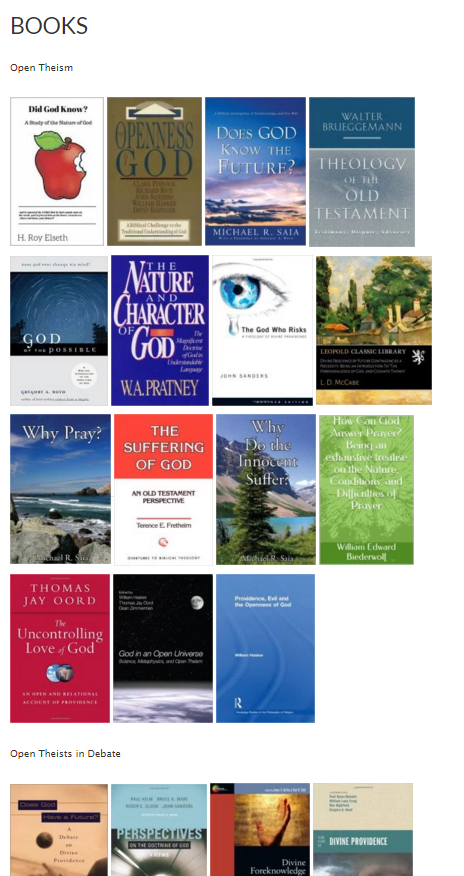
The God is Open website presents an entirely overhauled bookstore. On this page lists the main books about Open Theism and also adds supplementary reading suggestions. Each image is linked to Amazon for easy access. Ordering through the links on this page helps support GodisOpen.com, which has never and does not currently accept donations. Books which have free versions available will be listed on the Resources page with links to the free versions.
Click the link or find the Books subpage under the Resources dropdown.
Apologetics Thursday – Greek Thinking vs Jewish Thinking
Brad Jersak takes exception to the popular claims that Greek thinking is in contrast to Jewish thinking. He lists several “problems” with this type of reasoning. He starts with wondering “What Greek thinking” because Greek thinking incorporates a lot of various beliefs:
Which ‘Greek thinking’?
Not all Greek thinking is even close to the same. Much of this critique of ‘Greek thinking’ is based on faulty assumptions that come from reading the Greeks with Cartesian lenses (i.e. Enlightenment era rationalism that Plato would scoff at) and notions of dualism that are Gnostic but not Platonic in the least. So, what many critics of Plato are describing is actually Cartesian rationalism (Rene Descartes, early 1600’s) and then reading the entirety of Greek literature through those lenses. This shows how much we are conditioned to reading the Greeks through the very lenses we think they’re critiquing (in Plato for example). That is, it’s a projection of our own modernism that blinds us to Plato’s critique of rationalism and his actual epistemology, the core of which is contemplative.
The “What is Greek thinking” question seems more like a feigned ignorance than a serious question. True, not all Greek thinking is the same. But the Platonists are preciously what is being addressed. In his book “The Great Partnership”, Rabbi Sacks speaks out on the Platonism (and accompanying Negative Theology) that corrupted Christianity:
We owe virtually all our abstract concepts to the Greeks. The Hebrew Bible knows nothing of such ideas. There is a creation narrative – in fact, more than one – but there is no theoretical discussion of what the basic elements of the universe are. There is an enthralling story about the birth of monarchy in Israel, but no discussion, such as is to be found in Plato and Aristotle, about the relative merits of monarchy as opposed to aristocracy or democracy. When the Hebrew Bible wants to explain something, it does not articulate a theory. It tells a story.
And,
The fifth and most profound difference lies in the way the two traditions understood the key phrase in which God identifies himself to Moses at the burning bush. ‘Who are you?’ asks Moses. God replies, cryptically, Ehyeh asher ehyeh. This was translated into Greek as ego eimi ho on, and into Latin as ego sum qui sum, meaning ‘I am who I am’, or ‘I am he who is’. The early and medieval Christian theologians all understood the phrase to be speaking about ontology, the metaphysical nature of God’s existence. It meant that he was ‘Being-itself, timeless, immutable, incorporeal, understood as the subsisting act of all existing’. Augustine defines God as that which does not change and cannot change. Aquinas, continuing the same tradition, reads the Exodus formula as saying that God is ‘true being, that is being that is eternal, immutable, simple, self-sufficient, and the cause and principal of every creature’. 8
But this is the God of Aristotle and the philosophers, not the God of Abraham and the prophets. Ehyeh asher ehyeh means none of these things. It means ‘I will be what, where, or how I will be’. The essential element of the phrase is the dimension omitted by all the early Christian translations, namely the future tense. God is defining himself as the Lord of history who is about to intervene in an unprecedented way to liberate a group of slaves from the mightiest empire of the ancient world and lead them on a journey towards liberty.
So, one of the key differences between Platonized Christianity and Jewish religion is abstract thinking about the nature of God. This is a key and heavy element in Platonism (and other varieties of Greek thought), but it was the Platonists who really captivated early Christianity. Justin Martyr, an early Christian apologist, makes the absurd claim that Moses was the one to influence Plato. Anything that Plato taught was just rehashing of Moses! Augustine claimed the Bible is absurd unless it is read in light of Platonism. Augustine elsewhere suggests stealing Platonistic philosophy. Origin shares tutelage with the famed Neo-Platonist Plotinus.
And all the Church Fathers show this Platonic influence in their writings. They deal with undermining the text of the Bible in favor of the abstract, in favor of the immutable, in favor of Platonism. This is where Christianity and Platonism need to part. In the wise words of Walter Brueggemann:
What is most crucial about this relatedness is that Israel’s stock testimony is unconcerned to use a vocabulary that speaks about Yahweh’s own person per se. Israel has little vocabulary for that and little interest in exploring it. Such modest terminology as Israel has for Yahweh’s self might revolve around “Yahweh is holy,” but this sort of language is not normally used, and most often it occurs only in specialized priestly manuals. More important, Israel’s characteristic adjectival vocabulary about Yahweh is completely lacking in terms that have dominated classical theology, such as omnipotent, omniscient, omnipresent. This sharp contrast suggests that classical theology, insofar as it is dominated by such interpretive categories and such concerns, is engaged in issues that are not crucial for Israel’s testimony about Yahweh and are in fact quite remote from Israel’s primary utterance.
Willems Endorses Love Wins
Kurt Willems, in discussing Rob Bell’s Love Wins, talks about how the concepts in the book are friendly to Open Theism. (Note: Rob Bell is not an Open Theists and has preached against Open Theism) Willems correctly points out the goal of Open Theism is to free God from the Platonic construct:
In Love Wins, although Bell does not use the language of “open theism,” his view of human freedom certainly gives us hints of this influence in his theology. Again, as an open theist myself, I was impressed with the way that Bell poetically expressed the tension between human freewill and God’s desire: “Does God get what God wants?”
A basic premise of open theism is that the Christian church needs to recover a Hebraic view of God over against the Hellenistic perspective that dominates classical theology. Here, Rob Bell is consistent with his focus on the worldview of the Jews throughout much of his preaching and writing.
West Points Out the Absurdity of God Putting People Through Pain in Order to Minister
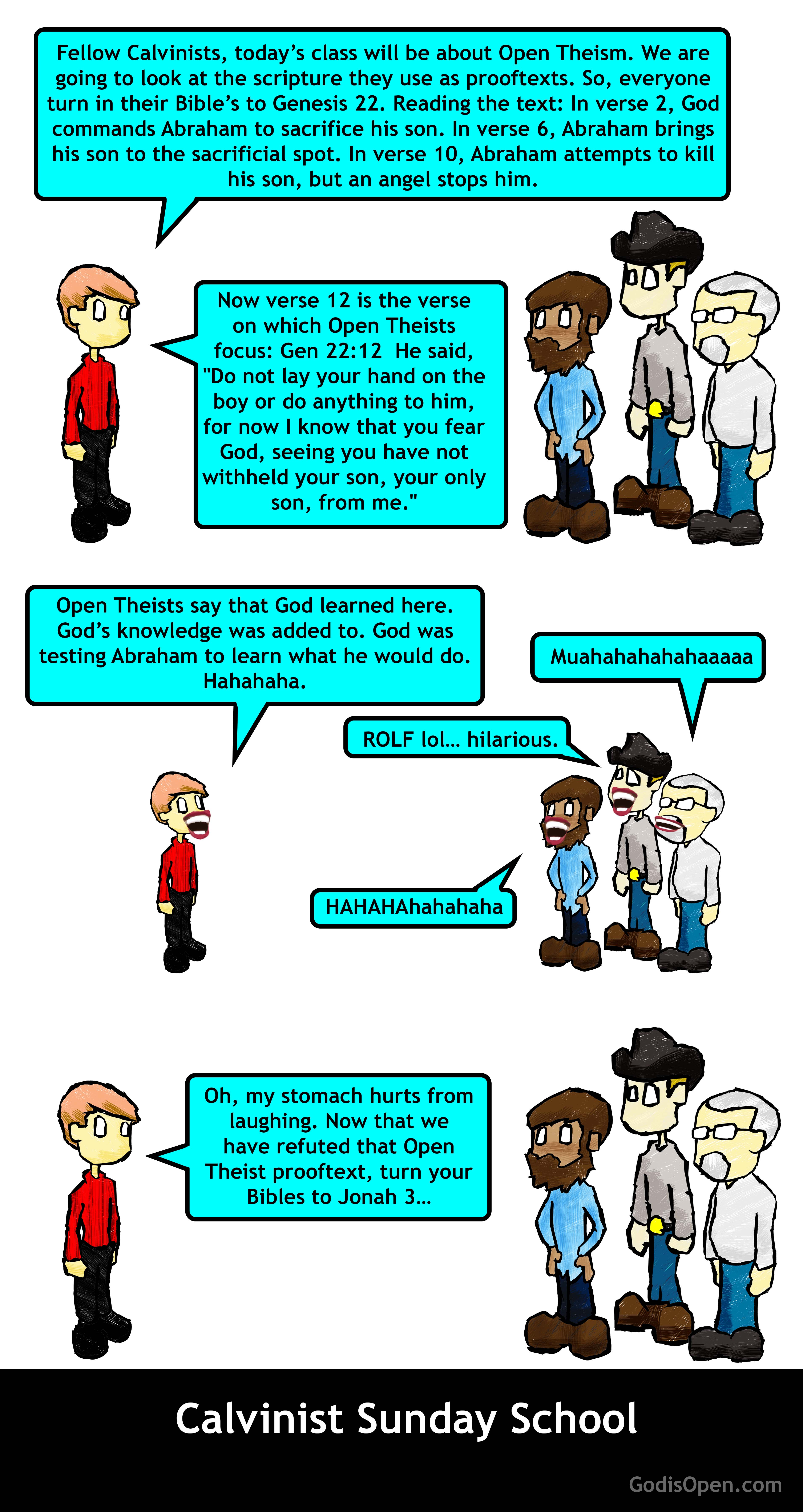
Meme Monday – Calvinist Sunday School Class
Worship Sunday – Only You
Take my heart, I Lay it down
At the feet of you whose crowned
Take my life, I’m letting go
I lift it upto You who’s throned
And I will worship You, Lord
Only You, Lord
And I will bow down before You
Only You Lord
Take my fret, take my fear
All I have, I’m leaving here
Be all my hopes, be all my dreams
Be all my delights, be my everything
And It’s just you and me here now
Only you and me here now
You should see the view
When it’s only You
Podcast EP117 – Time Travel Movies
God Choose His Attributes
From The Orthodox Open Theist:
As Open Theists we see God has having free will and freely creating morally capable beings with free will, so that we might engage in a free and loving relationship with God. That means letting go of the idea that God is always defined by attributes.
So, what’s the alternative? Free will, of course. You see, God loves, not because it is His nature to love, but rather because love is the means by which God chose to enter into relationship with us. In the same way, God is just in that God chooses to be sovereign over creation, not because it is an attribute of God. God is freely just in the same way that he freely loves.
Ultimately, this is the only way that God is completely God. If God’s attributes determine God’s behavior, then He is not omnipotent, as He cannot violate what His attributes force Him to do. That’s the complete God Open Theism needs.
Apologetics Thursday – Slick on the Problem of Evil
Matt Slick offers some reasons why evil exists. Here is his second possibility:
Second, God may be letting evil run its course in order to prove that evil is malignant and that suffering, which is the unfortunate product of evil, is further proof that anything contrary to God’s will is bad, harmful, painful, and leads to death.
Note the twisted logic here. God is attempting to prove something to creatures he could have just predestined the believe that same thing without all the fanfare. If God predestines everything, evil existing to prove a point or illustrate a concept becomes meaningless. After all, it would have been easier and less evil just to predestine that everyone just understand the concept of evil, rather than predestining evil to prove to people who are totally depraved something they could never believe unless predestined to do so. The sheer irrationality embedded in Slick’s number 2 possibility is countless.
Did God Know Republished
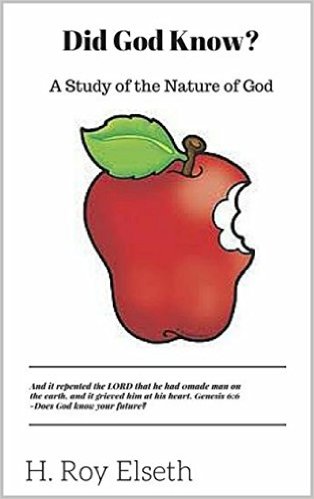
The classic Open Theist work by H Roy Elseth has finally been re-released. It is now available on Kindle and hardcopy on Amazon:
http://www.amazon.com/Did-God-Know-Illustrated-Revitalized-ebook/
Calvin on God Predestining Evil for Good
From the City of God:
It is with reference to the nature, then, and not to the wickedness of the devil, that we are to understand these words, This is the beginning of God’s handiwork; for, without doubt, wickedness can be a flaw or vice only where the nature previously was not vitiated… And because God, when He created him, was certainly not ignorant of his future malignity, and foresaw the good which He Himself would bring out of his evil, therefore says the psalm, This leviathan whom You have made to be a sport therein, that we may see that, even while God in His goodness created him good, He yet had already foreseen and arranged how He would make use of him when he became wicked.
For God would never have created any, I do not say angel, but even man, whose future wickedness He foreknew, unless He had equally known to what uses in behalf of the good He could turn him, thus embellishing, the course of the ages, as it were an exquisite poem set off with antitheses. For what are called antitheses are among the most elegant of the ornaments of speech. They might be called in Latin oppositions, or, to speak more accurately, contrapositions; but this word is not in common use among us, though the Latin, and indeed the languages of all nations, avail themselves of the same ornaments of style… As, then, these oppositions of contraries lend beauty to the language, so the beauty of the course of this world is achieved by the opposition of contraries, arranged, as it were, by an eloquence not of words, but of things…
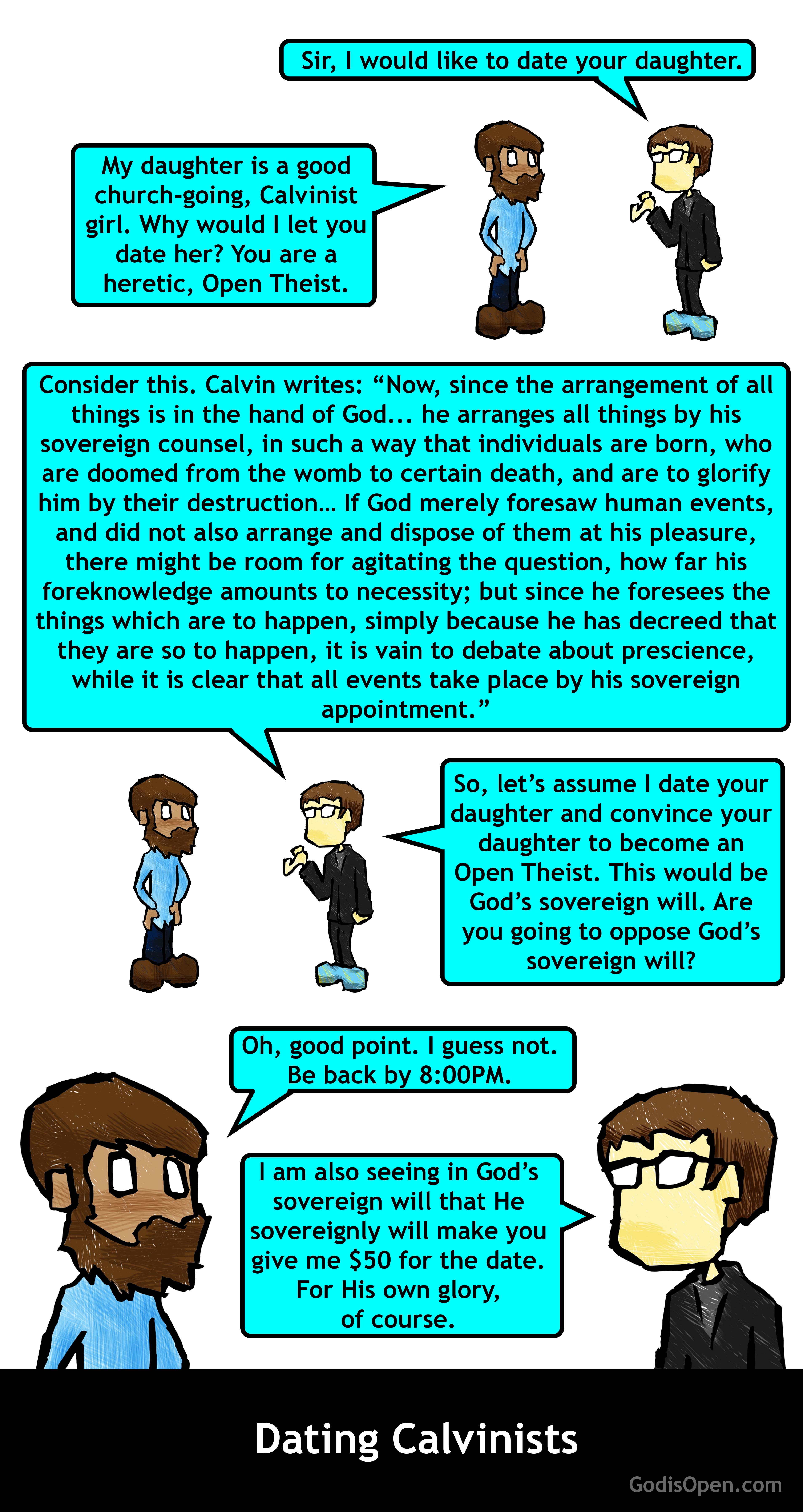
Meme Monday – Calvinist Dating
Worship Sunday – What have I done
What have I done Lord Jesus
To deserve Your endless love?
What have I done Lord Jesus
To be worthy of Your grace?
What have I done Lord Jesus
To be standing here with You?
What have I done Lord Jesus
To be worthy of You?
For I am nothing yet You love me
I am no one yet You care
You thought of me when You died
What have I done to deserve this love?
And I lay down my will to do Yours until
My life, I give henceforth to live for You alone
For I am nothing yet You love me
I am no one yet You care
You thought of me when You died
What have I done to deserve this love?
What have I done Lord Jesus
To deserve Your endless love?
What have I done Lord Jesus
To be worthy of Your grace?
What have I done Lord Jesus
To be standing here with You?
What have I done Lord Jesus
To be worthy of You?
You made me worthy of You
You made me worthy of You
Podcast EP116 – Answering James White
notesonthefoothills on Prophecy Paradoxes
notesonthefoothills offers this proof of prophecy not being based on future foreknowledge:
What I mean is this. Eternalists would say that God knows all truths in a single logical moment. They will say that this includes God knowing his giving of resistible grace, the free movements of his creatures themselves, and his response to their movements. Thus God knows in a single Now what happens at t1, t2, t3, etc.. From this it follows that it also true that God knows that what happens, say, at t3 happens in part due to times that come BEFORE t3. In other words, God knows that each moment in time is what it is in part because of times that come before it. I am married in part because at some time in the past I proposed to my wife, I was raised in a certain part of the world, and I was born from my two parents, etc. Now from this comes an important point: it seems undeniable that this temporal, causal relationship is only ONE WAY. That is to say, I was not raised in a certain part of the world because I later married my wife; nor was I born because one day I would propose to her. That sort of EFFICIENT causal relationship applied such to temporal sequence is nonsensical. Grasping this point is essential to understanding my overall point here about prophecy.
How the point ties in to prophecy is this. It seems to me that in an eternal Now, God’s causal interaction with moments of time would likewise have to follow this same one-way causal relation. That is, how he interacts with t3 would be “because” of what occurs at t3 and also because of what occurs before t3. But it doesn’t seem possible that how he interacts with t3 would be “because” of what occurs AFTER t3. Here is why. If God uses what is after t3 to interact with t3 – say for instance that what occurs at t9 is his “because” for interacting with t3 in a particular way – then that would involve a causal loop insofar as the t9 that God is interacting with ALREADY HAS the preceding t’s as part of its causal history. So, I say that to say, it seems to me that God could not “see what happens” at t9 and use that to give a prophecy at t3. (I.e. God could not use knowledge gained at t9 to effect t3, because t9 already contains t1-8.) Unfortunately this is the most common response from Eternalists that I have read regarding how God makes prophecies in time.
Therefore it seems to me 2 things follow from this idea combined with the doctrine of God’s mode of existence: a) that God’s causal interactions with us, which involves true responsiveness and God doing things “because” of what we do in time, would uphold this logical relation among themselves. That is, God’s interaction at each stage would be “decided” by previous t stages, but not vice versa. His interaction at t3 would involve his interaction at t1 and t2, but not t4, t5, etc. This is because later t stages represent OPEN POSSIBILITIES with respect to God’s causal relation to us. And b) it seems NO prophecy which temporally precedes the event of which it prophesies about could come about with absolute certainty without God taking away free will. That is, if a prophecy occurs at t3 about t9, then God’s interaction at t3 has not yet (logically speaking) “taken into account” what freely happens at t9 (again, because t9 itself already contains t’s 1-8). God could of course impose his will so that the prophesied event came about necessarily; or he could give a conditional prophecy. But it seems to me the logic of eternity would preclude the idea of God using what occurs at later logico-temporal points to effect prior logico-temporal points, for that would involve a causal loop/regress.
Apologetics Thursday – Erickson on Genesis 22
Erickson writes in his What Does God Know and When Does He Know It concerning Genesis 22:
Note, however, exactly what is said here. God does not say, “Now I know what you would do in such a situation.” Rather, he says, “Now I know that you fear me.” While this may seem to be a small matter of difference, it will be worth bearing in mind. Apparently, Jehovah did not simply not know what Abraham would do. If one interprets this text in a literal fashion, then one has also established that, at least in this case, Jehovah did not really know the heart of the person involved. The problem comes from the fact that the open theists believe that God knows persons completely, all of the personality and character of each person, all of the thoughts of the heart. It is only on this basis that God is able to make the predictions he does of what persons will do.
Erickson, Millard J. (2009-08-30). What Does God Know and When Does He Know It?: The Current Controversy over Divine Foreknowledge (pp. 24-25). Zondervan. Kindle Edition.
Erickson’s objection is a strange objection. Imagine a wife enlists one of her friend’s help in a plan to test her husband’s faithfulness. She has her friend proposition her husband in an intimate situation. Say that the husband passes the test. What is his wife to proclaim: “Now I know that you are faithful” or “Now I know what you will do in such a situation”? Erickson posits an entirely unrealistic narrative that the text would have to follow in order to be an Open Theist text.
But real life does not work the way Erickson posits. We test to gain general knowledge, not to gain knowledge of the specific. Gaining knowledge of the specific would completely defeat the entire point of the text! What good is a test whose results cannot be generalized to other areas? What was the purpose, then, of the test? To figure out within very narrow parameters how Abraham would act? That is not how character tests work.
Erikson’s second problem comes when he assumes the heart is knowable. He envisions the heart like a computer hard drive, all the coding is intact and various scenarios can be run with predictable results (that is, if one has access to the code). There is no indication this is a Biblical concept, and it entirely violates the natural Biblical assumption of free will. God often laments about His failed attempts to sway the people to Himself. Hearts do not work like input-output devices. Instead, knowledge of the heart is gained through testing. See how people respond to tests and then general trends can be known. Throughout the Bible, it explicitly states that God tests to know.
Roger Olson of the Calvinist Inquisition
Roger Olson recounts the hostility of Calvinism to both Open Theism and Arminianism:
I left Bethel in 1999 partly because of John Piper. Bethel and the BGC were then in the midst of a very heated, very divisive controversy about open theism. My colleague Greg Boyd was actually tried for heresy on campus. He and his theology of open theism were exonerated and found by the jury, on which I sat, to be “within evangelical boundaries.” That only added fuel to the fire raging among BGC pastors and greater pressure came down on not only Greg but on me for defending him and his theology as not heretical.
It was clear to me then that John Piper was at the center of that controversy—at least within the BGC and Bethel. He told me to my face that he would not try to get me fired merely for being Arminian, as much as he did not like Arminianism, but that he would get me fired for defending open theism as an “evangelical option.”
After that meeting Piper and I exchanged many letters and e-mails. I read many of his books as they were published. I listened to many of his talks on tape and then watched many of his podcasts on the web. I believed I was noticing a harsher tone toward Arminianism. Students who heard him speak at Passion conferences and other places began to ask me about Piper and especially about his Calvinism. And, as they knew I am Arminian, many of them have asked me over the past seventeen years—since I left Bethel and the BGC partly to escape Piper’s influence—about what they perceive as Piper’s misrepresentations of Arminianism.
That was one reason I wrote Arminian Theology: Myths and Realities (InterVarsity Press)—to correct misunderstandings and misrepresentations of true Arminianism. I made sure Piper received a copy. My main point in that book was that real Arminianism is not primarily about free will; it is primarily about the character of God. Using many quotations from Arminius himself and leading Arminian theologians since 1609 (when Arminius died) I demonstrated conclusively that true Arminianism is not obsessed with humanistic belief in free will; it is obsessed with God as revealed in Jesus Christ as loving and good and wanting all people to be saved. I have gone to great lengths there and here and in recorded talks later put up on the web to emphasize and prove that Arminianism is not what John Piper and other (mostly Calvinist) critics say it is. I have practically begged them to stop misrepresenting it as “human-centered love of free will and self-determination.”
On the Hebrew Concept of Time
From Cross Theology:
The Open Theist does not agree with Augustine’s high view on Platonism and his low view on believing in the Bible (for example, Confessions, Book 6, chapter 6). Rather, the Open Theist takes very serious what the Bible truly says about the connection between God and time.
Dr J. Barton Payne put it in very clear words: “God’s eternity was first revealed in Genesis 21:33, where Abraham called on the name of ‘Yaweh, El Olam,’ the ‘everlasting God.’ The term olam, however, did not suggest to the Hebrews God’s transcendence of time, but rather His endless duration in time (cf. 6:4) – ‘everlasting.’… Moses’ closest approach to (God’s pre-existence) is to be found in his poetic comparison that a thousand years are but a day to God (Ps. 90:4) and in his exclamation that ‘before the mountains were brought forth, even from olam to olam Thou art God!’ (v.2). His words correspond to the expressions of Job (Job 10:5) and of his authoritative counselor Elihu (36:26) that God’s duration is limitless, reaching far beyond the years of man. These verses describe eternity, but again in the sense of continuation, not timelessness” (The Theology of the Older Testament, p. 152).
Torbeyns on the Hebrew Concept of Time
From Cross Theology:
The Open Theist does not agree with Augustine’s high view on Platonism and his low view on believing in the Bible (for example, Confessions, Book 6, chapter 6). Rather, the Open Theist takes very serious what the Bible truly says about the connection between God and time.
Dr J. Barton Payne put it in very clear words: “God’s eternity was first revealed in Genesis 21:33, where Abraham called on the name of ‘Yaweh, El Olam,’ the ‘everlasting God.’ The term olam, however, did not suggest to the Hebrews God’s transcendence of time, but rather His endless duration in time (cf. 6:4) – ‘everlasting.’… Moses’ closest approach to (God’s pre-existence) is to be found in his poetic comparison that a thousand years are but a day to God (Ps. 90:4) and in his exclamation that ‘before the mountains were brought forth, even from olam to olam Thou art God!’ (v.2). His words correspond to the expressions of Job (Job 10:5) and of his authoritative counselor Elihu (36:26) that God’s duration is limitless, reaching far beyond the years of man. These verses describe eternity, but again in the sense of continuation, not timelessness” (The Theology of the Older Testament, p. 152).
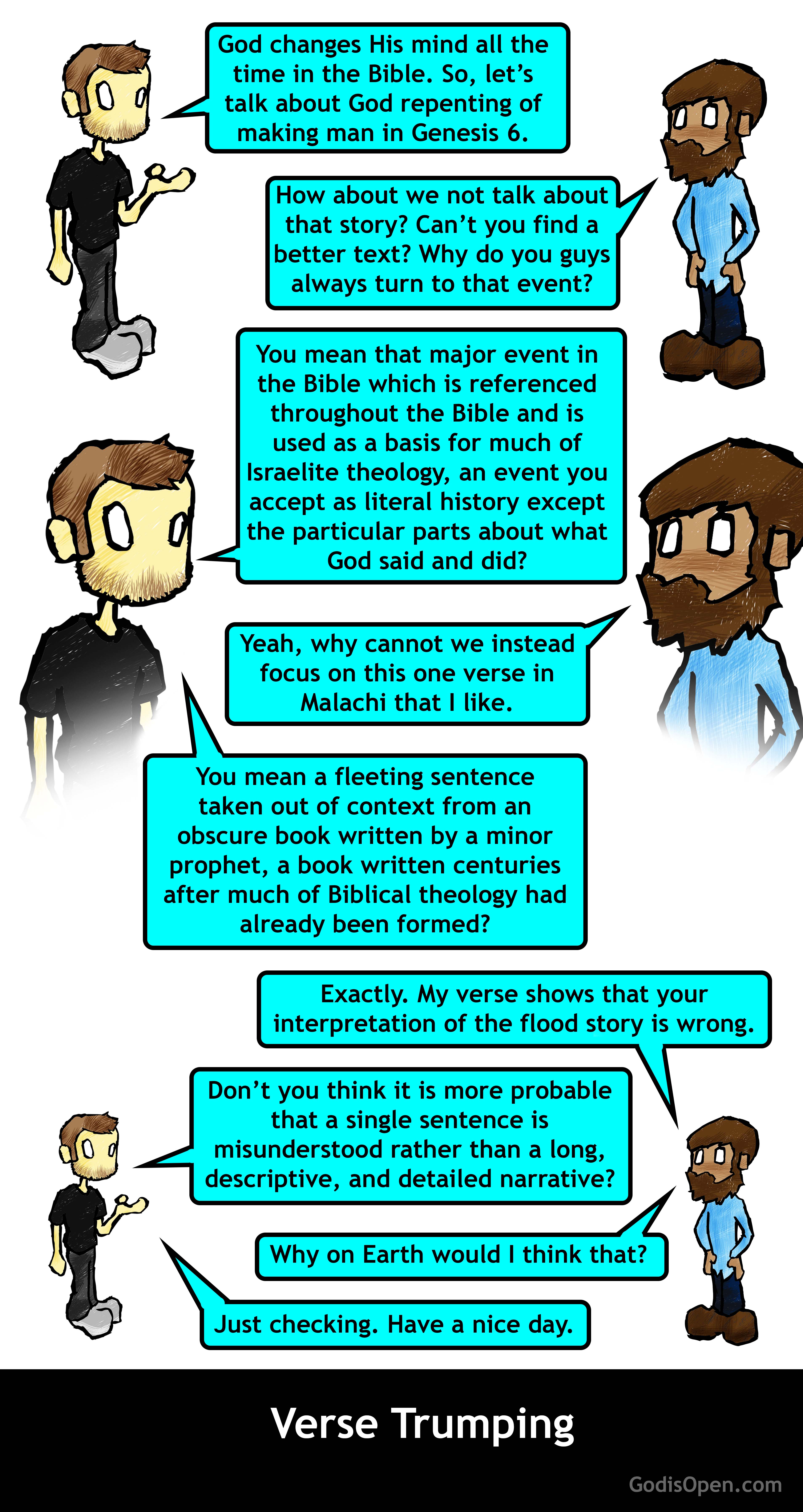
Meme Monday – Verse Trumping
Worship Sunday – Seek You
Fold back, strip away these layers
Test me in these flames until
Only You remain
Shine through
Piercing through the darkness
Search out anything in me
Thank is not of You
Seek You, Father God, I seek You
You are where my treasure lies
Seek you, Father God, I seek You
You are where my treasure lies
Save me, take me through the wasteland
Father, you have heard my cry
And you rescued me
Grow me, Holy Spirit, mold me
Change me by Your mercy, God
To be more like You
No more living in my own way
Following my own path
Living for my own desires
Surrender everything before You
Only for Your kingdom, Lord
Will I live my life
Seek You, Father God, I seek You
Podcast EP115 – Psalms 139
JEST Responds to Olson
From the open Facebook group Journal of Evangelical Speculative Theology in response to Roger Olson’s An Example of Unwarranted Theological Speculation: Divine Timelessness:
We, the moderators of JEST (Journal of Evangelical Speculative Theology) offer this letter of protest to Dr. Roger E. Olsen who offended our highly esteemed guild by claiming that Divine Timelessness amounts to UNWARRANTED speculation:
Dear Dr. Olsen, We affirm with you that Divine Timelessness is a speculative topic, and that of the highest degree. We here at JEST, however, take serious umbrage–at least as seriously as we are capable—at your claim that this glimmering jewel of theological speculation is “unwarranted.”
In short, sir, theological speculation is what we do, and we do it with unfettered enthusiasm. It is clear to us that your particular academic credentials do not qualify you to determine what speculation IS or IS NOT “unwarranted.” We do not find your dismissive remarks regarding our dubiously accredited guild to be lacking in disturbance and insensitivity.
We here at JEST encourage speculation as often as is warranted by the nature of the topic itself. The only instance that speculation could possibly be rightfully considered “unwarranted” would be in the absence of a dearth of biblical, textual, or other scholarly support. That is to say, scholarly evidence is the only thing that can “unwarrant” speculation. We advise that the topic be removed from the realm of actual scholarship and placed squarely in our field of speculation, where it rightfully belongs.
Dubiously submitted with all due speculation,
The Moderators
Apologetics Thursday – Erickson on God’s Grief
Erickson writes in his What Does God Know and When Does He Know It concerning Genesis 6:6, 1 Kings 15:11, and 1 Kings 15:35:
Perhaps the most we can say from a direct exegetical treatment of these passages is that they teach that God experiences emotional pain as a result of his having created humans and put certain ones of them in positions of leadership. Whether they teach that God changes his mind, and if so, whether this entails the idea that God must not have known antecedently what was to take place, remains to be decided.
Erickson, Millard J.; Erickson, Millard J. (2009-08-30). What Does God Know and When Does He Know It?: The Current Controversy over Divine Foreknowledge (p. 20). Zondervan. Kindle Edition.
This is a fairly odd claim. The repentance/sorrow/emotion is causes by something God did previously. God is showing sorrow, not over the events that occurred, but His own action. If His action was a rational and utilitarian best alternative, why the sorrow? Why then couple it with undoing the actions that made God sorrowful (in Genesis 6:6 this involves destroying the world and in 1 Kings 22 this involves revoking Saul as King). This is the normal word for regret and repentance, and only works in 1 Sam 15 as such (between the narrator’s statements, God’s statements, and the statement of Samuel). Erikson, irrationally, is forced to posit a shifting meaning of repentance in 1 Samuel 15.
These texts cannot be more clear about what is happening and the reasons it is happening.
Alternatively, I suggest there are no combinations of words that Erikson would accept as depicting God changing His mind up to an including a statement that says explicitly that God changes His mind.
Torbeyns on Isaiah
Declaring the end from the beginning, and from ancient times the things that are not yet done, saying, My counsel shall stand, and I will do all my pleasure”
– Isaiah 46:6-10Verse 10 is often used to “prove” that God is outside of time and therefore has perfect knowledge of the future. Yet, the text only signifies that God “from the beginning” (indication of time) declares what will happen in “the end” (the future, another indication of time). You can read this as meaning that God, who is outside of time, on a certain moment (speaking from a human perspective) states what He will do in the future (again, speaking from a human perspective). The most natural reading, however, seems to me that God simply lives in sequence, just like human beings. The platonistic concept that God is outside of time, is not necessary, is not a natural reading of the text and has to be read into the text (eisegesis) to arrive at that conclusion. If I take the context into account (this is always a necessity), then I see that the meaning of verse 10 is simply that God can say that He is going to do something and He can even accomplish this. The idols cannot speak, let alone tell in advance what they will carry out.
Corey on God’s Unchanging Love
Benjamin Corey writes about God’s changing unchanging love:
God is unchanging love. But the way he loves changes all the time depending on the circumstance. In fact, love invites us to be constantly changing and adapting to achieve the most beauty that’s possible– even if that means we love in ways that contradict how we loved in the past. Ironically, the unchanging nature of God is the very thing that causes God to be constantly changing— because love always grows, changes, and surprises us in beautiful ways.
Yes, God changes. His unchanging essence of love demands it. That’s the paradox of love.
In Scripture I see a God who is always changing– not in essence, but in how to love a world that’s constantly changing. The reason God changes is due to a combination of his unchanging essence of perfect love, and the divine constraint that requires God to always seek the options that lead to the most beauty. As situations change, the options as to how to love best also change.
It’s how we went from Gentiles being out to Gentiles being in. It’s how the outcasts became the guests at God’s banquet. It’s how the late vineyard workers got paid a full day’s wage. It’s how the unclean became clean.
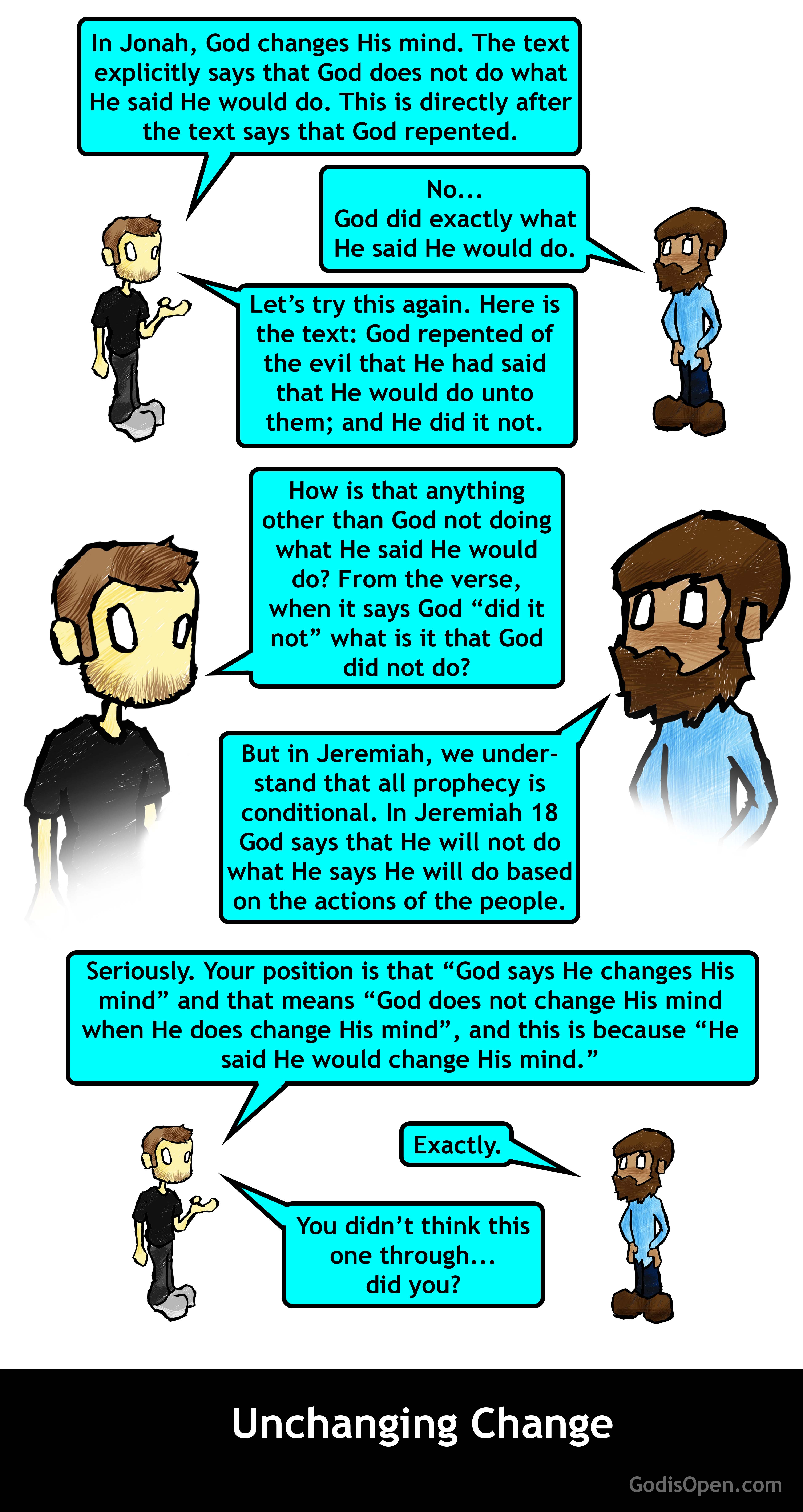
Meme Monday – Unchanging Changes
Worship Sunday – What Have I Done
What have I done Lord Jesus
To deserve Your endless love?
What have I done Lord Jesus
To be worthy of Your grace?
What have I done Lord Jesus
To be standing here with You?
What have I done Lord Jesus
To be worthy of You?
For I am nothing yet You love me
I am no one yet You care
You thought of me when You died
What have I done to deserve this love?
And I lay down my will to do Yours until
My life, I give henceforth to live for You alone
For I am nothing yet You love me
I am no one yet You care
You thought of me when You died
What have I done to deserve this love?
What have I done Lord Jesus
To deserve Your endless love?
What have I done Lord Jesus
To be worthy of Your grace?
What have I done Lord Jesus
To be standing here with You?
What have I done Lord Jesus
To be worthy of You?
You made me worthy of You
You made me worthy of You
Read more: Adie – What Have I Done Lyrics | MetroLyrics
Podcast EP115 – Pressing On Open Theism 2
In this episode we discuss a Calvinist podcast on Open Theism.
Clip resources:
https://soundcloud.com/pressingonpodcast/class-2-open-theism
http://reformedforum.org/ctc237/
Questions Answered – Joseph’s Brothers and God’s Will
From a Facebook group:
I am wondering if you have a snappy response to the charge that God planned for Joseph’s brothers to treat him like dirt.
(Genesis 50:20) As for you, you meant evil against me; but God meant it for good, to bring it about that many people should be kept alive, as they are today.
A response:
Acts 7:9 And the patriarchs, jealous of Joseph, sold him into Egypt; but God was with him
Acts 7:10 and rescued him out of all his afflictions and gave him favor and wisdom before Pharaoh, king of Egypt, who made him ruler over Egypt and over all his household.Only the Calvinists read this verse like Calvinists. Acts 7:9-10, God rescued Joseph from his brothers.
Apologetics Thrusday – Oord Responds to Snyder
Howard accuses me of committing several “logical fallacies.” When reading what he means by “fallacy,” however, one finds he has neither the typical examples of fallacies nor formal fallacies in mind. Howard’s use of “fallacy” is unusual.
…
The first “fallacy” Howard says I commit is the notion that “we can know rationally and judge what God should do and what God can do.” Of course, this is not a fallacy in any usual sense of the term. But more importantly, the opposite of this claim would be that we cannot know rationally and judge God’s actions. Should Christians claim they cannot know or judge the nature of God’s actions?
I do think we can know something about who God is, what God does, and what God can do. As I argue in the book, I think we can know these things – in part – because of the revelation of Jesus Christ, Scripture, science, experience, tradition, etc.
The emphasis Howard seems to have in mind here is on the word “rationally.” This seems to be his attempt to begin luring his readers toward the mystery views he will soon endorse. The crux of Howard’s concern seems to be summarized in this sentence: “Human capability to determine what God (a God of love) should, can, and cannot do is … a fallacy.” Howard seems to think I believe we can know fully or with certainty what God should, can, and cannot do.
John Sanders Writings on Open Theism
Articles and book chapters on open theism by John Sanders
1. “A Goldilocks God: Open Theism as a Feuerbachian Alternative?” Coauthored with J. Aaron Simmons. Element: The Journal for Mormon Philosophy and Theology (December, 2015).
2. “Open Theism.” Routledge Encyclopedia of Philosophy Online, April, 2015.
3. “Open Theistic Perspectives—The Freedom of Creation” in Ernst Conradie ed., Creation and Salvation Volume 2: A Companion on Recent Theological Movements (LIT Verlag, Berlin, 2012).
4. “Open Creation and the Redemption of the Environment,” Wesleyan Theological Journal, 47/1 (Spring 2012): 141-149.
5. “Open Theism” in the Global Wesleyan Dictionary of Theology ed. Albert Truesdale (Beacon Hill Press, 2012).
6. “Divine Reciprocity and Epistemic Openness in Clark Pinnock’s Theology,” The Other Journal: the Church and Postmodernity (January 2012).
7. “The Eternal Now and Theological Suicide: A Reply to Laurence Wood,” Wesleyan Theological Journal 45.2 (Fall, 2010): 67-81.
8. “Theological Muscle-Flexing: How Human Embodiment Shapes Discourse About God,” in Thomas Jay Oord ed., Creation Made Free: Open Theology Engaging Science (Pickwick Publications, 2009).
9. “Divine Suffering in Open Theism” in D. Steven Long ed., The Sovereignty of God Debate (Wipf and Stock, 2008).
10. “Responses to Bacote, Kalantzis, Lodahl, and Long” in Steven Long ed., The Sovereignty of God Debate (Wipf and Stock, 2008).
11. “Divine Providence and the Openness of God,” in Bruce Ware ed., Perspectives on the Doctrine of God: Four Views (Broadman & Holman, 2008).
12. “Responses to Helm, Ware and Olson,” in Bruce Ware ed., Perspectives on Doctrine of God: Four Views (Broadman & Holman, 2008).
13. “An Introduction to Open Theism,” Reformed Review, Vol. 60, no. 2 (Spring 2007). The issue includes three articles responding to my article. http://www.westernsem.edu/files/westernsem/john%20sanders%20article.pdf
14. “How Do We Decide What God is Like?” in And God saw that it was good: Essays on Creation and God in Honor of Terence E. Fretheim, ed. Frederick Gaiser and Mark Throntveit, (Word & World supplement series 5, April, 2006). [This is not on open theism directly. It deals with the values and concerns that motivate which views we find acceptable.]
15. “Response to the Stone Campbell Movement and Open Theism,” in Evangelicalism and the Stone-Campbell Movement, Vol. 2, ed. William Baker (Abilene Christian University Press, 2006).
16. “On Reducing God to Human Proportions” in Semper Reformandum: Studies in Honour of Clark Pinnock, eds. Anthony Cross and Stanley Porter (Paternoster, U.K. and Eerdmans, U.S. 2003), pp. 111-125.
17. “Is Open Theism a Radical Revision or Miniscule Modification of Arminianism?” Wesleyan Theological Journal 38.2 (Fall 2003): 69-102.
18. “On Heffalumps and Heresies: Responses to Accusations Against Open Theism” Journal of Biblical Studies 2, no. 1 (Spring 2002): 1-44.
19. “Be Wary of Ware: A Reply to Bruce Ware” Journal of the Evangelical Theological Society (June 2002): 221-231.
20. “A Tale of Two Providences.” Ashland Theological Journal 33 (2001): 41-55.
21. “The Assurance of Things to Come” in Looking to the Future, ed. David Baker, (BakerBook House, 2001): 281-294.
22. “Does God know your Next Move?” with Chris Hall, cover story for Christianity Today, May 21, 2001, pp. 38-45 and June 7, 2001, pp. 50-56.
23. “Theological Lawbreaker?” Books and Culture (January, 2000) pp.10-11. Reprinted in Taking Sides: Clashing Views on Controversial Issues in Religion, Daniel Judd, ed. (McGraw-Hill, 2002).
24. “Why Simple Foreknowledge Offers No More Providential Control than the Openness of God,” Faith and Philosophy 14, no. 1 (Jan. 1997): 26-40. Also published in Kevin Timpe, ed., Arguing about Religion (Routledge, second edition, 2009): 362-373.
Howard Snyder Critiques the Uncontrolling Love of God
Howard Snyder critiques Thomas Oord’s Uncontrolling Love of God:
First fallacy: Adequacy of reason. We know (or can know) what God should do.
Unpack the reasoning here, and what do we have? Let’s put it as simplified syllogisms:Premise a. God of love exists.
Premise b. But evil also exists.
Conclusion: This yields a dilemma that must be solved.
So far so good. Oord then develops this further, in effect employing a second syllogism:
Premise a. God of love exists but evil also exists (dilemma).
Premise b. A God of essential love should and would prevent evil in the world if he could.
Conclusion: Since God does not, God cannot prevent evil in the world.
The book is a philosophical defense of this conclusion. Oord seeks to show that because God is “essential” love, he not only does not but cannot prevent all evil. Oord mounts a finely honed defense of this position.
Underlying his argument however is yet another syllogism, which is unstated:
Premise a. This dilemma of evil in a world created by a loving God must have a resolution.
Premise b. This resolution must be reasonable and rational to humans.
Conclusion: Therefore a resolution exists which is reasonable and rational to humans.
Based on this logic, Oord argues that human beings are capable of determining or discerning what is reasonable or rational with regard to God. (This involves another unstated syllogism that I’ll pass over for now.)
But look at the syllogism above. We have a problem.
Premise a? Yes, OK. Unless the universe is meaningless or fundamentally evil or a mix of evil and good “forces” (à la Star Wars) the problem of evil must have a resolution and one that is not absurd or irrational. This is consistent with Scripture.
Premise b? Here’s the problem. The universe has meaning, as Scripture teaches and as we inherently intuit. So the problem of evil must have a reasonable, rational answer. But on what basis do we claim humans have the capacity adequately to understand that answer?
The conclusion is in fact false. For Oord’s argument to hold, he would have to show on biblical and theological grounds that human beings have the capacity to discern what is reasonable or rational with regard to God—and thus what God should do. But Oord does not do this. Human capability to determine what God (a God of love) should, can, and cannot do is a key underlying but never proven presupposition throughout the book.
In fact, it is a fallacy. If we unpack Oord’s argument further, we find yet another unstated syllogism:
Premise a. God created humans in his image, with reason.
Premise b. Human reason is (at least potentially) equal to or greater than God’s wisdom.
Conclusion: Therefore humans can determine what it is reasonable, good, and just for God to do—what God should do.
On strictly logical grounds, the conclusion is incontrovertibly true. If premises a. and b. are sound, the conclusion is certain according to the rules of logic.
Premise a. is fine; fully biblical. Clearly the problem is with premise b. From near the beginning of the book, Oord assumes but makes no attempt to prove that human reason (rationality, judgment), or at least the reason of some people, is not only equal to but superior to that of God. Otherwise the claim to know what God should do is absurd. Oord assumes that God created humans whose reason and ability to provide “explanatory consistency” is equal to or functionally superior to that of God.
This claim is fundamentally contrary to Scripture and Christian theology. I realize there is a process-philosophy answer to how humans can have the capacity to determine what God should or can or cannot do, but it is not the biblical answer.
It is unnecessary to cite here the dozens of relevant Scriptures. Key passages are Isaiah 41–42 and Job 40–41. We need merely recall familiar affirmations such as these: “For my thoughts are not your thoughts, nor are your ways my ways, says the Lord. For as the heavens are higher than the earth, so are my ways higher than your ways and my thoughts than your thoughts” (Isa 55:8–9).
Do we believe this?
This is not proof-texting. I am merely highlighting a central theme of all Scripture.
This deconstruction of Oord’s logic may seem tendentious or tedious or even silly. It is not. Since Oord appeals to logic, to logic we must go. And it does not hold up.
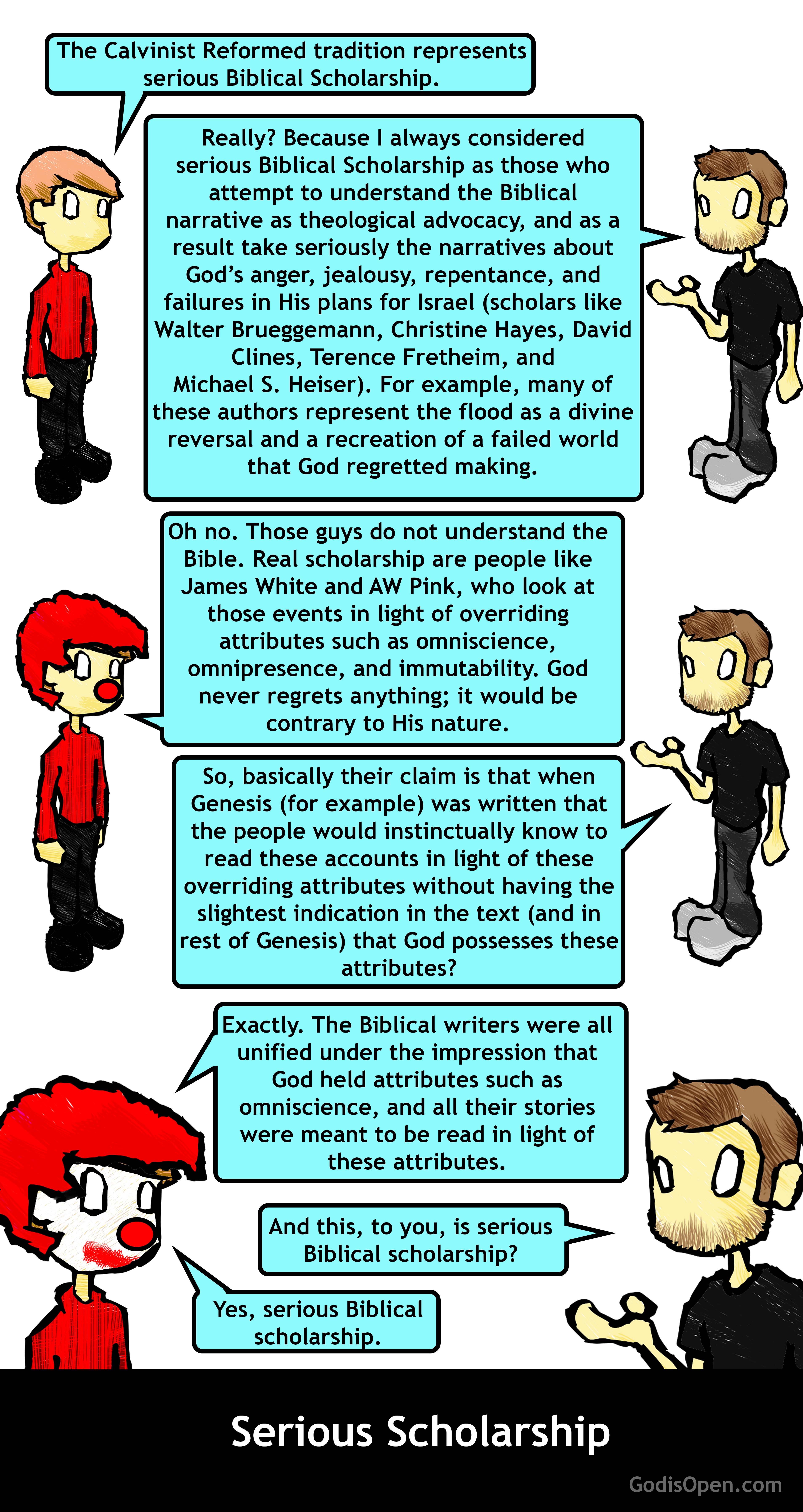
Meme Monday – Serious Scholarship
Worship Sunday – All Over Me
Wave come, wave fall
Cast me on Your broken shore
Son come, Son fall
Cast me on Your love so warm
Jesus’ love is, Jesus’ love is
All over me, all over me
All Your love is all over me
All over me, all over me
All Your love is, oh
All over me, all over me
All Your love is all over me
All over me, All over me
All Your love is
Christ come, Christ crawl
Nailed to a cross so tall
All come, all fall
All walk with hearts so torn
Jesus’ love is, Jesus’ love is
All over me, all over me
All Your love is all over me
All over me, all over me
All Your love is, oh
All over me, all over me
All Your love is all over me
All over me, all over me
All Your love is
Your love
Your love is all over me
Your love is all over me
All over me, all over me
All Your love is all over me
All over me, all over me
All Your love is, oh
All over me, all over me
All Your love is all over me
All over me, all over me
All Your love is
Your love is, Your love is over
Your love is, Your love
Your love is, Your love is over
Your love is, Your love is
All over me, all over me
Podcast EP113 – Pressing On Open Theism
New Open Theist Blog – Theological Anarchist
Jospeh Sabo, a frequent Open Theist commenter on various Open Theist Facebook groups, has started a new Open Theist friendly blog, highlighting notions of Christian Anarchism:
https://theologicalanarchist.wordpress.com/
He highlights, in his first post, the disappointing in Yahweh upon seeing Israel reject Him in favor of a king:
We are often taught as Christians, that the political and social landscape described in the text of Judges 17 is one of immorality, and rebellion towards God. This most assuredly might be the case if one was to assume that there were no Israelites that sought after the will of the Lord, but to those that sought to keep the commands and recognized Yahweh as their King, how wonderful life must have been. It is important to understand that no king was given to rule over Israel until they rejected Yahweh as their King and asked for someone to rule over them “like all the nations”( 1 Samuel 8:5-6). This was exceedingly displeasing in the sight of Samuel, to the point where Yahweh sought to console him by assuring Samuel “Listen to the voice of the people in regard to all that they say to you, for they have not rejected you, but they have rejected Me from being king over them.” In the mind of Yahweh, His children searching for someone to rule over them was tantamount to their rejection of His rule. To put it plainly; in Yahweh’s ideal, the system He set up for His children, there was to be no man ruling over them, only Himself.
As we have seen from the definition of “anarchy” given above, “without rulers” or, only Yahweh as King is initially how the children of Yahweh were intended to live. Yahweh even speaks through the prophet Samuel, and tells the people what will be the result of their seeking for a ruler over them like all the nations. See if you notice any parallels to our own times.
Apologetics Thursday – Jacques More Debates a Calvinist
Podcast EP112 – Genesis 6
Mccabe on Rationality in Christianity
“If our theology would overcome infidel vandals and survive the twentieth century she must adhere to logic. While clinging heartily to glorious mysteries, she must not advocate absurdities, and then remand them into the realm of the incomprehensible to be explained under the promise of a broader light in eternity. She must not ask superstition to relieve the Christian intellect of its legitimate work of logical processes, analytical discriminations and fearless enunciations. No light of eternity, however broad, can ever illuminate the absurdity that four multiplied by four equals seventeen, or that the sum of the angles of a triangle are equal to two right angles, or that freedom and predestination are terms not incompatible. We are sure to undermine faith whenever we stultify our reason as to the objects of our faith.”
L.D.McCabe, “Divine Nescience of Future Contingencies A Necessity”
Meme Monday – Rich Young Ruler

Worship Sunday – The Love of God
The love of God is greater far
Than tongue or pen can ever tell
It goes beyond the highest star
And reaches to the lowest hell
The guilty pair, bowed down with care
God gave His Son to win
His erring child He reconciled
And pardoned from his sin
Could we with ink the ocean fill
And were the skies of parchment made
Were every stalk on earth a quill
And every man a scribe by trade
To write the love of God above
Would drain the ocean dry
Nor could the scroll contain the whole
Though stretched from sky to sky
Hallelujah
O love of God, how rich and pure!
How measureless and strong!
It shall forevermore endure
The saints’ and angels’ song
Podcast EP111 – Exodus 32 The Open Theist’s Best Prooftext
Quantum Physics Predicts that God Observes Only What is Observable
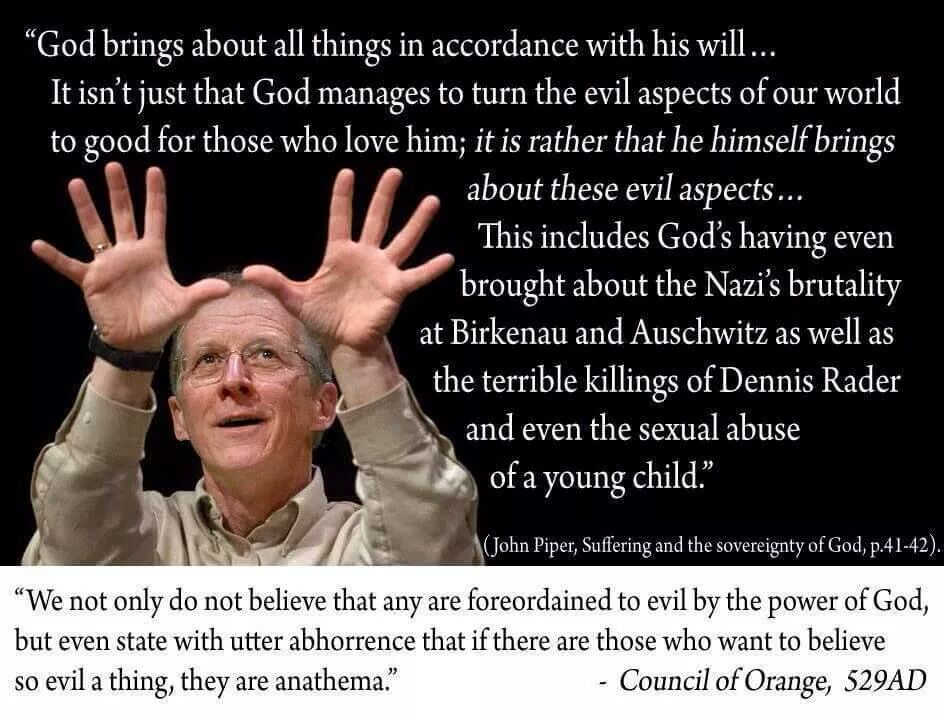
Apologetics Thursday – Piper v Orange
Podcast EP110 – Types Of Arguments
Brueggemann on Why the Old Testament Must not Go Away
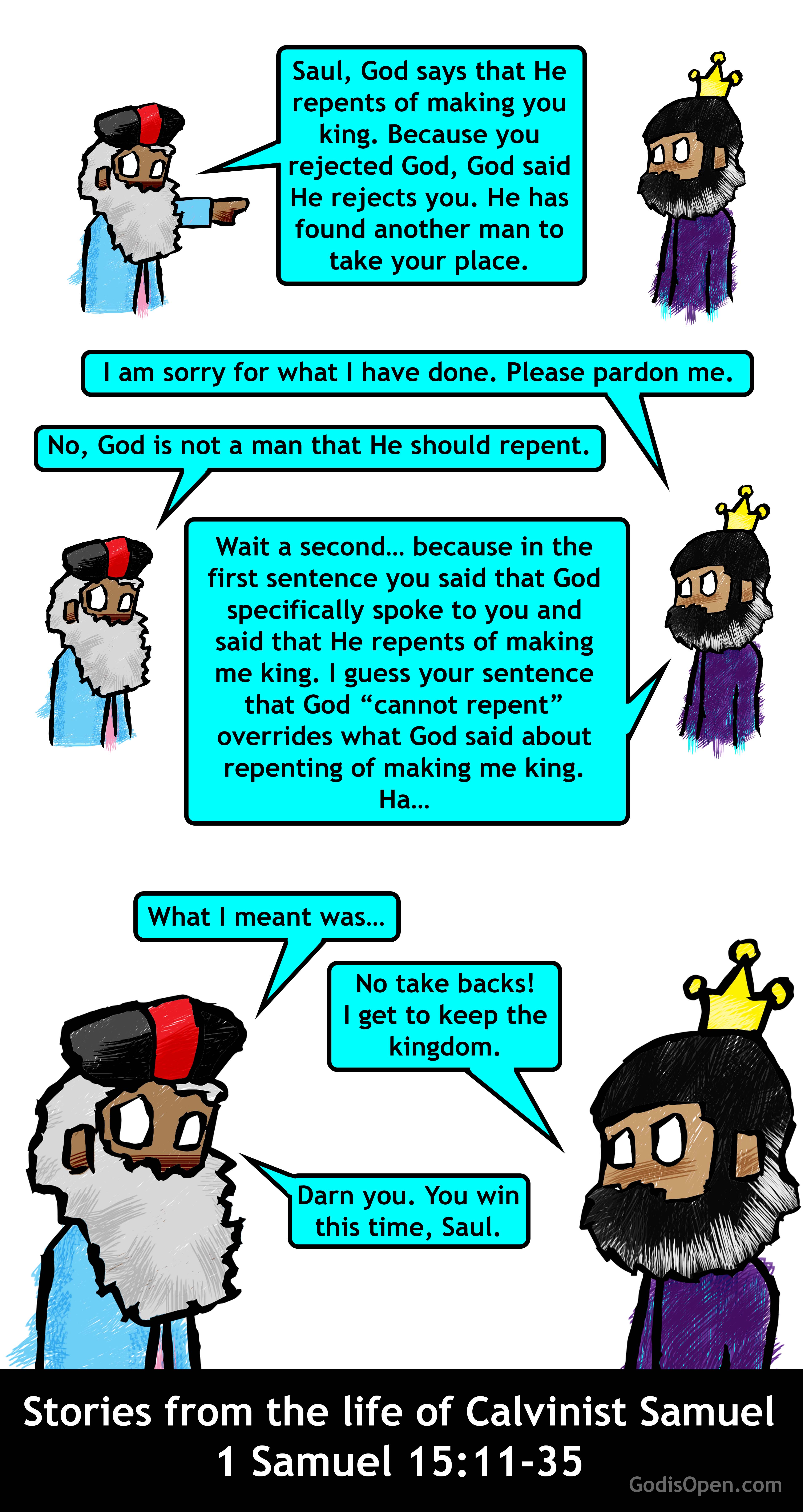
Meme Monday – Repentance with Saul
Worship Sunday -You Are Beautiful My Sweet, Sweet Song
You are beautiful my sweet, sweet song
You are beautiful my sweet, sweet song
You are beautiful my sweet, sweet song
And I will sing again
You are so good to me, You heal my broken heart
You are my Father in Heaven
You are so good to me, You heal my broken heart
You are my Father in Heaven
You are beautiful my sweet, sweet song
You are beautiful my sweet, sweet song
You ride upon the clouds, You lead me to the truth
You are the Spirit inside me
You ride upon the clouds, You lead me to the truth
You are the Spirit inside me
You are beautiful my sweet, sweet song
You are beautiful my sweet, sweet song
You are beautiful my sweet, sweet song
And I will sing again
You are my strong melody, yeah
You are my dancing rhythm
You are my perfect rhyme
I will sing of You forever
You poured out all Your blood, You died upon the cross
You are my Jesus who loves me
You poured out all Your blood, You died upon the cross
You are my Jesus who loves me, yeah
You are beautiful my sweet, sweet song
You are beautiful my sweet, sweet song
You are beautiful my sweet, sweet song
And I will sing again
(You are beautiful my sweet, sweet, song)
And I will sing again
(You are beautiful my sweet, sweet, song)
And I will sing again
(You are beautiful my sweet, sweet, song)
And I will sing again
(You are beautiful my sweet, sweet, song)
You are my Father in heaven
You are the Spirit in side me
You are my Jesus who loves me
Read more: Third Day – You Are So Good To Me Lyrics | MetroLyrics
Podcast EP109 – Origen
Church Fathers: Clement of Alexandria and Origen
Apologetics Thursday – God Warns David about Keilah
In 1 Samuel 2, King Saul is hunting King David. King David is at the city of Keilah, and wonders what to do:
1Sa 23:8 And Saul summoned all the people to war, to go down to Keilah, to besiege David and his men.
1Sa 23:9 David knew that Saul was plotting harm against him. And he said to Abiathar the priest, “Bring the ephod here.”
1Sa 23:10 Then David said, “O LORD, the God of Israel, your servant has surely heard that Saul seeks to come to Keilah, to destroy the city on my account.
1Sa 23:11 Will the men of Keilah surrender me into his hand? Will Saul come down, as your servant has heard? O LORD, the God of Israel, please tell your servant.” And the LORD said, “He will come down.”
1Sa 23:12 Then David said, “Will the men of Keilah surrender me and my men into the hand of Saul?” And the LORD said, “They will surrender you.”
David asks God two things. David asks if Saul is coming to attack him. God says yes. Then David asks if the people will turn him over to Saul. God says yes again. David is asking for insider knowledge from God. David does not know the disposition of the people and relies on God to inform him. The people are probably afraid of Saul (who kills priests for harboring David (1 Sam 22)), and they probably owe their allegiance to the current ruler of Israel and his armies. God sees this and warns David.
Negative theologians seem to take this verse as some sort of prooftext showing that God knows “all possible futures”. This features in the most popular Systematic Theology book sold on Amazon: Wayne Grudem’s Systematic Theology: An Introduction to Biblical Doctrine:
The definition of God’s knowledge given above also specifies that God knows “all things possible.” This is because there are some instances in Scripture where God gives information about events that might happen but that do not actually come to pass. For example, when David was fleeing from Saul he rescued the city of Keilah from the Philistines and then stayed for a time at Keilah. He decided to ask God whether Saul would come to Keilah to attack him and, if Saul came, whether the men of Keilah would surrender him into Saul’s hand. … And the LORD said, “They will surrender you.”
Likewise, other theologians make the same claims. Otherwise scholarly Michael Heiser states:
So in summary, with respect to actual events, God may or may not have predestined them, but he foreknows them all—and even foreknows events that don’t happen. And it is at this point that I am in disagreement with open theists who insist that God doesn’t know human choices ahead of time. That seems incoherent in that, if God foreknows events that don’t happen, why wouldn’t he foreknow what the possible choices were and which choice would be made? How can God foreknow a list of options that will not happen, but be unable to know the thing that does? This makes little sense.
The problem with this is that the prooftext proves too much. It takes a normal everyday occurrence (predicting people’s actions) and ascribes extraordinary conclusions. It is a non-sequitur. There is no link between God’s knowing the strength of people’s allegiances (what they will do when pressed) and knowing “all possible futures”. Probably any insider from the city would know the exact same thing.
In fact, plenty of instances in the Bible (and in modern life) show normal human beings making similar predictions. This is because it is easy for anyone to know what people will do just using common sense and present knowledge. In Genesis 12, Abraham (Abram at the time) predicts what the people of Egypt would do if Sarah (Sarai) did not pretend to be his sister:
Gen 12:11 When he was about to enter Egypt, he said to Sarai his wife, “I know that you are a woman beautiful in appearance,
Gen 12:12 and when the Egyptians see you, they will say, ‘This is his wife.’ Then they will kill me, but they will let you live.
Gen 12:13 Say you are my sister, that it may go well with me because of you, and that my life may be spared for your sake.”
Abraham is not “Omniscient”. Abraham did not know “all possible futures”. This is not a prooftext for a strange conception of Abraham’s knowledge. Instead, Abraham used his present knowledge to extrapolate on the motives of people he had never before met. This was not a hard prediction. Abraham’s suspicions seem to be true, evidenced in Pharaoh’s attempting to capture Sarah against her will.
There is no reason to make more of 1 Samuel 23 than it presents on face value. David is merely requesting that God inform him on the state of Keilah’s allegiances. This is doubly true considering that the same author wrote 1 Samuel 15 in which God regrets His own actions. Grudem seems to be stretching his theology to explain why a God who knows the future would think in conditional terms. This theological stretch just does not fit the entirety of the narrative of 1 and 2 Samuel.
Podcast EP108 – Second Isaiah Part I
Bible.org Lists Attributes Questioned by Open Theists
Bible.org lists out several attributes of God (besides omniscience) that are questioned by Open Theists (a list that is not without merit):
Independence. Grudem defines God’s independence as, “God does not need us or the rest of creation for anything, yet we and the rest of creation can glorify him and bring him joy.” Open theism teaches that God is dependent on the world in certain respects.
Immutability. Classical theology defines God’s immutability as, “God is unchanging in his being, perfections, purposes, and promises, yet God does act and feel emotions, and he acts and feels differently in response to different situations. Open theism teaches God is, “…open to new experiences, has a capacity for novelty and is open to reality, which itself is open to change.” Trying to have it both ways open theism says, “God is immutable in essence and in his trustworthiness over time, but in other respects God changes.”
Eternality. Classical theism states, “God has no beginning, end, or succession of moments in his own being, and he sees all time equally vividly, yet God sees events in time and acts in time.”15 Open theism teaches that, “God is a temporal agent. He is above time in the sense that he is above finite experience and measurement of time but he is not beyond “before and after” or beyond sequence of events. Scripture presents God as temporally everlasting, not timelessly eternal….Clearly God is temporally related to creatures and projects himself and his actions along a temporal path.”16
Omnipresence. Classical theology teaches that just as God is unlimited or infinite with respect to time, so God is unlimited with respect to space. God’s omnipresence may be defined as, “God does not have size or spatial dimensions and is present at every point of space with his whole being, yet God acts differently in different places.”17 A leading proponent of open theism says, “I do not feel obliged to assume that God is a purely spiritual being when his self-revelation does not suggest it….The only persons we encounter are embodied persons and, if God is not embodied, it may prove difficult to understand how God is a person….Embodiment may be the way in which the transcendent God is able to be immanent and why God is presented in such terms.”18
Unity. The unity of God in classical theology is defined as, “God is not divided into parts, yet we see different attributes of God emphasized at different time.”19 This is also called in theology the “simplicity” of God, meaning that God in not composed of parts and cautioning against singling out any one attribute of God as more important than all the others. This will be examined when the hermeneutics of open theism is discussed. Open theism reveals that, “The doctrine of divine simplicity, so crucial to the classical understanding of God, has been abandoned by a strong majority of Christian philosophers, through it still has a small band of defenders.”20 Clark Pinnock, having abandoned this doctrine says, “Let us not treat the attributes of God independently of the Bible but view the biblical metaphors as reality-depicting descriptions of the living God, whose very being is self-giving love.”21
Omnipotence. Classical theism defines God’s omnipotence in reference to His own power to do what he decides to do. It states, “God’s omnipotence means that God is able to do all his holy will.”22 On the other hand open theism states that “we must not define omnipotence as the power to determine everything but rather as the power that enables God to deal with any situation that arises.” Pinnock openly states that, “God cannot just do anything he wants, when he wants to….His power can, at least temporarily, be blocked and his will not be done in the short term.”
Meme Monday – Putting God in a Box
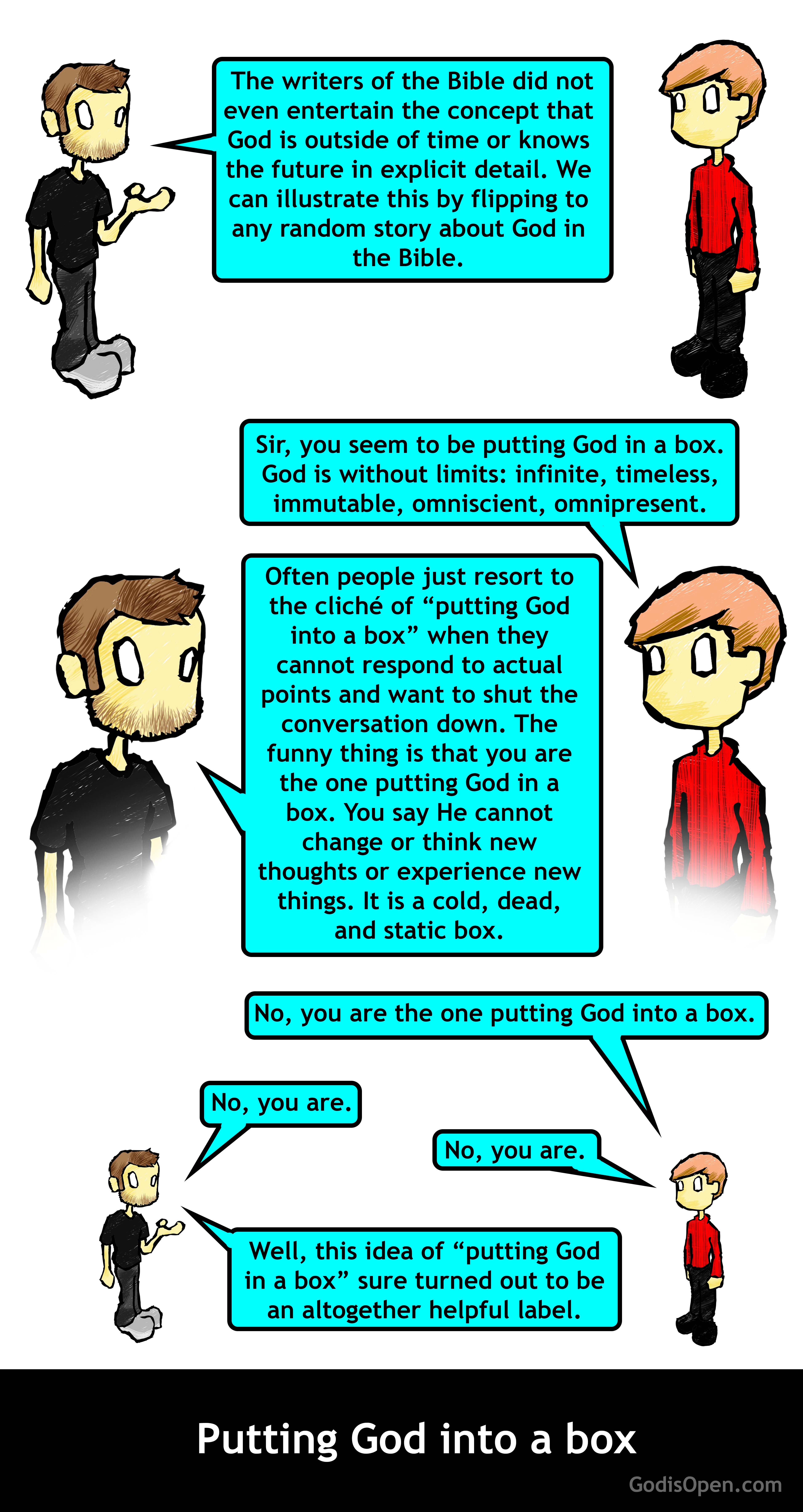
Worship Sunday – Start a Fire
This world can be cold and bitter
Feels like we’re in the dead of winter
Waiting on something better
But am I really gonna hide forever?
Over and over again
I hear Your voice in my head
Let Your light shine, let Your light shine for all to see
Start a fire in my soul
Fan the flame and make it grow
So there’s no doubt or denying
Let it burn so brightly
That everyone around can see
That it’s You, that it’s You that we need
Start a fire in me
You only need a spark to start a whole blaze
It only takes a little faith
Let it start right here in this city
So these old walls will never be the same
Over and over again
I hear Your voice in my head
They need to know
I need to go
Spirit won’t You fall on my heart now
Start a fire in my soul
Fan the flame and make it grow
So there’s no doubt or denying
Let it burn so brightly
That everyone around can see
That it’s You, that it’s You that we need
Start a fire in me
You are the fire You are the flame
You are the light on the darkest day
We have the hope we bear Your name
We carry the news that You have come to save
Only You can save
Start a fire in my soul
Fan the flame and make it grow
So there’s no doubt or denying
Let it burn so brightly
That everyone around can see
That it’s You, that it’s You that we need
Start a fire in me
PODCAST EP106 – Mark Burnard on Open Theism in China
Boyd on the Calvinist Crusade Against Art
Apologetics Thursday – Ontological Argument Debate
John Anselm’s Law. Basic ontological argument. Here’s a Wiki bit on it: Anselm defined God as “that than which nothing greater can be conceived”, and argued that this being must exist in the mind; even in the mind of the person who denies the existence of God. He suggested that, if the greatest possible being exists in the mind, it must also exist in reality. If it only exists in the mind, then an even greater being must be possible — one which exists both in the mind and in reality. Therefore, this greatest possible being must exist in reality.
Chris Fisher Anselm sounds like a lunatic.
John Really, and is that how you feel about ontology in general?
John Or is this the first you have ever even heard of it?
Chris Fisher John So, what necessitates that God is the greatest being imaginable? And who decides what “greatest” means? If I think pink is the greatest color, then God must be pink. If I think two hats are better than one, then God must have two hats. It is absurd and arbitrary. Explain how Anselm’s quote even borders on rationality.
John Chris Fisher, Anselm has been critiqued at length. Show me how an atheistic position even borders on rationality.
Chris Fisher I’m not an atheist. I just dont buy absolute nonsense arguments.
Chris Fisher Care to answer my questions?
John Chris Fisher, No. I do not. As I said, Anslem’s ontology has been critiqued at length. You ask who decides what “greatest” is — greatest is that for which there can be nothing greater than. I think that’s self-explanatory. Just like “truth.” Truth exists externally from our perceptions of truth. True is just true.
John There are many, many, many, … things in philosophy that I cannot wrap my mind around. But it isn’t fair for me to just dismiss them as nonsensical statements. I’ve not the skill.
John Anselm’s premise, is definition of God is “that than which nothing greater can be conceived.” I think it is a pretty good premise. I certainly stand upon it when I discuss the purposes for which the universe was created — and that for the highest orde…See More
Chris Fisher I did give reasons why the argument is irrational: it is arbitrary (and I give examples) and the assumptions just have no basis in reality. Your response is an appeal to authority and a “trust me, this seemingly nonsensical argument is legit”. Definitely no one should take Anselm seriously.
John The argument runs from the premise. You may state that the premise is not rational, but the premise is not part of the ontological problem. The premise is what it is. What follows is the concern, and whether such must follow.
John My appeal to authority, Sacred Scripture and nature, came later, after my discussion of the definition of “great” and “true” as being self-explanatory and unconcerned in the least about of perceptions of what is greatest and truly true. These exist externally to our perceptions. You chose, apparently, to skip that part.
John Anselm may have been wrong — atheist philosophers such as Hume certainly think so — but I don’t think you can call him a lunatic. There’s is another type of logical fallacy there called ad hominem.
Chris Fisher John, Ad Hominem is a widely misunderstood fallacy. An Ad Hominem is not just any “name calling”. Might as well say that Jesus fell for the Ad Hominem fallacy. The Ad Hominem fallacy is an argument that someone’s argument should be dismissed due to that name calling. If you were to say “Hume was an atheist, so he was wrong about his objections to Anselm”… then that would be an Ad Hominem.
I called Anselm a lunatic, because his argument has zero basis in reality. It doesn’t make sense. Observe:
1. God is the fattest being in we can imagine.
2. Assume God is just imaginary.
3. A real God is definitely fatter than an imaginary God.
4. Therefore God exists.
The amount of raw and speculative assumptions embedded in the proof are insane. Again, what necessitates that God is the greatest being imaginable (an idea with origins in Plato’s Republic and not in the Bible)? Who gets to define what “greatest” means? Is it not just the etymological fallacy to assume that existence is included in the concept of “greatest being imaginable”? What if someone were to argue (as theists do) that God is limitless, and existence implies limits?
The entire argument is just a mess of absurdities.
Podcast EP106 – The Classical Attributes
Open Theism Highlighted as an Exciting and Controversial Theology
Open Theism is features on a list of 4 New Theological Ideas You Need To Know About. From the article:
WHAT IS IT?
Open Theism is a new contender in the long-running theological question of how human free will and God’s foreknowledge work together. Traditionally there have been two camps:
Calvinist theology says that God ordains all things according to his will, including those who will be saved. This view ultimately limits the scope of human free will, as God’s sovereign will has already determined every event and decision.
Arminian theology, on the other hand, holds that God desires for everyone to be saved, but that humans may freely resist his call to repentance. Humans have free will, but God still has divine foreknowledge of what will happen in the future.
Open Theism goes a significant step beyond Arminianism. It submits that human free will cannot be truly free if God always knows what the future holds. In love, God has bestowed free will on his creation. But in order to allow us true freedom to choose, God has purposely limited himself to not knowing everything about the future.
In most versions of Open Theism, natural causes will inevitably dictate much of the way the future plays out and God may supernaturally know some aspects of the future (which allows for prophecy in scripture). But the way humans exercise their free will could lead to different possible futures, and therefore the future is open, not closed.
The view feeds into a wider theology that creation is subject to a cosmic spiritual battle between Satan and his angels who rebelled against God, and those who are joined with Jesus in bringing God’s kingdom on earth. Although God will eventually win the war and the new creation will one day be established, the outcome of our daily ‘spiritual battles’ are not a foregone conclusion and depend on our part in the process.
Meme Monday – Psalms 139
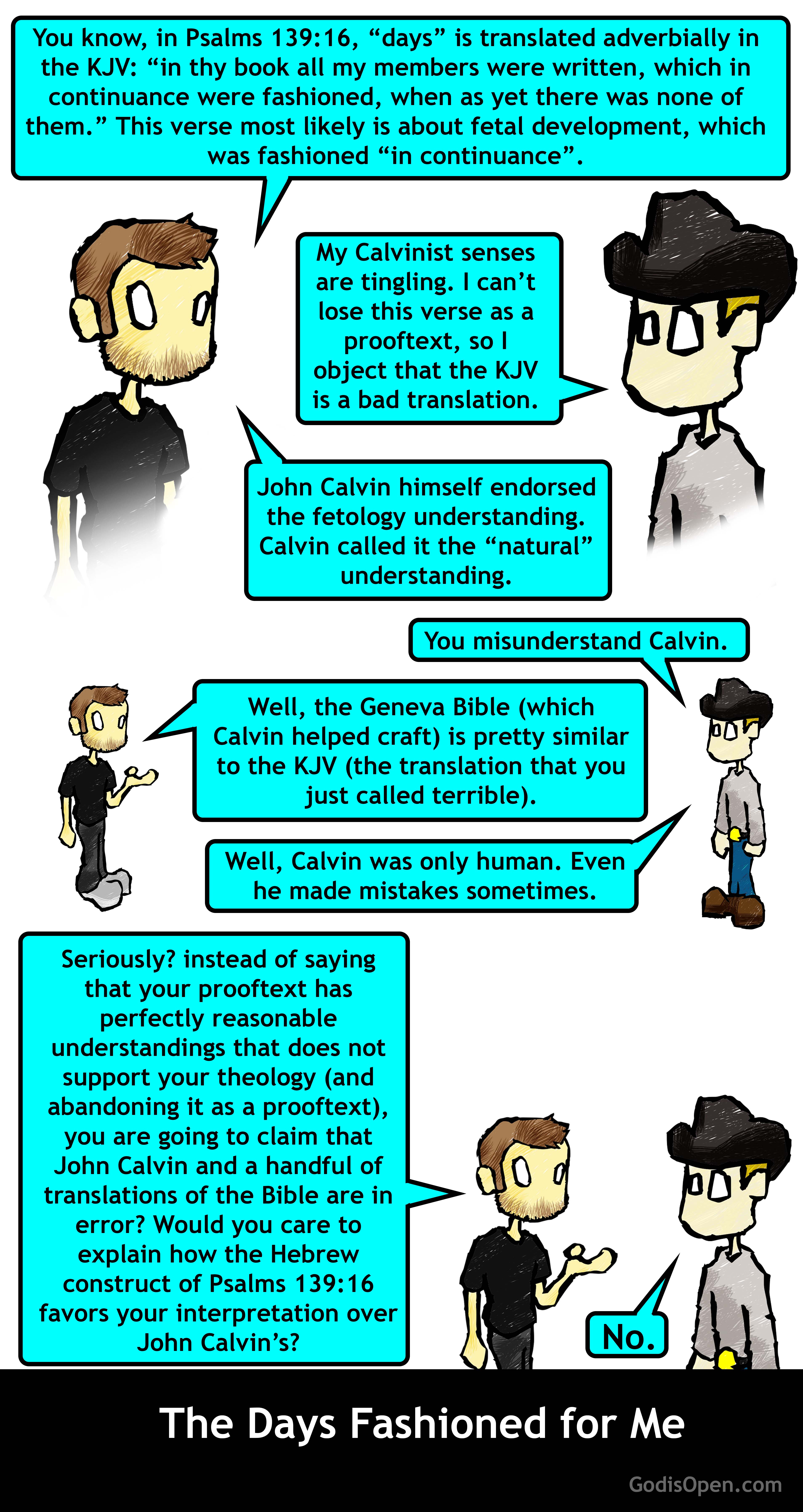
Worship Sunday – Horse and Rider Thrown into the Sea
I will sing unto the LORD,
for he has triumphed gloriously,
the horse and rider thrown into the sea.
The LORD, my God, my strength and song,
has now become my victory.
The LORD is God, and I will praise him,
Our fathers’ God and I will exalt him.
Podcast EP105 – Torbeyns On European Open Theism, Original Sin, And Speaking In Tongues
Corey Details a Philosophical Approach to the Bible
From 10 Tips To Raising Christian Kids After Fundamentalism:
9. Help them see the value of Old Testament stories is rooted in the narrative, not the historical reliability.
Fundamentalism (and even many atheists) view Scripture and our faith as a house of cards. If Jonah didn’t really live in the belly of a fish for three days, we can’t trust anything else it says, either. If any of it is historically untrue, it all belongs in the trash.
Unfortunately, that’s a very unenlightening way to read Scripture. It’s not even what the authors intended to convey; they weren’t recording history by Western standards, but were engaged in a process of making meaning.
As we raise Formerly Fundie kids, we must help them see that our faith and Scriptures aren’t a house of cards at all. They are stories filled with intrigue and lessons that are still as valuable today as they were back then.
8. Teach them the Bible is an inspired story of God revealing himself to us, but it’s not an owner’s manual for life.
So many of us grow up being taught that the Bible works as an owner’s manual, but as we get older we come to the realization that the Bible simply doesn’t work that way.
Yes, the Bible progressively reveals to us what God is like. Yes, the Bible ultimately shows us that God’s true identity is the character revealed in Jesus. And yes, we are taught to live like Jesus and follow him.But no, the Bible doesn’t answer all of life’s questions. It doesn’t tell us what to do in every situation we find ourselves in. The Bible simply doesn’t work that way.
Realizing the Bible doesn’t work as an owner’s manual has the potential to be discouraging, but when we help our kids see that the story is one of a progressive revelation that ultimately introduces us to Jesus, we’re invited to begin asking a different set of questions about how to live life well.
Apologetics Thursday – Hellenistic or Hebrew
In a paper entitled “Hellenistic Or Hebrew”, Michael Horton attempts to discuss the contrasting interpretations between Open Theism and Calvinism. In contrast to the paper’s title, throughout the paper the one thing that Horton forgets to address is the Hebrew method of interpretation. Horton seems to be under the impression that the Jewish method of understanding the Bible should be assumed to be his own.
This lies in stark contrast to what actual Jews have said on this matter. Rabbi Jonathan Sacks comments in his The Great Partnership: Science, Religion, and the Search for Meaning (pp. 64-65):
‘Who are you?’ asks Moses. God replies, cryptically, Ehyeh asher ehyeh. This was translated into Greek as ego eimi ho on, and into Latin as ego sum qui sum, meaning ‘I am who I am’, or ‘I am he who is’. The early and medieval Christian theologians all understood the phrase to be speaking about ontology, the metaphysical nature of God’s existence. It meant that he was ‘Being-itself, timeless, immutable, incorporeal, understood as the subsisting act of all existing’. Augustine defines God as that which does not change and cannot change. Aquinas, continuing the same tradition, reads the Exodus formula as saying that God is ‘true being, that is being that is eternal, immutable, simple, self-sufficient, and the cause and principal of every creature’.
But this is the God of Aristotle and the philosophers, not the God of Abraham and the prophets. Ehyeh asher ehyeh means none of these things. It means ‘I will be what, where, or how I will be’. The essential element of the phrase is the dimension omitted by all the early Christian translations, namely the future tense. God is defining himself as the Lord of history who is about to intervene in an unprecedented way to liberate a group of slaves from the mightiest empire of the ancient world and lead them on a journey towards liberty.
Rabbi Sack goes on to describe exactly who is the character Yahweh in the Hebrew Bible:
Far from being timeless and immutable, God in the Hebrew Bible is active, engaged, in constant dialogue with his people, calling, urging, warning, challenging and forgiving. When Malachi says in the name of God, ‘I the Lord do not change’ (Malachi 3: 6), he is not speaking about his essence as pure being, the unmoved mover, but about his moral commitments. God keeps his promises even when his children break theirs.
From one of the most prominent Jews in the world, it would be hard to dismiss his understanding as flawed. The Hebrew idea of God is not one of the Greek philosophers. The Hebrew position starts with the face value testimony found in the Bible. This is echoed by Christian Old Testament Scholar Walter Brueggemann and Secular Harvard Professor Christine Hayes. Both these individuals recognize that the Hebrew religion is in essence relational. Yahweh is not the timeless, immutable, and omniscient god of Plotinus, be relentlessly modifying His actions in response to human beings. This is the language of the Bible.
Yahweh began in earnest curiosity as mankind first budded onto the scene. This curiosity quickly morphed to regret as mankind fell into utter depravity. After a near universal destruction, God’s resignation towards a sinful creation allowed mankind to again replenish the Earth. Through dedication, God sought to reconcile the world to Him, choosing a man and a nation to act as His people. Through fierce anger, God punishes their oppressors. Through hope and mercy, God liberates them and brings them to their own land. In jealousy, God wants to destroy them time and time again for their rebellion. But through reason, God spares His wayward people.
This nation continually disappoints God. God grows frustrated and exasperated. God tries all types of blessings and curses to sway them, but they do not listen. God cycles through stages of sorrow, depression, anger, vindictiveness, and downright indifference. The world has at one time collectively failed God, and now God is suffering by fault of His own people.
Lastly, God sends His son to liberate His people once again. But once again this is met with rejection. A promise of a Kingdom on Earth is met with widespread disbelief. This results in a previously unseen mission to the Gentiles. Paul declares that God has made this people equal to the surrounding nations in a last ditch effort to provoke them to jealousy. After all these things are done, Yahweh will return to Earth and establish an everlasting Kingdom of God. Yahweh will rule from Jerusalem and all the nations will be subject to God.
Horton and his Calvinist kin (Ware, Piper, Sproul, Geisler) offer an alternative model. In this model, basically everything that is written in the Bible must be rejected because it does not fit their notions of God. Where do they get these notions if they are discounting the Biblical reference? They do not say. What makes their ideas about God true and others false? They do not say.
Instead, they start with the assumption that human beings cannot relate to the text of the Bible. Horton states:
All of God’s self revelation is analogical, not just some of it. This is why Calvin speaks, for instance, of God’s “lisping” or speaking “baby-talk” in his condescending mercy. Just as God comes down to us in the incarnation in order to save us who could not ascend to him, he meets us in Scripture by descending to our weakness. Thus, not only is God’s transcendence affirmed, but his radical immanence as well. Transcendence and immanence become inextricably bound up with the divine drama of redemption. Revelation no less than redemption is an act of condescension and grace.
In other words, the Bible must not be taken seriously except for in light of “transcendent” and “immanent” attributes that are presupposed. Why it is rational to believe that the authors of the Bible had this in mind at the time of writing is not explained. Why the authors would not use more accurate language and less language that contradicts Calvinist ideas of God is not explained. Why Calvinists condemn those who take the language seriously is also not explained.
Most importantly, how this is the “Biblical” interpretation technique is not at all touched upon. The fleeting verses that are referenced are referenced out of context to make points not being made by the authors. Besides, if the language of the Bible is not accurate, then how can a Calvinist claim to know the meaning of any single prooftext. This is not explained.
One very bad example of prooftexting is the use of Malachi 3:6. This verse is the same referenced by Rabbi Sacks as relating to God’s unilateral promise to Israel. Horton changes the meaning to cover all promises everywhere and to cover God’s nature:
The same is true in Mal 3:6: “For I am the LORD, I do not change; therefore you are not consumed, O sons of Jacob.” Neither God’s nature nor his secret plan changes, and this is why believers can be confident that “if we are faithless, he remains faithful; he cannot deny himself ” (2 Tim 2:13).
This is not how Malachi 3:6 is being used by the author. This is only referring to the Abrahamic covenant, and this covenant will stand. When God wishes to kill all of Israel in Exodus 32, He plans to fulfill the covenant through the lineage of Moses. Moses convinces God otherwise on multiple occasions. John the Baptist states that God can rise up sons of Israel through the rocks (Mat 3:9). John is literally claiming that God can kill all of Israel due to their rebellion and still find a way to fulfill His promise. Paul claims that God can fulfill His promise to Israel although all of Israel is cut off. Paul states in Romans 9 this is because Israel can adopt Gentile believers. In other words, Malachi is about God being determined to fulfill one particular unilateral covenant and has built contingency plans in order to see it to fruition. This is not a text about immutability, but just the opposite. Malachi is about God changing and reacting to people’s decisions:
Mal 3:7 … Return to me, and I will return to you…
And then God challenges the people to test Him to see if what He says is true:
Mal 3:10 Bring the full tithe into the storehouse, that there may be food in my house. And thereby put me to the test, says the LORD of hosts, if I will not open the windows of heaven for you and pour down for you a blessing until there is no more need.
For Horton to take Malachi 3 as a prooftext shows with what little regard Calvinists show the text of the Bible. In short, the paper Hellenistic or Hebrew is filled with unfounded assumptions and faulty logic.
West Shares
Jack West shares on Facebook:
Jack West – I too have broken much ground with people that are resistant to the Gospel over God’s character as presented from a closed thinking rational. People ask me why I’m so obsessed with Open Theism and that my friend is the answer. I came from a background that was not fun! Most of the people I interact with on a daily basis come from the same type of background. For people that have lived normal lives raised by typical and functional families the whole “God is in control” gospel is great. But for those of us that endured terrible childhoods and very hard adult lives as well, it’s not so great! In fact it sort of makes us really angry with Him.
Years ago I had an itinerant ministry called “Mad at the Devil Ministries.” LOL it was a crazy name but it was the best way to describe the message I preached. It was born of a resentment I had with God. One I developed due to very well meaning Christians who kept telling me that “God put you through all of that to help you minister to people who have been through the same.”
I believed them but it made me really mad. I would wonder to myself. If He put me through all that just so I can minister to other people who have been through hard times why is He putting them through all that? Wouldn’t it make much more sense not to put any of us through hard times so that it wouldn’t take someone like us to reach us???
Then overtime I realized that God didn’t put me through any of that. God wasn’t trying to give me a testimony the devil was trying to steal my testimony! Thus my ministry was born.
Sacks on the God of History
But this is the God of Aristotle and the philosophers, not the God of Abraham and the prophets. Ehyeh asher ehyeh means none of these things. It means ‘I will be what, where, or how I will be’. The essential element of the phrase is the dimension omitted by all the early Christian translations, namely the future tense. God is defining himself as the Lord of history who is about to intervene in an unprecedented way to liberate a group of slaves from the mightiest empire of the ancient world and lead them on a journey towards liberty. Already in the eleventh century, reacting against the neo-Aristotelianism that he saw creeping into Judaism, Judah Halevi made the point that God introduces himself at the beginning of the Ten Commandments not as God who created heaven and Earth, but by saying, ‘I am the Lord your God, who brought you out of Egypt, out of the land of slavery.’
Sacks, Jonathan (2012-09-11). The Great Partnership: Science, Religion, and the Search for Meaning (pp. 64-65). Knopf Doubleday Publishing Group. Kindle Edition.
Meme Monday – Pelagian
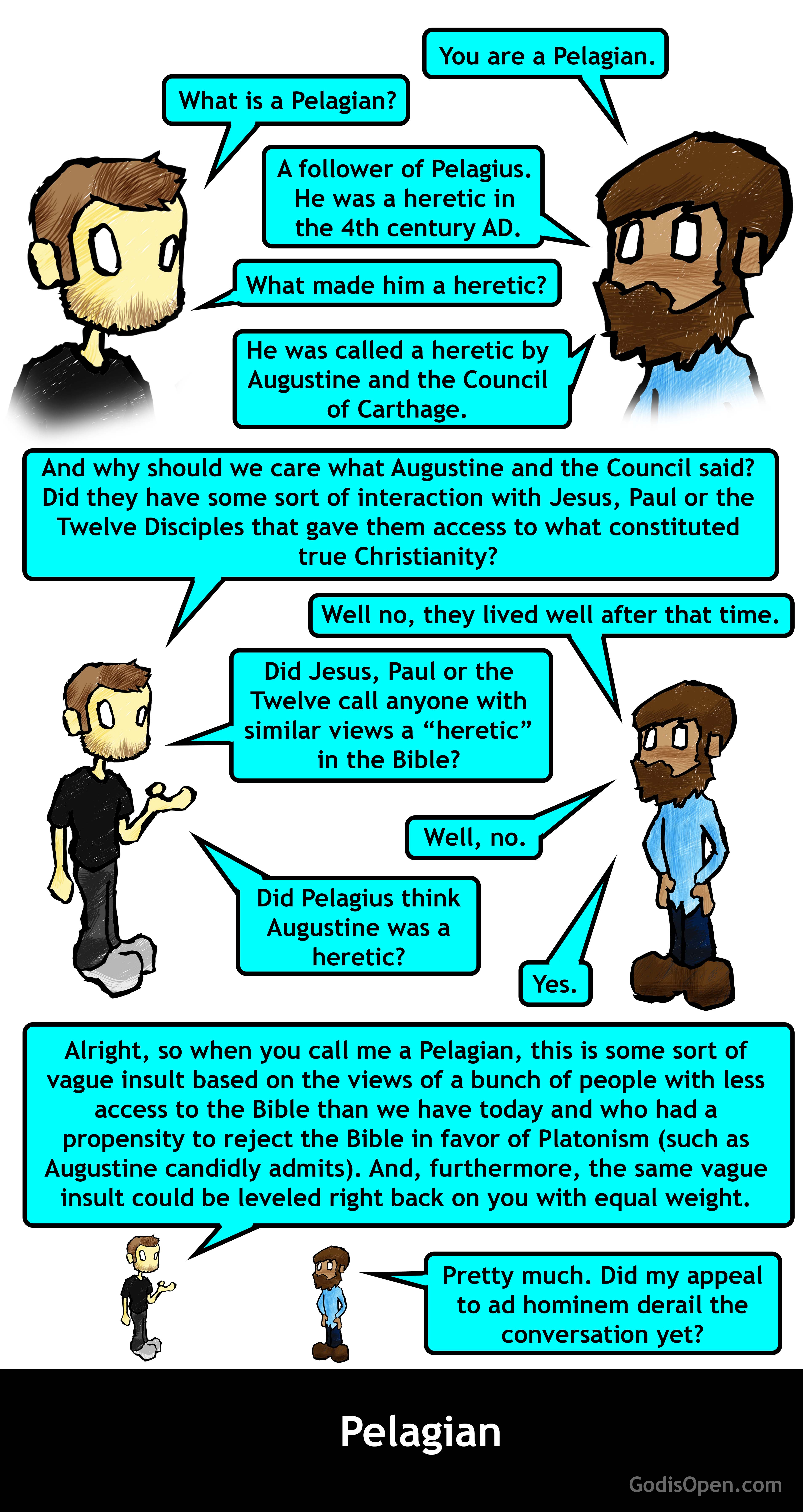
Worship Sunday – God of Wonders
Lord of all creation
Of water, earth and sky
The heavens are your tabernacle
Glory to the Lord on high
God of wonders beyond our galaxy
You are holy, holy
The universe declares Your Majesty
You are holy, holy
Lord of Heaven and earth
Lord of Heaven and earth
Early in the morning
I will celebrate the light
As I stumble in the darkness
I will call Your name by night
God of wonders beyond our galaxy
You are holy, holy
The universe declares Your Majesty
You are holy, holy
Lord of Heaven and earth
You’re the Lord of Heaven and earth
Hallelujah to the Lord of Heaven and earth
Hallelujah to the Lord of Heaven and earth
Hallelujah to the Lord of Heaven and earth
Hallelujah
God of wonders beyond our galaxy
You are holy, so holy
The universe declares Your Majesty
You are holy, holy
Oh, God of wonders beyond our galaxy
You are holy, holy
The universe declares Your Majesty
You are holy, holy
Hallelujah to the Lord of Heaven and earth
Hallelujah to the Lord of Heaven and earth
Hallelujah to the Lord of Heaven and earth
Hallelujah
Read more: Chris Tomlin – God Of Wonders Lyrics | MetroLyrics
Podcast EP104 – Basic Biblical Open Theism
Questions Answered – Eternal Promises
Craig writes:
I’m a Bible believing Christian that share in the Calvinists Doctrinal beliefs. Rarely am I able to have theological conversations with people without them squirming and leaving the room because they don’t care to hear or understand doctrinal truth.
So, I am to assume you believe in “open theism”?
I respond, yes and then Craig asks:
Good evening,
I wanted to know how “open theism” explains the topic of ETERNITY. If Gods word is authoritative, how does God understand forever, and ever?
“That whosoever believeth in him should not perish, but have eternal life.”
John 3:15 KJV“And these shall go away into everlasting punishment: but the righteous into life eternal.”
Matthew 25:46 KJV“But the Lord is the true God, he is the living God, and an everlasting king: at his wrath the earth shall tremble, and the nations shall not be able to abide his indignation.”
Jeremiah 10:10 KJVHow does He know this? If it’s possible that things can change.
Thanks,
Craig
I respond:
Sir,
That is a good question. Whenever I approach the Bible I attempt to treat the text as I would any other literary work. Statements need to be evaluated in context and with an understanding of any idiomatic meanings. We need to attempt to place ourselves in the shoes of the original readers and to recreate how they would have read the text. Would they read it with the fatalism of modern readers? I do not think so.
So, “everlasting life”: Is it idiomatic? Does it mean unconditional everlasting life? Does it contain some cultural assumptions? It seems to me the best way to understand how everlasting life works is to view it in relation to other everlasting promises in the Bible.
Several times in the Bible, everlasting promises are overturned when new events arise. In 1 Samuel 2:30, God had promised that Eli’s lineage would be eternal, but then Eli’s son’s turned out wicked and God revoked His eternal promise:
1Sa 2:30 Therefore the LORD God of Israel says: ‘I said indeed that your house and the house of your father would walk before Me forever.’ But now the LORD says: ‘Far be it from Me; for those who honor Me I will honor, and those who despise Me shall be lightly esteemed.
Likewise, King David’s Kingship is promised to be eternal, but stern warnings are attached. If David’s lineage rebelled, then the eternal promise could be revoked:
1Ki 9:4 Now if you walk before Me as your father David walked, in integrity of heart and in uprightness, to do according to all that I have commanded you, and if you keep My statutes and My judgments,
1Ki 9:5 then I will establish the throne of your kingdom over Israel forever, as I promised David your father, saying, ‘You shall not fail to have a man on the throne of Israel.’
1Ki 9:6 But if you or your sons at all turn from following Me, and do not keep My commandments and My statutes which I have set before you, but go and serve other gods and worship them,
1Ki 9:7 then I will cut off Israel from the land which I have given them; and this house which I have consecrated for My name I will cast out of My sight. Israel will be a proverb and a byword among all peoples.We also read that God was planning on offering this eternal Kingdom to Saul before he rebelled (1Sa 13:13). It does not seem that just the use of an “eternal” adjective would make Israel assume a promise could not be revoked if conditions change.
If we apply the same concept to “eternal life”, then eternal life is everlasting as long as we remain faithful to God. Yes, we can and do have eternal life. But that does not mean we then become robots and are incapable of choosing to reject God. The angels reject God in heaven, and we assume we cannot also?
We do not see God overriding free will, in the Bible. We see coercion, which suggests strongly that God does not override free will (why else would He have to coerce?). God is not shown making robots.
God changes in response to man. In fact, God explains that this is exactly how He operates:
Jer 18:7 The instant I speak concerning a nation and concerning a kingdom, to pluck up, to pull down, and to destroy it,
Jer 18:8 if that nation against whom I have spoken turns from its evil, I will relent of the disaster that I thought to bring upon it.
Jer 18:9 And the instant I speak concerning a nation and concerning a kingdom, to build and to plant it,
Jer 18:10 if it does evil in My sight so that it does not obey My voice, then I will relent concerning the good with which I said I would benefit it.Notice in this text how it contrasts how God both “thinks” and “says” something, and both must be reversed because of new events. The text of the Bible is that God reacts according to people’s actions. Sometimes this involves reversing eternal promises (as is clear in 1Sa 2:30 ).
I guess my question to you is this:
Does God revoke an eternal promise in 1 Samuel 2:30? Here is the text:
1Sa 2:30 Therefore the LORD God of Israel says: ‘I said indeed that your house and the house of your father would walk before Me forever.’ But now the LORD says: ‘Far be it from Me; for those who honor Me I will honor, and those who despise Me shall be lightly esteemed.
So, in 1 Samuel 2:30: Did God promise a “house” that would last “forever”? Does God revoke this promise that was meant to “last forever”?
Thank you,
Chris
Message sent Jan 8th, 2016 (no response).
Apologetics Thursday – Piper on the Book of Life
John Piper writes about being blotted out of the Book of Life:
Being in the book keeps you from doing what would get you erased from the book if you did it.
Notice the inherently tautological nature of this statement. If John, of Revelation, believed as much, why did he not state it? Why did he state it in the way he does, where there is a natural tendency to conclude losing your place in the Book of Life was possible?
And why does Piper ignore the very last warning in the book of Revelation:
Rev 22:19 and if anyone takes away from the words of the book of this prophecy, God shall take away his part from the Book of Life, from the holy city, and from the things which are written in this book.
People definitely can have a “part” in the Book of Life, and then have that part revoked. That is the normal assumption about the Book of Life, throughout the Bible (the Book of Life is not unique to the Revelation context).
Piper’s theology does not allow for this, so he invents a mechanism in which the author of Revelation is making a claim that can never be actualized. John describes names being removed from the Book of Life, although such a thing could never occur (at least in Piper’s theology). This doesn’t fit the context of the quotes, which are warning people to stay true to God and to refrain from actions that will disqualify them from the Book of Life. Piper, wishing to have his cake and eat it too, admits as much:
Never, never, never be cavalier or trifling about your perseverance. God uses real warnings to keep us vigilant and to keep us persevering. We are safe. But we are not careless. That is the point.
But Piper’s conclusions run counter to his theology.
China Rejects Omniscience
From China and the Christian Impact, by Jacques Gernet:
If it is said that at that time [after the Fall], the Master of Heaven [Yahweh] would have liked to destroy [Adam] and [Eve] but was afraid that then there would be no human race, why did he not start all over again and create a man who was truly good, since he possesses the inexhaustible power to create men? And if it is said that he had not the heart to cut the evil short, by eliminating the guilty, because the evil was not yet very serious, how is it that he could leave things as they were, knowing full well that little streams turn into big rivers and that great fires begin with tiny sparks?
Nor can it be held that the Master of Heaven wished to test the man he had created by leaving him free to act in order to see whether he would resist the temptation of doing evil. Omniscient as he was, he must have known in advance that Adam and Eve would transgress his prohibitions. Knowing for certain that they would fall into sin, he simply set a trap for them. The thesis of free will is incompatible with the creator’s omniscience:
If it is said that he knew in advance from the moment man was created that he would surely commit a fault but that he allowed him to act as man himself decided. either for good or for evil, so as to decide whether he should be rewarded or punished, that is what is called ‘trapping people with a net`. How does that show him to be the master [of all beings]? So what do these words ‘omniscient’ and ‘omnipotent’ mean?
Faber on God’s Free Will
So, what’s the alternative? Free will, of course. You see, God loves, not because it is His nature to love, but rather because love is the means by which God chose to enter into relationship with us. In the same way, God is just in that God chooses to be sovereign over creation, not because it is an attribute of God. God is freely just in the same way that he freely loves.
Meme Monday – Not My Will
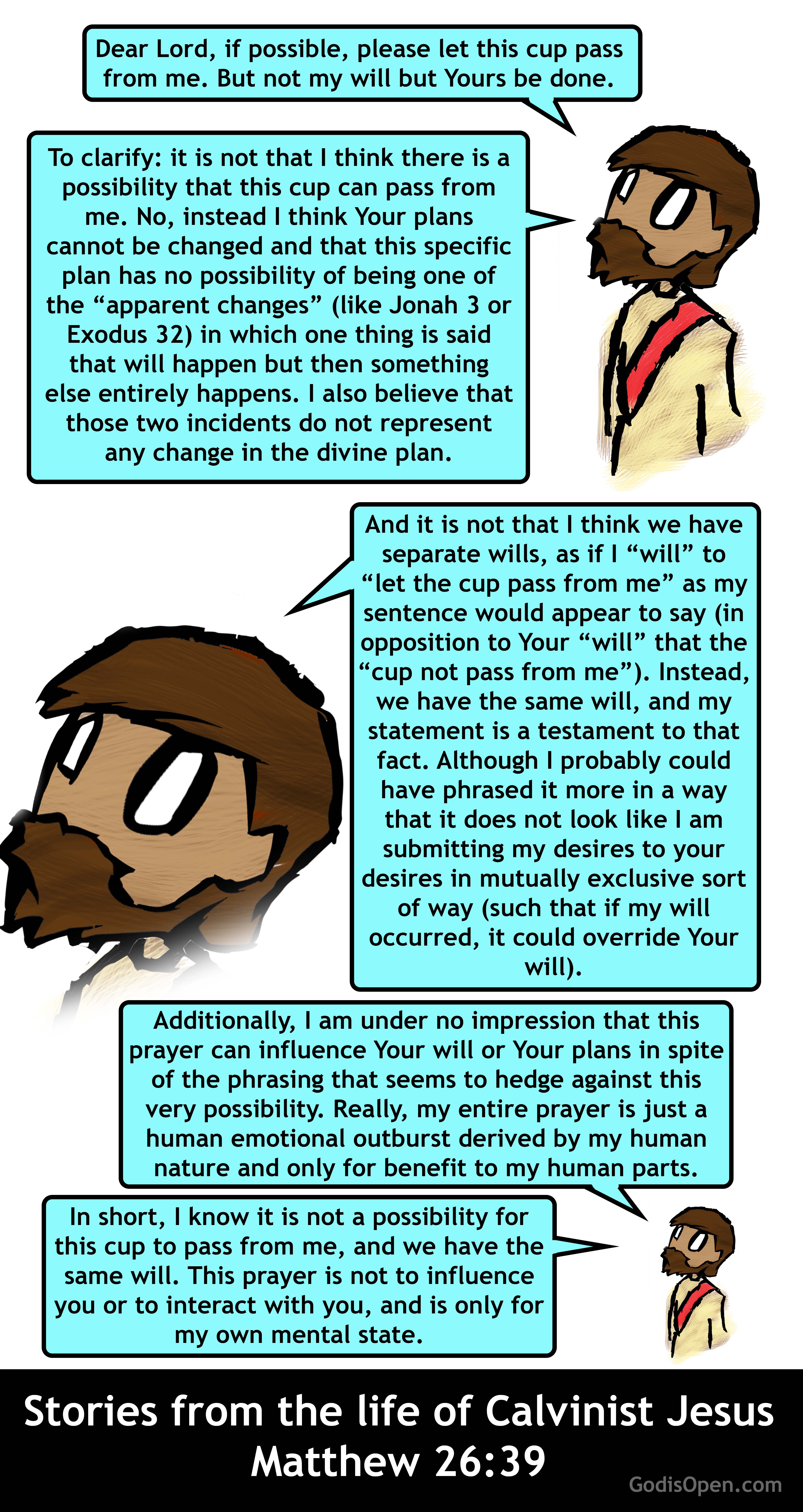
Worship Sunday – Soul on Fire
God, I’m running for Your heart
I’m running for Your heart
Till I am a soul on fire
Lord, I’m longing for Your ways
I’m waiting for the day
When I am a soul on fire
Till I am a soul on fire
Lord, restore the joy I had
And I have wandered bring me back
In this darkness, lead me through
Until all I see is You
Lord, let me burn for You again
Let me return to You again
And Lord, let me burn for You again
Let me return to You again
God, I’m running for Your heart
I’m running for Your heart
Till I am a soul on fire
I want to be
Till I am a soul on fire
Till I am a soul on fire
Podcast EP102 and EP103 – The Spectrum Of Open Theism
Questions Answered – Is God ever Surprised?
Scot McKnight answers a reader question:
Where are you on this one? Do you think God knows what you will wear tomorrow? Which way you will turn at the corner when you go for a leisure drive? What you will order when you go to Chipotle?
McKnight references John Goldingay, in his book, “Key Questions about Christian Faith: Old Testament Answers”. McKnight writes:
Sometimes God does not know how things will turn out.
I’m aware some of us are bothered by this statement, but I’m summarizing Goldingay and he’s reading the Bible and some passages in the Bible can be read just that way. So where?
Here’s one. Exodus 33:5: For the LORD had said to Moses, “Tell the Israelites, ‘You are a stiff-necked people. If I were to go with you even for a moment, I might destroy you. Now take off your ornaments and I will decide what to do with you.’” Or this one from Jeremiah 26:3: “Perhaps they will listen and each will turn from their evil ways. Then I will relent and not inflict on them the disaster I was planning because of the evil they have done.” It is the word “Perhaps” that reveals that either God is deceiving or God doesn’t know (or maybe others have other explanations). But a “plain reading” knows that “perhaps” implies contingency. And a final one from Exodus 4:8 Then the LORD said, “If they do not believe you or pay attention to the first sign, they may believe the second. 9 But if they do not believe these two signs or listen to you, take some water from the Nile and pour it on the dry ground. The water you take from the river will become blood on the ground.”
Sometimes things turn out differently from God’s expectations.
“God experiences disappointment” (29). In Isaiah 5 we find a song about a vinedresser and a vineyard, and it tells us that God expected/hoped for justice and righteousness but that’s not what happened. God was surprised. Read Jeremiah 3:6-7, 19-20; Isaiah 63:8-10.
Sometimes things turn out differently than God’s announcements.
Micah predicts through God that Jerusalem would be destroyed but it wasn’t (Mic 3:12); the king submitted himself to God (Jer 26:17-19). And Jonah predicted through God that Nineveh would be destroyed in 40 days and it wasn’t (Jonah 3:4, 10). The word here is “unless.” If things change, God’s announcements won’t turn out.
God and Nebuchadnezzar in Ezek 26:1-21; 29:17-20. God “sought to kill Moses” but his wife, Zipporah, stepped in and God backed off (Exod 4:24-26). Goldingay says Adam would die if he ate the fruit but he didn’t die — and that is another instance of this. He sees the predictions of Jesus — Matt 10:23; Mark 9:1; Mark 13 — as the same sort of thing.
Goldingay sees this as God’s intent and announcement but that they will happen if God doesn’t change his mind or things don’t shift. God remains consistent with the goals God has in mind.
Goldingay thinks open theism’s explanations don’t always apply. Sometimes God can know the future. Before it happens. But classical theists can’t explain that sometimes God doesn’t know and that sometimes God’s announcements don’t always occur as announced.
McKinght concludes:
Goldingay thinks open theism’s explanations don’t always apply. Sometimes God can know the future. Before it happens. But classical theists can’t explain that sometimes God doesn’t know and that sometimes God’s announcements don’t always occur as announced.
Scripture isn’t bothered by these problems, so Goldingay observes.
Enyart Recaps James White’s Denial of the Incarnation
Flowers Responds to White
Hayes on the Garden of Eden
From secular Yale professor Christine Hayes’ Introduction to the Bible:
The Garden of Eden story contains a narrative feature that will recur in the Pentateuch: Yahweh’s recalibrations in the light of human activity. Following the creation, Yahweh has to punt a bit. He modifies his plans for the first couple— barring access to the tree of life in response to their unforeseen disobedience. Despite their new mortality, humans are nevertheless a force to be reckoned with— unpredictable to the very god who created them.
Hayes, Christine (2012-10-30). Introduction to the Bible (The Open Yale Courses Series) (Kindle Locations 958-961). Yale University Press. Kindle Edition.
Meme Monday – Molinism
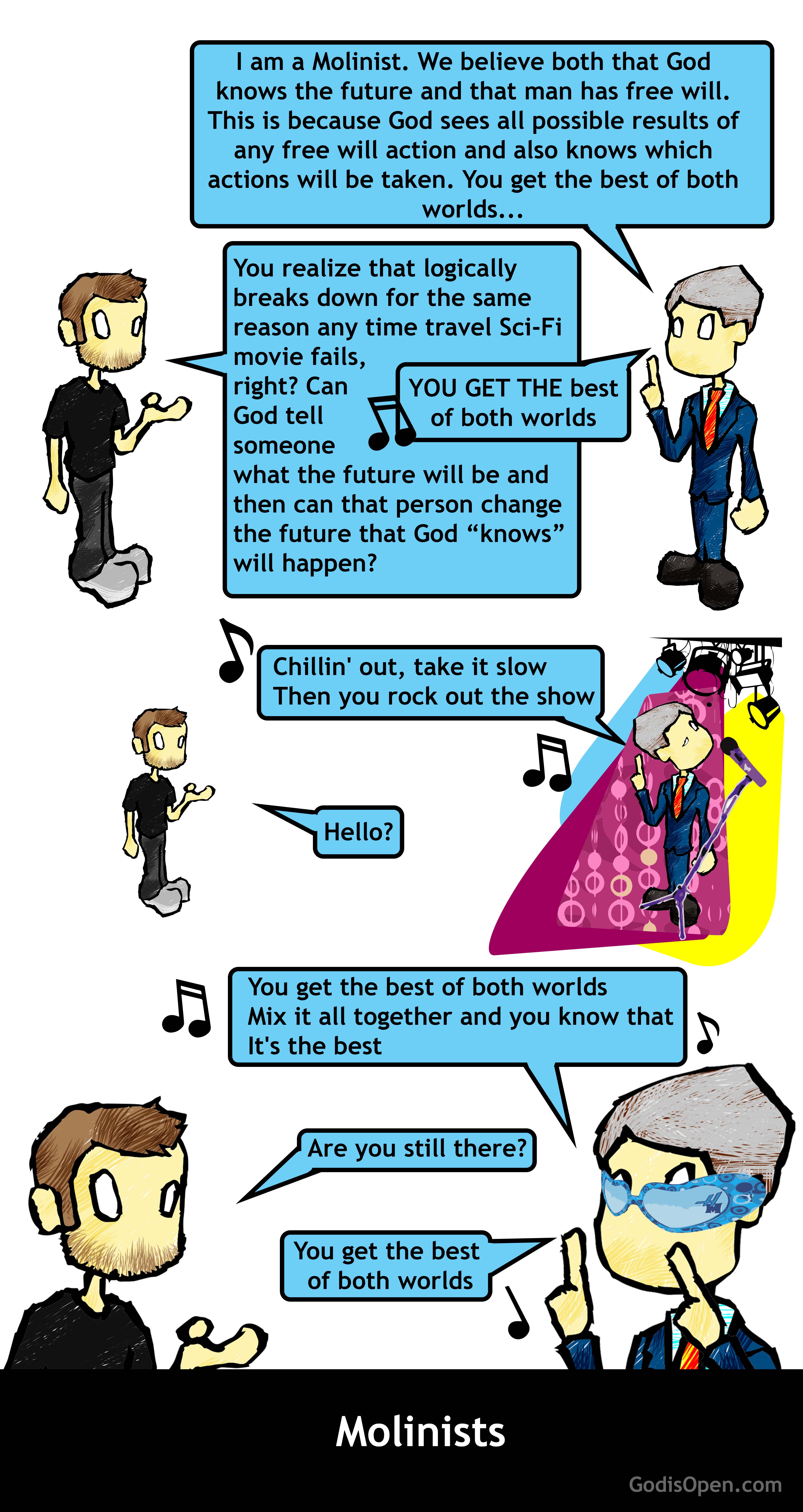
Worship Sunday – First
Before I bring my need
I will bring my heart
Before I lift my cares
I will lift my arms
I wanna know You
I wanna find You
In every season
In every moment
Before I bring my need
I will bring my heart
And seek You
First
I want to seek You
I want to seek You
First
I want to keep You
I want to keep You
First
More than anything I want, I want You
First
Before I speak a word
Let me hear Your voice
And in the midst of pain
Let me feel Your joy
I wanna know You
I wanna find You
In every season
In every moment
Before I speak a word
I will bring my heart
And seek You
First
I want to seek You
I want to seek You
First
I want to keep You
I want to keep You
First
More than anything I want, I want You
First
You are my treasure and my reward
Let nothing ever come before
You are my treasure and my reward
Let nothing ever come before
I seek You
First
First
I want to seek You
I want to seek You
First
I want to keep You
I want to keep You
First
More than anything I want, I want You
First
First
Podcast EP101 – An Overview Of 1st Century Religion
Questions Answered – What about the views of the Reformation
From James Jones’ defense of his 1828 book “An Inquiry Into the Popular Notion of an Unoriginated, Infinite and Eternal Prescience: With a Preface Containing a Dialogue Between the Author and One of His Readers”:
R. But, Sir, let me ask you, Did not Luther and Melancthon, and all the Reformers, believe in this very doctrine of eternal prescience?
A. It is possible they might: but even in that case, it will only follow, that although they exposed and reformed many errors of the church of Rome, they did not reform all its erroneous doctrines. The very principle upon which the agents of the Reformation founded their innovations on the church of Rime, is that on which I am now proceeding; the right and competency of private judgment in the interpretation of the word of God. And as to unsettling people’s minds, there is no possibility of reclaiming people from error except by unsettling their opinions. But if, but unsettling of people’s opinions, we can only lead them to the knowledge of truth, and to the enjoyment of personal salvation, then the acquisition of personal piety, and correct views of religious truth, must certainly be regarded as an ample recompense for all the trouble occasioned to the thereby.
A Detailed Response to Closing the Door on Open Theism – Part 6
Martyn McGeown writes:
Scripture knows nothing of a god who is infinitely resourceful because the unanticipated free choices of his creatures cause him to seek alternative routes to accomplish his ever changing purposes.
This is an interesting claim. The entire Bible is repeat with averted plans of God and even God explicitly saying He will change what He thinks and plans to do in response to man.
The central promise of the Old Testament even stands in stark contrast to McGeown’s claim. In Genesis 26, God gives Abraham an unconditional promise:
Gen 26:4 I will multiply your offspring as the stars of heaven and will give to your offspring all these lands. And in your offspring all the nations of the earth shall be blessed,
Throughout the Bible, this promise is treated as unconditional to the extent that in Malachi 3:6 God states that without the promise He would have killed all of Israel by that time. God’s contingency actions to fulfill this promise appear throughout the Bible and are even sometimes averted through human intervention. In Exodus 32 is one such instance.
In Exodus 32, God wants to kill all of Israel. But this would destroy His promise to Abraham (cutting off all of Abraham’s seed). But God has a solution: He will kill everyone except Moses. Moses could restart the promise of Abraham:
Exo 32:10 Now therefore let me alone, that my wrath may burn hot against them and I may consume them, in order that I may make a great nation of you.”
God never is left alone. God never is left to burn in His wrath. God never consumes Israel. Luckily for Israel’s sake, God’s plan to kill all of Israel except for Moses is averted. Moses convinces God not to destroy Israel. Moses threatens suicide (death). Moses gives a list of reasons. Moses appeals to God’s promise and to God’s public relations image. God repents and Israel is spared.
Throughout the Bible, there is often talk about a “remnant” coupled with talk of divine punishment. When Israel is to be punished, always a select few are to be saved in order to continue on the promise. In the New Testament, Paul takes this talk of a remnant, and claims that the Gentiles are being grafted into the remnant to fulfill the promise:
Rom 11:2 God has not rejected his people whom he foreknew. Do you not know what the Scripture says of Elijah, how he appeals to God against Israel?
Rom 11:3 “Lord, they have killed your prophets, they have demolished your altars, and I alone am left, and they seek my life.”
Rom 11:4 But what is God’s reply to him? “I have kept for myself seven thousand men who have not bowed the knee to Baal.”
Rom 11:5 So too at the present time there is a remnant, chosen by grace.
…
Rom 11:11 So I ask, did they stumble in order that they might fall? By no means! Rather through their trespass salvation has come to the Gentiles, so as to make Israel jealous.
Rom 11:12 Now if their trespass means riches for the world, and if their failure means riches for the Gentiles, how much more will their full inclusion mean!
This is heavy news for the Jews. To Paul, the promise of Abraham’s heirs is being fulfilled by Gentiles because of the unbelief of the Jews. This is God exercising a contingency plan. Also, interestingly enough, the purpose is to “provoke the Jews to jealousy”.
John the Baptist also explains how God could fulfill His unilateral promise to Abraham. Even if God killed every Jew alive, God could spring up new sons of Abraham from the rocks:
Mat 3:8 Therefore bear fruits worthy of repentance,
Mat 3:9 and do not think to say to yourselves, ‘We have Abraham as our father.’ For I say to you that God is able to raise up children to Abraham from these stones.
In other words, the Jews should not be confident that God’s promise will save them for the sake of the promise. God is resourceful and will find a way to fulfill the promise even if rejected by every Jew ever. To John, God will create new Jews. To Paul, God will graft in the Gentiles.
There are plenty more references to God navigating this promise in light of Israel’s actions, but this should suffice. Other examples of God’s resourcefulness in response to human behavior is finding a new king when God regrets choosing Saul, God building a cascading contingency plan to convince Israel of His power in Exodus 4 (even this contingency plan fails and God is forced to work unilaterally without the support of Israel), God forcing Nebuchadnezzar into a frenzy in order to subjugate him, God corralling a fleeing prophet in Jonah, God revoking His promise to destroy Nineveh once the people repent, God changing His promise of a priesthood once He encounters evil priests, and so on. The story of the Bible is a story of God acting, and acting in response to human acts, always changing and always modifying His plans.
As Biblical scholar, Christine Hayes states: “The character Yahweh in the Bible changes his mind; it’s just a fact of the text.”
For McGeown to claim otherwise is perplexing.
A Detailed Response to Closing the Door on Open Theism – Part 1 [link]
A Detailed Response to Closing the Door on Open Theism – Part 2 [link]
A Detailed Response to Closing the Door on Open Theism – Part 3 [link]
A Detailed Response to Closing the Door on Open Theism – Part 4 [link]
A Detailed Response to Closing the Door on Open Theism – Part 5 [link]
T. C. Moore Publishes an Extensive Review of the Uncontrolling Love of God
TC Moore publishes on acedemia.edu an extensive review of Oord’s The Uncontrolling Love of God. It begins:
In 15 years of full-time Christian ministry, I had not presided over a funeral service until yesterday. The funeral was for a 24 year old man who was brutally stabbed to death a few days before Christmas by a complete stranger.
He died mere hours before he was due to enter an expensive in-patient rehab program, to which he’d miraculously gained admission, after years of battling alcoholism. And from what I can gather from the police report given to the family, the young man’s murderer was an L.A. school teacher. The sheer absurdity and brutality of his murder continues to deeply sadden and confound me. How could something like this have even happened? The day before the funeral, I met with and listened to the victim’s mother as she told me just how completely devastating his death has been for her. She is a single mother of three and he was her oldest son. While I was listening and praying with her, she asked me a critical question that should give any sincere minister pause. She asked, “Do you think he was destined to die this way or do you think it was just bad luck?”
How would you have answered her?
As I imagine how pastors and ministers all over the United States would engage with that question, I’m deeply concerned that many are shamefully ill-equipped. They’ve been sold a model of divine providence that is not only biblical unfounded but also ethically bankrupt. Far too many well-meaning Christian ministers in the United States today would actually tell this grieving mother it was God’s will that her son die the way he did. Others, aware of how cruel such a statement would be, would attempt to find some creative way to avoid answering her directly, while secretly believing her son was predestined to be murdered.
Fisher Explains the Moralistic Fallacy to Agnostic
Fisher:
Mr Hendricks,
Thank you for agreeing to speak with me. You recently posted on an Open Theist Facebook group challenging Open Theism. I was very interested to speak with you about your views, so suggested this conversation which can then be posted to GodisOpen.com . You where amicable to such an arrangement, so I appreciate your willingness for dialogue.
I guess a good place to start is you. Can you tell us your background and your theological convictions? I am particularly interested in your views about the Bible and the authority of the Bible in your theology.
I await your reply.
Hendricks:
I was raised in the Nazarene church and started doubting their version of creation in my early teens. I have been agnostic since college and did not see much value in devotion to a nonhuman entity
So, from what I gather, you are not necessarily a Christian. That is a useful starting point.
Fisher:
About myself: I agree with much of what Yale Professor Christine Hayes says, and she too (like you) is not a Christian. Her scholarship extends to Old Testament theology. Her concerns, much like my own, is not whether the text is true or false, but an accurate reconstruction of Jewish ideas.
I believe that only after we examine the Bible can we then determine the truth of the Bible. I would assume you believe the same. Right?
Hendricks:
Examination is the first step to truth
Fisher:
Absolutely. You post on the Open Theism page suggested that mere revulsion had some sway on the truth of a mater. I would like to suggest that it does not. So if God is in your words “open-minded, fallible, somewhat mortal one” this would not be enough to determine the truth of who God is not.
This fallacy is formally known as the Moralistic fallacy. The moralistic fallacy is the informal fallacy of assuming that whichever aspect of nature which has socially unpleasant consequences cannot exist. Its typical form is “if X were true, then it would happen that Z!”, where Z is a morally, socially or politically undesirable thing. What should be moral is assumed a priori to also be naturally occurring.
So, I assume you would agree that “who the God of the Bible is” has no bearing on if He does or does not exist.
Hendricks:
I love this view of Biblical truth …
Fisher:
Again, that is the moralistic fallacy, rephrased. You are assuming that revulsion is a guide to truth. Whereas, in reality, our preference for a thing has zero bearing on the truth of that thing. Right?
Hendricks:
I have a bigger issue than this … I don’t believe in creation.
I find the concept of a human centered universe with a single non-human divine creator to be very egoistic arrogant. To assume our species deserves the singular focus of a being that creates all is ridiculous.
Fisher:
Creation is a bigger issue. But I am wondering if you understand the moralistic fallacy. This is important because it really is at the heart of so much false theology and false religion.
Your second point is again a moralistic fallacy. We cannot “will” reality into being.
Hendricks:
Talk about truth … this guy gets to the point of religion in general.
Fisher:
Not all Open Theists believe in hell. Some are annihilationists, some believe hell is just a place away from God. But this, to me, does not seem like a legitimate argument concerning the God of the Bible.
Secular Old Testament scholar, Christine Hayes talks about hell and explains how it is really not a facet of Old Testament religion. So acceptance of rejection of hell has little to do with acceptance or rejection of the God of the Old Testament.
After this, Hendricks does not respond.
Post discussion notes: it seems Hendricks did not have material objections to either Christianity or God in general. He did not seem to acknowledge the moralistic fallacy or recognize its use. Use of that basic fallacy shut down his most pressing arguments.
Olson Recounts His History with Boyd
From Roger Olsen’s Walter Wink and Greg Boyd on the Problem of Evil:
Recently I’ve been re-reading my former colleague and friend Greg Boyd’s book Satan and the Problem of Evil. (It’s also a very big book! Why can’t people keep their books briefer? :) I was privileged to work alongside Greg for several years and I remember our many talks about the subjects he deals with in that book. (In fact, I take some credit for helping launch Greg’s career as a theologian; it was I who choose his application out of a stack of applications for an open position in theology and insisted that we interview him. I remember how he absolutely hit the ball out of the ballpark in his interviews. Needless to say, he was hired and became one of the college’s most popular teachers and an influential evangelical scholar.)
Meme Monday – The Lord’s Prayer
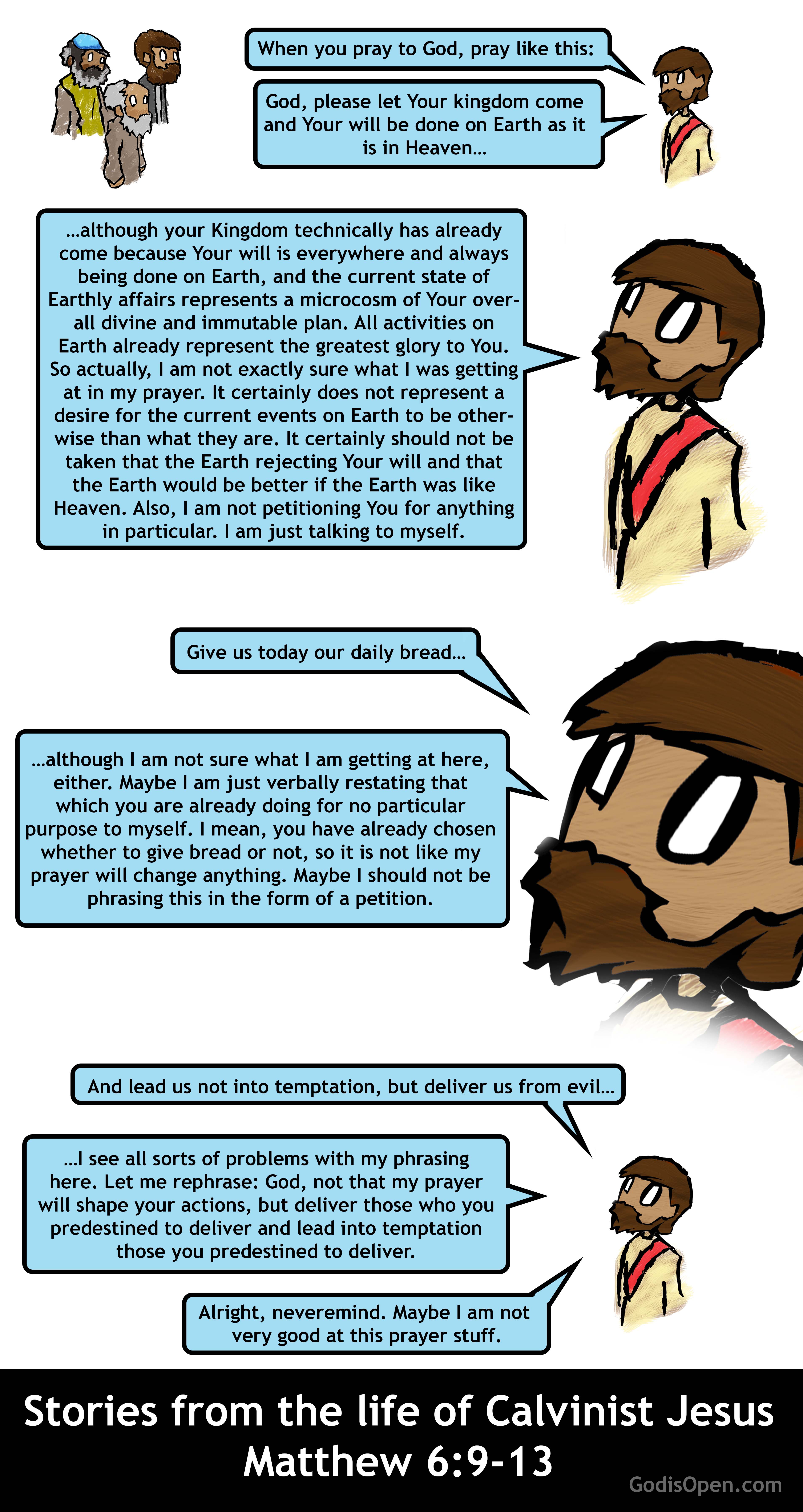
Worship Sunday – Receive Our Song
Let our songs of praise be always on our lips
Let our songs of praise be always on our lips
Let our songs of praise be always on our lips
Let our songs of praise be always on our lips
I thank You when the sun comes up
I seek You when the sun goes down
I praise You in the dusk
Exalt You in the dark
Let Your will be done
You’re the beginning and the end
Sovereign over life and death
We praise You as our King
To You our God we sing
Let Your kingdom come
Lord receive our songs
Your children singing praises to You
Lord receive our songs
Let Your kingdom come
Let it come
You have called us out of the darkness into the light
To You the night is bright as day
Podcast EP100 – GodisOpen
Questions Answered – Is Open Theism Heretical
From James Jones’ defense of his 1828 book “An Inquiry Into the Popular Notion of an Unoriginated, Infinite and Eternal Prescience: With a Preface Containing a Dialogue Between the Author and One of His Readers”:
Reader: Why, Sir, your book would overturn all law and gospel at once. It is absolutely not fit to be read by any Christian people.
Answer: Perhaps, my dear Sir, you have mistaken the design of my arguments. The object of my book is to disprove the doctrine of an unoriginated, infinite, and eternal prescience ; and I am sure that I could never discover that doctrine in any part of either the law or the gospel. It is, I think, pretty certain that not any one
of the ten commandments, contains the doctrine of eternal prescience; and I think it is. equally certain that it is not contained in any of the laws of Moses. The design of the gospel, as you are well aware, is that of dispensing the blessings of mercy and salvation, by faith in Jesus Christ, and under the wise and righteous
dictates of the law of obedience to God. Pray Sir, on what principles will you identify the doctrine of eternal prescience, with either the law or the gospel?
A Detailed Response to Closing the Door on Open Theism – Part 5
Martyn McGeown then makes a bad point and a good point:
In addition, a god who cannot predict the future cannot give us an infallible Bible, especially one replete with prophecies of future events. Stephen Wellum writes, “If God is ignorant of vast stretches of forthcoming history, then how can any of the predictive prophecies in Scripture be anything more than mere probabilities?”
What does “infallible” mean to McGeown? The Bible has plenty of time specific prophecies. Several do not come to past (like the prophecy against Nineveh) and some are inaccurate (like the time prophesied for Egyptian slavery or the time prophesied for Babylonian captivity). Timeframes often work like rough estimates in prophesy. This would be expected from the Open Theist perspective, and would render the Bible false in the Calvinist perspective. Prophecy is flexible. God even says that it can be adverted. God can say something or think something, and that something can change.
In this sense, it is true that all prophecy work with probabilities. As discussed earlier, even the crucifixion was not a fixed event, not from the Biblical perspective. In order to claim prophecy is fixed, extra-Biblical standards must be imposed on the text. And those standards are generated by the completely unsubstantiated claims that the future is exhaustively known.
McGeown then turns to omnipotence (another word not used in the Bible except for a vague reference in the book of Revelation):
Open theism rejects God’s omnipotence and replaces it with something called “omnicompetence.”
…
However much Boyd wants to spin it, the fact is that his god does not “perfectly anticipate” the moves of his creatures. Sometimes, as we have seen with Saul and others, he fails to anticipate what his creatures will do.
The omnicompetent god of open theism has the added attribute of resourcefulness. “Sometimes the desires of God are stymied,” writes Sanders, “but God is resourceful and faithfully works to bring good even out of evil situations.”
McGeown seems to take it as a granted that diminishing what McGeown personally values in sovereignty is some sort of affront to God. He does not refute any arguments, but seems to believe they are self-refuting. In lack of any real arguments against the Open Theistic concept of God’s power and ability, a quote by Roger Olsen will have to suffice to counter McGeown:
There is no “sovereignty” in human experience like the “sovereignty” Calvinists insist we must attribute to God in order “really” to believe in “God’s sovereignty.” In ordinary human language “sovereignty” NEVER means total control of every thought and every intention of every subject. And yet it has become a Calvinist mantra that non-Calvinists “do not believe in God’s sovereignty.” I have a tape of a talk where R. C. Sproul says that Arminians “say they believe in God’s sovereignty” but he goes on to say “there’s precious little sovereignty left” (after Arminians qualify it). And yet he doesn’t admit there (or anywhere I’m aware of) that his own view of God’s sovereignty (which I call divine determinism) is not at all like sovereignty as we ordinarily mean it. That’s like saying of an absolute monarch who doesn’t control every subject’s every thought and intention and every molecule in the universe that he doesn’t really exercise sovereignty. It’s an idiosyncratic notion of “sovereignty.”
A Detailed Response to Closing the Door on Open Theism – Part 1 [link]
A Detailed Response to Closing the Door on Open Theism – Part 2 [link]
A Detailed Response to Closing the Door on Open Theism – Part 3 [link]
A Detailed Response to Closing the Door on Open Theism – Part 4 [link]
A Detailed Response to Closing the Door on Open Theism – Part 5 [link]
Jones on Contradictory Beliefs
From his defense of his 1828 book “An Inquiry Into the Popular Notion of an Unoriginated, Infinite and Eternal Prescience: With a Preface Containing a Dialogue Between the Author and One of His Readers”:
My good Sir, say rather they are Christian contradictions; and as Christian contradictions they must be believed and received. I am well aware that the philosophy of religious truth may indeed be incomprehensible ; but the possibility of every Christian doctrine must be intuitively evident : or otherwise the fact can never be a subject of rational conviction. If the mystery, or rather the absurdity, of a doctrine may be argued as a valid objection to the cordial belief of it, then I am quite sure that no person can have any rational conviction of the doctrine of eternal prescience. Your argument, my good Sir, is solely and obviously against yourself. If we are not to have any thing to do with mysteries, or rather with contradictory things, then I am very sure we have no business with the doctrine of an eternal prescience.
Adam Clarke on Necessary Knowledge
From his commentary on Acts 2:47:
Therefore it does not follow that, because God can do all things, therefore he must do all things. God is omniscient, and can know all things; but does it follow from this that he must know all things? Is he not as free in the volitions of his wisdom, as he is in the volitions of his power? The contingent as absolute, or the absolute as contingent? God has ordained some things as absolutely certain; these he knows as absolutely certain. He has ordained other things as contingent; these he knows as contingent. It would be absurd to say that he foreknows a thing as only contingent which he has made absolutely certain. And it would be as absurd to say that he foreknows a thing to be absolutely certain which in his own eternal counsel he has made contingent.
By absolutely certain, I mean a thing which must be, in that order, time, place, and form in which Divine wisdom has ordained it to be; and that it can be no otherwise than this infinite counsel has ordained. By contingent, I mean such things as the infinite wisdom of God has thought proper to poise on the possibility of being or not being, leaving it to the will of intelligent beings to turn the scale. Or, contingencies are such possibilities, amid the succession of events, as the infinite wisdom of God has left to the will of intelligent beings to determine whether any such event shall take place or not. To deny this would involve the most palpable contradictions, and the most monstrous absurdities.
If there be no such things as contingencies in the world, then every thing is fixed and determined by an unalterable decree and purpose of God; and not only all free agency is destroyed, but all agency of every kind, except that of the Creator himself; for on this ground God is the only operator, either in time or eternity: all created beings are only instruments, and do nothing but as impelled and acted upon by this almighty and sole Agent.
Consequently, every act is his own; for if he have purposed them all as absolutely certain, having nothing contingent in them, then he has ordained them to be so; and if no contingency, then no free agency, and God alone is the sole actor. Hence the blasphemous, though, from the premises, fair conclusion, that God is the author of all the evil and sin that are in the world; and hence follows that absurdity, that, as God can do nothing that is wrong, Whatever Is, is Right. Sin is no more sin; a vicious human action is no crime, if God have decreed it, and by his foreknowledge and will impelled the creature to act it. On this ground there can be no punishment for delinquencies; for if every thing be done as God has predetermined, and his determinations must necessarily be all right, then neither the instrument nor the agent has done wrong.
Thus all vice and virtue, praise and blame, merit and demerit, guilt and innocence, are at once confounded, and all distinctions of this kind confounded with them. Now, allowing the doctrine of the contingency of human actions, (and it must be allowed in order to shun the above absurdities and blasphemies), then we see every intelligent creature accountable for its own works, and for the use it makes of the power with which God has endued it; and, to grant all this consistently, we must also grant that God foresees nothing as absolutely and inevitably certain which he has made contingent; and, because he has designed it to be contingent, therefore he cannot know it as absolutely and inevitably certain.
I conclude that God, although omniscient, is not obliged, in consequence of this, to know all that he can know; no more than he is obliged, because he is omnipotent, to do all that he can do.
Meme Monday – Loaded Language
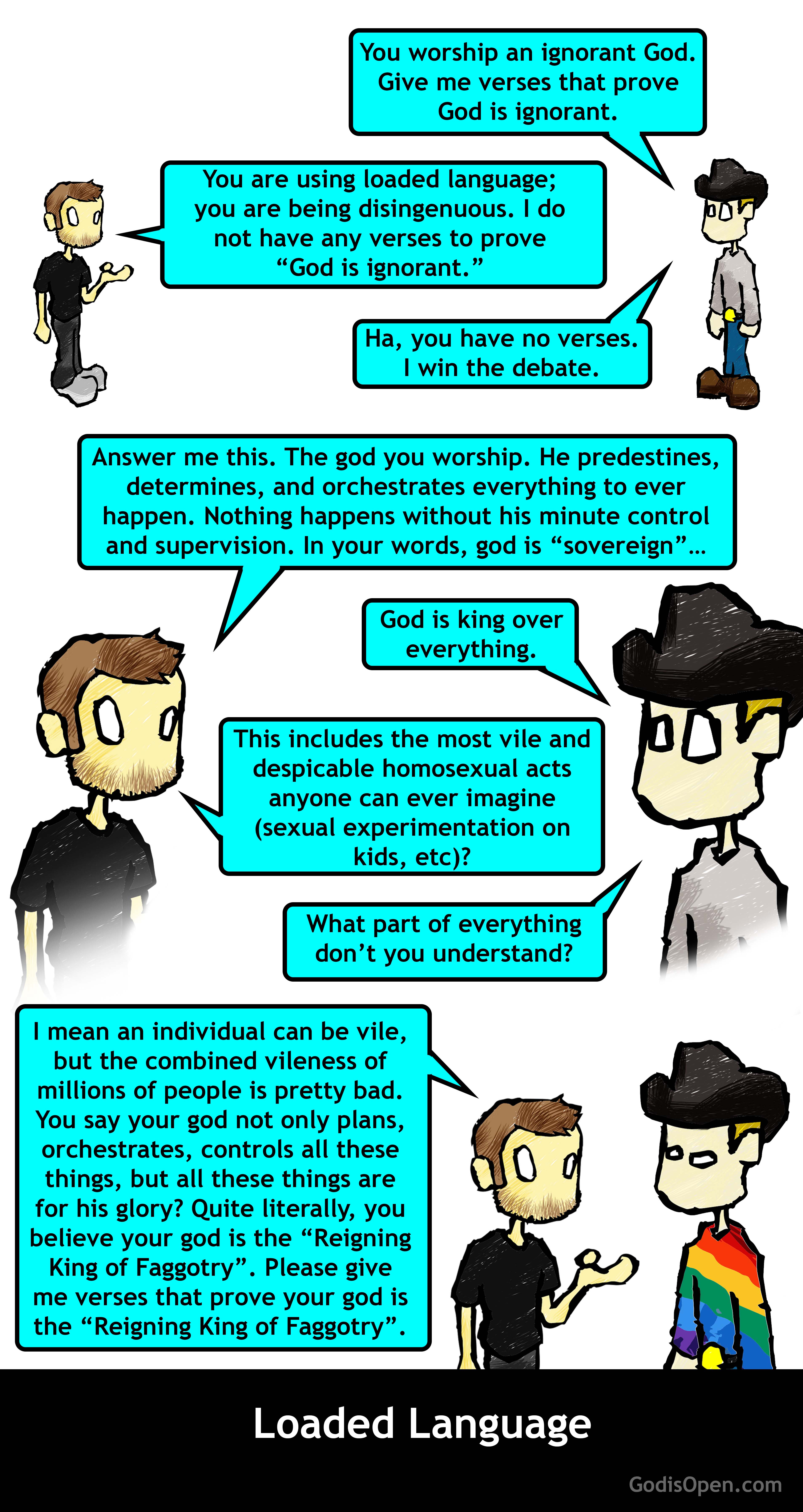
Worship Sunday – Oh Little Town Of Bethlehem
O little town of Bethlehem
How still we see thee lie
Above thy deep and dreamless sleep
The silent stars go by
Yet in thy dark streets shineth
The everlasting Light
The hopes and fears of all the years
Are met in thee tonight
For Christ is born of Mary
And gathered all above
While mortals sleep, the angels keep
Their watch of wondering love
O morning stars together
Proclaim the holy birth
And praises sing to God the King
And Peace to men on earth
How silently, how silently
The wondrous gift is given!
So God imparts to human hearts
The blessings of His heaven.
No ear may hear His coming,
But in this world of sin,
Where meek souls will receive him still,
The dear Christ enters in.
O holy Child of Bethlehem
Descend to us, we pray
Cast out our sin and enter in
Be born to us today
We hear the Christmas angels
The great glad tidings tell
O come to us, abide with us
Our Lord Emmanuel
Hayes on God Changing His Mind
From atheist Christine Hayes’ Yale lectures:
Secondly, remember that the Bible isn’t a manual of religion. It’s not a book of systematic theology. It doesn’t set out certain dogmas about God, and you need to be careful not to impose upon the Bible, theological ideas and beliefs that arose centuries after the bulk of the Bible was written — for example, a belief in a heaven and a hell as a system of reward or punishment, or the belief in a God that doesn’t change his mind. The character Yahweh in the Bible changes his mind; it’s just a fact of the text.
Staples Gives the Real Christmas Story
From Jason Staples:
In the first (recently published in NTS), he shows (in spite of the constant threat of the Spanish Inquisition) that Luke 2:7 in fact involves no “inn” (the word traditionally translated “inn” actually suggests an extra room or “place to stay”), nor does Luke suggest that Jesus was born in a stable, barn, cave, or anything of the sort. It’s an excellent article, and though it might take the fun out of nativity scenes for some folks, it is well worth the read for those interested in the biblical accounts of Jesus’ birth.
The end result is that in Luke’s account, Mary seems to have given birth in Joseph’s family’s house in Bethlehem, being forced to put Jesus in a manger, which would have been in the main room of the house, since they didn’t tend to have barns or stables for their animals like in the modern world, instead bringing the animals inside. Luke 2:7 is probably best translated something like this:
And she bore a son, her firstborn child, and they wrapped him in baby cloths and laid him in a manger, because they had no space in their accommodations [for him].
Yup, that’s right. No stable, no inn, no innkeeper. But on the plus side, it’s better exegesis of what Luke actually says. So it has that going for it. Which is nice.
A Detailed Response to Closing the Door on Open Theism – Part 4
Martyn McGeown proceeds to offer two more points against Open Theism: Open Theism wrongly suggests the crucifixion did not have to happen and Open Theism is incompatible with “true substitutionary atonement.” McGeown writes:
This is astounding. Christ’s incarnation was determined but not the cross?…
Sanders misses the point that the only reason why the Son became incarnate was to save the church. If there had been no fall, there would have been no need for the incarnation. And if the cross was not settled until Gethsemane why did Jesus repeatedly prophesy His death and even the means whereby He would die (Matt. 16:21; 20:18-19; John 3:14; 6:51; 10:11; 12:32-33; etc.) and what are we to make of passages such as Isaiah 53 which the New Testament insist were fulfilled at Calvary? God knew exactly, because He had planned exactly, how His Son would lay down His life for His elect (Acts 2:23; 4:27-28).
Any claim that the crucifixion could or could not have been avoided should be made on the basis of what the text of the Bible claims. Jesus spends ample time discussing if the crucifixion will happen. We see both statements that the crucifixion is predicted and that it can be avoided. Among Jesus’ statements is Jesus wondering if he should pray to forgo the crucifixion (Joh 12:27), Jesus praying to forgo the crucifixion (Mat 26:39, Mar 14:36, Luk 22:32), and Jesus explaining that God would honor His request to forgo the crucifixion at any time (Mat 26:53). These texts should very much inform the discussion on Jesus’ thoughts on the matter.
This is all in addition to God’s normal operating procedures (where God often changes His mind or even defers to mankind on how to do things). In Ezekiel 4, God commands that Ezekiel bake his food with human dung, Ezekiel objects, and God instantly allows Ezekiel to use cow dung. It does not bother God to change His plans in response to prayer.
McGeown gives a list of passage references that predict that Jesus would die and rise. Something has to be done with the apparent contradiction between McGeown’s texts and the texts in which Jesus shows the crucifixion can be avoided. To McGeown, his passages are taken as absolute; overriding any text that would suggest the crucifixion is not fixed. To the Open Theists, they take the more natural way of solving these discrepancies. Even very strong statements about future events are optional and can be reversed. If I say to my children that there is “no way” that I will give them ice cream because they have been naughty, they still might redeem themselves in some way. I might not think twice about then giving them ice cream after all. My strong statement about the future, as strong as it may be, is still flexible. This is normal in everyday conversation, and the Bible is no different.
In Jeremiah 18, God talks about several reversals that He entertains. He uses strong language about the future in each case. God might “think” He will do something, God might “say” that He will do something, but everything is not fixed in stone (despite what God previously promised):
Jer 18:8 if that nation against whom I have spoken turns from its evil, I will relent of the disaster that I thought to bring upon it.
Jer 18:10 if it does evil in My sight so that it does not obey My voice, then I will relent concerning the good with which I said I would benefit it.
We see this in action as God revokes “eternal” promises:
1Sa 2:30 Therefore the LORD God of Israel says: ‘I said indeed that your house and the house of your father would walk before Me forever.’ But now the LORD says: ‘Far be it from Me; for those who honor Me I will honor, and those who despise Me shall be lightly esteemed.
These examples are given, not to verse trump, but to show how language functions at a basic level. Any secular example would be just as valid. To understand the conflicting verses about the future, using normal speaking conventions (which are used throughout the Bible for the exact same purpose) seems more rational than inventing a strange adherence the absoluteness of future statements. The future is just not absolute and it is not treated as absolute by the Bible. Strong statements often do not materialize for various reasons.
McGeown also believes Open Theism affects views on the atonement:
In addition, open theism makes nonsense of the atonement. A universal atonement which does not save everyone is not a true substitutionary atonement. That is the blasphemy of Arminianism…
This is strange, indeed. McGeown presupposes some obscure, technical, and completely extra-Biblical definition of “atonement”. There are several competing views of the atonement. The atonement debate is held between opponents offering ambiguous verses that well post-date Jesus’ earthly ministry. To be adamant about one particular theory on atonement is strange. To call everyone else “blasphemers” is even stranger. Where is the Biblical precedence for particular views of the atonement to be the indicator between false and true Christians? Or is this just another Greek invention where philosophy trumps the concerns of those who wrote the Bible?
McGeown quotes Ware:
Therefore there could be no actual imputation of our sin to Christ … In fact, Christ would have had reason to wonder, as he hung on that cross, whether for any, or for how many, and for what sins, he was now giving his life. The sin paid for could only be sin in principle, and not sin by imputation, and the people died for was a blurry, impersonal, faceless, nameless, and numberless potential grouping.
These quotes from McGeown and Ware show in what warped mindset they operate. In what way are McGeown and Ware making coherent arguments? If I have a software that I give out for free, who cares if I know how many people will accept that free software. If Bill Gates funds a free ice cream cone for everyone in America, who cares if he knows how many people will eat that ice cream. But McGeown and Ware have a strange fascination with Jesus having to know (by name, date, and type) all sins that will ever occur? Where is the Bible concerned with such things? How does this even work with the fact that Jesus is depicted as learning throughout the gospels and as admitting to not knowing the end times? No doubt, Ware and McGeown would proffer some strange dualism where Jesus divests omniscience yet gets to selectively use it in the gospels when it fits Calvinist theology (apparently Jesus got a burst of omniscience on the cross). In order to save absurdities, more absurdities are invented.
A Detailed Response to Closing the Door on Open Theism – Part 1 [link]
A Detailed Response to Closing the Door on Open Theism – Part 2 [link]
A Detailed Response to Closing the Door on Open Theism – Part 3 [link]
A Detailed Response to Closing the Door on Open Theism – Part 4 [link]
A Detailed Response to Closing the Door on Open Theism – Part 5 [link]
An Open Letter to William Lane Craig
Tim Stratton writes to WLC on the nature of time. An excerpt:
My disagreement with you is regarding the claim that if the B-theory of time is true, then causal determinism is NOT false. That is to say, if the B-theory is reality, then causal determinism is true. In fact, just as the shape and structure of a slide at the water park determines the movement of the person traveling down the slide, the shape and structure of the 4-D block of spacetime causally determines the beliefs and behaviors of the “illusion of self-consciousness” traveling down the frozen “worm” in the static block. My argument is that these “choices” are purely illusory on a naturalistic B-theory model.
Dr. Craig, you rightly bring up the issue of divine foreknowledge and future free choices; however, I think this analogy is dissimilar. As you have taught me, knowledge (possessed by God or not) does not stand in causal relation with anything. For example, an infallible weather barometer that knew with 100 percent certainty that it will rain in Spain tomorrow does not cause the rain in Spain tomorrow.
However, on the B-theory model, the shape and structure of the eternal and static block does causally determine the beliefs and behaviors of the “person” who is nothing more than a slice of a frozen worm in the static block. Consider my water park analogy again: if the shape of the slide veers to the left, you could not go to the right even if you wanted to. Similarly, if the frozen worm in the static block veers to the left, the illusion of self-consciousness goes to the left no matter what. Therefore, this “choice” is nothing but an illusion if the B-theory of time is true (this would include the so-called “choice” to believe the B-theory is true).
Rogers Explains Jacob and Esau
Meme Monday – Kings 22
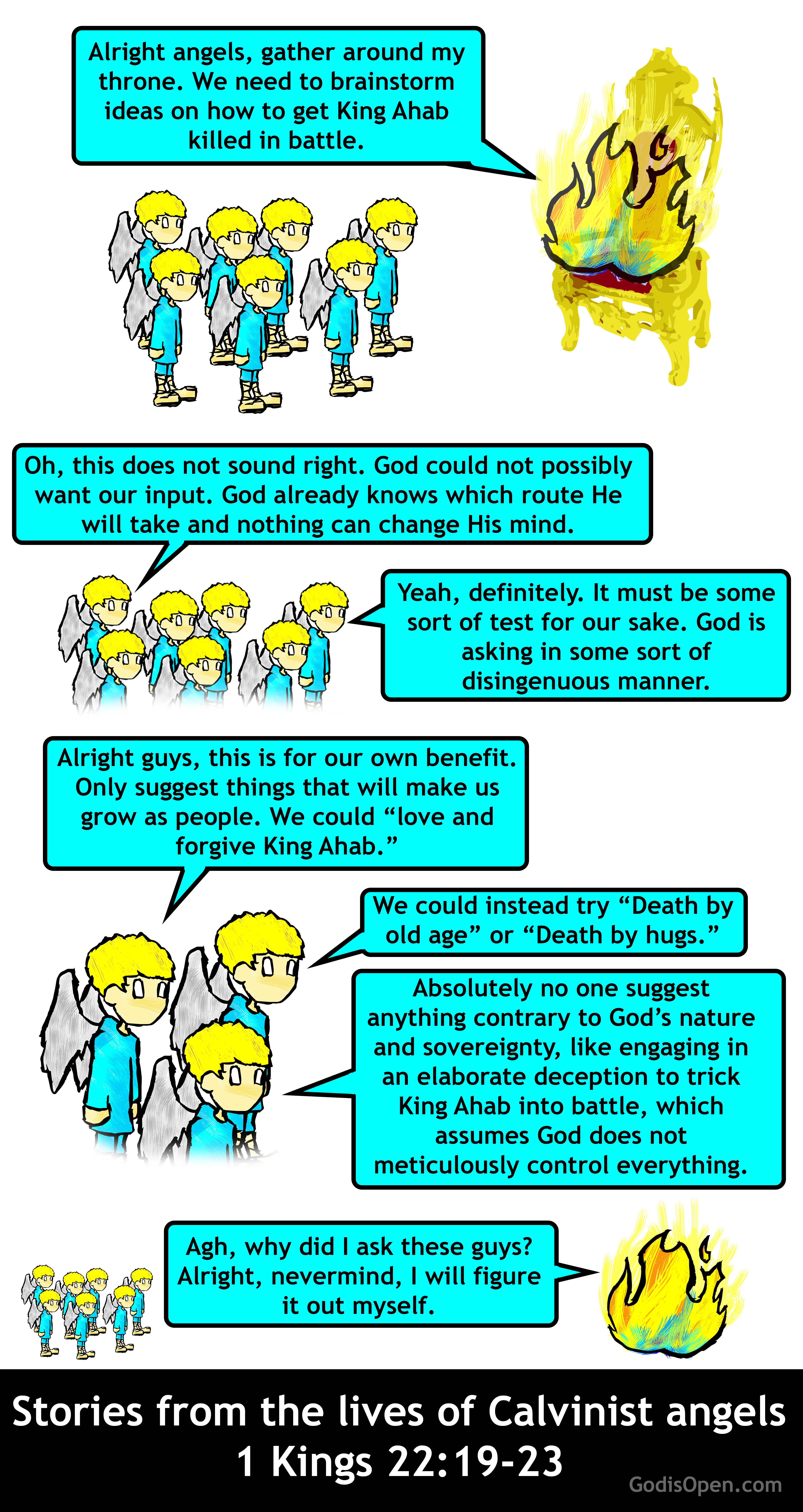
Worship Sunday – O Come, O Come, Emmanuel
O come, O come, Emmanuel
And ransom captive Israel
That mourns in lonely exile here
Until the Son of God appear
Rejoice! Rejoice! Emmanuel
Shall come to thee, O Israel.
O come, Thou Rod of Jesse, free
Thine own from Satan’s tyranny
From depths of Hell Thy people save
And give them victory o’er the grave
Rejoice! Rejoice! Emmanuel
Shall come to thee, O Israel.
O come, Thou Day-Spring, come and cheer
Our spirits by Thine advent here
Disperse the gloomy clouds of night
And death’s dark shadows put to flight.
Rejoice! Rejoice! Emmanuel
Shall come to thee, O Israel.
O come, Thou Key of David, come,
And open wide our heavenly home;
Make safe the way that leads on high,
And close the path to misery.
Rejoice! Rejoice! Emmanuel
Shall come to thee, O Israel.
O come, O come, Thou Lord of might,
Who to Thy tribes, on Sinai’s height,
In ancient times did’st give the Law,
In cloud, and majesty and awe.
Rejoice! Rejoice! Emmanuel
Shall come to thee, O Israel.
Boyd on the Relational Aspect of Prayer
One of the key differences between “magic” and biblical faith is that magic is about engaging in behaviors that ultimately benefit the practitioner, while biblical faith is about cultivating a covenantal relationship with God that is built on mutual trust. And while the God-human relationship, like all trusting human-to-human relationships, benefits both God and the person of faith, it is not entered into as a means to some other end. We might say that magical faith is utilitarian while biblical faith is simply faithful.
With all sincerity, people often try to believe the right things to pray the right way. They try to attain a sufficient level of certainty about particular doctrines so that they can be sure that they are saved. Or they work to avoid the “deal-breaker” sins in order to get God to “save” them. But how is this significantly different from those who engage in magic by performing certain behaviors to get the spiritual realm to benefit them?
Answered Questions – Do I Believe God Does Not Know the Future
Asked on Facebook:
Do you believe God doesn’t know what’s going to happen?
I know what is going to happen. Tomorrow I will wake up at about 630, be to work by 7. I will call an event vendor. I will talk to my coworker about my day off.
So if I know the future, why would I think God does not know the future?
The future is not hard to know. But, you are probably talking about some sort of special knowledge that is not related to anything we are familiar with. No, I don’t have that knowledge and neither does God. God regrets His own action of making man (Gen 6:6). God regrets His own action of appointing Saul king (1Sa 15:35). God has the angels brainstorm ways to kill King Ahab (1Ki 22). Moses convinces God not to destroy Israel through reasoned arguments (Exo 32).
No, I am not a platonist who ascribes to God a knowledge of the future invented in the pages of Plotinus. I am a Biblicalist, who thinks that the Bible accurately describes God.
Jesus’ Knowledge in the Gospel of John – part 2
Part I can be found here: [link]
Jesus on Lazarus
The Lazarus incident has several very interesting features. The first is that Jesus seems to instantly know the condition of Lazarus when he is told that Lazarus is sick:
Joh 11:4 But when Jesus heard it he said, “This illness does not lead to death. It is for the glory of God, so that the Son of God may be glorified through it.”
Jesus says it is not an illness that leads to death. But Lazarus dies. Is it the case that Jesus was incorrect but was ultimately made correct through God’s intervention? Is it the case that Jesus knew the entire episode would play out with Lazarus dying and coming back to life? Was Jesus just confident that if Lazarus died, that God would resurrect Lazarus (as evident in Jesus’ claim that Lazarus’ condition would be used for God’s glory)? Was Jesus just under the impression that Lazarus would be healed by God? It is hard to say.
The scene seems to flash forward a couple days until Lazarus dies. Jesus seems to know this, and says:
Joh 11:14 Then Jesus told them plainly, “Lazarus has died,
Joh 11:15 and for your sake I am glad that I was not there, so that you may believe. But let us go to him.”
Was Jesus waiting for Lazarus to die? Possibly. Did Jesus know that Lazarus would die? Possibly. Did learning of Lazarus’ death prompt Jesus to set out for Judea? Possibly. It is not clear how Jesus has and is using his knowledge here.
Jesus sets out for Judea. In Judea, Jesus meets Martha. Jesus tells her that Lazarus would rise again. The grave is opened and Jesus thanks God for hearing him:
Joh 11:41 So they took away the stone. And Jesus lifted up his eyes and said, “Father, I thank you that you have heard me.
Joh 11:42 I knew that you always hear me, but I said this on account of the people standing around, that they may believe that you sent me.”
Jesus is confident that God answers all his prayers. This suggests that Lazarus was healed by Jesus’ prayers to God and that God’s power was at work. Does this reflect back to Jesus’ assurances that Lazarus would be healed? Is Jesus just confident that God is powerful and answers prayer, or is this passage about foreknowledge? It seems to be a passage about Jesus’ relationship with God, not about knowledge.
Jesus knows what God will do because Jesus wishes God to do those things. The causality flows from Jesus to God. One would assume the knowledge accompanies this trust. If this is the case, the story of Lazarus might be of one in which Jesus sets up a situation to prove that he has God’s favor. Jesus hears Lazarus is sick, waits for things to turn south, and then arrives to make things right. Again, this text is probably not about knowledge but relationship.
Jesus Has Come for the Hour
In John 12, Jesus is said to have not been weary of the final hour:
Joh 12:27 “Now is my soul troubled. And what shall I say? ‘Father, save me from this hour’? But for this purpose I have come to this hour.
The most straightforward reading is perhaps a rejection of what is written in the other gospels, where Jesus prays to be saved from the crucifixion. If Jesus is saying this in emotionless confidence, then it would be in contrast to his behavior elsewhere. But Albert Barnes attempts to rectify John with the other gospels:
Father, save me – This ought undoubtedly to have been read as a question – “Shall I say, Father, save me?” Shall I apply to God to rescue me? or shall I go forward to bear these trials? As it is in our translation, it represents him as actually offering the prayer, and then checking himself. The Greek will bear either interpretation.
To Albert Barnes, the solution is that Jesus said these words in perplexity. Jesus was wondering if he should pray to be released from the crucifixion or go through with the crucifixion. If this is the correct reading, it fits that Jesus was “troubled” (per the text), that Jesus believed the future was open (per other texts in John), and Jesus could persuade God to forgo the crucifixion (per the other gospels).
Jesus Figures out the Hour has Come
In John 13, the text talks about Jesus coming to the realization that his hour has come. This text is ambiguous. Did Jesus always know the exact hour? Or did something indicate to Jesus that his time had come? The use of “hour” here seems to be a more specific timeframe than other uses of “hour” in John, as consistent with normal figurative speech:
Joh 13:1 Now before the Feast of the Passover, when Jesus knew that his hour had come to depart out of this world to the Father, having loved his own who were in the world, he loved them to the end.
This text does not indicate heavily about the extent and use of Jesus’ knowledge.
Jesus Knows Judas will Betray Him
Jesus then proceeds to host the last supper. In this supper, Jesus’ betrayal comes up in conversation. Jesus makes a convert comment towards Judas and the narrator follows with:
Joh 13:11 For he knew who was to betray him; that was why he said, “Not all of you are clean.”
Jesus then follows this by claiming that Judas’ betrayal is predicted by scripture:
Joh 13:18 I am not speaking of all of you; I know whom I have chosen. But the Scripture will be fulfilled, ‘He who ate my bread has lifted his heel against me.’
Joh 13:19 I am telling you this now, before it takes place, that when it does take place you may believe that I am he.
Calvinist James White claims verse 19 is an allusion to Isaiah 43:10 and a deity claim. Isaiah 43 reads:
Isa 43:9 All the nations gather together, and the peoples assemble. Who among them can declare this, and show us the former things? Let them bring their witnesses to prove them right, and let them hear and say, It is true.
Isa 43:10 “You are my witnesses,” declares the LORD, “and my servant whom I have chosen, that you may know and believe me and understand that I am he. Before me no god was formed, nor shall there be any after me.
John 13:19 and Isaiah 43:10 seem to only share parallel concepts. The words, themselves, seem to have different phrasing. Isaiah has “witness”, “know and believe”, and lacks the “before and after” terminology. It might be a jump in logic to style John as a deity claim based on Isaiah 43 rather than a Messiah claim based on the immediate context. As seen from the woman at the well, knowledge of things gave prophet status, not necessarily deity status.
The previous verse, verse 18, is an allusion to Psalms 41:9. The phrases are directly parallel. Compare:
Joh 13:18 I am not speaking of all of you; I know whom I have chosen. But the Scripture will be fulfilled, ‘He who ate my bread has lifted his heel against me.’
Psa 41:9 Even my close friend in whom I trusted, who ate my bread, has lifted his heel against me.
It would be strange that Jesus alludes to two separate Bible verses in two very different manners just one verse apart. It is more reasonable to think that Jesus is making a combined claim, one that God will raise him up and overcome his enemies (the context of Psalms 41) and that this will prove he is Israel’s Messiah.
In any case, the disciples do not understand anything Jesus is saying (which would make a knowledge based deity claim even stranger). Jesus, later, becomes troubled and point blank says he will be betrayed:
Joh 13:21 After saying these things, Jesus was troubled in his spirit, and testified, “Truly, truly, I say to you, one of you will betray me.”
Joh 13:22 The disciples looked at one another, uncertain of whom he spoke.
The disciples continue to be confused and do not understand even after Jesus indicates Judas will betray him. Satan then enters Judas:
Joh 13:27 Then after he had taken the morsel, Satan entered into him. Jesus said to him, “What you are going to do, do quickly.”
In verse 2, the Devil is said to put it into Judas’ heart to betray Jesus. Is “Satan entering Judas” a figure of speech, meaning Judas acted on the thoughts the devil planted in verse 2? Or was Judas possessed? Why does John 13 introduce the Devil and Satan in relation to Judas? The Devil is mentioned only 3 times in John, and Satan only once. Perhaps, Satan is being used in a sense of personification. Judas became adversarial after Jesus indicated Judas would betray him. Jesus then tells Judas to go, and Judas proceeds to leave.
Jesus links Judas’ betrayal to God being glorified. This links back to John 12:27 where Jesus questions whether to forgo the crucifixion. In John 12, Jesus links his hour coming to God being glorified. In John 12:28, God speaks back to Jesus claiming to be glorified again. Could John 12 have been the defining moment when Jesus resolved on this outcome, cementing the events?
How did Jesus know that Judas was to betray him? Was it based on character (Judas is described by John as robbing the donations (Joh 12:6) and was picked for his bad character (Joh 6:70))? Was Jesus’ knowledge based on fatalism? If so, how does that fix the crucifixion not being a fixed event in John 12. Was Jesus’ knowledge based on the works of the Devil (who entices Judas in verse 2 and is equated with Judas in 6:70)?
The mechanism for this knowledge is probably not fatalism or future exhaustive knowledge. The text goes out of its way to involve the Devil, literally or figuratively. This serves as motivation for Judas.
Part 2 conclusion
Jesus is styled as knowing much about Lazarus, possibly even setting up the scenario. Jesus possibly states that the crucifixion can be avoided if he so wished. Jesus then knows that Judas is in the process of betraying him (predicted in earlier texts).
Biederwolf on the Practicality of Prayer That Does Not Affect God
From How Can God Answer Prayer?
…but that if a man had any sort of assurance that such approach of the soul to God as communion involves was being made to a Supreme Being whose ear was deaf and whose heart indifferent to our cries of distress and our petitions for help or hearing could not help us because of the inevitable course of things over which He has no control, the probability is that that man would soon begin to incline toward a state of dumb resignation to the inevitable, which in turn would rapidly tend toward the neglect of prayer altogether. We pray too little as it is. If with Frederick W. Robertson we see in prayer only such contemplation of the character of God as ends with the resignation of ourselves to His will, most men, we fear, would not put themselves even to such effort to obtain it. They would be more likely to accept the inevitable and devote the time otherwise required for such contemplation to making the best out of a condition of affairs for which there is no help, at least from above.
Biederwolf, William Edward (2013-07-22). How Can God Answer Prayer? Being an exhaustive treatise on the Nature, Conditions, and Difficulties of Prayer (Kindle Locations 298-305). . Kindle Edition.
Boyd Inteprets All God’s Attributes Though Love
The same thing must be said of all the other attributes of God. All of them are ultimately expressions of God’s servant love. Here are a few examples of what we’re talking about.
Scripture teaches that God is everywhere (he is “omnipresent”). Since God’s very essence is love, the primary meaning of this teaching is that it’s impossible to hide from God’s love. Even if we make our bed in hell, Scripture teaches, we’re surrounded by God’s triune love (Ps. 139:7-10).
Scripture teaches that God never changes (he is “immutable,” see Ps 102:25-27). Since God’s very essence is love, the primary meaning of this teaching is that it’s impossible for God’s love to ever waver. His love is perfect and unwavering and it endures forever (Ps 36). The immutability of God’s loving character is marvelously expressed in Scripture’s repeated emphasis on God’s faithfulness and trustworthiness.
Scripture also teaches that God knows everything (he is “omniscient”). Since God’s very essence is love, the primary meaning of this teaching is not merely that God knows all the facts that exist, but that God is intimately aware of every facet of our being. As David says, God searches our heart and knows our innermost thoughts and feelings, even before we do (Ps. 139:1-2).
Finally, Scripture teaches that God is “holy.” While this attribute is frequently associated with God’s strict rules and burning wrath against sin, the biblical word for “holy” (Heb 12:16) denotes something set apart, utterly unique and other-worldly. Since God’s very essence is love, the primary meaning of God’s holiness is that God’s perfect love is different from the kind of fickle and shallow love we usually experience in our world.
Meme Monday – Impromptu Metaphysics Lesson
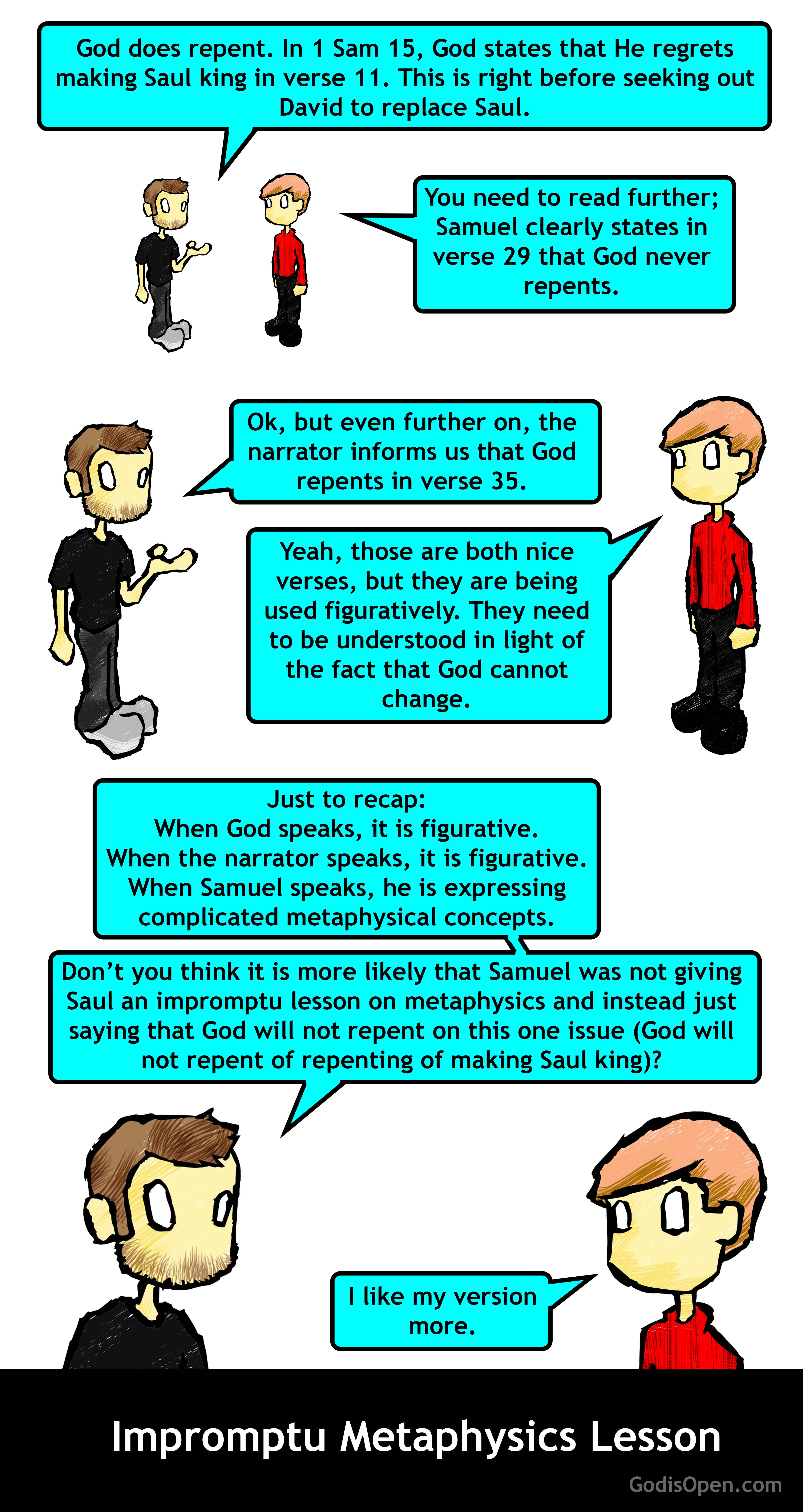
Worship Sunday – Little Drummer Boy
Come they told me, pa rum pum pum pum
A new born King to see, pa rum pum pum pum
Our finest gifts we bring, pa rum pum pum pum
To lay before the King, pa rum pum pum pum,
rum pum pum pum, rum pum pum pum,
So to honor Him, pa rum pum pum pum,
When we come.
Little Baby, pa rum pum pum pum
I am a poor boy too, pa rum pum pum pum
I have no gift to bring, pa rum pum pum pum
That’s fit to give the King, pa rum pum pum pum,
rum pum pum pum, rum pum pum pum,
Shall I play for you, pa rum pum pum pum,
On my drum?
Mary nodded, pa rum pum pum pum
The ox and lamb kept time, pa rum pum pum pum
I played my drum for Him, pa rum pum pum pum
I played my best for Him, pa rum pum pum pum,
rum pum pum pum, rum pum pum pum,
Then He smiled at me, pa rum pum pum pum
Me and my drum.
Jesus’ Knowledge in the Gospel of John – part 1
Reblogged from Realityisnotoptional.com:
I was recently challenged on the concept of Jesus in the gospel of John. The challenger stated that Jesus is depicted as omniscient or semi-omniscient. Jesus, throughout the gospel of John, seems to have access to God’s knowledge (and power) and utilized it on a regular basis.
The first thing to note about the writing style of John is that it is more ethereal and cryptic than the other gospels. John introduces about 90% new material, and uses that material in such a way that it presents Jesus as more divine than the other gospels. Much more of Jesus’ statements are contextless and not very concrete. There is a lot of confusion for the listeners and the readers. The text sometimes, but not always, follows up with clarifications.
The book also tends to divorce Jesus from his Jewish apocalyptic primary message depicted in the other gospels. This suggests a late date of writing, when the followers of Christianity began to expect the imminent end was not so imminent and the Gentile mission was larger. The book seems to be written to later Greek converts (having to define terms such as “Rabbi” and “Messiah”). The cryptic nature probably appealed more to the Greek sense of mystery than the Jewish sense of apocalypticism.
Jesus shows clairvoyance
Jesus is depicted as having access to much of God’s knowledge. There is a very early scene in which Jesus recalls having seen someone in a place where Jesus was not present:
Joh 1:47 Jesus saw Nathanael coming toward him and said of him, “Behold, an Israelite indeed, in whom there is no deceit!”
Joh 1:48 Nathanael said to him, “How do you know me?” Jesus answered him, “Before Philip called you, when you were under the fig tree, I saw you.”
Joh 1:49 Nathanael answered him, “Rabbi, you are the Son of God! You are the King of Israel!”
Jesus’ knowledge of the character of Nathanael is based on seeing Nathanael earlier. Something about this scene gave Jesus the indication that Nathanael was doing something under the fig tree that spoke to his character. Perhaps Nathanael was in prayer. Jesus’ claim would be that God showed him Nathanael’s prayer.
Jesus knows the character of man
In the second chapter, Jesus is said to know the character of his new converts. He knows not to trust them, because he understands “man”:
Joh 2:23 Now when he was in Jerusalem at the Passover Feast, many believed in his name when they saw the signs that he was doing.
Joh 2:24 But Jesus on his part did not entrust himself to them, because he knew all people
Joh 2:25 and needed no one to bear witness about man, for he himself knew what was in man.
How this is worded seems to say that Jesus knew the general character of man, especially the people who are claiming to be his disciples. This instance seems to be referenced in a much later context:
Joh 6:60 When many of his disciples heard it, they said, “This is a hard saying; who can listen to it?”
Joh 6:61 But Jesus, knowing in himself that his disciples were grumbling about this, said to them, “Do you take offense at this?
…
Joh 6:64 But there are some of you who do not believe.” (For Jesus knew from the beginning who those were who did not believe, and who it was who would betray him.)
If John 6:64 is a reference to John 2:25, it would appear that Jesus knew who would betray him because he knew the character of the people with which he was dealing. Unlike the John 1:48 instance, Jesus is not tapping into divine knowledge for this event.
Jesus acquires new information
John 4 begins with Jesus learning about the actions of the Pharisees. In this case, Jesus did not have foreknowledge or clairvoyance (assumedly) about something that happens.
Joh 4:1 Now when Jesus learned that the Pharisees had heard that Jesus was making and baptizing more disciples than John
Joh 4:2 (although Jesus himself did not baptize, but only his disciples),
Joh 4:3 he left Judea and departed again for Galilee.
Jesus is operating in a manner in which he learns something, after it happens, and then Jesus responds accordingly.
Jesus knows a woman’s past
John 4 cuts to Jesus interacting with a woman at a well. In this interaction, Jesus is able to recall events from this woman’s life with accuracy:
Joh 4:17 The woman answered him, “I have no husband.” Jesus said to her, “You are right in saying, ‘I have no husband’;
Joh 4:18 for you have had five husbands, and the one you now have is not your husband. What you have said is true.”
Joh 4:19 The woman said to him, “Sir, I perceive that you are a prophet.
To this woman, that Jesus could recount her past put Jesus in the role of a prophet, someone who communicates with and for God. The woman’s normal interpretation of these events is not to bestow omniscience on Jesus, but to understand Jesus as operating through the power of God.
This passage reveals several idiomatic expressions, hyperboles. The woman says that Jesus “told me all that I ever did” and she says that Christ would “tell us all things.” These normal idiomatic expressions are very important, because within John, the disciples tell Jesus that Jesus knows “all things”:
Joh 16:30 Now we know that you know all things and do not need anyone to question you; this is why we believe that you came from God.”
The phrase “all things” most naturally is limited to a hyperbolic expression that needs to be taken in context. It would be a mistake to assume some sort of literal and metaphysical sense to these words unless the context is explicit.
Jesus changes the future
Jesus’ ministry is entirely in the context of saving people from things that can happen. One does not see in Jesus a sense of fatalism. Jesus warns people that their actions will be responsible for future contingencies. Jesus attempts to avert the worst with warnings.
In John 5, Jesus warns someone he has just healed that he needs to refrain from sinning to avert judgment:
Joh 5:14 Afterward Jesus found him in the temple and said to him, “See, you are well! Sin no more, that nothing worse may happen to you.”
Jesus attempts to save people:
Joh 5:34 Not that the testimony that I receive is from man, but I say these things so that you may be saved.
Jesus uses the power of God
Consistent with the events of Nathanael and the woman at the well, Jesus makes the claim that his power is through God.
Joh 5:19 So Jesus said to them, “Truly, truly, I say to you, the Son can do nothing of his own accord, but only what he sees the Father doing. For whatever the Father does, that the Son does likewise.
And:
Joh 5:30 “I can do nothing on my own. As I hear, I judge, and my judgment is just, because I seek not my own will but the will of him who sent me.
Jesus tests the disciples
Although Jesus generally knows people’s hearts, sometimes Jesus tests them in specific ways to learn what they will do:
Joh 6:5 Lifting up his eyes, then, and seeing that a large crowd was coming toward him, Jesus said to Philip, “Where are we to buy bread, so that these people may eat?”
Joh 6:6 He said this to test him, for he himself knew what he would do.
Jesus planned on performing a miracle, but wanted to see if the disciples would put their faith in Jesus’ power. The disciples are thinking of the non-miraculous, and seem to fail the test.
Jesus knows that Judas will betray him
Later in John 6, Jesus has a falling out with many of his disciples. These are probably many of the same disciples that Jesus did not trust in John 2:25. Jesus calls them out and then a bunch leave. The text then states that Jesus knew they were not true converts, adding in that Jesus knows who would betray him:
Joh 6:64 But there are some of you who do not believe.” (For Jesus knew from the beginning who those were who did not believe, and who it was who would betray him.)
The text then identifies that individual, by name:
Joh 6:68 Simon Peter answered him, “Lord, to whom shall we go? You have the words of eternal life,
Joh 6:69 and we have believed, and have come to know, that you are the Holy One of God.”
Joh 6:70 Jesus answered them, “Did I not choose you, the Twelve? And yet one of you is a devil.”
Joh 6:71 He spoke of Judas the son of Simon Iscariot, for he, one of the Twelve, was going to betray him.
How does Jesus know Judas would betray him? The knowledge about the other disciples was per their character. Would it not be safe to assume Jesus knew the character of Judas? There are no hints of divine information sharing in this text.
Jesus avoids dangerous situations
After this, Jesus decides to avoid Judea because there would be a chance he would die:
Joh 7:1 After this Jesus went about in Galilee. He would not go about in Judea, because the Jews were seeking to kill him.
Jesus, here, is not operating with exhaustive future omniscience, but is minimizing risks of future occurrences by avoiding dangerous situations. Someone with exhaustive future omniscience could easily inject themselves into dangerous situations and overcome. Someone operating within the bounds of human activity, with some divine help, needs to take precautions.
Jesus eventually does go to Judea, but is careful not to let that information out:
Joh 7:10 But after his brothers had gone up to the feast, then he also went up, not publicly but in private.
Jesus’ divine protection
In John 7, Jesus gives a speech that incites the authorities. They attempt to arrest him, but Jesus escapes. The stated reason is that “his hour has not come”:
Joh 7:30 So they were seeking to arrest him, but no one laid a hand on him, because his hour had not yet come.
Perhaps this is because Jesus was given divine protection. If this is the case, divine protection thwarts what would have been. The future is being changed through divine action. The Jews are thwarted at the end of chapter 8 where they attempt to stone Jesus:
Joh 8:59 So they picked up stones to throw at him, but Jesus hid himself and went out of the temple.
Jesus runs away. This is reoccurring:
Joh 10:39 Again they sought to arrest him, but he escaped from their hands.
Jesus learns about a man
In chapter 9, Jesus heals a blind man. The Jewish authorities expel the man from the synagogue for declaring Jesus as the Messiah. Jesus learns about this and then seeks out the man:
Joh 9:35 Jesus heard that they had cast him out, and having found him he said, “Do you believe in the Son of Man?”
Part 1 conclusion:
The text presents Jesus as knowledgeable, with the ability to tap into God’s power. Jesus is not depicted as omniscient. And the future is portrayed as flexible and indefinite.
Unanswered Questions – Who are the leaders in the Biblical wing of Open Theism
On the GodisOpen facebook page, a conversation is occurring over the resent history of the Open Theism movement. Some are concerned about the prominence of the philosophical wing of Open Theism, wondering who the Biblical Open Theist leaders are.
This chart may provide an answer (to the extent the chart is correct). Morrell, Enyart and Saia seem to be main the contenders, although not as prominent as the Philosophical Open Theists (Hasker, Boyd, Rice, Swinburne, and Oord).
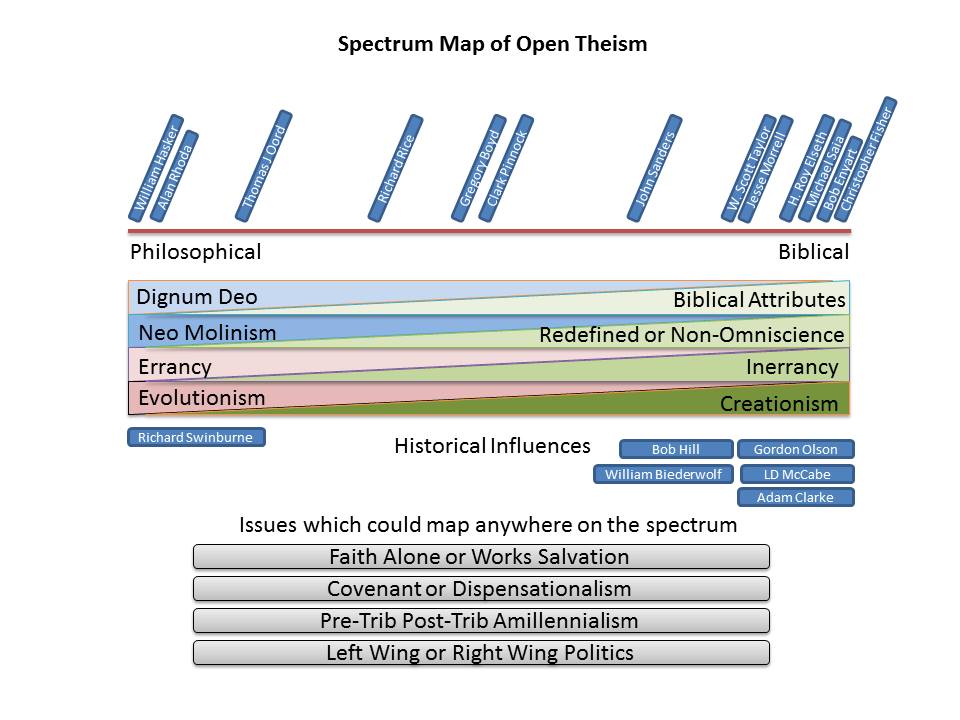
Apologetics Thursday – Hunt’s Sloppy Logic
David Hunt posits that Open Theists fall afoul of the law of Excluded Middle:
This reason for embracing Openism flies in the face of both logic and common usage. Let’s begin with logic. Either I will call my mother tomorrow, or I won’t call my mother tomorrow. One or the other of these statements about the future must be true. The principle that either a given statement or its denial is true is called the “Law of Excluded Middle.” But this first brief on behalf of Openism requires that this law be abrogated. That’s a heavy cost, and the vast majority of logicians would decline to pay it.
Craig, William Lane; Copan, Paul (2009-08-01). Contending with Christianity’s Critics: Anwering New Atheists and Other Objectors (Kindle Locations 5283-5287). B&H Publishing. Kindle Edition.
Where David Hunt errors is that he does not understand the law of Excluded Middle. The law of Excluded Middle only applies to statements that describe reality. For example, is the following statement true or false: “This statement is false”. If this statements was false, that would mean it is true. If this statement was true, that would mean it is false. If Hunt would apply his “logic” to this statement, then it is obvious that his law of Excluded Middle runs afoul of the law of Non-Contradiction.
Instead, when statements are abstract, and not based in “what is”, then the law of Excluded Middle does not apply. Does Santa have a beard? Well, “Santa” is an abstract concept. There is no real answer, not unless it is tied to reality in some sense: “Did Saint Nicolas at any time ever have a beard?” or “Does Santa, as imagined by the Coke commercials, have a beard?” These answers can be true or false because they are asking about an aspect of reality. Not unless a statement can be tied to reality does the law of Excluded Middle apply.
For Hunt to say that the law of Excluded Middle proves that the future can have true or false statement, he must first assume that the future can have true or false statements. He is falling prey to the Fallacy of Begging the Question (assuming what he is trying to prove), this is in addition to the fallacy of False Dilemma.
Hunt continues:
Ordinary usage and common sense also reject [Open Theism]. We make claims about the contingent future all the time, and we assume that such claims are sometimes true. Consider the following:
1. This coin will land heads on the next toss.
2. My wife will vote for candidate X in tomorrow’s election.
3. The U.S. will elect its first female president in 2016.The openist may object to taking such claims at face value on the grounds that the future is not yet real and that claims about it are therefore not yet true. But this objection would be received with bemusement by anyone engaged in the actual practice of making claims about the future.
Craig, William Lane; Copan, Paul (2009-08-01). Contending with Christianity’s Critics: Anwering New Atheists and Other Objectors (Kindle Locations 5287-5293). B&H Publishing. Kindle Edition.
Hunt moves from claiming that Open Theism flies in the face of “common usage” to claiming “ordinary usage… reject[s]” Open Theism. Hunt’s first statement might be correct; language is a good tool for showing how common people might intuitively understand a concept. But Hunt’s second statement is irrational. Language is filled with metaphors, hyperbole, figures of speech, and other linguistically shortcuts. “Language” does not “reject” anything. This is easily illustrated.
People talk about the “Sun rising”. This is even though, when questioned, basically everyone would admit that their concept of the “Sun rising” is that of the Earth revolving and spinning around a stationary Sun. The Sun rise imagery is a linguistical shortcut for all these people. When pressed, they will claim that the Sun really does not “rise”. The “Sun rising” is linguistical shortcut, and although it is a linguistical shortcut, it happens to a shortcut to a false concept.
Basically every astrophysicists knows that movement in space is relative. Phil Plait, the leading astrophysicist, has a good article on this. Movement is relative in space, and one can no more say that the Sun revolves around the Earth than the Earth revolves around the Sun. A reference point has to be arbitrarily picked. There are no “right” or “wrong” reference points.
Pretend Phil Plait adopted the reasoning of Hunt to make his case. Pretend he made the case that “ordinary usage” of language “rejects” the idea that the Earth revolves around the Sun. This would be an absurd claim. Linguistical features could tell us what ordinary people might find reasonable, but they in no way inform what accurately reflects reality.
That being said, “I was right” could easily be a linguistical shortcut to mean “what I predicted then happened to materialize”. In the same sense, one could easily claim “Santa has a beard” but actually mean “the commonly accepted image of Santa includes a beard.” Linguistical shortcuts are ubiquitous in human communication. Discounting them to try to score cheap theological points is not a good idea.
One could easily point out how the Biblical language “rejects” Calvinism in the use of language where people “choose” and God is consistently thwarted by those choices. And statements about time are always about past, present, and future, “rejecting” any timelessness. Hunt needs to rely on flexible language to maintain his Calvinism. Hunt’s arguments thwart his own beliefs.
Olson Teaches on Omniscience and Omnipresence
A classic lecture from Gordon Olson:
Oord Responds to Olson’s Response to Oord
Thomas J Oord responds to Roger Olson’s review of his book:
Closely related to the last point is the issue of God’s will vs. permission. If you (Roger) and others would say God’s will is always constrained by God’s love and that God’s love is always uncontrolling, we’d be in agreement. At least the first part of that previous sentence (“God’s will is always constrained by God’s love”) is solidly Arminian, as you know. In this, I’m retrieving an Arminian heritage I don’t find retrieved among many of my fellow open theists.
The second part of that sentence above seems necessary to overcome questions about God failing to prevent evil that God could prevent through control. That is, many say God could control free creatures, non-free creatures, less complex entities, or interrupt the law-like regularities of existence. Consequently, they cannot offer a solution to the problem of evil. If you would agree that God’s will is always constrained by God’s love and divine love is always uncontrolling, you would no longer need to say God “allows” evil. We’d be on the same page.
Meme Monday – Explaining the Parable
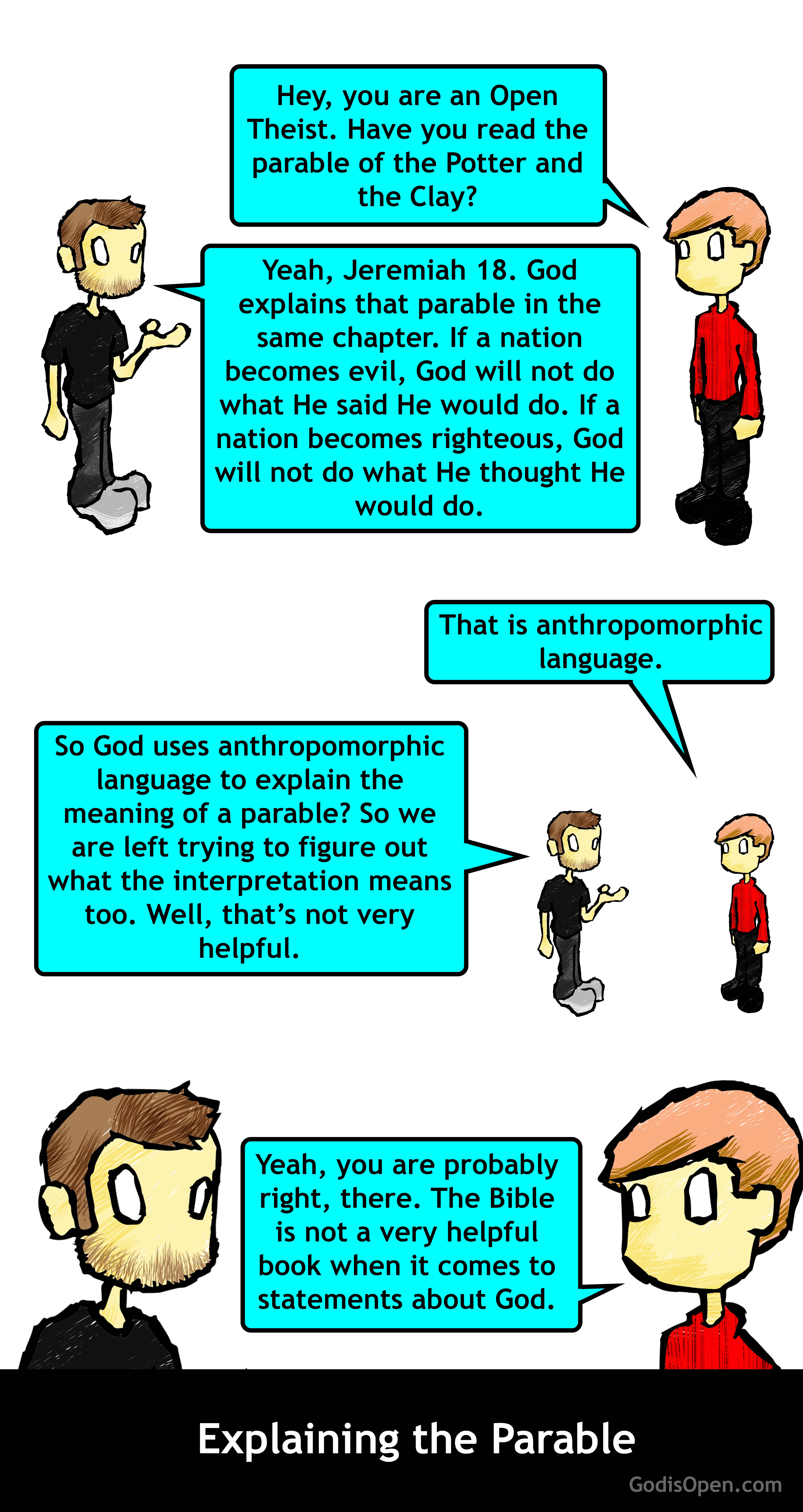
Worship Sunday – Break Free
I´m surrounded by Your presence
and my heart is filled with joy
a new passion deep within me
is awakening my soul
Just like David danced before You
full of strength and full of might
I will lay down everything that holds me back from You
I will break free, to live a life that honors You
I am dancing, by your spirit I am filled
I will break free to celebrate and worship you a-lone
I will choose to live after your heart and dance like David danced
I will choose to live after your heart and dance like David danced
Leighton Flowers Details Systematic Intellectual Dishonesty in James White
Unanswered Questions – Philosophical Objections to the Open View
On the GodisOpen Facebook page, one commenter asks:
I need some solid philosophical objections to the open view please.
Calvinists and Arminians, please help.
A detailed response to Closing the Door on Open Theism – Part 3
Martyn McGeown offers, perhaps, the best evidence for God knowing the future exhaustively. If God can predict, accurately, future events that involve too many random variables for even a present knowledge to accomidate, then this is evidence for divine foreknowledge. McGeown quotes Bruce Ware to this effect:
Consider the vast array of attending circumstances God must know about in advance for this prediction to be given. At the time Isaiah prophesies this, God must already know about the fall of Assyria, the rise and fall of Babylon, the rise of Medo-Persia, the fall of Israel, the fall of Judah, the birth and naming of Cyrus, the life and growth of this particular king, his ongoing life into adulthood, his selection as king, his willingness to consider helping the Israelites, his decision to assist in rebuilding Jerusalem, and on and on. This list hits a very few of the most significant items. Within each of these items is hidden a multitude of free will choices that would affect everything about the outcome for that particular piece of human history. It simply is incredible that God can say through Isaiah such a long time prior to Cyrus’s reign, “It is I who says of Cyrus, He is my shepherd! And he will perform all my desire.”
McGeown adds:
It simply will not do for the open theists to claim that God “tweaks” man’s free will occasionally to accomplish specific purposes. The example of Cyrus (Isa. 44:28) alone shows that open theism’s entire thesis collapses like a house of cards.
McGeown believes this is the best example in the Bible of God predicting something so minutely that it suggests future foreknowledge. This is an event in which Isaiah predicts the name (and character) of a king (possibly 140 years in advance). While McGeown is finally offering rational arguments, his evidence is fairly shoddy.
Assuming the prophecy of Isaiah is not Deutero-Isaiac (a critical assumption that must be held to make this point), then one would still have to figure out how likely it is to accurately predict names (and characters). It cannot be ruled out that God was involved with the naming (and breading), as power acts are traditionally how God predicts future events (as evident in Isaiah 40-48).
Two examples of people being named are found in the New Testament: Jesus and John the Baptist. In the case of Jesus, God asks Mary (Jesus’ mother) to name her baby and she does. In the case of John, God makes Zacharias (John’s father) mute until he names the baby what God wishes. Presumably, God would have killed Zacharias if he named his son anything except John. One naming was a request and one was coerced. Both of these examples suggest the naming is not fated, but must be brought about by free agents.
Another point should be added: it is a stretch to jump from “God knows the name and character of a baby, 140 years in advanced” to “God knows all events, no matter how small, infinitely into the future”. That is not a rational conclusion. If I was able to predict a name and character of a baby 140 years into the future (like a modern day Nostradamus) no one would jump to the conclusion I know the future in its entirety.
If a baby is the key evidence of future exhaustive foreknowledge, Open Theists should be assured that there is not any strong evidence against Open Theism in the Bible.
A Detailed Response to Closing the Door on Open Theism – Part 1 [link]
A Detailed Response to Closing the Door on Open Theism – Part 2 [link]
A Detailed Response to Closing the Door on Open Theism – Part 3 [link]
A Detailed Response to Closing the Door on Open Theism – Part 4 [link]
A Detailed Response to Closing the Door on Open Theism – Part 5 [link]
Olson Reviews Oord’s Book
From Arminian Roger Olson:
My second question is whether the God of the Bible in whom Oord believes (both God and the Bible as his inspired Word) ever intervened, interfered, powerfully and unilaterally, without the creatures’ consent, to control a creature—to make something happen to him or her that would not otherwise have happened? Oord does not think so. His final chapter (8) is “Miracles and God’s Providence.” Let it be noted that Oord affirms miracles. What he denies is that any miracle of God was or ever is unilateral, controlling and coercive. Let’s go right to two main miracles in the biblical narrative—both which Oord believes happened: the exodus and the resurrection of Jesus. Oord believes, and attempts to explain, that both involved creatures’ consent and participation. In neither case, Oord claims, did God act to control, without some level of cooperation from the things, persons being affected.
This is where I find Oord’s explanations frankly tortuous (not “torturous”). In fact, they become so fanciful and obscure that I cannot even imagine them as true. For example, in the exodus of Israel from Egypt, Oord suggests, God foreknew the wind that would separate the waters of the Red Sea and directed Moses to lead the Hebrew people to that spot at just the right time to walk across the Sea on dry land. One wonders how often that phenomenon happened! For example, in the case of Jesus’s bodily resurrection, God raised him back to live, to new life, immortal life, with Jesus’s own consent. True enough, I suppose one could argue and believe, but one still has to wonder about all the other circumstances surrounding and included in the resurrection event. But let’s turn to another “resurrection”—the resuscitation of Lazarus. Did Jesus gain Lazarus’s consent before raising him back to life? At one point Oord mentions that someone else’s consent can occasionally stand in for the consent of the person directly being affected by the divine act (when their consent is impossible). This would apparently be a necessary case of that. But is that really consistent with Oord’s overall thesis? What if Lazarus didn’t want to be resuscitated?
Whose consent did Jesus get to turn water into wine?
Then there are all the biblical events in which God apparently acted (or will act as prophecied) with the result of great harm to creatures: the flood of Noah’s day, the striking dead of Ananias and Sapphira (Acts 5), the judgment and punishment of rebellious angels and human sinners in the eschaton.
Torbeyns Reviews God’s Foreknowledge and Man’s Free Will
A Review of God’s Foreknowledge and Man’s Free Will by Richard Rice
Tom Torbeyns’s review Nov 28, 15
3 of 5 stars
Read from November 27 to 28, 2015, read count: 1‘“Come now, and let us reason together,” Says the Lord’
– Isaiah 1:18a (NKJV)POSITIVE ELEMENTS:
* This good piece of reasoning justifies God’s goodness.
* The chapter against Evil (chapter 4) is, in my opinion, the best part of the whole book.
It shows how the closed view of the future contains some serious problems concerning the subject of evil and the goodness of God.* In chapter 6, Providence and the Openness of God, the author of this book gives us a moving and most biblical way of how God can reform evil, which is intrinsically evil, to bring good out of it, even in our individual lives. It contains just a few examples of the beauty of an open future.
NEGATIVE ELEMENTS:
* While this book, in its defence of the possibility of an open future, is, in my opinion, irrefutable, more Bible verses in the first chapters would have surely made this a better book.
* I also expected more of chapter 7, which talks about the connection between prophecy and the open future.
Meme Monday – Eli’s Sons
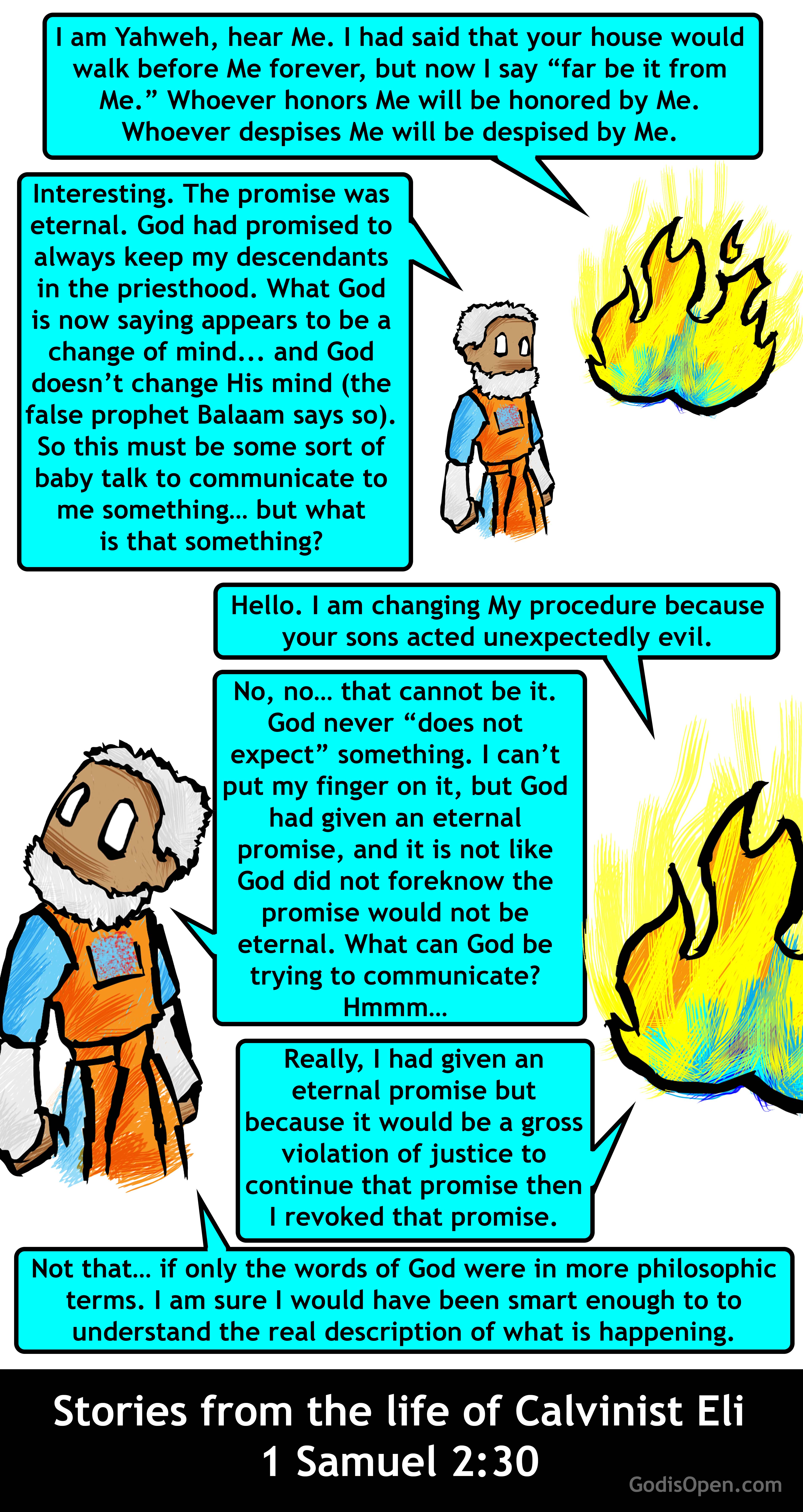
 God is Open