Rev 21:7 He who overcomes shall inherit all things, and I will be his God and he shall be My son.
Open Theism
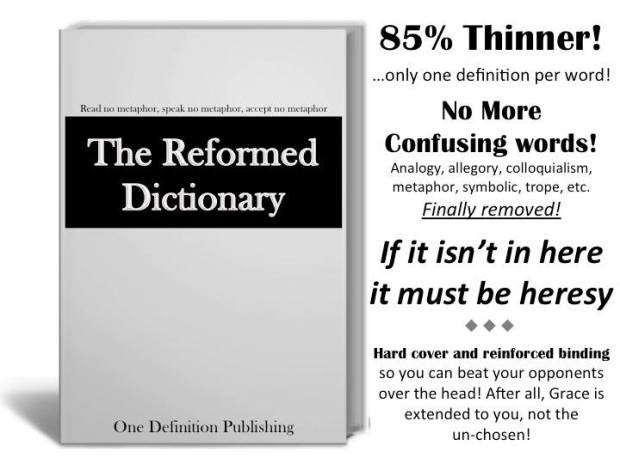
Meme Monday – Reformed Dictionary

VOTD Revelation 20:12
Rev 20:12 And I saw the dead, small and great, standing before God, and books were opened. And another book was opened, which is the Book of Life. And the dead were judged according to their works, by the things which were written in the books.
Worship Sunday – Holy Isaiah 6 Amazing Grace
Holy, holy, holy
Is the Lord God almighty and
The whole earth is full of His glory
Hallelujah, hallelujah
Hallelujah, hallelujah
Amazing grace, how sweet the sound
That saved a wretch like me
I once was lost but now am found
Was blind but now I see
When we’ve been there ten thousand years
Bright shining as the sun
We’ve no less days to sing God’s praise
Than when we’d first begun
VOTD Revelation 19:6
Rev 19:6 And I heard, as it were, the voice of a great multitude, as the sound of many waters and as the sound of mighty thunderings, saying, “Alleluia! For the Lord God Omnipotent reigns!
Jones on Total Depravity
A former Calvinist examines Total Depravity:
The Genesis Account
This loss of ability to receive spiritual truth is one of the consequences of Original Sin, we are told. If this is true, we would surely expect to find some mention of it in the Genesis account. Yet there is no record there of God imposing this curse of Total Inability on man’s nature. There are other curses listed. God pronounced the death sentence, which He defined as a return to the dust (Gen. 3:19). Such language obviously denotes a physical death, not a loss of spiritual ability or a death to God.
God decreed the presence of “thorns and thistles” to make toil more difficult (v.18). He told the woman that she must endure great pain in childbearing (v.16). Both of these curses are trivial compared to what would be the most debilitating curse of all: the removal of all ability to respond to God. Of this we haven’t the slightest mention. George Burnap comments:
“If this doctrine is true, God did not tell man the true penalty, neither the truth, nor the whole truth, nor a hundredth part of the truth. To have told the whole truth, according to this hypothesis, He should have said, ‘Because ye have done this, cursed be that moral nature which I have given you. Henceforth such is the change I make in your natures: that ye shall be, and your offspring, infinitely odious and hateful in my sight. The moment their souls shall go forth from my hand…if they are suffered to live, such shall be the diseased constitution of their moral natures: that they shall have no freedom to do one single good action, but everything they do shall be sin….What an awful blot would such a curse be on the first pages of Scripture!”6
It is true that death passed upon all men through the First Adam. His expulsion from the Garden with its Tree of Life removed him from the source of immortality and made death certain. This is also true of his posterity. But the transmission of Total Inability toward God is nowhere conveyed in the text.
Two primary texts adduced to prove the doctrine of Original Sin (Rom. 5; 1 Cor. 15) say nothing about Total Inability. Nowhere are we told that an invincible tendency to resist God was imparted to the race through the offense of one. If there were a place we would expect to find the doctrine, it would be in one of those passages dealing with the relationship between Adam and his descendants. But there is not a trace of such teaching there.
VOTD Revelation 18:20
Rev 18:20 “Rejoice over her, O heaven, and you holy apostles and prophets, for God has avenged you on her!”
Unanswered Questions – Was God Thwarted by Ahab?
To those who believe God controls all things, did ever God appoint someone for destruction and that appointment was thwarted?
1Ki 20:42 Then he said to him, “Thus says the LORD: ‘Because you have let slip out of your hand a man whom I appointed to utter destruction, therefore your life shall go for his life, and your people for his people.’ ”
VOTD Revelation 18:8
Rev 18:8 Therefore her plagues will come in one day—death and mourning and famine. And she will be utterly burned with fire, for strong is the Lord God who judges her.
Apologetics Thursday – Boyd Explains That God Does Not Hold False Beliefs
From reknew.org:
Does God Hold False Beliefs?
I turn now to seven specific charges that Ware brings against the open view.Ware alleges that in the open view, “God must…possess innumerable false beliefs about what will happen in the future.” In my opinion, the claim is quite unfounded. It is of course true that Scripture reports Yahweh as revealing that at times he “thought” or “expected” something would occur which didn’t come to pass (e.g. Jer. 3:7–8, 19–20; Isa. 5:1–5; Ezek. 12:2). And it’s true that open theists find no compelling reason to not take this language at face value. But only a most unsympathetic reading of Jeremiah’s and Isaiah’s language—and of the open theists who simply repeat it—would conclude that this language entails that God holds false beliefs.
A more sympathetic explanation is readily available. When God says he “thought” or “expected” something would take place that didn’t take place, he is simply reflecting his perfect knowledge of probabilities. When the improbable happens, as sometimes is the case with free agents, God says he genuinely “thought” or “expected” the more probable outcome would happen. Because God is infinitely intelligent, we cannot conceive of God being altogether shocked, as though he didn’t perfectly anticipate and prepare for this very improbability (as much as if it was a certainty from all eternity). But relative to the probabilities of the situation, the outcome was surprising [viz. improbable].
Jeremiah and Isaiah (and open theists who repeat their language) can only be accused of ascribing false beliefs to God if they claim that God was mistakenly certain something would occur which did not occur. But no biblical author, or open theist, has ever said this.
To turn the tables for a moment, if I may, the question Ware must answer regarding such passages is this: Why does God reveal that he “thought” or “expected” something was going to occur which in fact did not occur if he knew from all eternity (or predestined from all eternity) that it would not occur? If one insists that open theists have difficulties in taking passages like Jeremiah 3, Isaiah 5 and Ezekiel 12 at face value, must we not concede that those who anthropomorphize these passages because they do not square with the doctrine of exhaustively definite foreknowledge face difficulties at least as serious as these?
VOTD Revelation 16:19
Rev 16:19 Now the great city was divided into three parts, and the cities of the nations fell. And great Babylon was remembered before God, to give her the cup of the wine of the fierceness of His wrath.
Morrell on Psalms 139
From BiblicalTruthResources:
First of all, God knows the words we are going to speak before we speak them because He knows our hearts and minds. Jesus knew what was in their hearts even before they spoke at all. That part of the verse does not mean that God foreknows from eternity all of the future as an absolute certainty.
Second of all, all the days ordained does not mean what occurs within those days but the number of those days. And the fact remains, God can shorten the days of the wicked as proverbs says and God can also add days to your life like He did with Hezekieh. So the future is open as God is able to change it by adding or subtracting the days of your life.
VOTD Revelation 16:9
Rev 16:9 And men were scorched with great heat, and they blasphemed the name of God who has power over these plagues; and they did not repent and give Him glory.
Ezekiel 16
Triablogue wonders why Open Theists do not use Ezekiel 16 to show Open Theism:
However, the question at issue isn’t how I interpret Ezk 16, but how we’d expect open theism to handle this passage, if its proponents were consistent. Given their hermeneutical presuppositions, it’s hard to see how open theists can effectively resist the feministic interpretation. Ezk 23 presents the same dilemma.
vi) Given open theist hermeneutics, the God who emerges from Ezk 16 is a terrifying God. And terrifying in a particular respect: he lacks emotional self-control. He loses his cool, lashing out in fury. A God with a short fuse.
It’s like a Mafia Don who adopts the daughter of his late brother. He raises her with great affection and kindness. But if his ward betrays his love, his love turns to hate. He becomes vindictive. He’s wonderful to you as long as you don’t cross him. But if you get on his wrong side, if he feels betrayed, then you will find yourself on the receiving end of omnipotent revenge.
It’s like a throwback to Greek mythology. Think of the ingenious punishments which the Greek gods devise for those who fall out of favor.
VOTD Revelation 16:6
Rev 16:6 For they have shed the blood of saints and prophets, And You have given them blood to drink. For it is their just due.”
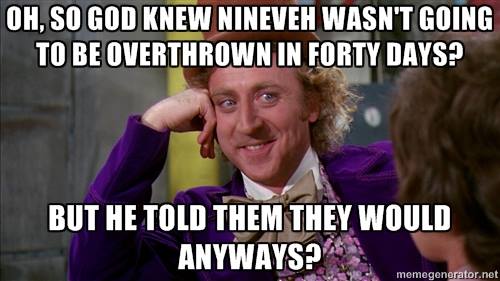
Meme Monday – Nineveh Lies
VOTD Revelation 16:1
Rev 16:1 Then I heard a loud voice from the temple saying to the seven angels, “Go and pour out the bowls of the wrath of God on the earth.”
Worship Sunday – Come Now Our King
By Chris August
Bethlehem turns in tonight
A town lit up by candle light
All the children tucked in tight
Bethlehem turns in tonight
The angels start their whispering
About the one they’re welcoming
No one knows what’s soon to be
As the angels start their whispering
They sing glory
In the highest
Come now our King
We’ve been
Waiting
Come now our King
Silence falls
Yet once again
The shepherds leave for Bethlehem
Baby’s cry soon welcomes them
Silence falls yet once again
They sing glory ( glory in the.. 2x )
In the highest
Come now our King, yeahiii
We’ve been ( we’ve been waiting 2x )
Waiting
Come now our King
Ooooh
Glory, Oh glory
You came here to save
Ooh Lord, we’ve been waiting so
Come now our King
Now my night has turned to day
An empty manger, empty grave
Baby born so I could say
Now my night has turned to day
Ooh, We sing glory ( glory in the.. 2x )
In the highest
Come now our King, oh ooh
We’ve been ( we’ve been waiting 2x )
Waiting ( waiting for you 2x )
Come now our king
Ooh ooh, Come now our King.
VOTD Revelation 15:1
Rev 15:1 Then I saw another sign in heaven, great and marvelous: seven angels having the seven last plagues, for in them the wrath of God is complete.
Boyd on Fatalism
From reknew.org:
This belief in fate or divine determinism is as tragic as it is unbiblical. Among other things, fatalism inevitably leads people to blame God for evil. If God is the ultimate cause of everything, how could this conclusion be avoided? Moreover, by undermining our freedom of choice, determinism strips us of our dignity and moral responsibility. It reduces us to pawns of fate and robs us of our potential to love. In other words, it destroys the beauty of the biblical proclamation that we are made in the image of God.
While it’s undeniable that the Bible depicts God as predestining some things, it’s also clear that free decisions do not fall into this category. To a significant extent, humans freely determine their own destiny. And the first step in understanding how an all-good God could create a world that is as messed up as the one we find ourselves in is to fully appreciate this fact.
VOTD Revelation 14:19-20
Rev 14:19 So the angel thrust his sickle into the earth and gathered the vine of the earth, and threw it into the great winepress of the wrath of God.
Rev 14:20 And the winepress was trampled outside the city, and blood came out of the winepress, up to the horses’ bridles, for one thousand six hundred furlongs.
Unanswered Questions – What About Dahmer?
Asked in Christians AGAINST the Heresy of Calvinism & TULIP:
Calvinists,
When a mentally ill person develops suicidal thoughts, is that God’s intention? I mean is it what He truthfully desires?
When Jeffrey Dahmer drugged young boys and not only molested them but actually ate their flesh and experimented with their unconscious bodies, was that God’s will?
Does God really go to these lengths in order to glorify His name? Is this the same God who said that He WEPT over the Moabites when He had to punish them?
Calvinism celebrates God’s power and sovereignty, but they put His love and holiness on the backburner.
VOTD Revelation 21:3-4
Rev 21:3 And I heard a loud voice from heaven saying, “Behold, the tabernacle of God is with men, and He will dwell with them, and they shall be His people. God Himself will be with them and be their God.
Rev 21:4 And God will wipe away every tear from their eyes; there shall be no more death, nor sorrow, nor crying. There shall be no more pain, for the former things have passed away.”
Apologetics Thursday – Boyd Responds to Ware
From reknew.org:
Breaking Fellowship on the Basis of Perceived Implications?
Ware argues that open theists should be excluded from the Evangelical Theological Society on the grounds that their view has “seriously unacceptable theological and practical implications.” Among other things, Ware believes open theism implies that God can’t do what the Bible says God does, that God holds false beliefs and possesses imperfect wisdom, that God can’t be trusted to guide believers, and that the Bible is not inerrant. Of course, open theists within the Evangelical Theological Society have responded to these sorts of charges numerous times before in writing—though, unfortunately, one would never surmise this from Ware’s essay.
Two things need to be said about this. First, Ware may not find our responses convincing, but it would be nice—to say nothing of displaying more academic integrity—if he would have interacted somewhat with our responses rather than proceeding as though we have no response. One almost gets the impression from Ware’s essay that he’s catching open theists totally off guard with new criticisms.
Second, one must be very careful about dismissing a position—to say nothing of breaking fellowship with a group of believers—on the basis of the implications they think follow from that position. After all, to many Arminians and open theists, the Calvinism Ware defends seems to deny the glory of God, the universal love of God, the wisdom of God, the urgency of prayer, the genuineness of God’s interactions with us, human moral responsibility, the need for missions, and many other things. Yet, since Calvinists themselves don’t deny these things, they are accepted as sisters and brothers in Christ. Arminians and open theists may judge them to be (fortunately) logically inconsistent, but we shouldn’t ascribe to them conclusions which we think follow from their position but which they themselves deny.
Open theists would simply like this Christian and academic courtesy to be extended to us. Ware obviously can’t understand how we avoid the implications he ascribes to us. Fine, perhaps we are simply logical nincompoops. Or perhaps (as I believe), Ware has difficulty getting inside of a system of thought that is radically different from his own. But in either case, it seems misguided and unchristian to move to brand a position as “non-evangelical” because some can’t understand how they avoid certain negative implications they think their theology implies. Our explicit confessions of faith, not what others think logically follows from our confessions of faith, should be the basis of our fellowship.
VOTD Revelation 22:13
Rev 22:13 I am the Alpha and the Omega, the Beginning and the End, the First and the Last.”
Piper’s Prooftexts
John Piper, a Calvinist, offers prooftexts to show that man does not thwart God’s will:
Genesis 50:20: Joseph says to his brothers who had sold him into slavery, “As for you, you meant evil against me, but God meant it for good in order to bring about this present result, to preserve many people alive.”
Deuteronomy 29:2-4: Moses says to the Israelites before they enter the promised land, “You have seen all that the Lord did before your eyes . . . those great signs and wonders. Yet to this day the Lord has not given you a heart to know, nor eyes to see, nor ears to hear.” (cf. Romans 11:32; Deuteronomy 5:29).
Proverbs 16:4: “The Lord has made everything for its own purpose, even the wicked for the day of evil.” (cf. 1 Peter 2:8; Jude 4; Romans 9:22)
Proverbs 16:9: “The mind of man plans his way, but the Lord directs his steps.”
Proverbs 16:33: “The lot is cast in the lap, but every decision is from the Lord.”
Proverbs 19:21: “Many are the plans of a man’s heart but the counsel of the Lord, it will stand.”
Proverbs 21:1: “The King’s heart is like channels of water in the hand of the Lord; he turns it wherever he wishes.”
Isaiah 63:17: “Why, O Lord, dost thou cause us to stray from thy ways, and harden our heart from fearing thee? Return for the sake of thy servants, the tribes of thy heritage.”
Jeremiah 10:23: “I know, O Lord, that a man’s way is not in himself; Nor is it in a man who walks to direct his steps.”
Jeremiah 32:40: In the promise of the new covenant God says, “I will put the fear of me in their hearts so that they will not turn away from me” (cf. Ezekiel 36:27; Jeremiah 52:1-3).
Lamentations 3:37f: “Who is there who speaks and it comes to pass, unless the Lord has commanded it? Is it not from the mouth of the Most High that both good and ill go forth?” (cf. Isaiah 45:7; Amos 3:6).
Philippians 2:12, 13: “Work out your salvation with fear and trembling; for it is God who is at work in you both to will and to work for his good pleasure.”
2 Timothy 2:24-26: “The Lord’s bond-servant must not be quarrelsome but . . . able to teach . . . with gentleness correcting those who are in opposition, if perhaps God may grant them repentance leading to a knowledge of the truth, and they may come to their senses and escape from the snare of the devil, having been held captive by him to do his will.”
Hebrews 13:20, 21: “Now the God of peace . . . equip you in every good thing to do his will, working in us that which is pleasing in his sight through Jesus Christ, to whom be the glory for ever and ever. Amen.
Revelation 17:17: Of the ten kings who wage war against the harlot (Babylon) it is said, “They will hate the harlot and will make her desolate and naked, and will eat her flesh and will burn her up with fire. For God has put it in their hearts to execute his purpose . . .”
VOTD Revelation 22:12
Rev 22:12 “And behold, I am coming quickly, and My reward is with Me, to give to every one according to his work.
88 Reasons Why the Rapture Will Happen in 1988
A nostalgic reminder to be careful in extrapolating from the Bible things not explicit in the Bible:
VOTD Revelation 21:6
Rev 21:6 And He said to me, “It is done! I am the Alpha and the Omega, the Beginning and the End. I will give of the fountain of the water of life freely to him who thirsts.
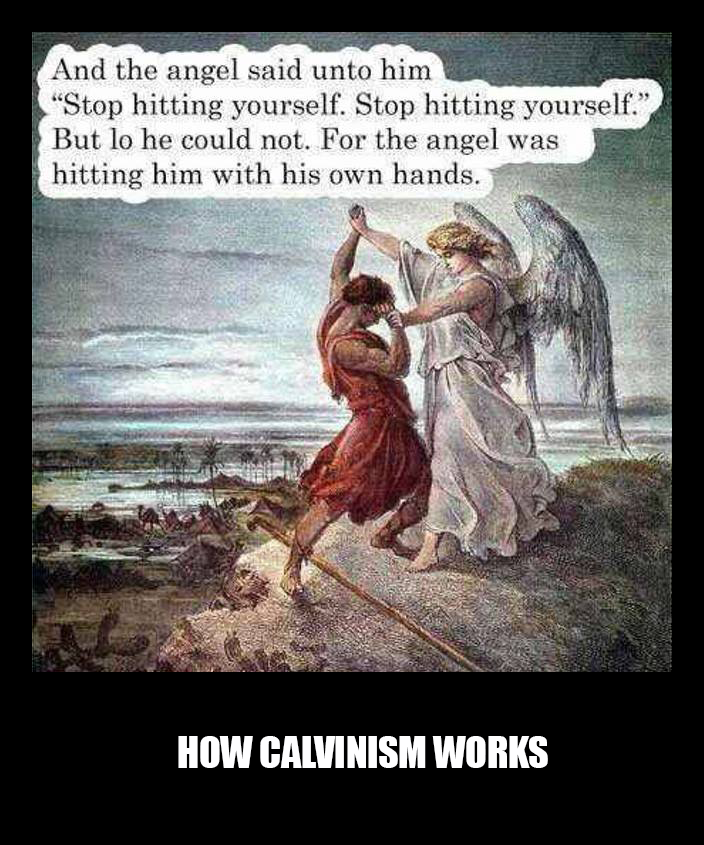
Meme Monday – How Calvinism Works
VOTD Revelation 19:15
Rev 19:15 Now out of His mouth goes a sharp sword, that with it He should strike the nations. And He Himself will rule them with a rod of iron. He Himself treads the winepress of the fierceness and wrath of Almighty God.
Worship Sunday – Who is Like Our God
By Laura Story
Where can I run in times of trouble
Where can I turn when hope seems lost
I find my strength within Your shelter
You will not fail though the night is long
Who is like our God
Mighty in the battle
Your Majesty be lifted high
Who is like our God
He reaches for the broken
Jesus hears me when I cry
How can it be that You are for me
Though I am weak, Your love is strong
You are my light and my salvation
In Your name alone, I overcome
Who is like our God
Mighty in the battle
Your Majesty be lifted high
Who is like our God
He reaches for the broken
Jesus hears me when I cry
Who else can help us
Who else can save
Who else can overcome the power of the grave
Who else can heal us
Break every chain
There is no one, no one else
There is no one, no one else
Who is like our God
Mighty in the battle
Your Majesty be lifted high
Who is like our God
He reaches for the broken
Jesus hears my cry
Who is like our God
Mighty in the battle
Your Majesty be lifted high
Who is like our God
He reaches for the broken
Jesus hears me when I cry
He hears me when I cry
He hears me when I cry
Who is like, who is like our God.
VOTD Revelation 19:2
Rev 19:2 For true and righteous are His judgments, because He has judged the great harlot who corrupted the earth with her fornication; and He has avenged on her the blood of His servants shed by her.”
Mohler on Open Theism
Albert Mohler is not impressed with Open Theism. He gives a brief overview of it and uses disparaging language against Boyd’s advice to a young lady:
Boyd writes as a pastor, and his illustrations reveal the emptiness and danger of his proposal. He tells of Suzanne, a woman committed to missions in Taiwan, who felt God was leading her to marry a fine young man following the same call. Later, the man turned out to be an abusive adulterer who abandoned her, extinguishing her ministry to Taiwan. How can this be explained? Boyd told the woman that God was surprised and grieved by how this young man turned out.
This is God cut down to size—a God who is well intended, but does not micromanage. He is ready with Plan B when Plan A fails. But, in the end, Boyd believes that God sometimes gives bad advice. Contrast that with the confession of Job: “I know that You can do all things, and that no purpose of Yours can be thwarted.” The God of the Bible needs no Plan B.
VOTD Revelation 15:7
Rev 15:7 Then one of the four living creatures gave to the seven angels seven golden bowls full of the wrath of God who lives forever and ever.
Answered Questions – Most Common Misperception of Open Theism
From a Reddit Question and Answer with Greg Boyd:
What’s the most common misperception people have of open theism? How do you address that?
Boyd responds:
LOVE that you asked this! The most common misperception of the Open Theism, at least as I espouse it, is that it is about the scope of God’s knowledge rather than the nature of the future. Its reflected in the many critics who claim Open Theists “deny omniscience.” The truth is that we all affirm God is omniscient. The issues isn’t how much God knows, but what is the nature of the reality that God knows. And the only distinctive claim of Open Theists is that the reality God exhaustively knows INCLUDES POSSIBILITIES. Precisely because God is omniscient, who knows things exactly as they are. So he knows possibilities AS POSSIBILITIES, and actualities as actualities.
VOTD Revelation 15:3
Rev 15:3 They sing the song of Moses, the servant of God, and the song of the Lamb, saying: “Great and marvelous are Your works, Lord God Almighty! Just and true are Your ways, O King of the saints!
Apologetics Thursday – Restraint of Free Will
Reposted from realityisnotoptional.com:
From the Contemporary Calvinist:
I find it strange that Arminians [substitute Open Theists] always focus on whether or not God actively causes men to sin. Why don’t they ever seem to be just as concerned about whether or not God actively restrains men from sinning? Wouldn’t that also be a violation of free will?
Calvinists seem to try to make this point often. If Pharaoh’s army is crossing the Red Sea and God impedes them by crashing the waves upon them from all sides, this is claimed as a “violation of free will”. Because God is killing people, he is not letting them use their “free will” to cross the Red Sea.
Contrary to what the Calvinists claim, that is absolutely not a violation of free will; free will involves overriding someone’s internal will in order to override their internal thinking. Free will is not about physical or mental constraints imposed by reality. Just because gravity exists, does not mean my “free will” to want to be weightless is overridden. My “will” to be weightless exists whether or not I can make it a reality.
To illustrate: My children have free will. They chose whether to fight amongst each other or play nicely. But when they do choose to fight, I may step in and resolve the matter. When faced with possible consequences and barriers to fighting, my children decide whether to try to defy me or back down. Defying me can be in a mental or physical aspect. Because I am about 8 times their weight, physical resistance usually is not a good choice (another plus: I never lose a “tickle” fight). Mental defiance in my children, I cannot control.
While I can never flip a switch to make my children obedient, I can help guide their mentality towards obedience. I might “break” them, as we commonly use the term. “Breaking” them involves changing their mind due to external stimulus. Only when I am able to convince them that they need to change will they actually change. I can do nothing except guide, lead, and convince.
God does this too. King Nebuchadnezzar was a great and mighty king. Daniel 4 describes an instance in which God wants to humble King Nebuchadnezzar:
Dan 4:24 this is the interpretation, O king, and this is the decree of the Most High, which has come upon my lord the king:
Dan 4:25 They shall drive you from men, your dwelling shall be with the beasts of the field, and they shall make you eat grass like oxen. They shall wet you with the dew of heaven, and seven times shall pass over you, till you know that the Most High rules in the kingdom of men, and gives it to whomever He chooses.
Dan 4:26 “And inasmuch as they gave the command to leave the stump and roots of the tree, your kingdom shall be assured to you, after you come to know that Heaven rules.
God cannot just override Nebuchadnezzar’s will. It would be infinitely easier for God to just “enforce” His will by overriding human will. God need not “flood the Egyptians” (Exo 14), “make Zacharias mute” (Luk 1), or “send lying spirits to convince false prophets” (1Ki 22). If God overrode wills, God could just “make the Egyptians decide to turn around”, “make Zacharias name his son John”, and “make Ahab decide to go to battle”. But the Bible does not describe this. God instead uses his resources to physically and mentally stop and manipulate people. God plagues Nebuchadnezzar both physically and mentally, turns him into a psychotic beast, in order to make him humble. This works, and Nebuchadnezzar is much more humble than before the humiliation.
This is in contrast to a robot. A robot has no free will. It is every programmer’s dream to even simulate free will. A robot cannot truly choose to perform an action. Instead, every decision is determined by coding. Even computer generated “random” number are not truly random numbers, but instead determined by complex formulas. Computers, even if not physically or mentally restrained, do not have free will.
Free will is not constrained by physical and mental impediments. Free will is our internal decisions, apart from physical and mental capabilities or limitations. When Calvinists see God killing someone as “limiting that person’s will” we should correct them. God impedes individuals, but nowhere in the Bible “limits their will”.
VOTD Revelation 14:9-10
Rev 14:9 Then a third angel followed them, saying with a loud voice, “If anyone worships the beast and his image, and receives his mark on his forehead or on his hand,
Rev 14:10 he himself shall also drink of the wine of the wrath of God, which is poured out full strength into the cup of His indignation. He shall be tormented with fire and brimstone in the presence of the holy angels and in the presence of the Lamb.
Piper on God’s Two Wills
Piper, a Calvinist, discusses God’s two wills in his review of God’s Strategy in Human History:
D. F&M cite many texts in which “not all men do God’s will” (31.4). They conclude from these verses (e.g. Luke 7:30; Matthew 23:37; 12:50; 7:21; John 7:17; 1 John 2:17; 1 Thessalonians 4:3, 5:17-19; Acts 7:51) that a man can thwart the will of God for him. If Jesus says that only those who do the will of his Father in heaven will enter into the Kingdom then there are many who do not do the will of God. F&M conclude: “Nothing in Scripture suggests that there is some kind of will or plan of God which is inviolable” (32.3, see “E” below for Scriptures which do indeed suggest this!). They reject any attempt to distinguish between two ways that the will or counsel of God is conceived (32.33). But in doing this they reject a theological construction which in my opinion handles the data of Scripture more coherently than the theological construction of free will and the thwartable God.
A careful reflection upon the Scriptures compels us to distinguish between different senses in which the will of God is spoken of. Calvin uses the terms “signified will” and “effectual will” (32). Jonathan Edwards refers to God’s “secret will” and his “revealed will” or, which is perhaps most apt, God’s “will of decree” and his “will of command.” The stumbling block for the Arminians has always been that Calvinists assert that God can command one thing and decree that another thing come to pass; he can say that one thing is his will and yet foreordain a contrary thing. But is this not in fact so?
Let’s take the example of Pharaoh’s hardening of heart. It is irrelevant for the present point whether F&M are right to translate “harden” as “strengthen.” What is important is simply this: to F&M after the fifth plague God gave Pharaoh “supernatural strength to continue with his evil path of rebellion” (73.9). In other words, it was God’s will that for five more plagues Pharaoh not let the people of Israel go. Nevertheless even after God had willed not to let Israel go for five more plagues, “The Lord said to Moses ‘Go to Pharaoh and say to him, “Thus says the Lord, Let my people go!””‘ (Exodus 8:1). Here is a clear example of where God’s “will of decree” and “will of command” have to be distinguished.
VOTD Revelation 14:7
Rev 14:7 saying with a loud voice, “Fear God and give glory to Him, for the hour of His judgment has come; and worship Him who made heaven and earth, the sea and springs of water.”
Piper Reviews God’s Strategy in Human History
Piper gives a brief overview of the Open Theist friendly book, God’s Strategy in Human History:
Now we have arrived at the root of F&M’s book. Now we can say what generated these 296 pages. I think God’s Strategy in Human History was written to prove this one sentence: “Human beings, of course, could not thwart God’s ultimate plan for the world, but they both can and do thwart his plan that they, as individuals, should have a part in it” (27.8, 30.4). To put it another way, “God ordains that the new heaven and new earth will come. He does not ordain which particular individuals will accept his plan for them to have a part in it” (28.2).
VOTD Revelation 11:15
Rev 11:15 Then the seventh angel sounded: And there were loud voices in heaven, saying, “The kingdoms of this world have become the kingdoms of our Lord and of His Christ, and He shall reign forever and ever!”
Free Monday – The Omniscience of God and Open Theism
Evangelical Arminians is hosting a paper by Ron Callaway entitled The Omniscience of God and Open Theism. This is a work against Open Theism. An excerpt:
Genesis 22:1-15
Genesis 22 is the well-known and beloved story of Abraham’s willingness
to sacrifice his son Isaac in order to obey the command of God.
The first verse of the passage tells us that God was “testing” (“tempt”
KJV) Abraham. In verse 12, the Angel of Yahweh tells Abraham not to
harm the boy, “for now I know that thou fearest God.”
Open theism, against classical Christian belief, says that the purpose
for the test was for God to “know” or to find out if Abraham really did
fear him. While Abraham probably benefited from the experience, God
needed to know whether Abraham really feared him. He apparently
thought that he did, but he needed to be sure. “If one presupposes that
God already ‘knew’ the results of the test beforehand, then the text is at
least worded poorly and at most simply false.”44
Classical Christianity has understood the use of “now I know,” spoken
by God in this passage, to be an anthropomorphic manner of God’s
expressing what he already knew concerning Abraham’s faith. Rather
than being a test for the Lord, it was Abraham himself who was “justified
by his works, when he had offered Isaac his son upon the altar” (James
2:21; cf. Hebrews 11:17; Genesis 22:5).
Open theists claim that they are the ones who are reading the text
correctly by denying that this is an anthropomorphism. God needed to
know, so he put Abraham to a genuine test. But the classical theologian
asks, “Then what about Genesis 3:9-13 in which God asks Adam a series
of questions? Was God also looking for information in this case as well?”
VOTD Revelation 10:6
Rev 10:6 and swore by Him who lives forever and ever, who created heaven and the things that are in it, the earth and the things that are in it, and the sea and the things that are in it, that there should be delay no longer,
Worship Sunday – Heart of Worship
Lyrics:
When the music fades
All is stripped away
And I simply come
Longing just to bring
Something that’s of worth
That will bless your heart
I’ll bring you more than a song
For a song in itself
Is not what you have required
You search much deeper within
Through the way things appear
You’re looking into my heart
I’m coming back to the heart of worship
And it’s all about you
It’s all about you, Jesus
I’m sorry Lord for the things I’ve made it
When it’s all about you
It’s all about you, Jesus
King of endless worth
No one could express
How much you deserve
Though I’m weak and poor
All I have is yours
Every single breath
VOTD Revelation 9:20
Rev 9:20 But the rest of mankind, who were not killed by these plagues, did not repent of the works of their hands, that they should not worship demons, and idols of gold, silver, brass, stone, and wood, which can neither see nor hear nor walk.
Green on Calvinist Justification of Slavery
The former Vice president unloads a lot in this portion theologically speaking. Off top he obviously felt that the subordination of the White man was wrong yet the suppression of the Negro was natural or normal. He employs strong Reformed theological language. In his understanding all that has took place was “the ordination of Providence”. Providence was another means of saying the “Creator” or God. As mentioned earlier in Reformed thought God is sovereignly in control of every aspect of the physical and immaterial planes of existence. No one can do a single thing on their own, every action is God. Alexander Hamilton Stephens also appeals to a popular misinterpretation of a biblical passage to justify his White Supremacist rhetoric. To top it off he even applies a text reserved for Jesus to their racist government as if to solidify the fact that their actions was the will of God.
VOTD Revelation 7:15
Rev 7:15 Therefore they are before the throne of God, and serve Him day and night in His temple. And He who sits on the throne will dwell among them.
Rev 7:16 They shall neither hunger anymore nor thirst anymore; the sun shall not strike them, nor any heat;
Rev 7:17 for the Lamb who is in the midst of the throne will shepherd them and lead them to living fountains of waters. And God will wipe away every tear from their eyes.”
Answered Questions – Open Theism Nearing Process Thought
From a Reddit Question and Answer with Greg Boyd:
Hey Greg! As a theology student, I’ve been very influenced by you in my own journey, and you helped me deal with many important theological issues during formative and important times of my life. So thanks! :)
So, here’s my question (which I hope will be answered tomorrow): You’ve written widely about the Warfare Worldview, and about the problems with the classical theological tradition and its “Blueprint worldview”, with its various explanations of evil and the sovereignty and omniscience of God. In books like “God of the Possible”, “God at War” and “Is God to Blame?”, you’ve pointed out the vulnerability and pitfalls of these theological traditions, in which we seem to have to justify even the worst cruelties in the world as “simply a part of God’s plan”.
With all that in mind, however, I’m wondering if you’ve anything to say about the problems and vulnerabilities of the theologies that elevates free will, spiritual warfare and human agency too much? Is there not a very real risk that people who are not as theologically nuanced as you will feel a kind of constant stress that prayer, spiritual warfare and “just a little bit more church work” could solve all the problems around them?
PS. And as a related question – despite your criticism, can you still see merit in the many, many spiritual giants who have simply assumed that God is guiding everything that happens to them?
Greg responds:
Thanks for sharing the kind words about my works. You raise a great point. People tend to ride the pendulum, reacting to one position by going to the opposite extreme. So yes, people can absolutely put too much stress on human free will that they minimize God’s providential rule. And this results in them thinking everything is up to THEM. And the direction some Open Theists are moving today, being overly influence by Process thought, is beginning to almost border on deism. This concerns me a lot.
As for your PS, I absolutely find merit in many spiritual giants who espoused the blueprint worldview. I have found great insights in Origen, Augustine, Aquinas, Luther, Calvin, Barth (ESPECIALLY) Barth and many many others. Bro Lawrence is one of my all time favs (“Practicing the Presence”), yet his thought is as thoroughly blueprint as it gets!
VOTD Revelation 7:2
Rev 7:2 Then I saw another angel ascending from the east, having the seal of the living God. And he cried with a loud voice to the four angels to whom it was granted to harm the earth and the sea,
Apologetics Thursday – Atheists Claim Free Will Contradiction
Do Humans Have Free Will, from Bible Contradictions:
Yes.
Joshua 24:15
And if it seem evil unto you to serve the LORD, choose you this day whom ye will serve; whether the gods which your fathers served that [were] on the other side of the flood, or the gods of the Amorites, in whose land ye dwell: but as for me and my house, we will serve the LORD.
No.
Jeremiah 10:23
O LORD, I know that the way of man [is] not in himself: [it is] not in man that walketh to direct his steps.
Acts 13:48
And when the Gentiles heard this, they were glad, and glorified the word of the Lord: and as many as were ordained to eternal life believed.
Jude 1:4
For there are certain men crept in unawares, who were before of old ordained to this condemnation, ungodly men, turning the grace of our God into lasciviousness, and denying the only Lord God, and our Lord Jesus Christ
Bible Contradictions lists maybe one verse for free will. But they do show a basic understanding that when the Bible gives choices, it does so under the presumption that people can in fact choose one option or the other. The Bible is filled with such verses.
The verses listed against free will are approached by Biblical Contradictions either as a gross misunderstanding of free will or a presumption of fatalism. If a father says “The way of my son is not his own will, I direct him” this is not a claim for fatalism or a counterclaim for free will. This is just a general control statement. Sometimes sons are even controlled against their will, but no one stipulates that the son no longer has free will because their resistance failed.
In Acts 13:48, the verb could very well be reflexive. The context suggests as much, as shown by Jesse Morrell.
On the face value reading, Jude 1:4 suggests mankind has free will. Who are the individuals marked out for condemnation? Those who turn grace to lewdness and deny Jesus. In Jude 1:18, the author even goes so far as to point out it is “their own ungodly lusts”. And interestingly enough, Jude adds in a call to save these people. In verse 23, Jude calls for believers to “pull out of the fire” those who are failing.
Biblical Contradictions doesn’t seem to notice the point of the author with verse 4. Jude is saying that God has prepared a judgment place for those who reject Him. The author is not saying individuals were picked by name to suffer this judgment.
VOTD Revelation 6:16
Rev 6:16 and said to the mountains and rocks, “Fall on us and hide us from the face of Him who sits on the throne and from the wrath of the Lamb!
Miller on the God’s Reputation with Others
From God’s Moral Government of Love:
“Why must God show that he is a fair, just, and loving, and not an arbitrary ruler? Because he cares about the opinions and good will of the onlooking universe. He is willing to have His government, His laws, which reflect His character, examined and evaluated by His created beings. This understanding of God’s sovereignty and justice in relation to human free will was the key that unlocked the door to the moral government of God; this conception of God’s government provided the framework for evangelical Christians insisting that human governments must act with morality and even love towards its citizens.
VOTD Revelation 5:13
Rev 5:13 And every creature which is in heaven and on the earth and under the earth and such as are in the sea, and all that are in them, I heard saying: “Blessing and honor and glory and power Be to Him who sits on the throne, And to the Lamb, forever and ever!”
Miller on the Origin of Double Predestination
From God’s Moral Government of Love:
Neither Luther nor Calvin, however, made pre-destination the central concern of their theologies. Luther was quick to say that pre-destination only had to do with the hidden God, the Deus Absconditus, and that Christians should focus on the choices and grace that the revealed God has promised to all. Likewise, Calvin did not advocate “double predestination,” where God creates some men to save them, and creates others with the intention of damning them. This stern doctrine was a later addition by his successors in Geneva, Theodore Beza and others.
Lutheranism is not known for its strict doctrines of election and sovereignty, largely because of the influence of Melanchthon. Also a first generation reformer, Melanchthon was willing to allow the puzzle of divine foreknowledge and human freedom to go unsolved, rather than insist that there was no free will. Due to Melanchthon’s influence, Lutheranism took a more moderate path in relation to pre-destination, with a general rejection of notions of double predestination and some openness to human choice.
VOTD Revelation 4:11
Rev 4:11 “You are worthy, O Lord, To receive glory and honor and power; For You created all things, And by Your will they exist and were created.”
Meme Monday – How Calvinism Works
VOTD Revelation 4:10
Rev 4:10 the twenty-four elders fall down before Him who sits on the throne and worship Him who lives forever and ever, and cast their crowns before the throne, saying:
Worship Sunday – Hallelujah (Your Love is Amazing)
Lyrics:
“Hallelujah (Your Love Is Amazing)”
Your love is amazing
Steady and unchanging
Your love is a mountain
Firm beneath my feet
Your love is a mystery
How You gently lift me
When I am surrounded
Your love carries me
Your love is surprising
I can feel it rising
All the joy that’s growing
Deep inside of me
And every time I see you
All your goodness shines through
And I can feel this God song rising up in me
Hallelujah, hallelujah, hallelujah
Your love makes me sing
Hallelujah, hallelujah, hallelujah
Your love makes me sing
Your love is surprising
I can feel it rising
All the joy that’s growing
Deep inside of me
And every time I see you
All your goodness shines through
And I can feel this God song rising up in me
VOTD 1 Samuel 8:18
1Sa 8:18 And you will cry out in that day because of your king whom you have chosen for yourselves, and the LORD will not hear you in that day.”
VeggieTales Creator on Intellectual Honesty
From Phil Vischer’s blog:
My friend Skye warned me when I said I was engaging with some online atheists. “Are you SURE you want to go there?!?” I believe is what he said. Not that he felt I would lose my faith or anything. But, having spent a few college years debating with atheists, he already knew that those who engage in this peculiar sport are typically more interested in victory than truth. Which, means, above all else, yield no ground. Show no weakness. No possible signs of uncertainty regarding one’s premises. No openness to altering one’s position.
And as unappealing as this attitude might be in an atheist, it is infinitely MORE unappealing in a follower of Christ.
VOTD Ezekiel 17:19
Eze 17:19 Therefore thus says the Lord GOD: As I live, surely it is my oath that he despised, and my covenant that he broke. I will return it upon his head.
Answered Questions – Open Theism and Relativity
From a Reddit Question and Answer with Greg Boyd:
I apologize beforehand if I butcher any concepts about science or Open Theism in this question. I realize the potential for pitfalls are numerous here, but here goes:
From what I can understand, Open Theism seems to operate under the fact that time is somewhat constant. But we know that time is relative, it moves at different paces based on different factors, like how fast you’re moving. (I think that’s why Einstein refers to it as space-time). Given that this is the case, how is it even possible for God and humanity to have the same time-reference to make Open Theism make sense? It seems to me that it wouldn’t even take a diety to see “into the future”, it would just take someone with the appropriate technology on another plane of time, and they can “look into our future” by observing Earth from their position. I guess what I’m basically asking is, does the fact that time is relative render Open Theism incoherent?
Boyd responds:
The theory of relativity states that WHEN an event takes place is relative to the distance an observer is from the event and the speed they’re traveling relative to that event. But the starting point of the theory is the event itself. It works from the present to the past. We each have our own “now.” But never is there a perspective that experiences the event BEFORE the event takes place. RT has nothing to say about the nature of the future, in other words.
Moreover, because it is a scientific theory, it applies to finite observers within the universe, relative to each other. It says nothing about what an omnipresent observer would observe. For such an observer — God — there would be a “cosmic now” that embraces and correlates all the finite “nows.”
VOTD Ezekiel 17:8
Eze 17:8 It had been planted on good soil by abundant waters, that it might produce branches and bear fruit and become a noble vine.
Apologetics Thursday – Fatalism Prooftext Roundup
The open theist maintains that we must have libertarian free will in order to be rightly held accountable for our actions. There are no explicit verses in Scripture that demonstrate our wills are independent of God’s will. Libertarian free will is more of a philosophical assumption, failing to take into account one’s will and desires in choosing or not choosing, failing to recognize the role of causality in events that take place. So what they have done to ensure the Bible teaches that we have libertarian free will is they have removed God’s divine foreknowledge.
Those findings listed above are staggering and devastating to one who holds to libertarian free will. Now, obviously we cannot go through all of verses demonstrating that God brings about human free actions that we are responsible for, so we will examine a few where we see this clearly, and I will list more Scriptures at the end.
While some Open Theists maintain that God does not provide any coercive influences (See Thomas J Oord’s work), this is not a standard belief in Open Theism. Both the Dispensationalist and Moral Government spectrum of Open Theism would take strong issue with this. One glaring example is that this wing of Open Theists sees God’s warlike calls to Israel as being literal and not impugning the character of God. Influence does not negate free will.
I can offer my son $20 to mow the lawn. He can accept it or not, but it is not as if my offer of $20 somehow makes his choice unfree. Human decision is largely a product of cost-benefit analysis mixed with randomness (free will). If I knew my son wanted money to buy a present for a girl, I have extra assurance he will take my offer. None of this necessitates omniscient knowledge of the future or even coercion (although that wouldn’t hurt). Prediction Markets exists and function well precisely because human behavior is largely predictable.
The Ranting Reformer offers a list of prooftexts to show God’s influences on people. But this is the question: if people cannot deviate from God’s will, why does God have to perform special action to ensure the people act how He wishes (see the strange case of King Nebuchadnezzar)? In fact, the entire story of the Bible is God’s struggle to mold and shape people. Particularly this is true for Israel. In Isaiah, God laments “What more could I have done?” (Isa 5:4). In Jeremiah, God punishes Israel in vain (Jer 2:30). In Ezekiel, God abandons Israel to be gang raped. Finally, in Romans, God cuts Israel off for disobedience (Rom 11:20). Neither blessings or curses worked in bringing Israel to God.
A lot of the times, God’s influences work. It is easy to influence Pharaoh to be prideful. It is really easy to call Assyrians to attack in pursuit of land and wealth (Isa 7:18). But when God wants to influence people to love Him, the Bible overwhelmingly portrays God’s attempts as futile. It is a lot harder to influence a prideful Pharaoh to love God. It is a lot harder to make the Assyrians repent and worship God. It is a lot harder to make Israel stay true to God. In Israel’s case, sometimes God has to cut them off and graft in the Gentiles in order to try to make Israel jealous (Rom 11:11). When God wants to cut people off, who can resist God’s will (Rom 9:19)? But when God wants to make people love Him, even lawyers can thwart God (Luk 7:30).
VOTD Ezekiel 16:59-63
Eze 16:59 “For thus says the Lord GOD: I will deal with you as you have done, you who have despised the oath in breaking the covenant,
Eze 16:60 yet I will remember my covenant with you in the days of your youth, and I will establish for you an everlasting covenant.
Eze 16:61 Then you will remember your ways and be ashamed when you take your sisters, both your elder and your younger, and I give them to you as daughters, but not on account of the covenant with you.
Eze 16:62 I will establish my covenant with you, and you shall know that I am the LORD,
Eze 16:63 that you may remember and be confounded, and never open your mouth again because of your shame, when I atone for you for all that you have done, declares the Lord GOD.”
Divine Impassibility Talk on Reformed Forum
The full audio can be found on Reformed Forum
A quote from the audio (“God is not free”):
“As soon as you say something like ‘God has the freedom’ you immediate have to qualify… God doesnt stand deliberatively in any passive sense before a range of action.”
An excerpt from the webpage:
The Christ the Center panel meets with Rev. Dr. James Dolezal to discuss the much maligned doctrine of divine impassibility. Beginning with a look at Westminster Confession of Faith 2.1, that “There is but one only, living, and true God, who is infinite in being and perfection, a most pure spirit, invisible, without body, parts, or passions…” the panel looks at the biblical basis and importance of understanding, affirming, and developing a proper use of this doctrine that God does not have passions. Often taken to be a denial of, for instance, God’s love, it is shown that the truth is to the contrary. As simple and as pure act, God is love in the fullest sense without fluctuation or change which is the human lot. This discussion offers much food for thought.
VOTD Ezekiel 16:43
Eze 16:43 Because you have not remembered the days of your youth, but have enraged me with all these things, therefore, behold, I have returned your deeds upon your head, declares the Lord GOD. Have you not committed lewdness in addition to all your abominations?
Olson on Unwarrented Timelessness
From Roger Olson’s blog:
Nowhere does the biblical story of God, the biblical narrative that identifies God for us, and upon which classical Christian theology claims to be based, say or even hint that God is “outside of time” or “timeless” or that all times are “simultaneously before the eyes of God.” This view of God’s eternity entered into Christian theology from Greek philosophy which regarded time as imperfection. Greek philosophy was notoriously negative with regard to time. Hebrew thought was not; it regarded time and history as the framework for God’s action.
VOTD Ezekiel 16:42
Eze 16:42 So will I satisfy my wrath on you, and my jealousy shall depart from you. I will be calm and will no more be angry.
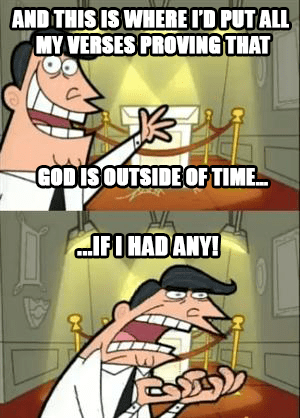
Meme Monday – Verses on God Being Outside of Time
VOTD Ezekiel 16:38
Eze 16:38 And I will judge you as women who commit adultery and shed blood are judged, and bring upon you the blood of wrath and jealousy.
Worship Sunday – Multiplied
Your love is
Like radiant diamonds
Bursting inside us
We cannot contain
Your love will
Surely come find us
Like blazing wildfires
Singing your name
God of mercy
Sweet love of mine
I have surrendered to your design
may this offering stretch across the sky
And these hallelujahs be multiplied.
VOTD Ezekiel 16:17-19
Eze 16:17 You also took your beautiful jewels of my gold and of my silver, which I had given you, and made for yourself images of men, and with them played the whore.
Eze 16:18 And you took your embroidered garments to cover them, and set my oil and my incense before them.
Eze 16:19 Also my bread that I gave you—I fed you with fine flour and oil and honey—you set before them for a pleasing aroma; and so it was, declares the Lord GOD.
An Open Theist Struggles with Childhood Cancer
From a Facebook post:
I’ve experienced a lot of thoughts and feelings in the last few months, but anger at God has not been one of them. I do not believe God makes everything that happens, happen.. we have free-will and much of what happens around us is things unfolding, naturally. I do, however, believe that God can and does change things; He hears and responds to prayer which is why prayer is the best thing we can ask for and the best thing you can do for us (James 4:2-3 “You do not have because you do not ask God”).
I find the book of Job interesting and inspirational.. a story where Job loses everything but still praises God, and from reading the story, I gather that is what God wants us to do (though we are in a relationship and when you are in a relationship it can be normal to experience highs and lows.. I don’t think it’s ideal to be angry at God or question Him, but it happens and I’m not trying to make anyone who has been there feel bad or anything :) – I’ve been there) I know when I was younger I thought being angry at God was an effective means of getting Him to listen.. learning the story of Job taught me that God doesn’t want us to do that and He wants us to praise and trust Him and that is more impactful to Him than anger.. this doesn’t mean I will never struggle with this, but it has kept me strong and these are just my thoughts of the day :) we are still going strong in our faith.. we are grateful and more at His mercy than ever.
Caleb’s Carringbridge site.
VOTD Ezekiel 15:7
Eze 15:7 And I will set my face against them. Though they escape from the fire, the fire shall yet consume them, and you will know that I am the LORD, when I set my face against them.
Answered Questions – Boyd’s Early Church Influences
From a Reddit Question and Answer with Greg Boyd:
Hey Greg Boyd! Love your work!
In what ways do the early church fathers influence your theology? Do you have particular church fathers you read that help you?
Also, I host a podcast from Theologues.com. Would you be willing to come on?
God bless!
Greg responds:
GREAT question! I love the theology of pre-Constantinian fathers. They SO got cosmic spiritual warfare and how it affects this earth. And they ALL emphasized free will. Irenaeus used to be my favorite, but over the last view years I’ve been into Origen. My approach to violent portraits of God in the OT has been influenced by him.
VOTD Ezekiel 14:20
Eze 14:20 even if Noah, Daniel, and Job were in it, as I live, declares the Lord GOD, they would deliver neither son nor daughter. They would deliver but their own lives by their righteousness.
Apologetics Thursday – God Makes the Mute
Triablogue posits a verse to show that God is the cause of all physical deformity:
Exod 4:11
Then the Lord said to him, “Who has made man’s mouth? Who makes him mute, or deaf, or seeing, or blind? Is it not I, the Lord? (Exod 4:11).
Some Christians, hoping apparently to limit God’s liability, effectively absolve God of responsibility for what goes on in the world. If a child is born blind, it is a result of a prenatal infection or genetic defect; God had nothing to do with it. If religious zealots bring down buildings and kill thousands, God was not involved. The problem with this is that it effectively limits God’s power and sovereignty. What if an infection was the proximate cause of a baby’s being born blind? Couldn’t God have saved the child if he had wanted to? Couldn’t God have stopped the mass-murderers? God cannot be almighty and all-knowing and also be absolved of responsibility for what happens in the world.
God’s response in Exod 4:11 is striking: he takes full responsibility for the suffering that people experience. He makes some blind, some deaf, and some mute. The text does not deny that there are proximate causes to such things (injuries, infections, etc.; the ancients knew nothing about viruses and bacteria, but they certainly knew that accidents and injuries could make a person blind or lame). Furthermore, the issue of human sin is never raised in God’s response. This passage is not at all concerned with proximate causes–human sin, like disease or injury, is really just another proximate cause. This text is focused on the ultimate cause, God, and does not shrink from affirming that God is in control of all that happens. Of course, the question of theodicy is very large, and merely asserting that God takes responsibility for all that happens in the world does not resolve all the issues. This topic is explored much more fully in Job. D. Garrett, A Commentary on Exodus (Kregel 2014), 215-16.
What is interesting about this verse is that Triablogue uses the ESV rendering of the verse:
Exo 4:11 Then the LORD said to him, “Who has made man’s mouth? Who makes him mute, or deaf, or seeing, or blind? Is it not I, the LORD?
The NKJV gives an alternative rendering:
Exo 4:11 So the LORD said to him, “Who has made man’s mouth? Or who makes the mute, the deaf, the seeing, or the blind? Have not I, the LORD?
The ESV seems to in fact say that God is the cause all birth defects, at minimum. The NKJV merely says that God makes all people (some may be mute and some may be blind). The Hebrew, as languages tend to do, can support either. So then the context must be examined.
The immediate point of the verse is that God is trying to convince Moses to go to Egypt on God’s behalf. That is not a fatalistic or Calvinist concept. God is arguing that Moses can speak, despite Moses’ lack of confidence, because God will be with him. It is interesting to note that God loses this argument with Moses. God gets angry, gives up, and appoints Aaron to be Moses’ mouthpiece:
Exo 4:14 So the anger of the LORD was kindled against Moses, and He said: “Is not Aaron the Levite your brother? I know that he can speak well. And look, he is also coming out to meet you. When he sees you, he will be glad in his heart.
In a context where God’s plan is thwarted by Moses, the meaning that Triablogue gives to the verse is highly unreasonable. God is not claiming to control all life changing calamities forever into the future. God is not controlling all things even in the present; sometimes petty complaints thwart God’s will. The text is just not about Calvinistic sovereignty.
If God is claiming to cause birth defects, God’s reasoning to Moses would have to be thus: “I am the one who created your mouth (and everyone’s mouth) and I know the limits to which I created it. I know you can speak for Me. Your argument is invalid.”
But the context of Exodus 3 and 4 is about God enabling Moses with power. So, while God could be claiming to cause birth defects, it is more likely that God is claiming to have power. God is the creator of all men. And the creator of all men would help Moses communicate. Moses does not have to worry about his speech because he has Yahweh on his side (see also Exo 3:12). The very next verse says:
Exo 4:12 Now therefore, go, and I will be with your mouth and teach you what you shall say.”
VOTD Ezekiel 14:14
Eze 14:14 even if these three men, Noah, Daniel, and Job, were in it, they would deliver but their own lives by their righteousness, declares the Lord GOD.
Tool on Free Will
Tool, who is not a Christian band, explores the effects of Free Will:
Angels on the sideline,
Puzzled and amused.
Why did Father give these humans free will?
Now they’re all confused.
Don’t these talking monkeys know that
Eden has enough to go around?
Plenty in this holy garden, silly old monkeys,
Where there’s one you’re bound to divide it
Right in two
Angels on the sideline,
Baffled and confused.
Father blessed them all with reason.
And this is what they choose.
(and this is what they choose)
Monkey, killing monkey, killing monkey
Over pieces of the ground.
Silly monkeys give them thumbs,
They forge a blade,
And when there’s one they’re bound to divide it,
Right in two.
Right in two.
Monkey, killing monkey, killing monkey
Over pieces of the ground.
Silly monkeys give them thumbs,
They make a club
And beat their brother… down.
How they survived so misguided is a mystery.
Repugnant is a creature who would squander the ability
to lift an eye to heaven conscious of his fleeting time here
Gotta divide it all right in two (x4)
They fight, till they die
Over earth, over sky
They fight, over life,
Over brawn, over air and light,
Over love, over sun. Over blood
They fight, or they die, all for what? For our rising!
Angels on the sideline again
Been too long with patience and reason
Angels on the sideline again
Wondering when this tug of war will end
Gotta divide it all right in two (x3)
Right in two
Right in two..
VOTD Ezekiel 14:10-11
Eze 14:10 And they shall bear their punishment—the punishment of the prophet and the punishment of the inquirer shall be alike—
Eze 14:11 that the house of Israel may no more go astray from me, nor defile themselves anymore with all their transgressions, but that they may be my people and I may be their God, declares the Lord GOD.”
New Open Theist Blog – Theological Overload
Theological Overload is a new Open Theist blog written by the administrator of the Facebook group Christian Free Thinkers.
An extract from the first post:
This is the key to understanding open theism: that the past present and future do not co-exist, but are ordered sequentially and in linear form. The past no longer exists, the future does not yet exist, and all that exists is the present (which a nanosecond ago was the future and a nanosecond later is the past). Once that is understood, biblical prophecy can be seen for what it is – the revelation of God’s own determined plans for the future. God can declare the end from the beginning because it is HIS plan, for example. Open theism explains the countless incidences in scripture where God changes his mind or learns new things without resorting to anthropomorphism or anthopopaphism, both of which remove any concept of God, in whose image we are made, truly communicating with mankind.
VOTD Ezekiel 14:8
Eze 14:8 And I will set my face against that man; I will make him a sign and a byword and cut him off from the midst of my people, and you shall know that I am the LORD.
Meme Monday – My Own Grandpa

VOTD Ezekiel 14:6
Eze 14:6 “Therefore say to the house of Israel, Thus says the Lord GOD: Repent and turn away from your idols, and turn away your faces from all your abominations.
Worship Sunday – As I Lift My Hands
By Philmore
Lord, I know my own righteousness is as filthy rags to You
So change me, cleanse me, purify me, make me white as snow
And even if I run one thousand miles away from You
I know that You’re always just one step away
As I lift my hands before You
Jesus, oh, how I adore You
I worship You, I worship You
VOTD Ezekiel 13:22
Eze 13:22 Because you have disheartened the righteous falsely, although I have not grieved him, and you have encouraged the wicked, that he should not turn from his evil way to save his life,
Eze 13:23 therefore you shall no more see false visions nor practice divination. I will deliver my people out of your hand. And you shall know that I am the LORD.”
NT Wright on the Problem of Evil
From a question and answer session with NT Wright:
Part of our trouble is that in the Western world, we’ve assumed that God is, as it were, the celestial CEO of this thing called the universe incorporated. And then, as one of Woody Allen’s characters says: “I sort of believe in God, but it looks like He’s basically an underachiever.” In other words, He’s not a very good CEO, He’s not good at running this show.
But actually, the world is much more complicated than that. It’s not simply a machine or a business with God as the CEO. God is involved with it in ways which it’s hard for us now, particularly in the modern world, to grasp.
When we read the stories of Jesus and see what is going on in those stories, perhaps we need to rethink the meaning of the word “God” around who we see in Jesus. Then all sorts of things come clearer and into sharper focus. It’s not simply a matter of “Has God blundered? Has He got it wrong?” But no, He’s been in the middle of this mess with us and He’s taken the worst the world can do onto Himself. He has launched His project of new creation. That’s what the story of Jesus is all about.
VOTD Ezekiel 13:14-15
Eze 13:14 And I will break down the wall that you have smeared with whitewash, and bring it down to the ground, so that its foundation will be laid bare. When it falls, you shall perish in the midst of it, and you shall know that I am the LORD.
Eze 13:15 Thus will I spend my wrath upon the wall and upon those who have smeared it with whitewash, and I will say to you, The wall is no more, nor those who smeared it,
Answered Questions – How Can God Ensure Every Knee Will Bow
From a Reddit Question and Answer with Greg Boyd:
How can the Open Theist God promise every knee will bow, and every tongue shall confess Jesus is Lord, without compromising anyone’s free will?
[–]GregBoyd[S] 3 points 11 days ago
How can a Calvinist affirm this without being a universalist? Look, this is an equally challenging passage for everyone who isn’t a universalist. For my two cents, I’m inclined to see this passage as expressing God’s loving bear hug around all humanity with the hope that all will come in. Yet, because love must be chosen, people always have the freedom to say NO THANKS.
VOTD Deuteronomy 7:21
Deu 7:21 You shall not be terrified of them; for the LORD your God, the great and awesome God, is among you.
Apologetics Thursday – Smock Debates Calvinism
VOTD Deuteronomy 6:21-23
Deu 6:21 then you shall say to your son: ‘We were slaves of Pharaoh in Egypt, and the LORD brought us out of Egypt with a mighty hand;
Deu 6:22 and the LORD showed signs and wonders before our eyes, great and severe, against Egypt, Pharaoh, and all his household.
Deu 6:23 Then He brought us out from there, that He might bring us in, to give us the land of which He swore to our fathers.
AW Pink of Foreknowledge and Election
From The Attributes of God by A.W. Pink:
God foreknows what will be because He has decreed what shall be. It is therefore a reversing of the order of Scripture, a putting of the cart before the horse, to affirm that God elects because He foreknows people. The truth is, He “foreknows” because He has elected. This removes the ground or cause of election from outside the creature, and places it in God’s own sovereign will. God purposed in Himself to elect a certain people, not because of anything good in them or from them, either actual or foreseen, but solely out of His own mere pleasure. As to why He chose the ones He did, we do not know, and can only say, “Even so, Father, for so it seemed good in Thy sight.” The plain truth of Romans 8:29 is that God, before the foundation of the world, singled out certain sinners and appointed them unto salvation (2 Thess. 2:13). This is clear from the concluding words of the verse: “Predestinated to be conformed to the image of His Son,” etc. God did not predestinate those whom He foreknew were “conformed,” but, on the contrary, those whom He “foreknew” (i.e., loved and elected) He predestinated to be conformed. Their conformity to Christ is not the cause, but the effect of God’s foreknowledge and predestination.
VOTD Deuteronomy 6:12
Deu 6:12 then beware, lest you forget the LORD who brought you out of the land of Egypt, from the house of bondage.
Sproul Talks About Open Theism
Abstract:
Israel’s Rejection Not Final (Part 3)
Sermon Text: Romans 11:26-35
In this lesson, Dr. Sproul discusses open theism and whether God has full knowledge of all events. If an event comes to pass we can believe it is His will. God does not wait for the sinner to change so he can come to God, but God goes to the sinner and changes the sinner and brings the sinner to Him. The lesson concludes with a discussion of prayer and how prayer changes things.
VOTD Deuteronomy 6:3
Deu 6:3 Therefore hear, O Israel, and be careful to observe it, that it may be well with you, and that you may multiply greatly as the LORD God of your fathers has promised you— ‘a land flowing with milk and honey.’
Meme Monday – James White Hermeneutics
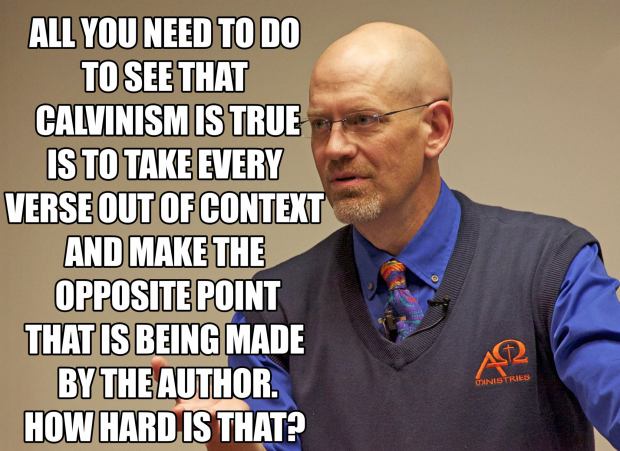
VOTD Deuteronomy 5:16
Deu 5:16 ‘Honor your father and your mother, as the LORD your God has commanded you, that your days may be long, and that it may be well with you in the land which the LORD your God is giving you.
Worship Sunday – Tzama L’ Chol Nafshi
Psa 63:2 To see thy power and thy glory, so as I have seen thee in the sanctuary.
Psa 63:3 Because thy lovingkindness is better than life, my lips shall praise thee.
VOTD Deuteronomy 5:15
Deu 5:15 And remember that you were a slave in the land of Egypt, and the LORD your God brought you out from there by a mighty hand and by an outstretched arm; therefore the LORD your God commanded you to keep the Sabbath day.
Why aren’t my prayers answered?
Sermon Audio by an Open Theist:
VOTD Deuteronomy 5:8
Deu 5:8 ‘You shall not make for yourself a carved image—any likeness of anything that is in heaven above, or that is in the earth beneath, or that is in the water under the earth;
Deu 5:9 you shall not bow down to them nor serve them. For I, the LORD your God, am a jealous God, visiting the iniquity of the fathers upon the children to the third and fourth generations of those who hate Me,
Answered Questions – Does the Open View Undermine God’s Sovereignty?
Gregory Boyd answers the question “Does the Open View Undermine God’s Sovereignty?”:
1. An adventurous sovereignty. First, the objection that God is not sovereign unless he controls everything assumes that sovereignty is synonymous with unilateral control. But why should we accept this understanding of divine sovereignty? There are no rational or biblical reasons to suppose that divine sovereignty must or should entail exhaustive, meticulous, divine control.
…
2. The undermining of divine sovereignty. The definition of sovereignty as control is not only unwarranted; it is, for many of us, not sovereign at all. To speak frankly, it is hard to conceive of a weaker God than one who would be threatened by events occurring outside of his meticulous control. It is difficult to imagine a less majestic view of God than one who is necessarily limited by a unilateral, deterministic mode of relating to his creation.
VOTD Deuteronomy 4:37
Deu 4:37 And because he loved your fathers and chose their offspring after them and brought you out of Egypt with his own presence, by his great power,
Apologetics Thursday – A Logical Refutation of a Logical Refutation of Open Theism
Adapted from a list of proofs on Carm.org:
1. God is the only eternal, uncaused, and self-existent being who was before all things.
Granted, as long as “things” refers to physical reality. After all, the axioms of logic are not “things” to be created. Neither is “time”.
2. Time is that non-spatial, continuous succession of events from the past, through the present, and into the future.
Assumption by Slick. Time is not a “thing” to be created or manipulated. In the Bible, there is no time travel. This is very telling. Clocks and daylight measure “time”, but that does not mean “time” is something created. Just as words describe the axioms of logic, this does not mean the laws of logic are a thing to be invented like words are.
3. Since God is eternal by nature, God is not restricted by nor contained within time, nor is He restricted by a continuous succession of events from the past, through the present, and into the future, nor is time an attribute of God’s nature.
False assumption. The Bible never describes God as “eternal” but “everlasting”. The precise concept is that God has always existed and will always exist. Slick assumes Platonism onto the text in contrast with what the Biblical authors intended. If an intellectually honest reader were to adhere to the intentions of the Biblical authors, Slick’s argument would be refuted by the very texts he uses as prooftexts.
Logically, if time is not a created thing (instead it would be an axiom such as the laws of logic), then being “contained within time” is a non-concept of the likes of being “contained within logic”.
4. God is the Creator of the universe and is independent of it.
Assumption. Universe needs to be properly defined. Independent has to be properly defined. Then the logical case must be made that a creator is independent of their creation. This is a tenuous statement.
5. The universe exists in relationship to time which is a consecutive series of events that relate to change and sequence.
Another assumption. If time is not a “thing”, this point does not follow.
6. God is not subject to or limited by the constraints of the universe, which includes the constraints or limits of time or any properties of time that may limit us as humans.
Another assumption. When very fragile assumptions are compounded upon one another, the ultimate conclusion becomes weaker and weaker.
7. Since God created the universe, and since God is not subject to time, and since the universe operates in time, God also created time when He created the universe.
“Time” being a “thing” is a major and unsubstantiated assumption. That God “created” time is not a Biblical concept. God is displayed as creating the material universe, in a certain sequence. God functions as if He is everlasting (like the Bible claims again and again) experiencing a before and after.
8. Since God created time, God has always existed and continues to exist outside of time and is not subject to its properties.
This is completely anti-Biblical speculation.
9. God is omnipresent. This means that He exists in all places in the universe as well as outside of it (as far as can be described to exist outside of existence).
The term omnipresent is not a Biblical term. Plus there is major dispute over what the concept means. Assuming any particular understanding of “omnipresense” is antithetical to philosophy and the Bible.
10. God’s omnipresence is not restricted by time because God, by nature, is not restricted by time.
This is the result of several compounding speculative and anti-Biblical claims.
11. Since God is not restricted by time, and since He is omnipresent, then the future is a present reality with God.
Even if the premises were founded, the conclusions do not follow. If time is able to be transversed, that doesn’t mean all time is present with God. That is an unfounded assumption. Maybe God can experience different points of time, randomly moving back and forward as presents. There is no reason to assume some sort of perpetual present of all time.
12. Therefore, because God is in all places at all times, God knows all things, even the future free will choices of free creatures. This means that the open theism view that God does not know all future events of free will creatures is false.
Garbage in, garbage out.
VOTD Deuteronomy 4:34-35
Deu 4:34 Or did God ever try to go and take for Himself a nation from the midst of another nation, by trials, by signs, by wonders, by war, by a mighty hand and an outstretched arm, and by great terrors, according to all that the LORD your God did for you in Egypt before your eyes?
Deu 4:35 To you it was shown, that you might know that the LORD Himself is God; there is none other besides Him.
Ehrman v the Infidel Guy
Bart Ehrman explains to the Infidel Guy the concept of historical evidence. He explains that Jesus did exist.
VOTD Deuteronomy 4:31
Deu 4:31 (for the LORD your God is a merciful God), He will not forsake you nor destroy you, nor forget the covenant of your fathers which He swore to them.
Biblical Open Theist Reading List
 From time to time individuals request a consolidated list of basic reading on the subject of Open Theism. This post sets out to build a basic reading list for Biblical Open Theism (contrasted with Philosophical Open Theism) for the neophyte.
1. Roger Olson explains how Open Theism has not been fairly represented by the critics. Instead, the critics wage a dishonest smear campaign. [link]
2. Macinnis relates her shock at blatant prooftexting of 1 Samuel 15 by a critic of Open Theism [link]
3. Apologetic Jedi lists 95 Open Theism verses in the tradition of Martin Luther’s 95 theses. [link]
4. A definition of Open Theism and an overview of the current ideological spectrum of Open Theism. [link]
5. A thorough examination of Exodus 32 and how future Biblical authors understood the text. [link]
6. A full text of Bob Enyart’s opening statement to James White during a debate on Open Theism [link]
Two important books
Did God Know, by H Roy Elseth [link]
Does God Know the Future, by Michael Saia [link]
VOTD Deuteronomy 4:28
Deu 4:28 And there you will serve gods, the work of men’s hands, wood and stone, which neither see nor hear nor eat nor smell.
Meme Monday – Dinkleberg
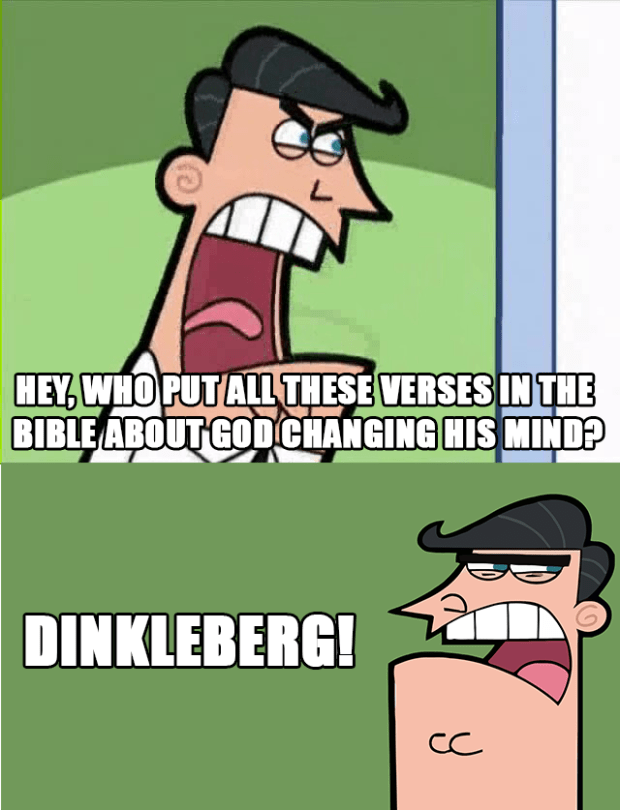
VOTD Deuteronomy 4:25
Deu 4:25 “When you father children and children’s children, and have grown old in the land, if you act corruptly by making a carved image in the form of anything, and by doing what is evil in the sight of the LORD your God, so as to provoke him to anger,
Worship Sunday – This is Amazing Grace
By Phil Wickham
Who breaks the power of sin and darkness
Whose love is mighty and so much stronger
The King of Glory, the King above all kings
Who shakes the whole earth with holy thunder
And leaves us breathless in awe and wonder
The King of Glory, the King above all kings
This is amazing grace
This is unfailing love
That You would take my place
That You would bear my cross
You lay down Your life
That I would be set free
Oh, Jesus, I sing for
All that You’ve done for me
Who brings our chaos back into order
Who makes the orphan a son and daughter
The King of Glory, the King of Glory
Who rules the nations with truth and justice
Shines like the sun in all of its brilliance
The King of Glory, the King above all kings
Worthy is the Lamb who was slain
Worthy is the King who conquered the grave
Worthy is the Lamb who was slain
Worthy is the King who conquered the grave
Worthy is the Lamb who was slain
Worthy is the King who conquered the grave
Worthy is the Lamb who was slain
Worthy, worthy, worthy
VOTD Deuteronomy 4:19
Deu 4:19 And take heed, lest you lift your eyes to heaven, and when you see the sun, the moon, and the stars, all the host of heaven, you feel driven to worship them and serve them, which the LORD your God has given to all the peoples under the whole heaven as a heritage.
Lynn on God’s Foreknowledge and Man’s Free Will
John Lynn of The Living Truth Fellowship
VOTD Jeremiah 16:17
Jer 16:17 For My eyes are on all their ways; they are not hidden from My face, nor is their iniquity hidden from My eyes.
Unanswered Questions – Was Jesus’ Human Nature Divine?
To those who follow the teachings of James White and Alpha and Omega Ministries:
Col 2:9 For in Him dwells all the fullness of the Godhead bodily;
The part of Jesus’ nature which was human… was that God?
VOTD Isaiah 6:8
Isa 6:8 Also I heard the voice of the Lord, saying: “Whom shall I send, And who will go for Us?” Then I said, “Here am I! Send me.”
Apologetics Thursday – Alpha and Omega Ministries’ Intellectual Dishonesty
Part of my reoccurring work is on exposing intellectual dishonesty. There are several signs of intellectual dishonesty: Refusal to debate. Refusal to make monetary bets. Refusal to answer simple questions. On Facebook, there are two universal telltale signs of intellectual dishonesty: deleting comments and threads. If a belief cannot be transparently questioned, if critics must be censored, then the advocate is intellectually dishonest.
This week, Alpha and Omega Ministries censored Bob Enyart when Enyart replied on their Facebook page to an article that James White wrote against Bob Enyart. If that censorship does not show the rampant intellectual dishonesty of James White and Alpha and Omega Ministries, then I will present my own exhibit. I was censored and banned for asking questions. The intellectual dishonesty is apparent on several levels. Straightforward questions are ignored and instead were censored.
The entire Facebook exchange between me and the A&O Facebook admin, Richard C Pierce, is available for all to read. It should be noted that I make zero theological arguments the entire “debate”. I take no stances and advocate no views. Instead, I ask questions. Questions are a chance for individuals to explain what they believe, to clarify. Instead, Pierce, hyper-reacts. He becomes belligerent. It is obvious he is afraid of the question. This is not unlike White’s handing of the question and answer period during the White Enyart debate. White and company are very afraid of questions. Their beliefs do not hold up to simple scrutiny. Pierce then bans me. I do get to, in the end, point out the intellectual dishonesty of A&O Ministries, which is very apparent by Pierce’s refusal to answer questions and his belligerence towards those asking questions.
Part of the exchange is obscured because I didn’t expand some comments before the copy/paste. Pierce can release the rest of those comments if he can be prevailed upon to do so. All the relevant parts are still intact:
Richard C Pierce ROFLing
I removed Bob and Will’s posting privileges because I got tired of their ignoring James and my responses. Unfortunately, when you do that on this kind of FB page FB ‘hides’ all posts from those individuals. This is certainly not my favorite f…See More
Like · Yesterday at 12:01am · Edited
Richard C Pierce Chris Fisher my only other option here is that if I were to receive assurances that Bob and Will can behave themselves from here on, I would lift the block. Without that assurance, I will keep it in place for the near future.
As for Bob Enyart’s blog…See More
Like · Yesterday at 12:07am · Edited
Chris Fisher Personally, I would like to see what the answer is to Duffy’s question:
Is Jesus the second person of the trinity?…See More
Richard C Pierce Chris Fisher How many times would you like to see it answered? James answered in this very post. The answer is yes, has always been yes and has not been anything other than yes. Perhaps you need to ask again to see if it changed?
Unlike · 1 · Yesterday at 3:47pm
Chris Fisher So, if Jesus is the second person of the trinity and Jesus took on human nature, then isn’t that God changing? God is going from God+Jesus (no human nature)+Holy Spirit to God+Jesus (with human nature)+Holy Spirit?
Richard C Pierce No, but again, Dr. White explained this, so why are you acting like he hasn’t? This whole ‘playing dumb’ act from your group is getting very tiring.
Chris Fisher No seriously. No one understands it. Explain how God can incorporate human nature and yet not change.
Rachel Troyer So… the second person of the trinity has a divine nature and a human nature, but before the incarnation did not have a human nature… right?
Isn’t this what James White believes?Richard C Pierce Jesus is ‘fully’ God and ‘fully’ man. This is called the hypostatic union. The natures are not a ‘mixture’ therefore God is not changed. But of course, Bob Enyart knows that is what we believe. He is ignoring that in order to prop up his straw man – false case.
Richard C Pierce I am sure that I could find something in Bob’s teachings that I could twist into something that he doesn’t actually believe and then play dumb while repeatedly poking at him about it and then acting like he can’t respond. Such is not honest communication.
Chris Fisher Here is where I think our communication breakdown may be happening: was the part of Jesus with human nature fully God?
Richard C Pierce Sigh. Again, the playing dumb act isn’t flying anymore. I just stated that there is no ‘mixture.’ This entire line is a straw man designed to tie up and waste time. The real problem here isn’t communication, it is that you don’t like the answer. Well, it is what it is so get honest with it. If you want to disagree with what we ‘really’ believe then do so. Otherwise, enough with the straw man argument.
Richard C Pierce All: Before you decide to chime in for some more ‘ring around the straw man rosey’ I suggest you read the rules for this page.
Admin
Rachel Troyer “Jesus is ‘fully’ God and ‘fully’ man. This is called the hypostatic union. The natures are not a ‘mixture’ therefore God is not changed”
So, I totally agree that Jesus is fully God and fully man.
But, the second person of the trinity (Jesus/Son of G…See MoreRachel Troyer I read the rules and I listened to the posts but it’s still confusing… James is trying to say that there is no change with God because God can not change in any way. So, he is saying that the incarnation was NOT a change… right?
Rachel Troyer Richard, I think it is purely communication. I don’t think it’s a “straw man” argument. It seems to me that everyone thinks the same thing but some refer to it as a change and some don’t.
the Word became flesh, so at one point it wasn’t flesh and at another point it was flesh… right?Chris Fisher It is a yes or no question. There is no “playing dumb” on my part. Either your view is comprehensible or it isn’t. You should be able to explain it if it is. Instead of typing two or three letters you chose for a paragraph ignoring the question:
Was the part of Jesus with human nature fully God? …See More
Richard C Pierce I am sorry that you are both so confused. Somehow, generations have been able to understand this for 2000 years. Perhaps someone has bewitched you?
Chris Fisher Was the part of Jesus with human nature fully God?
Richard C Pierce Answering for the last time. He who has ears to hear…
https://carm.org/jesus-two-natures
Jesus’ Two Natures: God and Man
by Matt Slick
CARM.ORG
Chris Fisher Sir, do you believe that answers my question? If so, copy and paste the sentence that explains if Jesus’ human nature was fully God. It feels to me that Slick and White avoid simple questions and defer to distractions that do not answer critical questions. Intellectual honesty calls for transparent answers to direct questions.
Arlin Edmondson “Was the part of Jesus with human nature fully God?”
What is incomprehensible is your question, Chris….See More
Chris Fisher It seams to me that you want to say “no”. So I will help you out. You can copy and paste this sentence: ” The part of Jesus’ nature that was human is not God. ”
Rachel Troyer Richard,
The Word became flesh. At one point the Word (God- the second person of the trinity) was not in the flesh and now the Word (God-the second person of the trinity) is in the flesh. For 2000 years+ Christians have professed Christ as dying and…See MoreRichard C Pierce Guys, argue all of the little conundrums that you want. Your argument is not with me, James White, Matt Slick or a host of others. It is with scripture. You can repeat your case all that you want, you are denying the direct teaching of scripture.
Hebrews 13:8 Jesus Christ is the same yesterday and today and forever.
Chris Fisher It is a yes or no question. I am not arguing anything. I have never seen someone so afraid of answering questions:
Was the part of Jesus with human nature fully God?
Micah Burke > Was the part of Jesus with human nature fully God?
This shows a startling lack of understanding of the hypostatic union.
Chris Fisher Micah, yes or no. From what I gather is that you and Richard would say “no”, and then talk about the hypostatic union. But you are too afraid to write out your beliefs.
Chris Fisher The fact that you will not say “yes” suggests you do not believe “yes”. You do not believe Jesus’ human side was divine. But you also do not want to say ” no” because you understand how heretical that would look. My conclusion is that you both are intellectually dishonest.
Rachel Troyer Micah, was there a point before the hypostatic union where Jesus was not the God-man?
From Gotquestions.org it says,
“Jesus always had been God (John 8:58,10:30), but at the incarnation Jesus became a human being (John 1:14). The addition of the human nature to the divine nature is Jesus, the God-man.”
This is similar to John Piper’s article on the hypostatic union.
“AT the incarnation, Jesus became a human being
Word became flesh”So, my question is simple, before the incarnation, was Jesus a human being? was there a human nature along with the divine nature? or did this “addition” become so at the incarnation?
If so, then this is a change in God… right? Because Jesus is fully God… always was and is and will be… but wasn’t always human… right?
Bible Questions Answered by GotQuestions.org! Fast and accurate answers to all your Bible…
GOTQUESTIONS.ORG
VOTD Isaiah 5:7
Isa 5:7 For the vineyard of the LORD of hosts is the house of Israel, And the men of Judah are His pleasant plant. He looked for justice, but behold, oppression; For righteousness, but behold, a cry for help.
Augustine on Stealing Platonistic Theology
From On Christian Doctrine:
60. Moreover, if those who are called philosophers, and especially the Platonists, have said anything that is true and in harmony with our faith, we are not only not to shrink from it, but to claim it for our own use from those who have unlawful possession of it.
VOTD Isaiah 5:2
Isa 5:2 He dug it up and cleared out its stones, And planted it with the choicest vine. He built a tower in its midst, And also made a winepress in it; So He expected it to bring forth good grapes, But it brought forth wild grapes.
Enyart on God Crossing Infinite Time
Abstract:
Misconception 3: God cannot cross an actual infinity: (Send any comment to Bob@kgov.com.) God has existed through the “beginningless past” (Morriston, 2010, Faith and Philosophy, pp. 439-450). Christian theologians who object to this typically do so by being inconsistent, and thus, their objection is easily neutralized, and then answered. For example, William Lane Craig denies that God has existed throughout time immemorial, infinitely into the past, because he claims that even God cannot cross an actual infinity. (Aristotle, for example, claimed that the infinite is never actual; he however, did not know God.) Yet while Craig doesn’t admit it, he himself believes that God has crossed an actual infinity. His belief that God has exhaustive foreknowledge of a kingdom that never ends requires divine knowledge of an infinite future, with this knowledge comprised of actual thoughts in God’s mind. (This would be like God having counted to infinity.) Further, because Craig happens to hold the untenable and rather grotesque belief that God knows every possible future, that philosophical claim requires God to cross an infinite number of actual infinities. Instead, in actuality, God has crossed the single infinity of the beginningless past. Using a typically unstated assumption, an argument against God’s “beginningless past” insists that He could not have crossed an infinite past because regardless of how much time has actually passed, “infinity” would require passage of even more time to arrive at any given moment. The unstated assumption in this objection however is that it assumes its conclusion, namely, that this past period must have had a beginning (for this objection asserts that this past period is of finite duration). If there is a valid systematic theology against God crossing an actual infinity, it would not support a philosophical claim that contradicts its own system, and it will not merely assume its conclusion. Let’s consider an analogy from geometry and then an excuse from mathematics. Using an analogy, not as a proof but as an illustration, a geometrical line is infinite in both directions, whereas a ray has a terminal point yet is infinite in one direction. For our analogy, the ray extends through eternity past and is terminated in God’s present, which is where God lives (in the fullness of time, so to speak). Relatedly, perhaps there is an excuse for theologians who failed to understand all this, who lived prior to mathematician Georg Cantor (d. 1918), who taught the world that it was possible to form infinite sets greater than other infinite sets. So, if God had already existed for eternity past at the moment of creation (an infinite set of moments), by the time of the Incarnation, He had then existed for an even longer infinite set of moments. For, He must increase. (Prior to Cantor the world of mathematics never accepted the concept of greater infinity.) And finally, God put eternity into our hearts. Yet unlike God, our life is not endless in two directions but only in one, namely, into the future. So you are like a “ray” that begins at a point (of conception) and then proceeds forever (Eccl. 3:11). Therefore, our eternal soul provides for us a context in which we can develop a gut feel for what it means to live forever (throughout eternity future). Yet we lack the divine intestinal fortitude, so to speak, which we would need in order to relate to His beginningless past. Thus, by the Scriptural teachings regarding time (see above) and because time could not have been created (see above), therefore we teach that God’s goings forth are from of old, from everlasting, from ancient times, the everlasting God who continues forever, from before the ages of the ages, He who is and who was and who is to come, who remains forever, the everlasting Father, whose years never end, from everlasting to everlasting, and of His kingdom there will be no end.
VOTD Isaiah 3:16
Isa 3:16 Moreover the LORD says: “Because the daughters of Zion are haughty, And walk with outstretched necks And wanton eyes, Walking and mincing as they go, Making a jingling with their feet,
Isa 3:17 Therefore the Lord will strike with a scab The crown of the head of the daughters of Zion, And the LORD will uncover their secret parts.”
Free Monday – First Chapter from Age of Anxiety
Philosophy Project is hosting E. R. Dodds’ first chapter from Pagan and Christian in an Age of Anxiety – Some Aspects of Religious Experience from Marcus Aurelius to Constantine
VOTD Isaiah 2:20
Isa 2:20 In that day a man will cast away his idols of silver And his idols of gold, Which they made, each for himself to worship, To the moles and bats,
Worship Sunday – Holy and Anointed One
By Vineyard
Jesus, Jesus
Holy and anointed One, Jesus
Jesus, Jesus
Risen and exalted One, Jesus
Your name is like honey on my lips
Your Spirit like water to my soul
Your Word is a lamp unto my feet
Jesus, I love You, I love You
VOTD Isaiah 2:19
Isa 2:19 They shall go into the holes of the rocks, And into the caves of the earth, From the terror of the LORD And the glory of His majesty, When He arises to shake the earth mightily.
James White Censors Enyart’s Response to White’s Criticism of Enyart
Update: posts are reinstated as of 1/26/2015
The following was deleted from Alpha and Omega Ministries. Bob Enyart and Will Duffy had quickly responded to White’s criticism of Enyart. White and his ministry did not want Enyart’s side to be heard and removed it from their Facebook page (update: both Enyart and Duffy were also blocked). This is all in response to White’s backtracking and disingenuous handling of the Enyart White Open Theism debate aftermath:
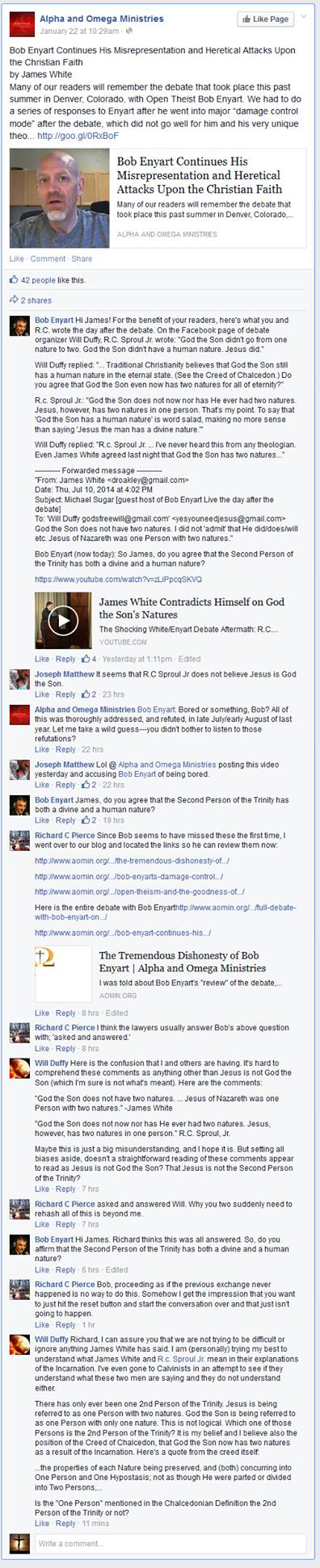
See also: James White’s Opening Statement Refuted Sentence by Sentence
Response posted by Alpha and Omega Ministries (1/25/2015). The reader can decide if Enyart’s and Duffy’s posts were inappropriate:
Augustine on God’s Ineffibility
From On Christian Doctrine:
6. Have I spoken of God, or uttered His praise, in any worthy way? Nay, I feel that I have done nothing more than desire to speak; and if I have said anything, it is not what I desired to say. How do I know this, except from the fact that God is unspeakable? But what I have said, if it had been unspeakable, could not have been spoken. And so God is not even to be called unspeakable, because to say even this is to speak of Him. Thus there arises a curious contradiction of words, because if the unspeakable is what cannot be spoken of, it is not unspeakable if it can be called unspeakable. And this opposition of words is rather to be avoided by silence than to be explained away by speech. And yet God, although nothing worthy of His greatness can be said of Him, has condescended to accept the worship of men’s mouths, and has desired us through the medium of our own words to rejoice in His praise. For on this principle it is that He is called Deus (God). For the sound of those two syllables in itself conveys no true knowledge of His nature; but yet all who know the Latin tongue are led, when that sound reaches their ears, to think of a nature supreme in excellence and eternal in existence.
VOTD Isaiah 2:4
Isa 2:4 He shall judge between the nations, And rebuke many people; They shall beat their swords into plowshares, And their spears into pruning hooks; Nation shall not lift up sword against nation, Neither shall they learn war anymore.
Unanswered Questions – Elect as Enemy to the Gospel
To those who believe the elect are a people chosen go to heaven or are saved:
Rom 11:28 Concerning the gospel they are enemies for your sake, but concerning the election they are beloved for the sake of the fathers.
Why are the elect the enemy of the gospel?
VOTD Isaiah 1:27
Isa 1:27 Zion shall be redeemed with justice, And her penitents [those who repent] with righteousness.
Apologetics Thursday – Saia on the Man Born Blind
From Why Do the Innocent Suffer:
One passage of Scripture gives many readers the impression God sometimes causes people to suffer so He can display His glory. The story, found in John chapter 9, seems to imply God made a man blind so He could manifest His works in the man by healing him.
This text bothered me for many years until I read the passage straight through in the Greek. I was reading this passage because of its reference to the word “sin,” but as I did, I saw something I had never seen before.
The early Greek manuscripts were written in all capital letters, most had no punctuation except paragraph breaks, and there were no spaces between the words. So John chapter nine, verses three and four might have looked something like this:
[image of Greek text without spaces or punctuation]
Because of the way the text was written, spaces between words, accents, breathing marks, and punctuation must be supplied by the translators. Most often these additions are helpful, but there are instances where the translation is influenced by the theological presuppositions of the translators.
As Roger Forster commented about this passage, it is most often translated the way it is because of “convention and prejudice”—“convention” because it has always been translated that way, and “prejudice” because the translators really believe God made the person blind so He could heal him. Roger also noted these translations represent God as completely different in character from the way He is described in the rest of the Scriptures. If these translations are accurate, this would be the only place is the Bible God is described as doing something evil to an innocent person so good could result.
The wording of most English versions gives the idea God made the man blind so He could display His glory in the man. But that would be doing evil so good may result. This is how the text is translated in the New American Standard Bible:
Jesus answered, “It was neither that this man sinned, nor his parents; but it was in order that the works of God might be displayed in him. We must work the works of Him who sent Me as long as it is day; night is coming when no man can work.”
In the Greek, however, the words “it was,” “that,” and “it was” are simply not there. That is why they are in italics in the NASB. If you read the text as the Greek reads, without the additional English words, you see the question is answered first, and then Jesus goes on with His original business of healing the man.
Jesus answered, “Neither this man sinned, nor his parents. But in order that the works of God might be displayed in him, we must work the works of Him who sent Me as long as it is day; night is coming when no one can work.”
In other words, “Enough of these questions about whose fault this is. We need to be getting on with the work of the Father.”
Thus, with different punctuation, and without the extra words from the translators, the meaning of the passage is very different. The disciples were discussing why the man was born blind. Was it because he sinned (maybe in a former life?), or that his parents sinned? Jesus’ answer was simple and straightforward—it was neither. So, in essence, Jesus did not really answer the question. Then, turning to the most important issue, He carried on with the work of His Father to heal the man.
VOTD Isaiah 1:13
Isa 1:13 Bring no more futile sacrifices; Incense is an abomination to Me. The New Moons, the Sabbaths, and the calling of assemblies— I cannot endure iniquity and the sacred meeting.
Isa 1:14 Your New Moons and your appointed feasts My soul hates; They are a trouble to Me, I am weary of bearing them.
Swinburne on Causation, Time, and God’s Omniscience
VOTD Isaiah 1:4
Isa 1:5 Why should you be stricken again? You will revolt more and more. The whole head is sick, And the whole heart faints.
Brueggemann on Jeremiah
VOTD Isaiah 1:2-3
Isa 1:2 Hear, O heavens, and give ear, O earth! For the LORD has spoken: “I have nourished and brought up children, And they have rebelled against Me;
Isa 1:3 The ox knows its owner And the donkey its master’s crib; But Israel does not know, My people do not consider.”
Free Monday – The influence of Greek ideas and usages upon the Christian church
A free book for anyone interested in serious Bible study. Edwin Hatch examines Greek influences on the Christian church.
Excerpt:
“few, if any, writers write with the precision of a legal document, and the inverted pyramids which have been built upon chance phrases of Clement or Justin are monuments of caution which we shall do well to keep before our eyes. ”
The influence of Greek ideas and usages upon the Christian church
VOTD Psalms 11:4
Psa 11:4 The LORD is in His holy temple, The LORD’s throne is in heaven; His eyes behold, His eyelids test the sons of men.
Worship Sunday – It is You
By the Newsboys
As we lift up our hands will you meet us here?
As we call on Your name will you meet us here?
We have come to this place to worship You
God of mercy and grace
It is You we adore
It is You, praises are for
Only You, the Heavens declare
It is You
It is You
An’ Holy, Holy is our God Almighty
An’ Holy, Holy is His name alone, yea
An’ Holy, Holy is our God Almighty
An’ Holy, Holy is His name alone
It is You we adore
It is You, only You
As we lift up our hands will You meet us here?
As we call on Your name will You meet us here?
We have come to this place to worship You
God of mercy and grace
It is You we adore
It is You, praises are for
Only You, the Heaven’s declare
It is You
It is You
An’ Holy, Holy is our God Almighty
An’ Holy, Holy is His name alone, yea
An’ Holy, Holy is our God Almighty
An’ Holy, Holy is His name alone
As we lift up our hands, as we call on Your name
Will You visit this place by Your mercy and grace?
As we lift up our hands, as we call on Your name
Will You visit this place by Your mercy and grace?
It is You we adore
It is you
It is you
An’ Holy, Holy is our God Almighty
An’ Holy, Holy is His name alone
An’ Holy, Holy is our God Almighty
An’ Holy, Holy is His name alone, yea
An’ Holy, Holy is our God Almighty
An’ Holy, Holy is His name alone
It is you we adore
It is you, only you
VOTD Amos 7:3
Amo 7:3 So the LORD relented concerning this. “It shall not be,” said the LORD.
Fisher on Being Elect
The holy calling is according to God’s purpose. His purpose was given to us before the times of the ages. Both the Second Timothy and the Ephesians verses should be understood be two important elements. There is an election to something; what is being elected? Who are persons being elected? Who are the “us in Christ?”
There is nothing inherent in the meaning of the verb “to choose” that implies salvation. The common use of electing or choosing people for public office is a good English equivalent of the Greek verb. Many people are elected or chosen to office all the time. The verb is very generic.
The word to choose in Greek “ἐκλέγομαι” occurs 19 times in the New Testament. Only perhaps three or four times does this verb mean an election to salvation. Thayer’s Greek-English Lexicon of the New Testament, an early scholarly work in English has been a basic reference book since 1885. In this book he lists at least five different types of election relating to this verb:
VOTD Zechariah 13:2
Zec 13:2 “It shall be in that day,” says the LORD of hosts, “that I will cut off the names of the idols from the land, and they shall no longer be remembered. I will also cause the prophets and the unclean spirit to depart from the land.
Answered Questions – 30 Pieces of Silver
A YouTube commenter challenges:
2) Did Jeremiah just get lucky when he prophesied that Jesus would be bought by men for precisely 30 silver, centuries later?
Jeremiah didn’t actually do that. Zechariah is what is being referenced. The context has nothing to do with Jesus.
Zec 11:12 Then I said to them, “If it is agreeable to you, give me my wages; and if not, refrain.” So they weighed out for my wages thirty pieces of silver.
In fact, if no 30 pieces of silver were ever used to purchase a field, no one would ever have heard of this failed prophecy. There is zero indication in Zechariah that this is a prophecy!
In ancient Israel, they showed truth by showing parallels. Things were true if they had precedence. That is what Matthew does when he says scripture is “fulfilled”. The fulfilled scripture usually has zero indication of having a secondary prophetic meaning. Paul and James even use precedence to prove competing points! And the context of some of Paul’s prooftexts are often the opposite point he advocates with the prooftexts. The idea is parallelism, not prophecy.
VOTD Daniel 10:12
Dan 10:12 Then he said to me, “Do not fear, Daniel, for from the first day that you set your heart to understand, and to humble yourself before your God, your words were heard; and I have come because of your words.
 God is Open