Job 42:2 “I know that You can do everything, And that no purpose of Yours can be withheld from You.
Open Theism
Worship Sunday – Oceans (Where My Feet Will Fail)
By Hillsong
Verse #1
You call me out upon the waters
The great unknown, where feet may fail
And there I find You in the mystery
In oceans deep, my faith will stand
Chorus:
And I will call upon Your name
And keep my eyes above the waves
When oceans rise
My soul will rest in Your embrace
For I am Yours, and You are mine
Verse #2
Your grace abounds in deepest waters
Your sovereign hand will be my guide
Where feet may fail and fear surrounds me
You’ve never failed, and You won’t start now
Chorus:
So I will call upon Your name
And keep my eyes above the waves
When oceans rise
My soul will rest in Your embrace
For I am Yours, and You are mine
Bridge:
Spirit lead me where my trust is without borders
Let me walk upon the waters
Wherever You would call me
Take me deeper than my feet could ever wander
And my faith will be made stronger
In the presence of my Savior x 3
Ending:
I will call upon Your name
Keep my eyes above the waves
My soul will rest in Your embrace
I am Yours, and You are mine
I am Yours, and You are mine
I am Yours, and You are mine
I am Yours, and You are mine
Read more: Hillsong United – Oceans (Where Feet May Fail) Lyrics | MetroLyrics
VOTD 1 Chronicles 29:17
1Ch 29:17 I know also, my God, that You test the heart and have pleasure in uprightness. As for me, in the uprightness of my heart I have willingly offered all these things; and now with joy I have seen Your people, who are present here to offer willingly to You.
James White Becomes Flustered about Child Rape
One belief of Calvinism is that God decrees child rape. This makes James White uneasy, as evident by his refusal to answer very basic questions during his debate with Bob Enyart. As a debate follow-up, White still shows that he is disturbed by his own belief that God decrees child rape. White’s argument: not only does God decree child rape, but everything (so ignore God decreeing the child rape). How does God decreeing child torture and child beheading absolve God of evil for decreeing child rape? No one knows.
James White’s most delusional statement: “Where have I never not answered this question directly?”
Starting at the 54:00 mark:
VOTD Job 36:26
Job 36:26 “Behold, God is great, and we do not know Him; Nor can the number of His years be discovered.
Unanswered Questions – Simplicity and the Trinity
For those who believe God is absolutely simple:
Is the trinity absolutely indivisible?
VOTD 2 Chronicles 32:31
2Ch 32:31 However, regarding the ambassadors of the princes of Babylon, whom they sent to him to inquire about the wonder that was done in the land, God withdrew from him, in order to test him, that He might know all that was in his heart.
Apologetics Thursday – Predestined What?
From the God is Open Facebook group by Mark B:
Just listened to the entire Bob Enyart/James White debate. My first thought:
James White quotes Romans 8:28-30, and he did include the beginning phrase: “Those who love God…”. But, then he totally ignores that phrase, and begins with: “..the called…predestinated to be conformed to the image of His Son…justified…glorified”. (White calls this progression, “the golden chain”
But, isn’t White’s “golden chain” the predestined blessings; “which God has prepared for them that love Him”? (1Cor.2:9)
Quoting Ephesians 1:1-11, White, again, wants us to believe in predestinated salvation, instead of predestined blessings.
Why doesn’t he include verses 12 and 13 to explain who receives “the golden chain”?“…those who hear the word of truth (the gospel of salvation),..believe it…trust in Christ…then, are sealed with the Holy Spirit of promise.”
VOTD Job 1:7
Job 1:7 And the LORD said to Satan, “From where do you come?” So Satan answered the LORD and said, “From going to and fro on the earth, and from walking back and forth on it.”
Context Matters with Jefferson Bethke
VOTD Exodus 3:6
Exo 3:6 Moreover He said, “I am the God of your father—the God of Abraham, the God of Isaac, and the God of Jacob.” And Moses hid his face, for he was afraid to look upon God.
Olson Warns of Stealth Calvinism
An excerpt from Roger Olson’s post on Stealth Calvinism:
I have been warning fellow Arminians for a long time that the Calvinist attacks on open theism will come around to haunt us. I knew that because all the evangelical books attacking open theism include arguments that, if valid, would also rule out Arminianism (e.g., that the open theist God cannot guarantee such-and-such in history because he allegedly lacks the knowledge necessary for that).
VOTD Exodus 2:23
Exo 2:23 Now it happened in the process of time that the king of Egypt died. Then the children of Israel groaned because of the bondage, and they cried out; and their cry came up to God because of the bondage.
Bob Enyart debates James White video
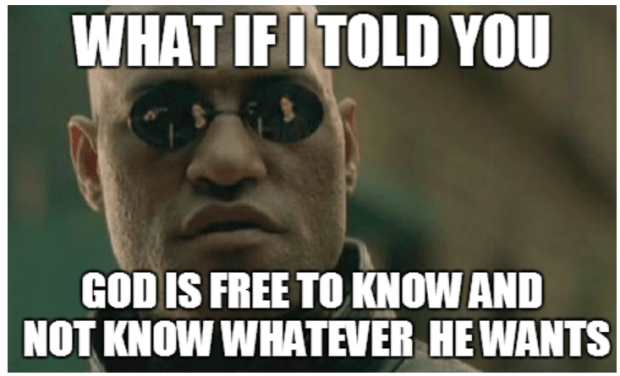
Meme Monday – Morpheus
VOTD Exodus 16:4
Exo 16:4 Then the LORD said to Moses, “Behold, I will rain bread from heaven for you. And the people shall go out and gather a certain quota every day, that I may test them, whether they will walk in My law or not.
Worship Sunday – I Love You, Lord
By Petra
I love you, Lord
And I lift my voice
To worship You
Oh, my soul, rejoice!
Take joy my King
In what You hear
Let it be a sweet, sweet sound
In Your ear
I love you, Lord
(I love you, Lord)
And I lift my voice
(And I lift my voice)
To worship You
(To worship You)
Oh, my soul, rejoice!
(Oh, my soul)
Take joy my King
(Take joy my King)
In what You hear
(In what You hear)
Let it be a sweet, sweet sound
(Let it be a sweet sound)
In Your ear
I love you, Lord
And I lift my voice
To worship You
Oh, my soul, rejoice!
Take joy my King
In what You hear
Let it be a sweet, sweet sound
In Your ear
I love you, Lord
(I love you, Lord)
I love you, Lord
(I love you, Lord)
(And I lift my voice)
I love you, Lord
(Take joy my King)
(Take joy my King)
I love you, Lord
(I love you, Lord)
I love you, Lord
(Let it be a sweet, sweet sound)
VOTD Deuteronomy 8:16
Deu 8:16 who fed you in the wilderness with manna, which your fathers did not know, that He might humble you and that He might test you, to do you good in the end—
Gunton on God and Jesus and Seperate Will
From Act and Being: Towards a Theology of the Divine Attributes:
And yet the gospel account appears to require at least two wills somewhere, as crucially in Gethsemane. When Jesus says, `not my will, but yours be done’, the gospel appears to imply that it is at least conceivable that the Son will will other than his Father. To avoid the problem of there being two wills in God, two were attributed to Christ. There must be in Christ himself, it was argued, two wills, a divine will and a human will, and what we see in Gethsemane is the human nature’s will accepting that of the divine nature.
VOTD Exodus 20:20
Exo 20:20 And Moses said to the people, “Do not fear; for God has come to test you, and that His fear may be before you, so that you may not sin.”
Answered Questions – Calvinist Misc
From a Calvinist Facebook page:
Since there appear to be so many in this group who do not believe in the sovereignty of God in election please Answer the following.
1. Can God heal someone without them giving Him permission?
2. Do you ever pray for God to soften someone’s heart?
3. Do you think that the Ark is a story that also represents Grace?
4. If salvation relied totally on the will of man to accept Jesus as Lord and Savior, what wires the brain or heart different from person to person to accept or deny?
1. I could too. Just strap them to a table and fix them. Of course God can.
2. Yes. In the Bible God had mechanics for softening and hardening hearts. Sometimes God hardened hearts by insulting someone’s pride. Sometimes God softened someone’s heart by turning them into a wild beast for years upon years.
3. Sure.
4. Nothing “wires the heart differently”. Throughout the Bible God laments in a confused fashion as to why people reject Him. God says: “What more could I do?”. Human beings are not input-output devices that one just has to flip a switch. We originate our own thoughts and desires, as James writes.
VOTD Psalms 8:4-6
Psa 8:4 What is man that You are mindful of him, And the son of man that You visit him?
Psa 8:5 For You have made him a little lower than the angels, And You have crowned him with glory and honor.
Psa 8:6 You have made him to have dominion over the works of Your hands; You have put all things under his feet,
Richard Holland – God, Time, and the Incarnation 7
Link to kgov.com.
VOTD Psalms 7:6
Psa 7:6 Arise, O LORD, in Your anger; Lift Yourself up because of the rage of my enemies; Rise up for me to the judgment You have commanded!
Richard Holland – God, Time, and the Incarnation 6
Link to kgov.com.
VOTD Psalms 5:2-3
Psa 5:2 Give heed to the voice of my cry, My King and my God, For to You I will pray.
Psa 5:3 My voice You shall hear in the morning, O LORD; In the morning I will direct it to You, And I will look up.
Richard Holland – God, Time, and the Incarnation 5
Link to kgov.com.
VOTD Psalms 3:7-8
Psa 3:7 Arise, O LORD; Save me, O my God! For You have struck all my enemies on the cheekbone; You have broken the teeth of the ungodly.
Psa 3:8 Salvation belongs to the LORD. Your blessing is upon Your people. Selah
Richard Holland – God, Time, and the Incarnation 4
Link to kgov.com.
VOTD Psalms 3:3-4
Psa 3:3 But You, O LORD, are a shield for me, My glory and the One who lifts up my head.
Psa 3:4 I cried to the LORD with my voice, And He heard me from His holy hill. Selah
Richard Holland – God, Time, and the Incarnation 3
Link to kgov.com.
VOTD Psalms 9:13
Psa 9:13 Have mercy on me, O LORD! Consider my trouble from those who hate me, You who lift me up from the gates of death,
Richard Holland – God, Time, and the Incarnation 2
Link to kgov.com.
VOTD Psalms 9:7-8
Psa 9:7 But the LORD shall endure forever; He has prepared His throne for judgment.
Psa 9:8 He shall judge the world in righteousness, And He shall administer judgment for the peoples in uprightness.
Richard Holland – God, Time, and the Incarnation
Link to kgov.com.
VOTD Psalms 11:5-7
Psa 11:5 The LORD tests the righteous, But the wicked and the one who loves violence His soul hates.
Psa 11:6 Upon the wicked He will rain coals; Fire and brimstone and a burning wind Shall be the portion of their cup.
Psa 11:7 For the LORD is righteous, He loves righteousness; His countenance beholds the upright.
Apologetics Thursday – Answering the Critics part 5
VOTD Psalms 9:12
Psa 9:12 When He avenges blood, He remembers them; He does not forget the cry of the humble.
Hasker on Molinism
From The Openness of God:
As has been noted, middle knowledge can afford God a very high degree of providential control over the world. But a price must be paid for this. The effect on our understanding of a personal relationship with God is similar to what we saw for Calvinism: God becomes the archmanipulator, knowing in every case exactly “which button to push” in order to elicit precisely the desired result from his creatures. The analogy of the cyberneticist and the robot applies here also, with one change:” we must suppose that part of the programming of the robot was done by a third party. (This, of course, represents the counterfactuals of freedom 39) But the robot-master still knows all about that part of the program and is able just as before to fine-tune the situations that the robot encounters so as to achieve just the desired result. Whether the change from Calvinism to Molinism makes the situation appreciably better in this regard is left for the reader to decide.
VOTD Psalms 14:2
Psa 14:2 The LORD looks down from heaven upon the children of men, To see if there are any who understand, who seek God.
Calvin on Genesis 6:6
From Calvin’s commentary on Genesis:
6. And it repented the Lord that he had made man on the earth The repentance which is here ascribed to God does not properly belong to him, but has reference to our understanding of him. For since we cannot comprehend him as he is, it is necessary that, for our sakes he should, in a certain sense, transform himself. That repentance cannot take place in God, easily appears from this single considerations that nothing happens which is by him unexpected or unforeseen. The same reasoning, and remark, applies to what follows, that God was affected with grief. Certainly God is not sorrowful or sad; but remains forever like himself in his celestial and happy repose: yet, because it could not otherwise be known how great is God’s hatred and detestation of sin, therefore the Spirit accommodates himself to our capacity. Wherefore, there is no need for us to involve ourselves in thorny and difficult questions, when it is obvious to what end these words of repentance and grief are applied; namely, to teach us, that from the time when man was so greatly corrupted, God would not reckon him among his creatures; as if he would say, ‘This is not my workmanship; this is not that man who was formed in my image, and whom I had adorned with such excellent gifts: I do not deign now to acknowledge this degenerate and defiled creature as mine.’ Similar to this is what he says, in the second place, concerning grief; that God was so offended by the atrocious wickedness of men, as if they had wounded his heart with mortal grief: There is here, therefore, an unexpressed antithesis between that upright nature which had been created by God, and that corruption which sprung from sin. Meanwhile, unless we wish to provoke God, and to put him to grief, let us learn to abhor and to flee from sin. Moreover, this paternal goodness and tenderness ought, in no slight degree, to subdue in us the love of sin; since God, in order more effectually to pierce our hearts, clothes himself with our affections. This figure, which represents God as transferring to himself what is peculiar to human nature, is called ἀνθρωποπάθεια
VOTD Psalms 16:8
Psa 16:8 I have set the LORD always before me; Because He is at my right hand I shall not be moved.
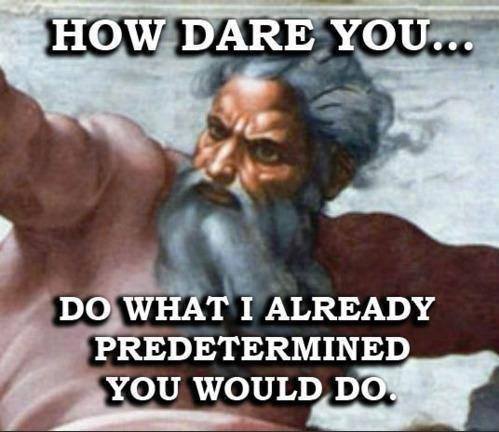
Meme Monday – How Dare You
VOTD Psalms 17:7
Psa 17:7 Show Your marvelous lovingkindness by Your right hand, O You who save those who trust in You From those who rise up against them.
Worship Sunday – Surrender
By Marc James
I’m giving You my heart
All that is within
I lay it all down
For the sake of You my King
I’m giving You my dreams laying down my rights
I’m giving up my pride
For the promise of new life
And I Surrender
All to You, all to You
I’m singing You this song
I’m waiting at the Cross
All the world holds dear
I count it all as loss
For the sake of knowing You
For the glory of Your name
To know the lasting joy
Even sharing in Your pain
VOTD Psalms 18:2-3
Psa 18:2 The LORD is my rock and my fortress and my deliverer; My God, my strength, in whom I will trust; My shield and the horn of my salvation, my stronghold.
Psa 18:3 I will call upon the LORD, who is worthy to be praised; So shall I be saved from my enemies.
Hasker on Omniscience
From The Openness of God:
Divine omniscience. Just as God is said to be all-powerful, he is also said to be all-knowing, or omniscient. Here also we need to go beyond the mere word to a careful definition. My proposal is: To say that God is omniscient means that at any time God knows all propositions such that God’s knowing them at that time is logically possible.
VOTD Exodus 3:15
Exo 3:15 Moreover God said to Moses, “Thus you shall say to the children of Israel: ‘The LORD God of your fathers, the God of Abraham, the God of Isaac, and the God of Jacob, has sent me to you. This is My name forever, and this is My memorial to all generations.’
Unanswered Questions – Can Psalms Mean Something Else
To those who believe Psalms 139 advocates God planning every man’s days.
Psa 139:16 Your eyes saw my substance, being yet unformed. And in Your book they all were written, The days fashioned for me, When as yet there were none of them.
Can Psalms 139:16 mean anything other than that God knows when people will die?
[This is an intellectual honesty test.]
VOTD Psalms 18:20-24
Psa 18:20 The LORD rewarded me according to my righteousness; According to the cleanness of my hands He has recompensed me.
Psa 18:21 For I have kept the ways of the LORD, And have not wickedly departed from my God.
Psa 18:22 For all His judgments were before me, And I did not put away His statutes from me.
Psa 18:23 I was also blameless before Him, And I kept myself from my iniquity.
Psa 18:24 Therefore the LORD has recompensed me according to my righteousness, According to the cleanness of my hands in His sight.
Apologetics Thursday – Answering the Critics part 4
VOTD Nehemiah 1:5-6
Neh 1:5 And I said: “I pray, LORD God of heaven, O great and awesome God, You who keep Your covenant and mercy with those who love You and observe Your commandments,
Neh 1:6 please let Your ear be attentive and Your eyes open, that You may hear the prayer of Your servant which I pray before You now, day and night, for the children of Israel Your servants, and confess the sins of the children of Israel which we have sinned against You. Both my father’s house and I have sinned.
Boyd on Romans 9
VOTD Psalms 13:6
Psa 13:6 I will sing to the LORD, Because He has dealt bountifully with me.
Boyd Says God Needs Prayer
VOTD Jeremiah 29:10-11
Jer 29:10 For thus says the LORD: After seventy years are completed at Babylon, I will visit you and perform My good word toward you, and cause you to return to this place.
Jer 29:11 For I know the thoughts that I think toward you, says the LORD, thoughts of peace and not of evil, to give you a future and a hope.
Meme Monday – Hey Girl

VOTD Ezekiel 2:7-8
Eze 2:7 You shall speak My words to them, whether they hear or whether they refuse, for they are rebellious.
Eze 2:8 But you, son of man, hear what I say to you. Do not be rebellious like that rebellious house; open your mouth and eat what I give you.”
Gordon Olson Lectures Part 6
Worship Sunday – Beautiful Things
By Gungor
All this pain
I wonder if I’ll ever find my way
I wonder if my life could really change at all
All this earth
Could all that is lost ever be found
Could a garden come up from this ground at all
You make beautiful things
You make beautiful things out of the dust
You make beautiful things
You make beautiful things out of us
All around
Hope is springing up from this old ground
Out of chaos life is being found in You
You make beautiful things
You make beautiful things out of the dust
You make beautiful things
You make beautiful things out of us
You make beautiful things
You make beautiful things out of the dust
You make beautiful things
You make beautiful things out of us
You make me new, You are making me new
You make me new, You are making me new
You make beautiful things
You make beautiful things out of the dust
You make beautiful things
You make beautiful things out of us
VOTD Psalms 18:25-27
Psa 18:25 With the merciful You will show Yourself merciful; With a blameless man You will show Yourself blameless;
Psa 18:26 With the pure You will show Yourself pure; And with the devious You will show Yourself shrewd.
Psa 18:27 For You will save the humble people, But will bring down haughty looks.
Boyd on Natural Evil
VOTD Ezekiel 18:31
Eze 18:30 Therefore I will judge you, O house of Israel, every one according to his ways, saith the Lord GOD. Repent, and turn yourselves from all your transgressions; so iniquity shall not be your ruin.
Unanswered Questions – Does God Wait
To those who believe God is outside of time.
Does God ever wait patiently and endure to a breaking point?
Isa 42:14 “I have held My peace a long time, I have been still and restrained Myself. Now I will cry like a woman in labor, I will pant and gasp at once.
Isa 42:15 I will lay waste the mountains and hills, And dry up all their vegetation; I will make the rivers coastlands, And I will dry up the pools.
VOTD Psalms 19:8
Psa 19:8 The statutes of the LORD are right, rejoicing the heart; The commandment of the LORD is pure, enlightening the eyes;
Apologetics Thursday – Answering the Critics part 3
VOTD Ezekiel 3:5-7
Eze 3:5 For you are not sent to a people of unfamiliar speech and of hard language, but to the house of Israel,
Eze 3:6 not to many people of unfamiliar speech and of hard language, whose words you cannot understand. Surely, had I sent you to them, they would have listened to you.
Eze 3:7 But the house of Israel will not listen to you, because they will not listen to Me; for all the house of Israel are impudent and hard-hearted.
VOTD Psalms 24:1-2
Psa 24:1 A Psalm of David. The earth is the LORD’s, and all its fullness, The world and those who dwell therein.
Psa 24:2 For He has founded it upon the seas, And established it upon the waters.
Pinnock on God is Open
From The Openness of God:
The God whom we love and worship is the living God who is metaphysically social and desires relationship with us. God is One whose ways are marked by flexibility and dynamism, who acts and reacts on behalf of his people, who does not exist in splendid isolation from a world of change, but relates to his creatures and shares life with them. God not only directs but interacts. No unmoved mover, God responds sensitively to what happens on earth and relates to us. God is the omnipotent Creator but exercises his power subtly and carefully in the world. By bringing other free agents into being and entering into their lives in love, God is open.
VOTD Ezekiel 12:2
Eze 12:2 “Son of man, you dwell in the midst of a rebellious house, which has eyes to see but does not see, and ears to hear but does not hear; for they are a rebellious house.
Pinnock on Perhaps
From The Openness of God:
Often God says things like this in the Bible: “Perhaps they will understand” or “It may be that they will listen.” From such phrases we must deduce that God has different options depending on people’s responses that are still outstanding (see Jer 26:3; Ezek 12:3; etc.). In saying “perhaps,” God also indicates that he does not possess complete knowledge of the future. The dozens of examples like this throughout Scripture establish that the Bible thinks of an open future that is not completely certain. The popular belief in God’s total omniscience is not so much a biblical idea as an old tradition.
Enyart White Debate Audio
Enyart’s prediction was that White would use Platonism to view the various proof texts. Although Enyart is not omniscient, the prediction came true.
Meme Monday – TULIP Glasses

VOTD Psalms 25:6-7
Psa 25:6 Remember, O LORD, Your tender mercies and Your lovingkindnesses, For they are from of old.
Psa 25:7 Do not remember the sins of my youth, nor my transgressions; According to Your mercy remember me, For Your goodness’ sake, O LORD.
Gordon Olson Lectures Part 5
VOTD Psalms 27:1
Psa 27:1 A Psalm of David. The LORD is my light and my salvation; Whom shall I fear? The LORD is the strength of my life; Of whom shall I be afraid?
VOTD Ezekiel 18:30-32
Eze 18:30 “Therefore I will judge you, O house of Israel, every one according to his ways,” says the Lord GOD. “Repent, and turn from all your transgressions, so that iniquity will not be your ruin.
Eze 18:31 Cast away from you all the transgressions which you have committed, and get yourselves a new heart and a new spirit. For why should you die, O house of Israel?
Eze 18:32 For I have no pleasure in the death of one who dies,” says the Lord GOD. “Therefore turn and live!”
Boyd Explains the Warfare Worldview
From Renkew:
While Scripture emphasizes God’s ultimate authority over the world, it also emphasizes that agents, whom God has created, can and do resist his will. Humans and fallen angels are able to grieve his Spirit and to some extent frustrate his purposes (e.g. Gen. 6:6; Isa. 63:10; Luke 7:30; Acts 7:51; Eph. 4:30; Heb. 3:8, 15; 4:7). Scripture refers to this myriad of other angels and humans who refuse to submit to God’s rule as a rebel kingdom (Matt. 12:26; Col. 1:13; Rev. 11:15), and identifies the head of this rebellion as a powerful fallen angel named Satan. It is clear that God shall someday vanquish this rebel kingdom, but it is equally clear that in the meantime, he genuinely wars against it.
This prominent biblical motif expresses what I call the “warfare worldview.” The world is caught up in a spiritual war between God and Satan. Unlike the blueprint worldview, the warfare worldview does not assume that there is a specific divine reason for what Satan and other evil agents do. To the contrary, God fights these opponents precisely because their purposes are working against his purposes.
Suffering takes on a different meaning when it is considered in the context of a cosmic war as opposed to a context in which everything is part of God’s meticulous plan and mysterious higher good. In the warfare worldview we would not wonder about what specific divine reason God might have had in allowing little children to be buried alive in mud or a little girl to be kidnapped. Instead, we would view these individuals as “victims of war” and assign the blame to human or demonic beings who oppose God’s will. Following Scripture, we would of course look to God for comfort in the midst of our suffering, trust that he is working to bring good out of the evil, and find consolation in our confidence that the war will someday come to a glorious end. But we would not look to God’s purposes for the explanation of why any particular evil occurred in the first place. In the warfare worldview, this is understood to be the result of the evil intentions and activity of human and angelic agents.
White Posts Pre-debate Video
Here is a summary of one of White’s illustrations:
“I am going to make a baby Hitler, but then I am going to kill that baby before he can become Hitler,” -the psychotic, evil god of Calvinism.
White Believes Jesus Has Two Natures
This blog has claimed James White is a dishonest person before. The aftermath of the debate shows more evidence. From a private Facebook page:
Josh Craddock
DURING the debate: [Q: “Did God the Son go from one nature to two natures?”] “He took on a human nature, yes.” [“Isn’t God the Son today and forever in the future, doesn’t he have two natures, a divine and a human nature, forever?”] “Yes.” [“So you agree that eternally past God the Son only had one nature?”] “Of course.” [“And today God the Son has two natures?”] “That’s correct.”
AFTER the debate: “Bob misrepresented me…God the Son does not have two natures. I did not ‘admit’ that He did/does/will etc.”
There’s no question about what’s going on here. James White is now regretting his candid answers about the nature of Christ in the debate. Instead of admitting that he misspoke or did not accurately articulate his belief, he resorts to his typical tactic of claiming that Bob is misrepresenting his position. That’s just shameful.
Unanswered Questions – Can God Innovate
To those who believe that God can do “anything” yet knows everything.
Can God choose to think a new thought?
VOTD Ezekiel 22:22
Eze 22:22 As silver is melted in the midst of a furnace, so shall you be melted in its midst; then you shall know that I, the LORD, have poured out My fury on you.’ ”
Apologetics Thursday – Answering the Critics part 2
VOTD Psalms 26:2
Psa 26:2 Examine me, O LORD, and prove me; Try my mind and my heart.
Clement of Alexandria on Predestination
In Stromata, Clement claims that God has no sensory perceptions, knows the future as if it were the present, and makes all things happen:
God is not, then, possessed of human form, so as to hear; nor needs He senses, as the Stoics have decided, “especially hearing and sight; for He could never otherwise apprehend.” But the susceptibility of the air, and the intensely keen perception of the angels, and the power which reaches the soul’s consciousness, by ineffable power and without sensible hearing, know all things at the moment of thought. And should any one say that the voice does not reach God, but is rolled downwards in the air, yet the thoughts of the saints cleave not the air only, but the whole world. And the divine power, with the speed of light, sees through the whole soul. Well! Do not also volitions speak to God, uttering their voice? And are they not conveyed by conscience? And what voice shall He wait for, who, according to His purpose, knows the elect already, even before his birth, knows what is to be as already existent? Does not the light of power shine down to the very bottom of the whole soul; “the lamp of knowledge,” as the Scripture says, searching “the recesses”? God is all ear and all eye, if we may be permitted to use these expressions.
VOTD John 14:23
Joh 14:23 Jesus answered and said to him, “If anyone loves Me, he will keep My word; and My Father will love him, and We will come to him and make Our home with him.
Boyd on Job
VOTD Psalms 25:8-10
Psa 25:8 Good and upright is the LORD; Therefore He teaches sinners in the way.
Psa 25:9 The humble He guides in justice, And the humble He teaches His way.
Psa 25:10 All the paths of the LORD are mercy and truth, To such as keep His covenant and His testimonies.
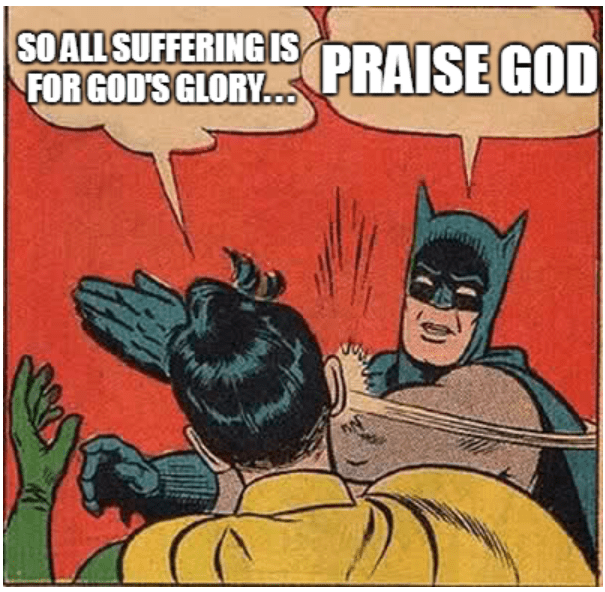
Meme Monday – Batman Praises God
VOTD Revelation 21:3
Rev 21:3 And I heard a loud voice from heaven saying, “Behold, the tabernacle of God is with men, and He will dwell with them, and they shall be His people. God Himself will be with them and be their God.
Gordon Olson Lectures Part 4
Worship Sunday – Nothing But the Blood
By Robert Lowry
What can wash away my sin?
Nothing but the blood of Jesus;
What can make me whole again?
Nothing but the blood of Jesus.
Refrain
Oh! precious is the flow
That makes me white as snow;
No other fount I know,
Nothing but the blood of Jesus.
For my pardon, this I see,
Nothing but the blood of Jesus;
For my cleansing this my plea,
Nothing but the blood of Jesus.
Refrain
Nothing can for sin atone,
Nothing but the blood of Jesus;
Naught of good that I have done,
Nothing but the blood of Jesus.
Refrain
This is all my hope and peace,
Nothing but the blood of Jesus;
This is all my righteousness,
Nothing but the blood of Jesus.
Refrain
Now by this I’ll overcome—
Nothing but the blood of Jesus,
Now by this I’ll reach my home—
Nothing but the blood of Jesus.
Refrain
Glory! Glory! This I sing—
Nothing but the blood of Jesus,
All my praise for this I bring—
Nothing but the blood of Jesus.
Refrain
VOTD Psalms 27:9-10
Psa 27:9 Do not hide Your face from me; Do not turn Your servant away in anger; You have been my help; Do not leave me nor forsake me, O God of my salvation.
Psa 27:10 When my father and my mother forsake me, Then the LORD will take care of me.
VOTD 1 Timothy 6:17
1Ti 6:17 Command those who are rich in this present age not to be haughty, nor to trust in uncertain riches but in the living God, who gives us richly all things to enjoy.
Pinnock on What God Can Make
From The Openness of God:
Those who are unsure of this should ask themselves if they think God could create a world where he would not be in total control of everything, where he would experience risk and where he would not foreknow all decisions of his creatures in advance. Surely this must be possible if God is all-powerful. Then is this world not just like that? Has God not already made just such a world? Does the Bible not assume it-do we not experience it as such.
Unanswered Questions – Can God Choose
To those who hold a classical view of omniscience:
Can God Choose not to know something?
VOTD Matthew 22:32
Mat 22:32 ‘I AM THE GOD OF ABRAHAM, THE GOD OF ISAAC, AND THE GOD OF JACOB’ ? God is not the God of the dead, but of the living.”
Apologetics Thursday – Answering the Critics part 1
VOTD Psalms 66:17
Psa 66:17 I cried to Him with my mouth, And He was extolled with my tongue.
Hasker on Timelessness Nonsense
From The Openness of God:
The other main difficulty about divine timelessness is that it is very hard to make clear logical sense of the doctrine. If God is truly timeless, so that temporal determinations of “before” and “after” do not apply to him, then how can God act in time, as the Scriptures say that he does?’ How can he know what is occurring on the changing earthly scene? How can he respond when his children turn to him in prayer and obedience? And above all, if God is timeless and incapable of change, how can God be born, grow up, live with and among people, suffer and die, as we believe he did as incarnated in Jesus? Whether there are good answers to these questions, whether the doctrine of divine timelessness is intelligible and logically coherent, and whether it can be reconciled with central Christian beliefs such as the incarnation remain matters of intense controversy.
VOTD Psalms 66:19-20
Psa 66:19 But certainly God has heard me; He has attended to the voice of my prayer.
Psa 66:20 Blessed be God, Who has not turned away my prayer, Nor His mercy from me!
Enyart v White – Is the Future Settled or Open
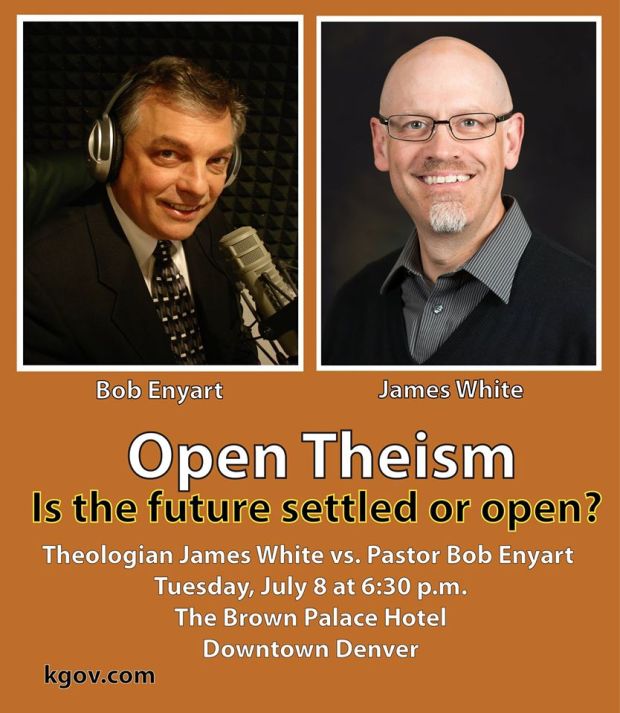
* July 8th Open Theism Enyart/White Debate: Well-known theologian James White will debate Bob Enyart, the pastor of Denver Bible Church on Open Theism: Is the future settled or open? On Tuesday evening, July 8 at 6:30 p.m., the debate will be held downtown Denver at Colorado’s historic Brown Palace hotel. If you’re in the state, or can be, you are cordially invited to come on out and we’ll have a great time in the Lord! Admission is free and seats for 100 attendees are available on a first-come, first-served basis. Quoting OpenTheism.org, “Open Theism is the Christian doctrine that the future is not settled but open because God is alive, eternally free, and inexhaustibly creative.” That is, God can forever think new thoughts, design new works, write new songs. He has not exhausted His creativity and never will for. Of His kingdom there will be no end and thus by God’s everlasting freedom and abilities, the future cannot be settled but must be open. In the meantime, check out some great O.T. debates including Bob’s previous efforts by clicking on the “Debate” tab at OpenTheism.org.
For previous posts about White, click here.
Perry on Grieving the Holy Spirit
Greg Perry writes about the flawed notion that the Holy Spirit cannot be grieved, quoting Ephesians 4:30. He compiles a list of ways:
So we have a fairly good list of things that grieve the Holy Spirit! So… don’t do them!
They are:
Don’t let the sun go down on your anger
Don’t give the devil an opportunity [to do anything he wants but unchecked, unrighteous anger is his foot in the door]
Don’t steal
Let no unwholesome word proceed from your mouth
Put away bitterness, wrath, anger, clamor, slander, and malice
VOTD Isaiah 1:15
Isa 1:15 When you spread out your hands, I will hide My eyes from you; Even though you make many prayers, I will not hear. Your hands are full of blood.
Meme Monday – I Dont Always Debate
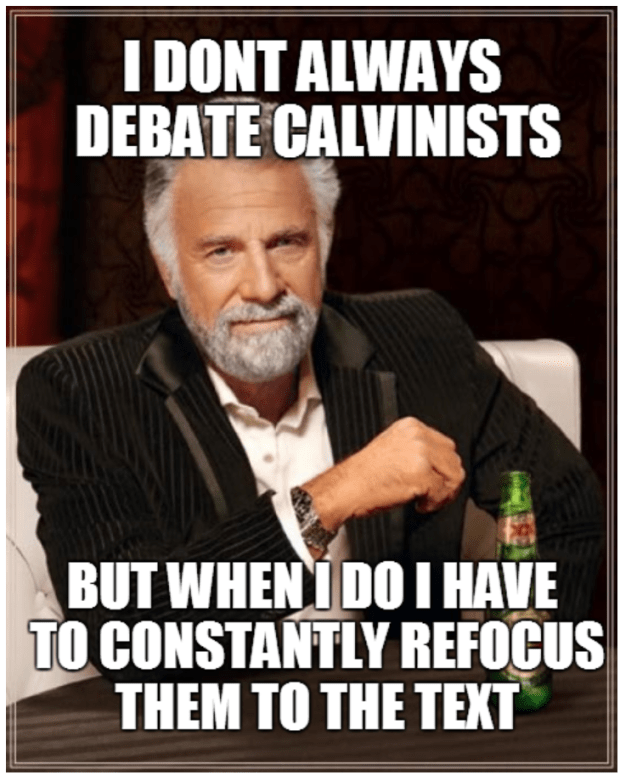
VOTD Isaiah 1:19-20
Isa 1:19 If you are willing and obedient, You shall eat the good of the land;
Isa 1:20 But if you refuse and rebel, You shall be devoured by the sword”; For the mouth of the LORD has spoken.
Gordon Olson Lectures Part 3
Worship Sunday – Brake Every Chain
By Jesus Culture
There is power in the name of Jesus
There is power in the name of Jesus
There is power in the name of Jesus
To break every chain
Break every chain
Break every chain
There is power in the name of Jesus
There is power in the name of Jesus
There is power in the name of Jesus
To break every chain
Break every chain
Break every chain
To break every chain
Break every chain
Break every chain
All sufficient sacrifice
So freely given
Such a price
Bought our redemption
Heaven’s gates swing wide
There is power in the name of Jesus
There is power in the name of Jesus
There is power in the name of Jesus
To Break every chain
Break every chain
Break every chain
There is power in the name of Jesus
There is power in the name of Jesus
There is power in the name of Jesus
To Break every chain
Break every chain
Break every chain
To Break every chain
Break every chain
Break every chain
There’s an army rising up
There’s an army rising up
There’s an army rising up
To Break every chain
Break every chain
Break every chain
There’s an army rising up
There’s an army rising up
There’s an army rising up
To Break every chain
Break every chain
Break every chain
To Break every chain
Break every chain
Break every chain
There is power in the name of Jesus
There is power in the name of Jesus
There is power in the name of Jesus
To Break every chain
Break every chain
Break every chain
There is power in the name of Jesus
There is power in the name of Jesus
There is power in the name of Jesus
To Break every chain
Break every chain
Break every chain
To Break every chain
Break every chain
Break every chain
VOTD Isaiah 62:5
Isa 62:5 For as a young man marries a virgin, So shall your sons marry you; And as the bridegroom rejoices over the bride, So shall your God rejoice over you.
TC Moore Talks about Factions in Open Theism
From Theological Graffiti:
Fast forward to 2013, when I and three others co-directed the first Open theology conference geared toward non-academics. This conference was supposed to gather all those who have embraced Open theism and are trying to live it out in their everyday contexts. Right away, it became clear we hadn’t fully anticipated just how different were all the other views Open theists hold. There were folks from widely divergent points of view—not just moderate evangelicals, like we expected. Some who attended were dyed-in-the-wool Fundamentalists. They balked at the suggestion that theistic evolution should be accepted by Open theists, and they insisted that the Bible be considered “inerrant.” Open theism had it’s first faction.
The “conservative/progressive” split in any U.S.-based theological movement isn’t so shocking. Virtually every U.S. denomination has some form of it. But what did surprise me was when the non-Fundamentalist Open theists began to splinter into even more factions. The next to demand their views be accepted by all Open theists were those who affirm the early Creeds of the church in addition to the Bible as authoritative.
VOTD Zephaniah 1:2-6
Zep 1:2 “I will utterly consume everything From the face of the land,” Says the LORD;
Zep 1:3 “I will consume man and beast; I will consume the birds of the heavens, The fish of the sea, And the stumbling blocks along with the wicked. I will cut off man from the face of the land,” Says the LORD.
Zep 1:4 “I will stretch out My hand against Judah, And against all the inhabitants of Jerusalem. I will cut off every trace of Baal from this place, The names of the idolatrous priests with the pagan priests—
Zep 1:5 Those who worship the host of heaven on the housetops; Those who worship and swear oaths by the LORD, But who also swear by Milcom;
Zep 1:6 Those who have turned back from following the LORD, And have not sought the LORD, nor inquired of Him.”
Hasker on Perfect Being Theology
From The Openness of God:
The difficulties with perfect being theology do not, in my view, stem from the assumption that God is an absolutely perfect being-that he is “whatever it is better to be than not to be.” Rather, difficulties have arisen because people have been too ready to assume that they can determine, easily and with little effort, what perfection is in the case of God-that is, what attributes a perfect being must possess. Yet it clearly is no simple matter to say what is the best kind of life for a human being or what are the ideal attributes (or virtues) for a human being to possess. So why should we assume that this is simple in the case of God? I do not think it should be taken as obvious, without long and thoughtful consideration, that it is “better” for God to be temporal or timeless, mutable or immutable, passible or impassible. So if we are going to object to Plato’s argument, we need not reject perfect being theology as such; rather, it is the application the argument makes of divine perfection that we must question.
Logical Proof on Perfection
A classical theists attempts to “prove” God’s infinite perfection:
233. Thesis II. God is infinitely perfect.
Explanation. We mean by a perfection any real entity, anything which it is better to have than not to have. A being is infinitely perfect when it has all possible entity in the highest possible degree. It is clear at once that God, being the cause of the world, must have all the perfections that are actually in the world; for there can be no perfection in the effect which is not in the cause. But besides, He must have, we maintain, all perfections that are intrinsically possible, i.e., all that imply no contradiction. We must, however, distinguish between pure perfections — i.e., such as imply no imperfection, e.g., knowledge, goodness, justice, power, etc.; and mixed perfections — i.e., such as imply some imperfection, e.g., reasoning, which implies that some truth was first unknown. Now, we mean that God has all pure perfections formally or as such, and the mixed He possesses eminently, i.e., in a better way, without any imperfections.
Proof. Whatever the necessary Being is, it is that necessarily; but God is the necessary Being; therefore, whatever He is, He is that necessarily. Therefore, if there is any limit to His perfection, that limit is necessary; i.e., further perfection is excluded by the very nature of His physical essence; in other words, the entity or perfection of His being would exclude some further perfection. But no perfection excludes other perfection, or is incompatible with further perfection; there can be no contradiction between good and good, entity and entity, but only between good and not good, entity and non-entity, perfection and imperfection. Therefore no perfection can exclude any other perfection; hence no perfection is excluded either in kind or in degree; therefore God is infinitely perfect.
VOTD Zephaniah 1:17
Zep 1:17 “I will bring distress upon men, And they shall walk like blind men, Because they have sinned against the LORD; Their blood shall be poured out like dust, And their flesh like refuse.”
Zep 1:18 Neither their silver nor their gold Shall be able to deliver them In the day of the LORD’s wrath; But the whole land shall be devoured By the fire of His jealousy, For He will make speedy riddance Of all those who dwell in the land.
Unanswered Questions – Leading Israel
To those who believe God controls all things or that the future is set.
Exo 13:17 Then it came to pass, when Pharaoh had let the people go, that God did not lead them by way of the land of the Philistines, although that was near; for God said, “Lest perhaps the people change their minds when they see war, and return to Egypt.”
Why didn’t God lead Israel by way of the land of the Philistines?
Apologetics Thursday – Was God Going to Destroy Nineveh
From a brief critique of Open Theism by Hank Hanegraaff:
Finally, while open theists suggest that God cannot know the future exhaustively because He changes His plans as a result of what people do, in reality it is not God who changes, but people who change in relationship to God. By way of analogy, if you walk into a headwind, you struggle against the wind; if you make a u–turn on the road, the wind is at your back. It is not the wind that has changed, but you have changed in relationship to the wind. As such, God’s promise to destroy Nineveh was not aborted because He did not know the future but because the Ninevites, who had walked in opposition to God, turned from walking in their wicked ways. Indeed, all of God’s promises to bless or to judge must be understood in light of the condition that God withholds blessing on account of disobedience and withholds judgment on account of repentance (Ezek.18; Jer.18:7–10).
The claim of Hanegraaff is that when the Bible states that God repented of what He planned to do to Nineveh, God was in reality not changing at all. The text:
Jon 3:10 And God saw their works, that they turned from their evil way; and God repented of the evil, that he had said that he would do unto them; and he did it not.
The text of Jonah does not even allow for this “situational” change. God said He will do something and that “something” was never done. This was not a situation where it was preached “God destroys evil nations and saves the righteous”. No, this was a situation where God said “in 40 days I will destroy you all.” This statement never came to pass.
The text clearly explains why:
1 “God saw their works” (Did God know their works beforehand or did God experience something that was not fixed in His mind? The text represents God as gaining new information.)
2. “that they turned from their evil way and God repented of the evil” (Was this a situational change? It appears instead that man changed, then God saw their change, and then God, in turn, changed. That is the text.)
3. “that he had said that he would do unto them; and he did it not.” (The text is clear that God had said He would do something and that “something” was never done.)
The story of Ninevah cannot fit the strange “situational change” described by Hanegraaff. Hanegraaff’s attempt to use twisted analogy to explain away the clear reading of the text grants insight to his adherence to extra-Biblical doctrine.
What is even more interesting is that sometimes individuals repent, but God has resolved against them and does not even follow the general rule set up by Hanegraaff. King Saul is the prime example (1Sa 15).
For Hanegraaff’s reading of Isaiah, he best put those verses into context as well.
VOTD Zephaniah 3:5
Zep 3:5 The LORD is righteous in her midst, He will do no unrighteousness. Every morning He brings His justice to light; He never fails, But the unjust knows no shame.
Hasker on Timelessness
From The Openness of God:
First of all, it is clear that the doctrine of divine timelessness is not taught in the Bible and does not reflect the way the biblical writers understood God. In spite of appeals by defenders of the doctrine to texts such as Exodus 3:14, John 8:58 and 2 Peter 3:8, there simply is no trace in the Scripture of the elaborate metaphysical and conceptual apparatus that is required to make sense of divine timelessness.’ On the positive side, the biblical writers undeniably do present God as living, acting and reacting in time.
Hunt Interviews Tom Lukashow
Jacob Hunt interviews Tom Lukashow on Open Theism during the last few hundred years:
Excerpts:
Tom: Open theism is not a new theological fad that was invented in the 1990’s. We are part of a long tradition of Christian believers. There have been many brave open theists who faced enormous opposition for the past few hundred years. However, this time I do not think the movement will fade into obscurity and need to be reinvented again in the future. Keep up the great work!
On his timeline of Open Theism:
Having dealt with criticism from Calvinists since the 1970’s I was sensitive to the charge open theist views are associated with and arose from heretical groups. I decided to include only authors who would be considered orthodox with respect to doctrines such as the Trinity, virgin birth, Deity of Christ, etc. Also, the bibliography does not include, as far as I am able to determine, any process theologians or Boston Personalists. I found some 19thcentury Universalists who were open theists but decided not to include them.
VOTD Zephaniah 3:7
Zep 3:7 I said, ‘Surely you will fear Me, You will receive instruction’— So that her dwelling would not be cut off, Despite everything for which I punished her. But they rose early and corrupted all their deeds.
Olson on Limited Atonement
From Against Calvinism:
What about other Calvinists? Do they affirm this limited atonement doctrine as Boettner did (and perhaps Calvin did not)? John Piper definitely affirms it: “He [Christ] did not die for all men in the same sense. The intention of the death of Christ for the children of God [the elect] was that it purchased far more than the rising of the sun and the opportunity to be saved . The death of Christ actually saves from All evil those for whom Christ died ‘especially.’” Sproul definitely affirms it. He prefers to call this doctrine “purposeful atonement”: “The atonement’s ultimate purpose is found in the ultimate purpose or will of God. This purpose or design does not include the entire human race. If it did, the entire human race would surely be redeemed.”
Beware Those Who Say The Bible Means the Opposite
From a Facebook comment on a private page:
Yes. Beware when anyone implies, God did not mean what He said, but He meant the opposite.
Of course, the reasoning they give is God is using human examples to help us understand Him. How difficult is it for the Great Communicator to help us understand Him? How difficult is it to say, *I always knew you would do that/say that and am not really upset at all, because all you do is predestined from the foundations of the world?* If He actually said that, we would have to accept it, since He cannot lie.
But to interpret His If/Then’s and His orders to choose, and all the Scriptures that says He repents/relents of His actions or promises, or that He grieves, looked for one thing and got another, or stretches out his hands all day to unbelieving people AND interpret those words as Him not really meaning what He says – but is using anthropopothism/anthropomorphisms to make you understand Him better, so He sounds like He is responding in real time with action and emotion – is to put words into His mouth and say what He did not say. That is blasphemy.
We must not say, “Thus sayeth the Lord, when He has not spoken.” We must also not ignore His actual words to us. We will give an account for how we handle such a great gift.
VOTD Zephaniah 3:8
Zep 3:8 “Therefore wait for Me,” says the LORD, “Until the day I rise up for plunder; My determination is to gather the nations To My assembly of kingdoms, To pour on them My indignation, All My fierce anger; All the earth shall be devoured With the fire of My jealousy.
Olson on Calvin’s Unconditional Election
From Against Calvinism:
What did Calvin say? Did he believe in this double predestination, including God’s sovereign reprobation of certain human persons to hell ? He wrote: “God once established by his eternal and unchangeable plan those whom he long before determined once for all to receive into salvation, and those whom, on the other hand, he would devote to destruction .” Lest anyone misunderstand him, Calvin drove his point home by ridiculing those who accept election but reject reprobation, calling that an “absurd” notion: “Therefore, those whom God passes over, he condemns; and this he does for no other reason than that he wills to exclude them from the inheritance which he predestines for his own children.” Calvin notoriously recognized and affirmed the highly objectionable character of this double predestination and especially the reprobation side of it, calling it “the horrible decree.”
Free Monday – Gordon Olson’s Research
Linked is Gordon Olson’s handwritten research notes.
VOTD Psalms 66:3-4
Psa 66:3 Say to God, “How awesome are Your works! Through the greatness of Your power Your enemies shall submit themselves to You.
Psa 66:4 All the earth shall worship You And sing praises to You; They shall sing praises to Your name.” Selah
Meme Monday – Make it Anthropomorphic
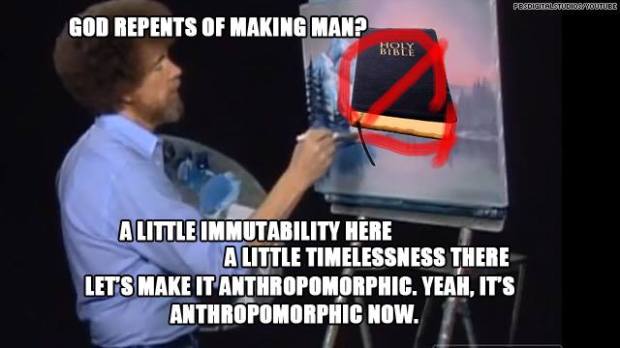
Gordon Olson Lectures Part 2
Worship Sunday – I Will Call Upon the Lord
I Will Call Upon the Lord by Michael O’Shields
Lyrics:
I will call upon the Lord who is worthy to be praised
So shall I be saved from my enemies, oh yeah
I will call upon the Lord who is worthy to be praised
So shall I be saved from my enemies
The Lord liveth and blessed be the Rock
And let the God of my salvation be exalted
The Lord liveth and blessed be the Rock
And let the God of my salvation be exalted
I will call upon the Lord who is worthy to be praised
So shall I be saved from my enemies
The Lord liveth and blessed be the Rock
And let the God of my salvation be exalted
The Lord liveth and blessed be the Rock
And let the God of my salvation be exalted
I will call upon the Lord who is worthy to be praised
So shall I be saved from my enemies
I will call upon the Lord who is worthy to be praised
So shall I be saved from my enemies
The Lord liveth and blessed be the Rock
And let the God of my salvation be exalted
The Lord liveth and blessed be the Rock
And let the God of my salvation be exalted
The Lord liveth and blessed be the Rock
And let the God of my salvation be exalted
The Lord liveth and blessed be the Rock
And let the God of my salvation be exalted
VOTD Psalms 66:5-6
Psa 66:5 Come and see the works of God; He is awesome in His doing toward the sons of men.
Psa 66:6 He turned the sea into dry land; They went through the river on foot. There we will rejoice in Him.
Calvinist Calls Out Arminianism’s Problem of Evil
From the Calvinist blog Triablogue:
iii) Take Arminians who affirm divine foreknowledge. How did the Arminian God not plan or will the foreseeable consequences of his own actions? If he knew in advance that by making the world, humans would fall into sin, how did he not will that outcome? Likewise, if he saw it coming, as a result of his creative fiat, how could that still be an unplanned consequence of his actions? Keep in mind, too, that according to Arminian concurrence, God enables the sinner to sin.
VOTD Psalms 66:10
Psa 66:10 For You, O God, have tested us; You have refined us as silver is refined.
Olson on Calvin’s Total Depravity
From Against Calvinism:
Calvin wrote that because of the fall of Adam “the whole [of every] man is overwhelmed— as by a deluge —from head to foot, so that no part is immune from sin and all that proceeds from him is to be imputed to sin. As Paul says , all turnings of the thoughts … are enmities against God … and therefore death.”
Answered Question – Psalms 139:4
A question from Open Theism:
This is why I feel as though if anybody is to be a philosophically reasonable theist, they must be an open theist. Of course there is the issue of verses such as Psalm 139:4, and so on.
John McCormick replies:
Psalms 139:4 MKJV
(4) For there is not a word in my tongue, but, lo, O Jehovah, You know it altogether.Let’s say that this is literal, even though the genre is poetic.
God certainly knows what is going on in our lives. He surely knows the signals passing through our nervous systems and our brains (though not our souls). He knows which things in our environments affect us and He knows how we normally talk, our speech patterns.
My wife and I say the exact same thing a frighteningly large amount of the time. We plainly connect on some level, either subconsciously through body language and other signals or through some “telepathy” as yet unrecognized by science.
If WE can communicate that well, it has to be a simple thing for God to know what we will say at least somewhat ahead of time.
However, I suspect that David was exaggerating poetically. The passage shows David’s surprise that God knows what he is going to say.
But the passage doesn’t specify the limits of God’s knowledge of what David is going to say. It doesn’t specify whether David means “from the beginning of my life to the end” or “all in this conversation I’m having with Him” or somewhere in between.
The sense in Psalm 139 seems to be that God knows David intimately, in a personal sense, not that David is explaining some technical description of God’s knowledge. Verse 3 says that God is “acquainted with all [of David’s] ways”, which suggests that God has learned about David rather than simply knowing automatically.
VOTD Psalms 54:4-5
Psa 54:4 Behold, God is my helper; The Lord is with those who uphold my life.
Psa 54:5 He will repay my enemies for their evil. Cut them off in Your truth.
Unanswed Questions – Jesus and Omniscience
To those who believe Jesus was omniscient:
Mar 13:32 “But of that day and hour no one knows, not even the angels in heaven, nor the Son, but only the Father.
Did Jesus know when the end of times would be?
Apologetics Thursday – Et Tu, Brute
William Lane Craig lists an answer to Open Theist’s claims that Calvinists rely on dignum deo over the Bible:
1. Openists have their own conception of what is dignum deo, and they don’t hesitate to draw on it when the Scriptures are silent. For example, if the openists are right that the Bible doesn’t clearly teach exhaustive omniscience with respect to the future, it’s no less true that it doesn’t clearly teach exhaustive omniscience with respect to the past and present; yet openists accept the latter. Why? Presumably because ignorance of any detail of the past and present would not be dignum deo.
The main problem with this as an answer to the Open Theist’s objection is that it really does not answer the objection at all. Instead, the argument is “well, you too.” There is a formal name for the fallacy known as the Tu quoque fallacy. Wikipedia sums the fallacy up nicely: “To clarify, although the person being attacked might indeed be acting inconsistently or hypocritically, such behavior does not invalidate the position presented.”
If two criminals were talking, one might say to the other: “You are a thief, you need to repent.”
The second might respond: “You are a thief too”.
Notice though that the second point does not answer the first. Thieves need to repent, regardless as to who says it.
William Lane Craig offers his remarks as the only answer to the Openness objection to Dignum Deo. It would be fine if Craig offered up compelling reasons for his belief and then added that Openness advocates were hypocrites, but focusing on the hypocrisy rather than the point is avoiding the real issues. In fact, some Open Theists do “accept the later” and by Craig avoiding the point, he successfully avoids answering a legitimate objection raised by consistent Open Theists.
VOTD Psalms 58:6
Psa 58:6 Break their teeth in their mouth, O God! Break out the fangs of the young lions, O LORD!
Craig on Openness Dignum Deo
William Lane Craig writes in his Contending with Christianity’s Critics:
1. Openists have their own conception of what is dignum deo, and they don’t hesitate to draw on it when the Scriptures are silent. For example, if the openists are right that the Bible doesn’t clearly teach exhaustive omniscience with respect to the future, it’s no less true that it doesn’t clearly teach exhaustive omniscience with respect to the past and present; yet openists accept the latter. Why? Presumably because ignorance of any detail of the past and present would not be dignum deo.
Hasker on Dignum Deo
From The Openness of God:
The difficulties with perfect being theology do not, in my view, stem from the assumption that God is an absolutely perfect being-that he is “whatever it is better to be than not to be.” Rather, difficulties have arisen because people have been too ready to assume that they can determine, easily and with little effort, what perfection is in the case of God-that is, what attributes a perfect being must possess. Yet it clearly is no simple matter to say what is the best kind of life for a human being or what are the ideal attributes (or virtues) for a human being to possess. So why should we assume that this is simple in the case of God? I do not think it should be taken as obvious, without long and thoughtful consideration, that it is “better” for God to be temporal or timeless, mutable or immutable, passible or impassible. So if we are going to object to Plato’s argument, we need not reject perfect being theology as such; rather, it is the application the argument makes of divine perfection that we must question.
Arminian Claims Open Theism Add to Free Will
From Evangelical Arminians:
So what exactly are Open Theists adding to libertarian free will? Open Theists hold the idea that propositions about future free will acts, in an absolute sense, cannot be true. (I say in an absolute sense, because some Open Theists reinterpret statements about the future in a relative, probabilistic sense, meaning given current factors, Bob will choose chocolate is more likely than not, but not 100% certain). If the statement, “Bob will eat chocolate” is true, then Bob is not free with respect to eating chocolate. Propositions about events become true the moment the events happen and not before. Bob himself has the power to change the proposition “Bob chose chocolate” from possibly true to actually true. This is how Open Theists cash out the idea of Bob making statements true and this is the power that Open Theists add to definition of libertarian free will.
VOTD Psalms 58:10
Psa 58:10 The righteous shall rejoice when he sees the vengeance; He shall wash his feet in the blood of the wicked,
Olson on Calvin’s Fatalism
From Against Calvinism:
Virtually all Calvinists (as distinct from some in the Reformed tradition and especially what I have called “revisionist Reformed” theologians) affirm a strong or high view of God’s sovereignty such as Boettner’s. Did Calvin himself affirm such? In Calvin’s Institutes of the Christian Religion, Geneva’s chief pastor wrote about God’s providence: “We ought undoubtedly to hold that whatever changes are discerned in the world are produced from the secret stirring of God’s hand … what God has determined must necessarily so take place.” 3 The surrounding context, including a vivid illustration about a merchant robbed and killed by thieves, makes absolutely clear that Calvin believed nothing at all can happen that is not foreordained and rendered certain by God. He says that a Christian will realize that nothing is truly an accident, as everything is planned by God.
More explains Elect means Fit
Jacques More writes about “election” in relation to the LXX:
In Pharaoh’s dream that Joseph interpreted a contrast between emaciated cows and fat fleshed quality cattle is made. The emphasis that prime and quality beef is in view is given by eklektos.
The best chariots and young men – guys in their physical prime – are seen as the best of their kind by eklektos.
The highest branches, the most desired country, the quality of solid tried stone, the clarity of the sun, with the pure You will show Yourself pure, all are expressed by eklektos.
There is an overwhelming and clear recognition by these that eklektos is about QUALITY.
This is the clear testimony of the Scripture text quoted regularly by Jesus and the apostles.
So that, with “quality” in mind with words like “pure”, “tried”, “fit”, what do you think of Jesus’ following words?Many are called, but few eklektos.
Matthew 20:16 & 22:14
Is it not better recognised as: “few are fit” or, “few are up to the task”?
This is why I translate this as,
. . . for many are called, but few have mettle.
Matthew 20:16 & 22:14 JM
So, was Jesus selected?
Or, is He Special?
Were angels picked out?
Or, are they “the good ones”?Answer: The evidence from the LXX points to the latter.
VOTD Psalms 59:3-5
Psa 59:3 For look, they lie in wait for my life; The mighty gather against me, Not for my transgression nor for my sin, O LORD.
Psa 59:4 They run and prepare themselves through no fault of mine. Awake to help me, and behold!
Psa 59:5 You therefore, O LORD God of hosts, the God of Israel, Awake to punish all the nations; Do not be merciful to any wicked transgressors. Selah
Olson on Standing Against Calvinism
From Against Calvinism:
I believe someone needs finally to stand up and in love firmly say “no!” to egregious statements about God’s sovereignty often made by Calvinists. Taken to their logical conclusion, that even hell and all who will suffer there eternally are foreordained by God, God is thereby rendered morally ambiguous at best and a moral monster at worst. I have gone so far as to say that this kind of Calvinism, which attributes everything to God’s will and control, makes it difficult (at least for me) to see the difference between God and the devil.
Free Monday – Early Christian Writings
Early Christian Writings hosts a wide variety of available ancient Christian and Gnostic texts. Although some of the dating is disputable, the information is priceless.
VOTD Psalms 59:16-17
Psa 59:16 But I will sing of Your power; Yes, I will sing aloud of Your mercy in the morning; For You have been my defense And refuge in the day of my trouble.
Psa 59:17 To You, O my Strength, I will sing praises; For God is my defense, My God of mercy.
Meme Monday – None Should Perish

Gordon Olson Lectures Part 1
 God is Open