Eze 8:12 Then He said to me, “Son of man, have you seen what the elders of the house of Israel do in the dark, every man in the room of his idols? For they say, ‘The LORD does not see us, the LORD has forsaken the land.’ ”
Jeff Robinson Believes Open Theism is Dying
From The Gospel Coalition:
The debate may have lost any remaining momentum in the death of the two figures at the forefront of the ETS controversy. Pinnock, open theism’s best-known scholar, and Roger Nicole, the Reformed theologian and founding member of ETS who brought charges against Pinnock and Sanders, died within four months of each other in 2010.
Bruce Ware, who served as ETS president in 2009 and was intimately involved in defending the classical view of God, said that openness adherents seem to have virtually disappeared from ETS, and that publishing from open theists seems to have dried up as well. But, he added, the view itself remains alive and growing within some pockets of evangelicalism.
“Since the ETS vote took place, the issue of open theism, which had been dominant for a decade, came to an end as a pressing issue,” Ware said. “Interestingly, there has been less presence of members (if they still are) who would advance an openness position since that vote. I suspect that even though the vote was in their favor, the vote was also very close . . . this did send a signal.”
VOTD Ezekiel 7:27
Eze 7:27 ‘The king will mourn, The prince will be clothed with desolation, And the hands of the common people will tremble. I will do to them according to their way, And according to what they deserve I will judge them; Then they shall know that I am the LORD!’ ”
Jed Smock on Open Theism Having Answers
Posted on Jed Smock’s Facebook page:
OPEN THEISTS HAVE THE ANSWERS
April 16, 2014, Indiana University,There were two groups, who claimed to have reserved the area under the clock; one was the secularist society. I started preaching in another area; I gained an audience of one boy, who quietly listened. Cole told me that he had recently experienced a baptism of fire and was determined to put Christianity into practice in his life. John the Baptist promised that the one who came after him “shall baptize you with the Holy Ghost, and with fire.” Few talk about the fire baptism today. I experienced it shortly after I was converted and I have been burning ever since.
The atheist called out to me and invited me to come preach close to him, which I did at the next break. He said, “Brother Jed, you are good advertising for us.” He had a large colorful sign which read, “ASK AN ATHEIST? Where does morality come from? Where did the universes come from? Is it reasonable to believe in God?”
Again at the second break I gathered an audience of one other than the atheist. This girl kept firing good questions at me and she actually was listening to my answers. However, after about 30 minutes her “boyfriend” came and whisked her away. I referred to him as Satan.
At the next break I lifted my banner, which lists various sins popular among college students. I also preached from a front page article in the Indiana Daily Student, entitled, “Deadly silence.” A large picture showed 1100 back packs spread on the lawn, which represented the 1100 students, who annually die by suicide. The exhibition was sponsored by “Send Silence Packing.” In the article psychologist, Chris Meno, claimed, “The number one cause of suicide is untreated depression.” I countered, “Suicide, which might better be called self-destruction or self-murder is not caused; it is chosen.” Meno wanted the “stigma against mental health to be stopped.” I countered, “The problem is not mental health; it is mental unhealthiness, which is the result of sin, guilt and lack of Christian hope.” A sign on one of the backpacks reportedly said, “Forty-four percent of college students have felt so depressed it was hard to function.” My answer is that alcohol, marijuana, masturbation and fornication can all contribute to depression. Drunks, dope fiends, masturbators and fornicators are not functioning well. Attempting to remove the stigma associated with unsound thinking (mental illness) has intensified the problem. There should be a stigma connected with bad thinking. Men need to transform their thinking through the renewing of their mind which is a result of faith in Jesus Christ and a mind focused on God and others instead of one’ self. I did not get any reaction to my message on sound mental health.
The atheist ended up asking me a lot of questions and later the girl who had been whisked away by the devil returned with more queries. The atheist admitted that my answers were different than most Christians. The basic reason for this is that I am an open theist for which I am thankful. Open theism intelligently answers so many of the legitimate complaints that sceptics have against a determinist God who exists outside of time and has absolute knowledge of the future. Oh, the God of the Bible is so often misrepresented by his most vocal alleged defenders.
Caleb, the homosexual, who is confided to a wheel chair, is a regular at my meeting. He showed up about 3 PM and informed me the reason I did not have my usual crowd was the so many students were attending actress, Meryl Streep’s, speech in the IU Auditorium, where she was receiving at honorary doctorate. I had noticed the class breaks were considerable less populated than usual. I folded things up at 3:30 PM.
I enjoyed talking with the atheists; he was polite and thoughtful. He even defended me when a woman from the other groups was speculating on having me removed since they had the area reserved. The atheist answered, “There is plenty of room for all of us.”
VOTD Ezekiel 7:20
Eze 7:20 ‘As for the beauty of his ornaments, He set it in majesty; But they made from it The images of their abominations— Their detestable things; Therefore I have made it Like refuse to them.
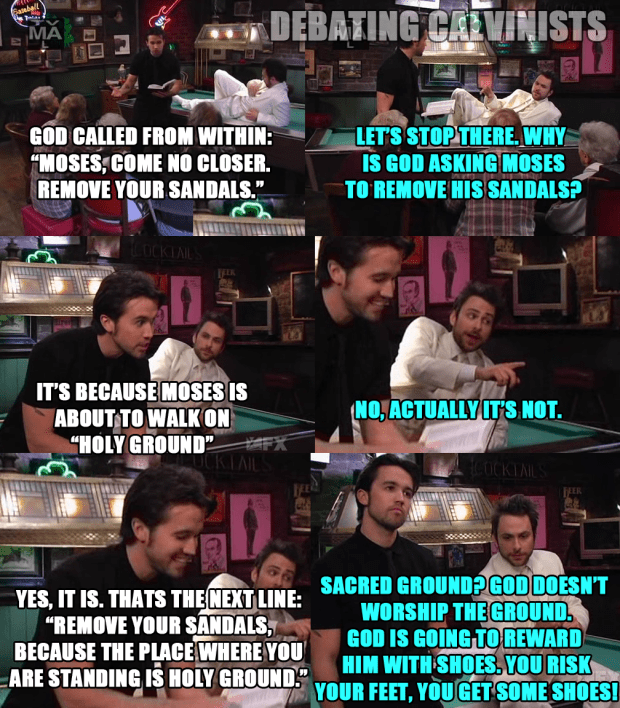
Meme Monday – Debating Calvinists
VOTD Isaiah 43:10
Isa 43:10 “You are My witnesses,” says the LORD, “And My servant whom I have chosen, That you may know and believe Me, And understand that I am He. Before Me there was no God formed, Nor shall there be after Me.
Worship Sunday – Fraction Anthem
By Vineyard
Jesus Christ, we praise You
Jesus Christ, we praise You
(For) Your body was broken for us
You were broken for us
(And) Your precious blood
Was poured out for us
You were poured out for us
Hallelujah, Hallelujah, Hallelujah
Hallelujah, Hallelujah, Hallelujah
VOTD Psalms 102:12
Psa 102:12 But You, O LORD, shall endure forever, And the remembrance of Your name to all generations.
Open Theist Neo-Molinism
Information from lecture by Elijah Hess, University of Arkansas — “Why the ‘Neo-Molinist’ Account of Open Theism Offers Free Will Theists the More Perspicuous Account of Divine Providence”
Neo-Molinism is an open theist belief in a specific mechanic of divine providence. The traditional Molinist view of God (that God knows what every creature would do in all circumstances and what creatures will do on the preferred timeline) is somewhat related, but not to be confused with another.
The Neo-Molinist view is the Open Theist position that God:
1. Knows all possible routes that can be taken
2. Does not know specifically which path will be taken
Free will, then, would be the mechanic by which the various routes would be chosen over another. Because God cannot know beforehand the free will decisions of human beings, then God has to then wait to see which free will route will be taken.
VOTD Psalms 100:3
Psa 100:3 Know that the LORD, He is God; It is He who has made us, and not we ourselves; We are His people and the sheep of His pasture.
Answered Questions – Verses on Immutability
Sami Zaatari of Answering Christianity asks:
The Bible says God cannot change (Cf. Numbers 23:19; 1 Samuel 15:29; Psalm 102:26-27; Malachi 3:6; Romans 11:29; Hebrews 6:17-18; James 1:17), and that he is all-knowing (Cf. Job 37:16; Psalm 147:4-5; 1 John 3:20). But the New Testament teaches that Jesus did change and that he didn’t even know the day or hour of his return (Cf. Mark 13:32; Luke 2:40,52). How can Jesus be God if he doesn’t even have these essential attributes of God?
This post will just deal with the context and meaning of the verses on change. The underlining assumptions in Zaatari’s question are mistaken. Zaatari further states about those verses:
Num 23:19: God is not a man, that he should lie; neither the son of man, that he should repent: hath he said, and shall he not do it? or hath he spoken, and shall he not make it good?
1 Samuel 15:29: And also the Strength of Israel will not lie nor repent: for he is not a man, that he should repent.
Malachi 3:6: For I am the LORD, I change not; therefore ye sons of Jacob are not consumed.
Those three verses should do. So basically we see making it very clear that he does not change. As Shamoun correctly stated, when God says he does not change, this means he does not change his essence, his attributes, his purpose and his decrees. However, this leaves the Christians with a problem. Sure the Christians say that those verses don’t mean that God cannot become a man, however the verses are still very clear, that God is not LIKE a man to repent or change his mind, God is not LIKE a man to be weak and have no power, God is not LIKE a man to become a servant. That is the main message that God is sending, he not like a man, so we cannot try and compare him with us, and he is not like a man to change his mind, such as his laws and his teachings. However so, if Jesus is indeed God, then God has indeed taken a drastic U-turn and has changed, not because he became a man, or the son of man, but because his attributes and essence have completely CHANGED.
Zaatari would have the reader believe that the verses in question are power verses, but in context they are about repentance only (and limited to the immediate context).
Num 23:19 “God is not a man, that He should lie, Nor a son of man, that He should repent. Has He said, and will He not do? Or has He spoken, and will He not make it good?
The phrasing of this verse is crucial. God will not repent. God has said something and God will do it. This is not about if God has the power to do something or not. No, that is taken for granted. The verse assumes that God can be prevailed upon to change His mind, and in that context can an event not occur. The text is hedging against God doing that in the particular context of the verse (not establishing a general rule). When general rules are established, it is always that God WILL repent if He sees people repent (see Jeremiah 18 and Ezekiel 18).
The context of the verse is about Balaam not being able to undo the blessings of Israel. Balak had hired Balaam to curse Israel, but God “met” with Balaam and told Balaam how to reply to Balak. The reply was that Balaam blessed Israel because God was not going to undo His blessing. In that context, God does not change.
Particularly damning to Zaatari’s reading of the verse is that the context of the verse assumes that if there was a good reason to repent then God would repent. Notice how the prophet “cannot reverse it” because no sin was observed:
Num 23:20 Behold, I have received a command to bless; He has blessed, and I cannot reverse it.
Num 23:21 “He has not observed iniquity in Jacob, Nor has He seen wickedness in Israel. The LORD his God is with him, And the shout of a King is among them.
Numbers 23 is clear: God would repent if there is a reason to repent. Because there is no reason to repent then God will not repent. A man may arbitrarily change his mind. God is not a man to change His mind without adequate reason.
1Sa 15:29 And also the Strength of Israel will not lie nor relent. For He is not a man, that He should relent.”
Here is the context of the entire chapter:
King Saul has just violated God’s command not to take spoils of war.
1Sa 15:9 But Saul and the people spared Agag, and the best of the sheep, and of the oxen, and of the fatlings, and the lambs, and all that was good, and would not utterly destroy them: but every thing that was vile and refuse, that they destroyed utterly.
1Sa 15:10 Then came the word of the LORD unto Samuel, saying,
1Sa 15:11 It repenteth me that I have set up Saul to be king: for he is turned back from following me, and hath not performed my commandments. And it grieved Samuel; and he cried unto the LORD all night.
This leads God directly to “repenting” of having made Saul the king of Israel. Samuel hears God’s message and the next morning confronts Saul on his spoils of war. Samuel explains to Saul that “Because thou hast rejected the word of the LORD, he hath also rejected thee from being king.” Saul immediately repents, and asks for mercy (for his kingdom to not be taken away):
1Sa 15:24 And Saul said unto Samuel, I have sinned: for I have transgressed the commandment of the LORD, and thy words: because I feared the people, and obeyed their voice.
1Sa 15:25 Now therefore, I pray thee, pardon my sin, and turn again with me, that I may worship the LORD.
Notice Saul’s deep repentance. Saul seeks pardon and wants to go worship God. But this is denied. Samuel says:
1Sa 15:28 And Samuel said unto him, The LORD hath rent the kingdom of Israel from thee this day, and hath given it to a neighbour of thine, that is better than thou.
1Sa 15:29 And also the Strength of Israel will not lie nor repent: for he is not a man, that he should repent.
The context of God not repenting is “repenting that He made Saul king.” When God says He will not repent, God is saying “I will not repent of repenting that I made Saul king (taking his kingdom away).” God is not making a general claim of immutability. God is making the claim that Saul cannot expect to convince God to give him back the kingdom. God has made up his mind.
To set up a parallel to really drive home the point: Pretend I allow my boys to play with GI Joes. Pretend I have given them instructions on how to play gently such that they do not destroy those action figures. If my boys then play with those GI Joes, destroy a couple, then I might then take away those toys. If my boys apologize and promise to be more careful in the future, I would be well within my rights to say: “I am taking the GI Joes. I will not change my mind. I am not your mom that I would change my mind.”
For someone to come along and claim that I am immutable would be a disservice to the context. My statement was limited to the events in question, and extrapolating and mystifying would be a gross injustice. My words, taken literally, are that my mind is made up on this one issue.
Mal 3:6 “For I am the LORD, I do not change; Therefore you are not consumed, O sons of Jacob.
Does this make sense if the verse was about immutability?
“For I am the Lord, I am immutable, thus you are not destroyed.”
Does immutability lead to the conclusion that God will not destroy a people? The author of Malachi was not offering some sort of immutability prooftext. That would not make any sense. This verse means “I am God, I am not revoking my promises to your forefathers to make a great nation, thus I have not wiped you off the face of the Earth for your sins as I should have done under normal circumstances.” As with the rest of the Bible, the idea is that God will only kill the wicked of Israel and attempt to build the promised nation out of the remnant. In that sense, God maintains judgement while maintaining His promise to Abraham.
The immediate context explains this verse. Needless to say, understanding the context reveals the verse is evidence that God is dynamic and changes.
Mal 3:5 And I will come near you for judgment; I will be a swift witness Against sorcerers, Against adulterers, Against perjurers, Against those who exploit wage earners and widows and orphans, And against those who turn away an alien— Because they do not fear Me,” Says the LORD of hosts.
Mal 3:6 “For I am the LORD, I do not change; Therefore you are not consumed, O sons of Jacob.
Mal 3:7 Yet from the days of your fathers You have gone away from My ordinances And have not kept them. Return to Me, and I will return to you,” Says the LORD of hosts.
The immediate context shows that God is talking about a people who have turned away from him and towards sin. God threatens them into returning to him. While people change their morality and claim that sins are not sins, God’s perspective on morality stays the same. Often not quoted by those who would have Malachi 3:6 mean that “God is immutable” is the following verse “Return to Me, and I will return to you”. The message is consistent with the rest of the Bible establishing that God responds to the actions of people. Interesting enough, Malachi then details the changes God will do based on the repentance of Israel:
Mal 3:10 …Says the LORD of hosts, “If I will not open for you the windows of heaven And pour out for you such blessing That there will not be room enough to receive it.
Mal 3:11 “And I will rebuke the devourer for your sakes, So that he will not destroy the fruit of your ground, Nor shall the vine fail to bear fruit for you in the field,” Says the LORD of hosts;
Mal 3:12 And all nations will call you blessed, For you will be a delightful land,” Says the LORD of hosts.
So the text which says “God cannot change” is in the context of saying that God changes his curses to blessings based on the actions of his people. That is the message of the Bible: God is judgement, justice, and responds righteously.
Psa 102:26 They will perish, but You will endure; Yes, they will all grow old like a garment; Like a cloak You will change them, And they will be changed.
Psa 102:27 But You are the same, And Your years will have no end.
The context of the verse is included in the verse. Obviously this verse is talking about God being everlasting (living forever). People will die and wither away, but God is the same, not growing old or dying. Tho make the phrase “But you are the same” to be a statement on immutability is not natural to the text:
They will die, but God will live. They will grow old, and God will change them, but God is immutable and will live forever.
The verses are just not about general change, but about lifespans, growing old, and dying.
Rom 11:29 For the gifts and the calling of God are irrevocable.
This verse is a good companion verse to Malachi 3:6. The context is that Paul is attempting to explain to the Gentiles that God has not just abandoned the Jews. In Romans 8-11, Paul sets up an argument as to how God could turn to the Gentiles without abandoning His promises to the Jews. In Romans 11:13, Paul then switches his audience to the Gentiles and starts explaining their roles as it pertains to the Jews. The verse has absolutely nothing to do with general immutability. The fact that Paul uses Romans to set up a complicated reasoning as to how God can fulfill a promise in spite of the rejection of the promise’s recipients is great evidence as to the fact that Paul thought God could change.
Heb 6:17 Thus God, determining to show more abundantly to the heirs of promise the immutability of His counsel, confirmed it by an oath,
Heb 6:18 that by two immutable things, in which it is impossible for God to lie, we might have strong consolation, who have fled for refuge to lay hold of the hope set before us.
This also is not a very good verse to show that God has general immutability. The context is about a specific promise. In order to prove that this particular promise was of special consideration, God performs an oath. God does not perform oaths for all promises, only this one. The text assumes that God can revoke some promises in some contexts. But this one particular promise, God performs special actions to prove His own sincerity. Of course, this promise is the promise to Abraham, the promise referenced by Romans 11:29 and Malachi 3:6. This promise is THE promise in the Bible. Much of the Bible revolves around God attempting to fulfill this promise. In Matthew 3:9, Jesus claims that to fulfill this one promise that God can kill all of Israel and then create a new Israel out of the rocks. This is not a promise that people can easily thwart or that God will easily revoke.
Jas 1:17 Every good gift and every perfect gift is from above, and comes down from the Father of lights, with whom there is no variation or shadow of turning.
The metaphor used in James is that God is not the Sun or stars. God is the father of lights. Whereas the pagans worshiped the lights, God created the lights. James contrasts God to these lights, in which revolve around the Earth (shadow of turning). The idea is that whereas the Sun and stars come and go from the visible sky, God will never leave. James says every good and perfect gift is from God, and in this context God does not disappear. This verse is not about general immutability, but that God does not hide. God is constant and active.
Examining all the above immutability prooftexts in context paints a much different character of God than the Classical Theists would have their audience believe. Much of the context of the immutability prooftexts is about how God changes in relation to people. In Samuel 1, the context is that God has repented and will not un-repent. The other major theme is that God will not undo His promise to Abraham. The message is consistent and clear.
VOTD Psalms 99:8
Psa 99:8 You answered them, O LORD our God; You were to them God-Who-Forgives, Though You took vengeance on their deeds.
Apologetics Thursday – Predefining God
In a critique of Open Theism, Tim Chaffey lists out several dangers of Open Theism (he is summarizing Richard Mayhue). Number seven reads:
7) Boyd’s position diminishes the Almighty’s deity.
This is a more formal version of a common claim against Open Theism: “if God were to not know the future then He would not be God.”
Darrell Berkley writes on the Facebook group God is Open:
Darrell Birkey I remember years ago when a friend at church asked me. “What if God doesn’t exhaustively know the future?”
Later that day at lunch with friends, I asked the same question and the reply was, “If He didn’t exhaustively know the future… He wouldn’t be God!”.
I responded, “Wouldn’t He just be different than the God of your imagination?”
God made man in His image and likeness. When we try to make God in our image and likeness, we can attribute some very bad things to God.
It is wrong to presume attributes as to what God “must” be like. This is the Dignum Deo fallacy. Because human beings do not have the luxury of creating reality through introspection, our thoughts on what “should be” have zero effect on what is actually. To illustrate:
A man might think: “a perfect wife is kind, sensitive, attractive, and patient”. But if he observes his own wife, it is a mistake for him to assume these attributes on her and then reinterpret all her actions such as to fit these attributes. Someone based in reality will instead observe the behaviors of his wife and then attribute attributes to her based on past experience. Introspection does not lead to truth. Observable evidence leads to truth.
VOTD Psalms 99:6
Psa 99:6 Moses and Aaron were among His priests, And Samuel was among those who called upon His name; They called upon the LORD, and He answered them.
Biederwolf on the Open Theism in 1906
From How Can God Answer Prayer:
3. Suppose we accept the third explanation: the explanation which affirms that God’s foreknowledge and foreordination are not necessarily all-comprehending.
You shrink from an attitude of thought like that toward the Supreme Being. It appears, does it not, to reflect discredit upon His perfection? Yet, let us not be too hasty in our judgment. Many earnest and noted scholars defend the position and strenuously maintain that not only does it not dishonor God, but that it is the only scheme of thought which does not divest Him of the essential attributes of His divinity.
VOTD Psalms 98:9
Psa 98:9 For He is coming to judge the earth. With righteousness He shall judge the world, And the peoples with equity.
Biederwolf on the Content of Prayers
From How Can God Answer Prayer:
Hence prayer is usually divided into the following component parts: Adoration, Thanksgiving, Confession and Petition. This suggest a splendid order for the express of what is doubtless in the mind of every one as he comes to God, though there can be nothing stereotyped in so vital a matter. Some of the most effective prayers in the Bible are simple, earnest cries for mercy; but the Bible abounds with prayers in which something of the order noted is observed.
VOTD Psalms 101:8
Psa 101:8 Early I will destroy all the wicked of the land, That I may cut off all the evildoers from the city of the LORD.
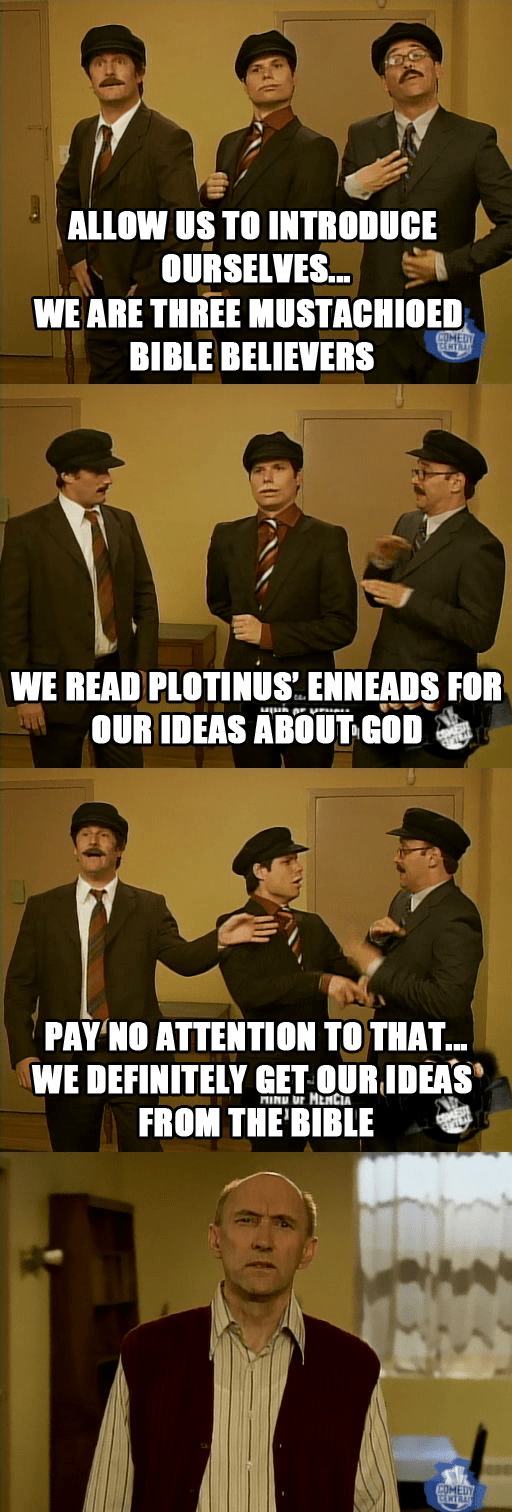
Meme Monday – Mustachioed Calvinists
VOTD Psalms 98:2-3
Psa 98:2 The LORD has made known His salvation; His righteousness He has revealed in the sight of the nations.
Psa 98:3 He has remembered His mercy and His faithfulness to the house of Israel; All the ends of the earth have seen the salvation of our God.
Worship Sunday – Brighter Day
By Chris Lizotte
I want to lift my hands and say
Thank You for a brighter day
Thank You for reaching down
And saving me
I want to to have eyes see
Everything You’ve done for me
Thank You for the blood
That was shed for me
And I praise Your name
With the voice You gave
And I thank You for all You’ve done
And for everything I give praise
And I thank You
Yes I thank You (4x)
Yes I praise You
Yes I praise You (4x)
VOTD Psalms 100:5
Psa 100:5 For the LORD is good; His mercy is everlasting, And His truth endures to all generations.
McCabe on God’s Freedom as Basis of Open Theism
From Divine Nescience of Future Contingencies a Necessity Being:
If the infinite One, in all his activities and faculties, is under the reign of necessity, then there can exist but a single universe, the universe of necessities. But if he possess the attribute of freedom, and can act under the law of liberty, then there must be a second universe, the universe of contingencies.
VOTD Psalms 97:10
Psa 97:10 You who love the LORD, hate evil! He preserves the souls of His saints; He delivers them out of the hand of the wicked.
Questions Answered – Praying for Unbelievers
Now I would like to turn the question back to my questioner: If you insist that this man must have the power of ultimate self-determination, what is the point of praying for him? What do you want God to do for him? You can’t ask that God overcome the man’s rebellion, for rebellion is precisely what the man is now choosing, so that would mean God overcame his choice and took away his power of self-determination. But how can God save this man unless he act so as to change the man’s heart from hard hostility to tender trust?
Will you pray that God enlighten his mind so that he truly see the beauty of Christ and believe? If you pray this, you are in effect asking God no longer to leave the determination of the man’s will in his own power. You are asking God to do something within the man’s mind (or heart) so that he will surely see and believe. That is, you are conceding that the ultimate determination of the man’s decision to trust Christ is God’s, not merely his.
When people live and operate in a Calvinist mindset, often common sense is quickly discarded. All kinds of random non-sequiturs are assumed into reality and used as presuppositions in arguing against competing worldviews (worldviews that don’t buy into the presuppositions). Free Will theologians do not think people cannot be influenced or should not be influenced. In fact, many Free Will theologians actively proselytize. Asking God to do the same is not only good tactics, but common sense.
Convincing someone to think something is different than forcing them to think something. God, to convince King Nebuchadnezzar to become righteous, morphs Nebuchadnezzar into a kind of man-beast. This is all to nudge Nebuchadnezzar into becoming a more righteous person. This flies in the face of Calvinism, where God could have just predestined Nebuchadnezzar to be more righteous. Instead, man and God desperately act to change hearts and minds.
For that reason, the point of praying for God to assist in converting people is to get God to use His power to help proselytization being effective.
VOTD Deuteronomy 7:25
Deu 7:25 You shall burn the carved images of their gods with fire; you shall not covet the silver or gold that is on them, nor take it for yourselves, lest you be snared by it; for it is an abomination to the LORD your God.
Apologetics Thursday – Does God know and see everything?
Skeptics Annotated Bible lists “contradictions” between verses where God “knows all things” and God is shown lacking knowledge. The standard Open Theist response is that God knows all knowable, just that events in the future are not able to be known. This answers most objections, but not all.
Alternatively, this response will be from an extreme Biblical Open Theist worldview, claiming God does not know some present knowledge.
SAB lists the following verses for God “knowing everything”:
No thought can be withholden from thee. Job 42:2
The better translation comes from the ESV or the NKJV, “no purpose of God can be thwarted”. This is a general rule of thumb saying that people cannot use their power to overthrow God’s purposes. This does not mean people cannot change God’s mind or God can’t change His own mind based on new developments.
In any case, if Job was talking about God knowing people’s minds (the phrase does not seem uncharacteristic of what Biblical authors could claim about God), the Biblical Open Theists would claim that God has mechanisms for figuring out the minds of people. Specifically, Romans talks about the spirit studying people to know their minds and Proverbs speaks about “eyes” watching people to know their minds.
For he knoweth the secrets of the heart. Psalm 44:21
The Biblical Open Theist claim is that God has mechanisms for knowing. God knows because God sees, God tests, and God does. In this particular psalm, the mechanism to which the author refers is God’s ability to see people’s hidden behaviors. That is the author’s point. God has abandoned His people, and this is perplexing because God can see that they have not abandoned God.
The writer of Psalms 44 is using the entire psalm to stir God to action. The context of the statement is that God would know if Israel had turned to other Gods, and the author claims that Israel has stayed true to God. The author did not assume the future was fixed, but that he could influence God to act. The writer implores God to awake and arise:
Psa 44:23 Awake! Why are you sleeping, O Lord? Rouse yourself! Do not reject us forever!
Psa 44:24 Why do you hide your face? Why do you forget our affliction and oppression?
Reading the psalm shows that the author did not have the same conceptions about God as the Augustinian Christians.
Whither shall I flee from thy presence? If I ascend up into heaven, thou art there; if I make my bed in hell, behold, thou art there. Psalm 139:7-8
This verse has more to do with God’s special watchfulness over King David than general applicability.
The eyes of the Lord are in every place. Proverbs 15:3
Eyes of the Lord are could mean general surveillance, but it would not be unprecedented for “Eyes of the Lord” to mean “angels”. Angels who report back to God are continually watching you.
For mine eyes are upon all their ways: they are not hid from my face, neither is their iniquity hid from mine eyes. Jeremiah 16:17
A general and reoccurring theme in the Bible is that God can see what man does. Man cannot hide from God, and even in secret places can God see what man is doing. God is saying here that He knows what these individuals have been doing. There are plenty of mechanisms to generate this knowledge. Statements like this case been easily taken as strong rules of thumb, and the language need not be extended to knowing ever single detail of ever single second ever.
Can any hide himself in secret places that I shall not see him? saith the Lord. Do not I fill heaven and earth? Jeremiah 23:24
See above.
Thou, Lord, which knowest the hearts of all men. Acts 1:24
See above.
God … knoweth all things. 1 John 3:20
The critical reading steps should be followed on this verse before determining general applicability. The question becomes “in what way and in what context does God know everything.” The context of the quote deals with God knowing if our heart is condemning Christians for not acting more humanely. In the text, God knows our history and actions and therefor can better judge over us.
VOTD Deuteronomy 7:18
Deu 7:18 you shall not be afraid of them, but you shall remember well what the LORD your God did to Pharaoh and to all Egypt:
McCabe on God being Infinite
From Divine Nescience of Future Contingencies a Necessity:
But to call such an abstract infinity, such a contradictory conception by the name of Deity, leads inevitably into incertitude and inextricable confusion. And it was conceiving of God as an infinity in the abstract that led the great Augustine into such erroneous and dangerous conceptions of the divine nature. The Augustinian conception of Deity was that of a universal infinite, that is, of a being infinite in all respects, and unlimited in all Ills attributes. But if God be infinite in every respect, he can neither be qualified nor conditioned in any respect. And if he cannot be qualified nor conditioned in any respect, he cannot be related; he cannot be a Creator, or a Father, or a Revealer, or an object of love, or a hearer of prayer, or a receiver of adoring worship. For who could worship a power too capricious to be limited by goodness? The distinguishing claims of the Augustinian theology are in reference to its logical consistency. But the very moment Augustinian theology completes its own logical processes it turns flatly against itself, and commits suicide. It is regretfully pronounced a veritable “felo-de-se” by myriad’s rigidly reared in the belief of its dogmas. Attributing to God the mathematical or metaphysical idea of infinity logically annihilates him in His concrete personality.
VOTD Deuteronomy 7:9
Deu 7:9 “Therefore know that the LORD your God, He is God, the faithful God who keeps covenant and mercy for a thousand generations with those who love Him and keep His commandments;
Moltmann is an Open Theist
Jürgen Moltmann, a German Reformed theologian who is Professor Emeritus of Systematic Theology at the University of Tübingen is an Open Theist (although the Open Theist controversy seems to be uniquely American).
From Roger Olson:
At first he was as always a bit reserved, but after perhaps five or six glasses of wine he became downright talkative. (The university hosting the lectures did not pay for the wine! I think the dean paid for it out of his own pocket! Moltmann, of course, did not know that.) I asked him about “open theism.” He asked me to explain it to him which I did. His response was: “But of course! That is part of the kenosis of God!”
VOTD Deuteronomy 7:8
Deu 7:7 The LORD did not set His love on you nor choose you because you were more in number than any other people, for you were the least of all peoples;
Deu 7:8 but because the LORD loves you, and because He would keep the oath which He swore to your fathers, the LORD has brought you out with a mighty hand, and redeemed you from the house of bondage, from the hand of Pharaoh king of Egypt.
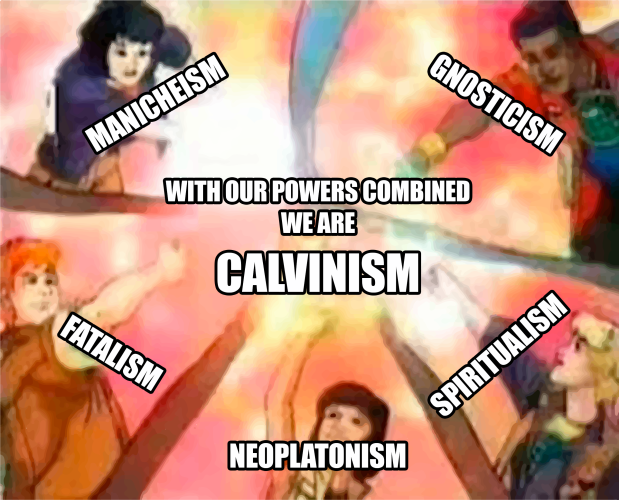
Meme Monday – Captain Planet Calvinism
VOTD Deuteronomy 7:6
Deu 7:6 “For you are a holy people to the LORD your God; the LORD your God has chosen you to be a people for Himself, a special treasure above all the peoples on the face of the earth.
Worship Sunday – Praise You in This Storm
Lyrics:
I was sure by now
God, You would have reached down
And wiped our tears away
Stepped in and saved the day
But once again, I say “Amen”, and it’s still raining
As the thunder rolls
I barely hear You whisper through the rain
“I’m with You”
And as Your mercy falls
I raise my hands and praise the God who gives
And takes away
I’ll praise You in this storm
And I will lift my hands
For You are who You are
No matter where I am
Every tear I’ve cried
You hold in Your hand
You never left my side
And though my heart is torn
I will praise You in this storm
I remember when
I stumbled in the wind
You heard my cry
You raised me up again
My strength is almost gone
How can I carry on
If I can’t find You
As the thunder rolls
I barely hear You whisper through the rain
“I’m with You”
And as Your mercy falls
I raise my hands and praise the God who gives
And takes away
I’ll praise You in this storm
And I will lift my hands
For You are who You are
No matter where I am
Every tear I’ve cried
You hold in Your hand
You never left my side
And though my heart is torn
I will praise You in this storm
I lift my eyes unto the hills
Where does my help come from?
My help comes from the Lord
The Maker of Heaven and Earth
I’ll praise You in this storm
And I will lift my hands
For You are who You are
No matter where I am
Every tear I’ve cried
You hold in Your hand
You never left my side
And though my heart is torn
I will praise You in this storm
VOTD Lamentations 4:11
Lam 4:11 The LORD has fulfilled His fury, He has poured out His fierce anger. He kindled a fire in Zion, And it has devoured its foundations.
NT Wright Avoids a Question on Open Theism
From Rachel Held Evens:
From Kurt: Hi Dr. Wright, First, allow me to admit that your writing and speaking has been the most influential thing in my theological, missional, and spiritual journey in the last 10 years. Before I was introduced to your work, I was convinced that Christianity was all about pie in the sky and leaving this world – not redeeming it. Discovering Romans 8 and a God who groans with creation for its ultimate redemption – [re]new[ed] creation – changes everything! For showing me this – along with various other things about the historical Jesus, the apostle Paul, and theology in general – I am truly grateful.
I do have a question for you: I am wondering if you would be willing to “show your cards” when it comes to open theism? Most of my friends who are open theists, Greg Boyd and others, are very influenced by your work. Certainly, nothing you have said seems to contradict such a God of possibilities. In fact, your reading of Abraham and Israel as God’s “plan B” actually helps give us a framework for thinking about such things. Even so, what would your thoughts be on open theism? I realize that you may not agree with this position of mine, but I would be intrigued to hear some your observations. Thanks for your continued ministry to the church!
Open theism is not something I have done a lot with and to be honest (and it’s late at night and I’m busy). I strongly suspect this is one of those classic American either/or questions that is forcing theology into a box. I never use the language of ‘Plan B’, certainly not about Abraham and Israel; in fact I often quote the Rabbi who envisaged God having Abraham in mind from the start. I don’t want to sign a blank check (or cheque as we spell it), especially when it’s written in dollars not pounds. Go figure!
VOTD Ezekiel 7:8
Eze 7:8 Now upon you I will soon pour out My fury, And spend My anger upon you; I will judge you according to your ways, And I will repay you for all your abominations.
Answered Questions – God’s Relation to Time
Dale asks: How is change related to God?
Bob Enyart responds:
God’s five primary biblical attributes are that He is living, personal, relational, good, and loving, and to be alive requires change. Anything that does not change, like a numeral, or the law of non-contradiction, is not alive. The number 3 (see rsr.org/3) describes the number of persons in the Trinity, and that number does not and cannot change (that is, not the symbol for the number, which is completely mutable, but the number itself). Just because something changes (like the composition of the sun) does not mean that it is alive, thus change is not a sufficient cause for life, but change is a necessary attribute of life. And when it is spiritual, moral, and sentient life that we are talking about, or specifically, God’s life, that change includes His eternal interacting within the Godhead, Father communing with the Son, Spirit affirming the Father, Son loving the Father, etc.)
VOTD Ezekiel 7:3
Eze 7:3 Now the end has come upon you, And I will send My anger against you; I will judge you according to your ways, And I will repay you for all your abominations.
Apologetics Thursday – Omniscience v Free Will Response
By Christopher Fisher
I was asked via a Facebook group: Refute the argument about the barometer.
My response:
The author is confused. He wants to make a video about free will and then compares the prediction to if it will rain or not (something that is not dependent on free will but by physics). That is a point towards fatalism and NOT what he is trying to prove.
He wants to say “look at this object that predicts x, and does not cause the event.” See, God can predict x and not cause it. But what he fails to take into account is free will. God says “You will cook with people poop”, and God’s prophet says “Howabout I cook with cow poop instead.” and God says “Yeah, do that instead.” Ezekiel 4:15
See also: God Yields Instantly
VOTD Ezekiel 6:13
Eze 6:13 Then you shall know that I am the LORD, when their slain are among their idols all around their altars, on every high hill, on all the mountaintops, under every green tree, and under every thick oak, wherever they offered sweet incense to all their idols.
Olson on the Calvinist Backlash Against Open Theism
How did that controversy become so explosive? Well, one way was anti-open theists misrepresenting open theism to non-theologians, pastors and lay people, as, for example, belief that “God gives bad advice” and belief in an “ignorant God.” Many of them went directly to denominational conventions and got resolutions passed against open theism by frightening delegates by implying that open theism is a Trojan horse for process theology. (They would sometimes spend more time talking about process theology than open theism and allow the scared delegates to think they are basically the same.)
I’ve often wondered why open theism, of all things, led to such hysteria (and sometimes outright dishonesty) among its critics. One thing I suspect is that many Calvinists realized that if many evangelicals adopted open theism, one of their strongest arguments against Arminianism would be nullified—that Arminianism cannot explain how God foreknows future free decisions of creatures without in any way determining them.
VOTD Ezekiel 6:12
Eze 6:12 He who is far off shall die by the pestilence, he who is near shall fall by the sword, and he who remains and is besieged shall die by the famine. Thus will I spend My fury upon them.
Bowen on Swinburne
From An Atheist Named Swinburne:
More importantly, Swinburne rejects the existence of God, where God is conceived of as being omniscient in the sense that ‘God knows everything that has ever happened and that ever will happen’. Many people, including many Christian believers, believe in such a God. But Swinburne asserts that these many devout Christian believers are mistaken, and that there is no such being.
God is a perfectly free person, according to Swinburne, and a perfectly free person cannot know with certainty what actions he/she will choose to do in the future (COT, p. 177). Perfect knowledge of the future is logically incompatible with perfect freedom; therefore, it is logically impossible for God to both be perfectly free and for God to also have perfect knowledge of the future.
God must either be perfectly free and have imperfect knowledge of the future, or else God has perfect knowledge of the future and does NOT have perfect freedom. Thus, Christians who believe in a God who is both perfectly free and who has perfect knowledge of the future believe in a God who not only does not exist, but they believe in a God who cannot possibly exist, because they believe in the existence of a being with attributes that are logically contradictory.
VOTD Ezekiel 6:10
Eze 6:10 And they shall know that I am the LORD; I have not said in vain that I would bring this calamity upon them.”
Meme Monday – Romans 9 None of my Business

VOTD Ezekiel 6:4
Eze 6:4 Then your altars shall be desolate, your incense altars shall be broken, and I will cast down your slain men before your idols.
Worship Sunday – Here I am to Worship
Lyrics:
Light of the world, You step down into darkness.
Opened my eyes let me see.
Beauty that made this heart adore you hope of a life spent with you.
[Chorus]
And here I am to worship,
Here I am to bow down,
Here I am to say that you’re my God,
You’re altogether lovely,
Altogether worthy,
Altogether wonderful to me.
King of all days,
Oh so highly exalted Glorious in heaven above.
Humbly you came to the earth you created.
All for love’s sake became poor.
[Chorus]
Here I am to worship,
Here I am to bow down,
Here I am to say that you’re my God,
You’re altogether lovely,
Altogether worthy,
Altogether wonderful to me.
I’ll never know how much it cost to see my sin upon that cross.
I’ll never know how much it cost to see my sin upon that cross.
And I’ll never know how much it cost to see my sin upon that cross.
No I’ll never know how much it cost to se my sin upon that cross.
[Chorus]
Here I am to worship,
Here I am to bow down,
Here I am to say that you’re my God,
You’re altogether lovely,
Altogether worthy,
Altogether wonderful to me.
So Here I am to worship,
Here I am to bow down,
Here I am to say that you’re my God,
VOTD Ezekiel 5:15
Eze 5:15 ‘So it shall be a reproach, a taunt, a lesson, and an astonishment to the nations that are all around you, when I execute judgments among you in anger and in fury and in furious rebukes. I, the LORD, have spoken.
Olson on the Distinction between Arminianism and Calvinism
From Roger Olson:
To me, this is a bigger, more important, issue than open theism. That’s because, for me, and for many Arminians, THE key to Arminianism is the character of God. That is what primarily distinguishes Arminianism from Calvinism.
VOTD Ezekiel 5:13
Eze 5:13 ‘Thus shall My anger be spent, and I will cause My fury to rest upon them, and I will be avenged; and they shall know that I, the LORD, have spoken it in My zeal, when I have spent My fury upon them.
Answered Questions – Time and Sequence
Dale asks: Are time and sequence related? Are they synonymous? If so, how? If not please explain the differences.
Bob Enyart responds:
Time and sequence are related but need not be viewed or used as synonyms. It is time that enables sequence. For example, God has existed throughout eternity past, and the Incarnation occurred in a point in time in which God the Son took upon Himself a second (human) nature, and became flesh. That is a sequence of events. Human beings, perhaps reflecting God’s perspective, distinguish events from time (as do for various Christian philosophers).
VOTD Ezekiel 5:10
Eze 5:10 Therefore fathers shall eat their sons in your midst, and sons shall eat their fathers; and I will execute judgments among you, and all of you who remain I will scatter to all the winds
Apologetics Thursday – Ware’s Prooftexts are Prooftexts Against Ware
From God’s Lesser Glory:
Very little of my own response is needed to Boyd on this point. Some 700 years prior to Israel’s rebellion of which Isaiah 5 speaks, and before Israel had entered the land God promised to give them, God, through Moses, had already predicted with complete understanding and foresight the future rebellion and idolatry of Israel. Notice in the following text God’s dogmatic assertions of how Israel will act and that he knows precisely what they will do. Notice also that, despite the fact that God knows exactly how Israel will rebel, he states how angry he will become with them at that time in the future. Deuteronomy 31:16-21 reads:
The LORD said to Moses, “Behold, you are about to lie down with your fathers; and this people will arise and play the harlot with the strange gods of the land, into the midst of which they are going, and will forsake Me and break My covenant which I have made with them. Then My anger will be kindled against them in that day, and I will forsake them and hide My face from them, and they will be consumed, and many evils and troubles will come upon them; so that they will say in that day, `Is it not because our God is not among us that these evils have come upon us?’ But I will surely hide My face in that day because of all the evil which they will do, for they will turn to other gods. Now therefore, write this song for yourselves, and teach it to the sons of Israel; put it on their lips, so that this song may be a witness for Me against the sons of Israel. For when I bring them into the land flowing with milk and honey, which I swore to their fathers, and they have eaten and are satisfied and become prosperous, then they will turn to other gods and serve them, and spurn Me and break My covenant. Then it shall come about, when many evils and troubles have come upon them, that this song will testify before them as a witness (for it shall not be forgotten from the lips of their descendants); for I know their intent which they are developing today, before I have brought them into the land which I swore.”
Consider especially the force of the concluding statement in verse 21. God says, “I know their intent which they are developing today, before I have brought them into the land which I swore.” God knows their future rebellion, for he specifically predicts it with certainty and in some detail before it occurs.
Notice how Ware handles Deuteronomy 31. The text explains that God knows what will happen and then it specifically describes how God knows it will happen. God knows Israel will rebel BECAUSE “I know their intent which they are developing today, before I have brought them into the land which I swore.”
When God explains how He knows the future, God never explains that it is because He is outside of time or can see the future in a crystal ball. God explains the current knowledge that has led Him to the future knowledge. Take for example Abraham:
Gen 18:17 And the LORD said, “Shall I hide from Abraham what I am doing,
Gen 18:18 since Abraham shall surely become a great and mighty nation, and all the nations of the earth shall be blessed in him?
Gen 18:19 For I have known him, in order that he may command his children and his household after him, that they keep the way of the LORD, to do righteousness and justice, that the LORD may bring to Abraham what He has spoken to him.”
Here God states that He knows what Abraham’s descendants will do and then God explains how He knows it: “For I have known him, in order that he may command his children and his household after him, that they keep the way of the LORD, to do righteousness and justice”.
Ware’s proof text for God knowing the future is a prooftext against Ware’s own theology! God states that He uses present knowledge to know the future. This is not what Ware would want people to believe about God. Ware doesn’t want people to believe God is in time, making predictions about the future based on what God observes in the present.
That Ware would use this text means a few things:
1. Ware just blindly assumes his theology onto the text, in spite of the most natural readings.
2. Ware does not examine the texts that he uses to figure out if texts support other understandings.
3. Ware will argue against a theology without accurately representing that theology’s counter arguments.
VOTD Ezekiel 4:12-15
Eze 4:12 And you shall eat it as barley cakes; and bake it using fuel of human waste in their sight.”
Eze 4:13 Then the LORD said, “So shall the children of Israel eat their defiled bread among the Gentiles, where I will drive them.”
Eze 4:14 So I said, “Ah, Lord GOD! Indeed I have never defiled myself from my youth till now; I have never eaten what died of itself or was torn by beasts, nor has abominable flesh ever come into my mouth.”
Eze 4:15 Then He said to me, “See, I am giving you cow dung instead of human waste, and you shall prepare your bread over it.”
Open Theism Risk Models
At the Randomness Conference, Johannes Grossl presented a paper entitled: “A Non-Inverventionist Risk Minimizing Strategy for Open Theism”. In this he advocates three main categories of risk models affirmed by Open Theism:
Low Risk – God created the world in such a way that it can be guaranteed that at least a certain percent of people would accept Him.
High Risk – God created the world in such a way that it is highly improbable that all people (every single individual) would reject God.
Extreme High Risk – God created the world in such a way that He did not know the probabilities (either 0% or 100%) that people would accept Him.
VOTD Ezekiel 3:18-21
Eze 3:18 When I say to the wicked, ‘You shall surely die,’ and you give him no warning, nor speak to warn the wicked from his wicked way, to save his life, that same wicked man shall die in his iniquity; but his blood I will require at your hand.
Eze 3:19 Yet, if you warn the wicked, and he does not turn from his wickedness, nor from his wicked way, he shall die in his iniquity; but you have delivered your soul.
Eze 3:20 “Again, when a righteous man turns from his righteousness and commits iniquity, and I lay a stumbling block before him, he shall die; because you did not give him warning, he shall die in his sin, and his righteousness which he has done shall not be remembered; but his blood I will require at your hand.
Eze 3:21 Nevertheless if you warn the righteous man that the righteous should not sin, and he does not sin, he shall surely live because he took warning; also you will have delivered your soul.”
Is God Wrong when Things Do Not Turn Out As Planned?
In Exodus 32, a story is laid out in which God is conversing with Moses. God tells Moses that He will destroy Israel and make a new nation out of Moses. Moses objects and pleads to God to spare Israel. The text then describes something interesting. God repents of the “evil” (the proposed destruction of Israel) that God thought God would accomplish:
Exo 32:14 And the LORD repented of the evil which he thought to do unto his people.
The question is then asked: Did God “know” a falsehood? Did God know something that was not true? Was God wrong in thinking He would destroy Israel?
The story is simple. God thinks He will do something. Someone convinces God not to do that thing. God then changes His mind and does not do what He thought He was going to do. Normal human communication standards would not consider God “wrong” although events did not ultimately turn out in the way God has expected. A parallel:
A group of people are flying to Dallas. All people on board, especially the pilot, believe they will be flying into DFW airport. In other words, everyone thinks they are going to DFW airport. As the pilot nears Dallas, a stewardess decides it would be funny if instead they land at DLF airport. This stewardess is very persuasive and persuades the pilot to instead fly to DLF airport. Were the people wrong to think “they were going to DFW”? Was the pilot wrong when he first took off to think that they were “going to DFW”?
Normal people reflecting on the situation at a future time would not say that the people were “wrong”. The people were right to think “they were going to DFW”. The airplane was pointed in the direction. The pilot was navigating the plane to DFW. They were, in fact, going to DFW. A normal person would reflect and say: “They were going to DFW, but then the pilot changed his mind and they instead went to DLF”. In fact, the only time the people would be wrong to think “they were going to DFW” would be after the pilot changed his mind. After the pilot knows that the plane is now headed to DLF, the pilot would likewise be wrong to believe “he was going to DFW”.
When evaluating the truthfulness of past claims, it is only valid to evaluate them with the truth available at the time. In the Exodus 32 example, the only way God would actually be “wrong” is if God knew full well He was not going to destroy Israel. The view of future omniscience makes God wrong. If the future does not exist, then God is not wrong to believe “He is going to destroy Israel” if in fact that was His destination at the time.
This can be modeled:
Assumptions:
Presentism: Statements about the future are not true or false, in the logical sense of the statement. Statements about the past are only true if tensed to recreate the context of the statement. Both the past and future do not exist; all that exists is “now”.
It is argued:
Because statements about the future are neither true or false (there is nothing to be true or false), future truths cannot affect the truth claims of the present. Those future events do not exist to weigh against the true value. It would also be a mistake to claim that truth claims of the present must hold into the future if the context changes (and vice versa, that claims of the present must hold into the past).
Furthermore it is argued:
While events can actualize in ways that are unexpected by God (in Jeremiah 18:8 God admits as much by saying “I will not do what I thought to do”), this does not necessarily involve thinking a falsehood.
True or false statements are only true or false in the context and time in which they are stated. Because there is no such thing as the future, attempting to include the future truth or falsehood into the truth equation would be the equivalent of trying to include similar non-existent mechanisms. One might as well say that any past event is true or false because of some other irrational and non-existent factor (such as timetravel).
Example of an equally nonsensical claim: “God was not incorrect about destroying Israel because of future timetravel, God can both destroy and not destroy Israel in the past.” Or “God was not incorrect about destroying Israel because all future branching paths lead to parallel worlds and one branching world included God destroying Israel.” These sorts of Deus Ex Machinia’s should be rejected as nonsense.
The statement that “In some context in the past, God thought He would destroy Israel” is the eternal truth (likewise is “In some context in the past, God didn’t think He would destroy Israel”). Alternative phrasing of the same statement: “In some context in the past, God knew He was going to destroy Israel”. At the moment in Exodus when God uttered that He would destroy Israel, it was true in the context in which it was uttered. In Exodus 32:10, God knew He would destroy Israel. God believed the truth. Whether or not Israel was ever destroyed is irrelevant to the question because future truths do not exist to weigh into the claims of the past.
Take for example a similar example:
At time point T1, proposition A “We are going to DFW” is true.
At time point T2, proposition A “We are going to DFW” is true.
At time point T3, proposition A “We are going to DFW” is true.
At time point T4, the pilot changes his mind and diverts the course to DLF.
At time point T5, proposition A “We are going to DFW” is false.
Notice the logical law of Non-contradiction is not violated in these two propositions. A truth (proposition A) cannot be both true and false at the same time in the same sense. Because time (and, more importantly, other factors) can change between T1 and T5 then “We are going to DFW” can be both true and false depending on the context of which it is said. Tensed, “We were going to DFW” can be both true and false depending on the T value to which is referred.
Now apply this concept to Exodus 32:
At time point T1, proposition A “God is going to destroy Israel” is true.
At time point T2, God repents.
At time point T3, proposition A “God is going to destroy Israel” is false.
At time point T4, we analyze:
Now it would be true at T4 the proposition “At time T1 ‘God was going to destroy Israel’ was a true proposition.” But it would not be true to say “At time T3 ‘God was going to destroy Israel’ was a true proposition.” It would also not be true to say “At time T1 ‘God was not going to destroy Israel’ is a true statement. Truth cannot be divorced from the context in which it is said. This is not to say that some context can change and truth value of the statement can’t remain the same (is it even still the same statement?). In order for proposition A to remain true at T3, the relevant context would have to hold between the two points.
In short, when evaluating truth we should not apply contexts which are not applicable. We should not assume that truth propositions would hold changing the context in which the truth is uttered.
At T1, God was going to destroy Israel. That was God’s intent. God was preparing and planning on destroying Israel. Rephrased: at T1, God knew “that He was going to destroy Israel”. Because God was going to destroy Israel (and God could have accomplished this as planned), God knew the truth.
At T3, it is no longer the case that God was going to destroy Israel. The context of the statement changed, thus we should not assume the truth value must hold. God no longer thought “that He was going to destroy Israel”.
Because of presentism, it can logically be claimed that God does not believe falsehoods about the future although it is possible that He could be incorrect if we irrationally project present truths into past “truth calculations”. Because the past does not exist, except in memory, recalculating truth determinations from the past is as fallacious as using future truths to calculate present truths. If the truth did exist, only then God would have believed a falsehood. God is only wrong if God knows the future.
In other words: God can know some truth now that does not materialize as expected.
VOTD Ezekiel 3:11
Eze 3:11 And go, get to the captives, to the children of your people, and speak to them and tell them, ‘Thus says the Lord GOD,’ whether they hear, or whether they refuse.”
Meme Monday – Romans 9 Bad Time

VOTD Ezekiel 3:7
Eze 3:7 But the house of Israel will not listen to you, because they will not listen to Me; for all the house of Israel are impudent and hard-hearted.
Worship Sunday – Lord I Lift Your Name on High
Lyrics:
“Lord I Lift Your Name On High”
Lord I lift Your name on high
Lord I love to sing Your praises
I’m so glad Your in my life
I’m so glad You came to save us
[Chorus:]
You came from heaven to earth
to show the way
from the earth to the cross
my debt to pay
from the cross to the grave
from the grave to the sky
Lord I lift Your name on high
VOTD Ezekiel 2:5
Eze 2:5 As for them, whether they hear or whether they refuse—for they are a rebellious house—yet they will know that a prophet has been among them.
Holland on a Timeless Being
“I have never conceded that an entity existing timelessly is a rational concept. I have never conceded that. I am sort of holding out. Because it seems to me that we can allege that the concept of timelessness is itself irrational.”
From part 4 of Richard Holland’s interview on kgov.
VOTD Ezekiel 2:3
Eze 2:3 And He said to me: “Son of man, I am sending you to the children of Israel, to a rebellious nation that has rebelled against Me; they and their fathers have transgressed against Me to this very day.
Answered Questions – What is Time
Dale asks: What is time?
Bob Enyart writes:
Definition of time: As with a myriad of other things in the physical and spiritual worlds, we can describe time but a precise definition seems to elude mankind. Time is the aspect of God’s existence that provides for a continuum which enables states and events to pass in a non-spatial, unidirectional succession flowing from the future, through the present, and into the past. For thousands of years theologians, philosophers, and more recently, scientists, have widely confessed bewilderment about the nature of time. Einstein’s worldview omits God so of course any absolute time that flows from God’s nature was inherently excluded from his theories, whereas Isaac Newton acknowledged what appears to be relative time due to man’s finite abilities, but claimed that absolute time would flow from God. For more thoughts on these matters, consider rsr.org/time and rsr.org/time-and-the-incarnation.
VOTD 2 Samuel 7:15
2Sa 7:15 But My mercy shall not depart from him, as I took it from Saul, whom I removed from before you.
Apologetics Thursday – Ware’s Subtle Dishonesty on Psalms 139
In God’s Lesser Glory, Bruce Ware talks about Psalms 139:
Psalm 139:16 provides another glimpse into the extent of God’s meticulous oversight of his creatures. The psalmist here declares, “Your eyes have seen my unformed substance; and in Your book were all written the days that were ordained for me, when as yet there was not one of them.” Clearly this passage indicates that God ordained (literally “formed,” from yatsar) the days of our lives before we even existed. But how can this be? How can God ordain or form all our days when (as the open theists would claim) he does not know any of the multitude of the future contingencies and future free actions of ourselves and of other people that may relate to our lives? The fact is that, without foreknowledge of a contingent future, God could not even know that we would be (e.g., God could not know what individuals might be miscarried or die in childbirth), much less know the days that would occupy our lives, and much less again, ordain them all from the outset. Clearly we are intended to be comforted with the assurance that God knows all that will happen to us…
The meaning of the verse, then, is clear. As he considers his earliest beginnings, while still in the womb of his mother, the psalmist cherishes the realization that, even then, God had planned and formed the very days of the life he would come to live.
Notice how Bruce Ware words his description of Psalms 139. One thing that Ware avoids at all costs is naming the author of Psalms 139, King David. When people do not name authors of books, it is usually because they dispute who the author is (like Biblical critics avoiding Moses as author of Genesis). Ware, most likely, does not dispute that King David wrote Psalms 139, so his motive is more than likely nefarious: if Ware inserted King David’s name into his description it would vastly undermine the applicability of the text to a general audience. It makes Ware’s description very specific to one individual. Instead, Ware decides to give no hint as to who the author was. In fact, Ware never uses King David’s name in his entire book, except quoting verses containing David’s name.
King David was a striking figure that most can only hope to rival. Pointing out that King David (a man after God’s own heart) makes the text more specific to one individual. This is not how Ware wants to present the text. Changing Ware’s usage, Ware’s point becomes lost:
King David, in Psalm 139:16, provides another glimpse into the extent of God’s meticulous oversight of his creatures. King David here declares, “Your eyes have seen my unformed substance; and in Your book were all written the days that were ordained for me, when as yet there was not one of them.” Clearly this passage indicates that God ordained (literally “formed,” from yatsar) the days of our lives before we even existed. But how can this be? How can God ordain or form all our days when (as the open theists would claim) he does not know any of the multitude of the future contingencies and future free actions of ourselves and of other people that may relate to our lives? The fact is that, without foreknowledge of a contingent future, God could not even know that we would be (e.g., God could not know what individuals might be miscarried or die in childbirth), much less know the days that would occupy our lives, and much less again, ordain them all from the outset. Clearly we are intended to be comforted with the assurance that God knows all that will happen to us…
The meaning of the verse, then, is clear. As King David considers his earliest beginnings, while still in the womb of his mother, David cherishes the realization that, even then, God had planned and formed the very days of the life he would come to live.
When pointing out that King David was writing, the generally applicability is quickly thrown into question. Of course King David led a special life that was heavily intertwined with God’s individual attention. God literally saved David from death on multiple occasions as his enemies sought to murder him. To mask this special relationship, Ware uses generalities. He calls King David “the psalmist” (as to pretend that any psalmist could replace the writer). If this methodology was used to generalize many of King David’s other psalms, the psalms would lose their meaning.
But Ware wants Psalms 139 to lose its meaning. That way Ware can claim it support his views while ignoring the thousands of verses also penned by King David that do not support Ware’s concept of God.
Also see: understanding Psalms 139
VOTD Psalms 97:7
Psa 97:7 Let all be put to shame who serve carved images, Who boast of idols. Worship Him, all you gods.
Aquinas on Immutability
From Summa Theologica:
On the contrary, It is written, “I am the Lord, and I change not” (Malachi 3:6).
I answer that, From what precedes, it is shown that God is altogether immutable.
First, because it was shown above that there is some first being, whom we call God; and that this first being must be pure act, without the admixture of any potentiality, for the reason that, absolutely, potentiality is posterior to act. Now everything which is in any way changed, is in some way in potentiality. Hence it is evident that it is impossible for God to be in any way changeable.
Secondly, because everything which is moved, remains as it was in part, and passes away in part; as what is moved from whiteness to blackness, remains the same as to substance; thus in everything which is moved, there is some kind of composition to be found. But it has been shown above (Question 3, Article 7) that in God there is no composition, for He is altogether simple. Hence it is manifest that God cannot be moved.
Thirdly, because everything which is moved acquires something by its movement, and attains to what it had not attained previously. But since God is infinite, comprehending in Himself all the plenitude of perfection of all being, He cannot acquire anything new, nor extend Himself to anything whereto He was not extended previously. Hence movement in no way belongs to Him. So, some of the ancients, constrained, as it were, by the truth, decided that the first principle was immovable.
VOTD Psalms 96:13
Psa 96:13 For He is coming, for He is coming to judge the earth. He shall judge the world with righteousness, And the peoples with His truth.
Brueggemann on God’s creativity
From Walter Brueggemann’s Theology of the Old Testament:
It is evident from the outset, in Israel’s most characteristic testimony, that right speech about Yahweh concerns Yahweh’s power to transform, to create, and to engender.
VOTD Psalms 96:5
Psa 96:5 For all the gods of the peoples are idols, But the LORD made the heavens.
Free Monday – Augustine Manichaeism and the Good
The first 26 pages of Kam-lun E. Lee’s 200+ page dissertation is available for free at this link:
Augustine Manichaeism and the Good
This book talks about the concept of Summum Bonum as it relates to Augustine’s theology. The entire book can be purchased on Amazon.
VOTD Psalms 97:9
Psa 97:9 For You, LORD, are most high above all the earth; You are exalted far above all gods.
Worship Sunday – Famous One
By Chris Tomlin
You are the Lord
The famous one
Famous one
Great is your name
In all the earth
The heavens declare
You’re glorious, glorious
Great is your fame
Beyond the earth
You are the Lord
The famous one
Famous one
Great is your name
In all the earth
The heavens declare
You’re glorious, glorious
Great is your fame
Beyond the earth
And for all you’ve done
And yet to do
With every breath
I’m praising you
Desire of nations
And every heart
You alone are God
You alone are God
You are the Lord
The famous one
The famous one
Great is your name
In all the earth
The heavens declare
You’re glorious, glorious
Great is your fame
Beyond the earth
The morning star
Is shining through
And every eye
Is watching you
Revealed by nature
And miracles
You are beautiful
You are beautiful
You are the Lord
The famous one
Famous one
Great is your name
In all the earth
The heavens declare
You’re glorious, glorious
Great is your fame
Beyond the earth
VOTD Psalms 90:13
Psa 90:13 Return, O LORD! How long? And have compassion on Your servants.
Fisher on Ephesians 1:4
Craig Fisher lays out a case why Ephesians 1 is not about “individual salvation”. The conclusion:
Is a person chosen in Christ “before the foundation of the world” or “after believing?” When Paul says the “us in Him” he is referring to the body of Christ. The individual members of the body of Christ are not chosen until they exercise faith and are sealed with the Holy Spirit. The corporate group is chosen to be holy and blameless before Him. We do not know who is in this group until much later than the foundation of the world.
Maybe an analogy will help. The director says “the band is really fortunate this year, we will play in Hawaii this winter.” Of course each band member has to try out for their chair in the band. There remains a competition to determine who is going to be in the band. The individual members have not yet been determined. The corporate entity, the band, will go to Hawaii.
God chose the body of Christ to be holy and blameless before Him in love. The body of Christ is the “us in Him.” The individual members of the body have yet to be determined.
VOTD Psalms 90:4
Psa 90:4 For a thousand years in Your sight Are like yesterday when it is past, And like a watch in the night.
Unanswered Questions – Was only Israel Saved?
For those who believes Romans 8-11 is about individual salvation as opposed to national election:
Rom 11:11 I say then, have they [the Jews] stumbled that they should fall? Certainly not! But through their fall, to provoke them to jealousy, salvation has come to the Gentiles.
Per Romans 11, were only Jews chosen by God before the fall of the Jews?
VOTD Lamentations 5:20-21
Lam 5:20 Why do You forget us forever, And forsake us for so long a time?
Lam 5:21 Turn us back to You, O LORD, and we will be restored; Renew our days as of old,
Apologetics Thursday – Knowing Pharaoh Beforehand
Blogsite Into the Harvest writes:
Does [Open Theism] make sense Biblically? I don’t see how it does. We see numerous passages showing that God knows what will happen in the future and I don’t see how that can be reconciled with the open theist view. In Exodus he says “But I know that the king of Egypt will not let you go unless compelled by a mighty hand. So I will stretch out my hand and strike Egypt with all the wonders that I will do in it; after that he will let you go.” (Ex. 3:19-20). God here seems to clearly know that the Pharaoh wouldn’t let the people go if Moses told him and he wouldn’t let them go until God did wonders. You also notice later on that when things happen, like the Pharaoh hardening his heart, it happens “as the Lord had said” (Ex. 7:13, 8:15, 8:19, 9:12, 9:35). It seems highly unlikely that God simply made a conditional prediction.
Let us consider what was actually said:
Exo 3:19 But I am sure that the king of Egypt will not let you go, no, not even by a mighty hand.
This sounds quite like someone who speaks and generally does not know the future. The fact that this specific example is provided contrasts against other uncertainty. God does not say “I know everything in the future and so know what Pharaoh will do.” God speaks like an Open Theist. Humans can and do say the same thing all the time:
“But I am sure that Mom will not let me take the car, not even with a lot of convincing.”
Just like the English word “to know”, the Hebrew brings with it a range of possible meanings. These meanings are known primarily from context. So what is the context of Exodus 3?
In Exodus 3:19 the context is God anticipating and reacting to what Pharaoh will do:
Exo 3:19 But I am sure that the king of Egypt will not let you go, no, not even by a mighty hand.
Exo 3:20 So I will stretch out My hand and strike Egypt with all My wonders which I will do in its midst; and after that he will let you go.
This is like saying:
“But I am sure that Mom will not let me take the car, not even with a lot of convincing.
So I will use every trick and skill I have to convince her, and she will let me take the car.”
This is well within the range of normal human communication about fellow humans (nevermind about God). There is no need to have any sort of divination necessary.
When the author claims “It seems highly unlikely that God simply made a conditional prediction”, most Open Theists would agree: God did not expect anything different to happen then what was stated. But there are always unwritten conditionals. God explains these conditionals in Jeremiah 18:
Jer 18:7 The instant I speak concerning a nation and concerning a kingdom, to pluck up, to pull down, and to destroy it,
Jer 18:8 if that nation against whom I have spoken turns from its evil, I will relent of the disaster that I thought to bring upon it.
Jer 18:9 And the instant I speak concerning a nation and concerning a kingdom, to build and to plant it,
Jer 18:10 if it does evil in My sight so that it does not obey My voice, then I will relent concerning the good with which I said I would benefit it.
God changes His plans based on the actions of people. The apostle Paul alludes to this chapter when speaking about reasons why God switched over to the Gentiles. The Jews never expected it, because they wanted to forget about God’s unwritten conditionals. Paul explains, in Romans 8-11 that God always has the right to change.
This concept is also echoed in God’s dealings with the original kingship of Israel.
VOTD Lamentations 5:19
Lam 5:19 You, O LORD, remain forever; Your throne from generation to generation.
Fisher on Romans 9
From a post examining Paul’s points in Romans 9:
Paul is building to an overarching point, because in Paul’s theology there is no longer room for this distinction between the “priest nation” and gentiles. Paul flips this point on its head, drawing the singular point that “because God arbitrarily chose one nation over another, then God is not wrong to disband that arbitrary choice.” Paul, being an Open Theist, is saying that God can revoke his promises, especially when those promised are not based on merit.
VOTD Lamentations 5:1
Lam 5:1 Remember, O LORD, what has come upon us; Look, and behold our reproach!
Boyd on Suffering
From a recent post on Reknew:
1. Nowhere is this explanation of suffering put forth as a general explanation for the problem of evil in Scripture. Indeed, the only time an explicit connection is made between divine punishment and evil in general is to deny that such a connection can be made. For example, the psalmist repeatedly complains that suffering and blessing are meted out to the righteous and the unrighteous arbitrarily. Jesus never suggests that any of the multitude of afflicted or demonized people he ministered to were being disciplined or punished. Rather, he suggests that such afflictions or demonizations were the direct or indirect result of Satan being the “ruler” of this world. (Jn 12:31). Though every person Jesus ministered to was a sinner, he uniformly treated them as casualties of war.
2. There is a world of difference between encouraging Christians facing persecution to see God refining their faith in the process (Heb 12:4-11) and encouraging a mother of a stillborn child to see this as God’s way of teaching her a lesson. While we certainly must believe that God is always working to bring good out of evil (Rom 8:28), in most circumstances it is presumptuous to suggest that God specifically allows or brings about suffering in order to discipline a person. Apart from divine revelation, how could we possibly know this? But this presumption morphs to cruel absurdity when we are speaking of horrors like a man mourning his murdered wife or a mother grieving over her stillborn child.
3. Even in the Old Testament when God is said to discipline individuals or nations with hardship, it is never presented as a part of God’s eternal plan. Instead, it’s depicted as a necessary response to sinful choices people were making. This is God’s “tough love.” It grieves God to do such things. He “does not willingly afflict or grieve anyone (Lam 3:33), though in response to sin he sometimes has.
VOTD Lamentations 4:16
Lam 4:16 The face of the LORD scattered them; He no longer regards them. The people do not respect the priests Nor show favor to the elders.
Free Monday – Books by B B Warfield
Monergism.org is hosting several free books by B B Warfield.
Faith and Life (eBook) by B. B. Warfield
Studies in Theology (eBook) by B. B. Warfield
Biblical Doctrines (eBook) by B. B. Warfield
Calvin and Calvinism (eBook) by B. B. Warfield
Augustine & The Pelagian Controversy (eBook)
The Making of the Westminster Confession (eBook) by B. B. Warfield
Sermons and Essays from the Works of B. B. Warfield (eBook) by B. B. Warfield
VOTD Lamentations 4:11
Lam 4:11 The LORD has fulfilled His fury, He has poured out His fierce anger. He kindled a fire in Zion, And it has devoured its foundations.
Worship Sunday – Build Your Kingdom Here
By Rend Collective
Come set Your rule and reign
in our hearts again.
Increase in us we pray.
Unveil why we’re made.
Come set our hearts ablaze with hope
like wildfire in our very souls.
Holy Spirit, come invade us now.
We are Your church.
We need Your power in us.
We seek Your kingdom first.
We hunger and we thirst.
Refuse to waste our lives
for You’re our joy and prize.
To see the captive hearts released.
The hurt, the sick, the poor at peace.
We lay down our lives for Heaven’s cause.
We are Your church.
We pray revive this earth.
Build Your kingdom here.
Let the darkness fear.
Show Your mighty hand.
Heal our streets and land.
Set Your church on fire.
Win this nation back.
Change the atmosphere.
Build Your kingdom here.
We pray.
Unleash Your kingdom’s power
reaching the near and far.
No force of Hell can stop
Your beauty changing hearts.
You made us for much more than this!
Awake the kingdom seed in us!
Fill us with the strength and love of Christ.
We are Your church.
We are the hope on earth.
Build Your kingdom here.
Let the darkness fear.
Show Your mighty hand.
Heal our streets and land.
Set Your church on fire.
Win this nation back.
Change the atmosphere.
Build Your kingdom here!
We pray!
Build Your kingdom here.
Let the darkness fear.
Show Your mighty hand.
Heal our streets and land!
Set Your church on fire!
Win this nation back.
Change the atmosphere!
Build Your kingdom here!
We pray!
VOTD Lamentations 3:56
Lam 3:56 You have heard my voice: “Do not hide Your ear From my sighing, from my cry for help.”
Morrell Open Air Preaches Open Theism
VOTD Lamentations 3:43-44
Lam 3:43 You have covered Yourself with anger And pursued us; You have slain and not pitied.
Lam 3:44 You have covered Yourself with a cloud, That prayer should not pass through.
Unanswered Questions – Prayer for the Past
To those who believe the future is settled:
Why do you not pray for past events in the same manner you pray for future events?
VOTD Lamentations 3:37
Lam 3:37 Who is he who speaks and it comes to pass, When the Lord has not commanded it?
Apologetics Thursday – The Calvinist Dictionary
Classical Christianity, and more specifically Calvinism, goes through great lengths to redefine words such as to mirror their theology. Below is a selected list of major concepts and words:
Election
To the Calvinist, Election is the process by which God choses some to be saved. One of the five points of Calvinism is Unconditional Election. This means that Calvinist affirm that God elects without condition, people’s actions and beliefs have no part in God electing those individuals. Here is John Piper:
Election refers to God’s choosing whom to save. It is unconditional in that there is no condition man must meet before God chooses to save him. Man is dead in trespasses and sins. So there is no condition he can meet before God chooses to save him from his deadness.
Election, however, does not mean this (not in any language in any time period). In the Greek, election is synonymous with favoritism. People have favorite TV shows, favorite foods, and favorite presidential candidates (of whom go through a process called election). When people have favorites it is always due to a valuation of the object. People’s favorite TV shows might be interesting or funny, people’s favorite foods are appealing, people’s favorite presidential candidate usually has some sort of attracting charisma. In the case of TV shows, the writers have enormous influence over if viewers favorite the show. In the case of food, chefs have enormous influence over if eaters favorite the food. In the case of presidential elections, candidates can make or break their own campaigns based on their own actions. This is election and this is favoritism. Both have everything to do with the qualities of the object.
Sometimes in the Bible, the elect fall out of favor.
Predestination
To the Calvinist, Predestination is the process by which man is chosen since before time began to be saved. But as Open Theist Beau Ballentine points out, this is not the natural understanding of what Predestination means:
Calvinism inherently rejects predestination. For predestination to be true, God must determine something beforehand. Before God determined, the future would have to be open. Predestination refutes an eternally settled future and Calvinism.
Anthropomorphism
Modern Americans should be well familiar with anthropomorphism. Brave Little Toaster, Pixar’s Cars, and a whole host of movies depict human features on inanimate objects. But the problem is that these depictions are purely fictional for entertainment value. Making a talking toaster is not an “idiom”, it is fantasy. Talking toasters do not exist. Describing a talking toaster does not communicate anything. Even when people say “my computer hates me”, it is a joke. It is a joke because computers cannot hate.
Anthropomorphisms depict fiction! For the Calvinist to claim the Bible is filled with anthropomorphisms is to claim the Bible is filled with fictitious portrayals of God that communicate nothing.
Sovereignty
Reposted comment from Roger Olson:
There is no “sovereignty” in human experience like the “sovereignty” Calvinists insist we must attribute to God in order “really” to believe in “God’s sovereignty.” In ordinary human language “sovereignty” NEVER means total control of every thought and every intention of every subject. And yet it has become a Calvinist mantra that non-Calvinists “do not believe in God’s sovereignty.” I have a tape of a talk where R. C. Sproul says that Arminians “say they believe in God’s sovereignty” but he goes on to say “there’s precious little sovereignty left” (after Arminians qualify it). And yet he doesn’t admit there (or anywhere I’m aware of) that his own view of God’s sovereignty (which I call divine determinism) is not at all like sovereignty as we ordinarily mean it. That’s like saying of an absolute monarch who doesn’t control every subject’s every thought and intention and every molecule in the universe that he doesn’t really exercise sovereignty. It’s an idiosyncratic notion of “sovereignty.”
Foreknowledge
From Elseth’s Did God Know?:
Proginosko carries with it the idea of past knowledge, to know beforehand, or even foresight, whether human or divine. It is rooted in a medical term originating in the time of Hippocrates and means almost exactly what our English counterpart word, prognosis, means. In medicine, it is the prediction of the probable course of the disease and of the chances of recovery based on present knowledge. In other words, it is a prognosis based on diagnosis…
Knowledge
The standard definition of knowledge is a “justified true belief”. The same standard which I can say “I know I am currently wearing pants”, “I know that if I tickle my daughter she will laugh”, and “I know that I was once a baby”, is the same standard which I can say “I know that if tomorrow I walk into Walmart, no employee will stop me from handing over cash in exchange for merchandise.”
Now critics can try to be clever. They always try. They say “You do not know that for sure. The world might end tomorrow.” The funny thing is that they are always wrong, and I am always right. But using extreme hypotheticals, the Augustinians open themselves up to claims that they are nihilists. Their definition of knowledge seems to be a 100% certainty without possibility, no matter how slight, of error.
By the Augustinian standard of “knowledge” I do not know I was once a baby. Maybe I am some programed robot or phantasm in a dream that only thinks I was once a baby. Maybe also, I do not know my daughter will laugh when I tickle her. Maybe my daughter is merely a figment of my imagination. I may be highly schizophrenic. Maybe the pants I am wearing are an elaborate mirage induced by crazy scientists messing with my brain.
Goodness
From Roger Olson:
Put another way, negatively, if one believes that God’s goodness is nothing like our best intuitions of goodness, that God’s goodness is possibly compatible with anything capable of being put into words (i.e., ultimately and finally mysterious), then there is no good reason to trust him. Trust in a person, even God, necessarily requires belief that the person is good and belief that the person is good necessarily requires some content and not “good” as a cipher for something totally beyond comprehension and unlike anything else we call “good.”
VOTD Lamentations 3:31-32
Lam 3:31 For the Lord will not cast off forever.
Lam 3:32 Though He causes grief, Yet He will show compassion According to the multitude of His mercies.
VOTD Lamentations 3:22
Lam 3:22 Through the LORD’s mercies we are not consumed, Because His compassions fail not.
Lam 3:23 They are new every morning; Great is Your faithfulness.
Musician Points Out Straw-man Culture Against Open Theism
Joshua Porter writes:
To this day, after reading many articles, essays and books that speak out against open theism, I have not read anything that I believe to be a convincing case against it. In my experience, I see folks paint a very nasty picture of something they call open theism, but isn’t actually open theism at all. Almost every argument I have ever read against Openess Theology is simply a straw man.
For instance, Moody’s Handbook of Theology states in the first line of its evaluation of open theism “Openness theology directly affects the doctrine of biblical inerrancy. By postulating that God does not know the future and makes mistakes, how are the prophetic portions of Scripture believable?”
I’ve never heard of any Open Theist that believes God does not know the future and makes mistakes. It seems that some detractors of Open Theism believe, personally, that this is inevitable where Open Theism leads, but the fact is that open theists do not. If i argued that Calvinists believe God is hateful, arbitrary, unjust and sadistic, I suspect a Calvinist would (rightly) refute the claim. Just because I believe an idea leads to a certain conclusion does not mean that it does.
The truth is that Open Theists believe that God is completely all-knowing (omniscient), incapable of mistakes, omnipotent and completely sovereign (in control). Open Theists simply believe that God’s omniscience and sovereignty function in a different way than, say, Calvinists or Armenians believe. These conclusions are based on scripture alone and not opinions or personal conflicts outside of the bible.
Boyd Makes the Case for Open Theism
From A Brief Outline and Defense of the Open View:
Some examples of these Scriptures include:
The Lord frequently changes his mind in the light of changing circumstances, or as a result of prayer (Exod. 32:14; Num. 14:12–20; Deut. 9:13–14, 18–20, 25; 1 Sam. 2:27–36; 2 Kings 20:1–7; 1 Chron. 21:15; Jer. 26:19; Ezek. 20:5–22; Amos 7:1–6; Jonah 1:2; 3:2, 4–10). At other times he explicitly states that he will change his mind if circumstances change (Jer. 18:7–11; 26:2–3; Ezek. 33:13–15). This willingness to change is portrayed as one of God’s attributes of greatness (Joel 2:13–14; Jonah 4:2).
Sometimes God expresses regret and disappointment over how things turned out—sometimes even including the results of his own will. (Gen. 6:5–6; 1 Sam. 15:10, 35; Ezek. 22:29–31).
At other times he tells us that he is surprised at how things turned out because he expected a different outcome (Isa. 5:3–7; Jer. 3:67; 19–20).
The Lord frequently tests his people to find out whether they’ll remain faithful to him (Gen. 22:12; Exod. 16:4; Deut. 8:2; 13:1–3; Judges 2:20–3:5; 2 Chron. 32:31).
The Lord sometimes asks non-rhetorical questions about the future (Num. 14:11; Hos. 8:5) and speaks to people in terms of what may or may not happen (Exod. 3:18–4:9; 13:17; Jer. 38:17–18, 20–21, 23; Ezek. 12:1–3).
The Lord frequently speaks of the future in terms of what may and may not come to pass (Ex.4:1-7; Ex. 13:17; Ezek 12:3).
Classical theologians often consider only the passages that demonstrate that the future is settled either in God’s mind (foreknowledge) or in God’s will (predestination) as revealing the whole truth about God’s knowledge of the future. They interpret passages (such as the above) that suggest God faces a partly open future as merely figurative. I do not see this approach as warranted on either exegetical or theological grounds. I am therefore compelled to interpret both sets of passages as equally literal and therefore draw the conclusion that the future that God faces is partly open and partly settled.
VOTD Lamentations 3:8
Lam 3:8 Even when I cry and shout, He shuts out my prayer.
Meme Monday – Baghdad Bob
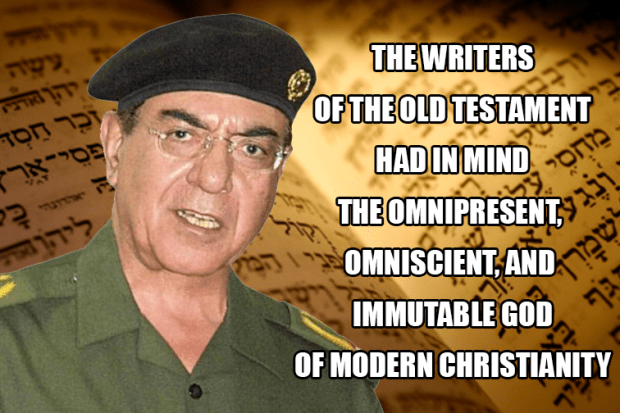
VOTD Lamentations 2:20
Lam 2:20 “See, O LORD, and consider! To whom have You done this? Should the women eat their offspring, The children they have cuddled? Should the priest and prophet be slain In the sanctuary of the Lord?
Worship Sunday – Days of Elijah
Days of Elijah by Robin Mark
These are the days of Elijah
Declaring the Word of the Lord
And these are the days of Your
Servant Moses
Righteousness being restored
And though these are days of
Great trials
Of famine and darkness and sword
Still we are the voice in the desert crying
Prepare ye the way of the Lord
Behold He comes riding on the clouds
Shining like the sun at the trumpet call
Lift your voice it’s the Year of Jubilee
Out of Zion’s hill salvation comes
These are the days of Ezekiel
The dry bones becoming as flesh
And these are the days of
Your servant David
Rebuilding a temple of praise
And these are the days of the harvest
The fields are as white in Your world
And we are the laborers in Your vineyard
Declaring the Word of the the Lord
There’s no god like Jehovah
Lift your voice it’s the year of Jubilee
Out of Zion
VOTD Lamentations 2:17
Lam 2:17 The LORD has done what He purposed; He has fulfilled His word Which He commanded in days of old. He has thrown down and has not pitied, And He has caused an enemy to rejoice over you; He has exalted the horn of your adversaries.
Boyd on Romans 9 full sermon
VOTD Lamentations 2:5-6
Lam 2:5 The Lord was like an enemy. He has swallowed up Israel, He has swallowed up all her palaces; He has destroyed her strongholds, And has increased mourning and lamentation In the daughter of Judah.
Lam 2:6 He has done violence to His tabernacle, As if it were a garden; He has destroyed His place of assembly; The LORD has caused The appointed feasts and Sabbaths to be forgotten in Zion. In His burning indignation He has spurned the king and the priest.
Answered Questions – Genesis 15:13
On the Open Theism Facebook page, John asks:
How do we explain Genesis 15:13 “God said to Abram, ‘know for certain that your descendants will be enslaved in a Foreign land for 400 years?”
In response, an article was posted by Gregory Boyd:
This passage may constitute a conditional prophecy which could have been modified had circumstances called for it. Many if not most prophecies in the Bible are conditional (cf. Jer. 18:7–10). They are not mere previews of an unalterable future. They rather reveal God’s present intentions, assuming things don’t change.
On the other hand, the passage may indeed constitute an unconditional prophecy. In this case the passage reveals a now-unalterable feature of God’s providential plan. The sovereign Lord of history who is ultimately in control of the movement of the nations (Acts 17:24–28) deemed it wise to ensure that his future people would be in captivity for four centuries. It is important to note, however, that the Lord would not need to control and/or foreknow every other detail about human history to accomplish this. The Lord of history who grants whatever degree of freedom he wishes to grant to his human subjects can control and foreknow aspects of the future and guide history toward his desired goal without micro-controlling and foreknowing every detail along the way.
VOTD Lamentations 2:3
Lam 2:3 He has cut off in fierce anger Every horn of Israel; He has drawn back His right hand From before the enemy. He has blazed against Jacob like a flaming fire Devouring all around.
Apologetics Thursday – Duncan Taught Reading Comprehension
J Ligon Duncan “disproves” Open Theism in two stanzas:
It occurred to me, as we were singing last night, that the first two stanzas of this hymn are all you need to refute “open theism” or at least all you need to know that “open theism” is unbiblical. If you understand what we sang then, you have all you need in order to know that open theism is wrong.
Listen to Dr. Boice’s lyrical rendering of Romans 11:33 and following. “Give praise to God who reigns above for perfect knowledge, wisdom, love. His judgments are divine, devout. His paths beyond all tracing out. No one can counsel God all wise or truths unveil to His sharp eyes. He marks our paths behind, before. He is our steadfast counselor. Come lift your voice to heaven’s high throne and glory give to God alone.”
Two points. The first point is that normal reading comprehension must make allowances for figurative, idiomatic, and hyperbolic speaking. Hyperboles are everywhere in normal conversation. Notice that the last sentence is itself a hyperbole (“everywhere” is not a literal descriptor). Hyperboles are so common that people do not even realize when they are being used.
Imagine that I say of a boss at work:
“Sam knows everything. He is also kind, generous, and his decisions are always fair.”
An honest reader would understand these as rules of thumb. They would not be wooden understandings, but dynamic and with leeway. Pretend now that the context of this statement is relating to Sam just firing an employee, Bob (Romans 11 is in the context of God revoking His promise to Israel):
“How can you question Sam’s action (knowing he is good, kind, generous, and fair)? You have no right to do so. It was Sam’s choice to hire Bob in the first place. Bob is not entitled to that job.”
Obviously, if the context is a firing then the specific statements are not normally read as generalizations. To then think that Sam’s actions are always unquestionable, is contrary to reading comprehension. Moses certainly questioned God’s intended actions on Mount Sinai, which resulted in God changing His mind. Instead, the descriptors are best understood as loose and flexible, specific to the instance in question.
When people are being described, it is usually in complete use of hyperboles. “My wife is kind, intelligent and truthful.” This would not mean that my wife never was mean, or never said something absurd, or never told a lie. Normal human communication describing people is filled (another hyperbole) with hyperboles. In fact, the Calvinist reading attempts to discount human communication (which is odd, considering the entire Bible is written for humans).
When Calvinists read verses, they often discount the most natural reading in favor of their theological take. They then discount all other possibilities.
The second point is that no Open Theist would refrain from making the same statements about God as listed in Romans. If Duncan wishes to disprove Open Theism, he might want to examine what they say about his specific prooftext.
Yes, no one has taught God “morality” or “justice” (although King David successfully moved God to judgment multiple times). No one has fully understood God’s power (although King David knew what God was capable of accomplishing). Note: King David was an Open Theist poet.
This does not mean that no one has ever swayed God, as David in the Psalms and as Moses did on Mount Sinai. The Mount Sinai event is documented thoroughly throughout the Bible. Paul was well aware of this event, believed this event, and still wrote his words. Is it more probable that Paul was using normal communication techniques? Or is it more probable that Paul was writing some theological code that overwrote Biblical stories with strange metaphysics. The normal reading comprehension of text should always be preferred over the theologically tainted.
The Calvinist reading is wholly unnatural and should be rejected as absurd.
VOTD Lamentations 2:2
Lam 2:2 The Lord has swallowed up and has not pitied All the dwelling places of Jacob. He has thrown down in His wrath The strongholds of the daughter of Judah; He has brought them down to the ground; He has profaned the kingdom and its princes.
Open Theist Miniseries
Reposted from realityisnotoptional.com:
The Record Keeper is a steampunk themed webseries centered around the angels’ perspectives as events occur throughout the Bible. If that sounds awesome, it is because it is awesome. The series was produced as an outreach project by Seventh Day Adventists. Adventists seem to ascribe to a Warfare Worldview in which the forces of evil engage against the forces of good for the fate of the future. This is the premise of the series.
In this series, the main protagonists are two angels (Larus and Cadan) who had long been friends but are separated as one defects with Satan (Larus) while the other remains loyal to God (Cadan). These two periodically meet with a “Record Keeper”. At some point in the past, God has appointed a Record Keeper to create a database of the facts of events throughout history. The purpose of these records is to build an evidence file for use during a future judgment. The record keeper acts as a neutral third party. In order to eliminate bias, Satan’s angels are given temporary guarantee of safety in order to periodically meet with the record keeper to give their version of events. They agree to this as a way to make sure documentation is included in the records against God and in their own defense. In the series, it comes to light that the agents of Satan employ their own record keeper in anticipation of a future judgment of God (they anticipate defeating God at some point).
Normally angels meet individually with the Record Keeper, but, because of the closeness of the two friends, they are allowed to meet together (one representing God and the other representing Satan). The series follows their relationship as the events of the Bible unfold. Additionally, the person of the record keeper is examined, as she struggles with learning about all these events second-hand.
The series, although creative and well written, was suspended by the leaders of the Seventh Day Adventists after the leaders objected to material found within. One such objection is that Open Theist themes strongly present itself in the plot narrative. This Open Theism is a reoccurring theme, as God’s angels plot to bring about prophecies from the Old Testament and Satan’s angels plot to negate them. The entire titular role is played by a record keeper meant to store information for future examination (the first few episodes suggest for use on judgment day, the last suggests for use by third parties). The storing of information is strongly anti-platonic. Really interesting is the episode where Satan becomes concerned that one of his angel’s is “leaking information” to God’s angels, something that should not be an issue if omniscience was assumed.
Additionally, the idea that Satan and his minions even believe “they can defeat God” does not play into the platonistic concept of who God is and what attributes He possesses. The Biblical account of the angelic rebellion is just as hard for platonistic Christians to explain as it is for critics of this webseries. Instead, the series is written similar to the Bible, in which Open Theism is an underlying theme manifesting in the behavior and dialogue of all actors. The times that platonism is injected seem very forced (“One day they will invent crumpets.”).
The series excels at bringing out good ideas that should probably be explored further. Why did the angels rebel? What were their motivations? How did they see their roles throughout history? How did they experience the events in the Bible? Where were they and what did they do while these events were taking place?
The series depicts multiple reasons for angels defecting with Satan (referred to as the “general” throughout the series). One of Satan’s main appeals was his declarations against “inequality” in God’s kingdom. Satan promised equality and freedom. Larus wanted freedom from God. He viewed God’s control with spitefulness and longed to control his own destiny. Another angel defected due to jealousy. This angel had been given the same position by Satan that she was rejected for in God’s kingdom. Certainly, Satan’s own jealousy is traditionally the reason given as to why Satan defected.
In the series, the audience is exposed to angels as persons. The angels have individual motivations and desires. The angels reason. The angels are affected with strong emotion. The angels are explored as people. Angels are not considered as a homogeneous mass of automatons.
Another series highlight is that “child murder” is portrayed as God’s ultimate hated sin. This is repeated a few times, and the act is even disdained by Satan’s followers. The implications for modern abortion are obvious.
As for the movie itself. The filming is done very professionally. In addition to steampunk themed offices, the Antelope Canyon and Horseshoe Bend serve as backdrop of this fantasy world. The actors are mostly believable. The dialogue is solid and interesting (plenty of nuances to flush out). The soundtrack includes an excellent rendition of Amazing Grace during the final episode. This is a high quality web series.
The list of reasons given by the Seventh Day Adventists as to why this series was suspended are mostly bogus, predicated on assumptions and a poor understandings of the plot. For example:
-The series does not portray Satan as “ruler of hell”, unless a poorly lit warehouse counts as hell. Satan must have some sort of base of operations. Why not a warehouse?
-Angels are seen ensuring that Jesus is born in Bethlehem through use of their power. Plenty of events in the Bible describe angels using their power to bring out prophecy. An angel slaughtering the Assyrian army is one such example (2 Kings 19:35). The Adventist leaders rightly understand that there are severe Open Theist implications. They reject the Bible due to their philosophy.
-When characters in the film say of Jesus “He’s not human” and “He cannot die”, they are shown to be wrong in the very next episode. That was the point, Satan’s angels believed (in the series) that Jesus was immortal and thus did not kill him sooner.
– The episode states “the plan required the death of God.” The Adventist leaders claim, “Deity did not die”. Peter claims contrary to this: “[You] killed the Prince of life, whom God hath raised from the dead; whereof we are witnesses.” (Acts 3:15)
Possibly the feminizing of the Holy Spirit is the strongest point that they have, but most of their complaints are shaky and amount to petty concerns. It would be a shame to throw out this gem based on trivial theological mistakes.
In retrospect, it is probably a good thing that this webseries was discontinued by the Seventh Day Adventists. Discontinuation ensures the series is not ruined with all the “fixes” suggested by the Adventist leaders, solidifying for eternity the theological implications of the series.
Trailer:
Episodes:
VOTD Psalms 90:11
Psa 90:11 Who knows the power of Your anger? For as the fear of You, so is Your wrath.
Oord Counters Sanders on Evil
Open Theist Thomas J Oord criticizes Open Theist John Sanders on the problem of evil:
In The God Who Risks, Sanders often says God permits evil when it could have been prevented (all quotations in this blog come from that book)…
Sanders’s position ends up sounding like a “best of all possible worlds” defense to the problem of evil. According to it, God allows evil because preventing it would undermine the good of the overall project. Sanders admits that many atrocities are “pointless evils” and “God does not have a specific purpose in mind for these occurrences.” But he also seems to believe “some evils are justified for some greater good.”
I find it difficult to imagine how God preventing rape and murder in any particular instance would throw out of balance the structures of the universe. I am not convinced the creation project requires God to allow genuine evils – including the Boston Marathon bombing, the debilitating condition of severely handicapped infants, the rape and murder of innocent women, and countless other atrocities.
VOTD Psalms 86:5
Psa 86:5 For You, Lord, are good, and ready to forgive, And abundant in mercy to all those who call upon You.
Meme Monday – Cant Explain That
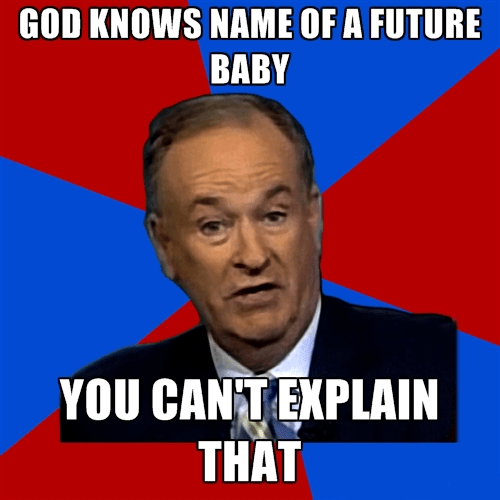
VOTD Isaiah 66:24
Isa 66:24 “And they shall go forth and look Upon the corpses of the men Who have transgressed against Me. For their worm does not die, And their fire is not quenched. They shall be an abhorrence to all flesh.
Worship Sunday – Our God is Living Personal Relational Good and Loving
By Tony Funderburk
As followers we say
We know He’s the only Way that frees us
From the sins we hide deep inside. They…can’t please us.
Our bodies…become the dust that scatters.
If that’s it…then nothing really matters.
We may as well give in
When we feel the world begin to seize us.
Who needs all that guilt and blame
You get calling on the name of Jesus?
But it’s not like that.
It’s a fact…Jesus sees us.
He’s living and He’s life…
He’s personal to talk to…
Relational with every son and daughter.
He’s good and so much more….
He’s loving to the core…
Jesus is the Living Water.
And each time a soul is saved all the angels above sing…
Our God is living, personal, relational, good…and loving.
Our souls know…infinity is calling.
But temptation…can keep our spirits falling.
So we need to fix our eyes
On the true eternal prize of Jesus.
When we stand before the throne,
He knows our lives, alone, won’t appease us.
No, we need the blood of the lamb…
we need Jesus
VOTD Isaiah 66:15-16
Isa 66:15 For behold, the LORD will come with fire And with His chariots, like a whirlwind, To render His anger with fury, And His rebuke with flames of fire.
Isa 66:16 For by fire and by His sword The LORD will judge all flesh; And the slain of the LORD shall be many.
Open Theism – CCT Conversations
VOTD Isaiah 66:13
Isa 66:13 As one whom his mother comforts, So I will comfort you; And you shall be comforted in Jerusalem.”
Answered Questions – Open Theism Charts
From the Facebook group What is Biblical Open Theism:
Teaching a theology small group and we’re covering open theism this week. Anybody know of any good handouts or charts I can give the group?
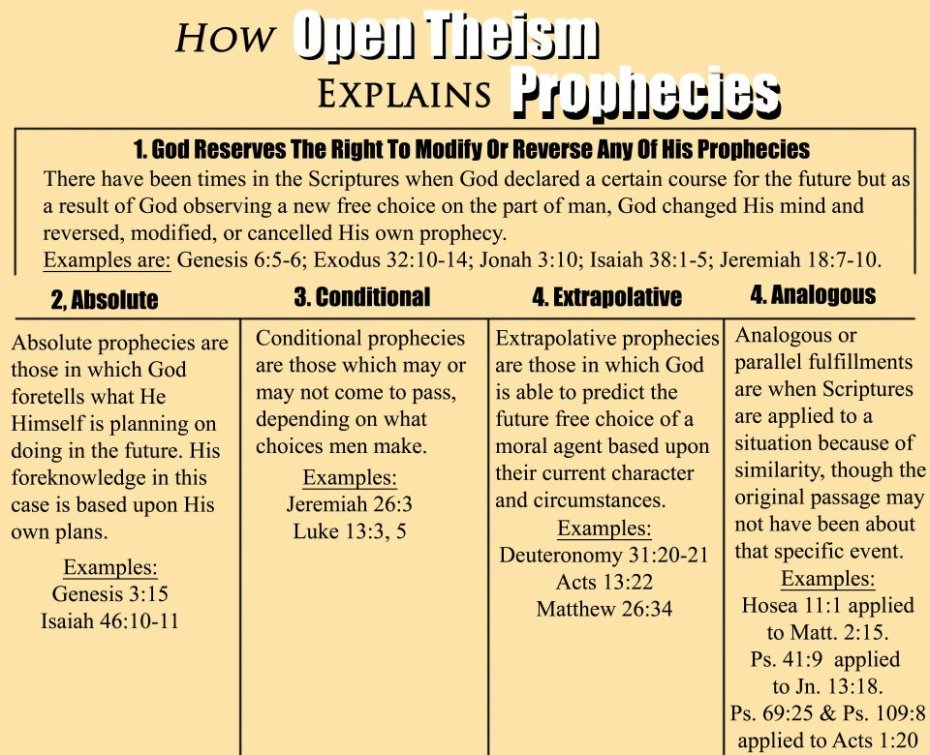

VOTD Isaiah 66:6
Isa 66:6 The sound of noise from the city! A voice from the temple! The voice of the LORD, Who fully repays His enemies!
Apologetics Thursday – Responding to Philosophy
In this video, John Schoenheit (after making several other excellent points) makes the case that the proper response to philosophical arguments is “that may be somebody’s accepted theology but that is simply not in the Bible.”
VOTD Isaiah 66:1
Isa 66:1 Thus says the LORD: “Heaven is My throne, And earth is My footstool. Where is the house that you will build Me? And where is the place of My rest?
Isa 66:2 For all those things My hand has made, And all those things exist,” Says the LORD. “But on this one will I look: On him who is poor and of a contrite spirit, And who trembles at My word.
Olson on Evil Necessitating God
From Roger Olson’s Evil As Signal of Transcendence:
The language and conceptuality of evil belongs within a theistic frame of reference. Atheists who use it are simply living off the leftovers of theism. Like my insightful atheist interlocutor here, they ought to discard it. But who can seriously refer to the Holocaust as a “mistake” or “harmful” or “pathological” without going further and calling it also evil? Sure, some will attempt it, but I dare them to have that conversation with a survivor of Auschwitz. And once you utter “evil” and mean it seriously, God is at least on the horizon. For without God (or something very much like God whatever you prefer to call him or it) evil falls back into being only a human value judgment which sucks the very power from it.
VOTD Isaiah 46:1
Isa 46:1 Bel bows down, Nebo stoops; Their idols were on the beasts and on the cattle. Your carriages were heavily loaded, A burden to the weary beast.
Isa 46:2 They stoop, they bow down together; They could not deliver the burden, But have themselves gone into captivity.
Calvinist turns Arminian
Excerpted from a post entitled: Calvinist Pastor Turns from Calvinism to Arminianism after 20 Years as a Calvinist and Intensive Study:
The third thing that set me on the course to reject RT was the thing that had led me into it – Scripture itself. As a pastor I preached through books of the Bible verse by verse. Occasionally I would encounter a common Calvinistic proof text and realize that it did not necessarily say what I had thought it said. John 3 does not necessarily teach that regeneration precedes faith; John 10 does not necessarily teach that Jesus died only for the elect; Eph 1 does not necessarily teach that God ordained whatever happens; 1 Pet 1 does not necessarily teach that God elected individuals for salvation – unconditionally, effectually, exclusively. Once again, these discoveries did not shake my confidence in RT. There were too many passages that clearly taught it; I considered Romans 9 impregnable to Arminian assault. But I realized that the quantity of verses used to support my view did not matter if, upon closer scrutiny, they could not bear the weight that we Calvinists were putting on them on a case-by-case basis.
VOTD Isaiah 43:3
Isa 43:3 For I am the LORD your God, The Holy One of Israel, your Savior; I gave Egypt for your ransom, Ethiopia and Seba in your place.
Meme Monday – Curious George
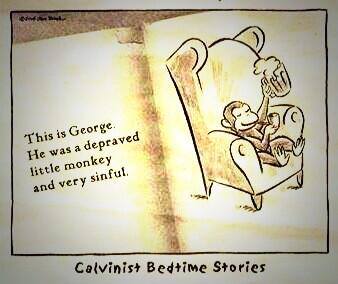
VOTD Isaiah 41:22-24
Isa 41:22 “Let them bring forth and show us what will happen; Let them show the former things, what they were, That we may consider them, And know the latter end of them; Or declare to us things to come.
Isa 41:23 Show the things that are to come hereafter, That we may know that you are gods; Yes, do good or do evil, That we may be dismayed and see it together.
Isa 41:24 Indeed you are nothing, And your work is nothing; He who chooses you is an abomination.
Worship Sunday – Every New Day
Written by Five Iron Frenzy
Lyrics:
When I was young, the smallest trick of light,
Could catch my eye,
Then life was new and every new day,
I thought that I could fly.
I believed in what I hoped for,
And I hoped for things unseen,
I had wings and dreams could soar,
I just don’t feel like flying anymore.
When the stars threw down their spears,
Watered Heaven with their tears,
Before words were spoken,
Before eternity.
Dear Father, I need you,
Your strength my heart to mend.
I want to fly higher,
Every new day again.
When I was small, the furthest I could reach,
Was not so high,
Then I thought the world was so much smaller,
Feeling that I could fly.
Through distant deeps and skies,
Behind infinity,
Below the face of Heaven,
He stoops to create me.
Dear Father, I need you,
Your strength my heart to mend.
I want to fly higher,
Every new day again.
Man versus himself.
Man versus machine.
Man versus the world.
Mankind versus me.
The struggles go on,
The wisdom I lack,
The burdens keep pilling
Up on my back.
So hard to breathe,
To take the next step.
The mountain is high,
I wait in the depths.
Yearning for grace,
And hoping for peace.
Dear God…
Increase.
Healing hands of God have mercy on our unclean souls once again.
Jesus Christ, light of the world burning bright within our hearts
forever.
Freedom means love without condition, without a beginning or an end.
Here’s my heart, let it be forever Your’s,
Only You can make every new day seem so new.
VOTD Isaiah 40:28
Isa 40:28 Have you not known? Have you not heard? The everlasting God, the LORD, The Creator of the ends of the earth, Neither faints nor is weary. His understanding is unsearchable.
Calvin on God’s Secret Will
That nothing happens by chance, though the causes may be concealed, but by the will of God; by his secret will which we are unable to explore,
VOTD Isaiah 5:25
Isa 5:25 Therefore the anger of the LORD is aroused against His people; He has stretched out His hand against them And stricken them, And the hills trembled. Their carcasses were as refuse in the midst of the streets. For all this His anger is not turned away, But His hand is stretched out still.
Answered Questions – Open Theist Hermeneutics
From the Open Theist Facebook page:
Have any open theists outlined a specifically open hermeneutic?
1. From Bob Enyart’s debate with Lamerson:
But because the argument based on God’s attributes and His redemption intervention in history stands not on a few proof texts, but on the combined force of the entire Word of God, whatever they concoct will have little persuasive effect, and the Openness movement will win over Christians in growing numbers and by far more biblical and powerful evangelism, increase the harvest of souls.
Jehovah’s
Obvious
Nativity
Attributes
HermeneuticJONAH demonstrates that attributes like relationship and love take precedence over immutability, knowledge, and power, thereby establishing the truth of Openness by obliterating the only justification for the Settled View.
And by JONAH, we can therefore use NOAH, the:
New
Openness-
Attributes
HermeneuticNOAH resolves conflicting interpretations by selecting those which give precedence to the biblical attributes of God as being living, personal, relational, good, and loving, and by rejecting explanations derived from commitment to the philosophical attributes of God such as omniscience, omnipresence, omnipotence, impassibility, and immutability.
2. From Rightnerve:
The Eight-Year Hermeneutic:
Definition: Ask an 8-year old, “What does this verse mean?” Almost always…you’ll hear what it means.
An 8-year old isn’t educated enough to spiritualize away obvious meanings. It takes a Master’s Degree in Theology or a serious reading of several dead Germans to become stupid enough to try that.
The Eight-Year Hermeneutic’s Corollary #1: If the 8-year old is home-educated, the hermeneutic’s accuracy rate increases 518.42%.
The Neo-Christianized Hermeneutic:
Definition: If most Christians say it, it’s probably wrong.
The Neo-Christianized Hermeneutic Corollary #1: In most cases, the more a Christian quotes a verse, the less likely it’s in the Bible.
3. From Walter Brueggemann’s Theology of the Old Testament:
We may now consider the peculiar and characteristic way in which Israel formulates its testimony about God. Here I suggest what appears to be a normative way in which such utterance is given in Israel, a way that constitutes the primary witness of Isreal…
It is important, first of all, to recognize that Israel’s utterance about God is characteristically stated in full sentences, and the sentence is the unit of testimony that most reliably is taken as revelation. Here we do well to follow James Barr in his warning against overreliance on isolated words. 14 I insist that God is embedded in Israel’s testimony of full sentences and cannot be extracted from such full sentences…
Second, Yahweh the God of Israel, who may variously be designated by many titles and metaphors, is characteristically the subject of the active verb. 16 Thus the characteristic claim of Israel’s testimony is that Yahweh is an active agent who is the subject of an active verb, and so the testimony is that Yahweh, the God of Israel, has acted in decisive and transformative ways… For our large purposes we should note, moreover, that such testimonial utterance in Israel is characteristically quite concrete, and only on the basis of many such concrete evidence does Israel dare to generalize.
The third element of this standard testimony of Israel is that the active verb has a direct object, the one acted on, the one for whom transformation has been wrought. 19 In the first instant, the direct object may be a personal pronoun— me, us— as the witness speaks about his or her own changed circumstance . Or this direct object may be expressed more formally as “Israel,” who is regularly the recipient of Yahweh’s direct activity. 20 But then, as we shall see, the direct object may vary greatly to include all of creation or even nonhuman parts of it, or the nations who are acted on by God in this rhetoric.
VOTD Isaiah 5:4
Isa 5:4 What more could have been done to My vineyard That I have not done in it? Why then, when I expected it to bring forth good grapes, Did it bring forth wild grapes?
Apologetics Thursday – White Contradicts on Jesus’ Nature
From Darrell Birkey:
The Shocking White/Enyart Debate Aftermath: R.C. Sproul Jr. & James White both startlingly deny that God the Son took upon Himself a human nature. Sproul: “God the Son does not now nor has He ever had two natures.” White: “God the Son does not have two natures. I did not ‘admit’ that He did/does/will etc.”
VOTD Isaiah 3:8-9
Isa 3:8 For Jerusalem stumbled, And Judah is fallen, Because their tongue and their doings Are against the LORD, To provoke the eyes of His glory.
Isa 3:9 The look on their countenance witnesses against them, And they declare their sin as Sodom; They do not hide it. Woe to their soul! For they have brought evil upon themselves.
Boyd on Peter
Gregory Boyd from Divine Foreknowledge: Four Views:
23. Also at play in the betrayal narrative is that Peter had been clinging to a mistaken militant concept of the Messiah (see, e, g., Matt. 16: 21 – 23). This is why Peter appeared so bold while Jesus was working miracles and the crowds were following him, yet revealed himself to be a coward once Jesus was arrested and the crowds turned against him. God’s purpose in having Jesus give the prophecy of Peter’s denial was to reveal to Peter the sinfulness of his own character and help him discover the true, self-sacrificial nature of leadership in the kingdom. The kingdom Jesus ushered into the world advances not by conquering people but by loving, serving, and dying for them (as Jesus was already showing Peter in the garden; see John 18: 10 – 11; cf. Luke 22: 50 – 51). I do not believe it is a coincidence that after the resurrection Peter was made to affirm three times his love for Christ and that Jesus then uttered another prophecy over him. Far from denying Christ, Peter was now ready to follow Jesus to the point of dying just as he died (see John 21: 15 – 19).
VOTD Isaiah 1:4
Isa 1:4 Alas, sinful nation, A people laden with iniquity, A brood of evildoers, Children who are corrupters! They have forsaken the LORD, They have provoked to anger The Holy One of Israel, They have turned away backward.
Boyd on the Seige of Tyre
Gregory Boyd explains that the prophecy of Tyre did not conclude as predicted:
Perhaps most impressively, in Ezekiel 26-28 we find a lengthy prophecy against the city of Tyre. It is said that Nebuchadnezzar, King of Babylon, would utterly defeat Tyre, killing its inhabitants, plundering all its wealth and leveling all its walls so that it ends up being flat as a rock. Indeed, it is prophesied that it would virtually vanish from the earth and never be found again. Well, it didn’t quite happen that way, as Goldingay notes.
Nebuchadnezzar did lay siege to Tyre, but, while he did gain some control of the city, it was “nowhere near as decisive as Ezekiel had implied” (Old Testament Theology, Vol. II, 83). The city wasn’t completely conquered and laid flat until Alexander did this several hundred years later.
Because his campaign failed, Nebuchadnezzar failed to get much of Tyre’s wealth. So, says Goldingay, Yahweh made “ a new decision.” He decided to turn Egypt over to him in order to repay him for his expenses in his “vain effort” to take Tyre (Ezek. 29:17-20; Goldingay, ibid., 84). The amazing thing is that this campaign also seems to have failed! Nebuchadnezzar invaded Egypt, but “the achievement did not amount to conquest” (op.cit.).
VOTD Numbers 14:34-35
Num 14:34 According to the number of the days in which you spied out the land, forty days, for each day you shall bear your guilt one year, namely forty years, and you shall know My rejection.
Num 14:35 I the LORD have spoken this. I will surely do so to all this evil congregation who are gathered together against Me. In this wilderness they shall be consumed, and there they shall die.’ ”
Free Monday – Arguments Of Celsus, Porphyry, And The Emperor Julian
Understanding the earliest Christian critics gives modern readers an understanding into the thought process of the ancient world. Arguments Of Celsus, Porphyry, And The Emperor Julian, Against The Christians takes the existing words of these Christian critics and compiles them into one convenient source.
VOTD Psalms 85:4-5
Psa 85:4 Restore us, O God of our salvation, And cause Your anger toward us to cease.
Psa 85:5 Will You be angry with us forever? Will You prolong Your anger to all generations?
Worship Sunday – Oh, Lord, You’re Beautiful
Written by Keith Green
Oh Lord, You’re beautiful
Your face is all I see
For when Your eyes are on this child
Your grace abounds to me
Oh Lord, please light the fire
That once burned bright and clean
Replace the lamp of my first love
That burns with holy fear
I want to take Your Word and shine it all around
But first help me just ot live it, Lord
And when I’m doing well, help me to never seek a crown
For my reward is giving glory to You
VOTD Psalms 85:3
Psa 85:2 You have forgiven the iniquity of Your people; You have covered all their sin. Selah
Psa 85:3 You have taken away all Your wrath; You have turned from the fierceness of Your anger.
Philo on I AM
Neo-Platonist Philo writes of God’s statement I AM:
And God said, “At first say unto them, I am that I am, that when they have learnt that there is a difference between him that is and him that is not, they may be further taught that there is no name whatever that can properly be assigned to me, who am the only being to whom existence belongs.
 God is Open