Open Theism

Craig on Foreknowledge versus Fatalism

Molinist William Lane Craig offers a defense of Molinism and speaks against Open Theism:

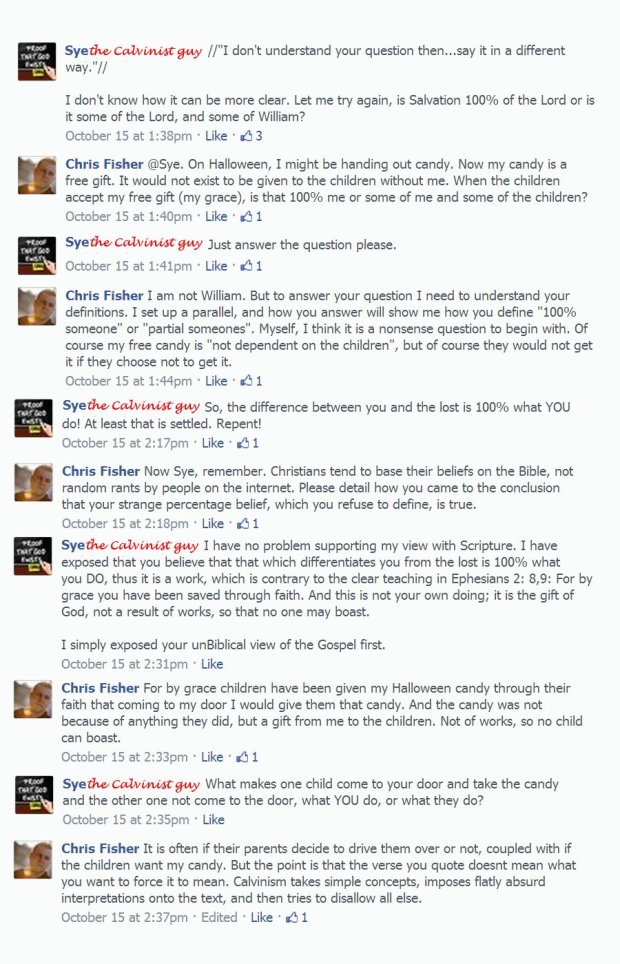
Of course, Craig is only offering a well worded distraction. Here is a response:

Could God tell someone what God knows they will do in the future and could that person choose to do something else? In this case, would God have really “known” they were going to that action? Would He have been lying?

Rice on Biblical Support

From The Openness of God:

It is not uncommon for people to dismiss these emotional descriptions of God, numerous as they are, as poetic flights essentially unrelated to the central qualities that the Old Testament attributes to God. As they see it, the real God of the Bible is made of sterner stuff. He is powerful, authoritarian and inflexible, so the tender feelings we read of in the prophets are merely examples of poetic license. As I understand it, however, the evidence supports a strikingly different conclusion. One scholar links these emotion-filled accounts of God’s love for Israel directly to the concept of divine oneness, which lies at the heart of biblical religion.

Perry on New Hermeneutics

Greg Perry of rightnerve suggests a couple new hermeneutics:

The Eight-Year Hermeneutic:

Definition: Ask an 8-year old, “What does this verse mean?” Almost always…you’ll hear what it means.

An 8-year old isn’t educated enough to spiritualize away obvious meanings. It takes a Master’s Degree in Theology or a serious reading of several dead Germans to become stupid enough to try that.

The Eight-Year Hermeneutic’s Corollary #1: If the 8-year old is home-educated, the hermeneutic’s accuracy rate increases 518.42%.

The Neo-Christianized Hermeneutic:

Definition: If most Christians say it, it’s probably wrong.

The Neo-Christianized Hermeneutic Corollary #1: In most cases, the more a Christian quotes a verse, the less likely it’s in the Bible.

For full post, click here.

Apologetics Thursday – Skelly on Revelation 6

By Christopher Fisher

Arminian Kerrigan Skelly states that he is not an Open Theist for a few Biblical reasons. He quotes Revelation 6:

Rev 6:9 When He opened the fifth seal, I saw under the altar the souls of those who had been slain for the word of God and for the testimony which they held.
Rev 6:10 And they cried with a loud voice, saying, “How long, O Lord, holy and true, until You judge and avenge our blood on those who dwell on the earth?”
Rev 6:11 Then a white robe was given to each of them; and it was said to them that they should rest a little while longer, until both the number of their fellow servants and their brethren, who would be killed as they were, was completed.

Skelly then states his objection to Open Theism:

How can God know with certainty exactly how many are going to be killed or that any more at all will be killed when killing a Christian for being a Christian is a freewill decision… not only that but how does God know there will be any more martyrs at all period because for all He knows all people who have a chance at being a martyred could depart from the faith and choose not to be martyrs and deny Christ and there would be no more martyrs at all.

When Calvinists debate against Open Theists, they naturally assume that if Open Theists say God does not control everything then the Open Theist is claiming that God can do nothing. Likewise, Arminian Skelly assumes that if Open Theists claim God does not know the future then God cannot predict the actions of free will agents.

Because future human actions are largely predictable by almost anyone, Skelly’s claim is wildly unfounded. It does not take a rocket scientist to predict that if we drive to Walmart right now, the clerk will accept cash in exchange for any candy bar we pick out. Even very dull human beings can accurately predict unknown future behavior of other human beings. That someone does not even have to know the cashier personally to know this future freewill decision. If humans can this easily and accurately predict other human behavior, how much more-so can God with access to infinitely more resources?

The verse in question does not quite suggest what Skelly believes it suggests. It appears that in the scenario, God is waiting until a certain magnitude of Christians are killed. The scenario suggests that God is not waiting for Christian number 31,732 to die, but God is waiting for a certain rough tipping point to enhance the impending vengeance.

It is very important to note that no time-frames are given, only rough estimates. How long? A little while longer. If God had the future locked in His mind, God could have provided a more definite answer. But God does not talk like someone who has the future mapped out in minute detail in His mind. Instead God speaks as if He has plans and then works with human actions to accomplish His purpose. In other words, the entire story of the Bible from God’s cascading series of contingency plans with Pharaoh to the crucifixion of Jesus.

Rice on Jeremiah 18

From The Openness of God:

But a more natural reading of the passage, we believe, suggests something quite different. What happens to nations is not something that God alone decides and then imposes on them. Instead, what God decided to do depends on what people decide to do. His decisions hinge on the way human beings respond to his threats and warnings. If this is so, a description of intended divine judgment is not an announcement of ineluctable fate, it is a call to repentance.

Smock on God’s Choice to Be Loving

From Open Air preacher Jed Smock:

If God is not free to do good or evil then God is not responsible or accountable. Many view the Sovereign God as being accountable or responsible to no one and without any controls. Surely the God of the Bible exerts self-control in the light of His law which is the expression of His heart. Although God is by nature independent, when He created the universe He became accountable and responsible to his creatures. Now His happiness is to a large degree dependent on their loving response to his overtures of love. What? Create dependent beings, and then not acknowledge any responsibly or accountability for their well-being? No, not the God of the Bible! “O my people, what have I done unto thee? and wherein have I wearied thee? testify against me.” ( Micah 6:3) Here we have the exalted God humbling himself before his creatures, asking them to judge Him. But how could men judge God, if there is no standard to which even He is accountable?

For full article, click here.

Rice on God’s Methodology

From The Openness of God:

These incidents indicate that human intercession can influence God’s actions. They show that God’s intentions are not absolute and invariant; he does not unilaterally and irrevocably decide what to do. When God deliberates, he evidently takes a variety of things into account, including human attitudes and responses. Once he formulates his plans, they are still open to revision. This appears to be true of even the most emphatic assurances on God’s part.

Piper Defends Augustine

From a recent blog post by Craig Fisher:

Here is what Piper believes about Augustine’s conversion experience. Augustine already believed in God and loved God but was held back from conversion because he had not achieved a purification from the bestial bondage of lust. The battle was between not having sex and having sex. The final conversion was in the words of Augustine, “You converted me to yourself, so that I no longer desired a wife.”

“Augustine was stung by his own bestial bondage to lust, when others were free and holy in Christ.” P 52

“So now the battle came down to the beauty of Continence and her tenders of love versus the trifles that plucked at his flesh.” P 53

“The experience of God’s grace in his own conversion set the trajectory for his theology of grace that brought him into conflict with Pelagius and made him the source of the Reformation a thousand years later.” P 54

“Later, just after his conversion, he went to tell his mother what God had done in answer to her prayers: Then we went and told my mother [of my conversion], …You converted me to yourself, so that I no longer desired a wife” p 68

For full post, click here.

Rice on God’s Plans

From The Openness of God:

But the biblical descriptions of divine repentance indicate that God’s plans are exactly that – plans or possibilities that he intends to realize. They are not ironclad decrees that fix the course of events and preclude all possible variation. For God to will something, therefore, does not make its occurrence inevitable. Factors can arise that hinder or prevent its realization. Consequentially, God may reformulate his plans, or alter his intentions, in response to developments.

Free Monday – Learn to Read Greek

From textkit.com, a list of free Greek resources:

Greek Answer Keys

A Brief Introduction to New Testament Greek Key, Samuel G. Green
First Greek Book Key, John Williams White
First Greek Writer Key, Arthur Sidgwick
Greek Prose Composition Key, North and Hillard
Greek Prose Composition Key, Arthur Sidgwick

Greek Composition Textbooks

First Greek Writer, Arthur Sidgwick
Greek Prose Composition, North and Hillard
Introduction to Greek Prose Composition, Arthur Sidgwick
Lectures on Greek Prose Composition, Arthur Sidgwick
Selections from the Septuagint, Conybeare and Stock

Greek Lexicon/Dictionary

First Four Books of Xenophon’s Anabasis, William W. Goodwin
Illustrated Dictionary to Xenophon’s Anabasis, John Williams White
Pocket Lexicon of Greek New Testament, Alexander Souter

Greek Reading Text

Book Twelve of The Odyssey in Greek, Richard A. Minckwitz
Easy Selections From Plato, Arthur Sidgwick
Georgics Book IV in Latin, T.E. Page
Plato’s Apology of Socrates and Crito in Greek, Louis Dyer
Prometheus Bound of Aeschylus in Greek, F. D. Allen
Selections From Herodotus in Greek, W. Walter Merry
The Gospel of St. Luke in Greek, H.R. Heatley
The Iliad by Homer Books XIX – XXIV in Greek, Edward B. Clapp
The Odyssey by Homer Books V – VIII in Greek, B. Perrin
Xenophon’s Anabasis in Greek – Book VI, G.M. Edwards

Greek Reference Grammars

Greek Grammar, William W. Goodwin
Greek Grammar, Herbert Weir Smyth
Syntax of the Moods and Tenses of the Greek Verb, William W. Goodwin

Greek Textbooks

A Brief Introduction to New Testament Greek, Samuel G. Green
A First Greek Course, Sir William Smith
A Short Syntax of New Testament Greek, H.P.V. Nunn
First Greek Book, John Williams White
First Greek Grammar Accidence, W. Gunion Rutherford
First Greek Grammar Syntax, W. Gunion Rutherford
Homeric Greek – A Book For Beginners, Clyde Pharr
Introduction to the Language and Verse of Homer, Thomas D. Seymour
NT Greek in a Nutshell, James Strong

For listing, click here.

Rice on Metaphors

From The Openness of God:

But most scholars would reject a sharp division between literal and figurative theistic language in the Bible. This implies that all metaphors are alike, and such a view obscures the rich variations within the biblical descriptions of God.

While no metaphor provides us with a literal account of the divine reality – a one-to-one correspondence to its object – this does not mean that all metaphors are equally distant from the object represented… most Christians would agree that God is more like a shepherd thank a rock, and more like a parent than a shepherd. So within the broad spectrum of biblical metaphors, some are more important than others. These metaphors bear a stronger resemblance to the divine reality – they are closer, so to speak, to the intended
object…

Boyd on Power Worship

In Four Views: Divine Providence, Gregory Boyd wonders why Christians worship power:

Second, and most important, while I do not find it at all surprising that pagans typically define a deity’s greatness by his or her level of control over others – humans, after all, have worshiped power since the dawn of history – I am nonplussed as to why followers of Jesus would ever think this way. At the center of the New Testament is the shockingly beautiful revelation that Jesus, the crucified Son of God, reveals what God is really like. Jesus is the very “radiance of God’s glory” and the one and only “exact representation of his being” (hypostasis) (Heb 1:3)… If our thinking about God was unwaveringly fixed on Jesus, I honestly cannot see how we could ever conclude that God’s greatness is primarily about how much control he exerts over others. To the contrary, in Jesus we discover that God’s greatness is most clearly revealed in the foolishness and weakness of the cross (1 Cor 1:18-25).

Worship Sunday – I Can Only Imagine

I Can Only Imagine by MercyMe

Lyrics:

I can only imagine
What it will be like
When I walk
By your side

I can only imagine
What my eyes will see
When your face
Is before me
I can only imagine

[Chorus:]
Surrounded by Your glory, what will my heart feel
Will I dance for you Jesus or in awe of you be still
Will I stand in your presence or to my knees will I fall
Will I sing hallelujah, will I be able to speak at all
I can only imagine

I can only imagine
When that day comes
And I find myself
Standing in the Son

I can only imagine
When all I will do
Is forever
Forever worship You
I can only imagine

[Chorus]

I can only imagine [x2]

I can only imagine
When all I will do
Is forever, forever worship you

Rice on Evidence for Interactiveness

From The Openness of God:

Two streams of biblical evidence support an interactive view of God’s relation to the world. One consists of statements that affirm in one way or another that God is responsive to what happens in the creaturely world, that what happens there affects God somehow – by evoking a certain emotion, a change in attitude, a change in plans. The other consists of statements that indicate creatrurely freedom in one way or another. These include various divine warnings and promises and calls to repentance, as well as fairly straightforward assertions that presuppose creaturely alternatives.

VOTD Genesis 1:26

Gen 1:26 Then God said, “Let Us make man in Our image, according to Our likeness; let them have dominion over the fish of the sea, over the birds of the air, and over the cattle, over all the earth and over every creeping thing that creeps on the earth.”

If you would like to guest post commentary on this verse, please send to admin@godisopen.com .

Craig on Culpability

In Four Views: Divine Providence, William Lane Craig lists why fatalism makes God responsible for evil:

If it is evil to make another person do wrong, then in this view God not only is the cause of sin and evil, but he becomes evil himself, which is absurd. By the same token, all human responsibility for sin has been removed, for our choices are not really up to us: God causes us to make them.

Apologetics Thursday – Skelly on 2 Thessalonians

By Christopher Fisher

Arminian Kerrigan Skelly states that he is not an Open Theist for a few Biblical reasons. He quotes 2 Thessalonians 2:

2Th 2:1 Now, brethren, concerning the coming of our Lord Jesus Christ and our gathering together to Him, we ask you,
2Th 2:2 not to be soon shaken in mind or troubled, either by spirit or by word or by letter, as if from us, as though the day of Christ had come.
2Th 2:3 Let no one deceive you by any means; for that Day will not come unless the falling away comes first, and the man of sin is revealed, the son of perdition,

Skelly then states his objection to Open Theism:

My question is this: How could God, possibly know, with certainty, that a falling away will ever come? Because falling away, according to the Open Theist perspective (of course, according to my perspective, as well) is a freewill choice of man. To fall away from the faith (or to apotheosize) is a freewill choice of man. And God couldn’t possibly know with certainty, unless of course, he was bringing it to past by his own power. But now, if we say that, we are back to Calvinism… If God does not know the future free will choices of man, for all God knows no one will ever fall away from the faith. This was written about 60AD, we are talking about almost 2000 years removed and that day has no come yet. God is saying with certainty something that will happen 2000 years into the future.

There are several problems with Skelly’s argumentation. The primary problem is that sin is easy to predict. If North Korea gains unfettered access to the internet, almost every computer will be filled with pornography. It happened after the fall of Saddam Hussein, after the fall of communism (while pornography was still in video cassette format), and it will happen in any society that gains unfettered internet access. A general falling away from truth is about the easiest thing to predict. It does not take God to make that prediction. In fact, countless times in history could have been used by God as that “falling away” and no one would have blinked twice. Predicting a common event (that anyone can predict) does not indicate precise foreknowledge.

The second problem is that we are now removed 2000 years from the prophecy. Either the prophecy has failed (God changed His mind, as He is allowed to do) or God has an infinite amount of time to fulfill this prophecy. Either case is not very conducive to Arminianism. The New Testament authors and readers were all well convinced the apocalypse would happen in their own lifetimes (Mat 4:17, Mat 10:7, Mar 1:15, Mat 24: 25-34, Mat 26: 63-64, Mat 10:23, Luk 21:22, Luk 21:28, Luk 21:31, 1 Pet 4:7, Heb 1:2, 1 Pet 1:20, Heb 9:26, Heb. 10:25, 1 Joh 2:18, Jas 4:13, Jas 5:8, 2Pe 3:11, Rev 3:11). The list goes on. Even in 1 Thessalonians, Paul is assuming a quick apocalypse. He informs the Thessalonians that their persecutors will receive harsh judgment (2Th 1:6-8) and he speaks as if they will still be alive during this event (2Th 1:11). He then explains, in the cited text, what they should be looking for (as opposed to their great-great-great-great-great-great + (65 more greats) grandchildren).This is just not the proof text that Skelly would have it be.

Alternatively, if God has an infinite amount of time to fulfill the prophecy then what does it matter if the event never comes to past? Arminians will forever claim that it is coming in the future, and then add whatever time between the prophecy and now as evidence God can see that far into the future. But if God has infinite time to fulfill the prophecy, couldn’t He just wait until the events line up in the fashion that He desires. As show before, everyone expected an imminent end. The facts better fit God waiting until the free choices of humans align with his plans rather than pre-knowing thousands of years of human history.

2 Thessalonians 2 fits the Open Theist model much better than any closed model. Either God changed His plans or God is waiting (longer than expected) to fulfill His plans.

VOTD Isaiah 55:6-8

Isa 55:6 Seek the LORD while He may be found, Call upon Him while He is near.
Isa 55:7 Let the wicked forsake his way, And the unrighteous man his thoughts; Let him return to the LORD, And He will have mercy on him; And to our God, For He will abundantly pardon.
Isa 55:8 “For My thoughts are not your thoughts, Nor are your ways My ways,” says the LORD.

If you would like to guest post commentary on this verse, please send to admin@godisopen.com .

Craig on Reality Under Fatalism

In Four Views: Divine Providence, William Lane Craig ponders reality under fatalism:

Universal, divine determinism makes reality into a farce. The whole world becomes a vain and empty spectacle. There are no free agents in rebellion against God, whom God seeks to win through love, and no one who freely responds to that love and freely gives his love and praise to God in return. The whole spectacle is a charade whose only real actor is God Himself. Far from glorifying God, Helseth’s view, I am convinced, denigrates God for engaging in such a farcical charade. It is deeply insulting to God to think that he would create beings that are in every respect causally determined by him and then treat them as though they were free agents, punishing them for the wrong actions he made them do or lving them as though they were freely responding agents. God would be like a child who sets up his toy soldiers and moves them about his play world, pretending that they merit praise of blame.

Calvinist Opposes Man Choosing to be Saved

In Four Views: Divine Providence, Calvinist Paul Helseth objects to Free Will because that would make man the initiator of salvation. From the book:

The “power to do otherwise” that is essential to these theories of providence not only “assaults the doctrine of salvation by grace” by regarding human beings with libertarian freedom as “the first and effective agent[s] in salvation/” More importantly, it challenges “the assumption that God alone is original, self-existent, and necessary and that the entire contingent order depends on God for its existence,” for it presumes – without so much as a shred of explicit biblical support – that finite agents have the capacity to bring themselves and other things “from potency to actuality without the divine concurrence.”

Calvinist Objects to Peter’s Denials

In Four Views: Divine Providence, Calvinist Paul Helseth counters what he believes to be the Open Theist view of Peter’s denials:

But if the God of open theism in fact is willing – as he was in the case of Peter’s denial of Jesus – to
revoke the gift of self-determining freedom in order to bring about states of affairs that he really wants to bring about, then what becomes of this defense? In other words, what becomes of the attempt to get God “off the hook” for the problem of evil if he in fact is willing to violate the gift of self-determining freedom that he has given to moral agents, the gift that openness theologians insist is not just “irrevocable” but “the key to morally responsible personhood?”

Craig on Illusory Free Will

In Four Views: Divine Providence, William Lane Craig asks why we should believe fatalism:

Now, certainly God has the power to create a world characterized by universal, causal determinism. He could have created a world operating according to deterministic natural laws and containing no sentient creatures at all. Perhaps he could have even created a world containing sentient, self-conscious beings who have the illusion of indeterministic freedom of the will, just as he could have created vats containing brains that have the illusion of bodies acting in some external world. But why should we think that he has done so? Why should we think that our experience of indeterministic freedom is illusory?

Worship Sunday – You are My All in All

You are My All in All by Natalie Grant

Lyrics:

You are my strength when I am weak
You are the treasure that I seek
You are my all in all

Seeking You as a precious jewel
Lord, to give up I’d be a fool
You are my all in all

Jesus, Lamb of God
Worthy is Your name
Jesus, Lamb of God
Worthy is Your name
Oh, Your name is worthy

Taking my sin, my cross, my shame
Rising again I bless Your name
(I bless Your name)
You are my all in all
(Oh yes you are, yes you are)

When I fall down You pick me up
When I am dry You fill my cup
(You fill my cup)
You are my all in all
(My all, Lord, hallelujah)

Jesus, Lamb of God
Worthy is Your name
(Oh, Your name, Your precious name is worthy, Lord)
Jesus, Lamb of God
Worthy is Your name

You’re my everything
The beginning and the end
The first, the last You are
The great I am

Jesus, Lamb of God
Worthy is Your name
Jesus, Lamb of God
(Oh, my Jesus, my precious Jesus)
Worthy is Your name

Worthy is Your name
Worthy is Your name

VOTD Genesis 3:22

Gen 3:22 Then the LORD God said, “Behold, the man has become like one of Us, to know good and evil. And now, lest he put out his hand and take also of the tree of life, and eat, and live forever”—
Gen 3:23 therefore the LORD God sent him out of the garden of Eden to till the ground from which he was taken.

If you would like to guest post commentary on this verse, please send to christopher.c.fisher@gmail.com .

Openness of God Defines Open Theism

In the preface to The Openness of God, the authors define Open Theism:

God, in grace, grants humans significant freedom to cooperate with or work against God’s will for their lives, and he enters into dynamic, give-and-take relationships with us. The Christian life involves genuine interaction between God and human beings. We respond to God’s gracious initiatives and God responds to our responses… and on it goes. God takes risks in this give-and-take relationship, yet he is endlessly resourceful and competent in working toward his ultimate goals. Sometimes God alone decides how to accomplish these goals. On other occasions, God works with human decisions, adapting his own plans to fit the changing situation. God does not control everything that happens. Rather he is open to receiving input from his creatures. In a loving dialogue, God invites us to participate with him to bring the future into being.

VOTD Nehemiah 9:8

Neh 9:7 “You are the LORD God, Who chose Abram, And brought him out of Ur of the Chaldeans, And gave him the name Abraham;
Neh 9:8 You found his heart faithful before You, And made a covenant with him To give the land of the Canaanites, The Hittites, the Amorites, The Perizzites, the Jebusites, And the Girgashites— To give it to his descendants. You have performed Your words, For You are righteous.

If you would like to guest post commentary on this verse, please send to admin@godisopen.com .

Mcmahon on Being Dragged – John 6:44

Excerpt:

Our passage in John 6 contrasts the first and third of the above designated groups. Jesus was explaining to the Jews who rejected Him that their refusal to believe in Him stemmed from their basic refusal to trust in God (in whom they falsely claimed to trust); that those who, in contrast, were now turning and following Him were the true believers in God, the true Jews. That’s what He means when he says that “everyone who listens to and learns from the Father comes to Me.” He isn’t talking about unbelieving Gentiles being regenerated (without even realizing that’s happened) and believing on Christ because they’re elect. He’s talking about Jewish people who were in personal relationship with God believing on Jesus because through their existing faith they recognize His divine origin. This model is not directly applicable to the human race in general today.

For PDF, click here.

Olson on Immutability

Arminian Robert Olson writes of God’s immutability:

In other words, these conservative evangelical theologians told me (through their writings), God-in-himself, God in his divinity, cannot experience anything new or suffer. But God-in-incarnation, the human nature of Jesus, can experience new things and suffer.
I’m not even going to go into all the problems this raises for Christology. I’ll just say I do believe in the hypostatic union, but not for that reason! Not to protect the deity of Christ from change and suffering.

I will also never forget the relief I felt when I first heard that Pascal said “The God of the philosophers is not the God of Abraham, Isaac, and Jacob!” And when I read the evangelical theology of Donald Bloesch who rejected the philosophical logic of perfection in favor of what Emil Brunner called “biblical personalism”—that the God of the Bible is personal and therefore capable of experiencing what is outside of himself including new experiences including suffering. Bloesch and Bunner held onto the idea I was taught in Sunday School and church as a child and youth—that God is faithful in every way and that is God’s immutability. But they rejected the philosophical (Platonic and Aristotelian) idea of God as an uncarved, immovable, impervious block of stone.

For full post, click here.

Olson on Glory

Arminian Robert Olson writes of God’s Glory:

Second, INSOFAR as they (Edwards, Piper and their ilk) imply that POWER takes precedence over LOVE in God’s glory, I demur. God’s glory IS his love–first his innertrinitarian love between Father, Son and Holy Spirit, and second his love flowing out from the Trinity toward creatures. God is glorious BECAUSE he is perfectly loving as well as perfectly powerful. BUT, since love is his essence, he can restrict his power (but not his love).

My point is that, in my view, anyway, while Edwards and Piper are correct to emphasize God’s glory as the chief end, purpose, of everything, they are wrong to empty God’s glory of meaningful love and focus it on power. Power without love is not glorious.

For full post, click here.

Jesus Was Not Controlling

From the Cruciform View on Sovereignty:

After talking about sovereignty and providence in Systematic Theology II today I’m reminded of how often Christians automatically equate God’s “sovereignty” with being all controlling.
Yet, our clearest image of God’s power—of God’s very nature (Heb. 1:3)—is Jesus lowering himself to the role of a servant, washing his disciples’ feet, using his miracles to heal victims of oppressive demonic power, and allowing himself to be brutally murdered when he could have just as easily defeated his murderers with violent force.

In Jesus, I do not see a God who lords his all-controlling “sovereignty” over His creation, but rather I see a God who willfully limits his power, to the point of becoming a servant and defeating evil through his inexhaustible love on the cross.

For full post, click here.

Oord Reviews Free Will in Philosophical Theology

Thomas Oord reviews Free Will in Philosophical Theology. His conclusion:

Although I have different metaphysical commitments than Timpe with regard to God’s relation to time and although by disposition I am less inclined to defend some beliefs in the classic tradition (e.g., purgatory), I often agreed with his proposals. A virtue libertarian with theological motivations like mine and not Timpe’s may have written a little different book. But this book is a strong foray into tackling problems presented free will theists, and it does an admirable job of offering plausible solutions. In sum, this is a strong book on free will in philosophical theology.

For full post, click here.

Oord Reflects on Life

Thomas Oord talks about his latest book in which he reflects on life:

Existence as we know it is abounding in information, values, mystery, and more. We experience love, joy, and happiness, along with evil, pain, and sadness. We act purposefully and intentionally to reach our goals, but we encounter randomness, chance, and luck as well. We seem to act freely much of our lives, but circumstances, opportunities, bodies, and environments limit our freedom. At one moment we may be in awe of the goodness and beauty of our lives, while in the next moment we get discouraged by the horror and ugliness we encounter. And most of the time, our lives are made up of the mundane, usual, and routine.

Making sense of life – in light of such wide-ranging diversity – is a daunting task. But it is a task we inevitably take up. In more or less sophisticated ways, we attempt to figure out how things work and what makes sense. All of us are metaphysicians, in the broad sense.

For full post, click here.

Fred Phelps was a Calvinist

Adam Weinstein on gawker covers the recently deceased Fred Phelps and his rampant Calvinism:

The broad theology of WBC can be summed up in one basic statement:

Everybody sucks.

Only awful, terrible, despicable, depraved people would cause a political hatemongering ruckus at a funeral or an elementary school. That’s absolutely true. The thing is, the faithful of Westboro Baptist Church would be the first to claim that they’re depraved—and so is everyone else. This is the bedrock of their belief system, laid out on their website:

These doctrines of grace were well summed up by John Calvin in his 5 points of Calvinism… Although these doctrines are almost universally hated today, they were once loved and believed, as you can see in many confessions of faith. Even though the Arminian lies that “God loves everyone” and “Jesus died for everyone” are being taught from nearly every pulpit in this generation, this hasn’t always been the case. If you are in a church that supposedly believes the Bible, and you are hearing these lies, then your church doesn’t teach what the Bible teaches.

Also of note, Weinstein’s summery of TULIP:

Basically, five-point Calvinism boils down to: There’s a God who saves some people and screws the rest over for eternity, and there’s nothing you can really do about it. If there were, He wouldn’t be God, and you wouldn’t be a depraved, terrible not-God quivering mass of id urges.

For full post, click here.

Stamp on Election

Copied from The Corporate View, from Donald C. Stamps’ Life in the Spirit Study Bible:

“Election. God’s choice of those who believe in Christ is an important teaching of the apostle Paul (see Rom 8:29-33; 9:6-26; 11:5, 7, 28; Col 3:12; 1 Thes 1:4; 2 Thes 2:13; Tit 1:1). Election (GK eklegó) refers to God choosing in Christ a people whom He destines to be holy and blameless in His sight (cf. 2 Thes 2:13). Paul sees this election as expressing God’s initiative as the God of infinite love in giving us as His finite creation every spiritual blessing through the redemptive work of His Son (Eph 1:3-5). Paul’s teaching about election involves the following truths:

(1) Election is Christocentric, i.e., election of humans occurs only in union with Jesus Christ. ‘He hath chosen us in him’ (Eph 1:4; see 1:1, note). Jesus Himself is first of all the elect of God. Concerning Jesus, God states, ‘Behold my servant, whom I have chosen’ (Mat 12:18; cf. Is 42:1, 6; 1 Pet 2:4). Christ, as the elect, is the foundation of our election. Only in union with Christ do we become members of the elect (Eph 1:4, 6-7, 9-10, 12-13). No one is elect apart from union with Christ through faith.

(2) Election is ‘in [him]…through his blood’ (Eph 1:7). God purposed before creation (Eph 1:4) to form a people through Christ’s redemptive death on the cross. Thus election is grounded in Christ’s sacrificial death to save us from our sins (Acts 20:28; Rom 3:24-26).

(3) Election in Christ is primarily corporate, i.e., an election of a people (Eph 1:4-5, 7, 9). The elect are called ‘the body of Christ’ (4:12), ‘my church’ (Mat 16:18), ‘a peculiar people’ (belonging to God) (1 Pet 2:9), and the ‘wife of Christ’ (Rev 19:7). Therefore, election is corporate and embraces individual persons only as they identify and associate themselves with the body of Christ, the true church (Eph 1:22-23; see Robert Shank, Elect in the Son, [Minneapolis: Bethany House Publishers]). This was true already of Israel in the OT (see Deut 29:18-21, note; 2 Ki 21:14, note; see article on God’s Covenant With the Israelites, p. 316).

(4) The election to salvation and holiness of the body of Christ is always certain. But the certainty of election for individuals remains conditional on their personal living faith in Jesus Christ and perseverance in union with Him. Paul demonstrates this as follows. (a) God’s eternal purpose for the church is that we should ‘be holy and without blame before him’ (Eph 1:4). This refers both to forgiveness of sins (Eph 1:7) and to the church’s purity as the bride of Christ. God’s elect people are being led by the Holy Spirit toward sanctification and holiness (see Rom 8:14; Gal 5:16-25). The apostle repeatedly emphasizes this paramount purpose of God (see Eph 2:10; 3:14-19; 4:1-3, 13-24; 5:1-18). (b) Fulfillment of this purpose for the corporate church is certain: Christ will ‘present it to himself a glorious church…holy and without blemish’ (Eph 5:27). (c) Fulfillment of this purpose for individuals in the church is conditional. Christ will present us ‘holy and without blame before him’ (Eph 1:4) only if we continue in the faith. Paul states this clearly: Christ will ‘present you holy and unblameable and unreprovable in his sight: If ye continue in the faith grounded and settled, and be not moved away from the hope of the gospel’ (Col 1:22-23).

(5) Election to salvation in Christ is offered to all (John 3:16-17; 1 Tim 2:4-6; Tit 2:11; Heb 2:9) but becomes actual for particular persons contingent on their repentance and faith as they accept God’s gift of salvation in Christ (Eph 2:8; 3:17; cf. Acts 20:21; Rom 1:16; 4:16). At the point of faith, the believer is incorporated into Christ’s elect body (the church) by the Holy Spirit (1 Cor 12:13), thereby becoming one of the elect. Thus, there is both God’s initiative and our response in election (see Rom 8:29, note; 2 Pet 1:1-11).

Worship Sunday – 10,000 Reasons

10,000 Reasons by Matt Redman

Lyrics:

[Chorus]
Bless the Lord, O my soul
O my soul
Worship His holy name
Sing like never before
O my soul
I’ll worship Your holy name

The sun comes up, it’s a new day dawning
It’s time to sing Your song again
Whatever may pass, and whatever lies before me
Let me be singing when the evening comes

[Chorus]
Bless the Lord, O my soul
O my soul
Worship His holy name
Sing like never before
O my soul
I’ll worship Your holy name

You’re rich in love, and You’re slow to anger
Your name is great, and Your heart is kind
For all Your goodness I will keep on singing
Ten thousand reasons for my heart to find

[Chorus]
Bless the Lord, O my soul
O my soul
Worship His holy name
Sing like never before
O my soul
I’ll worship Your holy name

And on that day when my strength is failing
The end draws near and my time has come
Still my soul will sing Your praise unending
Ten thousand years and then forevermore

[Chorus x2]
Bless the Lord, O my soul
O my soul
Worship His holy name
Sing like never before
O my soul
I’ll worship Your holy name

Jesus, I’ll worship Your holy name
Lord, I’ll worship Your holy name

Sing like never before
O my soul
I’ll worship Your holy name
Jesus, I’ll worship Your holy name
I’ll worship Your holy name

Fisher Defines Open Theism

Craig Fisher of Will the Real God Step Forward defines Open Theism as a departure from negative theology. Fisher writes:

What it means to be an open theist: Calvinists and even Arminians believe God is everywhere. This sounds almost pious; afterall, does this not give glory to God. The answer is emphatically. No.

Psalm 14:2
“The Lord looks down from heaven upon the children of men, To see if there are any who understand, who seek God.”

If God was everywhere, this verse would be meaningless. There would be no place that would be holy. It would mean the same thing to say God looks up from hell on the children of men. Only by appreciating the meaning of the words and divorcing oneself from the Platonic and Calvinist perspective on the omnipresence of God, can one truly appreciate and honor the meaning of Scriptures. Often a Calvinist has to destroy the communication of the Scriptures to protect his Platonic vision of God. Omnipresence is negative theology: negative theology defines God by what He is “not”. Omnipresence means God is not in any place, therefore he is everywhere. But this is counter by a basic reading of Scripture:

2 Thessalonians 1:9
“2 Thess 9 These shall be punished with everlasting destruction from the presence of the Lord and from the glory of His power,”

Negative theologians also deny the punishment of the unbelievers as described in 2 Thessalonians 1:9. Are those who die in disbelief truly separated from God forever? Are there beings who are not in the presence of the Lord? If God is everywhere then all souls will always be in the presence of God and this verse becomes meaningless. When this happens, God actually becomes the lessor god of the Platonic vision and his true character is lost. Only an open theist can truly honor God as he is.

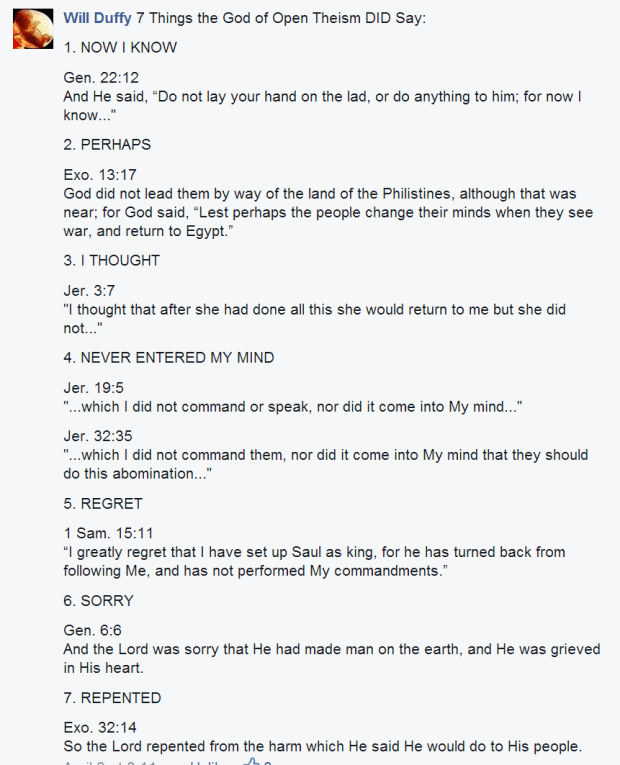
Duffy on Seven Things God Did Say

A Facebook post by Will Duffy, founder of the Collaborators Project on Facebook group God is Open. A response to Mocking God:

Will Duffy 7 Things the God of Open Theism DID Say:

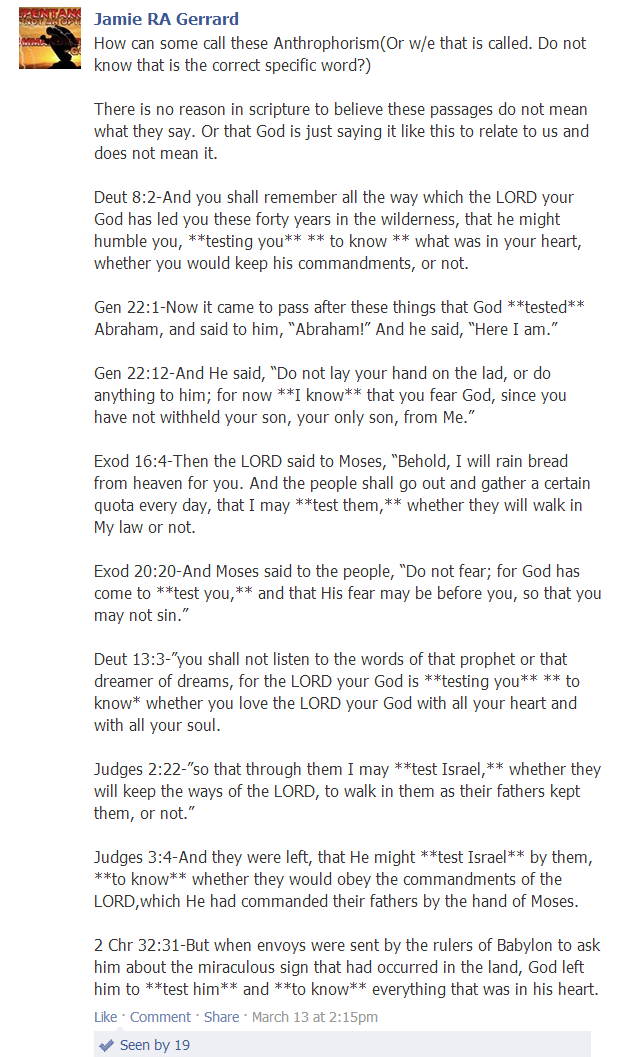
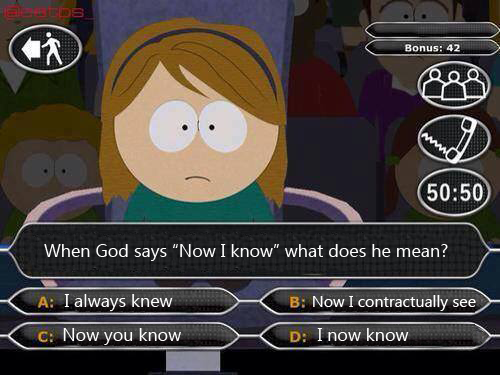
1. NOW I KNOW

Gen. 22:12
And He said, “Do not lay your hand on the lad, or do anything to him; for now I know…”

2. PERHAPS

Exo. 13:17
God did not lead them by way of the land of the Philistines, although that was near; for God said, “Lest perhaps the people change their minds when they see war, and return to Egypt.”

3. I THOUGHT

Jer. 3:7
“I thought that after she had done all this she would return to me but she did not…”

4. NEVER ENTERED MY MIND

Jer. 19:5
“…which I did not command or speak, nor did it come into My mind…”

Jer. 32:35
“…which I did not command them, nor did it come into My mind that they should do this abomination…”

5. REGRET

1 Sam. 15:11
“I greatly regret that I have set up Saul as king, for he has turned back from following Me, and has not performed My commandments.”

6. SORRY

Gen. 6:6
And the Lord was sorry that He had made man on the earth, and He was grieved in His heart.

7. REPENTED

Exo. 32:14
So the Lord repented from the harm which He said He would do to His people.

what God said

God draws with teaching

From Mark Ballentine on God is Open:

One of Calvinists’ favorite verses:

“No man can come to me, except the Father which hath sent me draw him: and I will raise him up at the last day.” (John 6:44)

So, how does the Father draw someone? The very next verse explains:

“It is written in the prophets, And they shall be all taught of God. Every man therefore that hath heard, and hath learned of the Father, cometh unto me.” (John 6:45)

Notice Abraham’s similar answer, when, the rich man begs him, to send Lazarus to warn his brothers.

(Luke 16:27-28)
“…they have Moses and the prophets; let them hear them.” (Luke 16:29) Mark B

god is drawing

Morrell Debates Sye on God’s Will and Abortion

Reposted from Jesse Morrell of Biblical Truth Resources:

Jesse Morrell: Hey on this topic, I wonder why Calvinists are so upset that Babies are Murdered at abortion clinics? Did not God eternally decree that they would be aborted and none can resist His eternal decrees? In that case, to oppose abortion would be to oppose the sovereign will of God. And to pray for God’s will to be done on earth is to pray for babies to be aborted. (That’s called an internal critique)

Seems like an internal contradiction within the system of Calvinism for Calvinists to be so upset and mourn over abortion…

Sye Ten Bruggencate: It would seem that way, if you did not know what you were talking about.

[snip]

Sye Ten Bruggencate: If you think that things can happen outside of God’s plan then you believe in a different “god.”

Jesse Morrell: If you believe that abortion was God’s eternal will, then one of us certainly does worship a false god!

[snip]

Jesse Morrell: Given these verses, was it God’s irresistible and eternal plan for Israel to sacrifice their babies to false gods?

Jer_19:5 They have built also the high places of Baal, to burn their sons with fire for burnt offerings unto Baal, which I commanded not, nor spake it, neither came it into my mind:

Jer_32:35 And they built the high places of Baal, which are in the valley of the son of Hinnom, to cause their sons and their daughters to pass through the fire unto Molech; which I commanded them not, neither came it into my mind, that they should do this abomination, to cause Judah to sin.

Sye Ten Bruggencate: Nothing happens outside of God’s plan Jesse, nothing.

[snip]

Jesse Morrell: ” Nothing happens outside of God’s plan Jesse, nothing.”

Well wait a minute. When I said that Calvinism teaches that abortion is God’s plan and that Calvinists mourning abortion and opposing abortion is them opposing God’s plan, you said that I did not know what I was talking about.

Now you say abortion is God’s plan. So apparently I did know what I was talking about!

You are either dishonest or confused or both. At the least your worldview is internally inconsistent.

For full post, click here.

VOTD 1 Samuel 13:13-14

1Sa 13:13 And Samuel said to Saul, “You have done foolishly. You have not kept the commandment of the LORD your God, which He commanded you. For now the LORD would have established your kingdom over Israel forever.
1Sa 13:14 But now your kingdom shall not continue. The LORD has sought for Himself a man after His own heart, and the LORD has commanded him to be commander over His people, because you have not kept what the LORD commanded you.”

If you would like to guest post commentary on this verse, please send to admin@godisopen.com .

Craig Thinks God’s Future Actions Are Known to God

From Gregory Boyd of renew.org:

To my surprise, Bill argued that my understanding of God’s middle knowledge undermines divine freedom. While God knows the truth value of statements about how free agents would act in every conceivable circumstance, “God doesn’t know the truth of statements about what he would do in any circumstance prior to the divine creative decree.” This, Bill contends, would undermine divine freedom. On these grounds Bill concludes that “Greg’s view is not carefully thought out.”

For full post, click here.

Apologetics Thrusday – Mocking God

Matt Slick has an article entitled “Things you might hear the God of open theism say” in which he attempts to mock God (as Open Theists view God). The problem is that Slick is mocking God. This is his mocking list which has been spliced with God actually saying an equivalent phrase or concept:

1. Ooops

God says to himself that He wishes He had not made man:

Gen 6:5 And GOD saw that the wickedness of man was great in the earth, and that every imagination of the thoughts of his heart was only evil continually.
Gen 6:6 And it repented the LORD that he had made man on the earth, and it grieved him at his heart.
Gen 6:7 And the LORD said, I will destroy man whom I have created from the face of the earth; both man, and beast, and the creeping thing, and the fowls of the air; for it repenteth me that I have made them.

2. Doh!

God kills children in an attempt to punish Israel, but the intended effect does not materialize:

Jer 2:30 “In vain I have chastened your children; They received no correction. Your sword has devoured your prophets Like a destroying lion.

3. Uh, oh.

God takes precautions against the eventuality that mankind eats from the Tree of Life:

Gen 3:22 Then the LORD God said, “Behold, the man has become like one of Us, to know good and evil. And now, lest he put out his hand and take also of the tree of life, and eat, and live forever”—
Gen 3:23 therefore the LORD God sent him out of the garden of Eden to till the ground from which he was taken.

4. Oh, no.

In Jeremiah 18, God outlines His basic operating procedures. Sometimes God expects a nation to be righteous. God then promises them blessings and prosperity. But sometimes these nations turn from Him, and as a response, God revokes His promises to them.

Jer 18:9 And at what instant I shall speak concerning a nation, and concerning a kingdom, to build and to plant it;
Jer 18:10 If it do evil in my sight, that it obey not my voice, then I will repent of the good, wherewith I said I would benefit them.

5. Dang it!

God thinks Israel would return to Him, but Israel refuses.

Jer 3:7 And I said, after she had done all these things, ‘Return to Me.’ But she did not return. And her treacherous sister Judah saw it.

6. Shucks!

God’s will is rejected to mankind’s own detriment.

Luk 7:30 But the Pharisees and lawyers rejected the will of God for themselves, not having been baptized by him.

7. Let me get back to you on that.

God endures Israel for a long time and then God promises to exact vengeance in the future.

Num 14:27 “How long shall I bear with this evil congregation who complain against Me? I have heard the complaints which the children of Israel make against Me.
Num 14:28 Say to them, ‘As I live,’ says the LORD, ‘just as you have spoken in My hearing, so I will do to you:
Num 14:29 The carcasses of you who have complained against Me shall fall in this wilderness, all of you who were numbered, according to your entire number, from twenty years old and above.

8. Wow, that was a surprise.

God says it never even entered His mind that people would literally burn their children to death.

Jer 19:5 They have built also the high places of Baal, to burn their sons with fire for burnt offerings unto Baal, which I commanded not, nor spake it, neither came it into my mind:

9. I hope it works out.

In Jeremiah, God wants Jeremiah’s message to work.

Jer 26:3 Perhaps everyone will listen and turn from his evil way, that I may relent concerning the calamity which I purpose to bring on them because of the evil of their doings.’

But the people do not listen and repent.

10. Oh no, now what is he going to do this time?

In Deuteronomy 30, God warns Israel that He is going to destroy them and then gives them two options: life or death. Each is confidently spoken as being possible. The only reasons to convince someone of something is if they are not already set on a particular action.

Deu 30:18 I denounce unto you this day, that ye shall surely perish, and that ye shall not prolong your days upon the land, whither thou passest over Jordan to go to possess it.
Deu 30:19 I call heaven and earth to record this day against you, that I have set before you life and death, blessing and cursing: therefore choose life, that both thou and thy seed may live:

11. No, I haven’t heard the joke about the open theist.

God goes to Sodom to verify reports and states that He will learn the truth.

Gen 18:21 I will go down now and see whether they have done altogether according to the outcry against it that has come to Me; and if not, I will know.”

12. Please, oh please, please, please believe in me.

God laments that He has shown Israel countless miracles and yet they reject Him. This is seriously the theme of much of the Old Testament:

Num 14:11 Then the LORD said to Moses: “How long will these people reject Me? And how long will they not believe Me, with all the signs which I have performed among them?

13. I’ll not do that again.

God states that He will not again destroy man, and God uses the exact same reason that He destroyed them in the first place. God is saying, under the same criteria, my actions will be different.

Gen 8:21 And the LORD smelled a soothing aroma. Then the LORD said in His heart, “I will never again curse the ground for man’s sake, although the imagination of man’s heart is evil from his youth; nor will I again destroy every living thing as I have done.

14. That didn’t turn out to well, did it?

God worked tirelessly to make Israel accept Him, but they rejected Him against what He expected.

Isa 5:4 What more could have been done to My vineyard That I have not done in it? Why then, when I expected it to bring forth good grapes, Did it bring forth wild grapes?

Isa 5:7 For the vineyard of the LORD of hosts is the house of Israel, And the men of Judah are His pleasant plant. He looked for justice, but behold, oppression; For righteousness, but behold, a cry for help.

15. I’ll try and get it right next time.

God offers Moses a Plan B to reset His promise to Israel. This is a divine mulligan.

Exo 32:9 And the LORD said to Moses, “I have seen this people, and indeed it is a stiff-necked people!
Exo 32:10 Now therefore, let Me alone, that My wrath may burn hot against them and I may consume them. And I will make of you a great nation.”

16. I’d answer your prayer but I don’t know what is going to happen.

God does answer Moses’ prayer to spare Israel, and interestingly enough God finds Himself in the exact same position wanting to destroy Israel in Numbers 14. God’s answer to Moses’ prayer did not turn out well, in Numbers 14 God answers Moses’ prayer again knowing full well the history of answering this specific prayer.

Exo 32:11 Then Moses pleaded with the LORD his God, and said: “LORD, why does Your wrath burn hot against Your people whom You have brought out of the land of Egypt with great power and with a mighty hand?
Exo 32:12 Why should the Egyptians speak, and say, ‘He brought them out to harm them, to kill them in the mountains, and to consume them from the face of the earth’? Turn from Your fierce wrath, and relent from this harm to Your people.
Exo 32:13 Remember Abraham, Isaac, and Israel, Your servants, to whom You swore by Your own self, and said to them, ‘I will multiply your descendants as the stars of heaven; and all this land that I have spoken of I give to your descendants, and they shall inherit it forever.’ ”
Exo 32:14 So the LORD relented from the harm which He said He would do to His people.

17. Hey, I just learned something.

God says that He tested Abraham (throughout the Bible God tests people) and then learned what Abraham would do in a compromising situation.

Gen 22:12 And He said, “Do not lay your hand on the lad, or do anything to him; for now I know that you fear God, since you have not withheld your son, your only son, from Me.”

18. Well, I can always go to plan B.

God tells Saul that the original plan was for Saul’s Kingdom to last forever. But God changes that plan based on Saul’s actions. God replaces this with a Plan B that David would be King.

1Sa 13:13 And Samuel said to Saul, “You have done foolishly. You have not kept the commandment of the LORD your God, which He commanded you. For now the LORD would have established your kingdom over Israel forever.
1Sa 13:14 But now your kingdom shall not continue. The LORD has sought for Himself a man after His own heart, and the LORD has commanded him to be commander over His people, because you have not kept what the LORD commanded you.”

19. Well, I can always go to plan B,C,D,E, F

In Exodus 3-4, God sets up a series of contingency plans for Moses. God prefaces the entire plan by saying He is positive that Pharaoh will not just let the people go. A strange thing for the classical understanding of omniscience:

Exo 3:19 But I am sure that the king of Egypt will not let you go, no, not even by a mighty hand.

God then gives Moses cascading conditional plan to convince Israel which God also states He will use against Pharaoh:

Exo 4:3 And He said, “Cast it on the ground.” So he cast it on the ground, and it became a serpent; and Moses fled from it.
Exo 4:4 Then the LORD said to Moses, “Reach out your hand and take it by the tail” (and he reached out his hand and caught it, and it became a rod in his hand),
Exo 4:5 “that they may believe that the LORD God of their fathers, the God of Abraham, the God of Isaac, and the God of Jacob, has appeared to you.”
Exo 4:6 Furthermore the LORD said to him, “Now put your hand in your bosom.” And he put his hand in his bosom, and when he took it out, behold, his hand was leprous, like snow.
Exo 4:7 And He said, “Put your hand in your bosom again.” So he put his hand in his bosom again, and drew it out of his bosom, and behold, it was restored like his other flesh.
Exo 4:8 “Then it will be, if they do not believe you, nor heed the message of the first sign, that they may believe the message of the latter sign.

Notice the “if they do not believe”. God then goes ahead and says that they will believe the second sign. God is saying the further miracles might not be necessary, but on the case that they are Moses was to do further signs. But God is not positive, so He adds more contingencies, just in case:

Exo 4:9 And it shall be, if they do not believe even these two signs, or listen to your voice, that you shall take water from the river and pour it on the dry land. The water which you take from the river will become blood on the dry land.”

God adds one more contingency plan: killing Pharaoh’s son:

Exo 4:22 Then you shall say to Pharaoh, ‘Thus says the LORD: “Israel is My son, My firstborn.
Exo 4:23 So I say to you, let My son go that he may serve Me. But if you refuse to let him go, indeed I will kill your son, your firstborn.” ‘ ”

Of course, this did not work either, so God used a cascading series of supplemental plagues to break Pharaoh’s spirit. Here is a breakdown:

So, God tells Moses: Show the rod to a snake, Show your hand turning white, take a jar of water from the river and show it turning to blood, tell Pharaoh that his son will die.

What happened: Moses showed the rod turning into a snake. Moses skips the hand turning white. Moses turned the entire river into blood, as opposed to a jar being poured onto dry land (God was upping the ante), Moses brought frogs, then lice, then flies, kills livestock, brings boils, then hail, then locusts, then darkness, then all of Egypt loses their firstborn (not just Pharaoh).

Even God’s express plans are open for modification on the fly.

19. Well, I can always go to plan B,C,D,E, F (Part 2)

Abraham discusses with God a complex hypothetical, convincing God not to destroy Sodom for an increasingly lower number of people, changing God’s plans on the fly.

Gen 18:24 Suppose there were fifty righteous within the city; would You also destroy the place and not spare it for the fifty righteous that were in it?
Gen 18:25 Far be it from You to do such a thing as this, to slay the righteous with the wicked, so that the righteous should be as the wicked; far be it from You! Shall not the Judge of all the earth do right?”
Gen 18:26 So the LORD said, “If I find in Sodom fifty righteous within the city, then I will spare all the place for their sakes.”
Gen 18:27 Then Abraham answered and said, “Indeed now, I who am but dust and ashes have taken it upon myself to speak to the Lord:
Gen 18:28 Suppose there were five less than the fifty righteous; would You destroy all of the city for lack of five?” So He said, “If I find there forty-five, I will not destroy it.”
Gen 18:29 And he spoke to Him yet again and said, “Suppose there should be forty found there?” So He said, “I will not do it for the sake of forty.”
Gen 18:30 Then he said, “Let not the Lord be angry, and I will speak: Suppose thirty should be found there?” So He said, “I will not do it if I find thirty there.”
Gen 18:31 And he said, “Indeed now, I have taken it upon myself to speak to the Lord: Suppose twenty should be found there?” So He said, “I will not destroy it for the sake of twenty.”
Gen 18:32 Then he said, “Let not the Lord be angry, and I will speak but once more: Suppose ten should be found there?” And He said, “I will not destroy it for the sake of ten.”

Matt Slick thinks he is being funny or cute, but he is mocking God.

Gal 6:7 Do not be deceived, God is not mocked; for whatever a man sows, that he will also reap.

May the Lord repay him according to his works.
Boyd on Process Versus Open

Boyd explains the difference between Open Theism and Process Theology:

In PT, God exists eternally in relation to a non-divine world. So PT denies “creation ex nihilo”
In PT, God is bound to metaphysical principles that govern both God and the world. So God isn’t able to really interact with the world as a personal being. God must always, of necessity, respond in ways that the metaphysics of the system stipulate. This means…
In PT God can’t intervene in unique ways, like personally answering prayer
In PT God can’t intervene and perform miracles In PT God can’t become uniquely embodied, as he is in Christ.

For full post, click here.

VOTD Deuteronomy 8:2

Deu 8:2 And you shall remember that the LORD your God led you all the way these forty years in the wilderness, to humble you and test you, to know what was in your heart, whether you would keep His commandments or not.

If you would like to guest post commentary on this verse, please send to christopher.c.fisher@gmail.com .

On Open Theist Unity

From an anonymous private conversation:

What I’ve learned is that we need to exercise a bit of Christian ecumenism within the Church itself. By that I mean that we need to be firm on essential doctrines (which, to be honest, I haven’t completely determined) and open on non-essentials. Not foolish. Just willing to listen and work through however long it may take.

That’s why I have adopted this maxim as one of my personal mottos:

In essentials, unity;
In non-essentials, liberty;
But in all things, charity.

Believers need to see that by being narrow-minded we lose out on truths we may never have learned otherwise. NOTHING is beyond questioning. That doesn’t mean that essentials can be simply discarded, but that we need to be open to the idea that perhaps there may be nuances we haven’t considered in the essentials or complete upsets of our theology through the non-essentials.

Sanders on the Morphing of Classical Theism

From John Sander’s paper Be Wary of Ware:

Today, there are exceedingly few evangelicals who are actual classical theists, even though they continue to use the title of themselves. Though Ware classifies himself as a classical theist, he rejects the traditional notion of immutability. Wayne Grudem rejects impassibility as being clearly unbiblical. Millard Erickson says that “the traditional doctrine of impassibility is not the current one” among contemporary evangelicals. These thinkers have modified classical theism in ways that Aquinas and Calvin would find logically inconsistent. The great classical theists understood that it was a package deal, you cannot change one of the attributes without affecting the others. When you begin to pull on the thread of a knit sweater, it will eventually unravel on you. So, beware of Ware, for his minor revisions to classical theism will, mutatis mutandis, lead to many more alterations.

VOTD 2 Kings 19:17

2Ki 19:17 Truly, LORD, the kings of Assyria have laid waste the nations and their lands,
2Ki 19:18 and have cast their gods into the fire; for they were not gods, but the work of men’s hands—wood and stone. Therefore they destroyed them.

If you would like to guest post commentary on this verse, please send to christopher.c.fisher@gmail.com .

Sanders on the Unseen Conditional Prophecy

From John Sander’s paper Be Wary of Ware:

God’s announcement to Hezekiah and Nineveh were stated in an unconditional/inviolable way. How do we know that they actually were not inviolable? Because what God said would happen did not happen. That is, it is only because they did not occur that we know that these seemingly “inviolable” predictions were, in fact, conditional upon what the human agents did. But what about seemingly “inviolable” predictions that did come to pass? Were some, even most of them, actually conditional upon the response of the human agents? The tendency is to think not, because they came to pass. However, I believe that there are actually very few such “inviolable” predictions.

Calvinist Says Old Testament Should Not Be Taken Seriously

From a critique of Open Theism:

Pilch and Malina in the Handbook of Biblical Social Values [50ff, 56ff] note the emphasis in the Biblical world on dramatic orientation as a point of honor. To be expressive in word and deed was to “gain, maintain, and enhance personal and group honor.” Expressions of eloquence, which involve exaggeration and over-assertion, may at times “not [be] intended to be taken seriously but are made solely for effect and are heartily appreciated and applauded by an audience that enjoys such eloquence when it hears it.”

Free and unrestrained expression of emotion was normal and acceptable, but may not always be taken seriously; note that this is NOT (as one critic of this article suggested) a matter of “honesty” for contextually in this setting, there is no “lie” being perpetrated (i.e., everyone KNOWS the expression is not “real”). Consider in this light the Jewish practice of paid mourners who were paid to wail, but obviously had no personal grief to speak of.

For full post, click here.

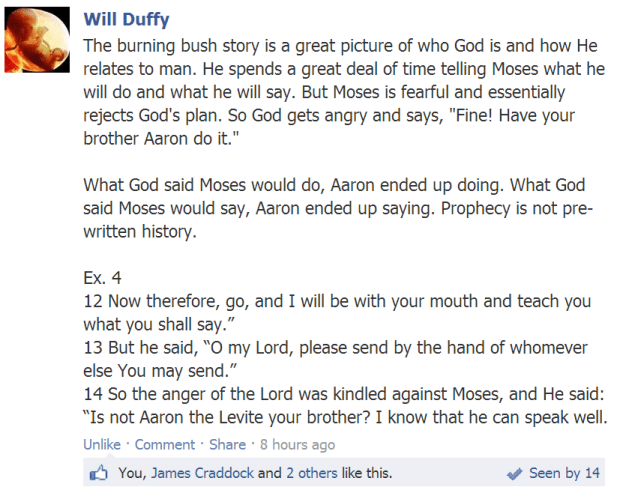
Duffy on Moses’ Speaking Replacement

A Facebook post by Will Duffy, founder of the Collaborators Project on Facebook group God is Open:

The burning bush story is a great picture of who God is and how He relates to man. He spends a great deal of time telling Moses what he will do and what he will say. But Moses is fearful and essentially rejects God’s plan. So God gets angry and says, “Fine! Have your brother Aaron do it.”

What God said Moses would do, Aaron ended up doing. What God said Moses would say, Aaron ended up saying. Prophecy is not pre-written history.

Ex. 4
12 Now therefore, go, and I will be with your mouth and teach you what you shall say.”
13 But he said, “O my Lord, please send by the hand of whomever else You may send.”
14 So the anger of the Lord was kindled against Moses, and He said: “Is not Aaron the Levite your brother? I know that he can speak well.

aaron

Fisher Describes Augustine’s Conversion

From Craig Fisher of Will the Real God Step Forward:

If one is to take Augustine’s words seriously, one must recognize this conversion was not in terms of a Protestant born again experience, but this conversion was a purification resembling the Neoplatonic purification: “The effect of your converting me to yourself was that I did not now seek a wife and had no ambition for success in this world.” To “not seek a wife” is a commitment to celibacy not an admission of guilt, repentance toward God, and belief in the death and resurrection of Jesus Christ.

Augustine’s autobiography, Confessions, may be described as a manual on Platonic purification. The first seven chapters represents the struggle against sexual desire, the nemesis of Platonic purification. Chapter eight is the accomplishment of his goal. The final chapters are his self-congratulation on his success.

The goal of purification is to become like God in order to see God. The practitioner expects to see God in his mind at the end of the ascent. The ascent is a meditative process, removing oneself from the distractions of physical life and seeing God with you mind. The name ascent refers to the Platonic metaphysical system of the pagan philosophers. God is at the top of the “ladder”, all creation is an ordered descent from the top. In order to reach God, it is necessary to ascend the ladder. Ascent is only possible through a process of purification.

For full post, click here.

Belt on Open Theism Core Beliefs

Tom Belt of An Open Orthodoxy, tries his hand and defining core beliefs of Open Theism:

Recent debates have clarified just what’s at the heart of open theism, so I’ll toss this out again just to have in front of us:

– Monotheism
– Divine benevolence
– Creation ex nihilo
– Creaturely freedom
– Causal openness
– Divine epistemic openness

For full post, click here.

Sanders on the Ungracious Debate

From John Sander’s paper Be Wary of Ware:

The accuser in these cases simply does not understand from the inside the position he is criticizing. This is the case with Ware on many of his points. Even though he explicitly claims to know how we might respond to his criticisms, in his writings to date he has shown a singularly unimaginative and unsympathetic attitude as to how we might answer. He never gives us the benefit of the doubt as to what we might mean and typically reads our statements in the worst possible light.

Apologetics Thursday – God Counts Hairs

By Christopher Fisher

In a 2007 debate, Gene Cook condescendingly asks Bob Enyart about how God gains His knowledge.

Cook: Ok, the Bible says that God knows the very number of hairs on a man’s head. How does God know this?
Enyart: Because He can count… so that’s present knowledge…
Cook: In order for God to have a running knowledge of how many hairs are on Gene Cook’s head does He have to recount them everyday.
Enyart: Well He counted it at some point, right?…
Cook: But it changes every day.
Enyart: God is a mathematician, and if He cares God can watch every atom throughout the entire universe simultaneously. He is capable. So it is not like it would tax God’s CPU to look down and see “is a sparrow is going to die” or “how many hairs are on your head.”

To Gene Cook, if God knows the number of hairs on someone’s head, that number must be foreknown from all eternity. But the Bible describes how God gains this knowledge much like Enyart describes and not at all as Cook assumes:

Mat 10:30 But the very hairs of your head are all numbered.

The translators of the KJV and NKJV use an archaic word “numbered” instead of the more colloquial term “counted”. Matthew 10:30 is saying that each man’s head is counted for hair. The same word is using in Revelation for counting:

Rev 7:9 After this I beheld, and, lo, a great multitude, which no man could number, of all nations, and kindreds, and people, and tongues, stood before the throne, and before the Lamb, clothed with white robes, and palms in their hands;

The Greek is arithmeo from where the English word “arithmetic” is derived. In Revelation, no one can count the multitude. In Matthew 10, God counts our hair. Counting is the method of gaining the information.

When Calvinists want to claim God predestines the future, one of the first places to which they turn is Isaiah 40-48. These verses were written to convince Israel that God is powerful and capable. Embeded in these verses is another “counting” verse:

Isa 40:12 Who hath measured the waters in the hollow of his hand, and meted out heaven with the span, and comprehended the dust of the earth in a measure, and weighed the mountains in scales, and the hills in a balance?

This verse is often ignored by Classical theists. But the message is clear. God knows the volume of water by counting. God knows the length of the sky by measuring. God knows the volume of dust by calculating. God knows the weight of the mountains by weighing.

These verses point to the operative nature of how God knows information. Isaiah was communicating to the Jews, explaining how mighty God is. Isaiah does not turn to pagan concepts such as “fatalistic foreknowledge” or “inherent knowledge”. Those methodologies are foreign to Israel’s concept of God. Instead Isaiah appeals to God’s ability to perform and accomplish things that no man possibly could. That is the thrust of Isaiah. God knows things and can make His will a reality through His power. When Classical theists assume otherwise, they are discarding the normal Biblical language about God.

VOTD Hosea 11:8-9

Hos 11:8 “How can I give you up, Ephraim? How can I hand you over, Israel? How can I make you like Admah? How can I set you like Zeboiim? My heart churns within Me; My sympathy is stirred.
Hos 11:9 I will not execute the fierceness of My anger; I will not again destroy Ephraim. For I am God, and not man, The Holy One in your midst; And I will not come with terror.

If you would like to guest post commentary on this verse, please send to christopher.c.fisher@gmail.com .

Olson of the Meaning of Good

From Roger E Olson:

Put another way, negatively, if one believes that God’s goodness is nothing like our best intuitions of goodness, that God’s goodness is possibly compatible with anything capable of being put into words (i.e., ultimately and finally mysterious), then there is no good reason to trust him. Trust in a person, even God, necessarily requires belief that the person is good and belief that the person is good necessarily requires some content and not “good” as a cipher for something totally beyond comprehension and unlike anything else we call “good.”

For full quote, click here.

Duffy on Joseph’s Dream

A Facebook post by Will Duffy, founder of the Collaborators Project on Facebook group God is Open:

I’ve always been shocked at the lack of information on the internet about this issue of Joseph’s dream. I think the answer is simple, yet goes against traditional theology, so people don’t want to talk about it.

The verse is definitely talking about Leah. Jacob interprets his son’s dream as that he, Leah and their 11 sons will bow down to Joseph. (This is quite insulting!) These dreams are prophesies from God to Joseph, which is where this gets really interesting.

As we read on in Genesis, we see that the brothers ended up bowing down to Joseph in Egypt as his first dream of sheaves stated. Jacob was on his deathbed when he found out that Joseph was still alive. He actually had to be carried to Egypt and was incredibly grateful that he got to see Joseph before dying.

But the interesting thing is that Leah did not make it to Egypt. We don’t know exactly when she died, but she was buried with Abraham, Sarah, Isaac and Rebekah in the field of Machpelah by Jacob himself.

So essentially, we have here a great example showing that prophesy is not pre-written history. God’s message to Joseph was not about specifics and numbers, but a general principle that He had a bigger plan in mind. Had even Jacob died before making it to Egypt (which was almost the case), God does not break because His prophecy did not come to pass exactly as stated. God is not concerned with details as much as Calvinists and Arminians are. He wants us to see the forest and not get caught up in the trees. This dream of Joseph’s is a perfect example.

Corey on Worthy Worship

From Benjamin L. Corey of Formerly Fundie. Reason 1 fo 5 from 5 Reasons Why Calvinism Makes Me Want To Gouge My Eyes Out:

I couldn’t in good conscience worship the Calvinist’s god.

One of the key aspects of Calvinism is a concept called “predestination” which essentially means, God picked the people who are going to heaven. Where it gets sick is on the flip side of that same coin (a position held by Calvin), that God also picks the people who go to hell. There are no choices involved– before God even created us, he hand picked who would go to heaven and who he would burn in hell for all of eternity.

Now, we know from the teachings of Jesus that the group of people in history who embrace God is smaller than the group who do not (broad vs. narrow road). If both Calvinists and Jesus are equally correct, the result is purely evil. This would mean that God created a MAJORITY of humanity for the sole purpose of torturing them in hell for all of eternity, and that they never had a choice. God would have created them for the sole purpose of torturing them. I just don’t think I can worship a god who would do something like that.

Case in point: if I get to heaven and find out that my beautiful daughter Johanna is in hell and that she’s in hell because God chose her before the foundations of the world to burn for all eternity, I won’t be able to worship him in good conscience. Perhaps I would bow down out of total fear, but I would NOT worship him because he was holy, beautiful, and “all together wonderful” as Boyd often describes him. Instead, I would bow down because he would be a sick and twisted god who scared the crap out of me.

For full post, click here.

Geisler Resigns ETS Over Open Theism

At one point, ETS was seeking to kick out any Open Theists. Oldly, Geisler was pressing to kick out Open Theists on the claim of rejecting “inerrancy”. He posted his resignation letter on his own webpage. Snippet:

4. ETS is Logically Inconsistent with Its Own Doctrinal Basis
The ETS statement affirms: “The Bible alone, and the Bible in its entirety, is the Word of God written and is therefore inerrant in the autographs” (emphasis added). The word “therefore” logically connects the word of “God” and “inerrant” to make it clear that neither God nor the Bible errs. This meaning of the word “therefore” is confirmed by the living framers of the statement. But Open Theists confessed both God and the Bible err in the sense understood by the framers of this doctrinal statement, namely, they believe that the Bible affirms some things that are not factually correct. John Sanders agrees that there are unconditional prophesies that go unfulfilled. And Pinnock confessed that Chronicles gives exaggerated numbers that do not correspond with the facts. But these count as errors according to the understanding of the ETS founding fathers. All the living founders expressed this in writing to ETS and those not living have expressed this same view in their writings.

For full letter, click here.

VOTD Hebrews 2:14-15

Heb 2:14 Inasmuch then as the children have partaken of flesh and blood, He Himself likewise shared in the same, that through death He might destroy him who had the power of death, that is, the devil,
Heb 2:15 and release those who through fear of death were all their lifetime subject to bondage.

If you would like to guest post commentary on this verse, please send to christopher.c.fisher@gmail.com .

Sanders on the Being Attacked for Believing the Bible

From John Sander’s paper Be Wary of Ware:

I am not stating a position but asking how simple foreknowledge handles a set of biblical texts that we all must address. What do we do with those texts where God says (unconditionally) that something will happen and then it does not happen? For example, God made an unconditional announcement that Nineveh would be destroyed (Jonah), and God made an unconditional announcement to Hezekiah that he would shortly die (2 Kings 20), but neither of these came to pass. As an aside, it is interesting that what really offends Ware is that we actually believe what the Bible says in such passages! For Ware, anyone who believes these biblical texts mean what they say is a heretic and should be thrown out of the assembly.

Enyart on Judas and Fatalism

From the TheologyOnline debate Does God Know Your Entire Future. Bob Enyart writes:

Settled Interpretation: By elevating the quantitative attributes of omniscience, control, omnipotence, and immutability, above God’s qualitative attributes of being relational, good, and loving, Calvinists believe that God is glorified more by Judas carrying out his treachery, than if he had repented and being broken, sought forgiveness.

Open Interpretation: Because the quantitative attributes should not take precedent over God’s being relational and loving, which are among His highest attributes, therefore no creaturely action can glorify God more than to obey the greatest command, which is to love Him. Thus if Judas had repented, Jesus would not be angered, but overjoyed, as the Shepherd who left the ninety-nine to recover the one lost sheep. God would care nothing of Judas failing to live up to the expected betrayal, as compared to the glory of reconciliation.

So let me restate your question into its historical narrative. Earlier, Judas had left the upper room after finding out that Jesus already knew about his betrayal. In the evening after dinner the Lord took the eleven for a walk over the Brook Kidron and up the side of the Mount of Olives to Gethsemane. And in that garden, the Lord spoke the most mournful prayers ever uttered, about the dear cost of our salvation. And now watch what Calvinists think is their greatest nightmare, and see what Openness possibilities would look like actually playing out in human history. As Jesus is praying, the traitor appears, but not with a cohort of temple guards. He comes alone. And he stumbles, and falls at the feet of his Lord. “Master…, I…, I…,” but he can’t stop crying. “Master…, Master…,” his words not able to break through his sobs. Peter stirs, and awoken by the wailing, comes to see what is happening. He has a weapon, but does not need to draw his sword. For no guards were there. And Malchus was still back at the high priest’s courtyard, warming himself at a fire of coals. Peter sees his fellow disciple, Judas, prostrate and consumed in tears. He was pleading with the Lord, for something Simon couldn’t understand. Judas was overcome with grief, and the sound of wailing brings James and John, who see Jesus put his arms around Judas’ head. And the Lord cleans his nose and eyes with the edge of His robe. Then the Lord asked him, “Who are you seeking?” And Judas couldn’t answer. And so He kissed him, and said, “I know, Judas, I know.”

“I forgive you.”

Sam. Consider the entirety of who Judas was and ever will be. What could he ever have done that could have glorified God more than to repent in Gethsemane? If Judas had repented, as did Nineveh after God promised destruction in forty days, God would not cease to be God. Rather, He and the angels in heaven would rejoice. The Evangelists would not feel defeated, but they would glory recording such an event in their Gospels, as does the Scripture when Nineveh repented and avoided God’s prophesied destruction forty days later. Jonah lamented that God’s mercy superseded His prophecy (though it did!). And Settled View proponents seem to suggest they would do likewise. Calvinists always bring up Judas, suggesting that God could not be God if Judas had repented, but He survived Nineveh. Actually, God wanted to be wrong about Nineveh, because love influences Him. And God could have survived Judas also. If Judas had repented, Christ might have given Matthias a different task, of engraving this story into the walls of the New Jerusalem [Rev. 21:14] just beneath the name of Judas Iscariot. Calvinists do not lament the fact that Nineveh repented (true?). And it would be EXACTLY the same situation if Judas had repented.

Worship Sunday – What A Friend We Have in Jesus

What A Friend We Have in Jesus by Joseph M. Scriven

Lyrics:

What a friend we have in Jesus,
All our sins and griefs to bear!
What a privilege to carry
Everything to God in prayer!
Oh, what peace we often forfeit,
Oh, what needless pain we bear,
All because we do not carry
Everything to God in prayer!
Have we trials and temptations?
Is there trouble anywhere?
We should never be discouraged—
Take it to the Lord in prayer.
Can we find a friend so faithful,
Who will all our sorrows share?
Jesus knows our every weakness;
Take it to the Lord in prayer.
Are we weak and heavy-laden,
Cumbered with a load of care?
Precious Savior, still our refuge—
Take it to the Lord in prayer.
Do thy friends despise, forsake thee?
Take it to the Lord in prayer!
In His arms He’ll take and shield thee,
Thou wilt find a solace there.
Blessed Savior, Thou hast promised
Thou wilt all our burdens bear;
May we ever, Lord, be bringing
All to Thee in earnest prayer.
Soon in glory bright, unclouded,
There will be no need for prayer—
Rapture, praise, and endless worship
Will be our sweet portion there.

VOTD 1 John 4:2

1Jn 4:2 By this you know the Spirit of God: Every spirit that confesses that Jesus Christ has come in the flesh is of God,
1Jn 4:3 and every spirit that does not confess that Jesus Christ has come in the flesh is not of God. And this is the spirit of the Antichrist, which you have heard was coming, and is now already in the world.

If you would like to guest post commentary on this verse, please send to christopher.c.fisher@gmail.com .

Sanders on Prayer

From John Sander’s paper Be Wary of Ware:

Ware castigates our view of petitionary prayer as “arrogant” and “presumptuous” to think we could advise God, helping God achieve a “better plan.” The view of petitionary prayer we have put forward is not unique to openness, since it is likely the dominant view of evangelicals. Hence, Ware’s vituperate attack is really denigrating the prayer life of mainstream evangelicalism! Unfortunately, Ware shows no understanding whatsoever of this deep-seated piety. In Ware’s view of prayer, we are saying to God what God has ordained we should say. Our prayers of petition are not genuine dialogue with God, but simply the means by which God brings about what he has ordained. How different this is from biblical characters such as Abraham, Moses, and Hezekiah who dialogued and even argued with God. God is the one who invites us to speak with him in this way—it is no presumption on our part. God is the one who invites us to collaborate with him. We clearly say in our writings that God does not need our advice, but God asks for our input anyway because of the genuine personal relationship he wants to develop. God is the one who has chosen to make prayer a dialogue instead of a monologue. Moreover, we have never said that, for instance, when Moses intercedes for the people (Exodus 32) and God accepts Moses’ input, this results in a “better” plan. What we have said is that God has sovereignly decided that part of the plan-making process will be to include what Moses desires. God has decided that his “best” plan will involve taking our concerns into account, not because God must, but because God lovingly wants this kind of relationship. This represents the overarching Arminian view of petitionary prayer.

VOTD Hebrews 2:16

Heb 2:16 For indeed He does not give aid to angels, but He does give aid to the seed of Abraham.
Heb 2:17 Therefore, in all things He had to be made like His brethren, that He might be a merciful and faithful High Priest in things pertaining to God, to make propitiation for the sins of the people.
Heb 2:18 For in that He Himself has suffered, being tempted, He is able to aid those who are tempted.

If you would like to guest post commentary on this verse, please send to christopher.c.fisher@gmail.com .

Belt on Open Theism Infighting

From Tom Belt of An Open Orthodoxy:

As I speak, the promise of a major unified voice of renewal within the Church is today a fragmented roomful of siblings fighting over who inherits the family name. In one corner you have fundamentalist open theists (imagine that!) who will burn you at the stake for disagreeing with the Chicago Statement on Biblical Inerrancy, some who will anathematize you for being an Old Earther, and others who think Greg Boyd is the Devil. In the opposite corner you have open theists who deeply value diversity for whom “theism” in “open theism” is just a generic theism, like the “theism” in “monotheism” but qualified by “open.” For these, open theists are Christians, Muslims, Jews, and some Hindus who also happen to believe the future is open. In this corner open theism is just an interfaith dialogue about human freedom and indeterminacy. Still for others (like Dwayne and me) open theism was a movement within orthodox (small ‘o’) Christianity. The 1994 authors of The Openness of God were Christian trinitarians, and their trinitarianism wasn’t incidental to their open theism. For these original five (Pinnock and Co.) at least, ‘open theism’ was ‘open trinitariansm’.

For full post, click here.

Apologetics Thursday – Peter’s Denials

By Christopher Fisher

From Divine Foreknowledge – Four Views. William Craig Lane questions Open Theism based on Jesus predicting Peter’s denials:

Boyd’s attempt to explain away Jesus’ predictions of Peter’s denials as an inference from his flawed character is fanciful. Granted that Jesus could infer that Peter would fail him, how could he infer that Peter’s failure would come in the form of denials, rather than, say, flight or silence, and how could he infer three denials before the cock crowed twice? In the absence of middle knowledge, Boyd’s claim that God “orchestrated” the circumstances implied that God took away the freedom of the servant girl and all the other in the courtyard of the high priest’s house, as well as those at the arrest of Jesus.

When Classical Theists imply that omniscience was necessary to know that Peter would deny Jesus three times before the cock crowed, it is useful to start with the well-established fact that Jesus did not know everything:

Mar 13:32 “But of that day and hour no one knows, not even the angels in heaven, nor the Son, but only the Father.

Jesus was not omniscient, yet he predicted Peter’s denials. Lane must then assume that Jesus gained his information from God or that Jesus (not omniscient) just knew Peter’s actions. The first case has little scriptural evidence. The second defeats Lane’s initial point.

This cannot be stressed enough. Jesus (who was not omniscient) predicted Peter’s denials. When your evidence defeats your position, your evidence may not be very good.

William Craig Lane offers alternative hypotheticals to Peter’s denial. Maybe when Peter is questioned, Peter chooses to flee. Maybe when Peter is questioned, Peter remains silent. Hypothetically, pretend the Bible recorded either. In both cases, an intellectually honest reader would clearly recognize that Lane, in an effort to salvage the “prophecy” would interpret three silences, or three fleeings, or any combination of the above as a “fulfillment” of prophecy. When the classical theists read the Bible, farfetched latitude is given for “prophecy fulfillment”. See the prophecy of Tyre. When the prophecy turns out very straightforward, zero latitude is given. To be intellectually honest, a classical theist would have to acknowledge there are countless ways in which the “prophecy” could have been fulfilled or explained away if it had failed.

Say it failed. Say Peter, instead, repented. Nineveh repented after Jonah proclaimed “forty days, and Nineveh shall be overthrown!”. The Classical Theists see that prophecy as a warning. There is no reason that if Peter repented that they would then not claim that Jesus’ prophecy was of the same category.

In other words, no matter what happened that night, the classical view would excuse the events. The only reason they hold it as “proof positive” of future events is that it was specific and it came true. Never mind that Jesus was not omniscient and that Jesus himself probably did not want his own prophecy to come true. Prophecy is often warning, and Jesus was making a point to Peter. Jesus was not attempting some magic forecasting trick.

Lane’s follow-up is that the people in the courtyard would have no free will. Lane assumes that some people would not freely inquire about the latest celebrity gossip unless they were forced. Again, the classical theist is enforcing a weird standard that is foreign to human experience. People are naturally gossip minded and love to ask questions about the latest exciting news. It does not take a particularly powerful or skillful person to influence three people to ask about the latest happenings. As Bob Enyart points out in a 2007 debate with Gene Cook:

Enyart: Whenever we debate… a settled viewer, they pretend that we’re saying that God is impotent that He can do nothing. But God is the creator God… so therefore He can do things. Like He can get people to name a baby Cyrus and He can get a rooster to crow. He can do some things…

Cook: [chuckles] That gives me great comfort, Bob, that: “God can do some things”.

Enyart: Well, that’s what we are up against. Doctor Lamerson denied that God could get a rooster to crow unless He foreknew that it would crow.

VOTD Isaiah 48:3-5

Isa 48:3 “I have declared the former things from the beginning; They went forth from My mouth, and I caused them to hear it. Suddenly I did them, and they came to pass.
Isa 48:4 Because I knew that you were obstinate, And your neck was an iron sinew, And your brow bronze,
Isa 48:5 Even from the beginning I have declared it to you; Before it came to pass I proclaimed it to you, Lest you should say, ‘My idol has done them, And my carved image and my molded image Have commanded them.’

If you would like to guest post commentary on this verse, please send to christopher.c.fisher@gmail.com .

Economist On Determinism and Culpability

Bryan Caplan talks about blame and determinism. Caplan shows that some individuals are not consistent in their beliefs:

…I’ll just point out that blaming Republicans is incompatible with any fundamental rejection of the notion of blame. Blaming Republicans is incompatible with the determinist rejection of blame: If Republicans, like all humans “just can’t help what they do,” how can you blame them for scoffing at the IPCC? Blaming Republicans is incompatible with the utilitarian rejection of blame: If we should always do whatever maximizes social utility, blaming Republicans is just an irrelevant excuse for public policies that fail to take Republicans’ feelings into account. Blaming Republicans is an existence theorem; if blaming Republicans is justified, blaming people is sometimes justified.

A theological parallel would be a determinist claiming that all names were or were not written in the book of life from before the world began, but then blaming individuals for not repenting.

Calvin on Now I Know

From Volume 1 of Calvin’s Commentaries on Genesis:

12. Now I know that thou fearest God. The exposition of Augustine, ‘I have caused thee to know,’ is forced. But how can any thing become known to God, to whom all things have always been present? Truly, by condescending to the manner of men, God here says that what he has proved by experiment, is now made known to himself. And he speaks thus with us, not according to his own infinite wisdom, but according to our infirmity. Moses, however, simply means that Abraham, by this very act, testified how reverently he feared God. It is however asked, whether he had not already, on former occasions, given many proofs of his piety? I answer that when God had willed him to proceed thus far, he had, at length, completed his true trial; in other persons a much lighter trial might have been sufficient.449 And as Abraham showed that he feared God, by not sparing his own, and only begotten son; so a common testimony of the same fear is required from all the pious, in acts of self-denial. Now since God enjoins upon us a continual warfare, we must take care that none desires his release before the time.

Fretheim on Now I Know

From The New Interpreter’s Bible: Genesis to Leviticus:

Brueggemann notes correctly that this test “is not a game with God; God genuinely does not know…. The flow of the narrative accomplishes something in the awareness of God. He did not know. Now he knows” (Brueggeman, Genesis, 187). The test is as real for God as it is for Abraham.

The test is not designed to teach Abraham something—that he is too attached to Isaac, or that Isaac is “pure gift,” or that he must learn to cling to God rather than to the content of the promise. Experience always teaches, of course, and Abraham certainly learns. But nowhere does the text say that he now trusts more in God or has learned a lesson of some sort. Rather, the test confirms a fact: Abraham trusts deeply that God has his best interests at heart so that he will follow where God’s command leads (a point repeated in vv. 12 and 16). The only one said to learn anything from the test is God: “Now I know” (v. 12). God does not teach; rather, God learns. For the sake of the future, God needs to know about Abraham’s trust.

While God knew what was likely to happen, God does not have absolute certainty as to how Abraham would respond. God has in view the larger divine purpose, not just divine curiosity or an internal divine need. The story addresses a future that encompasses all the families of the earth: Is Abraham the faithful one who can carry that purpose along? Or does God need to take some other course of action, perhaps even look for another?

Is the promise of God thereby made conditional? In some sense, yes (see. vv. 16-18). Fidelity was not optional. God could not have used a disloyal Abraham for the purposes God intends.

Willems on Now I Know

From the blog The Pangea:

Putting all of our Christian presuppositions aside, if we can be comfortable with a God who does not know every detail of our future decisions, would not such an interpretation actually make sense out of this whole incident of the near sacrifice of Isaac? God tested Abraham because so that God could learn something. It was a genuine discerning on God’s part to make sure that he had selected the right person for the job of creating a family that would eventually bless the world. If Abraham ended the test with a failing grade, a new plan would need to be initiated.[2] But in fact the test is passed with flying colors and so God reiterates the covenant to him in the verses that immediately follow (Genesis 22.15-20). Abraham, for a time, helped release God from the immediate bind at hand.

For full post, click here.

Enyart on Proof Against Open Theism

From the theologyonline debate, Does God Know Your Entire Future:

Therefore, Sam, if you show evidence that God told Moses that He would part the Red Sea, and He then did so, that would not qualify as a proof-text for exhaustive foreknowledge, but as a proof-text for God intervening in history. Theoretically your position can win with scriptural evidence that God knows everything that will ever happen, or that He knew us before we were conceived, or that He exists in the future, etc. But you cannot win the debate simply with evidence that God has plans, or that He intervenes, or that He knows the past or present, since we all agree that God does things, and knows things.

God decided in His time that He would pick a ruler, and name and empower him to do His bidding. The Open View doesn’t teach that God lacks competence and ability. He is not less competent and capable than FDR. We, after all, are the ones who teach that God can and does change what would otherwise occur in the future, including by influence, and by direct action. (But influence cannot violate anyone’s will, since that is impossible by definition, see BEA-SLQ3.) So as with the kinds of biblical examples offered by the Settled view, God prophesying something that He can do or bring about by influence cannot be proof of exhaustive foreknowledge, just as FDR’s committed effort toward the Allied victory does not prove him omniscient of the future. These Isaiah passages do not speak about omniscience, but about God’s ability to accomplish goals.

Free Monday – Open Theism Varients paper

In this paper by Alan R. Rhoda, he lays out some principles of Open Theism. Here is the abstract:

ABSTRACT: The goal of this paper is to facilitate ongoing dialogue between open
and non-open theists. First, I try to make precise what open theism is by
distinguishing the core commitments of the position from other secondary and
optional commitments. The result is a characterization of ‘generic open theism’,
the minimal set of commitments that any open theist, qua open theist, must affirm.
Second, within the framework of generic open theism I distinguish three important
variants and discuss challenges distinctive to each. The significance of this
approach is that it helps avoid conflating arguments bearing on specific versions of
open theism with arguments pertaining to open theism simpliciter.

For full paper, click here.

White is all Wrong on Open Theism

James White has a two hour talk on Open Theism. Hilariously, at about the 15 minute mark White claims that Open Theism is emotionally based and then White goes on to spend 45 more minutes (about an hour total) making emotional arguments! White also brings to the table some very strange misrepresentations of Open Theism. One example, at about the 42 minute mark he claims that Open Theism believes God can only control weather. White seems to be the reincarnation of AW Pink, a lot of rambling with little substance.

Edit: the audio download can be found here: link

Perry on Repentance

Best selling author, Greg Perry of RightNerve talks about Repentance:

As I said above, “repent” – meaning to change one’s mind – is an extremely close approximation to the original Greek and Hebrew words. So, what does that mean for us?

It means that when we read the English word repent in Scripture, we should stick with its accurate meaning of changing one’s mind. Anything else we add does little but subtract from God’s Word. Until we’re smart enough to win Jeopardy against God, we should probably stick with just listening to Him and taking Him at His Word.

God’s Word helps us understand God’s Word. Often, the immediate context of a word in Scripture, the surrounding context, the book it’s in, the time period it’s written in, and its place in Biblical history will all help us understand a word better.

…God says He repents more than 25 times in Scripture. He says a fewer number of times that He doesn’t repent. Yes, we have to work out what’s going on here. God isn’t psychotic or bipolar; we must read His Words and figure out what He is teaching us when when He uses context to teach us. (Hint: It turns out that this seeming contradiction is one of the simplest things to understand in Scripture. God often was either going to bless or bring destruction onto a person or nation and then, due to man’s change in one direction or another, God rethinks and changes what He said would happen. Or, due to man’s stubbornness to not change direction, God didn’t rethink or change what He was going to do. Those times He refuses to repent.)

Still, if we only used the number of times God says something as having more weight, God certainly seems to repent of what He was about to do several times.

By sticking to what words actually mean, we can begin to attack errant beliefs. And by “errant” I truly mean errant from the literal Word of God, not just those who disagree with us.

For full post, click here.

Gerrard on God’s Testings

Jamie RA Gerrard of The Pilgrim’s Diary on the Facebook group What is Open Theism:

How can some call these Anthrophorism(Or w/e that is called. Do not know that is the correct specific word?)

There is no reason in scripture to believe these passages do not mean what they say. Or that God is just saying it like this to relate to us and does not mean it.

Deut 8:2-And you shall remember all the way which the LORD your God has led you these forty years in the wilderness, that he might humble you, **testing you** ** to know ** what was in your heart, whether you would keep his commandments, or not.

Gen 22:1-Now it came to pass after these things that God **tested** Abraham, and said to him, “Abraham!” And he said, “Here I am.”

Gen 22:12-And He said, “Do not lay your hand on the lad, or do anything to him; for now **I know** that you fear God, since you have not withheld your son, your only son, from Me.”

Exod 16:4-Then the LORD said to Moses, “Behold, I will rain bread from heaven for you. And the people shall go out and gather a certain quota every day, that I may **test them,** whether they will walk in My law or not.

Exod 20:20-And Moses said to the people, “Do not fear; for God has come to **test you,** and that His fear may be before you, so that you may not sin.”

Deut 13:3-”you shall not listen to the words of that prophet or that dreamer of dreams, for the LORD your God is **testing you** ** to know* whether you love the LORD your God with all your heart and with all your soul.

Judges 2:22-”so that through them I may **test Israel,** whether they will keep the ways of the LORD, to walk in them as their fathers kept them, or not.”

Judges 3:4-And they were left, that He might **test Israel** by them, **to know** whether they would obey the commandments of the LORD,which He had commanded their fathers by the hand of Moses.

2 Chr 32:31-But when envoys were sent by the rulers of Babylon to ask him about the miraculous sign that had occurred in the land, God left him to **test him** and **to know** everything that was in his heart.

Open Theism

Eldredge on God’s Risk

From John Eldredge’s Wild At Heart:

As with every relationship, there’s a certain amount of unpredictability, and the ever-present likelihood that you’ll get hurt. The ultimate risk anyone ever takes is to love, for as C. S. Lewis says, “Love anything and your heart will be wrung and possibly broken. If you want to make sure of keeping it intact you must give it to no one, not even an animal.” But God does give it, again and again and again, until he is literally bleeding from it all. God’s willingness to risk is just astounding—far beyond what any of us would do were we in his position.

So far, so good. He later disclaims Open Theism:

Trying to reconcile God’s sovereignty and man’s free will has stumped the church for ages. We must humbly acknowledge that there’s a great deal of mystery involved, but for those aware of the discussion, I am not advocating open theism. Nevertheless, there is definitely something wild in the heart of God.

Elseth on evil

From Howard Elseth’s Did God Know:

The term sums up the common qualities of a certain class of actions. If we use the word goodness as a synonym for God, we must remember that God is good because He chooses to be good. If we say that God is simply a “blob” of good in the sky who can do nothing but good, because He is good, you then destroy the factor of choice. If you eliminate choice you eliminate virtue. This would make God no different than a machine operating out of necessity in proportion to the quality of its construction and the ability of its operator. Similarly in regard to evil. It is not a concrete thing, but an abstract term. It represents the common qualities of a certain class of actions. Evil exists because beings choose to sin. So the problem we must face is this: Is God responsible for the evil acts of these beings? If not, who is?

Boyd on Biblical Assumptions

From Gregory Boyd’s God of the Possible:

…it is better to allow Scripture to inform us regarding the nature of divine wisdom than to reinterpret an entire motif in order to square it with our preconceptions of divine wisdom. If God says he regretted a decision, and if Scripture elsewhere tells us that God is perfectly wise, then we should simply conclude that one can be perfectly wise and still regret a decision. Even if this is a mystery to us, it is better to allow the mystery to stand than to assume that we know what God’s wisdom is like and conclude on this basis that God can’t mean what he clearly says.

Apologetics Thursday – Now I Contractually Seal

By Christopher Fisher:

open theism meme

In Genesis 18, we find the story of when Abraham almost sacrificed his son by God’s command. God had commanded Abraham to kill his son. Abraham, although distraught, proved determined to obey God. God then stops the sacrifice at the last moment:

Gen 22:10 And Abraham stretched out his hand and took the knife to slay his son.
Gen 22:11 But the Angel of the LORD called to him from heaven and said, “Abraham, Abraham!” So he said, “Here I am.”
Gen 22:12 And He said, “Do not lay your hand on the lad, or do anything to him; for now I know that you fear God, since you have not withheld your son, your only son, from Me.”

This presents a problem to the Classical view of God. God is portrayed here as learning new information. God says “now I know” (as opposed to know before and not requiring the attempted sacrifice). Several attempts have been made for the Classical view to explain this. One such attempt is made by James Patrick Holding of Tekton. Holding claims that “now I know” is a figure of speech, binding a contract:

In the case of Genesis, we would again offer the conclusion that the “now I know” is a contractual seal saying what God has observed in response (in time) to a human act.

Holding quotes several verses in which he attempts to build the context that “now I know” is a “recognition” event. Several of the times this phrase appears in the Bible, the context is either ambiguous or detailing gaining information. Several of the instances are commands/imperatives and several are individuals speaking. Holding, himself, does not distinguish between the two.

Statements

Exo 18:10 And Jethro said, “Blessed be the LORD, who has delivered you out of the hand of the Egyptians and out of the hand of Pharaoh, and who has delivered the people from under the hand of the Egyptians.
Exo 18:11 Now I know that the LORD is greater than all the gods; for in the very thing in which they behaved proudly, He was above them.”

Jdg 17:12 So Micah consecrated the Levite, and the young man became his priest, and lived in the house of Micah.
Jdg 17:13 Then Micah said, “Now I know that the LORD will be good to me, since I have a Levite as priest!”

Psa 20:6 Now I know that the LORD saves His anointed; He will answer him from His holy heaven With the saving strength of His right hand. [This seems to be a Psalm written by David in response to some event in which God gave help]

Imperatives (“yada” is sometimes translated “consider”):

Jdg 18:14 Then the five men who had gone to spy out the country of Laish answered and said to their brethren, “Do you know that there are in these houses an ephod, household idols, a carved image, and a molded image? Now therefore, consider what you should do.”

1Sa 25:17 Now therefore, know and consider what you will do, for harm is determined against our master and against all his household. For he is such a scoundrel that one cannot speak to him.”

2Sa 24:13 So Gad came to David and told him; and he said to him, “Shall seven years of famine come to you in your land? Or shall you flee three months before your enemies, while they pursue you? Or shall there be three days’ plague in your land? Now consider and see what answer I should take back to Him who sent me.”

Jer 42:21 And I have this day declared it to you, but you have not obeyed the voice of the LORD your God, or anything which He has sent you by me.
Jer 42:22 Now therefore, know certainly [yada yada] that you shall die by the sword, by famine, and by pestilence in the place where you desire to go to dwell.”

In all cases, the individual in question is bringing something into their mind that may not have existed before. The imperatives are commands for people to think, always in response to provided information that could sway a decision. The one commanding is either unsure that the people were including this information in their decisions or bringing up new knowledge the individual did not have. People are responding to knowledge.

When the individual speaks about themselves, it never seems to be this “recognition” event. When the individual is speaking, they are learning new information. This makes sense; other people cannot be trusted to think for themselves so it must sometimes be pointed out to them to include information in their decisions. When people talk about themselves, it is a different dynamic. People know their own thoughts, and only say “Now I know” when they learn something new. They might have suspected in the past, but the new knowledge is confirming their thoughts.

The statement that “Now I Know” represents some sort of “contractual seal” is not a concept found in the Bible, although it is a better attempt to explain the text than calling it an anthropomorphism. In both the context of a self-referential statement and of an imperative statement it is a response to information. This is not what the Classical view wishes to portray God as doing. God is not being reminded of things He might not have known in order to think more clearly. And the Classical view does not want God learning new information. An “contractual agreement” idiom is just not supported by the context or other context of similar word use.

James Patrick Holding next includes texts which do not include the iconic phrase. Both Genesis 12:11 and 2 Kings 5:15 contain the English phrase “Now I know”, but the “now” is actually an interjection like “Hey”.

“Hey, I know you are beautiful.” Gen. 12:11
“Hey, I know there is no other God.” 2Ki 5:15

Holding mentions the Hebrew words are different, but fails to explain the meaning of the new word. In Genesis 12:13, two verse after the one used by Holding, the same word is translated “I pray thee” or “please”. This is not the same statement.

Elseth on Cliches about God

From H Roy Elseth’s Did God Know:

It is also quite common in Christian circles to hear the statements: “If we could prove God, He would not be God,” “If we could fully understand God, then we would be equal to Him,” or “If we could fully understand Him, He could not be God.” This is incredible subjective reasoning. It is just as logical as saying, if you could fully understand the workings of a television set or prove how it functions, then you would become a television set. Most of us would agree that God fully understands the principles of television. Does that mean then that we can absurdly reason that God is a television set?

Elseth on Preventing Evil

From H Roy Elseth’s Did God Know:

…that the absolute prevention of evil would have made our world not better than it is, but infinitely worse. There are three conceivable ways in which evil could have been prevented: 1) God might have refrained from creating beings capable of sinning; or 2), having created such beings, He might have kept them from temptation; or 3), allowing them to be tempted, He might have forcibly prevented them from yielding. First, suppose that He had created only beings incapable of sinning. That would have been to create nothing higher than a brute.

Book Recommendation – Four Views

From Dan Martin of Nailing it to the Door:

“Four Views” is a worthwhile study for what it really means for God to providentially rule creation, and the implications of that for the problem of evil and sin. It will come as no surprise to anyone who’s been reading this blog to know that I find the open view most compelling. But that’s not why I am recommending this book. The most important contents of this volume, to me, come in the introduction and conclusion by editor Dennis Jowers.

But the take-home message of the whole book, for me anyhow, comes in the concluding essay where Jowers summarizes areas of agreement and disagreement between the contributing authors. It is an essay that exudes respect for the positions, and the Christian commitment, of all four authors. While recognizing the significant areas of disagreement between them, Jowers observes “… the commitment to Scripture’s authority and inerrancy that this volume’s authors share is rare in the upper echelons of contemporary academic theology and, to this extent, worthy of notice and celebration.” The overall tenor of Jowers’ analysis of all four positions … pointing out strengths and weaknesses in each … demonstrates a generous attitude I don’t often encounter in theological debates. We could do with more like Dennis Jowers in the world.

For full post, click here.

Boyd on Sovereignty

From the Q&A with Gregory Boyd on Rachel Held Evens:

I find that people often assume that “sovereignty” means “control.” So if you deny that God controls everything, they assume you’re denying God is “sovereign.” My question is: why attribute this kind of “sovereignty” to God? While this is the kind of sovereignty power-hungry people have always grasped after, it’s not the kind of “sovereignty” we admire. In fact, most understand that leaders who lead by trying to control everyone instead of trusting their character and wisdom to win people over are leaders who lack character and wisdom – which is precisely why they try to control others. For my two cents, I think it is insulting to attribute this kind of “sovereignty” to God.