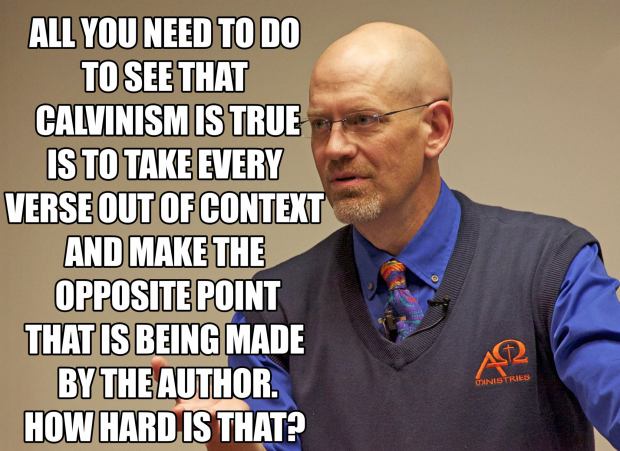
VOTD Deuteronomy 5:16
Deu 5:16 ‘Honor your father and your mother, as the LORD your God has commanded you, that your days may be long, and that it may be well with you in the land which the LORD your God is giving you.
Worship Sunday – Tzama L’ Chol Nafshi
Psa 63:2 To see thy power and thy glory, so as I have seen thee in the sanctuary.
Psa 63:3 Because thy lovingkindness is better than life, my lips shall praise thee.
VOTD Deuteronomy 5:15
Deu 5:15 And remember that you were a slave in the land of Egypt, and the LORD your God brought you out from there by a mighty hand and by an outstretched arm; therefore the LORD your God commanded you to keep the Sabbath day.
Why aren’t my prayers answered?
Sermon Audio by an Open Theist:
VOTD Deuteronomy 5:8
Deu 5:8 ‘You shall not make for yourself a carved image—any likeness of anything that is in heaven above, or that is in the earth beneath, or that is in the water under the earth;
Deu 5:9 you shall not bow down to them nor serve them. For I, the LORD your God, am a jealous God, visiting the iniquity of the fathers upon the children to the third and fourth generations of those who hate Me,
Answered Questions – Does the Open View Undermine God’s Sovereignty?
Gregory Boyd answers the question “Does the Open View Undermine God’s Sovereignty?”:
1. An adventurous sovereignty. First, the objection that God is not sovereign unless he controls everything assumes that sovereignty is synonymous with unilateral control. But why should we accept this understanding of divine sovereignty? There are no rational or biblical reasons to suppose that divine sovereignty must or should entail exhaustive, meticulous, divine control.
…
2. The undermining of divine sovereignty. The definition of sovereignty as control is not only unwarranted; it is, for many of us, not sovereign at all. To speak frankly, it is hard to conceive of a weaker God than one who would be threatened by events occurring outside of his meticulous control. It is difficult to imagine a less majestic view of God than one who is necessarily limited by a unilateral, deterministic mode of relating to his creation.
VOTD Deuteronomy 4:37
Deu 4:37 And because he loved your fathers and chose their offspring after them and brought you out of Egypt with his own presence, by his great power,
Apologetics Thursday – A Logical Refutation of a Logical Refutation of Open Theism
Adapted from a list of proofs on Carm.org:
1. God is the only eternal, uncaused, and self-existent being who was before all things.
Granted, as long as “things” refers to physical reality. After all, the axioms of logic are not “things” to be created. Neither is “time”.
2. Time is that non-spatial, continuous succession of events from the past, through the present, and into the future.
Assumption by Slick. Time is not a “thing” to be created or manipulated. In the Bible, there is no time travel. This is very telling. Clocks and daylight measure “time”, but that does not mean “time” is something created. Just as words describe the axioms of logic, this does not mean the laws of logic are a thing to be invented like words are.
3. Since God is eternal by nature, God is not restricted by nor contained within time, nor is He restricted by a continuous succession of events from the past, through the present, and into the future, nor is time an attribute of God’s nature.
False assumption. The Bible never describes God as “eternal” but “everlasting”. The precise concept is that God has always existed and will always exist. Slick assumes Platonism onto the text in contrast with what the Biblical authors intended. If an intellectually honest reader were to adhere to the intentions of the Biblical authors, Slick’s argument would be refuted by the very texts he uses as prooftexts.
Logically, if time is not a created thing (instead it would be an axiom such as the laws of logic), then being “contained within time” is a non-concept of the likes of being “contained within logic”.
4. God is the Creator of the universe and is independent of it.
Assumption. Universe needs to be properly defined. Independent has to be properly defined. Then the logical case must be made that a creator is independent of their creation. This is a tenuous statement.
5. The universe exists in relationship to time which is a consecutive series of events that relate to change and sequence.
Another assumption. If time is not a “thing”, this point does not follow.
6. God is not subject to or limited by the constraints of the universe, which includes the constraints or limits of time or any properties of time that may limit us as humans.
Another assumption. When very fragile assumptions are compounded upon one another, the ultimate conclusion becomes weaker and weaker.
7. Since God created the universe, and since God is not subject to time, and since the universe operates in time, God also created time when He created the universe.
“Time” being a “thing” is a major and unsubstantiated assumption. That God “created” time is not a Biblical concept. God is displayed as creating the material universe, in a certain sequence. God functions as if He is everlasting (like the Bible claims again and again) experiencing a before and after.
8. Since God created time, God has always existed and continues to exist outside of time and is not subject to its properties.
This is completely anti-Biblical speculation.
9. God is omnipresent. This means that He exists in all places in the universe as well as outside of it (as far as can be described to exist outside of existence).
The term omnipresent is not a Biblical term. Plus there is major dispute over what the concept means. Assuming any particular understanding of “omnipresense” is antithetical to philosophy and the Bible.
10. God’s omnipresence is not restricted by time because God, by nature, is not restricted by time.
This is the result of several compounding speculative and anti-Biblical claims.
11. Since God is not restricted by time, and since He is omnipresent, then the future is a present reality with God.
Even if the premises were founded, the conclusions do not follow. If time is able to be transversed, that doesn’t mean all time is present with God. That is an unfounded assumption. Maybe God can experience different points of time, randomly moving back and forward as presents. There is no reason to assume some sort of perpetual present of all time.
12. Therefore, because God is in all places at all times, God knows all things, even the future free will choices of free creatures. This means that the open theism view that God does not know all future events of free will creatures is false.
Garbage in, garbage out.
VOTD Deuteronomy 4:34-35
Deu 4:34 Or did God ever try to go and take for Himself a nation from the midst of another nation, by trials, by signs, by wonders, by war, by a mighty hand and an outstretched arm, and by great terrors, according to all that the LORD your God did for you in Egypt before your eyes?
Deu 4:35 To you it was shown, that you might know that the LORD Himself is God; there is none other besides Him.
Ehrman v the Infidel Guy
Bart Ehrman explains to the Infidel Guy the concept of historical evidence. He explains that Jesus did exist.
VOTD Deuteronomy 4:31
Deu 4:31 (for the LORD your God is a merciful God), He will not forsake you nor destroy you, nor forget the covenant of your fathers which He swore to them.
Biblical Open Theist Reading List
 From time to time individuals request a consolidated list of basic reading on the subject of Open Theism. This post sets out to build a basic reading list for Biblical Open Theism (contrasted with Philosophical Open Theism) for the neophyte.
1. Roger Olson explains how Open Theism has not been fairly represented by the critics. Instead, the critics wage a dishonest smear campaign. [link]
2. Macinnis relates her shock at blatant prooftexting of 1 Samuel 15 by a critic of Open Theism [link]
3. Apologetic Jedi lists 95 Open Theism verses in the tradition of Martin Luther’s 95 theses. [link]
4. A definition of Open Theism and an overview of the current ideological spectrum of Open Theism. [link]
5. A thorough examination of Exodus 32 and how future Biblical authors understood the text. [link]
6. A full text of Bob Enyart’s opening statement to James White during a debate on Open Theism [link]
Two important books
Did God Know, by H Roy Elseth [link]
Does God Know the Future, by Michael Saia [link]
VOTD Deuteronomy 4:28
Deu 4:28 And there you will serve gods, the work of men’s hands, wood and stone, which neither see nor hear nor eat nor smell.
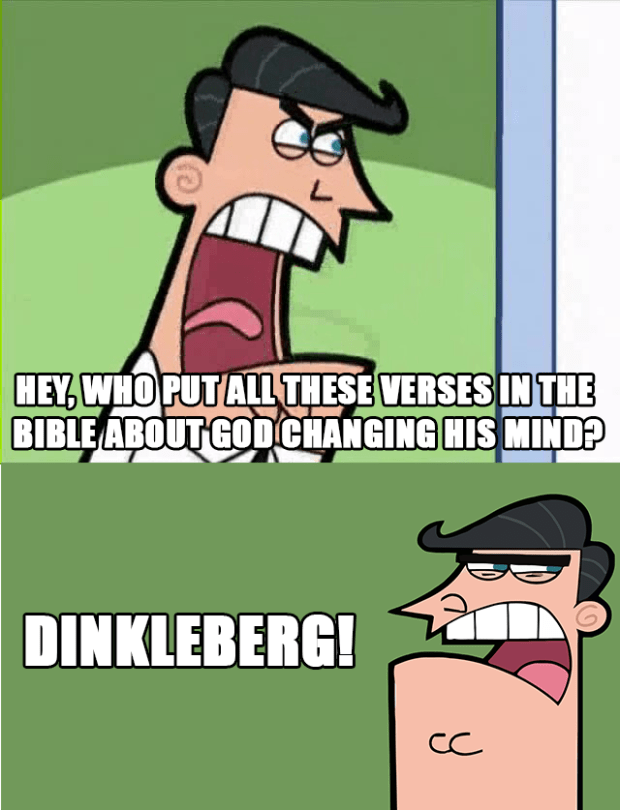
Meme Monday – Dinkleberg
VOTD Deuteronomy 4:25
Deu 4:25 “When you father children and children’s children, and have grown old in the land, if you act corruptly by making a carved image in the form of anything, and by doing what is evil in the sight of the LORD your God, so as to provoke him to anger,
Worship Sunday – This is Amazing Grace
By Phil Wickham
Who breaks the power of sin and darkness
Whose love is mighty and so much stronger
The King of Glory, the King above all kings
Who shakes the whole earth with holy thunder
And leaves us breathless in awe and wonder
The King of Glory, the King above all kings
This is amazing grace
This is unfailing love
That You would take my place
That You would bear my cross
You lay down Your life
That I would be set free
Oh, Jesus, I sing for
All that You’ve done for me
Who brings our chaos back into order
Who makes the orphan a son and daughter
The King of Glory, the King of Glory
Who rules the nations with truth and justice
Shines like the sun in all of its brilliance
The King of Glory, the King above all kings
Worthy is the Lamb who was slain
Worthy is the King who conquered the grave
Worthy is the Lamb who was slain
Worthy is the King who conquered the grave
Worthy is the Lamb who was slain
Worthy is the King who conquered the grave
Worthy is the Lamb who was slain
Worthy, worthy, worthy
VOTD Deuteronomy 4:19
Deu 4:19 And take heed, lest you lift your eyes to heaven, and when you see the sun, the moon, and the stars, all the host of heaven, you feel driven to worship them and serve them, which the LORD your God has given to all the peoples under the whole heaven as a heritage.
Lynn on God’s Foreknowledge and Man’s Free Will
John Lynn of The Living Truth Fellowship
VOTD Jeremiah 16:17
Jer 16:17 For My eyes are on all their ways; they are not hidden from My face, nor is their iniquity hidden from My eyes.
Unanswered Questions – Was Jesus’ Human Nature Divine?
To those who follow the teachings of James White and Alpha and Omega Ministries:
Col 2:9 For in Him dwells all the fullness of the Godhead bodily;
The part of Jesus’ nature which was human… was that God?
VOTD Isaiah 6:8
Isa 6:8 Also I heard the voice of the Lord, saying: “Whom shall I send, And who will go for Us?” Then I said, “Here am I! Send me.”
Apologetics Thursday – Alpha and Omega Ministries’ Intellectual Dishonesty
Part of my reoccurring work is on exposing intellectual dishonesty. There are several signs of intellectual dishonesty: Refusal to debate. Refusal to make monetary bets. Refusal to answer simple questions. On Facebook, there are two universal telltale signs of intellectual dishonesty: deleting comments and threads. If a belief cannot be transparently questioned, if critics must be censored, then the advocate is intellectually dishonest.
This week, Alpha and Omega Ministries censored Bob Enyart when Enyart replied on their Facebook page to an article that James White wrote against Bob Enyart. If that censorship does not show the rampant intellectual dishonesty of James White and Alpha and Omega Ministries, then I will present my own exhibit. I was censored and banned for asking questions. The intellectual dishonesty is apparent on several levels. Straightforward questions are ignored and instead were censored.
The entire Facebook exchange between me and the A&O Facebook admin, Richard C Pierce, is available for all to read. It should be noted that I make zero theological arguments the entire “debate”. I take no stances and advocate no views. Instead, I ask questions. Questions are a chance for individuals to explain what they believe, to clarify. Instead, Pierce, hyper-reacts. He becomes belligerent. It is obvious he is afraid of the question. This is not unlike White’s handing of the question and answer period during the White Enyart debate. White and company are very afraid of questions. Their beliefs do not hold up to simple scrutiny. Pierce then bans me. I do get to, in the end, point out the intellectual dishonesty of A&O Ministries, which is very apparent by Pierce’s refusal to answer questions and his belligerence towards those asking questions.
Part of the exchange is obscured because I didn’t expand some comments before the copy/paste. Pierce can release the rest of those comments if he can be prevailed upon to do so. All the relevant parts are still intact:
Richard C Pierce ROFLing
I removed Bob and Will’s posting privileges because I got tired of their ignoring James and my responses. Unfortunately, when you do that on this kind of FB page FB ‘hides’ all posts from those individuals. This is certainly not my favorite f…See More
Like · Yesterday at 12:01am · Edited
Richard C Pierce Chris Fisher my only other option here is that if I were to receive assurances that Bob and Will can behave themselves from here on, I would lift the block. Without that assurance, I will keep it in place for the near future.
As for Bob Enyart’s blog…See More
Like · Yesterday at 12:07am · Edited
Chris Fisher Personally, I would like to see what the answer is to Duffy’s question:
Is Jesus the second person of the trinity?…See More
Richard C Pierce Chris Fisher How many times would you like to see it answered? James answered in this very post. The answer is yes, has always been yes and has not been anything other than yes. Perhaps you need to ask again to see if it changed?
Unlike · 1 · Yesterday at 3:47pm
Chris Fisher So, if Jesus is the second person of the trinity and Jesus took on human nature, then isn’t that God changing? God is going from God+Jesus (no human nature)+Holy Spirit to God+Jesus (with human nature)+Holy Spirit?
Richard C Pierce No, but again, Dr. White explained this, so why are you acting like he hasn’t? This whole ‘playing dumb’ act from your group is getting very tiring.
Chris Fisher No seriously. No one understands it. Explain how God can incorporate human nature and yet not change.
Rachel Troyer So… the second person of the trinity has a divine nature and a human nature, but before the incarnation did not have a human nature… right?
Isn’t this what James White believes?Richard C Pierce Jesus is ‘fully’ God and ‘fully’ man. This is called the hypostatic union. The natures are not a ‘mixture’ therefore God is not changed. But of course, Bob Enyart knows that is what we believe. He is ignoring that in order to prop up his straw man – false case.
Richard C Pierce I am sure that I could find something in Bob’s teachings that I could twist into something that he doesn’t actually believe and then play dumb while repeatedly poking at him about it and then acting like he can’t respond. Such is not honest communication.
Chris Fisher Here is where I think our communication breakdown may be happening: was the part of Jesus with human nature fully God?
Richard C Pierce Sigh. Again, the playing dumb act isn’t flying anymore. I just stated that there is no ‘mixture.’ This entire line is a straw man designed to tie up and waste time. The real problem here isn’t communication, it is that you don’t like the answer. Well, it is what it is so get honest with it. If you want to disagree with what we ‘really’ believe then do so. Otherwise, enough with the straw man argument.
Richard C Pierce All: Before you decide to chime in for some more ‘ring around the straw man rosey’ I suggest you read the rules for this page.
Admin
Rachel Troyer “Jesus is ‘fully’ God and ‘fully’ man. This is called the hypostatic union. The natures are not a ‘mixture’ therefore God is not changed”
So, I totally agree that Jesus is fully God and fully man.
But, the second person of the trinity (Jesus/Son of G…See MoreRachel Troyer I read the rules and I listened to the posts but it’s still confusing… James is trying to say that there is no change with God because God can not change in any way. So, he is saying that the incarnation was NOT a change… right?
Rachel Troyer Richard, I think it is purely communication. I don’t think it’s a “straw man” argument. It seems to me that everyone thinks the same thing but some refer to it as a change and some don’t.
the Word became flesh, so at one point it wasn’t flesh and at another point it was flesh… right?Chris Fisher It is a yes or no question. There is no “playing dumb” on my part. Either your view is comprehensible or it isn’t. You should be able to explain it if it is. Instead of typing two or three letters you chose for a paragraph ignoring the question:
Was the part of Jesus with human nature fully God? …See More
Richard C Pierce I am sorry that you are both so confused. Somehow, generations have been able to understand this for 2000 years. Perhaps someone has bewitched you?
Chris Fisher Was the part of Jesus with human nature fully God?
Richard C Pierce Answering for the last time. He who has ears to hear…
https://carm.org/jesus-two-natures
Jesus’ Two Natures: God and Man
by Matt Slick
CARM.ORG
Chris Fisher Sir, do you believe that answers my question? If so, copy and paste the sentence that explains if Jesus’ human nature was fully God. It feels to me that Slick and White avoid simple questions and defer to distractions that do not answer critical questions. Intellectual honesty calls for transparent answers to direct questions.
Arlin Edmondson “Was the part of Jesus with human nature fully God?”
What is incomprehensible is your question, Chris….See More
Chris Fisher It seams to me that you want to say “no”. So I will help you out. You can copy and paste this sentence: ” The part of Jesus’ nature that was human is not God. ”
Rachel Troyer Richard,
The Word became flesh. At one point the Word (God- the second person of the trinity) was not in the flesh and now the Word (God-the second person of the trinity) is in the flesh. For 2000 years+ Christians have professed Christ as dying and…See MoreRichard C Pierce Guys, argue all of the little conundrums that you want. Your argument is not with me, James White, Matt Slick or a host of others. It is with scripture. You can repeat your case all that you want, you are denying the direct teaching of scripture.
Hebrews 13:8 Jesus Christ is the same yesterday and today and forever.
Chris Fisher It is a yes or no question. I am not arguing anything. I have never seen someone so afraid of answering questions:
Was the part of Jesus with human nature fully God?
Micah Burke > Was the part of Jesus with human nature fully God?
This shows a startling lack of understanding of the hypostatic union.
Chris Fisher Micah, yes or no. From what I gather is that you and Richard would say “no”, and then talk about the hypostatic union. But you are too afraid to write out your beliefs.
Chris Fisher The fact that you will not say “yes” suggests you do not believe “yes”. You do not believe Jesus’ human side was divine. But you also do not want to say ” no” because you understand how heretical that would look. My conclusion is that you both are intellectually dishonest.
Rachel Troyer Micah, was there a point before the hypostatic union where Jesus was not the God-man?
From Gotquestions.org it says,
“Jesus always had been God (John 8:58,10:30), but at the incarnation Jesus became a human being (John 1:14). The addition of the human nature to the divine nature is Jesus, the God-man.”
This is similar to John Piper’s article on the hypostatic union.
“AT the incarnation, Jesus became a human being
Word became flesh”So, my question is simple, before the incarnation, was Jesus a human being? was there a human nature along with the divine nature? or did this “addition” become so at the incarnation?
If so, then this is a change in God… right? Because Jesus is fully God… always was and is and will be… but wasn’t always human… right?
Bible Questions Answered by GotQuestions.org! Fast and accurate answers to all your Bible…
GOTQUESTIONS.ORG
VOTD Isaiah 5:7
Isa 5:7 For the vineyard of the LORD of hosts is the house of Israel, And the men of Judah are His pleasant plant. He looked for justice, but behold, oppression; For righteousness, but behold, a cry for help.
Augustine on Stealing Platonistic Theology
From On Christian Doctrine:
60. Moreover, if those who are called philosophers, and especially the Platonists, have said anything that is true and in harmony with our faith, we are not only not to shrink from it, but to claim it for our own use from those who have unlawful possession of it.
VOTD Isaiah 5:2
Isa 5:2 He dug it up and cleared out its stones, And planted it with the choicest vine. He built a tower in its midst, And also made a winepress in it; So He expected it to bring forth good grapes, But it brought forth wild grapes.
Enyart on God Crossing Infinite Time
Abstract:
Misconception 3: God cannot cross an actual infinity: (Send any comment to Bob@kgov.com.) God has existed through the “beginningless past” (Morriston, 2010, Faith and Philosophy, pp. 439-450). Christian theologians who object to this typically do so by being inconsistent, and thus, their objection is easily neutralized, and then answered. For example, William Lane Craig denies that God has existed throughout time immemorial, infinitely into the past, because he claims that even God cannot cross an actual infinity. (Aristotle, for example, claimed that the infinite is never actual; he however, did not know God.) Yet while Craig doesn’t admit it, he himself believes that God has crossed an actual infinity. His belief that God has exhaustive foreknowledge of a kingdom that never ends requires divine knowledge of an infinite future, with this knowledge comprised of actual thoughts in God’s mind. (This would be like God having counted to infinity.) Further, because Craig happens to hold the untenable and rather grotesque belief that God knows every possible future, that philosophical claim requires God to cross an infinite number of actual infinities. Instead, in actuality, God has crossed the single infinity of the beginningless past. Using a typically unstated assumption, an argument against God’s “beginningless past” insists that He could not have crossed an infinite past because regardless of how much time has actually passed, “infinity” would require passage of even more time to arrive at any given moment. The unstated assumption in this objection however is that it assumes its conclusion, namely, that this past period must have had a beginning (for this objection asserts that this past period is of finite duration). If there is a valid systematic theology against God crossing an actual infinity, it would not support a philosophical claim that contradicts its own system, and it will not merely assume its conclusion. Let’s consider an analogy from geometry and then an excuse from mathematics. Using an analogy, not as a proof but as an illustration, a geometrical line is infinite in both directions, whereas a ray has a terminal point yet is infinite in one direction. For our analogy, the ray extends through eternity past and is terminated in God’s present, which is where God lives (in the fullness of time, so to speak). Relatedly, perhaps there is an excuse for theologians who failed to understand all this, who lived prior to mathematician Georg Cantor (d. 1918), who taught the world that it was possible to form infinite sets greater than other infinite sets. So, if God had already existed for eternity past at the moment of creation (an infinite set of moments), by the time of the Incarnation, He had then existed for an even longer infinite set of moments. For, He must increase. (Prior to Cantor the world of mathematics never accepted the concept of greater infinity.) And finally, God put eternity into our hearts. Yet unlike God, our life is not endless in two directions but only in one, namely, into the future. So you are like a “ray” that begins at a point (of conception) and then proceeds forever (Eccl. 3:11). Therefore, our eternal soul provides for us a context in which we can develop a gut feel for what it means to live forever (throughout eternity future). Yet we lack the divine intestinal fortitude, so to speak, which we would need in order to relate to His beginningless past. Thus, by the Scriptural teachings regarding time (see above) and because time could not have been created (see above), therefore we teach that God’s goings forth are from of old, from everlasting, from ancient times, the everlasting God who continues forever, from before the ages of the ages, He who is and who was and who is to come, who remains forever, the everlasting Father, whose years never end, from everlasting to everlasting, and of His kingdom there will be no end.
VOTD Isaiah 3:16
Isa 3:16 Moreover the LORD says: “Because the daughters of Zion are haughty, And walk with outstretched necks And wanton eyes, Walking and mincing as they go, Making a jingling with their feet,
Isa 3:17 Therefore the Lord will strike with a scab The crown of the head of the daughters of Zion, And the LORD will uncover their secret parts.”
Free Monday – First Chapter from Age of Anxiety
Philosophy Project is hosting E. R. Dodds’ first chapter from Pagan and Christian in an Age of Anxiety – Some Aspects of Religious Experience from Marcus Aurelius to Constantine
VOTD Isaiah 2:20
Isa 2:20 In that day a man will cast away his idols of silver And his idols of gold, Which they made, each for himself to worship, To the moles and bats,
Worship Sunday – Holy and Anointed One
By Vineyard
Jesus, Jesus
Holy and anointed One, Jesus
Jesus, Jesus
Risen and exalted One, Jesus
Your name is like honey on my lips
Your Spirit like water to my soul
Your Word is a lamp unto my feet
Jesus, I love You, I love You
VOTD Isaiah 2:19
Isa 2:19 They shall go into the holes of the rocks, And into the caves of the earth, From the terror of the LORD And the glory of His majesty, When He arises to shake the earth mightily.
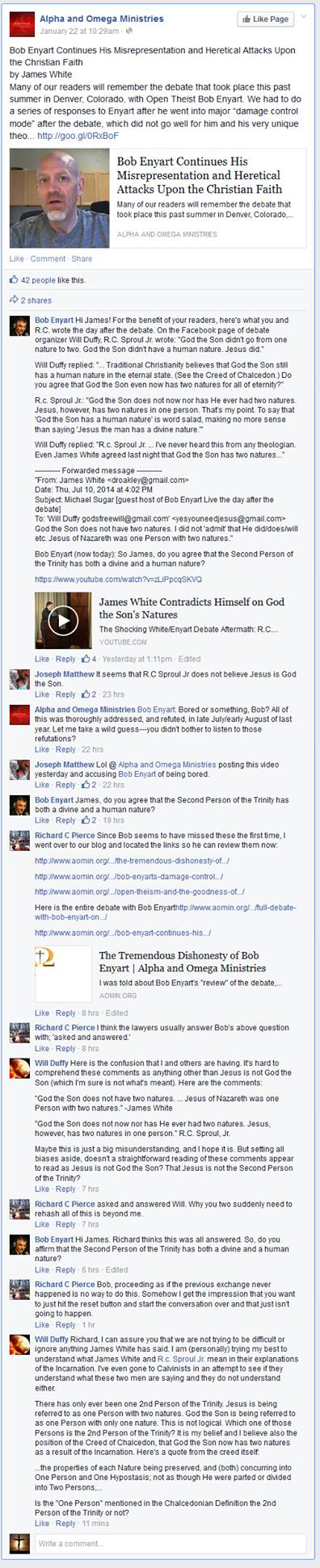
James White Censors Enyart’s Response to White’s Criticism of Enyart
Update: posts are reinstated as of 1/26/2015
The following was deleted from Alpha and Omega Ministries. Bob Enyart and Will Duffy had quickly responded to White’s criticism of Enyart. White and his ministry did not want Enyart’s side to be heard and removed it from their Facebook page (update: both Enyart and Duffy were also blocked). This is all in response to White’s backtracking and disingenuous handling of the Enyart White Open Theism debate aftermath:
See also: James White’s Opening Statement Refuted Sentence by Sentence
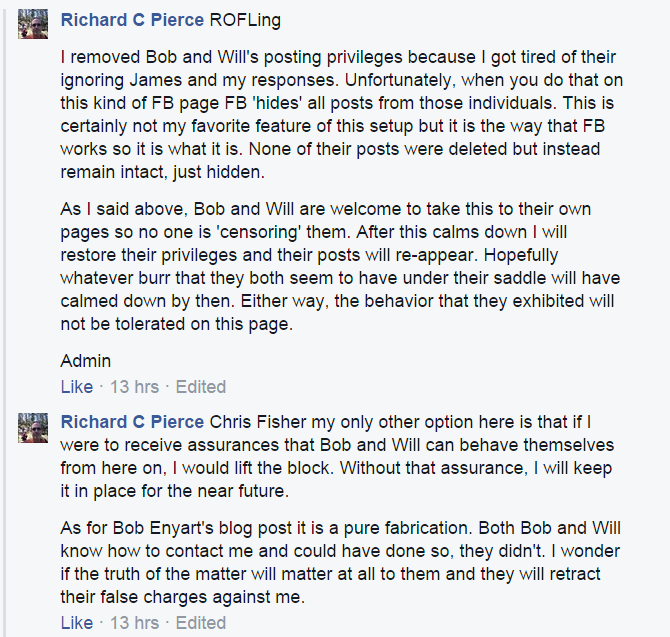
Response posted by Alpha and Omega Ministries (1/25/2015). The reader can decide if Enyart’s and Duffy’s posts were inappropriate:
Augustine on God’s Ineffibility
From On Christian Doctrine:
6. Have I spoken of God, or uttered His praise, in any worthy way? Nay, I feel that I have done nothing more than desire to speak; and if I have said anything, it is not what I desired to say. How do I know this, except from the fact that God is unspeakable? But what I have said, if it had been unspeakable, could not have been spoken. And so God is not even to be called unspeakable, because to say even this is to speak of Him. Thus there arises a curious contradiction of words, because if the unspeakable is what cannot be spoken of, it is not unspeakable if it can be called unspeakable. And this opposition of words is rather to be avoided by silence than to be explained away by speech. And yet God, although nothing worthy of His greatness can be said of Him, has condescended to accept the worship of men’s mouths, and has desired us through the medium of our own words to rejoice in His praise. For on this principle it is that He is called Deus (God). For the sound of those two syllables in itself conveys no true knowledge of His nature; but yet all who know the Latin tongue are led, when that sound reaches their ears, to think of a nature supreme in excellence and eternal in existence.
VOTD Isaiah 2:4
Isa 2:4 He shall judge between the nations, And rebuke many people; They shall beat their swords into plowshares, And their spears into pruning hooks; Nation shall not lift up sword against nation, Neither shall they learn war anymore.
Unanswered Questions – Elect as Enemy to the Gospel
To those who believe the elect are a people chosen go to heaven or are saved:
Rom 11:28 Concerning the gospel they are enemies for your sake, but concerning the election they are beloved for the sake of the fathers.
Why are the elect the enemy of the gospel?
VOTD Isaiah 1:27
Isa 1:27 Zion shall be redeemed with justice, And her penitents [those who repent] with righteousness.
Apologetics Thursday – Saia on the Man Born Blind
From Why Do the Innocent Suffer:
One passage of Scripture gives many readers the impression God sometimes causes people to suffer so He can display His glory. The story, found in John chapter 9, seems to imply God made a man blind so He could manifest His works in the man by healing him.
This text bothered me for many years until I read the passage straight through in the Greek. I was reading this passage because of its reference to the word “sin,” but as I did, I saw something I had never seen before.
The early Greek manuscripts were written in all capital letters, most had no punctuation except paragraph breaks, and there were no spaces between the words. So John chapter nine, verses three and four might have looked something like this:
[image of Greek text without spaces or punctuation]
Because of the way the text was written, spaces between words, accents, breathing marks, and punctuation must be supplied by the translators. Most often these additions are helpful, but there are instances where the translation is influenced by the theological presuppositions of the translators.
As Roger Forster commented about this passage, it is most often translated the way it is because of “convention and prejudice”—“convention” because it has always been translated that way, and “prejudice” because the translators really believe God made the person blind so He could heal him. Roger also noted these translations represent God as completely different in character from the way He is described in the rest of the Scriptures. If these translations are accurate, this would be the only place is the Bible God is described as doing something evil to an innocent person so good could result.
The wording of most English versions gives the idea God made the man blind so He could display His glory in the man. But that would be doing evil so good may result. This is how the text is translated in the New American Standard Bible:
Jesus answered, “It was neither that this man sinned, nor his parents; but it was in order that the works of God might be displayed in him. We must work the works of Him who sent Me as long as it is day; night is coming when no man can work.”
In the Greek, however, the words “it was,” “that,” and “it was” are simply not there. That is why they are in italics in the NASB. If you read the text as the Greek reads, without the additional English words, you see the question is answered first, and then Jesus goes on with His original business of healing the man.
Jesus answered, “Neither this man sinned, nor his parents. But in order that the works of God might be displayed in him, we must work the works of Him who sent Me as long as it is day; night is coming when no one can work.”
In other words, “Enough of these questions about whose fault this is. We need to be getting on with the work of the Father.”
Thus, with different punctuation, and without the extra words from the translators, the meaning of the passage is very different. The disciples were discussing why the man was born blind. Was it because he sinned (maybe in a former life?), or that his parents sinned? Jesus’ answer was simple and straightforward—it was neither. So, in essence, Jesus did not really answer the question. Then, turning to the most important issue, He carried on with the work of His Father to heal the man.
VOTD Isaiah 1:13
Isa 1:13 Bring no more futile sacrifices; Incense is an abomination to Me. The New Moons, the Sabbaths, and the calling of assemblies— I cannot endure iniquity and the sacred meeting.
Isa 1:14 Your New Moons and your appointed feasts My soul hates; They are a trouble to Me, I am weary of bearing them.
Swinburne on Causation, Time, and God’s Omniscience
VOTD Isaiah 1:4
Isa 1:5 Why should you be stricken again? You will revolt more and more. The whole head is sick, And the whole heart faints.
Brueggemann on Jeremiah
VOTD Isaiah 1:2-3
Isa 1:2 Hear, O heavens, and give ear, O earth! For the LORD has spoken: “I have nourished and brought up children, And they have rebelled against Me;
Isa 1:3 The ox knows its owner And the donkey its master’s crib; But Israel does not know, My people do not consider.”
Free Monday – The influence of Greek ideas and usages upon the Christian church
A free book for anyone interested in serious Bible study. Edwin Hatch examines Greek influences on the Christian church.
Excerpt:
“few, if any, writers write with the precision of a legal document, and the inverted pyramids which have been built upon chance phrases of Clement or Justin are monuments of caution which we shall do well to keep before our eyes. ”
The influence of Greek ideas and usages upon the Christian church
VOTD Psalms 11:4
Psa 11:4 The LORD is in His holy temple, The LORD’s throne is in heaven; His eyes behold, His eyelids test the sons of men.
Worship Sunday – It is You
By the Newsboys
As we lift up our hands will you meet us here?
As we call on Your name will you meet us here?
We have come to this place to worship You
God of mercy and grace
It is You we adore
It is You, praises are for
Only You, the Heavens declare
It is You
It is You
An’ Holy, Holy is our God Almighty
An’ Holy, Holy is His name alone, yea
An’ Holy, Holy is our God Almighty
An’ Holy, Holy is His name alone
It is You we adore
It is You, only You
As we lift up our hands will You meet us here?
As we call on Your name will You meet us here?
We have come to this place to worship You
God of mercy and grace
It is You we adore
It is You, praises are for
Only You, the Heaven’s declare
It is You
It is You
An’ Holy, Holy is our God Almighty
An’ Holy, Holy is His name alone, yea
An’ Holy, Holy is our God Almighty
An’ Holy, Holy is His name alone
As we lift up our hands, as we call on Your name
Will You visit this place by Your mercy and grace?
As we lift up our hands, as we call on Your name
Will You visit this place by Your mercy and grace?
It is You we adore
It is you
It is you
An’ Holy, Holy is our God Almighty
An’ Holy, Holy is His name alone
An’ Holy, Holy is our God Almighty
An’ Holy, Holy is His name alone, yea
An’ Holy, Holy is our God Almighty
An’ Holy, Holy is His name alone
It is you we adore
It is you, only you
VOTD Amos 7:3
Amo 7:3 So the LORD relented concerning this. “It shall not be,” said the LORD.
Fisher on Being Elect
The holy calling is according to God’s purpose. His purpose was given to us before the times of the ages. Both the Second Timothy and the Ephesians verses should be understood be two important elements. There is an election to something; what is being elected? Who are persons being elected? Who are the “us in Christ?”
There is nothing inherent in the meaning of the verb “to choose” that implies salvation. The common use of electing or choosing people for public office is a good English equivalent of the Greek verb. Many people are elected or chosen to office all the time. The verb is very generic.
The word to choose in Greek “ἐκλέγομαι” occurs 19 times in the New Testament. Only perhaps three or four times does this verb mean an election to salvation. Thayer’s Greek-English Lexicon of the New Testament, an early scholarly work in English has been a basic reference book since 1885. In this book he lists at least five different types of election relating to this verb:
VOTD Zechariah 13:2
Zec 13:2 “It shall be in that day,” says the LORD of hosts, “that I will cut off the names of the idols from the land, and they shall no longer be remembered. I will also cause the prophets and the unclean spirit to depart from the land.
Answered Questions – 30 Pieces of Silver
A YouTube commenter challenges:
2) Did Jeremiah just get lucky when he prophesied that Jesus would be bought by men for precisely 30 silver, centuries later?
Jeremiah didn’t actually do that. Zechariah is what is being referenced. The context has nothing to do with Jesus.
Zec 11:12 Then I said to them, “If it is agreeable to you, give me my wages; and if not, refrain.” So they weighed out for my wages thirty pieces of silver.
In fact, if no 30 pieces of silver were ever used to purchase a field, no one would ever have heard of this failed prophecy. There is zero indication in Zechariah that this is a prophecy!
In ancient Israel, they showed truth by showing parallels. Things were true if they had precedence. That is what Matthew does when he says scripture is “fulfilled”. The fulfilled scripture usually has zero indication of having a secondary prophetic meaning. Paul and James even use precedence to prove competing points! And the context of some of Paul’s prooftexts are often the opposite point he advocates with the prooftexts. The idea is parallelism, not prophecy.
VOTD Daniel 10:12
Dan 10:12 Then he said to me, “Do not fear, Daniel, for from the first day that you set your heart to understand, and to humble yourself before your God, your words were heard; and I have come because of your words.
Apologetics Thursday – Greek Influences in the Church
Arbour and Blount argue that Open Theists just assume that the church fathers rejected face value readings of the Bible in favor of Platonism. From The Camel’s Nose: Open Theism and Biblical Interpretation – Benjamin H. Arbour and Douglas K. Bloun:
Now Adolf Harnack and Wolfhart Pannenberg not withstanding, we doubt that the tradition’s interpretive approach has been as heavily influenced by Greek philosophy as open theists suggest. Sadly, however, we cannot entertain open theists’ arguments to the contrary for the simple reason that they have put forward no such arguments.21 That traditional Christian readings of scripture have been unduly influenced by Greek philosophy is not a conclusion for which open theists argue but rather an assumption from which they argue. So, for instance, Sanders—who proclaims the point persistently and pointedly—does nothing to show that the tradition has been so influenced; he also does nothing to show which Greek philosophical doctrines are problematic for Christian theology, not to mention why they are so. Apparently, he takes the point to be beyond dispute; it is not.
Arbour and Bloun might be unfamiliar with the extent of documentation of the early Church’s reliance on Platonism. Augustine, the most influential Christian writer, literally stated that he believed the Bible was absurd before Simplicanous told Augustine to read the Bible in light of Plotinus. Augustine admits it plainly. This is in the same work which Augustine shows utter contempt for those who read the Bible on face value:
6. I rejoiced also that the old Scriptures of the law and the prophets were laid before me, to be perused, not now with that eye to which they seemed most absurd before, when I censured Your holy ones for so thinking, whereas in truth they thought not so; and with delight I heard Ambrose, in his sermons to the people, oftentimes most diligently recommend this text as a rule—The letter kills, but the Spirit gives life; while, drawing aside the mystic veil, he spiritually laid open that which, accepted according to the letter, seemed to teach perverse doctrines— teaching herein nothing that offended me, though he taught such things as I knew not as yet whether they were true…
Notice, the Bible was “absurd” to Augustine during his face value readings. And what was absurd? In Chapter 11, Augustine mocks those who think God is in time and spoke as Jesus was being baptized. In Augustine’s commentary on Genesis, he does great damage to the text. Augustine makes the “original sin” as sex between Adam and Eve, as well as other affronts to the face value reading. As soon as Augustine was given license to reinterpret the text spiritually, dumping the face value reading, that allowed him to convert to Christianity.
26. But having then read those books of the Platonists, and being admonished by them to search for incorporeal truth, I saw Your invisible things, understood by those things that are made; [Romans 1:20] and though repulsed, I perceived what that was, which through the darkness of my mind I was not allowed to contemplate,— assured that You were, and were infinite, and yet not diffused in space finite or infinite; and that Thou truly art, who art the same ever, varying neither in part nor motion; and that all other things are from You, on this most sure ground alone, that they are. Of these things was I indeed assured, yet too weak to enjoy You… Upon these [books by the Platonists], therefore, I believe, it was Your pleasure that I should fall before I studied Your Scriptures, that it might be impressed on my memory how I was affected by them… For had I first been moulded in Your Holy Scriptures, and had Thou, in the familiar use of them, grown sweet unto me, and had I afterwards fallen upon those volumes, they might perhaps have withdrawn me from the solid ground of piety; or, had I stood firm in that wholesome disposition which I had thence imbibed, I might have thought that it could have been attained by the study of those books alone.
Notice, Augustine praises the books of the Platonists. Augustine then says his Platonism made the Bible repulsive. Augustine then says that once he used Platonism to understand the Bible, he accepted the Bible. And to top it off, Augustine runs a hypothetical: if Augustine first accepted the Bible and then came across the books of Platonism, Augustine would have converted away from Christianity to Platonism. Christianity, Augustine explicitly says, is Platonism plus charity.
In Confessions, Book 8, Simplicanus lets Augustine into a secret: All the Church Fathers were engrained in Platonism. Simplicanus told Augustine that all Augustine needed to do was import Platonism into Christianity to make Christianity believable:
But when I mentioned to him that I had read certain books of the Platonists, which Victorinus, sometime Professor of Rhetoric at Rome (who died a Christian, as I had been told), had translated into Latin, he congratulated me that I had not fallen upon the writings of other philosophers, which were full of fallacies and deceit, after the rudiments of the world, [Colossians 2:8] whereas they, in many ways, led to the belief in God and His word.
When Arbour and Bloun claim that it is only assumed that the Church Fathers read the Bible in light of Platonism, they are very mistaken. They might be unfamiliar with Early Church writings, but it is not a contested point. It is well documented that not only were the Church Fathers hardcore Platonists, but that they would reject Christianity if they believed the face value text of the Bible. Platonism was their mechanism to conforming Christianity into something they could accept. This is not assumption (as Arbour and Bloun label it); it is explicitly stated in essay format by the Church Fathers.
VOTD Daniel 9:18
Dan 9:18 O my God, incline Your ear and hear; open Your eyes and see our desolations, and the city which is called by Your name; for we do not present our supplications before You because of our righteous deeds, but because of Your great mercies.
Brown on the Origins of Double Predestination
From The Cruciform View:
The overall thrust of this chapter in Cary’s monograph is that Augustine’s idiosyncratic formulation of election and predestination (which would later influence Calvin and Luther’s own idiosyncratic neo-Augustinian versions of the doctrine) was influenced by Platonic and Neo-Platonic thought patterns of grace that differed significantly from the Pauline and Hebraic concept of grace, which is given to one (Israel, Christ, the Church) for the benefit of others rather than merely and arbitrarily given to one instead of another, which as Cary rightly says, leads logically to the “outright disaster” of Augustine’s (and later Calvin’s) doctrine of double-predestination.
VOTD Daniel 9:17
Dan 9:17 Now therefore, our God, hear the prayer of Your servant, and his supplications, and for the Lord’s sake cause Your face to shine on Your sanctuary, which is desolate.
Duffy on Unessential Attributes
Quote by Will Duffy from a Facebook discussion:
I don’t get bogged down with Greek philosophical attributes like omniscience and omnipresence or immutability. God isn’t Holy because He knows everything. He isn’t righteous because He can be everywhere. Jesus wasn’t ommipresent on earth. That proves it’s not an essential attribute for God. Will God be in the lake of fire for all eternity? Of course not. Essential to Who God is is that He’s living, personal, relational, good, and just, things Christ did not give up at the incarnation.
VOTD Daniel 9:15
Dan 9:15 And now, O Lord our God, who brought Your people out of the land of Egypt with a mighty hand, and made Yourself a name, as it is this day—we have sinned, we have done wickedly!
Free Monday – God Everlasting
Nicholas Wolterstorff argues that God is everlasting:
VOTD Daniel 9:13-14
Dan 9:13 “As it is written in the Law of Moses, all this disaster has come upon us; yet we have not made our prayer before the LORD our God, that we might turn from our iniquities and understand Your truth.
Dan 9:14 Therefore the LORD has kept the disaster in mind, and brought it upon us; for the LORD our God is righteous in all the works which He does, though we have not obeyed His voice.
Worship Sunday – Your Love, Oh Lord
By Third Day
Your Love, Oh Lord
Reaches to the heavens
Your faithfulness
Stretches to the skies
Your righteousness
Is like the mighty mountain
Your justice flows like the ocean’s tide
I will lift my voice
To worship You my King
And I will find my strength
In the shadow of Your wings
Your Love, Oh Lord
Reaches to the heavens
Your faithfulness
Stretches to the skies
Your righteousness
Is like the mighty mountain
Your justice flows like the ocean’s tide
I will lift my voice
To worship You my King
And I will find my strength
In the shadow of Your wings
Your Love, Oh Lord
Reaches to the heavens
Your faithfulness
Stretches to the skies
VOTD Daniel 5:23
Dan 5:23 And you have lifted yourself up against the Lord of heaven. They have brought the vessels of His house before you, and you and your lords, your wives and your concubines, have drunk wine from them. And you have praised the gods of silver and gold, bronze and iron, wood and stone, which do not see or hear or know; and the God who holds your breath in His hand and owns all your ways, you have not glorified.
Who is the God of Israel?
From Derek Ouellette of www.covenantoflove.net:
What a powerful statement from a man who is not interested in sustaining “static categories of interpretation” such as Calvinism or Arminianism; neither, it is prudent to add, is he interested in Open Theism. When Brueggemann approaches the scriptures he does not ask, is the God of Calvin here or the God of Arminius or the God of Pinnock? When Brueggemann approaches the Old Testament he asks the question to the ancient Hebrews, “Who do you say that He is?” Sometimes we see the categories of Calvin and sometimes we see the categories of Arminius, this is partly what makes God “unsettling”, because YWHW cannot be made to easily fit into our “static categories of interpretation” – He is too big, and we are too fallible.
Yet it is a fearful road Brueggemann offers, it is a road of discomfort; because in asking the Hebrews and not the Greeks “Who is YWHW?” he finds himself immediately at odds with classical Christian theology.
“In… much classical Christian theology, ‘God’ can be understood in terms of quite settled categories that are, for the most part, inimical to the biblical tradition. The casting of the classical tradition… is primarily informed by the Unmoved Mover of Hellenistic thought… a Being completely apart from and unaffected by the reality of the world” [p.1]
VOTD Daniel 5:21
Dan 5:21 Then he was driven from the sons of men, his heart was made like the beasts, and his dwelling was with the wild donkeys. They fed him with grass like oxen, and his body was wet with the dew of heaven, till he knew that the Most High God rules in the kingdom of men, and appoints over it whomever He chooses.
Unanswered Questions – How Can a Failed Prophecy Not Be a Lie
To those who believe God knows the future:
Jon 3:4 And Jonah began to enter the city on the first day’s walk. Then he cried out and said, “Yet forty days, and Nineveh shall be overthrown!”
2Ki 20:5 “Return and tell Hezekiah the leader of My people, ‘Thus says the LORD, the God of David your father: “I have heard your prayer, I have seen your tears; surely I will heal you. On the third day you shall go up to the house of the LORD.
2Ki 20:6 And I will add to your days fifteen years. I will deliver you and this city from the hand of the king of Assyria; and I will defend this city for My own sake, and for the sake of My servant David.” ‘ ”
How can a God who cannot lie make specific time-limit prophecies that do not come true when He said they would?
VOTD Daniel 5:18-20
Dan 5:18 O king, the Most High God gave Nebuchadnezzar your father a kingdom and majesty, glory and honor.
Dan 5:19 And because of the majesty that He gave him, all peoples, nations, and languages trembled and feared before him. Whomever he wished, he executed; whomever he wished, he kept alive; whomever he wished, he set up; and whomever he wished, he put down.
Dan 5:20 But when his heart was lifted up, and his spirit was hardened in pride, he was deposed from his kingly throne, and they took his glory from him.
Apologetics Thursday – Patterson’s Prooftexts
Nathan Patterson declares he is leaving Open Theism. Although he was wavering for some time, he chose the Arminian route. He will be missed as an advocate. He provides a lot of thoughtful comment. He does come closer than many at not misrepresenting Open Theism.
He leaves the fold with a few prooftexts, which he represents as God having concrete future plans:
“Before I formed you in the womb I knew you; Before you were born I sanctified you; I ordained you a prophet to the nations.” (Jeremiah 1:5, NKJV)
This text is about Jeremiah. God, throughout the Bible, chooses people from birth to be advocates for him. King David was convinced about this. Isaiah was convinced of this (Isa 49:1). One fallacy is to take special people in the Bible and then export their experiences to all of humanity. Not everyone is King David or Jeremiah. This is the logical fallacy of composition.
But even God’s calling doesn’t always go as planned. In Numbers 18, God gives Aaron and his sons the priesthood. But in Leviticus 10:1, Aaron’s immediate sons quickly sin and God puts them to death. They have failed their calling and have failed God.
In 1 Samuel 22, the same thing happens. The sons of Eli sin. God kills them, revokes his promise to Aaron’s lineage, and then promises to raise up a faithful priest instead:
1Sa 2:30 Therefore the LORD God of Israel says: ‘I said indeed that your house and the house of your father would walk before Me forever.’ But now the LORD says: ‘Far be it from Me; for those who honor Me I will honor, and those who despise Me shall be lightly esteemed.
Notice the revocation of God’s promise. If God has foreseen the revoking of His promise, then His promise was a lie. The more natural reading is that although God raised up Aaron’s lineage to be a priest nation, they ignored God’s guidance, and God changed His mind based on their actions. God chooses to raise up a new priest:
1Sa 2:35 Then I will raise up for Myself a faithful priest who shall do according to what is in My heart and in My mind. I will build him a sure house, and he shall walk before My anointed forever.
The very next chapter starts with God calling to the boy, Samuel. Samuel was called as a boy, not from before birth, and only because of the failings of Eli’s sons. But Eli was called young, because God raises up people from birth. Sometimes they are a plan B, as with David who receives Saul’s kingdom after God wanted to give Saul an eternal kingdom but then Saul failed. Sometimes God’s chosen fail God.
“Remember this, and show yourselves men; Recall to mind, O you transgressors. Remember the former things of old, For I am God, and there is no other; I am God, and there is none like Me, Declaring the end from the beginning, And from ancient times things that are not yet done, Saying, ‘My counsel shall stand, And I will do all My pleasure,’ Calling a bird of prey from the east, The man who executes My counsel, from a far country. Indeed I have spoken it; I will also bring it to pass. I have purposed it; I will also do it.” (Isaiah 46:8-11, NKJV)
Amos 3:7 is a parallel thought to Isaiah 46:
Amo 3:7 Surely the Lord GOD does nothing, Unless He reveals His secret to His servants the prophets.
If someone wanted to make the case that God doesn’t do much, because a lot of things happen on Earth without being first made known, then this is the verse to use. But when reading the Bible, common sense has to be used. The idea is that God specifically tells people what He is going to do before He does it. That way people will know God was the one to do it.
Isaiah 46, likewise, is not talking about “everything” God does. Really, the context is limited to His visible power acts meant to show people He is the living God. The false prophets had all sorts of power claims for their false gods. God points out the striking difference: God not only predicted what would happen, but why it would happen. God then made it happen.
God is explicit: “I have spoken it; I will bring it to pass.” This is all in a desperate attempt to get Israel to believe in Yahweh, something which historically has failed. In Isaiah, God wonders “what more could I have done for Israel to make them believe?” (Isa 5:4). Even Isaiah 40-48 is written from an Open Theist perspective:
1. God is desperately trying to convince people to believe in Him.
2. God is not given some sort of clairvoyance of the future, but instead works to make His word into reality.
3. God is said to know things through mechanisms for knowing. God knows the volume of water on Earth because He counts it (Isa 40:12).
4. God said he tried to punish Israel and it failed to have the affect He wanted. This made God mad. (Isa 42:25)
Him, being delivered by the determined purpose and foreknowledge of God, you have taken by lawless hands, have crucified, and put to death; whom God raised up, having loosed the pains of death, because it was not possible that He should be held by it. (Acts 2:23-24, NKJV)
God had a plan and God accomplished this plan. This is a working out of Isaiah 46, as quoted above. God’s plans coming true do not require clairvoyance. There is no reason to think God’s foreknowledge was more than a plan, whose details could have varied.
Jesus, himself, represents the crucifixion as not a fixed event (Mat 26:53). In that respect, Jesus did not think that even a purposed and foreknown event necessarily would happen. This is everyone’s experience. Sometimes we foreknow things and plan things, but then circumstances change. There is no reason to attach Negative Theology to this verse and ample reason to avoid doing so.
For whom He foreknew, He also predestined to be conformed to the image of His Son, that He might be the firstborn among many brethren. Moreover whom He predestined, these He also called; whom He called, these He also justified; and whom He justified, these He also glorified. (Romans 8:29-30, NKJV)
Romans is all about group status. The Jews are cut off, the Gentiles are grafted in, and remnant is created. When Jews thought about election, it was always corporate and it was always people groups. The “chosen people”, a “chosen nation”, a “priest nation” are Biblical terms. Likewise, one belief Paul had to constantly fight was the idea that Jews were saved by virtue of being Jewish. This was the strong corporate ideology found in 1st century Judaism. Romans is not about individual election.
Instead, Romans details God’s extreme measures to insure that He gets His own people group which He had been attempting to craft since Abraham. Paul’s solution to this that God is now trying a hybrid elect, a remnant (Rom 11:5), consisting of Gentiles and Jews who accept Jesus as Christ. But Paul warns them too, God will cut them off if they too fail Him (Rom 11:21). God is open to trying new and innovative things to build an elect people.
Romans reads like an Open Theist manifesto.
“I am the Alpha and the Omega, the Beginning and the End,” says the Lord, “who is and who was and who is to come, the Almighty.” (Revelation 1:8, NKJV)
God made the world and will destroy it. God is the beginning and the end. This is a fitting verse to include in a book about the end of the world. God always was, God is, and God always will be. There is nothing in this verse that suggests anything that Open Theists do not believe.
VOTD Daniel 4:35
Dan 4:35 All the inhabitants of the earth are reputed as nothing; He does according to His will in the army of heaven And among the inhabitants of the earth. No one can restrain His hand Or say to Him, “What have You done?”
Schoenheit on the Problem of Evil
VOTD Daniel 4:32
Dan 4:32 And they shall drive you from men, and your dwelling shall be with the beasts of the field. They shall make you eat grass like oxen; and seven times shall pass over you, until you know that the Most High rules in the kingdom of men, and gives it to whomever He chooses.”
Patterson on Context
From the new blog Why I am a Heretic:
The Lord said to Moses, “You are about to rest with your fathers, and these people will soon commit adultery with the foreign gods of the land they are entering. They will abandon Me and break the covenant I have made with them.” (Deuteronomy 31:16, HCSB)
The above verse a Classic Theist might state God knows all future decisions from either a simple foreknowledge point of view, or exhaustive foreknowledge.
But then we come to this verse:
“And when many troubles and afflictions come to them, this song will testify against them, because their descendants will not have forgotten it. For I know what they are prone to do, even before I bring them into the land I swore to give them.” (Deuteronomy 31:21, HCSB) [emphasis mine]
God knows what they are ‘prone’ to do, or some other translations state that God knows their ‘imaginations’ / ‘strong desire and purposes’ / ‘know how they think’.
The Hebrew term is יִצְר֗וֹ, or ‘yetser’ , which from Strong’s Exhaustive Concordance states: a form; figuratively, conception (i.e. Purpose) — frame, thing framed, imagination, mind, work.
God knows our hearts and intentions intimately because he knows US intimately as our Creator and heavenly Father. He doesn’t require exhaustive foreknowledge, or even simple foreknowledge to know these things.
VOTD Daniel 4:27
Dan 4:27 Therefore, O king, let my advice be acceptable to you; break off your sins by being righteous, and your iniquities by showing mercy to the poor. Perhaps there may be a lengthening of your prosperity.”
Free Monday – Open View of God Syllabus
Below is the Syllabus on the Open View of God seminar provided by Truth or Tradition:
Excerpt:
PART V. Sixteen reasons to believe in the Open View of God
1. It makes God the loving, responsive, relational, personal, and passionate God we see in
the Bible.
Both theologians who believe that God has exhaustive foreknowledge and theologian who
believe the Open View of God recognize that the Bible says God has emotions such as joy,
sorrow, anger, and jealousy, and that He even repents of some things. However, each theological
system explains them differently.
The Bible says that God has:
• Joy and Rejoicing: Deut. 28:63; Ps. 104:31; Isa. 62:5.
Isaiah 62:5 (ESV) “For as a young man marries a young woman, so shall your
sons marry you, and as the bridegroom rejoices over the bride, so shall your God
rejoice over you.”
• Sorrow and Grief: Gen. 6:3; Jug. 10:16; Ps. 78:40; Isa. 63:10
Psalm 78:40 (ESV) How often they rebelled against him in the wilderness and
grieved him in the desert!
• Regret, repentance: Gen. 6:6; Ex. 32:14; Ps. 106:45
Exodus 32:14 (KJV) “And the LORD repented of the evil which he thought to
do unto his people.”
Exodus 32:14 (NASB) “So the LORD changed His mind about the harm which
He said He would do to His people.”
• Anger: Ex. 4:14; Num. 11:11; Josh. 7:1; Judg. 3:8
Exodus 4:14 (ESV) Then the anger of the LORD was kindled against Moses
• Shocked or appalled: Isa. 59:16
• Jealousy: Deut. 32:16; 1 Kings 14:22
• Displeasure: Zech. 1:15
• Laughter (mocking laughter): Ps. 2:4; 37:13
• Hate: Prov. 6:16-19 (God hates evil)
VOTD Daniel 4:25
Dan 4:25 They shall drive you from men, your dwelling shall be with the beasts of the field, and they shall make you eat grass like oxen. They shall wet you with the dew of heaven, and seven times shall pass over you, till you know that the Most High rules in the kingdom of men, and gives it to whomever He chooses.
Worship Sunday – Whom Shall I Fear
Lyrics:
You hear me when I call
You are my morning song
Though darkness fills the night
It cannot hide the light
Whom shall I fear?
You crush the enemy
Underneath my feet
You are my Sword and Shield
Though troubles linger still
Whom shall I fear?
I know Who goes before me
I know Who stands behind
The God of angel armies
Is always by my side
The One who reigns forever
He is a Friend of mine
The God of angel armies
Is always by my side
My strength is in Your name
For You alone can save
You will deliver me
Yours is the victory
Whom shall I fear?
Whom shall I fear?
I know Who goes before me
I know Who stands behind
The God of angel armies
Is always by my side
The One who reigns forever
He is a Friend of mine
The God of angel armies
Is always by my side
And nothing formed against me shall stand
You hold the whole world in your hands
I’m holding onto Your promises
You are faithful
You are faithful
And nothing formed against me shall stand
You hold the whole world in your hands
I’m holding onto Your promises
You are faithful
You are faithful
You are faithful
I know Who goes before me
I know Who stands behind
The God of angel armies
Is always by my side
The One who reigns forever
He is a Friend of mine
The God of angel armies
Is always by my side
The God of angel armies is always by my side
VOTD Daniel 2:21
Dan 2:21 And He changes the times and the seasons; He removes kings and raises up kings; He gives wisdom to the wise And knowledge to those who have understanding.
Oord on Grassroots Open Theism
From Thomas J Oord’s latest post, The Future of Open Theology:
I think the future of open theology will be largely shaped by those at the grass roots. General features of open theology resonate deeply with laity and pastors. The conversations occurring on the internet and in local churches give me great hope that open theology will continue spread. We must continue to ponder how we might foster, support, and encourage this aspect of open theology.
A few year ago, I joined Tom Belt and TC Moore to host the first Open Theology for the Church conference at Gregory Boyd’s church outside Minneapolis. The eagerness of those attending was palpable, as they expressed their renewed sense of passion for God and Christian living. I hope similar events will be held in the future.
As I think about the future of Open theology, I’m also drawn to reflect on its relationship with Process theology. I’ll focus an entire blog to my thoughts on that relationship in the future.
VOTD Amos 3:7
Amo 3:7 Surely the Lord GOD does nothing, Unless He reveals His secret to His servants the prophets.
Unanswered Questions – Does God Sometimes Fail to Produce Response?
To those who believe God has a meaningful purpose in everything He does:
Jer 2:30 In vain have I struck your children; they took no correction; your own sword devoured your prophets like a ravening lion.
When God “struck” (aka “killed”) the children of Israel, did God’s intended purpose materialize?
VOTD Hosea 4:6
Hos 4:6 My people are destroyed for lack of knowledge. Because you have rejected knowledge, I also will reject you from being priest for Me; Because you have forgotten the law of your God, I also will forget your children.
Apologetics Thursday – Shotgun Prooftexts
From a comment on the YouTube video Hitler’s Rant Against Open Theism:
Open Theism cannot be anything but false since it runs counter to the express statements of Scripture (for instance Ps. 33:11; Prov. 19:21; Isaiah 14:34; 31:2; 46:9, 10; Mal. 3:6; 2 Cor. 1:20; Heb. 6:17; James 1:17) and since it puts God at loggerheads with His own statements. If God truly “changed His mind,” this would of necessity mean that an earlier statement of His mind would be displaced by the later statement, which would inevitably mean that the earlier statement had been false:
The comment lists a slew of supposed prooftexts against Open Theism. Usually when critics shotgun list verses, it quickly becomes apparent that the critics are coming to these texts with an ample amount of unfounded assumptions. Examining the presented prooftexts:
Psa 33:11 The counsel of the LORD stands forever, The plans of His heart to all generations.
This is interestingly enough, a verse used by King James Only advocates to claim that the King James is the only inspired version of the Bible. That is just one understanding that implies no Negative Attributes.
Generally it is true that God’s plans will not fail. In the context of this verse, the idea is that God will protect His people. Foreign kings cannot thwart God. This is not about times such as when Moses convinces God not to destroy Israel. This is not about God sparing Nineveh because they repented. If God is protecting His people, others cannot thwart that will. That is actually the context of another favorite Negative Theology prooftext.
But the author of Psalms 33 did not believe in the classical understanding of omniscience. God is said to watch people and examine what they do:
Psa 33:15 He fashions their hearts individually; He considers all their works.
That is how the author of Psalms 33 understood God’s knowledge. God sees. From what God sees God judges. That is the meaning of Psalms 33.
Pro 19:21 There are many plans in a man’s heart, Nevertheless the LORD’s counsel—that will stand.
This is just another general verse about man’s will not being able to thwart God’s will. If someone attempted to escape God by running away, God might catch them and humble them. This verse is all about power, not about Negative Attributes. This is not a problem text for Open Theists. If God really wants something to happen, who can stop Him?
Isa 31:2 Yet He also is wise and will bring disaster, And will not call back His words, But will arise against the house of evildoers, And against the help of those who work iniquity.
This verse is in context of Egypt, who does not “seek the Lord”. Of course, God is not going to recall His curses against an unrepentant nation. No common reader of Isaiah would expect Egypt to ever repent, and neither does God. This text is not antithetical to Open Theism. But in other nations at other times, God changes based on the changes of the people. This is a fulfillment of Jeremiah 18.
Isa 46:9 Remember the former things of old, For I am God, and there is no other; I am God, and there is none like Me,
Isa 46:10 Declaring the end from the beginning, And from ancient times things that are not yet done, Saying, ‘My counsel shall stand, And I will do all My pleasure,’
In these verses, Isaiah makes an impassioned appeal to his reader to remember the great works of God. The context is that Isaiah wants his reader to consider the evidence and then be reassured in God. In Exodus, God declares that He will lead Israel out of Egypt and then does so. That is the test. God says He will do something and then completes it. God declares the end from the beginning. It is a far reach to extend the meaning of this verse past God’s specific power acts, ones which He declared before they happened. That is not the point. If no one knew about them before they happened, then people can claim them as acts of other gods or just random happenstance.
The very next verse reinforces this straightforward understanding:
Isa 46:11 Calling a bird of prey from the east, The man who executes My counsel, from a far country. Indeed I have spoken it; I will also bring it to pass. I have purposed it; I will also do it.
God declares it and then God does it. This is not about things that happen without being declared to people, even God’s own actions. This is about proofs of God’s existence and God’s power. This is absolutely not an appeal to Negative Theology, which would defeat the point the author is stressing.
Mal 3:6 “For I am the LORD, I do not change; Therefore you are not consumed, O sons of Jacob.
The question is how does this verse logically follow. God doesn’t change equals the people not being consumed. Surely, the Bible talks about other people being consumed elsewhere. The truth is that Negative Theology advocates have to ignore the context of this verse to force it into a Negative Theology mindset. Even within the verse, Negative Attributes are not assumed.
God sees the works of Jacob. They are evil. God should destroy them, but remembers His promise to Abraham. For Abraham’s sake, God forgoes justice in favor of mercy. This is counter to Negative Theology. God sees. God judges. God weighs His promise against their wickedness. God decides to save Israel. But all the while, God says that He will return to Israel if only they return to Him first:
Mal 3:7 Yet from the days of your fathers You have gone away from My ordinances And have not kept them. Return to Me, and I will return to you,” Says the LORD of hosts. “But you said, ‘In what way shall we return?’
This is not Negative Theology. This verse is a clear case of grinding out the context to force theology.
2Co 1:20 For all the promises of God in Him are Yes, and in Him Amen, to the glory of God through us.
This is nothing an Open Theist would not say casually. There is nothing in this verse to assume Negative Theology.
Heb 6:17 Thus God, determining to show more abundantly to the heirs of promise the immutability of His counsel, confirmed it by an oath,
Hebrews 6 is about the promise also described in Malachi 3:6. This is the promise to Abraham, a promise that echoes throughout the Bible. This promise was so deep that many Israelites believed they were saved by virtue of being part of Israel. It is a mistake to use this, coupled with unfounded assumptions on what constitutes violating a promise, and then advocate Negative Theology.
This promise differs from God’s other promises. God wanted to give Saul an eternal kingdom, but this was dissolved due to sin. God promised David an eternal kingdom, but this was dissolved due to sin. For Abraham’s promise, God swore on Himself to fulfill it. Many passages in the Bible talk about how God may fulfill it if all of Israel decides to reject God. Jesus says that God can raise out sons of Abraham from the rocks. God tells Moses that God can kill everyone else and use Moses’ lineage to fulfill this promise. To pretend that Hebrews 6 is the same caliber of promise as any other promise by God is to do damage to the text. This was about an eternal covenant.
Jas 1:17 Every good gift and every perfect gift is from above, and comes down from the Father of lights, with whom there is no variation or shadow of turning.
The metaphor used in James is that God is not the Sun or stars. God is the father of lights. Whereas the pagans worshiped the lights, God created the lights. James contrasts God to these lights, in which revolve around the Earth (shadow of turning). The idea is that whereas the Sun and stars come and go from the visible sky, God will never leave. James says every good and perfect gift is from God, and in this context God does not disappear. This verse is not about general immutability, but that God does not hide. God is constant and active.
When critics of Open Theism use shotgun quoting of verses, it would behoove a reader to check a couple to see how well the verse fits into the point being presented. Proponents of Negative Attributes have a long history of just assuming their theology into the text. Authors should be allowed to speak for themselves.
VOTD Jeremiah 32:31
Jer 32:31 ‘For this city has been to Me a provocation of My anger and My fury from the day that they built it, even to this day; so I will remove it from before My face
1889 Letter to the Editor on Foreknowledge
A letter by Bird Weaver (Morgantown, KY) to the Messenger (GB) 4-5-1889:
We see in Gen. 6:5 “And GOD saw that the wickedness of man [was] great in the earth, and [that] every imagination of the thoughts of his heart [was] only evil continually.” Does it not occur to your mind dear readers, that if God had foreknew all this as well before the foundation of the world as He did at the time He looked down and discovered man’s wickedness, that He had been all of time and all of eternity grieving at heart, and repenting not that He had already made man, but away down at the dawn of time He would make man, and he would sin, and He would then punish him…
…If God be God, serve him; if Baal, serve him. Man may get up a very beautiful story concerning the foreknowledge of God, and hemay please the ear with his theory, but undoubtedly it is best for us to preach what we know; that God’s word helps us to understand and reveals to us.
VOTD Jeremiah 32:19
Jer 32:19 You are great in counsel and mighty in work, for your eyes are open to all the ways of the sons of men, to give everyone according to his ways and according to the fruit of his doings.
Roger Olson on Compatibilist Freedom
From Can a Single Act Be Both Determined and Free?:
My conclusion is that a single creaturely act can be both pre-determined and free in the compatibilist sense of “free” (merely doing what one wants to even if one could not do otherwise) but that a single creaturely act cannot be both pre-determined and free in the libertarian sense (power of contrary choice) because the two ideas cancel each other out — logically. In other words, it is inconceivalbe (not merely not presently known as to “how”) that a single creaturely act could be both pre-determined and free in the non-compatibilist sense. And if the Calvinist simply means that a single creaturely act can be both pre-determined and free in the compatibilist sense he has the burden of explaining the source of the sinful/evil intention, motive, desire that brought about the single sinful act. And he has the burden of explaining how God can be good and design, ordain, and render certain sin and evil and how sin and evil can be evil if God, who is perfectly good, designs, ordains and renders them certain.
VOTD Isaiah 42:10
Isa 42:10 Sing to the LORD a new song, And His praise from the ends of the earth, You who go down to the sea, and all that is in it, You coastlands and you inhabitants of them!
Free Monday – How Can God Answer Prayer
A free Open Theist book written in 1906, by William Edward Biederwolf:
VOTD 1 Corinthians 10:22
1Co 10:22 Or do we provoke the Lord to jealousy? Are we stronger than He?
Worship Sunday – I Heard the Bells on Christmas Day
I Heard the Bells on Christmas Day
Their old familiar carols play,
And wild and sweet the words repeat
Of peace on earth, good will to men.
I thought how, as the day had come,
The belfries of all Christendom
Had rolled along the unbroken song
Of peace on earth, good will to men.
And in despair I bowed my head:
“There is no peace on earth,” I said,
“For hate is strong and mocks the song
Of peace on earth, good will to men.”
Then pealed the bells more loud and deep:
“God is not dead, nor doth he sleep;
The wrong shall fail, the right prevail,
With peace on earth, good will to men.”
Till, ringing singing, on its way,
The world revolved from night to day,
A voice, a chime, a chant sublime,
Of peace on earth, good will to men!
VOTD Jeremiah 14:12
Jer 14:12 When they fast, I will not hear their cry; and when they offer burnt offering and grain offering, I will not accept them. But I will consume them by the sword, by the famine, and by the pestilence.”
John Schoenheit on Psalms 139
VOTD Jeremiah 11:14
Jer 11:14 “So do not pray for this people, or lift up a cry or prayer for them; for I will not hear them in the time that they cry out to Me because of their trouble.
Questions Answered – How Can God Always Exist
On the question of how God can always exist because that would involve traversing infinite time, Jack answers:
…there’s also an infinite amount of time increments from 1:52 to 1:53, but we get from one minute to the next just fine. That argument of never being able to reach the moment of creation doesn’t make sense because it’s still the common improper meshing of measurement systems with sequential existence. At least that’s how I see it???
I hope that makes more sense than Slick here: “Since the future is an existence relative to creation, but not to God, He can exist in the future.”
VOTD Jeremiah 7:16
Jer 7:16 “Therefore do not pray for this people, nor lift up a cry or prayer for them, nor make intercession to Me; for I will not hear you.
The Real Christmas Story
Reprinted from reality is not optional (also see Jason Staples on related issues:
Everyone knows the story of the birth of Jesus: Joseph and Mary traveled to Bethlehem, they checked all the hotels but all rooms were sold out, they then came across kindly strangers who offered to allow them to stay in their barn, and there Mary gave birth to Jesus. Shepherds and wise men both converged on the scene to celebrate. It is a nice story, but almost everything about it is false.
The birth account of Jesus is found in only two of the Gospels (Matthew and Luke). Those two accounts are very divergent in themselves. They almost replicate no information between each other. They do fit together, however, if they are understood as they are written.
According to the book of Luke, Joseph and Mary were living in Nazareth when they decide to travel to Bethlehem for a Roman census. While in Bethlehem, Mary gives birth to Jesus. The text of Luke says that Mary wrapped Jesus in cloth and placed him in an animal feeding trough because there was no room for them in the inn:
Luk 2:7 And she brought forth her firstborn Son, and wrapped Him in swaddling cloths, and laid Him in a manger, because there was no room for them in the inn.
Modern readers are quick to think that the word “inn” means a hotel, like Holiday Inn or the Marriot Inn. But this is not the word being used. That meaning does not make sense in context either. Joseph is traveling to a city from which he has relatives. He stays in this city for some time, waiting for the census to be accomplished. It is supposed he checks for motel rooms, and after not finding any he decides to sleep in a barn for weeks until Mary gives birth. That is not how the story goes.
Instead “inn” is the word for guestroom. In Luke 22:11, this “guestroom” is used for the place of the house where Jesus has his last supper. Guestroom was a part of any house reserved for guests. When Luke 2:7 says that there was no room in the guestroom, Joseph is at a relative’s house. Every Christmas all of America experiences the same thing: too many relatives are staying in one location and not everyone gets the nice bed. Joseph and Mary never checked for a hotel, instead their extended family called dibs on the nice places to sleep at a relative’s house. It is that or because they were expecting the birth they wanted more floor space for convenience. In this case, the relocation would be voluntary.
Furthermore, Joseph and Mary were not forced outside to have Jesus in a barn. In the modern world we think of great red barns when we think of farmers. The animals live in nice pens, and the farmer sleeps in some sort of white farmhouse. But in ancient times, farmers lived with their animals. Animals provided warmth at night. And rural peasants could not necessarily afford a second structure dedicated just to animals. The farmer lived where they worked and worked where they lived.
Part of the Joseph’s relative’s house was reserved for animals. It is this part of the house in which Mary gave birth. The text points to this. It says “Mary laid Jesus in a manger [animal feeding trough] because there was no room in the guestroom”. Mary had to relocate to a different part of the house to have Jesus. The nearest place to lay a newborn baby was a small structure filled with hay: the manger.
After Mary gives birth, Luke describes how shepherds come and worship him. There is no mention of the wise men so common to modern depictions. And there is a good reason for this: the wise men did not visit for another year or so. Matthew’s account does not detail the birth of Christ, but instead events soon after.
When the wise men first come to Judea, this is to find the already born “King of the Jews”. The star apparently appeared as Jesus was being born and it takes the wise men quite some time to travel to Jesus’ location. The text refers to Jesus as a “young child” several times. This is the same word for when the young children approached Jesus in his later ministry. Young child meant anything from toddler to teenager.
This is the age of Jesus when he met the wise men. The text does not talk about the shepherds or the circumstances of Jesus’ birth. All of these things are assumed to be in the past. Jesus was born long before, and seems to have continued living in Bethlehem for several years before he moved to Egypt (fleeing those who wish to harm him).
Because Jesus was born at the appearance of the star, this is why Herod kills all children less than 2 years of age. Herod wanted to kill his rival “King of the Jews” who had already been born sometime before. They were seeking a child aged between a newborn and a toddler.
The last misunderstanding is commonly known. Although various renditions of Jesus’ encounter with the wise men show only three wise men, the precise number of wise men is unknown. It is just assumed that there are three wise men because they present three types of gifts: gold, and frankincense, and myrrh.
In Monty Python’s The Life of Brian, three wise men are shown offering the gifts. The mother of Brian shows hesitance at the myrrh but accepts the frankincense and gold. In ancient times, all three of these gifts were valuable commodities. Each wise man might have presented a little from one or more categories (along with unnamed presents) or multiple wise men might have presented duplicate gifts (no one has ever complained about getting two or more gifts of cash for Christmas). The number of gifts does not limit the number of wise men.
Compounding the problem, in later accounts the three wise men are named and given backstories (Melchior, Jaspar, and Balthazar). This helped cement the image of three wise men in Christmas stories. But the names and number of wise men can most definitely be described as later embellishments of the account in Matthew.
The Real Story
If the accounts in both Matthew and Luke are correct, Joseph and Mary travel to Bethlehem for a census. They stay with a relative for a time, but because too many people were staying over (or Mary needed more birthing space) they sleep with the animals in the main part of the house. When Mary finally gives birth to Jesus they place Jesus in a feeding trough as shepherds come to worship. Joseph decides to stay with his relatives for some time in Bethlehem, and within a couple of years a group of wise men appear to worship and give gifts. Joseph is then warned that Herod wishes to harm Jesus, and Joseph moves to Egypt (financed by the wise men). It doesn’t make for a good Hollywood depiction of Jesus’ birth, but that is how the text reads.
VOTD Job 42:7-8
Job 42:7 And so it was, after the LORD had spoken these words to Job, that the LORD said to Eliphaz the Temanite, “My wrath is aroused against you and your two friends, for you have not spoken of Me what is right, as My servant Job has.
Job 42:8 Now therefore, take for yourselves seven bulls and seven rams, go to My servant Job, and offer up for yourselves a burnt offering; and My servant Job shall pray for you. For I will accept him, lest I deal with you according to your folly; because you have not spoken of Me what is right, as My servant Job has.”
Evangelical Arminians on Sovereignty
From evangelicalarminians.org:
Arminians have a high view of God’s sovereignty, contrary to the caricatures spread of us to the contrary. As a matter of fact, we think Arminians hold to a higher view of God’s sovereignty than do Calvinists, as I was reminded from my Arminian brother, Johnathan Pritchett. The reason the Arminian view of God’s sovereignty is considered higher than that of Calvinism is due to the following. For an omnipotent God, strictly controlling all people is easy and effortless. Like moving chess pieces on a chessboard, the movements are swift and carefree. The pieces move wherever the overseer places them without the slightest challenge whatsoever.
But when considering the individuality of each created being, coupled with their complexities and, at times, irrationality, to say nothing of their will, God is still able to work “all things according to his counsel and will” (Eph. 1:11), and to do so without controlling and manipulating His creatures (because human beings are not chess pieces or objects). You can make an object obey you by controlling it. But wooing a human being to love and obey you is another matter entirely — one which requires honesty, vulnerability, and relationship.
VOTD Job 31:4
Job 31:4 Does He not see my ways, And count all my steps?
Jones on Total Inability
From Calvinism Critiqued by a Former Calvinist by Steve Jones. Jones refutes Total Depravity (Total Inability):
The Genesis Account
This loss of ability to receive spiritual truth is one of the consequences of Original Sin, we are told. If this is true, we would surely expect to find some mention of it in the Genesis account. Yet there is no record there of God imposing this curse of Total Inability on man’s nature. There are other curses listed. God pronounced the death sentence, which He defined as a return to the dust (Gen. 3:19). Such language obviously denotes a physical death, not a loss of spiritual ability or a death to God.
God decreed the presence of “thorns and thistles” to make toil more difficult (v.18). He told the woman that she must endure great pain in childbearing (v.16). Both of these curses are trivial compared to what would be the most debilitating curse of all: the removal of all ability to respond to God. Of this we haven’t the slightest mention. George Burnap comments:
“If this doctrine is true, God did not tell man the true penalty, neither the truth, nor the whole truth, nor a hundredth part of the truth. To have told the whole truth, according to this hypothesis, He should have said, ‘Because ye have done this, cursed be that moral nature which I have given you. Henceforth such is the change I make in your natures: that ye shall be, and your offspring, infinitely odious and hateful in my sight. The moment their souls shall go forth from my hand…if they are suffered to live, such shall be the diseased constitution of their moral natures: that they shall have no freedom to do one single good action, but everything they do shall be sin….What an awful blot would such a curse be on the first pages of Scripture!”6
It is true that death passed upon all men through the First Adam. His expulsion from the Garden with its Tree of Life removed him from the source of immortality and made death certain. This is also true of his posterity. But the transmission of Total Inability toward God is nowhere conveyed in the text.
Two primary texts adduced to prove the doctrine of Original Sin (Rom. 5; 1 Cor. 15) say nothing about Total Inability. Nowhere are we told that an invincible tendency to resist God was imparted to the race through the offense of one. If there were a place we would expect to find the doctrine, it would be in one of those passages dealing with the relationship between Adam and his descendants. But there is not a trace of such teaching there.
VOTD Job 28:24
Job 28:24 For He looks to the ends of the earth, And sees under the whole heavens,
Meme Monday – Olson v Sproul
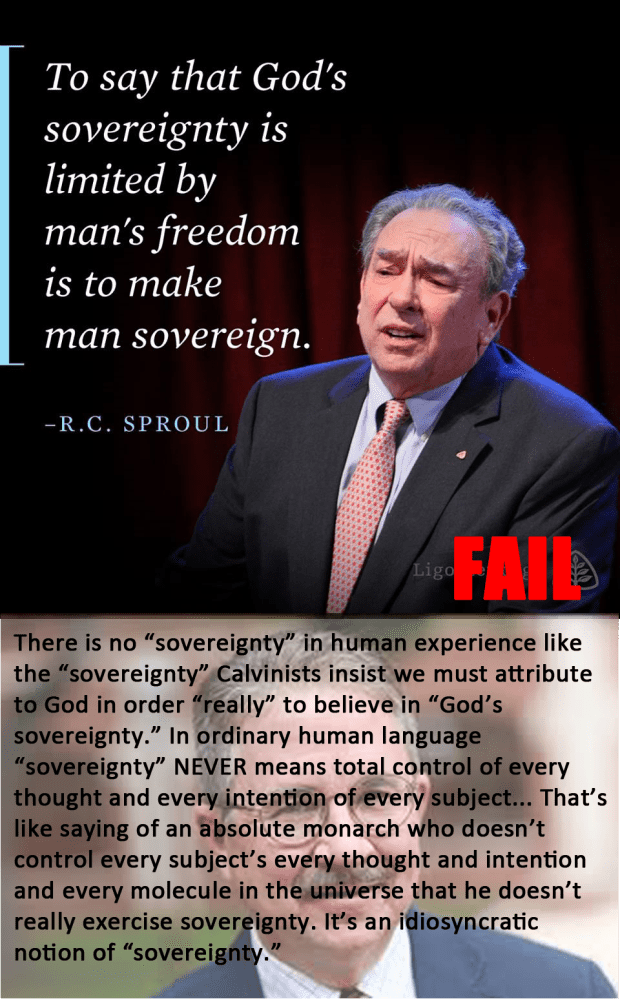
VOTD 1 Samuel 8:7
1Sa 8:7 And the LORD said to Samuel, “Heed the voice of the people in all that they say to you; for they have not rejected you, but they have rejected Me, that I should not reign over them.
Worship Sunday – Hark The Herald Angels
Hark the herald angels sing
“Glory to the newborn King!
Peace on earth and mercy mild
God and sinners reconciled”
Joyful, all ye nations rise
Join the triumph of the skies
With the angelic host proclaim:
“Christ is born in Bethlehem”
Hark! The herald angels sing
“Glory to the newborn King!”
Christ by highest heav’n adored
Christ the everlasting Lord!
Late in time behold Him come
Offspring of a Virgin’s womb
Veiled in flesh the Godhead see
Hail the incarnate Deity
Pleased as man with man to dwell
Jesus, our Emmanuel
Hark! The herald angels sing
“Glory to the newborn King!”
Hail the heav’n-born Prince of Peace!
Hail the Son of Righteousness!
Light and life to all He brings
Ris’n with healing in His wings
Mild He lays His glory by
Born that man no more may die
Born to raise the sons of earth
Born to give them second birth
Hark! The herald angels sing
“Glory to the newborn King!”
VOTD Genesis 21:33
Gen 21:33 Then Abraham planted a tamarisk tree in Beersheba, and there called on the name of the LORD, the Everlasting God.
Highlights from Greg Boyd on the Open Future
VOTD Genesis 16:13
Gen 16:13 Then she called the name of the LORD who spoke to her, You-Are- the-God-Who-Sees; for she said, “Have I also here seen Him who sees me?”
Openness of God (AAR 2014) Part 3
VOTD Malachi 4:6
Mal 4:6 And he will turn The hearts of the fathers to the children, And the hearts of the children to their fathers, Lest I come and strike the earth with a curse.
Apologetics Thursday – Answering Ware on Prayer
From An Open Orthodoxy:
Ware’s three criticisms of open theism’s effect upon one’s prayer life were: (1) It issues from our modern western consumerist’s mentality that fosters an unrealistically high view of the self, (2) it cannot represent the kind of mutually reciprocal and interpersonal relationship open theists claim since our petitions offer nothing to God in the way of new ‘information’, and (3) not knowing how future contingents will turn out, God cannot now know how best to answer our petitions…
It is difficult to know how to respond to Ware’s first charge. Undoubtedly western consumerism exerts its influence on us all. But has Ware actually argued his point or has he simply claimed that it is so? One could argue that open theism’s insistence upon individual responsibility and the value of a person are rooted in biblical concerns — Ezekiel’s emphasis upon the ‘individual’ (Ez. 18.13, 18, 20) and Jesus’ overwhelming declarations of God’s love for humanity (Jn. 3.16)… How does Ware distance the personal dimensions of his own faith from such consumerism while implicating open theism’s personal dimensions? Ware doesn’t say. And then lastly, Ware’s criticism could apply to his own theology in another sense. One could argue that Ware, unable to live with the truth that God’s will is sometimes not accomplished, has embraced a theology that feeds the consumer’s craving for personal security and hence offers as a ‘product’ a risk-free creation and the all-controlling God.
Regarding Ware’s second criticism, it seems to misconstrue what open theists believe to be at the heart of mutually reciprocal personal relations. Ware makes such relationships entirely about ‘information’ and assumes that two persons cannot transact personal loving relationality unless one is ‘educating’ the other by introducing information previously unknown to the other. But in fact open theists have agreed that petitioning God cannot be about ‘informing’ God. Ware’s assumption about information’s relevancy to personal relationships is entirely unfounded and without analogy. Even human-human relations can be mutually reciprocal in a fully personal sense without one party having to ‘educate’ the other.
…
For open theists, the “act” of petitioning another creates its own reality. It transcends information per se. Open theists thus do not suppose God responds to our prayers because they believe they have brought to God some new bit of information about the world which they believe God did not already know. On the contrary, it is the “act” of engaging another through petition that creates its own reality, a personal reality beyond the propositional content of the words uttered in the prayer. Consequently, outcomes are defined in terms of this personal exchange…
Lastly, Ware’s claim that if God were not to know future contingents he would not know how “best” to answer our petitions begs the question. Ware is doubtlessly assuming a notion of “best” that entails his own beliefs about the meticulous sort of providence he believes God exercises. “Best” for Ware just is his way of viewing God’s relationship to the world. But where there are real indeterminacy and risk in the world, “best” is to be understood in probabilistic terms. Does this mean God’s will is sometimes thwarted? Yes. Does this mean, as Basinger explains, that sometimes even God’s attempts to secure our petitions may fail to produce the desired outcomes? Yes. But it is no argument against this that it fails to satisfy a definition of “best” on some other construal of providence. That is rather to be expected.
…
VOTD Malachi 3:16
Mal 3:16 Then those who feared the LORD spoke to one another, And the LORD listened and heard them; So a book of remembrance was written before Him For those who fear the LORD And who meditate on His name.
Openness of God (AAR 2014) Part 2
VOTD Malachi 3:7
Mal 3:7 Yet from the days of your fathers You have gone away from My ordinances And have not kept them. Return to Me, and I will return to you,” Says the LORD of hosts. “But you said, ‘In what way shall we return?’
Openness of God (AAR 2014) Part 1
VOTD Malachi 2:9
Mal 2:9 “Therefore I also have made you contemptible and base Before all the people, Because you have not kept My ways But have shown partiality in the law.”
Meme Monday – Trapped in Time

VOTD Malachi 2:2
Mal 2:2 If you will not hear, And if you will not take it to heart, To give glory to My name,” Says the LORD of hosts, “I will send a curse upon you, And I will curse your blessings. Yes, I have cursed them already, Because you do not take it to heart.
Worship Sunday – O Holy Night
O Holy Night! The stars are brightly shining,
It is the night of the dear Saviour’s birth.
Long lay the world in sin and error pining.
Till He appeared and the Spirit felt its worth.
A thrill of hope the weary world rejoices,
For yonder breaks a new and glorious morn.
Fall on your knees! Oh, hear the angel voices!
O night divine, the night when Christ was born;
O night, O Holy Night , O night divine!
O night, O Holy Night , O night divine!
Led by the light of faith serenely beaming,
With glowing hearts by His cradle we stand.
O’er the world a star is sweetly gleaming,
Now come the wisemen from out of the Orient land.
The King of kings lay thus lowly manger;
In all our trials born to be our friends.
He knows our need, our weakness is no stranger,
Behold your King! Before him lowly bend!
Behold your King! Before him lowly bend!
Truly He taught us to love one another,
His law is love and His gospel is peace.
Chains he shall break, for the slave is our brother.
And in his name all oppression shall cease.
Sweet hymns of joy in grateful chorus raise we,
With all our hearts we praise His holy name.
Christ is the Lord! Then ever, ever praise we,
His power and glory ever more proclaim!
His power and glory ever more proclaim!
VOTD Malachi 1:9
Mal 1:9 “But now entreat God’s favor, That He may be gracious to us. While this is being done by your hands, Will He accept you favorably?” Says the LORD of hosts.
For/Against Calvinism Debate – Michael Horton v Roger Olson
VOTD Romans 14:20
Rom 14:20 Do not destroy the work of God for the sake of food. All things indeed are pure, but it is evil for the man who eats with offense.
Unanswered Questions – The Genesis Narrative
To those who believe the author/s of Genesis believed in omniscience of all future events:
Please show the verses in Genesis that suggests God possesses this type of omniscience of future events.
VOTD Romans 9:22
Rom 9:22 What if God, wanting to show His wrath and to make His power known, endured with much longsuffering the vessels of wrath prepared for destruction,
Apologetics Thursday – When God Destroys Cities
In the Sanders-White debate, James White quotes Amos 3:6 as saying every destruction of every city is the work of God:
Amo 3:6 If a trumpet is blown in a city, will not the people be afraid? If there is calamity in a city, will not the LORD have done it?
But contrary to White’s accretion, the context points to the exact opposite conclusion. The chapter starts with a warning to Israel:
Amo 3:1 Hear this word that the LORD has spoken against you, O children of Israel, against the whole family which I brought up from the land of Egypt, saying:
Amo 3:2 “You only have I known of all the families of the earth; Therefore I will punish you for all your iniquities.”
God is going to punish Israel. In the next series of verses, God uses metaphors to illustrate that this destruction will happen.
Amo 3:3 Can two walk together, unless they are agreed?
Amo 3:4 Will a lion roar in the forest, when he has no prey? Will a young lion cry out of his den, if he has caught nothing?
Amo 3:5 Will a bird fall into a snare on the earth, where there is no trap for it? Will a snare spring up from the earth, if it has caught nothing at all?
Amo 3:6 If a trumpet is blown in a city, will not the people be afraid? If there is calamity in a city, will not the LORD have done it?
The verses are not very cause-and-effect. Yeah, two people can walk together without agreeing, but it is not usual. Lions roar sometimes for no reason, but most likely they have a prey. Sometimes traps spring and birds die on their own. The exceptions are not the point. God is saying in Amos that He is the lion and He has found His prey. Amos is warning Israel of this destruction, and that warning will prove the destruction is from God. The very next verse debunks the claim that all destruction everywhere is from God:
Amo 3:7 Surely the Lord GOD does nothing, Unless He reveals His secret to His servants the prophets.
Amo 3:8 A lion has roared! Who will not fear? The Lord GOD has spoken! Who can but prophesy?
God highlights His power by first telling people what He will do before He does it. That is the point of Amos 3:6, God does what He declares. This is especially true concerning cities of Israel, to whom the warning is addressed. God had a special relationship with Israel which involved extra attention (both positive and negative).
Now, in the modern and ancient world there were many cities that perished without a prophet from God. These cities may or may not have been destroyed by God. God may or may not reveal His punishments to prophets. But to get credit, that is how God normally operates. God’s point is that when He proclaims disaster, then the disaster that comes is from God. God needs to specify this because in Amos 3:9 God is recruiting Israel’s normal enemies. It would be easy to think that they are acting without any punishment from God.
The really destructive point towards White’s theology is that God explains why He has summoned judgment:
Amo 3:10 For they do not know to do right,’ Says the LORD, ‘Who store up violence and robbery in their palaces.’ ”
The people rejected God and therefor God is calling judgment against them. God is responding to the actions of people, something that White rejects as a possibility.
VOTD Exodus 33:3
Exo 33:3 Go up to a land flowing with milk and honey; for I will not go up in your midst, lest I consume you on the way, for you are a stiff-necked people.”
Taylor on Sovereignty
From ideoamnostoutheou:
In God’s rulership over mankind He does not rule by force or by instinct, although at times He exercises both to accomplice His purposes. But the grand distinction in the Moral Kingdom God seeks to influence us by ideas and persuade us by revealed consequences to direct us to choosing His benevolent purpose for our lives. God is love, that is, He is benevolent and has been so from eternity. Love does not coerce, this we know as surely as we know that we exist. And the truth is that by our very creation in His image and likeness He cannot force us to choose love as a purpose for life. To talk of forcing a free will to choose to do His will is, on the face of it an absurdity. He doesn’t sneak in behind our conscious minds and overwhelm our will to choose to love Him. A reality that traditional understandings of God don’t seem to comprehend.
VOTD Exodus 33:5
Exo 33:5 For the LORD had said to Moses, “Say to the children of Israel, ‘You are a stiff-necked people. I could come up into your midst in one moment and consume you. Now therefore, take off your ornaments, that I may know what to do to you.’ ”
Boyd on the Consequences of Determinism
From Confronting Divine Determinism:
This belief in fate or divine determinism is as tragic as it is unbiblical. Among other things, fatalism inevitably leads people to blame God for evil. If God is the ultimate cause of everything, how could this conclusion be avoided? Moreover, by undermining our freedom of choice, determinism strips us of our dignity and moral responsibility. It reduces us to pawns of fate and robs us of our potential to love. In other words, it destroys the beauty of the biblical proclamation that we are made in the image of God.
VOTD Exodus 32:35
Exo 32:35 So the LORD plagued the people because of what they did with the calf which Aaron made.
Meme Monday – Piper Quote
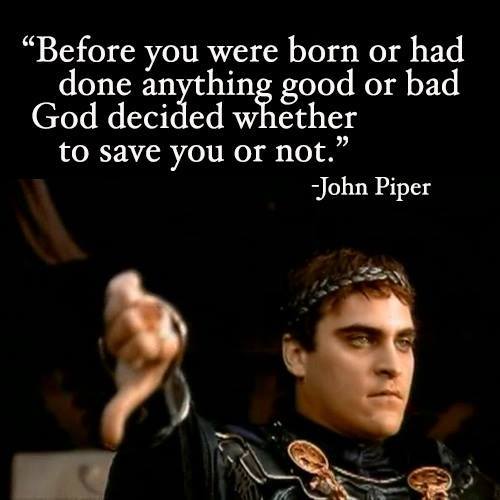
VOTD Exodus 32:33
Exo 32:33 And the LORD said to Moses, “Whoever has sinned against Me, I will blot him out of My book.
Worship Sunday – O’ Come O’ Come Emmanuel
O come, O come, Emmanuel
And ransom captive Israel
That mourns in lonely exile here
Until the Son of God appear
Rejoice! Rejoice! Emmanuel
Shall come to thee, O Israel.
O come, Thou Rod of Jesse, free
Thine own from Satan’s tyranny
From depths of Hell Thy people save
And give them victory o’er the grave
Rejoice! Rejoice! Emmanuel
Shall come to thee, O Israel.
O come, Thou Day-Spring, come and cheer
Our spirits by Thine advent here
Disperse the gloomy clouds of night
And death’s dark shadows put to flight.
Rejoice! Rejoice! Emmanuel
Shall come to thee, O Israel.
O come, Thou Key of David, come,
And open wide our heavenly home;
Make safe the way that leads on high,
And close the path to misery.
Rejoice! Rejoice! Emmanuel
Shall come to thee, O Israel.
O come, O come, Thou Lord of might,
Who to Thy tribes, on Sinai’s height,
In ancient times did’st give the Law,
In cloud, and majesty and awe.
Rejoice! Rejoice! Emmanuel
Shall come to thee, O Israel.
VOTD Exodus 32:30
Exo 32:30 Now it came to pass on the next day that Moses said to the people, “You have committed a great sin. So now I will go up to the LORD; perhaps I can make atonement for your sin.”
John Sanders Debates James White
James White has finally released a free version of his debate with John Sanders. The most probable reason for this (because, before this time the debate was available only via purchase) is because James White did so poorly debating Bob Enyart. The Enyart debate has been freely available from the beginning, containing an opening argument that White could not even start to refute. James White was in need of something public where he could claim debate over an Open Theist. Here is the only debate he had on file with another Open Theist:
VOTD Exodus 32:7-8
Exo 32:7 And the LORD said to Moses, “Go, get down! For your people whom you brought out of the land of Egypt have corrupted themselves.
Exo 32:8 They have turned aside quickly out of the way which I commanded them. They have made themselves a molded calf, and worshiped it and sacrificed to it, and said, ‘This is your god, O Israel, that brought you out of the land of Egypt!’ ”
Unanswered Questions – In What Way Does Jesus Resemble God?
To those who believe God is a timeless, spaceless, immutable, emotionless, abstract and absolutely omniscient being: When Jesus tells his disciples to look at him to see the Father, in what way did Jesus resemble the Father?
Joh 14:9 Jesus said to him, “Have I been with you so long, and yet you have not known Me, Philip? He who has seen Me has seen the Father; so how can you say, ‘Show us the Father’?
VOTD Ezekiel 12:28
Eze 12:28 Therefore say to them, ‘Thus says the Lord GOD: “None of My words will be postponed any more, but the word which I speak will be done,” says the Lord GOD.’ ”
Apologetics Thursday – Verses on God Ordaining Free Acts
Matthew of learntheology.com lists verses in which he claims God “ordains” the future free actions of human beings.
Third, contrary to open theism, Scripture affirms that God knows and ordains the future free actions of human beings (e.g. Genesis 50:19–20; Isaiah 10:5–19, 40–48; Acts 4:27–28; Psalm 139:16; John 6:64). For me, the only way to do justice to this Scriptural affirmation is to embrace a biblical compatibilism. However, open theist advocates reject this alternative with very little argumentation, due to their acceptance of a libertarian view of human freedom. But the cost is indeed great. No doubt, their view is a logically consistent view, but is it a biblical one? Probably the strongest reason they give for accepting the libertarian viewpoint is the perceived advantage it has in solving the problem of evil. But is this the only viable solution? Again, I disagree.
But does God both “ordain” future free actions and “ordain” in the sense that the author (Matthew) would have the reader believe? People like Matthew just assume that if God does not control all things in minutia, then God must be impotent. This is not defensible. Even very unpowerful people can “ordain” free will acts. I can ordain that people give me money for my furniture. All I have to do is post a classified ad with a reasonable price. Can Matthew explain how his idea of God’s “ordaining” differs from my “ordaining” that people buy my Craigslist furniture? We are not let into Matthew’s secret. Matthew avoids discussing the verses he quotes, possibly because it would be impossible for him to prove his beliefs from the texts.
The texts he lists do not imply what he wants to prove:
Gen 50:19 Joseph said to them, “Do not be afraid, for am I in the place of God?
Gen 50:20 But as for you, you meant evil against me; but God meant it for good, in order to bring it about as it is this day, to save many people alive.
This text shows that God repurposed the evil of Joseph’s brothers. It would be strange to say that God needed to force the brothers to be evil to get Joseph to Egypt. Couldn’t God have just asked Joseph to walk? Couldn’t God just have then ordained Pharaoh to accept Joseph into his court? Here is one of an infinitely number of scenarios which skips the entire part of Joseph’s brothers being evil:
God ordains Joseph to walk to Egypt.
God ordains Pharaoh to see Joseph and appoint him as a ruler.
No evil necessary. But this verse (instead of showing God making irrelevant events to effect His will) shows God’s planning to effect His will in spite of human evil. God uses evil actions for good. Nowhere in the text states that God “ordained” that the brothers sin.
For anyone to take this text as saying: “God forced the brothers to be evil to Joseph in order to place Joseph in a good place” makes God into a strange being, using weird methods to do things that could be done much easier without ordaining people into evil. It is unnatural.
Isa 10:5 “Woe to Assyria, the rod of My anger And the staff in whose hand is My indignation.
Isa 10:6 I will send him against an ungodly nation, And against the people of My wrath I will give him charge, To seize the spoil, to take the prey, And to tread them down like the mire of the streets.
Isa 10:7 Yet he does not mean so, Nor does his heart think so; But it is in his heart to destroy, And cut off not a few nations.
In Isaiah, God is shown to have a tenuous relationship with Assyria. Assyria is used by God. And how does God get Assyria to do what He wants? The immediate text states that they have “hearts” out to “destroy”. So God looks at their motivations and then lays in front of them an object that they could take. God calls this “whistling” in Isaiah 7:
Isa 7:18 And it shall come to pass in that day That the LORD will whistle for the fly That is in the farthest part of the rivers of Egypt, And for the bee that is in the land of Assyria.
So, God does not snap His magic fingers to make people do things. Instead, God uses motivations. Isaiah is clear that after Assyria is done, God then will punish Assyria for their evil. God did not force Assyria to do evil, and thus they are guilty of their own crimes. If God were to have forced Assyria to kill and plunder, then God would be to blame. Instead, God plans to punish.
But Assyria could repent before judgment. In Jeremiah 18, God is very clear: if Assyria were to repent of their evil then God would repent in turn of the evil God “thought to do to them”:
Jer 18:7 The instant I speak concerning a nation and concerning a kingdom, to pluck up, to pull down, and to destroy it,
Jer 18:8 if that nation against whom I have spoken turns from its evil, I will relent of the disaster that I thought to bring upon it.
So Jeremiah contradicts how Matthew would have the reader take Isaiah. Assyria could repent and could avert judgment. Although God had declared “evil” against Assyria, if Assyria repented then God would not do what He “thought to bring upon it.” There is no reason to think that Assyria is fated to action, and every reason to believe it is not. Does Isaiah ever assume that Assyria is fated? There is nothing in the text to assume so.
Isaiah is not the case of God “ordaining” free will actions insomuch as the president of the United States passing a law forcing people to buy health insurance (on the pain of fines) is not “ordaining” free will actions. This is God using motivations to effect His plans, not magic.
Act 4:27 “For truly against Your holy Servant Jesus, whom You anointed, both Herod and Pontius Pilate, with the Gentiles and the people of Israel, were gathered together
Act 4:28 to do whatever Your hand and Your purpose determined before to be done.
What was “determined before to be done”? Did it require Pilate, Herod, the Gentiles (Romans), or the Jews? If one of those actors were missing, would God’s determined plans have failed? The text does not assume that the plan operated any differently than God’s plan to use the Assyrians. No fatalism necessary. We learn from Jesus that the crucifixion did not have to happen! That God used people to enact His plan is testimony to His power, not fatalism.
This is just another case of God using the motivations of people to make His plans come true.
If Pilate or Herod had repented, Ezekiel 18 states very clearly that God would repent of judgment against them:
Eze 18:21 “But if a wicked man turns from all his sins which he has committed, keeps all My statutes, and does what is lawful and right, he shall surely live; he shall not die.
Eze 18:22 None of the transgressions which he has committed shall be remembered against him; because of the righteousness which he has done, he shall live.
If the Jews or the Gentiles repented, Jeremiah 18 makes it clear that God likewise would not do what He thought He was going to do to them. The message is very consistent throughout the Bible: people do not have to be evil. If they repent, then God repents.
Psa 139:16 Your eyes saw my substance, being yet unformed. And in Your book they all were written, The days fashioned for me, When as yet there were none of them.
This verse is about fetology. That is the immediate context before and after. Matthew doesn’t show that this has anything to do with fate. And because names in the Book of Life can be stricken out (Exo 32:33, Rev 3:5, Rev 22:19), there is no reason to pretend some sort of fatalistic understanding of how this “book” operates. There is every reason to think it is dynamic and responsive to events as they occur.
Joh 6:64 But there are some of you who do not believe.” For Jesus knew from the beginning who they were who did not believe, and who would betray Him.
Reading this verse in context gives a very different impression than Matthew would have people believe:
Joh 6:61 When Jesus knew in Himself that His disciples complained about this, He said to them, “Does this offend you?
Joh 6:62 What then if you should see the Son of Man ascend where He was before?
Joh 6:63 It is the Spirit who gives life; the flesh profits nothing. The words that I speak to you are spirit, and they are life.
Joh 6:64 But there are some of you who do not believe.” For Jesus knew from the beginning who they were who did not believe, and who would betray Him.
“When Jesus knew in Himself that His disciples complained about this.” Jesus figured out that his disciples were questioning Jesus’ teaching. “When” Jesus figures this out, Jesus confronts them. Jesus did not always know when the disciples were going to complain or if they would, but when Jesus figures it out then Jesus confronts them. Jesus knew from the beginning of his ministry that his disciples were weak and which ones these were. It does not take omniscience to evaluate your disciples.
In fact, the Bible is clear that Jesus is not “omniscient”:
Mar 13:32 “But of that day and hour no one knows, not even the angels in heaven, nor the Son, but only the Father.
In Matthew’s article on learntheology.com, on his list of verses that prove that God “ordains” human free will action, Matthew imports many wild assumptions that are not supported by the texts nor the context of the texts. Matthew does not in any sense prove his views on “ordaining” but just assumes them. The text of the Bible is unified in opposing Matthew’s view of how God operates. The very texts he quotes often refutes Matthew. His ideas cannot just be assumed onto the text.
VOTD Ezekiel 12:25
Eze 12:25 For I am the LORD. I speak, and the word which I speak will come to pass; it will no more be postponed; for in your days, O rebellious house, I will say the word and perform it,” says the Lord GOD.’ ”
Birch on Sovereignty
From I, Jacob Arminius:
Arminius believes that God governs all things which can be governed in His universe, which is to say that nothing is excluded. To admit that God is sovereign is to confess that He is the Ruler of the universe: He who is “the blessed and only Sovereign [dynastēs], the King of Kings and Lord of Lords” (1 Tim. 6:15 NRSV). Dynastēs refers to a ruler or officer of great authority, mighty (cf. Luke 1:49);5 a potentate. The word is derived from the noun dunamai, referring to ability, capability and power. That God is capable of controlling and manipulating all things imaginable is not tantamount to Him actually controlling and manipulating all things imaginable. Therefore the notion of sovereignty is not synonymous with determinism.
Catch, however, the connotations not attached to the word “sovereign”: controller of every minutiae of one’s existence; determiner of (and one who has strictly decreed) all things, including sin and evil; one who decrees and wills all things which shall come about by necessity. In other words, the word “sovereign” does not give way to the notion of God (or any ruler for that matter) exhaustively or meticulously determining by necessity every detail of one’s life, including what choices the individual will make and when such shall be made. Nor does the word “sovereign” give place to the theory that sin and evil are necessary. Therefore, Calvinism’s view of God’s deterministic sovereignty is a serious error.
VOTD Ezekiel 12:22
Eze 12:22 “Son of man, what is this proverb that you people have about the land of Israel, which says, ‘The days are prolonged, and every vision fails’?
Eze 12:23 Tell them therefore, ‘Thus says the Lord GOD: “I will lay this proverb to rest, and they shall no more use it as a proverb in Israel.” But say to them, “The days are at hand, and the fulfillment of every vision.
Thomas’ Journey to Open Theism
Rod Thomas shares his own personal journey to Open Theism:
When I left Calvinism, it was not any of my Arminian, liberal, or emerging church friends who convinced me to eventually leave Calvinist theology. It was one of the Five Point Hardliners who sent me a 20 page paper (I kid you not) via a Facebook message explaining to me why I was not a REAL Calvinist (and therefore not a real Christian) since I didn’t affirm ALL FIVE POINTS. I was so angry, I first started re-reading the Bible without Calvinist interpretation, learning historical contexts for things like the story of Jacob and Esau. It was around that time I transitioned to identifying as an outspoken Trinitarian and Open Theist.
When I first learned of Open Theism, I was unimpressed. In Baptist Theology class, the teacher abused his authority, using polemics and demonization to demonstrate his fauxgressive take on Open Theism. He would regularly cite C.S. Lewis’ The Last Battle and the story of the servant of Tash. Not. Impressed. It’s not as if the Tash story doesn’t have problems, like Orientalism, which is one of the three stools of White Supremacy’s throne. Plus, C.S. Lewis does not equal the Christian Canon or Tradition. So there was that too.
It took a combination of prayerful reflection on the Scriptures, familiarizing myself with continental philosophy, as well as forging friendships with people like T.C. Moore to help me grow as an Open Theist. What other theology dared begin with Jesus’ call to repentance as the start of theological introspection? Whose the politician outside George W. Bush that actually made Jesus the number one philosopher? Much like John Howard Yoder [whose silence and embodiment of male supremacy is problematic] who is said to have brought back Jesus’ teachings as central to Christian ethics, Open theists made free will theology anew, grounded in Jesus, contemporary hermeneutics and traditional evangelical theology such as God’s triunity and the trustworthiness of Scripture. At Brite Divinity School, I could have followed suit with everyone else and hopped on the process theology bandwagon, but I chose not to.
VOTD Ezekiel 12:20
Eze 12:20 Then the cities that are inhabited shall be laid waste, and the land shall become desolate; and you shall know that I am the LORD.” ‘ ”
Free Monday – Does God Know the Future
Rohan Holt asked Michael Saia to distribute for free his book “Does God Know the Future?”, and Michael Saia said yes. The Facebook post:
Rohan Holt uploaded a file.
November 24 at 5:02pm
Hi All,
Michael Saia, the author of “Does God Know The Future?”, has generously agreed to allow me to post a PDF of his book. Please feel free to distribute broadly. The book is still available for purchase, from Amazon & the like, but getting the word out is most important.
Cheers.
The book: [link]
VOTD Ezekiel 11:12
Eze 11:12 And you shall know that I am the LORD; for you have not walked in My statutes nor executed My judgments, but have done according to the customs of the Gentiles which are all around you.” ‘ ”
Worship Sunday – Fiery Love
By Samuel Lane
Come, search my heart, make me Yours
Take, all that I am, every thought
Jesus, be my song, be my love
Wake, me from my sleep, Faithful One
All my life for You, every single thing (Jesus)
All my love for You, every hope and dream
Lift me from my grave, and hold me up
With hands that hold the stars, with fiery love
Holy Spirit come, and light me up
With hands that hold my heart, with fiery love
Lord, lay me down, at Your feet
For I, have sown in tears, and I’ll wash them clean
VOTD Ezekiel 11:5
Eze 11:5 Then the Spirit of the LORD fell upon me, and said to me, “Speak! ‘Thus says the LORD: “Thus you have said, O house of Israel; for I know the things that come into your mind.
Fisher on Soul Mates
From Reality is Not Optional:
The Bible does not hold this fatalistic approach to marriage:
Paul gives widows the liberty to remarriage whomever “she wishes” (1 Cor 7:39). Paul advises people not to marry at all (1Co 7:8). Jesus is confronted by a scenario where seven brothers married the same lady (Luk 20:29). This handing down of wives to surviving brothers was ubiquitous in the Jewish culture. Jesus allows divorce (Mat 5:32), and Paul allows divorce (1Co 7:15). And Paul also warns Christians not to marry unbelievers (2Co 6:14). In each of these cases, fatalism is not assumed into the text although this would have been the perfect place to add “by the way, God has your special person chosen for you”. The Bible treats marriage as open, where any number of people could be sufficient for a spouse.
VOTD Ezekiel 8:18
Eze 8:18 Therefore I also will act in fury. My eye will not spare nor will I have pity; and though they cry in My ears with a loud voice, I will not hear them.”
Answered Questions – Why do Arminians hate the sovereignty of God?
A Calvinist named Avery asks in a mocking manner on Facebook group Calvinism, Arminianism, Pelagianism, Wesleyanism, Finneyism, Lutheranism…:
Why do Arminians hate the sovereignty of God?
John Moore responds, fittingly:
Why do Calvinists define “sovereignty” wrongly then make an idol of it and don’t think twice if they impugn and malign the character of God as long as they keep their idol intact?
VOTD Ezekiel 8:10
Eze 8:10 So I went in and saw, and there—every sort of creeping thing, abominable beasts, and all the idols of the house of Israel, portrayed all around on the walls.
Apologetics Thursday – Eternal v Everlasting
Wayne Jackson of Christian Courier writes:
Try to fathom this statement from John Sanders, one of the leading advocates of the New Theism: “God is everlasting through time rather than timelessly eternal” (http://www.opentheism.info/). If this statement does not conflict with the biblical doctrine of the eternality of God (cf. Psalm 90:2), I would not know what to make of it. In the same article Sanders says, “[T]he future is not entirely knowable, even for God” (emphasis added).
Jackson is confusing the meaning of the terms offered by John Sanders. Sanders is using “eternal” as a synonym with “timeless”. Modern Biblical translations might use the word “eternal”, but the authors definitely did not think God is “timeless”. Looking at Jackson’s prooftext:
Psa 90:2 Before the mountains were brought forth, Or ever You had formed the earth and the world, Even from everlasting to everlasting, You are God.
Notice the timeframes, God was from everlasting and will be to everlasting. This is not a “timeless” concept, but suggest God is everlasting in time. If the plain reading was not enough, the “Prayer of Moses” continues:
Psa 90:4 For a thousand years in Your sight Are like yesterday when it is past, And like a watch in the night.
The author of this psalm definitely believed God was in time and experienced duration. Maybe Sanders is too generous to grant that the term “eternal” will be used in conversation to be synonymous with “timeless”. His generosity confuses people like Jackson who fall for the old Equivocation Fallacy.
 God is Open