Neh 1:8 Remember, I pray, the word that You commanded Your servant Moses, saying, ‘If you are unfaithful, I will scatter you among the nations;
Neh 1:9 but if you return to Me, and keep My commandments and do them, though some of you were cast out to the farthest part of the heavens, yet I will gather them from there, and bring them to the place which I have chosen as a dwelling for My name.’
CS Lewis on Omnipotence
CS Lewis writes in his Problem of Pain:
His Omnipotence means power to do all that is intrinsically possible, not to do the intrinsically impossible. You may attribute miracles to Him, but not nonsense. There is no limit to His power.
If you choose to say, ‘God can give a creature free will and at the same time withhold free will from it,’ you have not succeeded in saying anything about God: meaningless combinations of words do not suddenly acquire meaning simply because we prifex to them the two other words, ‘God can.’
It remains true that all things are possible with God: the intrinsic impossibilities are not things but nonentities. It is no more possible for God than for the weakest of His creatures to carry out both of two mutually exclusive alternatives; not because His power meets an obstacle, but because nonsense remains nonsense even when we talk it about God.”
Free Monday – Dispensationalist Books
There is a site hosting just about everything written by Stam and Baker:
For PDFs, click here. Below is a list of books:
Things that differ – C.R. Stam
Two fold purpose of God- C.R. Stam
True Spirituality- C.R. Stam
Moses and Paul – C.R. Stam
No other doctrine – C.R. Stam
Thessalonians – C.R. Stam
Law and Grace – C.R. Stam
The authors Choice – C.R. Stam
1 Corinthians – C.R. Stam
2 Corinthians- C.R. Stam
Pastoral epistles- C.R. Stam
Romans- C.R. Stam
Our great commission- C.R. Stam
Man his nature and destinyC.R. Stam
Satan in derision C.R. Stam
The controversyC.R. Stam
The present perilC.R. Stam
Acts – 1 C.R. Stam
Acts – 2 C.R. Stam
Acts 3 C.R. Stam
Acts 4 C.R Stam
Real Baptism
Bible truth
Understanding the book of Acts
Understanding the Gospels
Dispensational theology
A dispensational synoposis
Dispensational relationships
Galatians
Understanding the body of Christ
The unsearchable riches of Christ
Ephesians
The mystery
Lordship salvation
The power of salvation
The city of two tales
Shure Words of Prophecy
Understanding your Bible
Riches of Christ P. Sadler
Ephesians – P. Sadler
Marriage – P.Sadler
The gifts – P.Sadler
Depression – R. Jordan
Romans – R. Jordan Part 1 Part 2 Part 3 Part 4 Part 5 Part 6
Ephisians – R. Jordan
Manuscript Evidence part 1 Manuscript Evidence part 2 R. Jordan
VOTD Psalms 119:137
Psa 119:137 Righteous are You, O LORD, And upright are Your judgments.
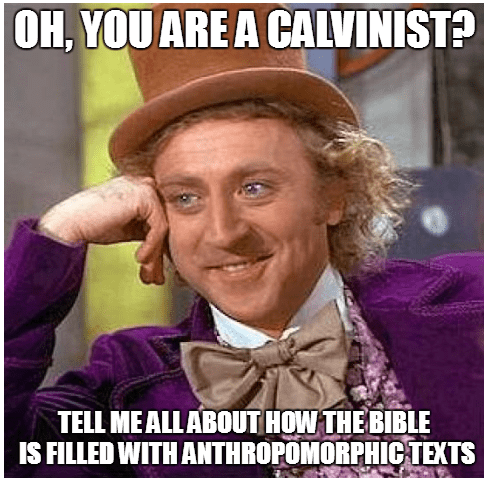
Monday Meme – Tell me about the Bible
Gerrard on God Changing His Mind
Worship Sunday – I Have Decided
I Have Decided Reasons by S. Sundar Singh
Lyrics:
I have decided to follow Jesus;
I have decided to follow Jesus;
I have decided to follow Jesus;
No turning back, no turning back.
Tho’ none go with me, I still will follow,
Tho’ none go with me I still will follow,
Tho’ none go with me, I still will follow;
No turning back, no turning back.
My cross I’ll carry, till I see Jesus;
My cross I’ll carry till I see Jesus,
My cross I’ll carry till I see Jesus;
No turning back, No turning back.
VOTD Jeremiah 3:22
Jer 3:22 “Return, you backsliding children, And I will heal your backslidings.” “Indeed we do come to You, For You are the LORD our God.
Enyart on How to Make a Rooster Crow
Enyart discusses his debate on TheologyOnline, the nature of God, and the failures of the Settled View:
VOTD Jeremiah 31:20
Jer 31:20 Is Ephraim My dear son? Is he a pleasant child? For though I spoke against him, I earnestly remember him still; Therefore My heart yearns for him; I will surely have mercy on him, says the LORD.
Rapien on Jonah
Arminian(?) Alvin Rapien of The Poor in Spirit writes of Jonah:
It is especially important to note that Jonah was a prophet, not a missionary, and Jonah’s message had no call to repentance, to destroy their idols, to stop their evil deeds, and there was no message of possible forgiveness.[6] Prophets in the Ancient Near East (ANE) were those who spoke with (usually) divine authority. They proclaimed messages about “particular political and social situations, a message that was not limited to issues of religious belief”.[7] Prophets were not limited to Israel. Assyria had their own history of prophets with “consistently positive [messages], affirming the king’s actions, decisions, and policies.”[8] However, Jonah’s message could be classified as an “unfavorable omen” – a threat of judgment to Nineveh from the God of Israel.
Reading the narrative, it would seem peculiar that the Ninevites reacted so quickly and genuinely to Jonah’s preaching. In 21st century America, whenever calls of judgment are being preached, the masses are quick to dismiss such a thing as religious fanaticism. Why did the Ninevites react the way they did to an Israelite prophet? It seems historically implausible from a few standpoints: The warlike nature of Assyrian society, the immediate response to a foreign god, and the coincidental “Israelite fashion” of fasting. However, there are a few possibilities, and they are not mutually exclusive.
First, the city of Nineveh and the Assyrian empire may have been in a vulnerable state, signified by their lack of war activities against Israel.[9] Second, Jonah’s omen may have coincided with unusual phenomenon within Nineveh, such as the strange signs from the entrails of the sacrificed animals, the flight pattern of birds, or any celestial signs. If Jonah’s message found some type of corroboration with Nineveh’s prophets, it would have immediately built credibility for Jonah’s message.[10] Third, Jonah as a “foreigner, would have served as evidence of the truth of his message, for why would someone have traveled all this distance unless impelled by deity?”[11] Since prophets were taken seriously in the ANE, a foreign prophet visiting from hundreds of miles away would have been a significant event. The polytheism in most ANE religions allowed for a belief in many gods that could take action, whether for or against an empire or kingdom. Therefore, Jonah’s declaration that the God of Israel is about to judge Nineveh is not an implausible statement in the theological atmosphere of the ANE. If one were to take a historical approach to the story of Jonah, then working through these issues is crucial. However, such an approach is not necessary, as I mentioned in my first post. We are focusing on the theological message of Jonah in its post-exilic form, not necessarily its historicity and plausibility.
For full post, click here.
Rejecting God’s Will
From God’s Strategy In Human History Dealing with Man’s Free-will by Roger T. Forster And V. Paul Marston:
GOD’S PLAN REJECTED (Greek root: boulomai)
We discover that an individual can reject God’s plan for him:
Luke 7.30: But the Pharisees and the lawyers rejected for themselves the counsel (boule) of God, being not baptised of him.
Mere human beings, of course, could not thwart God’s ultimate plan for the world, but they both can and do thwart His plan that they, as individuals, should have a part in it. The Pharisees could not prevent God’s ultimate plan achieving its end. The New Heaven and New Earth will come, whether they want it or not. In this sense we may well cry ‘Hallelujah, the Lord our God, the Almighty, reigneth.’3 But what they can do is to personally opt out of the new creation to come. God ordains that the new heaven and earth will come, He does not ordain which particular individuals will accept His plan for them to have a part in it.
VOTD Jonah 4:2
Jon 4:2 So he prayed to the LORD, and said, “Ah, LORD, was not this what I said when I was still in my country? Therefore I fled previously to Tarshish; for I know that You are a gracious and merciful God, slow to anger and abundant in lovingkindness, One who relents from doing harm.
Piper Interviews Knight
Calvinist John Piper interviews John Knight:
Piper: I said a minute ago that if you knew your boy was going to be healed at, say, age 20 or 30, you just might say 30 years of blindness would be worth seeing God do that. You’re probably not looking forward to that happening in five years. So how does John 9:3 work for you? How does the contextual reality or the wider biblical context sustain you, give you hope? You seem like a remarkably hope-filled person.
Knight: Well, it comes in the context of the entire Word of God, so that we can look at John 9:3 and see some of the characteristics of God that are hope giving. God looked through time and space and creation before anything was made and said about that man born blind, “He will be born blind so the works of
Apologetics Thursday – Historical Literal
In response to a 2008 post by a skeptic, Bob Laser says:
I have an insight into the debate of unfulfilled prophesy and God being all knowing and all present. One thing that atheists and fundamental Christians have in common is a concept that the bible is all truth, hence they will either believe it all or will not believe any of it.
The elusive obvious answer to this question is that the God of the Old Testament is a man made projection of whom he believes God to be. Being man-made it would contain error such as unfulfilled prophesy.
Remember that just because it is a man made idea that does not negate the reality of an all knowing God and does not negate the fact that Jesus came to tell us about the true God, not the man-made one.
It is our concepts of belief that prevent us from seeing the truth when it comes to spiritual matters and reconciling tough issues which arise from these root concepts.
Bob Laser cuts to the heart of the matter. There are two types of individuals:
1. Those who want to understand what the original author of any particular book of the Bible was attempting to communicate to his audience and see that communication as legitimate (taking into account genre and idioms).
And
2. Those who wish to reinterpret the events described in the Bible as written to men but not necessarily representing reality. Onto this we project other realities, as Mr Laser does.
If people take the second approach, there is no room for Bible debate. Any text in the Bible can be overshadowed by any theory. Competing theories can clash, but not in relation to the Bible.
For those who take the first approach, ground can be gained on the Biblical front. Books such as Kings and Chronicles are fairly hard to argue that they are not written to be taken as historical literal (as opposed to poetry or myth), yet the events described frustrate many Christians:
1Ki 22:19 Then Micaiah said, “Therefore hear the word of the LORD: I saw the LORD sitting on His throne, and all the host of heaven standing by, on His right hand and on His left.
1Ki 22:20 And the LORD said, ‘Who will persuade Ahab to go up, that he may fall at Ramoth Gilead?’ So one spoke in this manner, and another spoke in that manner.
1Ki 22:21 Then a spirit came forward and stood before the LORD, and said, ‘I will persuade him.’
1Ki 22:22 The LORD said to him, ‘In what way?’ So he said, ‘I will go out and be a lying spirit in the mouth of all his prophets.’ And the LORD said, ‘You shall persuade him, and also prevail. Go out and do so.’
1Ki 22:23 Therefore look! The LORD has put a lying spirit in the mouth of all these prophets of yours, and the LORD has declared disaster against you.”
Paralleled in 2 Chronicles 18:
2Ch 18:18 Then Micaiah said, “Therefore hear the word of the LORD: I saw the LORD sitting on His throne, and all the host of heaven standing on His right hand and His left.
2Ch 18:19 And the LORD said, ‘Who will persuade Ahab king of Israel to go up, that he may fall at Ramoth Gilead?’ So one spoke in this manner, and another spoke in that manner.
2Ch 18:20 Then a spirit came forward and stood before the LORD, and said, ‘I will persuade him.’ The LORD said to him, ‘In what way?’
2Ch 18:21 So he said, ‘I will go out and be a lying spirit in the mouth of all his prophets.’ And the LORD said, ‘You shall persuade him and also prevail; go out and do so.’
2Ch 18:22 Therefore look! The LORD has put a lying spirit in the mouth of these prophets of yours, and the LORD has declared disaster against you.”
To those who want to maintain dedication to the text of the Bible and who also want to maintain the classical view of God, they will hesitate before answering straightforward questions about the text:
Describe the events that the Micaiah depicts. Who talks to who, when, what is discussed, and what resolution is achieved?
Did these events happen as described?
Only the Open View can take the face value communication of Micaiah as true.
VOTD Genesis 18:21
Gen 18:21 I will go down now and see whether they have done altogether according to the outcry against it that has come to Me; and if not, I will know.”
Michael Hansen Responds – A Critique of Open Theism
Michael Hansen of Brief Inquisition was gracious enough to write a response to last week’s post Apologetics Thursday – God Does Not Let Eli’s Sons Repent:
My Response to Christopher Fisher (A Critique of Open Theism)
The secret things belong unto the LORD our God: but those things which are revealed belong unto us and to our children for ever, that we may do all the words of this law. (Deuteronomy 29:29)
Last month I wrote a post title “An Example of Where I See Calvinism in the Bible“. In this post I looked at a passage in 1 Samuel where a particular Calvinistic point of doctrine seemed clearly laid out in narrative form.
In the passage Phinehas & Hophni (sons of the high priest Eli) were abdicating their roles as priests and committing many sinful acts in Israel. Eli admonishes his sons to repentance but he sons refuse to heed their fathers admonition. In the passage we are given the reason for the sons disobedience: “it was the will of the LORD to put them to death.”
I took this example in scripture as an opportunity to show a particular Calvinistic doctrine. The doctrine is that of God’s sovereignty over human volition (the will). I explained that in this passage we see two things happening: 1) the willing disobedience of Phinehas and Hophni & 2) the reason for that disobedience, the will of God.
The ultimate conclusion is that the will of man is subservient to the will of God. I believe this is Biblical as it is clearly stated not only in this passage of scripture but in many others (Proverbs 21:1, Exodus 9:12, John 12:40, Genesis 50:20, and many more).
After I published the post ContemporaryCalvinist.com linked to it as a good example of seeing Calvinism in the Old Testament. If I remember correctly this brought my post under the criticism of GodisOpen.com, a cite committed to promoting the theology of “Open Theism”.
I am a layman so I do not pretend to be a strong voice for Calvinism (although I am for Calvinism) nor to I claim to be a voice to contend with in criticism of Open Theism (although I am definitely against it).
That being said Christopher Fisher suggested that I offer a fuller rebuttal of Open Theism and offered to repost it over at GodisOpen.com. Consider this post my response!
Considering Deuteronomy 29:29 is the verse I have chosen to place as a banner over this post it will heavily shape my argument against Open Theism.
Before I set out to refute Open Theism I shall first set the ground work and parameters for argumentation. In my argumentation I am assuming scripture to be the ultimate authority. Secondly I am assuming that the following of Open Theism: 1) God is absolutely free and powerful to do anything and everything he desires. 2) God’s absolute commitment to relationship and human autonomy predicates that all his actions be based on relation cause and effect (aka human actions of willing), & 3) Because of this relational commitment, the future is open; God does not know what the future holds because he is awaiting the actions and reactions of free humans. In hopes that I have accurately described Open Theism I will now attempt to show why each of these premises falls short of the Biblical definitions of God, Man, and God’s relationship to human actions and willing. If you are concerned that I have created a “Straw man” of Open Theism then please refer to the definition set forth by my detractor (here).
For the sake of argument I will name the three assumptions above 1) The Freedom of God, 2) God’s Relational Commitment, & 3) An Open Future.
Premise 1: The Freedom of God
When it comes to the first premise of Open Theism (that God is absolutely free and powerful to do anything and everything he desires) I really have no qualms. In fact, as a Calvinist, this is one of the main doctrines that I hold so clearly. When I read Psalm 115:3 “Our God is in the heavens; He does all that he pleases.” I find myself saying “AMEN”. God is absolutely free. This is a claim of open theism and insofar as an open theist truly embraces this reality I have no argument to offer in rebuttal.
Before moving on I will press Open Theism in their commitment to this Biblical truth. Along with the passage in 1 Samuel that started this discussion are a host of other Biblical stories and teachings that seem to indicate God’s absolute freedom in areas that would make an open theist uncomfortable. One example would be that of Pharaoh in the Exodus story. There seems to be numerous passages where God is said to Harden Pharaoh’s heart in order that His determined purpose might come about (Exodus 9:12 in particular). The freedom of God also seems to be placed over the granting or withholding of repentance (a human action) in the Bible (see 2 Timothy 2:25)
While in principle I do agree with this claim of open theism (that God is totally free) I do wonder whether or not a true open theist will hold to if truly pressed on the areas where the Bible (remember this is our authority) seems to show God’s freedom even reigning over areas of human volition.
Premise 2: God’s Relational Commitment
In my opinion this truly is the heart of Open Theism. An open theist desires to place God’s gracious commitment to mankind at the forefront of their Biblical hermeneutic. An open theist will see passages like Genesis 6:6 which states that “God regretted making man and was grieved in his heart.” and see a God who is first and foremost an emotional God with very strong commitments to His creation and mankind the pinnacle of that creation.
This is the point in the argument where the rubber really meats the road between an open theist and someone who holds and orthodox view of God’s relation to the future.
My main critique of Open Theism is that it limits the emotional qualities of God to that of Man.
I believe that the argument of Open Theism argues from a belief that God’s emotions are limited to that of man’s emotions. Open Theism believes that if God reacts or responds to the actions of man (repentance, faith, sin, etc) then that is all there is to it. It is a bit cliche to say but I feel that it must be employed in this argument: “For my thoughts are not your thoughts, neither are your ways my ways, declares the LORD.” (Isaiah 55:8).
Throughout the Bible we do indeed see that God acts relationally with mankind. Many times God determines to wipe out a people yet ceases to do so when someone intervenes (Abram, Moses, Jonah [albeit reluctantly]). Yet we are also told that God is always acting behind, beneath, and above all these very personal workings in his sovereignty.
The most blatant Biblical example of this come from Acts 4 after Peter and John have been chastised by the Jewish leaders for preaching in the name of Jesus. Peter and John return to the Christians and they all offer up a prayer in response to the beginning machinations of Jewish persecution. Here’s what they say:
“Sovereign Lord,” they said, “you made the heavens and the earth and the sea, and everything in them. 25You spoke by the Holy Spirit through the mouth of your servant, our father David:
“ ‘Why do the nations rage
and the peoples plot in vain?
26The kings of the earth rise up
and the rulers band together
against the Lord
and against his anointed one.b ’c
27Indeed Herod and Pontius Pilate met together with the Gentiles and the people of Israel in this city to conspire against your holy servant Jesus, whom you anointed. 28They did what your power and will had decided beforehand should happen.29Now, Lord, consider their threats and enable your servants to speak your word with great boldness. 30Stretch out your hand to heal and perform signs and wonders through the name of your holy servant Jesus.” (Emboldening & Italics mine).
When one reads this section of scripture we see many layers of story taking place at one time. The first is that Herod, Pontius Pilate, the Gentiles, and the people of Israel conspire against Jesus. More emphatically we see that they all did what God had decided to take place beforehand.
How all this works is impossible to tell. That is why I chose Deuteronomy 29:29 to be a banner over this post. Does the Bible make it clear that God cares deeply for the actions of mankind? Yes! Does the Bible make it clear that God sovereignly ordains the actions of people and events? Yes! Moreover, does the Bible teach us how this works? No, it does not. But to neglect God’s authoritative working over history and humanity, even human volition, is to neglect what the Bible teaches.
This finally leads me to the final premise.
Premise 3: An Open Future
This final premise may be my shortest rebuttal because I find it the weakest premise of Open Theism. The idea is that God does not know what the future holds because it is dependent on both human actions and his response to those actions.
The reason this last premise is so easily argued against is due to the sheer amount of straightforward claims by God in scripture to the contrary. I have already mentioned the example in Acts 4 above so I will leave that were it is and simply quote a few verses by way of summation:
Isaiah 46: 8-11
8“Remember this and stand firm,
recall it to mind, you transgressors,
9 remember the former things of old;
for I am God, and there is no other;
I am God, and there is none like me,
10declaring the end from the beginning
and from ancient times things not yet done,
saying, ‘My counsel shall stand,
and I will accomplish all my purpose,’
11calling a bird of prey from the east,
the man of my counsel from a far country.
I have spoken, and I will bring it to pass;
I have purposed, and I will do it.
Proverbs 19:21
Many are the plans in a person’s heart, but it is the LORD’s purpose that prevails.
Isaiah 25:1
LORD, you are my God; I will exalt you and praise your name, for in perfect faithfulness you have done wonderful things, things planned long ago.
Those things which God has planned of old he brings about regardless of the actions of man. Does he bring them about in and through the free actions of man? Yes!Even a greater mystery is the truth that God truly hates the free actions of man that he uses to bring about his purposes and would that they would not do them. This is beyond our ways and thoughts but we are not God.
Conclusion
In conclusion I would like to turn in a direction that might bring a little more enjoyment to any open theist who are reading this. I have stated a few times in this piece that the relationship between the absolute sovereignty of God and the reality of man’s freedom is a mystery. Moreover, I have stated that Deuteronomy 29:29 is the banner over this post.
I would like to concede to any open theist out there their criticism of Calvinism in so much as many Calvinists attempt to search out the secret things of God. Too often Calvinist are trying to find out who is and is not “elect”. Moreover, we are attempting to figure out if some people’s sin is a part of God’s plan or not. These are ridiculous questions if you ask me. These are things that belong to God and not to man. We are to live and occupy the world of revealed truth. That means that we are to regard all sin as heinous and all repentance as genuine. This does not mean that we ignore the fruit of someone’s life but it does mean we are careful to not damage true wheat in attempts to remove the tares.
Again I am thankful for Christopher Fisher for his interaction with this blog and again apologize if I have misrepresented any position that I myself do not hold. I am no theologian, I am simply a student of God’s word who wants to grow in my understanding of it.
Food for thought.
Michael
For original post, click here.
Thomas on Clement
Rod Thomas of Political Jesus writes an article entitled Open Theology, Clement, Stoicism, and Prevenient Grace. An excerpt:
Not only is the Exodus Creator God willing to demonstrate God’s holiness through acts of self-giving and self-revealing acts, God is awesomely generous. God’s grace, as the Gospels say, is like the Sun, that shines on the just and unjust. For Clement, Truth has revealed himself in the Logos. Speaking to the “Greek preparatory culture” since Clement was located in Alexandria, the Greek speaking city of Roman Egypt, Clement compares the salvific work of the Good Shepherd who not only takes “care of sheep, but the care of herds, and breeding of horses, and dogs, and bee-craft.” While all of these philosophies differ, they can be useful for life. Now, question is how does Clement define “philosophy.” They are in his words “whatever has been well said by each of those sects, which teach righteousness along with a science pervaded by piety,” and more importantly, Clement stresses, “But such conclusions of human reasonings as men have cut away and falsified, I would never call divine.”
VOTD Ezekiel 23:35
Eze 23:35 “Therefore thus says the Lord GOD: ‘Because you have forgotten Me and cast Me behind your back, Therefore you shall bear the penalty Of your lewdness and your harlotry.’ ”
Piper on Blindness
Calvinist John Piper talks about John 9:
But that is what Jesus is saying here in verse 3: “It was not that this man sinned, or his parents.” In other words, this blindness—this specific suffering—is not owing to the specific sins of the parents or the man. Don’t look there for the explanation.
Then he tells them where to look. Look for an explanation of this blindness in the purposes of God. Verse 3: “It was not that this man sinned, or his parents, but that the works of God might be displayed in him.” The explanation of the blindness lies not in the past causes but the future purposes.
…
One of the ways they try to escape the teaching of this text is to say that Jesus is pointing to the result of the blindness, not the purpose of the blindness. When Jesus says in verse 3, “It was not that this man sinned, or his parents, but that the works of God might be displayed in him,” he means, the result of the blindness is that God was able to use the blindness to show his work, not that he planned the blindness in order to show his work.
But there are at least three reasons why that won’t work.
1. One is that the disciples are asking for an explanation of the blindness, and Jesus’ answer is given as an explanation of the blindness. But if you say God had no purpose, no plan, no design in the blindness but simply finds the blindness later and uses it, that is not an explanation of the blindness. It doesn’t answer the disciples’ question. They want to know: Why is he blind? And Jesus really does give an answer. This is why he’s blind—there is purpose in it. There is a divine design. There’s a plan. God means for his work to be displayed in him.
2. Here’s another reason why that suggestion doesn’t work. God knows all things. He knows exactly what is happening in the moment of conception. When there is a defective chromosome or some genetic irregularity in the sperm that is about to fertilize an egg, God can simply say no. He commands the winds. He commands the waves. He commands the sperm and the genetic makeup of the egg. If God foresees and permits a conception that he knows will produce blindness, he has reasons for this permission. And those reasons are his purposes. His designs. His plans. God never has met a child from whom he had no plan. There are no accidents in God’s mind or hands.
3. And third, any attempt to deny God’s sovereign, wise, purposeful control over conception and birth has a head-on collision with Exodus 4:11 and Psalm 139:13. “The Lord said to Moses, ‘Who has made man’s mouth? Who makes him mute, or deaf, or seeing, or blind? Is it not I, the Lord?’” “You formed my inward parts; you knitted me together in my mother’s womb.”
MacInnis on Bias Against Open Theism
Arminian Amanda MacInnis of Cheese Wearing Theology writes about her disillusionment with professors:
As I watched and listened and read, I learned a valuable lesson: Just because the person is an academic, with a PhD and has written a book, does not mean that they are objective, nor are they always fair to their opponent’s argument or even Scripture. I learned very quickly that presuppositions and “I must be right” are very often at the heart of theological arguments…
Take, for example, the following scenario I observed at conference:
One scholar stood up and presented an argument that I have since heard time and time again. God does not repent/relent/regret/change his mind. Scripture says so. See, “He who is the Glory of Israel does not lie or change his mind; for he is not a man, that he should change his mind.” (1 Sam 15:29). There, you have it. Proof.
A well-respected OT scholar stood up in response and called the presenter out on his “proof.”
In 1 Sam 15 there are three statements:
God says, “I am grieved that I have made Saul king, because he has turned away from me and has not carried out my instructions.” (1 Sam 15:11)
Samuel the prophet says, “He who is the Glory of Israel does not lie or change his mind; for he is not a man, that he should change his mind.” (1 Sam 15:29)
The narrator says, “And the LORD was grieved that he had made Saul king over Israel.” (1 Sam 15:35).The OT scholar then called the presenter out on Hermeneutics 101: Who is to be trusted most, God? The narrator? A character in the narrative? (Answer: God and the narrator are always right. Characters can and do lie).
And then he pointed out, that Samuel’s “God does not change his mind/lie” is in reference to Saul’s pleading. God has changed his mind about Saul being king, but he won’t change it back.
The presenter hemmed and hawed and blustered. The entire room knew that the OT scholar was right. In a later context the presenter would accuse the OT scholar of being an Open Theist sympathizer! (Gasp! The Horror!)
And there I sat, an innocent theology student, shocked and stunned. How could the presenter not know this? How could the presenter talk about the integrity of Scripture and yet blatantly proof-text? This is a person with a Ph.D.! This is a professor!
For full post, click here.
VOTD Jonah 3:10
Jon 3:10 And God saw their works, that they turned from their evil way; and God repented of the evil, that he had said that he would do unto them; and he did it not.
New Open Theism blog – The Greatness of the Open God
A new Open Theist blog has been launched by Jacob Hunt. Of interest, Hunt states he is resolving Open Theism and an evolutionary view of history:
However far free-will goes in compensating for all the suffering in our world, when it comes to us Christians who believe an evolutionary account of history, the problem gets worse. It seems that we have to find a compensating good for all the suffering of the animals predating the existence of humans, and the free-will defender cannot do so by appealing to the most obvious bearers of free-will who come to mind – humans. So the evolutionary theologian is in a pickle. Call this pickle, the problem of animal suffering before the fall. This is another problem I would like to sift through in these blog posts, especially since several Open Theists have said things of interest to the subject. How can God be all-powerful and all-good when there was no obvious good compensating for the animal suffering which predated the human fall?
Answers to the bolded questions above are called theodicies. Answers to the latter question are of particular interest to me because many theologians provide a response which minimizes the suffering of animals. My challenge then, will be to ascribe to all the animal kingdom the full dignity it already possesses, while keeping my theology whole. I’m sure this will involve some adjustment to my theology, hopefully without cutting any corners. To those who travel this path with me, I’m glad for your company.
For full post, click here.
Free Monday – 14 Free Books
Calvinist website Desiring God is offing 14 free books.
Adoniram Judson: How Few There Are Who Die So Hard!
Alive to Wonder: Celebrating the Influence of C. S. Lewis
Andrew Fuller: I Will Go Down If You Will Hold the Rope!
David Brainerd May I Never Loiter On My Heavenly Journey!
Disability and the Sovereign Goodness of God
Doctrine Matters: Ten Theological Trademarks from a Lifetime of Preaching
Good News of Great Joy: Daily Readings for Advent
John G. Paton: You Will Be Eaten By Cannibals!
Love to the Uttermost: Devotional Readings for Holy Week
Martin Luther: Lessons from His Life and Labor
Preparing for Marriage: Help for Christian Couples
Sanctification in the Everyday: Three Sermons by John Piper
Take Care How You Listen: Sermons by John Piper on Receiving the Word
A Tribute to My Father: With Other Writings
An All-Consuming Passion for Jesus: Appeals to the Rising Generation
Captive to Glory: Celebrating the Vision and Influence of Jonathan Edwards
For pdfs and descriptions, click here.
VOTD Joel 2:13
Joe 2:13 And rend your heart, and not your garments, and turn unto the LORD your God: for he is gracious and merciful, slow to anger, and of great kindness, and repenteth him of the evil.
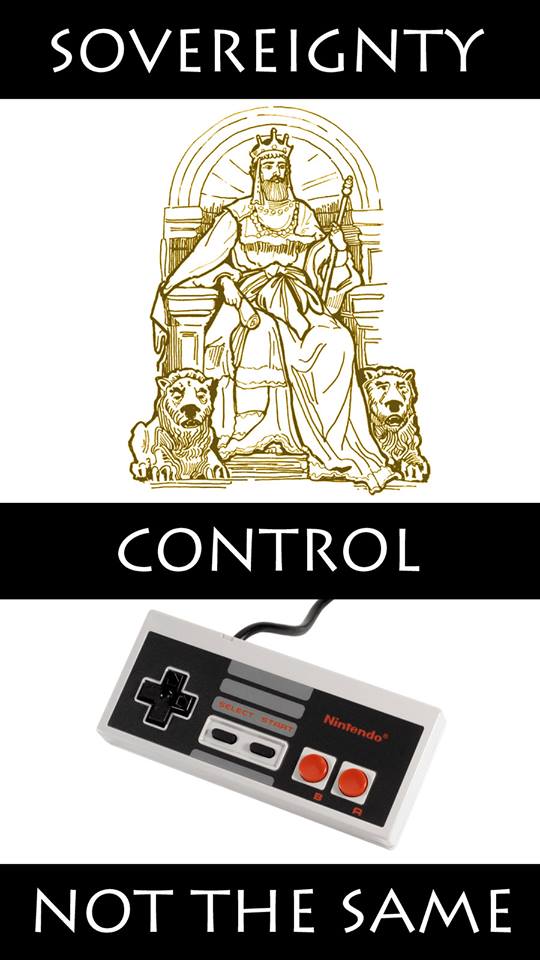
Meme Monday – Control
Perry on Repentance
From Greg Perry of rightnerve:
One of the most convicting aspects of the course is how much baggage we put upon Scripture. I like to say that most of us – we included, perhaps more than many – filter the Word through the world instead of filtering the world through the Word.
A good starting point to understand Scripture, to understand God’s will, to understand our place in the universe is simply this: If God didn’t mean what He said, then He would have said something else…
I believe God says He repents more than 25 times in Scripture. He says a fewer number of times that He doesn’t repent. Yes, we have to work out what’s going on here. God isn’t psychotic or bipolar; we must read His Words and figure out what He is teaching us when when He uses context to teach us. (Hint: It turns out that this seeming contradiction is one of the simplest things to understand in Scripture. God often was either going to bless or bring destruction onto a person or nation and then, due to man’s change in one direction or another, God rethinks and changes what He said would happen. Or, due to man’s stubbornness to not change direction, God didn’t rethink or change what He was going to do. Those times He refuses to repent.)
Still, if we only used the number of times God says something as having more weight, God certainly seems to repent of what He was about to do several times.
By sticking to what words actually mean, we can begin to attack errant beliefs. And by “errant” I truly mean errant from the literal Word of God, not just those who disagree with us.
For full post, click here.
Worship Sunday – Shout to the Lord
Shout to the Lord by Darlene Zschech
Lyrics:
My Jesus, my Savior
Lord, there is none like You
All of my days, I want to praise
The wonders of Your mighty love
My comfort, my shelter
Tower of refuge and strength
Let every breath, all that I am
Never cease to worship You
Shout to the Lord, all the earth, let us sing
Power and majesty, praise to the King
Mountains bow down and the seas will roar
At the sound of Your name
I sing for joy at the work of Your hands
Forever I’ll love You, forever I’ll stand
Nothing compares to the promise I have in You
My Jesus, my Savior
Lord, there is none like You
All of my days, I want to praise
The wonders of Your mighty love
My comfort, my shelter
Tower of refuge and strength
Let every breath, all that I am
Never cease to worship You
Shout to the Lord, all the earth, let us sing
Power and majesty, praise to the King
Mountains bow down and the seas will roar
At the sound of Your name
I sing for joy at the work of Your hands
Forever I’ll love You, forever I’ll stand
Nothing compares to the promise I have
Shout to the Lord, all the earth, let us sing
Power and majesty, praise to the King
Mountains bow down and the seas will roar
At the sound of Your name
I sing for joy at the work of Your hands
Forever I’ll love You, forever I’ll stand
Nothing compares to the promise I have in You
Nothing compares to the promise I have in You
Nothing compares to the promise I have in You
VOTD Psalms 119:90
Psa 119:90 Your faithfulness endures to all generations; You established the earth, and it abides.
Fischer on Calvinism and the Cross
Arminian Austin Fischer, author of Young, Restless, No Longer Reformed answers a few questions:
RNS: You are a former Calvinist, a vibrant movement in the American church. What drew you to the movement and what pushed you away from it?
AF: Like many young evangelicals, I grew up with thin, therapeutic faith. When convenient, I would make claims on my faith but never let my faith make claims on me. As my faith came of age, I realized it wanted more from me and I wanted more from it. Calvinism provided more, placing God at the center of my world, challenging me to take the Bible seriously, purging me of all sorts of petty selfishness and narcissism. Additionally, I loved how it had a place for everything: clean lines and painstakingly developed doctrines.
I began my journey out of Calvinism when I realized that if I were to be a consistent, honest Calvinist I would have to believe some terrible things about God. I realized I, personally, could not have Calvinism and a recognizably good God whose heart was fully revealed at the crucifixion of Jesus Christ. I could not have Calvinism and a God who would rather die than give humans what they deserve. For me, the crucifixion of Jesus Christ was something too generous for Calvinism to make sense of.
For full post, click here.
VOTD Jonah 4:11
Jon 4:11 And should I not pity Nineveh, that great city, in which are more than one hundred and twenty thousand persons who cannot discern between their right hand and their left—and much livestock?
Rhoda on Four Types of Open Theists
From Alan Rhoda’s defunct blog:
(1) Voluntary Nescience: The future is alethically settled but nevertheless epistemically open for God because he has voluntarily chosen not to know truths about future contingents. Dallas Willard espouses this position.
(2) Involuntary Nescience: The future is alethically settled but nevertheless epistemically open for God because truths about future contingents are in principle unknowable. William Hasker espouses this position.
(3) Non-Bivalentist Omniscience: The future is alethically open and therefore epistemically open for God because propositions about future contingents are neither true nor false. J. R. Lucas espouses this position.
(4) Bivalentist Omniscience: The future is alethically open and therefore epistemically open for God because propositions asserting of future contingents that they “will” obtain or that they “will not” obtain are both false. Instead, what is true is that they “might and might not” obtain. Greg Boyd (and yours truly) espouses this position.
For full post, click here.
White Defends Calvinism
James White defends Calvinism:
It seems James White is so dishonest he (or his ministry) had pulled his previous video on Open Theism hosted by a third party:
VOTD Zephaniah 3:17
Zep 3:17 The LORD your God in your midst, The Mighty One, will save; He will rejoice over you with gladness, He will quiet you with His love, He will rejoice over you with singing.”
Summary of Fischer White Debate
In a post entitled Young, restless….no longer reformed? Austin Fischer debates James White, the author sums up a debate between Arminian Austin Fischer and Calvinist James White. While the video of the debate has been taken down from YouTube (along with other James White videos (surprise, suprise)) the debate conclusion seems obvious:
My conclusion is this: Austin Fischer is no longer a Calvinist because he ceased the self-deception and honestly dealt with the difficult issue, whereas James White is in complete denial, and demonstrated that, completely.
For more good posts, see the unactive Examining Calvinism homepage.
Update: the audio has been located. Click here.
Apologetics Thursday – God Does Not Let Eli’s Sons Repent
1Sa 2:22 Now Eli was very old; and he heard everything his sons did to all Israel, and how they lay with the women who assembled at the door of the tabernacle of meeting.
1Sa 2:23 So he said to them, “Why do you do such things? For I hear of your evil dealings from all the people.
1Sa 2:24 No, my sons! For it is not a good report that I hear. You make the LORD’s people transgress.
1Sa 2:25 If one man sins against another, God will judge him. But if a man sins against the LORD, who will intercede for him?” Nevertheless they did not heed the voice of their father, because the LORD desired to kill them.
Calvinist Michael Hansen writes on this in his post “An Example of Where I See Calvinism in the Bible”:
The very last statement in verse 25 presents God’s sovereignty over human will clearly. Eli wishes that his sons would refrain from evil. He knows that, as priests of God, if they continue in evil, God will punish them. Phinehas & Hophni refuse to listen to their father’s wisdom. The author of the book of 1 Samuel gives us a reason why Phinehas & Hophni would not listen: “for it was the will of the LORD to put them to death”.
In that statement we see two things at work: 1) The will of Eli’s sons to disobey their father’s instruction. 2) The reason why Phinehas & Hophni willed disobedience -> the will of God. God’s will is the reason for their will.
When Calvinists quote verses such as 1 Samuel 2 to point out fleeting sections to glean “Calvinism”, I should always be pointed out the larger context explicitly contradicts Calvinism. The entire God is God revoking His promise to Eli based on the actions of human beings. God explains in the very next verses that although He had promised one thing, God will do something else instead:
1Sa 2:30 Therefore the LORD God of Israel says: ‘I said indeed that your house and the house of your father would walk before Me forever.’ But now the LORD says: ‘Far be it from Me; for those who honor Me I will honor, and those who despise Me shall be lightly esteemed.
So God has promised to make Eli’s house the house of priests forever. But then Eli’s sons sinned greatly. In this context does God not want them to repent (verse 25) and then killed them.
Did God override their free will as Michael Hansen claims? Maybe.
But a more reasonable view of this entire section is that because Samuel’s sons chose to disobey God, contrary to God’s desire that God sought to make sure they did not ask for repentance. In this fashion God was revoking His promise to Eli.
The entire context is about people thwarting what God wants and God repenting of His promise. This is not a good context for Calvinism.
How might God ensure the sons do not repent? God could make their eyes and ears dull or even just play into their personal hubris.
VOTD 1 Timothy 6:16
1Ti 6:15 which He will manifest in His own time, He who is the blessed and only Potentate, the King of kings and Lord of lords,
1Ti 6:16 who alone has immortality, dwelling in unapproachable light, whom no man has seen or can see, to whom be honor and everlasting power. Amen.
Olson Explains Why He is Not a Process Theologian
From a good article by Arminian Roger Olson:
First, process theology assumes that to be is to be in relation. It is a relational, organic worldview.
Second, process theology avers that God is not an exception to basic ontological rules but is their chief exemplification.
Third, process theology asserts that omnipotence is a theological mistake; God is not and cannot be omnipotent. God’s only power is the power of influence (persuasion).
Fourth, process theology is a form of theistic naturalism; it does not have room for the supernatural or for divine interventions (miracles).
Fifth, process theology denies creatio ex nihilo, creation out of nothing, and affirms classical panentheism—God and the world are mutually interdependent. There is a sense in which God is dependent on the world (beyond self-limitation).
Sixth, process theology refers to God as “dipolar”—having two “poles” or “natures”—one primordial and one consequent. God’s primordial pole is potential only and consists of ideals. God’s consequent pole is actual and consists of God’s experience. The world contributes experience to God. God has no primordial experience. (Theologian Austin Farrer referred to this as process theology’s lack of “prior actuality in God.”)
Seventh, process theology regards God as radically temporal; God learns as history unfolds and how history unfolds is ultimately up to creatures (actual occasions). (“God proposes but man disposes.”)
Eighth, process theology reduces God’s creative activity to bringing about order and harmony insofar as possible. God is not the actual creator of the world or any actual occasion (the basic building blocks of reality). God can only create, however, with creaturely cooperation.
Ninth, process theology views Jesus Christ as different in degree but not in kind from other creatures. His “divinity” consists of his embodying the self-expressive activity of God (“Logos”) which is “creative transformation.” He is not God incarnate in any absolutely unique sense that no other creature could be.
Tenth, process theology denies any guaranteed ultimate victory of God or good over evil. The future is “more of the same” so far as we know. Ultimately, that is up to us, not God. God always does God’s best, but he cannot guarantee anything.
For full post, click here.
Enyart on Theodicy
For kgov site, click here.
VOTD Jonah 3:4-9
Jon 3:4 And Jonah began to enter the city on the first day’s walk. Then he cried out and said, “Yet forty days, and Nineveh shall be overthrown!”
Jon 3:5 So the people of Nineveh believed God, proclaimed a fast, and put on sackcloth, from the greatest to the least of them.
Jon 3:6 Then word came to the king of Nineveh; and he arose from his throne and laid aside his robe, covered himself with sackcloth and sat in ashes.
Jon 3:7 And he caused it to be proclaimed and published throughout Nineveh by the decree of the king and his nobles, saying, Let neither man nor beast, herd nor flock, taste anything; do not let them eat, or drink water.
Jon 3:8 But let man and beast be covered with sackcloth, and cry mightily to God; yes, let every one turn from his evil way and from the violence that is in his hands.
Jon 3:9 Who can tell if God will turn and relent, and turn away from His fierce anger, so that we may not perish?
Calvinism and the SBC
From a new article on Calvinism in the Southern Baptist Convention:
About 30 percent of Southern Baptist pastors consider their churches Calvinist, according to a poll last year by SBC-affiliated LifeWay Research, but a much larger number — 60 percent — are concerned “about the impact of Calvinism in our convention.”
[snip]
Eighty percent of SBC pastors disagreed with the idea that only the elect will be saved, according to last year’s LifeWay poll, and two-thirds disagreed with the idea that salvation and damnation have already been determined.
For full news article, click here.
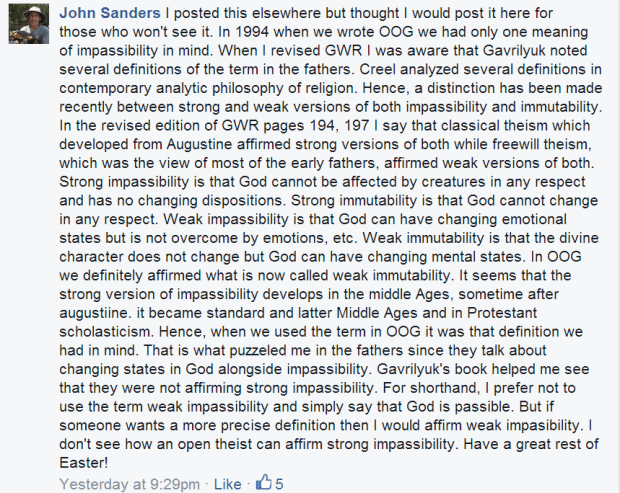
Sanders on Impassibility
John Sanders I posted this on the Facebook page Open Theism but thought I would post it here for those who won’t see it:
In 1994 when we wrote OOG we had only one meaning of impassibility in mind. When I revised GWR I was aware that Gavrilyuk noted several definitions of the term in the fathers. Creel analyzed several definitions in contemporary analytic philosophy of religion. Hence, a distinction has been made recently between strong and weak versions of both impassibility and immutability. In the revised edition of GWR pages 194, 197 I say that classical theism which developed from Augustine affirmed strong versions of both while freewill theism, which was the view of most of the early fathers, affirmed weak versions of both. Strong impassibility is that God cannot be affected by creatures in any respect and has no changing dispositions. Strong immutability is that God cannot change in any respect. Weak impassibility is that God can have changing emotional states but is not overcome by emotions, etc. Weak immutability is that the divine character does not change but God can have changing mental states. In OOG we definitely affirmed what is now called weak immutability. It seems that the strong version of impassibility develops in the middle Ages, sometime after augustiine. it became standard and latter Middle Ages and in Protestant scholasticism. Hence, when we used the term in OOG it was that definition we had in mind. That is what puzzeled me in the fathers since they talk about changing states in God alongside impassibility. Gavrilyuk’s book helped me see that they were not affirming strong impassibility. For shorthand, I prefer not to use the term weak impassibility and simply say that God is passible. But if someone wants a more precise definition then I would affirm weak impasibility. I don’t see how an open theist can affirm strong impassibility. Have a great rest of Easter!
VOTD Exodus 4:8
Exo 4:8 “Then it will be, if they do not believe you, nor heed the message of the first sign, that they may believe the message of the latter sign.
Gonzalez on Immutability
TC Moore quotes extensively from Justo Gonzalez on immutability:
Therefore, when Christians, in their eagerness to communicate their faith to the Greco-Roman world, began interpreting their God in Platonic terms, what they introduced into theology was not a sociopolitically neutral idea. What they introduced was an aristocratic idea of God, one which from that point on would serve to support the privilege of the higher classes by sacralizing changelessness as a divine characteristic. Yahweh, whose mighty arm intervened in history in behalf of the oppressed slaves of Egypt and of widows, orphans, and aliens was set aside in favor of the Supreme Being, the Impassible One, who saw neither the suffering of the children in exile nor the injustices of human societies, and who certainly did not intervene in behalf of the poor and the oppressed. It would be possible to follow the entire history of Christianity to see how this God functioned in favor of the privileged precisely by condemning change and sacralizing the status quo.”
For full post, click here.
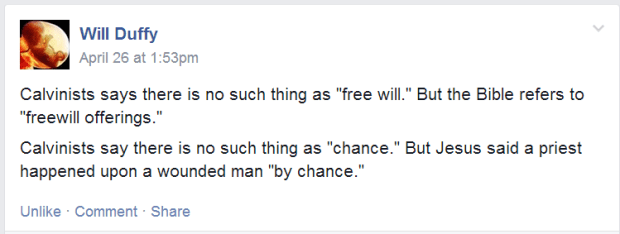
Duffy on Freewill and Chance
A Facebook post by Will Duffy, founder of the Collaborators Project on Facebook group God is Open:
Calvinists says there is no such thing as “free will.” But the Bible refers to “freewill offerings.”
Calvinists say there is no such thing as “chance.” But Jesus said a priest happened upon a wounded man “by chance.”
Oord on Randomness
From Thomas Jay Oord‘s blog:
Peirce’s inability to measure reality with absolute precision led him to conclude that a measure of spontaneity exists in the world. The world is not a determined machine, and chance emerging from spontaneity is inevitable. In fact, chance is irreducible, because randomness is a fundamental fact of life. Chance is genuine.
Peirce’s conclusions about the role of randomness ring true today. A number of philosophers accept that chance, randomness, unpredictability, and imprecision characterize existence, although specialists debate how best to speak of each. In this debate, philosophers sometimes use “random” to describe the product of a series of events and “chance” to describe the process of a single instance. There is no consensus on how best to conceptualize them in relation to each other. But the consensus among contemporary philosophers seems to be that randomness and chance is real.
For full post, click here.
Free Monday – Works of Warfield
Monergism.com is hosting the works of Calvinist BB Warfield in Kindle and Epub formats.
For link, click here.
VOTD Proverbs 1:28-30
Pro 1:28 “Then they will call on me, but I will not answer; They will seek me diligently, but they will not find me.
Pro 1:29 Because they hated knowledge And did not choose the fear of the LORD,
Pro 1:30 They would have none of my counsel And despised my every rebuke.
Fisher on the Conditional Eternal Kingdom
1Sa 13:13 And Samuel said to Saul, “You have done foolishly. You have not kept the commandment of the LORD your God, which He commanded you. For now the LORD would have established your kingdom over Israel forever.
1Sa 13:14 But now your kingdom shall not continue. The LORD has sought for Himself a man after His own heart, and the LORD has commanded him to be commander over His people, because you have not kept what the LORD commanded you.”
Christopher Fisher follows God’s series of conditional promises throughout Samuel, Kings and Chronicles.
From the conclusion:
God sought to give Saul an eternal kingdom but revoked that plan after Saul rebelled. God then regretted ever making Saul king and wished that He had not.
God then gave David the eternal kingdom, but this too was conditional (although originally not explicit, David, Solomon, and God later emphasized the conditional nature of this eternal kingdom). God did not seem to know when or if David’s lineage would ever forsake God. The eternal kingdom was only eternal if certain conditions were met.
Solomon inherited this promise, but things did not end well. Solomon started loyal to God but forsook God later in life. God then dissolved His promise and split the eternal kingdom into two parts, allowing David’s lineage to continue reigned over a fractional piece of the original promised kingdom.
God’s promises, although they look unconditional and promise something eternal, can be revoked if the actions of man warrant revocation. God can change plans at will and respond to unpredicted behaviors of human beings. As stated in Jeremiah 18, if a nation rebels against God, God is not bound to the promises He made to them.
For full post, click here.
Worship Sunday – You Are Good
You Are Good by Bethel Church
Lyrics:
Vs: 1
I want to scream it out
From every mountain top
Your goodness knows no bounds
Your goodness never stops
Your mercy follows me
Your kindness fills my life
Your Love amazes me
Chorus:
I sing because you are good
And I dance because you are good
And I
shout because you are good
You are good to me to me
Vs: 2
Nothing and no one comes
Anywhere close to you
The earth and oceans deep
Only reflect this truth
And in my darkest night
You shine as bright as day
Your Love amazes me
Bridge:
With a cry of praise, my heart will proclaim
You are good! You are good!
In the sun or rain, my life celebrates
You are good You are good
With a cry of praise my heart will proclaim
You are good! You are good!
In the sun or rain, my life celebrates
You are good! You are good!
VOTD Acts 16:31
Act 16:31 So they said, “Believe on the Lord Jesus Christ, and you will be saved, you and your household.”
If you would like to guest post commentary on this verse, please send to admin@godisopen.com .
Craig on Foreknowledge versus Fatalism
Molinist William Lane Craig offers a defense of Molinism and speaks against Open Theism:
Of course, Craig is only offering a well worded distraction. Here is a response:
Could God tell someone what God knows they will do in the future and could that person choose to do something else? In this case, would God have really “known” they were going to that action? Would He have been lying?
VOTD 1 Thessalonians 2:13
1Th 2:13 For this reason we also thank God without ceasing, because when you received the word of God which you heard from us, you welcomed it not as the word of men, but as it is in truth, the word of God, which also effectively works in you who believe.
If you would like to guest post commentary on this verse, please send to admin@godisopen.com .
Rice on Biblical Support
From The Openness of God:
It is not uncommon for people to dismiss these emotional descriptions of God, numerous as they are, as poetic flights essentially unrelated to the central qualities that the Old Testament attributes to God. As they see it, the real God of the Bible is made of sterner stuff. He is powerful, authoritarian and inflexible, so the tender feelings we read of in the prophets are merely examples of poetic license. As I understand it, however, the evidence supports a strikingly different conclusion. One scholar links these emotion-filled accounts of God’s love for Israel directly to the concept of divine oneness, which lies at the heart of biblical religion.
Perry on New Hermeneutics
Greg Perry of rightnerve suggests a couple new hermeneutics:
The Eight-Year Hermeneutic:
Definition: Ask an 8-year old, “What does this verse mean?” Almost always…you’ll hear what it means.
An 8-year old isn’t educated enough to spiritualize away obvious meanings. It takes a Master’s Degree in Theology or a serious reading of several dead Germans to become stupid enough to try that.
The Eight-Year Hermeneutic’s Corollary #1: If the 8-year old is home-educated, the hermeneutic’s accuracy rate increases 518.42%.
The Neo-Christianized Hermeneutic:
Definition: If most Christians say it, it’s probably wrong.
The Neo-Christianized Hermeneutic Corollary #1: In most cases, the more a Christian quotes a verse, the less likely it’s in the Bible.
For full post, click here.
VOTD Pslams 25:12
Psa 25:12 Who is the man that fears the LORD? Him shall He teach in the way He chooses.
If you would like to guest post commentary on this verse, please send to admin@godisopen.com .
Rice on God’s Love Trumping Rules
From The Openness of God:
In this respect God’s behavior transcends the norms that governed husband-wife relations in Israel. Once a divorced woman had remarried, her former husband was forbidden to marry her again. But God promises to marry Israel in spite of her in infidelities.
Apologetics Thursday – Skelly on Revelation 6
Arminian Kerrigan Skelly states that he is not an Open Theist for a few Biblical reasons. He quotes Revelation 6:
Rev 6:9 When He opened the fifth seal, I saw under the altar the souls of those who had been slain for the word of God and for the testimony which they held.
Rev 6:10 And they cried with a loud voice, saying, “How long, O Lord, holy and true, until You judge and avenge our blood on those who dwell on the earth?”
Rev 6:11 Then a white robe was given to each of them; and it was said to them that they should rest a little while longer, until both the number of their fellow servants and their brethren, who would be killed as they were, was completed.
Skelly then states his objection to Open Theism:
How can God know with certainty exactly how many are going to be killed or that any more at all will be killed when killing a Christian for being a Christian is a freewill decision… not only that but how does God know there will be any more martyrs at all period because for all He knows all people who have a chance at being a martyred could depart from the faith and choose not to be martyrs and deny Christ and there would be no more martyrs at all.
When Calvinists debate against Open Theists, they naturally assume that if Open Theists say God does not control everything then the Open Theist is claiming that God can do nothing. Likewise, Arminian Skelly assumes that if Open Theists claim God does not know the future then God cannot predict the actions of free will agents.
Because future human actions are largely predictable by almost anyone, Skelly’s claim is wildly unfounded. It does not take a rocket scientist to predict that if we drive to Walmart right now, the clerk will accept cash in exchange for any candy bar we pick out. Even very dull human beings can accurately predict unknown future behavior of other human beings. That someone does not even have to know the cashier personally to know this future freewill decision. If humans can this easily and accurately predict other human behavior, how much more-so can God with access to infinitely more resources?
The verse in question does not quite suggest what Skelly believes it suggests. It appears that in the scenario, God is waiting until a certain magnitude of Christians are killed. The scenario suggests that God is not waiting for Christian number 31,732 to die, but God is waiting for a certain rough tipping point to enhance the impending vengeance.
It is very important to note that no time-frames are given, only rough estimates. How long? A little while longer. If God had the future locked in His mind, God could have provided a more definite answer. But God does not talk like someone who has the future mapped out in minute detail in His mind. Instead God speaks as if He has plans and then works with human actions to accomplish His purpose. In other words, the entire story of the Bible from God’s cascading series of contingency plans with Pharaoh to the crucifixion of Jesus.
VOTD Isaiah 55:11
Isa 55:11 So shall My word be that goes forth from My mouth; It shall not return to Me void, But it shall accomplish what I please, And it shall prosper in the thing for which I sent it.
If you would like to guest post commentary on this verse, please send to admin@godisopen.com .
Rice on Jeremiah 18
From The Openness of God:
But a more natural reading of the passage, we believe, suggests something quite different. What happens to nations is not something that God alone decides and then imposes on them. Instead, what God decided to do depends on what people decide to do. His decisions hinge on the way human beings respond to his threats and warnings. If this is so, a description of intended divine judgment is not an announcement of ineluctable fate, it is a call to repentance.
Smock on God’s Choice to Be Loving
From Open Air preacher Jed Smock:
If God is not free to do good or evil then God is not responsible or accountable. Many view the Sovereign God as being accountable or responsible to no one and without any controls. Surely the God of the Bible exerts self-control in the light of His law which is the expression of His heart. Although God is by nature independent, when He created the universe He became accountable and responsible to his creatures. Now His happiness is to a large degree dependent on their loving response to his overtures of love. What? Create dependent beings, and then not acknowledge any responsibly or accountability for their well-being? No, not the God of the Bible! “O my people, what have I done unto thee? and wherein have I wearied thee? testify against me.” ( Micah 6:3) Here we have the exalted God humbling himself before his creatures, asking them to judge Him. But how could men judge God, if there is no standard to which even He is accountable?
For full article, click here.
VOTD Acts 17:30
Act 17:30 Truly, these times of ignorance God overlooked, but now commands all men everywhere to repent,
If you would like to guest post commentary on this verse, please send to admin@godisopen.com .
Rice on God’s Methodology
From The Openness of God:
These incidents indicate that human intercession can influence God’s actions. They show that God’s intentions are not absolute and invariant; he does not unilaterally and irrevocably decide what to do. When God deliberates, he evidently takes a variety of things into account, including human attitudes and responses. Once he formulates his plans, they are still open to revision. This appears to be true of even the most emphatic assurances on God’s part.
Piper Defends Augustine
From a recent blog post by Craig Fisher:
Here is what Piper believes about Augustine’s conversion experience. Augustine already believed in God and loved God but was held back from conversion because he had not achieved a purification from the bestial bondage of lust. The battle was between not having sex and having sex. The final conversion was in the words of Augustine, “You converted me to yourself, so that I no longer desired a wife.”
“Augustine was stung by his own bestial bondage to lust, when others were free and holy in Christ.” P 52
“So now the battle came down to the beauty of Continence and her tenders of love versus the trifles that plucked at his flesh.” P 53
“The experience of God’s grace in his own conversion set the trajectory for his theology of grace that brought him into conflict with Pelagius and made him the source of the Reformation a thousand years later.” P 54
“Later, just after his conversion, he went to tell his mother what God had done in answer to her prayers: Then we went and told my mother [of my conversion], …You converted me to yourself, so that I no longer desired a wife” p 68
For full post, click here.
VOTD Genesis 1:1
Gen 1:1 In the beginning God created the heaven and the earth.
If you would like to guest post commentary on this verse, please send to admin@godisopen.com .
Rice on God’s Plans
From The Openness of God:
But the biblical descriptions of divine repentance indicate that God’s plans are exactly that – plans or possibilities that he intends to realize. They are not ironclad decrees that fix the course of events and preclude all possible variation. For God to will something, therefore, does not make its occurrence inevitable. Factors can arise that hinder or prevent its realization. Consequentially, God may reformulate his plans, or alter his intentions, in response to developments.
Free Monday – Learn to Read Greek
From textkit.com, a list of free Greek resources:
Greek Answer Keys
A Brief Introduction to New Testament Greek Key, Samuel G. Green
First Greek Book Key, John Williams White
First Greek Writer Key, Arthur Sidgwick
Greek Prose Composition Key, North and Hillard
Greek Prose Composition Key, Arthur SidgwickGreek Composition Textbooks
First Greek Writer, Arthur Sidgwick
Greek Prose Composition, North and Hillard
Introduction to Greek Prose Composition, Arthur Sidgwick
Lectures on Greek Prose Composition, Arthur Sidgwick
Selections from the Septuagint, Conybeare and StockGreek Lexicon/Dictionary
First Four Books of Xenophon’s Anabasis, William W. Goodwin
Illustrated Dictionary to Xenophon’s Anabasis, John Williams White
Pocket Lexicon of Greek New Testament, Alexander SouterGreek Reading Text
Book Twelve of The Odyssey in Greek, Richard A. Minckwitz
Easy Selections From Plato, Arthur Sidgwick
Georgics Book IV in Latin, T.E. Page
Plato’s Apology of Socrates and Crito in Greek, Louis Dyer
Prometheus Bound of Aeschylus in Greek, F. D. Allen
Selections From Herodotus in Greek, W. Walter Merry
The Gospel of St. Luke in Greek, H.R. Heatley
The Iliad by Homer Books XIX – XXIV in Greek, Edward B. Clapp
The Odyssey by Homer Books V – VIII in Greek, B. Perrin
Xenophon’s Anabasis in Greek – Book VI, G.M. EdwardsGreek Reference Grammars
Greek Grammar, William W. Goodwin
Greek Grammar, Herbert Weir Smyth
Syntax of the Moods and Tenses of the Greek Verb, William W. GoodwinGreek Textbooks
A Brief Introduction to New Testament Greek, Samuel G. Green
A First Greek Course, Sir William Smith
A Short Syntax of New Testament Greek, H.P.V. Nunn
First Greek Book, John Williams White
First Greek Grammar Accidence, W. Gunion Rutherford
First Greek Grammar Syntax, W. Gunion Rutherford
Homeric Greek – A Book For Beginners, Clyde Pharr
Introduction to the Language and Verse of Homer, Thomas D. Seymour
NT Greek in a Nutshell, James Strong
For listing, click here.
VOTD Isaiah 66:4
Isa 66:4 So will I choose their delusions, And bring their fears on them; Because, when I called, no one answered, When I spoke they did not hear; But they did evil before My eyes, And chose that in which I do not delight.”
If you would like to guest post commentary on this verse, please send to admin@godisopen.com .
Rice on Metaphors
From The Openness of God:
But most scholars would reject a sharp division between literal and figurative theistic language in the Bible. This implies that all metaphors are alike, and such a view obscures the rich variations within the biblical descriptions of God.
While no metaphor provides us with a literal account of the divine reality – a one-to-one correspondence to its object – this does not mean that all metaphors are equally distant from the object represented… most Christians would agree that God is more like a shepherd thank a rock, and more like a parent than a shepherd. So within the broad spectrum of biblical metaphors, some are more important than others. These metaphors bear a stronger resemblance to the divine reality – they are closer, so to speak, to the intended
object…
Boyd on Power Worship
In Four Views: Divine Providence, Gregory Boyd wonders why Christians worship power:
Second, and most important, while I do not find it at all surprising that pagans typically define a deity’s greatness by his or her level of control over others – humans, after all, have worshiped power since the dawn of history – I am nonplussed as to why followers of Jesus would ever think this way. At the center of the New Testament is the shockingly beautiful revelation that Jesus, the crucified Son of God, reveals what God is really like. Jesus is the very “radiance of God’s glory” and the one and only “exact representation of his being” (hypostasis) (Heb 1:3)… If our thinking about God was unwaveringly fixed on Jesus, I honestly cannot see how we could ever conclude that God’s greatness is primarily about how much control he exerts over others. To the contrary, in Jesus we discover that God’s greatness is most clearly revealed in the foolishness and weakness of the cross (1 Cor 1:18-25).
VOTD Judges 10:14
Jdg 10:13 Yet you have forsaken Me and served other gods. Therefore I will deliver you no more.
Jdg 10:14 Go and cry out to the gods which you have chosen; let them deliver you in your time of distress.”
If you would like to guest post commentary on this verse, please send to admin@godisopen.com .
Worship Sunday – I Can Only Imagine
I Can Only Imagine by MercyMe
Lyrics:
I can only imagine
What it will be like
When I walk
By your side
I can only imagine
What my eyes will see
When your face
Is before me
I can only imagine
[Chorus:]
Surrounded by Your glory, what will my heart feel
Will I dance for you Jesus or in awe of you be still
Will I stand in your presence or to my knees will I fall
Will I sing hallelujah, will I be able to speak at all
I can only imagine
I can only imagine
When that day comes
And I find myself
Standing in the Son
I can only imagine
When all I will do
Is forever
Forever worship You
I can only imagine
[Chorus]
I can only imagine [x2]
I can only imagine
When all I will do
Is forever, forever worship you
Rice on Evidence for Interactiveness
From The Openness of God:
Two streams of biblical evidence support an interactive view of God’s relation to the world. One consists of statements that affirm in one way or another that God is responsive to what happens in the creaturely world, that what happens there affects God somehow – by evoking a certain emotion, a change in attitude, a change in plans. The other consists of statements that indicate creatrurely freedom in one way or another. These include various divine warnings and promises and calls to repentance, as well as fairly straightforward assertions that presuppose creaturely alternatives.
VOTD Genesis 1:26
Gen 1:26 Then God said, “Let Us make man in Our image, according to Our likeness; let them have dominion over the fish of the sea, over the birds of the air, and over the cattle, over all the earth and over every creeping thing that creeps on the earth.”
If you would like to guest post commentary on this verse, please send to admin@godisopen.com .
Rice on Biblical Support
From The Openness of God:
Agreement with Scripture is the most important test for any theological proposal. By definition, the task of Christian theology is to interpret the content of the Bible. So unless the perspective on God presented in this book can claim biblical support, it has little to recommend it to believing Christians.
Enyart on What The Ten Commandments Tell Us About God
Excerpt:
The Real God: The Ten Commandments reveal what God is actually like. Bob explains why so many Christians have mistaken ideas about God’s true nature and character.
For the audio, click here.
VOTD Psalms 105:4
Psa 105:5 Remember His marvelous works which He has done, His wonders, and the judgments of His mouth,
Craig on Culpability
In Four Views: Divine Providence, William Lane Craig lists why fatalism makes God responsible for evil:
If it is evil to make another person do wrong, then in this view God not only is the cause of sin and evil, but he becomes evil himself, which is absurd. By the same token, all human responsibility for sin has been removed, for our choices are not really up to us: God causes us to make them.
Apologetics Thursday – Skelly on 2 Thessalonians
Arminian Kerrigan Skelly states that he is not an Open Theist for a few Biblical reasons. He quotes 2 Thessalonians 2:
2Th 2:1 Now, brethren, concerning the coming of our Lord Jesus Christ and our gathering together to Him, we ask you,
2Th 2:2 not to be soon shaken in mind or troubled, either by spirit or by word or by letter, as if from us, as though the day of Christ had come.
2Th 2:3 Let no one deceive you by any means; for that Day will not come unless the falling away comes first, and the man of sin is revealed, the son of perdition,
Skelly then states his objection to Open Theism:
My question is this: How could God, possibly know, with certainty, that a falling away will ever come? Because falling away, according to the Open Theist perspective (of course, according to my perspective, as well) is a freewill choice of man. To fall away from the faith (or to apotheosize) is a freewill choice of man. And God couldn’t possibly know with certainty, unless of course, he was bringing it to past by his own power. But now, if we say that, we are back to Calvinism… If God does not know the future free will choices of man, for all God knows no one will ever fall away from the faith. This was written about 60AD, we are talking about almost 2000 years removed and that day has no come yet. God is saying with certainty something that will happen 2000 years into the future.
There are several problems with Skelly’s argumentation. The primary problem is that sin is easy to predict. If North Korea gains unfettered access to the internet, almost every computer will be filled with pornography. It happened after the fall of Saddam Hussein, after the fall of communism (while pornography was still in video cassette format), and it will happen in any society that gains unfettered internet access. A general falling away from truth is about the easiest thing to predict. It does not take God to make that prediction. In fact, countless times in history could have been used by God as that “falling away” and no one would have blinked twice. Predicting a common event (that anyone can predict) does not indicate precise foreknowledge.
The second problem is that we are now removed 2000 years from the prophecy. Either the prophecy has failed (God changed His mind, as He is allowed to do) or God has an infinite amount of time to fulfill this prophecy. Either case is not very conducive to Arminianism. The New Testament authors and readers were all well convinced the apocalypse would happen in their own lifetimes (Mat 4:17, Mat 10:7, Mar 1:15, Mat 24: 25-34, Mat 26: 63-64, Mat 10:23, Luk 21:22, Luk 21:28, Luk 21:31, 1 Pet 4:7, Heb 1:2, 1 Pet 1:20, Heb 9:26, Heb. 10:25, 1 Joh 2:18, Jas 4:13, Jas 5:8, 2Pe 3:11, Rev 3:11). The list goes on. Even in 1 Thessalonians, Paul is assuming a quick apocalypse. He informs the Thessalonians that their persecutors will receive harsh judgment (2Th 1:6-8) and he speaks as if they will still be alive during this event (2Th 1:11). He then explains, in the cited text, what they should be looking for (as opposed to their great-great-great-great-great-great + (65 more greats) grandchildren).This is just not the proof text that Skelly would have it be.
Alternatively, if God has an infinite amount of time to fulfill the prophecy then what does it matter if the event never comes to past? Arminians will forever claim that it is coming in the future, and then add whatever time between the prophecy and now as evidence God can see that far into the future. But if God has infinite time to fulfill the prophecy, couldn’t He just wait until the events line up in the fashion that He desires. As show before, everyone expected an imminent end. The facts better fit God waiting until the free choices of humans align with his plans rather than pre-knowing thousands of years of human history.
2 Thessalonians 2 fits the Open Theist model much better than any closed model. Either God changed His plans or God is waiting (longer than expected) to fulfill His plans.
VOTD Isaiah 55:6-8
Isa 55:6 Seek the LORD while He may be found, Call upon Him while He is near.
Isa 55:7 Let the wicked forsake his way, And the unrighteous man his thoughts; Let him return to the LORD, And He will have mercy on him; And to our God, For He will abundantly pardon.
Isa 55:8 “For My thoughts are not your thoughts, Nor are your ways My ways,” says the LORD.
If you would like to guest post commentary on this verse, please send to admin@godisopen.com .
Skelly Explains Why He is Not an Open Theist
Arminian (he claims not to be) Kerrigan Skelly explains why he is not an open theist:
Morrell Street Preaches Open Theism
VOTD Isaiah 65:12
Isa 65:12 Therefore I will number you for the sword, And you shall all bow down to the slaughter; Because, when I called, you did not answer; When I spoke, you did not hear, But did evil before My eyes, And chose that in which I do not delight.”
If you would like to guest post commentary on this verse, please send to admin@godisopen.com .
Craig on Reality Under Fatalism
In Four Views: Divine Providence, William Lane Craig ponders reality under fatalism:
Universal, divine determinism makes reality into a farce. The whole world becomes a vain and empty spectacle. There are no free agents in rebellion against God, whom God seeks to win through love, and no one who freely responds to that love and freely gives his love and praise to God in return. The whole spectacle is a charade whose only real actor is God Himself. Far from glorifying God, Helseth’s view, I am convinced, denigrates God for engaging in such a farcical charade. It is deeply insulting to God to think that he would create beings that are in every respect causally determined by him and then treat them as though they were free agents, punishing them for the wrong actions he made them do or lving them as though they were freely responding agents. God would be like a child who sets up his toy soldiers and moves them about his play world, pretending that they merit praise of blame.
Calvinist Opposes Man Choosing to be Saved
In Four Views: Divine Providence, Calvinist Paul Helseth objects to Free Will because that would make man the initiator of salvation. From the book:
The “power to do otherwise” that is essential to these theories of providence not only “assaults the doctrine of salvation by grace” by regarding human beings with libertarian freedom as “the first and effective agent[s] in salvation/” More importantly, it challenges “the assumption that God alone is original, self-existent, and necessary and that the entire contingent order depends on God for its existence,” for it presumes – without so much as a shred of explicit biblical support – that finite agents have the capacity to bring themselves and other things “from potency to actuality without the divine concurrence.”
VOTD John 3:16
Joh 3:16 For God so loved the world that He gave His only begotten Son, that whoever believes in Him should not perish but have everlasting life.
If you would like to guest post commentary on this verse, please send to admin@godisopen.com .
Calvinist Objects to Peter’s Denials
In Four Views: Divine Providence, Calvinist Paul Helseth counters what he believes to be the Open Theist view of Peter’s denials:
But if the God of open theism in fact is willing – as he was in the case of Peter’s denial of Jesus – to
revoke the gift of self-determining freedom in order to bring about states of affairs that he really wants to bring about, then what becomes of this defense? In other words, what becomes of the attempt to get God “off the hook” for the problem of evil if he in fact is willing to violate the gift of self-determining freedom that he has given to moral agents, the gift that openness theologians insist is not just “irrevocable” but “the key to morally responsible personhood?”
Free Monday – Toward an Open Theistic Theology of Petitionary Prayer
VOTD Exodus 3:19
Exo 3:19 But I am sure that the king of Egypt will not let you go, no, not even by a mighty hand.
If you would like to guest post commentary on this verse, please send to christopher.c.fisher@gmail.com .
Craig on Illusory Free Will
In Four Views: Divine Providence, William Lane Craig asks why we should believe fatalism:
Now, certainly God has the power to create a world characterized by universal, causal determinism. He could have created a world operating according to deterministic natural laws and containing no sentient creatures at all. Perhaps he could have even created a world containing sentient, self-conscious beings who have the illusion of indeterministic freedom of the will, just as he could have created vats containing brains that have the illusion of bodies acting in some external world. But why should we think that he has done so? Why should we think that our experience of indeterministic freedom is illusory?
Worship Sunday – You are My All in All
You are My All in All by Natalie Grant
Lyrics:
You are my strength when I am weak
You are the treasure that I seek
You are my all in all
Seeking You as a precious jewel
Lord, to give up I’d be a fool
You are my all in all
Jesus, Lamb of God
Worthy is Your name
Jesus, Lamb of God
Worthy is Your name
Oh, Your name is worthy
Taking my sin, my cross, my shame
Rising again I bless Your name
(I bless Your name)
You are my all in all
(Oh yes you are, yes you are)
When I fall down You pick me up
When I am dry You fill my cup
(You fill my cup)
You are my all in all
(My all, Lord, hallelujah)
Jesus, Lamb of God
Worthy is Your name
(Oh, Your name, Your precious name is worthy, Lord)
Jesus, Lamb of God
Worthy is Your name
You’re my everything
The beginning and the end
The first, the last You are
The great I am
Jesus, Lamb of God
Worthy is Your name
Jesus, Lamb of God
(Oh, my Jesus, my precious Jesus)
Worthy is Your name
Worthy is Your name
Worthy is Your name
VOTD Genesis 3:22
Gen 3:22 Then the LORD God said, “Behold, the man has become like one of Us, to know good and evil. And now, lest he put out his hand and take also of the tree of life, and eat, and live forever”—
Gen 3:23 therefore the LORD God sent him out of the garden of Eden to till the ground from which he was taken.
If you would like to guest post commentary on this verse, please send to christopher.c.fisher@gmail.com .
Openness of God Defines Open Theism
In the preface to The Openness of God, the authors define Open Theism:
God, in grace, grants humans significant freedom to cooperate with or work against God’s will for their lives, and he enters into dynamic, give-and-take relationships with us. The Christian life involves genuine interaction between God and human beings. We respond to God’s gracious initiatives and God responds to our responses… and on it goes. God takes risks in this give-and-take relationship, yet he is endlessly resourceful and competent in working toward his ultimate goals. Sometimes God alone decides how to accomplish these goals. On other occasions, God works with human decisions, adapting his own plans to fit the changing situation. God does not control everything that happens. Rather he is open to receiving input from his creatures. In a loving dialogue, God invites us to participate with him to bring the future into being.
A Documentary on Open Air Preacher Jesse Morrell
VOTD Nehemiah 9:8
Neh 9:7 “You are the LORD God, Who chose Abram, And brought him out of Ur of the Chaldeans, And gave him the name Abraham;
Neh 9:8 You found his heart faithful before You, And made a covenant with him To give the land of the Canaanites, The Hittites, the Amorites, The Perizzites, the Jebusites, And the Girgashites— To give it to his descendants. You have performed Your words, For You are righteous.
If you would like to guest post commentary on this verse, please send to admin@godisopen.com .
Mcmahon on Being Dragged – John 6:44
Excerpt:
Our passage in John 6 contrasts the first and third of the above designated groups. Jesus was explaining to the Jews who rejected Him that their refusal to believe in Him stemmed from their basic refusal to trust in God (in whom they falsely claimed to trust); that those who, in contrast, were now turning and following Him were the true believers in God, the true Jews. That’s what He means when he says that “everyone who listens to and learns from the Father comes to Me.” He isn’t talking about unbelieving Gentiles being regenerated (without even realizing that’s happened) and believing on Christ because they’re elect. He’s talking about Jewish people who were in personal relationship with God believing on Jesus because through their existing faith they recognize His divine origin. This model is not directly applicable to the human race in general today.
For PDF, click here.
Olson on Immutability
Arminian Robert Olson writes of God’s immutability:
In other words, these conservative evangelical theologians told me (through their writings), God-in-himself, God in his divinity, cannot experience anything new or suffer. But God-in-incarnation, the human nature of Jesus, can experience new things and suffer.
I’m not even going to go into all the problems this raises for Christology. I’ll just say I do believe in the hypostatic union, but not for that reason! Not to protect the deity of Christ from change and suffering.I will also never forget the relief I felt when I first heard that Pascal said “The God of the philosophers is not the God of Abraham, Isaac, and Jacob!” And when I read the evangelical theology of Donald Bloesch who rejected the philosophical logic of perfection in favor of what Emil Brunner called “biblical personalism”—that the God of the Bible is personal and therefore capable of experiencing what is outside of himself including new experiences including suffering. Bloesch and Bunner held onto the idea I was taught in Sunday School and church as a child and youth—that God is faithful in every way and that is God’s immutability. But they rejected the philosophical (Platonic and Aristotelian) idea of God as an uncarved, immovable, impervious block of stone.
For full post, click here.
VOTD Genesis 22:12
Gen 22:12 And He said, “Do not lay your hand on the lad, or do anything to him; for now I know that you fear God, since you have not withheld your son, your only son, from Me.”
If you would like to guest post commentary on this verse, please send to christopher.c.fisher@gmail.com .
Olson on Glory
Arminian Robert Olson writes of God’s Glory:
Second, INSOFAR as they (Edwards, Piper and their ilk) imply that POWER takes precedence over LOVE in God’s glory, I demur. God’s glory IS his love–first his innertrinitarian love between Father, Son and Holy Spirit, and second his love flowing out from the Trinity toward creatures. God is glorious BECAUSE he is perfectly loving as well as perfectly powerful. BUT, since love is his essence, he can restrict his power (but not his love).
…
My point is that, in my view, anyway, while Edwards and Piper are correct to emphasize God’s glory as the chief end, purpose, of everything, they are wrong to empty God’s glory of meaningful love and focus it on power. Power without love is not glorious.
For full post, click here.
Apologetics Thrusday – Morrell Refutes Miano
VOTD Exodus 32:10
Exo 32:10 Now therefore, let Me alone, that My wrath may burn hot against them and I may consume them. And I will make of you a great nation.”
If you would like to guest post commentary on this verse, please send to christopher.c.fisher@gmail.com .
Hasker on Open Theism
Jesus Was Not Controlling
From the Cruciform View on Sovereignty:
After talking about sovereignty and providence in Systematic Theology II today I’m reminded of how often Christians automatically equate God’s “sovereignty” with being all controlling.
Yet, our clearest image of God’s power—of God’s very nature (Heb. 1:3)—is Jesus lowering himself to the role of a servant, washing his disciples’ feet, using his miracles to heal victims of oppressive demonic power, and allowing himself to be brutally murdered when he could have just as easily defeated his murderers with violent force.In Jesus, I do not see a God who lords his all-controlling “sovereignty” over His creation, but rather I see a God who willfully limits his power, to the point of becoming a servant and defeating evil through his inexhaustible love on the cross.
For full post, click here.
VOTD Numbers 14:11
Num 14:11 Then the LORD said to Moses: “How long will these people reject Me? And how long will they not believe Me, with all the signs which I have performed among them?
If you would like to guest post commentary on this verse, please send to christopher.c.fisher@gmail.com .
Oord Reviews Free Will in Philosophical Theology
Thomas Oord reviews Free Will in Philosophical Theology. His conclusion:
Although I have different metaphysical commitments than Timpe with regard to God’s relation to time and although by disposition I am less inclined to defend some beliefs in the classic tradition (e.g., purgatory), I often agreed with his proposals. A virtue libertarian with theological motivations like mine and not Timpe’s may have written a little different book. But this book is a strong foray into tackling problems presented free will theists, and it does an admirable job of offering plausible solutions. In sum, this is a strong book on free will in philosophical theology.
For full post, click here.
Oord Reflects on Life
Thomas Oord talks about his latest book in which he reflects on life:
Existence as we know it is abounding in information, values, mystery, and more. We experience love, joy, and happiness, along with evil, pain, and sadness. We act purposefully and intentionally to reach our goals, but we encounter randomness, chance, and luck as well. We seem to act freely much of our lives, but circumstances, opportunities, bodies, and environments limit our freedom. At one moment we may be in awe of the goodness and beauty of our lives, while in the next moment we get discouraged by the horror and ugliness we encounter. And most of the time, our lives are made up of the mundane, usual, and routine.
Making sense of life – in light of such wide-ranging diversity – is a daunting task. But it is a task we inevitably take up. In more or less sophisticated ways, we attempt to figure out how things work and what makes sense. All of us are metaphysicians, in the broad sense.
For full post, click here.
VOTD Hosea 11:4
Hos 11:4 I drew them with gentle cords, With bands of love, And I was to them as those who take the yoke from their neck. I stooped and fed them.
If you would like to guest post commentary on this verse, please send to admin@godisopen.com .
VOTD Jeremiah 2:30
Jer 2:30 In vain have I smitten your children; they received no correction: your own sword hath devoured your prophets, like a destroying lion.
If you would like to guest post commentary on this verse, please send to christopher.c.fisher@gmail.com .
Fred Phelps was a Calvinist
Adam Weinstein on gawker covers the recently deceased Fred Phelps and his rampant Calvinism:
The broad theology of WBC can be summed up in one basic statement:
Everybody sucks.
Only awful, terrible, despicable, depraved people would cause a political hatemongering ruckus at a funeral or an elementary school. That’s absolutely true. The thing is, the faithful of Westboro Baptist Church would be the first to claim that they’re depraved—and so is everyone else. This is the bedrock of their belief system, laid out on their website:
These doctrines of grace were well summed up by John Calvin in his 5 points of Calvinism… Although these doctrines are almost universally hated today, they were once loved and believed, as you can see in many confessions of faith. Even though the Arminian lies that “God loves everyone” and “Jesus died for everyone” are being taught from nearly every pulpit in this generation, this hasn’t always been the case. If you are in a church that supposedly believes the Bible, and you are hearing these lies, then your church doesn’t teach what the Bible teaches.
Also of note, Weinstein’s summery of TULIP:
Basically, five-point Calvinism boils down to: There’s a God who saves some people and screws the rest over for eternity, and there’s nothing you can really do about it. If there were, He wouldn’t be God, and you wouldn’t be a depraved, terrible not-God quivering mass of id urges.
For full post, click here.
Free Monday – Redating the New Testament
AT Robinson’s very detailed and scholarly work on the dating of New Testament books:
For full book, click here.
VOTD Numbers 14:27
Num 14:27 “How long shall I bear with this evil congregation who complain against Me? I have heard the complaints which the children of Israel make against Me.
If you would like to guest post commentary on this verse, please send to christopher.c.fisher@gmail.com .
Stamp on Election
Copied from The Corporate View, from Donald C. Stamps’ Life in the Spirit Study Bible:
“Election. God’s choice of those who believe in Christ is an important teaching of the apostle Paul (see Rom 8:29-33; 9:6-26; 11:5, 7, 28; Col 3:12; 1 Thes 1:4; 2 Thes 2:13; Tit 1:1). Election (GK eklegó) refers to God choosing in Christ a people whom He destines to be holy and blameless in His sight (cf. 2 Thes 2:13). Paul sees this election as expressing God’s initiative as the God of infinite love in giving us as His finite creation every spiritual blessing through the redemptive work of His Son (Eph 1:3-5). Paul’s teaching about election involves the following truths:
(1) Election is Christocentric, i.e., election of humans occurs only in union with Jesus Christ. ‘He hath chosen us in him’ (Eph 1:4; see 1:1, note). Jesus Himself is first of all the elect of God. Concerning Jesus, God states, ‘Behold my servant, whom I have chosen’ (Mat 12:18; cf. Is 42:1, 6; 1 Pet 2:4). Christ, as the elect, is the foundation of our election. Only in union with Christ do we become members of the elect (Eph 1:4, 6-7, 9-10, 12-13). No one is elect apart from union with Christ through faith.
(2) Election is ‘in [him]…through his blood’ (Eph 1:7). God purposed before creation (Eph 1:4) to form a people through Christ’s redemptive death on the cross. Thus election is grounded in Christ’s sacrificial death to save us from our sins (Acts 20:28; Rom 3:24-26).
(3) Election in Christ is primarily corporate, i.e., an election of a people (Eph 1:4-5, 7, 9). The elect are called ‘the body of Christ’ (4:12), ‘my church’ (Mat 16:18), ‘a peculiar people’ (belonging to God) (1 Pet 2:9), and the ‘wife of Christ’ (Rev 19:7). Therefore, election is corporate and embraces individual persons only as they identify and associate themselves with the body of Christ, the true church (Eph 1:22-23; see Robert Shank, Elect in the Son, [Minneapolis: Bethany House Publishers]). This was true already of Israel in the OT (see Deut 29:18-21, note; 2 Ki 21:14, note; see article on God’s Covenant With the Israelites, p. 316).
(4) The election to salvation and holiness of the body of Christ is always certain. But the certainty of election for individuals remains conditional on their personal living faith in Jesus Christ and perseverance in union with Him. Paul demonstrates this as follows. (a) God’s eternal purpose for the church is that we should ‘be holy and without blame before him’ (Eph 1:4). This refers both to forgiveness of sins (Eph 1:7) and to the church’s purity as the bride of Christ. God’s elect people are being led by the Holy Spirit toward sanctification and holiness (see Rom 8:14; Gal 5:16-25). The apostle repeatedly emphasizes this paramount purpose of God (see Eph 2:10; 3:14-19; 4:1-3, 13-24; 5:1-18). (b) Fulfillment of this purpose for the corporate church is certain: Christ will ‘present it to himself a glorious church…holy and without blemish’ (Eph 5:27). (c) Fulfillment of this purpose for individuals in the church is conditional. Christ will present us ‘holy and without blame before him’ (Eph 1:4) only if we continue in the faith. Paul states this clearly: Christ will ‘present you holy and unblameable and unreprovable in his sight: If ye continue in the faith grounded and settled, and be not moved away from the hope of the gospel’ (Col 1:22-23).
(5) Election to salvation in Christ is offered to all (John 3:16-17; 1 Tim 2:4-6; Tit 2:11; Heb 2:9) but becomes actual for particular persons contingent on their repentance and faith as they accept God’s gift of salvation in Christ (Eph 2:8; 3:17; cf. Acts 20:21; Rom 1:16; 4:16). At the point of faith, the believer is incorporated into Christ’s elect body (the church) by the Holy Spirit (1 Cor 12:13), thereby becoming one of the elect. Thus, there is both God’s initiative and our response in election (see Rom 8:29, note; 2 Pet 1:1-11).
Worship Sunday – 10,000 Reasons
10,000 Reasons by Matt Redman
Lyrics:
[Chorus]
Bless the Lord, O my soul
O my soul
Worship His holy name
Sing like never before
O my soul
I’ll worship Your holy name
The sun comes up, it’s a new day dawning
It’s time to sing Your song again
Whatever may pass, and whatever lies before me
Let me be singing when the evening comes
[Chorus]
Bless the Lord, O my soul
O my soul
Worship His holy name
Sing like never before
O my soul
I’ll worship Your holy name
You’re rich in love, and You’re slow to anger
Your name is great, and Your heart is kind
For all Your goodness I will keep on singing
Ten thousand reasons for my heart to find
[Chorus]
Bless the Lord, O my soul
O my soul
Worship His holy name
Sing like never before
O my soul
I’ll worship Your holy name
And on that day when my strength is failing
The end draws near and my time has come
Still my soul will sing Your praise unending
Ten thousand years and then forevermore
[Chorus x2]
Bless the Lord, O my soul
O my soul
Worship His holy name
Sing like never before
O my soul
I’ll worship Your holy name
Jesus, I’ll worship Your holy name
Lord, I’ll worship Your holy name
Sing like never before
O my soul
I’ll worship Your holy name
Jesus, I’ll worship Your holy name
I’ll worship Your holy name
VOTD Jeremiah 19:5
Jer 19:5 They have built also the high places of Baal, to burn their sons with fire for burnt offerings unto Baal, which I commanded not, nor spake it, neither came it into my mind:
Fisher Defines Open Theism
Craig Fisher of Will the Real God Step Forward defines Open Theism as a departure from negative theology. Fisher writes:
What it means to be an open theist: Calvinists and even Arminians believe God is everywhere. This sounds almost pious; afterall, does this not give glory to God. The answer is emphatically. No.
Psalm 14:2
“The Lord looks down from heaven upon the children of men, To see if there are any who understand, who seek God.”If God was everywhere, this verse would be meaningless. There would be no place that would be holy. It would mean the same thing to say God looks up from hell on the children of men. Only by appreciating the meaning of the words and divorcing oneself from the Platonic and Calvinist perspective on the omnipresence of God, can one truly appreciate and honor the meaning of Scriptures. Often a Calvinist has to destroy the communication of the Scriptures to protect his Platonic vision of God. Omnipresence is negative theology: negative theology defines God by what He is “not”. Omnipresence means God is not in any place, therefore he is everywhere. But this is counter by a basic reading of Scripture:
2 Thessalonians 1:9
“2 Thess 9 These shall be punished with everlasting destruction from the presence of the Lord and from the glory of His power,”Negative theologians also deny the punishment of the unbelievers as described in 2 Thessalonians 1:9. Are those who die in disbelief truly separated from God forever? Are there beings who are not in the presence of the Lord? If God is everywhere then all souls will always be in the presence of God and this verse becomes meaningless. When this happens, God actually becomes the lessor god of the Platonic vision and his true character is lost. Only an open theist can truly honor God as he is.
Duffy on Seven Things God Did Say
A Facebook post by Will Duffy, founder of the Collaborators Project on Facebook group God is Open. A response to Mocking God:
Will Duffy 7 Things the God of Open Theism DID Say:
1. NOW I KNOW
Gen. 22:12
And He said, “Do not lay your hand on the lad, or do anything to him; for now I know…”2. PERHAPS
Exo. 13:17
God did not lead them by way of the land of the Philistines, although that was near; for God said, “Lest perhaps the people change their minds when they see war, and return to Egypt.”3. I THOUGHT
Jer. 3:7
“I thought that after she had done all this she would return to me but she did not…”4. NEVER ENTERED MY MIND
Jer. 19:5
“…which I did not command or speak, nor did it come into My mind…”Jer. 32:35
“…which I did not command them, nor did it come into My mind that they should do this abomination…”5. REGRET
1 Sam. 15:11
“I greatly regret that I have set up Saul as king, for he has turned back from following Me, and has not performed My commandments.”6. SORRY
Gen. 6:6
And the Lord was sorry that He had made man on the earth, and He was grieved in His heart.7. REPENTED
Exo. 32:14
So the Lord repented from the harm which He said He would do to His people.
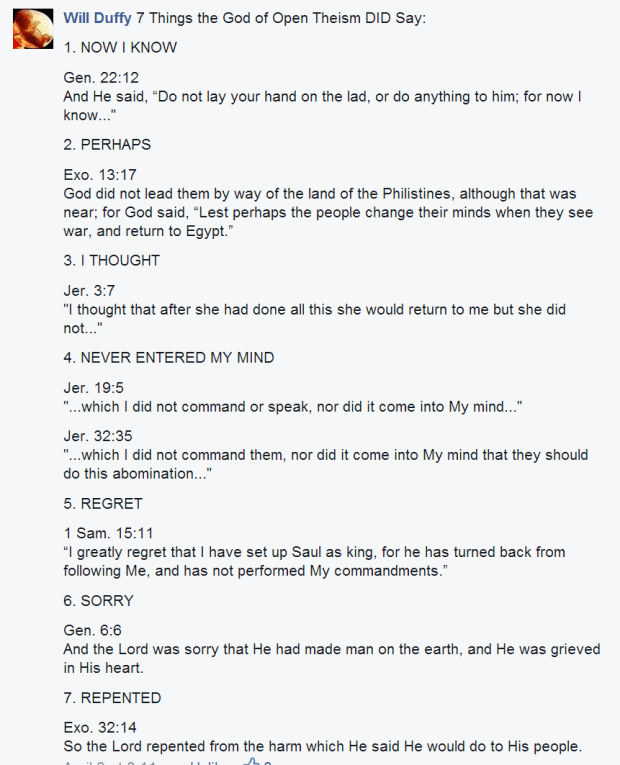
God draws with teaching
From Mark Ballentine on God is Open:
One of Calvinists’ favorite verses:
“No man can come to me, except the Father which hath sent me draw him: and I will raise him up at the last day.” (John 6:44)
So, how does the Father draw someone? The very next verse explains:
“It is written in the prophets, And they shall be all taught of God. Every man therefore that hath heard, and hath learned of the Father, cometh unto me.” (John 6:45)
Notice Abraham’s similar answer, when, the rich man begs him, to send Lazarus to warn his brothers.
(Luke 16:27-28)
“…they have Moses and the prophets; let them hear them.” (Luke 16:29) Mark B

Morrell Debates Sye on God’s Will and Abortion
Reposted from Jesse Morrell of Biblical Truth Resources:
Jesse Morrell: Hey on this topic, I wonder why Calvinists are so upset that Babies are Murdered at abortion clinics? Did not God eternally decree that they would be aborted and none can resist His eternal decrees? In that case, to oppose abortion would be to oppose the sovereign will of God. And to pray for God’s will to be done on earth is to pray for babies to be aborted. (That’s called an internal critique)
Seems like an internal contradiction within the system of Calvinism for Calvinists to be so upset and mourn over abortion…
Sye Ten Bruggencate: It would seem that way, if you did not know what you were talking about.
[snip]
Sye Ten Bruggencate: If you think that things can happen outside of God’s plan then you believe in a different “god.”
Jesse Morrell: If you believe that abortion was God’s eternal will, then one of us certainly does worship a false god!
[snip]
Jesse Morrell: Given these verses, was it God’s irresistible and eternal plan for Israel to sacrifice their babies to false gods?
Jer_19:5 They have built also the high places of Baal, to burn their sons with fire for burnt offerings unto Baal, which I commanded not, nor spake it, neither came it into my mind:
Jer_32:35 And they built the high places of Baal, which are in the valley of the son of Hinnom, to cause their sons and their daughters to pass through the fire unto Molech; which I commanded them not, neither came it into my mind, that they should do this abomination, to cause Judah to sin.
Sye Ten Bruggencate: Nothing happens outside of God’s plan Jesse, nothing.
[snip]
Jesse Morrell: ” Nothing happens outside of God’s plan Jesse, nothing.”
Well wait a minute. When I said that Calvinism teaches that abortion is God’s plan and that Calvinists mourning abortion and opposing abortion is them opposing God’s plan, you said that I did not know what I was talking about.
Now you say abortion is God’s plan. So apparently I did know what I was talking about!
You are either dishonest or confused or both. At the least your worldview is internally inconsistent.
For full post, click here.
VOTD 1 Samuel 13:13-14
1Sa 13:13 And Samuel said to Saul, “You have done foolishly. You have not kept the commandment of the LORD your God, which He commanded you. For now the LORD would have established your kingdom over Israel forever.
1Sa 13:14 But now your kingdom shall not continue. The LORD has sought for Himself a man after His own heart, and the LORD has commanded him to be commander over His people, because you have not kept what the LORD commanded you.”
If you would like to guest post commentary on this verse, please send to admin@godisopen.com .
Fisher Debates Sye on Ephesians 2:8
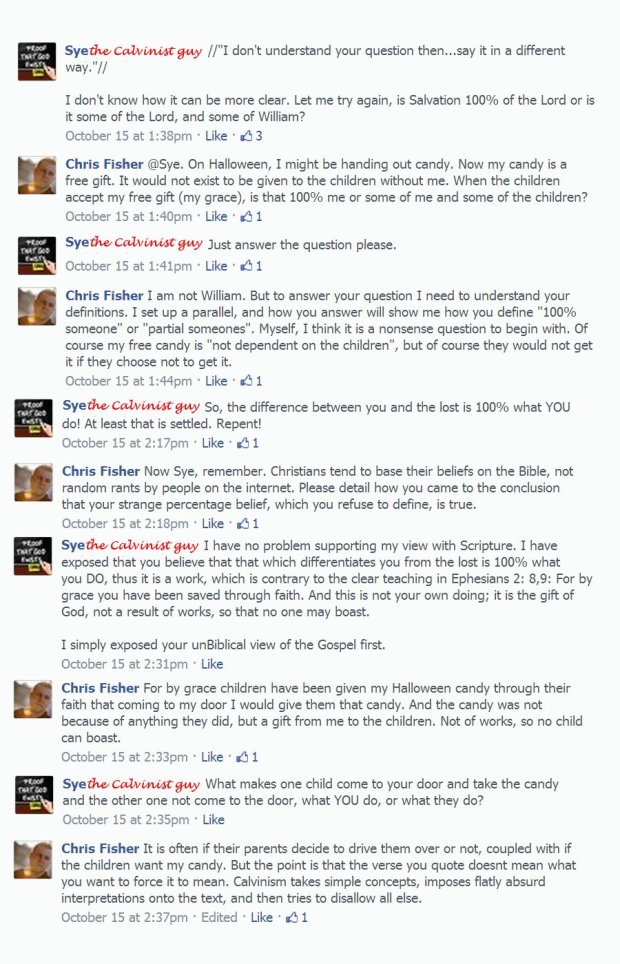
Craig Thinks God’s Future Actions Are Known to God
From Gregory Boyd of renew.org:
To my surprise, Bill argued that my understanding of God’s middle knowledge undermines divine freedom. While God knows the truth value of statements about how free agents would act in every conceivable circumstance, “God doesn’t know the truth of statements about what he would do in any circumstance prior to the divine creative decree.” This, Bill contends, would undermine divine freedom. On these grounds Bill concludes that “Greg’s view is not carefully thought out.”
For full post, click here.
VOTD Jeremiah 26:3
Jer 26:3 If so be they will hearken, and turn every man from his evil way, that I may repent me of the evil, which I purpose to do unto them because of the evil of their doings.
If you would like to guest post commentary on this verse, please send to christopher.c.fisher@gmail.com .
Nash Against Open Theism
Apologetics Thrusday – Mocking God
Matt Slick has an article entitled “Things you might hear the God of open theism say” in which he attempts to mock God (as Open Theists view God). The problem is that Slick is mocking God. This is his mocking list which has been spliced with God actually saying an equivalent phrase or concept:
1. Ooops
God says to himself that He wishes He had not made man:
Gen 6:5 And GOD saw that the wickedness of man was great in the earth, and that every imagination of the thoughts of his heart was only evil continually.
Gen 6:6 And it repented the LORD that he had made man on the earth, and it grieved him at his heart.
Gen 6:7 And the LORD said, I will destroy man whom I have created from the face of the earth; both man, and beast, and the creeping thing, and the fowls of the air; for it repenteth me that I have made them.
2. Doh!
God kills children in an attempt to punish Israel, but the intended effect does not materialize:
Jer 2:30 “In vain I have chastened your children; They received no correction. Your sword has devoured your prophets Like a destroying lion.
3. Uh, oh.
God takes precautions against the eventuality that mankind eats from the Tree of Life:
Gen 3:22 Then the LORD God said, “Behold, the man has become like one of Us, to know good and evil. And now, lest he put out his hand and take also of the tree of life, and eat, and live forever”—
Gen 3:23 therefore the LORD God sent him out of the garden of Eden to till the ground from which he was taken.
4. Oh, no.
In Jeremiah 18, God outlines His basic operating procedures. Sometimes God expects a nation to be righteous. God then promises them blessings and prosperity. But sometimes these nations turn from Him, and as a response, God revokes His promises to them.
Jer 18:9 And at what instant I shall speak concerning a nation, and concerning a kingdom, to build and to plant it;
Jer 18:10 If it do evil in my sight, that it obey not my voice, then I will repent of the good, wherewith I said I would benefit them.
5. Dang it!
God thinks Israel would return to Him, but Israel refuses.
Jer 3:7 And I said, after she had done all these things, ‘Return to Me.’ But she did not return. And her treacherous sister Judah saw it.
6. Shucks!
God’s will is rejected to mankind’s own detriment.
Luk 7:30 But the Pharisees and lawyers rejected the will of God for themselves, not having been baptized by him.
7. Let me get back to you on that.
God endures Israel for a long time and then God promises to exact vengeance in the future.
Num 14:27 “How long shall I bear with this evil congregation who complain against Me? I have heard the complaints which the children of Israel make against Me.
Num 14:28 Say to them, ‘As I live,’ says the LORD, ‘just as you have spoken in My hearing, so I will do to you:
Num 14:29 The carcasses of you who have complained against Me shall fall in this wilderness, all of you who were numbered, according to your entire number, from twenty years old and above.
8. Wow, that was a surprise.
God says it never even entered His mind that people would literally burn their children to death.
Jer 19:5 They have built also the high places of Baal, to burn their sons with fire for burnt offerings unto Baal, which I commanded not, nor spake it, neither came it into my mind:
9. I hope it works out.
In Jeremiah, God wants Jeremiah’s message to work.
Jer 26:3 Perhaps everyone will listen and turn from his evil way, that I may relent concerning the calamity which I purpose to bring on them because of the evil of their doings.’
But the people do not listen and repent.
10. Oh no, now what is he going to do this time?
In Deuteronomy 30, God warns Israel that He is going to destroy them and then gives them two options: life or death. Each is confidently spoken as being possible. The only reasons to convince someone of something is if they are not already set on a particular action.
Deu 30:18 I denounce unto you this day, that ye shall surely perish, and that ye shall not prolong your days upon the land, whither thou passest over Jordan to go to possess it.
Deu 30:19 I call heaven and earth to record this day against you, that I have set before you life and death, blessing and cursing: therefore choose life, that both thou and thy seed may live:
11. No, I haven’t heard the joke about the open theist.
God goes to Sodom to verify reports and states that He will learn the truth.
Gen 18:21 I will go down now and see whether they have done altogether according to the outcry against it that has come to Me; and if not, I will know.”
12. Please, oh please, please, please believe in me.
God laments that He has shown Israel countless miracles and yet they reject Him. This is seriously the theme of much of the Old Testament:
Num 14:11 Then the LORD said to Moses: “How long will these people reject Me? And how long will they not believe Me, with all the signs which I have performed among them?
13. I’ll not do that again.
God states that He will not again destroy man, and God uses the exact same reason that He destroyed them in the first place. God is saying, under the same criteria, my actions will be different.
Gen 8:21 And the LORD smelled a soothing aroma. Then the LORD said in His heart, “I will never again curse the ground for man’s sake, although the imagination of man’s heart is evil from his youth; nor will I again destroy every living thing as I have done.
14. That didn’t turn out to well, did it?
God worked tirelessly to make Israel accept Him, but they rejected Him against what He expected.
Isa 5:4 What more could have been done to My vineyard That I have not done in it? Why then, when I expected it to bring forth good grapes, Did it bring forth wild grapes?
…
Isa 5:7 For the vineyard of the LORD of hosts is the house of Israel, And the men of Judah are His pleasant plant. He looked for justice, but behold, oppression; For righteousness, but behold, a cry for help.
15. I’ll try and get it right next time.
God offers Moses a Plan B to reset His promise to Israel. This is a divine mulligan.
Exo 32:9 And the LORD said to Moses, “I have seen this people, and indeed it is a stiff-necked people!
Exo 32:10 Now therefore, let Me alone, that My wrath may burn hot against them and I may consume them. And I will make of you a great nation.”
16. I’d answer your prayer but I don’t know what is going to happen.
God does answer Moses’ prayer to spare Israel, and interestingly enough God finds Himself in the exact same position wanting to destroy Israel in Numbers 14. God’s answer to Moses’ prayer did not turn out well, in Numbers 14 God answers Moses’ prayer again knowing full well the history of answering this specific prayer.
Exo 32:11 Then Moses pleaded with the LORD his God, and said: “LORD, why does Your wrath burn hot against Your people whom You have brought out of the land of Egypt with great power and with a mighty hand?
Exo 32:12 Why should the Egyptians speak, and say, ‘He brought them out to harm them, to kill them in the mountains, and to consume them from the face of the earth’? Turn from Your fierce wrath, and relent from this harm to Your people.
Exo 32:13 Remember Abraham, Isaac, and Israel, Your servants, to whom You swore by Your own self, and said to them, ‘I will multiply your descendants as the stars of heaven; and all this land that I have spoken of I give to your descendants, and they shall inherit it forever.’ ”
Exo 32:14 So the LORD relented from the harm which He said He would do to His people.
17. Hey, I just learned something.
God says that He tested Abraham (throughout the Bible God tests people) and then learned what Abraham would do in a compromising situation.
Gen 22:12 And He said, “Do not lay your hand on the lad, or do anything to him; for now I know that you fear God, since you have not withheld your son, your only son, from Me.”
18. Well, I can always go to plan B.
God tells Saul that the original plan was for Saul’s Kingdom to last forever. But God changes that plan based on Saul’s actions. God replaces this with a Plan B that David would be King.
1Sa 13:13 And Samuel said to Saul, “You have done foolishly. You have not kept the commandment of the LORD your God, which He commanded you. For now the LORD would have established your kingdom over Israel forever.
1Sa 13:14 But now your kingdom shall not continue. The LORD has sought for Himself a man after His own heart, and the LORD has commanded him to be commander over His people, because you have not kept what the LORD commanded you.”
19. Well, I can always go to plan B,C,D,E, F
In Exodus 3-4, God sets up a series of contingency plans for Moses. God prefaces the entire plan by saying He is positive that Pharaoh will not just let the people go. A strange thing for the classical understanding of omniscience:
Exo 3:19 But I am sure that the king of Egypt will not let you go, no, not even by a mighty hand.
God then gives Moses cascading conditional plan to convince Israel which God also states He will use against Pharaoh:
Exo 4:3 And He said, “Cast it on the ground.” So he cast it on the ground, and it became a serpent; and Moses fled from it.
Exo 4:4 Then the LORD said to Moses, “Reach out your hand and take it by the tail” (and he reached out his hand and caught it, and it became a rod in his hand),
Exo 4:5 “that they may believe that the LORD God of their fathers, the God of Abraham, the God of Isaac, and the God of Jacob, has appeared to you.”
Exo 4:6 Furthermore the LORD said to him, “Now put your hand in your bosom.” And he put his hand in his bosom, and when he took it out, behold, his hand was leprous, like snow.
Exo 4:7 And He said, “Put your hand in your bosom again.” So he put his hand in his bosom again, and drew it out of his bosom, and behold, it was restored like his other flesh.
Exo 4:8 “Then it will be, if they do not believe you, nor heed the message of the first sign, that they may believe the message of the latter sign.
Notice the “if they do not believe”. God then goes ahead and says that they will believe the second sign. God is saying the further miracles might not be necessary, but on the case that they are Moses was to do further signs. But God is not positive, so He adds more contingencies, just in case:
Exo 4:9 And it shall be, if they do not believe even these two signs, or listen to your voice, that you shall take water from the river and pour it on the dry land. The water which you take from the river will become blood on the dry land.”
God adds one more contingency plan: killing Pharaoh’s son:
Exo 4:22 Then you shall say to Pharaoh, ‘Thus says the LORD: “Israel is My son, My firstborn.
Exo 4:23 So I say to you, let My son go that he may serve Me. But if you refuse to let him go, indeed I will kill your son, your firstborn.” ‘ ”
Of course, this did not work either, so God used a cascading series of supplemental plagues to break Pharaoh’s spirit. Here is a breakdown:
So, God tells Moses: Show the rod to a snake, Show your hand turning white, take a jar of water from the river and show it turning to blood, tell Pharaoh that his son will die.
What happened: Moses showed the rod turning into a snake. Moses skips the hand turning white. Moses turned the entire river into blood, as opposed to a jar being poured onto dry land (God was upping the ante), Moses brought frogs, then lice, then flies, kills livestock, brings boils, then hail, then locusts, then darkness, then all of Egypt loses their firstborn (not just Pharaoh).
Even God’s express plans are open for modification on the fly.
19. Well, I can always go to plan B,C,D,E, F (Part 2)
Abraham discusses with God a complex hypothetical, convincing God not to destroy Sodom for an increasingly lower number of people, changing God’s plans on the fly.
Gen 18:24 Suppose there were fifty righteous within the city; would You also destroy the place and not spare it for the fifty righteous that were in it?
Gen 18:25 Far be it from You to do such a thing as this, to slay the righteous with the wicked, so that the righteous should be as the wicked; far be it from You! Shall not the Judge of all the earth do right?”
Gen 18:26 So the LORD said, “If I find in Sodom fifty righteous within the city, then I will spare all the place for their sakes.”
Gen 18:27 Then Abraham answered and said, “Indeed now, I who am but dust and ashes have taken it upon myself to speak to the Lord:
Gen 18:28 Suppose there were five less than the fifty righteous; would You destroy all of the city for lack of five?” So He said, “If I find there forty-five, I will not destroy it.”
Gen 18:29 And he spoke to Him yet again and said, “Suppose there should be forty found there?” So He said, “I will not do it for the sake of forty.”
Gen 18:30 Then he said, “Let not the Lord be angry, and I will speak: Suppose thirty should be found there?” So He said, “I will not do it if I find thirty there.”
Gen 18:31 And he said, “Indeed now, I have taken it upon myself to speak to the Lord: Suppose twenty should be found there?” So He said, “I will not destroy it for the sake of twenty.”
Gen 18:32 Then he said, “Let not the Lord be angry, and I will speak but once more: Suppose ten should be found there?” And He said, “I will not destroy it for the sake of ten.”
Matt Slick thinks he is being funny or cute, but he is mocking God.
Gal 6:7 Do not be deceived, God is not mocked; for whatever a man sows, that he will also reap.
May the Lord repay him according to his works.
VOTD 1 Timothy 2:3
1Ti 2:3 For this is good and acceptable in the sight of God our Savior,
1Ti 2:4 who desires all men to be saved and to come to the knowledge of the truth.
If you would like to guest post commentary on this verse, please send to christopher.c.fisher@gmail.com .
Brother Jed – The Movie
A documentary about Open Theist Open Air preacher Jed Smock:
Boyd on Process Versus Open
Boyd explains the difference between Open Theism and Process Theology:
In PT, God exists eternally in relation to a non-divine world. So PT denies “creation ex nihilo”
In PT, God is bound to metaphysical principles that govern both God and the world. So God isn’t able to really interact with the world as a personal being. God must always, of necessity, respond in ways that the metaphysics of the system stipulate. This means…
In PT God can’t intervene in unique ways, like personally answering prayer
In PT God can’t intervene and perform miracles In PT God can’t become uniquely embodied, as he is in Christ.
For full post, click here.
VOTD Deuteronomy 8:2
Deu 8:2 And you shall remember that the LORD your God led you all the way these forty years in the wilderness, to humble you and test you, to know what was in your heart, whether you would keep His commandments or not.
If you would like to guest post commentary on this verse, please send to christopher.c.fisher@gmail.com .
On Open Theist Unity
From an anonymous private conversation:
What I’ve learned is that we need to exercise a bit of Christian ecumenism within the Church itself. By that I mean that we need to be firm on essential doctrines (which, to be honest, I haven’t completely determined) and open on non-essentials. Not foolish. Just willing to listen and work through however long it may take.
That’s why I have adopted this maxim as one of my personal mottos:
In essentials, unity;
In non-essentials, liberty;
But in all things, charity.Believers need to see that by being narrow-minded we lose out on truths we may never have learned otherwise. NOTHING is beyond questioning. That doesn’t mean that essentials can be simply discarded, but that we need to be open to the idea that perhaps there may be nuances we haven’t considered in the essentials or complete upsets of our theology through the non-essentials.
Launch of BiblicalOpenTheism.com
A new Open Theist site has launched. BiblicalOpenTheism.com
W Scott Taylor of IdeoAmneosTosTheos.com is merging two outlets to reach a broader audience.
Taylor also runs Facebook groups: ”Trinitarian Open Theism” and “What Is Open Theism”.
Sanders on the Morphing of Classical Theism
From John Sander’s paper Be Wary of Ware:
Today, there are exceedingly few evangelicals who are actual classical theists, even though they continue to use the title of themselves. Though Ware classifies himself as a classical theist, he rejects the traditional notion of immutability. Wayne Grudem rejects impassibility as being clearly unbiblical. Millard Erickson says that “the traditional doctrine of impassibility is not the current one” among contemporary evangelicals. These thinkers have modified classical theism in ways that Aquinas and Calvin would find logically inconsistent. The great classical theists understood that it was a package deal, you cannot change one of the attributes without affecting the others. When you begin to pull on the thread of a knit sweater, it will eventually unravel on you. So, beware of Ware, for his minor revisions to classical theism will, mutatis mutandis, lead to many more alterations.
VOTD 2 Kings 19:17
2Ki 19:17 Truly, LORD, the kings of Assyria have laid waste the nations and their lands,
2Ki 19:18 and have cast their gods into the fire; for they were not gods, but the work of men’s hands—wood and stone. Therefore they destroyed them.
If you would like to guest post commentary on this verse, please send to christopher.c.fisher@gmail.com .
Sanders on the Unseen Conditional Prophecy
From John Sander’s paper Be Wary of Ware:
God’s announcement to Hezekiah and Nineveh were stated in an unconditional/inviolable way. How do we know that they actually were not inviolable? Because what God said would happen did not happen. That is, it is only because they did not occur that we know that these seemingly “inviolable” predictions were, in fact, conditional upon what the human agents did. But what about seemingly “inviolable” predictions that did come to pass? Were some, even most of them, actually conditional upon the response of the human agents? The tendency is to think not, because they came to pass. However, I believe that there are actually very few such “inviolable” predictions.
Free Monday – Calvin on Genesis
VOTD Luke 22:31-32
Luk 22:31 And the Lord said, “Simon, Simon! Indeed, Satan has asked for you, that he may sift you as wheat.
Luk 22:32 But I have prayed for you, that your faith should not fail; and when you have returned to Me, strengthen your brethren.”
If you would like to guest post commentary on this verse, please send to christopher.c.fisher@gmail.com .
Calvinist Says Old Testament Should Not Be Taken Seriously
From a critique of Open Theism:
Pilch and Malina in the Handbook of Biblical Social Values [50ff, 56ff] note the emphasis in the Biblical world on dramatic orientation as a point of honor. To be expressive in word and deed was to “gain, maintain, and enhance personal and group honor.” Expressions of eloquence, which involve exaggeration and over-assertion, may at times “not [be] intended to be taken seriously but are made solely for effect and are heartily appreciated and applauded by an audience that enjoys such eloquence when it hears it.”
Free and unrestrained expression of emotion was normal and acceptable, but may not always be taken seriously; note that this is NOT (as one critic of this article suggested) a matter of “honesty” for contextually in this setting, there is no “lie” being perpetrated (i.e., everyone KNOWS the expression is not “real”). Consider in this light the Jewish practice of paid mourners who were paid to wail, but obviously had no personal grief to speak of.
For full post, click here.
More Debates Calvinism
Worship Sunday – All to You
All to You by 24 Idaho
Lyrics:
Jesus Christ
Lord of my life
Why do we stumble?
Why do we fall away?
Let me be empty
Or open wide
And these tears i’ve shed
And of the pain i’ve bled
I give it all to you
VOTD Romans 1:20
Rom 1:20 For since the creation of the world His invisible attributes are clearly seen, being understood by the things that are made, even His eternal power and Godhead, so that they are without excuse,
If you would like to guest post commentary on this verse, please send to christopher.c.fisher@gmail.com .
Duffy on Moses’ Speaking Replacement
A Facebook post by Will Duffy, founder of the Collaborators Project on Facebook group God is Open:
The burning bush story is a great picture of who God is and how He relates to man. He spends a great deal of time telling Moses what he will do and what he will say. But Moses is fearful and essentially rejects God’s plan. So God gets angry and says, “Fine! Have your brother Aaron do it.”
What God said Moses would do, Aaron ended up doing. What God said Moses would say, Aaron ended up saying. Prophecy is not pre-written history.
Ex. 4
12 Now therefore, go, and I will be with your mouth and teach you what you shall say.”
13 But he said, “O my Lord, please send by the hand of whomever else You may send.”
14 So the anger of the Lord was kindled against Moses, and He said: “Is not Aaron the Levite your brother? I know that he can speak well.
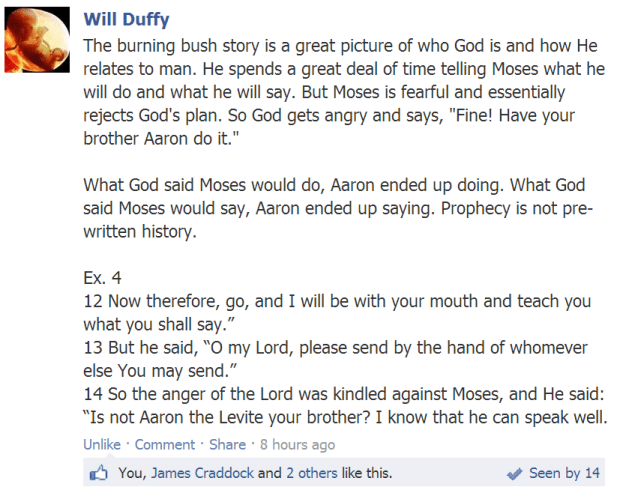
Fisher Describes Augustine’s Conversion
From Craig Fisher of Will the Real God Step Forward:
If one is to take Augustine’s words seriously, one must recognize this conversion was not in terms of a Protestant born again experience, but this conversion was a purification resembling the Neoplatonic purification: “The effect of your converting me to yourself was that I did not now seek a wife and had no ambition for success in this world.” To “not seek a wife” is a commitment to celibacy not an admission of guilt, repentance toward God, and belief in the death and resurrection of Jesus Christ.
Augustine’s autobiography, Confessions, may be described as a manual on Platonic purification. The first seven chapters represents the struggle against sexual desire, the nemesis of Platonic purification. Chapter eight is the accomplishment of his goal. The final chapters are his self-congratulation on his success.
The goal of purification is to become like God in order to see God. The practitioner expects to see God in his mind at the end of the ascent. The ascent is a meditative process, removing oneself from the distractions of physical life and seeing God with you mind. The name ascent refers to the Platonic metaphysical system of the pagan philosophers. God is at the top of the “ladder”, all creation is an ordered descent from the top. In order to reach God, it is necessary to ascend the ladder. Ascent is only possible through a process of purification.
For full post, click here.
VOTD Romans 1:16
Rom 1:16 For I am not ashamed of the gospel of Christ, for it is the power of God to salvation for everyone who believes, for the Jew first and also for the Greek.
If you would like to guest post commentary on this verse, please send to christopher.c.fisher@gmail.com .
Belt on Open Theism Core Beliefs
Tom Belt of An Open Orthodoxy, tries his hand and defining core beliefs of Open Theism:
Recent debates have clarified just what’s at the heart of open theism, so I’ll toss this out again just to have in front of us:
– Monotheism
– Divine benevolence
– Creation ex nihilo
– Creaturely freedom
– Causal openness
– Divine epistemic openness
For full post, click here.
Craig Debates Helm on Calvinism vs Molinism
Calvinism vs. Molinism – William Lane Craig (Molinist) vs. Paul Helm (Calvinist)
VOTD Isaiah 45:4
Isa 45:4 For Jacob My servant’s sake, And Israel My elect, I have even called you by your name; I have named you, though you have not known Me.
If you would like to guest post commentary on this verse, please send to christopher.c.fisher@gmail.com .
Sanders on the Ungracious Debate
From John Sander’s paper Be Wary of Ware:
The accuser in these cases simply does not understand from the inside the position he is criticizing. This is the case with Ware on many of his points. Even though he explicitly claims to know how we might respond to his criticisms, in his writings to date he has shown a singularly unimaginative and unsympathetic attitude as to how we might answer. He never gives us the benefit of the doubt as to what we might mean and typically reads our statements in the worst possible light.
Apologetics Thursday – God Counts Hairs
In a 2007 debate, Gene Cook condescendingly asks Bob Enyart about how God gains His knowledge.
Cook: Ok, the Bible says that God knows the very number of hairs on a man’s head. How does God know this?
Enyart: Because He can count… so that’s present knowledge…
Cook: In order for God to have a running knowledge of how many hairs are on Gene Cook’s head does He have to recount them everyday.
Enyart: Well He counted it at some point, right?…
Cook: But it changes every day.
Enyart: God is a mathematician, and if He cares God can watch every atom throughout the entire universe simultaneously. He is capable. So it is not like it would tax God’s CPU to look down and see “is a sparrow is going to die” or “how many hairs are on your head.”
To Gene Cook, if God knows the number of hairs on someone’s head, that number must be foreknown from all eternity. But the Bible describes how God gains this knowledge much like Enyart describes and not at all as Cook assumes:
Mat 10:30 But the very hairs of your head are all numbered.
The translators of the KJV and NKJV use an archaic word “numbered” instead of the more colloquial term “counted”. Matthew 10:30 is saying that each man’s head is counted for hair. The same word is using in Revelation for counting:
Rev 7:9 After this I beheld, and, lo, a great multitude, which no man could number, of all nations, and kindreds, and people, and tongues, stood before the throne, and before the Lamb, clothed with white robes, and palms in their hands;
The Greek is arithmeo from where the English word “arithmetic” is derived. In Revelation, no one can count the multitude. In Matthew 10, God counts our hair. Counting is the method of gaining the information.
When Calvinists want to claim God predestines the future, one of the first places to which they turn is Isaiah 40-48. These verses were written to convince Israel that God is powerful and capable. Embeded in these verses is another “counting” verse:
Isa 40:12 Who hath measured the waters in the hollow of his hand, and meted out heaven with the span, and comprehended the dust of the earth in a measure, and weighed the mountains in scales, and the hills in a balance?
This verse is often ignored by Classical theists. But the message is clear. God knows the volume of water by counting. God knows the length of the sky by measuring. God knows the volume of dust by calculating. God knows the weight of the mountains by weighing.
These verses point to the operative nature of how God knows information. Isaiah was communicating to the Jews, explaining how mighty God is. Isaiah does not turn to pagan concepts such as “fatalistic foreknowledge” or “inherent knowledge”. Those methodologies are foreign to Israel’s concept of God. Instead Isaiah appeals to God’s ability to perform and accomplish things that no man possibly could. That is the thrust of Isaiah. God knows things and can make His will a reality through His power. When Classical theists assume otherwise, they are discarding the normal Biblical language about God.
VOTD Hosea 11:8-9
Hos 11:8 “How can I give you up, Ephraim? How can I hand you over, Israel? How can I make you like Admah? How can I set you like Zeboiim? My heart churns within Me; My sympathy is stirred.
Hos 11:9 I will not execute the fierceness of My anger; I will not again destroy Ephraim. For I am God, and not man, The Holy One in your midst; And I will not come with terror.
If you would like to guest post commentary on this verse, please send to christopher.c.fisher@gmail.com .
Olson of the Meaning of Good
From Roger E Olson:
Put another way, negatively, if one believes that God’s goodness is nothing like our best intuitions of goodness, that God’s goodness is possibly compatible with anything capable of being put into words (i.e., ultimately and finally mysterious), then there is no good reason to trust him. Trust in a person, even God, necessarily requires belief that the person is good and belief that the person is good necessarily requires some content and not “good” as a cipher for something totally beyond comprehension and unlike anything else we call “good.”
For full quote, click here.
Duffy on Joseph’s Dream
A Facebook post by Will Duffy, founder of the Collaborators Project on Facebook group God is Open:
I’ve always been shocked at the lack of information on the internet about this issue of Joseph’s dream. I think the answer is simple, yet goes against traditional theology, so people don’t want to talk about it.
The verse is definitely talking about Leah. Jacob interprets his son’s dream as that he, Leah and their 11 sons will bow down to Joseph. (This is quite insulting!) These dreams are prophesies from God to Joseph, which is where this gets really interesting.
As we read on in Genesis, we see that the brothers ended up bowing down to Joseph in Egypt as his first dream of sheaves stated. Jacob was on his deathbed when he found out that Joseph was still alive. He actually had to be carried to Egypt and was incredibly grateful that he got to see Joseph before dying.
But the interesting thing is that Leah did not make it to Egypt. We don’t know exactly when she died, but she was buried with Abraham, Sarah, Isaac and Rebekah in the field of Machpelah by Jacob himself.
So essentially, we have here a great example showing that prophesy is not pre-written history. God’s message to Joseph was not about specifics and numbers, but a general principle that He had a bigger plan in mind. Had even Jacob died before making it to Egypt (which was almost the case), God does not break because His prophecy did not come to pass exactly as stated. God is not concerned with details as much as Calvinists and Arminians are. He wants us to see the forest and not get caught up in the trees. This dream of Joseph’s is a perfect example.
 God is Open
